Mail ID: contact@vedavarsity.com

Contact: +91 9634998911

Google search engineGoogle search engine
Home Blog Page 72

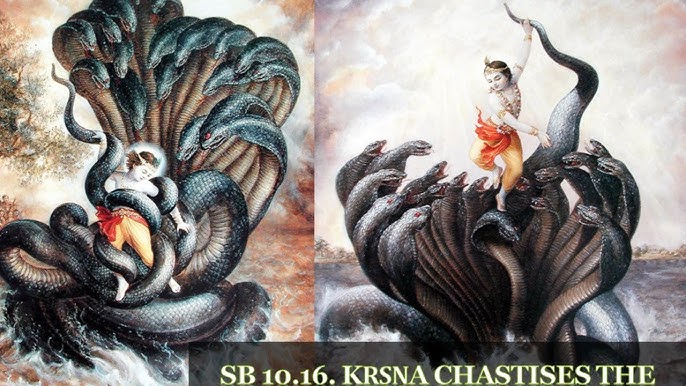
Srimad Bhagavatam | Canto 10 Chapter 16 | Krishna Chastises The Serpent Kāliya

0

Śukadeva Gosvāmī said: Lord Śrī Kṛṣṇa, the Supreme Personality of Godhead, seeing that the Yamunā River had been contaminated by the black snake Kāliya, desired to purify the river, and thus the Lord banished him from it. (1)

King Parīkṣit inquired: O learned sage, please explain how the Supreme Personality of Godhead chastised the serpent Kāliya within the unfathomable waters of the Yamunā, and how it was that Kāliya had been living there for so many ages. (2) O brāhmaṇa, the unlimited Supreme Personality of Godhead freely acts ac[1]cording to His own desires. Who could be sati[1]ated when hearing the nectar of the magnani[1]mous pastimes He performed as a cowherd boy in Vṛndāvana? (3)

ŚrīŚukadeva Gosvāmī said: Within the river Kālindī [Yamunā] was a lake inhabited by the serpent Kāliya, whose fiery poison con[1]stantly heated and boiled its waters. Indeed, the vapors thus created were so poisonous that birds flying over the contaminated lake would fall down into it. (4) The wind blowing over that deadly lake carried droplets of water to the shore. Simply by coming in contact with that poisonous breeze, all vegetation and creatures on the shore died. (5) Lord Kṛṣṇa saw how the Kāliya serpent had polluted the Yamunā River with his terribly powerful poison. Since Kṛṣṇa had descended from the spiritual world specif[1]ically to subdue envious demons, the Lord im[1]mediately climbed to the top of a very high ka[1]damba tree and prepared Himself for battle. He tightened His belt, slapped His arms and then jumped into the poisonous water. (6) When the Supreme Personality of Godhead landed in the serpent’s lake, the snakes there became ex[1]tremely agitated and began breathing heavily, further polluting it with volumes of poison. The force of the Lord’s entrance into the lake caused it to overflow on all sides, and poison[1]ous, fearsome waves flooded the surrounding lands up to a distance of one hundred bow[1]lengths. This is not at all amazing, however, for the Supreme Lord possesses infinite strength. (7)

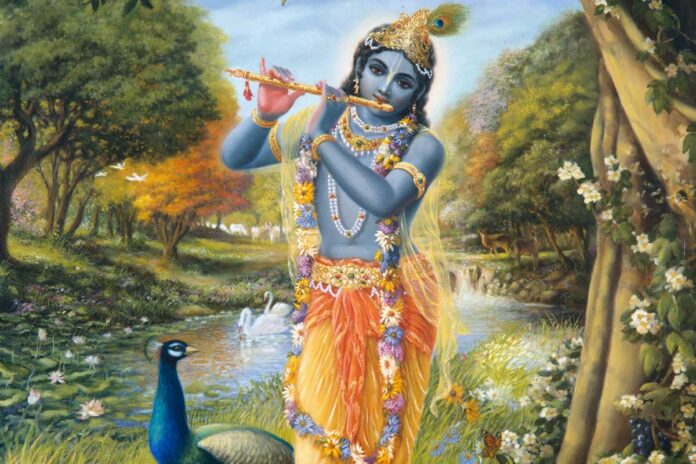
Kṛṣṇa began sporting in Kāliya’s lake like a lordly elephantswirling His mighty arms and making the water resound in various ways. When Kāliya heard these sounds, he under[1]stood that someone was trespassing in his lake. The serpent could not tolerate this and immedi[1]ately came forward. (8) Kāliya saw that Śrī Kṛṣṇa, who wore yellow silken garments, was very delicate, His attractive body shining like a glowing white cloud, His chest bearing the mark of Śrīvatsa, His face smiling beautifully and His feet resembling the whorl of a lotus flower. The Lord was playing fearlessly in the water. Despite His wonderful appearance, the envious Kāliya furiously bit Him on the chest and then completely enwrapped Him in his coils. (9) When the members of the cowherd community, who had accepted Kṛṣṇa as their dearmost friend, saw Him enveloped in the snake’s coils, motionless, they were greatly disturbed. They had offered Kṛṣṇa every[1]thingtheir very selves, their families, their wealth, wives and all pleasures. At the sight of the Lord in the clutches of the Kāliya snake, their intelligence became deranged by grief, lamentation and fear, and thus they fell to the ground. (10) The cows, bulls and female calves, in great distress, called out piteously to Kṛṣṇa. Fixing their eyes on Him, they stood still in fear, as if ready to cry but too shocked to shed tears. (11)

In the Vṛndāvana area there then arose all three types of fearful omensthose on the earth, those in the sky and those in the bodies of living creatureswhich announced imminent danger. (12) Seeing the inauspicious omens, Nanda Mahārāja and the other cowherd men were fearful, for they knew that Kṛṣṇa had gone to herd the cows that day without His elder brother, Balarāma. Because they had dedicated their minds to Kṛṣṇa, accepting Him as their very life, they were unaware of His great power and opulence. Thus they concluded that the in[1]auspicious omens indicated He had met with death, and they were overwhelmed with grief, lamentation and fear. All the inhabitants of Vṛndāvana, including the children, women and elderly persons, thought of Kṛṣṇa just as a cow thinks of her helpless young calf, and thus these poor, suffering people rushed out of the village, intent upon finding Him. (13-15) The Supreme Lord Balarāma, the master of all transcendental knowledge, smiled and said nothing when He saw the residents of Vṛndāvana in such distress, since He understood the extraordinary power of His younger brother. (16) The residents hurried toward the banks of the Yamunā in search of their dearmost Kṛṣṇa, following the path marked by His footprints, which bore the unique signs of the Personality of Godhead. (17)

The footprints of Lord Kṛṣṇa, the master of the entire cowherd community, were marked with the lotus flower, barleycorn, elephant goad, thunderbolt and flag. My dear King Parīkṣit, seeing His footprints on the path among the cows’ hoofprints, the residents of Vṛndāvana rushed along in great haste. (18) As they hurried along the path to the bank of the Yamunā River, they saw from a distance that Kṛṣṇa was in the lake, motionless within the coils of the black serpent. They further saw that the cowherd boys had fallen unconscious and that the animals were standing on all sides, cry[1]ing out for Kṛṣṇa. Seeing all this, the residents of Vṛndāvana were overwhelmed with anguish and confusion. (19) When the young gopīs, whose minds were constantly attached to Kṛṣṇa, the unlimited Supreme Lord, saw that He was now within the grips of the serpent, they remembered His loving friendship, His smiling glances and His talks with them. Burn[1]ing with great sorrow, they saw the entire uni[1]verse as void. (20) Although the elder gopīs were feeling just as much distress as she and were pouring forth a flood of sorrowful tears, they had to forcibly hold back Kṛṣṇa’s mother, whose consciousness was totally absorbed in her son. Standing like corpses, with their eyes fixed upon His face, these gopīs each took turns recounting the pastimes of the darling of Vraja. (21) Lord Balarāma then saw that Nanda Mahārāja and the other cowherd men, who had dedicated their very lives to Kṛṣṇa, were begin[1]ning to enter the serpent’s lake. As the Supreme Personality of Godhead, Lord Balarāma fully knew Lord Kṛṣṇa’s actual power, and therefore He restrained them. (22)

The Lord remained for some time within the coils of the serpent, imitating the behavior of an ordinary mortal. But when He understood that the women, children and other residents of His village of Gokula were in acute distress be[1]cause of their love for Him, their only shelter and goal in life, He immediately rose up from the bonds of the Kāliya serpent. (23) His coils tormented by the expanding body of the Lord, Kāliya released Him. In great anger the serpent then raised his hoods high and stood still, breathing heavily. His nostrils appeared like vessels for cooking poison, and the staring eyes in his face like firebrands. Thus the serpent looked at the Lord. (24) Again and again Kāliya licked his lips with his bifurcated tongues as He stared at Kṛṣṇa with a glance full of terrible, poisonous fire. But Kṛṣṇa playfully circled around him, just as Garuḍa would play with a snake. In response, Kāliya also moved about, looking for an opportunity to bite the Lord. (25) Having severely depleted the serpent’s strength with His relentless circling, Śrī Kṛṣṇa, the origin of everything, pushed down Kāliya’s raised shoulders and mounted his broad serpen[1]tine heads. Thus Lord Śrī Kṛṣṇa, the original master of all fine arts, began to dance, His lotus feet deeply reddened by the touch of the numer[1]ous jewels upon the serpent’s heads. (26) See[1]ing the Lord dancing, His servants in the heav[1]enly planetsthe Gandharvas, Siddhas, sages, Cāraṇas and wives of the demigodsimmedi[1]ately arrived there. With great pleasure they be[1]gan accompanying the Lord’s dancing by play[1]ing drums such as mṛdaṅgas, paṇavas and ānakas. They also made offerings of songs, flowers and prayers. (27) My dear King, Kāliya had 101 prominent heads, and when one of them would not bow down, Lord Śrī Kṛṣṇa, who inflicts punishment on cruel wrong-doers, would smash that stubborn head by striking it with His feet. Then, as Kāliya entered his death throes, he began wheeling his heads around and vomiting ghastly blood from his mouths and nostrils. The serpent thus experienced extreme pain and misery. (28) Exuding poisonous waste from his eyes, Kāliya, would occasionally dare to raise up one of his heads, which would breathe heavily with anger. Then the Lord would dance on it and subdue it, forcing it to bow down with His foot. The demigods took each of these exhibitions as an opportunity to worship Him, the primeval Personality of God[1]head, with showers of flowers. (29) My dear King Parīkṣit, Lord Kṛṣṇa’s wonderful, power[1]ful dancing trampled and broke all of Kāliya’s one thousand hoods. Then the serpent, pro[1]fusely vomiting blood from his mouths, finally recognized Śrī Kṛṣṇa to be the eternal Person[1]ality of Godhead, the supreme master of all moving and nonmoving beings, Śrī Nārāyaṇa. Thus within his mind Kāliya took shelter of the Lord. (30) When Kāliya’s wives saw how the serpent had become so fatigued from the exces[1]sive weight of Lord Kṛṣṇa, who carries the en[1]tire universe in His abdomen, and how Kāliya’s umbrellalike hoods had been shattered by the striking of Kṛṣṇa’s heels, they felt great dis[1]tress. With their clothing, ornaments and hair scattered in disarray, they then approached the eternal Personality of Godhead. (31) Their minds very much disturbed, those saintly ladies placed their children before them and then bowed down to the Lord of all creatures, laying their bodies flat upon the ground. They desired the liberation of their sinful husband and the shelter of the Supreme Lord, the giver of ulti[1]mate shelter, and thus they folded their hands in supplication and approached Him. (32)

The wives of the Kāliya serpent said: The punishment this offender has been subjected to is certainly just. After all, You have incarnated within this world to curb down envious and cruel persons. You are so impartial that You look equally upon Your enemies and Your own sons, for when You impose a punishment on a living being You know it to be for his ultimate benefit. (33) What You have done here is actu[1]ally mercy for us, since the punishment You give to the wicked certainly drives away all their contamination. Indeed, because this con[1]ditioned soul, our husband, is so sinful that he has assumed the body of a serpent, Your anger toward him is obviously to be understood as Your mercy. (34) Did our husband carefully perform austerities in a previous life, with his mind free of pride and full of respect for others? Is that why You are pleased with him? Or did he in some previous existence carefully execute religious duties with compassion for all living beings, and is that why You, the life of all living beings, are now satisfied with him? (35) O Lord, we do not know how the serpent Kāliya has attained this great opportunity of being touched by the dust of Your lotus feet. For this end, the goddess of fortune performed austeri[1]ties for centuries, giving up all other desires and observing austere vows. (36) Those who have attained the dust of Your lotus feet never hanker for the kingship of heaven, limitless sovereignty, the position of Brahmā or rul[1]ership over the earth. They are not interested even in the perfections of yoga or in liberation itself. (37) O Lord, although this Kāliya, the king of the serpents, has taken birth in the mode of ignorance and is controlled by anger, he has achieved that which is difficult for others to achieve. Embodied souls, who are full of de[1]sires and are thus wandering in the cycle of birth and death, can have all benedictions man[1]ifested before their eyes simply by receiving the dust of Your lotus feet. (38)

We offer our obeisances unto You, the Su[1]preme Personality of Godhead. Although pre[1]sent in the hearts of all living beings as the Su[1]persoul, You are all-pervasive. Although the original shelter of all created material elements, You exist prior to their creation. And although the cause of everything, You are transcendental to all material cause and effect, being the Su[1]preme Soul. (39) Obeisances unto You, the Ab[1]solute Truth, who are the reservoir of all tran[1]scendental consciousness and potency and the possessor of unlimited energies. Although completely free of material qualities and trans[1]formations, You are the prime mover of mate[1]rial nature. (40) Obeisances unto You, who are time itself, the shelter of time and the witness of time in all its phases. You are the universe, and also its separate observer. You are its crea[1]tor, and also the totality of all its causes. (41) Obeisances unto You, who are the ultimate soul of the physical elements, of the subtle basis of perception, of the senses, of the vital air of life, and of the mind, intelligence and conscious[1]ness. By Your arrangement the infinitesimal spirit souls falsely identify with the three modes of material nature, and their perception of their own true self thus becomes clouded. We offer our obeisances unto You, the unlim[1]ited Supreme Lord, the supremely subtle one, the omniscient Personality of Godhead, who are always fixed in unchanging transcendence, who sanction the opposing views of different philosophies, and who are the power upholding expressed ideas and the words that express them. (42-43) We offer our obeisances again and again to You, who are the basis of all au[1]thoritative evidence, who are the author and ul[1]timate source of the revealed scriptures, and who have manifested Yourself in those Vedic literatures encouraging sense gratification as well as in those encouraging renunciation of the material world. (44) We offer our obeisances to Lord Kṛṣṇa and Lord Rāma, the sons of Vasudeva, and to Lord Pradyumna and Lord Aniruddha. We offer our respectful obeisances unto the master of all the saintly devotees of Viṣṇu. (45) Obeisances to You, O Lord, who manifest varieties of material and spiritual qualities. You disguise Yourself with the mate[1]rial qualities, and yet the functioning of those same material qualities ultimately reveals Your existence. You stand apart from the material qualities as a witness and can be fully known only by Your devotees. (46) O Lord Hṛṣīkeśa, master of the senses, please let us offer our obeisances unto You, whose pastimes are in[1]conceivably glorious. Your existence can be in[1]ferred from the necessity for a creator and re[1]vealer of all cosmic manifestations. But alt[1]hough Your devotees can understand You in this way, to the nondevotees You remain silent, absorbed in self-satisfaction. (47) Obeisances unto You, who know the destination of all things, superior and inferior, and who are the presiding regulator of all that be. You are dis[1]tinct from the universal creation, and yet You are the basis upon which the illusion of material creation evolves, and also the witness of this il[1]lusion. Indeed, You are the root cause of the en[1]tire world. (48)

O almighty Lord, although You have no rea[1]son to become involved in material activity, still You act through Your eternal potency of time to arrange for the creation, maintenance and destruction of this universe. You do this by awakening the distinct functions of each of the modes of nature, which before the creation lie dormant. Simply by Your glance You perfectly execute all these activities of cosmic control in a sporting mood. (49) Therefore, all material bodies throughout the three worldsthose that are peaceful, in the mode of goodness; those that are agitated, in the mode of passion; and those that are foolish, in the mode of igno[1]ranceall are Your creations. Still, those living entities whose bodies are in the mode of good[1]ness are especially dear to You, and it is to maintain them and protect their religious prin[1]ciples that You are now present on the earth. (50) At least once, a master should tolerate an offense committed by his child or subject. O su[1]preme peaceful Soul, You should therefore for[1]give our foolish husband, who did not under[1]stand who You are. (51) O Supreme Lord, please be merciful. It is proper for the saintly to feel compassion for women like us. This ser[1]pent is about to give up his life. Please give us back our husband, who is our life and soul. (52) Now please tell us, Your maidservants, what we should do. Certainly anyone who faithfully executes Your order is automatically freed from all fear. (53)

Śukadeva Gosvāmī said: Thus praised by the Nāgapatnīs, the Supreme Personality of Godhead released the serpent Kāliya, who had fallen unconscious, his heads battered by the striking of the Lord’s lotus feet. (54) Kāliya slowly regained his vital force and sensory functions. Then, breathing loudly and pain[1]fully, the poor serpent addressed Lord Kṛṣṇa, the Supreme Personality of Godhead, in hum[1]ble submission. (55)

The serpent Kāliya said: Our very birth as a snake has made us envious, ignorant and constantly angry. O my Lord, it is so difficult for people to give up their conditioned nature, by which they identify with that which is unreal. (56) O supreme creator, it is You who generate this universe, composed of the variegated ar[1]rangement of the material modes, and in the process You manifest various kinds of person[1]alities and species, varieties of sensory and physical strength, and varieties of mothers and fathers with variegated mentalities and forms. (57) O Supreme Personality of Godhead, among all the species within Your material cre[1]ation, we serpents are by nature always en[1]raged. Being thus deluded by Your illusory en[1]ergy, which is very difficult to give up, how can we possibly give it up on our own? (58) O Lord, since You are the omniscient Lord of the uni[1]verse, You are the actual cause of freedom from illusion. Please arrange for us whatever You consider proper, whether it be mercy or punish[1]ment. (59)

Śukadeva Gosvāmī said: After hearing Kāliya’s words, the Supreme Personality of Godhead, who was acting the role of a human being, replied: O serpent, you may not remain here any longer. Go back to the ocean immedi[1]ately, accompanied by your retinue of children, wives, other relatives and friends. Let this river be enjoyed by the cows and humans. (60) If a mortal being attentively remembers My com[1]mand to youto leave Vṛndāvana and go to the oceanand narrates this account at sunrise and sunset, he will never be afraid of you. (61) If one bathes in this place of My pastimes and of[1]fers the water of this lake to the demigods and other worshipable personalities, or if one ob[1]serves a fast and duly worships and remembers Me, he is sure to become free from all sinful reactions. (62) Out of fear of Garuḍa, you left Ramaṇaka Island and came to take shelter of this lake. But because you are now marked with My footprints, Garuḍa will no longer try to eat you. (63)

Śukadeva Gosvāmī continued: My dear King, having been released by Lord Kṛṣṇa, the Supreme Personality of Godhead, whose activ[1]ities are wonderful, Kāliya joined his wives in worshiping Him with great joy and reverence. (64)

Kāliya worshiped the Lord of the universe by offering Him fine garments, along with necklaces, jewels and other valuable orna[1]ments, wonderful scents and ointments, and a large garland of lotus flowers. Having thus pleased the Lord, whose flag is marked with the emblem of Garuḍa, Kāliya felt satisfied. Re[1]ceiving the Lord’s permission to leave, Kāliya circumambulated Him and offered Him obei[1]sances. Then, taking his wives, friends and chil[1]dren, he went to his island in the sea. The very moment Kāliya left, the Yamunā was immedi[1]ately restored to her original condition, free from poison and full of nectarean water. This happened by the mercy of the Supreme Person[1]ality of Godhead, who was manifesting a hu[1]manlike form to enjoy His pastimes. (65-67)
library.vedavarsity.com || www.vedavarsity.com

NBS#275 | Renunciation

0

Respected Devotees,

Please accept our humble obeisances.
All glories to Śrīla Prabhupāda!
All glories to Śrī Guru and Śrī Gaurāṅga!

We are pleased to share NBS #275, and we also warmly invite you to remain connected with us through our daily devotional offerings.

Vedavarsity is the first of its kind online Vedic University offering education with no fees, following a contribution-based model in the true spirit of Vedic learning.

We humbly invite all sincere seekers to benefit from this opportunity—and request well-wishers to support this service through donations.

Visit: www.vedavarsity.com
Contribute: https://library.vedavarsity.com/donate/

To receive daily articles, quotes, and inspiring videos from Vaishnavas, along with courses on Bhakti, relationships, and Vedic lifestyle, please join our WhatsApp channel:

In Service of Śrīmad Bhāgavatam™
https://whatsapp.com/channel/0029Var5TSW6RGJMUXDTYb1b


NBS #275 – Key Theme

Renunciation is not as important as enhancing one’s attachment to Krishna. The Krishna consciousness movement is especially meant for this purpose. We are preaching the principle that it does not matter whether one is a sannyāsī or a gṛhastha. One simply has to increase one’s attachment to Krishna—then life is successful.


Features in This Issue

• Summary of Lord Krishna’s Glories
  — Śrīla Śukadeva Gosvāmī

• The Queens and the Swan
  — Disciples of His Divine Grace A. C. Bhaktivedanta Swami Prabhupāda

• Renunciation
  — His Divine Grace A. C. Bhaktivedanta Swami Prabhupāda

• The Science of the Supreme Lord
  — Śrīla Bhaktisiddhānta Sarasvatī Gosvāmī Ṭhākura

📖 Read the full issue here:
https://www.scribd.com/document/981642973/NBS-275

With prayers that this humble service may nourish our faith and deepen our attachment to Śrīmad Bhāgavatam, the spotless Purāṇa.

In service of Śrīmad Bhāgavatam,
Your servant,

Bhaktipradipa Tirtha

0

Bhaktipradipa Tirtha Maharaja, originally named Jagadisa, was born in Sandvipa Hatiya, Noakhali District (now Bangladesh) to Rajanikanta Vasu and Bidhumukhi Vasu. His father, a government employee, was a disciple of the Gosvami family of Baghnapada, and both parents were initiated by Bhaktivinoda Thakura. Later, Rajanikanta accepted the vow of Babaji from Bhaktisiddhanta Sarasvati, while Bidhumukhi spent her last days in Navadvipa.

After graduating from Calcutta University, Jagadisa worked as a teacher in Calcutta, living with his wife. His younger brother, Ananta Vasu, later became known as Bhaktiprasada Puri Gosvami.

On March 25, 1910, Jagadisa, accompanied by Vaikunthanatha Ghosal (Bhaktitattva Vacaspati), traveled to Mayapura for the appearance day of Lord Caitanya, where he first met Bhaktivinoda Thakura. In the presence of Siddhanta Sarasvati, Jatindranatha, the Zamindar of Taki, and other devotees, Jagadisa fell prostrate before Bhaktivinoda Thakura, who advised him to take up the service of preaching Lord Caitanya’s message.

Following the advice of Siddhanta Sarasvati, Jagadisa visited Gaurakisora dasa Babaji at Kuliya, offering obeisances and a watermelon. Babaji, accepting the offering, requested Jagadisa to lead kirtana and instructed him to be humble, tolerant, avoid dishonest association, and chant the holy names constantly. Babaji assured him that Bhaktivinoda Thakura would shower mercy and that Mayapura was the proper place to dedicate oneself to service of the Lord.

Jagadisa returned to Mayapura, where, after shaving his head and bathing in the Ganges, he received mantra-diksha from Bhaktivinoda Thakura at Godruma. He relished remnants of prasada from his spiritual master and studied under Bhaktivinoda, who expounded on the Sikshastaka, while Krsnadasa Babaji also contributed explanations.

Shortly after initiation, Jagadisa, along with Vasanta Babu and Manmatha Babu, underwent Upanayana under Siddhanta Sarasvati, receiving Brahman Gayatri, Guru Gayatri, and Gauranga Gayatri. Appreciating his dedication to sastras and service, Siddhanta Sarasvati conferred upon him the title Bhaktipradipa, and later Vidyavinod Bhaktisastri Sampradaya Vaibhavacarya after completion of the examination.

Jagadisa spent much time serving his spiritual master at Godruma, reciting from Chaitanya-charitamrita while Bhaktivinoda offered commentary. Early each morning, Jagadisa and other devotees performed sankirtana throughout Godruma, chanting: “Nadia Godruma Nityananda Mahajana.” On June 23, 1914, the evening of Bhaktivinoda Thakura’s disappearance, he was present to hear Thakura’s invaluable instructions refuting materialistic arguments and Smartavada.

After the disappearance of his wife, Jagadisa accepted the renounced order under Siddhanta Sarasvati in Kartika (Oct-Nov) 1920, receiving the name Tridandisvami Bhaktipradipa Tirtha Maharaja. Following instructions from Bhaktisiddhanta Sarasvati, he traveled to eastern Bengal to propagate the teachings of Lord Caitanya, preaching from East Bengal to Orissa via Calcutta, Burdwan, and Midnapur. He was the first sannyasi disciple of Bhaktisiddhanta Sarasvati, and later 24 other disciples, qualified with western education, also took sannyasa from Siddhanta Sarasvati and were sent across India.

On March 18, 1933, Bhaktisiddhanta Sarasvati addressed Bhaktipradipa, Bhaktihridaya, and Samvidananda Bhaktisastri prior to their preaching mission to Europe, where Bhaktipradipa propagated Sri Caitanya’s teachings, translated the life of Gaurasundara, and portions of the Bhagavad-gita into English.

Bhaktipradipa was present when Bhaktisiddhanta Sarasvati departed on Pausa 15, 1343 (Dec. 31, 1936). On March 26, 1937 (Gaura Purnima), Bhaktiprasada Puri Gosvami was appointed Acarya of Yogapitha, and Bhaktipradipa delivered the inaugural address on behalf of the sannyasis.

At the first annual general meeting of the Sri Caitanya Math (1941), Bhaktipradipa was elected President of the Gaudiya Mission (registered under the 1860 Act). At the age of 82, he retired to Purusottama Math, Jagannatha-ksetra, engaging in meditation under the advice of senior gurus.

On the Purnima tithi of Agrahayana, 1360 (1954), Bhaktipradipa Maharaja gave his final instructions to the devotees, meticulously performing his daily sadhana, reciting from Gaurangasmaranamangalam, Svaniyamadasakam, and Srimad-Bhagavatam (10th canto, Brahmastavas). Sitting on a new asana, offering water to Tulasi, reciting prayers, and listening to Anathanatha Dasa read the madhya-lila, he concluded with the prayer: “Oh Gaura, Oh Nitai, Oh Gadadhara,” and peacefully departed from this world, absorbed in the holy names.

Bhaktikevala Audulomi

0

Bhaktikevala, known as Pramoda Bihari from birth, was born in 1895 AD. in the Bengali month of Agrahayana (Nov-Dec), on the eighth day of the dark fortnight, in the village of Banaripara, Barisal district. His father was Sri Saratcandra Guhathakurata and mother, Srimati Bhuvanamohini, both of which were extremely pious.  From childhood Audulomi was endowed with a calm and quiet temperament.  He graduated with distinction from the Calcutta University in 1919, thereafter he studied philosophy in Kasi for a few month and later was employed as a teacher.  However, understanding the transient nature of this world, he soon became disenchanted with his work and took shelter of Bhaktisiddhanta Sarasvati.

At his initiation Prabhupada Sarasvati gave him the name Patitapavana dasa brahmacari.  During his brahmacari days he was engaged in temple services, such as caring for the deity.  Some years later Bhaktisiddhanta Sarasvati initiated him into tridanda sannyasa, giving him the name Bhaktikevala Audulomi Maharaja.  From that time he was engaged in preaching throughout India.  He was one amongst the sannyasi and brahmacari disciples of Bhaktisiddhanta who was chosen to preach the message of Lord Caitanya throughout the world.  He was also fortunate enough to be blessed with the darsana of Bhaktivinoda Thakura, whereupon he became inspired to seriously take up the study of the sastras.

Bhaktisiddhanta Sarasvati, the founder of the Gaudiya Math, left this world on January 1, 1937 AD.  Afterwards, Bhaktiprasada Puri Gosvami succeeded as the Acarya of the Gaudiya Math mission.  In March 1940, Bhaktiprasada Puri gave Audulomi the assignment of undertaking Navadvipadhama parikrama.  Thus for seven consecutive years, Audulomi Maharaja not only led the parikrama, but also acted as the head of the entire Navadvipa mandala and Sri Caitanya Matha.  In 1943 he was selected as a member of the Gaudiya Mission Paricarya committee.  He also took an active part in publishing and distributing devotional books.  He translated Lord Caitanya’s Siksamrta into English.  Around this time Bhaktiprasada Puri gave a series of discourses on Bhaktisandarbha at Mayapura, which Audulomi attended and listened to with rapt attention.

For some years, while observing Urjavrata, Audulomi Maharaja traveled and preached widely throughout Maimansimha, Naryanaganj, and Dhaka in East Bengal.  After completing his vow in October 1953, and bathing in the Jamuna, he took up the garb of paramahamsa.

At the Kumbha Mela festival held in Prayaga in January 1954, a huge sankirtana procession was organized by the Sri Rupa Gaudiya Math and the procession was led by Audulomi.  For some days afterwards Maharaja gave classes in the hall of the Math on Sri Bhaktisandarbha.

In December 1953 the president of the Gaudiya Mission, Bhaktipradipa Tirtha Gosvami, expired.  Afterwards, February 16, 1954, Bhaktikevala Audulomi became the next president/acarya      of the Mission.  At that point Sundarananda Vidyavinod resigned from the post of secretary, whereupon Srirupa Bhagavata Maharaja became the acting secretary, and Sripad Bhavavandhacchida dasa Bhaktisaurabha was appointed the joint secretary.     After taking the position of president/acarya, Bhaktikevala Audulomi visited various parts of India to inspect the Mathas.  In the course of his travels he gave instructions and diksa to many devotees.

Under his guidance and inspiration a new temple, along with a nata-mandira (congregation hall), residence for devotees, and a bhajana kutir were constructed at Cirulia village in the district of Midnapur.  Similar construction work was done at Kisorapura in Vrndavana, as well as Godrumadvipa, Navadvipa, Patna, Puri, and Lucknow.  Audulomi continuously visited various mathas to deliver lectures on the teachings of Lord Gauranga, leaving deep impressions upon the minds of his listeners.  Annual Vrajamandala parikrama, introduced by Audulomi (1957-1960), is still being observed regularly.

Balarama Thakur

0

Balarama was born in 1655-66 AD in the village of Baladakhan in the district of Dhaka.  His fathers name was Taracand Bhagyavanta.  Some of his forefathers were devotees of Advaita Prabhu, but Balarama himself belonged to the lineage of Nityananda Prabhu.  From Baladakhan he later migrated to the village of Bhuikhali in the Pabna district, where he established his Sripata and was awarded the title of Gosvami.

During his childhood Balarama left home in an ecstatic state of Gaura-prema and went on pilgrimage.  He constantly carried the Deity of Sri Kesavaraya with him and would not part with it for even a second.  The story regarding this deity is related as follows:  In a former birth Balarama Thakura was known as Sukadeva Gosvami and was born in the family of Advaita Prabhu.  In that birth Sukadeva had a brahmana disciple which he gave the Deity of Sri Kesavaraya to, instructing him as follows:  “You should take the utmost care of this deity until I come back, but as soon as I return you must give back my treasure.  You will not die until I come again.”  Sukadeva then left and soon after passed away.  The disciple continued to worship the deity with great care.  Many years later this brahmana disciple suddenly met Balarama, understanding him to be his guru (Sukadeva) he danced joyfully and handed over the deity to Balarama.  The brahmana then left his body peacefully.  From that time wherever Balarama traveled he always carried the deity with him.

Balarama’s serene appearance, coupled with his power to perform miracles, commanded the reverence of both Hindus and Muslims.  Attracted by the qualities of Balarama, the Nawab of Mushidavad offered him a Zamindary estate named `Bore’.  However, Balarama declined the offer.  The Nawab believed that if a saint, such as Balarama, lived on his land, no calamity could take place there.  Thus he insisted that Balarama accept his offer.  When the Nawab expressed his desire to settle Balarama in a good area named Biyajitpur near the Daulatpur police station in the district of Nadia, Balarama finally agreed.  However, instead of taking a whole village, he accepted only 20 bighas of land, on which he installed his deity of Kesavaraya.

Long after, the Maharaja of Nator, having heard the glories of Balarama, came for his darsana.  He was so impressed that he coaxed and cajoled Balarama until he agreed to settle at Bhuinkhali village near the Saithia police station in the district of Pabna, within his own Zamindary estates.

Balarama was divinely inspired to marry at a fairly advanced age.  He had two sons; the eldest was named Nandakisora and the younger, Saccidananda.  Apart from the deity of Kesavaraya, there is also a Nilamurti which was worshipped by Balarama.  One wooden staff which was used by Balarama Thakura is kept by the side of these deities and is also worshipped.  The festival of Rasayatra of Kesavaraya is still celebrated in a grand manner.

Balarama Dasa

4

Balarama was a great devotee of Lord Jagannatha. He was a resident of Puri and the eldest of the Panchasakhas.  In his Jagamohana Ramayana, Balarama Dasa says that his father’s name was Somanatha Mahapatra and his mother was Manamaya.  In Vaisnavavandana Balarama’s name is mentioned with great reverence, describing him as a profound devotee of Lord Jagannatha and Balarama.  He had a number of encounters with Lord Caitanya throughout his life.  Dibakara Dasa, the author of Jagannatha Charitamrtia, mentions  him as the disciple of Hrdayananda, in the line of Gauridasa Pandita.  On Lord Caitanya’s request Balarama initiated Jagannatha Dasa.  Thereafter, Balarama left to travel throughout India on pilgrimage.

In the Chaitanyabhagavata Iswar Dasa describes Balarama’s first meeting with Lord Caitanya in his native village of Chandrapur which is situated near Jagpur.  Lord Caitanya stayed at Chandrapur on his way to Puri. Upon seeing Him there, Balarama fell down at the Lord’s feet. The Lord kindly raised him up and embraced him affectionately.  Lord Caitanya addressed Balarama as Subala and imparted the “Rama-Taraka-Brahma” mantra into his ear.

According to the Sunyasamhita and Chaitanyabhagavata, Balarama Dasa always accompanied the sankirtana party.  In the Caitanyabhagavata the story is related of how one elephant of Gajapati Prataparudra became made and killed his own mahuta (keeper).  Balarama Dasa caught hold of the wild elephant and chanted the holy name in his ear.  The elephant suddenly became docile and bowed to the feet of Lord Caitanya. Astonished to see the divine power of Balarama, Lord Caitanya embraced him, calling him “Matta”.  From that day on Balarama was known as Matta.  In his Jagannatha Charitamrita Dibakar Dasa also refers to Balarama as Matta.  In the Vedantasaraguptagita it is said that Balarama was gifted with divine powers.

In the Chaitanyabhagavata by Iswar Dasa (compiled by Dr. A.B. Mohanty), Lord Caitanya asked the Panchasakhas about their writings.  The eldest, Balarama, said that he had composed the Ramayana in seven kandas and one lakh of padas, Bhagavatagita in eighteen chapters, Vedantasaraguptagita in the guise of Brahmabidya.  Besides the works mentioned in Chaitanya Bhagavata he wrote a number of books such as: 1.Brahmapurana, 2.Kanta Koile, 3.Guptagita, 4.Bata Aavakash, 5.Bhava Samudra, 6.Amarkoshgita, 7.Brahmandabhagola, 8.Saptanga Yogasaragita, 9.Bhagavatatika, 10.Bedaparikrama, 11.Arjunagita, etc.

Once the brahmanas of Puri challenged Balarama, accusing him of being an ignorant, low-born man.  In response to this accusation Balarama brought a deaf and dumb man named Haridasa before the assembly and touched the head of Haridasa.  Suddenly Haridasa began explaining the Vedanta.  Everyone present, including Prataparudra, was astonished to see Balarama’s spiritual potency. From that day the king honored him as “Paramaguru”, as he was in some ways greater than Lord Caitanya, who was Balarama’s own guru.

According to Chaurasi Ajna Balarama was present at the Mukti Mandapa along with Lord Caitanya and King Prataparudra, when the famous jackfruit episode took place.  It is also found in the above book, that Balarama referred to himself as Subala of Dvaparayuga, and as Sudra in the Kaliyuga.  Sri Krsna appeared to Balarama in a dream and informed him that He would appear in Navadvipa as Lord Caitanya.  The Lord ordered Balarama to serve the Lord and His followers.

In Gurubhaktigita (by Achyutananda Dasa, Vol.111, Chapter XLIX, p.176) Balarama Dasa is referred to as the companion, Samadira, of Radha.  This fact is supported by Chaitanyaganodesa, in which Balarama Dasa is referred to as sakhi Sumandira which leads us to believe that Balarama was Samadira in a previous birth.  (Krsnadasa Kaviraja, Sri Chaitanyaganoddesadipika, manuscript preserved in Orissa State Museum, Cat. No. L 470(B).)

Baladeva Vidyabhusana

0

He was born during the eighteenth century AD., in a village near Remuna in the Balasore district of Orissa.  He studied Vyakarana, Alamkara, and Nyayasastra in an academic center on the bank of Lake Cilka.  Afterwards he went to Karnataka to study the Vedas.  At that point he was initiated into the Madhva Sampradaya.  After taking sannyasa he defeated the scholars of Puri (Purusottamaksetra) in a debate on Sastra.

Baladeva stayed at the Tattvavadi Matha, but after studying Satsandarbha under Radhadamodara, a resident of Kanauj and a disciple of Rasikananda Prabhu, he became attracted to the profound philosophical essence of Gaudiya Vaisnavism.  Thus he became a disciple of his teacher, Radhadamodara.  It is said that Baladeva studied Bhaktisastra under Pitamvaradasa, and Srimad Bhagavatam under Visvanatha Cakravarti.

After adopting Virakta Vaisnava Vesa, Baladeva became known as “Ekanti-Govindadasa”.  It was Baladeva who installed the deity of Syamasundara in Vrndavana.  Uddhavadasa and Nandamisra were the two foremost disciples of Baladeva.

In Visvanatha Cakravarti’s old age he received news that the Bengali sevaits from the temple of Jaipur had been branded as a-sampradaya and deprived of their right to offer seva.  Visvanatha immediately sent Baladeva, accompanied by Krsnadeva and Sarvabhauma, to Jaipur.  There Baladeva defeated his opponents in a debate and re-instated the Gaudiyas in their seat at the mountainous region of Galta.  He also installed the deity of Vijaya Gopala there. (This temple and deity is still existing.)

At this same time Baladeva wrote the book Sri Govindabhasya, a glorious contribution to the Gaudiya Vaisnava community. The following is a list of Baladeva’s other works:

(1)  Tika of Satsandarbha

(2)  Tika of Laghubhagavatamrta

(3)  Siddhantaratna

(4)  Vedantasyamantaka

(5)  Prameyaratnavalir

(6)  Siddhantadarpanda

(7)  Tika of Syamanandasataka

(8)  Tika of Natakacandrika (rare)

(9)  Sahityakaumudi

(10) Chandahkaustubha

(11) Kavyakaustubha

(12) Vaisnavanandini tika of Srimad Bhagavatam

(13) Sri Gopalatapnai, and bhasya of Srimad Bhagavadgita   

(14) Tika of Stavamala

(15) Aisaryakadamvini

Acyutananda

0

According to Bhakti Movement in Orissa (BMO p. 73‑75), Acyutananda Dasa was a sixteenth century poet who showed versatile genius in writing books on Vaisnava philosophy and religion.  He was born in the village Tilkana, situated one mile away from the famous village Nembala (Lembalo), on the bank of the Chitropala (a branch of Mahandi), in the district of Cuttack.  According to Udayakahani he was born in 1482 A.D. His father was Dinabandhu Khuntia, and mother Padmavati.  From boyhood Acyutananda showed no interest in his studies, and became increasingly indifferent to all worldly affairs as he grew.

Once Dinabandhu, along with his wife and son, went to Puri to pay respect to Lord Jagannatha.  At that time Lord Caitanya was present at Puri.  One day Dinabandhu and Acyuta went to see the Lord.  Upon touching the feet of Lord Caitanya, Acyuta experienced a surge of spiritual energy.

In the Sunya Samhita it is stated that while Acyuta was in Puri with his father, Lord Caitanya advised Sanatana Goswami (not the Sanatana Goswami of the six goswami’s, but another from Doligram) to initiate Acyuta.  Thus he took initiation in the name of Hari.

However in the Gurubhaktigita another story is related. Once while Acyuta was playing under a banyan tree Lord Caitanya came there in disguise to take rest.  The Lord asked Acyuta about his parents and requested to see them.  Acyuta conveyed the news to his father, who later came there to met Lord Caitanya.  At that time the Lord told Dinabandhu that his child should be given Harinama initiation. Dinabandhu thus made preparations for his sons initiation and on the eleventh day of the new moon of Vaisaka Lord Caitanya initiated Achyuta.  Afterwards, on the request of Dinabandhu, Lord Caitanya manifested His four‑armed form.  The Lord also told Acyuta that they would meet again at Puri.

According to Sri Caitanya Bhagavata of Iswar Dasa, Achyuta was advised by Sri Krsna to take the paramhansa mantra from Lord Caitanya: “Accept Him as preceptor and propagate the name of Hari.”  He then left for Puri where he served Caitanya Mahaprabhu.

Regardless of who Achyuta’s guru actually was, Lord Caitanya’s advent definitely marked a turning point in Achyuta’s life.  In the Sunya Samhita it is said that Lord Caitanya gave Achyuta cymbals and drums (kola), and taught him the art of tuning, timing, and sense of rhythm.

On the order of Caitanya Mahaprabhu, Achyuta set out on a pilgrimage and returned after a long journey.  During that journey Achyuta, being profoundly influenced by Lord Caitanya, formed a Sankirtana (Rahasa) party and preached the name of Sri Krsna in different provinces of India.  The account of his Sankirtana party is discussed in an unpublished manuscript called Baranacharita‑grantha.

Lord Caitanya and Achyuta had a very cordial relationship and are certainly eternal associates.  The description in chapter ten of Sunya Samhita reveals that Achyuta was not only associated with Lord Caitanya during the period mentioned, but he was also a companion in previous births.  The story indicates that Sri Krsna informed Sudama that He was going to descend to the earth.  Krsna said: “Go thou Sudama, we shall meet again in Kaliyuga.  I shall reveal myself in the form of Buddha, and you will bear the name Sundarananda.  Later I will manifest in Navadvipa as Sri Caitanya and preach the name of Hari from door to door.  At that time you will stay with us, and will be known by the name Achyuta.  You will save the cowherd class.”

In another passage of Sunya Samhita, Sudama, Subala and others asked Krsna how and when they would meet again.  Krsna replied that they would be born as Panchasakhas in the Kaliyuga at Nilacala, and King Prataparudradeva would serve the.

Once Lord Caitanya came to Cuttack and the king desired to perform a religious festival.  Lord Caitanya advised the king to bring the Panchasakhas.  Thus the Panchasakhas came to Cuttack to join the party and the Lord embraced all of them. In the Chourasi Ajna it is described that Lord Caitanya sat in the Muktimandapa along with His five associates, the king, and Sarvabhauma.  The Lord declared that the five associates were the followers of Krsna in every age.  The associates replied that they were but five branches (panca sakha) of one tree. Lord Caitanya called them to his side and asked them to give a demonstration of their occult powers.  He handed over the seed of a jackfruit to Jagannatha Dasa, and Acyutananda ripened the fruit.

In the Sri Caitanya Bhagavata it is further stated that Lord Caitanya once asked Achyuta about his writings, and Achyuta told the Lord that he had written many songs and bhajans.  In the Gurubhaktigita it is also mentioned that Lord Caitanya advised Achyuta to compose books on rasa.  In Anakarsamhita, Acyutananda states that he has written one lakh of padas and padavalis.  The renowned scholars, Dr. A. B. Mahanty, claims that he has personally seen 3,000 manuscripts. Achyuta also wrote Samhitas and Upanisads.  He was popular in Orissa and known as the Gopala guru.  He was the guru of the milkman caste.  His Ogalas are very popular amongst his disciples.  His famous works are: Sunyasamhita, Sabdabrahmandasamhita, Anakarsamhita, Mahanitya‑rahasa, Nitya‑rahasa, Sunya‑rahasa, Brundarasa, Radha‑rasa.  He is still remembered for his Bhabisyamalikas.

Atulcandra Campati (Kolkata)

0

Atula Candra completed his B.A. degree with honors in English, Sanskrit, and Mathematics and was a favorite student of the renowned mathematician, Gaurisankara babu.  He lived at No. 1. Madan Mitra Lane in north Calcutta.

Atula married Kshiroda, the only daughter of Digamvari Devi.  Digamvari was the sister of Jagadvandhu, thus on the occasion of his marriage Atula met Jagadvandhu for the first time and was very impressed with his beauty, simplicity and sweet disposition.  Later, after returning from Brahmanakanda, Jagadvandhu unexpectedly arrived at Atula’s Madan Mitra Lane residence.  They did not, however, develop any deeper intimacy on that occasion.

Later, Atula Candra’s daughter, Saraju, passed away when Atula was working as the Headmaster of Arah High School.  At that time Jagadvandhu suddenly arrived at Arah to offer solace to him.  According to convention, Atula Candra offered Vandhu a pair of loin cloths prepared from matka silk which he gladly accepted.  Before his departure for Bengal, Vandhu called Atula Candra aside and told him privately:  “The only substantial thing within this unreal universe is Krsna bhajan.  Do not get entangled in this maya.  You are destined to assist me in my mission.”

After this conversation a distinct change came about in Atula Candra’s nature; he felt agitated inwardly and wanted to ascertain the actual spiritual position of his maternal uncle-in-law, Jagadvandhu.

On one occasion Atula Candra and his assistant teacher had a quarrel, which lasted for a few days, regarding the administration of the school.  At that time Atula received a letter from Vandhu, who was staying at Dahapada.  The letter advised Atula to give up quarrelling and try to become absorbed in love instead. Atula was stunned to think that Jagadvandhu had the power to understand what was taking place in Arah and could send a letter to reach him just at the appropriate moment.

Atula Candra contemplated the incident for days and became increasingly detached from his daily life.  Suddenly an idea came to his mind which would prove beyond any doubt whether Sri Jagadvandhu was actually an incarnation of God;  On a dark night Atula Candra went inside a nearby railway tunnel and positioned himself on the rail, thinking that if the incoming Bombay Mail were to stop about five feet away from where he way lying, he would then be convinced that this was an act of God (Jagadvandhu).  Thereafter the Bombay mail train came to a halt a few feet away from his body, apparently due to some serious mechanical trouble.  Atula Candra jumped up in joy shouting “Jaya Prabhu Jagadvandhu” and ran off in search of Vandhu.  That was the end of his career as a teacher. (This miraculous story was narrated by Atula Candra Campati Mahasaya personally to the humble author of this book Sri Haridasa Dasa.)

It is said that Vandhu had once earlier gone to Arah on his way to the west and had given Atula Candra an indirect hint that both of them would meet again in Calcutta.  Prabhu gave a leaf packet containing prasada, rice cooked in ghee, to Atula Candra, who after touching the packet to his forehead, happily consumed not only the rice but also the leaf packet.  As a result, a wonderful sense of detachment surfaced within Atula Candra and he began to chant “Haribalo” incessantly.

Atula Candra’s manners and behavior after his arrival in Calcutta appeared to be somewhat unbalanced.  He discarded his original dress, putting on a saffron colored robe, and began to walk about the streets of Calcutta in search of his beloved Jagadvandhu, all the while chanting Harinama, unmindful of food or rest.  Though he became emaciated, he looked cheerful and anxiously awaited the darshan of Jagadvandhu.  One day, while strolling near Strand Road he heard a familiar voice coming from a horse-drawn carriage with its shutters down, saying; “Hare Krsna, Come to me”.  In ecstacy, Atula Candra jumped on the roof of the carriage, chanting the holy name very loudly and continued until the carriage came to a halt at No. 67, Casadhopa Pada Lane (a locality of farmers and washermen).

Atula Candra was considered a very close devotee of Prabhu Jagadvandhu, so much so that Atula would become mesmerized at the very sight of Jagadvandhu.  One day Vandhu gave two rupees to Atula and made him buy one set of loin cloths and a pair of cymbals.  Then Vandhu called Atula close to him and instructed him clearly as follows;  1. To go to Jagannatha Ghata very early the following morning, take a dip in the river Ganges, put on the set of loin cloths and discard the saffron robe; 2. To wander continuously throughout the streets playing his cymbals and chanting “Krsna Govinda Gopala Shyama”; 3. To go to Kalighata, take a dip in the river and then return to Jagannatha Ghata for another dip; 4. To continue this program throughout the day and night for as long as possible; 5. Govinda would provide him food at His will; 6. After the task would be satisfactorily completed then Atula would be able to receive darsana of a Mahapurusha.

From the next day, Atula dedicated himself fully to implicitly following Vandhu’s instructions.  By the grace of Jagadvandhu he acquired adequate strength and was able to undergo the difficult rituals prescribed by Jagadvandhu for a long period of time.  Despite many obstacles he continued, oblivious of his near and dear ones, his pride of birth, education, and status.  After completing his vow Atula was filled with ecstacy. Drawn by the love of Jagadvandhu, Atula went to the cottages of the “Domas” (untouchable caste) in the Rambagan area where a maha mahotsava had been organized by the devotees to celebrate the appearance of Sri Jagadvandhu Prabhu.  Atula was overjoyed to see the festivities and embraced everyone present.  With his own hands, Vandhu offered Atula mahaprasada and later on took Atula with him to Pabna.  A mahapurusha called Harana Kshepa (Kshepa means insane) used to live at the outskirts of this town.  Harana’s behavior and manners appeared very unusual.  Jagadvandhu Prabhu went away after leaving Atula in the charge of Harana Kshepa.

During Atula’s stay there he was ordered one day by Harana to eat the left over food of one Vanku Mondala.  Without hesitation Atula consumed the left over food as ordered.  Afterwards Harana affectionately embraced Atula and kissed him on the cheek.

Soon thereafter Harana explained to Atula the real identity of Jagadvandhu Prabhu, which left no further doubt in Atula’s mind.  Before sending Atula back to Calcutta, Harana blessed Atula and endowed him with mahasakti (great power). (This has been taken from a book entitled Sri Vandhu Lilatarangini)

On his arrival in Calcutta Campati (Atula) devoted himself to the service of Vandhu.  It is said that Campati once picked up phlegm, which had been spit by Jagadvandhu into an open drain, and swallowed it as if it were nectar.  Seeing this Vandhu at first questioned Campati’s action but afterwards, in appreciation of his total devotion, gave him a `Magna Carta’ saying that from then onward Campati would be at liberty to act as he wished and Vandhu would hold himself responsible for the consequences of his actions.

Thereafter Atula Candra, dressed in the garb of a social outcast and fearlessly went from door to door chanting the holy name at the top of his voice in the neighborhood of wine shops and prostitutes quarters.  Keeping in the spirit of his own name, Atula Candra, took it upon himself to reclaim the clan of social outcasts.

Later on Atula Candra supervised the seva at Sriangana, established by Vandhuprabhu at Goalcamata in Faridapura.  For two and a half years (from 1910 to 1912 AD.) Kshiroda Devi, Atula’s wife, prepared the bhoga with due reverence; she abstained from speech and kept her nose covered by a piece of cloth while cooking.  She used to travel between her nearby maternal uncle’s house and Sriangana daily.

After the demise of Vandhuprabhu on the first day Asvina 1328 B.S. (1921 AD.), Campati Mahasaya stayed mostly at his Madan Mitra Lane house in Calcutta.  He followed the teaching of Vandhu and wandered about the streets of Calcutta daily chanting the holy name.  He walked about absorbed in trance, oblivious of his garments, food, and rest. His melodious kirtana was appreciated by everyone throughout the city.

Sri Bipin Bihari Cattopadhyaya, a Munsiff by profession and a resident of Makadadaha, happened to be a classmate and childhood friend of Campati Mahasaya.  We (the author and his associates) had the good fortune of enjoying the company of Campati Mahasaya in his most intimate mood at Makadadaha by courtesy of Bipin babu.  When the two friends met they would invariably become involved in a fake quarrel, but would later sing and dance together.  Once Bipin babu took Campati Mahasaya to Kasi with him.  One day they got into one of their usual arguments but it turned so serious that Bipin babu suddenly called a barber and instructed him to shave half of Campati’s head, moustache, and beard.  Campati Mahasaya did not protest and the barber completed his job.  Afterwards Campati calmly went into the street as if nothing had happened and wandered about singing Harinama, unmindful of the peoples’ adverse reactions to his appearance.  When Campati Mahasaya returned in the evening Bipin babu called his junior, Giridhari Dasa, and pointing to Campati said, “This is called nirabhimana (modesty). Without this state of mind one cannot expect to reach God.”  Then he embraced Campati and they happily chanted the holy name together. Bipin babu eventually died on the lap of his friend Campati Mahasaya.

Campati Mahasaya had respect for all religions.  One day I (Haridasa Dasa) reached his place when he was taking prasada. Seeing my pale face he said, “I know today is Ekadasi and you have not taken any food.”  At that moment a gentleman passed by and Campati begged him for some money.  The person did not have any cash but went out and brought some ravdi (sweetened condensed milk) from a shop outside.  Campati affectionately gestured to me to take the milk and I was fully satisfied.  Later on he took me out with him but cautioned me to keep silent and listen only to what he said.  First he went to a gentleman at Kumartuli and asked for eight annas to buy food for me, a brahmana boy who had nothing to eat that day.  After some persuasion the man paid two annas.  Thereafter we walked inside the prostitutes quarters of the Sonagaci area.  Campati Mahasaya fell prostrate on the door steps and began reciting “Haribola, jaya Prabhu Jagadvandu sundara, jaya sundara baiji (baiji means a professional dancing girl).  On hearing Campati’s Harinama the inmates of the quarters began to abuse him with filthy language.  This, however, had no effect whatsoever upon Campati. Constantly chanting the holy name, Campti Mahasaya proceeded towards Beadon Park.  Without realizing how to attain bhakti I (the author) followed along behind him thinking within myself that I was going around with an insane person.  As if reading my thoughts, Campati Mahasaya suddenly stopped and turning towards me and said, “You fool, bhakti is attained through bhiksha.”

He then walked up to Rambagan and after placing a piece of his loin cloth around his neck approached each hut dweller.  Addressing them as mothers of Vraja he begged for their bhiksha.  These low caste Doma community people were extremely poor yet each one of them gave half a paisa to Campati with great pleasure, which amounted to five annas in all.  I thought that his method of collecting alms was a bit queer and questioned him about it. In his typical taunting way he told me that according to Jagadvandhu, Harinama is the only satyam (truth) in this universe, everything else is mithya (falsehood).

Campati Mahasaya’s deep devotion to Jagadvandhu was unparalleled; He saw Prabhu in everything.  When we used to meet he always snatched away my money or clothing.  Once, while escorting him from the Medical College to his Madan Mitra Lane residence, I asked him to bless me for a good future life.  He replied saying that he would do it if I gave him sixteen annas (a full rupee).  I told him that I had no possession except my abhiman (pride).  He said, in his typical taunting way, “When a man is born out of urination and dies when his breathing stops what then is the value of abhiman?”

Before his demise in 1925 AD. I made several unsuccessful attempts to meet him again.  However, Campati Mahasaya appeared in my dream and warned me to be careful of Narijati (women).

Advaitadasa Babaji Mahasaya

0

He was born in a poor kayastha family of the Varendra clan in the village Cadia of Sirajganja in the district of Pavna.  He was known as Bhimakishore Rakshita.  His parents died during his childhood, leaving only a widow sister to look after him.  In his youth He received very little education but managed to learn something about the work of an Amin (land surveyor) and thus became connected with the Zemindary estates.  Padmalocana Nag Mahasaya, the Dewan of the Sanyal group of Zamindars of Salap village, was a great devotee.  By the grace of Lord Caitanya, Bhimakishore came in contact with Nag Mahasaya and was employed by him to do estate work.

The weaver caste Zamindar of Sonarangi, a village situated at the center of the four districts (Murshidabad, Burdwan, Birbhum, and Bankura) was also a great devotee. During the battle between the English and the Siraj‑ud‑daula, the Chief of the English Army was wounded.  At the insistence of the Chief, his principal employee continued with the fight wearing the uniform of the chief, and won the battle.  As a reward for his services, the Englishman presented a few villages to the said employee, thus the Zamindary estate of Sonarangi became established.

These people were very close to Lord Caitanya.  One Basu Mahasaya, originally from Cak village of the Dhaka district, became the first Dewan of the Sonarangi Estate.  Through the association of these holy persons Basu Mahasaya became a highly devout person.  Padmalocana Nag Mahasaya originated from the village of Mailani of the Dhaka district.  By the arrangement of Basu Mahasaya, Padmalocana came in close contact with Lord Caitanya for a short while.

Padmalocana had no son of his own so he brought up Bhimakishore as his own son and in due course of time implanted the seeds of devotion in the heart of Bhimakishore. He also helped him to receive initiation from a progeny of Sri Advaita.  Afterwards Bhimakishore was married.

Once, while Nag Mahasaya was away visiting his native village at Mailani, one of the descendants of Sri Nityananda arrived at Bhimakishore’s house.  During discourses with that saintly person regarding the supreme goal of life (Paramartha), Bhimakishore became very attracted and went away with the sadhu to Murshidabad.  Upon returning home Nag Mahasaya was at first disappointed to find that Bhimakishore had left, but later he became happy, appreciating the budding qualities of devotion within Bhimakishore.

Bhimakishore stayed in Murshidabad, enjoying the company of devotees.  There he began to study Sri Caitanya Caritamrta, but being unable to decipher Sanskrit words such as `Kurvan’ or `San’, he sought the guidance of another devotee, who advised him to learn Sanskrit grammar from a nearby `Tole’ (Sanskrit school) run by a brahmana pandita.  He immediately joined the Tole and began lessons on Laghuharinamamrta. However, after a few lessons the pandita explained to Bhimakishore that without vairagya one cannot gain thorough knowledge of the subject.  At that time Bhimakishore was only twenty seven years old and had no property except a few bighas of land at his native village, yet he immediately embraced the life of a vairagi (veshasraya) without any consideration of how his childless wife and widowed sister would earn a livelihood.

At that time the Prabhu, with whom Babaji had come to Murshidabad, was away.  When Babaji returned home the women folk of the family burst into loud expressions of grief at the sight of Babaji’s vairagi attire.

As a vairagi, Babaji became engrossed in studying devotional books.  Dissatisfied with his previous teacher, Babaji, along with some Vaisnava associates, traveled first to Navadvipa in search of a better teacher, and later went to Puri.  After four months in Puri he found out that Sri Jagadananda Pandita Mahasaya of Sri Radhakunda was a very good tutor on Sri Harinamamrta Vyakarana.  Babaji waited until the rainy season had abated and then returned to Sri Vrndavana, via Sambalpura, on foot.  The long journey was very strenuous, but Babaji endured the sufferings calmly, bearing in mind that Lord Caitanya and other great gosvamis had also travelled this route to Sri Vrndavana on foot.

After a short rest Babaji went to Srikunda and began his studies on Sri Harinamamrta under the guidance of Pandita Sri Jagadananda Dasaji.  Unfortunately, because Pandita Sri Jagadananda was constantly being visited by various devotees, Babaji Advaita dasa felt disturbed by the interruption to his studies and returned to Santipura where he resumed his lessons on vyakarana under the guidance of Sri Rama Siromani, of Sri Advaita’s lineage.

Babaji studied there for a few years, but again felt that he was not properly utilizing his time due to frequent interruptions.  Thus at the age of thirty six he returned to Sri Radhakunda in Vrndavana and completed his studies of Sri Harinamamrta under Sri Jagadananda Dasaji.

During this period a famous kirtania named Sri Gopidasa lived at Srikunda.  He was also the closest associate of the great contemporary musician who gave recital of Padakalpataru (compiled by Sri Vaisnava Carana Dasa).  While Sri Advaitadasa stayed at Srikunda he took elementary lessons on kirtana from Sri Gopinatha Dasa. Advaitadasa Babaji’s voice was melodious, thus whenever Gopidasa gave a kirtana recital Advaitadasa would accompany him.  But Babaji Mahasaya was more interested in studying than in kirtana.

Every year on the occasion of Sri Jahnavi Mata’s utsava, all the Vaisnavas of Vraja congregated near Srikunda to participate in kirtana.  On the fourth day of the festival the congregation did parikrama of Srikunda. On one such occasion Gopidasaji, while in the midst of a kirtana recital suddenly stopped singing.  His companion, Sri Advaitadasa, immediately picked up and continued the song, repeating the kirtana recited by Sri Gopidasaji.  Hearing the excellent recital of kirtana by Sri Advaitadasaji, Siddha Gauracarana Dasa Babaji of Kunjara was so impressed that he took Advaita dasa in his arms and announced to the audience that from then on there would be one more musician at Srikunda.  Babaji Mahasaya then touched his admirer’s feet and received his blessings.

From that day Babaji Mahasaya’s interest in music developed.  He first took lessons on kirtana from Sri Gopidasa babaji and afterwards learned other styles of music under Krsnadayala Candra Mahasaya of Pancthupi village in the land of Radha.  He visited many other places and studied from various famous musicians to enhance his knowledge in music and kirtana.  Babaji Mahasaya also took lessons from Sri Vaisnavacarana and his sister (descendants of Sri Mahananda Basak, a well known kirtania of Vrndavana in the earlier days.)  Sripada Nilamani Prabhu, a descendant of Sri Advaita, had also been a student of Sri Vaisnavacarana.  At that time, Sripada Nilamani Prabhu became very fond of Babaji Mahasaya. At his own expense he sent Babaji to various places to take lessons from different famous musicians, and afterwards Nilamani learned everything from Babaji Mahasaya.  Famous kirtaniyas of later generations such as Sri Navadipa Vrajavasi, Rai Bahadur Dhagendra Nath Mitra, Sri Gadadharadasa babaji and Sri Bhakticarana Dasa Babaji, received lessons on kirtana from recitals of Sri Advaita Dasa Babaji Mahasaya.

Padmalocana Nag Mahasaya lived in Vrndavana during the last stage of his life.  Sri Advaitadasa Babaji regarded him as his guru and his wife as gurupatni.  Babaji also treated the two daughters of Nag Mahasaya as his own sisters.  When Nag Mahasaya’s wife died at a very old age, Sri Advaita Dasa Babaji performed her last funeral rites and organized the utsava in true vaisnava tradition, including recitals of kirtana.

In the course of his earlier visits to various places for learning kirtana, Advaitadasa once stayed at Katoa for some time.  Receiving the news of his presence there, Babaji Mahasaya’s wife and widowed sister came to meet him.  At the sight of their poverty stricken condition, all the great vaisnavas present there including both elder and younger Prabhu (descendants of Sri Advaita), Venimadhava Thakura, a priest and beneficiary of Lord Caitanya, felt extremely grieved.  They collectively counseled Sri Advaita Dasa Babaji and persuaded him to return to his wife.  Submitting to the desires of the devotees, Babaji Mahasaya went to live in Navadvipa along with his family.

Later on a daughter was born to his wife and at an appropriate time Babaji Mahasaya gave her in marriage to the son of a respected Varendra clan Kayastha family.  Sri Advaita Dasa Babaji Mahasaya’s daughter gave birth to a son, who later came to be known as Bimana Bihari Majumdar, M.A.  Babaji Mahasaya then gave his property to his daughter and son-in-law and left for Sri Vrndavana taking his wife with him, there he took shelter of Rajarshi Bahadur.  Shortly thereafter Babaji Mahasaya’s wife passed away and he shifted to a Vaisnava abode named `Kangaler Mahaprabhu’ (Lord Caitanya of the poor).

Babaji’s eyesight became very weak, he had one operation on his eyes in Mathura but without much improvement.  After his return to Vrndavana, Babaji Mahasaya shared his hard earned knowledge by teaching  Sri Harinamamrta Vyakarana and at the same time continued with his studies of Vedanta.  In his spare time Babaji Mahasaya participated in discourses on devotional literature.  At that time there was no expert teacher in Vrndavana to give lessons in Nyaya, hence Babaji Mahasaya went back to Navadvipa with all his valuable collections and documents to study Nyaya sastra.  However, due to his advanced age of 85 years, Babaji Mahasaya was practically blind, thus he sought the assistance of his daughter and grandson to arrange for an operation on his right eye.  Unfortunately, his daughter died shortly thereafter and Babaji Mahasaya was forced to return to his former abode Kangaler Mahaprabhu in Sri Vrndavana.

In his earlier days, during his stay under the shelter of Rajarshi Bahadur in Vrndavana, Rai Bahadur Manindra Candra Nandi of Kashimbazar Raj estates had engaged Sri Advaitadasa in giving kirtana lessons to students at his estate capital. Babaji had acquired his knowledge of music from various music teachers in an orthodox and proper sequence, based on sound and technical skill.  In fact, the famous `Garanhati’ style of kirtana recitals, introduced by Sri Narottama Thakura, remained unimpaired so long as Sri Advaita Babaji Mahasaya remained alive.  When the Maharaja of Kashimbazar realized that the students could not properly grasp Sri Advaita’s orthodox style of kirtana, the Maharaja asked Sri Radhika Prosad Goswami, a renowned classical musician of Vanavishnupura,  to take notations (Swaralipi) on Babaji’s kirtanas.  The Maharaja was greatly disappointed when Sri Radhika Prosad explained that the music of Sri Advaitadasa Mahasaya’s was based on Vilamvita laya (slow tempo) and thus was in most places beyond the scope of conventional notation rules.

Babaji Mahasaya’s love for traditional kirtana recital was very intense, a quality rarely encountered during that period of time.  On one occasion Babaji Mahasaya demonstrated his enduring capabilities by skillfully performing kirtana recitals at Sri Radhika Prosad Goswami’s house from nine in the morning until eleven in the evening, without break and without the aid of any companion.

Stay Connected

16,985FansLike
12,500FollowersFollow
61,453SubscribersSubscribe