Mail ID: contact@vedavarsity.com

Contact: +91 9634998911

Google search engineGoogle search engine
Home Blog Page 71

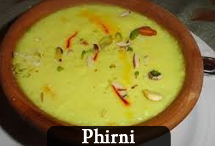
 Lauki Ka Halwa

0

Ingredients: (for 2 people)

1) Two regular cups of grated lauki.

2) 0.5 litres of milk.

3) 3 to 4 tablespoons of Desi Ghee(use cow’s ghee).

4) one-fourth cup of sugar powder or jaggery powder. 

5) Crushed almonds, raisins, and cashews. 

How to make it? 

1) On a heated pan, put the ghee and saute the grated lauki.

2) Add milk and cook it on a low flame until the lauki completely absorbs the milk.

3) Add sugar powder and cook until it thickens.

4) Now, top the dish with crushed dry fruits and nuts.  

Why prefer this dish: This halwa is nutritious, hydrating, and makes you feel full like a meal. 

Vrat Aloo Tikki

0

Ingredients: (for 2 people)

1) Three big boiled and mashed potatoes.

2) One or two tablespoons of buckwheat flour. 

3) Roast cumin seed powder.

4) Sendha namak and Ghee (cow’s ghee).

How to make it? 

1) Mix all the ingredients and divide them into a few pieces.

2) On a heated pan, put some ghee and fry it until it gets a little golden-brown.

Why prefer this dish: This dish is fulfilling as a meal. It’s a good option to have in one-time meal fastings.

Kuttu Ki Puri

0

Kuttu(buckwheat) is a traditionally used ingredient in making fasting food. It is rich in fibres, carbohydrates, and minerals. Also, it is naturally gluten-free, which is ideal for health. 

Here are the ingredients and the step-by-step recipe of Sabudana Kheer: 

Ingredients: (for 2 people)

1) One cup of Kuttu flour.

2) Boiled and mashed potatoes (about 2 medium-sized potatoes).

3) Chopped green chilli.

4) Ghee(cow’s ghee), warm water and sendha namak.

How to make it? 

1) Mix the flour, mashed potatoes, chilli, and sedha namak(rock salt) in a bowl.

2) Now, use the warm water to knead this mixture into a dough.

Note: The boiled potatoes are required to provide gluten to the flour. Actually, buckwheat flour is free of gluten, and without gluten, you can’t make a dough for puris.

Why prefer this: These puris provide the same satisfaction as the regular grains. Also, the buckwheat is healthy and light to digest.

Sabudana Recipes

0

Sabudana is one of the ingredients that is used in all types of fasting foods, except the fast of Nirjala Ekadashi. It is also known for sago or tapioca pearls. It has nutrients like Carbohydrate, Protein, Fat, Fibre, and Minerals, which is why it fulfills the hunger of grains during fastings. It provides high energy and is easy to digest on an empty stomach. 

i) Sabudana Khichdi: 

Here are the ingredients and the step-by-step recipe of Sabudana Khichdi: 

Ingredients: (for 2 people)

1) One cup of soaked Sabudana(soak it overnight)

2) Two medium-sized boiled potatoes

3) Roasted peanuts, usually 2-3 tablespoons, are enough

4) green chilli, cumin seeds, senda namak(rock salt)

5) Ghee(use cow’s ghee), fresh coriander leaves

How to make it? 

1) On a heated pan, put ghee and then roast the cumin seeds.

2) Add the chopped green chilli and saute a little.

3) Cut the boiled potatoes into small pieces and add them to the pan. 

4) Now, add the soaked and washed sabudana, roasted peanuts, and the sedha namak. 

5) When the other ingredients mix perfectly with the sabudana, add the chopped coriander leaves on top.

Note: Soaked the sabudana overnight to prevent stomach bloating or any digestive discomfort.

Why prefer this dish:-

Sabudana Khichdi is a light dish to consume on an empty stomach. It provides complete energy for the day, as equal as a one-time meal provides. Also, the use of cow’s ghee will fuel you with energy, save you from fatigue or tiredness. 

ii) Sabudana Kheer: 

Here are the ingredients and the step-by-step recipe of Sabudana Kheer: 

Ingredients: (for 2 people)

1) one-fourth cup of soaked sabudana.

2) 0.5 litre of fresh milk(with full cream).

3) Sugar powder/Jaggery powder.

4) chopped dry fruits, almonds, cashews, and makhane.

How to make it? 

1) Boil the whole milk in a container over medium heat for 6 to 7 minutes. 

Note: Make sure to mix the cream within the milk and prevent it from sticking to the side and bottom of the container.

2) Turn the heat to low, add the washed sabudana, and continuously mix it with the milk with a big spoon. Stir the milk every 3 minutes and do it for 20 minutes.

3) Now, add the sugar powder and cook it for another 5 minutes.

4) Finally, add the crushed dry fruits to the kheer and stir it for 2-3 minutes.

Note: For jaggery powder, once the kheer is prepared, let it cool down. After 5 minutes of cooling down, add the jaggery powder. 

Make sure not to add the powder while making the kheer or when the kheer is still hot. 

It’s because the jaggery powder contains acid, which can react with the hot milk, making the milk curdly.

Why prefer this dish:-

Kheer is usually considered a heavy, sweet dish. Actually, sabudana kheer is a comforting sweet dish, especially on the days of fasting. It contains milk, sabudana, which are good for calcium nutrition and easy digestion. 

Also, the dry fruits provide warmth to the digestive tract. This warmth eases the digestive cycle. It is a good choice for one-time fastings.

Srimad Bhagavatam | Canto 4 Chapter 3 | Talks Between Lord Siva & Sati

0

Maitreya continued: In this manner the tension between the father-in-law and son-in law, Dakṣa and Lord Śiva, continued for a con siderably long period (1).When Lord Brahmā appointed Dakṣa the chief of all the Prajāpatis, the progenitors of population, Dakṣa became very much puffed up (2).Dakṣa began a sacri fice named vājapeya, and he became exces sively confident of his support by Lord Brahmā. He then performed another great sac rifice, named bṛhaspati-sava (3).While the sac rifice was being performed, many brahmarṣis, great sages, ancestral demigods and other dem igods, their wives all very nicely decorated with ornaments, attended from different parts of the universe (4).

The chaste lady Satī, the daughter of Dakṣa, heard the heavenly denizens flying in the sky conversing about the great sacrifice being per formed by her father. When she saw that from all directions the beautiful wives of the heav enly denizens, their eyes very beautifully glit tering, were near her residence and were going to the sacrifice dressed in fine clothing and or namented with earrings and necklaces with lockets, she approached her husband, the mas ter of the bhūtas, in great anxiety, and spoke as follows (5-7). Satī said: My dear Lord Śiva, your father in-law is now executing great sacrifices, and all the demigods, having been invited by him, are going there. If you desire, we may also go (8).

I think that all my sisters must have gone to this great sacrificial ceremony with their husbands just to see their relatives. I also desire to deco rate myself with the ornaments given to me by my father and go there with you to participate in that assembly (9).My sisters, my mother’s sisters and their husbands, and other affection ate relatives must be assembled there, so if I go I shall be able to see them, and I shall be able to see the flapping flags and the performance of the sacrifice by the great sages. For these rea sons, my dear husband, I am very much anxious to go (10).This manifested cosmos is a wonder ful creation of the interaction of the three mate rial modes, or the external energy of the Su preme Lord. This truth is fully known to you. Yet I am but a poor woman, and, as you know, I am not conversant with the truth. Therefore I wish to see my birthplace once more (11).

O never-born, O blue-throated one, not only my relatives but also other women, dressed in nice clothes and decorated with ornaments, are go ing there with their husbands and friends. Just see how their flocks of white airplanes have made the entire sky very beautiful (12). O best of the demigods, how can the body of a daugh ter remain undisturbed when she hears that some festive event is taking place in her fa ther’s house? Even though you may be consid ering that I have not been invited, there is no harm if one goes to the house of one’s friend, husband, spiritual master or father without in vitation (13).O immortal Śiva, please be kind towards me and fulfill my desire. You have ac cepted me as half of your body; therefore please show kindness towards me and accept my re quest (14). The great sage Maitreya said: Lord Śiva, the deliverer of the hill Kailāsa, having thus been addressed by his dear wife, replied smil ingly, although at the same time he remem bered the malicious, heart-piercing speeches delivered by Dakṣa before the guardians of the universal affairs (15).

The great Lord replied: My dear beautiful wife, you have said that one may go to a friend’s house without being invited, and this is true, provided such a friend does not find fault with the guest because of bodily identification and thereby become angry towards him (16).Although the six qualities education, aus terity, wealth, beauty, youth and heritage are for the highly elevated, one who is proud of possessing them becomes blind, and thus he loses his good sense and cannot appreciate the glories of great personalities (17).One should not go to anyone’s house, even on the consid eration of his being a relative or a friend, when the man is disturbed in his mind and looks upon the guest with raised eyebrows and angry eyes (18).

Lord Śiva continued: If one is hurt by the arrows of an enemy, one is not as aggrieved as when cut by the unkind words of a relative, for such grief continues to rend one’s heart day and night (19). My dear white-complexioned wife, it is clear that of the many daughters of Dakṣa you are the pet, yet you will not be honored at his house because of your being my wife. Rather, you will be sorry that you are connected with me (20).One who is conducted by false ego and thus always distressed, both mentally and sen sually, cannot tolerate the opulence of self-re alized persons. Being unable to rise to the standard of self-realization, he envies such per sons as much as demons envy the Supreme Per sonality of Godhead (21). My dear young wife, certainly friends and relatives offer mutual greetings by standing up, welcoming one another and offering obei sances. But those who are elevated to the tran scendental platform, being intelligent, offer such respects to the Supersoul, who is sitting within the body, not to the person who identi fies with the body (22).

I am always engaged in offering obeisances to Lord Vāsudeva in pure Kṛṣṇa consciousness. Kṛṣṇa consciousness is always pure consciousness, in which the Su preme Personality of Godhead, known as Vāsudeva, is revealed without any covering (23).Therefore you should not see your father, although he is the giver of your body, because he and his followers are envious of me. Be cause of his envy, O most worshipful one, he has insulted me with cruel words although I am innocent (24).If in spite of this instruction you decide to go, neglecting my words, the future will not be good for you. You are most respect able, and when you are insulted by your rela tive, this insult will immediately be equal to death (25).

Srimad Bhagavatam | Canto 4 Chapter 2 | Dakṣa Curses Lord Śiva

0

Vidura inquired: Why was Dakṣa, who was so affectionate towards his daughter, envi ous of Lord Śiva, who is the best among the gentle? Why did he neglect his daughter Satī? (1) Lord Śiva, the spiritual master of the entire world, is free from enmity, is a peaceful per sonality, and is always satisfied in himself. He is the greatest among the demigods. How is it possible that Dakṣa could be inimical towards such an auspicious personality? (2) My dear Maitreya, to part with one’s life is very difficult. Would you kindly explain to me how such a son-in-law and father-in-law could quarrel so bitterly that the great goddess Satī could give up her life? (3)

The sage Maitreya said: In a former time, the leaders of the universal creation performed a great sacrifice in which all the great sages, philosophers, demigods and fire-gods assem bled with their followers (4). When Dakṣa, the leader of the Prajāpatis, entered that assembly, his personal bodily luster as bright as the efful gence of the sun, the entire assembly was illu minated, and all the assembled personalities be came insignificant in his presence (5). Influ enced by his personal bodily luster, all the fire gods and other participants in that great assem bly, with the exceptions of Lord Brahmā and Lord Śiva, gave up their own sitting places and stood in respect for Dakṣa (6).Dakṣa was ade quately welcomed by the president of the great assembly, Lord Brahmā. After offering Lord Brahmā respect, Dakṣa, by the order of Brahmā, properly took his seat (7).

Before taking his seat, however, Dakṣa was very much offended to see Lord Śiva sitting and not showing him any respect. At that time, Dakṣa became greatly angry, and, his eyes glowing, he began to speak very strongly against Lord Śiva (8).All sages, brāhmaṇas and fire-gods present, please hear me with atten tion, for I speak about the manners of gentle persons. I do not speak out of ignorance or envy (9).Śiva has spoiled the name and fame of the governors of the universe and has polluted the path of gentle manners. Because he is shame less, he does not know how to act (10).He has already accepted himself as my subordinate by marrying my daughter in the presence of fire and brāhmaṇas. He has married my daughter, who is equal to Gāyatrī, and has pretended to be just like an honest person (11).

He has eyes like a monkey’s, yet he has married my daugh ter, whose eyes are just like those of a deer cub. Nevertheless he did not stand up to receive me, nor did he think it fit to welcome me with sweet words (12).I had no desire to give my daughter to this person, who has broken all rules of civil ity. Because of not observing the required rules and regulations, he is impure, but I was obliged to hand over my daughter to him just as one teaches the messages of the Vedas to a śūdra (13).He lives in filthy places like crematori ums, and his companions are the ghosts and de mons. Naked like a madman, sometimes laugh ing and sometimes crying, he smears cremato rium ashes all over his body. He does not bathe regularly, and he ornaments his body with a garland of skulls and bones. Therefore only in name is he śiva, or auspicious; actually, he is the most mad and inauspicious creature. Thus he is very dear to crazy beings in the gross mode of ignorance, and he is their leader (14 15).

On the request of Lord Brahmā I handed over my chaste daughter to him, although he is devoid of all cleanliness and his heart is filled with nasty things (16). The sage Maitreya continued: Thus Dakṣa, seeing Lord Śiva sitting as if against him, washed his hands and mouth and cursed him in the following words (17).The demigods are eligible to share in the oblations of sacrifice, but Lord Śiva, who is the lowest of all the dem igods, should not have a share (18).Maitreya continued: My dear Vidura, in spite of the re quests of all the members of the sacrificial as sembly, Dakṣa, in great anger, cursed Lord Śiva and then left the assembly and went back to his home (19).

Upon understanding that Lord Śiva had been cursed, Nandīśvara, one of Lord Śiva’s princi pal associates, became greatly angry. His eyes became red, and he prepared to curse Dakṣa and all the brāhmaṇas present there who had tolerated Dakṣa’s cursing Śiva in harsh words (20).Anyone who has accepted Dakṣa as the most important personality and neglected Lord Śiva because of envy is less intelligent and, be cause of visualizing in duality, will be bereft of transcendental knowledge (21).Pretentiously religious householder life, in which one is at tracted to material happiness and thus also at tracted to the superficial explanation of the Ve das, robs one of all intelligence and attaches one to fruitive activities as all in all (22).

Dakṣa has accepted the body as all in all. Therefore, since he has forgotten the viṣṇu-pāda, or viṣṇu gati, and is attached to sex life only, within a short time he will have the face of a goat (23).Those who have become as dull as matter by cultivating materialistic education and intel ligence are nesciently involved in fruitive ac tivities. Such men have purposely insulted Lord Śiva. May they continue in the cycle of re peated birth and death (24).May those who are envious of Lord Śiva, being attracted by the flowery language of the enchanting Vedic promises, and who have thus become dull, al ways remain attached to fruitive activities (25).

These brāhmaṇas take to education, aus terity and vows only for the purpose of main taining the body. They shall be devoid of dis crimination between what to eat and what not to eat. They will acquire money, begging from door to door, simply for the satisfaction of the body (26). When all the hereditary brāhmaṇas were thus cursed by Nandīśvara, the sage Bhṛgu, as a reaction, condemned the followers of Lord Śiva with this very strong brahminical curse (27).One who takes a vow to satisfy Lord Śiva or who follows such principles will certainly become an atheist and be diverted from tran scendental scriptural injunctions (28). Those who vow to worship Lord Śiva are so foolish that they imitate him by keeping long hair on their heads. When initiated into worship of Lord Śiva, they prefer to live on wine, flesh and other such things (29).Bhṛgu Muni continued: Since you blaspheme the Vedas and the brāhmaṇas, who are followers of the Vedic principles, it is understood that you have al ready taken shelter of the doctrine of atheism (30).

The Vedas give the eternal regulative prin ciples for auspicious advancement in human civilization which have been rigidly followed in the past. The strong evidence of this princi ple is the Supreme Personality of Godhead, who is called Janārdana, the well-wisher of all living entities (31). By blaspheming the princi ples of the Vedas, which are the pure and su preme path of the saintly persons, certainly you followers of Bhūtapati, Lord Śiva, will descend to the standard of atheism without a doubt (32). The sage Maitreya said: When such curs ing and countercursing was going on between Lord Śiva’s followers and the parties of Dakṣa and Bhṛgu, Lord Śiva became very morose. Not saying anything, he left the arena of the sacri fice, followed by his disciples (33).

The sage Maitreya continued: O Vidura, all the progeni tors of the universal population thus executed a sacrifice for thousands of years, for sacrifice is the best way to worship the Supreme Lord, Hari, the Personality of Godhead (34).My dear Vidura, carrier of bows and arrows, all the dem igods who were performing the sacrifice took their bath at the confluence of the Ganges and the Yamunā after completing the yajña perfor mance. Such a bath is called avabhṛtha-snāna. After thus becoming purified in heart, they de parted for their respective abodes (35).

Srimad Bhagavatam | Canto 4 Chapter 1 | Genealogical Table Of The Daughters Of Manu

2

Śrī Maitreya said: Svāyambhuva Manu be got three daughters in his wife, Śatarūpā, and their names were Ākūti, Devahūti and Prasūti (1).Ākūti had two brothers, but in spite of her brothers, King Svāyambhuva Manu handed her over to Prajāpati Ruci on the condition that the son born of her be returned to Manu as his son. This he did in consultation with his wife, Śatarūpā (2). Ruci, who was very powerful in his brah minical qualifications and was appointed one of the progenitors of the living entities, begot one son and one daughter by his wife, Ākūti (3).

Of the two children born of Ākūti, the male child was directly an incarnation of the Su preme Personality of Godhead, and His name was Yajña, which is another name of Lord Viṣṇu. The female child was a partial incarna tion of Lakṣmī, the goddess of fortune, the eter nal consort of Lord Viṣṇu (4).Svāyambhuva Manu very gladly brought home the beautiful boy named Yajña, and Ruci, his son-in-law, kept with him the daughter, Dakṣiṇā (5).The Lord of the ritualistic performance of yajña later married Dakṣiṇā, who was anxious to have the Personality of Godhead as her husband, and in this wife the Lord was also very much pleased to beget twelve children (6).

The twelve boys born of Yajña and Dakṣiṇā were named Toṣa, Pratoṣa, Santoṣa, Bhadra, Śānti, Iḍaspati, Idhma, Kavi, Vibhu, Svahna, Sudeva and Rocana (7).During the time of Svāyambhuva Manu, these sons all became the demigods col lectively named the Tuṣitas. Marīci became the head of the seven ṛṣis, and Yajña became the king of the demigods, Indra (8). Svāyambhuva Manu’s two sons, Priyavrata and Uttānapāda, became very powerful kings, and their sons and grandsons spread all over the three worlds dur ing that period (9). My dear son, Svāyambhuva Manu handed over his very dear daughter Devahūti to Kar dama Muni. I have already spoken to you about them, and you have heard about them almost in full (10).

Svāyambhuva Manu handed over his daughter Prasūti to the son of Brahmā named Dakṣa, who was also one of the progenitors of the living entities. The descendants of Dakṣa are spread throughout the three worlds (11). You have already been informed about the nine daughters of Kardama Muni, who were handed over to nine different sages. I shall now describe the descendants of those nine daugh ters. Please hear from me (12).Kardama Muni’s daughter Kalā, who was married to Marīci, gave birth to two children, whose names were Kaśyapa and Pūrṇimā. Their descendants are spread all over the world (13).My dear Vidura, of the two sons, Kaśyapa and Pūrṇimā, Pūrṇimā begot three children, namely Viraja, Viśvaga and Devakulyā. Of these three, Devakulyā was the water which washed the lo tus feet of the Personality of Godhead and which later on transformed into the Ganges of the heavenly planets (14).

Anasūyā, the wife of Atri Muni, gave birth to three very famous sons Soma, Dattātreya and Durvāsā who were par tial representations of Lord Viṣṇu, Lord Śiva and Lord Brahmā. Soma was a partial represen tation of Lord Brahmā, Dattātreya was a partial representation of Lord Viṣṇu, and Durvāsā was a partial representation of Lord Śiva (15). After hearing this, Vidura inquired from Maitreya: My dear master, how is it that the three deities Brahmā, Viṣṇu and Śiva, who are the creator, maintainer and destroyer of the whole creation, became the offspring of the wife of Atri Muni? (16) Maitreya said: When Lord Brahmā ordered Atri Muni to create generations after marrying Anasūyā, Atri Muni and his wife went to per form severe austerities in the valley of the mountain known as Ṛkṣa (17).

In that mountain valley flows a river named Nirvindhyā. On the bank of the river are many aśoka trees and other plants full of palāśa flowers, and there is always the sweet sound of water flowing from a water fall. The husband and wife reached that beauti ful place (18).There the great sage concentrated his mind by the yogic breathing exercises, and thereby controlling all attachment, he remained standing on one leg only, eating nothing but air, and stood there on one leg for one hundred years (19).He was thinking: May the Lord of the universe, of whom I have taken shelter, kindly be pleased to offer me a son exactly like Him (20).

While Atri Muni was engaged in these se vere austerities, a blazing fire came out of his head by virtue of his breathing exercise, and that fire was seen by the three principal deities of the three worlds (21).At that time, the three deities approached the hermitage of Atri Muni, accompanied by the denizens of the heavenly planets, such as the celestial beauties, the Gandharvas, the Siddhas, the Vidyādharas and the Nāgas. Thus they entered the āśrama of the great sage, who had become famous by his aus terities (22).The sage was standing on one leg, but as soon as he saw that the three deities had appeared before him, he was so pleased to see them all together that despite great difficulty he approached them on one leg (23).

Thereafter he began to offer prayers to the three deities, who were seated on different carriers a bull, a swan and Garuḍa and who held in their hands a drum, kuśa grass and a discus. The sage offered them his respects by falling down like a stick (24).Atri Muni was greatly pleased to see that the three devas were gracious towards him. His eyes were dazzled by the effulgence of their bodies, and therefore he closed his eyes for the time being (25).But since his heart was already attracted by the deities, somehow or other he gathered his senses, and with folded hands and sweet words he began to offer prayers to the predominating deities of the universe (26).

 The great sage Atri said: O Lord Brahmā, Lord Viṣṇu and Lord Śiva, you have divided yourself into three bodies by accepting the three modes of material nature, as you do in every millennium for the creation, maintenance and dissolution of the cosmic manifestation. I offer my respectful obeisances unto all of you and beg to inquire whom of you three I have called by my prayer (27).I called for the Su preme Personality of Godhead, desiring a son like Him, and I thought of Him only. But alt hough He is far beyond the mental speculation of man, all three of you have come here. Kindly let me know how you have come, for I am greatly bewildered about this (28).

The great sage Maitreya continued: Upon hearing Atri Muni speak in that way, the three great deities smiled, and they replied in the fol lowing sweet words (29). The three deities told Atri Muni: Dear brāhmaṇa, you are perfect in your determina tion, and therefore as you have decided, so it will happen; it will not happen otherwise. We are all the same person upon whom you were meditating, and therefore we have all come to you (30).You will have sons who will represent a partial manifestation of our potency, and be cause we desire all good fortune for you, those sons will glorify your reputation throughout the world (31).Thus, while the couple looked on, the three deities Brahmā, Viṣṇu and Maheśvara disappeared from that place after bestowing upon Atri Muni the benediction (32).

 Thereaf ter, from the partial representation of Brahmā, the moon-god was born of them; from the par tial representation of Viṣṇu, the great mystic Dattātreya was born; and from the partial rep resentation of Śaṅkara [Lord Śiva], Durvāsā was born. Now you may hear from me of the many sons of Aṅgirā (33). Aṅgirā’s wife, Śraddhā, gave birth to four daughters, named Sinīvālī, Kuhū, Rākā and Anumati (34).Besides these four daughters, she also had another two sons. One of them was known as Utathya, and the other was the learned scholar Bṛhaspati (35).Pulastya begot in his wife, Havirbhū, one son of the name Agastya, who in his next birth became Dahrāgni. Besides him, Pulastya begot another very great and saintly son, whose name was Viśravā (36).

Viśravā had two wives. The first wife was Iḍaviḍā, from whom Kuvera, the mas ter of all Yakṣas, was born, and the next wife was named Keśinī, from whom three sons were born Rāvaṇa, Kumbhakarṇa and Vibhīṣaṇa (37). Gati, the wife of the sage Pulaha, gave birth to three sons, named Karmaśreṣṭha, Varīyān and Sahiṣṇu, and all of them were great sages (38).Kratu’s wife, Kriyā, gave birth to sixty thousand great sages, named the Vālakhilyas. All these sages were greatly advanced in spir itual knowledge, and their bodies were illumi nated by such knowledge (39).The great sage Vasiṣṭha begot in his wife, Ūrjā [sometimes called Arundhatī], seven spotlessly great sages, headed by the sage named Citraketu (40).

The names of these seven sages are as follows: Citraketu, Suroci, Virajā, Mitra, Ulbaṇa, Vasubhṛdyāna and Dyumān. Some other very competent sons were born from Vasiṣṭha’s other wife (41).Citti, wife of the sage Atharvā, gave birth to a son named Aśvaśirā by accept ing a great vow called Dadhyañca. Now you may hear from me about the descendants of the sage Bhṛgu (42). The sage Bhṛgu was highly fortunate. In his wife, known as Khyāti, he begot two sons, named Dhātā and Vidhātā, and one daughter, named Śrī, who was very much devoted to the Supreme Personality of Godhead (43).The sage Meru had two daughters, named Āyati and Ni yati, whom he gave in charity to Dhātā and Vidhātā. Āyati and Niyati gave birth to two sons, Mṛkaṇḍa and Prāṇa (44).

From Mṛkaṇḍa, Mārkaṇḍeya Muni was born, and from Prāṇa, the sage Vedaśirā, whose son was Uśanā [Śukrācārya], also known as Kavi. Thus Kavi also belonged to the descendants of the Bhṛgu dynasty (45).My dear Vidura, the population of the universe was thus increased by the descend ants of these sages and the daughters of Kar dama. Anyone who hears the descriptions of this dynasty with faith will be relieved from all sinful reactions (46). Another of Manu’s daughters, known as Prasūti, married the son of Brahmā named Dakṣa (47). Dakṣa begot sixteen very beautiful daugh ters with lotuslike eyes in his wife Prasūti. Of these sixteen daughters, thirteen were given in marriage to Dharma, and one daughter was given to Agni (48).

One of the remaining two daughters was given in charity to the Pitṛloka, where she resides very amicably, and the other was given to Lord Śiva, who is the deliverer of sinful persons from material entanglement. The names of the thirteen daughters of Dakṣa who were given to Dharma are Śraddhā, Maitrī, Dayā, Śānti, Tuṣṭi, Puṣṭi, Kriyā, Unnati, Bud dhi, Medhā, Titikṣā, Hrī and Mūrti. These thir teen daughters produced the following sons: Śraddhā gave birth to Śubha, Maitrī produced Prasāda, Dayā gave birth to Abhaya, Śānti gave birth to Sukha, Tuṣṭi gave birth to Muda, Puṣṭi gave birth to Smaya, Kriyā gave birth to Yoga, Unnati gave birth to Darpa, Buddhi gave birth to Artha, Medhā gave birth to Smṛti, Titikṣā gave birth to Kṣema, and Hrī gave birth to Praśraya. Mūrti, a reservoir of all respectable qualities, gave birth to Śrī Nara-Nārāyaṇa, the Supreme Personality of Godhead (49-52).

On the occasion of the appearance of Nara Nārāyaṇa, the entire world was full of joy. Eve ryone’s mind became tranquil, and thus in all directions the air, the rivers and the mountains became pleasant (53).In the heavenly planets, bands began to play, and they showered flow ers from the sky. The pacified sages chanted Vedic prayers, the denizens of heaven known as the Gandharvas and Kinnaras sang, the beau tiful damsels of the heavenly planets danced, and in this way, at the time of the appearance of Nara-Nārāyaṇa, all signs of good fortune were visible. Just at that time, great demigods like Brahmā also offered their respectful pray ers (54-55).

The demigods said: Let us offer our re spectful obeisances unto the transcendental Personality of Godhead, who created as His ex ternal energy this cosmic manifestation, which is situated in Him as the air and clouds are sit uated in space, and who has now appeared in the form of Nara-Nārāyaṇa Ṛṣi in the house of Dharma (56).Let that Supreme Personality of Godhead, who is understood by truly author ized Vedic literature and who has created peace and prosperity to destroy all calamities of the created world, be kind enough to bestow His glance upon the demigods. His merciful glance can supersede the beauty of the spotless lotus flower which is the home of the goddess of for tune (57).

[Maitreya said:] O Vidura, thus the demi gods worshiped with prayers the Supreme Per sonality of Godhead appearing as the sage Nara-Nārāyaṇa. The Lord glanced upon them with mercy and then departed for Gand hamādana Hill (58).That Nara-Nārāyaṇa Ṛṣi, who is a partial expansion of Kṛṣṇa, has now appeared in the dynasties of Yadu and Kuru, in the forms of Kṛṣṇa and Arjuna respectively, to mitigate the burden of the world (59). The predominating deity of fire begot in his wife, Svāhā, three children, named Pāvaka, Pa vamāna and Śuci, who exist by eating the obla tions offered to the fire of sacrifice (60).From those three sons another forty-five descendants  were generated, who are also fire-gods. The to tal number of fire-gods is therefore forty-nine, including the fathers and the grandfather (61).These forty-nine fire-gods are the benefi ciaries of the oblations offered in the Vedic sac rificial fire by impersonalist brāhmaṇas (62).

The Agniṣvāttas, the Barhiṣadas, the Saumyas and the Ājyapas are the Pitās. They are either sāgnika or niragnika. The wife of all these Pitās is Svadhā, who is the daughter of King Dakṣa (63). Svadhā, who was offered to the Pitās, begot two daughters named Vayunā and Dhāriṇī, both of whom were impersonalists and were expert in transcendental and Vedic knowledge (64).The sixteenth daughter, whose name was Satī, was the wife of Lord Śiva. She could not produce a child, although she always faithfully engaged in the service of her husband (65).The reason is that Satī’s father, Dakṣa, used to rebuke Lord Śiva in spite of Śiva’s faultlessness. Consequently, before attaining a mature age, Satī gave up her body by dint of yogic mystic power (66).

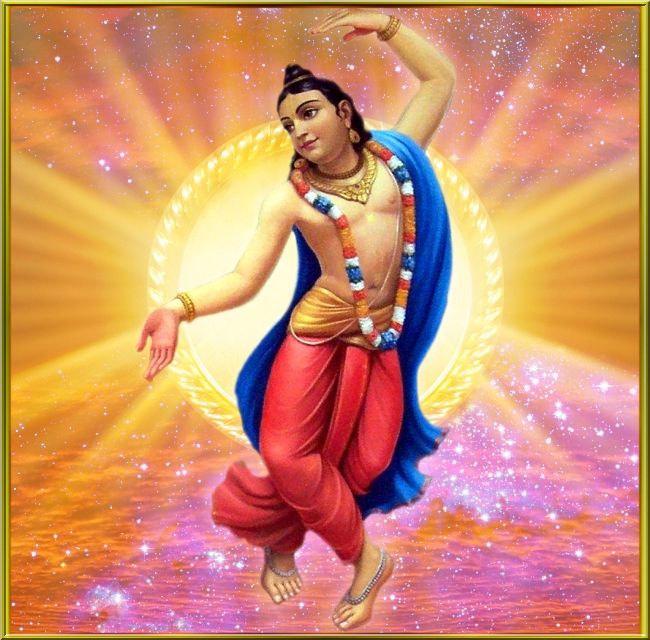
Glorifying Lord Chaitanya

0

– From “Following Srila Prabhupada – Rememberances” ISKCON Cinema

February 1971: BENARES, INDIA Festival glorifying Lord Chaitanya

Radha Govinda Swami: I was in Benares at that time when Srila Prabhupada was touring, traveling India with his 40 disciples. I read in a newspaper in America Krishna-bhakti is preached. Naturally, I was a devotee of Krishna so I liked this topic. So I went there. Then there was a procession from Dashashvamedha Ghat to Tapan Misra’s house that is now in Benares.

When the procession finished, I approached Srila Prabhupada and I spoke in Hindi, “When you went to America, and how you preach?”
Prabhupada said, “You see, I just chant Hare Krishna and give some lecture.” He said, “They need this Vedic knowledge. So just see how they are happy and they are chanting.”
Then I asked, “Where is your program after Benares?”
Prabhupada said, “I will go to Gorakhpur.”
So I wrote down the date.

Then I went to Gorakhpur, and Prabhupada was there. He was staying in Krishna Niketan.

I went there, I was waiting. Prabhupada was at that time alone, so I did not recognize that he is Prabhupada.

“Where is A.C. Bhaktivedanta Swami?” I asked Prabhupada.
So Prabhupada asked me, “Why you want to meet with him?”
I replied, “Because he is my guru. I like him very much.”
So Prabhupada asked me, “Why you accept him as your guru?”
I said, “Because he is the servant of Chaitanya Mahaprabhu.”
Then Prabhupada asked me, “Who is Chaitanya Mahaprabhu?”
So I said, “He is Krishna Himself.”
So I was talking and Prabhupada asked, “Why you accept Lord Chaitanya as Krishna?” “Because I read Chaitanya-caritamrta Krishna Himself came as a devotee to preach.”
Then Prabhupada said, “No, no, no, He’s not Krishna, He is devotee of Krishna.”
I said, “No, He is Krishna Himself.”
But Prabhupada insisted, “No, He is devotee of Krishna, He is not Krishna.”
Then I spoke very hard words to Srila Prabhupada. I said, “Just keep quiet, don’t speak anymore.”
Then Prabhupada laughed very loudly, very loudly he was laughing.

Then some bhaktas came and they were offering obeisances. So I realized that he is Guru Maharaj, he is Srila Prabhupada. So when they offered obeisances, I also offered obeisances.
So I said, “Please forgive me, I offended at your lotus feet. I did not recognize you. Please forgive me.”
Then Prabhupada caught my hand like this and said, “Come to my room.”
Then three disciples were sitting there and Prabhupada was laughing, laughing. His smile was not stopped, and then he told that “He knows that Chaitanya Mahaprabhu is Krishna Himself.”
He said, “You chastised me, I like that. I am very happy with your words.”

The Glories of Chapter Eighteen

0

Parvati said “My dear husband, you have told me the glories of the Seventeenth Chapter of the Srimad Bhagavad-gita, now kindly relate the glories of the Eighteenth Chapter of Srimad Bhagavad-gita.


Lord Siva said; “Oh daughter of the Himalayas (Parvati), please listen to the glories of the Eighteenth Chapter of Srimad Bhagavad-gita, which is higher than the Vedas and the giver of unlimited bliss. When it enters into one’s ears it destroys all material desires. For the pure devotee, it is divine nectar, it is Lord Vishnu’s very life and it is a solace to the hearts of Lord Indra and the demigods as well as the great yogis headed by Sanak and Sananda
One who recites it sends the messengers of Yamaraja far away. There is no other recitation, which can so quickly destroy all sin and free one from the threefold miseries of this world. Now listen with great devotion.
On the topmost peak of Mount Meru is Amaravati, which was built by Visvakarma.

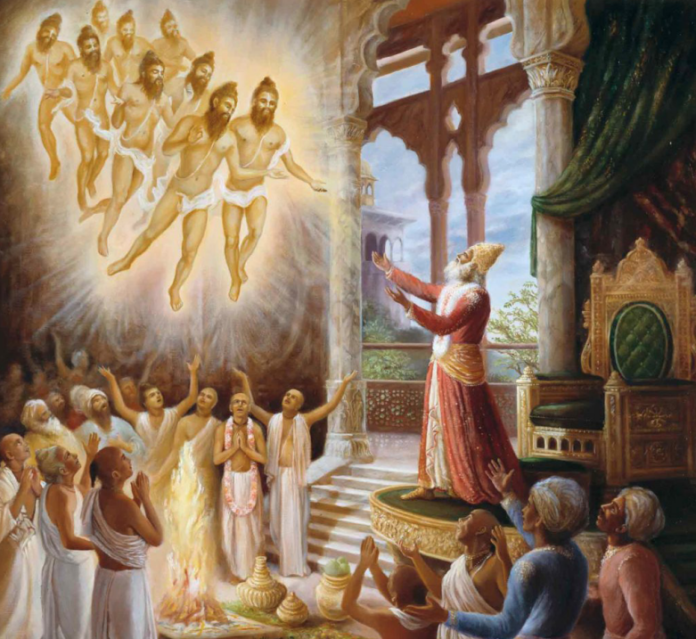
In that heavenly kingdom, Lord Indra along with his wife Saci is served by the demigods. One day while Lord Indra was sitting peacefully, he saw that one very beautiful person had arrived there, whom the servants of Lord Vishnu were serving. When. Lord Indra saw that beautiful young person; he immediately fell from his throne unto the ground. At that time those demigod who had been worshipping Indra picked up the crown that he was wearing and placed it on the head of that new beautiful person. After that, all the demigods and other denizens of the heavenly planets started to perform artik and sing wonderful songs to that new King Indra. The great rishis came there and offered their blessings and chanted Vedic mantras and the Gandharvas and Apsaras started to sing and dance joyfully. In this way, the new Indra, who had not performed the usual one hundred horse sacrifices, started to enjoy hundreds of different types of services rendered by the demigods and other denizens of the heavenly planets. When the old Indra saw this he became very surprised.


He started to think to himself, “This person here has never built wells or dug kunds or planted trees for the welfare of others, and when there were droughts, he did not provide grains in charity. He never performed any fire-sacrifices or great charities in the holy places. So how has he managed to attain my seat?” The old Indra, feeling greatly disturbed in his mind, left to the ocean of milk to pray to Lord Vishnu. When he managed to obtain darshan of Lord Vishnu, he asked Him “My dear Lord Vishnu, in the past I performed many sacrifices and other pious activities, for which I was installed as the Lord of heaven. But at this time another person has come there and taken my place as the king of heaven. This person in his life never performed any great, wonderful pious activities, nor had he performed any great Vedic sacrifices.

So, how is it possible that he has managed to obtain my throne?”
At that time Lord Vishnu said, “My dear Indra, That great soul has performed the recitation daily of the Eighteenth Chapter of the Srimad Bhagavad-gita. Everyday during his life, he recited five slokas from this Chapter, and because of that activity he has attained the results of all sorts of pious activities and yajnas and after enjoying for many years as the king of heaven, he will attain My personal abode. If you perform the same activity of reciting the Eighteenth Chapter of Srimad Bhagavad-gita, you can also attain My divine abode.”


After hearing Lord Visnu’s words, Lord Indra took the form of a brahmana and went to the bank of the Godavari River, where he saw the town of Kalegrani, which is very sacred. At that place, the Supreme Lord in His form known as Kalesva, resides. Close to this town, on the bank of the Godavari river, one very pure brahmana was sitting, who was very merciful and had understood the topmost goal and secret of the Vedic literatures. Daily he would sit at that spot and recite slokas of the Eighteenth Chapter of Srimad Bhagavad-gita.

When Lord Indra saw him he became very happy. He immediately fell at his lotus-feet and requested him to teach him the Eighteenth Chapter of Srimad Bhagavad-gita. After Lord Indra had practiced the recitation, of the Eighteenth Chapter of Srimad Bhagavad-gita for sometime he managed to attain the topmost place of Vishnuloka. When he attained that place, he realized that the pleasure he had enjoyed as King Indra, along with the demigods, was nothing in comparison.


My dear Parvati, for this reason, the great sages, especially chant this Eighteenth Chapter of Srimad Bhagavad-gita and by so doing very quickly attain the lotus-feet of Lord Visnu.


Anyone who hears or studies this Gita Mahatmya very quickly destroys all sins, which he has accumulated. And that person, who remembers this discourse with great faith attains the results of all kinds of pious activities and great sacrifices, and after enjoying all worldly opulences, attains the abode of Lord Visnu.
Thus ends the glories of the Srimad Bhagavad-gita as spoken by Lord Siva to his wife Parvati Devi.
GM: Gita Mahatmyam by Sri Sankaracarya

The Glories of Chapter Seventeen

0

c Now, kindly hear the nectarian glories of the Seventeenth Chapter of Srimad Bhagavad-gita.
King Khadgabahu’s son had a servant by the name of Dushasan who was very crafty and exceptionally foolish. Dushasan made a bet with the prince that he could ride the elephant, at which time he jumped upon the elephant and after going a few steps, the people there started requesting him, not to ride that dangerous elephant. But foolish Dushasan started to prod that elephant and used strong words to urge him on. Suddenly, that elephant became very angry and started to run wildly here and there. Unable to hold on, Dushasan fell to the ground. The elephant stomped on him and Dushasan died. After that he attained the body of an elephant in Simbaldwip, where he stayed in the king’s palace.


The king of Simbaldwip was a close friend of King Khadgabahu. One day the king of Simhaldwip decided to send that elephant as a present to his friend, King Khadgabahu, who in turn presented that elephant to one poet, who pleased him with his beautiful poetry.


Thereafter, that poet sold that elephant for one hundred gold coins to the king of Malva. After some time, that elephant contracted a terminal disease. When the elephant-keepers saw that the elephant had stopped eating and drinking, they reported the matter to the king. When the king found out, he went to the place of the elephant, along with the best of doctors. At that time, to the surprise of that king, the elephant started to speak, “My dear king you are very pious, and a strict follower of the Vedas. You always worship the lotus feet of Lord Visnu. So you should know, that at this time, these medicines and doctors will be of no use. Neither any kind of charity of sacrifice will help at the time of death. If you care for me and want to help me, then bring someone, who daily recites the Seventeenth Chapter of Srimad Bhagavad-gita.”


As requested by that elephant, the king brought one great devotee, who regularly recited the Seventeenth Chapter of the Srimad Bhagavad-gita. That devotee, while chanting the Seventeenth Chapter, sprinkled water on the elephant at which time he gave up his elephant body and attained a four-armed form, similar to that of Lord Vishnu. He immediately sat down in a flower airplane, which had been sent to take him to Vaikuntha. While sitting in that airplane, the king inquired from him about his previous birth, and Dushasan, after telling him everything, left for Vaikuntha. After which, that best of men, the king of Malva, started regularly reciting the Seventeenth Chapter of Srimad Bhagavad-gita. After a short time he attained the lotus feet of Lord Krishna.

Stay Connected

16,985FansLike
12,500FollowersFollow
61,453SubscribersSubscribe