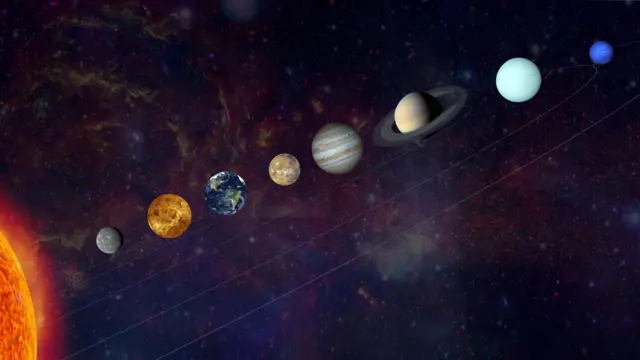
In this book we will take it for granted that the earth planet on which we live our daily lives can be practically thought of as a globe with a diameter of about 8,000 miles. In the age of international travel by jet airplanes, it is easy for people in general to accumulate abundant evidence that confirms this. Commercial airlines fly regularly scheduled flights along a network of routes that completely covers the inhabited areas of the earth. A glance at an airline’s route map shows that each of these routes follows a great circle-the shortest path connecting two points on the surface of a sphere.
(There are some exceptions, of course, due to political considerations.) One can experience changes in time zones of the kind that one would expect to find if the earth is a globe, and one can consider that if the airline authorities do not properly understand the size and shape of the earth, along with the location of various cities on it, then how is it possible for them to arrange regular flights from one city to another?
There are many regions on the earth that have not been thoroughly explored. However, it would be difficult to argue that airplanes have not flown over most areas of the earth’s surface, including the Arctic and Antarctic regions. One can read popular articles describing life during the winter at an American base at the South Pole, and one can also read about artificial satellites with orbits ranging from equatorial to circumpolar. Thus human experience with remote, seldom-visited regions of the earth is also consistent with the idea that the earth is a sphere.
Yet, even though the earth can be regarded as a globe from the viewpoint of our ordinary sensory experience, we have already argued that there is a sense in which the earth is definitely not a globe. The very idea of a sphere is based on three-dimensional Euclidian geometry. Thus, if the three-dimensional continuum of our ordinary experience is simply a limited aspect of a higher-dimensional reality, it follows that the globe of the earth is also simply an aspect of that higher reality. To properly describe what that reality is, in and of itself, we must go beyond three-dimensional constructs such as a sphere or a plane. A yogī who can reach directly to another continent by means of the prāpti-siddhi is not experiencing the earth as a sphere.
Similarly, a person who is able to realize that Vṛndāvana in India is nondifferent from the unlimited spiritual realm of Goloka cannot be thinking of the earth simply_as a small globe. The earth globe may be one aspect of the reality that he is experiencing, but he may choose to describe that reality by emphasizing other aspects that for him are more important.
We propose that although the total reality of the world is very difficult, or even impossible, to fully describe in words, different aspects of it can be described in readily comprehensible language. These aspects correspond to different perspectives, which depend on the different situations and sensory capacities of different observers. Simple geometric imagery may be quite fitting for the description of the universe from many of these different individual perspectives, even though it is completely inadequate to describe the material world as a whole.
In this book we propose that the cosmological system of the Bhāgavatam is a simplified description of the universe as it appears from the viewpoint of demigods, ṛṣis, and highly elevated human beings, who are the principal characters in this work. In contrast, our familiar conception of the earth globe is a valid account of our immediate environs as they appear from the viewpoint of persons with ordinary human senses. This can also be said of the world system of the astronomical siddhāntas, which we have proposed in Chapter 1 to be an integral and long-standing part of the Vedic culture. There the earth is also described as a small globe, and the astronomical discussions are limited to phenomena that people can observe with their gross senses.
3.b.1. Bhārata-varṣa
In an abstract form, the foregoing is our general idea about the nature of the relationship between Vedic cosmology and our modern world view. However, to make this idea more vivid and concrete, it is necessary to work it out in much greater detail. We will now proceed to do this, beginning with the question of how this earth relates to Bhū-maṇḍala as a whole.
In SB 5.19.21p Śrīla Prabhupāda refers to Bhārata-varṣa as India, and he points out that the demigods aspire to take birth there. In SB 2.7.10p this earth planet is identified with Bhārata-varṣa, and a similar reference is made in SB 1.12.20p. In SB 3.18.19p Śrīla Prabhupāda points out that the earth planet was once known as Ilāvṛta-varṣa, but when Mahārāja Parīkṣit ruled the earth it was called Bhārata-varṣa. By the process of political fragmentation, Bhārata-varṣa gradually came to mean India alone. The idea that Bhārata-varṣa once referred to the entire earth is also indicated in SB 4.22.36p, where Śrīla Prabhupāda suggests on the basis of Purāṇic references that Brazil, rather than Ceylon, was Rāvaṇa’s kingdom.
In SB 1.12.5 the earth ruled by Mahārāja Yudhiṣṭhira is referred to as Jambūdvīpa, and in SB 4.12.16 the earth ruled by Dhruva Mahārāja is referred to as Bhū-maṇḍala itself. Going further, SB 5.1.22 states that Mahārāja Priya-vrata ruled all the planets of the universe (akhila-dharā-maṇḍala), and Śrīla Prabhupāda points out that it is difficult for us to understand just where Mahārāja Priyavrata was situated.
In addition to his statements identifying our earth with Bhārata-varṣa, Śrīla Prabhupāda also makes statements indicating that some regions of Bhū-maṇḍala are not part of this earth. We have already noted his reference to the other eight varṣas of Jambūdvīpa as “the lower heavenly planets.” In SB 4.18.20 one of these varṣas, known as Kiṁpuruṣa-varṣa, is spoken of as a planet whose inhabitants are endowed with remarkable mystic powers. In SB 3.23.39p Śrīla Prabhupāda describes Mount Meru as being a resort area for demigods that is “situated somewhere between the sun and the earth,” and in SB 3.2.8p he says that the moon was born from the milk ocean “in the upper planets.” In SB 5.1.8p he speaks of “a planet covered mostly by great mountains, one of which is Gandhamādana Hill.” This mountain marks one of the boundaries of Ilāvṛta-varṣa (SB 5.16.10). When commenting on the description of Ilāvṛta-varṣa in SB 5.16.10, he distinguishes between the mountains of this planet earth and the “greater mountainous areas of the universe.” Finally, in SB 8.2.14-19p he describes Trikūṭa Mountain, surrounded by the ocean of milk, as being on another planet.
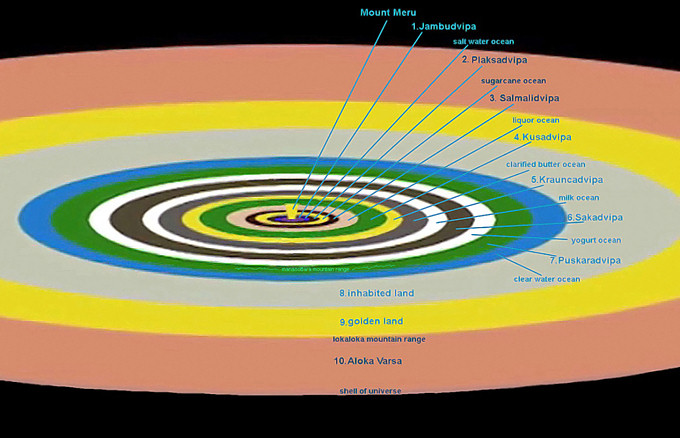
All of these statements can be reconciled if we adopt the idea that the earth of the Bhāgavatam is the disc of Bhū-maṇḍala, but that only a small portion of this earth is accessible to the limited senses of modern-day human beings. In previous yugas larger regions of Bhū-maṇḍala were accessible, and people experienced a correspondingly larger earth. Thus in Mahārāja Yudhiṣṭhira’s time, at the end of the Dvāpara-yuga, people had access to the entire region of Jambūdvīpa, and people living in the Satya-yuga during the reign of Dhruva Mahārāja had access to the whole of Bhū-maṇḍala. In the Caitanya-caritāmṛta it is said that persons from the various dvīpas of Bhū-maṇḍala visited the home of Lord Caitanya disguised as human beings.
To these persons it is presumably still natural to think of the earth as Bhū-maṇḍala.
3.b.2. The Projection of Bhū-maṇḍala on the Sky
If Bhū-maṇḍala is a disc 4 billion miles in diameter, one natural question is, Where is this disc located? We have indicated that our own location on the earth corresponds to part of Bhārata-varṣa, which lies almost exactly in the center of Bhū-maṇḍala. In SB 1.1.4p we read that Lord Brahmā once envisioned the forest of Naimiṣāraṇya in India as the center of a great wheel that enclosed the universe. This suggests that this well-known site in India is located exactly in the center of the vast disc depicted in Figure 3. In any case, both India and the rest of the earth of our experience must lie close to this center.
Let us consider a person somewhere on this earth. If he is standing in the center of a disc that extends for millions of miles into space, then from his perspective most of that disc will be very far away from him, and it will appear to be projected into a circular band running through the heavens. We can discuss this circular band more precisely by introducing the celestial sphere of the astronomers.
In observational astronomy it is customary to visualize celestial objects such as stars and planets as lying on the surface of an enormous imaginary sphere centered on the earth. The system of earthly latitude and longitude is projected onto this sphere, and thus the sphere has celestial north and south poles corresponding to the north and south poles of the earth, and also a celestial equator corresponding to the earth’s equator (see Fig. 10). Any disc centered on the earth and extending millions of miles into space will intersect this sphere in a great circle tilted at some angle to the celestial equator. Our question thus becomes, What great circle on the celestial sphere corresponds to the disc of Bhū-maṇḍala?
In Section 3.d we will discuss the daily and yearly motion of the sun. We will argue that the projected orbit of the sun on the celestial sphere provides a marker that will help us locate the projection of Bhū-maṇḍala. We will present two hypotheses regarding this projection: (1) The projection of Bhū-maṇḍala coincides with the great circle known as the ecliptic. This circle marks the yearly path of the sun through the heavens, and it passes through the circular band of constellations known as the zodiac. (2) The projection of Bhū-maṇḍala corresponds to the celestial equator. Although we tend to favor hypothesis (1), we present both hypotheses, since some śāstric support can be provided for each one.
We will discuss these hypotheses in detail in Section 3.d, but for the moment we will consider some questions that naturally arise from them. First of all, it might seem that the Bhāgavatam is presenting a simple model of the earth as a flat plane. According to this idea, the plane of Bhū-maṇḍala should be parallel to the surface of the earth, and therefore the projection of Bhū-maṇḍala on the sky should correspond to the circle of the horizon. One problem with this is that the Bhāgavatam contains a number of verses indicating that the sun moves in a circular path on the surface of Bhū-maṇḍala (or very close to it) at a very large distance from Jambūdvīpa (for example, see SB 5.20.30). If the celestial projection of Bhū-maṇḍala corresponds to the horizon, then these verses imply that the sun must always remain close to the horizon, instead of rising in the east, going high in the sky, and setting in the west as we observe. In fact, the Indian astronomer Bhāskarācārya seems to believe that the Purāṇas do imply this, and he takes this as a reason for rejecting the Purāṇic view (SSB1, p. 114).
Actually, in the Arctic and Antarctic regions the sun does behave in this way at certain times of the year. However, since the earth of our experience is a globe, the inclination of the sun’s path in the sky changes as we go north and south, and over most of the earth’s inhabited regions this inclination is very steep. In Chapter 1 we have argued that the spherical nature of this earth planet was known in Vedic times, and this, of course, is incompatible with a flat-earth interpretation of Vedic cosmology. However, even if we disregard this point, we can hardly suppose that a hypothetical pre-scientific sage living by the side of the Ganges would not have noticed that the sun moves high overhead in the course of a day. We therefore propose that the Purāṇas could not be identifying the plane of Bhū-maṇḍala with the horizon.
At this point, the objection will be raised that when we look at the sky at night, we do not see anything unusual in the direction of either the zodiac or the celestial equator. Indeed, we see nothing but stars in all directions. If the surface of Bhū-maṇḍala bisects the sky along one of these great circles, then we should see stars only on one side of the circle. On the other side we should see solid earth, as we do in the case of the horizon. Our answer to this objection is that since most of Bhū-maṇḍala is not accessible to our senses, we cannot see it.
This may initially seem to be a rather unsatisfactory answer, but it is consistent with all of the material that we have gathered from the Bhāgavatam thus far. For example, the height of Mount Meru is nearly equal to the diameter of the sun (according to modern data), so if it is indeed located “somewhere between the sun and the earth,” then why can’t we see it? Also, if the plane of Bhū-maṇḍala exists at all, and acts as a barrier to our vision, then the sky must be bisected along some circle, with all visible stars lying on one side. Yet, if we go from the Northern to the Southern Hemisphere, it is possible to look at the night sky in all directions, and wherever we look, we simply see stars. This is true, for example, if we look towards the south celestial pole from New Zealand or South Africa (see Figs. 11 and 12).
Another question that may be raised is, If you are saying that Bhū-maṇḍala is higher-dimensional and therefore invisible, why do you try to assign it a location in three-dimensional space at all? The answer is that a higher-dimensional structure can also have a three-dimensional location. To illustrate this idea, consider a person who is trying to find a particular office in Manhattan. By moving north-south and east-west through the grid of streets, he may arrive at the address of the office but be disappointed to find that he cannot see it. To actually reach the office he may have to move fifty stories in the vertical direction by taking an elevator. Thus, the office has a two-dimensional location, but to reach it, three-dimensional travel is necessary. Likewise, to reach a given location in Bhū-maṇḍala, both three-dimensional and higher-dimensional travel may be required.
In summary, we propose that the Vedic cosmology corresponds to our observable world in the following way: The earth of our experience is a small globe surrounded by the starry heavens in all directions. Bhū-maṇḍala is a vast disc that extends for millions of miles into space but is not perceivable by our present senses. Its projection on the celestial sphere must be ascertained on the basis of the movement of the sun, and this projection does not correspond to the variable horizon of this earth. We suggest that this is not simply an artificial reconciliation of Vedic cosmology with modern astronomical views. Rather, we propose that this is how Vedic cosmology was understood in ancient times.
3.b.3. A Historical Interlude
In this subsection we will briefly consider some historical evidence suggesting that Vedic cosmology, or something very similar to it, may once have been widely accepted throughout the world. Some of this evidence supports the ideas we have just outlined on the nature and position of Bhū-maṇḍala.
Societies throughout the world have traditionally passed down ancient legends and myths describing the nature and origin of the universe. In this seemingly chaotic array of diverse stories, two historians named Giorgio de Santillana and Hertha von Dechend thought they could see evidence for a common ancestral culture. According to them, this “archaic” culture antedated all the ancient civilizations we know of today, including those of Babylon, China, and India. They argued that this culture possessed a sophisticated scientific understanding of astronomy, but that it expressed this understanding in terms we today call mythological because we do not understand them.
Here is what de Santillana and von Dechend have to say about how this archaic culture viewed the earth:
(1) First, what was the “earth”? In the most general sense, the “earth” was the ideal plane laid through the ecliptic. The “dry earth,” in a more specific sense, was the ideal plane going through the celestial equator [HM, p. 58].
(2) The name of “true earth” (or of the “inhabited world”) did not in any way denote our physical geoid for the archaics. It applies to the band of the zodiac, two dozen degrees right and left of the ecliptic [HM, pp. 61-62].
(3) At the “top,” in the center high above the “dry” plane of the equator, was the Pole star. At the opposite top, or rather in the depth of the waters below, unobserved from our latitudes, was the southern pole, thought to be Canopus” [HM, p. 63].
The idea of the earth presented here runs parallel to the ideas we have discussed regarding Bhū-maṇḍala. According to the Bhāgavatam, below the plane of Bhū-maṇḍala are seven lower planetary systems and then the Garbhodaka Ocean, which fills one half of the universal globe. Here we see a similar conception of the earth as a plane projected against either the celestial equator or the band of the zodiac, with a region of water in the direction of the southern pole.
Many bits and pieces of information can be collected from old myths and legends suggesting that a cosmology similar to that of the Bhāgavatam was widely disseminated in ancient times. In many cases this information comes down to us in the form of what may be called fossilized stories, or stories that have lost their original meaning but have been preserved in a distorted, fragmentary form in various traditions. One interesting example of this is the following story taken from Norse mythology: At the time of the destruction of the cosmos (the Norse ragnarok), all-engulfing flames come out of Surt the Black. This Surt is said to be “the king of eternal bliss ‘at the southern end of the sky.'” It is also stated in the Norse myths that “there are many good abodes and many bad; best it is to be in Gimle with Surt” (HM, p. 157).
Here one cannot help but think of Saṅkarṣaṇa, or Ananta Śeṣa, who destroys the three worlds with fire at the time of annihilation, and who reclines on the Garbhodaka Ocean. If we project the location of Saṅkarṣaṇa on the sky, it should be to the south, in the direction of the watery region mentioned in (3) above. Saṅkarṣaṇa is known as tāmasī, or “dark,” since He is in charge of annihilation, but He is also certainly the king of eternal bliss (SB 5.25.1). This passage from Norse mythology is therefore very curious, since standard historical accounts describe the ancient Scandinavians as polytheists who had no conception of one Supreme Godhead.
Whatever the true significance of the story of Surt may be, the ancient Scandinavians clearly had a concept of the earth that is very similar to Jambūdvīpa as described in the Bhāgavatam. They regarded the earth as a circular island surrounded by a world ocean. In the center of the island is an enormous mountain, crowned by Asgard, the home of the gods (see Fig. 13). Interestingly enough, the number of warriors of the gods stationed in Asgard is 432,000, a number that often appears in the Vedic literature (HM, p. 162).
In his book Shamanism (SH), Mircea Eliade points out that the idea of three worlds with a universal axis marked by a cosmic mountain is extremely widespread. It is found in the ancient cultures of Egypt, India, China, Greece, and Mesopotamia, and it is also found in tribal societies throughout Asia, Africa, and the Americas. In central Asia, the names for the central mountain, such as Sumber, Sumur, or Sumer, are clearly related to the Sanskrit name Sumeru. The Greeks, of course, had their Mount Olympus; the Iranians had Haraberezaiti (Elbruz); the Germans had Himingbjorg; the Saxons had Irminsul, “the universal column that sustains everything” (SH, p. 261); and the Chinese had Mount Khun-Lun, where the dwellings of the immortals were situated (ND, pp. 566-67). Among the Babylonians, the ziggurat represented the cosmic mountain, and the central pillar of tribal dwellings in Asia and North America carried a similar symbolic meaning (SH, pp. 261-62). Needham, in his Science and Civilization in China, notes that “wheel maps,” depicting the earth as a circle surrounding a central mountain, were very common in the ancient world. He is uncertain as to whether these maps had ultimately an Indian or a Babylonian origin, but he notes that they seem to represent a tradition of great antiquity in both places (ND, pp. 588-90).
It may perhaps seem far-fetched to link the traditions of North American Indians with Vedic civilization, but even here we find some suggestive connections. For example, the Sioux Indians tell of a cycle of four ages. There is a buffalo that loses one leg during each age; at present we are in the last age-an age of degradation-and the buffalo has one leg. In the Bhāgavatam, of course, the same story is told about the bull named Dharma; at present we are in the last age (the Age of Kali), and Dharma is standing on one leg (EB, p. 9).
In Figure 14 we give another example of what may be a remnant of the Vedic world view. This is a picture from the Maya Codex Tro-Cortesianus. Some people have interpreted it as a depiction of the churning of the milk ocean, as described in the Vedic literature. The picture is difficult to interpret, but it does seem to contain a tortoise, a central churn, and a serpent being pulled like a rope by what may be demigods and asuras. This picture illustrates both the attractive and the discouraging aspects of this kind of evidence. It seems highly suggestive, but its history is difficult, if not impossible, to trace out. We would suggest, however, that the presence of Vedic cosmological themes in many widely separated cultures throughout the world does provide evidence for the existence of a single culture in the remote past that widely disseminated these themes.
3.b.4. The Principle of Correspondence
Thus far we have developed the idea that the earth of our experience is a small globe and simultaneously a part of a region called Bhārata-varṣa in a larger, higher-dimensional structure called Bhū-maṇḍala. We have proposed that the connection between the earth globe and Bhū-maṇḍala is higher-dimensional. Since this idea is very foreign to the Western way of thinking, we will devote this subsection to a discussion of further examples from the Bhāgavatam indicating that this earth (and India in particular) is linked with a higher level of reality. To borrow a phrase from modern physics, we can speak of this idea of a higher-dimensional connection as the principle of corres-pondence linking our familiar earth globe with the domain described in the Vedic literature.
There are many references in the Bhāgavatam indicating that in previous ages many activities of demigods and great ṛṣis were regularly carried out on this earth. These include the following:
(1) Trita Muni, who became one of the seven sages in the Varuṇaloka, came from the western countries of this earth (SB 1.9.7p).
(2) Inhabitants of the Vāyuloka (airy planets) were invited to expedite the cooking work at the sacrifice of Mahārāja Marutta. (Also, a golden mountain peak belonging Mahārāja Marutta is located somewhere in the Himalayas.) (SB 1.12.33p)
(3) Viśvāvasu, the leader of the Gandharvas, fell from his vimāna (airplane) upon seeing Devahūti playing ball on her palace roof. This took place in India (SB 3.22.17).
(4) Atri Muni performed austerities in a valley of Ṛkṣa Mountain near the river Nirvindhya in India (SB 4.1.17).
(5) The sacrifice in which Dakṣa offended Lord Śiva took place at the confluence of the Ganges and the Yamunā (SB 4.2.35).
(6) Parvatī, the wife of Lord Śiva, took birth as the daughter of the Himalayas (SB 4.7.58-59).
(7) Svāyambhuva Manu ruled from Brahmāvarta, which is located in India where the river Sarasvatī flows toward the east (SB 4.19.1).
(8) Indra became intoxicated on soma-rasa at Mahārāja Gaya’s sacrifice (SB 5.15.12).
These items all indicate that in the past this earth was the setting for many activities that lie beyond the range of our present senses. In the Bhāgavatam (including both the Sanskrit texts and Śrīla Prabhupāda’s purports) these activities are described from the viewpoint of persons whose sensory level is higher than that of ordinary people of today, and thus they are presented as normal, day-to-day affairs. In the Caitanya-caritāmṛta there is evidence indicating that similar activities are still taking place on the earth today. For example, CC ML 9.174-77 describes a meeting that took place between Lord Caitanya and Lord Śiva on the hill of Śri Śaila in south India. It is pointed out that Lord Śiva and Devī lived on that hill, along with Lord Brahmā and all the demigods. In this description, however, it is clear that this was not visible to the general human population.
In KB p. 494 we read that the dowry of King Nagnajit’s daughter included 90,000,000 horses and “a hundred times more slaves than horses.” Modern scholars use statements like this as an excuse to reject Vedic scripture as “Hindu mythology,” or utterly irresponsible fantasy. However, as we have already suggested, their interpretation is contradicted by the abundant evidence indicating the Vedic literature’s gravity and seriousness of purpose. We suggest that these very large numbers refer to activities taking place on a higher earthly domain, which was experienced by the people of those times (the late Dvāpara-yuga).
In many cultures around the world we find the idea that in an earlier age people had direct contact with higher realms and their inhabitants (SH). This direct contact is often thought to have been broken in the distant past by a fall, which consigned human beings to a life of struggle in a state of cosmic alienation. The fall of Adam and Eve in Judeo-Christian tradition is an example of this. The Vedic literature, however, can be thought of as being written from a pre-fall perspective. Although this literature describes the degradation of human society in the Age of Kali, it generally describes activities and events taking place in societies where communication with higher-dimensional realms was taken for granted.
In SB 6.10.16p Śrīla Prabhupāda comments that the battle between Indra and Vṛtrāsura took place not by the Narmadā River in India, as one might surmise from the text, but by its celestial counterpart. He points out that “the five sacred rivers in India-the Gaṅgā, Yamunā, Narmadā, Kāverī, and Kṛṣṇā-are all celestial. Like the Ganges River, the Narmadā River also flows in the higher planetary systems.” For this to be possible, the connection between the celestial river and the earthly river that we can directly see must be higher-dimensional.
Likewise, in SB 3.21.25p Śrīla Prabhupāda points out that Brahmāvarta, where Svāyambhuva Manu ruled, is said by some to be a place in India and by others to be a place in Brahmaloka. He says, “There are many places on the surface of this earth which are also known in the higher planetary systems; we have places on this planet like Vṛndāvana, Dvārakā, and Mathurā, but they are also eternally situated in Kṛṣṇaloka.” Thus, a place in India on this earth may correspond on a higher-dimensional level to part of Brahmaloka.
In a number of places, Śrīla Prabhupāda cites traditions identifying features of the earth with features of Bhū-maṇḍala and the higher planets in general. Some examples are:
(1) “Bhauma-svarga [which corresponds to the eight varṣas of Jambūdvīpa other than Bhārata-varṣa] is sometimes accepted as the tract of land in Bhārata-varṣa known as Kashmir” (SB 5.17.11p).
(2) It is said that Śivaloka is “supposed to be situated near the Himalaya Mountains” (SB 4.24.22p).
(3) The Yakṣas (who are associated with the demigod Kuvera) are identified as Himalayan hill tribes like the Tibetans (SB 4.10.5p).
(4) The words ā-mānasa-acalāt, meaning “up to Mānasa Mountain,” are translated as referring to the Arctic region (SB 4.16.14).
(5) “Sapta-dvīpa refers to the seven great islands or continents on the surface of the globe: (1) Asia, (2) Europe, (3) Africa, (4) North America, (5) South America, (6) Australia, and (7) Oceania” (SB 4.21.12p). Similar statements are made in SB 3.21.2p and TLC, p. 80.
We suggest that identifications of this kind either refer directly to higher-dimensional associations between earthly and celestial locations, or else they refer to traditions that have arisen because of ancient experience of the earth as a higher realm. Thus, Lord Śiva is always associated with the Himalayas, and in the Vedic literature there are many stories about him that take place in a Himalayan setting. It is therefore natural to think of the Himalayas as the place of Lord Śiva, and he may indeed be especially accessible there to advanced yogīs. Of course, we cannot simply regard Śivaloka or Sapta-dvīpa as places in the three-dimensional earthly realm of our ordinary experience.
The astronomical siddhāntas also contain passages identifying features of Bhū-maṇḍala with parts of the earth globe. Thus the Sūrya-siddhānta describes Mount Meru as a small mountain at the North Pole, and the Siddhānta-śiromaṇi places the seven dvīpas in the Southern Hemisphere. In his purports to CC AL 5.111 and CC ML 20.218, Śrīla Prabhupāda cites the Siddhānta-śiromaṇi’s description of the seven dvīpas. Since Śrīla Bhaktisiddhānta Sarasvatī Ṭhākura also cites this description in his Anubhāṣya commentary on these verses of Caitanya-caritāmṛta, we will reproduce it here:
Most learned astronomers have stated that Jambūdvīpa embraces the whole northern hemisphere lying to the north of the salt sea; and that the other six dvīpas and the seven seas … are all situated in the southern hemisphere.
To the south of the equator lies the salt sea, and to the south of it the sea of milk,… where the omnipresent Vāsudeva, to whose lotus feet Brahmā and all the gods bow in reverence, holds his favorite residence.
Beyond the sea of milk lie in succession the seas of curds, clarified butter, sugar cane juice, and wine; and, last of all, that of sweet water, which surrounds Vadavānala. The Pātāla lokas, or infernal regions, form the concave strata of the earth [SSB1, p. 116].
We should note that these verses of Siddhānta-śiromaṇi describe a correspondence between the earth globe and Bhū-maṇḍala that can be expressed in mathematical form. The points on the plane of Bhū-maṇḍala can be mapped onto the earth globe by a stereographic projection. This is a standard kind of map projection, in which countries on the curved surface of the earth are represented on a flat plane.
In this particular case, one can use a modified polar stereographic projection, which sends the North Pole of the earth to the center point on the plane and sends circles of latitude on the earth to ever-widening concentric circles on the plane. It is possible to set up such a projection so that
(1) The path of the sun in Puṣkaradvīpa maps to the tropic of Capricorn (see Section 3.d).
(2) The six dvīpas surrounding Jambūdvīpa map to bands along parallels of latitude in the Southern Hemisphere.
(3) The equator cuts the salt ocean between Jambūdvīpa and Plakṣadvīpa in half. Thus Jambūdvīpa lies in the Northern Hemisphere.
(4) The base of Mount Meru maps to the Arctic Circle. Thus Mount Meru corresponds to the “land of the midnight sun,” north of the Arctic Circle.
This correspondence agrees with the description of the dvīpas in the Siddhānta-śiromaṇi, and it agrees with the account given in the Sūrya-siddhānta of the life of the demigods on Mount Meru. There it is stated that the demigods experience days and nights of six months each, and that their dawn and evening occur at the times of the vernal and autumnal equinoxes (SS, p. 81). This, of course, is the situation at the North Pole.
The question is, What is the meaning of this mapping between Bhū-maṇḍala and the earth globe? It is not possible for us to take it as a literal description of the earth, since the continents in the Southern Hemisphere are not at all arranged in concentric rings. It may be that this mapping refers to actual higher-dimensional connections between parts of this earth and parts of Bhū-maṇḍala. This is suggested by the fact that Śrīla Bhaktisiddhānta Sarasvatī refers to it, and Śrīla Prabhupāda, following in disciplic succession, does also.
However, since the authors of the astronomical siddhāntas often expressed doubts about Purāṇic cosmology, it seems likely that for them, at least, the mapping was simply an artificial attempt to force this cosmology into a three-dimensional framework and thereby make sense out of it. We therefore suggest that although historical Indian astronomers such as Bhāskarācārya were carrying on a genuine Vedic tradition of astronomy, their understanding of Vedic cosmology was nonetheless imperfect. They did not understand the higher-dimensional nature of structures such as Bhū-maṇḍala, and they consequently focused their attention on those features of Vedic astronomy that can be readily understood in three-dimensional terms.
In recent centuries, many Vaiṣṇavas have also experienced perplexity in their efforts to understand the relationship between Bhū-maṇḍala and the earth globe of our direct experience. This is shown in Appendix 1, where we reproduce a discussion of this relationship by the Vaiṣṇava commentator Vaṁśīdhara. If the existing Vedic literature consists of materials dating to an era in which people had direct experience of higher-dimensional reality, then it is not surprising that many statements in it are bewildering from our gross sensory perspective. It is therefore reasonable to follow the example of the ācāryas and simply receive these statements with faith. If this is done, then further insight may come in due course of time. (In contrast, the approach of skeptical rejection is not likely to lead to further study and insight.)
We will end this subsection by noting another correspondence principle involving Vedic cosmology-the principle of correspondence between microcosm (the body) and macrocosm (the universe and the universal form). In SB 5.23cs there is the statement that “yogīs worship the Śiśumāra planetary system, which is technically known as the kuṇḍalini-cakra.” It appears that yogīs in meditation would identify the central axis of the universe (which we will discuss in Chapter 4) with the series of cakras in the spinal column. By moving their life airs up the series of cakras, they would prepare their subtle bodies to travel up the axis of the universe to Brahmaloka. This basic idea appears in mystical traditions throughout the world, but it would take us too far afield to discuss it further here (again, see SH).