




Exploring the silent gap between inhalation and exhalation through So’ham Meditation
So’ham meditation is a subtle yet profound practice rooted in ancient Vedic wisdom. It uses the natural rhythm of breath to guide awareness inward. In this method, the practitioner observes the sound and movement of breathing while mentally repeating the sacred vibration “So’ham.” This process is not merely a breathing exercise—it is a disciplined way of perceiving the deeper nature of consciousness.
Through So’ham meditation, one begins to recognize that beyond the body and mind exists a field of pure awareness, steady and unchanging.
Understanding the Practice of So’ham Meditation
The term So’ham is composed of two Sanskrit sounds:
- “So” – associated with inhalation
- “Ham” – associated with exhalation
Together, they reflect the natural sound of breath itself. This practice does not impose anything artificial. Rather, it refines attention toward what is already present.
Step-by-Step Method
- Sit comfortably with a steady posture.
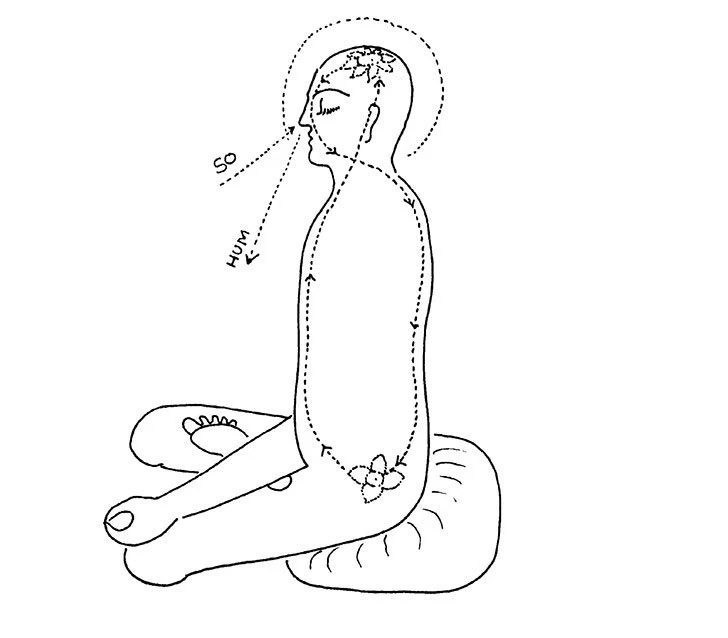
- Inhale gently, as if drawing breath from a short distance—approximately nine inches from the nostrils.
- As you inhale, mentally repeat “so…ooo”.
- Allow awareness to follow the breath inward, toward the center of the brain and body.
- Notice a brief pause at the end of inhalation.
- Exhale slowly while mentally repeating “hammmm”.
- Feel the exhalation dissolve outward into space.
This completes one cycle of So’ham meditation.
The Significance of the Gap in So’ham Meditation
A central feature of So’ham meditation is the gap between inhalation and exhalation. These two subtle pauses—after “so” and after “ham”—hold special importance.
Within this gap, there is no movement of breath, no mental repetition, and no external engagement. It is a moment of stillness.
This stillness can be understood as a canvas of pure awareness. Just as a painting appears upon a canvas, all experiences of life arise within this silent background.
Remaining attentive to this gap gradually reveals:
- Inner quietness
- Clarity of perception
- Stability of awareness
In Vedic understanding, this reflects the distinction between the changing body-mind and the steady ātma (self).
So’ham Meditation and the Nature of Awareness
The practice leads the practitioner toward recognizing that awareness itself is constant, while thoughts and sensations are temporary.
As attention deepens:
- Breathing continues naturally
- Thoughts arise and pass
- But awareness remains unchanged
This insight aligns with the principle that the self is not the body or mind, but the observer of both.
So’ham meditation, therefore, is not an act of creating peace, but of recognizing the peace already present within.
Integrating So’ham Meditation Into Daily Life
With consistent practice, the awareness of the gap extends beyond formal meditation.
Living With Awareness
- While walking, one remains attentive to the inner stillness
- While eating, awareness continues without interruption
- During activity, the mind engages outwardly, but awareness stays inwardly grounded
Life then appears as a series of actions occurring at the surface, while the practitioner remains centered within.
This state is described as being rooted within while acting externally.
The Witness Perspective
As So’ham meditation matures, a shift in perception occurs.
One begins to observe life as:
- A sequence of events
- A movement of circumstances
- A changing field of experiences
Yet, internally, there is a stable witness.
This is sometimes described as seeing life as a drama or play, where one performs necessary duties (dharma) while remaining unattached.
Such detachment does not lead to indifference. Rather, it brings:
- Balance in action
- Clarity in decision-making
- Freedom from unnecessary disturbance
Pronunciation of So’ham
The correct pronunciation supports the natural flow of the practice:
- “So” is elongated as “so…ooo”
- “Ham” is pronounced “hum”, where the “a” sounds like the “a” in about, not cat
This subtlety ensures that the sound aligns harmoniously with the breath.
Benefits of So’ham Meditation
Regular practice of So’ham meditation may lead to:
- Improved mental clarity
- Reduced inner restlessness
- Greater emotional balance
- Heightened awareness
- A natural sense of peace
These benefits arise not from force, but from steady observation and alignment with natural rhythms.
A Deeper Perspective on Practice
In Vedic thought, true knowledge is not imposed externally but realized internally through disciplined awareness.
So’ham meditation reflects this principle. It does not introduce new concepts but reveals what is already present.
The breath continues, awareness exists, and life unfolds. The practice simply refines perception.
One may understand this as aligning individual consciousness with a greater order that governs all existence.
Conclusion: Returning to Inner Stillness Through So’ham Meditation
So’ham meditation offers a direct method to observe the connection between breath and awareness. By focusing on the natural rhythm of inhalation and exhalation, and especially on the silent gap between them, one gradually recognizes a deeper dimension of existence.
This practice does not withdraw one from life but brings clarity into it. Actions continue, responsibilities remain, but the inner state becomes steady.
In this way, So’ham meditation serves as both a practical discipline and a pathway toward self-understanding. It gently reveals that beneath the changing movements of life, there exists a quiet, enduring awareness—unchanging and complete.
library.vedavarsity.com | www.vedavarsity.com
Deepen your Bhakti-yoga practice, harmonize relationships, and receive guided coaching — all at Vedavarsity.com