Mail ID: contact@vedavarsity.com

Contact: +91 9634998911

Google search engineGoogle search engine
Home Blog Page 90

Are Western Festivals Obstacles—Or Opportunities—For Devotional Service?

0

Throughout the course of the year, ISKCON Tucson has consistently found meaningful and effective ways to engage the wider public by thoughtfully participating in commonly observed Western holidays and civic traditions. By approaching people in settings where they naturally congregate—whether at a Thanksgiving gathering or along the route of a city procession—the temple has transformed familiar cultural occasions into auspicious opportunities for prasāda distribution, philosophical contemplation, and cheerful spiritual association.

Thanksgiving Prasāda at Govinda’s Welcomes Hundreds

For more than thirty years, the observance of Thanksgiving has remained a central feature of ISKCON Tucson’s outreach efforts through its award-winning vegetarian restaurant, Govinda’s. This year’s Thanksgiving celebration once again proved to be the largest single holiday event hosted by the temple, with 420 guests served over the course of the day.

Operating from noon until 6 p.m., the all-you-can-eat buffet was prepared in the spirit of Śrīla Prabhupāda’s instruction that guests should depart fully satisfied. The offerings included tofu turkey, quinoa stuffing, cranberry sauce, mashed potatoes with carrot-cashew gravy, green bean almondine, basmati rice, vegetable soup, dinner rolls, a fresh salad bar, and pumpkin pie.

Although Govinda’s conducts significant prasāda distributions throughout the year—on Christmas, New Year’s Day, Easter, Mother’s Day, and Father’s Day—Thanksgiving consistently draws the greatest attendance. To accommodate the steady flow of visitors, devotees arranged two serving stations, one indoors and one on the patio, ensuring orderly service and a peaceful dining experience.

More than a dozen devotees served throughout the day, warmly welcoming guests, replenishing the buffet, and maintaining Govinda’s well-known standard of hospitality. Live devotional music enlivened the patio as guests dined in Tucson’s pleasant autumn weather, many remarking on the serene atmosphere and welcoming spirit that have made the event a cherished annual observance.

Adding a familiar and gentle presence to the occasion was Sufi, the temple’s resident white turkey, who greeted visitors from an enclosed pen near the dining area. His presence served as a quiet reminder of the Hare Kṛṣṇa teaching that every living entity possesses eternal spiritual value and is deserving of care and protection.

Ratha-yātrā at the All Souls’ Procession Extends Outreach Beyond the Temple

This same spirit of outreach was carried into the heart of downtown Tucson through ISKCON Tucson’s continued participation in the city’s annual All Souls’ Procession, one of the largest public gatherings in southern Arizona. Originating from the Christian observance of All Souls’ Day and enriched by elements of Día de los Muertos, the procession provides a contemplative space centered on remembrance, connection, and the nature of the soul—subjects that harmonize naturally with Vaiṣṇava philosophy.

During the 2025 procession, devotees once again presented a complete Ratha-yātrā, with Lord Jagannātha, Lord Baladeva, and Subhadrā Devī proceeding majestically through the nighttime parade. A prominent banner bearing the words of Bhagavad-gītā (2.20)—“For the soul, there is never birth or death”—conveyed the Vaiṣṇava understanding of the soul’s eternality to thousands of onlookers.

Devotees from San Diego, Los Angeles, Phoenix, and the El Paso preaching center joined the Tucson community, thereby strengthening both organization and outreach.

“Each year it becomes larger and better organized on our side,” said Sandamini Devī Dāsī, Temple President of ISKCON Tucson. “We are a small temple, and the assistance of devotees from other centers makes the difference between a good Ratha-yātrā and a truly excellent one.”

Following the two-mile procession—during which many local residents participated by chanting, dancing, and pulling the ropes—devotees distributed more than 300 plates of a five-course prasāda feast, along with 2,500 cookies, all of which were gratefully received by participants and spectators. A book table accompanied the distribution, giving visitors an opportunity to learn more about the spiritual philosophy underlying the celebration.

Outreach Through Familiar Traditions

Whether through a Thanksgiving feast or a citywide procession rooted in Western religious observance, ISKCON Tucson continues to demonstrate how well-known cultural traditions can serve as gateways to spiritual discussion, compassion, and devotional service. By offering prasāda, transcendental knowledge, and joyful participation within settings already dear to the public, the temple has shown that Western holidays can become powerful instruments for outreach and genuine spiritual connection.

To stay informed about the expanding service of the Tucson community, receive updates on their Temple project, and more, signup for their newsletter, visit their website, and follow them on Facebook and YouTube.

Is Caring For The Environment Of The Holy Dhāma A Spiritual Duty?

0

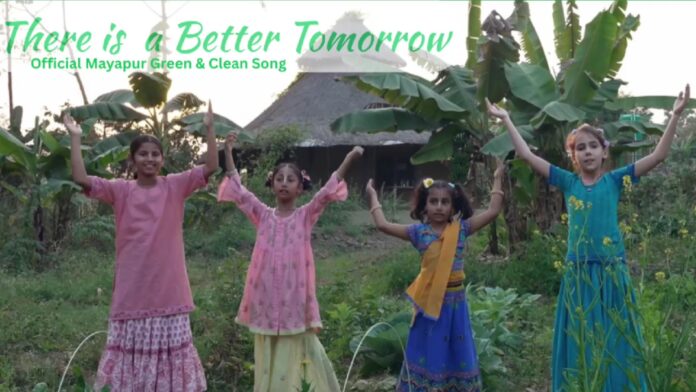
The Mayapur Clean and Green initiative, under the guidance of Murari Mohini Devi Dasi, has released a new song accompanied by a music video to glorify and support its ongoing environmental service in the holy land of Śrī Māyāpur Dhāma. Appropriately entitled “Mayapur Clean and Green,” this offering is the fruit of a harmonious international collaboration, uniting devotees, musicians, and students from the Philippines, the United States, Italy, the United Kingdom, Russia, and India. In this way, it reflects the spirit of unity and cooperation so strongly emphasized by His Divine Grace Śrīla Prabhupāda.

Speaking on the inspiration behind the project, Murari Mohini Devi Dasi explained, “This song arose from the need to inspire participation both from the local community and from the international community connected with Māyāpur Dhāma—whether as residents, pilgrims, or those who hold the holy dhāma in the highest reverence, recognizing that it should stand as an exemplary model for all humanity.”

The song features an original composition by Bhaktin Gandharvikā from the Philippines, who not only composed the piece but also performs as guitarist and vocalist, offering her musical talents in service to conveying the spiritual importance of caring for Māyāpur’s sacred environment. The composition is further enriched by the mṛdaṅga rhythms of Bhakta Prahlāda from the United States, while Prema Vilāsa Dāsa from the Philippines contributes piano accompaniment, together creating an uplifting soundscape that harmoniously blends devotional sentiment with ecological awareness.

Recalling the development of the song, Murari Mohini Devi Dasi shared, “From the very first visit of Gandharvikā to Māyāpur, we were deeply impressed by her artistic gifts and began requesting her to compose a song that could unite us as one community—dedicated to the protection and respectful care of the holy dhāma. Gradually, at the appropriate time, Gandharvikā gave birth to this beautiful and profoundly meaningful composition. When she shared it with me, I offered a few suggestions, and in this way the final verse of the song came into being.”

Students of Śrī Māyāpur International School—educating children from Italy, the United Kingdom, Russia, and India—also participated in the recording. Among them were Bhakta Niloy, Bhaktin Citra, Bhaktin Nandinī, Bhaktin Ekādaśī, Bhakta Govinda, and Bhaktin Rādhikā. Their participation underscores the initiative’s emphasis on educating the younger generation in sustainable habits and instilling from early life a sacred sense of responsibility to protect the dhāma. The international nature of the project extended to its production as well, with sound engineering carried out by Rādhānātha Dāsa in the Philippines and Padmarāṇī Devī Dāsī in Māyāpur. Videography and editing were undertaken by I Love Mayapur, led by Indradyumna Dāsa and Sudevī Dāsī, who beautifully portray the life of the holy dhāma while highlighting the beauty and sanctity of its natural surroundings.

After the completion of the song and music video, the Mayapur Clean and Green team visited local schools to teach and practice the song with the children, integrating it with classes on environmental education.

The composer and volcalist Bhaktin Gandharvika and Prahlad playing the Mridanga.

(LtoR) Bhaktin Ekadasi, Bhakta Niloy, Bhakta Govinda, and Bhaktin Krishna singing for the video.

(Left) Murari with Mayapur Clean and Green team i Mohini Devi Dasi participating in the recording of the song. (Right) Murari with devotees and volunteers.

Sharing her experience of participating in the project, Gandharvikā said, “I was inspired by the mission of Murari Mohini Mātājī to make Māyāpur cleaner and greener. I believe we can help change the mentality of those who significantly contribute to improper waste management. The song required a year of coordination before it was finally posted on YouTube—from gathering the students, rehearsing, recording, and filming. I am very grateful that everyone remained patient throughout the process.” She further expressed, “My hope is that this video will be shown to everyone before they enter Māyāpur Dhāma, so that their hearts may be touched and they may realize their responsibility as residents or visitors, ensuring that no rubbish is left behind. This is our dream for Māyāpur Dhāma.”

Looking to the future, the Mayapur Clean and Green team plans to produce Bengali and Hindi versions of the song and warmly invites artists fluent in these languages to assist. They also aim to make the song widely available on SoundCloud, Spotify, and other accessible platforms.

Citing Śrī Navadvīpa Māhātmya by Śrīla Bhaktivinoda Ṭhākura, along with the numerous teachings and instructions of Śrīla Prabhupāda, Murari Mohini Devi Dāsī explained that Śrī Māyāpur Dhāma is nondifferent from the spiritual world itself—the eternal abode of Śrī Kṛṣṇa—established by Śrīmatī Rādhārāṇī for His pleasure. The extraordinary natural beauty of Māyāpur exists because Śrīmatī Rādhārāṇī personally adorned it with verdant forests, fragrant flowers, and sacred rivers, all meant to attract Śrī Kṛṣṇa. For this reason, Śrī Kṛṣṇa has promised to reside there eternally. Śrī Māyāpur Dhāma is thus a spiritual heritage for all humanity, and preserving it is a sacred duty.

Murari Mohini Devi Dāsī concluded, “Nevertheless, due to the ambition and degradation characteristic of Kali-yuga, many foreign and harmful influences have entered this sacred land, resulting in the deterioration of its natural purity and beauty. Certainly, the dhāma itself is always pure and transcendental, yet as sincere followers of Śrīla Prabhupāda, we have a responsibility to protect his legacy. We pray that this song will reach the hearts of millions, awakening awareness of the sanctity of Śrī Māyāpur Dhāma—not only among visitors, but especially among the leaders of society, who bear the grave responsibility of protecting, preserving, and properly developing the holy dhāma.”

Click the video below to enjoy the music video, or watch on the MC&G YouTube channel here. 

Follow and Donate

You can follow MC&G’s service on social media platforms like YouTube, Instagram,  Telegram, and WhatsApp. If you have questions, please email them.

To contribute, visit their new donation page and follow the instructions there. Most importantly, please select “Mayapur Clean and Green” from the dropdown menu (see screenshot below).

Srimad Bhagavatam | Canto 10 Chapter 11 | The Childhood Pastimes Of Krishna

0

Śukadeva Gosvāmī continued: O Mahārāja Parīkṣit, when the yamala-arjuna trees fell, all the cowherd men in the neighbor hood, hearing the fierce sound and fearing thunderbolts, went to the spot. (1) There they saw the fallen yamala-arjuna trees on the ground, but they were bewildered because even though they could directly perceive that the trees had fallen, they could not trace out the cause for their having done so. (2) Kṛṣṇa was bound by the rope to the ulūkhala, the mortar, which He was dragging. But how could He have pulled down the trees? Who had actually done it? Where was the source for this incident? Considering all these astounding things, the cowherd men were doubtful and bewildered. (3)

Then all the cowherd boys said: It is Kṛṣṇa who has done this. When He was in between the two trees, the mortar fell crosswise. Kṛṣṇa dragged the mortar, and the two trees fell down. After that, two beautiful men came out of the trees. We have seen this with our own eyes. (4) Because of intense paternal affection, the cow herd men, headed by Nanda, could not believe that Kṛṣṇa could have uprooted the trees in such a wonderful way. Therefore, they could not put their faith in the words of the boys. Some of the men, however, were in doubt. “Since Kṛṣṇa was predicted to equal Nārāyaṇa,” they thought, “it might be that He could have done it.” (5) When Nanda Mahārāja saw his own son bound with ropes to the wooden mortar and dragging it, he smiled and released Kṛṣṇa from His bonds. (6)

The gopīs would say, “If You dance, my dear Kṛṣṇa, then I shall give You half a sweet meat.” By saying these words or by clapping their hands, all the gopīs encouraged Kṛṣṇa in different ways. At such times, although He was the supremely powerful Personality of God head, He would smile and dance according to their desire, as if He were a wooden doll in their hands. Sometimes He would sing very loudly, at their bidding. In this way, Kṛṣṇa came com pletely under the control of the gopīs. (7) Sometimes mother Yaśodā and her gopī friends would tell Kṛṣṇa, “Bring this article” or “Bring that article.” Sometimes they would order Him to bring a wooden plank, wooden shoes or a wooden measuring pot, and Kṛṣṇa, when thus ordered by the mothers, would try to bring them. Sometimes, however, as if unable to raise these things, He would touch them and stand there. Just to invite the pleasure of His relatives, He would strike His body with His arms to show that He had sufficient strength. (8) To pure devotees throughout the world who could understand His activities, the Supreme Person ality of Godhead, Kṛṣṇa, exhibited how much He can be subdued by His devotees, His serv ants. In this way He increased the pleasure of the Vrajavāsīs by His childhood activities. (9)

Once a woman selling fruit was calling, “O inhabitants of Vrajabhūmi, if you want to pur chase some fruits, come here!” Upon hearing this, Kṛṣṇa immediately took some grains and went to barter as if He needed some fruits. (10) While Kṛṣṇa was going to the fruit vendor very hastily, most of the grains He was holding fell. Nonetheless, the fruit vendor filled Kṛṣṇa’s hands with fruits, and her fruit basket was immediately filled with jewels and gold. (11)

Once, after the uprooting of the yamala-ar juna trees, Rohiṇīdevī went to call Rāma and Kṛṣṇa, who had both gone to the riverside and were playing with the other boys with deep at tention. (12) Because of being too attached to playing with the other boys, Kṛṣṇa and Balarāma did not return upon being called by Rohiṇī. Therefore, Rohiṇī sent mother Yaśodā to call Them back, because mother Yaśodā was more affectionate to Kṛṣṇa and Balarāma. (13) Kṛṣṇa and Balarāma, being attached to Their play, were playing with the other boys although it was very late. Therefore, mother Yaśodā called Them back for lunch. Because of her ec static love and affection for Kṛṣṇa and Balarāma, milk flowed from her breasts. (14) Mother Yaśodā said: My dear son Kṛṣṇa, lotus eyed Kṛṣṇa, come here and drink the milk of my breast. My dear darling, You must be very tired because of hunger and the fatigue of play ing so long. There is no need to play any more. (15) My dear Baladeva, best of our family, please come immediately with Your younger brother, Kṛṣṇa. You both ate in the morning, and now You ought to eat something more. (16) Nanda Mahārāja, the King of Vraja, is now waiting to eat. O my dear son Balarāma, he is waiting for You. Therefore, come back to please us. All the boys playing with You and Kṛṣṇa should now go to their homes. (17) Mother Yaśodā further told Kṛṣṇa: My dear son, because of playing all day, Your body has become covered with dust and sand. Therefore, come back, take Your bath and cleanse Your self. Today the moon is conjoined with the aus picious star of Your birth. Therefore, be pure and give cows in charity to the brāhmaṇas. (18) Just see how all Your playmates of Your own age have been cleansed and decorated with beautiful ornaments by their mothers. You should come here, and after You have taken Your bath, eaten Your lunch and been deco rated with ornaments, You may play with Your friends again. (19) My dear Mahārāja Parīkṣit, because of intense love and affection, mother Yaśodā, Kṛṣṇa’s mother, considered Kṛṣṇa, who was at the peak of all opulences, to be her own son. Thus she took Kṛṣṇa by the hand, along with Balarāma, and brought Them home, where she performed her duties by fully bath ing Them, dressing Them and feeding Them. (20)

ŚrīŚukadeva Gosvāmī continued: Then one time, having seen the great disturbances in Bṛhadvana, all the elderly persons among the cowherd men, headed by Nanda Mahārāja, as sembled and began to consider what to do to stop the continuous disturbing situations in Vraja. (21) At this meeting of all the inhabitants of Gokula, a cowherd man named Upananda, who was the most mature in age and knowledge and was very experienced according to time, circumstances and country, made this sugges tion for the benefit of Rāma and Kṛṣṇa. (22) He said: My dear friends the cowherd men, in or der to do good to this place, Gokula, we should leave it, because so many disturbances are al ways occurring here, just for the purpose of killing Rāma and Kṛṣṇa. (23) The child Kṛṣṇa, simply by the mercy of the Supreme Personal ity of Godhead, was somehow or other rescued from the hands of the Rākṣasī Pūtanā, who was determined to kill Him. Then, again by the mercy of the Supreme Godhead, the handcart missed falling upon the child. (24) Then again, the demon Tṛṇāvarta, in the form of a whirl wind, took the child away into the dangerous sky to kill Him, but the demon fell down onto a slab of stone. In that case also, by the mercy of Lord Viṣṇu or His associates, the child was saved. (25)

Even the other day, neither Kṛṣṇa nor any of His playmates died from the falling of the two trees, although the children were near the trees or even between them. This also is to be con sidered the mercy of the Supreme Personality of Godhead. (26) All these incidents are being caused by some unknown demon. Before he comes here to create another disturbance, it is our duty to go somewhere else with the boys until there are no more disturbances. (27) Between Nandeśvara and Mahāvana is a place named Vṛndāvana. This place is very suitable because it is lush with grass, plants and creepers for the cows and other animals. It has nice gardens and tall mountains and is full of facilities for the happiness of all the gopas and gopīs and our animals. (28) Therefore, let us immediately go today. There is no need to wait any further. If you agree to my proposal, let us prepare all the bullock carts and put the cows in front of us, and let us go there. (29)

Upon hearing this advice from Upananda, the cowherd men unanimously agreed. “Very nice,” they said. “Very nice.” Thus they sorted out their household affairs, placed their cloth ing and other paraphernalia on the carts, and immediately started for Vṛndāvana. (30) Keep ing all the old men, women, children and household paraphernalia on the bullock carts and keeping all the cows in front, the cowherd men picked up their bows and arrows with great care and sounded bugles made of horn. O King Parīkṣit, in this way, with bugles vibrating all around, the cowherd men, accompanied by their priests, began their journey. (31-32) The cowherd women, riding on the bullock carts, were dressed very nicely with excellent gar ments, and their bodies, especially their breasts, were decorated with fresh kuṅkuma powder. As they rode, they began to chant with great pleasure the pastimes of Kṛṣṇa. (33) Thus hear ing about the pastimes of Kṛṣṇa and Balarāma with great pleasure, mother Yaśodā and Ro hiṇīdevī, so as not to be separated from Kṛṣṇa and Balarāma for even a moment, got up with Them on one bullock cart. In this situation, they all looked very beautiful. (34) In this way they entered Vṛndāvana, where it is always pleasing to live in all seasons. They made a temporary place to inhabit by placing their bullock carts around them in the shape of a half moon. (35) O King Parīkṣit, when Rāma and Kṛṣṇa saw Vṛndāvana, Govardhana and the banks of the river Yamunā, They both enjoyed great pleas ure. (36)

In this way, Kṛṣṇa and Balarāma, acting like small boys and talking in half-broken language, gave transcendental pleasure to all the inhabit ants of Vraja. In due course of time, They be came old enough to take care of the calves. (37) Not far away from Their residential quarters, both Kṛṣṇa and Balarāma, equipped with all kinds of playthings, played with other cowherd boys and began to tend the small calves. (38) Sometimes Kṛṣṇa and Balarāma would play on Their flutes, sometimes They would throw ropes and stones devised for getting fruits from the trees, sometimes They would throw only stones, and sometimes, Their ankle bells tin kling, They would play football with fruits like bael and āmalakī. Sometimes They would cover Themselves with blankets and imitate cows and bulls and fight with one another, roar ing loudly, and sometimes They would imitate the voices of the animals. In this way They en joyed sporting, exactly like two ordinary hu man children. (39-40)

One day while Rāma and Kṛṣṇa, along with Their playmates, were tending the calves on the bank of the river Yamunā, another demon ar rived there, desiring to kill Them. (41) When the Supreme Personality of Godhead saw that the demon had assumed the form of a calf and entered among the groups of other calves, He pointed out to Baladeva, “Here is another de mon.” Then He very slowly approached the de mon, as if He did not understand the demon’s intentions. (42) Thereafter, Śrī Kṛṣṇa caught the demon by the hind legs and tail, twirled the demon’s whole body very strongly until the de mon was dead, and threw him into the top of a kapittha tree, which then fell down, along with the body of the demon, who had assumed a great form. (43) Upon seeing the dead body of the demon, all the cowherd boys exclaimed, “Well done, Kṛṣṇa! Very good, very good! Thank You.” In the upper planetary system, all the demigods were pleased, and therefore they showered flowers on the Supreme Personality of Godhead. (44)

After the killing of the demon, Kṛṣṇa and Balarāma finished Their breakfast in the morn ing, and while continuing to take care of the calves, They wandered here and there. Kṛṣṇa and Balarāma, the Supreme Personalities of Godhead, who maintain the entire creation, now took charge of the calves as if cowherd boys. (45) One day all the boys, including Kṛṣṇa and Balarāma, each boy taking his own group of calves, brought the calves to a reser voir of water, desiring to allow them to drink. After the animals drank water, the boys drank water there also. (46) Right by the reservoir, the boys saw a gigantic body resembling a moun tain peak broken and struck down by a thunder bolt. They were afraid even to see such a huge living being. (47) That great-bodied demon was named Bakāsura. He had assumed the body of a duck with a very sharp beak. Having come there, he immediately swallowed Kṛṣṇa. (48) When Balarāma and the other boys saw that Kṛṣṇa had been devoured by the gigantic duck, they became almost unconscious, like senses without life. (49) Kṛṣṇa, who was the father of Lord Brahmā but who was acting as the son of a cowherd man, became like fire, burning the root of the demon’s throat, and the demon Bakāsura immediately disgorged Him. When the demon saw that Kṛṣṇa, although having been swallowed, was unharmed, he immedi ately attacked Kṛṣṇa again with his sharp beak. (50)

When Kṛṣṇa, the leader of the Vaiṣṇavas, saw that the demon Bakāsura, the friend of Kaṁsa, was endeavoring to attack Him, with His arms He captured the demon by the two halves of the beak, and in the presence of all the cowherd boys Kṛṣṇa very easily bifurcated him, as a child splits a blade of vīraṇa grass. By thus killing the demon, Kṛṣṇa very much pleased the denizens of heaven. (51) At that time, the celestial denizens of the higher plane tary system showered mallikā-puṣpa, flowers grown in Nandana-kānana, upon Kṛṣṇa, the en emy of Bakāsura. They also congratulated Him by sounding celestial kettledrums and conchshells and by offering prayers. Seeing this, the cowherd boys were struck with won der. (52) Just as the senses are pacified when consciousness and life return, so when Kṛṣṇa was freed from this danger, all the boys, includ ing Balarāma, thought that their life had been restored. They embraced Kṛṣṇa in good con sciousness, and then they collected their own calves and returned to Vrajabhūmi, where they declared the incident loudly. (53)

When the cowherd men and women heard about the killing of Bakāsura in the forest, they were very much astonished. Upon seeing Kṛṣṇa and hearing the story, they received Kṛṣṇa very eagerly, thinking that Kṛṣṇa and the other boys had returned from the mouth of death. Thus they looked upon Kṛṣṇa and the boys with si lent eyes, not wanting to turn their eyes aside now that the boys were safe. (54) The cowherd men, headed by Nanda Mahārāja, began to con template: It is very astonishing that although this boy Kṛṣṇa has many times faced many var ied causes of death, by the grace of the Supreme Personality of Godhead it was these causes of fear that were killed, instead of Him. (55) Alt hough the causes of death, the daityas, were very fierce, they could not kill this boy Kṛṣṇa. Rather, because they came to kill innocent boys, as soon as they approached they them selves were killed, exactly like flies attacking a fire. (56) The words of persons in full knowledge of Brahman never become untrue. It is very wonderful that whatever Garga Muni predicted we are now actually experiencing in all detail. (57) In this way all the cowherd men, headed by Nanda Mahārāja, enjoyed topics about the pastimes of Kṛṣṇa and Balarāma with great transcendental pleasure, and they could not even perceive material tribulations. (58) In this way Kṛṣṇa and Balarāma passed Their childhood age in Vrajabhūmi by engaging in activities of childish play, such as playing hide and-seek, constructing a make-believe bridge on the ocean, and jumping here and there like monkeys. (59)

library.vedavarsity.com || www.vedavarsity.com

Srimad Bhagavatam | Canto 10 Chapter 10 | The Deliverance Of The Yamala-Arjuna Trees

0

King Parīkṣit inquired from Śukadeva Gosvāmī: O great and powerful saint, what was the cause of Nalakūvara’s and Maṇigrīva’s having been cursed by Nārada Muni? What did they do that was so abominable that even Nārada, the great sage, became angry at them? Kindly describe this to me. (1)

Śukadeva Gosvāmī said: O King Parīkṣit, because the two sons of Kuvera had been ele vated to the association of Lord Śiva, of which they were very much proud, they were allowed to wander in a garden attached to Kailāsa Hill, on the bank of the Mandākinī River. Taking ad vantage of this, they used to drink a kind of liq uor called Vāruṇī. Accompanied by women singing after them, they would wander in that garden of flowers, their eyes always rolling in intoxication. (2-3)

Within the waters of the Mandākinī Ganges, which were crowded with gardens of lotus flowers, the two sons of Kuvera would enjoy young girls, just like two male elephants enjoy ing in the water with female elephants. (4)

O Mahārāja Parīkṣit, by some auspicious opportunity for the two boys, the great saint Devarṣi Nārada once appeared there by chance. Seeing them intoxicated, with rolling eyes, he could understand their situation. (5) Upon see ing Nārada, the naked young girls of the demi gods were very much ashamed. Afraid of being cursed, they covered their bodies with their gar ments. But the two sons of Kuvera did not do so; instead, not caring about Nārada, they re mained naked. (6) Seeing the two sons of the demigods naked and intoxicated by opulence and false prestige, Devarṣi Nārada, in order to show them special mercy, desired to give them a special curse. Thus he spoke as follows. (7)

Nārada Muni said: Among all the attrac tions of material enjoyment, the attraction of riches bewilders one’s intelligence more than having beautiful bodily features, taking birth in an aristocratic family, and being learned. When one is uneducated but falsely puffed up by wealth, the result is that one engages his wealth in enjoying wine, women and gambling. (8) Unable to control their senses, rascals who are falsely proud of their riches or their birth in aristocratic families are so cruel that to main tain their perishable bodies, which they think will never grow old or die, they kill poor ani mals without mercy. Sometimes they kill ani mals merely to enjoy an excursion. (9) While living one may be proud of one’s body, think ing oneself a very big man, minister, president or even demigod, but whatever one may be, af ter death this body will turn either into worms, into stool or into ashes. If one kills poor animals to satisfy the temporary whims of this body, one does not know that he will suffer in his next birth, for such a sinful miscreant must go to hell and suffer the results of his actions. (10) While alive, does this body belong to its employer, to the self, to the father, the mother, or the mother’s father? Does it belong to the person who takes it away by force, to the slave master who purchases it, or to the sons who burn it in the fire? Or, if the body is not burned, does it belong to the dogs that eat it? Among the many possible claimants, who is the rightful claim ant? Not to ascertain this but instead to main tain the body by sinful activities is not good. (11) This body, after all, is produced by the un manifested nature and again annihilated and merged in the natural elements. Therefore, it is the common property of everyone. Under the circumstances, who but a rascal claims this property as his own and while maintaining it commits such sinful activities as killing ani mals just to satisfy his whims? Unless one is a rascal, one cannot commit such sinful activi ties. (12) Atheistic fools and rascals who are very much proud of wealth fail to see things as they are. Therefore, returning them to poverty is the proper ointment for their eyes so they may see things as they are. At least a poverty stricken man can realize how painful poverty is, and therefore he will not want others to be in a painful condition like his own. (13) By seeing their faces, one whose body has been pricked by pins can understand the pain of others who are pinpricked. Realizing that this pain is the same for everyone, he does not want others to suffer in this way. But one who has never been pricked by pins cannot understand this pain. (14) A poverty-stricken man must automati cally undergo austerities and penances because he does not have the wealth to possess any thing. Thus his false prestige is vanquished. Al ways in need of food, shelter and clothing, he must be satisfied with what is obtained by the mercy of providence. Undergoing such com pulsory austerities is good for him because this purifies him and completely frees him from false ego. (15) Always hungry, longing for suf ficient food, a poverty-stricken man gradually becomes weaker and weaker. Having no extra potency, his senses are automatically pacified. A poverty-stricken man, therefore, is unable to perform harmful, envious activities. In other words, such a man automatically gains the re sults of the austerities and penances adopted voluntarily by saintly persons. (16)

Saintly persons may freely associate with those who are poverty-stricken, but not with those who are rich. A poverty-stricken man, by association with saintly persons, very soon be comes uninterested in material desires, and the dirty things within the core of his heart are cleansed away. (17) Saintly persons [sādhus] think of Kṛṣṇa twenty-four hours a day. They have no other interest. Why should people ne glect the association of such exalted spiritual personalities and try to associate with material ists, taking shelter of nondevotees, most of whom are proud and rich? (18) Therefore, since these two persons, drunk with the liquor named Vāruṇī, or Mādhvī, and unable to control their senses, have been blinded by the pride of celes tial opulence and have become attached to women, I shall relieve them of their false pres tige. (19) These two young men, Nalakūvara and Maṇigrīva, are by fortune the sons of the great demigod Kuvera, but because of false prestige and madness after drinking liquor, they are so fallen that they are naked but cannot un derstand that they are. Therefore, because they are living like trees(for trees are naked but are not conscious), these two young men should re ceive the bodies of trees. This will be proper punishment. Nonetheless, after they become trees and until they are released, by my mercy they will have remembrance of their past sinful activities. Moreover, by my special favor, after the expiry of one hundred years by the meas urement of the demigods, they will be able to see the Supreme Personality of Godhead, Vāsudeva, face to face, and thus revive their real position as devotees. (20-22)

Śukadeva Gosvāmī continued: Having thus spoken, the great saint Devarṣi Nārada re turned to his āśrama, known as Nārāyaṇa āśrama, and Nalakūvara and Maṇigrīva became twin arjuna trees. (23) The Supreme Personal ity of Godhead, Śrī Kṛṣṇa, to fulfill the truth fulness of the words of the greatest devotee, Nārada, slowly went to that spot where the twin arjuna trees were standing. (24)

“Although these two young men are the sons of the very rich Kuvera and I have nothing to do with them, Devarṣi Nārada is My very dear and affectionate devotee, and therefore because he wanted Me to come face to face with them, I must do so for their deliverance.” (25) Having thus spoken, Kṛṣṇa soon entered between the two arjuna trees, and thus the big mortar to which He was bound turned crosswise and stuck between them. (26) By dragging behind Him with great force the wooden mortar tied to His belly, the boy Kṛṣṇa uprooted the two trees. By the great strength of the Supreme Person, the two trees, with their trunks, leaves and branches, trembled severely and fell to the ground with a great crash. (27) Thereafter, in that very place where the two arjuna trees had fallen, two great, perfect personalities, who ap peared like fire personified, came out of the two trees. The effulgence of their beauty illuminat ing all directions, with bowed heads they of fered obeisances to Kṛṣṇa, and with hands folded they spoke the following words. (28)

O Lord Kṛṣṇa, Lord Kṛṣṇa, Your opulent mysticism is inconceivable. You are the su preme, original person, the cause of all causes, immediate and remote, and You are beyond this material creation. Learned brāhmaṇas know [on the basis of the Vedic statement sarvaṁ khalv idaṁ brahma] that You are everything and that this cosmic manifestation, in its gross and subtle aspects, is Your form. (29) You are the Supreme Personality of Godhead, the con troller of everything. The body, life, ego and senses of every living entity are Your own self. You are the Supreme Person, Viṣṇu, the imper ishable controller. You are the time factor, the immediate cause, and You are material nature, consisting of the three modes passion, good ness and ignorance. You are the original cause of this material manifestation. You are the Su persoul, and therefore You know everything within the core of the heart of every living en tity. (30-31) O Lord, You exist before the crea tion. Therefore, who, trapped by a body of ma terial qualities in this material world, can un derstand You? (32) O Lord, whose glories are covered by Your own energy, You are the Su preme Personality of Godhead. You are Saṅkarṣaṇa, the origin of creation, and You are Vāsudeva, the origin of the caturvyūha. Be cause You are everything and are therefore the Supreme Brahman, we simply offer our re spectful obeisances unto You. (33) Appearing in bodies like those of an ordinary fish, tortoise and hog, You exhibit activities impossible for such creatures to performextraordinary, incom parable, transcendental activities of unlimited power and strength. These bodies of Yours, therefore, are not made of material elements, but are incarnations of Your Supreme Person ality. You are the same Supreme Personality of Godhead, who have now appeared, with full potency, for the benefit of all living entities within this material world. (34-35)

O supremely auspicious, we offer our re spectful obeisances unto You, who are the su preme good. O most famous descendant and controller of the Yadu dynasty, O son of Vasudeva, O most peaceful, let us offer our obeisances unto Your lotus feet. (36) O su preme form, we are always servants of Your servants, especially of Nārada Muni. Now give us permission to leave for our home. It is by the grace and mercy of Nārada Muni that we have been able to see You face to face. (37) Hence forward, may all our words describe Your pas times, may our ears engage in aural reception of Your glories, may our hands, legs and other senses engage in actions pleasing to You, and may our minds always think of Your lotus feet. May our heads offer our obeisances to every thing within this world, because all things are also Your different forms, and may our eyes see the forms of Vaiṣṇavas, who are nondifferent from You. (38)

Śukadeva Gosvāmī continued: The two young demigods thus offered prayers to the Su preme Personality of Godhead. Although Śrī Kṛṣṇa, the Supreme Godhead, is the master of all and was certainly Gokuleśvara, the master of Gokula, He was bound to the wooden mortar by the ropes of the gopīs, and therefore, smiling widely, He spoke to the sons of Kuvera the fol lowing words. (39)

The Supreme Personality of Godhead said: The great saint Nārada Muni is very mer ciful. By his curse, he showed the greatest favor to both of you, who were mad after material op ulence and who had thus become blind. Alt hough you fell from the higher planet Svar galoka and became trees, you were most fa vored by him. I knew of all these incidents from the very beginning. (40)

When one is face to face with the sun, there is no longer darkness for one’s eyes. Similarly, when one is face to face with a sādhu, a devo tee, who is fully determined and surrendered to the Supreme Personality of Godhead, one will no longer be subject to material bondage. (41) O Nalakūvara and Maṇigrīva, now you may both return home. Since you desire to be always absorbed in My devotional service, your desire to develop love and affection for Me will be fulfilled, and now you will never fall from that platform. (42)

Śukadeva Gosvāmī said: The Supreme Personality of Godhead having spoken to the two demigods in this way, they circumambu lated the Lord, who was bound to the wooden mortar, and offered obeisances to Him. After taking the permission of Lord Kṛṣṇa, they re turned to their respective homes. (43)

library.vedavarsity.com || www.vedavarsity.com

Srimad Bhagavatam | Canto 10 Chapter 9 | Mother Yaśodā Binds Lord Kṛṣṇa

0

ŚrīŚukadeva Gosvāmī continued: One day when mother Yaśodā saw that all the maid servants were engaged in other household af fairs, she personally began to churn the yogurt. While churning, she remembered the childish activities of Kṛṣṇa, and in her own way she composed songs and enjoyed singing to herself about all those activities. (1-2)

Dressed in a saffron-yellow sari, with a belt tied about her full hips, mother Yaśodā pulled on the churning rope, laboring considerably, her bangles and earrings moving and vibrating and her whole body shaking. Because of her in tense love for her child, her breasts were wet with milk. Her face, with its very beautiful eye brows, was wet with perspiration, and mālatī flowers were falling from her hair. (3)

While mother Yaśodā was churning butter, Lord Kṛṣṇa, desiring to drink the milk of her breast, appeared before her, and in order to in crease her transcendental pleasure, He caught hold of the churning rod and began to prevent her from churning. (4) Mother Yaśodā then em braced Kṛṣṇa, allowed Him to sit down on her lap, and began to look upon the face of the Lord with great love and affection. Because of her intense affection, milk was flowing from her breast. But when she saw that the milk pan on the oven was boiling over, she immediately left her son to take care of the overflowing milk, although the child was not yet fully satisfied with drinking the milk of His mother’s breast. (5) Being very angry and biting His reddish lips with His teeth, Kṛṣṇa, with false tears in His eyes, broke the container of yogurt with a piece of stone. Then He entered a room and began to eat the freshly churned butter in a solitary place. (6)

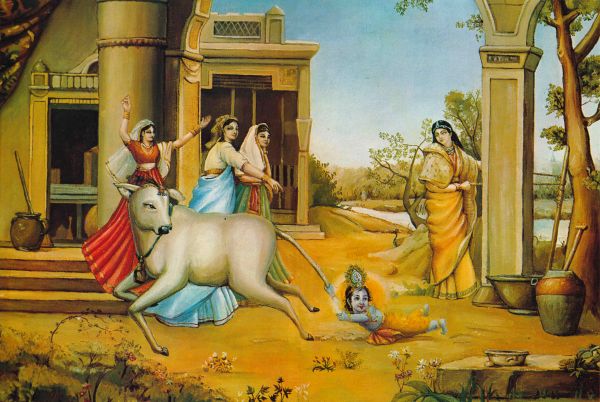
Mother Yaśodā, after taking down the hot milk from the oven, returned to the churning spot, and when she saw that the container of yo gurt was broken and that Kṛṣṇa was not present, she concluded that the breaking of the pot was the work of Kṛṣṇa. (7) Kṛṣṇa, at that time, was sitting on an upside-down wooden mortar for grinding spices and was distributing milk prep arations such as yogurt and butter to the mon keys as He liked. Because of having stolen, He was looking all around with great anxiety, sus pecting that He might be chastised by His mother. Mother Yaśodā, upon seeing Him, very cautiously approached Him from behind. (8) When Lord Śrī Kṛṣṇa saw His mother, stick in hand, He very quickly got down from the top of the mortar and began to flee as if very much afraid. Although yogīs try to capture Him as Paramātmā by meditation, desiring to enter into the effulgence of the Lord with great austerities and penances, they fail to reach Him. But mother Yaśodā, thinking that same Personality of Godhead, Kṛṣṇa, to be her son, began fol lowing Kṛṣṇa to catch Him. (9) While follow ing Kṛṣṇa, mother Yaśodā, her thin waist over burdened by her heavy breasts, naturally had to reduce her speed. Because of following Kṛṣṇa very swiftly, her hair became loose, and the flowers in her hair were falling after her. Yet she did not fail to capture her son, Kṛṣṇa. (10) When caught by mother Yaśodā, Kṛṣṇa became more and more afraid and admitted to being an offender. As she looked upon Him, she saw that He was crying, His tears mixing with the black ointment around His eyes, and as He rubbed His eyes with His hands, He smeared the oint ment all over His face. Mother Yaśodā, catch ing her beautiful son by the hand, mildly began to chastise Him. (11)

Mother Yaśodā was always overwhelmed by intense love for Kṛṣṇa, not knowing who Kṛṣṇa was or how powerful He was. Because of maternal affection for Kṛṣṇa, she never even cared to know who He was. Therefore, when she saw that her son had become excessively afraid, she threw the stick away and desired to bind Him so that He would not commit any fur ther naughty activities. (12)

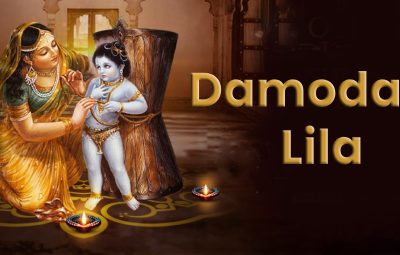
The Supreme Personality of Godhead has no beginning and no end, no exterior and no inte rior, no front and no rear. In other words, He is all-pervading. Because He is not under the in fluence of the element of time, for Him there is no difference between past, present and future; He exists in His own transcendental form at all times. Being absolute, beyond relativity, He is free from distinctions between cause and effect, although He is the cause and effect of every thing. That unmanifested person, who is be yond the perception of the senses, had now ap peared as a human child, and mother Yaśodā, considering Him her own ordinary child, bound Him to the wooden mortar with a rope. (13-14) When mother Yaśodā was trying to bind the offending child, she saw that the binding rope was short by a distance the width of two fin gers. Thus she brought another rope to join to it. (15)

This new rope also was short by a measure ment of two fingers, and when another rope was joined to it, it was still two fingers too short. As many ropes as she joined, all of them failed; their shortness could not be overcome. (16) Thus mother Yaśodā joined whatever ropes were available in the household, but still she failed in her attempt to bind Kṛṣṇa. Mother Yaśodā’s friends, the elderly gopīs in the neigh borhood, were smiling and enjoying the fun. Similarly, mother Yaśodā, although laboring in that way, was also smiling. All of them were struck with wonder. (17) Because of mother Yaśodā’s hard labor, her whole body became covered with perspiration, and the flowers and comb were falling from her hair. When child Kṛṣṇa saw His mother thus fatigued, He be came merciful to her and agreed to be bound. (18) O Mahārāja Parīkṣit, this entire universe, with its great, exalted demigods like Lord Śiva, Lord Brahmā and Lord Indra, is under the con trol of the Supreme Personality of Godhead. Yet the Supreme Lord has one transcendental attribute: He comes under the control of His devotees. This was now exhibited by Kṛṣṇa in this pastime. (19)

Neither Lord Brahmā, nor Lord Śiva, nor even the goddess of fortune, who is always the better half of the Supreme Lord, can obtain from the Supreme Personality of Godhead, the deliverer from this material world, such mercy as received by mother Yaśodā. (20) The Supreme Personality of Godhead, Kṛṣṇa, the son of mother Yaśodā, is accessible to devotees en gaged in spontaneous loving service, but He is not as easily accessible to mental speculators, to those striving for self-realization by severe austerities and penances, or to those who con sider the body the same as the self. (21)

While mother Yaśodā was very busy with household affairs, the Supreme Lord, Kṛṣṇa, observed twin trees known as yamala-arjuna, which in a former millennium had been the demigod sons of Kuvera. (22) In their former birth, these two sons, known as Nalakūvara and Maṇigrīva, were extremely opulent and fortu nate. But because of pride and false prestige, they did not care about anyone, and thus Nārada Muni cursed them to become trees. (23)

library.vedavarsity.com || www.vedavarsity.com

Srimad Bhagavatam | Canto 10 Chapter 8 | Lord Kṛṣṇa Shows The Universal Form Within His Mouth

0

Śukadeva Gosvāmī said: O Mahārāja Parīkṣit, the priest of the Yadu dynasty, namely Garga Muni, who was highly elevated in aus terity and penance, was then inspired by Vasudeva to go see Nanda Mahārāja at his home. (1) When Nanda Mahārāja saw Garga Muni present at his home, Nanda was so pleased that he stood up to receive him with folded hands. Although seeing Garga Muni with his eyes, Nanda Mahārāja could appreci ate that Garga Muni was adhokṣaja; that is, he was not an ordinary person seen by material senses. (2) When Garga Muni had been properly received as a guest and was very com fortably seated, Nanda Mahārāja submitted with gentle and submissive words: Dear sir, be cause you are a devotee, you are full in every thing. Yet my duty is to serve you. Kindly order me. What can I do for you? (3) O my lord, O great devotee, persons like you move from one place to another not for their own interests but for the sake of poor-hearted gṛhasthas [house holders]. Otherwise they have no interest in go ing from one place to another. (4) O great saintly person, you have compiled the astrolog ical knowledge by which one can understand past and present unseen things. By the strength of this knowledge, any human being can under stand what he has done in his past life and how it affects his present life. This is known to you. (5) My lord, you are the best of the brāhmaṇas, especially because you are fully aware of the jyotiḥ-śāstra, the astrological science. There fore, you are naturally the spiritual master of every human being. This being so, since you have kindly come to my house, kindly execute the reformatory activities for my two sons. (6)

Garga Muni said: My dear Nanda Mahārāja, I am the priestly guide of the Yadu dynasty. This is known everywhere. Therefore, if I perform the purificatory process for your sons, Kaṁsa will consider Them the sons of Devakī. (7) Kaṁsa is both a great diplomat and a very sinful man. Therefore, having heard from Yoga-māyā, the daughter of Devakī, that the child who will kill him has already been born somewhere else, having heard that the eighth pregnancy of Devakī could not bring forth a female child, and having understood your friendship with Vasudeva, Kaṁsa, upon hearing that the purificatory process has been performed by me, the priest of the Yadu dyn asty, may certainly consider all these points and suspect that Kṛṣṇa is the son of Devakī and Vasudeva. Then he might take steps to kill Kṛṣṇa. That would be a catastrophe. (8-9)

Nanda Mahārāja said: My dear great sage, if you think that your performing this process of purification will make Kaṁsa suspicious, then secretly chant the Vedic hymns and per form the purifying process of second birth here in the cow shed of my house, without the knowledge of anyone else, even my relatives, for this process of purification is essential. (10)

Śukadeva Gosvāmī continued: Having thus been especially requested by Nanda Mahārāja to do that which he already desired to do, Garga Muni performed the name-giving ceremony for Kṛṣṇa and Balarāma in a solitary place. (11)

Garga Muni said: This child, the son of Ro hiṇī, will give all happiness to His relatives and friends by His transcendental qualities. There fore, He will be known as Rāma. And because He will manifest extraordinary bodily strength, He will also be known as Bala. Moreover, be cause He unites two familiesVasudeva’s family and the family of Nanda MahārājaHe will be known as Saṅkarṣaṇa. (12) Your son Kṛṣṇa ap pears as an incarnation in every millennium. In the past, He assumed three different col orswhite, red and yellowand now He has ap peared in a blackish color. [In another Dvāpara yuga, He appeared (as Lord Rāmacandra) in the color of śuka, a parrot. All such incarnations have now assembled in Kṛṣṇa.] (13) For many reasons, this beautiful son of yours sometimes appeared previously as the son of Vasudeva. Therefore, those who are learned sometimes call this child Vāsudeva. (14) For this son of yours there are many forms and names accord ing to His transcendental qualities and activi ties. These are known to me, but people in gen eral do not understand them. (15) To increase the transcendental bliss of the cowherd men of Gokula, this child will always act auspiciously for you. And by His grace only, you will sur pass all difficulties. (16) O Nanda Mahārāja, as recorded in history, when there was an irregu lar, incapable government, Indra having been dethroned, and people were being harassed and disturbed by thieves, this child appeared in or der to protect the people and enable them to flourish, and He curbed the rogues and thieves. (17) Demons [asuras] cannot harm the demi gods, who always have Lord Viṣṇu on their side. Similarly, any person or group attached to Kṛṣṇa is extremely fortunate. Because such persons are very much affectionate toward Kṛṣṇa, they cannot be defeated by demons like the associates of Kaṁsa [or by the internal en emies, the senses]. (18) In conclusion, there fore, O Nanda Mahārāja, this child of yours is as good as Nārāyaṇa. In His transcendental qualities, opulence, name, fame and influence, He is exactly like Nārāyaṇa. You should all raise this child very carefully and cautiously. (19) Śrīla Śukadeva Gosvāmī continued: After Garga Muni, having instructed Nanda Mahārāja about Kṛṣṇa, departed for his own home, Nanda Mahārāja was very pleased and considered himself full of all good fortune. (20)

After a short time passed, both brothers, Rāma and Kṛṣṇa, began to crawl on the ground of Vraja with the strength of Their hands and knees and thus enjoy Their childhood play. (21)

When Kṛṣṇa and Balarāma, with the strength of Their legs, crawled in the muddy places created in Vraja by cow dung and cow urine, Their crawling resembled the crawling of serpents, and the sound of Their ankle bells was very charming. Very much pleased by the sound of other people’s ankle bells, They used to follow these people as if going to Their mothers, but when They saw that these were other people, They became afraid and returned to Their real mothers, Yaśodā and Rohiṇī. (22) Dressed with muddy earth mixed with cow dung and cow urine, the babies looked very beautiful, and when They went to Their moth ers, both Yaśodā and Rohiṇī picked Them up with great affection, embraced Them and al lowed Them to suck the milk flowing from their breasts. While sucking the breast, the ba bies smiled, and Their small teeth were visible. Their mothers, upon seeing those beautiful teeth, enjoyed great transcendental bliss. (23) Within the house of Nanda Mahārāja, the cow herd ladies would enjoy seeing the pastimes of the babies Rāma and Kṛṣṇa. The babies would catch the ends of the calves’ tails, and the calves would drag Them here and there. When the ladies saw these pastimes, they certainly stopped their household activities and laughed and enjoyed the incidents. (24) When mother Yaśodā and Rohiṇī were unable to protect the babies from calamities threatened by horned cows, by fire, by animals with claws and teeth such as monkeys, dogs and cats, and by thorns, swords and other weapons on the ground, they were always in anxiety, and their household en gagements were disturbed. At that time, they were fully equipoised in the transcendental ec stasy known as the distress of material affec tion, for this was aroused within their minds. (25)

O King Parīkṣit, within a very short time both Rāma and Kṛṣṇa began to walk very easily in Gokula on Their legs, by Their own strength, without the need to crawl. (26) Thereafter, Lord Kṛṣṇa, along with Balarāma, began to play with the other children of the cowherd men, thus awakening the transcendental bliss of the cow herd women. (27) Observing the very attractive childish restlessness of Kṛṣṇa, all the gopīs in the neighborhood, to hear about Kṛṣṇa’s activ ities again and again, would approach mother Yaśodā and speak to her as follows. (28)

“Our dear friend Yaśodā, your son some times comes to our houses before the milking of the cows and releases the calves, and when the master of the house becomes angry, your son merely smiles. Sometimes He devises some process by which He steals palatable curd, but ter and milk, which He then eats and drinks. When the monkeys assemble, He divides it with them, and when the monkeys have their bellies so full that they won’t take more, He breaks the pots. Sometimes, if He gets no op portunity to steal butter or milk from a house, He will be angry at the householders, and for His revenge He will agitate the small children by pinching them. Then, when the children begin crying, Kṛṣṇa will go away. (29) “When the milk and curd are kept high on a swing hanging from the ceiling and Kṛṣṇa and Balarāma cannot reach it, They arrange to reach it by piling up various planks and turning up side down the mortar for grinding spices. Being quite aware of the contents of a pot, They poke holes in it. While the elderly gopīs go about their household affairs, Kṛṣṇa and Balarāma sometimes go into a dark room, brightening the place with the valuable jewels and ornaments on Their bodies and taking advantage of this light by stealing. (30) “When Kṛṣṇa is caught in His naughty activities, the master of the house will say to Him, ‘Oh, You are a thief,’ and artificially express anger at Kṛṣṇa. Kṛṣṇa will then reply, ‘I am not a thief. You are a thief.’ Sometimes, being angry, Kṛṣṇa passes urine and stool in a neat, clean place in our houses. But now, our dear friend Yaśodā, this expert thief is sitting before you like a very good boy.” Sometimes all the gopīs would look at Kṛṣṇa sitting there, His eyes fearful so that His mother would not chastise Him, and when they saw Kṛṣṇa’s beautiful face, instead of chastising Him they would simply look upon His face and enjoy transcendental bliss. Mother Yaśodā would mildly smile at all this fun, and she would not want to chastise her blessed tran scendental child. (31)

One day while Kṛṣṇa was playing with His small playmates, including Balarāma and other sons of the gopas, all His friends came together and lodged a complaint to mother Yaśodā. “Mother,” they submitted, “Kṛṣṇa has eaten earth.” (32) Upon hearing this from Kṛṣṇa’s playmates, mother Yaśodā, who was always full of anxiety over Kṛṣṇa’s welfare, picked Kṛṣṇa up with her hands to look into His mouth and chastise Him. Her eyes fearful, she spoke to her son as follows. (33) Dear Kṛṣṇa, why are You so restless that You have eaten dirt in a solitary place? This complaint has been lodged against You by all Your playmates, including Your elder brother, Balarāma. How is this? (34)

Lord Śrī Kṛṣṇa replied: My dear mother, I have never eaten dirt. All My friends complain ing against Me are liars. If you think they are being truthful, you can directly look into My mouth and examine it. (35) Mother Yaśodā challenged Kṛṣṇa, “If You have not eaten earth, then open Your mouth wide.” When challenged by His mother in this way, Kṛṣṇa, the son of Nanda Mahārāja and Yaśodā, to exhibit pas times like a human child, opened His mouth. Although the Supreme Personality of Godhead, Kṛṣṇa, who is full of all opulences, did not dis turb His mother’s parental affection, His opu lence was automatically displayed, for Kṛṣṇa’s opulence is never lost at any stage, but is man ifest at the proper time. (36)

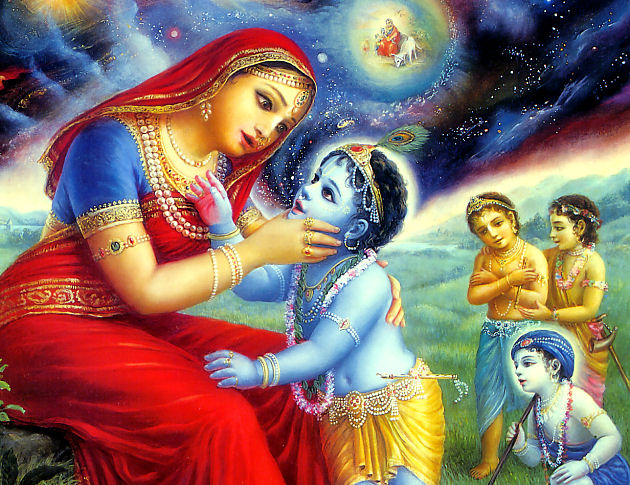
When Kṛṣṇa opened His mouth wide by the order of mother Yaśodā, she saw within His mouth all moving and nonmoving entities, outer space, and all directions, along with mountains, islands, oceans, the surface of the earth, the blowing wind, fire, the moon and the stars. She saw the planetary systems, water, light, air, sky, and creation by transformation of ahaṅkāra. She also saw the senses, the mind, sense perception, and the three qualities, good ness, passion and ignorance. She saw the time allotted for the living entities, she saw natural instinct and the reactions of karma, and she saw desires and different varieties of bodies, mov ing and nonmoving. Seeing all these aspects of the cosmic manifestation, along with herself and Vṛndāvana-dhāma, she became doubtful and fearful of her son’s nature. (37-39) [Mother Yaśodā began to argue within herself:] Is this a dream, or is it an illusory creation by the exter nal energy? Has this been manifested by my own intelligence, or is it some mystic power of my child? (40) Therefore, let me surrender unto the Supreme Personality of Godhead and offer my obeisances unto Him, who is beyond the conception of human speculation, the mind, ac tivities, words and arguments, who is the origi nal cause of this cosmic manifestation, by whom the entire cosmos is maintained, and by whom we can conceive of its existence. Let me simply offer my obeisances, for He is beyond my contemplation, speculation and meditation. He is beyond all of my material activities. (41) It is by the influence of the Supreme Lord’s māyā that I am wrongly thinking that Nanda Mahārāja is my husband, that Kṛṣṇa is my son, and that because I am the queen of Nanda Mahārāja, all the wealth of cows and calves are my possessions and all the cowherd men and their wives are my subjects. Actually, I also am eternally subordinate to the Supreme Lord. He is my ultimate shelter. (42) Mother Yaśodā, by the grace of the Lord, could understand the real truth. But then again, the supreme master, by the influence of the internal potency, Yoga māyā, inspired her to become absorbed in in tense maternal affection for her son. (43) Im mediately forgetting Yoga-māyā’s illusion that Kṛṣṇa had shown the universal form within His mouth, mother Yaśodā took her son on her lap as before, feeling increased affection in her heart for her transcendental child. (44) The glo ries of the Supreme Personality of Godhead are studied through the three Vedas, the Upaniṣads, the literature of Sāṅkhya-yoga, and other Vaiṣṇava literature, yet mother Yaśodā consid ered that Supreme Person her ordinary child. (45)

Having heard of the great fortune of mother Yaśodā, Parīkṣit Mahārāja inquired from Śukadeva Gosvāmī: O learned brāhmaṇa, mother Yaśodā’s breast milk was sucked by the Supreme Personality of Godhead. What past auspicious activities did she and Nanda Mahārāja perform to achieve such perfection in ecstatic love? (46) Although Kṛṣṇa was so pleased with Vasudeva and Devakī that He de scended as their son, they could not enjoy Kṛṣṇa’s magnanimous childhood pastimes, which are so great that simply chanting about them vanquishes the contamination of the ma terial world. Nanda Mahārāja and Yaśodā, however, enjoyed these pastimes fully, and therefore their position is always better than that of Vasudeva and Devakī. (47)

Śukadeva Gosvāmī said: To follow the or ders of Lord Brahmā, Droṇa, the best of the Va sus, along with his wife, Dharā, spoke to Lord Brahmā in this way. (48) Droṇa and Dharā said: Please permit us to be born on the planet earth so that after our appearance, the Supreme Lord, the Personality of Godhead, the supreme con troller and master of all planets, will also ap pear and spread devotional service, the ultimate goal of life, so that those born in this material world may very easily be delivered from the miserable condition of materialistic life by ac cepting this devotional service. (49) When Brahmā said, “Yes, let it be so,” the most for tune Droṇa, who was equal to Bhagavān, ap peared in Vrajapura, Vṛndāvana, as the most fa mous Nanda Mahārāja, and his wife, Dharā, ap peared as mother Yaśodā. (50) Thereafter, O Mahārāja Parīkṣit, best of the Bhāratas, when the Supreme Personality of Godhead became the son of Nanda Mahārāja and Yaśodā, they maintained continuous, unswerving devotional love in parental affection. And in their associa tion, all the other inhabitants of Vṛndāvana, the gopas and gopīs, developed the culture of kṛṣṇa-bhakti. (51) Thus the Supreme Personal ity, Kṛṣṇa, along with Balarāma, lived in Vra jabhūmi, Vṛndāvana, just to substantiate the benediction of Brahmā. By exhibiting different pastimes in His childhood, He increased the transcendental pleasure of Nanda and the other inhabitants of Vṛndāvana. (52)

library.vedavarsity.com || www.vedavarsity.com

Srimad Bhagavatam | Canto 10 Chapter 7 | The Killing Of The Demon Tṛṇāvarta

0

King Parīkṣit said: My lord, Śukadeva Gosvāmī, all the various activities exhibited by the incarnations of the Supreme Personality of Godhead are certainly pleasing to the ear and to the mind. Simply by one’s hearing of these activities, the dirty things in one’s mind immedi ately vanish. Generally we are reluctant to hear about the activities of the Lord, but Kṛṣṇa’s childhood activities are so attractive that they are automatically pleasing to the mind and ear. Thus one’s attachment for hearing about material things, which is the root cause of material existence, vanishes, and one gradually devel ops devotional service to the Supreme Lord, at tachment for Him, and friendship with devotees who give us the contribution of Kṛṣṇa consciousness. If you think it fit, kindly speak about those activities of the Lord. (1-2) Please describe other pastimes of Kṛṣṇa, the Supreme Personality, who appeared on this planet earth, imitating a human child and performing won derful activities like killing Pūtanā. (3)

Śukadeva Gosvāmī said: When mother Yaśodā’s baby was slanting His body to at tempt to rise and turn around, this attempt was observed by a Vedic ceremony. In such a cere mony, called utthāna, which is performed when a child is due to leave the house for the first time, the child is properly bathed. Just after Kṛṣṇa turned three months old, mother Yaśodā celebrated this ceremony with other women of the neighborhood. On that day, there was a con junction of the moon with the constellation Ro hiṇī. As the brāhmaṇas joined by chanting Ve dic hymns and professional musicians also took part, this great ceremony was observed by mother Yaśodā. (4) After completing the bath ing ceremony for the child, mother Yaśodā received the brāhmaṇas by worshiping them with proper respect and giving them ample food grains and other eatables, clothing, desirable cows, and garlands. The brāhmaṇas properly chanted Vedic hymns to observe the auspicious ceremony, and when they finished and mother Yaśodā saw that the child felt sleepy, she lay down on the bed with the child until He was peacefully asleep. (5) The liberal mother Yaśodā, absorbed in celebrating the utthāna ceremony, was busy receiving guests, worship ing them with all respect and offering them clothing, cows, garlands and grains. Thus she could not hear the child crying for His mother. At that time, the child Kṛṣṇa, demanding to drink the milk of His mother’s breast, angrily threw His legs upward. (6) Lord Śrī Kṛṣṇa was lying down underneath the handcart in one cor ner of the courtyard, and although His little legs were as soft as leaves, when He struck the cart with His legs, it turned over violently and col lapsed. The wheels separated from the axle, the hubs and spokes fell apart, and the pole of the handcart broke. On the cart there were many lit tle utensils made of various metals, and all of them scattered hither and thither. (7) When mother Yaśodā and the other ladies who had as sembled for the utthāna festival, and all the men, headed by Nanda Mahārāja, saw the won derful situation, they began to wonder how the handcart had collapsed by itself. They began to wander here and there, trying to find the cause, but were unable to do so. (8) The assembled cowherd men and ladies began to contemplate how this thing had happened. “Is it the work of some demon or evil planet?” they asked. At that time, the small children present asserted that the cart had been kicked apart by the baby Kṛṣṇa. As soon as the crying baby had kicked the cart’s wheel, the cart had collapsed. There was no doubt about it. (9) The assembled gopīs and gopas, unaware that Kṛṣṇa is always unlim ited, could not believe that baby Kṛṣṇa had such inconceivable power. They could not believe the statements of the children, and therefore they neglected these statements as being child ish talk. (10)

Thinking that some bad planet had attacked Kṛṣṇa, mother Yaśodā picked up the crying child and allowed Him to suck her breast. Then she called for experienced brāhmaṇas to chant Vedic hymns and perform an auspicious ritual istic ceremony. (11) After the strong, stout cowherd men assembled the pots and parapher nalia on the handcart and set it up as before, the brāhmaṇas performed a ritualistic ceremony with a fire sacrifice to appease the bad planet, and then, with rice grains, kuśa, water and curd, they worshiped the Supreme Lord. (12) When brāhmaṇas are free from envy, untruthfulness, unnecessary pride, grudges, disturbance by the opulence of others, and false prestige, their blessings never go in vain. Considering this, Nanda Mahārāja soberly took Kṛṣṇa on his lap and invited such truthful brāhmaṇas to perform a ritualistic ceremony according to the holy hymns of the Sāma Veda, Ṛg Veda and Yajur Veda. Then, while the hymns were being chanted, he bathed the child with water mixed with pure herbs, and after performing a fire ceremony, he sumptuously fed all the brāhmaṇas with first-class grains and other food. (13-15) Nanda Mahārāja, for the sake of the affluence of his own son Kṛṣṇa, gave the brāhmaṇas cows fully decorated with garments, flower garlands and gold necklaces. These cows, fully qualified to give ample milk, were given to the brāhmaṇas in charity, and the brāhmaṇas ac cepted them and bestowed blessings upon the whole family, and especially upon Kṛṣṇa. (16) The brāhmaṇas, who were completely expert in chanting the Vedic hymns, were all yogīs fully equipped with mystic powers. Whatever bless ings they spoke were certainly never fruitless. (17)

One day, a year after Kṛṣṇa’s appearance, mother Yaśodā was patting her son on her lap. But suddenly she felt the child to be heavier than a mountain peak, and she could no longer bear His weight. (18) Feeling the child to be as heavy as the entire universe and therefore being anxious, thinking that perhaps the child was be ing attacked by some other ghost or demon, the astonished mother Yaśodā put the child down on the ground and began to think of Nārāyaṇa. Foreseeing disturbances, she called for the brāhmaṇas to counteract this heaviness, and then she engaged in her other household affairs. She had no alternative than to remember the lo tus feet of Nārāyaṇa, for she could not under stand that Kṛṣṇa was the original source of everything. (19)

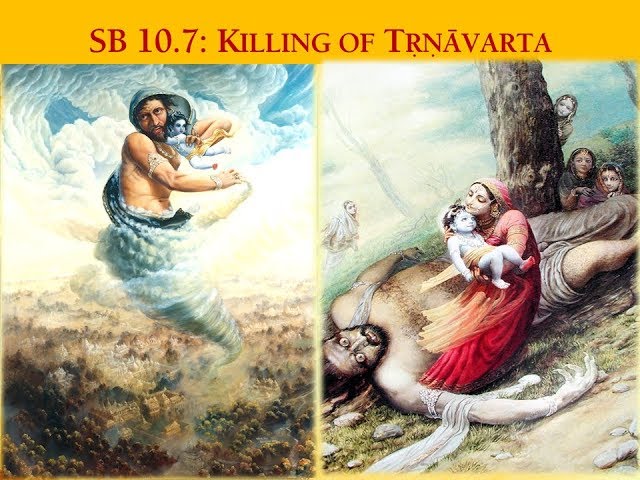
While the child was sitting on the ground, a demon named Tṛṇāvarta, who was a servant of Kaṁsa’s, came there as a whirlwind, at Kaṁsa’s instigation, and very easily carried the child away into the air. (20) Covering the whole land of Gokula with particles of dust, that de mon, acting as a strong whirlwind, covered everyone’s vision and began vibrating every where with a greatly fearful sound. (21) For a moment, the whole pasturing ground was over cast with dense darkness from the dust storm, and mother Yaśodā was unable to find her son where she had placed Him. (22) Because of the bits of sand thrown about by Tṛṇāvarta, people could not see themselves or anyone else, and thus they were illusioned and disturbed. (23) Because of the dust storm stirred up by the strong whirlwind, mother Yaśodā could find no trace of her son, nor could she understand why. Thus she fell down on the ground like a cow who has lost her calf and began to lament very pitifully. (24)

When the force of the dust storm and the winds subsided, Yaśodā’s friends, the other go pīs, approached mother Yaśodā, hearing her pitiful crying. Not seeing Kṛṣṇa present, they too felt very much aggrieved and joined mother Yaśodā in crying, their eyes full of tears. (25)

Having assumed the form of a forceful whirlwind, the demon Tṛṇāvarta took Kṛṣṇa very high in the sky, but when Kṛṣṇa became heavier than the demon, the demon had to stop his force and could go no further. (26)

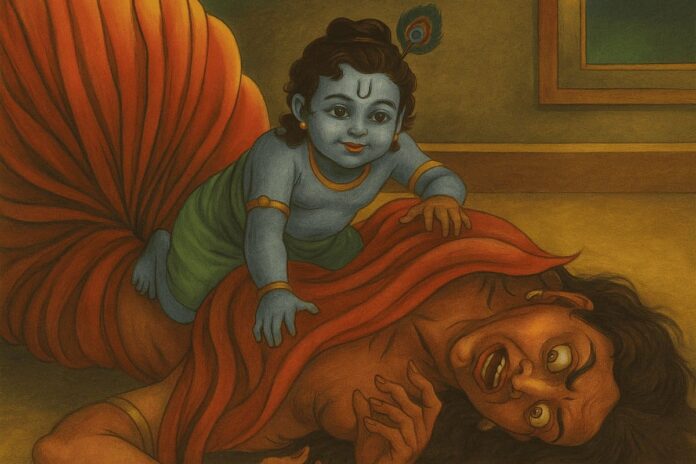
Because of Kṛṣṇa’s weight, Tṛṇāvarta con sidered Him to be like a great mountain or a hunk of iron. But because Kṛṣṇa had caught the demon’s neck, the demon was unable to throw Him off. He therefore thought of the child as wonderful, since he could neither bear the child nor cast aside the burden. (27) With Kṛṣṇa grasping him by the throat, Tṛṇāvarta choked, unable to make even a sound or even to move his hands and legs. His eyes popping out, the demon lost his life and fell, along with the little boy, down to the ground of Vraja. (28) While the gopīs who had gathered were crying for Kṛṣṇa, the demon fell from the sky onto a big slab of stone, his limbs dislocated, as if he had been pierced by the arrow of Lord Śiva like Tripurāsura. (29) The gopīs immediately picked Kṛṣṇa up from the chest of the demon and delivered Him, free from all inauspicious ness, to mother Yaśodā. Because the child, alt hough taken into the sky by the demon, was un hurt and now free from all danger and misfor tune, the gopīs and cowherd men, headed by Nanda Mahārāja, were extremely happy. (30) It is most astonishing that although this innocent child was taken away by the Rākṣasa to be eaten, He has returned without having been killed or even injured. Because this demon was envious, cruel and sinful, he has been killed for his own sinful activities. This is the law of na ture. An innocent devotee is always protected by the Supreme Personality of Godhead, and a sinful person is always vanquished for his sin ful life. (31) Nanda Mahārāja and the others said: We must previously have performed aus terities for a very long time, worshiped the Su preme Personality of Godhead, performed pi ous activities for public life, constructing pub lic roads and wells, and also given charity, as a result of which this boy, although faced with death, has returned to give happiness to His rel atives. (32) Having seen all these incidents in Bṛhadvana, Nanda Mahārāja became more and more astonished, and he remembered the words spoken to him by Vasudeva in Mathurā. (33)

One day, mother Yaśodā, having taken Kṛṣṇa up and placed Him on her lap, was feed ing Him milk from her breast with maternal af fection. The milk was flowing from her breast, and the child was drinking it. (34) O King Parīkṣit, when the child Kṛṣṇa was almost fin ished drinking His mother’s milk and mother Yaśodā was touching Him and looking at His beautiful, brilliantly smiling face, the baby yawned, and mother Yaśodā saw in His mouth the whole sky, the higher planetary system and the earth, the luminaries in all directions, the sun, the moon, fire, air, the seas, islands, moun tains, rivers, forests, and all kinds of living en tities, moving and nonmoving. (35-36) When mother Yaśodā saw the whole universe within the mouth of her child, her heart began to throb, and in astonishment she wanted to close her restless eyes. (37)

library.vedavarsity.com || www.vedavarsity.com

Srimad Bhagavatam | Canto 10 Chapter 6 | The Killing Of The Demon Pūtanā

0

Śukadeva Gosvāmī continued: My dear King, while Nanda Mahārāja was on the way home, he considered that what Vasudeva had said could not be false or useless. There must have been some danger of disturbances in Gokula. As Nanda Mahārāja thought about the danger for his beautiful son, Kṛṣṇa, he was afraid, and he took shelter at the lotus feet of the supreme controller. (1) While Nanda Mahārāja was returning to Gokula, the same fierce Pūtanā whom Kaṁsa had previously en gaged to kill babies was wandering about in the towns, cities and villages, doing her nefarious duty. (2) My dear King, wherever people in any position perform their occupational duties of devotional service by chanting and hearing [śravaṇaṁ kīrtanaṁ viṣṇoḥ], there cannot be any danger from bad elements. Therefore, there was no need for anxiety about Gokula while the Supreme Personality of Godhead was person ally present. (3) Once upon a time, Pūtanā Rākṣasī, who could move according to her de sire and was wandering in outer space, con verted herself by mystic power into a very beautiful woman and thus entered Gokula, the abode of Nanda Mahārāja. (4) Her hips were full, her breasts were large and firm, seeming to overburden her slim waist, and she was dressed very nicely. Her hair, adorned with a garland of mallikā flowers, was scattered about her beau tiful face. Her earrings were brilliant, and as she smiled very attractively, glancing upon every one, her beauty drew the attention of all the in habitants of Vraja, especially the men. When the gopīs saw her, they thought that the beauti ful goddess of fortune, holding a lotus flower in her hand, had come to see her husband, Kṛṣṇa. (5-6)

While searching for small children, Pūtanā, whose business was to kill them, entered the house of Nanda Mahārāja unobstructed, having been sent by the superior potency of the Lord. Without asking anyone’s permission, she en tered Nanda Mahārāja’s room, where she saw the child sleeping in bed, His unlimited power covered like a powerful fire covered by ashes. She could understand that this child was not or dinary, but was meant to kill all demons. (7)

Lord Śrī Kṛṣṇa, the all-pervading Supersoul, lying on the bed, understood that Pūtanā, a witch who was expert in killing small children, had come to kill Him. Therefore, as if afraid of her, Kṛṣṇa closed His eyes. Thus Pūtanā took upon her lap Him who was to be her own anni hilation, just as an unintelligent person places a sleeping snake on his lap, thinking the snake to be a rope. (8) Pūtanā Rākṣasī’s heart was fierce and cruel, but she looked like a very affection ate mother. Thus she resembled a sharp sword in a soft sheath. Although seeing her within the room, Yaśodā and Rohiṇī, overwhelmed by her beauty, did not stop her, but remained silent be cause she treated the child like a mother. (9)

On that very spot, the fiercely dangerous Rākṣasī took Kṛṣṇa on her lap and pushed her breast into His mouth. The nipple of her breast was smeared with a dangerous, immediately ef fective poison, but the Supreme Personality of Godhead, Kṛṣṇa, becoming very angry at her, took hold of her breast, squeezed it very hard with both hands, and sucked out both the poi son and her life. (10) Unbearably pressed in every vital point, the demon Pūtanā began to cry, “Please leave me, leave me! Suck my breast no longer!” Perspiring, her eyes wide open and her arms and legs flailing, she cried very loudly again and again. (11) As Pūtanā screamed loudly and forcefully, the earth with its mountains, and outer space with its planets, trembled. The lower planets and all directions vibrated, and people fell down, fearing that thunderbolts were falling upon them. (12) In this way the demon Pūtanā, very much ag grieved because her breast was being attacked by Kṛṣṇa, lost her life. O King Parīkṣit, opening her mouth wide and spreading her arms, legs and hair, she fell down in the pasturing ground in her original form as a Rākṣasī, as Vṛtrāsura had fallen when killed by the thunderbolt of In dra. (13)

O King Parīkṣit, when the gigantic body of Pūtanā fell to the ground, it smashed all the trees within a limit of twelve miles. Appearing in a gigantic body, she was certainly extraordi nary. (14) The Rākṣasī’s mouth was full of teeth, each resembling the front of a plow, her nostrils were deep like mountain caves, and her breasts resembled big slabs of stone fallen from a hill. Her scattered hair was the color of cop per. The sockets of her eyes appeared like deep blind wells, her fearful thighs resembled the banks of a river, her arms, legs and feet seemed like big bridges, and her abdomen appeared like a dried-up lake. The hearts, ears and heads of the cowherd men and women were already shocked by the Rākṣasī’s screaming, and when they saw the fierce wonder of her body, they were even more frightened. (15-17) Without fear, the child Kṛṣṇa was playing on the upper portion of Pūtanā Rākṣasī’s breast, and when the gopīs saw the child’s wonderful activities, they immediately came forward with great ju bilation and picked Him up. (18)

Thereafter, mother Yaśodā and Rohiṇī, along with the other elderly gopīs, waved about the switch of a cow to give full protection to the child Śrī Kṛṣṇa. (19) The child was thoroughly washed with cow urine and then smeared with the dust raised by the movements of the cows. Then different names of the Lord were applied with cow dung on twelve different parts of His body, beginning with the forehead, as done in applying tilaka. In this way, the child was given protection. (20) The gopīs first executed the process of ācamana, drinking a sip of water from the right hand. They purified their bodies and hands with the nyāsa-mantra and then ap plied the same mantra upon the body of the child. (21)

[Śukadeva Gosvāmī informed Mahārāja Parīkṣit that the gopīs, following the proper system, protected Kṛṣṇa, their child, with this mantra.] May Aja protect Your legs, may Maṇimān protect Your knees, Yajña Your thighs, Acyuta the upper part of Your waist, and Hayagrīva Your abdomen. May Keśava protect Your heart, Īśa Your chest, the sun-god Your neck, Viṣṇu Your arms, Urukrama Your face, and Īśvara Your head. May Cakrī protect You from the front; may Śrī Hari, Gadādharī, the carrier of the club, protect You from the back; and may the carrier of the bow, who is known as the enemy of Madhu, and Lord Ajana, the carrier of the sword, protect Your two sides. May Lord Urugāya, the carrier of the conchshell, protect You from all corners; may Upendra protect You from above; may Garuḍa protect You on the ground; and may Lord Haladhara, the Supreme Person, protect You on all sides. (22-23) May Hṛṣīkeśa protect Your senses, and Nārāyaṇa Your life air. May the master of Śvetadvīpa protect the core of Your heart, and may Lord Yogeśvara protect Your mind. (24) May Lord Pṛśnigarbha protect Your intelligence, and the Supreme Personality of Godhead Your soul. While You are playing, may Govinda protect You, and while You are sleeping may Mādhava protect You. May Lord Vaikuṇṭha protect You while You are walking, and may Lord Nārāyaṇa, the husband of the goddess of fortune, protect You while You are sitting. Similarly, may Lord Yajñabhuk, the fearful enemy of all evil planets, always protect You while You enjoy life. (25-26) The evil witches known as Ḍākinīs, Yātudhānīs and Kuṣmāṇḍas are the greatest enemies of chil dren, and the evil spirits like Bhūtas, Pretas, Piśācas, Yakṣas, Rākṣasas and Vināyakas, as well as witches like Koṭarā, Revatī, Jyeṣṭhā, Pūtanā and Mātṛkā, are always ready to give trouble to the body, the life air and the senses, causing loss of memory, madness and bad dreams. Like the most experienced evil stars, they all create great disturbances, especially for children, but one can vanquish them simply by uttering Lord Viṣṇu’s name, for when Lord Viṣṇu’s name resounds, all of them become afraid and go away. (27-29)

Śrīla Śukadeva Gosvāmī continued: All the gopīs, headed by mother Yaśodā, were bound by maternal affection. After they thus chanted mantras to protect the child, mother Yaśodā gave the child the nipple of her breast to suck and then got Him to lie down on His bed. (30) Meanwhile, all the cowherd men, headed by Nanda Mahārāja, returned from Ma thurā, and when they saw on the way the gigan tic body of Pūtanā lying dead, they were struck with great wonder. (31) Nanda Mahārāja and the other gopas exclaimed: My dear friends, you must know that Ānakadundubhi, Vasudeva, has become a great saint or a master of mystic power. Otherwise how could he have foreseen this calamity and predicted it to us? (32) The inhabitants of Vraja cut the gigantic body of Pūtanā into pieces with the help of axes. Then they threw the pieces far away, cov ered them with wood and burned them to ashes. (33) Because of Kṛṣṇa’s having sucked the breast of the Rākṣasī Pūtanā, when Kṛṣṇa killed her she was immediately freed of all material contamination. Her sinful reactions automati cally vanished, and therefore when her gigantic body was being burnt, the smoke emanating from her body was fragrant like aguru incense. (34) Pūtanā was always hankering for the blood of human children, and with that desire she came to kill Kṛṣṇa; but because she offered her breast to the Lord, she attained the greatest achievement. What then is to be said of those who had natural devotion and affection for Kṛṣṇa as mothers and who offered Him their breasts to suck or offered something very dear, as a mother offers something to a child? (35-36) The Supreme Personality of Godhead, Kṛṣṇa, is always situated within the core of the heart of the pure devotee, and He is always of fered prayers by such worshipable personalities as Lord Brahmā and Lord Śiva. Because Kṛṣṇa embraced Pūtanā’s body with great pleasure and sucked her breast, although she was a great witch, she attained the position of a mother in the transcendental world and thus achieved the highest perfection. What then is to be said of the cows whose nipples Kṛṣṇa sucked with great pleasure and who offered their milk very jubilantly with affection exactly like that of a mother? (37-38) The Supreme Personality of Godhead, Kṛṣṇa, is the bestower of many ben edictions, including liberation [kaivalya], or oneness with the Brahman effulgence. For that Personality of Godhead, the gopīs always felt maternal love, and Kṛṣṇa sucked their breasts with full satisfaction. Therefore, because of their relationship as mother and son, although the gopīs were engaged in various family activ ities, one should never think that they returned to this material world after leaving their bodies. (39-40)

Upon smelling the fragrance of the smoke emanating from Pūtanā’s burning body, many inhabitants of Vrajabhūmi in distant places were astonished. “Where is this fragrance com ing from?” they asked. Thus they went to the spot where Pūtanā’s body was being burnt. (41) When the inhabitants of Vraja who had come from distant places heard the whole story of how Pūtanā had come and then been killed by Kṛṣṇa, they were certainly astonished, and they offered their blessings to the child for His won derful deed of killing Pūtanā. Nanda Mahārāja, of course, was very much obliged to Vasudeva, who had foreseen the incident, and simply thanked him, thinking how wonderful Vasudeva was. (42) O Mahārāja Parīkṣit, best of the Kurus, Nanda Mahārāja was very liberal and simple. He immediately took his son Kṛṣṇa on his lap as if Kṛṣṇa had returned from death, and by formally smelling his son’s head, Nanda Mahārāja undoubtedly enjoyed transcendental bliss. (43) Any person who hears with faith and devotion about how Kṛṣṇa, the Supreme Per sonality of Godhead, killed Pūtanā, and who thus invests his hearing in such childhood pas times of Kṛṣṇa, certainly attains attachment for Govinda, the supreme, original person. (44)

library.vedavarsity.com || www.vedavarsity.com

Srimad Bhagavatam | Canto 10 Chapter 5 | The Meeting Of Nanda Mahārāja And Vasudeva

0

Śukadeva Gosvāmī said: Nanda Mahārāja was naturally very magnanimous, and when Lord Śrī Kṛṣṇa appeared as his son, he was overwhelmed by jubilation. Therefore, after bathing and purifying himself and dressing himself properly, he invited brāhmaṇas who knew how to recite Vedic mantras. After hav ing these qualified brāhmaṇas recite auspicious Vedic hymns, he arranged to have the Vedic birth ceremony celebrated for his newborn child according to the rules and regulations, and he also arranged for worship of the demigods and forefathers. (1-2) Nanda Mahārāja gave two million cows, completely decorated with cloth and jewels, in charity to the brāhmaṇas. He also gave them seven hills of grain, covered with jewels and with cloth decorated with golden embroidery. (3)

O King, by the passing of time, land and other material possessions are purified; by bathing, the body is purified; and by being cleansed, unclean things are purified. By purifi catory ceremonies, birth is purified; by auster ity, the senses are purified; and by worship and charity offered to the brāhmaṇas, material pos sessions are purified. By satisfaction, the mind is purified; and by self-realization, or Kṛṣṇa consciousness, the soul is purified. (4) The brāhmaṇas recited auspicious Vedic hymns, which purified the environment by their vibra tion. The experts in reciting old histories like the Purāṇas, the experts in reciting the histories of royal families, and general reciters all chanted, while singers sang and many kinds of musical instruments, like bherīs and dundubhis, played in accompaniment. (5) Vrajapura, the residence of Nanda Mahārāja, was fully deco rated with varieties of festoons and flags, and in different places, gates were made with vari eties of flower garlands, pieces of cloth, and mango leaves. The courtyards, the gates near the roads, and everything within the rooms of the houses were perfectly swept and washed with water. (6)

The cows, the bulls and the calves were thor oughly smeared with a mixture of turmeric and oil, mixed with varieties of minerals. Their heads were bedecked with peacock feathers, and they were garlanded and covered with cloth and golden ornaments. (7) O King Parīkṣit, the cowherd men dressed very opulently with val uable ornaments and garments such as coats and turbans. Decorated in this way and carrying various presentations in their hands, they ap proached the house of Nanda Mahārāja. (8)

The gopī wives of the cowherd men were very pleased to hear that mother Yaśodā had given birth to a son, and they began to decorate themselves very nicely with proper dresses, or naments, black ointment for the eyes, and so on. (9) Their lotuslike faces extraordinarily beautiful, being decorated with saffron and newly grown kuṅkuma, the wives of the cow herd men hurried to the house of mother Yaśodā with presentations in their hands. Be cause of natural beauty, the wives had full hips and full breasts, which moved as they hurried along. (10) In the ears of the gopīs were bril liantly polished jeweled earrings, and from their necks hung metal lockets. Their hands were decorated with bangles, their dresses were of varied colors, and from their hair, flowers fell onto the street like showers. Thus while go ing to the house of Mahārāja Nanda, the gopīs, their earrings, breasts and garlands moving, were brilliantly beautiful. (11) Offering bless ings to the newborn child, Kṛṣṇa, the wives and daughters of the cowherd men said, “May You become the King of Vraja and long maintain all its inhabitants.” They sprinkled a mixture of turmeric powder, oil and water upon the birth less Supreme Lord and offered their prayers. (12) Now that the all-pervading, unlimited Lord Kṛṣṇa, the master of the cosmic manifes tation, had arrived within the estate of Mahārāja Nanda, various types of musical instruments re sounded to celebrate the great festival. (13) In gladness, the cowherd men enjoyed the great festival by splashing one another’s bodies with a mixture of curd, condensed milk, butter and water. They threw butter on one another and smeared it on one another’s bodies. (14) The great-minded Mahārāja Nanda gave clothing, ornaments and cows in charity to the cowherd men in order to please Lord Viṣṇu, and thus he improved the condition of his own son in all re spects. He distributed charity to the sūtas, the māgadhas, the vandīs, and men of all other pro fessions, according to their educational qualifi cations, and satisfied everyone’s desires. (15 16) The most fortunate Rohiṇī, the mother of Baladeva, was honored by Nanda Mahārāja and Yaśodā, and thus she also dressed gorgeously and decorated herself with a necklace, a garland and other ornaments. She was busy wandering here and there to receive the women who were guests at the festival. (17) O Mahārāja Parīkṣit, the home of Nanda Mahārāja is eternally the abode of the Supreme Personality of Godhead and His transcendental qualities and is there fore always naturally endowed with the opu lence of all wealth. Yet beginning from Lord Kṛṣṇa’s appearance there, it became the place for the pastimes of the goddess of fortune. (18)

Śukadeva Gosvāmī continued: Thereafter, my dear King Parīkṣit, O best protector of the Kuru dynasty, Nanda Mahārāja appointed the local cowherd men to protect Gokula and then went to Mathurā to pay the yearly taxes to King Kaṁsa. (19) When Vasudeva heard that Nanda Mahārāja, his very dear friend and brother, had come to Mathurā and already paid the taxes to Kaṁsa, he went to Nanda Mahārāja’s resi dence. (20) When Nanda Mahārāja heard that Vasudeva had come, he was overwhelmed with love and affection, being as pleased as if his body had regained its life. Seeing Vasudeva suddenly present, he got up and embraced him with both arms. (21) O Mahārāja Parīkṣit, hav ing thus been received and welcomed by Nanda Mahārāja with honor, Vasudeva sat down very peacefully and inquired about his own two sons because of intense love for them. (22)

My dear brother Nanda Mahārāja, at an ad vanced age you had no son at all and were hopeless of having one. Therefore, that you now have a son is a sign of great fortune. (23) It is also by good fortune that I am seeing you. Having obtained this opportunity, I feel as if I have taken birth again. Even though one is pre sent in this world, to meet with intimate friends and dear relatives in this material world is ex tremely difficult. (24) Many planks and sticks, unable to stay together, are carried away by the force of a river’s waves. Similarly, although we are intimately related with friends and family members, we are unable to stay together be cause of our varied past deeds and the waves of time. (25) My dear friend Nanda Mahārāja, in the place where you are living with your friends, is the forest favorable for the animals, the cows? I hope there is no disease or incon venience. The place must be full of water, grass and other plants. (26) My son Baladeva, being raised by you and your wife, Yaśodādevī, con siders you His father and mother. Is He living very peacefully in your home with His real mother, Rohiṇī? (27) When one’s friends and relatives are properly situated, one’s religion, economic development and sense gratification, as described in the Vedic literatures, are bene ficial. Otherwise, if one’s friends and relatives are in distress, these three cannot offer any hap piness. (28)

Nanda Mahārāja said: Alas, King Kaṁsa killed so many of your children, born of Devakī. And your one daughter, the youngest child of all, entered the heavenly planets. (29) Every man is certainly controlled by destiny, which determines the results of one’s fruitive activities. In other words, one has a son or daughter because of unseen destiny, and when the son or daughter is no longer present, this also is due to unseen destiny. Destiny is the ul timate controller of everyone. One who knows this is never bewildered. (30) Vasudeva said to Nanda Mahārāja: Now, my dear brother, since you have paid the annual taxes to Kaṁsa and have also seen me, do not stay in this place for many days. It is better to return to Gokula, since I know that there may be some disturbances there. (31)

Śukadeva Gosvāmī said: After Vasudeva advised Nanda Mahārāja in this way, Nanda Mahārāja and his associates, the cowherd men, took permission from Vasudeva, yoked their bulls to the bullock carts, and started riding for Gokula. (32)

library.vedavarsity.com || www.vedavarsity.com

Srimad Bhagavatam | Canto 10 Chapter 4 | The Atrocities Of King Kaṁsav

0

Śukadeva Gosvāmī continued: My dear King Parīkṣit, the doors inside and outside the house closed as before. Thereafter, the inhabit ants of the house, especially the watchmen, heard the crying of the newborn child and thus awakened from their beds. (1) Thereafter, all the watchmen very quickly approached King Kaṁsa, the ruler of the Bhoja dynasty, and sub mitted the news of the birth of Devakī’s child. Kaṁsa, who had awaited this news very anx iously, immediately took action. (2) Kaṁsa im mediately got up from bed, thinking, “Here is Kāla, the supreme time factor, which has taken birth to kill me!” Thus overwhelmed, Kaṁsa, his hair scattered on his head, at once ap proached the place where the child had been born. (3) Devakī helplessly, piteously appealed to Kaṁsa: My dear brother, all good fortune unto you. Don’t kill this girl. She will be your daughter-in-law. Indeed, it is unworthy of you to kill a woman. (4)

My dear brother, by the influence of destiny you have already killed many babies, each of them as bright and beautiful as fire. But kindly spare this daughter. Give her to me as your gift. (5) My lord, my brother, I am very poor, being bereft of all my children, but still I am your younger sister, and therefore it would be wor thy of you to give me this last child as a gift. (6)

Śukadeva Gosvāmī continued: Piteously embracing her daughter and crying, Devakī begged Kaṁsa for the child, but he was so cruel that he chastised her and forcibly snatched the child from her hands. (7) Having uprooted all relationships with his sister because of intense selfishness, Kaṁsa, who was sitting on his knees, grasped the newborn child by the legs and tried to dash her against the surface of a stone. (8)

The child, Yoga-māyā-devī, the younger sister of Lord Viṣṇu, slipped upward from Kaṁsa’s hands and appeared in the sky as Devī, the goddess Durgā, with eight arms, com pletely equipped with weapons. (9) The god dess Durgā was decorated with flower gar lands, smeared with sandalwood pulp and dressed with excellent garments and ornaments made of valuable jewels. Holding in her hands a bow, a trident, arrows, a shield, a sword, a conchshell, a disc and a club, and being praised by celestial beings like Apsarās, Kinnaras, Ura gas, Siddhas, Cāraṇas and Gandharvas, who worshiped her with all kinds of presentations, she spoke as follows. (10-11) O Kaṁsa, you fool, what will be the use of killing me? The Supreme Personality of Godhead, who has been your enemy from the very beginning and who will certainly kill you, has already taken His birth somewhere else. Therefore, do not un necessarily kill other children. (12) After speaking to Kaṁsa in this way, the goddess Durgā, Yoga-māyā, appeared in different places, such as Vārāṇasī, and became cele brated by different names, such as Annapūrṇā, Durgā, Kālī and Bhadrā. (13)

After hearing the words of the goddess Durgā, Kaṁsa was struck with wonder. Thus he approached his sister Devakī and brother-in law Vasudeva, released them immediately from their shackles, and very humbly spoke as follows. (14) Alas, my sister! Alas, my brother in-law! I am indeed so sinful that exactly like a man-eater [Rākṣasa] who eats his own child, I have killed so many sons born of you. (15) Be ing merciless and cruel, I have forsaken all my relatives and friends. Therefore, like a person who has killed a brāhmaṇa, I do not know to which planet I shall go, either after death or while breathing. (16) Alas, not only human be ings but sometimes even providence lies. And I am so sinful that I believed the omen of provi dence and killed so many of my sister’s chil dren. (17) O great souls, your children have suf fered their own misfortune. Therefore, please do not lament for them. All living entities are under the control of the Supreme, and they can not always live together. (18) In this world, we can see that pots, dolls and other products of the earth appear, break and then disappear, mixing with the earth. Similarly, the bodies of all con ditioned living entities are annihilated, but the living entities, like the earth itself, are unchang ing and never annihilated [na hanyate han yamāne śarīre]. (19)

One who does not understand the constitu tional position of the body and the soul [ātmā] becomes too attached to the bodily concept of life. Consequently, because of attachment to the body and its by-products, he feels affected by union with and separation from his family, society and nation. As long as this continues, one continues his material life. [Otherwise, one is liberated.] (20) My dear sister Devakī, all good fortune unto you. Everyone suffers and enjoys the results of his own work under the control of providence. Therefore, although your sons have unfortunately been killed by me, please do not lament for them. (21) In the bodily conception of life, one remains in dark ness, without self-realization, thinking, “I am being killed” or “I have killed my enemies.” As long as a foolish person thus considers the self to be the killer or the killed, he continues to be responsible for material obligations, and conse quently he suffers the reactions of happiness and distress. (22) Kaṁsa begged, “My dear sis ter and brother-in-law, please be merciful to such a poor-hearted person as me, since both of you are saintly persons. Please excuse my atrocities.” Having said this, Kaṁsa fell at the feet of Vasudeva and Devakī, his eyes full of tears of regret. (23) Fully believing in the words of the goddess Durgā, Kaṁsa exhibited his fa milial affection for Devakī and Vasudeva by immediately releasing them from their iron shackles. (24) When Devakī saw her brother actually repentant while explaining ordained events, she was relieved of all anger. Similarly, Vasudeva was also free from anger. Smiling, he spoke to Kaṁsa as follows. (25) O great per sonality Kaṁsa, only by the influence of igno rance does one accept the material body and bodily ego. What you have said about this phi losophy is correct. Persons in the bodily con cept of life, lacking self-realization, differenti ate in terms of “This is mine” and “This be longs to another.” (26) Persons with the vision of differentiation are imbued with the material qualities lamentation, jubilation, fear, envy, greed, illusion and madness. They are influ enced by the immediate cause, which they are busy counteracting, because they have no knowledge of the remote, supreme cause, the Personality of Godhead. (27)

Śukadeva Gosvāmī continued: Thus hav ing been addressed in purity by Devakī and Vasudeva, who were very much appeased, Kaṁsa felt pleased, and with their permission he entered his home. (28) After that night passed, Kaṁsa summoned his ministers and in formed them of all that had been spoken by Yoga-māyā [who had revealed that He who was to slay Kaṁsa had already been born some where else]. (29) After hearing their master’s statement, the envious asuras, who were ene mies of the demigods and were not very expert in their dealings, advised Kaṁsa as follows. (30) If this is so, O King of the Bhoja dynasty, beginning today we shall kill all the children born in all the villages, towns and pasturing grounds within the past ten days or slightly more. (31) The demigods always fear the sound of your bowstring. They are constantly in anx iety, afraid of fighting. Therefore, what can they do by their endeavors to harm you? (32) While being pierced by your arrows, which you discharged on all sides, some of them, who were injured by the multitude of arrows but who desired to live, fled the battlefield, intent on escaping. (33) Defeated and bereft of all weapons, some of the demigods gave up fighting and praised you with folded hands, and some of them, appearing before you with loos ened garments and hair, said, “O lord, we are very much afraid of you.” (34) When the dem igods are bereft of their chariots, when they for get how to use weapons, when they are fearful or attached to something other than fighting, or when their bows are broken and they have thus lost the ability to fight, Your Majesty does not kill them. (35) The demigods boast uselessly while away from the battlefield. Only where there is no fighting can they show their prow ess. Therefore, from such demigods we have nothing to fear. As for Lord Viṣṇu, He is in se clusion in the core of the hearts of the yogīs. As for Lord Śiva, he has gone to the forest. And as for Lord Brahmā, he is always engaged in aus terities and meditation. The other demigods, headed by Indra, are devoid of prowess. There fore, you have nothing to fear. (36) Nonethe less, because of their enmity, our opinion is that the demigods should not be neglected. There fore, to uproot them completely, engage us in fighting with them, for we are ready to follow you. (37) As a disease, if initially neglected, be comes acute and impossible to cure, or as the senses, if not controlled at first, are impossible to control later, an enemy, if neglected in the beginning, later becomes insurmountable. (38) The foundation of all the demigods is Lord Viṣṇu, who lives and is worshiped wherever there are religious principles, traditional cul ture, the Vedas, cows, brāhmaṇas, austerities, and sacrifices with proper remuneration. (39) O King, we, who are your adherents in all re spects, shall therefore kill the Vedic brāhmaṇas, the persons engaged in offering sacrifices and austerities, and the cows that sup ply milk, from which clarified butter is ob tained for the ingredients of sacrifice. (40) The brāhmaṇas, the cows, Vedic knowledge, aus terity, truthfulness, control of the mind and senses, faith, mercy, tolerance and sacrifice are the different parts of the body of Lord Viṣṇu, and they are the paraphernalia for a godly civi lization. (41) Lord Viṣṇu, the Supersoul within the core of everyone’s heart, is the ultimate en emy of the asuras and is therefore known as asura-dviṭ. He is the leader of all the demigods because all the demigods, including Lord Śiva and Lord Brahmā, exist under His protection. The great saintly persons, sages and Vaiṣṇavas also depend upon Him. To persecute the Vaiṣṇavas, therefore, is the only way to kill Viṣṇu. (42)

Śukadeva Gosvāmī continued: Thus, hav ing considered the instructions of his bad min isters, Kaṁsa, who was bound by the laws of Yamarāja and devoid of good intelligence be cause he was a demon, decided to persecute the saintly persons, the brāhmaṇas, as the only way to achieve his own good fortune. (43) These de mons, the followers of Kaṁsa, were expert at persecuting others, especially the Vaiṣṇavas, and could assume any form they desired. After giving these demons permission to go every where and persecute the saintly persons, Kaṁsa entered his palace. (44) Surcharged with pas sion and ignorance and not knowing what was good or bad for them, the asuras, for whom im pending death was waiting, began the persecu tion of the saintly persons. (45) My dear King, when a man persecutes great souls, all his ben edictions of longevity, beauty, fame, religion, blessings and promotion to higher planets will be destroyed. (46)

library.vedavarsity.com || www.vedavarsity.com

Stay Connected

16,985FansLike
12,500FollowersFollow
61,453SubscribersSubscribe
Have a question?Send us an enquiry. We usually reply within a day.