


Mail ID: contact@vedavarsity.com

Contact: +91 9634998911

Google search engineGoogle search engine
Home Blog Page 91

Srimad Bhagavatam | Canto 10 Chapter 3 | The Birth Of Lord Kṛṣṇa

0

Thereafter, at the auspicious time for the ap pearance of the Lord, the entire universe was surcharged with all the qualities of goodness, beauty and peace. The constellation Rohiṇī ap peared, as did stars like Aśvinī. The sun, the moon and the other stars and planets were very peaceful. All directions appeared extremely pleasing, and the beautiful stars twinkled in the cloudless sky. Decorated with towns, villages, mines and pasturing grounds, the earth seemed all-auspicious. The rivers flowed with clear wa ter, and the lakes and vast reservoirs, full of lil ies and lotuses, were extraordinarily beautiful. In the trees and green plants, full of flowers and leaves, pleasing to the eyes, birds like cuckoos and swarms of bees began chanting with sweet voices for the sake of the demigods. A pure breeze began to blow, pleasing the sense of touch and bearing the aroma of flowers, and when the brāhmaṇas engaging in ritualistic cer emonies ignited their fires according to Vedic principles, the fires burned steadily, undis turbed by the breeze. Thus when the birthless Lord Viṣṇu, the Supreme Personality of God head, was about to appear, the saints and brāhmaṇas, who had always been disturbed by demons like Kaṁsa and his men, felt peace within the core of their hearts, and kettledrums simultaneously vibrated from the upper plane tary system. (1-5)

The Kinnaras and Gandharvas began to sing auspicious songs, the Siddhas and Cāraṇas of fered auspicious prayers, and the Vidyādharīs, along with the Apsarās, began to dance in jubi lation. (6) The demigods and great saintly per sons showered flowers in a joyous mood, and clouds gathered in the sky and very mildly thundered, making sounds like those of the ocean’s waves. Then the Supreme Personality of Godhead, Viṣṇu, who is situated in the core of everyone’s heart, appeared from the heart of Devakī in the dense darkness of night, like the full moon rising on the eastern horizon, because Devakī was of the same category as Śrī Kṛṣṇa. (7-8)

Vasudeva then saw the newborn child, who had very wonderful lotuslike eyes and who bore in His four hands the four weapons śaṅkha, cakra, gadā and padma. On His chest was the mark of Śrīvatsa and on His neck the brilliant Kaustubha gem. Dressed in yellow, His body blackish like a dense cloud, His scat tered hair fully grown, and His helmet and ear rings sparkling uncommonly with the valuable gem Vaidūrya, the child, decorated with a bril liant belt, armlets, bangles and other orna ments, appeared very wonderful. (9-10) When Vasudeva saw his extraordinary son, his eyes were struck with wonder. In transcendental ju bilation, he mentally collected ten thousand cows and distributed them among the brāhmaṇas as a transcendental festival. (11) O Mahārāja Parīkṣit, descendant of King Bharata, Vasudeva could understand that this child was the Supreme Personality of Godhead, Nārāyaṇa. Having concluded this without a doubt, he became fearless. Bowing down with folded hands and concentrating his attention, he began to offer prayers to the child, who illumi nated His birthplace by His natural influence. (12)

Vasudeva said: My Lord, You are the Su preme Person, beyond material existence, and You are the Supersoul. Your form can be per ceived by transcendental knowledge, by which You can be understood as the Supreme Person ality of Godhead. I now understand Your posi tion perfectly. (13) My Lord, You are the same person who in the beginning created this mate rial world by His personal external energy. Af ter the creation of this world of three guṇas [sattva, rajas and tamas], You appear to have entered it, although in fact You have not. (14) The mahat-tattva, the total material energy, is undivided, but because of the material modes of nature, it appears to separate into earth, wa ter, fire, air and ether. Because of the living en ergy [jīva-bhūta], these separated energies combine to make the cosmic manifestation vis ible, but in fact, before the creation of the cos mos, the total energy is already present. There fore, the total material energy never actually enters the creation. Similarly, although You are perceived by our senses because of Your pres ence, You cannot be perceived by the senses, nor experienced by the mind or words [avāṅ mānasa-gocara]. With our senses we can per ceive some things, but not everything; for ex ample, we can use our eyes to see, but not to taste. Consequently, You are beyond percep tion by the senses. Although in touch with the modes of material nature, You are unaffected by them. You are the prime factor in every thing, the all-pervading, undivided Supersoul. For You, therefore, there is no external or inter nal. You never entered the womb of Devakī; ra ther, You existed there already. (15-17) One who considers his visible body, which is a product of the three modes of nature, to be in dependent of the soul is unaware of the basis of existence, and therefore he is a rascal. Those who are learned have rejected this conclusion because one can understand through full dis cussion that with no basis in soul, the visible body and senses would be insubstantial. None theless, although his conclusion has been re jected, a foolish person considers it a reality. (18) O my Lord, learned Vedic scholars con clude that the creation, maintenance and anni hilation of the entire cosmic manifestation are performed by You, who are free from en deavor, unaffected by the modes of material na ture, and changeless in Your spiritual situation. There are no contradictions in You, who are the Supreme Personality of Godhead, Parabrah man. Because the three modes of material na turesattva, rajas and tamasare under Your con trol, everything takes place automatically. (19) My Lord, Your form is transcendental to the three material modes, yet for the maintenance of the three worlds, You assume the white color of Viṣṇu in goodness; for creation, which is surrounded by the quality of passion, You ap pear reddish; and at the end, when there is a need for annihilation, which is surrounded by ignorance, You appear blackish. (20) O my Lord, proprietor of all creation, You have now appeared in my house, desiring to protect this world. I am sure that You will kill all the armies that are moving all over the world under the leadership of politicians who are dressed as kṣatriya rulers but who are factually demons. They must be killed by You for the protection of the innocent public. (21) O my Lord, Lord of the demigods, after hearing the prophecy that You would take birth in our home and kill him, this uncivilized Kaṁsa killed so many of Your elder brothers. As soon as he hears from his lieutenants that You have appeared, he will im mediately come with weapons to kill You. (22)

Śukadeva Gosvāmī continued: Thereafter, having seen that her child had all the symptoms of the Supreme Personality of Godhead, Devakī, who was very much afraid of Kaṁsa and unusually astonished, began to offer pray ers to the Lord. (23)

Śrī Devakī said: My dear Lord, there are different Vedas, some of which describe You as unperceivable through words and the mind. Yet You are the origin of the entire cosmic manifestation. You are Brahman, the greatest of everything, full of effulgence like the sun. You have no material cause, You are free from change and deviation, and You have no mate rial desires. Thus the Vedas say that You are the substance. Therefore, my Lord, You are di rectly the origin of all Vedic statements, and by understanding You, one gradually understands everything. You are different from the light of Brahman and Paramātmā, yet You are not dif ferent from them. Everything emanates from You. Indeed, You are the cause of all causes, Lord Viṣṇu, the light of all transcendental knowledge. (24)

After millions of years, at the time of cosmic annihilation, when everything, manifested and unmanifested, is annihilated by the force of time, the five gross elements enter into the sub tle conception, and the manifested categories enter into the unmanifested substance. At that time, You alone remain, and You are known as Ananta Śeṣa-nāga. (25) O inaugurator of the material energy, this wonderful creation works under the control of powerful time, which is di vided into seconds, minutes, hours and years. This element of time, which extends for many millions of years, is but another form of Lord Viṣṇu. For Your pastimes, You act as the con troller of time, but You are the reservoir of all good fortune. Let me offer my full surrender unto Your Lordship. (26) No one in this mate rial world has become free from the four prin ciples birth, death, old age and disease, even by fleeing to various planets. But now that You have appeared, My Lord, death is fleeing in fear of You, and the living entities, having obtained shelter at Your lotus feet by Your mercy, are sleeping in full mental peace. (27) My Lord, be cause You dispel all the fear of Your devotees, I request You to save us and give us protection from the terrible fear of Kaṁsa. Your form as Viṣṇu, the Supreme Personality of Godhead, is appreciated by yogīs in meditation. Please make this form invisible to those who see with material eyes. (28) O Madhusūdana, because of Your appearance, I am becoming more and more anxious in fear of Kaṁsa. Therefore, please arrange for that sinful Kaṁsa to be una ble to understand that You have taken birth from my womb. (29) O my Lord, You are the all-pervading Supreme Personality of God head, and Your transcendental four-armed form, holding conchshell, disc, club and lotus, is unnatural for this world. Please withdraw this form [and become just like a natural human child so that I may try to hide You somewhere]. (30) At the time of devastation, the entire cos mos, containing all created moving and non moving entities, enters Your transcendental body and is held there without difficulty. But now this transcendental form has taken birth from my womb. People will not be able to be lieve this, and I shall become an object of ridi cule. (31)

The Supreme Personality of Godhead re plied: My dear mother, best of the chaste, in your previous birth, in the Svāyambhuva mil lennium, you were known as Pṛśni, and Vasudeva, who was the most pious Prajāpati, was named Sutapā. (32) When both of you were ordered by Lord Brahmā to create prog eny, you first underwent severe austerities by controlling your senses. (33) My dear father and mother, you endured rain, wind, strong sun, scorching heat and severe cold, suffering all sorts of inconvenience according to different seasons. By practicing prāṇāyāma to control the air within the body through yoga, and by eating only air and dry leaves fallen from the trees, you cleansed from your minds all dirty things. In this way, desiring a benediction from Me, you worshiped Me with peaceful minds. (34-35)

Thus you spent twelve thousand celestial years performing difficult activities of tapasya in consciousness of Me [Kṛṣṇa consciousness]. (36)

O sinless mother Devakī, after the expiry of twelve thousand celestial years, in which you constantly contemplated Me within the core of your heart with great faith, devotion and auster ity, I was very much satisfied with you. Since I am the best of all bestowers of benediction, I appeared in this same form as Kṛṣṇa to ask you to take from Me the benediction you desired. You then expressed your desire to have a son exactly like Me. (37-38) Being husband and wife but always sonless, you were attracted by sexual desires, for by the influence of de vamāyā, transcendental love, you wanted to have Me as your son. Therefore, you never de sired to be liberated from this material world. (39) After you received that benediction and I disappeared, you engaged yourselves in sex to have a son like Me, and I fulfilled your desire. (40) Since I found no one else as highly ele vated as you in simplicity and other qualities of good character, I appeared in this world as Pṛśnigarbha, or one who is celebrated as having taken birth from Pṛśni. (41) In the next millen nium, I again appeared from the two of you, who appeared as My mother, Aditi, and My fa ther, Kaśyapa. I was known as Upendra, and because of being a dwarf, I was also known as Vāmana. (42) O supremely chaste mother, I, the same personality, have now appeared of you both as your son for the third time. Take My words as the truth. (43) I have shown you this form of Viṣṇu just to remind you of My previous births. Otherwise, if I appeared like an ordinary human child, you would not believe that the Supreme Personality of Godhead, Viṣṇu, has indeed appeared. (44)

Both of you, husband and wife, constantly think of Me as your son, but always know that I am the Supreme Personality of Godhead. By thus thinking of Me constantly with love and affection, you will achieve the highest perfec tion: returning home, back to Godhead. (45)

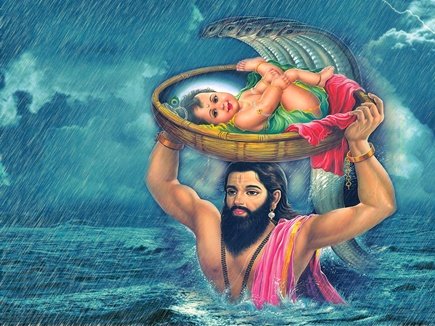
Śukadeva Gosvāmī said: After thus in structing His father and mother, the Supreme Personality of Godhead, Kṛṣṇa, remained si lent. In their presence, by His internal energy, He then transformed Himself into a small hu man child. [In other words, He transformed Himself into His original form: kṛṣṇas tu bha gavān svayam.] (46) Thereafter, exactly when Vasudeva, being inspired by the Supreme Per sonality of Godhead, was about to take the newborn child from the delivery room, Yoga māyā, the Lord’s spiritual energy, took birth as the daughter of the wife of Mahārāja Nanda. (47)/By the influence of Yoga-māyā, all the doorkeepers fell fast asleep, their senses unable to work, and the other inhabitants of the house also fell deeply asleep. When the sun rises, the darkness automatically disappears; similarly, when Vasudeva appeared, the closed doors, which were strongly pinned with iron and locked with iron chains, opened automatically. Since the clouds in the sky were mildly thun dering and showering, Ananta-nāga, an expan sion of the Supreme Personality of Godhead, followed Vasudeva, beginning from the door, with hoods expanded to protect Vasudeva and the transcendental child. (48-49) Because of constant rain sent by the demigod Indra, the  river Yamunā was filled with deep water, foam ing about with fiercely whirling waves. But as the great Indian Ocean had formerly given way to Lord Rāmacandra by allowing Him to con struct a bridge, the river Yamunā gave way to Vasudeva and allowed him to cross. (50) When Vasudeva reached the house of Nanda Mahārāja, he saw that all the cowherd men were fast asleep. Thus he placed his own son on the bed of Yaśodā, picked up her daughter, an expansion of Yoga-māyā, and then returned to his residence, the prison house of Kaṁsa. (51)

Vasudeva placed the female child on the bed of Devakī, bound his legs with the iron shack les, and thus remained there as before. (52) Ex hausted by the labor of childbirth, Yaśodā was overwhelmed with sleep and unable to under stand what kind of child had been born to her. (53)

library.vedavarsity.com || www.vedavarsity.com

Srimad Bhagavatam | Canto 10 Chapter 1 | The Advent Of Lord Kṛṣṇa: Introduction

0

King Parīkṣit said: My dear lord, you have elaborately described the dynasties of both the moon-god and the sun-god, with the exalted and wonderful character of their kings. (1) O best of munis, you have also described the de scendants of Yadu, who were very pious and strictly adherent to religious principles. Now, if you will, kindly describe the wonderful, glori ous activities of Lord Viṣṇu, or Kṛṣṇa, who ap peared in that Yadu dynasty with Baladeva, His plenary expansion. (2) The Supersoul, the Su preme Personality of Godhead, Śrī Kṛṣṇa, the cause of the cosmic manifestation, appeared in the dynasty of Yadu. Please tell me elaborately about His glorious activities and character, from the beginning to the end of His life. (3)

Glorification of the Supreme Personality of Godhead is performed in the paramparā sys tem, that is, it is conveyed from the spiritual master to disciple. Such glorification is relished by those no longer interested in the false, tem porary glorification of this cosmic manifesta tion. Descriptions of the Lord are the right med icine for the conditioned soul undergoing re peated birth and death. Therefore, who will cease hearing such glorification of the Lord ex cept a butcher or one who is killing his own self? (4) Taking the boat of Kṛṣṇa’s lotus feet, my grandfather Arjuna and others crossed the ocean of the Battlefield of Kurukṣetra, in which such commanders as Bhīṣmadeva resembled great fish that could very easily have swal lowed them. By the mercy of Lord Kṛṣṇa, my grandfathers crossed this ocean, which was very difficult to cross, as easily as one steps over the hoofprint of a calf. Because my mother surrendered unto Lord Kṛṣṇa’s lotus feet, the Lord, Sudarśana-cakra in hand, entered her womb and saved my body, the body of the last remaining descendant of the Kurus and the Pāṇḍavas, which was almost destroyed by the fiery weapon of Aśvatthāmā. Lord Śrī Kṛṣṇa, appearing within and outside of all materially embodied living beings by His own potency in the forms of eternal time that is, as Paramātmā and as virāṭ-rūpa gave liberation to everyone, either as cruel death or as life. Kindly enlighten me by describing His transcendental character istics. (5-7)

My dear Śukadeva Gosvāmī, you have al ready explained that Saṅkarṣaṇa, who belongs to the second quadruple, appeared as the son of Rohiṇī named Balarāma. If Balarāma was not transferred from one body to another, how is it possible that He was first in the womb of Devakī and then in the womb of Rohiṇī? Kindly explain this to me. (8) Why did Kṛṣṇa, the Supreme Personality of Godhead, leave the house of His father, Vasudeva, and transfer Himself to the house of Nanda in Vṛndāvana? Where did the Lord, the master of the Yadu dynasty, live with His relatives in Vṛndāvana? (9) Lord Kṛṣṇa lived both in Vṛndāvana and in Mathurā. What did He do there? Why did He kill Kaṁsa, His mother’s brother? Such killing is not at all sanctioned in the śāstras. (10) Kṛṣṇa, the Supreme Personality of Godhead, has no material body, yet He appears as a hu man being. For how many years did He live with the descendants of Vṛṣṇi? How many wives did He marry, and for how many years did He live in Dvārakā? (11) O great sage, who know everything about Kṛṣṇa, please describe in detail all the activities of which I have in quired and also those of which I have not, for I have full faith and am very eager to hear of them. (12)

Because of my vow on the verge of death, I have given up even drinking water, yet because I am drinking the nectar of topics about Kṛṣṇa, which is flowing from the lotus mouth of your Lordship, my hunger and thirst, which are extremely difficult to bear, cannot hinder me. (13) Sūta Gosvāmī said: O son of Bhṛgu, after Śukadeva Gosvāmī, the most respectable devo tee, the son of Vyāsadeva, heard the pious ques tions of Mahārāja Parīkṣit, he thanked the King with great respect. Then he began to discourse on topics concerning Kṛṣṇa, which are the rem edy for all sufferings in this Age of Kali. (14) Śrīla Śukadeva Gosvāmī said: O Your Majesty, best of all saintly kings, because you are greatly attracted to topics of Vāsudeva, it is certain that your intelligence is firmly fixed in spiritual un derstanding, which is the only true goal for hu manity. Because that attraction is unceasing, it is certainly sublime. (15)

The Ganges, emanat ing from the toe of Lord Viṣṇu, purifies the three worlds, the upper, middle and lower plan etary systems. Similarly, when one asks ques tions about the pastimes and characteristics of Lord Vāsudeva, Kṛṣṇa, three varieties of men are purified: the speaker or preacher, he who inquires, and the people in general who listen. (16) Once when mother earth was overburdened by hundreds of thousands of military phalanxes of various conceited demons dressed like kings, she approached Lord Brahmā for relief. (17) Mother earth assumed the form of a cow. Very much distressed, with tears in her eyes, she ap peared before Lord Brahmā and told him about her misfortune(18) Thereafter, having heard of the distress of mother earth, Lord Brahmā, with mother earth, Lord Śiva and all the other demi gods, approached the shore of the Ocean of Milk. (19)

After reaching the shore of the Ocean of Milk, the demigods worshiped the Supreme Personality of Godhead, Lord Viṣṇu, the master of the whole universe, the supreme God of all gods, who provides for everyone and di minishes everyone’s suffering. With great at tention, they worshiped Lord Viṣṇu, who lies on the Ocean of Milk, by reciting the Vedic mantras known as the Puruṣa-sūkta. (20) While in trance, Lord Brahmā heard the words of Lord Viṣṇu vibrating in the sky. Thus he told the demigods: O demigods, hear from me the order of Kṣīrodakaśāyī Viṣṇu, the Supreme Person, and execute it attentively without delay. (21) Lord Brahmā informed the demigods: Before we submitted our petition to the Lord, He was already aware of the distress on earth. Conse quently, for as long as the Lord moves on earth to diminish its burden by His own potency in the form of time, all of you demigods should appear through plenary portions as sons and grandsons in the family of the Yadus. (22)

The Supreme Personality of Godhead, Śrī Kṛṣṇa, who has full potency, will personally appear as the son of Vasudeva. Therefore, all the wives of the demigods should also appear in order to satisfy Him. (23) The foremost manifestation of Kṛṣṇa is Saṅkarṣaṇa, who is known as Ananta. He is the origin of all incarnations within this material world. Previous to the appearance of Lord Kṛṣṇa, this original Saṅkarṣaṇa will appear as Baladeva, just to please the Supreme Lord Kṛṣṇa in His transcendental pastimes. (24) The potency of the Lord, known as viṣṇu-māyā, who is as good as the Supreme Personality of Godhead, will also appear with Lord Kṛṣṇa. This potency, acting in different capacities, captivates all the worlds, both material and spiritual. At the request of her master, she will appear with her different potencies in order to execute the work of the Lord. (25)

Śukadeva Gosvāmī continued: After thus advising the demigods and pacifying mother earth, the very powerful Lord Brahmā, who is the master of all other Prajāpatis and is there fore known as Prajāpati-pati, returned to his own abode, Brahmaloka. (26) Formerly, Śūrasena, the chief of the Yadu dynasty, had gone to live in the city of Mathurā. There he enjoyed the places known as Māthura and Śūrasena. (27) Since that time, the city of Ma thurā had been the capital of all the kings of the Yadu dynasty. The city and district of Mathurā are very intimately connected with Kṛṣṇa, for Lord Kṛṣṇa lives there eternally. (28) Some time ago, Vasudeva, who belonged to the dem igod family [or to the Śūra dynasty], married Devakī. After the marriage, he mounted his chariot to return home with his newly married wife. (29)

Kaṁsa, the son of King Ugrasena, in order to please his sister Devakī on the occasion of her marriage, took charge of the reins of the horses and became the chariot driver. He was surrounded by hundreds of golden chariots. (30) Devakī’s father, King Devaka, was very much affectionate to his daughter. Therefore, while she and her husband were leaving home, he gave her a dowry of four hundred elephants nicely decorated with golden garlands. He also gave ten thousand horses, eighteen hundred chariots, and two hundred very beautiful young maidservants, fully decorated with ornaments. (31-32) O beloved son, Mahārāja Parīkṣit, when the bride and bridegroom were ready to start, conch shells, bugles, drums and kettle drums all vibrated in concert for their auspi cious departure. (33) While Kaṁsa, controlling the reins of the horses, was driving the chariot along the way, an unembodied voice addressed him, “You foolish rascal, the eighth child of the woman you are carrying will kill you!” (34)

Kaṁsa was a condemned personality in the Bhoja dynasty because he was envious and sin ful. Therefore, upon hearing this omen from the sky, he caught hold of his sister’s hair with his left hand and took up his sword with his right hand to sever her head from her body. (35) Wanting to pacify Kaṁsa, who was so cruel and envious that he was shamelessly ready to kill his sister, the great soul Vasudeva, who was to be the father of Kṛṣṇa, spoke to him in the following words. (36) Vasudeva said: My dear brother-in-law Kaṁsa, you are the pride of your family, the Bhoja dynasty, and great heroes praise your qualities. How could such a qualified person as you kill a woman, your own sister, especially on the occasion of her marriage? (37) O great hero, one who takes birth is sure to die, for death is born with the body. One may die today or after hundreds of years, but death is sure for every living entity. (38)

When the present body turns to dust and is again reduced to five ele ments: earth, water, fire, air and ether, the pro prietor of the body, the living being, automati cally receives another body of material ele ments according to his fruitive activities. When the next body is obtained, he gives up the pre sent body. (39) Just as a person traveling on the road rests one foot on the ground and then lifts the other, or as a worm on a vegetable transfers itself to one leaf and then gives up the previous one, the conditioned soul takes shelter of an other body and then gives up the one he had be fore. (40) Having experienced a situation by seeing or hearing about it, one contemplates and speculates about that situation, and thus one surrenders to it, not considering his present body. Similarly, by mental adjustments one dreams at night of living under different cir cumstances, in different bodies, and forgets his actual position. Under this same process, one gives up his present body and accepts another [tathā dehāntara-prāptiḥ]. (41)

At the time of death, according to the thinking, feeling and willing of the mind, which is involved in frui tive activities, one receives a particular body. In other words, the body develops according to the activities of the mind. Changes of body are due to the flickering of the mind, for otherwise the soul could remain in its original, spiritual body. (42) When the luminaries in the sky, such as the moon, the sun and the stars, are reflected in liquids like oil or water, they appear to be of different shapes sometimes round, sometimes long, and so on because of the movements of the wind. Similarly, when the living entity, the soul, is absorbed in materialistic thoughts, he accepts various manifestations as his own iden tity because of ignorance. In other words, one is bewildered by mental concoctions because of agitation from the material modes of nature. (43)

Therefore, since envious, impious activi ties cause a body in which one suffers in the next life, why should one act impiously? Con sidering one’s welfare, one should not envy an yone, for an envious person must always fear harm from his enemies, either in this life or in the next. (44) As your younger sister, this poor girl Devakī is like your own daughter and de serves to be affectionately maintained. You are merciful, and therefore you should not kill her. Indeed, she deserves your affection. (45) Śukadeva Gosvāmī continued: O best of the Kuru dynasty, Kaṁsa was fiercely cruel and was actually a follower of the Rākṣasas. There fore, he could be neither pacified nor terrified by the good instructions given by Vasudeva. He did not care about the results of sinful activities, either in this life or in the next. (46)

When Vasudeva saw that Kaṁsa was determined to kill his sister Devakī, he thought to himself very deeply. Considering the imminent danger of death, he thought of another plan to stop Kaṁsa. (47) As long as he has intelligence and bodily strength, an intelligent person must try to avoid death. This is the duty of every embod ied person. But if death cannot be avoided in spite of one’s endeavors, a person facing death commits no offense. (48) Vasudeva consid ered: By delivering all my sons to Kaṁsa, who is death personified, I shall save the life of Devakī. Perhaps Kaṁsa will die before my sons take birth, or, since he is already destined to die at the hands of my son, one of my sons may kill him. For the time being, let me promise to hand over my sons so that Kaṁsa will give up this immediate threat, and if in due course of time Kaṁsa dies, I shall have nothing to fear. (49 50)

When a fire, for some unseen reason, leaps over one piece of wood and sets fire to the next, the reason is destiny. Similarly, when a living being accepts one kind of body and leaves aside another, there is no other reason than unseen destiny. (51) After thus considering the matter as far as his knowledge would allow, Vasudeva submitted his proposal to the sinful Kaṁsa with great respect. (52) Vasudeva’s mind was full of anxiety because his wife was facing danger, but in order to please the cruel, shameless and sin ful Kaṁsa, he externally smiled and spoke to him as follows. (53) Vasudeva said: O best of the sober, you have nothing to fear from your sister Devakī because of what you have heard from the un seen omen. The cause of death will be her sons. Therefore, I promise that when she gives birth to the sons from whom your fear has arisen, I shall deliver them all unto your hands. (54)

Śrīla Śukadeva Gosvāmī continued: Kaṁsa agreed to the logical arguments of Vasudeva, and, having full faith in Vasudeva’s words, he refrained from killing his sister. Vasudeva, being pleased with Kaṁsa, pacified him further and entered his own house. (55) Each year thereafter, in due course of time, Devakī, the mother of God and all the demi gods, gave birth to a child. Thus she bore eight sons, one after another, and a daughter named Subhadrā. (56) Vasudeva was very much dis turbed by fear of becoming a liar by breaking his promise. Thus with great pain he delivered his first-born son, named Kīrtimān, into the hands of Kaṁsa. (57) What is painful for saintly persons who strictly adhere to the truth? How could there not be independence for pure devotees who know the Supreme Lord as the substance? What deeds are forbidden for per sons of the lowest character? And what cannot be given up for the sake of Lord Kṛṣṇa by those who have fully surrendered at His lotus feet? (58)

My dear King Parīkṣit, when Kaṁsa saw that Vasudeva, being situated in truthfulness, was completely equipoised in giving him the child, he was very happy. Therefore, with a smiling face, he spoke as follows. (59) O Vasudeva, you may take back your child and go home. I have no fear of your first child. It is the eighth child of you and Devakī I am con cerned with because that is the child by whom I am destined to be killed. (60) Vasudeva agreed and took his child back home, but be cause Kaṁsa had no character and no self-con trol, Vasudeva knew that he could not rely on Kaṁsa’s word. (61) The inhabitants of Vṛndāvana, headed by Nanda Mahārāja and including his associate cowherd men and their wives, were none but denizens of the heavenly planets, O Mahārāja Parīkṣit, best of the descendants of Bharata, and so too were the descendants of the Vṛṣṇi dyn asty, headed by Vasudeva and Devakī and the other women of the dynasty of Yadu. The friends, relatives and well-wishers of both Nanda Mahārāja and Vasudeva and even those who externally appeared to be followers of Kaṁsa were all demigods. (62-63)

Once the great saint Nārada approached Kaṁsa and in formed him of how the demoniac persons who were a great burden on the earth were going to be killed. Thus Kaṁsa was placed into great fear and doubt. (64) After the departure of the great saint Nārada, Kaṁsa thought that all the members of the Yadu dynasty were demigods and that any of the children born from the womb of Devakī might be Viṣṇu. Fearing his death, Kaṁsa arrested Vasudeva and Devakī and chained them with iron shackles. Suspect ing each of the children to be Viṣṇu, Kaṁsa killed them one after another because of the prophecy that Viṣṇu would kill him. (65-66) Kings greedy for sense gratification on this earth almost always kill their enemies indis criminately. To satisfy their own whims, they may kill anyone, even their mothers, fathers, brothers or friends. (67) In his previous birth, Kaṁsa had been a great demon named Kālanemi and been killed by Viṣṇu. Upon learning this information from Nārada, Kaṁsa became envious of everyone connected with the Yadu dynasty. (68) Kaṁsa, the most pow erful son of Ugrasena, even imprisoned his own father, the King of the Yadu, Bhoja and Andhaka dynasties, and personally ruled the states known as Śūrasena. (69)

Choti Si Kisori Mere Angana Men Dole Re

0

Song Name: Choti Si Kisori Mere Angana Men Dole Re

Official Name: None

Author: Candrasakhi

Book Name: None

Language: Braja Bhasa

LYRICS:

(1)

choṭī sī kisorī mere āńgana meń ḍole re

pāva me pāyaliyā bāke jham-jhamā-jham bole re

(2)

maine bāse pūchī lālī kahā tero nāma re

hāsa hāsa ke batāve boto rādhā mero nāma re

(3)

maine bāse pūchī lālī kahā tero gāva re

mīṭhī mīṭhī bole mose barasāno mero gāva re

(4)

maine bāse pūchī lālī, kauna tero sasurāla re

śaramāke yo bole mose jāvaṭa grāma sasurāla re

(5)

maine bāse pūchī lālī kauna tero bharatāra re

muskarāke bolī mose śyāma mero bharatāra re

(6)

maine bāse pūchī lālī, khāogī kā mākhana

āhā, āhā bole, mere āge pīche ḍole re

(7)

candrasakhī bhaja bāla kṛṣṇa chavi

sapane me āke mose mīṭḥī mīṭḥī bole re

pāva me pāyaliyā bāke jham-jhamā-jham bole re

TRANSLATION

1) A young girl is wandering in my courtyard and Her anklebells are jingling.

2) When I asked Her, “Lali, what is Your name?” Laughing, She told me, “My name is Radha.”

3) When I asked Her, “Lali, where is Your village?” She sweetly replied, “My village is Varsana.”

4) When I asked Her, “Lali, who are Your in-laws?” Coyly She replied, “My in-laws reside in the village of Yavata.”

5) When I asked Her, “Lali, who is Your beloved?” Smiling She replied, “My beloved is Syama.”

6) When I asked Her, “Lali, will You eat some butter?” She replied, “Yes, yes” and began prancing around Me.

7) Candrasakhi worships the beautiful boy Sri Krsna Radhika came in a dream and spoke so sweetly and the jingling of Her anklebells was so charming.

Choti Choti Gwaiyan Chote Chote Gwal

0

Song Name: Choti Choti Gwaiyan Chote Chote Gwal

Official Name: None

Author: Traditional

Book Name: None

Language: Braja Bhasa

LYRICS:

(refrain)

choṭi choṭi gwaiyāń choṭe choṭe gwāl

choṭo so mero madana gopāla (hare)

(1)

āge āge gwaiyāń pīche pīche gwāl

bīca meń mero madana gopāla

(2)

kāli kāli gwaiyāń gore gore gwāl

śyāma varaṇa mero madana gopāla

(3)

rāsatāń meń gwaiyāń dūdh pīte gwāl

mākhana khāoe mero madana gopāla

(4)

choṭi choṭi lakuṭi choṭi choṭi hātha

baḿśi bajāoe mero madana gopāla

(5)

choṭi choṭi sakhiyāń madhuvana bāgh

rāsa racawe mero madana gopāla

TRANSLATION

(Refrain) The cows and the cowherd boys are young and small, just like my Madana Gopala Krsna.

1) In front are the cowherd boys, while the cows are behind. Between them, my Madana Gopala Krsna is present.

2) The cowherd boys are dark skinned, while the cows are fair skinned. My Madana Gopala Krsna is the color of the thundercloud.

3) The cowherd boys are on the road, while the cows are drinking milk. My Madana Gopala Krsna is eating butter.

4) The cowherd boys play with little sticks with their little hands. My Madana Gopala Krsna is playing the flute.

5) The small little cowherd girls are in the Madhuvana Grove. My Madana Gopala Krsna is enjoying the rasa dance with the gopis.

Chata Teri Tina Loka Se

0

Song Name: Chata Teri Tina Loka Se

Official Name: None

Author: Anonymous

Book Name: None

Language: Hindi

LYRICS:

(1)

chaṭā terī tīna loka se, nyāri hai govardhana mahārāja

mānasī gańgā ko snāna, dharayo phira cakaleśvara ko dhyāna

dāna ghāṭi pe dadhi ko dāna, karo parikramā ko taiyārī hai, govardhana mahārāja

(2)

gāva ānyaura kuṇḍa govinda, pūñcharī ko lauṭā mere dvanda

sarovara bhari rahe svachanda pāsa me jatīpurā sukhakārī hai, govardhana mahārāja

(3)

śikhara ke ūpara nāce mora, santajana pane rahe cahu-ora

devako dhyāna dhare nita bhora kare ye saba brajakī rakhavālī hai, govardhana mahārāja

(4)

kṛṣṇa aura rādhā kuṇḍa apāra, nitya hoye avicala yahā vihāra

kusuma kī vikaṭa khilī phulavārī hai, mahārāja

(5)

dhanya jo bāsa kare girirāja, siddha hoye unke sabare kāja

rādhā kṛṣṇa yugala balihārī hai, mahārāja

TRANSLATION

1) Govardhana Maharaja! Your image is more beautiful than anything within the three worlds. Bathing in Manasa Ganga, meditating on Cakalesvara, giving yogurt at Dana Ghati, we are always anxious to circumambulate you.

2) Govardhana Maharaja! Circumambulating you, we will visit Govinda-kunja in the village of Anyaura, the Deity of Krsna’s dearmost friend at Lauta, and near Jatipura, the pond of pure water which gives great happiness, Rudan-sarovara.

3) Govardhana Maharaja! The peacocks dance upon you, the saints who meditate every morning reside all around you, and you are the protector of the entire Vraja-mandala.

4) Govardhana Maharaja! Strolling around you daily we see Radha-kunda and Krsna-kunda and the many gardens of blossoming flowers.

5) Govardhana Maharaja! You increase Sri Radha-Krsna’s conjugal pleasure. Those who reside near you are fortunate indeed and all their endeavors are successful.

Chari Anya Abhilasa

0

Song Name: Chari Anya Abhilasa

Official Name: Rupanuga Bhajana Darpana Song 4

Author: Bhaktivinoda Thakura

Book Name: Gitamala

Language: Bengali

LYRICS:

(1)

chāḍi’ anya abhilāṣa          jñāna-karma-sahābāsa

ānukūlya kṛṣṇānuśīlana

śuddha-bhakti boli’ tāre      bhakti-śāstra su-bicāre

śrī-rūpera siddhānta-bacana

(2)

śrabaṇa kīrtana smṛti         sebārcana dāsya nati

sakhya ātma-nibedana hoya

sādhana-bhaktira ańga         sādhakera jāhe rańga

sadā sādhu-jana-sańga-moya

(3)

sādhana-bhaktira bale         bhāba-rūpa bhakti-phale

tāhā punaḥ prema-rūpa pāya

preme jība kṛṣṇa bhaje        kṛṣṇa-bhakti-rase māje

sei rasa śrī-rūpa śikhāya

TRANSLATION

1) Srila Rupa Gosvami, after intensely studying all the devotional scriptures, has made the following conclusive definition of pure devotional service: Giving up all desires for fruitive reward or philosophical jugglery, one should execute favorable devotional service to Krsna for his pleasure only.

2) The divisions of regulated devotional service are: 1) hearing the glories of the Lord, 2) chanting His holy names, 3) remembering Him within the core of the heart, 4) serving His lotus feet, 5) worshiping His Deity form, 6) becoming His menial servant, 7) offering prayers to Him revealing the mind, 8) entering into a friendly relationship with Him, and 9) ultimately surrendering one’s whole existence in full dedication by mind, body and words. The practicing neophyte devotees continuously perform all of these nine processes joyfully in the association of saintly persons who are adept in hones devotional dedication.

3) By the strength of the above-mentioned ninefold practices of regulated devotional service, the devotion thereafter fructifies into an ecstatic emotional service attitude, and after that one reawakens his original pure ecstatic love of Godhead. In such transcendental love, the soul whole-heartedly worships Krsna, constantly immersed in tasting the ecstatic mellows of devotion to Him. This is the delicious mellow that Srila Rupa Gosvami is teaching us about.

Ceto Darpana Marjanam

0

Song Name: Ceto Darpana Marjanam

Official Name: Antya Lila Chapter 20 Verses 12, 16, 21, 29, 32, 36, 39, 47, and 65; Sri Siksastakam

Author:  Krsnadasa Kaviraja

Book Name: Caitanya Caritamrt

Language: Sanskrit, Bengali

LYRICS:

(1)

ceto-darpaṇa-mārjanaḿ bhava-mahā-dāvāgni-nirvāpaṇaḿ
śreyaḥ-kairava-candrikā-vitaraṇaḿ vidyā-vadhū-jīvanam
ānandāmbudhi-vardhanaḿ prati-padaḿ pūrṇāmṛtāsvādanaḿ
sarvātma-snapanaḿ paraḿ vijayate śrī-kṛṣṇa-sańkīrtanam

(2)

nāmnām akāri bahudhā nija-sarva-śaktis
tatrārpitā niyamitaḥ smaraṇe na kālaḥ
etādṛśī tava kṛpā bhagavan mamāpi
durdaivam īdṛśam ihājani nānurāgaḥ

(3)

tṛṇād api sunīcena
taror api sahiṣṇunā
amāninā mānadena
kīrtanīyaḥ sadā hariḥ

(4)

na dhanaḿ na janaḿ na sundarīḿ
kavitāḿ vā jagad-īśa kāmaye
mama janmani janmanīśvare
bhavatād bhaktir ahaitukī tvayi

(5)

ayi nanda-tanuja kińkaraḿ
patitaḿ māḿ viṣame bhavāmbudhau
kṛpayā tava pāda-pańkaja-
sthita-dhūlī-sadṛśaḿ vicintaya

(6)

nayanaḿ galad-aśru-dhārayā
vadanaḿ gadgada-ruddhayā girā
pulakair nicitaḿ vapuḥ kadā
tava nāma-grahaṇe bhaviṣyati

(7)

yugāyitaḿ nimeṣeṇa
cakṣuṣā prāvṛṣāyitam
śūnyāyitaḿ jagat sarvaḿ
govinda-viraheṇa me

(8)

āśliṣya vā pāda-ratāḿ pinaṣṭu mām
adarśanān marma-hatāḿ karotu vā
yathā tathā vā vidadhātu lampaṭo
mat-prāṇa-nāthas tu sa eva nāparaḥ

(9)

prabhura ‘śikṣāṣṭaka’-śloka yei paḍe, śune

kṛṣṇe prema-bhakti tāra bāḍe dine-dine

TRANSLATION
1) Glory to the sri-krsna-sankirtana, which cleanses the heart of all the dust accumulated for years and extinguishes the fire of conditional life, of repeated birth and death. This sankirtana movement is the prime benediction for humanity at large because it spreads the rays of the benediction moon. It is the life of all transcendental knowledge. It increases the ocean of transcendental bliss, and it enables us to fully taste the nectar for which we are always anxious.

2) O my Lord, Your holy name alone can render all benediction to living beings, and thus You have hundreds and millions of names, like Krsna and Govinda. In these transcendental names You have invested all Your transcendental energies. There are not even hard and fast rules for chanting these names. O my Lord, out of kindness You enable us to easily approach You by Your holy names, but I am so unfortunate that I have no attraction for them.

3) One should chant the holy name of the Lord in a humble state of mind, thinking oneself lower than the straw in the street; one should be more tolerant than a tree, devoid of all sense of false prestige, and should be ready to offer all respect to others. In such a state of mind one can chant the holy name of the Lord constantly.


4) O almighty Lord, I have no desire to accumulate wealth, nor do I desire beautiful women nor do I want any number of followers. I only want Your causeless devotional service, birth after birth.


5) O son of Maharaja Nanda (Krsna), I am Your eternal servitor, yet somehow or other I have fallen into the ocean of birth and death. Please pick me up from this ocean of death and place me as one of the atoms at Your lotus feet.


6) O my Lord, when will my eyes be decorated with tears of love flowing constantly when I chant Your holy name? When will my voice choke up, and when will the hairs of my body stand on end at the recitation of Your name?


7) O Govinda! Feeling Your separations I am considering a moment to be like twelve years or more. Tears are flowing from my eyes like torrents of rain, and I am feeling all vacant in the world in Your absence.


8) I know no one but Krsna as my Lord, and He shall remain so even if He handles me roughly by His embrace or makes me brokenhearted by not being present before me. He is completely free to do anything and everything, for He is always my worshipful Lord, unconditionally

9) If anyone recites or hears these eight verses of instruction by Sri Caitanya Mahaprabhu, his ecstatic love and devotion for Krsna increase day by day.

Candana Carcita Nila Kalevara

0

Song Name: Candana Carcita Nila Kalevara

Official Name: Song 4

Author: Jayadeva Goswami

Book Name: Gita Govinda

Language: Sanskrit

LYRICS:

(1)

candana-carcita-nīla-kalevara-pīta-vasana-vana-mālī

keli-calan-maṇi-kuṇḍala-maṇḍita-gaṇḍa-yuga-smita-śālī

(2)

harir iha mugdha-vadhū-nikare vilāsini vilāsati kelī-pare 

(3)

pīna-payodhara-bhāra-bhareṇa hariḿ parirabhya sarāgam 

gopa-vadhūr anugāyati kācid udañcita-parama-rāgam

(4)

kāpi vilāsa-vilola-vilocana-khelana-janita-manojam 

dhyāyati mugdha-vadhūr adhikaḿ madhusūdana-vadana-sarojam

(5)

kapi kapola-tale militā lapituḿ kim api śruti-mūle

cāru cucumba nitambavatī dayitaḿ pulakair anukūle

(6)

keli-kalā-kutukena ca kācid amuḿ yamunā-jala-kūle 

mañjula-vañjula-kuñja-gataḿ vicakarṣa kareṇa dukūle

(7)

kara-tala-tāla-tarala-valayāvali-kalita-kalasvana-vaḿśe 

rāsa-rase saha-nṛtya-parā hariṇa-yuvatī-praśaśaḿse

(8)

śliṣyati kām api cumbati kām api kām api ramayati rāmām 

paśyati sa-smita-cāru-tarām aparām anugacchati vāmām

(9)

śrī-jayadeva-bhaṇitam idam adbhuta-keśava-keli-rahasyam 

vṛndāvana-vipine lalitaḿ vitanotu śubhāni yaśasyam

TRANSLATION

1) Lord Krsna wears yellow garments and His lovely, dark complexioned body is decorated with sandalwood paste. While He enjoys loving pastimes with His gopis, His jewel earrings dance over His cheeks as He smiles at them.

2) Look Radhe! Look at Krsna’s loving and divine lila with all of His surrendered gopis!

3) One beautiful gopi lovingly smacks Krsna with the heavy weight of her devotion! Then she sings to Him from the fifth scale at a higher octave.

4-5) One charmed gopi fixes her love filled gaze upon Krsna’s mukharvinda.Aho! Her playful, batting eyes light become lamps of love for Krsna’s heart! A gopi attempts to whisper something to Krsna’s ear, but ends up kissing His cheek.

6) One haughty gopi grabs hold of Krsna’s garments to playfully pull Him into a solitary location beside the Yamuna.

7) Another gopi is dancing with the rasa with Krsna. As He plays the flute; she claps her hands making her bracelets sweetly tinkle in time with the music. Seeing her skill, Krsna praises.

8) Krsna embraces a gopi, kisses another, and associates with someone else. Then, He eagerly smiles to attract another gopi with His vulnerable eyes. However, noticing a resisting damsel, who is ever more beautiful, He begins pursuing her.

9)  O reader! Let Jayadeva’s description of Sri Kesava’s amazing and secret Vrndavana prema keli bring good fortune to you.

Calo Mana Sri Vrndavana Dhama

0

Song Name: Calo Mana Sri Vrndavana Dhama

Official Name: None

Author: Anonymous

Book Name: None

Language: Hindi

LYRICS:

(refrain)

calo mana śrī vṛndāvana dhāma

(1)

jahā viharata nāgari arū nāgara, kuñjana āṭho jāma

(2)

bhūkha lage to rasikana jhūṭhana khāye lahiya viśrāma

(3)

pyāsa lage to tarūṇi tanujā taṭa piyu salila lalāma

(4)

nīnda lage to jāya soi rahu, latana kuñja abhirāma

(5)

braja ki reṇu lakhi cinmaya, tanmama rahu abhirāma

(6)

pe kṛpālu mana jāti yaha bhūliya bhāva rahe niṣkāma

TRANSLATION

(Refrain) O mind, immediately race to Vrndavana!

1) Where the Hero and heroines perpetually enjoy in the kunjas;

2) When hungry, I will take the remnants of rasika devotees and then take rest

3) When thirsty I will go to the banks of the Yamuna and drink her tasty water.

4) When fatigued, I will rest in the dense kunjas.

5) O mind, you will find eternal peace upon seeing the transcendental dust of Vraja.

6) O mind, be merciful to me and renounce all other desires besides these.

Calo Aiyo Re Syama Mere Palakana Pe

0

Song Name: Calo Aiyo Re Syama Mere Palakana Pe

Official Name: None

Author: Traditional

Book Name: None

Language: Braja Bhasa

LYRICS:

(refrain)

calo aiyo re śyāma mere palakana pe

calo aiyo re

hāń re calo aiyo re

ham pe calo aiyo re śyāma mere palakana pe

calo aiyo re

(1)

tu tori jo mere navala jogana

hāń mhāre rasiyāń ho mhāre rasiyāń

meri hī tilakana pe (calo re!)

(2)

tu tori jo mere laṭaka cāla pe

hāń mhāre rasiyāń ho mhāre rasiyāń

meri jī teri alakhana pe (calo re!)

(3)

puruṣottama prabhu kī chavī nirakhe

hāń mhāre rasiyāń ho mhāre rasiyāń

abhi lāgi teri jhalakana pe (calo re!)

Stay Connected

16,985FansLike
12,500FollowersFollow
61,453SubscribersSubscribe
Have a question?Send us an enquiry. We usually reply within a day.