Mail ID: contact@vedavarsity.com

Contact: +91 9634998911

Google search engineGoogle search engine
Home Blog Page 52

Mathura Is Located In The Madhuvana Forest

0

The Bhakti-ratnakara says, “In the forest of Madhuvana, Mathura Puri is gloriously situated. By performing parikrama at special times one achieves extraordinary fruits.” That the holy city of Mathura is located within the forest of Madhuvana is confirmed by the Puranas, the Ramayana and other Vedic literatures. In the Skanda Purana it is said, “Originally Mathura Puri was the forest of the demon Madhu who was slain by the almighty Shri Hari. O King, nothing is impossible within this Madhuvana of Shri Hari. I am not capable of naming all the holy places situated here.” This verse also confirms that Mathura is located within the forest of Madhuvana. The forest of Madhuvana is glorified throughout the Vedas as the place where Lord Vishnu slew the demon named Madhu. The Puranas say that the demon Madhu established his kingdom here in Madhuvana forest and built a city called Madhu Puri. Eventually, Lord Vishnu appeared in the Madhuvana forest and slew the demon Madhu. After slaying the demon, the Lord became known as ‘Madhusudana, the killer of the demon Madhu’.

Dhruva Underwent Penance in Madhuvana Forest

The Shrimad-Bhagavatam reveals that the sacred forest of Madhuvana was well known to the earliest Aryans and its long history has been recorded in the Vedic scriptures. Although Madhuvana forest and Mathura are both manifestations on the earthly plane of the original Madhuvana and Mathura located in the spiritual world of Gokula Vrindavana, their earthly manifestations have existed since eternity and are mentioned in historical accounts from the period of the first Satya-yuga in the Swayambhuva-manvantara when the demon Madhu established his city here. During the subsequent Raivata-manvantara, the five year old boy-saint Dhruva Maharaja, son of King Uttanapada, performed severe austerities in Madhuvana forest so as to achieve darshana of Lord Vishnu. Dhruva would bathe every day in the Yamuna River at the place now known as Dhruva Ghata in Mathura and then sit in meditation on a nearby hillock now called Dhruva-tila.

Prince Ayu establishes a City at Mathura

According to historians, Prince Ayu, the son of King Pururava, the forefather of the Chandra-vamsha dynasty of kings, is said to have established the first known city at Mathura during the fifth Treta-yuga of the present Vaivasvata-manvantara. Prince Ayu’s father King Pururava ruled all the lands on the western bank of the Ganges and is said to have established his capital city at Pratishthanpur (Prayag). At this time in history the kings of the Surya-vamsha dynasty ruled all the lands on the eastern bank of the Ganges with their capitol city at Ayodhya.

The Vishnu Purana (4.1.17) says, “The descendants of Pururava became kshatriya kings and spread in all directions.” King Pururava was followed on the throne by his son Ayu, followed by his son Nahusha. After Nahusha, his celebrated son Maharaja Yayati ascended the throne of Pratisthanpura in the twelfth Treta-yuga; he was followed by his son Yadu, who became the founder of the famous Yadava Dynasty in which Lord Krishna appeared. The Yadavas of the Chandra-vamsha Dynasty began their rule over Mathura at this time and established a large kingdom known as Shurasena which covered the region around Mathura and Agra. During this period in history, Mathura became one of the most prominent of the famous sixteen ‘Janapadas’ or large ‘urban cities’ of Bharata-varsha that have been mentioned in the Vedas.

Shatrughna Established the Present City of Mathura

The present city of Mathura that we see today has been built over the foundations of the previous city established by Shatrughna, Lord Rama’s younger brother, immediately after he slew the demon Lavanasura, the son of Madhu. In the Vishnu Purana it is said, “This city is named Mathura because here Shatrughna killed powerful Lavanasura, the son of the rakshasa Madhu.” It has been established from various Puranas and the Ramayana that Shatrughna founded Mathura after killing Lavanasura. This is also confirmed by Valmiki Muni in the uttara khanda of his epic Ramayana. During the twenty-fourth Treta-yuga of the Vaivasvata manvantara, shortly after the powerful demon Ravana had been killed by Lord Ramachandra in the Lankan war, Lord Rama sent His young brother Shatrughna to Madhuvana to kill the demon Lavanasura, who was one of the last remaining demons on earth at that time. Shatrughna, after successfully slaying Lavanasura, established the city of Mathura Puri on the banks of the River Yamuna. Shatrughna ruled over the Mathura region and expanded the empire of the Surya vamsa dynasty on the eastern bank of the Ganges.

Adharam Madhuram

0

Song Name: Adharam Madhuram

Official Name: Sri Madhurastakam

Author: Vallabhacharya

Language: Sanskrit  

LYRICS

(1)

adharaḿ madhuraḿ vadanaḿ madhuraḿ

nayanaḿ madhuraḿ hasitaḿ madhuraḿ

hṛdayaḿ madhuraḿ gamanaḿ madhuraḿ

madhurādhi-pater akhilaḿ madhuraḿ

(2)

vacanaḿ madhuraḿ caritaḿ madhuraḿ

vasanaḿ madhuraḿ valitaḿ madhuraḿ

calitaḿ madhuraḿ bhramitaḿ madhuraḿ

madhurādhi-pater akhilaḿ madhuraḿ

(3)

veṇur madhuro reṇur madhuraḥ

pāṇir madhuraḥ pādau madhurau

nṛtyaḿ madhuraḿ sakhyaḿ madhuraḿ

madhurādhi-pater akhilaḿ madhuraḿ

(4)

gītaḿ madhuraḿ pītaḿ madhuraḿ

bhuktaḿ madhuraḿ suptam madhuraḿ

rūpaḿ madhuraḿ tilakaḿ madhuraḿ

madhurādhi-pater akhilaḿ madhuraḿ

(5)

karaṇaḿ madhuraḿ taraṇaḿ madhuraḿ

haraṇaḿ madhuraḿ ramaṇaḿ madhuraḿ

vamitaḿ madhuraḿ śamitaḿ madhuraḿ

madhurādhi-pater akhilaḿ madhuraḿ

(6)

guñjā madhurā mālā madhurā

yamunā madhurā vīcī madhurā

salilaḿ madhuraḿ kamalaḿ madhuraḿ

madhurādhi-pater akhilaḿ madhuraḿ

(7)

gopī madhurā līlā madhurā

yuktaḿ madhuraḿ bhuktaḿ madhuraḿ

hṛṣṭaḿ madhuraḿ śiṣṭaḿ madhuraḿ

madhurādhi-pater akhilaḿ madhuraḿ

(8)

gopā madhurā gāvo madhurā

yaṣṭir madhurā sṛṣṭir madhurā

dalitaḿ madhuraḿ phalitaḿ madhuraḿ

madhurādhi-pater akhilaḿ madhuraḿ

TRANSLATION
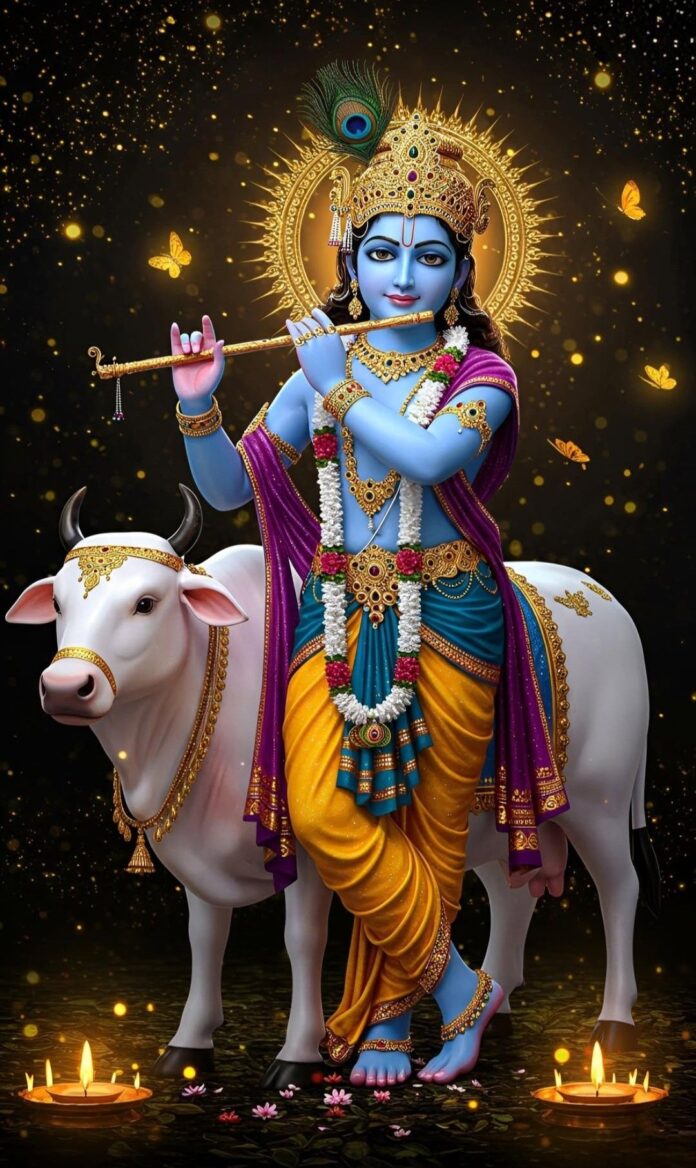
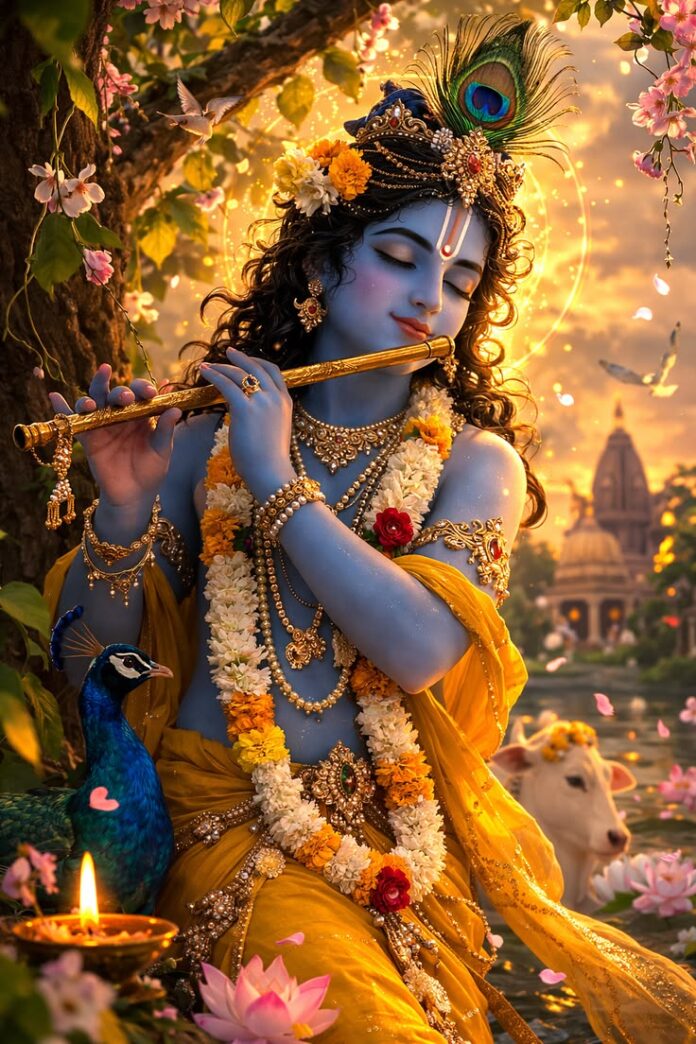
1) His lips are sweet, His face is sweet His eyes are sweet, His smile is sweet His heart is sweet, His gait is sweet—Everything is sweet about the Emperor of sweetness!

2) His words are sweet, His character is sweet His dress is sweet, His belly-folds are sweet His movements are sweet, His wandering is sweet—Everything is sweet about the Emperor of sweetness!

3) His flute is sweet, His foot-dust is sweet His hands are sweet, His feet are sweet His dancing is sweet, His friendship is sweet—Everything is sweet about the Emperor of sweetness!

4) His singing is sweet, His yellow cloth is sweet His eating is sweet, His sleeping is sweet His beauty is sweet, His tilaka is sweet—Everything is sweet about the Emperor of sweetness!

5) His deeds are sweet, His liberating is sweet His stealing is sweet, His love-sports are sweet His oblations are sweet, His tranquility is sweet—Everything is sweet about the Emperor of sweetness!

6) His gunja-berry necklace is sweet, His flower garland is sweet His Yamuna river is sweet, His ripples are sweet His water is sweet, His lotuses are sweet—Everything is sweet about the Emperor of sweetness!

7) His gopis (cowherd boys) are sweet, His pastimes are sweet, His union is sweet, His food is sweet, His delight is sweet, His courtesy is sweet — Everything is sweet about the Emperor of sweetness!

8) His gopas (cowherd boys) are sweet, His cows are sweet His staff is sweet, His creation is sweet His trampling is sweet, His fruitfulness is sweet—Everything is sweet about the Emperor of sweetness!

Acyutam Kesavam Rama Narayanam

0

Song Name: Acyutam Kesavam Rama Narayanam

Official Name: Acyutastakam

Author: Adi Sankracharya

Language: Sanskrit

LYRICS:

(1)

acyutaḿ keśavaḿ rāma nārāyaṇaḿ

kṛṣṇa dāmodaraḿ vāsudevaḿ harim

śrīdharaḿ mādhavaḿ gopīkā-vallabhaḿ

jānakī-nāyakaḿ rāmacandraḿ bhaje

(2)

acyutaḿ keśavāḿ satyabhāmādhavaḿ

mādhavaḿ śrīdharaḿ rādhikā-rādhitam

indirā-mandiraḿ cetasā sundaraḿ

devakī-nandanaḿ nandanaḿ sandadhe

(3)

viṣṇave jiṣṇave śańkhine cakriṇe

rukmiṇī-rāgiṇe jānakī-jānaye

vallavī-vallabhāyārcitāyātmane

kaḿsa-vidhvaḿsine vaḿśine te namaḥ

(4)

kṛṣṇa govinda he rāma nārāyaṇa

śrīpate vāsudevārjita śrīnidhe

acyutānanta he mādhavādhokṣaja

dvārakānāyaka draupadī-rakṣaka

(5)

rākṣasa-kṣobhitaḥ sītayā śobhito

daṇḍakāraṇyabhu-puṇyatā-kāraṇaḥ

lakṣmaṇe-nānvito vānaraiḥ sevito-

‘gastya-sampujito rāghavaḥ pātu mām

(6)

dhenukāriṣṭako’niṣṭa-kṛddveṣiṇāḿ

keśihā kaḿsa-hṛd-vaḿśikā-vādakaḥ

pūtanā-kopakaḥ surajā khelano

bāla gopālakaḥ pātu māḿ sarvadā

(7)

vidyudadyotavnpra-sphurad-vāsasaḿ

prāvṛḍambhodavat prollasad-vigrahaḿ

vanyayā mālayā śobhitorasthalaḿ

lohitāńghridvayaḿ vārijākṣaḿ bhaje

(8)

kuñcitaiḥ kuntalair bhrojamānānanaḿ

ratnamauliḿ lasatkuṇḍalaḿ gaṇḍayoḥ

hārakeyurakaḿ kańkaṇa-projjvalaḿ

kińkiṇīmañjulaḿ śyāmalaḿ taḿ bhaje

TRANSLATION

1) I worship Acyuta, the infallible one, Who is Ramacandra, Kesava, Rama, Narayana, Krsna, Damodara, Vasudeva, Hari, Sridhara, Madhava, Who is dear to Gopika, and Who is the consort of Janaki.

2) I offer my obeisances to Lord Kesava, Who is infallible (Acyuta), Who is the consort of Satyabhama, Madhava, Sridhara, Who is longed-for by Radhika, Who is the temple of Laksmi (Indira), Who is beautiful by thought, Who is dear to Devaki, and Who is dear to all.

3) Salutations for Visnu, Who conquers everyone, Who holds a conch-shell and a discus, Who is dear to Rukmini, Who is the consort of Janaki, Who is dear to gopi girls, Who is offered [in sacrifices], the Supersoul Who destroyed Kamsa, and Who plays the flute.

4) O Krsna! O Govinda! O Rama! O Narayana, Who is the consort of Laksmi! O Vasudeva, Who attained the treasure of Laksmi! O Acyuta, Who is immeasurable! O Madhava, O Adhoksaja, Who is the leader of Dvaraka, and Who is the protector of Draupadi!

5) May Raghava — Who disturbed the atheistic practices of the demons, Who adorned Sita, Who is Dandaka-forest purification cause, Who is accompanied by Laksmana, Who was served by monkeys, and Who is revered by Sage Agastya — O Lord, please protect me.

6) May Baby Gopala (Krsna) — Who was unfavorable to Dhenukasura and Aristasura, Who destroyed Kesi, Who killed Kamsa, Who plays the flute, and Who got angry on Putana — always protect me.

7) I sing praise of Acyuta, Who is adorned by a lightening like shining yellow robe, Whose body is resplendent like a cloud of the rainy-season, Who is adorned by a wild-flower garland at His chest, Whose twin-feet are of copper-red color, and Who has lotus-like eyes.

8) I sing praise of that Syama, Whose face is adorned by falling locks of curly tresses, Who has jewels at forehead, Who has shining ear-rings on the cheeks, Who is adorned with a Keyura (flower) garland, Who has a resplendent bracelet, and Who has a melodious anklet.

A Devotee Is Gentle (Sajjana – Mṛdu)

0

Overview

Continuing with Śrīla Bhaktisiddhānta Sarasvatī Prabhupāda’s deliniation on the twenty-six qualities of a devotee, in this article from Sajjana Toṣaṇī (Vol.20, Issue 8) published in 1917, Sarasvatī Ṭhākura explains the quality of mṛdu, or gentleness, in a devotee and concludes that only a devotee can truly be gentle.

Articles in This Series:

When a materialist serves the objects of the senses, it makes his heart hard. Due to the incessant beatings of the sense-objects, there is absolutely no softness left within him. As he tolerates the sharp barbs produced by the miseries of these sense-objects, day by day, his heart become harder and harder. Seeing that ignorance or foolishness is endangering him at every step, he endeavours to attain some recognition by becoming skilled in various types of severe intellectual practices. Being fatigued by different kinds of problems and scarcities, he learns how to become arrogant and renounces any gentleness. By learning the art of debate and counter-debate, he hardens his hearts and, without analysing the various circumstances, becomes adept at arguing and seeks only victory. Becoming disturbed at the behaviour of others, he invokes a variety of wicked and unfortunate situations in order to harm them. The hearts of those who are devoted to Hari are not like that. They are gentle (mṛdu).

Bhagavān is as hard as thunderbolt to a materialist, yet He is softer than a flower to the devotee. Although He may be perceived as harsh by critics, His sweetness and soft-heartedness is supremely charming to the sādhus. Due to the influence of Bhagavān’s supremely delightful charm, His own devotees, who have taken shelter of Him, are a constant source of gentleness. In the process of sādhana practised by those devotees, especially when bhāva arrives after the stage of anartha-nivṛtti, a state of detachment from material sense-objects is observed. The heart of the sādhaka is always softened by relishing that which is connected to Bhagavān. Although he may still possess anarthas, a devotee is specifically imbued with śuddha-sattva, or pure goodness.

The relationship between Bhagavān as the viṣaya (the object of love) and the āśrayālambana (the devotee who is a subject in love) manifests within his heart in an excellent way. He is immersed in the stimulating mutual emotions of the viṣaya and the āśraya. Due to the overwhelming influence of Bhagavān’s qualities and endeavours, his heart softens. Those undertakings that express the mood of the heart, which are indicative of his gentle mood, manifest in the form of actions. In the songs and dances of the devotees, who are free from deceit, extraordinary gentleness is observed. The assault upon the mind by the divine bhāva of Hari is called sattva. From such pure sattva, aṣṭa-sāttvika-bhāva arises.(1) In particular, when sthāyī-bhāva for Kṛṣṇa predominates, it manifests thirty-three secondary bhāvas in speech and gestures.(2)

At no time is there an absence of tenderness in the mental state of a sādhu. A devotee is gentle at all times. At the time when he is still engaged in sādhana, a devotee rejects wicked association that promotes concepts opposed to Hari. While he is engaged in various activities, although to the eyes of a hard-hearted worldly person, there may seem to be an absence of tenderness in him, in reality, even at that time, he is not without a gentle disposition. A person who is always under the shelter of the supremely gentle Gaura-hari always possesses a gentle nature. Even though he abandons the association of harsh people in society along with their bad conduct, the innate natural softness within does not abandon him. Apart from a devotee, no one else can ever be gentle. A materialist is never gentle at any time.

A Devotee Is Pure (Sajjana – Śuci)

0

Overview

Continuing with the explanation on the twenty-six qualities of a devotee by Prabhupāda Sarasvatī Ṭhākura. In this article ‘A Devotee is Pure (Sajjana – Śuci)’ from Sajjana Toṣaṇī (Vol.20, Issue 10) published in 1917, Sarasvatī Ṭhākura gives a brief description of the quality of purity, concluding that all things related to Kṛṣṇa are pure, and those that are opposed to Him are impure.

Articles in This Series:

The concept of purity varies according to inclination. What one person considers pure, another may consider as impure, according to their analysis. That which a person possessing material desires with a sense of purity may deem as clean, a devotee of Bhagavān cannot accept as clean. What the karmī designates as pure does not align with the definition of purity according to a devotee. According to the opinion of the jṣānī, who identifies himself as identical with the formless Brahman, purity is external – which is specified as impure according to the analysis of the devotees. The devotees are not obliged to refer to the virtuous conduct found in the karma and jṣāna-śāstra, as pure. The selfishness of those possessing mundane desires, the craving for results by the karmī, and the renunciation of the jṣānī are not equally revered by the devotee. The devotees say that they are not compelled to give instructions on the matter of purity under the influence of the tastes of the non-devotees.

The place where there is no hari-kathā is a place which is unclean. The time when there is no service to Hari is a time which is impure, the subject who is devoid of the process of bhajana is indeed defiled. In the beginning, middle, and final sections of the most sacred Mahābhārata, Rāmāyaṇa, and the Vedas, Hari is sung about everywhere. Since all those pure śāstras contain narrations singing the qualities of Hari, all those śāstras themselves are pure, and by reading all those śāstras, the jīvas are blessed.

The devotees say that wherever there is no reverence for hari-kathā, impurity dwells there. The devotees always accept Hari as the object of all their endeavours. Wherever Hari is not the main topic, that place is not seen to be pure in the eyes of the devotees. Sādhus always reject topics that do not focus on Kṛṣṇa, considering it to be impure knowledge. Bhagavān alone is the only source of all purity. Where there is no mention of Bhagavān, such a subject is completely filled with impurity. From the māyika perspective, the karmī attributes purity to water, fire, and the sun – in reality, if one does not see a connection to Hari in them, then those objects can never be considered as pure. The devotees say that any topic other than Kṛṣṇa is merely an unclean pasturing ground. Kṛṣṇa alone is the centre of all purity, and the devotee of Kṛṣṇa is truly replete with the virtues of purity.

The analysis of purity and impurity regarding things like bananas, radish, plantain, and the concepts of purity and impurity concerning uncooked rice and boiled rice, and other various distinctions, arise when considering purity. However, devotees know that things related to Hari are pure, and objects that are opposed to the service of Hari are considered impure. In consideration of varṇa, concepts of purity and impurity based on various mundane practices, are superficial. The eternal concepts of the Vaiṣṇavas are nourished by pure conduct in all regards.

Śrī Nāma Saṅkīrtana

0

Overview

The following talk, ‘Śrī Nāma Saṅkīrtana’, by Prabhupāda Śrīla Bhaktisiddhānta Sarasvatī Ṭhākura was given on the day of Śrī Nityānanda Trayodaśī, at Śrī Yogapīṭha in Māyāpura, in the year 1926. This lecture was originally printed in The Gauḍīya (Vol.5, Issues 34 & 35). Herein, Śrīla Sarasvatī Ṭhākura explains the five primary limbs of devotion in relation to hari-nāma, and gives pertinent advice on the qualification to chant the Holy Name.

We receive the quintessential teachings of Śrīman Mahāprabhu within the Śrī Śikṣāṣṭaka. Mahāprabhu did not teach about Deity worship, but in the Śikṣāṣṭaka, He gave teachings concerning śrī-nāma-saṅkīrtana. Firstly, He says, “It is necessary to perform kīrtana of the Name of Śrī Kṛṣṇa properly.” He also said, “The Name and the Named (nāma and nāmī) are identical.” When the glorification of an object is performed properly, that object is revealed through analysis. The Name of Bhagavān, His form, qualities, pastimes, and associates – Śrī Nāma is comprised of these five things. All these (Name, form, qualities, pastimes, and associates) reside within Bhagavān’s form as Śrī Nāma. Although there may be distinctions and diversity amongst these (such as between the Name and the form, the Name and the qualities, the Name and the pastimes etc.) from the standpoint of the perceiver, the object itself is not separate. (in other words, the form, qualities, pastimes and associates are non-different from the Name – they are not separate objects).

If someone thinks, “I will take darśana of the form of Bhagavān,” then they should know that these eyes cannot take darśana of Bhagavān’s form. The forms perceived by material eyes are objects for sense enjoyment. Bhagavān Kṛṣṇacandra is the Enjoyer (bhokta) – He is not an object of enjoyment. Sense gratification occurs through objects of enjoyment. As it is stated in the Bhāgavata – “Those things in relation to Bhagavān cannot be perceived through these eyes. Those things that are seen with these eyes are not the form of Bhagavān.”

Śrī Kṛṣṇa and śrī-kṛṣṇa-nāma are not two separate entities. Although perceived and accepted in different ways, the form, qualities, pastimes, and associates are all within Śrī Nāma. A distinction is observed between the name and the named within the material world, however this is not the case in relation to śrī-kṛṣṇa-nāma, which is aprākṛta. Thus, Śrī Gaurasundara has said, “Let śrī-kṛṣṇa-saṅkīrtana be our sole abhidheya, or objective!”

‘Śrī Kṛṣṇa’ plus ‘saṅkīrtana’ equals ‘śrī-kṛṣṇa-saṅkīrtana.’ ‘Śrī Kṛṣṇa’ means ‘śrī’ and ‘kṛṣṇa.’ ‘Śrī’ means Lakṣmī. In other words, all Lakṣmīs are expansions of Śrīmatī Gāndharvā (Rādhārāṇī). Thus, when we say ‘śrī-kṛṣṇa’ it means Gāndharvā along with Giridhara Vrajendra-nandana. When everyone comes together for kīrtana, that is called saṅkīrtana, or samyak-kīrtana. Saṅkīrtana means the chanting of the complete glories of Śrī Kṛṣṇa – the Name, form, qualities, pastimes and associates. Such kīrtana is nāma-saṅkīrtana. Such saṅkīrtana should be especially victorious above all!

We know of the nine aspects of bhakti in the stage of sādhana-bhakti – (1) Hearing, (2) Chanting, (3) Remembering, (4) Serving the Lord’s feet, (5) Worship, (6) Offering prayers, (7) Servitorship, (8) Friendship, and (9) Offering one’s very self. The sixty-four limbs of bhakti described in Śrī Bhakti-rasāmṛta-sindhu are all expansions of these devotional activities. Among these sixty-four divisions of bhakti, five are mentioned as the most essential forms of sādhana:

sādhu-saṅga nāma-kīrtana bhāgavata-śravaṇa
mathurā-vāsa śrī-mūrtira śraddhāya sevāna
sakala-sādhana-śreṣṭha ei paṣca aṅga
kṛṣṇa-prema janmāya ei pāṣcera alpa-saṅga

Associating with sādhus, chanting the Holy Name, hearing the Bhāgavata, residing in Mathurā, and serving the Deity with faith – these five limbs are the best kinds of sādhana. Even by a little connection with these five, kṛṣṇa-prema can appear. (Caitanya-caritāmṛta, Madhya 22.128-129)

When analysing these five superior kinds of sādhana, it is obvious that śrī-nāma-bhajana is at the foundation of them and it is victorious above all. The term, sādhu-saṅga is mentioned with the sole purpose that a taste for śrī-nāma-bhajana will arise in one through the association of those who are devoted to Śrī Nāma, or who engage in śrī-nāma-kīrtana. In the Śrīmad Bhāgavata, only śrī-nāma-bhajana has been glorified as the para-dharma (the supreme religious principle):

etāvān eva loke’smin puṁsāṁ dharmaḥ paraḥ smṛtaḥ
bhakti-yogo bhagavati tan-nāma-grahaṇādibhiḥ

Bhakti-yoga to Bhagavān, beginning with the chanting of His Name, is recognised as the supreme dharma for the people in this world. (Śrīmad Bhāgavatam 6.3.22)

kaler doṣa-nidhe rājann asti hy eko mahān guṇaḥ
kīrtanād eva kṛṣṇasya mukta-saṅgaḥ paraṁ vrajet

kṛte yad dhyāyato viṣṇuṁ tretāyāṁ yajato makhaiḥ
dvāpare paricaryāyāṁ kalau tad dhari-kīrtanāt

O king, despite the age of Kali being an ocean of faults, it has one great quality. By performing kīrtana, one immediately becomes free from all bondage and attains the highest attainment. That which was achieved in the Kṛta-yuga by meditation on Viṣṇu, in Treta-yuga by the performance of fire sacrifices, and in Dvapara-yuga by serving the Deity can be achieved in the Kali-yuga by hari-kīrtana. (Śrīmad Bhāgavatam 12.3.51-52)

The beginning, middle, and the end of the Śrīmad Bhāgavata constantly teaches śrī-nāma-saṅkīrtana. The inherent meaning of mathurā-vāsa, i.e. residing in śrī-dhāma, is for the purpose of engaging in nāma-bhajana. Residing where one is immersed in the Name, or in a place where sādhus engage in saṅkīrtana together – that is actual śrī-dhāma-vāsa.

Śrī-mūrti-sevā (worshipping the Deity) is performed through the mantra consisting of the Name of Bhagavān, and primarily by bhagavān-nāma-kīrtana – thus, śrī-nāma-kīrtana is victorious above all. Only through śrī-nāma-saṅkīrtana is all perfection achieved:

bhajanera madhye śreṣṭha nava-vidhā bhakti
kṛṣṇa-prema kṛṣṇa dite dhare mahā-śakti
tāra madhye sarva-śreṣṭha nāma-saṅkīrtana
niraparādhe nāma laile pāya prema-dhana

Within bhajana the nine processes of bhakti are superior. They possess the potency to give Kṛṣṇa and kṛṣṇa–prema. Amongst them, nāma-saṅkīrtana is the best of all. If the Holy Name is chanted without offence, one will achieve the treasure of prema. (Caitanya-caritāmṛta, Antya-līlā 4.71)

Among thousands of devotional practices mentioned in the sātvata-smṛti, or among the sixty-four kinds of bhakti, śrī-nāma-saṅkīrtana is the supreme. All auspiciousness is achieved through the yajṣa of nāma-saṅkīrtana. All the nine processes of bhakti are present within nāma-saṅkīrtana. Śravaṇa, kīrtana, smaraṇa, vandana etc. are all included in śrī-nāma-saṅkīrtana. In consideration of abhidheya, the heartfelt intention of Jagadguru Śrī Gaurasundara, who enacts the pastimes of preaching the siddhānta of acintya-bhedābheda, is that śrī-kṛṣṇa-saṅkīrtana alone is the ultimate abhidheya. One who practices the limb of bhakti known as kīrtana attains all auspiciousness. All kinds of sādhana are included within śrī-kṛṣṇa-saṅkīrtana. One who is firmly convinced of this knows that śrī-kṛṣṇa-saṅkīrtana is the crest-jewel of all sādhanas. Śrī-kṛṣṇa-saṅkīrtana encompasses various processes of sādhana within it.

yadyapi anya-bhaktiḥ kalau kartavyā, tadā kīrtanākhya-bhakti-saṁyogenaiva

Although other processes of bhakti should be performed in the age of Kali, they must be accompanied by kīrtana. (Bhakti Sandarbha 273)

eka aṅga sādhe keha sādhe bahu aṅga
niṣṭhā haile upajaya premera taraṅga
eka aṅge siddhi pāila bahu bhakta-gaṇa

If someone performs either one limb of bhakti or many limbs, if they are determined, then the waves of prema will arise. Many devotees have attained perfection by following only one limb. (Caitanya-caritāmṛta, Madhya-līlā 22.134-135)

Among the many limbs of sādhana, śrī-kṛṣṇa-saṅkīrtana is the best. Even in those śāstras where one limb of sādhana is mentioned, the object of focus is śrī-kṛṣṇa-saṅkīrtana. Without śrī-kṛṣṇa-saṅkīrtana, no other limb such as mathurā-vāsa, sādhu-saṅga etc., can be complete. However, if one simply performs śrī-kṛṣṇa-saṅkīrtana, then through that, one achieves all the results of mathurā-vāsa, sādhu-saṅga, śrī-mūrti-śraddhāya sevāna, and bhagavata-śravaṇa. The jīva attains all perfection through nāma-bhajana. Through the one limb of nāma-saṅkīrtana, all perfection is achieved. Paṣca alpa-saṅga (a little connection with one of these five) – even one of these must include the mention of śrī-nāma-saṅkīrtana. In the holy dhāma where Śrī Kṛṣṇa resides, there is no other activity besides śrī-nāma-saṅkīrtana.

Through hearing and chanting the Śrīmad Bhāgavata, a jīva is delivered from anarthas and becomes qualified to attain the highest necessity. Even amongst the liberated souls, there is no other activity besides śrī-nāma-saṅkīrtana. Through hearing, chanting, and deliberating upon the Śrīmad Bhāgavata, a jīva is liberated. By reciting the Śrīmad Bhāgavata, a jīva learns how to engage in hari-saṅkīrtana. By performing arcana (which includes a system with mantras based upon the Holy Name, and within the mantra, the Holy Name in the fourth nominative case is employed)*, the jīva receives instruction in performing saṅkīrtana. One who recites the mantra offers himself at the lotus feet of Śrī Nāma. The day that one achieves mantra-siddhi (perfection in chanting the mantra), is the day that hari-nāma constantly dances within the mouth.

  • Translator’s Note: This refers to the Sanskrit grammatical rule concerning case endings – in this case, the caturthī-vibhakti, or fourth case ending, indicating the recipient of an action. For example, with the fourth case ending, the name kṛṣṇa becomes kṛṣṇāya (‘unto Kṛṣṇa’), indicating surrender. Thus, a typical mantra used in Deity worship would be, śrī-kṛṣṇāya namaḥ – ‘I offer obeisance unto Kṛṣṇa.’

yena janma-śataiḥ pūrvaṁ vāsudevaḥ samārcitaḥ
tan-mukhe hari-nāmāni sadā tiṣṭhanti bhārata

O descendant of Bharata, the Name of Hari will eternally remain on the lips of those who have worshipped Vāsudeva in their previous hundred births. (Padma Purāṇa, cited in Hari-bhakti-vilāsa 11.454)

If we neglect to serve the Vaiṣṇavas, the residents of the maṭha of pure bhakti that are engaged in śrī-kṛṣṇa-saṅkīrtana, and instead become mere practitioners of the path of arcana, then our own welfare will be out of reach. It is the duty of the residents of the maṭha to read the Śrīmad Bhāgavata. A maṭha is not established in the māyika universe – it only descends. In the māyika universe, there is only talk of gratifying one’s senses. Everyone is busy in the maṭha trying to satisfy Kṛṣṇa’s senses. Guided by external consciousness, some persons observe among the residents of the maṭha similar behaviour to their own indulgence in sensual activities and efforts for self-gratification. This is merely the illusion of the perceiver, being inebriated by sensual knowledge.

Everything necessary for serving Hari is available in the maṭha in all respects. By serving the residents of the maṭha, one becomes qualified to chant Śrī Nāma. The residents of the maṭha always serve Hari in every way and with all their senses. They have no other duty except serving the hari-janas (devotees of Hari). The residents of the maṭha perform kīrtana of all these things for the benefit of those who do not understand what is a hari-jana. If those who are gṛhasthas can become free from the gṛha-concept through their hari-bhajana and identify as a resident of Goloka, perceiving the members of their household, not as objects of personal enjoyment, but as instruments for Kṛṣṇa’s service, then they too will achieve auspiciousness. If we keep all of our senses engaged in the external world, we can never become devoted to the Holy Name. It is for the purpose of making us devoted to the Holy Name that the united form of Śrī Rādhā-Govinda directly descended to this place.

Materialistic persons attempt to enjoy Śrī Gaurasundara as one of the unlimited objects of sense-pleasure. They understand teachings of divine knowledge to be perhaps part of the ‘import and export’ of the innumerable objects of sense-gratification meant for their own enjoyment. If we can engage in an exchange with Bhagavān and His devotees, then only we will be delivered from the transactional activities, or karma-vāda (the doctrine of result-oriented actions) of this mercantile society. We are busy in observing the forms, qualities, and diversity of the external world. We are engaged in external definitions. Only if a connection to Kṛṣṇa is perceived in observing external forms is it auspicious – otherwise, it is simply ‘māyā.’

Happiness or distress arises from Kṛṣṇa’s service. If we become attached to the appearance of such happiness or distress, then we become idol-worshippers, or atheists. We only have great respect towards those who can provide what we want. The jīvas of this world are busy with ‘import and export.’

There is no need to eat, there is no need to drink, if we do not perform kṛṣṇa-bhajana. It would be better for us not to achieve the eligibility of attaining a human birth if there is no hari-bhajana. If human life is spent simply in eating, drinking, and indulging like animals, then the qualification we attained will be lost, and one will be subjected to extreme difficulties across countless lifetimes. “I have come to this world to worship Kṛṣṇa!” Animals become humans in order to perform hari-bhajana.

The highest form of sādhana to Kṛṣṇa is saṅkīrtana. All other sādhanas can only be called ‘sādhana’ if they are favourable or conducive to kṛṣṇa–kīrtana. Otherwise, they should be understood to be ku-yogi-vaibhava (the opulence of a charlatan religionist), or a mere obstacle to the practice of sādhana.

The body of one who is a karma-phala-vādī (one who accepts the notion that he must receive results for his pious activities) has been imported from the parents. At present, that imported body will be exported on the day that it is buried in the ground, or set on fire. The karma-phala-vādī accumulates various intellectual achievements during the period of import (life), but it is all gone during export (death). The ‘import and export’ of saṁsāra, or the doctrine of karma-phala, only lasts for a couple of days. That which is said to be the attainment of celestial delights, and worldly achievement, adoration and prestige – these are all imports that we cannot hold onto forever. The society that follows the philosophy of karma-phala is importing into a leaking vessel! They are having children, yet they cannot protect them from the ‘export process.’ The medical community is unable to save them, and ultimately, the Lord takes back those things that belong to Him.

The intelligence and deliberation of those who do not engage in hari-bhajana does not arises in any way. There is no other duty for the jīva except hari-bhajana. Whether a child, an elderly person, a youth, a woman, a man, a scholar, a fool, a rich person, a poor person, a handsome person, an ugly person, a pious person, or a sinner – in whatever condition one may be in, there is no other method of sādhana. The only sādhana is śrī-kṛṣṇa-saṅkīrtana.

Bahubhir militvā yat kīrtanaṁ tad eva saṅkīrtanam – that kīrtana in which many people join together is called saṅkīrtana. If a few low-class people, such as myself, come together and scream loudly, “Hey! Hey!”, increasing their bile, would that be called saṅkīrtana? If I perform kīrtana along with those who have taken shelter of the śrota-panthā (the path of submissive hearing), only then will it be considered to be hari-saṅkīrtana. That kīrtana which is performed for relief from cholera, or for intelligence in business, or kīrtana performed for the sake of attaining mundane achievements, adoration and prestige, is not hari-saṅkīrtana – it is Māyā’s kīrtana.

The servant of Hari says, “Serve Hari! Do nothing else! Do not engage in sense-gratification in the name of serving Hari. Remember, satisfying the senses of Kṛṣṇa is called ‘sevā.’ Satiating your own senses which are bahirmukha, averse to the Lord – that is not sevā! If you consider that to be sevā, you will be deceiving yourself.

If we actually associate with a servant of Hari, or a performer of true kīrtana, then we too will engage in saṅkīrtana. It is necessary for us to engage in kīrtana properly. Kṛṣṇa is a complete entity – He is not an inferior, fragmented, non-existent, or partial entity. If someone says, “This has been made by so-and-so, the blacksmith. It looks very good to my eyes. I will call it my Kṛṣṇa Ṭhākura” – that is not Kṛṣṇa! By placing a blindfold over my eyes, Māyā does not allow me to see Kṛṣṇa. She shows me something imaginary for my enjoyment – an ‘idol’—and says, “This is Kṛṣṇa Ṭhākura!” Under the deception of Māyā, one is never able to have the true darśana of Kṛṣṇa. As long as I do not engage in kīrtana with a devotee of Kṛṣṇa who genuinely performs kīrtana, Māyā will continue to mislead me in various ways. If one engages in kīrtana with those whose hearts do not desire their own true welfare, who wish to deceive themselves, then no benefit will arise. It will become the kīrtana of Māyā. Those who sit down wearing a garland and tilaka, who increase their bile by shouting, “Oh! Oh!,” who never listen to their guru and do not know how to perform kīrtana – if you follow such persons, that will not be saṅkīrtana.

There is also another kind of person who is a hinderance to saṅkīrtana. They say:

vedānta-vākyeṣu sadā ramantaḥ…kaupīnavantaḥ khalu bhāgyavantaḥ

Those who recite the Vedānta are always in bliss. Blessed indeed is he who wears the kaupīna. (Śaṅkarācārya, Kaupīna Paṣcaka, Text 1)

Some, by following Pataṣjali Ṛṣi, become bound to the practice of exhalation, inhalation, and similar techniques of expanding or contracting the life airs. Even with this concept, they become entangled in the external world. I think, “I will renounce!” However, the life of a sādhu is not my destiny. I desire to be separate from the world, thinking that through practices like the path of yoga and the study of Vedānta, I will achieve auspiciousness. Yet these kind of fanciful plans to become a renunciate, or hidden desires for enjoyment cannot bring us the highest good, and therefore, such statements cannot be defined by the word ‘abhidheya.’ Therefore, those great personalities who are without deceit, who have spoken the impartial truth to people, state:

karma-kāṇḍa, jṣāna-kāṇḍa, kevala viṣera bhāṇḍa
amṛta baliyā yebā khāya
nānā yoni sadā phire, kadarya bhakṣaṇa kare
tāra janma adhaḥpāte yāya

The path of karma and the path of jṣāna are simply pots full of poison. Yet those who drink them say it is nectar. Eating filth, they constantly roam through various wombs, and their birth is ruined. (Prema Bhakti Candrikā 8.8)

Being a karmī or a jṣānī is not an essential thing for a jīva. Karma and jṣāna is not the dharma of a jīvātmā. Service to Śrī Kṛṣṇa is the eternal dharma of the jīva. The jīvas will only be benefited by engaging in śrī-kṛṣṇa-kīrtana. True auspiciousness for the jīva will not be achieved within the ‘shadow’ of auspiciousness. According to the farmer’s technique, in order to ensure the well-being of the rice, the weeds must be uprooted. While removing the weeds, one should be careful not to uproot the rice plants. There is no service to Bhagavān in karma and jṣāna. The karmī and the jṣānī are selfish. The ku-karmī (performer of wicked deeds) is most sinful. The reward of the pious acts of a su-karmī (performer of good deeds) is also a type of punishment – it is simply the punishment of foolishness. Becoming extremely beautiful, accumulating great wealth, and becoming highly learned are different types of punishment. We can easily understand the punishment for sin, but the punishment for piety, when it occurs in the future, is not realised at all. Ṭhākura Mahāśaya has said:

pāpe nā kariha mana, adhama se pāpī-jana
tāre mana dūre parihari
pūṇya ye sūkhera dhāma, tā’ra nā lai-o nāma
pūṇya mukti dui tyāga kari

prema-bhakti-sudha-nidhi, tāhe ḍuba niravadhi
āra yata kṣara nidhi prāya
nirantara sukha pābe, sakala santāpa yābe
para-tattva karile upāya

O mind, do not engage in sinful acts, Sinners are most abominable. O mind! Stay far away from such persons. Piety is the abode of happiness, but do not even mention it’s name! Reject both piety and liberation! Prema-bhakti is an ocean of nectar which you should constantly drown in. Everything else is like an ocean of salt. You will attain eternal joy, and the three-fold miseries will completely vanish. This is the way of achieving the Supreme Truth. (Prema Bhakti Candrikā 6.13-14)

The inner mood of those who are deprived of bhagavat-bhajana is that they consider the worshippable Deity to simply be an idol fashioned by a blacksmith! The external mindset has completely enveloped them to such an extent that they are entirely driven by the nature of the body and mind. Since their vision is dominated by external forms, they are unable to perceive the śrī-mūrti. They consider the Deity to be an object of their enjoyment. They consider the Names of Rādhā-Govinda to be mere syllables. In other words, by continually committing nāma-aparādha, they are dashing towards the realm of material enjoyment. To deliver such atheistic persons, Śrī Nityānanda Prabhu, the pāṣaṇḍa-dalana-vānā’ (the subduer of atheists), had taken up a most important task.

Concealing the truth has now become a characteristic of great scholarship. Those who have distanced themselves from Satyaṁ Paraṁ, the intrinsic characteristic of Bhagavān, and are engaged in the business of import and export are karma-kāṇḍīs. Those who do not believe in the words of Bhagavān and do not recognise saṅkīrtana as the highest sādhana and the ultimate sādhya (goal), as well as the object of worship for the liberated souls – such persons are jṣāna-kāṇḍīs who are akin to Jarāsandha. One is a material enjoyer, and the other is a false renunciate, or a covered enjoyer. Through kṛṣṇa-saṅkīrtana, we achieve complete liberation from the mentality of improving our worldly life (from mundane endeavours driven by the desire for worldly gain, recognition, and prestige). From the moonlight emanating from kṛṣṇa-saṅkīrtana, the auspicious lotus of the jīva blossoms and flourishes. A person who engages in nāma-bhajana achieves the highest form of wisdom. Only one who performs nāma-kīrtana has complete eligibility to all forms of true knowledge. When the heart is completely immersed in the bliss of caitanya-rasa–vigraha (the fully conscious form of divine mellows), one easily becomes free from becoming preoccupied with thoughts of the external world, or the intoxicating madness for temporary happiness. All forms of violence are pacified, and one comes to understand that māyāvāda is unacceptable.

nāmnām akāri bahudhā nija-sarva-śaktis
tatrārpitā niyamitaḥ smaraṇe na kālaḥ
etādṛśī tava kṛpā bhagavan mamāpi
durdaivam īdṛśam ihājani nānurāgaḥ

O Bhagavān! It is Your Name that bestows all auspiciousness to the jīvas, therefore You have distributed Your various Names such as Kṛṣṇa, Govinda etc. You have invested all Your potencies in those Names, and You have not created any rules (regulations or considerations) in remembering them. Prabhu, being so kind, You have made Your Name easily accessible to the jīvas. However, my misfortune has made it so that, even though your Name is so attainable, affection for it does not arise within me! (Śikṣāṣṭaka 2)

Everyone is eligible for śrī-kṛṣṇa-saṅkīrtana. Kṛṣṇa possesses all potencies, and His Name also carries the same all-powerful potency. “A man can engage in hari-bhajana – a woman cannot! A healthy person can engage in hari-bhajana – a sick person cannot! One who cannot bathe three times a day cannot engage in hari-bhajana! One who cannot sing loudly with force cannot engage in hari-bhajana! One who is born in a low-class family cannot engage in hari-bhajana!” – there are no such considerations with śrī-nāma-saṅkīrtana. “He is younger, I am senior – I will not do hari-kīrtana with him! I am learned, he’s an idiot – I will not do hari-kīrtana with him! I am high-born, he is low-born – I will not do hari-kīrtana with him!” Such considerations based on the nature of the mind and body are not the nature of the ātma in relation to kṛṣṇa-saṅkīrtana. “One cannot chant hari-nāma with a sinful heart, or while passing stool or urine!” There is no such consideration with śrī-kṛṣṇa-saṅkīrtana. One can chant hari-nāma even at the time of passing stool and urine. Even a sinful person can chant hari-nāma. However, those who take shelter of hypocrisy, thinking, “All my sins will be absorbed by chanting hari-nāma” cannot actually chant hari-nāma. If there is a tendency to commit sins on the strength of hari-nāma, then that does not become the Holy Name.

A fool has no right to perform Deity worship. But this is the age of Kali. A brāhmaṇa will tell his son, “If you can’t learn how to read and write, then you can become a big pūjārī!” But Deity worship is the highest form of scholarship.

yasyātma-buddhiḥ kuṇape tri-dhātuke
sva-dhīḥ kalatrādiṣu bhauma ijya-dhīḥ
yat-tīrtha-buddhiḥ salile na karhicij
janeṣv abhijṣeṣu sa eva gokharaḥ

He who considers the true self to be this corpse-like body that is full of mucus, bile and air, who believes that his family belongs to him, who thinks his country of birth is worthy of worship, who thinks that a holy place is merely an ordinary body of water and who never seeks the association of the wise, is no different from an ass. (Śrīmad Bhāgavatam 10.84.13)

The consideration of a non-brāhmaṇa is, “My wife, my children, and this body are mine. I was born in a superior dynasty, and my blood, flesh, and skin are absolutely pure!” One cannot approach a devotee of Bhagavān which such considerations. Without the mercy of a devotee of Bhagavān, hari-nāma does not arise. With such a deluded mindset, one will not achieve darśana of the Deity – they will merely see an idol and think that Ṭhākura has been sculpted from clay, stone, wood, or metal. Whatever condition someone is in, if they hear the words of a sādhu, then their idolatry will be removed.

“I have learned how to read and write!” just because one’s intelligence is strong, one cannot engage in the service of Hari. It will simply become idolatry. A person has no need to learn at all if that learning becomes an obstacle to the worship of Hari. Through such reading and writing, people become idolators. Instead of worshipping Hari, they worship the false ego. Just as a foolish karma-kāṇḍī cannot serve Hari, the over-intelligent jṣāna-kāṇḍī also becomes attached to the darkness of ignorance:

andhaṁ tamaḥ praviśanti ye’vidyām upāsate
tato bhūya iva te tamo ya u vidyāyām ratāḥ

One situated in ignorance enters into a realm of complete darkness. And one engaged in knowledge enters a darker place than that. (Īśopaniṣad 9)

In this world, people talk about thousands and thousands of methods of sādhana. Some say, “Chanting hari-nāma is the work of a fool! The work of a scholar is not hari-nāma – it is to become a bāhādur!*” Thus, Gaurahari, who appeared in order to teach the educated society, is saying, “O hari-nāma! You did not give Me any taste. I have no attachment to Your Name!”

*Translator’s Note: Bāhādur was an honorific title given by the Moghuls and the British to persons of renown.

“Let śūdras and morons chant hari-nāma! I am a paṇḍita, I am a brāhmaṇa – I will study the Vedas, I will perform pūjā.” Mahaprabhu is saying, “Such a stubborn attitude arises in the bound jīva,” thus He displays His divine pastime, in the guise of a teacher, saying, “Alas! I have a taste for every other activity except chanting Bhagavān’s Name. I have no taste for His direct worship.”

The third point He makes in relation to the Holy Name is, “O jīvas! Do nothing else other than kīrtana. Always engage in kīrtana.” One cannot do kīrtana without amānīnā mānada (showing respect to others, and not expecting respect), tṛṇādapi sunīca (considering oneself as insignificant as a blade of grass). You are a big teacher, a big scholar – do not become bewildered by all these considerations. I have received an instruction from Gaurasundara to become, “More humble than a blade of grass.” If someone attacks me, I should tolerate that and chant hari-nāma. Then I should understand that today, Bhagavān has graced me with the opportunity to become ‘more humble than a blade of grass.’ Knowing this, I should become even more enthusiastic in my chanting of hari-nāma.

But if someone disrespects the high position of my guru, I will say to them, “O atheist! You cannot understand the humble status of a Vaiṣṇava. How can you consider such a Vaiṣṇava who bears the mark of the Lord on their chest, shoulder, and forehead to be lower than yourself? You dare to impose the vile things that dwell within you upon the Vaiṣṇavas? You are an atheistic karmī! You should know that the personification of all auspiciousness is always standing with folded hands, waiting to serve the Vaiṣṇavas, and if you criticise those Vaiṣṇavas, your misfortune is certain! Hatred towards a Vaiṣṇava brings the greatest inauspiciousness to a jīva.”

A blasphemer of Vaiṣṇavas must be suitably punished – this is tṛṇād api sunīcā (humility) and sahīṣṇutā (tolerance). However, when someone starts insulting me personally, then I should know that Bhagavān is arranging my welfare through those people who are giving me trouble. When Bhagavān shows me His mercy, He teaches me the quality of tolerance by forcing me to endure countless harsh words spoken through countless mouths. Bhagavān tells me, “If you do not learn to tolerate the criticism of this world, then you do not have the right to chant hari-nāma.”

To engage in kṛṣṇa-kīrtana, one must become mānada (ready to offer respect to all). I have seen our Gurudeva to be the personification of mānada. He used to give happiness to persons who were disinclined towards the Lord and send them away by speaking nonsense. This is because they themselves did not perform hari-bhajana, nor would they allow others to do so. Everyone thinks that they know best. That being said, Māyā should not be made to appear as if she is ‘Hari.’ I should not call the ingredients of my enjoyment, my ‘foodstuffs,’ as ‘Bhagavān.’ One should only call Bhagavān’s prasāda as Bhagavān.

“Let the people serve me!” – this is called karma-kāṇḍa. “I will make Hari do my bhajana! Hari will remain my servant! He will always stand there, supplying us with the objects of our enjoyment!” – this is our crippled karma-kāṇḍa mentality!

All discussions for increasing one’s inclination towards serving Hari, are called hari-kathā. But all discussions for increasing one’s inclination towards mundane enjoyment are not hari-kathā – they are māyā-kathā. Perform Kṛṣṇa’s saṅkīrtana, and let people know that Māyā’s kīrtana is not Kṛṣṇa’s saṅkīrtana. All activities that are favourable for service are bhakti. They should not be confounded with karma. In karma-kāṇḍa, there is no tṛṇād api sunīcita. Deceitfully displaying false bhāva is not tṛṇād api sunīcita. That is why Śrīla Prabodhānanda Sarasvatīpāda has said, “Without tṛṇād api sunīcita, it is not possible for a person to be free from hypocrisy and endowed with sincere affection for the lotus feet of Śrī Caitanya.”

tṛṇād api sunīcatā sahaja-saumya-mugdhākṛtiḥ
sudhā-madhura-bhāṣitā viṣaya-gandha-thūthūtkṛtiḥ
hari-praṇaya-vihvalā kim api dhīranārambhitā
bhavanti kila sad-guṇā jagati gaura-bhājām amī
(Caitanya-candrāmṛta 24)

In other words, tṛṇād api sunīcita means an absence of worldly pride, possessing a naturally affectionate and pleasing form, having sweet and nectar-like speech, having complete disgust for anything unrelated to Śrī Kṛṣṇa Caitanya, being fully absorbed in hari-prema, and being completely devoid of external consciousness – all these divine qualities are exclusively found in the devotees of Gaurāṅga.

Apart from hari-kathā, there is nothing else in this world. The jīva only achieves auspiciousness through hari-kathā. Melody, tone, rhythm and tempo – all these do not make a kīrtana. Śrīman Mahāprabhu did not tell us to become expert singers. He said, “Always chant hari-kīrtana!” Churning out a variety of rhythms on a mṛdaṅga, or by impressing the common people does not make one a performer of kīrtana. One’s own sense-gratification is not hari-kīrtana – that which satisfies Kṛṣṇa’s senses is real hari-kīrtana. One cannot engage in the līlā-kīrtana of Kṛṣṇa until one has entered the līlā himself.

Mahāprabhu spoke about śrī-nāma-sādhana, and explained that the chanter of the Holy Name must renounce all kinds of deception and selfish desires. Bhāgavat-dharma or para-dharma, is only accomplished through nāma-kīrtana. It is projjhita-kaitava-dharma (completely free from deceit). We should not endeavour for wealth, followers, scholarship, fame, worship, prestige, or even liberation. Among the so-called religious communities of this world, a hundred percent of them are hankering for dharma, artha, kāma, or the results of karma, and mokṣa. Śrīman Mahāprabhu had declared that all of these are nothing but deception or fraud. For all those who make such endeavours, hari-nāma will never emerge from their mouths. We should never commit an offence at the feet of the Name by making a show of taking shelter of the Name while harbouring desires for dharma, artha, kāma or mokṣa. One should never offer prayers at the feet of Bhagavān for one’s own enjoyment or peace. One should never make Bhagavān a ‘servant’ for one’s own benefit, nor should one make Him work. Those desiring dharma, artha, and kāma are called karma-kāṇḍīs, and those who renounce the results of karma are called jṣāna-kāṇḍīs. They are both selfish – busy making Bhagavān their servant; busy trying to make Bhagavān, the bhokta-tattva (the principle recipient of enjoyment), an object of their enjoyment! However, the pure devotees say:

nāhaṁ vande tava caraṇayor dvandvam advandva-hetoḥ
kumbhīpākaṁ gurum api hare nārakaṁ nāpanetum
ramyā-rāmā-mṛdu-tanu-latā nandane nāpi rantuṁ
bhāve bhāve hṛdaya-bhavane bhāvayeyaṁ bhavantam

O Hari! I do not offer respects at Your feet in order to achieve sense pleasure, or to escape from the severe Kumbhīpāka hell, or from any other infernal condition. Nor do I offer obeisance at Your feet in order to attain happiness in the company of the soft, slender forms of the beautiful celestial damsels of Nanda-kānana. But in order to be firmly established in the exclusive bhakti, I meditate upon Your lotus feet in the temple of my heart. (Mukunda-mālā Stotra 4)

I do not desire peace or non-peace from my own actions. Dharma, artha, kāma – all these are of the nature of the mind, the nature of the body, and one’s nature at present. Those who consider the four goals of life to be necessary cannot be hari-janas – they cannot engage in hari-bhajana. The mouths of those involved in ‘import and export’ never utter śrī-kṛṣṇa-saṅkīrtana. When there is import, there is export.

Vaiṣṇava-aparādha and nāma-aparādha are both the same thing. As a result of nāma-aparādha, one attempts material enjoyment, and one becomes interested in endeavouring for karma and jṣāna. If we are praying for the qualification to serve Nanda-nandana, then it is necessary to be delivered from the clutches of kanaka, kāminī and pratiṣṭhā (wealth, women and fame).

tomāra kanaka, bhogera janaka
kanakera dvāre sevaha mādhava
kaminīra kāma, nahe tava dhāma
tāhāra mālika kevala yādava

pratiṣṭhāśā-taru, jaḍa-māyā-maru
nā pela rāvaṇa yujhiyā rāghava
vaiṣṇavi pratiṣṭhā, tā’te kara niṣṭhā
tāhā nā bhajile labhibe raurava

Your desire for wealth merely produces an enjoying mentality. Through that wealth you should serve Mādhava. The desire for women is not your place, because Yādava is their only true master. The tree of the desire for fame grows in the desert of mundane illusion, and when Rāvaṇa fought with Rāghava, he could not achieve it. If you are not determined to identify oneself as a Vaiṣṇava, you will achieve a hellish existence. (Vaiṣṇava Ke, 3-4)

Place the pursuit of kanaka, kāminī and pratiṣṭhā in their rightful place, otherwise, the result from them will be poisonous. If one wishes to be saved from the clutches of inauspiciousness, there is no other way except for the shelter of the lotus feet of Mahāprabhu.

dante nidhāya tṛṇakaṁ padayor nipatya
kṛtvā ca kāku-śatam etad ahaṁ bravīmi
he sādhavaḥ sakalam eva vihāya dūrād
caitanya-candra-caraṇe kurutānurāgam

Having placed a straw between my teeth and falling at your feet a hundred times, I say, “O sādhu! Leave everything aside and attain love for the feet of Caitanya-candra.” (Caitanya-candrāmṛta 120)

(Translated by Swami Bhaktivijṣāna Giri)

The Events At Fatima

0

An example of interaction with higher beings on a sattvic level is provided by the events that occurred in 1917 in Fatima, Portugal. These events centered on a series of revelations made to three children named Lucia, Francisco, and Jacinta by a divine personage whom they understood to be the Virgin Mary. The revelations occurred on the 13th of the month for six successive months in a natural amphitheater called the Cova da Iria, near the town of Fatima. Here we will not be concerned with the theological content of the revelations (which, as far as it goes, is compatible with the philosophy of Kṛṣṇa consciousness), but will focus on the evidence they provide for the existence of higher-dimensional realms.

The revelations were made in the presence of the three children and a large throng of onlookers, which increased greatly from month to month as news spread. The actual visions of the beautiful divine personage could be seen only by the three children, and so our knowledge of these visions is limited to their testimony. However, during the revelations there occurred related phenomena that were witnessed by large numbers of people.

These phenomena included the appearance of a glowing, globe-shaped vehicle and the occurrence of a shower of rose petals that vanished upon touching the ground. One witness, Mgr. J. Quaresma, described the appearance of the globe on July 13, 1917, as follows:

To my surprise, I see clearly and distinctly a globe of light advancing from east to west, gliding slowly and majestically through the air…. Suddenly the globe with its extraordinary light vanished, but near us a little girl of about ten continues to cry joyfully, “I still see it! I still see it! Now it is going down!” [FJ, p. 46].

He reports that after the events,

My friend, full of enthusiasm, went from group to group … asking people what they had seen. The persons asked came from the most varied social classes and all unanimously affirmed the reality of the phenomena which we ourselves had observed [FJ, p. 47].

During one of the revelations, the child Lucia had requested that a miracle be shown so that people who could not see the divine lady would believe in the reality of what was happening. She was told that this would occur on the 13th of October, and she immediately communicated this to others.

On this date it is estimated that a crowd of some 70,000 people congregated in the vicinity of the Cova da Iria in anticipation of the predicted miracle. The day was overcast and rainy, and the crowd huddled under umbrellas in the midst of a sea of mud. Suddenly, the clouds parted, and an astonishing solar display began to unfold. We will describe this in the words of some of the witnesses.

Dr. Formigao, a professor at the seminary at Santarem:

As if like a bolt from the blue, the clouds were wrenched apart, and the sun at its zenith appeared in all its splendour. It began to revolve vertiginously on its axis, like the most magnificent firewheel that could be imagined, taking on all the colours of the rainbow and sending forth multi-coloured flashes of light, producing the most astounding effect. This sublime and incomparable spectacle, which was repeated three distinct times, lasted for about ten minutes. The immense multitude, overcome by the evidence of such a tremendous prodigy, threw themselves on their knees [FJ, p. 63].

Dr. Joseph Garrett, Professor of Natural Sciences at Coimbra University:

The sun’s disc did not remain immobile. This was not the sparkling of a heavenly body, for it spun round on itself in a mad whirl, when suddenly a clamour was heard from all the people. The sun, whirling, seemed to loosen itself from the firmament and advance threateningly upon the earth as if to crush us with its huge fiery weight. The sensation during those moments was terrible [FJ, p. 62].

Similar testimony was given by large numbers of people, both from the crowd at the Cova da Iria and from a surrounding area measuring about 20 by 30 miles. The presence of confirming witnesses over such a large area suggests that the phenomena cannot be explained as the result of crowd hysteria. The absence of reports from a wider area and the complete absence of reports from scientific observatories suggest that the phenomena were local to the region of Fatima. It would seem either that remarkable atmospheric phenomena were arranged by an intelligent agency at a time announced specifically in advance, or that coordinated hallucinations in thousands of people were similarly arranged at this time. By either interpretation, it is hard to fit these phenomena into the framework of modern science. They do, however, fit naturally into the multidimensional, hierarchical cosmos of the Vedic literature.

At this point we should briefly summarize the conclusions of this chapter. The Vedic literature maintains that we live in a hierarchically structured universe occupied by 400,000 species of humanlike form and some 8,000,000 nonhuman species. These living beings inhabit a graded system of worlds such as Bhū-maṇḍala, which possess variegated geographical features. The thesis of this book is that these worlds are literally real, even though they are almost entirely inaccessible to ordinary human senses. We have tried to relate this idea to modern mathematical thought by describing the universe as a multidimensional system.

We can ask, If this description of the universe is correct, then is there anything that humans could expect to observe that would tend to corroborate it? First of all, we could not expect to readily see the demigods, for human beings generally do not have the karmic qualifications required for this. (See Section 6.c.1.) This means that we also cannot expect to gain access to the regions where the demigods are active, such as the slopes of Mount Meru, since this would surely entail being able to see the demigods themselves.

We might expect to interact with beings lower than the demigods but slightly higher than ourselves in the cosmic hierarchy. However, since these beings are higher than ourselves, we could not expect to fully control these interactions. We might expect that they would have access to us but that we would not have access to them or their abodes.

The beings between humans and demigods range from powerful types of ghosts to demonic entities such as Yakṣas and Rākṣasas, and to more attractive beings such as Vidyādharas, Cāraṇas, Siddhas, and Gandharvas. Interactions with these various beings might take various forms, depending on their own interests and on our level of consciousness. These interactions are likely to involve mystic powers, since these beings are all well-endowed with such powers. They must involve higher-dimensional transformations, because the abodes of these beings are invisible to our senses. They may also involve remarkable flying machines, since such machines are often ascribed to these beings in the Vedic literature.

We propose that these ideas about what we might expect to see in the Vedic universe are consistent with the evidence provided by psychical phenomena, UFO reports, folklore, and reports of miracles. This broad body of evidence is consistent with the Vedic world picture. However, none of this evidence is compatible with modern science, and all of it is rejected by the scientific community. We suggest that the Vedic world view is broadly supported by empirical evidence, but this evidence can never be respectable until the Vedic world view itself is restored to a respectable status.

The Link with Traditional Lore

0

When the reports of UFOs are surveyed broadly, they are seen to resemble stories from traditional folklore that have been recounted in cultures all over the world since time immemorial. Jacques Vallee illustrates this point with the following story from ninth-century France:
One day, among other instances, it chanced at Lyons that three men and a woman were seen descending from these aerial ships. The entire city gathered about them, crying out they were magicians and were sent by Grimaldus, Duke of Beneventum, Charlemagne’s enemy, to destroy the French harvests. In vain the four innocents sought to vindicate themselves by saying that they were their own country-folk, and had been carried away a short time since by miraculous men who had shown them unheard of marvels, and had desired to give them an account of what they had seen. The frenzied populace … were on the point of casting them into the fire, when the worthy Agobard, Bishop of Lyons,… having heard the accusations of the people and the defense of the accused, gravely pronounced that both one and the other were false [JV, p. 19].

The story refers to the “miraculous men” as sylphs, a class of beings thought by Paracelsus to inhabit the earth’s atmosphere and to have the power of appearing or disappearing at will before humans.

In medieval folklore, such beings were thought to coexist with ordinary humans in this world and to inhabit invisible abodes, sometimes associated with lakes, mountains, or subterranean regions (EW). They were thought to interact with people in ways that were sometimes beneficial, sometimes sinister, and sometimes mischievous or trivial. Similar patterns of interaction are to be seen in the UFO literature.
According to the Vedic literature, interactions of this kind occur between humans and a variety of near-human beings, including Yakṣas, Kiṁpuruṣas , Rākṣasas, Vidyādharas, and Gandharvas. These beings occupy Bhū-maṇḍala, the lower planetary systems, and the upper system of Bhuvarloka. They are to be distinguished from the demigods and ṛṣis of Svargaloka and the higher planetary systems ranging up to Brahmaloka.

Such beings are frequently described in the Vedic literature as possessing aerial vehicles called vimānas. This is illustrated in the story of Śālva from Śrīmad-Bhāgavatam. There it is described that a king named Śālva engaged in severe austerities to please Lord Śiva and thereby obtain an airplane that could be used to attack Kṛṣṇa’s city of Dvārakā. Lord Śiva granted the benediction and arranged for the airplane to be manufactured by the demon Maya Dānava, an inhabitant of the lower planetary system of Talātala in bila-svarga. The airplane is described as follows:

But still the airplane occupied by Śālva was very mysterious. It was so extraordinary that sometimes many airplanes would appear to be in the sky, and sometimes there were apparently none. Sometimes the plane was visible and sometimes not visible, and the warriors of the Yadu dynasty were puzzled about the whereabouts of the peculiar airplane. Sometimes they would see the airplane on the ground, sometimes flying in the sky, sometimes resting on the peak of a hill, and sometimes floating on the water. The wonderful airplane flew in the sky like a whirling firebrand-it was not steady even for a moment [KB, p. 649].

We can compare the appearance and disappearance of Śālva’s airplane with the “blinking on and off” of the UFO observed by the crew of the RB-47. The observers on the RB-47 also noted that their UFO sometimes generated two signals with different bearings on their electronic monitoring equipment.

We have argued that the domain of Maya Dānava can be reached only by higher-dimensional travel, and we suggest that even today, people of this earth may be interacting with beings originating from higher-dimensional regions of the universe. In Vedic times, people in general could directly see such phenomena as Śālva’s airplane. But they presumably had little direct access to Maya Dānava’s abode and could learn of the existence of such places only through hearing from higher authority. It can be suggested that we might be in a similar situation today.
In the Bhāgavatam it is described that the inhabitants of Maya Dānava’s abode have excellent material facilities, including cities with beautiful architecture and attractive gardens. There is no fear of the passage of time there because the distinction between day and night does not exist. The inhabitants are highly atheistic and materialistic. They are expert in various mystic powers and are free from disease and old age. However, they must all meet eventual death in accordance with the strict arrangement of the Supreme Personality of Godhead (SB 5.24.10-14).

The Vedic literature describes the universe as having a hierarchical organization, with a graded series of domains occupied by beings with different levels of consciousness. As we described in Section 4.a, these domains can be divided into the lower, middle, and upper worlds, whose inhabitants are characterized by the respective modes of ignorance, passion, and goodness. Beyond the material world lies the transcendental domain of the Supreme Personality of Godhead, which is characterized by pure goodness (viśuddha-sattva).
Given this hierarchical structure, one would expect interactions between humans and higher beings to be characterized by a variety of psychological modes, ranging from ignorance up to pure goodness. This seems to be the case, and it is interesting to note that cases of interaction on an apparently higher, sattvic level provide some of the best-attested evidence for the existence of higher beings and realms.

Unidentified Flying Objects

0

In this subsection we will discuss some modern empirical evidence suggesting that we are part of a larger world of humanlike beings that is largely inaccessible to our senses and that may involve higher-dimensional inhabited realms. Before we begin, we should emphasize that all empirical evidence is faulty, since it is subject to the four defects of sensory imperfection, mistakes, illusion, and the tendency to cheat. This is particularly true of empirical evidence regarding phenomena that cannot be readily controlled or subjected to systematic experimentation. It is even more true of the evidence we shall consider here, which may involve the independent actions of living beings possessing human or superhuman powers. Evidence of this kind will tend to be controversial no matter how strong it is, since it contradicts fundamental assumptions lying at the root of modern Western civilization. Unfortunately, such evidence will also tend to be imperfect and fragmentary, since we are unable to control the phenomena involved and there is a natural tendency for people to suppress reports of these phenomena.

Thus far in this book, we have presented arguments that are intended to show that Vedic cosmology might be true. These arguments can be divided into two categories: (1) explanations that clarify Vedic cosmological ideas and hopefully make them more plausible and understandable, and (2) refutations of objections to Vedic cosmology raised by modern scientific theories. (Chapters 6 and 7 and Appendix 2 contain additional material in this category.) Although these arguments may remove various objections to Vedic cosmology, they do not provide any direct empirical evidence indicating that Vedic cosmology is true. Of course, according to the paramparā system, Vedic cosmology should be accepted simply on the basis of śāstric authority. However, the doubt may arise that if Vedic cosmology really is true, then it would seem strange if no empirical evidence could be adduced that directly supports it.

We suggest that there is actually abundant evidence for the existence of realms of intelligent living beings operating almost entirely outside the range of our ordinary senses. This evidence is what we would expect to find if Vedic cosmology is true, and it is definitely not what we would expect to find on the basis of accepted scientific paradigms. It can therefore be interpreted as giving support for the Vedic world view, although it does not refer directly to the structure of Bhū-maṇḍala and other features of Vedic cosmography.

This evidence falls into three broad categories: (1) folklore and traditional world views, (2) psychical phenomena, and (3) the evidence regarding unidentified flying objects, or UFOs. Each of these categories provides direct testimony indicating that interactions have occurred between human beings and other intelligent beings possessing paranormal or superhuman powers. In this chapter we will discuss category three, although, as we will see, these categories are interrelated and show considerable overlap.

There is extensive documentation on the subject of UFOs, which is largely generated by three groups of people: empirical investigators, debunkers, and UFO cultists. One prominent characteristic of this field of study is that the evidence tends to generate strong emotions, both positive and negative, in the people involved. This makes objective discussion of the evidence difficult. Nonetheless, the UFO evidence can be potentially useful in helping people understand the overall validity of the Vedic world view, and therefore we will briefly consider it here.

We will begin by considering two examples of sightings of unidentified flying objects. The first sighting took place during the evening of July 14, 1952. Second Officer William Nash was at the controls of a Pan American DC-4 flying at 8,000 feet in the vicinity of Norfolk, Virginia, and Third Officer William Fortenberry was acting as copilot. It is described that the night was clear, with unlimited visibility, and the lights of Newport News could be seen out of the port window.

Shortly after 8:00 P.M. (EST), both men spotted a reddish glow off in the distance, apparently east of Newport News. As the glow resolved itself into six bright points, it became obvious that the objects were approaching at a very high speed. Within seconds, the objects could be clearly recognized as reddish, glowing discs, as they streaked under the airliner. Then, abruptly, the entire group flipped on edge, made a sharp-angled turn, and reversed direction. As this was happening, the procession of six discs was joined by two more identical objects coming from under the plane, and all eight blinked out, back on again, and then off for good, while heading westward north of Newport News [RS, p. 138].

Both Nash and his copilot had been military pilots, trained in observing and identifying aircraft. They maintained that the discs looked solid, with sharp, well-defined edges. Based on their observations of the flight paths of the discs, they estimated that they had been traveling at least 12,000 miles per hour.

A closer sighting of what seemed to be a strange flying machine was reported by several witnesses near Exeter, New Hampshire, during the early-morning hours of September 3, 1965 (RS, pp. 176-78). At 1:30 A.M. Police Officer Eugene Bertrand investigated a parked car and found a distraught woman who claimed that her car had been followed for some 12 miles by a spaceship with red lights. Bertrand rejected this story, but was soon summoned back to his police station to investigate a similar story by 18-year-old Norman Muscarello. The teenager had burst into the station at 2:24 A.M. “in a state of near shock.” He stated that while he was hitchhiking along route 150, a glowing object with pulsating red lights suddenly came floating across a nearby field in his direction. He said that the object was as big as a house and that it was completely silent as it moved toward him. After he dove for cover, the object backed away, and he flagged down a car, which took him to the police station.

Bertrand and Muscarello returned to the scene, and at about 3 A.M. both saw the object rise silently from behind two seventy-foot-tall pine trees. As Bertrand later described it, it was a “large, dark, solid object as big as a house…. It seemed compressed, as if it were round or egg-shaped, with definitely no protrusions like wings, rudder, or stabilizer” (RS, p. 177). The object had a row of five blinding red lights that blinked cyclically, casting a blood-red glow over the field and a nearby farmhouse. As nearby horses kicked in their stalls and dogs howled, it floated about two hundred feet off the ground with a fluttering motion, like a falling leaf.

This testimony was confirmed by officer David Hunt, who arrived on the scene in time to observe the object for five or six minutes as it departed in the direction of Hampton. The police also received a phone call from an excited man in Hampton, who reported seeing the object.

Here we will briefly touch upon some of the interpretations that have been proposed for such sightings, but we will not try to resolve the many controversial issues they involve. Broadly speaking, these sightings have been interpreted as involving (1) illusions or hoaxes, (2) secret military vehicles, (3) alien spaceships from other planets, and (4) vehicles piloted by beings from higher-dimensional realms. Without going into great detail, we would evaluate these interpretations as follows.

There are, of course, many instances in which sightings of strange phenomena turn out to be illusions or even deliberate frauds. However, there also seem to be many reports-such as the two we have summarized here-that are not amenable to this interpretation. If we dismiss either of these reports as the result of illusion or fraud, then it would seem that we must cast grave doubt on the reliability of human testimony in general. Let us therefore consider what consequences follow if we give at least as much credence to human testimony as is customarily done in courts of law.

The hypothesis of secret military vehicles may explain some sightings, but it seems doubtful that it can account for all of them. For example, if the flying discs seen by Nash and Fortenberry in 1952 were the product of human military technology, then one might ask why no technology of an even remotely similar nature had been used by any nation during World War II, only seven years before. Of course, it might be argued that technology had advanced by leaps and bounds in the post-war period, as shown by the example of computers. But this does not seem to be true of aerospace technology. For example, in the 1980’s the space shuttle is being propelled into earth orbit by dangerous, unreliable solid-fuel booster rockets quite similar to the rockets used by the ancient Chinese, and atmospheric flight still depends on conventional propellers and jet engines.

We should also point out that more is involved here than mere technology; many sightings seem to involve phenomena that are incomprehensible in terms of the known principles of physics. Secret military developments certainly take place, but we know of no example in which fundamental scientific advances were made that were unknown to civilian scientists. For example, the basic scientific principles underlying the atomic bomb were well known to European scientists prior to World War II, and the Manhattan Project was devoted to routine but expensive engineering developments. It is difficult to see how government scientists working under conditions of secrecy could make spectacular advances in fundamental physics that remain inconceivable to scientists in the world at large.

The hypothesis of aliens from other planets also has its drawbacks, when presented in conventional form. Let us examine this hypothesis from the perspective of modern science. According to modern scientific thinking, the other planets of our solar system are devoid of life. Many scientists think that intelligent life may have developed on planets circling other stars, but they believe that this could happen only by a process of evolution similar to the process that has produced life on the earth. It is therefore important to note that prominent evolutionists have ruled out this possibility. These evolutionists point out that many random events are involved in the production of human beings, and the chance that something even remotely comparable to ourselves could evolve independently on another planet is essentially zero.

The evolutionist George Gaylord Simpson has raised this question in the following form: “Even in planetary histories different from ours might not some quite different and yet comparably intelligent beings-humanoids in a broader sense-have evolved?” (GS, p. 268) His answer is that the essential nonrepeatability of evolution makes this extremely unlikely. A similar conclusion was reached by the evolutionist Theodosius Dobzhansky (TD).

In fact, we agree with the analysis of Simpson and Dobzhansky, and we would go further by noting that, according to their reasoning, the probability is nearly zero that evolutionary processes would produce humans on the earth. By a probability of nearly zero, we mean a probability of the form 1 out of 10 to the power N, where N is a number in the hundreds or thousands. If an event occurs on one planet with this probability, then the probability that it will occur independently on two planets out of a billion possible planets is about 1 out of 10 to the power 2N-18. (Here we are assuming the existence of one billion planets suitable for life, and the 18 is the log of one billion squared.) In short, it seems highly unlikely that the evolution of matter would produce builders of flying machines on the earth, and far less likely that it would do this independently on other planets. (For a detailed discussion of the low probabilities associated with the evolution of advanced life forms, see the book Mechanistic and Nonmechanistic Science (MN), by the author.)

Of course, we can depart from the scientific hypothesis of extraterrestrial aliens by proposing, say, that one superintelligent being (i.e., Brahmā) may have created humanoids on other planets. However, we are still confronted by the fact that, according to modern astronomy, the nearest star is several light-years away, and most stars in this galaxy are hundreds or thousands of light-years away. Given the limitations imposed by the known laws of physics, a vehicle traveling between the nearest star and the earth would take several years at the very least to make the trip.

Many thousands of sightings of unidentifiable flying vehicles have been reported in the period following World War II, and practically all have involved brief encounters followed by no significant developments. Since it is inconvenient to make many journeys, each of which lasts for years, these observations suggest that either (1) the aliens have established local residences or (2) they are able to travel faster than the speed of light. Our point at this stage in the argument is that in making necessary modifications of the scientific extraterrestrial-alien hypothesis, we have brought it closer, step by step, to the Vedic world view. According to Vedic cosmology, there are 400,000 created humanoid life-forms in the universe. Many are locally based (such as the Yakṣas and Vidyādharas), and many are capable of unusual modes of travel (such as travel at the speed of the mind).

Another aspect of the UFO phenomenon is what could be called its psychic component. UFO sightings are frequently accompanied by telepathic impressions that observers tend to interpret as communications transmitted by UFO occupants. Psychic healings are reported in connection with UFOs, and UFO encounters are often followed by the appearance of typical psychical phenomena. Here is one case that illustrates some of these features (JV, pp. 173-76):

On November 1, 1968, a French medical doctor was awakened by calls from his 14-month-old baby shortly before 4:00 A.M. On opening a window, he saw two hovering disc-shaped objects that were silvery-white on top and bright red beneath. After moving closer for some time, the two discs merged into a single disc, which directed a beam of white light at the doctor’s house. The disc then vanished with a sort of explosion, leaving a cloud that dissipated slowly.

The doctor testified that he had received a serious leg injury while chopping wood three days before. After the departure of the mysterious object(s), the swelling and pain from this injury suddenly vanished, and during subsequent days he also noticed the disappearance of all the chronic after-effects of the injuries he had received in the Algerian war.

During a two-year period following this incident, there was no recurrence of symptoms associated with either the war injuries or the leg wound. However, strange paranormal phenomena began to take place around the doctor and his family. According to the French scientist Jacques Vallee, “Coincidences of a telepathic nature are frequently reported, and the doctor has allegedly, on at least one occasion, experienced levitation without being able to control it” (JV, p. 176). The doctor apparently did not experience such things prior to his UFO sighting.

Psychical phenomena are a standard feature of human societies in all times and places, and they are referred to almost continuously in the Vedic literature. In modern human societies there seems to be an almost inverse relationship between the development of mechanical technology and the development of various psychic powers. However, in the Vedic literature we read of beings, such as the Dānavas of bila-svarga, who possess both advanced mechanical technology and mystic siddhis, and who are apparently able to combine the two. The UFO phenomenon seems to involve something similar, and this is another reason for thinking that this phenomenon can be better understood in terms of Vedic cosmology than in terms of standard theories involving high technology and interstellar evolution.

In addition to sightings of UFOs from a distance, there are many reports of close encounters with UFO occupants. These beings are often reported to communicate directly by telepathic processes, and they are also said to be able to project illusions through some kind of hypnotic power. Here is a typical example of this kind of report (JV, pp. 191-92):

On November 17, 1971, at 9:30 P.M., a Brazilian man named Paulo Gaetano was driving back from a business trip, accompanied by his friend  Elvio. Paulo informed his companion that the car was not pulling normally, but his companion reacted by saying that he was tired and wanted to sleep. The engine then stalled, and after pulling to the side of the road, Paulo saw some kind of craft about twelve feet away. Next, he later maintained, several small beings appeared, took him into the craft, and subjected him to some kind of medical examination, which included taking a blood sample from his arm. He could not recall how he and Elvio got back home.

For his part, Elvio did not remember seeing a strange craft, but only an ordinary bus following the car at a normal distance. He saw the car pull off to the side of the road, and he remembered finding Paulo on the ground behind the parked car. But he did not remember seeing Paulo get out of the car, and did not know what had happened to him. He took Paulo by bus to the nearby town of Itaperuna, but he could not explain why they had abandoned the car. The police noticed the cut on Paulo’s arm and later found the car parked on the highway.

Of course, there is a natural temptation to dismiss stories such as this as crazy nonsense. However, there are evidently many cases in which events of this kind are reported (including many that do not involve the questionable procedure of hypnotic regression). One possible explanation is that these stories involve delusions caused by some kind of mental disorder. However, there is psychiatric testimony indicating that common forms of nervous and mental disease do not involve delusions of seeing UFOs. For example, the psychiatrist Berthold Schwarz has stated,

In thirteen years of private practice … I have never noted symptoms related to UFOs. A similar finding was confirmed on questioning Theodore A. Anderson, M.D., a senior psychiatrist, and Henry A. Davidson, M.D., then Medical Director of the Essex County Overbrook Hospital. Dr. Davidson recalled no patients with gross UFO symptoms out of three thousand in-patients, nor among all those presented to the staff while he was superintendent; nor of the thirty thousand patients who have been hospitalized since the turn of the century [ET, pp. 23-24].

It is possible that UFO close-encounter cases may involve the action of beings endowed with Vedic mystic siddhis. We do not wish to insist on this point, but we note that such a state of affairs would be consistent with Vedic cosmology. Śrīla Prabhupāda describes the vaśitā siddhi as follows:

By this perfection one can bring anyone under his control. This is a kind of hypnotism which is almost irresistible. Sometimes it is found that a yogī who may have attained a little perfection in this vaśitā mystic power comes out among the people and speaks all sorts of nonsense, controls their minds, exploits them, takes their money, and then goes away [NOD, p. 12].

The story of Paulo and Elvio clearly involves some kind of illusion (either of the bus or of the strange craft). We should also note that many people reporting close encounters with UFOs maintain that the UFO occupants overcame their will with some kind of telepathic power.

The appearance of humanoid beings in UFO reports enables us to strengthen our remarks concerning the theory of evolution. The literature on UFOs is filled with reports of a wide variety of humanlike beings. These beings often exhibit recognizable emotions, and sometimes are said to communicate various philosophical teachings. If such beings actually exist, then it is very hard to see how they could have arisen by evolution, either on this planet or elsewhere. Paleoanthropology has no place for them on the earth, and the probability that beings so similar to ourselves would evolve independently on another planet is certainly infinitesimal. They fit consistently into the Vedic world view, but their existence is strongly incompatible with the theory of evolution.

Our final topic in this section is the tendency of UFO phenomena to abruptly appear and disappear from the viewpoint of human observers and their electronic instruments. Here are two cases illustrating this. The first case involved Air Force observations of a UFO in the south-central U.S. on July 17, 1957, and was summarized in the journal Astronautics and Aeronautics, as follows:

An Air Force RB-47, equipped with electronic countermeasures (ECM) gear and manned by six officers, was followed by an unidentified object for a distance of well over 700 mi. and for a time period of 1.5 hr., as it flew from Mississippi, through Louisiana and Texas and into Oklahoma. The object was, at various times, seen visually by the cockpit crew as an intensely luminous light, followed by ground-radar and detected on ECM monitoring gear aboard the RB-47. Of special interest in this case are several instances of simultaneous appearances and disappearances on all three of these physically distinct “channels,” and rapidity of maneuvers beyond the prior experience of the crew [AAA, p. 66].

One of the disappearances of the object occurred as the RB-47 was about to fly over it. The pilot remarked that it seemed to blink out visually and simultaneously disappear from the scope of ECM monitor #2 (an electronic surveillance device). At the same time it disappeared from radar scopes at ADC site Utah (a radar station on the ground). Moments later the object blinked on again visually, and simultaneously appeared on the ECM monitor and ground radar.

Abrupt appearances and disappearances of this kind are reported in many UFO accounts (including the Nash and Fortenberry sighting, with which we began this section). Although one might propose that invisibility was being produced through techniques involving known physical laws, this behavior of UFOs has suggested to many observers that they are illusions or projections of some kind, rather than physical objects. This is also suggested by the ability of these entities to accelerate abruptly to remarkable speeds without generating noticeable sonic booms. Of course, the hypothesis of illusion raises the question of how radar-reflecting illusions exhibiting intelligent behavior are generated.

The idea of illusion is also suggested by our second case, which took place at Nouatre, Indre-et-Loire, France, on September 30, 1954. At about 4:30 P.M. Georges Gatey, the head of a team of construction workers, encountered a strange-looking man standing in front of a large shining dome that floated about three feet above the ground. Our concern here is with the way in which these odd apparitions disappeared:

Suddenly the strange man vanished, and I couldn’t explain how he did, since he did not disappear from my field of vision by walking away, but vanished like an image one erases suddenly.

Then I heard a strong whistling sound, which drowned the noise of our excavators; the saucer rose by successive jerks, in a vertical direction, and then it too was erased in a sort of blue haze, as if by a miracle [VJ2, p. 68].

Mr. Gatey, a pragmatic war veteran, maintained he was not used to flights of fancy, and his story was corroborated by several of the construction workers. Although such stories seem bizarre, they are not uncommon, and they are consistent with the more prosaic long-distance sightings reported by pilots and military personnel. They are also consistent with the mystic powers attributed to the Kiṁpuruṣas and other intelligent beings described in the Vedic literature.

Srila Prabhupada’s Program With Allen Ginsberg

0

By Chintamani dasi ACBSP

What is this? Oh my, Srila Prabhupada appearing with Allen Ginsberg? On the same stage? How is it possible?

It was true. We put these posters all over the Ohio State University campus. I was in the room when Srila Prabhupada was talking to Sriman Allen Ginsberg before the event. I was shocked, quite honestly, at how humble Srila Prabhupada was, how he was asking Ginsberg’s opinion on the venue. It was amazing. Anyway, about 2,000 midwest teenagers from the “All American City” of Columbus, Ohio showed up, mostly to hear from the bohemian Allen. At this time he was a famous poet. At the event he gave a talk, and I only remember one thing he said. It certainly wasn’t exactly parampara.

Then Srila Prabhupada talked, and then the most amazing thing happened that I can never forget. We had the most amazing kirtan I have ever experienced. As the audience gradually started to catch on to the magical maha mantra, they began to chant. Not only chant, they all chanted like enthusiastic devotees. As the devotees stood up on the stage around Srila Prabhupada and started to dance, after having been seated around His Divine Grace, some of the audience also started dancing. Some came up by the stage, some stood up in their seats. Then Srila Prabhupada stood up on his box-like Vyasasana and was dancing and throwing some of his garland flowers to the crowd who was catching them. It was so wild, so blissful. I felt like Srila Prabhupada “opened the storehouse of love of God” and was just passing it out!

THIS is what I love about Srila Prabhupada, all the love he had and showed. Not the cosmic two-by-four on the head, bashing with the philosophy that some people strongly preach about. But that’s just me. Also, Srila Prabhupada had a way of saying things that gave one realization, he was an acharya, we can’t imitate him. He knew what to say to who, but there was love behind it. That’s right, love and we knew it. Only the pure hearted can do that.

Oh, what was the one thing I remember Allen Ginsberg saying? He grabbed his microphone and said “I’ve never seen so many people jumping out of their skins before!” That was during the kirtan. It seemed to go on forever. One could feel and realize that Krishna was His name! I thought I was going to pass out. The whole room was electric.

I just met one devotee whose husband had been in that audience and became a devotee. He recently passed away. She told me he thought Srila Prabhupada was glowing. I was seeing the same thing. This was a drop of nectar right from the spiritual world. I am so grateful to have experienced the real deal.

I just thought I would share and also make a point. We are all individuals. As devotees we are individuals. Some may be more intellectual. Some may be more interested in the love aspect, like me. Srila Prabhupada could attract all of us! He was charming and also a perfect gentleman and knew when to be “heavy” and when to be soft. With me he was soft. He had said about me, “Your wife cries very easily, be kind to her.” That is only an example of one of the things he said. Some people are turned off by the not so nice criticism of other devotees. Maybe there is a little jealousy of others’ success? Just an observation.

Happy New Year everyone! And Hare Krishna!
Your servant,
Chintamani dasi.

—-

Pradyumna : Hayagriva went to work as an English professor at Ohio State University in Columbus, Ohio. Prabhupada wrote and said, “Start a center there and take Pradyumna das brahmachari with you.” So Hayagriva and I shared an apartment in Columbus, and we started something called the OSU Yoga Society, which became successful with a lot of student participation. Gradually I rented a house in Columbus, which we turned into a center, and invited Prabhupada to come. He came in May of 1969.

At that time, Allen Ginsberg used to lecture and recite his poetry at universities all over the country. Before the poetry recitation, he’d always chant Hare Krishna for twenty minutes or so. Hayagriva was quite friendly with Allen, so Hayagriva wrote to him, “Will you consider coming to Columbus and doing a joint program with Swami Bhaktivedanta?” Allen agreed, and in May we had a huge event at Ohio State University with the poet and the Swami.

We put big posters up all over with a picture of Ginsberg on one side and Prabhupada on the other, and we rented the biggest auditorium at the university. A massive crowd came. The event was very successful. When Prabhupada got up on the stage to dance, the entire audience got up and danced. It was the most wonderful sight I’ve ever seen. It was completely spontaneous.

Stay Connected

16,985FansLike
12,500FollowersFollow
61,453SubscribersSubscribe