Mail ID: contact@vedavarsity.com

Contact: +91 9634998911

Google search engineGoogle search engine
Home Blog Page 51

Gaura Govindananda Bhagavata Swami

0

Gauragovindananda Svami, also known as Bhagavatasvami, was born in a high-caste Brahmana family in a prosperous village in Jessore district, Bangladesh. He lost his father and mother at a very young age and was brought up by his maternal grandfather, Sanyal Mahasaya, a middle-class professor noted for his hospitality (Caitanya-caritamrita Antya 4.23).

From early childhood, Gauragovinda displayed extraordinary devotional inclinations. Once, while his grandfather was away, he personally attended to a visiting brahmacari, offering obeisances, water, and service, and was deeply impressed by the saint’s appearance and demeanor. After the visitor departed, Gauragovinda realized he had not paid proper obeisances and ran to the brahmacari, calling out, “Thakura! Thakura!” (Caitanya-caritamrita Antya 4.24).

At the age of thirteen or fourteen, after the death of Sanyal Mahasaya, Gauragovinda left home to travel with a brahmacari, wearing the dress of a young Vaisnava. He came to the asrama of a Vaisnava guru, who was greatly pleased with the boy’s intelligence, devotional inclination, and vairagya. The guru predicted that the boy would become a shaven-headed hermit, fully engaged in transcendental service (Srimad Bhagavatam 1.2.11, purport).

Gauragovinda studied in Navadvipa under the guidance of a Vaisnava householder, learning scriptures in an ashram-like environment. Due to an incident with a widow, he left and continued wandering as an udasina, engaging in devotional practices. Eventually, he met the same brahmacari who had inspired him earlier to renounce home life, and together they visited the asrama of a highly advanced Vaisnava guru. There, Gauragovinda served the aged saint with humility, nursing him, massaging his body with ointments, and observing all regulations of devotional service. By the mercy of the guru, he received direct instruction in Srimad Bhagavatam and other sastras (Srimad Bhagavatam 1.5.25, purport).

During his training, Gauragovinda demonstrated miraculous spiritual qualities. He acquired perfect knowledge of the sastras through the mercy of saints and dreams, memorizing and understanding Srimad Bhagavatam, Upanisads, Nyaya, Mimamsa, Patanjala, and Vedanta philosophy without formal study (Caitanya-caritamrita Antya 4.45).

Around 1903 AD, he studied Vedanta philosophy under Paramananda Tirtha Maharaja of Kasi, following brahmacari vows, wearing tulasi-leaf garlands, applying the sectarian mark, and performing regular Krsnarcana rituals. In 1905–1906 AD, he observed Mathuravasa, living in an asrama atop Krsnaganga, serving sannyasis and Vaisnavas, and receiving mercy from a paramahamsa saint known as Devagiri Muni. He later visited Vrndavana, Govardhana, and observed mounavrata for one year, deepening his realization of Srimad Bhagavatam (Bhagavatam 1.5.25, purport).

Gauragovindananda Svami authored several books: Kripakusumanjali (1935 AD), Sadhanakusumanjali (1936 AD), Sriguruvaisnavabhaktikusumanjali (1940 AD), and Srililatattva-kusumanjali (1941 AD), documenting his interactions with prominent saints such as Paramananda Tirtha Svami, Bholanandagiri Maharaja, Krsnaprasada Dasa Babaji (Gudhibaba), Siddha Jagadisa Baba, and Ramadasa Kathia Baba.

He practiced intense bhajan in a dark cave at Kamyavana, Vraja, for seven years and later traveled to Srihatta, Tripura, Silchar, Dhaka, and Mymensingh, preaching and rescuing fallen souls. Gauragovindananda Svami departed this world on 8 Jaistha, 1349 BS (May–June 1942 AD), leaving behind a life of exemplary renunciation, scholarship, and devotional service (Caitanya-caritamrita Antya 4.125).

Siddha Gauracaranadasa (Dauji,Kunjara)

0

Gauracarana Dasa, a descendant of the family of Lokanatha Gosvami, was born in Talakhadi village in Jessore district, Bangladesh. In his early childhood he had the fortune of hearing the glories of Lokanatha Gosvami and Narottama Thakura, which inspired him deeply in devotional service (Caitanya-caritamrita Antya 5.23, purport).

Shortly thereafter, he left home and traveled to Navadvipa, where he took shelter under Siddha Caitanyadasa Babaji (some say Siddha Bhagavandasa Babaji of Kalna). He remained under the guidance of Siddha Babaji for a long time, until the desire to visit Vrndavana arose in his heart. When he sought permission from his guru, he was advised: “You may go, but remember, if you become too attached, you will never want to return here” (Caitanya-caritamrita Antya 5.24).

Upon reaching Vrndavana, Gauracarana traveled alone to Caurasi Krosa and later to Dauji of Gokula Mahavana. That night Dauji appeared in a dream and instructed him to practice bhajan in a nearby cave. Gauracarana, initially reluctant to disobey his guru’s instructions, eventually realized the divine direction and remained in the cave, chanting the holy names of Radha-Krsna. He became fully absorbed in sakhyarasa, considering himself the younger brother of Sridama and elder brother of Radharani. He chanted on a long rosary and resided in that cave for twenty consecutive years (Srimad Bhagavatam 10.9.24, purport).

His daily routine consisted of rising at dawn for ablutions, performing bhajan in the cave, studying sastras until dusk, and then going for madhukari. Gauracarana interacted with no one, yet Dauji, moved by his devotion, personally appeared to feed him butter and sugar-crystals.

During this time, a lower-caste devotee arrived in Vrndavana and waited for one year near Gauracarana’s cave, seeking his blessings. Eventually, Gauracarana permitted him to enter and read from an old manuscript of Caitanya-caritamrita. After one year of hearing the scripture, Gauracarana initiated him, giving diksa and vesasraya, and named him Dayala Dasa, his first disciple (Caitanya-caritamrita Antya 5.45, purport). Gradually, Gauracarana shifted his meditation from Radha-Krsna to Nitai-Gauranga bhajan, chanting: “Sri Gauranga Nityananda Sri Advaitacandra Gadadhara Srivasadi Gaurabhaktavrnda.”

After Dayala Dasa departed for Navadvipa, Gauracarana, deeply attached to his disciple, wandered calling “Dayala, Dayala,” recognizing him as a manifestation of Lord Gauranga who had come to teach him Gaurabhakti. Six years later, he settled in Kunjara village in a hut offered by local residents, where he gathered many disciples, among whom Jagannathadasa Babaji was foremost.

Gauracarana’s later years were spent in Vrndavana, residing near Dulala Saha at Dhirasamira and finally with his disciple Kailasadasa (alias Krsna Caitanyadasa) at Manipuri Kunja, where he departed from this world at a mature age.

He was absorbed in sakhyarasa, demonstrating extraordinary devotional mood. Once, he stretched his leg towards the deity of Govindaji, requesting obeisances to be offered at his feet. The priests, mistaking him for a madman, drove him out, but he insisted that the deity must come out to touch his feet. Gauracarana also displayed strict adherence to devotional sentiment; once he slapped a kirtana singer who inserted rasabhasa into a recital of Gosthalila, teaching the proper respect for devotional sentiment (Caitanya-caritamrita Antya 5.67, purport).

Gauracarana was famous for loudly chanting the holy names even during deep sleep, demonstrating his complete absorption in nama-bhajana. His life exemplified vairagya, intense devotional absorption, and the mood of service in Vrndavana (Srimad Bhagavatam 10.23.47, purport).

Ganga Mata Gosvamini

0

Saci Devi, the only daughter of King Naresanarayana of Puntiya in Rajsahi district (now in Bangladesh), was endowed with a religious temperament from childhood. She became proficient in vyakarana, kavya, and other scriptures at an early age (Caitanya-caritamrita Antya 6.12, purport). Though extremely beautiful, her heart was absorbed in Madanagopala, and she refused all worldly marriage proposals, declaring that she would never marry a mortal (Caitanya-caritamrita Antya 6.13, purport).

After the passing of her parents, Saci Devi temporarily managed the royal administration, but soon renounced all responsibilities and set out on pilgrimage. In Puri, she sought the shelter of a sat-guru, meeting Haridasa Pandita, a disciple of Ananta Acarya. Falling at his feet with tears, she prayed for guidance (Caitanya-caritamrita Antya 6.15, purport).

Haridasa initially advised her to return home to practice bhajana, but Saci Devi, firm in renunciation, continued her devotional service. Gradually, she gave up costly garments and ornaments, and under Haridasa’s instruction went out on madhukari in Vraja, covering herself with a simple tattered garment. Despite her austerity, her grace distinguished her from ordinary women. She bathed in the Yamuna, cleaned temple yards, performed parikrama, attended arati, and listened attentively to devotional discourses (Caitanya-caritamrita Antya 6.17, purport).

Seeing her unwavering devotion, Haridasa Pandita initiated Saci Devi in Radha-Krsna mantra on the thirteenth day of the bright fortnight in the month of Chaitra. She then studied Gosvami sastra under his guidance, becoming thoroughly conversant with Gosvami-siddhanta in a short period (Caitanya-caritamrita Antya 6.20, purport).

Together with Laksmipriya, another ardent devotee of Haridasa, Saci Devi performed Radhakunda bhajana and Govardhana parikrama daily. When Haridasa saw her purity and steadfastness, he instructed her to move to Puridhama (Puri) to continue her devotional service and preach Lord Caitanya’s teachings among the residents (Caitanya-caritamrita Antya 6.23, purport).

In Puri, Saci Devi resided in the dilapidated house of Sarvabhauma Pandita and recited from Srimad Bhagavatam to the devotees. Her recitation and commentaries became widely respected. Maharaja Mukunda-deva, impressed by her discourse, offered her a site near Sveta-ganga. Initially hesitant, she accepted the land following the command of Lord Jagannatha (Caitanya-caritamrita Antya 6.25, purport).

On the auspicious day of Varuni, desiring to bathe in the Ganges, she followed her guru’s instruction to remain in Sriksetra. That night, Lord Jagannatha appeared in her dream and assured her that the Ganges would flow to her. When Saci Devi went to bathe, she was miraculously carried by the waters into the restricted bathing place within the temple premises, fulfilling the Lord’s desire (Caitanya-caritamrita Antya 6.27, purport).

Due to misunderstanding, she was briefly imprisoned, but Lord Jagannatha appeared again to Maharaja Mukunda-deva in a dream, commanding her immediate release. The Maharaja prostrated at her feet, and Saci Devi granted mantra-diksa to him and the priests. From that time she was known as Gangamata Gosvamini, a revered acharya and spiritual guide (Caitanya-caritamrita Antya 6.28, purport).

As a token of devotion, Maharaja Mukunda-deva offered land and daily items of mahaprasada for the Matha of Gangamata. She permitted only two vessels of prasada, one vessel of vegetables, one cloth, and 160 paise to be sent daily after the noon offering. This custom continues to this day (Caitanya-caritamrita Antya 6.30, purport).

Gangamata Gosvamini’s life exemplifies vairagya, pure devotion, and unflinching surrender to guru and Lord Caitanya, serving as a model for devotional service in both Vrndavana and Puri.

Dharmadasa Babaji ( Kamyavana )

0

Dharmadasa Babaji was the grand-disciple of Siddha Baba of Kamyavana. He was a native of Orissa and received very little formal education. Despite this, he was extremely humble and never criticized anyone. He often quoted the verse:

“He who chants the holy name with a heart devoid of malice receives the blessings of the Lord and is immediately liberated.” (Cc. Madhya 19.151, purport)

Dharmadasa took charge of serving the deity of Radha-Madana Gopala, previously served by Siddha Baba. Although he was not strictly orthodox in ritualistic observances, he was meticulous about cleanliness. Even in old age, he maintained personal hygiene, cleansing himself after passing urine while standing waist-deep in Vimala Kunda. He resided at the Jagamohana of the temple and performed the mangala-arati throughout the year. To avoid disturbing Madhavadasa Babaji and other sleeping devotees, he did not ring the bell during arati but rang it afterward.

Dharmadasa arranged for seva through bhiksa, but his method was unique: if an ingredient ran out, he would silently stand before a shop and mention the requirement, and the shopkeeper would immediately supply it.

He regularly served the residents of Vraja who visited Vimala Kunda for bathing. He distributed twigs for brushing teeth, tilak, and japa beads, and maintained a fire during winter months for their warmth.

For offering to Madana-Gopala, he accepted vegetables if given; otherwise, he collected wild leafy vegetables and served them along with a few chapatis. Early in the morning, he prepared sweet balls from wheat flour, ghee, and jaggery. Visiting devotees were always welcomed cordially. Dharmadasa prepared extra food in anticipation of unexpected visitors, and if bhoga was insufficient, he divided it equally among all present. Those left out were later satisfied by his madhukari.

Once, Madhavadasa complained that a Babaji staying with them ate onions. Dharmadasa rebuked Madhava, saying: “This place belongs to Siddha Babaji Mahasaya. Our duty is only to serve the visiting Vaisnavas and guests. It is beyond our duty to advise others.”

Long before Madhava dasa arrived, a devotee had died at Dharmadasa’s residence. He distributed the deceased’s clothing to another Vaisnava, unintentionally violating the law requiring government notification. Dharmadasa was summoned and imprisoned for a few days. Unruffled, he remarked, “I have had the opportunity to experience a visit to the kingdom of Yama.” While imprisoned, he was not required to perform labor; wheat flour and pulses were supplied, brahmanas cooked for him, and other prisoners attended to his needs.

Around 1889–1890, Dharmadasa Babaji passed away at nearly one hundred years of age, leaving behind a legacy of humble, selfless service, and strict adherence to devotion and cleanliness.

Sripad Brahmananda Gosvami Prabhu

0

Sripada Brahmananda Prabhu, later known as Sri Paramananda, was a fourth-generation descendant of Nandakisora. He established the Sripata of Nityananda Prabhu in Vrndavana. Brahmananda was very handsome, and when he and his cousin-brother Nrisimhananda performed kirtana together, the audience was so absorbed that it seemed as if Lord Caitanya and Nityananda Prabhu were personally present. He was an accomplished kirtaniya, well versed in sastras, and he appreciated these qualities in others.

Under the guidance of the ascetic Vaisnava Golokadasa Babaji, Brahmananda mastered the art of kirtana. When people heard him perform, they left all other work to attend. Distinguished persons and other kirtaniyas became so absorbed that they forgot the time of day. On occasions when kirtana continued until midnight, Brahmananda arranged food for about forty Vaisnavas.

Brahmananda meticulously performed two annual rituals in memory of his parents. During one such occasion, a day-long kirtana recital was arranged, followed by nagara-sankirtana the next day. The first day’s kirtana was led by Krsnadasa Babaji, accompanied by his brother Gauradasa Babaji. At that time, kirtana performed by Gaura and Krsnadasa was considered unparalleled.

When the kirtana ended, Brahmananda escorted Krsnadasa to a separate bed placed alongside his own. Being tired, Krsnadasa quickly fell asleep, and Brahmananda quietly massaged his body. When asked what he was doing, Brahmananda replied that Krsnadasa should concern himself more with the nagara-sankirtana than the massage.

Brahmananda Prabhu was a close friend of Siddha Jagannathadasa Babaji. He was dignified, blissful, devoid of anger, and uninterested in material pleasure. He accepted all food offered to him with love. Prabhupada Premananda once told his disciple Madhavadasaji that Brahmananda had earned more than two lakh rupees, yet he did not keep a single paise for himself.

One day, at Sripata Purulia, as Brahmananda completed his sadhana, he learned that his eldest son had passed away. Though relatives arrived weeping, Brahmananda remained unperturbed, took prasada from the pujari, and continued his bhajana, leaving the family to perform the funeral rites. Thereafter, he never mentioned his son.

Brahmananda was magnanimous. When a devotee committed an act unbecoming of a true Vaisnava, he blamed himself for not properly guiding the devotee. Simultaneously, he ensured the person was separated from others, and if necessary, sent him elsewhere at his own expense.

Once, in Brahmananda Prabhu’s presence, Siddha Krsnadasaji recited Sri Radha’s snana-sringara lila continuously for twenty-four hours.

Sripada Brahmananda Prabhu departed on the fourteenth day of the bright fortnight of Jaistha in the Bengali year 1305 (1898 AD.), leaving behind a legacy of devotion, humility, and selfless service.

Srila Bhaktisiddhanta Sarasvati Gosvami

0

Srila Bhaktisiddhanta Sarasvati Gosvami Maharaja was one of ten children born to Bhaktivinoda Thakura, a great Vaisnava teacher in the disciplic succession from Lord Caitanya Himself. While residing at Narayana Chata near the temple of Lord Jagannatha in Puri, Bhaktivinoda Thakura served as a Deputy Magistrate and superintendent of the Jagannatha temple. Despite his official responsibilities, he energetically advanced the cause of Krsna consciousness. Praying to Lord Caitanya for assistance in preaching, he requested a son to continue his mission.

On February 6, 1874, Bhaktisiddhanta Sarasvati was born to Bhaktivinoda Thakura and Bhagavati Devi in Jagannatha Puri. Born with the umbilical cord wrapped around his neck and draped across his chest like a sacred thread, he was considered the answer to his father’s prayers. At six months, he underwent the annaprasana ceremony and was named Bimala Prasada. Soon after, during the Jagannatha festival, the infant spontaneously touched the feet of Lord Jagannatha and was blessed with a garland falling from the Deity, signifying his future as a great devotee.

Bimala Prasada spent his early infancy in Puri and then in Nadia District, Ranaghat, where he absorbed devotional knowledge from his mother. Raised in a strict Vaisnava family, he refrained from eating unoffered food. At the age of four, after a minor incident involving a mango not offered to Krsna, he vowed never to eat mangoes unoffered, a vow he maintained throughout his life. By age seven, he had memorized the Bhagavad-gita and could explain its verses. His father trained him in proofreading and printing for the publication of Sajjana-tosani.

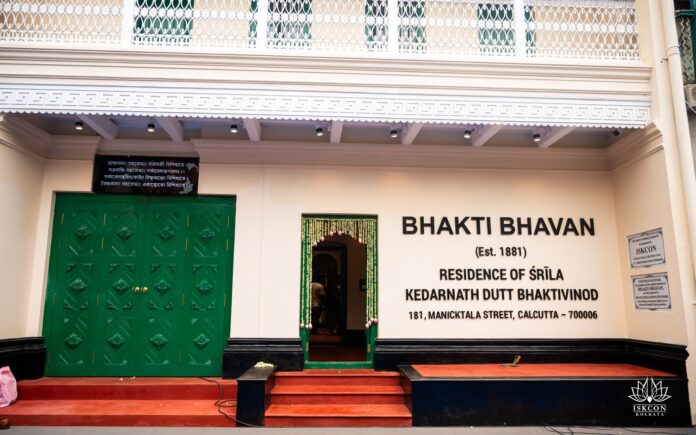
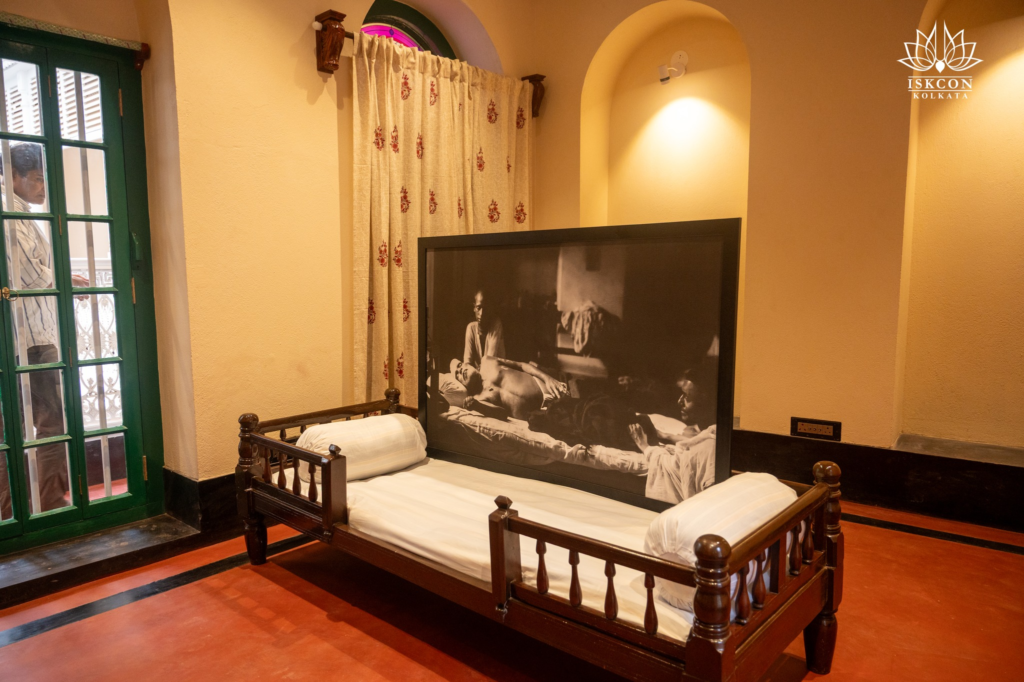
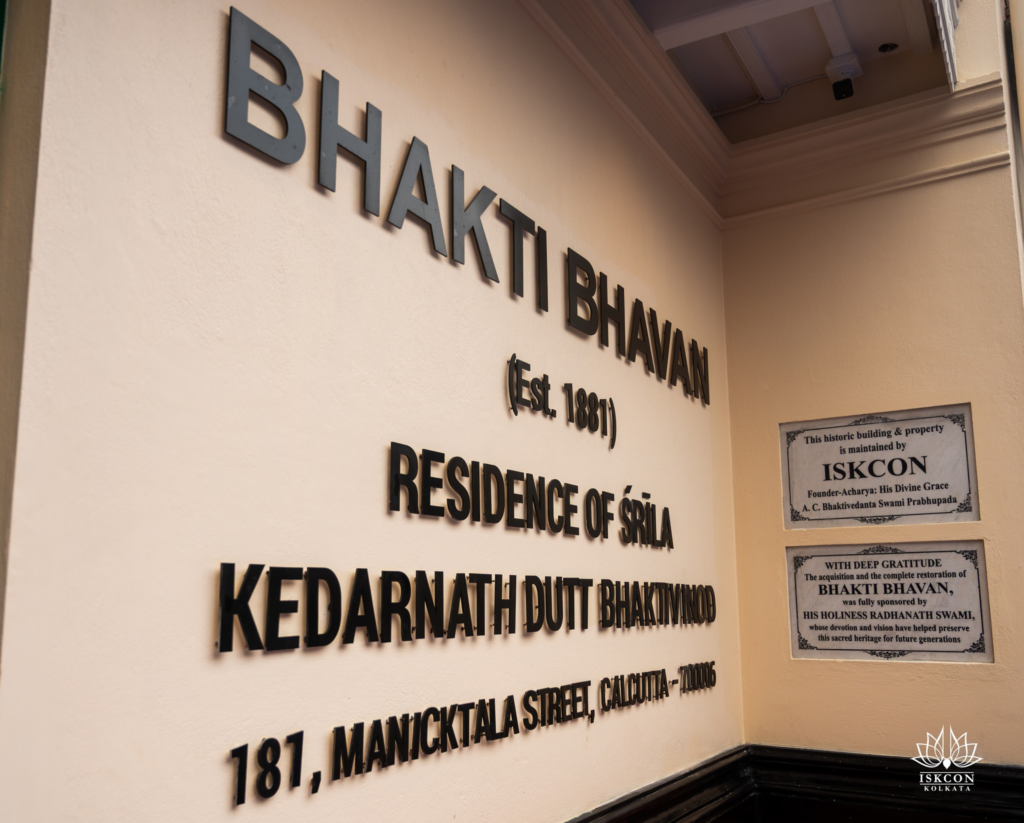
In 1881, during the construction of Bhakti Bhavana at Rambagan, Calcutta, a deity of Kurmadeva was unearthed, and young Bimala Prasada was entrusted with its service. In 1884, his father was appointed senior Deputy Magistrate of Serampore, where Bimala entered Serampore High School. He excelled in writing, inventing the Bicanto script, and studied mathematics and astrology under Pandita Mahesacandra Cudamoni, though his primary interest remained devotional literature.

By 1892, Bimala entered the Sanskrit College of Calcutta, studying philosophy, Vedas under Prithvidhara Sarma, and contributing articles to religious journals. Later, he established an autonomous Catuspathi, publishing journals such as Jyotirvid and Vrihaspati, and by age twenty-five, he was recognized as Siddhanta Sarasvati for his expertise in Sanskrit, mathematics, and astronomy.

In 1895, he served as editor for Rajaratnakara, the history of the Tripura royal family, and educated the Yuvaraja and princes. Observing corruption in state affairs, he renounced worldly employment after three years, maintaining only spiritual pursuits. From 1898, he accompanied his father on pilgrimages to Kasi, Prayag, and Gaya, discussing philosophical topics with learned scholars and increasing his inclination toward renunciation.

At age twenty-six, following his father’s guidance, he sought initiation from Gaurakisora dasa Babaji, a renounced Vaisnava known for strict detachment and austerity. After persistent requests and demonstrating devotion, Bimala received diksa from Gaurakisora Babaji, who instructed him to preach the Absolute Truth and set aside all other work.

In 1900, he accompanied his father on pilgrimages to Balasore, Remuna, Bhuvanesvar, and Puri, lecturing on the Caitanya-caritamrta. Through his father’s efforts, the current of pure bhakti began to flow again, reversing the darkness after Lord Caitanya’s disappearance. Siddhanta Sarasvati contributed to the revival of suddha-bhakti siddhanta, writing numerous books and periodicals, and establishing Namahatta and Prapannasrama centers.

In 1905, he took a vow to chant the Hare Krsna mantra one billion times, residing in Mayapur in a grass hut, performing austerities and chanting day and night. In 1912, he attended a Vaisnava Sammilani in Cossimbazar, preaching suddha-bhakti to learned persons while fasting due to the presence of non-Vaisnava sectarians.

During this period, he opposed prakrita Sahajiya sects misrepresenting Vaisnavism, firmly disassociating from deviated practices and performing bhajana in solitude. Once, Lord Caitanya and the six Gosvamis appeared in vision, instructing him to re-establish Varnasrama and propagate devotional love.

In 1911, he defended the principle that anyone, regardless of birth, can become a Vaisnava, conclusively proving through scripture that qualities, not birth, determine brahminical status. After his father’s disappearance in 1916, and following the instructions of his parents, he continued preaching and editing Sajjana-tosani, establishing the Bhagwat Press in Krishnanagar.

In 1918, he assumed sannyasa at Mayapur, taking the name Bhaktisiddhanta Sarasvati Gosvami Maharaja. He utilized the printing press as a “brhat mrdanga,” disseminating Krsna consciousness worldwide. He established sixty-four Suddha Bhakti Mathas across India and abroad, and initiated twenty-five learned disciples into Tridandi sannyasa.

He published numerous periodicals, including:

  1. Sajjanatosani (Bengali fortnightly)
  2. The Harmonist (English fortnightly)
  3. Gaudiya (Bengali weekly)
  4. Bhagavata (Hindi fortnightly)
  5. Nadiya Prakasa (Bengali daily)
  6. Kirtana (Assamese monthly)
  7. Paramarthi (Odiya monthly)

A few days before his departure, he instructed his disciples: “Preach the message of Rupa Raghunatha, remain humble and tolerant, glorify Hari constantly, and never abandon bhajana even amidst dangers, insults, or persecutions.”

In the early hours of January 1, 1937, Srila Bhaktisiddhanta Sarasvati Gosvami Maharaja passed away, leaving a worldwide movement dedicated to the service of Lord Caitanya and pure devotional principles.

Bhaktiprasada Puri

0

Bhaktiprasada Puri, originally named Ananta, was born on the sixth lunar day of the bright fortnight in the month of Bhadra, 1302 (August 25, 1895), in Sandvipa Hatiya village, Noakhali District (now Bangladesh). He was one of five sons of Bidhumukhi and Rajanikanta Vasu. His elder brother, Yogindra, later became well known as Bhaktipradipa Tirtha Maharaja.

From early childhood, Ananta exhibited a deep love for kirtana and great reverence for the Bhagavata-sastra. By the age of eight, he could recite from memory portions of the Ramayana, Mahabharata, and Bhagavad-gita. His melodious voice and expert handling of the mrdanga revealed his nitya-siddha Bhagavata-svabhava. At sixteen, he visited Bhaktibhavana, Ramabagan, Calcutta, with his father and Yogindra, where he received the blessings of Bhaktivinoda Thakura, Bhaktisiddhanta Sarasvati, and Krsnadasa Babaji.

Ananta completed his Intermediate course at Krsnanatha College, Baharampur, and graduated first class from Calcutta University. After the disappearance of Bhaktivinoda Thakura, he visited Ramabagan in 1918 with Yogindra to meet Bhaktisiddhanta Sarasvati. Concerned about arguments raised by critics of Vaisnavism, he inquired whether it was possible to demonstrate through sound logic that the conclusions of the Srimad-Bhagavatam represent the philosophy enjoined in the Vedanta.

In 1918, on the appearance day of Lord Caitanya, Bhaktisiddhanta Sarasvati took sannyasa and established the Sri Caitanya Matha. The deity of Sri Sri Vinodapran was installed, and the following day he gave mantra-diksha to Ananta, Haripada Vidyaratna, and Dhirendra Natha Bandopadhayaya. Ananta received the name Ananta Vasudeva Brahmacari and was later conferred the title Paravidyabhusana by the Navadvipa Pracarini Sabha.

From 1925 onwards, Ananta fully engaged in the service of Bhaktisiddhanta Sarasvati, taking notes of his lectures, performing secretarial work, and traveling with him to East Bengal. A srutidhara, Ananta could recall every explanation of Bhagavata slokas and assist his spiritual master instantly. Fully surrendered, he would not eat without being asked, sometimes going without food for extended periods.

After the establishment of Sri Caitanya Matha, Ananta helped manage the household and selected a house at 1 Ultadingi Road, Calcutta, to establish a center for bhakti propagation. In 1919, a seat in memory of Bhaktivinoda Thakura was installed, and the international court for Vaisnavas was re-established there. During this period, he managed the Sri Bhagavata Press, publishing numerous Vaisnava books, and assisted in composing Vyasa Puja offerings for Bhaktisiddhanta Sarasvati.

After the disappearance of Bhaktisiddhanta Sarasvati on December 31, 1936, Ananta was unanimously elected President-Acarya of the Gaudiya Matha and Mission, under the chairmanship of Kunjavihari Vidyabhusan. On the same day, he initiated over one hundred disciples and came to be addressed as Acaryadeva.

In 1937, Acaryadeva traveled extensively, preaching in Dhaka and later in Rangoon, Hardwar, and other places, opening exhibitions, giving lectures, and organizing kirtana festivals. On February 22, 1938, he left for Rangoon with a group of sannyasis, continuing vigorous preaching activities. In 1938, he commemorated the appearance of Bhaktivinoda Thakura in Calcutta with a two-month celebration, delivering lectures throughout the city.

Ananta Vasudeva accepted tridanda sannyasa at Gayadhama in 1939 on the fifth day of the dark fortnight in Asada (1346), receiving the name Bhaktiprasada Puri. After sannyasa, he fully renounced worldly life, wearing only a kaupina, walking barefoot, avoiding metal utensils, sleeping on the floor, and remaining awake on Ekadasi nights. He served Isana Thakura, caretaker of the Jagannatha temple garden, watering and clearing weeds regularly.

Following the Haribhaktivilasa, Bhaktiprasada Puri strictly observed the rituals of the month of Vaisaka (April-May) and introduced observances for Harivasara, Lord Gauranga’s appearance day, Nityananda Prabhu’s appearance, Advaita Acarya’s vrata, and Radhastami. Between 1942–1945, he lectured on Sri Bhakti Sandarbha, and from 1945 onwards published the works of the Gosvamis. In 1954, he appointed Bhaktikevala Audulomi Maharaja as President-Acarya of the Gaudiya Mission and retired to Vrndavana as a complete renunciate.

During his preaching years, he engaged in profound discussions on Daiva Varnasrama Dharma, countering the Sahajiyavada, and highlighting the principles of suddha Bhagavata dharma. In Vrndavana, he was surrounded by devotees such as Bhakti Srirupa Bhagavata Maharaja, Sivadavastava Prabhu, and Vrajasundara Dasa.

On the morning of March 8, 1958, at the Kunjavati of Sri Radharamanadeva, Bhaktiprasada Puri delivered his parting advice:

“Try to be in touch with the Inner Self. Preoccupation with the external world is of no use. Give up egoism and surrender to Krsna. Krsna is the creator, sustainer, and controller. There is no alternative for survival other than self-surrender.”

After instructing the devotees to continuously chant:
Sri Krsna Caitanya Sacisuta Gaura Gunadhama”
Bhaktiprasada Puri passed away, leaving a legacy of strict adherence to devotional principles, preaching, and publication of the Gosvamis’ works.

Balarama Das Babaji Mahasaya

0

From the age of twelve years he was engaged in the service of Siddha-baba at Suryakunda.  After eighteen years at Suryakunda Balarama became disenchanted when he discovered that one of the babaji’s in their cottage went out nightly, incognito, to enjoy the performance of music and dance performed by some local girls.  It appeared that the babaji concerned had an unholy relation with one of the dancing girls.  Thus, with due reverence to Siddha baba, Balarama left Vrndavana to settle down at Gauda-mandala.

Balaramadasa established an `Akhara’ to accommodate all visiting Vaisnavas from Vrajamandala and Gaudadesh. He organized programs for the celebration of various festivals every year and made adequate arrangements for everyone’s comfort.  With pleasure he served the Vaisnavas for almost thirty years.  One day he happened to meet a saintly old acquaintance from Sri Vrndavana who revived joyful memories of life in Vraja.  Upon discussing with the devotee, Balaramadasa babaji found out that Siddha baba of Govardhana, Siddha baba of Suryakunda, and many other former associates had all passed away.  In anguish Balaramadasa set out for Vrndavana, leaving behind all his possessions.

He lived a detached life alone in Vrndavana. He carried on with life as a mere formality, eating anything which was offered to him with affection.  Out of the one rupee babaji mahasaya received daily from a retired post master, he spent two paise to buy some puris and cooked vegetables for his evening meal.  He regularly attended kirtana at various places.  He listened to kirtana attentively with deep concentration, but turned a deaf ear to all other conversations around him.  Babaji mahasaya could quote, from memory, verses from Padavali composed by Rayasekhara, and would walk away after kirtana reciting verses from Padavali.

During the later years of his life, at the request of Sri Madhavadasa, Babaji mahasaya gave recitals at his place from  Govindalilamrta, Padakalpataru, and verses composed by Jagadananda Thakura, which Madhavadasa himself attended at times.  Babaji Mahasaya also did Vraja parikrama with Madhavadasa.

Balaramadasa lived in a thatched cottage within the premises of Rajarshi Bahadura, whose mother Babaji mahasaya initiated into vesasraya.

Balram Das Babaji Maharaj

0

At the age of forty Balarama received diksha from Siddha Krsnadasa babaji.  Within a short time he mastered the Sanskrit language.  Thereupon he translated Srimad Bhagavatam, in his own handwriting and presented it to Krsnadasa babaji.

He lived an austere, detached life at Jhadumandala in Vrndavana, and expected others to live in the same way.

Balarama’s uncompromising attitude is exhibited in the following story: At one time Jagadanandadasa of Orissa adopted the life of Vaisnava asceticism, under Nityanandadasa babaji of Mandana Mohana Thoura.  Afterwards he visited Balaramadasa and offered his obeisances, still wearing his sacred thread.  Balaramadasa became very annoyed and remarked:  “You have changed your garb yet you retain your sacred thread to display your brahmana caste (ego).”  Feeling very ashamed Jagadananda threw his sacred thread into the Jamuna and returned to Balaramadasa to receive his blessings.  Balaramadasa was a great devotee and commanded reverence from all.

At that time it was the custom to send to all distinguished Vaisnavas and descendants of Acaryas, a notification, twenty four hours in advance, regarding any up-coming nagara-sankirtana programs.  Simply upon receiving such news Balarama’s body automatically assumed a dancing posture and he became absorbed in devotional ecstacy.

He always kept himself at a safe distance from women, never looking upon their faces, nor talking to them.  It is said that sometimes he visited temples in Vrndavana walking blind-folded, with the help of a stick, just to avoid the sight of women.  Once a young servant of Sri Radharamana temple named Madhusudana Gosvami challenged Balaramadasa, asking why such an old, emaciated man was still so afraid of women.  Balaramadasa replied that according to Lord Caitanya, the inherent desire for physical pleasure exists as long as one is still situated within a body of flesh and blood, therefore the association of women must always be avoided.

Prabhupada Nilamani, a Gosvami of Vraja, ordered that whenever any festival was held at his temple a responsible devotee should be sent to deliver two plates of prasada to Balaramadasa’s cottage at Jhadumandala. Only after receiving Balarama’s approval would his devotees accept the prasada.  The prasada was then hung on the wall, inside a wire-net bag and  Balaramadasa would respect the prasada at his will.

On one occasion prasada was brought from Prabhu Nilamani’s temple and kept inside the wire-net bag, as usual.  When Balarama was about to respect the prasada, he looked up and saw that the prasada had become stained with blood, and fresh drops of blood were dripping on the floor.

On receiving an urgent call from Balarama, Nilamani Prabhu quickly came to Jhadumandala and offered his obeisances to Balaramadasa Maharaja.  In great anguish Balarama showed Nilamani the prasada. Nilamani immediately conducted an enquiry, which revealed that the mahotsava at his temple had been performed with finances received from some women of questionable profession from Calcutta.

Another incident connected with prasada which was offered to Balaramadasa on the occasion of a mahotsava is recorded as follows:  Everyday Balaramadasa sat on the bank of the Jamuna at Jhadumandal and recited from the Srimad Bhagavatam before the assembled Vaisnavas of Vraja.  On one such occasion while Balarama was sitting on the Vyasasana giving a lecture, his vision happened to rest upon the breasts of a young woman devotee.  The upper portion of her saree had fallen, exposing her breasts.  Balarama suddenly became physically excited, in utter disgust he abruptly stopped speaking.  He then confessed before his audience that he no longer considered himself fit to be addressed as a Siddha baba.  He declared that he intended to atone for his sin, then and there, by drowning himself in the Jamuna.

His devotees somehow persuaded Balaramadasa not to take such drastic action, but to at least give them time to check back on the source of the prasada from Sri Govinda temple which Balarama had eaten that morning.  After a thorough investigation they found that the festival at the Govinda temple had been organized with donations received from an aged Gosvami-mata from a temple in Bengal, who admitted that the money she donated had been earned in her earlier days through a dishonest profession.  From that very day Balaramadasa never accepted any prasada offered on the occasion of any utsava.

The History Of Mathura At The Time Of Lord Krishna

0

Mathura became the capital of the Shurasena Province, which comprised of the modern-day districts of Mathura, Agra, and Firozabad and was ruled by the kings belonging to the Yadava Dynasty. The Yadavas of the Shurasena Province were a confederacy of many clans which included the Vrishnis, Madhavas, Andhakas, and Bhojas, who belonged to the Chandra vamsha ksatriya lineage and ruled from different principalities in and around the province of Shurasena. The Yadavas were all descendents of King Yadu, the illustrious son of Maharaja Yayati, who had ruled from his capital city at Pratisthanpur (Prayag).

The Chandra-vamsha Empire under Yayati stretched from the Narmada River in the south to Hastinapura in the north and all the central regions of Aryavarta lying west of the Ganges were under his control. At the end of Dwapara-yuga, the most prominent King amongst the Yadava clan was Ugrasena Maharaja, who was the king of Mathura at the time of Lord Krishna’s appearance. His eldest son Kamsa, later imprisoned Ugrasena Maharaja and forcibly usurped his father’s throne. The other prominent king at the time was the virtuous Shurasena Maharaja, after whom the Yadava kingdom of Shurasena was named. Shurasena Maharaja ruled from the city of Yadupura, also called Vateshwara (Batasar), located about one hundred kilometers to the south of Mathura and some forty-five kilometers southeast of Agra. The Shurasena kingdom formally covered parts of the modern-day districts of Mathura and Agra in the Indian state of Uttar Pradesh.

Maharaja Shurasena’s son was the celebrated Vasudeva, who married Princess Devaki but just after their wedding they were imprisoned by Kamsa, who according to an omen, feared that a son born to them would kill him in the future. While in Kamsa’s prison cell, Devaki gave birth to a number of children who were all immediately slaughtered by the evil Kamsa. Devaki’s eighth child was Lord Krishna, the Supreme Personality of Godhead and immediately after His birth, He was taken by Vasudeva to the safety of Nanda Maharaja’s home in Gokula where Kamsa could not harm Him. The Shrimad Bhagavatam reveals that Lord Shri Krishna spent the first eleven years of His life living in the rural environs of Gokula Vrindavana, under the care of His foster parents Nanda and Yashoda, before eventually returning to Mathura in order to kill Kamsa, deliver Vasudeva and Devaki from persecution, and restore Ugrasena Maharaja on the throne of Mathura.

Subsequently, after numerous attacks on the city of Mathura by inimical kings and their legions, Krishna established the new city of Dwaraka in the midst of the ocean and relocated the entire Yadava Dynasty to the new city. In the course of His life, Krishna vanquished all the evil demons on earth and during the ensuing fratricidal conflict between the royal cousins, the Pandavas and the Kauravas, known as the Mahabharata war, by His divine will, Krishna removed the great burden on earth created by so many kings and their military forces who were all vanquished during the battle, which left no survivors except the five pious Pandava brothers and a few of their loyal followers.

Then some thirty-six years after the Mahabharata war, in the year 3102 BCE, Lord Krishna disappeared from the vision of the world. According to the Surya siddhanta, Kali-yuga began at midnight on the 18 February 3102 BCE, on the very day that Krishna left the world. Sometime after the departure of Lord Krishna, the Pandavas decided to retire from worldly affairs and leave for the Himalayas to pursue spiritual emancipation. In order to continue the rule of the Chandra-vamsha Dynasty, Yudisthira enthroned Parikshit Maharaja at Hastinapur while Arjuna enthroned Lord Krishna’s great grandson Vajranabha Maharaja as the ruler of both Indraprashta and Mathura.

Stay Connected

16,985FansLike
12,500FollowersFollow
61,453SubscribersSubscribe