Mail ID: contact@vedavarsity.com

Contact: +91 9634998911

Google search engineGoogle search engine
Home Blog Page 109

Srimad Bhagavatam | Canto 1 Chapter 3 |Avatars Of The Supreme Lord

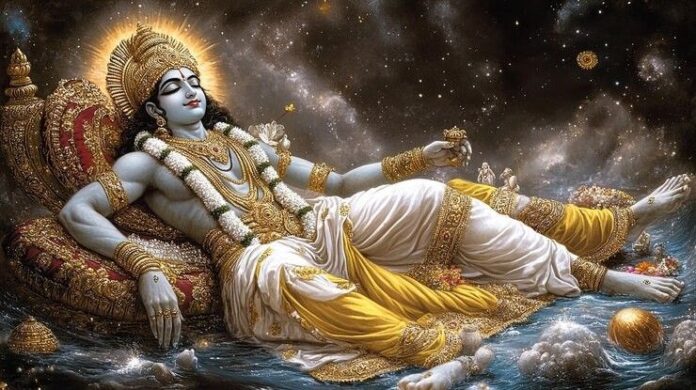
Sūta said: In the beginning of the creation, the Lord first expanded Himself in the univer sal form of the puruṣa incarnation and mani fested all the ingredients for the material crea tion. And thus at first there was the creation of the sixteen principles of material action. This was for the purpose of creating the material uni verses(1). A part of the puruṣa lies down within the water of the universe, from the navel lake of His body sprouts a lotus stem, and from the lotus flower atop this stem, Brahmā, the master of all engineers in the universe, becomes man ifest(2). It is believed that all the universal plan etary systems are situated on the extensive body of the puruṣa, but He has nothing to do with the created material ingredients. His body is eternally in spiritual existence par excellence (3). The devotees, with their perfect eyes, see the transcendental form of the puruṣa who has thousands of legs, thighs, arms and faces all extraordinary. In that body there are thousands of heads, ears, eyes and noses. They are deco rated with thousands of helmets and glowing earrings and are adorned with garlands (4). This form [the second manifestation of the puruṣa] is the source and indestructible seed of multi farious incarnations within the universe. From the particles and portions of this form, different living entities, like demigods, men and others, are created (5).

 First of all, in the beginning of creation, there were the four unmarried sons of Brahmā [the Kumāras], who, being situated in a vow of celibacy, underwent severe austerities for real ization of the Absolute Truth (6). The supreme enjoyer of all sacrifices accepted the incarna tion of a boar [the second incarnation], and for the welfare of the earth He lifted the earth from the nether regions of the universe.(7)In the mil lennium of the ṛṣis, the Personality of Godhead accepted the third empowered incarnation in the form of Devarṣi Nārada, who is a great sage among the demigods. He collected expositions of the Vedas which deal with devotional ser vice and which inspire nonfruitive action (8). In the fourth incarnation, the Lord became Nara and Nārāyaṇa, the twin sons of the wife of King Dharma. Thus He undertook severe and exem plary penances to control the senses (9).

 The fifth incarnation, named Lord Kapila, is fore most among perfected beings. He gave an ex position of the creative elements and metaphys ics to Āsuri Brāhmaṇa, for in course of time this knowledge had been lost (10). The sixth incar nation of the puruṣa was the son of the sage Atri. He was born from the womb of Anasūyā, who prayed for an incarnation. He spoke on the subject of transcendence to Alarka, Prahlāda and others [Yadu, Haihaya, etc.] (11). The sev enth incarnation was Yajña, the son of Prajāpati Ruci and his wife Ākūti. He controlled the pe riod during the change of the Svāyambhuva Manu and was assisted by demigods such as His son Yāma (12). The eighth incarnation was King Ṛṣabha, son of King Nābhi and his wife Merudevī. In this incarnation the Lord showed the path of perfection, which is followed by those who have fully controlled their senses and who are honored by all orders of life (13). O brāhmaṇas, in the ninth incarnation, the Lord, prayed for by sages, accepted the body of a king [Pṛthu] who cultivated the land to yield various produce, and for that reason the earth was beautiful and attractive (14). When there was a complete inundation after the period of the Cākṣuṣa Manu and the whole world was deep within water, the Lord accepted the form of a fish and protected Vaivasvata Manu, keep ing him up on a boat (15).

 The eleventh incar nation of the Lord took the form of a tortoise whose shell served as a pivot for the Man darācala Hill, which was being used as a churn ing rod by the theists and atheists of the uni verse (16). In the twelfth incarnation, the Lord appeared as Dhanvantari, and in the thirteenth He allured the atheists by the charming beauty of a woman and gave nectar to the demigods to drink (17). In the fourteenth incarnation, the Lord appeared as Nṛsiṁha and bifurcated the strong body of the atheist Hiraṇyakaśipu with His nails, just as a carpenter pierces cane (18).

 In the fifteenth incarnation, the Lord assumed the form of a dwarf brāhmaṇa [Vāmana] and visited the arena of sacrifice arranged by Mahārāja Bali. Although at heart He was will ing to regain the kingdom of the three planetary systems, He simply asked for a donation of three steps of land (19). In the sixteenth incar nation of the Godhead, the Lord [as Bhṛgupati] annihilated the administrative class [kṣatriyas] twentyone times, being angry with them be cause of their rebellion against the brāhmaṇas [the intelligent class] (20). Thereafter, in the seventeenth incarnation of Godhead, Śrī Vyāsadeva appeared in the womb of Satyavatī through Parāśara Muni, and he divided the one Veda into several branches and subbranches, seeing that the people in general were less in telligent (21). In the eighteenth incarnation, the Lord appeared as King Rāma. In order to per form some pleasing work for the demigods, He exhibited superhuman powers by controlling the Indian Ocean and then killing the atheist King Rāvaṇa, who was on the other side of the sea (22).

 In the nineteenth and twentieth incarnations, the Lord advented Himself as Lord Balarāma and Lord Kṛṣṇa in the family of Vṛṣṇi [the Yadu dynasty], and by so doing He removed the burden of the world (23). Then, in the be ginning of Kaliyuga, the Lord will appear as Lord Buddha, the son of Añjanā, in the prov ince of Gayā, just for the purpose of deluding those who are envious of the faithful theist (24). Thereafter, at the conjunction of two yugas, the Lord of the creation will take His birth as the Kalki incarnation and become the son of Viṣṇu Yaśā. At this time almost all the rulers of the earth will have degenerated into plunderers (25).

 O brāhmaṇas, the incarnations of the Lord are innumerable, like rivulets flowing from in exhaustible sources of water (26). All the ṛṣis, Manus, demigods and descendants of Manu, who are especially powerful, are plenary por tions or portions of the plenary portions of the Lord. This also includes the Prajāpatis (27). All of the above mentioned incarnations are either plenary portions or portions of the plenary por tions of the Lord, but Lord Śrī Kṛṣṇa is the orig inal Personality of Godhead. All of them appear on planets whenever there is a disturbance cre ated by the atheists. The Lord incarnates to pro tect the theists (28). Whoever carefully recites the mysterious appearances of the Lord, with devotion in the morning and in the evening, gets relief from all miseries of life (29).

 The conception of the virāṭ universal form of the Lord, as appearing in the material world, is imaginary. It is to enable the less intelligent [and neophytes] to adjust to the idea of the Lord’s having form. But factually the Lord has no material form (30). Clouds and dust are car ried by the air, but less intelligent persons say that the sky is cloudy and the air is dirty. Simi larly, they also implant material bodily concep tions on the spirit self (31). Beyond this gross conception of form is another, subtle concep tion of form which is without formal shape and is unseen, unheard and unmanifest. The living being has his form beyond this subtlety, other wise he could not have repeated births (32). Whenever a person experiences, by self reali zation, that both the gross and subtle bodies have nothing to do with the pure self, at that time he sees himself as well as the Lord (33). If the illusory energy subsides and the living en tity becomes fully enriched with knowledge by the grace of the Lord, then he becomes at once enlightened with selfrealization and thus be comes situated in his own glory (34).Thus learned men describe the births and activities of the unborn and inactive, which is undiscovera ble even in the Vedic literatures. He is the Lord of the heart (35).

 The Lord, whose activities are always spot less, is the master of the six senses and is fully omnipotent with six opulences. He creates the manifested universes, maintains them and an nihilates them without being in the least af fected. He is within every living being and is always independent (36). The foolish with a poor fund of knowledge cannot know the tran scendental nature of the forms, names and ac tivities of the Lord, who is playing like an actor in a drama. Nor can they express such things, neither in their speculations nor in their words (37). Only those who render unreserved, unin terrupted, favorable service unto the lotus feet of Lord Kṛṣṇa, who carries the wheel of the chariot in His hand, can know the creator of the universe in His full glory, power and transcend ence (38).

 Only by making such inquiries in this world can one be successful and perfectly cognizant, for such inquiries invoke transcen dental ecstatic love unto the Personality of Godhead, who is the proprietor of all the uni verses, and guarantee centpercent immunity from the dreadful repetition of birth and death (39).

This Śrīmad Bhāgavatam is the literary in carnation of God, and it is compiled by Śrīla Vyāsadeva, the incarnation of God. It is meant for the ultimate good of all people, and it is all successful, all blissful and all perfect (40).Śrī Vyāsadeva delivered it to his son, who is the most respected among the self realized, after extracting the cream of all Vedic literatures and histories of the universe (41). Śukadeva Gosvāmī, the son of Vyāsadeva, in his turn de livered the Bhāgavatam to the great Emperor Parīkṣit, who sat surrounded by sages on the bank of the Ganges, awaiting death without tak ing food or drink (42). This Bhāgavata Purāṇa is as brilliant as the sun, and it has arisen just after the departure of Lord Kṛṣṇa to His own abode, accompanied by religion, knowledge, etc. Persons who have lost their vision due to the dense darkness of ignorance in the Age of Kali shall get light from this Purāṇa. O learned brāhmaṇas, when Śukadeva Gosvāmī recited Bhāgavatam there [in the presence of Emperor Parīkṣit], I heard him with rapt attention, and thus, by his mercy, I learned the Bhāgavatam from that great and powerful sage. Now I shall try to make you hear the very same thing as I learned it from him and as I have realized it (43 44).

Srimad Bhagavatam | Canto 1 Chapter 2 |Discovering The Supreme Purpose Of Life

Ugraśravā [Sūta Gosvāmī], the son of Romaharṣaṇa, being fully satisfied by the per fect questions of the brāhmaṇas, thanked them and thus attempted to reply.(1)

 Śrīla Sūta Gosvāmī said: Let me offer my respectful obeisances unto that great sage [Śukadeva Gosvāmī] who can enter the hearts of all. When he went away to take up the re nounced order of life [sannyāsa], leaving home without undergoing reformation by the sacred thread or the ceremonies observed by the higher castes, his father, Vyāsadeva, fearing separation from him, cried out, “O my son!” In deed, only the trees, which were absorbed in the same feelings of separation, echoed in response to the begrieved father.(2)

 Let me offer my respectful obeisances unto him [Śuka], the spiritual master of all sages, the son of Vyāsadeva, who, out of his great com passion for those gross materialists who strug gle to cross over the darkest regions of material existence, spoke this most confidential supple ment to the cream of Vedic knowledge, after having personally assimilated it by experi ence.(3) Before reciting this Śrīmad Bhāgavatam, which is the very means of con quest, one should offer respectful obeisances unto the Personality of Godhead, Nārāyaṇa, unto Naranārāyaṇa Ṛṣi, the supermost human being, unto mother Sarasvatī, the goddess of learning, and unto Śrīla Vyāsadeva, the au thor.(4)

 O sages, I have been justly questioned by you. Your questions are worthy because they relate to Lord Kṛṣṇa and so are of relevance to the world’s welfare. Only questions of this sort are capable of completely satisfying the self.(5) The supreme occupation [dharma] for all hu manity is that by which men can attain to loving devotional service unto the transcendent Lord. Such devotional service must be unmotivated and uninterrupted to completely satisfy the self. (6) By rendering devotional service unto the Personality of Godhead, Śrī Kṛṣṇa, one imme diately acquires causeless knowledge and de tachment from the world. (7) The occupational activities a man performs according to his own 42 Srimad Bhagavata Mahapurana position are only so much useless labor if they do not provoke attraction for the message of the Personality of Godhead. (8) All occupational engagements are certainly meant for ultimate liberation. They should never be performed for material gain. Furthermore, according to sages, one who is engaged in the ultimate occupa tional service should never use material gain to cultivate sense gratification. (9) Life’s desires should never be directed toward sense gratifi cation. One should desire only a healthy life, or self preservation, since a human being is meant for inquiry about the Absolute Truth. Nothing else should be the goal of one’s works. (10) Learned transcendentalists who know the Ab solute Truth call this nondual substance Brah man, Paramātmā or Bhagavān. (11)

 The seriously inquisitive student or sage, well equipped with knowledge and detach ment, realizes that Absolute Truth by rendering devotional service in terms of what he has heard from the Vedānta śruti.(12) O best among the twiceborn, it is therefore concluded that the highest perfection one can achieve by discharg ing the duties prescribed for one’s own occupa tion according to caste divisions and orders of life is to please the Personality of Godhead.(13) Therefore, with one pointed attention, one should constantly hear about, glorify, remem ber and worship the Personality of Godhead, who is the protector of the devotees. (14) With sword in hand, intelligent men cut through the binding knots of reactionary work [karma] by remembering the Personality of Godhead. Therefore, who will not pay attention to His message?(15)

 O twiceborn sages, by serving those devo tees who are completely freed from all vice, great service is done. By such service, one gains affinity for hearing the messages of Vāsudeva.(16)Śrī Kṛṣṇa, the Personality of Godhead, who is the Paramātmā [Supersoul] in everyone’s heart and the benefactor of the truthful devotee, cleanses desire for material enjoyment from the heart of the devotee who has developed the urge to hear His messages, which are in themselves virtuous when properly heard and chanted.(17) By regular at tendance in classes on the Bhāgavatam and by rendering of service to the pure devotee, all that is troublesome to the heart is almost completely destroyed, and loving service unto the Person ality of Godhead, who is praised with transcen dental songs, is established as an irrevocable fact. (18) As soon as irrevocable loving service is established in the heart, the effects of na ture’s modes of passion and ignorance, such as lust, desire and hankering, disappear from the heart. Then the devotee is established in good ness, and he becomes completely happy. (19) Thus established in the mode of unalloyed goodness, the man whose mind has been enliv ened by contact with devotional service to the Lord gains positive scientific knowledge of the Personality of Godhead in the stage of libera tion from all material association.(20) Thus the knot in the heart is pierced, and all misgivings are cut to pieces. The chain of fruitive actions is terminated when one sees the self as mas ter.(21) Certainly, therefore, since time imme morial, all transcendentalists have been render ing devotional service to Lord Kṛṣṇa, the Per sonality of Godhead, with great delight, be cause such devotional service is enlivening to the self. (22)

The transcendental Personality of Godhead is indirectly associated with the three modes of material nature, namely passion, goodness and ignorance, and just for the material world’s cre ation, maintenance and destruction He accepts the three qualitative forms of Brahmā, Viṣṇu and Śiva. Of these three, all human beings can derive ultimate benefit from Viṣṇu, the form of the quality of goodness.(23) Firewood is a transformation of earth, but smoke is better than the raw wood. And fire is still better, for by fire we can derive the benefits of superior knowledge [through Vedic sacrifices]. Simi larly, passion [rajas] is better than ignorance [tamas], but goodness [sattva] is best because by goodness one can come to realize the Abso lute Truth.(24) Previously all the great sages rendered service unto the Personality of God head due to His existence above the three modes of material nature. They worshiped Him to become free from material conditions and thus derive the ultimate benefit. Whoever fol lows such great authorities is also eligible for 43 Srimad Bhagavata Mahapurana liberation from the material world. (25) Those who are serious about liberation are certainly nonenvious, and they respect all. Yet they re ject the horrible and ghastly forms of the dem igods and worship only the all blissful forms of Lord Viṣṇu and His plenary portions.(26) Those who are in the modes of passion and ig norance worship those in the same category namely the forefathers, other living beings and the demigods who are in charge of cosmic ac tivities for they are urged by a desire to be ma terially benefited with women, wealth, power and progeny. (27) In the revealed scriptures, the ultimate object of knowledge is Śrī Kṛṣṇa, the Personality of Godhead. The purpose of performing sacrifice is to please Him. Yoga is for realizing Him. All fruitive activities are ul timately rewarded by Him only. He is supreme knowledge, and all severe austerities are per formed to know Him. Religion [dharma] is ren dering loving service unto Him. He is the su preme goal of life. (28-29) In the beginning of the material creation, that Absolute Personality of Godhead [Vāsudeva], in His transcendental position, created the energies of cause and ef fect by His own internal energy. (30)

 After creating the material substance, the Lord [Vāsudeva] expands Himself and enters into it. And although He is within the material modes of nature and appears to be one of the created beings, He is always fully enlightened in His transcendental position.(31)The Lord, as Supersoul, pervades all things, just as fire per meates wood, and so He appears to be of many varieties, though He is the absolute one without a second. (32) The Supersoul enters into the bodies of the created beings who are influenced by the modes of material nature and causes them to enjoy the effects of these modes by the subtle mind.(33) Thus the Lord of the universes maintains all planets inhabited by demigods, men and lower animals. Assuming the roles of incarnations, He performs pastimes to reclaim those in the mode of pure goodness.(34)

Srimad Bhagavatam | Canto 1 Chapter 1 | Sages’ Questions

O my Lord, Śrī Kṛṣṇa, son of Vasudeva, O all pervading Personality of Godhead, I offer my respectful obeisances unto You. I meditate upon Lord Śrī Kṛṣṇa because He is the Abso lute Truth and the primeval cause of all causes of the creation, sustenance and destruction of the manifested universes. He is directly and in directly conscious of all manifestations, and He is independent because there is no other cause beyond Him. It is He only who first imparted the Vedic knowledge unto the heart of Brahmājī, the original living being. By Him even the great sages and demigods are placed into illusion, as one is bewildered by the illu sory representations of water seen in fire, or land seen on water. Only because of Him do the material universes, temporarily manifested by the reactions of the three modes of nature, ap pear factual, although they are unreal. I there fore meditate upon Him, Lord Śrī Kṛṣṇa, who is eternally existent in the transcendental abode, which is forever free from the illusory representations of the material world. I medi tate upon Him, for He is the Absolute Truth. (1) Completely rejecting all religious activities which are materially motivated, this Bhāgavata Purāṇa propounds the highest truth, which is understandable by those devotees who are fully pure in heart. The highest truth is reality distin guished from illusion for the welfare of all. Such truth uproots the threefold miseries. This beautiful Bhāgavatam, compiled by the great sage Vyāsadeva [in his maturity], is sufficient in itself for God realization. What is the need of any other scripture? As soon as one attentively and submissively hears the message of Bhāgavatam, by this culture of knowledge the Supreme Lord is established within his heart.(2)

 O expert and thoughtful men, relish Śrīmad Bhāgavatam, the mature fruit of the desire tree of Vedic literatures. It emanated from the lips of Śrī Śukadeva Gosvāmī. Therefore this fruit has become even more tasteful, although its nectarean juice was already relishable for all, including liberated souls.(3)

Once, in a holy place in the forest of Naimiṣāraṇya, great sages headed by the sage Śaunaka assembled to perform a great thousand year sacrifice for the satisfaction of the Lord and His devotees.(4) One day, after finishing their morning duties by burning a sacrificial fire and offering a seat of esteem to Śrīla Sūta Gosvāmī, the great sages made inquiries, with great respect, about the following matters.(5)

The sages said: Respected Sūta Gosvāmī, you are completely free from all vice. You are well versed in all the scriptures famous for re ligious life, and in the Purāṇas and the histories as well, for you have gone through them under proper guidance and have also explained them.(6)Being the eldest learned Vedāntist, O Sūta Gosvāmī, you are acquainted with the knowledge of Vyāsadeva, who is the incarna tion of Godhead, and you also know other sages who are fully versed in all kinds of physical and metaphysical knowledge.(7)And because you are submissive, your spiritual masters have en dowed you with all the favors bestowed upon a gentle disciple. Therefore you can tell us all that you have scientifically learned from them.(8)Please, therefore, being blessed with many years, explain to us, in an easily under standable way, what you have ascertained to be the absolute and ultimate good for the people in general.(9)O learned one, in this iron age of Kali men have but short lives. They are quar relsome, lazy, misguided, unlucky and, above all, always disturbed.(10)There are many vari eties of scriptures, and in all of them there are many prescribed duties, which can be learned only after many years of study in their various divisions. Therefore, O sage, please select the essence of all these scriptures and explain it for the good of all living beings, that by such in struction their hearts may be fully satisfied.(11) All blessings upon you, O Sūta Gosvāmī. You know for what purpose the Personality of God head appeared in the womb of Devakī as the son of Vasudeva.(12)

O Sūta Gosvāmī, we are eager to learn about the Personality of Godhead and His incarna tions. Please explain to us those teachings im parted by previous masters [ācāryas], for one is uplifted both by speaking them and by hearing them. (13) Living beings who are entangled in the complicated meshes of birth and death can be freed immediately by even unconsciously chanting the holy name of Kṛṣṇa, which is feared by fear personified. (14) O Sūta, those great sages who have completely taken shelter of the lotus feet of the Lord can at once sanctify those who come in touch with them, whereas the waters of the Ganges can sanctify only after prolonged use. (15) Who is there, desiring de liverance from the vices of the age of quarrel, who is not willing to hear the virtuous glories of the Lord? (16) His transcendental acts are magnificent and gracious, and great learned sages like Nārada sing of them. Please, there fore, speak to us, who are eager to hear about the adventures He performs in His various in carnations. (17) O wise Sūta, please narrate to us the tran scendental pastimes of the Supreme Godhead’s multiincarnations. Such auspicious adventures and pastimes of the Lord, the supreme control ler, are performed by His internal powers. (18) We never tire of hearing the transcendental pas times of the Personality of Godhead, who is glorified by hymns and prayers. Those who have developed a taste for transcendental rela tionships with Him relish hearing of His pas times at every moment. (19) Lord Śrī Kṛṣṇa, the Personality of Godhead, along with Balarāma, played like a human being, and so masked He performed many superhuman acts. (20) Know ing well that the age of Kali has already begun, we are assembled here in this holy place to hear at great length the transcendental message of Godhead and in this way perform sacrifice. (21) We think that we have met Your Goodness by the will of providence, just so that we may ac cept you as captain of the ship for those who desire to cross the difficult ocean of Kali, which deteriorates all the good qualities of a human being. (22) Since Śrī Kṛṣṇa, the Absolute Truth, the master of all mystic powers, has departed for His own abode, please tell us to whom the religious principles have now gone for shel ter(23)

Stay Connected

16,985FansLike
12,500FollowersFollow
61,453SubscribersSubscribe