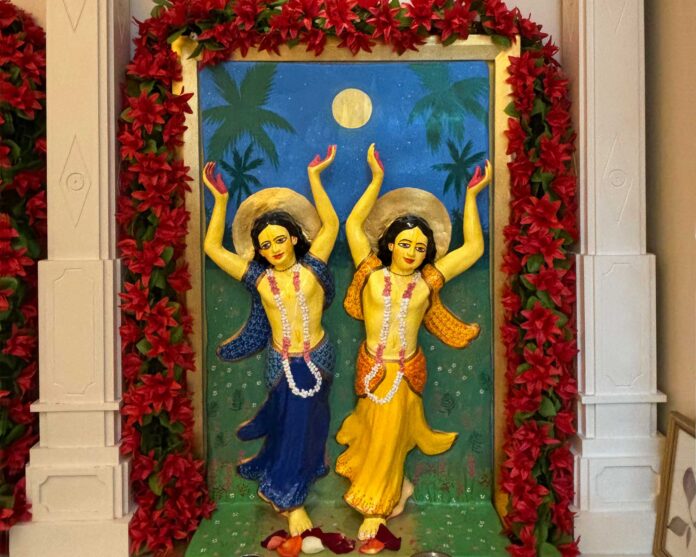
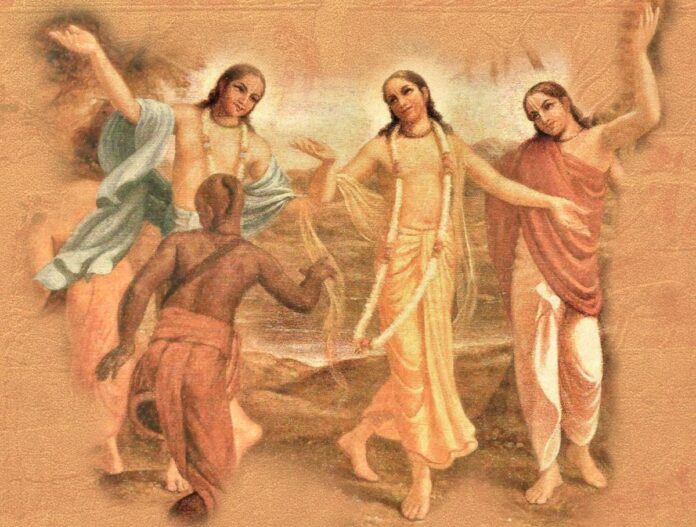
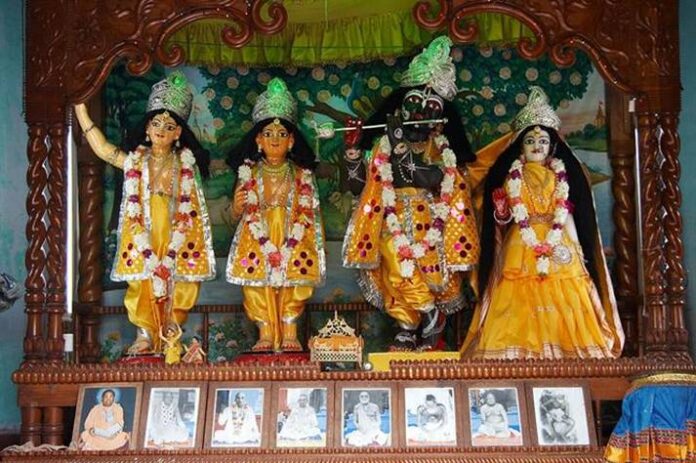
1) Lord Nityananda is my wealth. Lord Gauracandra is my master. The youthful Divine Couple is my life. Advaita Acarya is my strength. Gadadhara is my family. Narahari Sarakara is my glory.
2) The dust of the devotees’ lotus feet is my bathing water. The chanting of the devotees names is my satisfaction. Considering the merits of all Vedic literatures in the light of devotional service, I have concluded that the Srimad Bhagavatam is the best of all scriptures.
3) My mind is firmly convinced of the spiritual benefit obtained by eating the remnants of foodstuff left by the devotees. The names of the devotees are my happiness. The land of Vrndavana is the enclosure within which I keep my mind. Poor-hearted Narottama dasa speaks in this way.
gaura bhajan anurāge (anurāge, bholā mana, mana re āmār)
anurāge tilakete
gaura bhajan holo nā (hāi bholā mana)
(4)
jei jana nitya bastu ādor kore
āmār doyāl nitāi tāńhāra ghore
tāre bhakti bhāve ḍākle pore
utor sādhan saphal ha’be (viphal ha’be nā)
TRANSLATION:
1) O naïve mind, I did not meet Nitai! I did not meet Gaura! Even though my entire body is covered with tilak, I did not meet Gaura!
2) How can you come across the love of Sri Gaura if you are not proper, internally and externally? If your worship is not proper, you will not find that gold (love of Sri Gaura)!
3) With cleansing of one’s mind, one can develop love for Sri Gaura. But if you develop love for decorating your body with tilak, you are not worshipping Lord Caitanya! (O my naïve mind, you are not worshipping Gaura!)
4) To that person who always respects this item (the love of Lord Caitanya), my merciful Nitai will be present at their home. If you call out with feelings of devotion, your austerity will become successful. (It will not become a failure!)
“O Lord of the universe, kindly be visible unto me.”
Jagannatha means “Lord of the Universe”. Jagannatha Swami is a unique Deity form of Lord Sri Krishna, who has especially appeared in Kali-yuga to deliver the most fallen souls. Merciful Lord Jagannatha accepts worship from one and all. Padma Purana states:
Samudrasyottare tire, aste sri-purusottame
Purnananda-mayam brahma, daru-vyaja-sarira-bhrt
“At Sri Purusottama [Jagannatha Puri], on the northern shore of the ocean, resides the Supreme Absolute Truth. Full of ecstatic bliss, He has assumed a transcendental body that appears wooden.”
Jagannatha Svami is called daru-brahman because He is the Absolute Truth in wood (daru), and because He destroys (daranat) the miseries of material existence. Daru Brahman means the Deity form of God, the Supreme Brahman, Parabrahman. It means the Supreme Personality of Godhead Sri Krishna who cuts away all sufferings and miserable material attachments, and then rewards one an eternal life of endless bliss in the spiritual world; He is Lord Jagannatha or Daru Brahman.
Being absolute, Lord Jagannatha is identical in person, form, picture, kirtana and all other circumstances. If one thinks that the form of Lord Jagannatha is an idol made of wood, he immediately brings ill fortune into his life. Lord Jagannatha is sac-cid-ananda-vigraha, just as the body of Krishna is sac-cid-ananda-vigraha. A pure devotee who knows the science of Krishna Consciousness makes no distinction between Lord Jagannatha and His body. Lord Jagannatha is identical with Sri Krishna (Krsnera ‘atma-svarupa). But in Jagannatha Puri, He appears as daru-brahma, a non-moving entity (sthavara-svarupa). Thus Lord Jagannatha and Sri Caitanya Mahaprabhu, although appearing as two, are one because They are both Krishna, who is one alone. The supreme desire to deliver the entire world meets in both Mahaprabhu and Jagannatha, and for that reason also They are one and the same. To deliver all the materially contaminated people of the world, that same Krishna has descended in the moving form (jangama rupa) of Gaura. (Caitanya Caritamrta Antya Lila 5.148-151)
Beauty of Jagannatha Svami:Lord Jagannatha has extraordinary form. Pilgrims in Puri often ask, “Why does the Deity of Jagannatha Deva have such an unusual form?” Answer is simple: God wants to appear like this, in this most unusual form, to establish religion in this most unusual age of Kali. Vamadeva Samhita and Skanda Purana state that Lord Sri Krishna appears in this covered wooden form out of His independent will and due to prayer of Brahma Ji. Sri Caitanya Mahaprabhu was very thirsty to see the Deity of Lord Jagannatha. Gauranga’s eyes became like two bumblebees drinking the honey from the lotus-like eyes of Lord Jagannatha who is Krishna Himself.
The eyes of Lord Jagannatha conquer the beauty of blossoming lotus flowers and His neck defeats the luster of a mirror made of blue sapphires. The chin of Jagannatha Svami, tinged with a buff color conquers the beauty of bandhuli flower. This increases the beauty of Jagannatha’s mild smiling, which is like lustrous waves of nectar. Luster of Jagannatha Deva’s beautiful face increases at every moment, and the eyes of 100’s and 1000’s of devotees drink its honey like bumblebees. Feeling such great pleasure upon seeing the face of Lord Jagannatha, Sri Caitanya Mahaprabhu forgot everything. (Caitanya Caritamrta Madhya Lila 12.210-19)
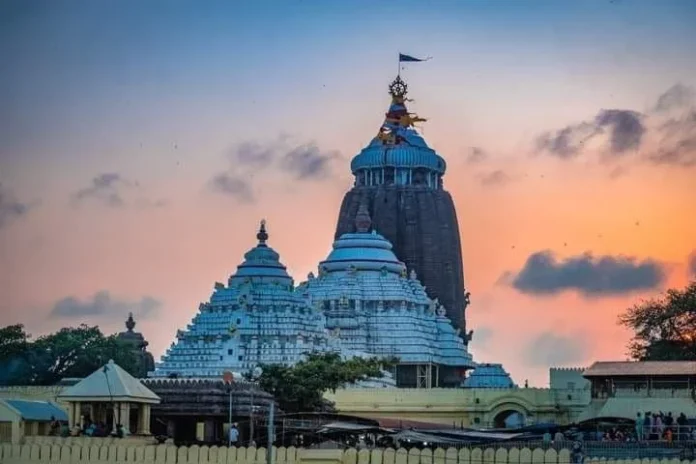
Temple Architecture: Main temple of Jagannatha Svami soars 214 feet high. Temple complex comprises an area of 10.7 acres and is enclosed by 2 rectangular walls. Outer enclosure is called Meghananda Prachira (665 x 640 feet). Walls are 6 meters high. Inner wall is called Kurmabedha (420 x 315 ft). This ancient temple combines two styles: South Indian (Dravidian) and North Indian (Nagara). King Anangabhima Deva completed the temple in 1200 AD. Within the boundary walls of the Jagannatha temple there are 30 different temples. Outer wall has opening in four directions. East and main gate, Lion Gate (Simha-dvara) has two crouching stone lions. South gate, Horse Gtae (Aswa-dvara) has a pair of galloping horses carrying Jagannatha and Baladeva on backs with all Their martial glory. West gate, Tiger Gate (Vyaghra-dvara) has two stone tigers, and north gate, Elephant Gate (Hasti-dvara) has a huge stone elephant.
Cakra and Flags: The cakra (Sudarsana disc) above Lord Jaganantha’s temple is called “Nila-Cakra” (blue wheel). Nila-cakra is made of an alloy of 8 different metals. It is 11 feet 8inch high and has circumference of 36 feet. On every Ekadasi a lamp is lit near the wheel. Daily around 6:30pm, the Garuda Sevaka (a pujari flag bearer) fearlessly climbs up 214 feet to the Nila-cakra and fastens a number of flags to the mast fixed to Nila-cakra. Flags, which are bright red, white or bright yellow in color, are embroidered with a crescent moon and a sun in the middle, signifying that Lord Jagannatha is our ever-watchful, loving guardian both in the day and night. It alsom means that Lord Jagannatha rules the universe wherever the sun and moon shine. Nila-cakra sevaits, begin this hereditary service from age of 8, get the ability to perform this very difficult service by the mercy of Garuda, whose name they chant while scaling the shikara.
In front of main gate is a pillar 11m high called Aruna Stambha. On top of this single-stone pillar is Aruna, the charioteer of the sun god. In passage room of main gate is a Deity of Lord Jagannatha called Patita Pavana (saviour of the most fallen). It is visible from the road. One can stand behind Aruna Stambha and respectively gaze at the Nila-Cakra, flags billowing atop Jagannatha’s temple and Patita Pavana Jagannatha in front, and then offer humble obeisances. Seeing Nila-Cakra, flags and Patita Pavana Jagannatha is equal to direct darshana of Lord Jagannatha in the temple. (Caitanya Caritamrta Madhya Lila 11.195 purport)
Transcendental ambience within sacred space of the Supreme Lord Jagannatha: While approaching innermost sanctuary (Garbha Grha) of the Jagannatha Temple through the various halls and past many pillars and carved panels, a devotee is subtly influenced by sacredness of the architecture. He finds himself enclosed with the Supreme Lord in a dim, soothing atmosphere. His eyes find rest after fierce light of the day outside. Not only is lighting dim, but the air is filled with scent of flowers, burning oil lamps and incense coming from the sanctuary. Gradually his mood calms and his spiritual feelings are awakened as he approaches the Deities.
Garuda-stambha: Garuda-stambha (pillar) stands along east back wall of the Jagamohana. It supports murti of Lord Narayana’s eagle carrier Garuda, who is admiring the Deity of Jagannatha Deva from this vintage point. Devotees regularly hug this pillar and offer prayers while seeing Lord Jagannatha. By doing this they feel blessings of Lord’s direct embrace. Gauranga Mahaprabhu used to stand here and offer obeisances and prayers while reeling in ecstatic bliss gazing upon saksat Vrajendranandana Jagannatha Svami. Mahaprabhu’s divine finger prints are imprinted on the wall behind the Garuda-stambha. Srila Krishna dasa Kavriraj Goswami describes:
“Staying near the Garuda-stambha, Gaura-raya gazed upon the Lord Jagannatha. What can be said about the strength of that love? On the ground beneath the column of the Garuda-stambha was a deep ditch, which filled with the water of Gauranga’s tears.” (Caitanya Caritamrta Madhya Lila 2.54)
Kitchen and Maha-Prasadam of Lord Jagannatha:
· Temple has largest kitchen in the world and feeds thousands of devotees every day. Kitchen can prepare prasadam for 100,000 people one day, and 250,000 is normal on a festival day.
· Kitchen has astounding 752 wood-burning stoves, each 3’x4’ spread over one acre in the south east corner, far left inside the Lion Gate.
· 600 cooks and 1,000 devotees work daily in the kitchen.
· Chillies, onion, garlic, carrots and widely available “new-world” ingredients such as cabbage, potatoes, tomatoes, cauliflowers are not used in any preparation. Wide variety of locally available organic produce such as beans, tubers, squashes, melons, leafy greens, local spices like mace, cumin, fennel, nutmeg, cardamom, cinnamon, coriander, mustard seed and black cumin is used.
· Without electricity or machines, skilled chefs work under oil lamps over open wood fires. Every day they prepare more than a 100 different dishes and offer them to the Deities. Given only 1 day notice the chefs can prepare a full meal for up to 10,000 guests at a sitting.
· Every day, a fire sacrifice is performed in the temple kitchen. Afterwards, the cooks take embers from that sacrificial fire to ignite their individual stoves.
· All bhoga is cooked in earthen pots. Nine clay pots full of bhoga are cooked simultaneously upon one oven with 9 burners. Every pot of bhoga is placed before Lord Jagannatha, Baladeva and Subhadra, unlike most temples in India where only small portions of the entire meal are offered before the Deities.
· Everyday Lord Jagannatha is offered 56 items (chappana bhoga) for His pleasure: 9 rice preparations, 14 subjis and curries, 9 milk preparations, 11 sweets, 13 cakes, pancakes and patties.
· Jagannatha Temple kitchens are exemplary in many ways. Three things are of special significance: Preservation of ancient cooking standards, Training program for temple priests and Highly efficient system for distribution of temple prasadam.
Ananda Bazaar: Near the northeast corner, after climbing 22 stairs from Lion Gate on right side is where one can get Jagannatha maha-prasadam and experience the bliss (ananda) of tasting Lord’s unprecedented mercy remnants. There are 36 traditional communities (chatisha niyaga) who render a specific hereditary service to the Deities. Temple has as many as 6000 priests.
Deity Dresses (vesa) of Lord Jagannatha: Lord Jagannatha is regularly dressed in silk or cotton outfits enhanced with lots of pretty flowers, tulasi garlands and manjaris. Only sweet smelling flowers of white, yellow, gold, orange and pink colors are offered to Jagannatha Svami. Jasmines, marigolds and pink and white lotuses are Jagannatha’s favourites. Some devotees adore Jagannatha Svami as Sri Krishna, the majestic, opulent Lord of Dvaraka. Others see Him as Vrajendranandana, the simple, carefree cowherd of Vraja. This combination of simplicity and grandeur is prominently visible in the varieties of Lord Jagannatha’s outfits.
Nava-kalevara-yatra (or ritual of transformation): Since the Deities are made from wood, each 12 years Nava-kalevara-yatra (or ritual of transformation) is held. After elaborate preliminary preparations, the right trees are found, Deities carved, transformation made and old Deities buried in the ground. Though as much as half million people attend the festival, most of the procedures are conducted in secret and no other than few appointed priests and servants can be present. First of all the special trees with the symbolic marks of chakra, conch shell, mace and lotus have to be found. The search party consists of exact numbers of man belonging to specific families and casts. After several stops they will reach village Kakatpur 80 km from Puri. The oldest member of Dayitapati family has to sleep in the temple of Goddess Vimala or Mangala, meaning “Auspicious One”. He must have a dream during this stay in which goddess tells him the exact location where the trees can be found. The tree for each of the four Deities will be in a different place (the fourth Deity is Sudarsan). When the search party locates the places, they may find many trees, but the sacred symbols will be found on only one of them. The Siva’s temple and pond has to be nearby. Very rare types of trees must be growing beside: The Varuna tree, which can protect you from snakes. It is said that this tree has the power to destroy all anger and pride. People today often carry a piece of Varuna bark with them if they must meet a bothersome person. The Sahada tree, which gives the power to forget oneself. The Vilua tree, which has the power to cure any disease, even heart disease, cancer and leprosy The cure is obtained by chewing its leaves. All three trees are very rare, whereas the Neem tree is very common. When the trees are found, they must construct a small hut nearby in which they will now reside. A great fire sacrifice is performed there to invite all demigods to give their blessings and cutting of the tree can start. First only the golden axe can touch the tree, then silver and after that iron axe can finish the work. 108 names of the Lord are chanted continuously. Neem wood will not decay for more than thirty years and it is one of the longest-lasting types of wood in India. Since “Neem” is called “daru” Jagannatha Deity is also called “daru-brahman”. Only members of the Dayitapati family have the right of carrying the huge log back to Puri and the descendant of the original carver can carve the Deity. Only few precisely designated servants can participate in the rites of transformation. Old Deities are placed in front of the new ones and three oldest members of Dayitapati family transfer “Daru-brahman” to the new Deities Not even the head priest can be there during this time. Nava-kalevara-yatra is actually this transformation ceremony during which all present have very intense experiences as they blindfolded transfer “life force” to the new Deities. Old Deities are buried in a place known as Koili Vaikuntha. Koili means “burial ground” and Vaikuntha means “Heaven”.
Non-Hindus tread the humble Path:Although many western born convert to Hindu thought and Gaudiya Vaishnavism in particular visit Puri, they cannot enter temple to see Lord Jagannatha because temple law forbids entrance of “non-Hindus”. Srila Prabhupada speaks sympathetically, “We should not feel sorry about this, as long as we engage in chanting Hare Krishna maha-mantra. Krishna Himself associates with with devotees who are chanting His holy name, and there is no need to be unhappy over not being able to enter a certain temple. Such dogmatic prohibitions were not approved by Sri Caitanya Mahaprabhu. Those who were thought unfit to enter Jagannatha temple, Srila Rupa Goswami, Sanatana Goswami, Haridasa Thakura, were daily visited by Caitanya Mahaprabhu, and this indicates that Mahaprabhu did not approve of the prohibitions. To avoid unnecessary turmoil, however, these great personalities did not enter the Jagannatha temple.” (Caitanya Caritamrta Madhya Lila 1.63)
Out of His infinite compassion, Jagannatha shows Himself in three wonderful forms:
· Patita Pavana Jagannatha, Nila-Cakra and flags: Everyday Lord Jagannatha sits just inside Lion Gate as Patita Pavana Jagannatha smiling and glancing lovingly toward anyone who peeks in from the street, and also gaze at Nila-Cakra and flags atop Jagannatha’s Temple. Seeing Nila-Cakra, flags and Patita Pavana Jagannatha is equal to direct darshana of Lord Jagannatha in the temple. (Caitanya Caritamrta Madhya Lila 11.195 purport)
· Jagannatha maha-prasadam: He arrears in His most relishable form as Jagannatha maha-prasadam for everyone to see by tasting. In the form of maha-prasadam He reciprocates very intimately with all His worshipers.
· Snana-yatra, Rathayatra and Ulta-Rathayatra: Their Lordships Sri Sri Jagannatha, Baladeva, Subhadra come out in full public three times a year – Snana-yatra, Rathayatra and Ulta-Rathayatra. At these times everyone can directly see their benevolent Lord, worship and pray to Him, pull Jagannatha’s chariot and relish His beautiful darshana to their heart’s content.
In addition, Sri Murari Gupta, an eternal associate of Lord Gauranga as confirmed in Sri Krishna Caitanya Carita Maha-kavya 3.4.39: “Whatever benefit is achieved by having direct darshan of Lord Jagannatha, the master of Purusottama Ksetra, one can obtain simply by regularly reciting the pastimes of Gaurahari.”
“SRI MANDIRA” – LORD JAGANNATHA TEMPLE Eternal abode of Their Lordships Sri Sri Jagannatha, Baladeva and Subhadra
PATITA PAVANA LORD JAGANNATHA
In passage room of main gate is a Deity of Lord Jagannatha called Patita Pavana (saviour of the most fallen). It is visible from the road. One can stand behind Aruna Stambha and respectively gaze at the Nila-Cakra, flags billowing atop Jagannatha’s temple and Patita Pavana Jagannatha in front, and then offer humble obeisances. Seeing Nila-Cakra, flags and Patita Pavana Jagannatha is equal to direct darshana of Lord Jagannatha in the temple. (Caitanya Caritamrta Madhya Lila 11.195 purport)
LORD JAGANNATHA RATHAYATRA
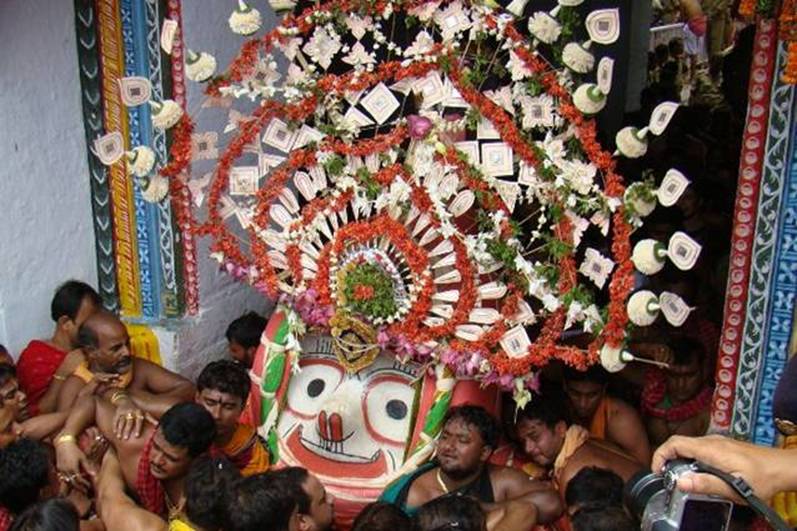
Phandi Ceremony of Lord Balabhadra (also known as Bada Thakur), the elder brother of Lord Jagannatha, during the Rathayatra.
Lord Balarama (Balabhadra) coming out of Sri Mandira. Phandi is the ceremony of Deities coming out of the Temple to the Rathayatra Chariot. Lord Balabhadra is bulkiest of the three.
Floral crown is known as ‘Tahia’ is prepared by Raghava Math and is brought to the Temple early in the morning. Elaborate flowers are beautifully decorated on a bamboo frame. Flowers are lotus flowers, champaka, malati flowers and Tulsi leaves. These decorations have been going on since ages in a very traditional manner. Totally 16 Tahia’s are worn. Two large Tahia’s when Lord comes out of the Sri Mandira, Two large Tahia’s when Lord enters Gundica Mandira. Two small Tahia’s when coming out of Gundica Mandira during the return-tourney and Two small Tahia’s before entering the Sri Mandira. Lord Balaram is fanned by chamara called ‘arota chamara’. The head is covered with red cotton cloth.
There is blank color umbrella in front. For Lord Balabhadra umbrella is black color, for Lord Jagannatha it is white color and for Subdhara Devi it is red and black color.
Phandi Ceremony of Sister Subhadra Devi
Phandi Ceremony of Lord Jagannatha
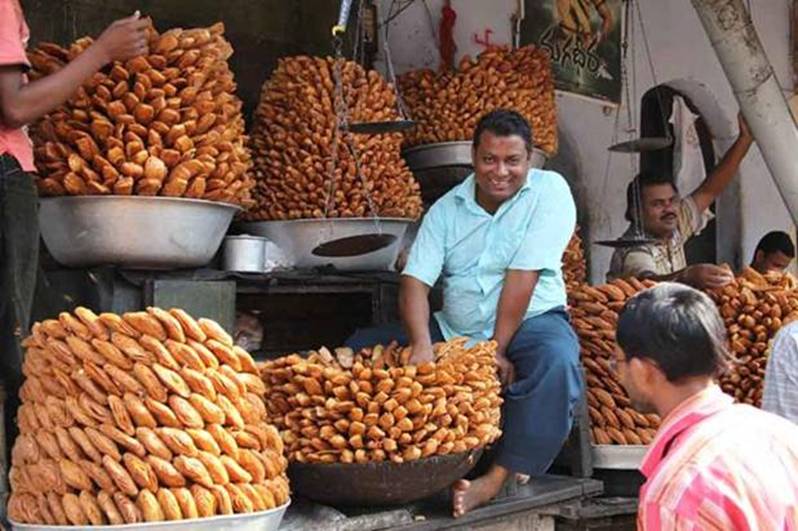
KHAJA – LORD JAGANNATHA’S FAVORITE SWEETS!
Places to visit near Jagannatha Puri:
1) Saksi Gipala Temple: This is 20km west of Jagannatha Puri in a town called Saksi-Gopala. It is easily reachable by taxi, bus or train. Vrajranabha (Sri Krishna’s great-grandson) installed two Gopala Deities in Vraja Mandala: Saksi-Gopala and Madna Gopala (Madana Mohana). The Saksi-Gopala Deity here, being 5000 years old, is exceptionally special one.
#Pastime: Lord Testifies for His Devotee
Once two brahmins, a young and old one, left their homes in Vidyanagara, South India, and visited many holy places before coming to Vrindavana. Satisfied with the service of the young brahmin and feeling grateful, the old one promised him before the Gopala Deity of Vrindavana to offer his youngest daughter in marriage. Hence, Gopalji acted as a witness. When the two brahmins returned to Vidyanagara, the old brahmin, due to family constraints, reneged on his promise; flatly denying that he had ever made such a promise. The younger brahmin, upset and dejected, returned to Vrindavana and told everything to the Gopala Deity. Out of love for His devotee (bhakta-vatsala), Gopalji, followed the young brahmin to Vidyanagara in South India to act as witness (saksi). All the way, that fortunate brahmin heard the joyful, tinkling sound of Gopalji’s ankle bells. In Vidyanagara, all the senior brahmins listened as Gopalji testified to the promise of the elderly brahmin. Thus the marriage was rightfully performed.
2) Danda-Bhanga: This sacred place is where Lord Nityananda Prabhu broke Gauranga’s sannyasa danda in three pieces. When Sriman Mahaprabhu went alone to visit the temple of Lord Siva known as Kapatesvara Mahadev, Lord Nityananda, taking advantage of the absence of Mahaprabhu, broke His danda (staff) into three pieces and threw it into the sacred waters of river Kancha (the tributary of river Bhargavi).
Importance:
danda-bhanga-lila ei parama gambhira sei bujhe dunhara pade yanra bhakti dhira (Sri Caitanya-Caritamrta, Madhya Lila, 5, 158)
The devotees could not understand why Nityananda Prabhu broke the staff, why Sri Caitanya Mahaprabhu permitted him to do so, or why, after permitting Him, Caitanya Mahaprabhu became angry. This Dandabhanga pastime, of Sri Caitanya Mahaprabhu and Lord Nityananda Prabhu, is supremely deep, supremely grave and supremely hidden. Only to him, who is unflinchingly surrendered and soberly fixed at the Divine Lotus Feet of the two Lords, in his heart of hearts, can the immeasurable glories of this great eternal pastime be revealed. Danda Bhanga is located in the village of Candanpur on main road to Bhubaneswar, 10km, from Sri Jagannatha Puri Dhama. After the occurrence of this wonderful pastime, the river subsequently came to known as river Dandabhanga, meaning breaking of the staff.
3) Sri Alarnath Temple: Lord Alalanatha is an ancient four-handed Visnu Deity installed by one of the Alvars. This temple is in Brahmagiri, one hour taxi ride from Jagannatha Puri. Lord Alarnath is the representative of Lord Jagannatha at Puri. Sri Caitanya Mahaprabhu stayed at this temple during anavasara, the two-week period after Snana-yatra when Lord Jagannatha rests in seclusion before the annual Rathayatra (chariot festival) in Jagannatha Puri. Lord Caitanya couldn’t bear staying in Puri without seeing His beloved Lord, and at Alarnath He would reveal the highest spiritual emotions, pining in ecstatic separation. While doing the Temple’s Parikrama, one can take darshan of the incredible prema-sila (stone slab) of Lord Caitanya, on the right side of the temple when entering the main gate from the road. This stone slab bears impressions from Lord Caitanya’s body. When Lord Caitanya first lay in full obeisance before Lord Alarnath, the stone beneath Lord Caitanya melted from His ecstatic touch.
4) ISKCON Bhubaneswar: ISKCON Bhubaneswar was the last founded project of Srila Prabhupada’s worldwide established temples and the 108th temple of ISKCON. Srila Prabhupada stayed here continuously for 17 days in a humble cottage in Jan-Feb 1977. His Divine Grace finished the English translation of 9th Canto of Srimad Bhagavatam and started 10th Canto Srimad Bhagavatam translation here. Bhubaneswar is only 2 hours from Puri.
5) Gopal Jiu Temple at Gadaigiri: Gadaigiri is a small village situated in the Jagatsinghpur district of Orissa, about 2 hours from Bhubaneswar. Gadaigiri houses exceptional Deity of Gopal Jiu which came from Vrindavana. ISKCON has guesthouse facility at Gadaigiri.
6) Choti at Kendrapara – The Native Place of Srila Bhaktivinoda Thakura: Choti is famous for as the home of ancestral Deities of Srila Bhaktivinoda Thakura, Sri Sri Radha-Madhava. Srila Bhaktivinoda Thakura wrote hundreds of songs glorifying the Supreme Lord Sri Krishna. His songs capture the essence of Gaudiya Vaisnava philosophy. One song, “Jaya Radha-Madhava”, was a favorite of Srila A. C. Bhaktivedanta Swami Prabhupada, who would sing it every day just before his public lectures. This song paints a beautiful picture of the Vrindavana pastimes of Srila Bhaktivinoda Thakura’s beloved Lordships Sri Sri Radha-Madhava. Further details on Choti are avaialble in book: “Choti: The Native Place of Srila Bhaktivinoda Thakura” by Gopal Jiu publications.
7) Remuna Ksira-cora Gopinatha Temple: Famous temple of Ksira-cora Gopinatha, the Krishna Deity who stole condensed milk (ksira) for His dear-most devotee, Sr Madhavendra Puri, lies in a small pastoral village named Remuna in the Balasore (Baleshwar) district of Orissa. Balasore is halfway between Puri and Kolkata, is the nearest railway junction to Remuna. Remuna is called Gupta Vrindavana because Gopinatha had many pastimes here in the mood of Vrindavana with His intimate vraja-madhurya premi bhaktas.
Between 5am-7am visitors can have full darshana of the Deity while the pujari baths and dresses Gopinatha. One can clearly see cows, cowherd boys and asta-sakhis carved in black stone bas-relief Deity of Ksira-cora Gopinatha. On Gopinatha’s right and left are black stone Deities of Govinda and Madana-Mohana brought. There are also Deities of Radha-Rasabihari, Lord Jagannatha and Mahaprabhu. All Vaishnavas are welcome here for Gopinatha’s special darshana, and the indescribably mouth-watering milk sweet known as amrta-keli, prepared from condensed milk, cream, sugar and a smidgen of raisins.
8) Nila-Madhava: This is a small village in the interior hilly region of Orissa state, about 6-7 hours from Jagannatha Puri. Very nice pastime about Nila-Madhava took place here. Local devotees at ISKCON Puri temple can tell more on this.
9) Varaha-Ksetra at Jajpur: In Satya-yuga Lord Varaha dev appeared here who killed demon Hiranyakhya. In other kalpas also different Varahadev appears here, and because of that this is called Varaha Ksetra. Lord Sri Caitanya Mahaprabhu stayed here for a day or two and offered worship to Lord Varaha on his way to Puri in the first decade of 16th century. Lord Sri Krishna Caitanya’s Lotus foot print by the melting of stone at varaha kshetra inside Varaha temple. Jajpur is very close to Kapilesvara, the birthplace of Lord Caitanya Mahaprabhu’s grandfather. It is the place from where His grandfather’s family had moved to Bengal. This is one of the four most holy places (Char Dhams) in the religious tradition of Vaishnavism located in Orissa. According to the tradition, Lord Vishnu after killing the demon Gayasura (at Gaya city of Modern Bihar), to commemorate the glory of His victory, placed his Sankha (Conch) in Puri, Chakra (Disc) in Bhubaneswar, Gada (Mace) in Jajpur and Padma (Lotus) in Konark and they were later known as Sankha Ksetra, Chakra Ksetra, Gada Ksetra and Padma Ksetra respectively in spiritual and religious tradition.
10) Sridham Mayapur: The Appearance Place of Lord Sri Caitanya Mahaprabhu. Jagannatha Puri to Sridham Mayapur is little more than overnight tourney by train via Howrah.
11) Ekachakra Dhama: The Appearance place of Lord Nityananda Prabhu. Ekachakra Dhama is about 4 hours tourney (165km) by taxi from Sridham Mayapur.
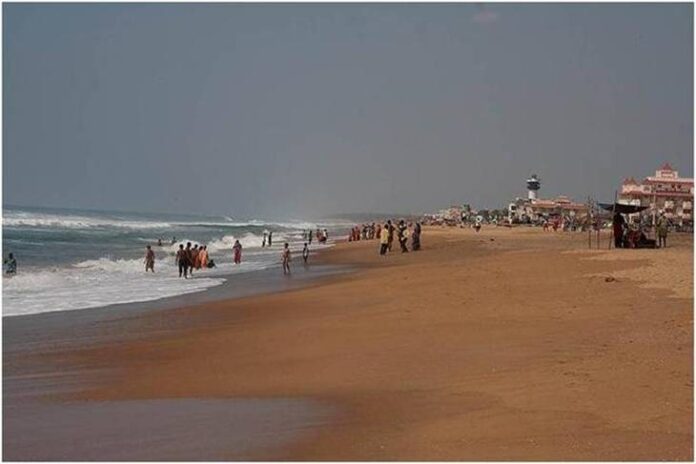
Like holy Ganga and Yamuna rivers, the ocean at Puri is a purifying sacred place of pilgrimage. Ocean here is not just a pilgrimage place; it is a maha-tirtha, a great pilgrimage site. During Nama-acarya Srila Haridasa Thakura’s samadhi ceremony, Lord Sri Caitanya Mahaprabhu bathed his transcendental body in the sea and declared, “From today onwards, this sea has become a great pilgrimage site, samudra ei maha-tirtha.” Every day, Sri Caitanya Mahaprabhu would bathe in the ocean and take darsana of the nila-cakra of Lord Jagannatha’s temple, offering obeisances to it. He also instructed His devotees to follow His example and perform these practices.
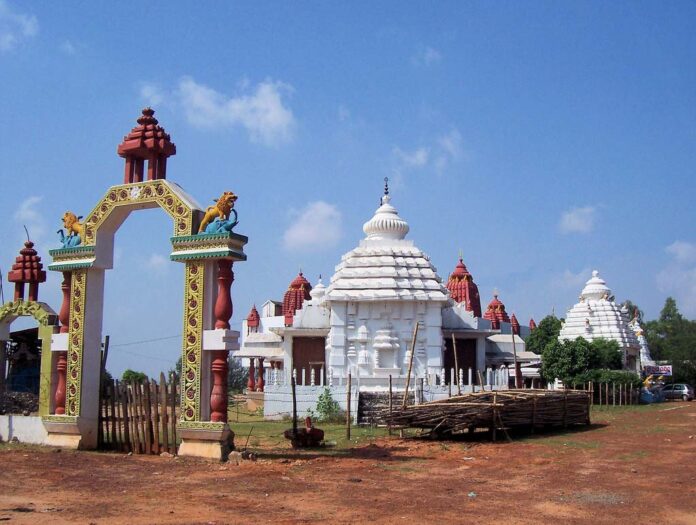
Kutir is on top of the hill behind Purusottma Gaudiya Math, which stands on the hilly sand dune known as Cataka Parvata on the road leading to Tota Gopinatha temple. Main temple houses Deities of Sri Sri Gaura-Gadadhara and Radha-Vinoda Madhava Jiu. Inside the bhajana kutira are Srila Bhaktisiddhanta Sarasvati Thakura’s bed and personal effects. There is also a murti of Srila Vedavyasa and Madhvacarya. Srila A.C. Bhaktivedanta Swami Prabhupada once stayed here for a few days.
In Orissa “Mausi Ma” means aunty. Temple is situated almost the mid-way of the Grand road, a small temple of the Goddess Ardhasini otherwise called as Mausima of Lord Jagannatha. She is maha-saktis who also help protect Puri Dhama. According to local stories, once Lakshmi Devi left Sri Mandira, and thus Jagannatha and Baladeva becomes poor. They had nothing to eat for a long period of time and so they had to go out begging. When Jagannatha and Baladeva were out during that time, Subhadra Devi was forced to stay here at Mausi Ma, or aunty’s house. During return of Rathayatra all chariots stop here at Mausi Ma Mandira and the Deities are offered Poda Pitha, a kind of cake.
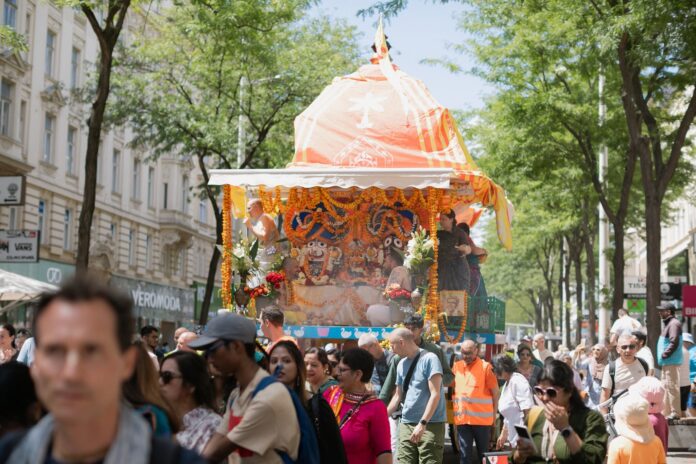
The Ratha Yatra 2026 Vienna festival brought together devotees, well-wishers, families, and visitors for a memorable celebration of devotion centered on Lord Jagannatha. Organized by ISKCON Vienna (Vedisches Zentrum Wien), the annual Festival of Chariots once again filled the city with melodious congregational chanting, devotional service, and the timeless message of spiritual unity.
More than a cultural gathering, Ratha Yatra is a sacred tradition originating from the ancient city of Puri, India. It invites everyone—regardless of nationality, culture, or background—to participate in glorifying the Supreme Lord through chanting, dancing, and hearing transcendental wisdom. The Vienna celebration reflected this universal spirit, creating an atmosphere of warmth, cooperation, and genuine happiness.
Ratha Yatra 2026 Vienna: A Festival of Devotion
The Ratha Yatra 2026 Vienna celebration was marked by enthusiastic participation from devotees and guests who joined together in singing the holy names of the Lord. Joyful kirtana echoed throughout the procession as participants accompanied the beautifully decorated chariot carrying Lord Jagannatha, Lord Baladeva, and Subhadra Devi.
The festival demonstrated how devotional service naturally brings people together. Volunteers contributed in numerous ways—from organizing the event and decorating the chariot to preparing prasadam and assisting visitors throughout the celebration. Every act of sincere service added to the spiritual atmosphere of the day.
Smiling faces, heartfelt chanting, and cooperative service transformed the festival into an occasion of lasting remembrance for everyone who attended.
A Tradition Rooted in Ancient Vedic Culture
Ratha Yatra, also known as the Festival of Chariots, has been celebrated for centuries and occupies a special place within the Vedic tradition. The festival commemorates Lord Jagannatha’s journey from His temple to the Gundicha Temple, symbolizing the Lord’s merciful outreach to everyone.
Unlike many religious observances that remain confined within temple walls, Ratha Yatra carries the Lord into the streets so that all people may receive His blessings. This compassionate spirit reflects the Vedic understanding that spiritual knowledge is meant to benefit humanity as a whole.
His Divine Grace A. C. Bhaktivedanta Swami Prabhupada introduced Ratha Yatra festivals throughout the world, fulfilling the desire that people everywhere have the opportunity to hear the holy names of Krishna and experience devotional culture firsthand.
Kirtana and Service at the Heart of the Festival
The defining feature of Ratha Yatra 2026 Vienna was the vibrant congregational chanting of the Hare Krishna maha-mantra. Accompanied by traditional musical instruments and enthusiastic singing, the kirtana created an uplifting atmosphere that inspired both participants and onlookers.
According to the Vedic scriptures, chanting the holy names purifies the consciousness and awakens one’s original spiritual nature. While people may come to the festival out of curiosity, appreciation of culture, or faith, the experience of hearing and chanting the holy names leaves a lasting spiritual impression.
Equally important was the spirit of seva, or selfless devotional service. Volunteers worked harmoniously in countless visible and unseen roles, demonstrating that genuine happiness arises not merely from receiving but from serving with sincerity.
A Celebration Beyond Cultural Boundaries
One of the remarkable aspects of Ratha Yatra is its universal appeal. The Ratha Yatra 2026 Vienna festival welcomed people from diverse backgrounds, reflecting the timeless Vedic understanding that every living being is spiritual by nature.
The Vedic scriptures explain that the living entity (ātma) is distinct from the temporary material body. While external identities may differ according to nationality, language, or culture, the soul shares an eternal relationship with the Supreme Lord. Festivals such as Ratha Yatra gently remind participants of this deeper spiritual identity through joyful engagement rather than philosophical debate.
This universal message continues to make the Festival of Chariots relevant in modern society, where genuine unity is often sought amid diversity.
Gratitude to the Devotees and Volunteers
The success of Ratha Yatra 2026 Vienna was made possible through the dedicated efforts of numerous devotees, volunteers, supporters, and well-wishers.
Every offering of time, energy, and devotion contributed to the festival’s success. Whether participating in kirtana, assisting with logistics, preparing prasadam, welcoming guests, or helping behind the scenes, each person played an important role in creating an atmosphere of devotion and hospitality.
The organizers expressed heartfelt appreciation to everyone who participated, noting that the collective enthusiasm, cheerful service, and devotional spirit created unforgettable memories for all.
A Living Expression of Dharma
Ratha Yatra also illustrates an important principle of dharma, or righteous duty. When individuals act with a spirit of service rather than selfishness, cooperation naturally develops, benefiting both the individual and society.
The festival reminds us that actions performed with devotion carry lasting spiritual value. While external celebrations conclude, the cultivation of qualities such as humility, gratitude, compassion, and service continues to enrich one’s life long after the procession has ended.
Such festivals demonstrate that spiritual culture is not merely a matter of ritual but a practical way of living that harmonizes individual well-being with higher purpose.
Looking Ahead
As another successful celebration concludes, the memories of Ratha Yatra 2026 Vienna continue to inspire devotees and visitors alike. The festival reaffirmed the enduring relevance of devotional traditions that uplift the heart while fostering friendship, cooperation, and spiritual reflection.
In a world often marked by division and distraction, Ratha Yatra offers a timeless reminder that genuine happiness arises through service, remembrance of the Supreme Lord, and appreciation of our shared spiritual nature. Every sincere step taken in devotion carries lasting significance, inviting all to move toward a life centered on divine consciousness and inner fulfillment.
The organizers of ISKCON Vienna extended their heartfelt gratitude to everyone whose smiles, service, kirtana, and joyful participation made this year’s Ratha Yatra 2026 Vienna a truly memorable celebration. May the blessings of Lord Jagannatha continue to inspire devotion, unity, and spiritual progress in the hearts of all.
1) O fish like soul, why have you fallen into the entangling nets of Maya? You have not understood that being bound up by those nets you will have to remain in this material world for a long, long time.
2) After becoming captive in Maya’s snare due to your desires for insignificant enjoyments, you remain transformed in a spiritually diseased condition, punishable just like a disobedient servant.
3) Now, by the power of devotional service, always remain subservient to Lord Krsna, swimming and frolicking freely in the nectarine ocean of Krsna-prema.
1) I am an impious sinner and have caused others great anxiety and trouble.
2) I have never hesitated to perform sinful act for my own enjoyment. Devoid of all compassion, concerned only with my own selfish interests, I am remorseful seeing others happy. I am a perpetual liar, and the misery of others is a source of great pleasure for me.
3) The material desires within the core of my heart are unlimited. I am wrathful, devoted to false pride and arrogance, intoxicated by vanity, and bewildered by worldly affairs. Envy and egotism are the ornaments I wear.
4) Ruined by laziness and sleep, I resist all pious deeds; yet I am very active and enthusiastic to perform wicked acts. For worldly fame and reputation I engage in the practice of deceitfulness. Thus I am destroyed by my own greed and am always lustful.
5) A vile, wicked man such as this, rejected by godly people, is a constant offender. I am such a person, devoid of all good works, forever inclined toward evil, worn out and wasted by various miseries.
6) Now in old age, deprived of all means of success, humbled and poor, Bhaktivinoda submits his tale of grief at the feet of the Supreme Lord.