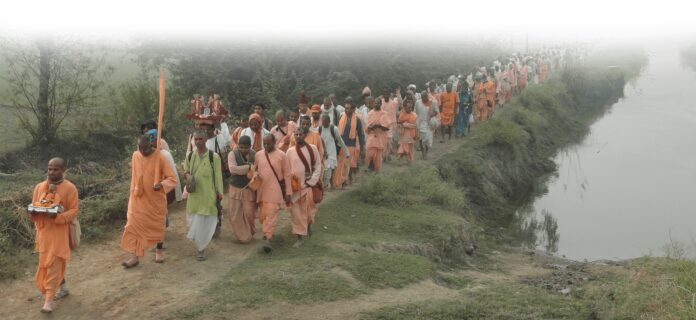
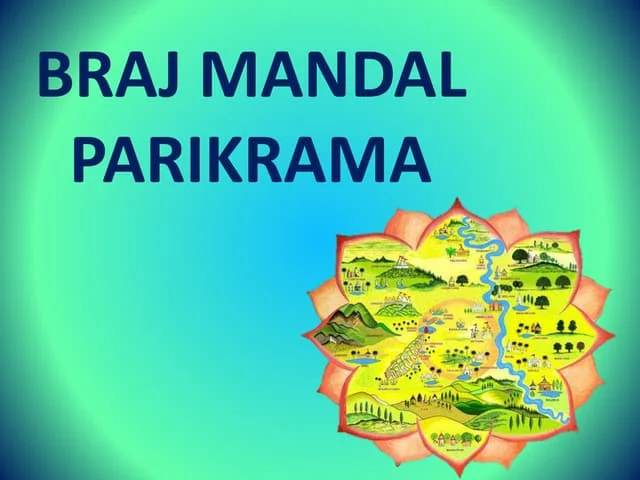
There are many benefits of performing the Vraja Mandala Parikrama and in the Vedic literatures one can find the following verses: In the Skanda Purana it says, “Those who with firm faith and devotion for Lord Krishna, who perform the parikrama of Vraja Mandala – are freed from all sins and go back to godhead at the time of death.”
The Mathura Mahatmya says, “All sins accumulated through innumerable births can be destroyed in a second by staying in Vrindavana Dhama even for one day.” The Mathura Mahatmya also says, “What is the need for any further consideration, anyone who simply hears about the glories of Vraja Mandala automatically delivers two hundred generations of both his paternal and maternal family members.” The Adi-Varaha Purana says, “Those who visit the twelve sacred forests of Vrindavana will no longer suffer the pangs of hellish life.”
There are many benefits of performing the Vraja Mandala Parikrama and in the Vedic literatures one can find the following verses: In the Skanda Purana it says, “Those who with firm faith and devotion for Lord Krishna, who perform the parikrama of Vraja Mandala – are freed from all sins and go back to godhead at the time of death.” The Mathura Mahatmya says, “All sins accumulated through innumerable births can be destroyed in a second by staying in Vrindavana Dhama even for one day.” The Mathura Mahatmya also says, “What is the need for any further consideration, anyone who simply hears about the glories of Vraja Mandala automatically delivers two hundred generations of both his paternal and maternal family members.” The Adi-Varaha Purana says, “Those who visit the twelve sacred forests of Vrindavana will no longer suffer the pangs of hellish life.”
Besides being an important aspect of sadhana-bhakti, by performing Vraja Mandala Parikrama, one offers one’s homage to the holy dhama by circumambulating the twelve sacred forests of Vrindavana, just as Lord Chaitanya Mahaprabhu had done on His pilgrimage to the dhama in the year 1515. The word ‘parikrama’ is derived from the word ‘pradakshina’ which means to circumambulate or walk in a ‘circular motion to the right’ around a holy place of worship. The performance of pradakshina or parikrama is an important act of self-purification as well as an offering of devotion to the Lord.
The goal of performing parikrama around Vraja is to increase ones smaranam, or remembrance of Lord Krishna, while seeing all the holy places where the Lord performed His transcendental pastimes five thousand years earlier. By performing parikrama around the sacred forests of Vrindavana, one’s faith in the lotus feet of the Lord automatically increases with every step. Lord Chaitanya Mahaprabhu was the first to perform the circumambulation of the twelve sacred forests of Vrindavana and He chanted the holy names and danced in ecstasy in all the various holy places that He visited during His historic journey.
Circumambulating the sacred forests had a very powerful effect on Lord Chaitanya Mahaprabhu, especially after reaching the celebrated Imli-tala, the site where Radharani experienced the ecstasy of maha-bhava. After performing the Vraja Mandala Parikrama, Lord Chaitanya’s mood drastically changed and after returning to Jagannatha Puri, He became more and more absorbed in the transcendental ecstasy of Radha-bhava, while experiencing Radharani’s own intense feelings when She herself is separated from Her beloved Krishna.
While performing the Vraja Mandala Parikrama, besides circumambulating hundreds and thousands of holy tirthas, temples and sacred shrines, one also simultaneously performs many other important parikramas including the parikramas of Vrindavana, Mathura, Radha kunda, Govardhana Hill, Kamyavana, Varsana, Nandagrama, and Gokula-Mahavana. Therefore it is said in the Vedic scriptures that those who perform the Vraja Mandala Parikrama are immediately freed from all their sins and will never take birth again in this material world.
His Divine Grace A. C. Bhaktivedanta Swami Prabhupada, the founder of ISKCON, the International Society for Krishna Consciousness, also known as the ‘Hare Krishna Movement’, became the first Vaishnava acharya in the history of the world to travel to the West and convert Americans and Europeans to Krishna Consciousness also known as Bhagavata-dharma. After traveling to America in 1965, He established hundreds of Radha-Krishna temples, not only in America but around the globe, and translated into the English language for the first time a large volume of books on the subject of Vedic culture and religion, including the Vedic classics Shrimad-Bhagavatam and Chaitanya-charitamrita.
His unique translation of the celebrated Bhagavad-gita became the best selling edition of the Gita in history and his books are most highly appreciated by scholars, educators and academicians the world over. Shrila Prabhupada was also the first Vaishnava acharya to introduce Westerners to the Vraja Mandala Parikrama when in 1972, he arrived in India from the West with a large party of Europeans and American devotees and personally took them to all the important holy places around Vraja Mandala including: Vrindavana, Govardhana Hill, Radha-kunda, Varsana, Nandagrama, and Gokula. He later established the famous Krishna Balarama Mandira in Vrindavana, where his foreign disciples could visit on pilgrimage and become purified of all contamination of the material world while spending their time appreciating the transcendentally surcharged atmosphere of the holy dhama, while engaging in yoga, meditation, chanting Krishna’s holy names and performing parikrama.
In November 1977, during the last few days of his life, as Shrila Prabhupada lay ill in his rooms at the Krishna Balarama Mandira in Vrindavana, even though in a precarious state of health, he desired to be taken on parikrama to Govardhana Hill and requested that his disciples bring a bullock-cart in which he could travel to the various holy places. When a number of senior disciples objected saying that the ride would kill him, he challenged them saying that parikrama of Govardhana Hill would in fact give him life. Shrila Prabhupada also said that it was far better to die while on parikrama of Govardhana Hill, than to die while lying in bed, as it would be a far more glorious death.
However, his senior disciples refused to allow him to go, in fear he would die at the first bump in the road. On the third day after Govardhana-puja, which is the celebration of Krishna’s pastime of lifting Govardhana Hill, Shrila Prabhupada breathed his last and entered into maha-samadhi and the eternal pastimes of Krishna’s Vraja-lila. In order to fulfill Shrila Prabhupada’s final wish, a parikrama was organized by his disciples and a Deity of Shrila Prabhupada was taken on parikrama around Govardhana Hill. It was decided to organize this parikrama as an annual celebration and it has been performed each year since then. A few years later, it was decided to perform the full Vraja Mandala Parikrama in honor of Shrila Prabhupada, and this particular parikrama is now organized every year in the holy month of Kartika, which has now become very popular with all ISKCON devotees from around the world who flock to Vrindavana to take part in this ecstatic parikrama.
The Ayurvedic concept of Ojas corresponds to the modern Western conception of immunity, encompassing the resilience of the body’s digestive, nervous, endocrine and hematopoietic systems. It is both a biological substance and an energetic principle which enables the body and mind of an individual to resist disease and thrive in strength, love and vitality.
In Ayurveda, the three doshas or governing energies of the body; Vata, Pitta and Kapha are said to be derived from the five great elements or panchamahabhutas; Space, Air, Fire, Water and Earth. Vata is made up of Space and Air, Pitta of Fire and Water and Kapha of Water and Earth.
Ojas, along with Tejas and Prana are said to be the essence of each of these doshas. Ojas is the subtle essence of Kapha dosha, and in particular the water element while Prana relates to Vata and Tejas to Pitta. So, we can think of the qualities of Ojas as the most purified form of Kapha and the Water element. Often, Ojas is likened to ghee as a substance as they share similar intensely nourishing and healing qualities.
The functions of Ojas
Why is it that, when exposed to the same pathogens or the same imbalancing factors, one person may get sick and another does not? The answer, according to Ayurveda, is Ojas. Whether disease arises from within; for example from undigested thoughts, emotions or experiences that crystallize in the body’s tissues, or from outside as is the case with bacteria and viruses, the strength of Ojas will determine whether or not these fluctuations will actually manifest and come into expression as a disease. If the strength of an individual’s Ojas is superior to the strength of the disease, the disease will not manifest. If, indeed, the strength of the disease is superior to that of Ojas, then disease; whether it be acute or chronic, mild or intense, will manifest.
This all being said, the main function of Ojas is to protect against imbalance and disease. Ojas also protects the body from aging and general decay and maintains the health and stability of the seven dhatus (body tissues), three malas (channels of waste; feces, urine and sweat), and three doshas (Vata, Pitta and Kapha).
On a more subtle level, the type of superfine Ojas, of which each individual is said to only have 8 drops residing in the heart, is said to stabilize consciousness in the physical body. It helps to keep the heart beating and maintains the span of life. Without Ojas, there is no life.
That being said, one of the main symptoms of Ojas disturbance or depletion is frequently being sick.
In the same way that the milk of a cow has to transgress various processes to become ghee, Ojas is the product of metabolism of Kapha dosha in the body.
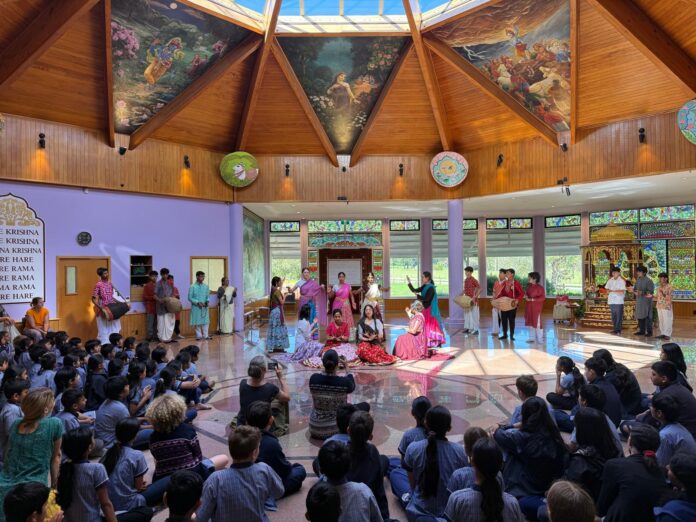
Year 9 and 10’s assembly presentation to the school on Ratha Yatra.
Hare Krishna School is celebrating the New Zealand Ministry of Education’s approval of its application to extend to Year 13, making it New Zealand’s only primary and secondary school where children can complete their entire education in a Krishna-conscious environment grounded in the teachings of His Divine Grace A.C. Bhaktivedanta Swami Prabhupāda.
Founded as a private school in 1982, Hare Krishna School is located in the serene rural community of ISKCON Auckland and offers students both spiritual nourishment and a peaceful learning environment. With a roll approaching 200 students, the school is a state-integrated special-character institution that delivers the New Zealand Curriculum through the lens of Kṛṣṇa-bhakti. Each day begins with kīrtana, āratī, recitation of ślokas, śāstra reading, and japa meditation—establishing a devotional rhythm that supports academic excellence and personal character.
A Steady Journey of Growth: 1992–2025
Hare Krishna School became ISKCON’s first state-integrated school in 1992, entering the national network as a Year 1–6 primary school. It expanded to Year 1–8 in 2005, then to Year 1–10 in 2019, reflecting growing demand within the devotee community. Now, with Year 13 approval granted in 2025, the school completes its transformation into a full Year 1–13 Krishna-conscious schooling pathway.
This year also marks the school’s first Year 11 cohort sitting NCEA external examinations—New Zealand’s national secondary qualification recognised internationally.
Lalita Krishna, a year 11 student who has been at the school since year 1 (2014) shared her experience, “I feel grateful that I can spend my whole school life at the Hare Krishna School. It is common for students to part ways after primary school as they attend different high schools, but at the Hare Krishna School, you have the opportunity to stay with your friends for your entire school journey. I have found the NCEA exams a welcome challenge. As exams always come with nerves and stress, I was initially worried about how we would overcome this challenge; however, our teachers have done their best to support us and provide all the knowledge we need to pass our exams. Their hard work and effort have paid off, as I feel excited and well-prepared for the upcoming exams.”
A Distinctive Pedagogical Approach Rooted in Bhakti
Hare Krishna School’s teaching philosophy is grounded in the traditional Gauḍīya Vaiṣṇava tri-jñāna-aṅga process of learning:
•Śravaṇam — attentive hearing
•Mananam / Abhyāsaḥ — reflection and repeated practice
•Nididhyāsanam — deep internalisation and lived application
This approach ensures that learning is relational, contemplative, and anchored in devotional service.
The specialised Śāstra and Sanskrit curriculum, developed by Principal Dharma-setu Dāsa, is organised around the three foundational strands of Gauḍīya theology: sambandha (relationship with Kṛṣṇa), abhidheya (the path of devotional practice), and prayojana (the goal of prema). Students progressively build śāstra literacy, Sanskrit fluency, and personal reflection from their earliest years through to senior secondary school.
By high school, many students can articulate core philosophical ideas, read portions of Sanskrit texts, and apply śāstra perspectives to contemporary issues—strengthening both their devotional identity and their academic confidence.
Wisdom, Respect, and Joy at the Heart of School Culture
The high school culture is shaped by three values—Wisdom, Respect, and Joy—which permeate classroom practice, relationships, and the wider school environment. Lunchtimes often feature prasādam shared in friendship, spontaneous kīrtanas under the trees, and students joyfully engaging in sport and recreation, reflecting the school’s family-like devotional atmosphere.
Sarada, Head of Social Science and Science, as well as the Career Advisor, shared, “ I find it truly exciting to have a KC high school, especially as a second-generation devotee who didn’t have access to anything like this while growing up. It has been my motivation for becoming a teacher, as I’ve always felt it was important to create this opportunity for the next generation. In today’s world, where children are surrounded by so many unfavourable influences, having a supportive, Krishna-conscious environment feels more essential than ever. It offers them a safer, more positive path to grow, learn, and develop. My favourite part of school is the class performances for our festivals. I love seeing the children take centre stage, practising so wholeheartedly and offering their best for Krishna’s pleasure and the joy of all the devotees. It’s such a meaningful experience, and I feel it enriches the students on so many levels.”Year 10 students performing experiments.Year 11 science students.Students working on a project in Year 11 Chemistry.Students at their High School Festival performance.Some of Hare Krishna School’s students on a field trip.Students participating in the High School’s sports program.Years 9 and 10 on a recent field trip.
Major Campus Development to Support Growth
To accommodate its expansion, ISKCON Auckland is enabling a significant development project across the school campus, including seven new classrooms, a school library, an expanded sports field, and upgraded administrative facilities.
The first stage—specialist rooms for Śāstra, Arts, Social Sciences, and Mathematics—was completed in 2025, along with new student restrooms and a foyer. A Science laboratory, Music room, and senior study area will open in 2026, followed in 2027 by additional classrooms, a senior library, teacher workspaces, and expanded outdoor facilities. These developments significantly enhance the school’s ability to deliver the full range of NCEA programmes within a spiritually centred environment.
A Message from the Principal
Principal Dharma-setu Dāsa reflected on the milestone, “This achievement is truly Kṛṣṇa’s mercy. We aspire to help each young person grow in knowledge, character, and loving devotion to the Lord. To now offer a complete Year 1–13 Krishna conscious education is a blessing we have long prayed for. I am deeply grateful to our dedicated staff, our Board of Trustees, the ISKCON Auckland management led by our Temple President Kalasamvara Prabhu, and the entire ISKCON Auckland community for supporting this sacred mission.”
Indradyumna Swami and organizers of the US Sadhu Sanga Kirtan Retreat have announced that the 2026 gathering will take place in New Orleans, Louisiana, over Memorial Day Weekend, May 22–25, 2026. The annual event, known for drawing thousands of devotees for immersive kirtan and fellowship, will be held at the Hyatt Regency New Orleans, a 4-star hotel on the banks of the Mississippi River.
The venue offers 1,200 onsite rooms and more than 75,000 square feet of hall space across three large rooms, providing a spacious setting for what is expected to be one of the largest ISKCON gatherings in North America. Organizers anticipate more than 5,000 attendees for the 2026 retreat.
Several leading kirtan leaders have already confirmed their participation, including Sacinandana Swami, Radhanath Swami, Badahari Das, Vaisesika Das, Mukunda Datta Das, Madhava Das, Sri Prahlada Das, and Indradyumna Swami. Additional invitations are pending confirmation from Jayapataka Swami, Sivarama Swami, BB Govinda Swami, Acyuta Gopi, and others. Over the four-day event, participants can look forward to more than 40 hours of kirtan along with prasadam served three times daily.
Organizers note that the 2026 retreat holds special significance, as it coincides with ISKCON’s 60th anniversary. The milestone offers devotees an opportunity to gather in large numbers to chant, dance, and honor the legacy of His Divine Grace A.C. Bhaktivedanta Swami Prabhupada.
Registration for the 2026 retreat opens on Sunday, December 7, 2025, at 10:00 a.m. PDT / 1:00 p.m. EDT. Please download the Sadhu Sanga mobile app for iphone or Android. If you already have the app installed, please upgrade to the latest version using the links above. Otherwise, your registration will not process. Please take a moment to update your account before the registration opening date. As usual, children aged 5 or under are free, but they need to be included in the registration.
Jagāī-Mādhāī-ghāṭa was near Jagannātha Miśra’s house in Māyāpura, on the bank of the Gaṅgā. By the mercy of Śrīman Mahāprabhu, Śrī Mādhāī used to clean this ghāṭa with his own hands. Jagāī and Mādhāī, previously Jagadānanda and Mādhavānanda Bandhopādhyāya, were born into a prestigious brāhmaṇa family of Navadvīpa, but bad association corrupted their characters and they became great rogues, drunkards and sinners. In fear of their oppressive and tyrannical behaviour, no virtuous persons – especially the elderly, children or women would come to bathe at this ghāṭa.
Śrīman Mahāprabhu had appointed the exalted Nityānanda Prabhu and Haridāsa Ṭhākura to go throughout the town to propagate nāma-prema, transcendental love for Kṛṣṇa through chanting the holy name. They both considered Jagāī and Mādhāī to be the most suitable candidates for receiving nāma-prema, and they asked them to chant the holy name. But the brothers were completely intoxicated on wine. Mādhāī took a piece of a broken, earthen wine pot and threw it at Nityānanda Prabhu’s head, making it bleed.
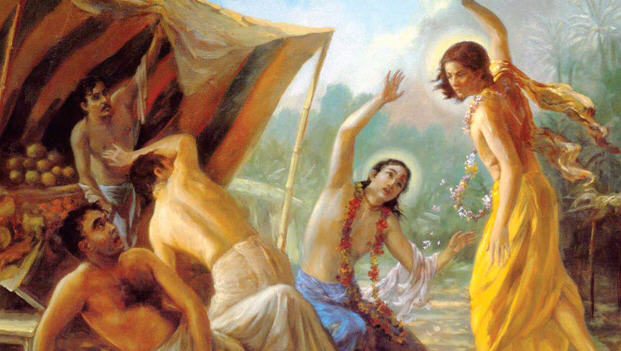
Haridāsa Ṭhākura reported this unfor tunate incident to Śrīman Mahāprabhu, who, enraged, went there with all of His associates. Raising His hand above His head, He summoned His disc weapon, crying, “Cakra, cakra!” The sight of the transcendental disc weapon in the hand of Mahāprabhu made Jagāī and Mādhāī tremble in fear. This melted the heart of the most compassionate Śrī Nityānanda Prabhu, who grasped Mahāprabhu’s hand and said, “The purpose of Your appearance in this incarnation is to distribute love of God. It is therefore not fitting for You to kill someone. Instead it is appropriate for You to purify a person’s heart by giving him prema. Jagāī prevented Mādhāī from striking Me a second time, so please be merciful to him.”
Mahāprabhu embraced Jagāī, who fainted in ecstasy, then He placed His feet on Jagāī’s chest. Jagāī began to weep and chant, “Kṛṣṇa, Kṛṣṇa!” Seeing this, Mādhāī fell at the feet of Nityānanda Prabhu begging for forgiveness and Mahāprabhu bestowed prema upon him also. Mādhāī asked Nityānanda Prabhu how he could become free from his former sins of killing various living entities, and Nityānanda Prabhu instructed him to tend to the maintenance of this ghāṭa. He told him that rendering service to the Gaṅgā would remove his offences. On the order of Nityānanda Prabhu, Mādhāī performed this service for the rest of his life, and in this way took the dust of the Vaiṣṇavas’ feet. He built steps at this ghāṭa with his own hands and also cleaned them daily. People therefore called this ghāṭa Jagāī Mādhāī-ghāṭa, or just Mādhāī-ghāṭa. It was situated thirty yards north of Mahāprabhu-ghāṭa.
Close to Kṣetrapāla Śiva is a temple of Śrī Nṛsiṁhadeva, who destroys obstacles on the path of devotion, and nearby are the deities of Śrī Gaura-Gadādhara.
In Vṛndāvana, Śrī Rādhā-kuṇḍa and Śrī Śyāma-kuṇḍa are supremely glorious. Similarly, in Navadvīpa, which is non different from Vṛndāvana, Śrī Gaura-kuṇḍa in Māyāpura is matchlessly glorious. The devotees of Śrī Gaurasundara bathe and perform ācamana in this pond, and thus they taste the sweetness of Śrī Rādhā-Kṛṣṇa’s mercy. Many exalted person alities, expert in bhajana, perform their worship here.
Vṛddha-Śiva, or Śiva-ḍovā
Vṛddha-Śiva is located on the bank of the Gaṅgā south of the Yogapīṭha. In Śrīman Mahāprabhu’s time there was a temple of Vṛddha-Śiva here, but the temple has since disappeared in the Gaṅgā’s flow. At that place, which is now known as Śiva-ḍovā, Śrī Nityānanda Prabhu gave Śrī Jiva Gosvāmī darśana of Vṛddha-Śiva.
Mahāprabhu-ghāṭa
Mahāprabhu-ghāṭa was situated near the Yogapīṭha, six yards north of Vṛddha-Śiva. These ghāṭas no longer exist, having been submerged by the Gaṅgā. Here Nimāī, as a young boy and as a scholar, used to bathe in the Gaṅgā and perform water-sports. Just as the Yamunā witnessed Kṛṣṇa’s pastimes, the Gaṅgā received the good fortune to delight in Nimāī’s pastimes.
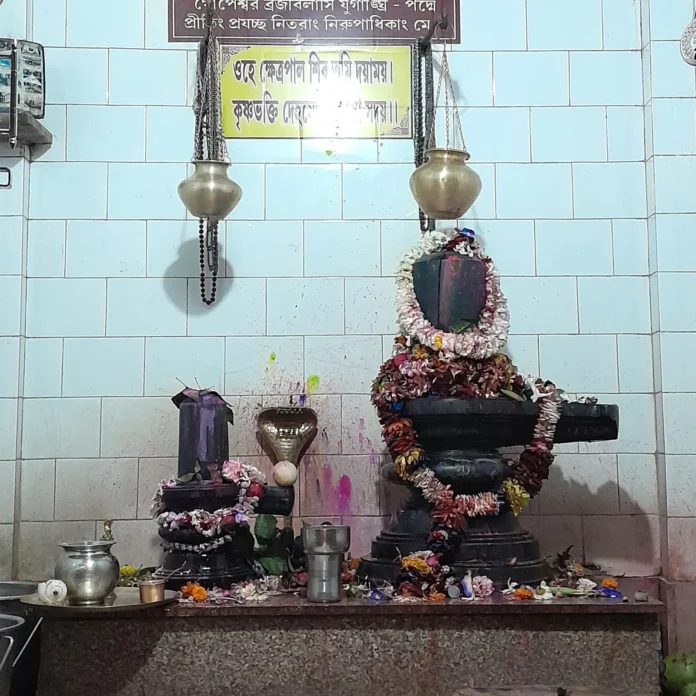
In the Yogapīṭha, Kṣetrapāla Śiva, the protector of the dhāma, is eternally worshipped. He is also known as Śrī Gopīśvara, and he bestows service to the dhāma.
Pure devotees who perform their worship in accordance with the followers of Śrīla Rūpa Gosvāmī (the śrī-rūpānugas) honour Kṣetrapāla Śiva as Gopīśvara Śiva, and pray to him for eternal service to Śrī Gaura that is devoid of material attrib utes. Śrī Gaura is the embodiment of rasarāja-mahābhāva, the com bined form of Śrī Rādhā-Kṛṣṇa. Gopīśvara Śiva’s praṇāma-mantra (from Śrīla Viśvanātha Cakravartī Ṭhākura’s Śrī Saṅkalpa kalpadruma, text 103) is:
vṛdāvanāvani-pate! jaya soma! soma-maule! sanaka-sanandana-sanātana-nāradeḍya gopīśvara! vraja-vilāsi-yugāṅghri-padme prema prayaccha nirūpādhi namo namas te
O gatekeeper of Vṛndāvana! O Soma, all glories to you! O you whose forehead is decorated with the moon, and who is worshipful for the sages headed by Sanaka, Sanandana, Sanātana and Nārada! O Gopīśvara! Desiring that you bestow upon me prema for the lotus feet of Śrī Rādhā-Mādhava, who perform joyous pastimes in Vraja-dhāma, I offer obeisances unto you time and again.
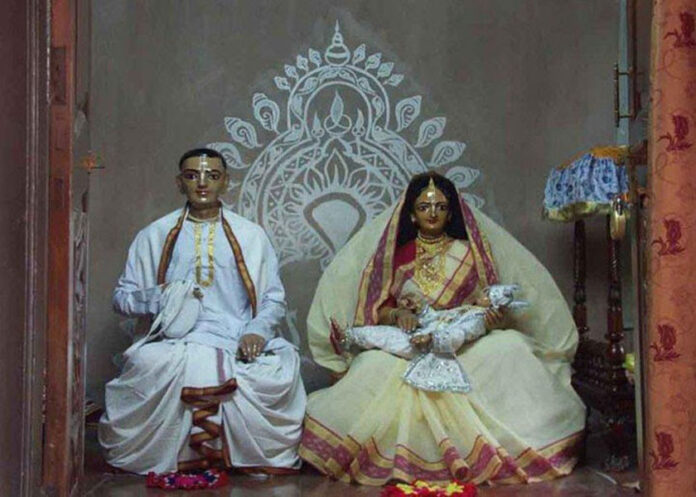
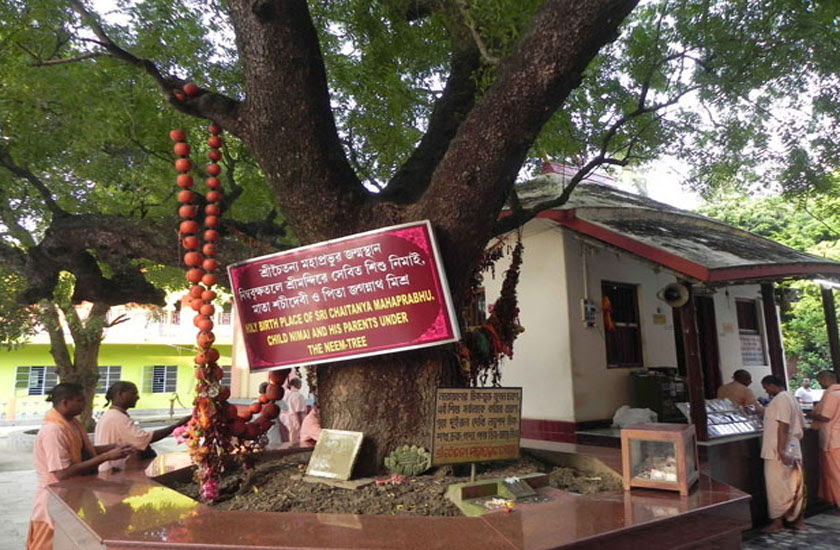
Here under a neem tree, baby Nimāī took birth from the womb of Mother Śacī. The original tree has since departed from this world, and a new tree has grown in the same place.