Mail ID: contact@vedavarsity.com

Contact: +91 9634998911

Google search engineGoogle search engine
Home Blog Page 128

Antardvipa-Atopura Grama

0

Four-headed Brahmā performed austerities at Ātopura grāma to become free from the offence he committed during Kṛṣṇa’s pastimes of stealing the cowherd boys and calves. Feeling deeply remorseful and having contemplated Śrīman Mahāprabhu’s coming pastimes and His munificence, he worshipped the Lord at this place. Mahāprabhu’s pastimes are eternal, yet sometimes they mani fest in this world and other times they do not. Conse quently, it is not against established philosophical conclusions to worship Śrīman Mahāprabhu even before He performs His pastimes in this world. Satisfied with Lord Brahmā’s worship, Śrīman Mahāprabhu appeared before him.

Brahmājī begged forgiveness for his offences, and asked for a boon: “When You exhibit Your pastimes in this world, please arrange for me to take birth in a low-class family and, thus in a mood of humility and wretched ness, fulfil Your innermost desire with my service.” Śrīman Mahāprabhu then granted Lord Brahmā his boon, saying, “You will take birth in a Muslim family and serve Me by preaching and loudly chanting the holy names of Hari. I will appear in this form of Gaurāṅga, having accepted the sentiment and bodily lustre of My beloved Rādhā for the purpose of fulfilling My three special internal desires.

I will madden all the living entities in the universe by making them dance in harināma-saṅkīrtana and by bestowing upon them the most elevated and resplendent prema, which is rarely attained even by the demigods. You will assist Me in fulfilling My heart’s desires to accomplish this.” This island (dvīpa) became known as Antardvīpa, because it was here that the Lord revealed His internal (antara) sentiments to Brahmā. In Śrīman Mahāprabhu’s pastimes this same Brahmā appeared as nāma-ācārya Śrīla Haridāsa Ṭhākura, the authority in the chanting of the holy name.

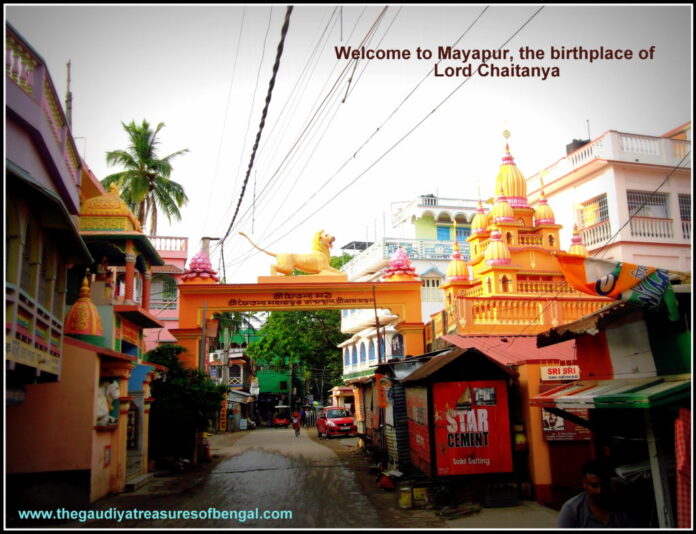
Antardvīpa is also known as Ātopura. Antardvīpa’s central point, the Mahā-yogapīṭha, is the appearance-place of the Lord, and is also known as Māyāpura. This Antardvīpa consists of Ballāla-dīghī (Pṛthu-kuṇḍa), a portion of Vāmana-pukura, Śrīnāthapura, Gaṅgā-nagara and other places. Śrī Jagannātha Miśra’s house was within the present Vāmana-pukura. Although Śrīman Mahāprabhu eternally performs pastimes here, only fortunate souls can witness them. When the foundation to the present grand Yogapīṭha Temple in Māyāpura was being dug, a small four-armed deity was found. This deity had been worshipped by Śrī Jagannātha Miśra, whose temple was located in that spot. And just nearby, under a large neem tree, Nimāī took birth from Śrī Śacī-devī’s womb.

Śacī-devī’s father, Śrī Nīlāmbara Cakravartī, was a renowned scholar of astrology and logic. Śacī-devī was highly chaste, devout and the embodiment of mercy. Her eight daughters died at birth, one after the other. She then gave birth to an extraordinary son named Śrī Viśvarūpa. He was learned in the scriptures, peaceful in nature and benevolent. He was omniscient and his intellect was unparalleled. Although he was incomparably beautiful, he was completely detached from sense enjoyment. Nimāī took birth after Viśvarūpa. Nimāī was none other than Vrajendra-nandana Śrī Kṛṣṇa Himself who had accepted the mood and lustre of Śrī Rādhā.

He chose to appear in this world for several reasons among which four are prominent:

(1) To propagate the yuga-dharma, or the religious practice for the age. This is the congregational chanting of the holy names (śrī-nāma-saṅkīrtana).

(2) To distribute what had never been given before unnatojjvala-prema, transcendental love in the elevated amorous mellow.

(3) To respond to the entreaty of Śrī Advaita Ācārya, who was perturbed by the extremely irreligious state of the world at that time. Śrī Advaita Ācārya had wor shipped Śrī Krṣṇa with Gaṅgā water and tulasī leaves, and thus induced the Lord to appear.

(4) To fulfil His three confidential desires. Kṛṣṇa, who is supremely merciful and the enjoyer of all transcenden tal mellows, accepted the mood and lustre of Śrī Rādhā and appeared as Śrī Gaurāṅga: (a) to taste the greatness of Śrīmatī Rādhikā’s prema, (b) to personally taste, as Śrīmatī Rādhikā does, all the sweetness of His form, and (c) to taste Śrīmatī Rādhikā’s happiness when She relishes His sweetness. Śrī Gaurāṅga Mahāprabhu took birth on 23rd Phālguna in the Śakābda Era 1407, that is [according to the Christian Era] 28th February, 1486.

It was a full-moon day, and He appeared at twilight. There was a lunar eclipse that evening, and everywhere hundreds of thousands of people were singing the glories of Hari. In such a glorious atmosphere, which was surcharged with the chanting of the holy name, He appeared from the womb of Śrī Śacī-devī. Because He took birth under a neem tree He was named Nimāī, and because His complexion was golden in lustre, He became known as Gaurāṅga (golden-limbed). The ladies exclaimed, “Hari Bol, Hari Bol!” and that abode re sounded continuously with the vibration of the holy names. Nimāī’s childhood nature was extremely restless, just like Śrī Kṛṣṇa’s.

Once, in the house of Jagannātha Miśra, He caught a snake and proceeded to play with it. Another time He climbed upon the shoulders of a thief and rode on them throughout the town. On an Ekādaśī day He begged for the food that was being offered to the deity in the house of a devotee. He cried often, and only stopped when someone chanted the holy names, at which He broke out into loud peals of laughter. Sometimes, on His way home from school He would play games in the Gaṅgā with the other children. When His elder brother Viśvarūpa accepted the renounced order, however, Nimāī’s behaviour became more subdued and He studied at Śrī Gaṅgādāsa’s school, which He attended with Gadādhara, Dāmodara, Jagadānanda, Mukunda and other boys.

Later He established a Sanskrit school in His own home where He taught grammar. At one of the Gaṅgā’s ghāṭas in Antardvīpa, He crushed the pride of a champion of erudition named Keśava Kāśmīrī and instructed him in bhajana. In Antardvīpa He was married twice; first to Śrī Lakṣmīpriyā-devī, and after she left this world, to Śrī Viṣṇupriyā-devī. It was from here that He travelled to Gayā, where Śrī Īśvara Purī initiated Him into the chanting of Śrī Kṛṣṇa’s names. When He returned He had become transformed into an exalted devotee who constantly tasted transcendental sentiments. Finally, in a mood of detachment, He left His aged mother and His wife Viṣṇupriyā and crossed the Gaṅgā to accept the renounced order in Kaṭavā. Later, in Śāntipura, His mother requested Him to take up His residence in Purī-dhāma instead of Vṛndāvana, and He agreed to do this.

He later left Purī to travel through out South India, where He dis cussed bhakti-tattva with Śrī Rāmānanda Rāya on the bank of the river Godāvarī. In all, He remained based in Purī-dhāma for twenty-four years, the first six of which were spent travelling to Vṛndāvana, South India and other places. During the remaining eighteen years He experienced an unceasing restlessness caused by feelings of separation from Kṛṣṇa. Svarūpa Dāmodara and Rāya Rāmānanda were able to pacify Śrīman Mahāprabhu’s specific moods by reciting appropriate verses from Śrīmad Bhāgavatam, or by singing songs by Caṇḍīdāsa, Vidyāpati or from Jayadeva Gosvāmī’s Gīta-Govinda.

He had conducted His married life as an ideal house-holder, and when He renounced it, He lived a life of complete detachment. In this way He set the example how to engage in the ideal, renounced life of bhajana. When Śrīman Mahāprabhu accepted sannyāsa, the lives of Mother Śacī and Viṣṇupriyā-devī became filled with intolerable separation from Him. At that time, they were cared for by Īśāna Ṭhākura and Śrī Vaṁśī-vadanānanda. In separation from Mahāprabhu, Viṣṇupriyā-devī forgot to eat, drink or tend to other bodily needs. Indeed, she forgot everything, and became extremely weak and frail. She simply chanted the mahā-mantra from morning to noon, and for each mantra she chanted, she put aside one grain of rice.

At noon she prepared that rice and offered it to Śrī Rādhā-Kṛṣṇa and her deity of Mahāprabhu. She then offered the prasāda to Śacī-devī, who would accept some and leave the rest, which amounted to a mere handful, for Viṣṇupriyā-devī. With a restless heart she remembered Śrī Caitanya Mahāprabhu day and night, and as she chanted the holy name, she wept. Faithful devotees received darśana of her lotus feet only after repeated requests. Unable to tolerate separation from Śrīman Mahāprabhu, Vaiṣṇavas like Śrī Nityānanda Prabhu, Śrī Advaita Ācārya and Śrīvāsa Paṇḍita gradually moved away from Navadvīpa to reside elsewhere. Later, when the Gaṅgā flooded a large part of Navadvīpa, the inhabitants of Navadvīpa moved to the western bank, called Kuliyā-Pahāḍapura.
Ahobilam (Singavel Kunram)

0

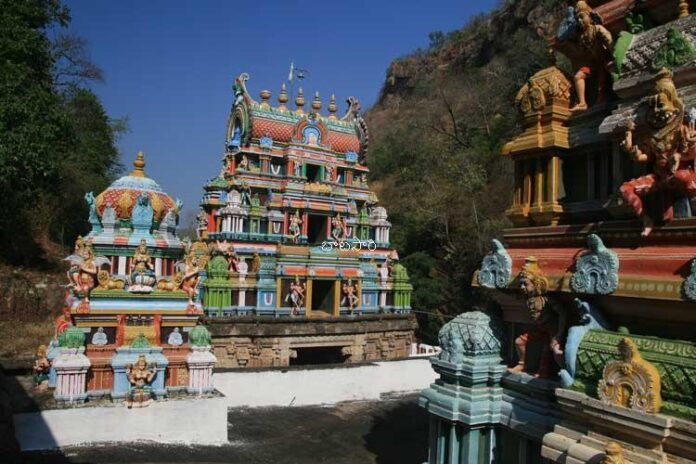
Description Ahobilam is one of the most venerated Vaishnava temples enshrining Narasimha. It is located near Nandyal in Andhra Pradesh. It is accessed from Cuddappah on the Chennai Mumbai railroad.

Forty miles from Cuddapah is Allagedda, and there are bus routes to Ahobalam from Allagedda. Other possible routes, are Nandyal-Allagadda-Ahobalam and Dhone-Banganapalli-Koilakuntla-Ahobalam. It is referred to as the Nava Narasimha Kshetram, and is the seat of the Ahobila Mutt.

Singavelkunram, praised in Tirumangai Alwar‘s decad of 10 verses in Tamil, is the Ahobila Divya Desam, enshrining as many as nine images of Narasimha – and is one of the two Divya Desams in Andhra Pradesh.

The Puranas state thet the Nallamalai hills from Kurnool to Chittoor district are a personification of Adiseshan whose tail is Sri Sailam, middle is Ahobalam and head is Tirumala.

Deities: This Nava Narasimha Kshetram enshrines Ahobila Narasimhan, Varaha Narasimhan, Malola Narasimhan, Yogananda Narasimhan, Bhavana Narasimhan, Kaarancha Narasimhan, Chakra Vada Narasimhan, Bhargava Narasimhan and Jwala Narasimhan. In the temple at the foothills, the Moolavar  Prahladavaradan in a seated posture facing east; there are festival images of 8 of the Narasimhas, other than malola Narasimha. The festival image of Malola Narasimha is located in the Ahobila Mutt. The Moolavar in the Ahobila Mutt is Lakshmi Narasimha, while the utsavar is Rama.

Upper Ahobalam is 2800 feet above sea level.It is an arduous trek to upper Ahobilam from the foothills. The Lakshmi Narasimhar temple at the lower level, has mandapams, with remnants of fine sculpture from the Vijayanagar period. Upper Ahobilam enshrines Ahobila Narasimhan and Ugra Narasimhan. The moolavar images were the only shrines of worship during the period of the Chalukyan king Vikramaketu, while it was during the period of Prataparudra that festival images were made. Krishna Devarayar is known to have made endowments here. 

The two crests of the hill are caled Vedadri and Garudadri, through which the Bhavanasini Thirtham flows. There is a pillar near the Ugra Narasimhar and the Guha Narasimhar shrine; said to be the pillar, facing which the demon Hiranyakasipu asked Prahlada to demonstrate the omnipresence of Vishnu.

Legend has it that Rama, separated from Sita worshipped Lakshmi Narasimhar here.  Legend has it that Garuda, desirous of seeing the Narasimha form of Vishnu worshipped him here, and that Vishnu manifested himself as nine forms of Narasimha. Mahalakshmi is believed to have reincarnated into a family of hunters as Senjulakshmi, and married Narasimhar here. This event is commemorated in the annual festival in the tamil month of Maasi, when the local tribe actively participates in the festivities.

Sri Sailam

0

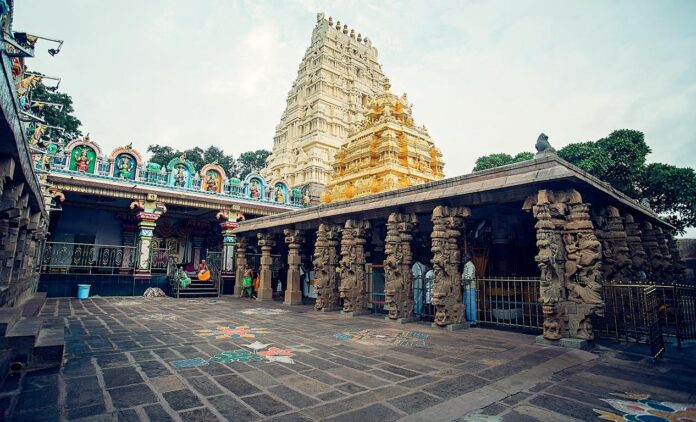
Significance: This is one of the greatest Saivite shrines in India and it constitutes one of the 12 Jyotirlingam shrines of Shiva.  The presiding deities here are Mallikarjuna (Shiva) and Bhramaramba (Devi).

This is an ancient temple with fort like walls, towers and a rich endowment of sculptural work. This huge temple built in the Dravidian style with lofty towers and sprawling courtyards is one of the finest specimens of Vijayanagar architecture.

The Satavahanas of the 2nd century AD have referred to it and the Saivite Tamil Saints have sung its glory. The Kakatiyas and the Vijayanagar kings (esp Krishnadevaraya) have made several endowments here. This temple is of immense religious, historical and architectural significance.

Antiquity The origins of this temple are buried in antiquity. The Skanda Purana has a chapter dedicated to it. The great religious leader Aadi Sankara is said to have visited this shrine and composed his immortal Sivananda Lahiri here. Praise of this temple has been sung by the Tamil Saint poets of the past millennium.

The shrine dedicated to Bhramaramba is considered to be of great significance. Legend has it that Durga is said to have assumed the shape of a bee and worshipped Shiva here, and chose this place as her abode.

Temples in the vicinity:

1. Tripurantakam to the east of Sree Sailam.

2. Siddavatam of Cuddapah district to the South

3. Alampur Navabhrama temples in Mahboobnagar district to the West

4. Umamaheswaram in Mahboobnagar district to the North.

5. Paladhara Panchadara – the spot where Adi Sankara is said to have meditated.

6. Hatakeswaram: another Shiva temple near Paladhara Panchadara where the lingam was originally made of gold.

7. Sakthi Ganapathi temple: It is considered important to visit this temple before visiting Sri Sailam.

8. Kailasa Dwaram: The main entrance to Sri Sailam for those trekking to the temple

9. Sikharam: There is a hill temple dedicated to Shiva at a height of 2850 feet above sea level in the Nallamalai hills

10. Patalaganga: is where the bathing ghats associated with Sri Sailam are located. (Krishna river).

Tripurantakam, Siddavatam, Alampura  and Umamaheswaram are considered to be the four gateways to Sri Sailam.

Vitthala Temple At Hampi

0

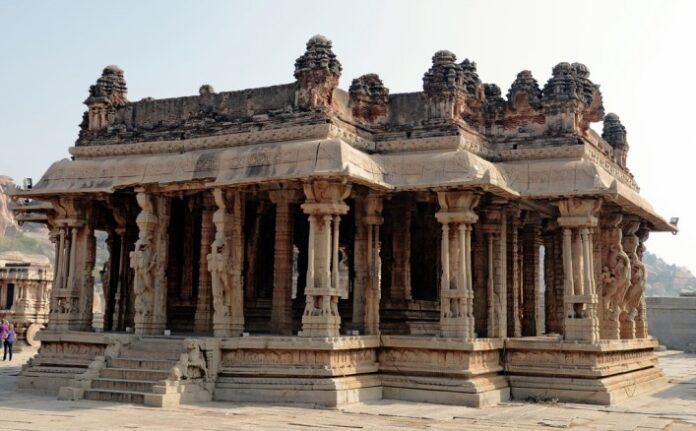
The most splendid of temples at Vijayanagar is the Vitthala temple, near the Tungabhadra river. It is considered to be the most ornate of the Vijayanagar temples.

Hampi, now in ruins is the site of the ancient city of Vijayanagar, capital of the Vijayanagar empire (founded under the spiritual guidance of Vidyaranya of sringeri in early (14th century) which brought about a renaissance of indigenous art and culture, as it defended the region against the  plundering armies from elsewhere.

Much of Vijayanagar is now in ruins, as when the rulers were defeated at the hands of the invaders at the battle of Talikota in the 16th century, most of the marvelous structures and edifices were systematically destroyed.

Vitthala – Vishnu is enshrined in this  temple. The mahamandapam of this temple, in front of the sanctum – enclosed in the inner courtyard is of great beauty. It’s base is chiseled with friezes of the swan, the horse and the warrior. At intervals, there are projections with bas reliefs portraying the deification of the ten avatars of vishnu. 

The steps on the east of the mahamandapam are flanked by an elephant balustrade. The facades are lined with forty pillars, each over 10 feet in height. Each group of pillars has a central pillar with slender shafts around. The center of the Mahamandapam has sixteen pillars decorated with Narasimha and Yali, forming a rectangular court. The ceiling of the Mahamandapam is also covered with sculptural work.

The stone chariot in this temple is of great fame. Its stone wheels, each shaped in the form of a lotus, are capable of revolving. It represents the sprakling creativity of the artistes of the fifteenth century. Temple chariots are often mobile reproductions of a temple. The stone chariot here is in turn a static version of the mobile temple chariot.

Tiruvanandapuram

0

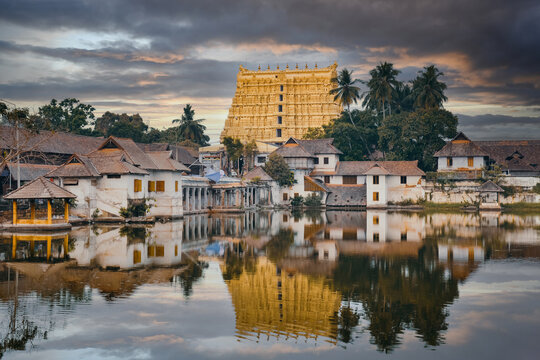
Description Tiruvanandapuram (Trivandrum) gets its name from the grand Anantapadmanabhaswamy temple, enshrining the tutelary deity – Anantapadmanabha  of the Travancore kingdom. It is one of the grandest temples of Kerala, exhibiting an amalgamation of Dravidian and Kerala temple architectural styles. It is a temple vibrant with tradition, having been associated for years with the arts and music. The rulers of Travancore have held this temple in the highest regard. Even today, an elaborate worship protocol is followed in the strictest sense and this is one of the best maintained temples in India.

This is an ancient temple and has been revered by the tamil hymns of the Alwar Saint Nammalwar of the 1st millennium CE. Eight shrines in Kerala  Tirunaavai, Trikakkara, Moozhikkalam, Tiruvalla, Tirukkodittanam, Chengannur, Tirupuliyur, Aranmula, Tiruvanvandur and Tiruvanantapuram and two in Kanyakumari district (formerly in Travancore) Tiruvaattar and Tirupatisaram have been revered by the tamil hymns of Nammalwar. Tirumangaialwar has sung of Tiruvalla, and has mentioned Tirupuliyur in one of his hymns.

Deities: This temple enshrines an imposing image of Vishnu, in the Anantasayanam posture; an image viewed through three doors in front of the shrine. The original image was of wood; the current image was fashioned out of 1200 saalagramams which were specially brought down for this purpose and moulded into shape with a special paste kadusarkara – a mixture of lime, granite, molasses and mustard. Vishnu is viewed through three doors in a row – the face on the southern side, the feet on the northern side and the nabhi (navel) in the middle.  Padmanabhan is enshrined in the yoganidhra posture, reclining on Aadiseshan -( making offerings of vilvam to a small Shivalingam, to  his right).

The sanctum of this temple is fashioned in the style of the temples of Kerala, while the surrounding walls and the towers resemble that of the Tamil (Dravidian architecture)temples. Interesting murals adorn the outer walls of the sanctum. There are shrines to Narasimha, Hanuman and Krishna near the sanctum.

An interesting legend surrounds the origin of the imposing image. A rishi by name Divakara Yogi, who was engaged in the worship of Vishnu, was enraged by the sight of a two year old toddler swallowing his Salagramam, the object of his worship. The toddler, upon being chased by the yogi, entered a tree; the tree split, and Vishnu revealed himself in all his splendour to the Rishi, who then requested him to assume a form that could be held in worship, upon which Vishnu assumed the form of the image, now held in worship in this temple.

History: Martanda Varma of the Travancore Kingdom, in a spectacular ceremony in 1750 surrendered the kingdom to the presiding deity of the temple, and received it back as a fiefdom and ruled Travancore as a servant of Padmanabhan; all of his successors adopted this custom. Much of the present structure dates back to the period of Martanda Varma, who made several renovations and built the eastern gopuram, which got completed by 1798.

The  flagstaff  is enclosed in a casing of gold. The Kulasekhara mandapam near the flagstaff has fine sculptures dating back to the 17th century. The long prakaram, with a terraced roof with 324 columns, mesaures 540 feet by 325 feet, and is about 24 feet wide. It has two rows of granite pillars, and every pillar bears an image of a Deepalakshmi. Also here are images of yalis (mythological animal), with non removable stone balls in their mouths.

Festivals: There are two annual festivals here – one in the month of Pankuni (Pisces-Meenam) March 15-April14, and the other in Aippasi (Tulaa-Libra) (Oct-Nov).

Meenakshi Sundareswarar Temple

0
Menakshi Temple, Madurai, Tamil Nadu, India

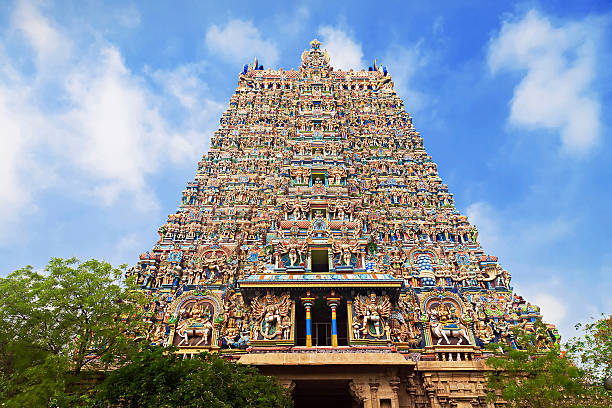
The temple town of Madurai is one of the most ancient heritage sites of India truly reflective of the cultural ethos of India. Madurai is closely associated with the literary wealth of Classical and Modern Tamil. The crowning glory of this historic city is the sprawling Meenakshi Sundareswarar temple. Four of the 6 major streams of the indigenous system of beliefs as codified by Sankaracharya (i.e. Saivism, Shaktism, Vaishnavism and the worship of Skanda) meet in this historic city during festive occasions when the entire region is transformed into a vast space of celebration.

It would be no exaggeration to state that Madurai is a true representation of the cultural ethos of India, and of the grandeur of Indian art. Central to this standing is the sprawling Meenakshi Sundareswarar Temple.

The plurality of faiths centered around the Meenakshi Sundareswarar temple, the splendour of its festival traditions, the invocation of events from the 1st millennium CE in its festival traditions (as in the enactment of the Tiruvilayadal Puranam), the association with the Golden age of Tamil literature – the Sangam period, the abundance of literature associated with the temple, the wealth of sculpture seen in the temple, the popularity of the temple in terms of the number of visitors etc. contribute to this standing.

The literature of the pre Christian Sangam period speaks of Madurai. The devotional hymns of the Nayanmars venerate Somasundarar – or Aalavaayan of Madurai. The Haalaasya Mahatmyam or the Tiruvilayadal Puranam speak of the various legends associated with Shiva, which still form a part of the festival traditions of this temple.

The most amazing feature of this temple is the fact that it is a living legend, absorbing traditions for over two millennia. In its finished form, it represents the marvelous resilience of the Indian cultural ethos – (the fact that it was reconstructed during the Nayak period, after the destruction of the temple by Malik Kafur, one of the generals of Allaudin Khilji). Legends such as Meenakshi Kalyanam, the coronation of Meenakshi and Sundareswarar as the Queen and King of Madurai, still form part of the grand festival traditions.

In fact, Meenakshi and Sundareswarar are regarded as the Royal Pandya rulers of Madurai; Meenakshi’s father, is said to be Malayadwaja Pandyan, who was preceded by Kulasekhara Pandyan – the legendary builder of the city of Madurai.

The living legend the temple is – is complimented with architectural and sculptural splendour thanks to the vision and patronage of the Madurai Nayak rulers – successors to the Vijayanagar empire. Towering Rajagopurams dominate the skyline of Madurai; each of these gopurams is filled with myriad stucco images reflecting legends from the puranas; the temple complex in itself is a lavish art gallery, what with the grandeur of sculptures in the 1000 pillared hall, the millions of stucco images adorning the towring gopurams of the temple the murals, the depiction of the Tiruvilayadal puranam – only to name a few.

The festival traditions here represent a congruence of the Saiva, Shakta, Skanda And Vaishnava streams of the Hindu religion – thanks to the adept repositioning of the Maasi Tiruvizha in the month of Chittirai, to coincide with the annual festival at the Kallazhagar temple, when all of Madurai is transformed into one huge space of celebration.
faith.

Amarnath

0

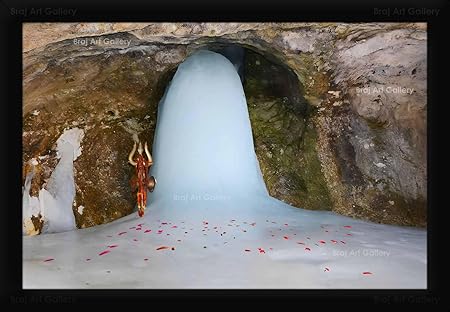
This is one of the revered pilgrimage sites of India tucked away in the mighty Himalayas. Open only for a few months during the year, Amarnath enshrines a natural Shivalingam of ice, and is reached after an arduous trek through the mountains of Kashmir.

Amarnath is an ancient pilgrimage center. The Amarnath cave is located at a distance of 86 miles north east of Srinagar, at a height of 13000 feet above sea level. Shiva is worshipped here in the form of a Shivalinga shaped ice block, made by drops of water oozing naturally in the cave.

To the left of the Shivalingam is another ice block representing Ganesha, and to the right of the Shivalingam are blocks representing Parvati and Bharirava. The cave faces south. Inside the Amarnath cave is another small cave on the left of the image, from which a chalk like substance is given out to pilgrims as Vibhuti. Amarnath is surrounded by snow clad mountains.

Legend has it that Shiva made the Gods immortal by providing them with the celestial nectar, and resided here upon their request. This boon of immortality lent the name Amarnath.

Kashmir was a great Saivite center in the 1st millennium CE. Kashmiri Saivism is referred to as Trika Mata and it dates back to the eighth century CE. The three components of Kashmiri Saiva literature are Agama Sastra, Spanda Shastra and the Pratyabhijna ShastraKalhana, a contemporary of King Jayasimha of Kashmir of the 12th century describes Kashmir as Parvati incarnate. Legend has it that there was once a lake by name Sati-Saras named after Shiva’s consort Sati. The demons residing here were destroyed by Sage Kashyapa, the grandson of Bhrama. It is believed that Kashyapa then converted this lake into Kashmira Mandala.

Tradition has it that in every lunar month, the icy Shivalingam begins to form, on the first day of the bright half of the month, and reachest its fullest size on the full moon day, and then begins to wane and disappear on the new moon day. This process repeats itself each month. Since it is believed that Shiva manifested himself first on the full moon day in the month of Sravana (Leo), the only summer month that permits travel in this mountainous area, it is considered to be special to go on a pilgrimage to Amarnath during this month.

The trek to Amarnath begins at Srinagar on the panchami day of the bright half of the month. The next halt enroute is Pampur,  9 miles south east of Srinagar. Subsequent halts are at Avantipur, Brijbihara and Martand. Martand is known for its ancient temple dedicated to the Sun God – now in ruins.  Enroute to Martand are Anant Nag and Gautam Nag. Martand is known as the architectural lion of Kashmir. It is a temple with a colonnade of 84 columns full of artistic work. This temple dates back to Lalitaditya of Kashmir of the 8th century. The next halt is at Aishmukam, and the next is Pahalgam, which is reached on the day of Dasami, the tenth day of the bright half of the month. At Pahalgam is the confluence of the rivers Seshnag and Liddar.

The next stop enroute is Chandanwadi, from where the confluence of the rivers Asthan Marg and Seshnag. Further up is the Pishu Ghati, believed to be the site where the demons were crushed by the Gods. Further up is the Seshnag lake at a height of about 12000 feet above sea level. The Seshnag river flows out of this lake. The next halt is at Wavjan before the steep climb to the Mahagunus Pass at a height of 14000 feet, after which there is a down slope leading to Panchatarni. From here, the Amarnath cave is reached on the full moon day, and the pilgrimage is complete.

Kailash

0

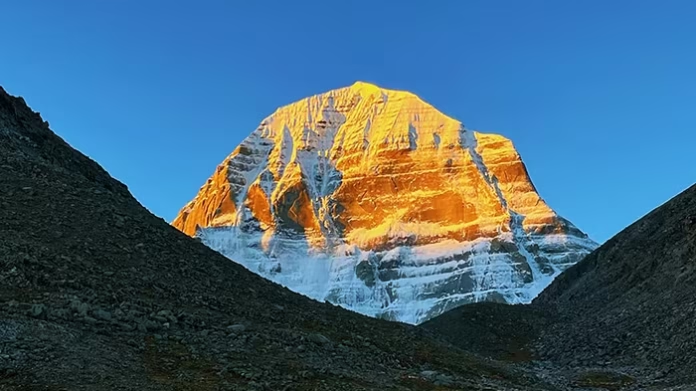
Description: The towering 22028  ft high peak Mt. Kailash in the Himalayas, 25 miles north of the Mansarovar lake is hailed as the abode of Shiva. It is an arduous trek to Kailash through the snow clad Himalayas and is attempted only by a few. The Tibetians refer to Kailash as Kangrimpoche (Jewel of Snow). Kailash is also referred to as Hemakootam. This is one of the 4 Tevarastalams in the Himalayas the other three being Gauri Kund,Kedarnath and Indraneela Parvatam. Major rivers have their source around the Manasarovar lake and Kailash.

Route to Kailash: Pilgrims go to Kailash via the Lipu Lekh pass. They first go to Tonakpur, then through Pithorgarh, Askot and Dharchula and Garbiang the last town in Indian territory. The Lipu Lekh pass is 16750 feet above sea level, and is at the Tibet frontier. Pilgrims then reach Taklakot, a Budhist center. Manasoravar is 34 miles away from here. 12 miles from Taklakot in Bhutan, is Kocharnath. An alternate route to Mansarovar is via Kathgodam, Karpot, Milon, Tirthapuri and Kailash. Yet another route is from Haridwar via the Niti pass.

The Mansarovar lake is known as Cho Mapan. There are two lakes here; one the rakshasa tal, where Ravana performed penances towards Shiva, and the other the Mansarovar, considered to be one of the 51 Sakth Peethams.

Mount Kailash is located 20 miles from Mansarovar; it appears like a giant Shivalingam placed in a 16 petaled lotus. Pilgrims first reach Darchin, and then start their 32 mile pradakshina or circumambulation around the sacred mountain. From Darchin, they proceed to Landifu, then Derfu, and then in a north east direction to Gowrikund 19000 feet above sea level. Gowri Kund in Tibet is known as Thuki Singbu.  Then they go to Jandalfu and come back to Darchin. There are several Buddhist temples in this area.

The Nayanmars: Tirunavukkarasar on his way to Kailasam is said to have been  transported by divine intervention to Tiruvaiyaru – Dakshina Kailasam. Karaikkal Ammaiyar is said to have trekked to Kailasam and returned to Tiruvalangadu. Sundaramoorthy Nayanar is said to have travelled to Kailasam on a white elephant, while his contemporary Cheraman Perumal Nayanar of Tiruvanjaikkalam composed Tirukkayilaya Gnana Ula at Mt. Kailash. Sambandar sang praises of Kailasam from Sree Kalahasti   Kailash is the fifth of the Tevara Stalams hailed by the Tamil hymns of the Nayanmars, located outside of Tamilnadu/Kerala/Karnataka i.e. in Vada Naadu (the northern lands).

Mt. Kailash is regarded by Hindus as an embodiment of Shiva and Parvati. The Buddhists refer to the sacred mountain as Kangri Karchchak; they regard the presiding deity of Mt. Kailash as Deity with three eyes, holding the damaru and the trishul; his consort is referred to as Dorje Fangmo. The Jains regard Mt. Kailash as the Ashtapada mountain where the first Tirtankara Adinath (Rishabhadeva) attained nirvana.

Dev-Prayag

0

Description Devaprayag in the Himalayas at a height of 1700 feet above sea (70 km from Rishikesh) level, where Alakananda and Bhagirathi merge to form the Ganges, is considered to be a pilgrimage center of great significance.. It is  held in reverence all over India, and is a resting point for pilgrims bound to (and from) Badrinath and is located at a distance of 70 km from Rishikesh enroute to Badrinath.

There is an ancient temple established by Adi Sankaracharya here, enshrining Rama (Raghunathji); there are also shrines to Hanuman, Badrinathji, Kaala Bhairavar, and Shiva here. Bhrama, Dasaratha and Rama are said to have prayed here.

Periyalwar of the 1st millennium CE, composed in Tamil, a decad of 10 verses praising the glory of Tirukkandam as a shrine on the banks of the Ganges. These verses state that Vishnu enshrined in Mathura, Salagramam, Dwarka, Ayodhya & Sri Vaikuntham is the same as the one (Purushottaman) enshrined in Tirukkandam or Kadinagar. Devaprayag is considered to be Tirukkandam or Kadinagar.

Sri Kedarnath Dham

0

Description: This is one of the best known Shivastalams in India and is considered to be one of the most sacred pilgrimage centers of the country, located in the lofty Himalayas. It is revered as one of the 12 Jyotirlingams – the Northern most one, while the Southernmost one is Rameshwaram. The spiritual leader Adi Sankaracharya is closely associated with Kedarnath. Kedarnath is a shrine steeped in antiquity, rich in legend and religious significance.

Four Himalayan shrines dedicated to Shiva have been glorified by the Tamil Tevaram Hymns composed by the Nayanmars of the 1st millennium CE. These shrines are Indraneela Parvatam in Nepal, Gaurikund, Kedarnath and Mount Kailash in Tibet. Although none of the Nayanmars visited Kedarnath, Sambandar sang its praises from Kalahasti . The Tamil hymns of the Nayanmars refer to Kedarnath as Tirukkedaram. Kedarnath is the fourth of the Tevara Stalams hailed by the Tamil hymns of the Nayanmars, located outside of Tamilnadu/Kerala/Karnataka i.e. in Vada Naadu (the northern lands).

The Temple: Located in the Himalayas at a height of 12000 feet in awe inspiring surroundings, this small shrine is accessible by foot, only 6 months a year. The temple at Kedarnath enshrining the Jyotirlingam of Shiva opens only when the sun enters the zodiac sign of Aries and it is closed when the sun enters Scorpio. The priests then go to Ukhimath, where the worship of Kedareshwara is continued during the winter season.

Kedarnath is located on a ridge which juts out at right angles from below the 23000 feet high snowy peak of Mahapanth. Kedarnath is located on the Rudra Himalaya range.

The Rudra Himalaya range is also known as the Pancha Parvata; its five peaks are Rudra Himalaya, Vishnupuri, Bhramapuri, Udgari-Kanth and Swargarohini. It is believed that four of the Pandavas died on the last of these peaks.

Legend has it that Parvati worshipped Kedareshwar to unite with Shiva as Ardhanareeswarar. Kedara Munivar is also said to have established this shrine visited by the Pancha Pandavas.

Legend also has it that Nara and Narayana – two incarnations of Vishnu practised severe penances at Badrikashram, in front of a Shivalingam fashioned out of earth. When Shiva appeared in front of them, they requested him to take up a permanent abode as a Jyotirlingam at Kedarnath.

Legend also has it that the Pandava princes were advised to visit Kedarnath after the great Kurukshetra battle. Shiva upon seeing the Pandavas, assumed the form of a male buaffalo and entered the earth. It is believed that the rear of its body remained here, as Kedareshwar. The front part is believed to be in Nepal. This legend says that when Shiva entered the ground, he became five fold – his hind remained at Kedar, his arms Tunganatha, his face Rudranatha, his belly Madhyameswara and his Jata Kalpeswara. These five shrines together as known as the Pancha Kedara.

The Pandavas are believed to have visited this area several times. Arjuna is believed to have come here to pray to Shiva to obtain the coveted Pasupataastra. The other Pandavas are believed to have come here in search of him, where Draupadi came across the heavenly lotus Kalyana Saugandikam, and requested Bhima to bring here some more of the same. It was during his venturing out to seek these flowers that Bhima met Hanumaan.

Tradition has it that pilgrims first visit Yamunotri and Gangotri and bring with them the holy waters from the sources of the rivers Yamuna and Ganga and offer abhishekams to Kedareshwara. The traditional pilgrim route is Haridwar-Rishikesh- Devaprayag – Tehri – Dharasu – Yamunotri  – Uttar Kashi – Gangotri – Triyugnarayan – Gowrikund and Kedarnath. Alternatively, the route to Kedar from Rishikesh is via Devprayag, Srinagar, Rudraprayag and Ukhimath.

Near Kedarnath is the source of the river Mandakini. Mandakini joins Alakananda at Rudraprayag.

Stay Connected

16,985FansLike
12,500FollowersFollow
61,453SubscribersSubscribe