


Mail ID: contact@vedavarsity.com

Contact: +91 9634998911

Google search engineGoogle search engine
Home Blog Page 126

Vraja Mandala Is Non-different From Lord Krishna

0

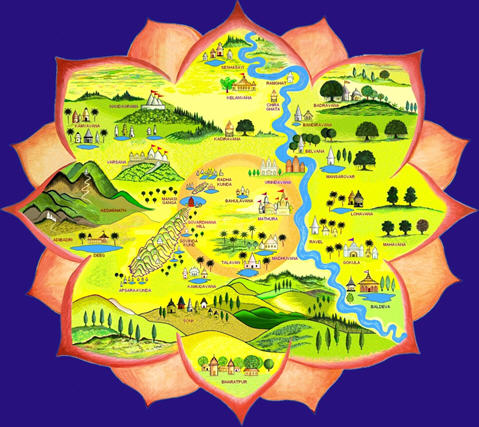
In the Visnu-rahasya it is said that Vraja Mandala is non-different from the Lord’s own form. Therefore, just as Govardhana Hill is considered to be the transcendental form of Lord Krishna, Vraja Mandala is also another form of the Lord. The Visnu-rahasya reveals that this particular form of the Lord has fifty-five parts which are represented by fifty-five different forest of Vraja. Amongst the fifty-five forests that form the Lord’s body are the twelve sacred dwadashavanas while others are; upavanas, prativanas and adhivanas.

The Visnu-rahasya says, “Mathura is the heart, Madhuvana is the navel, Kumudavana and Talavana are the two parts of the chest, Vrindavana and Mayuravana are the forehead, Bahulavana and Mahavana are the biceps, Bhandiravana and Kokilavana are the hands, Khadiravana and Bhadrakavana are the shoulders, Chattravana and Lohajanghavana are the lotus eyes, Bilvavana and Bhadravana are the ears, Kamyavana is the chin, Triveni and Sakhi-kupa are the lips, Vihvala and others are the teeth, Surabhivana is the tongue, Manengitavana is the nose, Sesasayi and Paramanandavana are the nostrils, Karela and Kamai are the hips, Karnavana is the genitals, Krishna-ksipanak is the rectum, Nandanavana is the head, and Indravana is the back.

The five fingers of the right hand are Siksavana, Candravana, Lohavana, Nanda-grama, and Sri-kunda. The five fingers of the left hand are Garhasthana, Lalita-grama, Varsana, Gokula, and Baladeva. The five toes of the left foot are Govardhana, Javata, Sanketavana, Naradavana, and Madhuvana. The five toes of the right foot are Mridavana, Jahnuvana, Menakavana, Kajalavana, and Nandakupavana.” The Puranas like the Padma Purana, Adi-Varaha Purana, Vishnu Purana, and Bhavishya Purana, mention one hundred thirty-two most important forests of Vraja Mandala where Lord Krishna performed His transcendental pastimes.

Out of these, twelve forests are called the dwadashavanas and are revered as being the most sacred. The Adi-Varaha Purana lists the twelve sacred forests (dwadashavanas) by number: 1.Madhuvana 2.Talavana 3.Kamudavana 4.Kamyavana 5.Bahulavana 6.Bhadravana 7.Khadiravana 8.Mahavana 9.Lauhajangavana 10.Bilvavana 11.Bhandiravana 12, Vrindavana. Of the twelve sacred forests, seven are situated on the western bank of the Yamuna River including: Madhuvana, Talavana, Kamudavana, Bahulavana, Kamyavana, Khadiravana and Vrindavana, and five forests are situated on the eastern bank of the Yamuna including: Bhadravana, Bhandiravana, Bilvavana (Belvana), Lohavana (Lauhajangavana), and Mahavana.

It is said that Lord Krishna is the predominating Deity of the forests on the western bank of Yamuna and Lord Balarama is the predominating Deity of the forests on the eastern bank of the Yamuna. Both Krishna and Balarama are said to be the predominating Deities of Brihadvana (Mahavana). The Vraja Mandala Parikrama is also known as the Vana-yatra, because it circumambulates the dwadashavanas, the twelve primary forests of Vrindavana Dhama. The Sanskrit word dwadasha means twelve, the word is ‘vana’ means ‘forest’ and ‘yatra’ means ‘pilgrimage’.

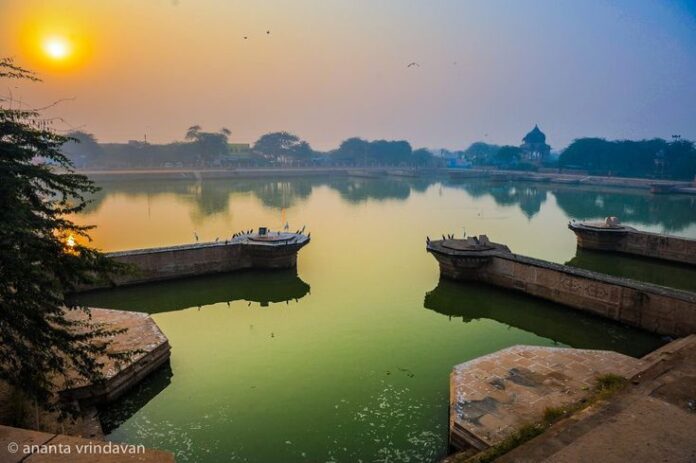
Out of the twelve primary forests, the forest of Vrindavana is considered the most sacred and important. The Vraja-bhakti-vilasa has divided the sacred forests of Vrindavana into eleven groups with twelve forests in each group totaling 132 forests. Besides the original 12 dwadashvanas, there are 12 upavanas, 12 prativanas, 12 adhvanas, 12 sevavanas, 12 tapovanas, 12 mokshavanas, 12 kamavanas, 12 arthavanas, 12 dharmavanas and 12 siddhavanas. The word ‘upavana’ means ‘secondary forest’, ‘prativana’ means ‘replica forest’, and ‘adhivana’ means ‘half-forest’. In some Puranas the names of the sub-forests differ, but the list below from Vraja bhakti-vilasa is the most accurate.
Various Dimensions Attributed To Vraja Mandala

0

In the Puranas a number of dimensions have been attributed to the area of Vraja Mandala including those of 21, 20 16, 12, 6 and 5 yojanas. This is possible because the Puranas describe many different regions within Vraja Mandala. Another reason is the variation in a kosa which was not a fixed measurement and in the different Puranas a kosa can vary between 1.75 and 2.75 miles. However, in today’s Gaudiya Vaishnava literature, the standard measurement of a kosa has been established as being two miles and a yojana as eight miles, based on the dimensions of Vraja Mandala found in the Adi-Varaha Purana. An example of variation in the yojana can be seen in the following two verses.

The Garga Samhita says that the area of Vraja Mandala from Yayavara to Saukari is twenty-one yojanas (eighty-four kosas), “The wise say that the most splendid transcendental land of Vraja mandala is 21 yojanas in extent.” The Bhakti-ratnakara says, “Just as the boundary of Mathura Mandala extends from Yayavara to Saukari, in this way all the directions are extended up to twenty yojanas.” Thus while describing the same area of Vraja Mandala there is a difference of one yojana (four kosas) between the Bhakti-ratnakara and the Garga Samhita, However, the dimensions found in the Garga Samhita of 21 yojanas (84 Kosas) are accepted as being correct by all Gaudiya Vaishnava scholars, whereas those of Bhakti-ratnakara are simply an approximation of the same area.

In another example of yojana variation, the Brihad-gautamiya-tantra says, “The glories of Vrindavana are beyond anyone’s calculation. People say Vrindavana covers sixteen kosa, and in the shastra it is said Vrindavana extends five yojanas.” According to the shastras, Vrindavana forest covers an area of five yojanas (twenty kosa), which is accepted as correct by Vaishnava scholars, whereas the local people say it covers four yojanas (sixteen kosa), a difference of just one yojana. 1. An example of various regions being described within the area of Vraja Mandala is found in the following verse. The Adi-Varaha Purana says, “Mathura Mandala extends throughout twenty four kosas and is decorated with twelve forests, dvadasa-vanas, where Mathuradevi, the bestower of all accomplishments resides.” Twenty-four kosas equals six yojanas or forty eight miles.

This is the approximate dimension of the inner border region of Vraja Mandala from Kambhi in the north to Baldeo (Baldev) in the south, encompassing the twelve sacred forests (dwadasa-vanas) where the pastimes of Krishna and Balarama took place. The border of this six yojana region was demarcated by Vajranabha Maharaja based on the above verse from Adi Varaha Purana. A number of stone pillars (kambha) were erected by Vajranabha at various places to mark the inner boundary of Vraja Mandala and one of these stone pillars still exists near the village of Kambhi. In the Skanda Purana it is said, “The tract of land called Mathura Mandala is spread over twelve yojanas.”

Regarding this particular reference from the Skanda Purana, the Bhakti-ratnakara says, “The Puranas have classified these holy places within Mathura Mandala where Krishna and Balarama used to play, stating that these holy places covered twelve yojanas.” However, twelve yojanas is equal to forty-eight kosas or ninety-six miles which is a very large area compared to the six yojanas mentioned in the Adi-Varaha Purana for the very same area where Krishna and Balarama used to play. Twelve yojanas or ninety-six miles is very close to the actual radius of Vraja Mandala which according to the Garga Samhita is forty-two kosas (10.5 yojanas) or eighty-four miles.

The Geographical Area Of Vraja Mandala

0

The region of Vraja Mandala is also known as Mathura Mandala and the same geographical area is also known as Vrindavana Dhama. In most of the Puranas the area of the dhama is generally referred to by its more ancient name as Mathura Mandala, although in the Garga Samhita we find both Vraja Mandala as well as Mathura Mandala being used. It was only after the pilgrimage to Vrindavana by Lord Chaitanya Mahaprabhu that the terms Vraja and Vraja Mandala became prominent, mainly due to the writings of the Gaudiya Goswamis, who used the term Vraja profusely in their literatures.

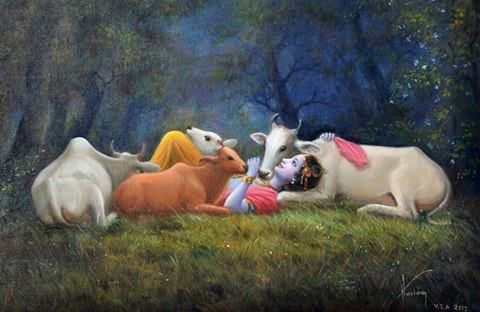
The word ‘Vraja’ which means ‘the place where the cows roam unhindered’ is a Sanskrit word which is most applicable to the holy land where Lord Krishna performed His cow-herding pastimes as a boy. The land of Vraja is often referred to in the local dialects of Vrajabasa (Bhojpuri) as ‘Brij’ or ‘Brijbhoomi’ and these terms have been in common use since the late 16th century when the excavation of the holy dhama began and the revival of its culture and traditions emerged after having been in neglect for almost fifty centuries.

According to the Padma Purana (Mathura-mahatmya), the transcendental land of Vraja Mandala should be visualized as being a thousand-petaled lotus flower with the city of Mathura situated on the central whorl of that lotus. A similar description is also found in the Brahma samhita. While describing the five presiding Deities of Vraja Mandala, the Adi-Varaha Purana says that Vraja Mandala may be seen as a four-petaled lotus; Keshavadeva presides over the central whorl of that lotus, Govindadeva presides over the northern petal, Varahadeva presides over the southern petal, Harideva presides over the western petal, and Vishranti presides over the eastern petal, (Sometimes it is said that Baladeva presides over the eastern petal, and elsewhere it says He presides over the southern petal).

The Puranas also say that the holy dhama of Vrindavana is a completely spiritual place and transcendental to the material atmosphere, therefore attempting to measure it by mundane material means is considered to be an offense. Nevertheless, the Vedic scriptures have presented the approximate dimensions of the holy dhama for the benefit of devotees who want to visit the holy places connected to Lord Krishna’s pastimes. The Garga Samhita says, “The land between Baharisad (Barhada) in the northeast, Yadupura (Batesar) in the south, Sonitpura (Sohna) in the west, which measures eighty-four kosas, has been called Mathura Mandala or Vraja by all learned persons.”

From Sonha to Batesara is eighty-four kosas which is equal to twenty-one yojanas or one hundred and sixty eight miles. This is the actual diameter of the holy dhama from north to south or east to west, thus creating a circular mandala with Mathura in the centre. Therefore the radius of Vraja Mandala from Mathura to its outer border in all directions is forty-two kosas or eighty-four miles. The Garga Samhita mentions Baharisad as one of the border reference points which many scholars believe is the town of Barhada which is located in Aligarh District of Uttar Pradesh State. Barhada is also known as Bara Kalan, but the town of Barhada is not located at the correct distance of eighty-four miles (forty-two kosas) from the centre of Vraja to be identified with Baharisad.

The second reference point is Yadupura, the city of the Yadus which was ruled by Maharaja Surasena, the father of Vasudeva (Krishna’s father). Yadupura is presently known as Batesara which lies to the south of the modern city of Agra. The ancient name of Batesara was Saukri-Vateshwara and it is the place from where the boar incarnation of Vishnu, Lord Varahadeva appeared. Saukri-vateshwara, which is located on the southern petal of the lotus of Vraja, is considered to be Lord Varahadeva’s eternal residence. The third reference point is Sonitpura which is presently called Sohna; it is a well known spa and beauty-spot situated in the Aravali Hills in Haryana State and famous for its hot springs.

The ancient name of Sonitpur was Yayavara and it was so named after a famous brahmana who had once resided there. The Padma Purana, (Yamuna-mahatmya) states, “Long ago in this beautiful place of the Apsaras (Sonitpur), there lived an ascetic brahmana named Yayavara. Becoming overwhelmed by sensual pleasures that brahmana offended Lord Indra and was thus cursed. After suffering a long time from the fire of Indra’s curse, in spite of performing severe austerities to get relief, he eventually got freed from his sin simply by touching a drop of water here. That brahmana then traveled east till he reached Saukara-puri where Lord Varahadeva had previously manifest Himself to rescue the earth when it had sunk in the ocean of universal devastation.”

The Bhakti-ratnakara while giving another reference to the area of Vraja Mandala mentions the place known as Yayavara (Sonitpur) when it says, “According to the scriptures, the boundary of Mathura Mandala extends from Yayavara to Saukari-vateshwara.” The Brahmanda Purana mentions that the borders of Vraja Mandala are also demarcated by various sacred forests and says that in the north of Vraja Mandala is Suryapatnavana, in the east is Hasyavana, in the west is Parvatavana, and in the south is Janhuvana. These four forests demarcate the greater border of the chaurai-kosa Vraja Mandala area as described in the Garga Samhita.

The Vraja Mandala Borderline Parikrama

0

The Vraja Mandala Borderline-Parikrama revealed in the Vraja-bhakti-vilasa does not visit all the twelve sacred forests as such, but instead circumambulates around them. This particular parikrama travels around the border of what is called the inner core of Vraja Mandala, inside of which all five-hundred holy places, including the twelve sacred forests are contained. This particular borderline-parikrama is generally performed by tyagi-sadhus and babajis of the various Vaishnava sampradayas.

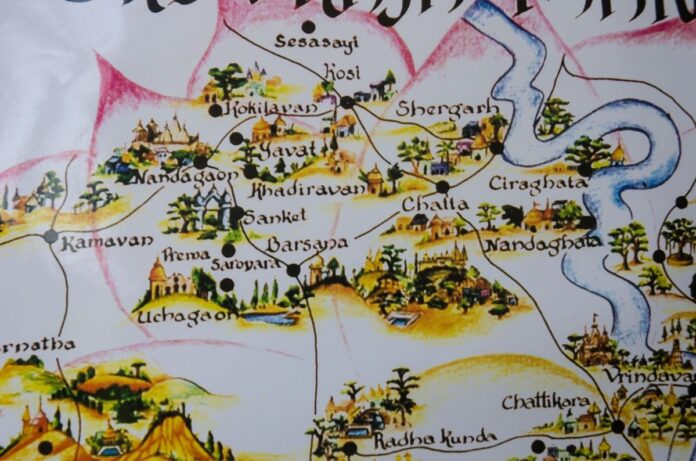
The prominent places on the Vraja Mandala Borderline Parikrama are as follows: Madhuvana, Kamudavana, Sonk, Vac, Samai, Syama-Dhak, Bahej, Dig, Didavali, Konha, Adi-Badri, Pasopa, Kedaranatha, Badali, Charana-pahadi, Bhojana-Thali, Paigrama, Punthana, Singara, Sondha, Vanchari, Khambi, Hasanpur, Marava, Jedapura, Bajana, Salaka, Pitora, Tetigrama, Jarava, Raya, Karab, Vandi-Anandi, Baldeo, Brahmanda Ghata, Koila Ghata, Banda, Dhana, and Talavana.

Vraja Mandala Parikrama Route Followed By ISKCON

0

The Vraja Mandala Parikrama followed by ISKCON passes through eighty-four of the most important holy places of Vraja Mandala. ISKCON’S Vraja Mandala Parikrama begins from Vrindavana on Saradiya-purnima (Sharad-purnima) with a parikrama of Vrindavana and the seven Goswami temples. The following day which is niyam-seva, the parikrama followed by ISKCON leaves Vrindavana for Mathura going via Bhatrol-bihari, Akrura Ghata and Gokarnesvara. ISKCON’S Vraja Mandala Parikrama travels a distance of approximately two hundred and seventy kilometers from start to finish, which by foot takes one month to complete returning on Kartika purnima

Dwarka

0
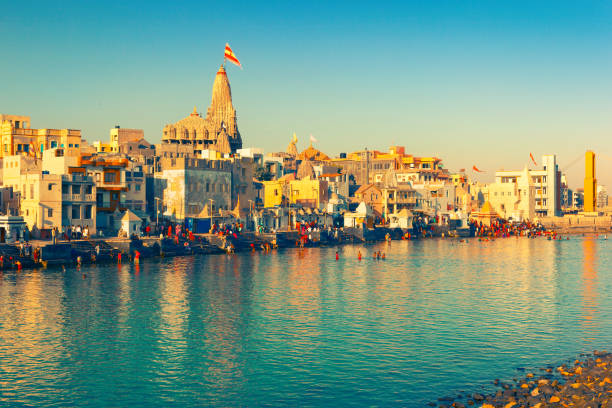
View of Gomti Ghat and Krishna Temple "Shree Dwarkadhish". Dwarka, Gujarat, India

Introduction to Dvārakā-dhāma

Dvārakā, counted amongst the four sacred Catur-dhāma pilgrimage sites and honored as one of the seven holy cities (Sapta-purī), has from time immemorial been worshiped by the devotees of the Supreme Personality of Godhead. Situated at the western extremity of the Gujarat peninsula, the renowned Dvārakā Temple, commonly called Jagat-mandir, is dedicated to Lord Śrī Kṛṣṇa, the Supreme Lord, the knower of all knowledge, and the most charming transcendental hero. This holy place stands as a gateway to spiritual realization, for it represents the eternal kingdom of Kṛṣṇa and combines ancient history with profound religious potency.

Historical and Scriptural Background

According to the authoritative Vedic literature, Lord Śrī Kṛṣṇa, after leaving Mathurā, established His capital city at Dvārakā and ruled there with great opulence and transcendental majesty. The city has been submerged many times and rebuilt, leaving behind traces of ancient culture and maritime remains that bear witness to its antiquity. It is traditionally accepted that the original temple at this site was constructed by Vajranābha, the grandson of Lord Kṛṣṇa, over the spot known as Hari-gṛha, the residence of the Lord during His manifest pastimes. Over the course of centuries, the temple has undergone various renovations, and its present majestic structure dates from around the sixteenth century, thus standing as evidence of the unbroken remembrance of Kṛṣṇa among His devotees.

Dvārakā Among the Seven Sacred Cities

Dvārakā is glorified as one of the Sapta-purī—cities especially blessed for spiritual advancement, along with Ayodhyā, Mathurā, Haridvāra, Kāśī (Vārāṇasī), Kāñcī, and Ujjain. These holy places are repeatedly mentioned in the Vedic literature as auspicious destinations for pilgrimage, for by visiting them one purifies the heart and becomes free from sinful reactions. Dvārakā specifically shines as the city personally established by Śrī Kṛṣṇa and thus is eternally associated with His divine presence. The city is therefore considered a spiritual bridge between the material world and the transcendental abode, for its atmosphere constantly reminds one of the Supreme Lord and His pastimes.

The Present Importance of Dvārakā Temple in the Practice of Bhakti

Even today Dvārakā Temple draws innumerable pilgrims who seek the mercy of the Lord. Because Kṛṣṇa enacted His pastimes here, one who visits this sacred temple with sincerity naturally feels devotion awaken within the heart. The atmosphere is especially conducive for remembering the teachings of the Lord, as spoken in the Bhagavad-gītā, wherein He instructs all living entities to follow the path of dharma and surrender unto Him. In this way the temple remains a place of enlightenment, where one may engage in hearing, chanting, and remembering the glories of Lord Kṛṣṇa.

Distinctive Rituals and Festivals

The worship at Dvārakā Temple is carried out with great reverence according to traditional standards. Early in the morning the Maṅgala-ārati is performed, awakening the Lord with devotional songs, offerings of flowers, and other articles of worship. In the evening the Śayana-ārati concludes the day’s service, when the Lord takes rest amidst the sound of sacred hymns and the waving of lamps. The temple becomes especially splendid during Janmāṣṭamī, the appearance day of Lord Kṛṣṇa. At midnight, when the Lord advented Himself in this world, the devotees hold elaborate functions, dramatic presentations of His divine activities, and generous distribution of prasāda. There is also the Tulābhāra ceremony, in which such items as grains, fruit, or precious substances are offered on a scale equal to the weight of the devotee, symbolizing surrender and gratitude for the Lord’s blessings.

Cultural and Architectural Features

The Dvārakā Temple is renowned for its lofty spire (śikhara), visible from a great distance, guiding pilgrims like a spiritual lighthouse. The external walls are ornamented with carvings depicting the various activities of Lord Kṛṣṇa, thus giving even casual visitors a glimpse into the transcendental character of the Supreme Lord. Within, the Deity of Dvārakādhīśa, the King of Dvārakā, is worshiped with opulent paraphernalia. Traditional craftsmanship, ancient design, and devotional symbolism combine to produce a structure that nourishes both the eyes and the heart, elevating one’s consciousness to Kṛṣṇa’s eternal pastimes.

Service to Society and Spiritual Culture

The temple is not merely a building made of stone; it is a center of spiritual culture. Surrounding communities are sustained by the constant flow of pilgrims. Markets, guides, artisans, and hospitality services gain their livelihood by supporting the pilgrims who come to see the Lord. The temple hosts numerous festivals and devotional gatherings, ensuring that the historical and spiritual heritage of Dvārakā is preserved and passed down to new generations. Thus the temple remains a living institution, influencing society through the principles of devotion, cooperation, and remembrance of the Supreme Personality of Godhead.

Environmental Care and Preservation

Because Dvārakā stands on the seacoast facing the Arabian Sea, there are natural challenges such as erosion and the effects of salt air. For this reason, preservation efforts continue to protect the ancient heritage. Responsible authorities seek to maintain cleanliness, regulate waste, and safeguard the surroundings so that future generations may also have the opportunity to benefit from coming to this sacred place. Such work is essential, for holy places are meant to be maintained in their original purity.

A Pilgrimage of Eternal Benefit

The pilgrim who approaches Dvārakā with devotion receives spiritual strength and inner purification. The temple, its worship, the chanting of the holy names, the scriptures spoken by learned priests, and the atmosphere saturated with remembrance of the Lord create a unique opportunity for spiritual advancement. Dvārakā remains eternally relevant, for the presence of Lord Kṛṣṇa is never diminished by the passing of time.

One who visits this holy dhāma with faith, performs devotional service, and hears the glories of the Supreme Lord certainly becomes blessed. Such sacred places of Kṛṣṇa Consciousness have existed from time immemorial and will continue to bestow spiritual benefit as long as men approach them in a humble mood, desiring to revive their forgotten relationship with the Supreme Personality of Godhead.

The Vraja Mandala Parikrama Detailed in this Article

0

The parikrama route described in this book is based on the parikrama undertaken by Raghava Pandita, Shrinivasa Acharya and Narottama Dasa Thakura, as mentioned in the Bhakti ratnakara. The particular parikrama detailed in this book is now called the ‘Chaurasi-tirtha Parikrama’ as it specifically visits the eighty-four (chaurasi) most important holy places (tirthas) within Vraja Mandala. (This is the same ‘Chaurasi-tirtha Parikrama’ route is being followed by ISKCON’S Vraja Mandala Parikrama). Besides these eighty-four prominent holy places, this book also describes many hundreds of other holy places that can be visited while following the main Chaurasi–tirtha-Parikrama route. Thus every holy place within Vraja Mandala that has been mentioned in books like: Bhakti-ratnakara, Vraja-bhakti-vilasa, Adi-Varaha Purana, and Chaitanya-charitamrita, are included in this edition.

Vraja Mandala Parikrama Based on Bhakti-ratnakara

0

There are a total of two hundred and eighty-eight holy places listed in Bhakti ratnakara that were visited by Raghava Pandita, Shrinivasa Acharya and Narottama Dasa Thakura, during their parikrama of Vraja Mandala. Although some tirthas are no longer visible, the places they visited are as follows:

Mathura (Vishrama Ghata and the 24 ghatas along the Yamuna, Keshavadeva, Gokarna-tirtha, Krishna-ganga, Vaikuntha-tirtha, Asi-kunda, Varaha, Narayana (Padmanabha), Vamana, Langali (Balarama), Catuh-samudrika, Sudama-ghara, Rajaka-vada-tila, Kuvalayapida badha-sthala, Rangabhumi, Kamsa-khali, Kubja-kupa, Baladeva-kunda, Krishna-kupa, Vallabha Bhavana), Madhuvana, Talavana, Kamudavana, Datiha, Shastikara, Sakata Rohana, Garuda Govinda, Gandharvara-kunda, Satoha, Bahulavana, Sankarshana-kunda, Mana-sarasi, Mayura, Dakshina-grama, Vasati, Ral, Radha-kunda and Shyama-kunda, Govardhana, Kusuma-sarovara, Narada-kunda, Ratna-simhasana, Govinda-kunda, Gandharva-kunda, Nipa-kunda, Sankarshana kunda, Gauri-tirtha, Aniyora, Annakuta-sthana, Indra-dhvaja Vedi, Rinmochana, Papamochana, Dana-nivartana-kunda, Apsara-kunda, Airavata, Surabhi-kunda, Rudra-kunda, Kadamba-khandi, Dana-ghati, Brahma-kunda, Manasa-ganga, Cakra-tirtha, Pali, Ata-grama, Shyama Dhaka, Paitha, Parsauli, Candra-sarovara, Sonkrai, Sakhisthali, Surya-kunda, Bhadayara, Magahera, Ghanthuli, Reheja, Devashirsa-sthana-kunda, Munishirsa-sthana–kunda, Paramadana, Setukandara, Budhe Badri, Kadamba-kanana, Indroli, Kanoyaro, Kamyavana, Vishnu-simhasana, Charana-kunda, Kameshwara, Garuda-baithaka, Dharma-kunda, Vishoka, Pancha-pandava-kunda, Manikarnika, Vimala-kunda, Yashoda-kunda, Prahlada-kunda, Lakshmi-kunda, Dhulauda-grama, Udha-grama, Atora-grama, Svarnahara, Unchagrama, Triveni.

Varsana, Sankari-khora, Dana-parvata, Mana parvata, Vilasa-parvata, Chiksauli, Dohani-kunda, Mukta-kunda, Bhanu-khora, Piyala-sarovara, Pilu-khora), Dabhararo, Prema-sarovara, Sanketa, Vihvala-kunda, Krishna-kunda, Radhika gamana-routea, Nandagrama, Nanda Bhavan, Pavana-sarovara, Sanatana Goswami Bhajana kutira, Nandeshvara Parvata, Nandeshvara-gufa, Tagada-tirtha, Ksunahara-kunda, Dhoyani kunda, Krishna-kunda, Kadambavana, Lalita-kunda, Surya-kunda, Vishakha-kunda, Purnamasi kunda, Nandamukhi, Yashoda-kunda, Karela-kunda, Madhusudana-kunda, Yashoda’s Kithchen, Dadhi-mantana, Purnamasi-ka-agamana-routea’, Vrnda-kunda, Sahasi-kunda, Mukta-kunda, Akrura-sthana, Yogiya-sthana, Khadiravana, Sangama-kunda, Kadamba-khandi, Bakathara, Neochaka, Bhandagora, Nipavana, Krishna-kunda, Kundala-kunda, Bedokhora, Anjanaka, Vidyudvari, Sigrama, Kamai, Karala, Ludhauli, Piyaso, Sahara, Rama-talao, Krishna-kunda, Narisemari, Chatravana, Kishori-kunda. Yavata, Mukta-kunda, Pibana-kunda, Ladali-kunda, Krishna-kunda, Narada-kunda, Kokilavana.

Charana Pahari, Haroyala, Satoya (Surya-kunda, Nandana-kupa, Vidya-shila), Pai-grama, Chalana-sila, Kamari, Vichora, Tiloyara, Shringara Vata, Vasosi, Paya-grama, Dadhi-grama, Kotaravana, Sesashayi, Rama Ghata, Viharavana. Bhandira (Akshaya Vata), Ara, Munjatawi, Tapovana, Gopi Ghata, Chira Ghata, Nanda Ghata, Vatsavana, Unai, Balahara, Parkhama, Chaumuhan, Aghavana, Sapauli, Jait, Soyano, Taroli, Baroli, Maghera, Tamalavana, Atas, Sakaroya, Varahara, Rasoli, Surukhuru. Bhadravana, Bhandiravana, Matha grama, Krishna-kunda, Belvana, Manasa-sarovara, Lohavana, Brahmanda Ghata, Mahavana Trinavarta-badha-sthala, Yamalarjuna-bhanjana-tirtha, Sapta-samudra-kupa, Gopeshwara, Madana-gopala, Ravel, Vishrama Ghata, Ambika-kanana, Gokarneshwara, Krishna-ganga, Mahavidya Mandira (Ambika Devi), Akrura Ghata, Bhojana Sthali, Sanorakha, Vrindavana, Kaliya Ghata, Dwadashaditya-tirtha, Prashkandana Ghata, Surya Ghata, Advaita Vata, Imli-tala, Shringara Vata, Chira Ghata, Keshi Ghata, Manikarnika, Vamsi Vata, Gopeshvara, Brahma-kunda, Govindaji, Davanala-kunda.

The Vraja Mandala Parikrama of Lord Chaitanya Mahaprabhu

0

He parikrama route followed by Lord Chaitanya is described in both the Chaitanya charitamrita and Bhakti-ratnakara as follows: Vishrama Ghata, Shri Krishna Janmasthana, Keshava Mandira, the twenty-four ghatas along the banks of the Yamuna (the Yamuna ghatas mentioned in Chaitanya-charitamrita are not in systematic order). The correct order is from north to south: Uttara-Koti Ghata, Vighnaraja Ghata, Dashashmavamedha Ghata, Chakra-tirtha Ghata, Saraswati-Patana Ghata, Soma Ghata, Brahma Ghata, Ghanta-Bharanaka Ghata, Naga Ghata, Dharapatana Ghata, Samyamana Ghata, Nava Ghata, Vishrama Ghata, Avimukta Ghata, Guhya Ghata, Prayag Ghata, Kankhala Ghata, Tinduka Ghata, Surya Ghata, Bata-Swami Ghata, Dhruva Ghata, Rishi Ghata, Moksha Ghata, Dakshina-Koti Ghata and Bodhi Ghata.

During His parikrama of Mathura Lord Chaitanya visited many holy places including: Kamsa’s palace, the Mutra-sthana (where baby Krishna urinated on Vasudeva), Uddhava’s house, the washer-man’s house, Sudama the garland-makers house, Kubja’s house (Kubja-kupa), Ranga bhumi, Vasudeva’s house, Ugrasena’s palace, Kamsa-khali (Kamsa-tila), Kamsa Kupa (where Kamsa planned to throw Krishna’s dead body), Agastya Kupa, Setabandhu-sarovara, Sapta samudra-kunda, Mara-shila (where Kamsa killed Devaki’s seven sons), Bhuteshwara Mahadeva, Jnana-vapi, Krishna Kupa and Saraswati Sangama. The Chaitanya-charitamrita says that Lord Chaitanya also had darshana of Dirgha-Vishnu, Swayambhu (Padmanabha), Gokarneshwara Mahadeva, and Mahavidya Devi.

After parikrama of Mathura, Lord Chaitanya then visited: Madhuvana, Talavana, Kumudavana and Bahulavana, Arit-grama (Radha-kunda and Shyama-kunda), Sumanas Lake (Kusuma Sarovara), Govardhana Hill, Harideva, Brahma-kunda, Manasa-ganga, Govardhana Hill, Govinda-kunda, Ganthhuli-grama, Kamyavana, Nandishwara (Nandagrama), Pavana Sarovara, Khadiravana, Seshashayi, Khela-tirtha (Kelanvana), Bhandiravana (Akshaya Vata), Bhadravana, Lohavana, Mahavana, Gokula, Yamalarjuna-bhanjana-tirtha (twin arjuna trees), Shri Krishna Janmasthana (second time), Akrura-tirtha (Akrura Ghata), Vrindavana, Kaliya Lake (Kaliya Ghata), Praskandana Ghata, Dwadasaditya-tila, Tentuli-tala (Imli-tala), Chira Ghata ( Chayana Ghata) and Keshi-tirtha (Keshi Ghata).

The Various Routes Followed by Vraja Mandala Parikrama

0

While performing Vraja Mandala Parikrama, there are a number of different routes followed by the various Vaishnava sampradayas which are based on four main literatures: Adi Varaha Purana, Vraja-bhakti-vilasa, Chaitanya-charitamrita and Bhakti-ratnakara. The various parikrama routes may also change from time to, but the overall purpose of these parikramas is to circumambulate the twelve sacred forests of Vrindavana Dhama, whereas the places visited in between may differ according to preference. The Bhakti-ratnakara and Chaitanya-charitamrita trace out the parikrama route taken by Lord Chaitanya Mahaprabhu while the Vraja Mandala Parikrama followed by the Gaudiya Math is based upon Vraja-bhakti-vilasa. Besides the Gaudiya sampradaya, two other prominent sampradayas also conduct the annual Vraja Mandala Parikrama, the Nimbarka sampradaya and the Vallabhacharya sampradaya.

Stay Connected

16,985FansLike
12,500FollowersFollow
61,453SubscribersSubscribe