


Mail ID: contact@vedavarsity.com

Contact: +91 9634998911

Google search engineGoogle search engine
Home Blog Page 124

Chaitanya Charitamrta | Madhya Lila | Chapter 4 | Section 63

0

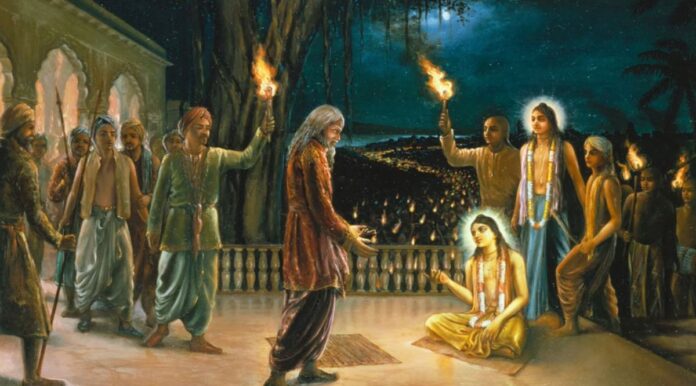
When the Deity was being installed, nine hundred pots of water were brought from Govinda- kuṇḍa. There were musical sounds of bugles and drums and the singing of women. (56) During the festival at the installation ceremony, some people sang and some danced. All the milk, yogurt and clarified butter in the village was brought to the festival. (57) Various foods and sweetmeats, as well as other kinds of presentations, were brought there. I am unable to describe all these. (58) The villagers brought a large quantity of tulasī leaves, flowers, and various kinds of garments. Then Śrī Mādhavendra Purī personally began the abhiṣeka [bathing ceremony]. (59) After all inauspicious things were driven away by the chanting of the mantra, the Deity’s bathing ceremony started. First the Deity was massaged with a large quantity of oil, so that His body became very glossy. (60)

After the first bathing, further bathings were conducted with pañca- gavya and then with pañcāmṛta. Then the mahā- snāna was performed with ghee and water, which had been brought in one hundred pots. (61) After the mahā- snāna was finished, the Deity was again massaged with scented oil and His body made glossy. Then the last bathing ceremony was performed with scented water kept within a conchshel. (62) After the body of the Deity was cleansed, He was dressed very nicely with new garments. Then sandalwood pulp, tulasī garlands and other fragrant flower garlands were placed upon the body of the Deity. (63) After the bathing ceremony was finished, incense and lamps were burned and all kinds of food offered before the Deity. These foods included yogurt, milk and as many sweetmeats as were received. (64)

The Deity was first offered many varieties of food, then scented drinking water in new pots, and then water for washing the mouth. Finally pan mixed with a variety of spices was offered. (65) After the last offering of tāmbūla and pan, bhoga- ārātrika was performed. Finally everyone offered various prayers and then obeisances, falling flat before the Deity in full surrender. (66) As soon as the people of the village had understood that the Deity was going to be installed, they had brought their entire stocks of rice, dhal and wheat flour. They brought such large quantities that the entire surface of the top of the hill was filled. (67) When the villagers brought their stock of rice, dhal and flour, the potters of the village brought all kinds of cooking pots, and in the morning the cooking began. (68) Ten brāhmaṇas cooked the food grains, and five brāhmaṇas cooked both dry and liquid vegetables. (69)

The vegetable preparations were made from various kinds of spinach, roots and fruits collected from the forest, and someone had made baḍā and baḍi by mashing dhal. In this way the brāhmaṇas prepared all kinds of food. (70) Five to seven men had prepared a huge quantity of chapatis, which were sufficiently covered with ghee [clarified butter], as were all the vegetables, rice and dhal. (71) All the cooked rice was stacked on palāśa leaves, which were on new cloths spread over the ground. (72) Around the stack of cooked rice were stacks of chapatis, and all the vegetables and liquid vegetable preparations were placed in different pots and put around them. (73) Pots of yogurt, milk, buttermilk and śikhariṇī, sweet rice, cream and solid cream were placed alongside the vegetables. (74) In this way the Annakūṭa ceremony was performed, and Mādhavendra Purī Gosvāmī personally offered everything to Gopāla. (75)

Many waterpots were filled with scented water for drinking, and Lord Śrī Gopāla, who had been hungry for many days, ate everything offered to Him. (76) Although Śrī Gopāla ate everything offered, still, by the touch of His transcendental hand, everything remained as before. (77) How Gopāla ate everything while the food remained the same was transcendentally perceived by Mādhavendra Purī Gosvāmī; nothing remains a secret to the devotees of the Lord. (78) The wonderful festival and installation of Śrī Gopālajī was arranged in one day. Certainly all this was accomplished by the potency of Gopāla. No one but a devotee can understand this. (79) Mādhavendra Purī offered water to Gopāla for washing His mouth, and he gave Him betel nuts to chew. Then, while ārati was performed, all the people chanted, “Jaya, Jaya!” [“All glories to Gopāla!”]. (80) Arranging for the Lord’s rest, Śrī Mādhavendra Purī brought a new cot, and over this he spread a new bedspread and thus made the bed ready. (81)

A temporary temple was constructed by covering the bed all around with a straw mattress. Thus there was a bed and a straw mattress to cover it. (82) After the Lord was laid down to rest on the bed, Mādhavendra Purī gathered all the brāhmaṇas who had prepared the prasādam and said to them, “Now feed everyone sumptuously, from the children on up to the aged!” (83) All the people gathered there sat down to honor the prasādam, and by and by they took food. All the brāhmaṇas and their wives were fed first. (84) Those who took prasādam included not only the people of Govardhana village but also those who came from other villages. They also saw the Deity of Gopāla and were offered prasādam to eat. (85) Seeing the influence of Mādhavendra Purī, all the people gathered there were struck with wonder. They saw that the Annakūṭa ceremony, which had been performed before during the time of Kṛṣṇa, was now taking place again by the mercy of Śrī Mādhavendra Purī. (86) All the brāhmaṇas present on that occasion were initiated by Mādhavendra Purī into the Vaiṣṇava cult, and Mādhavendra Purī engaged them in different types of service. (87)

After taking rest, the Deity must be awakened at the end of the day, and immediately some food and some water must be offered to Him. (88) When it was advertised throughout the country that Lord Gopāla had appeared atop Govardhana Hill, all the people from neighboring villages came to see the Deity. (89) One village after another was pleased to beg Mādhavendra Purī to allot them one day to perform the Annakūṭa ceremony. Thus, day after day, the Annakūṭa ceremony was performed for some time. (90) Śrī Mādhavendra Purī did not eat anything throughout the day, but at night, after laying the Deity down to rest, he took a milk preparation. (91) The next morning, the rendering of service to the Deity began again, and people from one village arrived with all kinds of food grains. (92) The inhabitants of the village brought to the Deity of Gopāla as much food grains, ghee, yogurt and milk as they had in their village. (93) The next day, almost as before, there was an Annakūṭa ceremony. All the brāhmaṇas prepared foods and Gopāla accepted them. (94)

The ideal place to execute Kṛṣṇa consciousness is Vrajabhūmi, or Vṛndāvana, where the people are naturally inclined to love Kṛṣṇa and Kṛṣṇa is naturally inclined to love them. (95) Throngs of people came from different villages to see the Deity of Gopāla, and they took mahā- prasādam sumptuously. When they saw the superexcellent form of Lord Gopāla, all their lamentation and unhappiness disappeared. (96) All the villages in neighboring Vrajabhūmi [Vṛndāvana] became aware of the appearance of Gopāla, and all the people from these villages came to see Him. Day after day they all performed the Annakūṭa ceremony. (97) In this way not only the neighboring villages but all the other provinces came to know of Gopāla’s appearance. Thus people came from all over, bringing a variety of presentations. (98)

The people of Mathurā, who are very big capitalists, also brought various presentations and offered them before the Deity in devotional service. (99) Thus countless presentations of gold, silver, garments, scented articles and eatables arrived. The store of Gopāla increased daily. (100) One very rich kṣatriya of the royal order constructed a temple, someone made cooking utensils, and someone constructed boundary walls. (101) Each and every family residing in the land of Vrajabhūmi contributed one cow. In this way, thousands of cows became the property of Gopāla. (102) Eventually two brāhmaṇas in the renounced order arrived from Bengal, and Mādhavendra Purī, who liked them very much, kept them in Vṛndāvana and gave them all kinds of comforts. (103)

These two were then initiated by Mādhavendra Purī, and he entrusted them with the daily service of the Lord. This service was performed continuously, and the worship of the Deity became very gorgeous. Thus Mādhavendra Purī was very pleased. (104) In this way the Deity worship in the temple was very gorgeously performed for two years. Then one day Mādhavendra Purī had a dream. (105) In his dream, Mādhavendra Purī saw Gopāla, who said, “My bodily temperature still has not decreased. Please bring sandalwood from the Malaya province and smear the pulp over My body to cool Me. (106) “Bring sandalwood pulp from Jagannātha Purī. Kindly go quickly. Since no one else can do it, you must.” (107) After having this dream, Mādhavendra Purī Gosvāmī became very glad due to ecstasy of love of Godhead, and in order to execute the command of the Lord, he started east toward Bengal. (108)

Before leaving, Mādhavendra Purī made all arrangements for regular Deity worship, and he engaged different people in various duties. Then, taking up the order of Gopāla, he started for Bengal. (109) When Mādhavendra Purī arrived at the house of Advaita Ācārya in Śāntipura, the Ācārya became very pleased upon seeing the ecstatic love of Godhead manifest in Mādhavendra Purī. (110) Advaita Ācārya begged to be initiated by Mādhavendra Purī. After initiating Him, Mādhavendra Purī started for South India. (111) Going into South India, Śrī Mādhavendra Purī visited Remuṇā, where Gopīnātha is situated. Upon seeing the beauty of the Deity, Mādhavendra Purī was overwhelmed. (112) In the corridor of the temple, from which people generally viewed the Deity, Mādhavendra Purī chanted and danced. Then he sat down there and asked a brāhmaṇa what kinds of foods they offered to the Deity. (113) From the excellence of the arrangements, Mādhavendra Purī understood by deduction that only the best food was offered. (114)

Mādhavendra Purī thought, “I shall inquire from the priest what foods are offered to Gopīnātha so that by making arrangements in our kitchen, we can offer similar foods to Śrī Gopāla.” (115) When the brāhmaṇa priest was questioned about this matter, he explained in detail what kinds of foods were offered to the Deity of Gopīnātha. (116) The brāhmaṇa priest said, “In the evening the Deity is offered sweet rice in twelve earthen pots. Because the taste is as good as nectar [amṛta], it is named amṛta- keli. (117) “This sweet rice is celebrated throughout the world as gopīnātha- kṣīra. It is not offered anywhere else in the world.” (118) While Mādhavendra Purī was talking with the brāhmaṇa priest, the sweet rice was placed before the Deity as an offering. Hearing this, Mādhavendra Purī thought as follows. (119) “If, without my asking, a little sweet rice is given to me, I can then taste it and make a similar preparation to offer my Lord Gopāla.” (120) Mādhavendra Purī became greatly ashamed when he desired to taste the sweet rice, and he immediately began to think of Lord Viṣṇu. While he was thus thinking of Lord Viṣṇu, the offering was completed, and the ārati ceremony began. (121) After the ārati was finished, Mādhavendra Purī offered his obeisances to the Deity and then left the temple. He did not say anything more to anyone. (122)
Chaitanya Charitamrta | Madhya Lila | Chapter 4 | Section 62

0

I offer my respectful obeisances unto Mādhavendra Purī, who was given a pot of sweet rice stolen by Śrī Gopīnātha, celebrated thereafter as Kṣīra- corā. Being pleased by Mādhavendra Purī’s love, Śrī Gopāla, the Deity at Govardhana, appeared to the public vision. (1) All glories to Lord Caitanya Mahāprabhu! All glories to Nityānanda Prabhu! All glories to Advaita Prabhu! And all glories to all the devotees of Lord Caitanya! (2) The Lord went to Jagannātha Purī and visited Lord Jagannātha’s temple. He also met with Sārvabhauma Bhaṭṭācārya. All these pastimes have been very elaborately explained by Vṛndāvana dāsa Ṭhākura in his book Caitanya- bhāgavata. (3-4)

By nature all the activities of Śrī Caitanya Mahāprabhu are very wonderful and sweet, and when they are described by Vṛndāvana dāsa Ṭhākura, they become like a shower of nectar. (5) Therefore I very humbly submit that since these incidents have already been nicely described by Vṛndāvana dāsa Ṭhākura, I would be very proud to repeat the same thing, and this would not be very good. I do not have such powers. (6) I am therefore presenting only a synopsis of those events already described elaborately by Vṛndāvana dāsa Ṭhākura in his Caitanya- maṅgala [now known as Caitanya- bhāgavata]. (7) Some of the incidents he did not describe elaborately but only summarized, and these I shall try to describe in this book. (8) I thus offer my respectful obeisances unto the lotus feet of Vṛndāvana dāsa Ṭhākura. I hope that I will not offend his lotus feet by this action. (9)

Śrī Caitanya Mahāprabhu proceeded toward Jagannātha Purī with four of His devotees, and He chanted the holy name of the Lord, the Hare Kṛṣṇa mantra, with great eagerness. (10) Each day Śrī Caitanya Mahāprabhu personally went to a village and collected a great quantity of rice and other grains for the preparation of prasādam. (11) There were many rivers on the way, and at each river there was a tax collector. They did not hinder the Lord, however, and He showed them mercy. Finally He reached the village of Remuṇā. (12) The Deity of Gopīnātha in the temple at Remuṇā was very attractive. Lord Caitanya visited the temple and offered His obeisances with great devotion. (13) When Śrī Caitanya Mahāprabhu offered His obeisances at the lotus feet of the Gopīnātha Deity, the helmet of flowers on the head of Gopīnātha fell down and landed on the head of Caitanya Mahāprabhu. (14) When the Deity’s helmet fell upon His head, Śrī Caitanya Mahāprabhu became very pleased, and thus He chanted and danced in various ways with His devotees. (15)

All the servants of the Deity were struck with wonder due to Śrī Caitanya Mahāprabhu’s intense love, His exquisite beauty and His transcendental qualities. (16) Because of their love for Śrī Caitanya Mahāprabhu, they served Him in many ways, and that night the Lord stayed at the temple of Gopīnātha. (17) The Lord remained there because He was very eager to receive the remnants of sweet rice offered to the Gopīnātha Deity, having heard a narration from His spiritual master, Īśvara Purī, of what had once happened there. (18) That Deity was known widely as Kṣīra- corā- gopīnātha, and Caitanya Mahāprabhu told His devotees the story of how the Deity became so famous. (19) Formerly the Deity had stolen a pot of sweet rice for Mādhavendra Purī; therefore He became very famous as the Lord who stole the sweet rice. (20) Once, Śrī Mādhavendra Purī traveled to Vṛndāvana, where he came upon the hill known as Govardhana. (21)

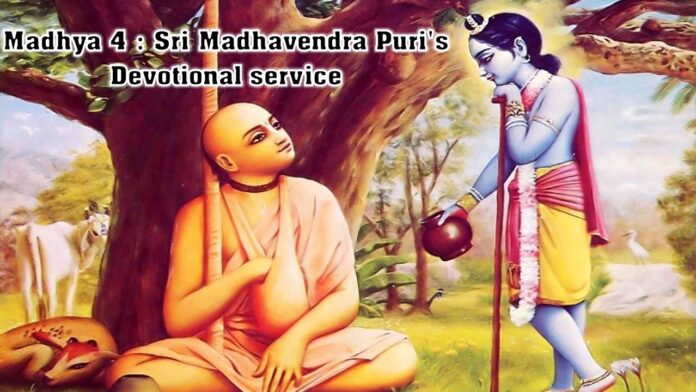
Mādhavendra Purī was almost mad in his ecstasy of love of Godhead, and he did not know whether it was day or night. Sometimes he stood up, and sometimes he fell to the ground. He could not discriminate whether he was in a proper place or not. (22) After circumambulating the hill, Mādhavendra Purī went to Govinda- kuṇḍa and took his bath. He then sat beneath a tree to take his evening rest. (23) While he was sitting beneath a tree, an unknown cowherd boy came with a pot of milk, placed it before Mādhavendra Purī and, smiling, addressed him as follows. (24) “O Mādhavendra Purī, please drink the milk I have brought. Why don’t you beg some food to eat? What kind of meditation are you undergoing?” (25) When he saw the beauty of that boy, Mādhavendra Purī became very satisfied. Hearing His sweet words, he forgot all hunger and thirst. (26) Mādhavendra Purī said, “Who are You? Where do You reside? And how did You know that I was fasting?” (27) The boy replied, “Sir, I am a cowherd boy, and I reside in this village. In My village, no one fasts. (28)

“In this village a person can beg food from others and thus eat. Some people drink only milk, but if a person does not ask anyone for food, I supply him all his eatables. (29) “The women who come here to take water saw you, and they supplied Me with this milk and sent Me to you.” (30) The boy continued, “I must go very soon to milk the cows, but I shall return and take back this milk pot from you.” (31) Saying this, the boy left the place. Indeed, He suddenly could be seen no more, and Mādhavendra Purī’s heart was filled with wonder. (32) After drinking the milk, Mādhavendra Purī washed the pot and put it aside. He looked toward the path, but the boy never returned. (33) Mādhavendra Purī could not sleep. He sat and chanted the Hare Kṛṣṇa mahā- mantra, and at the end of the night he dozed a little, and his external activities stopped. (34) In a dream Mādhavendra Purī saw the very same boy. The boy came before him and, holding his hand, took him to a bush in the jungle. (35) The boy showed Mādhavendra Purī the bush and said, “I reside in this bush, and because of this I suffer very much from severe cold, rain showers, winds and scorching heat. (36)

“Please bring the people of the village and get them to take Me out of this bush. Then have them situate Me nicely on top of the hill. (37) “Please construct a temple on top of that hill,” the boy continued, “and install Me in that temple. After this, wash Me with large quantities of cold water so that My body may be cleansed. (38) “For many days I have been observing you, and I have been wondering, ‘When will Mādhavendra Purī come here to serve Me?’ (39) “I have accepted your service due to your ecstatic love for Me. Thus I shall appear, and by My audience all fallen souls will be delivered. (40) “My name is Gopāla. I am the lifter of Govardhana Hill. I was installed by Vajra, and here I am the authority. (41) “When the Muslims attacked, the priest who was serving Me hid Me in this bush in the jungle. Then he ran away out of fear of the attack. (42) “Since the priest went away, I have been staying in this bush. It is very good that you have come here. Now just remove Me with care.” (43) After saying this, the boy disappeared. Then Mādhavendra Purī woke up and began to consider his dream. (44)

Mādhavendra Purī began to lament, “I saw Lord Kṛṣṇa directly, but I could not recognize Him!” Thus he fell down on the ground in ecstatic love. (45) Mādhavendra Purī cried for some time, but then he fixed his mind on executing the order of Gopāla. Thus he became tranquil. (46) After taking his morning bath, Mādhavendra Purī entered the village and assembled all the people. Then he spoke as follows. (47) “The proprietor of this village, Govardhana- dhārī, is lying in the bushes. Let us go there and rescue Him from that place. (48) “The bushes are very dense, and we will not be able to enter the jungle. Therefore take choppers and spades to clear the way.” (49)

After hearing this, all the people accompanied Mādhavendra Purī with great pleasure. According to his directions, they cut down bushes, cleared a path and entered the jungle. (50) When they saw the Deity covered with dirt and grass, they were all struck with wonder and pleasure. (51) After they had cleansed the body of the Deity, some of them said, “The Deity is very heavy. No single person can move Him.” (52) Since the Deity was very heavy, some of the stronger men assembled to carry Him to the top of the hill. Mādhavendra Purī also went there. (53) A big stone was made into a throne, and the Deity was installed upon it. Another big stone was placed behind the Deity for support. (54) All the brāhmaṇa priests of the village gathered together with nine waterpots, and water from Govinda- kuṇḍa lake was brought there and filtered. (55)

Chaitanya Charitamrta | Madhya Lila | Chapter 3 | Section 61

0

The Lord met all the devotees one after the other, and looking at everyone’s face individually, He embraced them tightly. (151) Although the devotees were unhappy at not seeing the Lord’s hair, they nonetheless derived great happiness from seeing His beauty. (152)Śrīvāsa, Rāmāi, Vidyānidhi, Gadādhara, Gaṅgādāsa, Vakreśvara, Murāri, Śuklāmbara, Buddhimanta Khāṅ, Nandana, Śrīdhara, Vijaya, Vāsudeva, Dāmodara, Mukunda, Sañjaya and all the others, however many I can mention—indeed, all the inhabitants of Navadvīpa—arrived there, and the Lord met them with smiles and glances of mercy. (153-155) Everyone was chanting the holy names of Hari and dancing. In this way the domicile of Advaita Ācārya was converted into Śrī Vaikuṇṭha Purī. (156)

People came to see Śrī Caitanya Mahāprabhu from various other villages nearby, as well as Navadvīpa. (157) To everyone who came to see the Lord from villages nearby, especially from Navadvīpa, Advaita Ācārya gave residential quarters, as well as all kinds of eatables, for many days. Indeed, He properly adjusted everything. (158) The supplies of Advaita Ācārya were inexhaustible and indestructible. As many goods and commodities as He used, just as many again appeared. (159) From the day Śacīmātā arrived at the house of Advaita Ācārya, she took charge of the cooking, and Śrī Caitanya Mahāprabhu dined in the company of all the devotees. (160) All the people who came there during the day saw Lord Caitanya Mahāprabhu and the friendly behavior of Advaita Ācārya. At night they had the opportunity to see the Lord’s dancing and hear His chanting. (161) When the Lord performed kīrtana, He manifested all kinds of transcendental symptoms. He appeared stunned and trembling, His hair stood on end, and His voice faltered. There were tears and devastation. (162)

Frequently the Lord would tumble to the ground. Seeing this, mother Śacī would cry. (163) Śrīmatī Śacīmātā thought that the body of Nimāi was being smashed when He fell down so. She cried, “Alas!” and petitioned Lord Viṣṇu. (164) “My dear Lord, kindly bestow this benediction as a result of whatever service I have rendered unto You from my childhood. (165) “Whenever Nimāi falls to the surface of the earth, please do not let Him feel any pain.” (166) When mother Śacī was thus overwhelmed in maternal love for Lord Caitanya Mahāprabhu, she became transformed with happiness, fear and humility, as well as bodily symptoms. (167) Since Advaita Ācārya was giving alms and food to Lord

Caitanya Mahāprabhu, the other devotees, headed by Śrīvāsa Ṭhākura, also desired to give Him alms and invite Him for lunch. (168) Hearing these proposals made by other devotees of the Lord, mother Śacī said to the devotees, “How many times shall I get the chance to see Nimāi again?” (169) Śacīmātā submitted, “As far as you are concerned, you can meet Nimāi [Śrī Caitanya Mahāprabhu] many times somewhere else, but what is the possibility of my ever meeting Him again? I shall have to remain at home. A sannyāsī never returns to his home.” (170) Mother Śacī appealed to all the devotees to give her this charity: As long as Śrī Caitanya Mahāprabhu remained at the house of Advaita Ācārya, only she would supply Him food. (171) Hearing this appeal from mother Śacī, all the devotees offered obeisances and said, “We all agree to whatever mother Śacī desires.” (172)

When Śrī Caitanya Mahāprabhu saw His mother’s great eagerness, He became a little agitated. He therefore assembled all the devotees present and spoke to them. (173) Śrī Caitanya Mahāprabhu informed them all, “Without your order, I tried to go to Vṛndāvana. There was some obstacle, however, and I had to return. (174) “My dear friends, although I have suddenly accepted this renounced order, I still know that I shall never be indifferent to you. (175) “My dear friends, as long as I remain manifest, I shall never give you up. Nor shall I be able to give up My mother. (176) “After accepting sannyāsa, it is not the duty of a sannyāsī to remain at his birthplace, encircled by relatives. (177) “Make some arrangement so that I may not leave you and at the same time people may not blame Me for remaining with relatives after taking sannyāsa.” (178) After hearing Lord Caitanya’s statement, all the devotees, headed by Advaita Ācārya, approached mother Śacī. (179) When they submitted Lord Caitanya’s statement, mother Śacī, who is the mother of the universe, began to speak. (180)

Śacīmātā said, “It will be a great happiness for me if Nimāi [Śrī Caitanya Mahāprabhu] stays here. But at the same time, if someone blames Him, it will be my great unhappiness.” (181) Mother Śacī said, “This consideration is good. In my opinion, if Nimāi remains at Jagannātha Purī, He may not leave any one of us and at the same time can remain aloof as a sannyāsī. Thus both purposes are fulfilled. (182) “Since Jagannātha Purī and Navadvīpa are intimately related—as if they were two rooms in the same house— people from Navadvīpa generally go to Jagannātha Purī, and those in Jagannātha Purī go to Navadvīpa. This going and coming will help carry news of Lord Caitanya. In this way I will be able to get news of Him. (183) “All you devotees will be able to come and go, and sometimes He may also come to take His bath in the Ganges. (184) “I do not care for my personal happiness or unhappiness, but only for His happiness. Indeed, I accept His happiness as my happiness.” (185) After hearing Śacīmātā, all the devotees offered her prayers and assured her that her order, like a Vedic injunction, could not be violated. (186) All the devotees informed Lord Caitanya of Śacīmātā’s decision. Hearing it, the Lord became very pleased. (187)

Lord Śrī Caitanya Mahāprabhu offered respects to all the devotees present from Navadvīpa and other towns, speaking to them as follows. (188) “My dear friends, you are all My intimate friends. Now I am begging a favor of you. Please give it to Me.” (189) Lord Caitanya Mahāprabhu requested them all to return home and begin chanting the holy name congregationally. He also requested them to worship Kṛṣṇa, chant His holy name and discuss His holy pastimes. (190) After thus instructing the devotees, the Lord asked their permission to go to Jagannātha Purī. He assured them that at intervals He would come there and meet them again and again. (191) In this way, Śrī Caitanya Mahāprabhu, offering due respects to all the devotees and smiling very mildly, bade them farewell. (192) After requesting all the devotees to return home, the Lord decided to go to Jagannātha Purī. At that time Haridāsa Ṭhākura began to cry and speak some pathetic words. (193) Haridāsa Ṭhākura said, “You are going to Jagannātha Purī, and that is all right, but what will be my destination? I am not able to go to Jagannātha Purī.” (194) “Because I am the lowest among men, I shall not be able to see You. How shall I maintain my sinful life?” (195)

The Lord replied to Haridāsa Ṭhākura, “Please check your humility. Just the sight of your humility very much agitates My mind.” (196) Lord Caitanya Mahāprabhu assured Haridāsa Ṭhākura that He would place a petition before Lord Jagannātha and that He would certainly take him there to Jagannātha Purī. (197) After that, Advaita Ācārya respectfully requested Lord Caitanya Mahāprabhu to show Him mercy by remaining another two or four days. (198) Caitanya Mahāprabhu never violated the request of Advaita Ācārya; therefore He remained at His home and did not leave immediately for Jagannātha Purī. (199) Lord Caitanya’s decision was received very happily by Advaita Ācārya, mother Śacī and all the devotees. Advaita Ācārya celebrated every day with a great festival. (200) During the day the devotees discussed subject matters concerning Kṛṣṇa, and at night there was a great festival of congregational chanting at the house of Advaita Ācārya. (201)

Mother Śacī cooked with great pleasure, and Śrī Caitanya Mahāprabhu, along with the devotees, accepted the prasādam with great pleasure. (202) In this way all the opulences of Advaita Ācārya—His faith, devotion, home, riches and everything else—were successfully utilized in the worship of Lord Caitanya Mahāprabhu. (203) As mother Śacī constantly saw the face of her son and fed Him, her own happiness increased and was indeed complete. (204) In this way, at Advaita Ācārya’s house all the devotees met and passed some days together in a greatly festive mood. (205) The next day, Lord Caitanya Mahāprabhu requested all the devotees to return to their respective homes. (206) Śrī Caitanya Mahāprabhu also asked them to execute the congregational chanting of the holy name of the Lord at their homes, and He assured them that they would be able to meet Him again. (207) Śrī Caitanya Mahāprabhu told them, “Sometimes you will come to Jagannātha Purī, and sometimes I shall come bathe in the Ganges.” (208)

Śrī Advaita Ācārya sent four persons— Nityānanda Gosāñi, Jagadānanda Paṇḍita, Dāmodara Paṇḍita and Mukunda Datta— to accompany the Lord. After pacifying His mother, Śacīmātā, Śrī Caitanya Mahāprabhu submitted prayers to her lotus feet. (209-210) When everything was arranged, Lord Caitanya Mahāprabhu circumambulated His mother and then started for Jagannātha Purī. In the house of Advaita Ācārya there arose tumultuous crying. (211) Śrī Caitanya Mahāprabhu was unaffected. He left swiftly, and Advaita Ācārya followed Him, weeping. (212) After He had followed Śrī Caitanya Mahāprabhu for some distance, Advaita Ācārya was petitioned by Śrī Caitanya Mahāprabhu with folded hands. The Lord spoke the following sweet words. (213) Śrī Caitanya Mahāprabhu said, “Please pacify all the devotees and My mother. If You become agitated, no one will be able to continue to exist.” (214)

Saying this, Śrī Caitanya Mahāprabhu embraced Advaita Ācārya and stopped Him from following any further. Then, without anxiety, He proceeded to Jagannātha Purī. (215) The Lord, with the other four persons, went along the banks of the Ganges through the path of Chatrabhoga toward Nīlādri, Jagannātha Purī. (216) In his book known as Caitanya- maṅgala [Caitanya- bhāgavata], Vṛndāvana dāsa Ṭhākura has elaborately described the Lord’s passage to Jagannātha Purī. (217) If one hears the activities of the Lord at the house of Advaita Ācārya, he will certainly very soon attain the riches of love of Kṛṣṇa. (218) Praying at the lotus feet of Śrī Rūpa and Śrī Raghunātha, always desiring their mercy, I, Kṛṣṇadāsa, narrate Śrī Caitanya- caritāmṛta, following in their footsteps. (219)

Chaitanya Charitamrta | Madhya Lila | Chapter 3 | Section 60

0

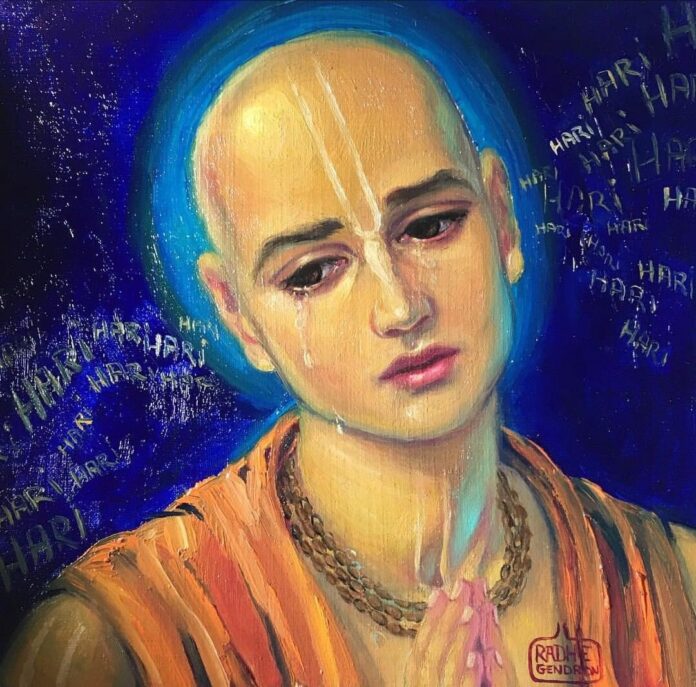
When the people of Śāntipura heard that Lord Śrī Caitanya Mahāprabhu was staying there, they all immediately came to see His lotus feet. (108) Being very pleased, all the people loudly began to shout the holy name of the Lord, “Hari! Hari!” Indeed, they became struck with wonder upon seeing the beauty of the Lord. (109) They saw Śrī Caitanya Mahāprabhu’s very fair- complexioned body and its bright luster, which conquered the brilliance of the sun. Over and above this was the beauty of the saffron garments that glittered upon His body. (110) People came and went with great pleasure. There was no calculating how many people assembled there before the day was over. (111)

As soon as it was evening, Advaita Ācārya began the congregational chanting. He even began to dance Himself, and the Lord saw the performance. (112) When Advaita Ācārya began to dance, Nityānanda Prabhu began dancing behind Him. Haridāsa Ṭhākura, being very pleased, also began dancing behind Him. (113) Advaita Ācārya said, “‘My dear friends, what shall I say? Today I have received the highest transcendental pleasure. After many, many days, Lord Kṛṣṇa is in My house.’” (114) Advaita Ācārya led the saṅkīrtana party, and with great pleasure He sang this verse. There was a manifestation of ecstatic perspiration, shivering, raised hairs, tears in the eyes and sometimes thundering and bellowing. (115) While dancing, Advaita Ācārya would sometimes turn around and around and catch the lotus feet of Śrī Caitanya Mahāprabhu. Advaita Ācārya would then speak to Him as follows. (116)

Śrī Advaita Ācārya would say, “Many days You escaped Me by bluffing. Now I have You in My home, and I will keep You bound up.” (117) So speaking, Advaita Ācārya performed congregational chanting with great pleasure for three hours that night and danced all the time. (118) When Advaita Ācārya danced in that way, Lord Caitanya felt ecstatic love for Kṛṣṇa, and because of His separation, the waves and flames of love increased. (119) Being agitated by the ecstasy, Śrī Caitanya Mahāprabhu suddenly fell to the ground. Seeing this, Advaita Ācārya stopped dancing. (120) When Mukunda saw the ecstasy of Śrī Caitanya Mahāprabhu, he understood the feelings of the Lord and began to sing many stanzas augmenting the force of the Lord’s ecstasy. (121) Advaita Ācārya raised the body of Śrī Caitanya Mahāprabhu to help Him dance, but the Lord, after hearing the stanzas sung by Mukunda, could not be held due to His bodily symptoms. (122)

Tears fell from His eyes, and His whole body trembled. His bodily hairs stood on end, He perspired heavily, and His words faltered. Sometimes He stood, and sometimes He fell. And sometimes He cried. (123) Mukunda sang, “‘My dear intimate friend! What has not happened to me! Due to the effects of the poison of love for Kṛṣṇa, my body and mind have been severely afflicted. (124) “‘My feeling is like this: My mind burns day and night, and I can get no rest. If there were someplace I could go to meet Kṛṣṇa, I would immediately fly there.’” (125) This stanza was sung by Mukunda in a very sweet voice, but as soon as Caitanya Mahāprabhu heard this stanza, His mind went to pieces. (126) The transcendental ecstatic symptoms of disappointment, moroseness, pleasure, restlessness, pride and humility all began to fight like soldiers within the Lord. (127) The entire body of Lord Śrī Caitanya Mahāprabhu began to totter due to the onslaught of various ecstatic symptoms. As a result, He immediately fell to the ground, and His breathing almost stopped. (128)

Upon seeing the condition of the Lord, all the devotees became very anxious. Then, suddenly, the Lord got up and began to make thundering sounds. (129) Upon standing up, the Lord said, “Go on speaking! Go on speaking!” Thus He began to dance, overwhelmed with pleasure. No one could understand the strong waves of this ecstasy. (130) Lord Nityānanda began to walk with Caitanya Mahāprabhu to see that He would not fall, and Advaita Ācārya and Haridāsa Ṭhākura followed Them, dancing. (131) In this way the Lord danced for at least three hours. Sometimes the symptoms of ecstasy were visible, including pleasure, moroseness and many other waves of ecstatic emotional love. (132) The Lord had been fasting for three days, and after that period He took eatables sumptuously. Thus when He danced and jumped high, He became a little fatigued. (133) Being fully absorbed in love of Godhead, He would not understand His fatigue. But Nityānanda Prabhu, catching Him, stopped His dancing. (134)

Although the Lord was fatigued, Nityānanda Prabhu kept Him steady by holding Him. At that time Advaita Ācārya suspended the chanting and, by rendering various services to the Lord, made Him lie down to take rest. (135) For ten continuous days Advaita Ācārya held feasting and chanting in the evening. He served the Lord in this way without any change. (136) In the morning Candraśekhara seated Śacīmātā in a palanquin and brought her from her house with many devotees. (137) In this way, all the people of the town of Nadia—including all women, boys and old men—came there. Thus the crowd increased. (138) In the morning, after regular duties were completed and the Lord was chanting the Hare Kṛṣṇa mahā- mantra, the people accompanied Śacīmātā to the house of Advaita Ācārya. (139) As soon as mother Śacī appeared on the scene, Caitanya Mahāprabhu fell before her like a stick. Mother Śacī began to cry, taking the Lord on her lap. (140)

Upon seeing each other, they both became overwhelmed. Seeing the Lord’s head without hair, mother Śacī became greatly agitated. (141) Out of love she began to caress the body of the Lord. Sometimes she kissed His face and tried to observe Him carefully, but because her eyes were filled with tears, she could not see. (142) Understanding that Lord Caitanya had accepted the renounced order of life, Śacīmātā, crying, said to the Lord, “My darling Nimāi, do not be cruel like Viśvarūpa, Your elder brother.” (143) Mother Śacī continued, “After accepting the renounced order, Viśvarūpa never again gave me audience. If You do like Him, that will certainly be the death of me.” (144) The Lord replied, “My dear mother, please hear. This body belongs to you. I do not possess anything. (145)

“This body was raised by you, and it comes from you. I cannot repay this debt even in millions of births. (146) “Knowingly or unknowingly I have accepted this renounced order. Still, I shall never be indifferent to you. (147) “My dear mother, wherever you ask Me to stay I shall stay, and whatever you order I shall execute.” (148) Saying this, the Lord offered obeisances to His mother again and again, and mother Śacī, being pleased, took Him again and again on her lap. (149) Then Advaita Ācārya took mother Śacī within the house. The Lord was immediately ready to meet all the devotees. (150)

Chaitanya Charitamrta | Madhya Lila | Chapter 3 | Section 59

0

There were three sitting places where soft cloths were placed. Thus Lord Kṛṣṇa was offered all the food, and the Lord took it very pleasantly. (57) It is the system, after offering food, to perform bhoga- ārati. Advaita Prabhu asked the two brothers, Lord Caitanya Mahāprabhu and Nityānanda Prabhu, to come see the ārati. The two Lords and all others present went to see the ārati ceremony. (58) After ārati was performed for the Deities in the temple, Lord Kṛṣṇa was made to lie down to rest. Advaita Ācārya then came out to submit something to Lord Caitanya Mahāprabhu. (59) Śrī Advaita Prabhu said, “My dear Lords, kindly enter this room.” The two brothers, Caitanya Mahāprabhu and Nityānanda Prabhu, then came forward to take the prasādam. (60)

When Lord Śrī Caitanya Mahāprabhu and Nityānanda Prabhu went to accept the prasādam, They both called Mukunda and Haridāsa to come with Them. However, Mukunda and Haridāsa, both with folded hands, spoke as follows. (61) When Mukunda was called for, he submitted, “My dear sir, I have something to do that is not yet finished. Later I shall accept the prasādam, so You two Prabhus should now please enter the room.” (62) Haridāsa Ṭhākura said, “I am the most sinful and lowest among men. Later I shall eat one palmful of prasādam while waiting outside.” (63) Advaita Ācārya took Lord Nityānanda Prabhu and Lord Caitanya Mahāprabhu within the room, and the two Lords saw the arrangement of the prasādam. Śrī Caitanya Mahāprabhu was especially very pleased. (64)

Śrī Caitanya Mahāprabhu approved of all the methods employed in cooking and offering food to Kṛṣṇa. Indeed, He was so pleased that He said, “Frankly, I will personally take the lotus feet of anyone who can offer Kṛṣṇa such nice food and place those lotus feet on My head birth after birth.” (65) When Śrī Caitanya Mahāprabhu entered the room, He saw three divisions of food, and He knew that all of these were meant for Kṛṣṇa. However, He did not understand the intentions of Advaita Ācārya. (66) Śrī Caitanya Mahāprabhu said, “Let Us sit down in these three places, and We shall take prasādam.” However, Advaita Ācārya said, “I shall distribute the prasādam.” (67) Śrī Caitanya Mahāprabhu thought that all three servings were meant for distribution; therefore He asked for another two banana leaves, saying, “Let Us have a very little quantity of vegetable and rice.” (68)

Advaita Ācārya said, “Just sit down here on these seats.” Catching Their hands, He sat Them both down. (69) Śrī Caitanya Mahāprabhu said, “It is not proper for a sannyāsī to eat such a variety of foods. If he does, how can he control his senses?” (70) When Śrī Caitanya Mahāprabhu did not accept the food that had already been served, Advaita Ācārya said, “Please give up Your concealment. I know what You are, and I know the confidential meaning of Your accepting the sannyāsa order.” (71) Advaita Ācārya thus requested Śrī Caitanya Mahāprabhu to eat and give up juggling words. The Lord replied, “I certainly cannot eat so much food.” (72) Advaita Ācārya then requested the Lord to simply accept the prasādam without pretense. If He could not eat it all, the balance could be left on the plate. (73) Śrī Caitanya Mahāprabhu said, “I will not be able to eat so much food, and it is not the duty of a sannyāsī to leave remnants.” (74)

In this connection Advaita Ācārya referred to Caitanya Mahāprabhu’s eating at Jagannātha Purī. Lord Jagannātha and Śrī Caitanya Mahāprabhu are identical. Advaita Ācārya pointed out that at Jagannātha Purī Caitanya Mahāprabhu ate fifty- four times a day, and each time He ate many hundreds of pots of food. (75) Śrī Advaita Ācārya said, “The amount of food that three people can eat does not constitute even a morsel for You. In proportion to that, these edibles are not even five morsels of food for You.” (76) Advaita Ācārya continued, “By My great fortune You have just come to My home. Please do not juggle words. Just begin eating and do not talk.” (77) Upon saying this, Advaita Ācārya supplied water to the two Lords so that They could wash Their hands. The two Lords then sat down and, smiling, began to eat the prasādam. (78) Nityānanda Prabhu said, “I have undergone fasting for three days continuously. Today I had hoped to break My fast.” (79)

Although Śrī Caitanya Mahāprabhu was thinking that the quantity of food was enormous, Nityānanda Prabhu, on the contrary, thought it not even a morsel. He had been fasting for three days and had greatly hoped to break fast on that day. Indeed, He said, “Although I am invited to eat by Advaita Ācārya, today also is a fast. So small a quantity of food will not fill even half My belly.” (80) Advaita Ācārya replied, “Sir, You are a mendicant traveling on pilgrimage. Sometimes You eat fruits and roots, and sometimes You simply go on fasting. (81) “I am a poor brāhmaṇa, and You have come to My home. Please be satisfied with whatever little food You have received and give up Your greedy mentality.” (82) Lord Nityānanda Prabhu replied, “Whatever I may be, You have invited Me. Therefore You must supply as much as I want to eat.” (83) His Divine Grace Advaita Ācārya, after hearing the statement of Nityānanda Prabhu, took the opportunity presented by the joking words and spoke to Him as follows. (84) Advaita Ācārya said, “You are a reject paramahaṁsa, and You have accepted the renounced order of life just to fill up Your belly. I can understand that Your business is to give trouble to brāhmaṇas.” (85)

Advaita Ācārya accused Nityānanda Prabhu, saying, “You can eat ten to twenty mānas of rice. I am a poor brāhmaṇa. How shall I get so much rice? (86) “Whatever You have, though it be a palmful of rice, please eat it and get up. Don’t show Your madness and strew the remnants of food here and there.” (87) In this way, Nityānanda Prabhu and Lord Caitanya Mahāprabhu ate and talked with Advaita Ācārya jokingly. After eating half of each vegetable preparation given to Him, Śrī Caitanya Mahāprabhu abandoned it and went on to the next. (88) As soon as half of the vegetable in the pot was finished, Advaita Ācārya filled it up again. In this way, as the Lord finished half of a preparation, Advaita Ācārya again and again filled it up. (89) After filling a pot with vegetables, Advaita Ācārya requested Them to eat more, and Caitanya Mahāprabhu said, “How much more can I go on eating?” (90) Advaita Ācārya said, “Please do not give up whatever I have already given You. Now, whatever I am giving, You may eat half and leave half.” (91)

In this way, by submitting various humble requests, Advaita Ācārya made Śrī Caitanya Mahāprabhu and Lord Nityānanda eat. Thus Caitanya Mahāprabhu fulfilled all the desires of Advaita Ācārya. (92) Again Nityānanda Prabhu jokingly said, “My belly is not yet filled up. Please take away Your food. I have not taken the least of it.” (93) After saying this, Nityānanda Prabhu took a handful of rice and threw it on the floor in front of Him, as if He were angry. (94) When two or four pieces of the thrown rice touched His body, Advaita Ācārya began to dance in various ways with the rice still stuck to His body. (95) When the rice thrown by Nityānanda Prabhu touched His body, Advaita Ācārya thought Himself purified by the touch of remnants thrown by Paramahaṁsa Nityānanda. Therefore He began dancing. (96)

Advaita Ācārya jokingly said, “My dear Nityānanda, I invited You, and indeed I have received the results. You have no fixed caste or dynasty. By nature You are a madman. (97) “To make Me a madman like Yourself, You have thrown the remnants of Your food at Me. You did not even fear the fact that I am a brāhmaṇa.” (98) Nityānanda Prabhu replied, “These are the remnants of food left by Lord Kṛṣṇa. If You take them to be ordinary remnants, You have committed an offense.” (99) Śrīla Nityānanda Prabhu continued, “If you invite at least one hundred sannyāsīs to Your home and feed them sumptuously, Your offense will be nullified.” (100) Advaita Ācārya replied, “I shall never again invite another sannyāsī, for it is a sannyāsī who has spoiled all My brahminical smṛti regulations.” (101) After this, Advaita Ācārya made the Lords wash Their hands and mouths. He then took Them to a nice bed and made Them lie down to take rest. (102)

Śrī Advaita Ācārya fed the two Lords cloves and cardamom mixed with tulasī flowers. Thus there was a good flavor within Their mouths. (103) Śrī Advaita Ācārya then smeared the bodies of the Lords with sandalwood pulp and then placed very fragrant flower garlands on Their chests. (104) When the Lord lay down on the bed, Advaita Ācārya waited to massage His legs, but the Lord was very hesitant and spoke as follows to Advaita Ācārya. (105) Śrī Caitanya Mahāprabhu said, “Advaita Ācārya, You have made Me dance in various ways. Now give up this practice. Go with Mukunda and Haridāsa and accept Your lunch.” (106) Thereupon Advaita Ācārya took prasādam with Mukunda and Haridāsa, and they all wholeheartedly ate as much as they desired. (107)

Chaitanya Charitamrta | Madhya Lila | Chapter 3 | Section 58

0

After accepting the sannyāsa order of life, Lord Caitanya Mahāprabhu, out of intense love for Kṛṣṇa, wanted to go to Vṛndāvana, but apparently by mistake He wandered in the Rāḍha- deśa. Later He arrived at Śāntipura and enjoyed Himself there with His devotees. I offer my respectful obeisances to Śrī Caitanya Mahāprabhu. (1) All glories to Śrī Caitanya Mahāprabhu! All glories to Nityānanda! All glories to Advaita Prabhu! And all glories to all the devotees of Lord Caitanya, headed by Śrīvāsa! (2) At the end of His twenty- fourth year, in the month of Māgha, Śrī Caitanya Mahāprabhu accepted the sannyāsa order during the waxing period of the moon. (3)

After accepting the sannyāsa order, Caitanya Mahāprabhu, out of intense love for Kṛṣṇa, started for Vṛndāvana. However, He mistakenly wandered about in a trance continuously for three days in the tract of land known as Rāḍha- deśa. (4) Passing through the tract of land known as Rāḍha- deśa, Śrī Caitanya Mahāprabhu recited the following verse in ecstasy. (5) “[As a brāhmaṇa from Avantī- deśa said:] ‘I shall cross over the insurmountable ocean of nescience by being firmly fixed in the service of the lotus feet of Kṛṣṇa. This was approved by the previous ācāryas, who were fixed in firm devotion to the Lord, Paramātmā, the Supreme Personality of Godhead.’” (6) Śrī Caitanya Mahāprabhu approved the purport of this verse on account of the determination of the mendicant devotee to engage in the service of Lord Mukunda. He gave His approval of this verse, indicating that it was very good. (7)

The real purpose of accepting sannyāsa is to dedicate oneself to the service of Mukunda. By serving Mukunda, one can actually be liberated from the bondage of material existence. (8) After accepting the sannyāsa order, Śrī Caitanya Mahāprabhu decided to go to Vṛndāvana and engage Himself wholly and solely in the service of Mukunda in a solitary place. (9) As Śrī Caitanya Mahāprabhu was en route to Vṛndāvana, all the ecstatic symptoms became manifest, and He did not know in which direction He was going, nor did He know whether it was day or night. (10) When Śrī Caitanya Mahāprabhu went toward Vṛndāvana, Nityānanda Prabhu, Candraśekhara and Prabhu Mukunda followed Him. (11) When Śrī Caitanya Mahāprabhu passed through Rāḍha- deśa, whoever saw Him in ecstasy exclaimed, “Hari! Hari!” As they chanted this with the Lord, all the unhappiness of material existence diminished. (12)

All the cowherd boys who saw Śrī Caitanya Mahāprabhu passing joined with Him and began to shout loudly, “Hari! Hari!” (13) When He heard all the cowherd boys also chanting “Hari! Hari!” Śrī Caitanya Mahāprabhu was very pleased. He approached them, put His hand on their heads and said, “Go on chanting like that.” (14) Śrī Caitanya Mahāprabhu thus blessed them all, saying that they were all fortunate. In this way He praised them, and He felt very successful because they chanted the holy name of Lord Hari. (15) Calling all the boys in confidence and telling a reasonable story, Nityānanda Prabhu instructed them as follows. (16) “If Śrī Caitanya Mahāprabhu asks you about the path to Vṛndāvana, please show Him the path on the bank of the Ganges instead.” (17)

When the cowherd boys were questioned by Lord Caitanya Mahāprabhu about the path to Vṛndāvana, the boys showed Him the path on the bank of the Ganges, and the Lord went that way in ecstasy. (18-19) As the Lord proceeded along the bank of the Ganges, Śrī Nityānanda Prabhu requested Ācāryaratna [Candraśekhara Ācārya] to go immediately to the house of Advaita Ācārya. (20) Śrī Nityānanda Gosvāmī told him, “I shall take Śrī Caitanya Mahāprabhu to the bank of the Ganges at Śāntipura, and Advaita Ācārya should carefully stay there on shore with a boat. (21) “After that,” Nityānanda Prabhu continued, “I shall go to Advaita Ācārya’s house, and you should go to Navadvīpa and return with mother Śacī and all the other devotees.” (22) After sending Ācāryaratna to the house of Advaita Ācārya, Śrī Nityānanda Prabhu went before Lord Caitanya Mahāprabhu and gave notice of His coming. (23)

Śrī Caitanya Mahāprabhu was in ecstasy, and He asked where Nityānanda Prabhu was going. Nityānanda replied that He was going with Him toward Vṛndāvana. (24) When the Lord asked Nityānanda Prabhu how far it was to Vṛndāvana, Nityānanda replied, “Just see! Here is the river Yamunā.” (25) Saying this, Nityānanda Prabhu took Caitanya Mahāprabhu near the Ganges, and the Lord, in His ecstasy, accepted the river Ganges as the river Yamunā. (26) The Lord said, “Oh, what good fortune! Now I have seen the river Yamunā.” Thus thinking the Ganges to be the river Yamunā, Caitanya Mahāprabhu began to offer prayers to it. (27) “O river Yamunā, you are the blissful spiritual water that gives love to the son of Nanda Mahārāja. You are the same as the water of the spiritual world, for you can vanquish all our offenses and the sinful reactions incurred in life. You are the creator of all auspicious things for the world. O daughter of the sun- god, kindly purify us by your pious activities.” (28) After reciting this mantra, Śrī Caitanya Mahāprabhu offered obeisances and took His bath in the Ganges. At that time He had on only one piece of underwear, for there was no second garment. (29)

While Śrī Caitanya Mahāprabhu was standing there without a second garment, Śrī Advaita Ācārya arrived in a boat, bringing with Him new underwear and external garments. (30) When Advaita Ācārya arrived, He stood before the Lord and offered His obeisances. After seeing Him, the Lord began to wonder about the entire situation. (31) Still in His ecstasy, the Lord asked Advaita Ācārya, “Why did You come here? How did You know that I was in Vṛndāvana?” (32) Advaita Ācārya disclosed the whole situation, telling Śrī Caitanya Mahāprabhu, “Wherever You are, that is Vṛndāvana. Now it is My great fortune that You have come to the bank of the Ganges.” (33) Śrī Caitanya Mahāprabhu then said, “Nityānanda has cheated Me. He has brought Me to the bank of the Ganges and told Me that it was the Yamunā.” (34) When Śrī Caitanya Mahāprabhu accused Nityānanda of cheating Him, Śrīla Advaita Ācārya said, “Whatever Nityānanda Prabhu has told You is not false. You have indeed just now taken Your bath in the river Yamunā.” (35)

Advaita Ācārya then explained that at that spot the Ganges and Yamunā flow together. On the western side was the Yamunā, and on the eastern side was the Ganges. (36) Advaita Ācārya then suggested that since Caitanya Mahāprabhu had taken His bath in the river Yamunā and His underwear was now wet, the Lord should change His underwear for dry garments. (37) Advaita Ācārya said, “You have been fasting continuously for three days in Your ecstasy of love for Kṛṣṇa. I therefore invite You to My home, where You may kindly take Your alms. Come with Me to My residence.” (38) Advaita Prabhu continued, “At My home I have just cooked one palmful of rice. The vegetables are always very simple. There is no luxurious cooking—simply a little liquid vegetable and spinach.” (39)

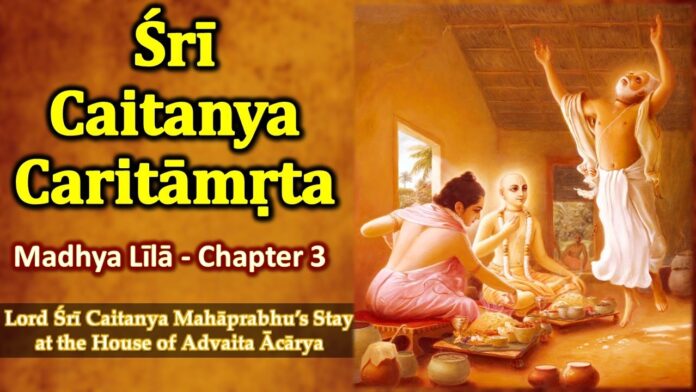
Saying this, Śrī Advaita Ācārya took the Lord into the boat and brought the Lord to His residence. There Advaita Ācārya washed the feet of the Lord and was consequently very happy within. (40) All the eatables were first cooked by the wife of Advaita Ācārya. Then Śrīla Advaita Ācārya personally offered everything to Lord Viṣṇu. (41) All the prepared food was divided into three equal parts. One part was arranged on a metal plate for offering to Lord Kṛṣṇa. (42) Of the three divisions, one was arranged on a metal plate, and the other two were arranged on plantain leaves. These leaves were not bifurcated, and they were taken from a banana tree that held at least thirty- two bunches of bananas. The two plates were filled very nicely with the kinds of food described below. (43) The cooked rice was a stack of very fine grains nicely cooked, and in the middle was yellow clarified butter from the milk of cows. Surrounding the stack of rice were pots made of the skins of banana trees, and in these pots were varieties of vegetables and mung dhal. (44)

Among the cooked vegetables were paṭolas, squash, mānakacu and a salad made with pieces of ginger and various types of spinach. (45) There was sukhta, bitter melon mixed with all kinds of vegetables, defying the taste of nectar. There were five types of bitter and pungent sukhtas. (46) Amongst the various vegetables were newly grown leaves of nimba trees fried with eggplant. The fruit known as paṭola was fried with phulabaḍi, a kind of dhal preparation first mashed and then dried in the sun. There was also a preparation known as kuṣmāṇḍa- mānacāki. (47) The preparation made with coconut pulp mixed with curd and rock candy was very sweet. There was a curry made of banana flowers and squash boiled in milk, all in great quantity. (48) There were small cakes in sweet and sour sauce and five or six kinds of sour preparations. All the vegetables were so made that everyone present could take prasādam. (49)

There were soft cakes made with mung dhal, soft cakes made with ripe bananas, and soft cakes made with urad dhal. There were various kinds of sweetmeats, condensed milk mixed with rice cakes, a coconut preparation and every kind of cake desirable. (50) All the vegetables were served in pots made of banana leaves taken from trees producing at least thirty- two bunches of bananas. These pots were very strong and big and did not tilt or totter. (51) All around the three eating places were a hundred pots filled with various kinds of vegetables. (52)

Along with the various vegetables was sweet rice mixed with ghee. This was kept in new earthen pots. Earthen pots filled with highly condensed milk were placed in three places. (53) Besides the other preparations, there were chipped rice made with milk and mixed with bananas, and also white squash boiled in milk. Indeed, it is not possible to describe all the preparations that were made. (54) In two places there were earthen pots filled with another preparation made with yogurt, sandeśa [a sweetmeat made with curd] and banana. I am unable to describe it all. (55) Upon the stack of boiled rice and all the vegetables were flowers of the tulasī trees. There were also pots filled with scented rosewater. (56)

Chaitanya Charitamrta | Madhya Lila | Chapter 2 | Section 57

0

In this way, Lord Caitanya used to revel in ecstasy day after day and exhibit these ecstasies before Svarūpa and Rāmānanda Rāya. Externally there appeared severe tribulation, as if He were suffering from poisonous effects, but internally He was experiencing bliss. This is characteristic of transcendental love of Kṛṣṇa. (50) If one tastes such love of Godhead, he can compare it to hot sugarcane. When one chews hot sugarcane, his mouth burns, yet he cannot give it up. Similarly, if one has but a little love of Godhead, he can perceive its powerful effects. It can only be compared to poison and nectar mixed together. (51)

Lord Caitanya Mahāprabhu spoke, “‘My dear beautiful friend, if one develops love of Godhead, love of Kṛṣṇa, the son of Nanda Mahārāja, all the bitter and sweet influences of this love will manifest in one’s heart. Such love of Godhead acts in two ways. The poisonous effects of love of Godhead defeat the severe and fresh poison of the serpent. Yet there is simultaneously transcendental bliss, which pours down and defeats the pride of nectar and diminishes its value. In other words, love of Kṛṣṇa is so powerful that it simultaneously defeats the poisonous effects of a snake, as well as the happiness derived from pouring nectar on one’s head. It is perceived as doubly effective, simultaneously poisonous and nectarean.’” (52)

When Śrī Caitanya Mahāprabhu would see Jagannātha along with Balarāma and Subhadrā, He would immediately think that He had reached Kurukṣetra, where all of them had come. He would think that His life was successful because He had seen the lotus- eyed one, whom, if seen, pacifies the body, mind and eyes. (53) Staying near the Garuḍa- stambha, the Lord would look upon Lord Jagannātha. What can be said about the strength of that love? On the ground beneath the column of the Garuḍa- stambha was a deep ditch, and that ditch was filled with the water of His tears. (54) When coming from the Jagannātha temple to return to His house, Śrī Caitanya Mahāprabhu used to sit on the ground and mark it with His nails. At such times He would be greatly morose and would cry, “Alas, where is Vṛndāvana? Where is Kṛṣṇa, the son of the King of the cowherd men? Where is that person who plays the flute?” (55)

Śrī Caitanya Mahāprabhu used to lament by saying, “Where is Śrī Kṛṣṇa, whose form is curved in three places? Where is the sweet song of His flute, and where is the bank of the Yamunā? Where is the rāsa dance? Where is that dancing, singing, and laughing? Where is My Lord, Madana- mohana, the enchanter of Cupid?” (56) In this way various ecstatic emotions evolved, and the mind of Caitanya Mahāprabhu filled with anxiety. He could not escape even for a moment. In this way, because of fierce feelings of separation, His patience began to totter, and He began to recite various verses. (57) “‘O My Lord, O Supreme Personality of Godhead, O friend of the helpless! You are the only ocean of mercy! Because I have not met You, My inauspicious days and nights have become unbearable. I do not know how I shall pass the time.’ (58) “All these inauspicious days and nights are not passing, for I have not met You. It is difficult to know how to pass all this time. But You are the friend of the helpless and an ocean of mercy. Kindly give Me Your audience, for I am in a precarious position.” (59)

In this way, the Lord’s restlessness was awakened by ecstatic feelings, and His mind became agitated. No one could understand what course such ecstasy would take. Because Lord Caitanya could not meet the Supreme Personality of Godhead, Kṛṣṇa, His mind burned. He began to ask Kṛṣṇa about the means by which He could reach Him. (60) “‘O Kṛṣṇa, O flute- player, the sweetness of Your early age is wonderful within these three worlds. You know My unsteadiness, and I know Yours. No one else knows about this. I want to see Your beautiful attractive face somewhere in a solitary place, but how can this be accomplished?’ (61) “My dear Kṛṣṇa, only You and I know the strength of Your beautiful features and, because of them, My unsteadiness. Now, this is My position; I do not know what to do or where to go. Where can I find You? I am asking You to give directions.” (62)

Because of the various kinds of ecstasy, contradictory states of mind occurred, and this resulted in a great fight between different types of ecstasy. Anxiety, impotence, humility, anger and impatience were all like soldiers fighting, and the madness of love of Godhead was the cause. (63) The body of the Lord was just like a field of sugarcane into which the mad elephants of ecstasy entered. There was a fight amongst the elephants, and in the process the entire field of sugarcane was destroyed. Thus transcendental madness was awakened in the body of the Lord, and He experienced despondency in mind and body. In this ecstatic condition, He began to speak as follows. (64) “‘O My Lord! O dearest one! O only friend of the universe! O Kṛṣṇa, O restless one, O only ocean of mercy! O My Lord, O My enjoyer, O beloved to My eyes! Alas, when will You again be visible to Me?’” (65)

The symptoms of madness served as an impetus for remembering Kṛṣṇa. The mood of ecstasy awoke love, disdain, defamation by words, pride, honor and indirect prayer. Thus Śrī Kṛṣṇa was sometimes blasphemed and sometimes honored. (66) [In the attitude of Rādhārāṇī, Śrī Caitanya Mahāprabhu addressed Kṛṣṇa:] “My dear Lord, You are engaged in Your pastimes, and You utilize all the women in the universe according to Your desire. You are so kind to Me. Please divert Your attention to Me, for by fortune You have appeared before Me. (67) “My dear Lord, You attract all the women of the universe, and You make adjustments for all of them when they appear. You are Lord Kṛṣṇa, and You can enchant everyone, but on the whole, You are nothing but a debauchee. Who can honor You? (68)

“My dear Kṛṣṇa, Your mind is always restless. You cannot remain in one place, but You are not at fault for this. You are actually the ocean of mercy, the friend of My heart. Therefore I have no reason to be angry with You. (69) “My dear Lord, You are the master and the life and soul of Vṛndāvana. Kindly arrange for the deliverance of Vṛndāvana. We have no leisure hours away from our many activities. Actually, You are My enjoyer. You have appeared just to give Me happiness, and this is one of Your expert activities. (70) “Taking My words as defamation, Lord Kṛṣṇa has left Me. I know that He is gone, but kindly hear My prayers in praise: ‘You are the satisfaction of My eyes. You are My wealth and My life. Alas, please give Me your audience once again.’” (71)

There were different transformations of the body of Lord Caitanya Mahāprabhu: being stunned, trembling, perspiring, fading away of color, weeping, and choking of the voice. In this way His whole body was pervaded by transcendental joy. As a result, sometimes Caitanya Mahāprabhu would laugh, sometimes cry, sometimes dance and sometimes sing. Sometimes He would get up and run here and there, and sometimes fall on the ground and lose consciousness. (72) When Śrī Caitanya Mahāprabhu was thus unconscious, He happened to meet the Supreme Personality of Godhead. Consequently He got up and immediately made a tumultuous sound, very loudly declaring, “Now Kṛṣṇa, the great personality, is present.” In this way, because of Kṛṣṇa’s sweet qualities, Caitanya Mahāprabhu made different types of mistakes in His mind. Thus by reciting the following verse, He ascertained the presence of Lord Kṛṣṇa. (73)

In the attitude of Rādhārāṇī, Śrī Caitanya Mahāprabhu addressed the gopīs: “‘My dear friends, where is that Kṛṣṇa, Cupid personified, who has the effulgence of a kadamba flower, who is sweetness itself, the nectar of My eyes and mind, He who loosens the hair of the gopīs, who is the supreme source of transcendental bliss and My life and soul? Has He come before My eyes again?’” (74) Śrī Caitanya Mahāprabhu then began to talk like this: “Is Cupid personified present with the effulgence and reflection of the kadamba tree? Is He the same person, personified sweetness, who is the pleasure of My eyes and mind, who is My life and soul? Has Kṛṣṇa actually come before My eyes?” (75) As the spiritual master chastises the disciple and teaches him the art of devotional service, so all the ecstatic symptoms of Lord Caitanya Mahāprabhu—including despondency, moroseness, humility, restlessness, joy, endurance and anger— instructed His body and mind. In this way, Śrī Caitanya Mahāprabhu passed His time. (76)

He also passed His time reading the books and singing the songs of Caṇḍīdāsa and Vidyāpati, and listening to quotations from the Jagannātha- vallabha- nāṭaka, Kṛṣṇa- karṇāmṛta and Gīta- govinda. Thus in the association of Svarūpa Dāmodara and Rāya Rāmānanda, Śrī Caitanya Mahāprabhu passed His days and nights chanting and hearing with great pleasure. (77) Among His associates, Lord Caitanya Mahāprabhu enjoyed paternal loving affection from Paramānanda Purī, friendly affection with Rāmānanda Rāya, unalloyed service from Govinda and others, and humors of conjugal love with Gadādhara, Jagadānanda and Svarūpa Dāmodara. Śrī Caitanya Mahāprabhu enjoyed all these four mellows, and thus He remained obliged to His devotees. (78) Līlāśuka [Bilvamaṅgala Ṭhākura] was an ordinary human being, yet he developed many ecstatic symptoms in his body. What, then, is so astonishing about these symptoms’ being manifest in the body of the Supreme Personality of Godhead? In the ecstatic mood of conjugal love, Śrī Caitanya Mahāprabhu was on the highest platform; therefore, all the exuberant ecstasies were naturally visible in His body. (79)

During His previous pastimes in Vṛndāvana, Lord Kṛṣṇa desired to enjoy the three different types of ecstasy, but despite great endeavor, He could not taste them. Such ecstasies are the monopoly of Śrīmatī Rādhārāṇī. Therefore, in order to taste them, Śrī Kṛṣṇa accepted the position of Śrīmatī Rādhārāṇī in the form of Śrī Caitanya Mahāprabhu. (80) By personally tasting the mellows of love of Godhead, Caitanya Mahāprabhu taught His direct disciples the process. Śrī Caitanya Mahāprabhu is a wealthy capitalist possessing the touchstone of love of God. Not considering whether one is a proper or improper recipient, He gives His treasure to anyone and everyone. Thus He is the most munificent. (81) No one, not even Lord Brahmā, can ascertain or even taste a drop of this confidential ocean of ecstasy, but Śrī Caitanya Mahāprabhu, out of His causeless mercy, has distributed this love of Godhead all over the world. Thus there cannot be any incarnation more munificent than Śrī Caitanya Mahāprabhu. There is no greater donor. Who can describe His transcendental qualities? (82)

Such topics are not to be discussed freely because if they are, no one will understand them. Such are the wonderful pastimes of Śrī Caitanya Mahāprabhu. Unto one who is able to understand, Śrī Caitanya Mahāprabhu has shown mercy by giving him the association of the servant of His own servant. (83) The pastimes of Śrī Caitanya Mahāprabhu are the topmost of jewels. They have been kept in the storehouse of Svarūpa Dāmodara Gosvāmī, who has explained them to Raghunātha dāsa Gosvāmī, who has repeated them to me. Whatever little I have heard from Raghunātha dāsa Gosvāmī I have described in this book, which is presented to all devotees. (84) If one says that Śrī Caitanya- caritāmṛta is full of Sanskrit verses and therefore not understandable by a common man, I reply that what I have described are the pastimes of Śrī Caitanya Mahāprabhu and that for me to satisfy everyone is not possible. (85)

In this Caitanya- caritāmṛta there is no contradictory conclusion, nor is anyone else’s opinion accepted. I have written this book to describe the simple substance as I have heard it from superiors. If I become involved in someone’s likes and dislikes, I cannot possibly write the simple truth. (86) If one does not understand in the beginning but continues to hear again and again, the wonderful effects of Lord Caitanya’s pastimes will bring love for Kṛṣṇa. Gradually one will come to understand the loving affairs between Kṛṣṇa and the gopīs and other associates of Vṛndāvana. Everyone is advised to continue to hear over and over again in order to greatly benefit. (87) In reply to those critics who say that Śrī Caitanya- caritāmṛta is full of Sanskrit verses, it can be said that Śrīmad- Bhāgavatam is also full of Sanskrit verses, as are the commentaries on Śrīmad- Bhāgavatam. Nonetheless, Śrīmad- Bhāgavatam can be understood by everyone, as well as by advanced devotees who study the Sanskrit commentaries. Why, then, will people not understand the Caitanya- caritāmṛta? There are only a few Sanskrit verses, and these have been explained in the Bengali vernacular. What is the difficulty in understanding? (88)

I have already given a synopsis of all the facts and figures of Lord Śrī Caitanya Mahāprabhu’s last pastimes, and I have a desire to describe them elaborately. If I remain longer and am fortunate enough to receive the mercy of Lord Śrī Caitanya Mahāprabhu, I shall try to describe them again more elaborately. (89) I have now become too old and disturbed by invalidity. While I write, my hands tremble. I cannot remember anything, nor can I see or hear properly. Still I write, and this is a great wonder. (90) In this chapter I have to some extent described the essence of the pastimes of Lord Caitanya at the end. If I die in the meantime and cannot describe them in detail, at least the devotees will have this transcendental treasure. (91) In this chapter I have briefly described the Antya līlā- līlā. Whatever I have not described I shall describe extensively in the future. If by Śrī Caitanya Mahāprabhu’s mercy I live for so many days that I can fulfill my desires, I will give full consideration to these pastimes. (92)

I worship herewith the lotus feet of all kinds of devotees, both advanced and neophyte. I request all of them to be satisfied with me. I am faultless because I have written herein whatever I have understood from Svarūpa Dāmodara Gosvāmī and Rūpa and Raghunātha dāsa Gosvāmīs. I have neither added to nor subtracted from their version. (93) According to the paramparā system, I wish to take the dust from the lotus feet of Śrī Caitanya Mahāprabhu, Nityānanda Prabhu, Advaita Prabhu, and all the associates of Śrī Caitanya Mahāprabhu like Svarūpa Dāmodara, Rūpa Gosvāmī, Sanātana Gosvāmī and Raghunātha dāsa Gosvāmī. I wish to take the dust of their lotus feet upon my head. In this way I wish to be blessed with their mercy. (94) Receiving orders from the above authorities and the Vaiṣṇavas of Vṛndāvana, especially from Haridāsa, the priest of Govindajī, I, Kṛṣṇadāsa Kavirāja Gosvāmī, have tried to describe one small particle of one drop of one wave of the ocean of the pastimes of Śrī Caitanya Mahāprabhu. (95)

Chaitanya Charitamrta | Madhya Lila | Chapter 2 | Section 56

0

While relating in synopsis form the last division of the pastimes of Lord Caitanya Mahāprabhu, in this chapter I shall describe the Lord’s transcendental ecstasy, which appears like madness due to His separation from Kṛṣṇa. (1) All glories to Śrī Caitanya Mahāprabhu! All glories to Lord Nityānanda! All glories to Advaitacandra! And all glories to all the devotees of the Lord! (2) During His last twelve years, Śrī Caitanya Mahāprabhu always manifested all the symptoms of ecstasy in separation from Kṛṣṇa. (3) Śrī Caitanya Mahāprabhu’s state of mind, day and night, was practically identical to Rādhārāṇī’s state of mind when Uddhava came to Vṛndāvana to see the gopīs. (4)

The Lord constantly exhibited a state of mind reflecting the madness of separation. All His activities were based on forgetfulness, and His talks were always based on madness. (5) Blood flowed from all the pores of His body, and all His teeth were loosened. At one moment His whole body became slender, and at another moment His whole body became fat. (6) The small room beyond the corridor is called the Gambhīrā. Śrī Caitanya Mahāprabhu used to stay in that room, but He did not sleep for a moment. All night He used to grind His mouth and head on the wall, and His face sustained injuries all over. (7)

Although the three doors of the house were always closed, the Lord would nonetheless go out and sometimes would be found at the Jagannātha Temple, before the gate known as Siṁha- dvāra. And sometimes the Lord would fall flat into the sea. (8) Śrī Caitanya Mahāprabhu would also run very fast across the sand dunes, mistaking them for Govardhana. As He ran, He would wail and cry loudly. (9) Sometimes Caitanya Mahāprabhu mistook the small parks of the city for Vṛndāvana. Sometimes He would go there, dance and chant and sometimes fall unconscious in spiritual ecstasy. (10) The extraordinary transformations of the body due to transcendental feelings would never have been possible for anyone but the Lord, in whose body all transformations were manifest. (11) The joints of His hands and legs would sometimes become separated by eight inches, and they remained connected only by the skin. (12)

Sometimes Śrī Caitanya Mahāprabhu’s hands, legs and head would all enter within His body, just like the withdrawn limbs of a tortoise. (13) In this way Śrī Caitanya Mahāprabhu used to manifest wonderful ecstatic symptoms. His mind appeared vacant, and there were only hopelessness and disappointment in His words. (14) Śrī Caitanya Mahāprabhu used to express His mind in this way: “Where is the Lord of My life, who is playing His flute? What shall I do now? Where should I go to find the son of Mahārāja Nanda? (15) “To whom should I speak? Who can understand My disappointment? Without the son of Nanda Mahārāja, My heart is broken.” (16) In this way Śrī Caitanya Mahāprabhu always expressed bewilderment and lamented in separation from Kṛṣṇa. At such times He used to recite the ślokas from Rāmānanda Rāya’s drama, known as Jagannātha- vallabha- nāṭaka. (17)

[Śrīmatī Rādhārāṇī used to lament:] “‘Our Kṛṣṇa does not realize what We have suffered from injuries inflicted in the course of loving affairs. We are actually misused by love because love does not know where to strike and where not to strike. Even Cupid does not know of Our very much weakened condition. What should I tell anyone? No one can understand another’s difficulties. Our life is actually not under Our control, for youth will remain for two or three days and soon be finished. In this condition, O creator, what will be Our destination?’” (18) [Śrīmatī Rādhārāṇī spoke thus, in distress due to separation from Kṛṣṇa:] “Oh, what shall I say of My distress? After I met Kṛṣṇa My loving propensities sprouted, but upon separating from Him I sustained a great shock, which is now continuing like the sufferings of a disease. The only physician for this disease is Kṛṣṇa Himself, but He is not taking care of this sprouting plant of devotional service. What can I say about the behavior of Kṛṣṇa? Outwardly He is a very attractive young lover, but at heart He is a great cheat, very expert in killing others’ wives.” (19) [Śrīmatī Rādhārāṇī continued lamenting about the consequences of loving Kṛṣṇa:] “My dear friend, I do not understand the regulative principles given by the Creator. I loved Kṛṣṇa for happiness, but the result was just the opposite. I am now in an ocean of distress. It must be that now I am going to die, for My vital force no longer remains. This is My state of mind. (20)

“By nature loving affairs are very crooked. They are not entered with sufficient knowledge, nor do they consider whether a place is suitable or not, nor do they look forward to the results. By the ropes of His good qualities, Kṛṣṇa, who is so unkind, has bound My neck and hands, and I am unable to get relief. (21) “In My loving affairs there is a person named Madana. His qualities are thus: Personally He possesses no gross body, yet He is very expert in giving pains to others. He has five arrows, and fixing them on His bow, He shoots them into the bodies of innocent women. Thus these women become invalids. It would be better if He took My life without hesitation, but He does not do so. He simply gives Me pain. (22) “In the scriptures it is said that one person can never know the unhappiness in the mind of another. Therefore what can I say of My dear friends, Lalitā and the others? Nor can they understand the unhappiness within Me. They simply try to console Me repeatedly, saying, ‘Dear friend, be patient.’ (23) “I say, ‘My dear friends, you are asking Me to be patient, saying that Kṛṣṇa is an ocean of mercy and that some time in the future He will accept Me. However, I must say that this will not console Me. A living entity’s life is very flickering. It is like water on the leaf of a lotus flower. Who will live long enough to expect Kṛṣṇa’s mercy? (24)

“‘A human being does not live more than a hundred years. You should also consider that the youthfulness of a woman, which is the only attraction for Kṛṣṇa, remains for only a few days. (25) “‘If you say that Kṛṣṇa is an ocean of transcendental qualities and therefore must be merciful some day, I can only say that He is like fire, which attracts moths by its dazzling brightness and kills them. Such are the qualities of Kṛṣṇa. By showing Us His transcendental qualities, He attracts Our minds, and then later, by separating from Us, He drowns Us in an ocean of unhappiness.’” (26) In this way, Lord Śrī Caitanya Mahāprabhu lamented in a great ocean of sadness, and thus He opened the doors of His unhappiness. Forced by the waves of ecstasy, His mind wandered over transcendental mellows, and He recited another verse [as follows]. (27) “‘My dear friends, unless I serve the transcendental form, qualities and pastimes of Śrī Kṛṣṇa, all My days and all My senses will become entirely useless. Now I am uselessly bearing the burden of My senses, which are like stone blocks and dried wood. I do not know how long I will be able to continue without shame.’ (28)

“Of what use are the eyes of one who does not see the face of Kṛṣṇa, which resembles the moon and is the birthplace of all beauty and the reservoir of the nectarean songs of His flute? Oh, let a thunderbolt strike his head! Why does he keep such eyes? (29) “My dear friends, please hear Me. I have lost all providential strength. Without Kṛṣṇa, My body, consciousness and mind, as well as all My senses, are useless. (30) “Topics about Kṛṣṇa are like waves of nectar. If such nectar does not enter one’s ear, the ear is no better than the hole of a damaged conchshell. Such an ear is created for no purpose. (31) “The nectar from the lips of Lord Kṛṣṇa and His transcendental qualities and characteristics surpass the taste of the essence of all nectar, and there is no fault in tasting such nectar. If one does not taste it, he should die immediately after birth, and his tongue is to be considered no better than the tongue of a frog. (32)

“One’s nostrils are no better than the bellows of a blacksmith if one has not smelled the fragrance of Kṛṣṇa’s body, which is like the aroma of musk combined with that of the bluish lotus flower. Indeed, such combinations are actually defeated by the aroma of Kṛṣṇa’s body. (33) “The palms of Kṛṣṇa’s hands and the soles of His feet are so cool and pleasant that they can be compared only to the light of millions of moons. One who has touched such hands and feet has indeed tasted the effects of touchstone. If one has not touched them, his life is spoiled, and his body is like iron.” (34) Lamenting in this way, Śrī Caitanya Mahāprabhu opened the doors of grief within His heart. Morose, humble and disappointed, He recited a verse again and again with a despondent heart. (35) “‘If by chance the transcendental form of Kṛṣṇa comes before My path of vision, My heart, injured from being beaten, will be stolen away by Cupid, happiness personified. Because I could not see the beautiful form of Kṛṣṇa to My heart’s content, when I again see His form I shall decorate the phases of time with many jewels.’ (36) “Whenever I had the chance to see Lord Kṛṣṇa’s face and His flute, even in a dream, two enemies would appear before Me. They were pleasure and Cupid, and since they took away My mind, I was not able to see the face of Kṛṣṇa to the full satisfaction of My eyes. (37)

“If by chance such a moment comes when I can once again see Kṛṣṇa, then I shall worship those seconds, moments and hours with flower garlands and pulp of sandalwood and decorate them with all kinds of jewels and ornaments.” (38) In an instant, Śrī Caitanya Mahāprabhu regained external consciousness and saw two persons before Him. Questioning them, He asked, “Am I conscious? What dreams have I been seeing? What craziness have I spoken? Have you heard some expressions of humility?” (39) Śrī Caitanya Mahāprabhu continued, “My dear friends, you are all My life and soul; therefore I tell you that I possess no wealth of love for Kṛṣṇa. Consequently My life is poverty- stricken. My limbs and senses are useless.” (40) Again He addressed Svarūpa Dāmodara and Rāya Rāmānanda, speaking despondently: “Alas! My friends, you can now know the certainty within My heart, and after knowing My heart you should judge whether I am correct or not. You can speak of this properly.” Śrī Caitanya Mahāprabhu then began to chant another verse. (41)

“‘Love of Godhead, devoid of cheating propensities, is not possible within this material world. If there is such a love, there cannot be separation, for if there is separation, how can one live?’ (42) “Pure love for Kṛṣṇa, just like gold from the Jāmbū River, does not exist in human society. If it existed, there could not be separation. If separation were there, one could not live.” (43) Thus speaking, the son of Śrīmatī Śacīmātā recited another wonderful verse, and Rāmānanda Rāya and Svarūpa Dāmodara heard this verse with rapt attention. Śrī Caitanya Mahāprabhu said, “I feel shameful to disclose the activities of My heart. Nonetheless, I shall be done with all formalities and speak from the heart. Please hear.” (44) Śrī Caitanya Mahāprabhu continued, “‘My dear friends, I have not the slightest tinge of love of Godhead within My heart. When you see Me crying in separation, I am just falsely exhibiting a demonstration of My great fortune. Indeed, not seeing the beautiful face of Kṛṣṇa playing His flute, I continue to live My life like an insect, without purpose.’ (45)

“Actually, My love for Kṛṣṇa is far, far away. Whatever I do is actually an exhibition of pseudo love of Godhead. When you see Me cry, I am simply falsely demonstrating My great fortune. Please try to understand this beyond a doubt. (46) “Even though I do not see the moonlike face of Kṛṣṇa as He plays on His flute, and although there is no possibility of My meeting Him, still I take care of My own body. That is the way of lust. In this way, I maintain My flylike life. (47) “Love for Lord Kṛṣṇa is very pure, just like the waters of the Ganges. That love is an ocean of nectar. That pure attachment to Kṛṣṇa does not conceal any spot, which would appear just like a spot of ink on a white cloth. (48) “Unalloyed love of Kṛṣṇa is like an ocean of happiness. If someone gets one drop of it, the whole world can drown in that drop. It is not befitting to express such love of Godhead, yet a madman must speak. But even though he speaks, no one believes him.” (49)

Chaitanya Charitamrta | Madhya Lila | Chapter 1 | Section 55

0

Thus I have given a synopsis of the Madhya-līlā, the middle pastimes of the Lord. Now, O devotees, kindly hear the synopsis of the final pastimes of the Lord, known as the Antya-līlā. (248) When the Lord returned to Jagannātha Purī from Vṛndāvana, He remained there and did not go anywhere else for eighteen years. (249) During those eighteen years, all the devotees of Bengal used to visit Him at Jagannātha Purī every year. They would remain there for four continuous months and enjoy the company of the Lord. (250) At Jagannātha Purī, Śrī Caitanya Mahāprabhu performed chanting and dancing unceasingly. Thus He enjoyed the pastime of saṅkīrtana. He manifested His causeless mercy, pure love of God, to everyone, including the lowest man. (251)

Residing with the Lord at Jagannātha Purī were Paṇḍita Gosāñi and other devotees, such as Vakreśvara, Dāmodara, Śaṅkara and Haridāsa Ṭhākura. (252) Jagadānanda, Bhagavān, Govinda, Kāśīśvara, Paramānanda Purī and Svarūpa Dāmodara were other devotees who also lived with the Lord. (253) Śrīla Rāmānanda Rāya and other devotees who were residents of Jagannātha Purī also remained permanently with the Lord. (254) Other devotees of the Lord—headed by Advaita Ācārya, Nityānanda Prabhu, Mukunda, Śrīvāsa, Vidyānidhi, Vāsudeva and Murāri—used to visit Jagannātha Purī and remain with the Lord for four continuous months. The Lord enjoyed various pastimes in their company. (255-256) At Jagannātha Purī, Haridāsa Ṭhākura passed away. The incident was very wonderful because the Lord Himself performed the festival of Ṭhākura Haridāsa’s departure. (257)

At Jagannātha Purī Śrīla Rūpa Gosvāmī met the Lord again, and the Lord invested his heart with all transcendental power. (258) After this, the Lord punished Junior Haridāsa, and Dāmodara Paṇḍita gave some warning to the Lord. (259) Thereafter Sanātana Gosvāmī met the Lord again, and the Lord tested him in scorching heat during the month of Jyaiṣṭha. (260) Being pleased, the Lord sent Sanātana Gosvāmī back to Vṛndāvana. After that, He was fed wonderfully by the hands of Śrī Advaita Ācārya. (261) After sending Sanātana Gosvāmī back to Vṛndāvana, the Lord privately consulted with Śrī Nityānanda Prabhu. He then sent Him to Bengal to preach love of Godhead. (262) Soon afterward, Vallabha Bhaṭṭa met the Lord at Jagannātha Purī, and the Lord explained to him the import of the holy name of Kṛṣṇa. (263) After explaining the transcendental qualities of Rāmānanda Rāya, the Lord sent Pradyumna Miśra to his residence, and Pradyumna Miśra learned kṛṣṇa- kathā from him. (264) After this, Lord Caitanya Mahāprabhu saved Gopīnātha Paṭṭanāyaka, the younger brother of Rāmānanda Rāya, from being condemned to death by the King. (265)

Rāmacandra Purī criticized Lord Caitanya Mahāprabhu’s eating; therefore the Lord reduced His eating to a minimum. However, when all the Vaiṣṇavas became very sorry, the Lord increased His portion to half as much as usual. (266) There are fourteen planetary systems within the universe, and all living entities reside in those planetary systems. (267) Dressing like human beings on pilgrimage, they all used to come to Jagannātha Purī to visit Śrī Caitanya Mahāprabhu. (268) One day all the devotees, headed by Śrīvāsa Ṭhākura, were chanting the transcendental qualities of Śrī Caitanya Mahāprabhu. (269) Not liking the chanting of His transcendental qualities, Śrī Caitanya Mahāprabhu chastised them as if He were angry. “What kind of chanting is this?” He asked. “Are you leaving aside the chanting of the holy name of the Lord?” (270) Thus Śrī Caitanya Mahāprabhu chastised all the devotees, telling them not to show impudence and spoil the entire world by becoming independent. (271) When Śrī Caitanya Mahāprabhu was apparently in an angry mood and chastising His devotees, many thousands of people outside loudly cried in a tumultuous voice, “All glories to Śrī Caitanya Mahāprabhu!” (272)

All the people began to call very loudly, “All glories to Śrī Caitanya Mahāprabhu, who is the son of Mahārāja Nanda! Now You have appeared in order to deliver the whole world! (273) “O Lord, we are very unhappy. We have come a long distance to see You. Please be merciful and show us Your favor.” (274) When the Lord heard the humble petition made by the people, His heart softened. Being very merciful, He immediately came out and gave audience to all of them. (275) Raising His arms, the Lord asked everyone to chant loudly the vibration of the holy name of Lord Hari. There immediately arose a great stir, and the vibration of “Hari!” filled all directions. (276) Seeing the Lord, everyone became joyful out of love. Everyone accepted the Lord as the Supreme, and thus they offered their prayers. (277)

While the people were offering their prayers unto the Lord, Śrīvāsa Ṭhākura sarcastically said to the Lord, “At home, You wanted to be covered. Why have You exposed Yourself outside?” (278) Śrīvāsa Ṭhākura continued, “Who has taught these people? What are they saying? Now You can cover their mouths with Your own hand. (279) “It is as if the sun, after rising, wanted to hide itself. We cannot understand such characteristics in Your behavior.” (280) The Lord replied, “My dear Śrīnivāsa, please stop joking. You have all combined together to humiliate Me in this way.” (281) Thus speaking, the Lord entered His room after glancing auspiciously upon the people out of charity. In this way the desires of the people were completely fulfilled. (282) At this time, Raghunātha dāsa approached Śrī Nityānanda Prabhu and, according to His order, prepared a feast and distributed prasādam composed of chipped rice and curd. (283)

Later, Śrīla Raghunātha dāsa Gosvāmī left home and took shelte of Śrī Caitanya Mahāprabhu at Jagannātha Purī. At that time, the Lord received him and placed him under the care of Svarūpa Dāmodara for spiritual enlightenment. (284) Later, Śrī Caitanya Mahāprabhu stopped Brahmānanda Bhāratī’s habit of wearing deerskin. The Lord thus enjoyed His pastimes continuously for six years, experiencing varieties of transcendental bliss. (285) I have thus given a synopsis of the Madhya-līlā- līlā. Now please hear the pastimes the Lord performed during the last twelve years. (286) Praying at the lotus feet of Śrī Rūpa and Śrī Raghunātha, always desiring their mercy, I, Kṛṣṇadāsa, narrate Śrī Caitanya- caritāmṛta, following in their footsteps. (287)

Chaitanya Charitamrta | Madhya Lila | Chapter 1 | Section 54

0

In the morning, the Lord left and went to a place known as Kānāi Nāṭaśālā. While there, He saw many pastimes of Lord Kṛṣṇa. (227) That night the Lord considered Sanātana Gosvāmī’s proposal that He should not go to Vṛndāvana followed by so many people. (228) The Lord thought, “If I go to Mathurā with such crowds behind Me, it would not be a very happy situation, for the atmosphere would be disturbed.” (229) The Lord concluded that He would go alone to Vṛndāvana or, at most, would take only one person as His companion. In that way, going to Vṛndāvana would be very pleasant. (230)

Thinking like this, the Lord took His morning bath in the Ganges and started for Nīlācala, saying “I shall go there.” (231) Walking and walking, Śrī Caitanya Mahāprabhu arrived at Śāntipura and remained at the house of Advaita Ācārya for five to seven days. (232) Taking this opportunity, Śrī Advaita Ācārya Prabhu sent for mother Śacīdevī, and she remained at His house for seven days to prepare the meals for Śrī Caitanya Mahāprabhu. (233) Taking permission from His mother, Lord Caitanya Mahāprabhu then started for Jagannātha Purī. When the devotees followed Him, He humbly begged them to remain and bade them all farewell. (234)

Śrī Caitanya Mahāprabhu, although requesting all the devotees to go back, allowed two people to follow Him. He requested all the devotees to come to Jagannātha Purī and meet Him during the car festival. (235) The two persons who accompanied Śrī Caitanya Mahāprabhu to Jagannātha Purī [Nīlācala] were Balabhadra Bhaṭṭācārya and Dāmodara Paṇḍita. (236) After remaining at Jagannātha Purī for a few days, the Lord secretly started for Vṛndāvana at night. He did this without anyone’s knowledge. (237) When Śrī Caitanya Mahāprabhu left Jagannātha Purī for Vṛndāvana, only Balabhadra Bhaṭṭācārya was with Him. Thus He traveled on the path through Jhārikhaṇḍa and arrived in Benares [Vārāṇasī] with great delight. (238) Śrī Caitanya Mahāprabhu stayed at Benares only four days and then left for Vṛndāvana. After seeing the town of Mathurā, He visited the twelve forests. (239)

When Śrī Caitanya Mahāprabhu visited all twelve places of Śrī Kṛṣṇa’s pastimes, He became very much agitated because of ecstasy. Balabhadra Bhaṭṭācārya somehow or other got Him out of Mathurā. (240) After leaving Mathurā, the Lord began to walk along the path on the bank of the Ganges, and finally He reached the holy place named Prayāga [Allahabad]. It was there that Śrīla Rūpa Gosvāmī came and met the Lord. (241) At Prayāga, Rūpa Gosvāmī fell down on the ground to offer obeisances to the Lord, and the Lord embraced him with great delight. (242) After instructing Śrīla Rūpa Gosvāmī at Prayāga, at the Daśāśvamedha- ghāṭa, Caitanya Mahāprabhu ordered him to go to Vṛndāvana. The Lord then returned to Vārāṇasī. (243)

When Lord Caitanya Mahāprabhu arrived at Vārāṇasī, Sanātana Gosvāmī met Him there. The Lord remained there for two months and instructed Sanātana Gosvāmī perfectly. (244) After fully instructing Sanātana Gosvāmī, Śrī Caitanya Mahāprabhu sent him to Mathurā with empowered devotional service. In Benares He also bestowed His mercy upon the Māyāvādī sannyāsīs. He then returned to Nīlācala [Jagannātha Purī]. (245)The Lord traveled all over India for six years. He was sometimes here and sometimes there, performing His transcendental pastimes, and sometimes He remained at Jagannātha Purī. (246) While at Jagannātha Purī, the Lord passed His time in great joy by performing saṅkīrtana and visiting the temple of Jagannātha in great ecstasy. (247)

Stay Connected

16,985FansLike
12,500FollowersFollow
61,453SubscribersSubscribe