



Mail ID: contact@vedavarsity.com

Contact: +91 9634998911

Google search engineGoogle search engine
Home Blog Page 123

Chaitanya Charitamrta | Madhya Lila | Chapter 6 | Section 73

0

As they danced and embraced, spiritual symptoms manifested in their bodies. They perspired, trembled and shed tears, and the Lord began to speak in His ecstasy. (229) Śrī Caitanya Mahāprabhu said, “Today I have conquered the three worlds very easily. Today I have ascended to the spiritual world.” (230) Caitanya Mahāprabhu continued, “I think that today all My desires have been fulfilled because I see that Sārvabhauma Bhaṭṭācārya has acquired faith in the mahā- prasādam of Lord Jagannātha. (231) “Indeed, today you have undoubtedly taken shelter of the lotus feet of Kṛṣṇa, and Kṛṣṇa, without reservation, has become very merciful toward you. (232) “My dear Bhaṭṭācārya, today you have been released from material bondage in the bodily conception of life; you have cut to pieces the shackles of the illusory energy. (233) “Today your mind has become fit to take shelter of the lotus feet of Kṛṣṇa because, surpassing the Vedic regulative principles, you have eaten the remnants of food offered to the Lord. (234)

“‘When a person takes shelter of the lotus feet of the Supreme Personality of Godhead without reservation, the unlimited, merciful Lord bestows His causeless mercy upon him. Thus he can pass over the insurmountable ocean of nescience. Those whose intelligence is fixed in the bodily conception, who think, “I am this body,” are fit food for dogs and jackals. The Supreme Lord never bestows His mercy upon such people.’” (235) After speaking to Sārvabhauma Bhaṭṭācārya in this way, Śrī Caitanya Mahāprabhu returned to His residence. From that day on, the Bhaṭṭācārya was free because his false pride had been dismantled. (236) From that day on, Sārvabhauma Bhaṭṭācārya did not know anything but the lotus feet of Lord Caitanya Mahāprabhu, and from that day he could explain the revealed scriptures only in accordance with the process of devotional service. (237) Seeing that Sārvabhauma Bhaṭṭācārya was firmly fixed in the cult of Vaiṣṇavism, Gopīnātha Ācārya, his brother- in- law, began to dance, clap his hands and chant, “Hari! Hari!” (238) The next day, the Bhaṭṭācārya went to visit the temple of Lord Jagannātha, but before he reached the temple, he went to see Caitanya Mahāprabhu. (239)

When he met Lord Caitanya Mahāprabhu, the Bhaṭṭācārya fell down flat to offer Him respects. After offering various prayers to Him, he spoke of his previous bad disposition with great humility. (240) Then the Bhaṭṭācārya asked Caitanya Mahāprabhu, “Which item is most important in the execution of devotional service?” The Lord replied that the most important item was the chanting of the holy name of the Lord. (241) “‘In this age of quarrel and hypocrisy, the only means of deliverance is the chanting of the holy names of the Lord. There is no other way. There is no other way. There is no other way.’” (242) Śrī Caitanya Mahāprabhu very elaborately explained the harer nāma verse of the Bṛhan- nāradīya Purāṇa, and Sārvabhauma Bhaṭṭācārya was struck with wonder to hear His explanation. (243) Gopīnātha Ācārya reminded Sārvabhauma Bhaṭṭācārya, “My dear Bhaṭṭācārya, what I foretold to you has now taken place.” (244)

Offering his obeisances to Gopīnātha Ācārya, the Bhaṭṭācārya said, “Because I am related to you and you are a devotee, by your mercy the Lord has shown mercy to me. (245) “You are a first- class devotee, whereas I am in the darkness of logical arguments. Because of your relationship with the Lord, the Lord has bestowed His benediction upon me.” (246) Śrī Caitanya Mahāprabhu was very pleased with this humble statement. After embracing the Bhaṭṭācārya, He said, “Now go see Lord Jagannātha in the temple.” (247) After visiting the temple of Lord Jagannātha, Sārvabhauma Bhaṭṭācārya returned home with Jagadānanda and Dāmodara. (248) The Bhaṭṭācārya brought large quantities of excellent food remnants blessed by Lord Jagannātha. All this prasādam was given to his own brāhmaṇa servant, along with Jagadānanda and Dāmodara. (249) Sārvabhauma Bhaṭṭācārya then composed two verses on the leaf of a palm tree. Giving the palm leaf to Jagadānanda Prabhu, the Bhaṭṭācārya requested him to deliver it to Śrī Caitanya Mahāprabhu. (250)

Jagadānanda and Dāmodara then returned to Śrī Caitanya Mahāprabhu, bringing Him both the prasādam and the palm leaf on which the verses were composed. But Mukunda Datta took the palm leaf from the hands of Jagadānanda before he could deliver it to Śrī Caitanya Mahāprabhu. (251) Mukunda Datta then copied the two verses on the wall outside the room. After this, Jagadānanda took the palm leaf from Mukunda Datta and delivered it to Lord Caitanya Mahāprabhu. (252) As soon as Lord Caitanya Mahāprabhu read the two verses, He immediately tore up the palm leaf. However, all the devotees read these verses on the outside wall, and they all kept them within their hearts. The verses read as follows. (253) “Let me take shelter of the Supreme Personality of Godhead, Śrī Kṛṣṇa, who has descended in the form of Lord Caitanya Mahāprabhu to teach us real knowledge, His devotional service and detachment from whatever does not foster Kṛṣṇa consciousness. He has descended because He is an ocean of transcendental mercy. Let me surrender unto His lotus feet. (254)

“Let my consciousness, which is like a honeybee, take shelter of the lotus feet of the Supreme Personality of Godhead, who has just now appeared as Śrī Kṛṣṇa Caitanya Mahāprabhu to teach the ancient system of devotional service to Himself. This system had almost been lost due to the influence of time.” (255) These two verses composed by Sārvabhauma Bhaṭṭācārya will always declare his name and fame as loudly as a pounding drum, for they have become pearl necklaces around the necks of all devotees. (256) Indeed, Sārvabhauma Bhaṭṭācārya became an unalloyed devotee of Caitanya Mahāprabhu; he did not know anything but the service of the Lord. (257) The Bhaṭṭācārya always chanted the holy name of Śrī Kṛṣṇa Caitanya, son of mother Śacī and reservoir of all good qualities. Indeed, chanting the holy names became his meditation. (258)

One day Sārvabhauma Bhaṭṭācārya came before Caitanya Mahāprabhu and, after offering obeisances, began to recite a verse. (259) He began to quote one of Lord Brahmā’s prayers from Śrīmad- Bhāgavatam, but he changed two syllables at the end of the verse. (260) The Bhaṭṭācārya recited, “‘One who seeks Your compassion and thus tolerates all kinds of adverse conditions due to the karma of his past deeds, who engages always in Your devotional service with his mind, words and body, and who always offers obeisances unto You is certainly a bona fide candidate for becoming Your unalloyed devotee.’” (261) Śrī Caitanya Mahāprabhu immediately pointed out, “In that verse the word is ‘mukti- pade,’ but you have changed it to ‘bhakti- pade.’ What is your intention?” (262) Sārvabhauma Bhaṭṭācārya replied, “The awakening of pure love of Godhead, which is the result of devotional service, far surpasses liberation from material bondage. For those averse to devotional service, merging into the Brahman effulgence is a kind of punishment.” (263)

The Bhaṭṭācārya continued, “The impersonalists, who do not accept the transcendental form of Lord Śrī Kṛṣṇa, and the demons, who are always engaged in blaspheming and fighting with Him, are punished by being merged into the Brahman effulgence. But that does not happen to the person engaged in the devotional service of the Lord. (264-265) “There are five kinds of liberation: sālokya, sāmīpya, sārūpya, sārṣṭi and sāyujya. (266) “If there is a chance to serve the Supreme Personality of Godhead, a pure devotee sometimes accepts the sālokya, sārūpya, sāmīpya or sārṣṭi forms of liberation, but never sāyujya. (267) “A pure devotee does not like even to hear about sāyujya- mukti, which inspires him with fear and hatred. Indeed, the pure devotee would rather go to hell than merge into the effulgence of the Lord.” (268) Sārvabhauma Bhaṭṭācārya continued, “There are two kinds of sāyujya- mukti: merging into the Brahman effulgence and merging into the personal body of the Lord. Merging into the Lord’s body is even more abominable than merging into His effulgence.” (269)

Sārvabhauma Bhaṭṭācārya concluded, “‘Even though he is offered all kinds of liberation, the pure devotee does not accept them. He is fully satisfied engaging in the service of the Lord.’” (270) Lord Śrī Caitanya Mahāprabhu replied, “The word ‘mukti- pade’ has another meaning. ‘Mukti- pada’ directly refers to the Supreme Personality of Godhead. (271) “All kinds of liberation exist under the feet of the Supreme Personality of Godhead; therefore He is known as mukti- pada. According to another meaning, mukti is the ninth subject, and the Supreme Personality of Godhead is the shelter of liberation. (272) “Since I can understand Kṛṣṇa according to these two meanings,” Caitanya Mahāprabhu said, “what point is there in changing the verse?” Sārvabhauma Bhaṭṭācārya replied, “I was not able to give that reading to the verse. (273) “Although Your explanation is correct, it should not be used, because there is ambiguity in the word ‘mukti- pada.’ (274) “The word ‘mukti’ refers to five kinds of liberation. But its direct meaning usually conveys the idea of becoming one with the Lord. (275)

“The very sound of the word ‘mukti’ immediately induces hate and fear, but when we say the word ‘bhakti,’ we naturally feel transcendental bliss within the mind.” (276) Upon hearing this explanation, the Lord began to laugh and, with great pleasure, immediately embraced Sārvabhauma Bhaṭṭācārya very firmly. (277) Indeed, that very person who had been accustomed to reading and teaching Māyāvāda philosophy was now even hating the word “mukti.” This was possible only by the mercy of Śrī Caitanya Mahāprabhu. (278) As long as it does not turn iron into gold by its touch, no one can recognize an unknown stone to be a touchstone. (279)

Upon seeing transcendental Vaiṣṇavism in Sārvabhauma Bhaṭṭācārya, everyone could understand that Lord Caitanya was none other than Kṛṣṇa, the son of Nanda Mahārāja. (280) After this incident, all the inhabitants of Jagannātha Purī, headed by Kāśī Miśra, came to take shelter of the lotus feet of the Lord. (281) Later I shall describe how Sārvabhauma Bhaṭṭācārya always engaged in the service of the Lord. (282) I shall also describe in full detail how Sārvabhauma Bhaṭṭācārya perfectly rendered service to Śrī Caitanya Mahāprabhu by offering Him alms. (283) If one hears with faith and love these pastimes concerning Lord Caitanya Mahāprabhu’s meeting with Sārvabhauma Bhaṭṭācārya, he very soon is freed from the net of speculation and fruitive activity and attains the shelter of Śrī Caitanya Mahāprabhu’s lotus feet. (284-285) Praying at the lotus feet of Śrī Rūpa and Śrī Raghunātha, always desiring their mercy, I, Kṛṣṇadāsa, narrate Śrī Caitanya- caritāmṛta, following in their footsteps. (286)
Chaitanya Charitamrta | Madhya Lila | Chapter 6 | Section 72

0

Śrī Caitanya Mahāprabhu continued, “The Supreme Personality of Godhead is the central point of all relationships, acting in devotional service to Him is one’s real occupation, and the attainment of love of Godhead is the ultimate goal of life. These three subject matters are described in the Vedic literature. (178) “If one tries to explain the Vedic literature in a different way, he is indulging in imagination. Any interpretation of the self- evident Vedic version is simply imaginary. (179) “Actually there is no fault on the part of Śaṅkarācārya. He simply carried out the order of the Supreme Personality of Godhead. He had to imagine some kind of interpretation, and therefore he presented a kind of Vedic literature that is full of atheism. (180) “[Addressing Lord Śiva, the Supreme Personality of Godhead said:] ‘Please make the general populace averse to Me by imagining your own interpretation of the Vedas. Also, cover Me in such a way that people will take more interest in advancing material civilization just to propagate a population bereft of spiritual knowledge.’ (181)

“[Lord Śiva informed goddess Durgā, the superintendent of the material world:] ‘In the Age of Kali I take the form of a brāhmaṇa and explain the Vedas through false scriptures in an atheistic way, similar to Buddhist philosophy.’” (182) Sārvabhauma Bhaṭṭācārya became very much astonished upon hearing this. He became stunned and said nothing. (183) Lord Śrī Caitanya Mahāprabhu then told him, “Do not be astonished. Actually, devotional service unto the Supreme Personality of Godhead is the highest perfection of human activity. (184) “Even the self- satisfied sages perform devotional service to the Supreme Lord. Such are the transcendental qualities of the Lord. They are full of inconceivable spiritual potency. (185) “‘Those who are self- satisfied and unattracted by external material desires are also attracted to the loving service of Śrī Kṛṣṇa, whose qualities are transcendental and whose activities are wonderful. Hari, the Personality of Godhead, is called Kṛṣṇa because He has such transcendentally attractive features.’” (186)

After hearing the ātmārāma verse, Sārvabhauma Bhaṭṭācārya addressed Śrī Caitanya Mahāprabhu, “My dear Sir, please explain this verse. I have a great desire to hear Your explanation of it.” (187) The Lord replied, “First let Me hear your explanation. After that, I shall try to explain what little I know.” (188) Sārvabhauma Bhaṭṭācārya then began to explain the ātmārāma verse, and according to the principles of logic, he put forward various propositions. (189) The Bhaṭṭācārya explained the ātmārāma verse in nine different ways on the basis of scripture. After hearing his explanation, Śrī Caitanya Mahāprabhu, smiling a little, began to speak. (190) Śrī Caitanya Mahāprabhu said, “My dear Bhaṭṭācārya, you are exactly like Bṛhaspati, the priest of the heavenly kingdom. Indeed, no one within this world has the power to explain the scriptures in such a way. (191) “My dear Bhaṭṭācārya, you have certainly explained this verse by the prowess of your vast learning, but you should know that, besides this scholarly explanation, there is another purport to this verse.” (192)

Upon the request of Sārvabhauma Bhaṭṭācārya, Lord Caitanya Mahāprabhu began to explain the verse, without touching upon the nine explanations given by the Bhaṭṭācārya. (193) There are eleven words in the ātmārāma verse, and Śrī Caitanya Mahāprabhu explained each word, one after the other. (194) Lord Caitanya Mahāprabhu took each word specifically and combined it with the word “ātmārāma.” He thus explained the word “ātmārāma” in eighteen different ways. (195) Śrī Caitanya Mahāprabhu said, “The Supreme Personality of Godhead, His different potencies and His transcendental qualities all have inconceivable prowess. It is not possible to explain them fully. (196) “These three items attract the mind of a perfect student engaged in spiritual activities and overcome all other processes of spiritual activity.” (197) Śrī Caitanya Mahāprabhu explained the meaning of the verse by giving evidence concerning Śukadeva Gosvāmī and the four ṛṣis Sanaka, Sanat- kumāra, Sanātana and Sanandana. Thus the Lord gave various meanings and explanations. (198)

Upon hearing Caitanya Mahāprabhu’s explanation of the ātmārāma verse, Sārvabhauma Bhaṭṭācārya was struck with wonder. He then understood Lord Śrī Caitanya Mahāprabhu to be Kṛṣṇa in person, and he thus condemned himself in the following words. (199) “Caitanya Mahāprabhu is certainly Lord Kṛṣṇa Himself. Because I could not understand Him and was very proud of my own learning, I have committed many offenses.” (200) When Sārvabhauma Bhaṭṭācārya denounced himself as an offender and took shelter of the Lord, the Lord desired to show him mercy. (201) To show him mercy, Śrī Caitanya Mahāprabhu allowed him to see His Viṣṇu form. Thus He immediately assumed four hands. (202) Śrī Caitanya Mahāprabhu first showed him the four- handed form and then appeared before him in His original form of Kṛṣṇa, with a blackish complexion and a flute to His lips. (203) When Sārvabhauma Bhaṭṭācārya saw the form of Lord Kṛṣṇa manifested in Caitanya Mahāprabhu, he immediately fell down flat to offer Him obeisances. Then he stood up and with folded hands began to offer prayers. (204)

By the mercy of the Lord, all truths were revealed to Sārvabhauma Bhaṭṭācārya, and he could understand the importance of chanting the holy name and distributing love of Godhead everywhere. (205) Sārvabhauma Bhaṭṭācārya composed one hundred verses in a very short time. Indeed, not even Bṛhaspati, the priest of the heavenly planets, could compose verses as quickly. (206) After hearing the one hundred verses, Śrī Caitanya Mahāprabhu happily embraced Sārvabhauma Bhaṭṭācārya, who was immediately overwhelmed in ecstatic love of Godhead and fell unconscious. (207) Out of ecstatic love of God, the Bhaṭṭācārya shed tears, and his body was stunned. He exhibited an ecstatic mood, and he perspired, shook and trembled. He sometimes danced, sometimes chanted, sometimes cried and sometimes fell down to touch the lotus feet of the Lord. (208) While Sārvabhauma Bhaṭṭācārya was in this ecstasy, Gopīnātha Ācārya was very pleased. The associates of Śrī Caitanya Mahāprabhu all laughed to see the Bhaṭṭācārya dance so. (209)

Gopīnātha Ācārya told Lord Caitanya Mahāprabhu, “Sir, You have brought all this upon Sārvabhauma Bhaṭṭācārya.” (210) Śrī Caitanya Mahāprabhu replied, “You are a devotee. Because of your association, Lord Jagannātha has shown him mercy.” (211) After this, Śrī Caitanya Mahāprabhu pacified the Bhaṭṭācārya, and when he was quieted, he offered many prayers to the Lord. (212) Sārvabhauma Bhaṭṭācārya said, “My dear Sir, You have delivered the entire world, but that is not a very great task. However, You have also delivered me, and that is certainly the work of very wonderful powers. (213) “I had become dull- headed due to reading too many books on logic. Consequently I had become like an iron bar. Nonetheless, You have melted me, and therefore Your influence is very great.” (214) After hearing the prayers offered by Sārvabhauma Bhaṭṭācārya, Śrī Caitanya Mahāprabhu returned to His residence, and the Bhaṭṭācārya, through Gopīnātha Ācārya, induced the Lord to accept lunch there. (215)

Early the following morning, Śrī Caitanya Mahāprabhu went to see Lord Jagannātha in the temple, and He saw the Lord rise from His bed. (216) The priest there presented Him with garlands and prasādam that had been offered to Lord Jagannātha. This pleased Caitanya Mahāprabhu very much. (217) Carefully tying the prasādam and garlands in a cloth, Caitanya Mahāprabhu hastened to the house of Sārvabhauma Bhaṭṭācārya. (218) He arrived at the Bhaṭṭācārya’s house a little before sunrise, just when the Bhaṭṭācārya was arising from bed. (219) As Sārvabhauma Bhaṭṭācārya arose from bed, he distinctly chanted, “Kṛṣṇa, Kṛṣṇa.” Lord Caitanya was very pleased to hear him chant the holy name of Kṛṣṇa. (220) The Bhaṭṭācārya noticed Śrī Caitanya Mahāprabhu outside, and with great haste he went to Him and offered prayers unto His lotus feet. (221) The Bhaṭṭācārya offered a carpet for the Lord to sit upon, and both of them sat there. Then Śrī Caitanya Mahāprabhu opened the prasādam and placed it in the hands of the Bhaṭṭācārya. (222)

At that time the Bhaṭṭācārya had not even washed his mouth, nor had he taken his bath or finished his morning duties. Nonetheless, he was very pleased to receive the prasādam of Lord Jagannātha. (223) By the mercy of Śrī Caitanya Mahāprabhu, all the dullness in the mind of Sārvabhauma Bhaṭṭācārya was eradicated. After reciting the following two verses, he ate the prasādam offered to him. (224) The Bhaṭṭācārya said, “‘One should eat the mahā- prasādam of the Lord immediately upon receiving it, even though it is dried up, stale or brought from a distant country. One should consider neither time nor place. (225) “‘The prasādam of Lord Kṛṣṇa is to be eaten by gentlemen as soon as it is received; there should be no hesitation. There are no regulative principles concerning time and place. This is the order of the Supreme Personality of Godhead.’” (226) Śrī Caitanya Mahāprabhu was very pleased to see this. He became ecstatic in love of Godhead and embraced Sārvabhauma Bhaṭṭācārya. (227) The Lord and the servant embraced each other and began to dance. Simply by touching each other, they became ecstatic. (228)

Chaitanya Charitamrta | Madhya Lila | Chapter 6 | Section 71

0

The Bhaṭṭācārya said, “Hearing Vedānta philosophy is a sannyāsī’s main business. Therefore without hesitation You should study Vedānta philosophy, hearing it without cessation from a superior person.” (121) Lord Caitanya replied, “You are very merciful to Me, and therefore I think it is My duty to obey your order.” (122) Thus for seven days continually, Śrī Caitanya Mahāprabhu listened to the Vedānta philosophy expounded by Sārvabhauma Bhaṭṭācārya. However, Caitanya Mahāprabhu did not say anything and did not indicate whether it was right or wrong. He simply sat there and listened to the Bhaṭṭācārya. (123) On the eighth day, Sārvabhauma Bhaṭṭācārya said to Caitanya Mahāprabhu, “You have been listening to Vedānta philosophy from me continually for seven days. (124)

“You have simply been listening, fixed in Your silence. Since You do not say whether You think it is right or wrong, I cannot know whether You are actually understanding Vedānta philosophy or not.” (125) Śrī Caitanya Mahāprabhu replied, “I am a fool, and consequently I do not study the Vedānta- sūtra. I am just trying to hear it from you because you have ordered Me. (126) “Only for the sake of executing the duties of the renounced order of sannyāsa do I listen. Unfortunately, I cannot in the least understand the meaning you are presenting.” (127) Sārvabhauma Bhaṭṭācārya replied, “I accept that You do not understand, yet even one who does not understand inquires about the subject matter. (128) “You are hearing again and again, yet You keep silent. I cannot understand what is actually within Your mind.” (129)

Śrī Caitanya Mahāprabhu then revealed His mind, saying, “I can understand the meaning of each sūtra very clearly, but your explanations have simply agitated My mind. (130) “The meaning of the aphorisms in the Vedānta- sūtra contain clear purports in themselves, but other purports you presented simply covered the meaning of the sūtras like a cloud. (131) “You do not explain the direct meaning of the Brahma- sūtras. Indeed, it appears that your business is to cover their real meaning.” (132) Caitanya Mahāprabhu continued, “The Vedānta- sūtra is the summary of all the Upaniṣads; therefore whatever direct meaning is there in the Upaniṣads is also recorded in the Vedānta- sūtra, or Vyāsa- sūtra. (133) “For each sūtra the direct meaning must be accepted without interpretation. However, you simply abandon the direct meaning and proceed with your imaginative interpretation. (134) “Although there is other evidence, the evidence given in the Vedic version must be taken as foremost. Vedic versions understood directly are first- class evidence.” (135)

Caitanya Mahāprabhu continued, “Conchshells and cow dung are nothing but the bones and the stool of some living entities, but according to the Vedic version they are both considered very pure. (136) “The Vedic statements are self- evident. Whatever is stated there must be accepted. If we interpret according to our own imagination, the authority of the Vedas is immediately lost.” (137) Śrī Caitanya Mahāprabhu continued, “The Brahma- sūtra, compiled by Śrīla Vyāsadeva, is as radiant as the sun. One who tries to interpret its meaning simply covers that sunshine with a cloud. (138) “All the Vedas and literature that strictly follows the Vedic principles explain that the Supreme Brahman is the Absolute Truth, the greatest of all, and a feature of the Supreme Lord. (139) “Actually, the Supreme Absolute Truth is a person, the Supreme Personality of Godhead, full with all opulences. You are trying to explain Him as impersonal and formless. (140)

“Wherever there is an impersonal description in the Vedas, the Vedas mean to establish that everything belonging to the Supreme Personality of Godhead is transcendental and free of mundane characteristics.” (141) Śrī Caitanya Mahāprabhu continued, “‘Whatever Vedic mantras describe the Absolute Truth impersonally only prove in the end that the Absolute Truth is a person. The Supreme Lord is understood in two features—impersonal and personal. If one considers the Supreme Personality of Godhead in both features, he can actually understand the Absolute Truth. He knows that the personal understanding is stronger because we see that everything is full of variety. No one can see anything that is not full of variety.’ (142) “Everything in the cosmic manifestation emanates from the Absolute Truth, remains in the Absolute Truth, and after annihilation again enters the Absolute Truth. (143) “The personal features of the Supreme Personality of Godhead are categorized in three cases— namely ablative, instrumental and locative.” (144)

Śrī Caitanya Mahāprabhu continued, “When the Supreme Personality of Godhead wished to become many, He glanced over the material energy. Before the creation there were no mundane eyes or mind; therefore the transcendental nature of the Absolute Truth’s mind and eyes is confirmed. (145-146) “The word ‘Brahman’ indicates the complete Supreme Personality of Godhead, who is Śrī Kṛṣṇa. That is the verdict of all Vedic literature. (147) “The confidential meaning of the Vedas is not easily understood by common men; therefore that meaning is supplemented by the words of the Purāṇas. (148) “‘How greatly fortunate are Nanda Mahārāja, the cowherd men and all the inhabitants of Vrajabhūmi! There is no limit to their fortune, because the Absolute Truth, the source of transcendental bliss, the eternal Supreme Brahman, has become their friend.’ (149) “The Vedic ‘apāṇi- pāda’ mantra rejects material hands and legs, yet it states that the Lord goes very fast and accepts everything offered to Him. (150) “All these mantras confirm that the Absolute Truth is personal, but the Māyāvādīs, throwing away the direct meaning, interpret the Absolute Truth as impersonal. (151)

“Are you describing as formless that Supreme Personality of Godhead whose transcendental form is complete with six transcendental opulences? (152) “The Supreme Personality of Godhead has three primary potencies. Are you trying to prove that He has no potencies? (153) “‘The internal potency of the Supreme Lord, Viṣṇu, is spiritual, as verified by the śāstras. There is another spiritual potency, known as kṣetra- jña, or the living entity. The third potency, which is known as nescience, makes the living entity godless and fills him with fruitive activity. (154) “‘O King, the kṣetra- jña- śakti is the living entity. Although he has the facility to live in either the material or spiritual world, he suffers the threefold miseries of material existence because he is influenced by the avidyā [nescience] potency, which covers his constitutional position. (155) “‘This living entity, covered by the influence of nescience, exists in different forms in the material condition. O King, he is thus proportionately freed from the influence of material energy, to a greater or lesser degree.’ (156)

“‘The Supreme Personality of Godhead is sac- cid- ānanda- vigraha. This means that He originally has three potencies—the pleasure potency, the potency of eternality and the potency of knowledge. Together these are called the cit potency, and they are present in full in the Supreme Lord. For the living entities, who are part and parcel of the Lord, the pleasure potency in the material world is sometimes displeasing and sometimes mixed. This is not the case with the Supreme Personality of Godhead, because He is not under the influence of the material energy or its modes.’ (157) “The Supreme Personality of Godhead in His original form is full of eternity, knowledge and bliss. The spiritual potency in these three portions [sat, cit and ānanda] assumes three different forms. (158) The three portions of the spiritual potency are called hlādinī [the bliss portion], sandhinī [the eternity portion] and samvit [the knowledge portion]. We accept knowledge of these as full knowledge of the Supreme Personality of Godhead. (159)

“The spiritual potency of the Supreme Personality of Godhead also appears in three phases— internal, marginal and external. These are all engaged in His devotional service in love. (160) “In His spiritual potency, the Supreme Lord enjoys six kinds of opulences. You do not accept this spiritual potency, and this is due to your great impudence. (161) “The Lord is the master of the potencies, and the living entity is the servant of them. That is the difference between the Lord and the living entity. However, you declare that the Lord and the living entities are one and the same. (162) “In the Bhagavad- gītā the living entity is established as the marginal potency of the Supreme Personality of Godhead. Yet you say that the living entity is completely different from the Lord. (163) “‘Earth, water, fire, air, ether, mind, intelligence and false ego are My eightfold separated energies. (164) “‘Besides these inferior energies, which are material, there is another energy, a spiritual energy, and this is the living being, O mighty- armed one. The entire material world is sustained by the living entities.’ (165)

“The transcendental form of the Supreme Personality of Godhead is complete in eternity, cognizance and bliss. However, you describe this transcendental form as a product of material goodness. (166) “One who does not accept the transcendental form of the Lord is certainly an agnostic. Such a person should be neither seen nor touched. Indeed, he is subject to be punished by Yamarāja. (167) “The Buddhists do not recognize the authority of the Vedas; therefore they are considered agnostics. However, those who have taken shelter of the Vedic scriptures yet preach agnosticism in accordance with the Māyāvāda philosophy are certainly more dangerous than the Buddhists. (168) “Śrīla Vyāsadeva presented the Vedānta philosophy for the deliverance of conditioned souls, but if one hears the commentary of Śaṅkarācārya, everything is spoiled. (169) “The Vedānta- sūtra aims at establishing that the cosmic manifestation has come into being by the transformation of the inconceivable potency of the Supreme Personality of Godhead. (170)

“The touchstone, after touching iron, produces volumes of gold without being changed. Similarly, the Supreme Personality of Godhead manifests Himself as the cosmic manifestation by His inconceivable potency, yet He remains unchanged in His eternal, transcendental form. (171) “Śaṅkarācārya’s theory states that the Absolute Truth is transformed. By accepting this theory, the Māyāvādī philosophers denigrate Śrīla Vyāsadeva by accusing him of error. They thus find fault in the Vedānta- sūtra and interpret it to try to establish the theory of illusion. (172) “The theory of illusion can be applied only when the living entity identifies himself with the body. As far as the cosmic manifestation is concerned, it cannot be called false, although it is certainly temporary. (173)

“The transcendental vibration oṁkāra is the sound form of the Supreme Personality of Godhead. All Vedic knowledge and this cosmic manifestation are produced from this sound representation of the Supreme Lord. (174) “The subsidiary vibration tat tvam asi [“you are the same”] is meant for the understanding of the living entity, but the principal vibration is oṁkāra. Not caring for oṁkāra, Śaṅkarācārya has stressed the vibration tat tvam asi.” (175) Thus Śrī Caitanya Mahāprabhu criticized Śaṅkarācārya’s Śārīraka- bhāṣya as imaginary, and He pointed out hundreds of faults in it. To defend Śaṅkarācārya, however, Sārvabhauma Bhaṭṭācārya presented unlimited opposition. (176) The Bhaṭṭācārya presented various types of false arguments with pseudo logic and tried to defeat his opponent in many ways. However, Śrī Caitanya Mahāprabhu refuted all these arguments and established His own conviction. (177)

Chaitanya Charitamrta | Madhya Lila | Chapter 6 | Section 70

0

The next day Gopīnātha Ācārya took Lord Caitanya Mahāprabhu to see the early rising of Lord Jagannātha. (67)Gopīnātha Ācārya then took Mukunda Datta with him and went to Sārvabhauma’s house. When they arrived, Sārvabhauma addressed Mukunda Datta as follows. (68) “The sannyāsī is very meek and humble by nature, and His person is very beautiful to see. Consequently my affection for Him increases. (69) “From which sampradāya has He accepted the sannyāsa order, and what is His name?” (70) Gopīnātha Ācārya replied, “The Lord’s name is Śrī Kṛṣṇa Caitanya, and His sannyāsa preceptor is the greatly fortunate Keśava Bhāratī.”(71) Sārvabhauma Bhaṭṭācārya said, “‘Śrī Kṛṣṇa’ is a very good name, but He belongs to the Bhāratī community. Therefore He is a second- class sannyāsī.” (72)

Gopīnātha Ācārya replied, “Śrī Kṛṣṇa Caitanya Mahāprabhu does not rely on any external formality. There is no need for Him to accept the sannyāsa order from a superior sampradāya.” (73) The Bhaṭṭācārya inquired, “Śrī Caitanya Mahāprabhu is in His full- fledged youthful life. How can He keep the principles of sannyāsa? (74) “I shall continually recite Vedānta philosophy before Caitanya Mahāprabhu so that He may remain fixed in His renunciation and thus enter upon the path of monism.” (75) Sārvabhauma Bhaṭṭācārya then suggested, “If Śrī Caitanya Mahāprabhu would like, I could bring Him into a first- class sampradāya by offering Him saffron cloth and performing the reformatory process again.” (76) Gopīnātha Ācārya and Mukunda Datta became very unhappy when they heard this. Gopīnātha Ācārya therefore addressed Sārvabhauma Bhaṭṭācārya as follows. (77) “My dear Bhaṭṭācārya, you do not know the greatness of Lord Caitanya Mahāprabhu. All the symptoms of the Supreme Personality of Godhead are found in Him to the highest degree.” (78)

Gopīnātha Ācārya continued, “Lord Caitanya Mahāprabhu is celebrated as the Supreme Personality of Godhead. Those who are ignorant in this connection find the conclusion of knowledgeable men very difficult to understand.” (79) The disciples of Sārvabhauma Bhaṭṭācārya retaliated, “By what evidence do you conclude that Śrī Caitanya Mahāprabhu is the Supreme Lord?” Gopīnātha Ācārya replied, “The statements of authorized ācāryas who understand the Supreme Personality of Godhead are proof.” (80) The disciples of the Bhaṭṭācārya said, “We derive knowledge of the Absolute Truth by logical hypothesis.” Gopīnātha Ācārya replied, “One cannot attain real knowledge of the Supreme Personality of Godhead by such logical hypothesis and argument.” (81) Gopīnātha Ācārya continued, “One can understand the Supreme Personality of Godhead only by His mercy, not by guesswork or hypothesis.” (82) The Ācārya continued, “If one receives but a tiny bit of the Lord’s favor by dint of devotional service, he can understand the nature of the Supreme Personality of Godhead. (83)

“‘My Lord, if one is favored by even a slight trace of the mercy of Your lotus feet, he can understand the greatness of Your personality. But those who speculate in order to understand the Supreme Personality of Godhead are unable to know You, even though they continue to study the Vedas for many years.’” (84) Gopīnātha Ācārya then addressed Sārvabhauma Bhaṭṭācārya: “You are a great scholar and a teacher of many disciples. Indeed, there is no other scholar like you on earth. Nonetheless, because you are bereft of even a pinch of the Lord’s mercy, you cannot understand Him, even though He is present in your home. (85-86) “It is not your fault; it is the verdict of the scriptures. You cannot understand the Supreme Personality of Godhead simply by scholarship.” (87) Sārvabhauma Bhaṭṭācārya replied, “My dear Gopīnātha Ācārya, please speak with great care. What is the proof that you have received the mercy of the Lord?” (88) Gopīnātha Ācārya replied, “Knowledge of the summum bonum, the Absolute Truth, is evidence of the mercy of the Supreme Lord.” (89)

Gopīnātha Ācārya continued, “You have seen the symptoms of the Supreme Personality of Godhead in the body of Śrī Caitanya Mahāprabhu during His absorption in an ecstatic mood. (90) “Despite directly perceiving the symptoms of the Supreme Lord in the body of Śrī Caitanya Mahāprabhu, you cannot understand Him. This is commonly called illusion. (91) “A person influenced by the external energy is called bahirmukha jana, a mundane person, because despite his perception, he cannot understand the real substance.” Hearing Gopīnātha Ācārya say this, Sārvabhauma Bhaṭṭācārya smiled and began to speak as follows. (92) The Bhaṭṭācārya said, “We are just having a discussion among friends and considering the points described in the scriptures. Do not become angry. I am simply speaking on the strength of the śāstras. Please don’t take any offense. (93) “Śrī Caitanya Mahāprabhu is certainly a great, uncommon devotee, but we cannot accept Him as an incarnation of Lord Viṣṇu because, according to śāstra, there is no incarnation in this Age of Kali. (94) “Another name for Lord Viṣṇu is Triyuga because there is no incarnation of Lord Viṣṇu in Kali- yuga. Indeed, this is the verdict of the revealed scriptures.” (95)

Upon hearing this, Gopīnātha Ācārya became very unhappy. He said to the Bhaṭṭācārya, “You consider yourself the knower of all Vedic scriptures. (96) “Śrīmad- Bhāgavatam and the Mahābhārata are the two most important Vedic scriptures, but you have paid no attention to their statements. (97) “In Śrīmad- Bhāgavatam and Mahābhārata it is stated that the Lord appears directly, but you say that in this age there is no manifestation or incarnation of Lord Viṣṇu. (98) “In this Age of Kali there is no līlā- avatāra of the Supreme Personality of Godhead; therefore He is known as Triyuga. That is one of His holy names.” (99) Gopīnātha Ācārya continued, “There is certainly an incarnation in every age, and such an incarnation is called the yuga- avatāra. But your heart has become so hardened by logic and argument that you cannot consider all these facts. (100) “‘In the past, your son has had bodies of three different colors, according to the age. These colors were white, red and yellow. In this age [Dvāpara- yuga] He has accepted a blackish body.’ (101)

“‘In the Age of Kali, as well as in Dvāpara- yuga, the people offer prayers to the Supreme Personality of Godhead by various mantras and observe the regulative principles of the supplementary Vedic literatures. Now please hear of this from me. (102) “‘In this Age of Kali, those who are intelligent perform the congregational chanting of the Hare Kṛṣṇa mahā- mantra, worshiping the Supreme Personality of Godhead, who appears in this age always describing the glories of Kṛṣṇa. That incarnation is yellowish in hue and is always associated with His plenary expansions [such as Śrī Nityānanda Prabhu] and personal expansions [such as Gadādhara], as well as His devotees and associates [such as Svarūpa Dāmodara].’ (103) “‘The Lord [in the incarnation of Gaurasundara] has a golden complexion. Indeed, His entire body, which is very nicely constituted, is like molten gold. Sandalwood pulp is smeared all over His body. He will take the fourth order of spiritual life [sannyāsa] and will be very much self- controlled. He will be distinguished from Māyāvādī sannyāsīs in that He will be fixed in devotional service and will spread the saṅkīrtana movement.’” (104)

Gopīnātha Ācārya then said, “There is no need to quote so much evidence from the śāstras, for you are a very dry speculator. There is no need to sow seeds in barren land. (105) “When the Lord will be pleased with you, you will also understand these conclusions and will quote from the śāstras. (106) “The false arguments and philosophical word jugglery of your disciples are not faults of theirs. They have simply received the benediction of Māyāvāda philosophy. (107) “‘I offer my respectful obeisances unto the Supreme Personality of Godhead, who is full of unlimited qualities and whose different potencies bring about agreement and disagreement between disputants. Thus the illusory energy again and again covers the self- realization of both disputants.’ (108) “‘In almost all cases, whatever learned brāhmaṇas speak becomes accepted; nothing is impossible for one who takes shelter of My illusory energy and speaks under her influence.’” (109) After hearing this from Gopīnātha Ācārya, Sārvabhauma Bhaṭṭācārya said, “First go to the place where Śrī Caitanya Mahāprabhu is staying and invite Him here with His associates. Ask Him on my account. (110)

“Take jagannātha- prasādam and first give it to Caitanya Mahāprabhu and His associates. After that, come back here and teach me well.” (111) Gopīnātha Ācārya was the brother- in- law of Sārvabhauma Bhaṭṭācārya; therefore their relationship was very sweet and intimate. Under the circumstances, Gopīnātha Ācārya taught him by sometimes blaspheming him, sometimes praising him and sometimes laughing at him. This had been going on for some time. (112) Śrīla Mukunda Datta felt very satisfied to hear the conclusive statements of Gopīnātha Ācārya, but he became very unhappy and angry to hear the statements put forward by Sārvabhauma Bhaṭṭācārya. (113) According to the instructions of Sārvabhauma Bhaṭṭācārya, Gopīnātha Ācārya went to Śrī Caitanya Mahāprabhu and invited Him on the Bhaṭṭācārya’s behalf. (114) The Bhaṭṭācārya’s statements were discussed before Śrī Caitanya Mahāprabhu. Gopīnātha Ācārya and Mukunda Datta disapproved of the Bhaṭṭācārya’s statements because they caused mental pain. (115)

Hearing this, Śrī Caitanya Mahāprabhu said, “Do not speak like that. Sārvabhauma Bhaṭṭācārya has shown great affection and mercy toward Me. (116) “Out of paternal affection for Me, he wants to protect Me and see that I follow the regulative principles of a sannyāsī. What fault is there in this?” (117) The next morning, Śrī Caitanya Mahāprabhu and Sārvabhauma Bhaṭṭācārya together visited the temple of Lord Jagannātha. Both of them were in a very pleasant mood. (118) When they entered the temple, Sārvabhauma Bhaṭṭācārya offered Caitanya Mahāprabhu a seat, while he himself sat down on the floor out of due respect for a sannyāsī. (119) He then began to instruct Lord Caitanya Mahāprabhu on Vedānta philosophy, and out of affection and devotion, he spoke to the Lord as follows. (120)

Chaitanya Charitamrta | Madhya Lila | Chapter 6 | Section 69

0

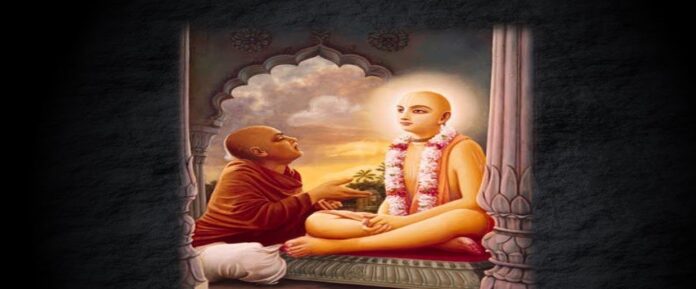
I offer my respectful obeisances unto Lord Gauracandra, the Supreme Personality of Godhead, who converted the hardhearted Sārvabhauma Bhaṭṭācārya, the reservoir of all bad logic, into a great devotee. (1) All glories to Lord Caitanya Mahāprabhu! All glories to Lord Nityānanda Prabhu! All glories to Advaita Ācārya! And all glories to all the devotees of Lord Caitanya! (2) In ecstasy, Śrī Caitanya Mahāprabhu went from Āṭhāranālā to the temple of Jagannātha. After seeing Lord Jagannātha, He became very restless due to love of Godhead. (3) Lord Śrī Caitanya Mahāprabhu went swiftly to embrace Lord Jagannātha, but when He entered the temple, He was so overwhelmed with love of Godhead that He fainted to the floor. (4) When Śrī Caitanya Mahāprabhu fell down, Sārvabhauma Bhaṭṭācārya happened to see Him. When the watchman threatened to beat the Lord, Sārvabhauma Bhaṭṭācārya immediately forbade him. (5)

Sārvabhauma Bhaṭṭācārya was very surprised to see the personal beauty of Lord Caitanya Mahāprabhu, as well as the transcendental transformations wrought on His body due to love of Godhead. (6) Śrī Caitanya Mahāprabhu remained unconscious for a long time. Meanwhile, the time for offering prasādam to Lord Jagannātha came, and the Bhaṭṭācārya tried to think of a remedy. (7) While Lord Caitanya Mahāprabhu was unconscious, Sārvabhauma Bhaṭṭācārya, with the help of the watchman and some disciples, carried Him to his home and laid Him down in a very sanctified room. (8) Examining the body of Śrī Caitanya Mahāprabhu, Sārvabhauma saw that His abdomen was not moving and that He was not breathing. Seeing His condition, the Bhaṭṭācārya became very anxious. (9) The Bhaṭṭācārya then took a fine cotton swab and put it before the Lord’s nostrils. When he saw the cotton move very slightly, he became hopeful. (10)

Sitting beside Śrī Caitanya Mahāprabhu, he thought, “This is a transcendental ecstatic transformation brought about by love of Kṛṣṇa.” (11) Upon seeing the sign of sūddīpta- sāttvika, Sārvabhauma Bhaṭṭācārya could immediately understand the transcendental ecstatic transformation in the body of Lord Caitanya Mahāprabhu. Such a sign takes place only in the bodies of eternally liberated devotees. (12) Sārvabhauma Bhaṭṭācārya considered, “The uncommon ecstatic symptoms of adhirūḍha- bhāva are appearing in the body of Śrī Caitanya Mahāprabhu. This is very wonderful! How are they possible in the body of a human being?” (13) While the Bhaṭṭācārya was thinking in this way at his home, all the devotees of Caitanya Mahāprabhu, headed by Nityānanda Prabhu, approached the Siṁha- dvāra [the entrance door of the temple]. (14) There the devotees heard the people talking about a mendicant who had come to Jagannātha Purī and seen the Deity of Jagannātha. (15) The people said that the sannyāsī had fallen unconscious upon seeing the Deity of Lord Jagannātha. Because His consciousness did not return, Sārvabhauma Bhaṭṭācārya had taken Him to his home. (16)

Hearing this, the devotees could understand that they were speaking of Lord Caitanya Mahāprabhu. Just then, Śrī Gopīnātha Ācārya arrived. (17) Gopīnātha Ācārya was a resident of Nadia, the son- in- law of Viśārada and a devotee of Caitanya Mahāprabhu. He knew the true identity of His Lordship. (18) Gopīnātha Ācārya had previously been acquainted with Mukunda Datta, and when the Ācārya saw him at Jagannātha Purī, he was very much astonished. (19) Mukunda Datta offered obeisances unto Gopīnātha Ācārya upon meeting him. Then the Ācārya embraced Mukunda Datta and inquired about news of Śrī Caitanya Mahāprabhu. (20) Mukunda Datta replied, “The Lord has already arrived here. We have come with Him.” (21) As soon as Gopīnātha Ācārya saw Nityānanda Prabhu, he offered his obeisances unto Him. In this way, meeting all the devotees, he asked about news of Lord Caitanya Mahāprabhu again and again. (22)

Mukunda Datta continued, “After accepting the sannyāsa order, Lord Caitanya Mahāprabhu has come to Jagannātha Purī and has brought all of us with Him. (23) “Lord Caitanya Mahāprabhu left our company and walked ahead to see Lord Jagannātha. We have just arrived and are now looking for Him. (24) “From the talk of the people in general, we have guessed that the Lord is now at the house of Sārvabhauma Bhaṭṭācārya. (25) “Upon seeing Lord Jagannātha, Caitanya Mahāprabhu became ecstatic and fell unconscious, and Sārvabhauma Bhaṭṭācārya has taken Him to his home in this condition. (26) “Just as I was thinking of meeting you, by chance we have actually met. (27)

“First let us all go to the house of Sārvabhauma Bhaṭṭācārya and see Caitanya Mahāprabhu. Later we shall come to see Lord Jagannātha.” (28) Hearing this and feeling very pleased, Gopīnātha Ācārya immediately took all the devotees with him and approached the house of Sārvabhauma Bhaṭṭācārya. (29) Arriving at the home of Sārvabhauma Bhaṭṭācārya, everyone saw the Lord lying unconscious. Seeing Him in this condition, Gopīnātha Ācārya became very unhappy, but at the same time he was happy just to see the Lord. (30) Sārvabhauma Bhaṭṭācārya permitted all the devotees to enter his house, and upon seeing Nityānanda Prabhu, the Bhaṭṭācārya offered Him obeisances. (31) Sārvabhauma met with all the devotees and offered them a proper welcome. They were all pleased to see Lord Caitanya Mahāprabhu. (32) The Bhaṭṭācārya then sent them all back to see Lord Jagannātha, and he asked his own son, Candaneśvara, to accompany them as a guide. (33) Everyone was then very pleased to see the Deity of Lord Jagannātha. Lord Nityānanda in particular was overwhelmed with ecstasy. (34) When Lord Nityānanda Prabhu nearly fainted, all the devotees caught Him and steadied Him. At that time, the priest of Lord Jagannātha brought a garland that had been offered to the Deity and offered it to Nityānanda Prabhu. (35)

Everyone was pleased to receive this garland worn by Lord Jagannātha. Afterwards they all returned to the place where Lord Śrī Caitanya Mahāprabhu was staying. (36) All of the devotees then began to loudly chant the Hare Kṛṣṇa mantra. Just before noon the Lord regained His consciousness. (37) Caitanya Mahāprabhu got up and very loudly chanted, “Hari! Hari!” Sārvabhauma Bhaṭṭācārya was very pleased to see the Lord regain consciousness, and he took the dust of the Lord’s lotus feet. (38) The Bhaṭṭācārya informed all of them, “Please take your midday baths immediately. Today I shall offer you mahā- prasādam, the remnants of food offered to Lord Jagannātha.” (39) After bathing in the sea, Śrī Caitanya Mahāprabhu and His devotees returned very soon. The Lord then washed His feet and sat down on a carpet to take lunch. (40) Sārvabhauma Bhaṭṭācārya made arrangements to bring various kinds of mahā- prasādam from the Jagannātha temple. Śrī Caitanya Mahāprabhu then accepted lunch with great happiness. (41) Caitanya Mahāprabhu was offered special rice and first- class vegetables on golden plates. He thus took lunch in the company of His devotees. (42) While Sārvabhauma Bhaṭṭācārya personally distributed the prasādam, Lord Caitanya Mahāprabhu requested him, “Please give Me only boiled vegetables. (43)

“You can offer the cakes and preparations made with condensed milk to all the devotees.” Hearing this, the Bhaṭṭācārya folded his hands and spoke as follows. (44) “Today, all of you please try to taste the lunch just as Lord Jagannātha accepted it.” (45) After saying this, he made them all eat the various cakes and condensed- milk preparations. After feeding them, he offered them water to wash their hands, feet and mouths. (46) Begging permission from Lord Caitanya Mahāprabhu and His devotees, Sārvabhauma Bhaṭṭācārya then went with Gopīnātha Ācārya to take lunch. After finishing their lunch, they returned to Lord Caitanya Mahāprabhu. (47) Offering his obeisances to Caitanya Mahāprabhu, Sārvabhauma Bhaṭṭācārya said, “Namo nārāyaṇāya” [“I offer my obeisances to Nārāyaṇa”]. In return, Caitanya Mahāprabhu said, “Kṛṣṇe matir astu” [“Let your attention be on Kṛṣṇa”]. (48) Hearing these words, Sārvabhauma understood Lord Caitanya to be a Vaiṣṇava sannyāsī. (49) Sārvabhauma then said to Gopīnātha Ācārya, “I want to know Caitanya Mahāprabhu’s previous situation.” (50)

Gopīnātha Ācārya replied, “There was a man named Jagannātha, who was a resident of Navadvīpa, and whose surname was Miśra Purandara. (51) “Lord Caitanya Mahāprabhu is the son of that Jagannātha Miśra, and His former name was Viśvambhara Miśra. He also happens to be the grandson of Nīlāmbara Cakravartī.” (52) The Bhaṭṭācārya said, “Nīlāmbara Cakravartī was a classmate of my father, Maheśvara Viśārada. I knew him as such. (53) “Jagannātha Miśra Purandara was respected by my father. Thus because of their relationship with my father, I respect both Jagannātha Miśra and Nīlāmbara Cakravartī.” (54) Hearing that Śrī Caitanya Mahāprabhu belonged to the Nadia district, Sārvabhauma Bhaṭṭācārya became very pleased and addressed the Lord as follows. (55) “You are naturally respectable. Besides, You are a sannyāsī; thus I wish to become Your personal servant.” (56) As soon as Caitanya Mahāprabhu heard this from the Bhaṭṭācārya, He immediately remembered Lord Viṣṇu and began to speak humbly to him as follows. (57)

“Because you are a teacher of Vedānta philosophy, you are the master of all the people in the world and their well- wisher as well. You are also the benefactor of all kinds of sannyāsīs. (58) “I am a young sannyāsī, and I actually have no knowledge of what is good and what is bad. Therefore I am taking shelter of you and accepting you as My spiritual master. (59) “I have come here only to associate with you, and I am now taking shelter of you. Will you kindly maintain Me in all respects? (60) “The incident that happened today was a great obstacle for Me, but you have kindly relieved Me of it.” (61) The Bhaṭṭācārya replied, “Do not go alone to see the Deity at the Jagannātha temple. It is better that You go with me or my men.” (62) The Lord said, “I shall never enter the temple but shall always view the Lord from the side of the Garuḍa- stambha.” (63) Sārvabhauma Bhaṭṭācārya then told Gopīnātha Ācārya, “Take Gosvāmījī and show Him Lord Jagannātha. (64) “Also, the apartment belonging to my maternal aunt is in a very solitary place. Make all arrangements for Him to stay there.” (65) Thus Gopīnātha Ācārya took Lord Caitanya Mahāprabhu to His residential quarters and showed Him where to find water, tubs and waterpots. Indeed, he arranged everything. (66)

Chaitanya Charitamrta | Madhya Lila | Chapter 5 | Section 68

0

He said, “My Lord, You are the protector of brahminical culture, and You are also very merciful. Therefore, kindly show Your great mercy by protecting the religious principles of us two brāhmaṇas. (88) “My dear Lord, I am not thinking to become happy by getting the daughter as a bride. I am simply thinking that the brāhmaṇa has broken his promise, and that is giving me great pain.” (89) The young brāhmaṇa continued, “My dear Sir, You are very merciful and You know everything. Therefore, kindly be a witness in this case. A person who knows things as they are and still does not bear witness becomes involved in sinful activities.” (90) Lord Kṛṣṇa replied, “My dear brāhmaṇa, go back to your home and call a meeting of all the men. In that meeting, just try to remember Me. (91)

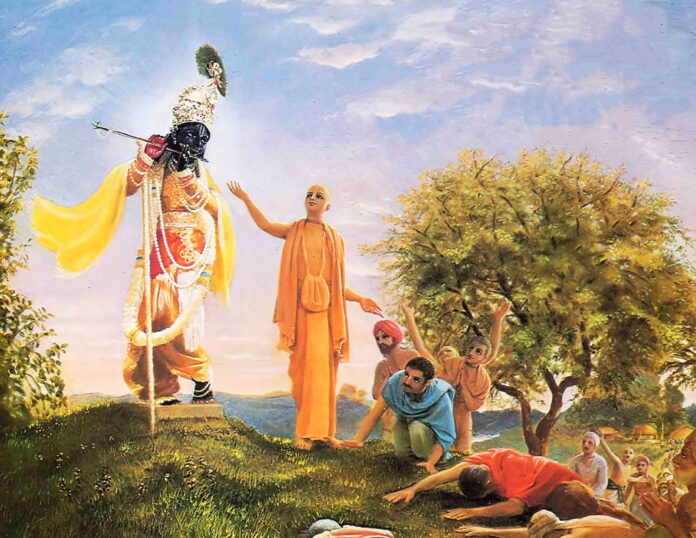
“I shall certainly appear there, and at that time I shall protect the honor of both you brāhmaṇas by bearing witness to the promise.” (92) The young brāhmaṇa replied, “My dear sir, even if You appear there as a four- handed Viṣṇu Deity, still, none of those people will believe in Your words. (93) “Only if You go there in this form of Gopāla and speak the words from Your beautiful face will Your testimony be heard by all the people.” (94) Lord Kṛṣṇa said, “I’ve never heard of a Deity’s walking from one place to another.” The brāhmaṇa replied, “That is true, but how is it that You are speaking to me, although You are a Deity? (95) “My dear Lord, You are not a statue; You are directly the son of Mahārāja Nanda. Now, for the sake of the old brāhmaṇa, You can do something You have never done before.” (96) Śrī Gopālajī then smiled and said, “My dear brāhmaṇa, just listen to Me. I shall walk behind you, and in this way I shall go with you.” (97) The Lord continued, “Do not try to see Me by turning around. As soon as you see Me, I shall remain stationary in that very place. (98)

“You will know that I am walking behind you by the sound of My ankle bells. (99) “Cook one kilogram of rice daily and offer it. I shall eat that rice and follow behind you.” (100) The next day, the brāhmaṇa begged permission from Gopāla and started for his country. Gopāla followed him, step by step. (101) While Gopāla followed the young brāhmaṇa, the tinkling sound of His ankle bells could be heard. The brāhmaṇa became very pleased, and he cooked first- class rice for Gopāla to eat. (102) The young brāhmaṇa walked and walked in this way until he eventually arrived in his own country. When he neared his own village, he began to think as follows. (103) “I have now come to my village, and I shall go to my home and tell all the people that the witness has arrived.” (104)

The brāhmaṇa then began to think that if the people didn’t directly see the Gopāla Deity, they would not believe that He had arrived. “But even if Gopāla stays here,” he thought, “there is still nothing to fear.” (105) Thinking this, the brāhmaṇa turned to look back, and He saw that Gopāla, the Supreme Personality of Godhead, was standing there smiling. (106) The Lord told the brāhmaṇa, “Now you can go home. I shall stay here and shall not leave.” (107) The young brāhmaṇa then went to the town and informed all the people about Gopāla’s arrival. Hearing this, the people were struck with wonder. (108) All the townspeople went to see the witness Gopāla, and when they saw the Lord actually standing there, they all offered their respectful obeisances. (109) When the people arrived, they were very pleased to see the beauty of Gopāla, and when they heard that He had actually walked there, they were all surprised. (110) Then the elderly brāhmaṇa, being very pleased, came forward and immediately fell like a stick in front of Gopāla. (111)

Thus in the presence of all the townspeople, Lord Gopāla bore witness that the elderly brāhmaṇa had offered his daughter in charity to the young brāhmaṇa. (112) After the marriage ceremony was performed, the Lord informed both brāhmaṇas, “You two brāhmaṇas are My eternal servants, birth after birth.” (113) The Lord continued, “I have become very much pleased by the truthfulness of you both. Now you can ask for a benediction.” Thus with great pleasure the two brāhmaṇas begged for a benediction. (114) The brāhmaṇas said, “Please remain here so that people all over the world will know how merciful You are to Your servants.” (115) Lord Gopāla stayed, and the two brāhmaṇas engaged in His service. After hearing of the incident, many people from different countries began to come to see Gopāla. (116) Eventually the King of that country heard this wonderful story, and he also came to see Gopāla and thus became very satisfied. (117)

The King constructed a nice temple, and regular service was executed. Gopāla became very famous under the name of Sākṣi- gopāla [the witness Gopāla]. (118) Thus Sākṣi- gopāla stayed in Vidyānagara and accepted service for a very long time. (119) Later there was a fight, and this country was conquered by King Puruṣottama- deva of Orissa. (120) That King was victorious over the King of Vidyānagara, and he took possession of his throne, the Māṇikya- siṁhāsana, which was bedecked with many jewels. (121) King Puruṣottama- deva was a great devotee and was advanced in the civilization of the Āryans. He begged at the lotus feet of Gopāla, “Please come to my kingdom.” (122) When the King begged Him to come to his kingdom, Gopāla, who was already obliged for his devotional service, accepted his prayer. Thus the King took the Gopāla Deity and went back to Kaṭaka. (123)

After winning the Māṇikya throne, King Puruṣottama- deva took it to Jagannātha Purī and presented it to Lord Jagannātha. In the meantime, he also established regular worship of the Gopāla Deity at Kaṭaka. (124) When the Gopāla Deity was installed at Kaṭaka, the Queen of Puruṣottama- deva went to see Him and, with great devotion, presented various kinds of ornaments. (125) The Queen had a very valuable pearl, which she wore on her nose, and she wished to give it to Gopāla. She then began to think as follows. (126) “If there were a hole in the Deity’s nose, I could transfer the pearl to Him.” (127) Considering this, the Queen offered her obeisances to Gopāla and returned to her palace. That night she dreamed that Gopāla appeared and began to speak to her as follows. (128) “During My childhood My mother made a hole in My nose and with great endeavor set a pearl there. (129)

“That very hole is still there, and you can use it to set the pearl you desired to give Me.” (130) After dreaming this, the Queen explained it to her husband, the King. Both the King and the Queen then went to the temple with the pearl. (131) Seeing the hole in the nose of the Deity, they set the pearl there and, being very pleased, held a great festival. (132) Since then, Gopāla has been situated in the city of Kaṭaka [Cuttak], and He has been known ever since as Sākṣi- gopāla. (133) Thus Śrī Caitanya Mahāprabhu heard the narration of Gopāla’s activities. Both He and His personal devotees became very pleased. (134) When Śrī Caitanya Mahāprabhu was sitting before the Gopāla Deity, all the devotees saw Him and the Deity as being of the same form. (135) They were of the same complexion, and both had gigantic bodies. Both wore saffron cloth, and both were very grave. (136)

The devotees saw that both Lord Caitanya Mahāprabhu and Gopāla were brilliantly effulgent and had eyes like lotuses. They were both absorbed in ecstasy, and both Their faces resembled full moons. (137) When Nityānanda saw the Gopāla Deity and Śrī Caitanya Mahāprabhu in that way, He began to exchange remarks with the devotees, all of whom were smiling. (138) Thus with great pleasure Lord Śrī Caitanya Mahāprabhu passed that night in the temple. After seeing the maṅgala- ārati ceremony in the morning, He started on His journey. (139) [In his book Caitanya- bhāgavata] Śrīla Vṛndāvana dāsa Ṭhākura has very vividly described the places visited by the Lord on the way to Bhuvaneśvara. (140) When Śrī Caitanya Mahāprabhu arrived at Kamalapura, He took His bath in the Bhārgīnadī River and left His sannyāsa staff in the hands of Lord Nityānanda. (141) When Lord Caitanya Mahāprabhu went to the temple of Lord Śiva known as Kapoteśvara, Nityānanda Prabhu, who was keeping His sannyāsa staff in custody, broke the staff in three parts and threw it into the river Bhārgīnadī. Later this river became known as Daṇḍa- bhāṅgā- nadī. (142-143)

After seeing the temple of Jagannātha from a distant place, Śrī Caitanya Mahāprabhu immediately became ecstatic. After offering obeisances to the temple, He began to dance in the ecstasy of love of God. (144) All the devotees became ecstatic in the association of Lord Caitanya, and thus absorbed in love of God, they were dancing and singing while going along the main road. (145) Śrī Caitanya Mahāprabhu laughed, cried, danced and made many ecstatic vibrations and sounds. Although the temple was only six miles away, to Him the distance seemed thousands of miles. (146) Thus walking and walking, the Lord eventually arrived at the place known as Āṭhāranālā. Arriving there, He expressed His external consciousness, speaking to Śrī Nityānanda Prabhu. (147) When Lord Caitanya Mahāprabhu had thus regained external consciousness, He asked Lord Nityānanda Prabhu, “Please return My staff.” Nityānanda Prabhu then replied, “It has been broken into three parts.” (148) Nityānanda Prabhu said, “When You fell down in ecstasy, I caught You, but both of Us together fell upon the staff. (149) “Thus the staff broke under Our weight. Where the pieces have gone, I cannot say. (150)

“It is certainly because of My offense that Your staff was broken. Now You can punish Me on this account as You think proper.”(151) After hearing the story about how His staff had been broken, the Lord expressed a little sadness and, displaying a bit of anger, began to speak as follows. (152) Caitanya Mahāprabhu said, “You have all benefited Me by bringing Me to Nīlācala. However, My only possession was that one staff, and you have not kept it. (153) “So all of you should go before or behind Me to see Lord Jagannātha. I shall not go with you.” (154) Mukunda Datta told Śrī Caitanya Mahāprabhu, “My Lord, You should go ahead and allow all the others to follow. We shall not go with You.” (155) Śrī Caitanya Mahāprabhu then began to walk very swiftly before all the other devotees. No one could understand the real purpose of the two Lords, Caitanya Mahāprabhu and Nityānanda Prabhu. (156)

The devotees could not understand why Nityānanda Prabhu broke the staff, why Śrī Caitanya Mahāprabhu permitted Him to do so, or why, after permitting Him, Caitanya Mahāprabhu became angry. (157) The pastime of the breaking of the staff is very deep. Only one whose devotion is fixed upon the lotus feet of the two Lords can understand it. (158) The glories of Lord Gopāla, who is merciful to brāhmaṇas, are very great. The narration of Sākṣi- gopāla was spoken by Nityānanda Prabhu and heard by Śrī Caitanya Mahāprabhu. (159) One who hears this narration of Lord Gopāla with faith and love very soon attains the lotus feet of Lord Gopāla.(160) Praying at the lotus feet of Śrī Rūpa and Śrī Raghunātha, always desiring their mercy, I, Kṛṣṇadāsa, narrate Śrī Caitanya- caritāmṛta, following in their footsteps. (161)

Chaitanya Charitamrta | Madhya Lila | Chapter 5 | Section 67

0

When the elderly brāhmaṇa’s son heard this, he took the opportunity to juggle some words. Becoming very impudent, he stood before the assembly and spoke as follows. (58) “While touring various holy places of pilgrimage, my father carried much money. Seeing the money, this rogue decided to take it away. (59) “There was no one besides this man with my father. Giving him an intoxicant known as dhuturā to eat, this rogue made my father mad. (60) “Having taken all my father’s money, this rogue claimed that it was taken by some thief. Now he is claiming that my father has promised to give him his daughter in charity. (61) “All of you assembled here are gentlemen. Please judge whether it is befitting to offer this poor brāhmaṇa my father’s daughter.” (62)

Hearing all these statements, all the people gathered there became a little doubtful. They thought it quite possible that because of attraction for riches one might give up his religious principles. (63) At that time the young brāhmaṇa said, “My dear gentlemen, please hear. Just to gain victory in an argument, this man is lying. (64) “Being very satisfied with my service, this brāhmaṇa said to me of his own accord, ‘I promise to hand over my daughter to you.’ (65) “At that time I forbade him to do this, telling him, ‘O best of the brāhmaṇas, I am not a fit husband for your daughter. (66) “‘Whereas you are a learned scholar, a rich man belonging to an aristocratic family, I am a poor man, uneducated and with no claim to aristocracy.’ (67) “Still this brāhmaṇa insisted. Again and again he asked me to accept his proposal, saying, ‘I have given you my daughter. Please accept her.’ (68)

“I then said, ‘Please hear. You are a learned brāhmaṇa. Your wife, friends and relatives will never agree to this proposal. (69) “‘My dear sir, you will not be able to fulfill your promise. Your promise will be broken.’ Yet, again and again the brāhmaṇa emphasized his promise. (70) “‘I have offered you my daughter. Do not hesitate. She is my daughter, and I shall give her to you. Who can forbid me?’ (71) “At that time I concentrated my mind and requested the brāhmaṇa to make the promise before the Gopāla Deity. (72) “Then this gentleman said in front of the Gopāla Deity, ‘My dear Lord, please bear witness. I have offered my daughter to this brāhmaṇa in charity.’ (73) “Accepting the Gopāla Deity as my witness, I then submitted the following at His lotus feet. (74) “‘If this brāhmaṇa later hesitates to give me his daughter, my dear Lord, I shall call on You as a witness. Please note this with care and attention.’ (75)

“Thus I have called upon a great personality in this transaction. I have asked the Supreme Godhead to be my witness. The entire world accepts the words of the Supreme Personality of Godhead.” (76) Taking this opportunity, the elderly brāhmaṇa immediately confirmed that this was really true. He said, “If Gopāla personally comes here to serve as a witness, I shall surely give my daughter to the young brāhmaṇa.” The elderly brāhmaṇa’s son immediately confirmed this, saying, “Yes, this is a very nice settlement.” (77-78) The elderly brāhmaṇa thought, “Since Lord Kṛṣṇa is very merciful, He will certainly come to prove my statement.” (79) The atheistic son thought, “It is not possible for Gopāla to come and bear witness.” Thinking thus, the father and son agreed. (80)

The young brāhmaṇa took this opportunity to speak: “Please write this down on paper in black and white so that you may not again change your word of honor.” (81) All the assembled people got this statement down in black and white and, taking the signatures of agreement from both of them, served as the mediators. (82) The young brāhmaṇa then said, “Will all you gentlemen present please hear me? This elderly brāhmaṇa is certainly truthful and is following religious principles. (83) “He had no desire to break his promise, but fearing that his kinsmen would commit suicide, he deviated from the truth. (84) “By the piety of the elderly brāhmaṇa, I shall call the Supreme Personality of Godhead as a witness. Thus I shall keep his truthful promise intact.” (85) Hearing the emphatic statement of the younger brāhmaṇa, some atheists in the meeting began to cut jokes. However, someone else said, “After all, the Lord is merciful, and if He likes, He can come.” (86) After the meeting, the young brāhmaṇa started for Vṛndāvana. Upon arriving there, he first offered his respectful obeisances to the Deity and then narrated everything in full detail. (87)

Chaitanya Charitamrta | Madhya Lila | Chapter 5 | Section 66

0

I offer my respectful obeisances unto the Supreme Personality of God [brahmaṇya- deva], who appeared as Sākṣi- gopāla to benefit a brāhmaṇa. For one hundred days He traveled through the country, walking on His own legs. Thus His activities are wonderful. (1) All glories to Lord Śrī Caitanya Mahāprabhu! All glories to Lord Nityānanda Prabhu! All glories to Śrī Advaita Prabhu! And all glories to all the devotees of Śrī Caitanya Mahāprabhu! (2) Walking and walking, Śrī Caitanya Mahāprabhu and His party finally arrived at Yājapura, on the river Vaitaraṇī. There He saw the temple of Varāhadeva and offered His obeisances unto Him. (3) In the temple of Varāhadeva, Śrī Caitanya Mahāprabhu engaged in chanting and dancing and offered prayers. He passed that night in the temple. (4)

Afterwards, Śrī Caitanya Mahāprabhu went to the town of Kaṭaka to see the temple of the witness Gopāla. When He saw the Deity of Gopāla, He was very much pleased by His beauty. (5) While there, Śrī Caitanya Mahāprabhu engaged in chanting and dancing for some time, and being overwhelmed, He offered many prayers to Gopāla. (6) That night Śrī Caitanya Mahāprabhu stayed in the temple of Gopāla, and along with all the devotees, He heard the narration of the witness Gopāla with great pleasure. (7) Previously, when Nityānanda Prabhu had toured all over India to see different places of pilgrimage, He also had come to see Sākṣi- gopāla at Kaṭaka. (8) At that time, Nityānanda Prabhu had heard the story of Sākṣi- gopāla from the townspeople. He now recited this again, and Lord Caitanya Mahāprabhu heard the narration with great pleasure. (9)

Formerly at Vidyānagara in South India there were two brāhmaṇas who made a long tour to see different places of pilgrimage. (10) First of all they visited Gayā, then Kāśī, then Prayāga. Finally, with great pleasure, they came to Mathurā. (11) After reaching Mathurā, they started visiting the different forests of Vṛndāvana and came to Govardhana Hill. They visited all twelve forests [vanas] and at last came to the town of Vṛndāvana. (12) In the village of Pañcakrośī Vṛndāvana, at the site where the Govinda temple is now situated, there was a great temple where gorgeous worship of Gopāla was performed. (13) After taking baths at different bathing places along the river Yamunā, such as Keśī- ghāṭa and Kāliya- ghāṭa, the pilgrims visited the temple of Gopāla. Afterwards, they took rest in that temple. (14) The beauty of the Gopāla Deity stole away their minds, and feeling great happiness, they remained there for two or four days. (15)

One of the two brāhmaṇas was an old man, and the other was young. The young man was assisting the old one. (16) Indeed, the young brāhmaṇa always rendered service to the older one, and the old man, being very satisfied with his service, was pleased with him. (17) The older man told the younger, “You have rendered various types of service to me. You have assisted me in traveling to all these places of pilgrimage. (18) “Even my own son does not render such service. By your mercy, I did not become fatigued while on this tour. (19) “If I did not show you any respect, I would be ungrateful. Therefore, I promise to give you my daughter in charity.” (20) The younger brāhmaṇa replied, “My dear sir, please hear me. You are saying something very unusual. Such a thing never happens. (21) “You are a most aristocratic family man, well educated and very rich. I am not at all aristocratic, and I am without a decent education and have no wealth. (22)

“Sir, I am not a suitable bridegroom for your daughter. I render service to you only for the satisfaction of Kṛṣṇa. (23) “Lord Kṛṣṇa is very much pleased by service rendered to brāhmaṇas, and when the Lord is pleased, the opulence of one’s devotional service increases.” (24) The older brāhmaṇa replied, “My dear boy, do not doubt me. I will give you my daughter in charity. I have already decided this.” (25) The young brāhmaṇa said, “You have a wife and sons, and you have a large circle of relatives and friends. (26) “Without the consent of all your friends and relatives, it is not possible to give me your daughter in charity. Just consider the story of Queen Rukmiṇī and her father, Bhīṣmaka. (27) “King Bhīṣmaka wanted to give his daughter, Rukmiṇī, in charity to Kṛṣṇa, but Rukmī, his eldest son, objected. Therefore he could not carry out his decision.” (28)

The elderly brāhmaṇa said, “My daughter is my own property. If I choose to give my property to someone, who has the power to stop me? (29) “My dear boy, I will give my daughter to you in charity, and I will neglect the position of all others. Don’t doubt me in this regard; just accept my proposal.” (30) The younger brāhmaṇa replied, “If you have decided to give your young daughter to me, then say so before the Gopāla Deity.” (31) Coming before Gopāla, the elderly brāhmaṇa said, “My dear Lord, please witness that I have given my daughter to this boy.” (32) Then the younger brāhmaṇa addressed the Deity, saying, “My dear Lord, You are my witness. I shall call for You to testify if it is necessary later on.” (33) After these talks, the two brāhmaṇas started for home. As usual, the young brāhmaṇa accompanied the elderly brāhmaṇa as if the older brāhmaṇa were a guru [spiritual master] and rendered him service in various ways. (34)

After returning to Vidyānagara, each brāhmaṇa went to his respective home. After some time, the elderly brāhmaṇa became very anxious. (35) He began to think, “I have given my word to a brāhmaṇa in a holy place, and what I promised will certainly come to pass. I must now disclose this to my wife, sons, other relatives and friends.” (36) Thus one day the elderly brāhmaṇa called for a meeting of all his relatives and friends, and before them all he narrated what had taken place in front of Gopāla. (37) When those who belonged to the family circle heard the narration of the old brāhmaṇa, they made exclamations showing their disappointment. They all requested that he not make such a proposal again. (38) They unanimously agreed, “If you offer your daughter to a degraded family, your aristocracy will be lost. When people hear of this, they will make jokes and laugh at you.” (39) The elderly brāhmaṇa said, “How can I undo the promise I made in a holy place while on pilgrimage? Whatever may happen, I must give him my daughter in charity.” (40)

The relatives unanimously said, “If you give your daughter to that boy, we shall give up all connection with you.” Indeed, his wife and sons declared, “If such a thing happens, we shall take poison and die.” (41) The elderly brāhmaṇa said, “If I do not give my daughter to the young brāhmaṇa, he will call Śrī Gopālajī as a witness. Thus he will take my daughter by force, and in that case my religious principles will become meaningless.” (42) His son replied, “The Deity may be a witness, but He is in a distant country. How can He come to bear witness against you? Why are you so anxious over this? (43) “You do not have to flatly deny that you spoke such a thing. There is no need to make a false statement. Simply say that you do not remember what you said. (44) “If you simply say, ‘I do not remember,’ I shall take care of the rest. By argument, I shall defeat the young brāhmaṇa.” (45) When the elderly brāhmaṇa heard this, his mind became very much agitated. Feeling helpless, he simply turned his attention to the lotus feet of Gopāla. (46)

The elderly brāhmaṇa prayed, “My dear Lord Gopāla, I have taken shelter of Your lotus feet, and therefore I request You to please protect my religious principles from disturbance and at the same time save my kinsmen from dying.” (47) The next day, the elderly brāhmaṇa was thinking deeply about this matter when the young brāhmaṇa came to his house. (48) The young brāhmaṇa came to him and offered respectful obeisances. Then, very humbly folding his hands, he spoke as follows. (49) “You have promised to give your daughter in charity to me. Now you do not say anything. What is your conclusion?” (50) After the young brāhmaṇa submitted this statement, the elderly brāhmaṇa remained silent. Taking this opportunity, his son immediately came out with a stick to strike the younger man. (51) The son said, “Oh, you are most degraded! You want to marry my sister, just like a dwarf who wants to catch the moon!” (52)

Seeing a stick in the hand of the son, the younger brāhmaṇa fled. The next day, however, he gathered together all the people of the village. (53) All the people of the village then called for the elderly brāhmaṇa and brought him to their meeting place. The young brāhmaṇa then began to speak before them as follows. (54) “This gentleman has promised to hand over his daughter to me, yet now he does not follow his promise. Please ask him about his behavior.” (55) All the people gathered there asked the elderly brāhmaṇa, “If you have already promised to give him your daughter in charity, why are you not fulfilling your promise? You have given your word of honor.” (56) The elderly brāhmaṇa said, “My dear friends, please hear what I have to submit. I do not exactly remember making a promise like that.” (57)

Chaitanya Charitamrta | Madhya Lila | Chapter 4 | Section 65

0

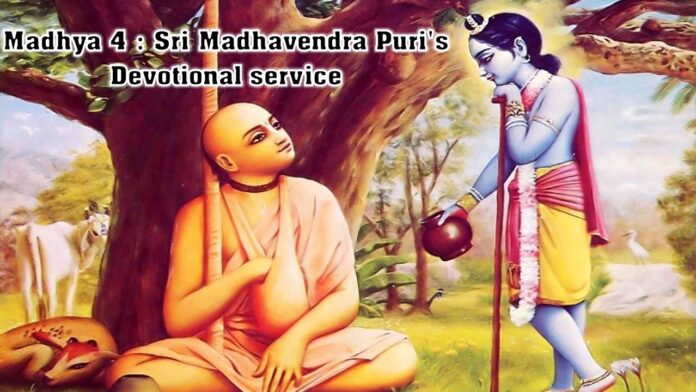
At the end of summer Mādhavendra Purī returned to Jagannātha Purī, where he remained with great pleasure during the whole period of Cāturmāsya. (169) Thus Śrī Caitanya Mahāprabhu personally praised the nectarean characteristics of Mādhavendra Purī, and while He related all this to the devotees, He personally relished it. (170) Lord Śrī Caitanya Mahāprabhu asked Nityānanda Prabhu to judge whether there was anyone within the world as fortunate as Mādhavendra Purī. (171) Śrī Caitanya Mahāprabhu said, “Mādhavendra Purī was so fortunate that Kṛṣṇa personally appeared before him on the plea of delivering milk. Three times the Lord gave orders to Mādhavendra Purī in dreams. (172) “Being obliged because of the loving affairs of Mādhavendra Purī, Lord Kṛṣṇa Himself appeared as the Gopāla Deity, and, accepting his service, He liberated the whole world. (173)

“On account of Mādhavendra Purī, Lord Gopīnātha stole the pot of sweet rice. Thus He became famous as Kṣīra- corā [the thief who stole the sweet rice]. (174) “Mādhavendra Purī smeared the sandalwood pulp over the body of Gopīnātha, and in this way he was overpowered with love of Godhead. (175) “In the provinces of India governed by the Muslims, there was much inconvenience in traveling with sandalwood and camphor. Because of this, Mādhavendra Purī might have gotten into trouble. This became known to the Gopāla Deity. (176) “The Lord is very merciful and attached to His devotees, so when Gopīnātha was covered with sandalwood pulp, Mādhavendra Purī’s labor became successful.” (177) Caitanya Mahāprabhu placed the standard of Mādhavendra Purī’s intense love before Nityānanda Prabhu for judgment. “All his loving activities are uncommon,” Caitanya Mahāprabhu said. “Indeed, one is struck with wonder to hear of his activities.” (178) Caitanya Mahāprabhu continued, “Śrī Mādhavendra Purī used to remain alone. He was completely renounced and always very silent. He was uninterested in everything material, and for fear of talking about mundane things, he always lived without a companion. (179)

“After receiving the transcendental orders of Gopāla, this great personality traveled thousands of miles just to collect sandalwood by begging. (180) “Although Mādhavendra Purī was hungry, he would not beg food to eat. This renounced person carried a load of sandalwood for the sake of Śrī Gopāla. (181) “Without considering his personal comforts, Mādhavendra Purī carried one maund [about eighty- two pounds] of sandalwood and twenty tolās [about eight ounces] of camphor to smear over the body of Gopāla. This transcendental pleasure was sufficient for him. (182) “Since there were restrictions against taking the sandalwood out of the Orissa province, the toll official confiscated the stock, but Mādhavendra Purī showed him the release papers given by the government and consequently escaped difficulties. (183) “Mādhavendra Purī was not at all anxious during the long journey to Vṛndāvana through the provinces governed by the Muslims and filled with unlimited numbers of watchmen. (184) “Although Mādhavendra Purī did not have a farthing with him, he was not afraid to pass by the toll officers. His only enjoyment was in carrying the load of sandalwood to Vṛndāvana for Gopāla. (185)

“This is the natural result of intense love of Godhead. The devotee does not consider personal inconveniences or impediments. In all circumstances he wants to serve the Supreme Personality of Godhead. (186) “Śrī Gopāla wanted to show how intensely Mādhavendra Purī loved Kṛṣṇa; therefore He asked him to go to Nīlācala to fetch sandalwood and camphor. (187) “With great trouble and after much labor, Mādhavendra Purī brought the load of sandalwood to Remuṇā. However, he was still very pleased; he discounted all the difficulties. (188) “To test the intense love of Mādhavendra Purī, Gopāla, the Supreme Personality of Godhead, ordered him to bring sandalwood from Nīlācala, and when Mādhavendra Purī passed this examination, the Lord became very merciful to him. (189) “Such behavior exhibited in loving service between the devotee and the devotee’s lovable object, Śrī Kṛṣṇa, is transcendental. It is not possible for a common man to understand. Common men do not even have the capacity.” (190) After saying this, Lord Caitanya Mahāprabhu read the famous verse of Mādhavendra Purī. That verse is just like the moon. It has spread illumination all over the world. (191)

Continuous rubbing increases the aroma of Malaya sandalwood. Similarly, consideration of this verse increases one’s understanding of its importance. (192) As the Kaustubha- maṇi is considered the most precious of valuable stones, this verse is similarly considered the best of poems dealing with the mellows of devotional service. (193) Actually this verse was spoken by Śrīmatī Rādhārāṇī Herself, and by Her mercy only was it manifest in the words of Mādhavendra Purī. (194) Only Śrī Caitanya Mahāprabhu has tasted the poetry of this verse. No fourth man is capable of understanding it. (195) Mādhavendra Purī recited this verse again and again at the end of his material existence. Thus uttering this verse, he attained the ultimate goal of life. (196) “O My Lord! O most merciful master! O master of Mathurā! When shall I see You again? Because of My not seeing You, My agitated heart has become unsteady. O most beloved one, what shall I do now?” (197)

When Śrī Caitanya Mahāprabhu recited this verse, He immediately fell to the ground unconscious. He was overwhelmed and had no control over Himself. (198) When Lord Śrī Caitanya Mahāprabhu fell to the ground in ecstatic love, Lord Nityānanda quickly took Him on His lap. Crying, Caitanya Mahāprabhu then got up again. (199) Exhibiting ecstatic emotions, the Lord began to run here and there, making resounding noises. Sometimes He laughed, and sometimes He cried, and sometimes He danced and sang. (200) Caitanya Mahāprabhu could not recite the whole verse. He simply said, “Ayi dīna! Ayi dīna!” repeatedly. Thus He could not speak, and profuse tears were in His eyes. (201) Trembling, perspiration, jubilant tears, shock, fading of the bodily luster, disappointment, moroseness, loss of memory, pride, joy and humility were all visible in Śrī Caitanya Mahāprabhu’s body. (202) This verse uncovered the door of ecstatic love, and when it was exhibited, all the servants of Gopīnātha saw Caitanya Mahāprabhu dance in ecstasy. (203)

When many people crowded around Śrī Caitanya Mahāprabhu, He regained His external senses. In the meantime, the offering to the Deity had been finished, and there was a resounding ārati performance. (204) When the Deities were laid down to rest, the priest came out of the temple and offered all twelve pots of sweet rice to Lord Caitanya Mahāprabhu. (205) When all the pots of sweet rice, remnants left by Gopīnātha, were placed before Śrī Caitanya Mahāprabhu, He became very pleased. In order to feed the devotees, He accepted five of them. (206) The seven remaining pots were pushed forward and delivered to the priest. Then the five pots of sweet rice the Lord had accepted were distributed among the five devotees, and they ate the prasādam. (207) Being identical with the Gopīnātha Deity, Śrī Caitanya Mahāprabhu had already tasted and eaten the pots of sweet rice. Yet just to manifest devotional service, He again ate the pots of sweet rice as a devotee. (208)

Śrī Caitanya Mahāprabhu passed that night at the temple engaged in congregational chanting. In the morning, after seeing the maṅgala- ārati performance, He departed. (209) In this way, Lord Śrī Caitanya Mahāprabhu personally tasted with His own mouth the transcendental qualities of Gopālajī, Gopīnātha and Śrī Mādhavendra Purī. (210) Thus I have described both the transcendental glories of Lord Caitanya Mahāprabhu’s affection for His devotees and the highest limit of ecstatic love of God. (211) One who hears this narration with faith and devotion attains the treasure of love of Godhead at the lotus feet of Śrī Kṛṣṇa. (212) Praying at the lotus feet of Śrī Rūpa and Śrī Raghunātha, always desiring their mercy, I, Kṛṣṇadāsa, narrate Śrī Caitanya- caritāmṛta, following in their footsteps. (213)

Chaitanya Charitamrta | Madhya Lila | Chapter 4 | Section 64

0

Mādhavendra Purī avoided begging. He was completely unattached and indifferent to material things. If, without his begging, someone offered him some food, he would eat; otherwise he would fast. (123) A paramahaṁsa like Mādhavendra Purī is always satisfied in the loving service of the Lord. Material hunger and thirst cannot impede his activities. When he desired to taste a little sweet rice offered to the Deity, he considered that he had committed an offense by desiring to eat what was being offered to the Deity. (124) Mādhavendra Purī left the temple and sat down in the village marketplace, which was vacant. Sitting there, he began to chant. In the meantime, the temple priest laid the Deity down to rest. (125) Finishing his daily duties, the priest went to take rest. In a dream he saw the Gopīnātha Deity come to talk to him, and He spoke as follows. (126)

“O priest, please get up and open the door of the temple. I have kept one pot of sweet rice for the sannyāsī Mādhavendra Purī. (127) “This pot of sweet rice is just behind My cloth curtain. You did not see it because of My tricks. (128) “A sannyāsī named Mādhavendra Purī is sitting in the vacant marketplace. Please take this pot of sweet rice from behind Me and deliver it to him.” (129) Awaking from the dream, the priest immediately rose from bed and thought it wise to take a bath before entering the Deity’s room. He then opened the temple door. (130) According to the Deity’s directions, the priest found the pot of sweet rice behind the cloth curtain. He removed the pot and mopped up the place where it had been kept. He then went out of the temple. (131) Closing the door of the temple, he went to the village with the pot of sweet rice. He called out in every stall in search of Mādhavendra Purī. (132)

Holding the pot of sweet rice, the priest called, “Will he whose name is Mādhavendra Purī please come and take this pot! Gopīnātha has stolen this pot of sweet rice for you!” (133) The priest continued, “Would the sannyāsī whose name is Mādhavendra Purī please come and take this pot of sweet rice and enjoy the prasādam with great happiness! You are the most fortunate person within these three worlds!” (134) Hearing this invitation, Mādhavendra Purī came out and identified himself. The priest then delivered the pot of sweet rice and offered his obeisances, falling flat before him. (135) When the story about the pot of sweet rice was explained to him in detail, Śrī Mādhavendra Purī at once became absorbed in ecstatic love of Kṛṣṇa. (136)

Upon seeing the ecstatic loving symptoms manifest in Mādhavendra Purī, the priest was struck with wonder. He could understand why Kṛṣṇa had become so much obliged to him, and he saw that Kṛṣṇa’s action was befitting. (137) The priest offered his obeisances to Mādhavendra Purī and returned to the temple. Then, in ecstasy, Mādhavendra Purī ate the sweet rice offered to him by Kṛṣṇa. (138) After this, Mādhavendra Purī washed the pot and broke it into pieces. He then bound all the pieces in his outer cloth and kept them nicely. (139) Each day, Mādhavendra Purī would eat one piece of that earthen pot, and after eating it he would immediately be overwhelmed with ecstasy. These are wonderful stories. (140) Having broken the pot and bound the pieces in his cloth, Mādhavendra Purī began to think, “The Lord has given me a pot of sweet rice, and when the people hear of this tomorrow morning, there will be great crowds.” (141) Thinking this, Śrī Mādhavendra Purī offered his obeisances to Gopīnātha on the spot and left Remuṇā before morning. (142)

Walking and walking, Mādhavendra Purī finally reached Jagannātha Purī, which is also known as Nīlācala. There he saw Lord Jagannātha and was overwhelmed with loving ecstasy. (143) When Mādhavendra Purī was overwhelmed in the ecstasy of love of Godhead, he sometimes stood up and sometimes fell to the ground. Sometimes he laughed, danced and sang. In this way he enjoyed transcendental bliss by seeing the Jagannātha Deity. (144) When Mādhavendra Purī came to Jagannātha Purī, people were aware of his transcendental reputation. Therefore crowds of people came and offered him all sorts of respect in devotion. (145) Even though one may not like it, reputation, as ordained by providence, comes to him. Indeed, one’s transcendental reputation is known throughout the entire world. (146)

Being afraid of his reputation [pratiṣṭhā], Mādhavendra Purī fled from Remuṇā. But the reputation brought by love of Godhead is so sublime that it goes along with the devotee, as if following him. (147) Mādhavendra Purī wanted to leave Jagannātha Purī because the people were honoring him as a great devotee; however, this threatened to hinder his collecting sandalwood for the Gopāla Deity. (148) Śrī Mādhavendra Purī told all the servants of Lord Jagannātha and all the great devotees there the story of the appearance of Śrī Gopāla. (149) When all the devotees at Jagannātha Purī heard that the Gopāla Deity wanted sandalwood, in great pleasure they all endeavored to collect it. (150) Those who were acquainted with government officers met with them and begged for camphor and sandalwood, which they collected. (151)

One brāhmaṇa and one servant were given to Mādhavendra Purī just to carry the sandalwood. He was also given the necessary traveling expenses. (152) To get past the toll collectors along the way, Mādhavendra Purī was supplied with the necessary release papers from government officers. The papers were placed in his hand. (153) In this way Mādhavendra Purī started for Vṛndāvana with the burden of sandalwood, and after some days he again reached the village of Remuṇā and the Gopīnātha temple there. (154) When Mādhavendra Purī reached the temple of Gopīnātha, he offered his respectful obeisances many times at the lotus feet of the Lord. In the ecstasy of love, he began to dance and sing without cessation. (155) When the priest of Gopīnātha saw Mādhavendra Purī again, he offered all respects to him and, giving him the sweet rice prasādam, made him eat. (156)

Mādhavendra Purī took rest that night in the temple, but toward the end of the night he had another dream. (157) Mādhavendra Purī dreamed that Gopāla came before him and said, “O Mādhavendra Purī, I have already received all the sandalwood and camphor. (158) “Now just grind all the sandalwood together with the camphor and then smear the pulp on the body of Gopīnātha daily until it is finished. (159) “There is no difference between My body and Gopīnātha’s body. They are one and the same. Therefore if you smear the sandalwood pulp on the body of Gopīnātha, you will naturally also smear it on My body. Thus the temperature of My body will be reduced. (160) “You should not hesitate to act according to My order. Believing in Me, just do what is needed.” (161) After giving these instructions, Gopāla disappeared, and Mādhavendra Purī awoke. He immediately called for all the servants of Gopīnātha, and they came before him. (162)

Mādhavendra Purī said, “Smear the body of Gopīnātha with this camphor and sandalwood I have brought for Gopāla in Vṛndāvana. Do this regularly every day. (163) “If the sandalwood pulp is smeared over the body of Gopīnātha, then Gopāla will be cooled. After all, the Supreme Personality of Godhead is completely independent; His order is all- powerful.” (164) The servants of Gopīnātha became very pleased to hear that in the summer all the sandalwood pulp would be used to anoint the body of Gopīnātha. (165) Mādhavendra Purī said, “These two assistants will regularly grind the sandalwood, and you should also get two other people to help. I shall pay their salaries.” (166) In this way Gopīnāthajī was supplied ground sandalwood pulp daily. The servants of Gopīnātha were very pleased with this. (167) In this way the sandalwood pulp was smeared over the body of Gopīnātha until the whole stock was finished. Mādhavendra Purī stayed there until that time. (168)

Stay Connected

16,985FansLike
12,500FollowersFollow
61,453SubscribersSubscribe