Mail ID: contact@vedavarsity.com

Contact: +91 9634998911

Google search engineGoogle search engine
Home Blog Page 122

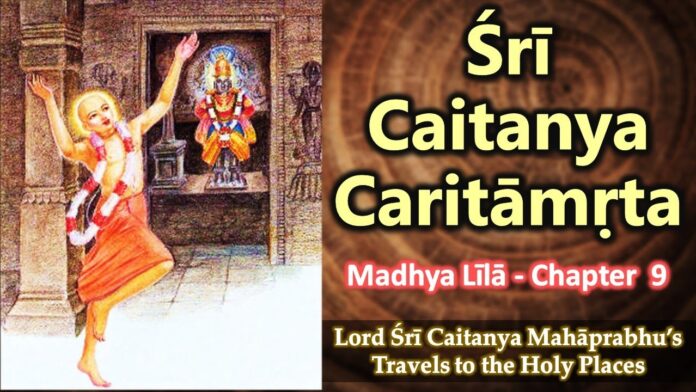
Chaitanya Charitamrta | Madhya Lila | Chapter 9 | Section 82

0

Lord Śrī Caitanya Mahāprabhu converted the inhabitants of South India. These people were as strong as elephants, but they were in the clutches of the crocodiles of various philosophies, such as the Buddhist, Jain and Māyāvāda philosophies. With His disc of mercy the Lord delivered them all by converting them into Vaiṣṇavas, devotees of the Lord. (1) All glories to Lord Śrī Caitanya Mahāprabhu! All glories to Lord Nityānanda Prabhu! All glories to Śrī Advaita Prabhu! And all glories to all the devotees of Śrī Caitanya Mahāprabhu! (2) Śrī Caitanya Mahāprabhu’s tour of South India was certainly very extraordinary because He visited many thousands of places of pilgrimage there. (3) On the plea of visiting all those holy places, the Lord converted many thousands of residents and thus delivered them. Simply by touching the holy places, He made them into great places of pilgrimage. (4)

I cannot chronologically record all the places of pilgrimage visited by Lord Śrī Caitanya Mahāprabhu. I can only summarize everything by saying that the Lord visited all holy places right and left, coming and going. (5) Because it is impossible for me to record all these places in chronological order, I will simply make a token gesture of recording them. (6) As previously stated, all the residents of the villages visited by Lord Caitanya became Vaiṣṇavas and began to chant Hari and Kṛṣṇa. In this way, in all the villages visited by the Lord, everyone became a Vaiṣṇava, a devotee. (7-8) In South India there were many types of people. Some were philosophical speculators, and some were fruitive workers, but in any case there were innumerable nondevotees. (9) By the influence of Śrī Caitanya Mahāprabhu, all these people abandoned their own opinions and became Vaiṣṇavas, devotees of Kṛṣṇa. (10) At the time, all the South Indian Vaiṣṇavas were worshipers of Lord Rāmacandra. Some were Tattvavādīs, and some were followers of Rāmānujācārya. (11)

After meeting Śrī Caitanya Mahāprabhu, all those different Vaiṣṇavas became devotees of Kṛṣṇa and began chanting the Hare Kṛṣṇa mahā- mantra. (12) “‘O Lord Rāmacandra, descendant of Mahārāja Raghu, kindly protect me! O Lord Kṛṣṇa, killer of the Keśī demon, kindly protect me!’” (13) While walking on the road, Śrī Caitanya Mahāprabhu used to chant this Rāma Rāghava mantra. Chanting in this way, He arrived at the banks of the Gautamī- gaṅgā and took His bath there. (14) Śrī Caitanya Mahāprabhu then went to Mallikārjuna- tīrtha and saw the deity of Lord Śiva there. He also induced all the people to chant the Hare Kṛṣṇa mahā- mantra. (15) There he saw Lord Mahādeva [Śiva], the servant of Lord Rāma. He then went to Ahovala- nṛsiṁha. (16) Upon seeing the Ahovala- nṛsiṁha Deity, Caitanya Mahāprabhu offered many prayers unto the Lord. He then went to Siddhavaṭa, where He saw the Deity of Rāmacandra, the Lord of Sītādevī. (17)

Upon seeing the Deity of Lord Rāmacandra, the descendant of King Raghu, the Lord offered His prayers and obeisances. Then a brāhmaṇa invited the Lord to take lunch. (18) That brāhmaṇa constantly chanted the holy name of Rāmacandra. Indeed, but for chanting Lord Rāmacandra’s holy name, that brāhmaṇa did not speak a word. (19) That day, Lord Caitanya remained there and accepted prasādam at his house. After bestowing mercy upon him in this way, the Lord proceeded ahead. (20) At the holy place known as Skanda- kṣetra, Lord Śrī Caitanya Mahāprabhu visited the temple of Skanda. From there He went to Trimaṭha, where He saw the Viṣṇu Deity Trivikrama. (21) After visiting the temple of Trivikrama, the Lord returned to Siddhavaṭa, where He again visited the house of the brāhmaṇa, who was now constantly chanting the Hare Kṛṣṇa mahā- mantra. (22) After finishing His lunch there, Śrī Caitanya Mahāprabhu asked the brāhmaṇa, “My dear friend, kindly tell Me what your position is now. (23)

“Formerly you were constantly chanting the holy name of Lord Rāma. Why are you now constantly chanting the holy name of Kṛṣṇa?” (24) The brāhmaṇa replied, “This is all due to Your influence, Sir. After seeing You, I have lost my lifelong practice. (25) “From my childhood I have been chanting the holy name of Lord Rāmacandra, but upon seeing You I chanted the holy name of Lord Kṛṣṇa just once. (26) “Since then, the holy name of Kṛṣṇa has been tightly fixed upon my tongue. Indeed, since I have been chanting the holy name of Kṛṣṇa, the holy name of Lord Rāmacandra has gone far away. (27) “From my childhood I have been collecting the glories of the holy name from revealed scriptures. (28) “‘The Supreme Absolute Truth is called Rāma because the transcendentalists take pleasure in the unlimited true pleasure of spiritual existence.’ (29) “‘The word “kṛṣ” is the attractive feature of the Lord’s existence, and “ṇa” means spiritual pleasure. When the verb “kṛṣ” is added to the affix “ṇa,” it becomes “Kṛṣṇa,” which indicates the Absolute Truth.’ (30)

“As far as the holy names of Rāma and Kṛṣṇa are concerned, they are on an equal level, but for further advancement we receive some specific information from the revealed scriptures. (31) “[Lord Śiva addressed his wife, Durgā:] ‘O Varānanā, ‘I chant the holy name of Rāma, Rāma, Rāma and thus enjoy this beautiful sound. This holy name of Rāmacandra is equal to one thousand holy names of Lord Viṣṇu.’ (32) “‘The pious results derived from chanting the thousand holy names of Viṣṇu three times can be attained by only one utterance of the holy name of Kṛṣṇa.’ (33) “According to this statement of the śāstras, the glories of the holy name of Kṛṣṇa are unlimited. Still I could not chant His holy name. Please hear the reason for this. (34) “My worshipable Lord has been Lord Rāmacandra, and by chanting His holy name I received happiness. Because I received such happiness, I chanted the holy name of Lord Rāma day and night. (35) “By Your appearance, Lord Kṛṣṇa’s holy name also appeared, and at that time the glories of Kṛṣṇa’s name awoke in my heart. (36)

“Sir, You are that Lord Kṛṣṇa Himself. This is my conclusion.” Saying this, the brāhmaṇa fell down at the lotus feet of Śrī Caitanya Mahāprabhu. (37) After showing mercy to the brāhmaṇa, Lord Śrī Caitanya Mahāprabhu left the next day and arrived at Vṛddhakāśī, where He visited the temple of Lord Śiva. (38) Śrī Caitanya Mahāprabhu then left Vṛddhakāśī and proceeded further. In one village He saw that most of the residents were brāhmaṇas, and He took His rest there. (39) Due to the influence of Lord Caitanya Mahāprabhu, many millions of men came just to see Him. Indeed, the assembly being unlimited, its members could not be counted. (40) The Lord’s bodily features were very beautiful, and in addition He was always in the ecstasy of love of Godhead. Simply by seeing Him, everyone began chanting the holy name of Kṛṣṇa, and thus everyone became a Vaiṣṇava devotee. (41)

There are many kinds of philosophers. Some are logicians who follow Gautama or Kaṇāda. Some follow the Mīmāṁsā philosophy of Jaimini. Some follow the Māyāvāda philosophy of Śaṅkarācārya, and others follow Kapila’s Sāṅkhya philosophy or the mystic yoga system of Pataṣjali. Some follow the smṛti- śāstra composed of twenty religious scriptures, and others follow the Purāṇas and the tantra- śāstra. In this way there are many different types of philosophers. (42) All of these adherents of various scriptures were ready to present the conclusions of their respective scriptures, but Śrī Caitanya Mahāprabhu broke all their opinions to pieces and established His own cult of bhakti based on the Vedas, Vedānta, the Brahma- sūtra and the philosophy of acintya- bhedābheda- tattva. (43) Śrī Caitanya Mahāprabhu established the devotional cult everywhere. No one could defeat Him. (44) Being thus defeated by Lord Śrī Caitanya Mahāprabhu, all these philosophers and their followers entered into His cult. In this way Lord Caitanya made South India into a country of Vaiṣṇavas. (45)

When the nonbelievers heard of the erudition of Śrī Caitanya Mahāprabhu, they came to Him with great pride, bringing their disciples with them. (46) One of them was a leader of the Buddhist cult and was a very learned scholar. To establish the nine philosophical conclusions of Buddhism, he came before the Lord and began to speak. (47) Although the Buddhists are unfit for discussion and should not be seen by Vaiṣṇavas, Caitanya Mahāprabhu spoke to them just to decrease their false pride. (48) The scriptures of the Buddhist cult are chiefly based on argument and logic, and they contain nine chief principles. Because Śrī Caitanya Mahāprabhu defeated the Buddhists in their argument, they could not establish their cult. (49) The teacher of the Buddhist cult set forth the nine principles, but Śrī Caitanya Mahāprabhu broke them to pieces with His strong logic. (50) All mental speculators and learned scholars were defeated by Śrī Caitanya Mahāprabhu, and when the people began to laugh, the Buddhist philosophers felt both shame and fear. (51) The Buddhists could understand that Lord Śrī Caitanya Mahāprabhu was a Vaiṣṇava, and they returned home very unhappy. Later, however, they began to plot against the Lord. (52)

Chaitanya Charitamrta | Madhya Lila | Chapter 8 | Section 81

0

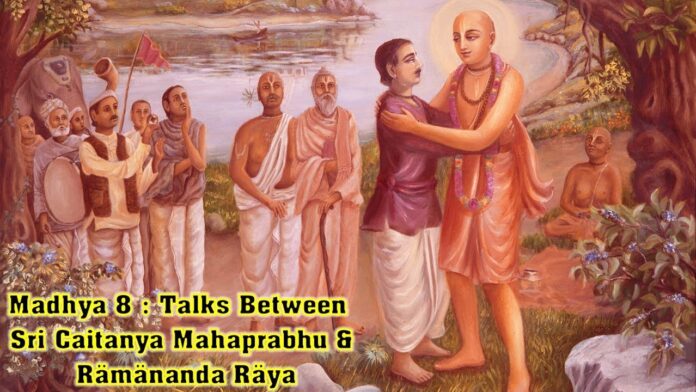
Lord Śrī Kṛṣṇa is the reservoir of all pleasure, and Śrīmatī Rādhārāṇī is the personification of ecstatic love of Godhead. These two forms had combined as one in Śrī Caitanya Mahāprabhu. This being the case, Lord Śrī Caitanya Mahāprabhu revealed His real form to Rāmānanda Rāya. (282) Upon seeing this form, Rāmānanda Rāya lost consciousness in transcendental bliss. Unable to remain standing, he fell to the ground.(283) When Rāmānanda Rāya fell to the ground unconscious, Caitanya Mahāprabhu touched his hand, and he immediately regained consciousness. But when he saw Lord Caitanya in the dress of a sannyāsī, he was struck with wonder. (284) After embracing Rāmānanda Rāya, the Lord pacified him, informing him, “But for you, no one has ever seen this form.” (285) Śrī Caitanya Mahāprabhu confirmed, “All the truths about My pastimes and mellows are within your knowledge. Therefore I have shown this form to you. (286)

“Actually My body does not have a fair complexion. It only appears so because it has touched the body of Śrīmatī Rādhārāṇī. However, She does not touch anyone but the son of Nanda Mahārāja. (287) “I have now converted My body and mind into the ecstasy of Śrīmatī Rādhārāṇī; thus I am tasting My own personal sweetness in that form.” (288) Lord Caitanya Mahāprabhu then admitted to His pure devotee, Rāmānanda Rāya, “Now there is no confidential activity unknown to you. Even though I try to conceal My activities, you can understand everything in detail by virtue of your advanced love for Me.” (289) The Lord then requested Rāmānanda Rāya, “Keep all these talks a secret. Please do not expose them anywhere and everywhere. Since My activities appear to be like those of a madman, people may take them lightly and laugh.”(290) Caitanya Mahāprabhu then said, “Indeed, I am a madman, and you are also a madman. Therefore we are on the same platform.” (291)

For ten nights Lord Caitanya Mahāprabhu and Rāmānanda Rāya spent a happy time discussing the pastimes of Kṛṣṇa. (292) The conversations between Rāmānanda Rāya and Śrī Caitanya Mahāprabhu contain the most confidential subject matters, touching the conjugal love between Rādhā and Kṛṣṇa in Vṛndāvana [Vrajabhūmi]. Although they talked at great length about these pastimes, they could not reach the limit of discussion. (293) Actually, these conversations are like a great mine where, from a single place, one can extract all kinds of metals—copper, bell metal, silver and gold—and also touchstone, the basis of all metals. (294) Śrī Caitanya Mahāprabhu and Rāmānanda Rāya worked like miners, excavating all kinds of valuable metals, each one better than the other. Their questions and answers are exactly like that. (295) The next day Śrī Caitanya Mahāprabhu begged Rāmānanda Rāya to give Him permission to leave, and at the time of farewell the Lord gave him the following orders. (296)

Śrī Caitanya Mahāprabhu told him, “Give up all material engagements and come to Jagannātha Purī. I will return there very soon after finishing My tour and pilgrimage. (297) “The two of us shall remain together at Jagannātha Purī and happily pass our time discussing Kṛṣṇa.” (298) Śrī Caitanya Mahāprabhu then embraced Śrī Rāmānanda Rāya, and after sending him back to his home, the Lord took rest. (299) After rising from bed the next morning, Śrī Caitanya Mahāprabhu visited the local temple, where there was a deity of Hanumān. After offering him obeisances, the Lord departed for South India. (300) All the residents of Vidyānagara were of different faiths, but after seeing Śrī Caitanya Mahāprabhu, they abandoned their own faiths and became Vaiṣṇavas. (301) When Rāmānanda Rāya began to feel separation from Śrī Caitanya Mahāprabhu, he was overwhelmed. Meditating on the Lord, he gave up all his material business.(302)

I have briefly described the meeting between Śrī Caitanya Mahāprabhu and Rāmānanda Rāya. No one can actually describe this meeting exhaustively. It is even impossible for Lord Śeṣa Nāga, who has thousands of hoods. (303) The activities of Śrī Caitanya Mahāprabhu are like condensed milk, and the activities of Rāmānanda Rāya are like large quantities of sugar candy. (304) Their meeting is exactly like a mixture of condensed milk and sugar candy. When they talk of the pastimes of Rādhā and Kṛṣṇa, camphor is added. One who tastes this combined preparation is most fortunate. (305) This wonderful preparation has to be taken aurally. If one takes it, he becomes greedy to relish it even further. (306) By hearing the talks between Rāmānanda Rāya and Śrī Caitanya Mahāprabhu, one becomes enlightened with the transcendental knowledge of the mellows of Rādhā and Kṛṣṇa’s pastimes. Thus one can develop unalloyed love for the lotus feet of Rādhā and Kṛṣṇa. (307)

The author requests every reader to hear these talks with faith and without argument. By studying them in this way, one will be able to understand the confidential truth of Śrī Caitanya Mahāprabhu. (308) This part of Śrī Caitanya Mahāprabhu’s pastimes is most confidential. One can derive benefit quickly only by faith; otherwise, by arguing one will always remain far away. (309) He who has accepted as everything the lotus feet of Śrī Caitanya Mahāprabhu, Nityānanda Prabhu and Advaita Prabhu can attain this transcendental treasure. (310) I offer ten million obeisances unto the lotus feet of Śrī Rāmānanda Rāya because from his mouth much spiritual information has been expanded by Śrī Caitanya Mahāprabhu. (311) I have tried to preach the pastimes of Lord Śrī Caitanya Mahāprabhu’s meeting with Rāmānanda Rāya in accordance with the notebooks of Śrī Svarūpa Dāmodara. (312) Praying at the lotus feet of Śrī Rūpa and Śrī Raghunātha, always desiring their mercy, I, Kṛṣṇadāsa, narrate Śrī Caitanya- caritāmṛta, following in their footsteps. (313)

Chaitanya Charitamrta | Madhya Lila | Chapter 8 | Section 80

0

The entire night was passed in this way, in ecstatic love of Godhead. In the morning they both departed to tend to their respective duties. (234) Before departing from Śrī Caitanya Mahāprabhu, Rāmānanda Rāya fell to the ground and caught hold of the Lord’s lotus feet. He then spoke submissively as follows. (235) Śrī Rāmānanda Rāya said, “You have come here just to show me Your causeless mercy. Therefore stay here for at least ten days and purify my polluted mind. (236) “But for You, there is no one who can deliver all the living entities, for You alone can deliver love of Kṛṣṇa.” (237) The Lord replied, “Having heard about your good qualities, I have come here. I have come to hear about Kṛṣṇa from you and thus purify My mind. (238) “Now that I have actually seen your glories, what I heard about you is confirmed. As far as the pastimes of Rādhā and Kṛṣṇa in a loving mood are concerned, you are the limit of knowledge.” (239)

Śrī Caitanya Mahāprabhu continued, “To say nothing of ten days, as long as I live I shall find it impossible to give up your company. (240) “You and I shall remain together at Jagannātha Purī. We shall pass our time together in joy, talking about Kṛṣṇa and His pastimes.” (241) In this way they both departed to perform their respective duties. Then, in the evening, Rāmānanda Rāya returned to see Lord Caitanya Mahāprabhu. (242) Thus they met time and time again, sitting in a secluded place and jubilantly discussing devotional service by the question- and- answer process. (243) Śrī Caitanya Mahāprabhu asked the questions, and Śrī Rāmānanda Rāya gave the answers. In this way they were engaged in discussion throughout the night. (244) On one occasion the Lord inquired, “Of all types of education, which is the most important?” Rāmānanda Rāya replied, “No education is important other than the transcendental devotional service of Kṛṣṇa.” (245)

Śrī Caitanya Mahāprabhu then asked Rāmānanda Rāya, “Out of all glorious activities, which is the most glorious?” Rāmānanda Rāya replied, “That person who is reputed to be a devotee of Lord Kṛṣṇa enjoys the utmost fame and glory.” (246) Śrī Caitanya Mahāprabhu asked, “Of the many capitalists who possess great riches, who is the topmost?” Rāmānanda Rāya replied, “He who is richest in love for Rādhā and Kṛṣṇa is the greatest capitalist.” (247) Śrī Caitanya Mahāprabhu asked, “Of all kinds of distress, what is the most painful?” Śrī Rāmānanda Rāya replied, “Apart from separation from the devotee of Kṛṣṇa, I know of no unbearable unhappiness.” (248) Śrī Caitanya Mahāprabhu then inquired, “Out of all liberated persons, who should be accepted as the greatest?” Rāmānanda Rāya replied, “He who has love for Kṛṣṇa has attained the topmost liberation.” (249) Śrī Caitanya Mahāprabhu next asked Rāmānanda Rāya, “Among many songs, which song is to be considered the actual religion of the living entity?” Rāmānanda Rāya replied, “That song describing the loving affairs of Śrī Rādhā and Kṛṣṇa is superior to all other songs.” (250)

Then Śrī Caitanya Mahāprabhu asked, “Out of all auspicious and beneficial activities, which is best for the living entity?” Rāmānanda Rāya replied, “The only auspicious activity is association with the devotees of Kṛṣṇa.” (251) Śrī Caitanya Mahāprabhu asked, “What should all living entities constantly remember?” Rāmānanda Rāya replied, “The chief objects of remembrance are always the Lord’s holy name, qualities and pastimes.” (252) Śrī Caitanya Mahāprabhu further inquired, “Out of many types of meditation, which is required for all living entities?” Śrīla Rāmānanda Rāya replied, “The chief duty of every living entity is to meditate upon the lotus feet of Rādhā and Kṛṣṇa.” (253) Śrī Caitanya Mahāprabhu asked, “Where should the living entity live, abandoning all other places?” Rāmānanda Rāya replied, “He should live in the holy place known as Vṛndāvana or Vrajabhūmi, where the Lord performed His rāsa dance.” (254) Śrī Caitanya Mahāprabhu asked, “Out of all topics people listen to, which is best for all living entities?” Rāmānanda Rāya replied, “Hearing about the loving affairs between Rādhā and Kṛṣṇa is most pleasing to the ear.” (255) Śrī Caitanya Mahāprabhu asked, “Among all worshipable objects, which is the chief?” Rāmānanda Rāya replied, “The chief worshipable object is the holy name of Rādhā and Kṛṣṇa, the Hare Kṛṣṇa mantra.” (256)

“And what is the destination of those who desire liberation and those who desire sense gratification?” Śrī Caitanya Mahāprabhu asked. Rāmānanda Rāya replied, “Those who attempt to merge into the existence of the Supreme Lord will have to accept bodies like those of trees. And those who are overly inclined toward sense gratification will attain the bodies of demigods.” (257) Rāmānanda Rāya continued, “Those who are devoid of all transcendental mellows are like the crows that suck the juice from the bitter fruits of the nimba tree of knowledge, whereas those who enjoy mellows are like the cuckoos who eat the buds of the mango tree of love of Godhead.” (258) Rāmānanda Rāya concluded, “The unfortunate empiric philosophers taste the dry process of philosophical knowledge, whereas the devotees regularly drink the nectar of love of Kṛṣṇa. Therefore they are the most fortunate of all.” (259)

In this way Caitanya Mahāprabhu and Rāmānanda Rāya passed the whole night relishing the mellows of kṛṣṇa- kathā, topics about Kṛṣṇa. While they were chanting, dancing and crying, the night ended. (260) The next morning they both departed to perform their respective duties, but in the evening Rāmānanda Rāya returned to meet the Lord again. (261) That evening, after discussing the topics of Kṛṣṇa for some time, Rāmānanda Rāya caught hold of the lotus feet of the Lord and spoke as follows. (262) “There is a variety of transcendental truths—the truth about Kṛṣṇa, the truth about Rādhārāṇī, the truth about Their loving affairs, the truth about transcendental humors, and the truth about the Lord’s pastimes. (263) “You have manifested all these transcendental truths in my heart. This is exactly the way Nārāyaṇa educated Lord Brahmā.” (264) Rāmānanda Rāya continued, “The Supersoul within everyone’s heart speaks not externally but from within. He instructs the devotees in all respects, and that is His way of instruction.” (265)

“‘O my Lord, Śrī Kṛṣṇa, son of Vasudeva, O all- pervading Personality of Godhead, I offer my respectful obeisances unto You. I meditate upon Lord Śrī Kṛṣṇa because He is the Absolute Truth and the primeval cause of all causes of the creation, sustenance and destruction of the manifested universes. He is directly and indirectly conscious of all manifestations, and He is independent because there is no other cause beyond Him. It is He only who first imparted the Vedic knowledge unto the heart of Brahmājī, the original living being. By Him even the great sages and demigods are placed into illusion, as one is bewildered by the illusory representations of water seen in fire, or land seen on water. Only because of Him do the material universes, temporarily manifested by the reactions of the three modes of nature, appear factual, although they are unreal. I therefore meditate upon Him, Lord Śrī Kṛṣṇa, who is eternally existent in the transcendental abode, which is forever free from the illusory representations of the material world. I meditate upon Him, for He is the Absolute Truth.’” (266)

Rāmānanda Rāya then said that he had but one doubt within his heart, and he petitioned the Lord, “Please be merciful upon me and just remove my doubt.” (267) Rāmānanda Rāya then told Lord Śrī Caitanya Mahāprabhu, “At first I saw You appear like a sannyāsī, but now I am seeing You as Śyāmasundara, the cowherd boy. (268) “I now see You appearing like a golden doll, and Your entire body appears covered by a golden luster. (269) “I see that You are holding a flute to Your mouth, and Your lotus eyes are moving very restlessly due to various ecstasies. (270) “I actually see You in this way, and this is very wonderful. My Lord, please tell me without duplicity what is causing this.” (271) Lord Śrī Caitanya Mahāprabhu replied, “You have a deep love for Kṛṣṇa, and one who has such deep ecstatic love for the Lord naturally sees things in such a way. Please take this from Me to be certain. (272)

“A devotee advanced on the spiritual platform sees everything movable and inert as the Supreme Lord. For him, everything he sees here and there is but a manifestation of Lord Kṛṣṇa. (273) “The mahā- bhāgavata, the advanced devotee, certainly sees everything mobile and immobile, but he does not exactly see their forms. Rather, everywhere he immediately sees manifest the form of the Supreme Lord.” (274) Śrī Caitanya Mahāprabhu continued, “‘A person advanced in devotional service sees within everything the soul of souls, the Supreme Personality of Godhead, Śrī Kṛṣṇa. Consequently he always sees the form of the Supreme Personality of Godhead as the cause of all causes and understands that all things are situated in Him.’ (275) “‘The plants, creepers and trees were full of fruits and flowers due to ecstatic love of Kṛṣṇa. Indeed, being so full, they were bowing down. They were inspired by such deep love for Kṛṣṇa that they were constantly pouring showers of honey. In this way the gopīs saw all the forests of Vṛndāvana.’” (276)

Lord Caitanya Mahāprabhu continued, “My dear Rāya, you are an advanced devotee and are always filled with ecstatic love for Rādhā and Kṛṣṇa. Therefore whatever you see—anywhere and everywhere—simply awakens your Kṛṣṇa consciousness.” (277) Rāmānanda Rāya replied, “My dear Lord, please give up all these serious talks. Please do not conceal Your real form from me.” (278) Rāmānanda Rāya continued, “My dear Lord, I can understand that You have assumed the ecstasy and bodily complexion of Śrīmatī Rādhārāṇī. By accepting this, You are tasting Your own personal transcendental humor and have therefore appeared as Śrī Caitanya Mahāprabhu. (279) “My dear Lord, You have descended in this incarnation of Lord Caitanya for Your own personal reasons. You have come to taste Your own spiritual bliss, and at the same time You are transforming the whole world by spreading the ecstasy of love of Godhead. (280) “My dear Lord, by Your causeless mercy You have appeared before me to grant me liberation. Now You are playing in a duplicitous way. What is the reason for this behavior?” (281)

Chaitanya Charitamrta | Madhya Lila | Chapter 8 | Section 79

0

Rāya Rāmānanda replied, “Lord Kṛṣṇa is dhīra- lalita, for He can always keep His girlfriends in a subjugated state. Thus His only business is enjoying sense gratification. (187) “‘A person who is very cunning and always youthful, expert in joking and without anxiety, and who can keep his girlfriends always subjugated, is called dhīra- lalita.’ (188) “Day and night Lord Śrī Kṛṣṇa enjoys the company of Śrīmatī Rādhārāṇī in the bushes of Vṛndāvana. Thus His pre- youthful age is fulfilled through His affairs with Śrīmatī Rādhārāṇī. (189) “‘Thus Lord Śrī Kṛṣṇa spoke of the sexual activities of the previous night. In this way He made Śrīmatī Rādhārāṇī close Her eyes out of shyness. Taking this opportunity, Śrī Kṛṣṇa painted various types of dolphins on Her breasts. Thus He became a very expert artist for all the gopīs. During such pastimes, the Lord enjoyed the fulfillment of His youth.’” (190) Śrī Caitanya Mahāprabhu said, “This is all right, but please continue.” At that time Rāya Rāmānanda replied, “I don’t think my intelligence goes beyond this.” (191)

Rāya Rāmānanda then informed Śrī Caitanya Mahāprabhu that there was another topic, known as prema- vilāsa- vivarta. “You may hear of this from me,” Rāmānanda Rāya said, “but I do not know whether You will be happy with it or not.” (192) Saying this, Rāmānanda Rāya began to sing a song he had composed, but Śrī Caitanya Mahāprabhu, out of the ecstasy of love of Godhead, immediately covered Rāmānanda’s mouth with His own hand. (193) “‘Alas, before We met there was an initial attachment between Us brought about by an exchange of glances. In this way attachment evolved. That attachment has gradually grown, and there is no limit to it. Now that attachment has become a natural sequence between Ourselves. It is not that it is due to Kṛṣṇa, the enjoyer, nor is it due to Me, for I am the enjoyed. It is not like that. This attachment was made possible by mutual meeting. This mutual exchange of attraction is known as manobhava, or Cupid. Kṛṣṇa’s mind and My mind have merged together. Now, during this time of separation, it is very difficult to explain these loving affairs. My dear friend, though Kṛṣṇa might have forgotten all these things, you can understand and bring this message to Him. But during Our first meeting there was no messenger between Us, nor did I request anyone to see Him. Indeed, Cupid’s five arrows were Our via media. Now, during this separation, that attraction has increased to another ecstatic state. My dear friend, please act as a messenger on My behalf, because if one is in love with a beautiful person, this is the consequence.’ (194)

“‘O my Lord, You live in the forest of Govardhana Hill, and, like the king of elephants, You are expert in the art of conjugal love. O master of the universe, Your heart and Śrīmatī Rādhārāṇī’s heart are just like shellac and are now melted in Your spiritual perspiration. Therefore one can no longer distinguish between You and Śrīmatī Rādhārāṇī. Now You have mixed Your newly invoked affection, which is like vermilion, with Your melted hearts, and for the benefit of the whole world You have painted both Your hearts red within this great palace of the universe.’” (195) Śrī Caitanya Mahāprabhu confirmed these verses recited by Śrī Rāmānanda Rāya, saying, “This is the limit of the goal of human life. Only by your mercy have I come to understand it conclusively. (196) “The goal of life cannot be achieved unless one practices the process. Now, being merciful upon Me, please explain that means by which this goal can be attained.” (197) Śrī Rāmānanda Rāya replied, “I do not know what I am saying, but You have made me speak what I have spoken, be it good or bad. I am simply repeating that message. (198) “Within these three worlds, who is so undisturbed that he can remain steady as You manipulate Your different energies? (199) “Actually You are speaking through my mouth, and at the same time You are listening. This is very mysterious. Anyway, kindly hear the explanation of the process by which the goal can be attained. (200)

“The pastimes of Rādhā and Kṛṣṇa are very confidential. They cannot be understood through the mellows of servitude, fraternity or parental affection. (201) “Actually, only the gopīs have the right to appreciate these transcendental pastimes, and only from them can these pastimes be expanded. (202) “Without the gopīs, these pastimes between Rādhā and Kṛṣṇa cannot be nourished. Only by their cooperation are such pastimes broadcast. It is their business to taste the mellows. (203) “Without the help of the gopīs, one cannot enter into these pastimes. Only one who worships the Lord in the ecstasy of the gopīs, following in their footsteps, can engage in the service of Śrī Śrī Rādhā- Kṛṣṇa in the bushes of Vṛndāvana. Only then can one understand the conjugal love between Rādhā and Kṛṣṇa. There is no other procedure for understanding. (204-205) “‘The pastimes of Śrī Rādhā and Kṛṣṇa are self- effulgent. They are happiness personified, unlimited and all- powerful. Even so, the spiritual humors of such pastimes are never complete without the gopīs, the Lord’s personal friends. The Supreme Personality of Godhead is never complete without His spiritual potencies; therefore unless one takes shelter of the gopīs, one cannot enter into the company of Rādhā and Kṛṣṇa. Who can be interested in Their spiritual pastimes without taking their shelter?’ (206)

“There is an inexplicable fact about the natural inclinations of the gopīs. The gopīs never want to enjoy themselves with Kṛṣṇa personally. (207) “The happiness of the gopīs increases ten million times when they serve to engage Śrī Śrī Rādhā and Kṛṣṇa in Their transcendental pastimes. (208) “By nature, Śrīmatī Rādhārāṇī is just like a creeper of love of Godhead, and the gopīs are the twigs, flowers and leaves of that creeper. (209) “When the nectar of Kṛṣṇa’s pastimes is sprinkled on that creeper, the happiness derived by the twigs, flowers and leaves is ten million times greater than that derived by the creeper itself. (210) “‘All the gopīs, the personal friends of Śrīmatī Rādhārāṇī, are equal to Her. Kṛṣṇa is pleasing to the inhabitants of Vrajabhūmi, just as the moon is pleasing to the lotus flower. His pleasure- giving potency is known as āhlādinī, of which the active principle is Śrīmatī Rādhārāṇī. She is compared to a creeper with newly grown flowers and leaves. When the nectar of Kṛṣṇa’s pastimes is sprinkled on Śrīmatī Rādhārāṇī, all Her friends, the gopīs, immediately appreciate the pleasure a hundred times more than if they were sprinkled themselves. Actually this is not at all wonderful.’ (211)

“Although the gopīs, Śrīmatī Rādhārāṇī’s friends, do not desire to enjoy themselves directly with Kṛṣṇa, Śrīmatī Rādhārāṇī makes a great endeavor to induce Kṛṣṇa to enjoy Himself with the gopīs. (212) “Presenting various pleas for the gopīs, Śrīmatī Rādhārāṇī sometimes sends the gopīs to Kṛṣṇa just to enable them to associate with Him directly. At such times, She enjoys a happiness ten million times greater than that enjoyed through direct association. (213) “The transcendental mellow is nourished by that mutual behavior in transcendental love of Godhead. When Lord Kṛṣṇa sees how the gopīs have developed pure love for Him, He becomes very satisfied. (214) “It is to be noted that the natural characteristic of the gopīs is to love the Supreme Lord. Their lusty desire is not to be compared to material lust. Nonetheless, because their desire sometimes appears to resemble material lust, their transcendental love for Kṛṣṇa is sometimes described as lust. (215)

“‘Although the dealings of the gopīs with Kṛṣṇa are on the platform of pure love of Godhead, such dealings are sometimes considered to be lusty. But because they are completely spiritual, Uddhava and all the other dearmost devotees of the Lord desire to participate in them.’ (216) “Lusty desires are experienced when one is concerned with his own personal sense gratification. The mood of the gopīs is not like that. Their only desire is to satisfy the senses of Kṛṣṇa. (217) “Among the gopīs, there is not a pinch of desire for sense gratification. Their only desire is to give pleasure to Kṛṣṇa, and this is why they mingle with Him and enjoy with Him. (218) “[All the gopīs said:] ‘Dear Kṛṣṇa, we carefully hold Your delicate lotus feet upon our hard breasts. When You walk in the forest, Your soft lotus feet are pricked by small bits of stone. We fear that this is paining You. Since You are our life and soul, our minds are very much disturbed when Your lotus feet are pained.’ (219) “One who is attracted by that ecstatic love of the gopīs does not care about popular opinion or the regulative principles of Vedic life. Rather, he completely surrenders unto Kṛṣṇa and renders service unto Him. (220)

“If one worships the Lord on the path of spontaneous love and goes to Vṛndāvana, he receives the shelter of Vrajendra- nandana, the son of Nanda Mahārāja. (221) “In his liberated stage the devotee is attracted by one of the five humors in the transcendental loving service of the Lord. As he continues to serve the Lord in that transcendental mood, he attains a spiritual body to serve Kṛṣṇa in Goloka Vṛndāvana. (222) “Those saintly persons who represent the Upaniṣads are vivid examples of this. By worshiping the Lord on the path of spontaneous love, they attained the lotus feet of Vrajendra- nandana, the son of Nanda Mahārāja. (223) “‘Great sages conquer the mind and senses by practicing the mystic yoga system and controlling the breath. Thus engaging in mystic yoga, they see the Supersoul within their hearts and ultimately enter into impersonal Brahman. But even the enemies of the Supreme Personality of Godhead attain that position simply by thinking of the Supreme Lord. However, the damsels of Vraja, the gopīs, being attracted by the beauty of Kṛṣṇa, simply wanted to embrace Him and His arms, which are like serpents. Thus the gopīs ultimately tasted the nectar of the lotus feet of the Lord. Similarly, we Upaniṣads can also taste the nectar of His lotus feet by following in the footsteps of the gopīs.’” (224)

“The word ‘sama- dṛśaḥ,’ mentioned in the fourth line of the previous verse, means ‘following the mood of the gopīs.’ The word ‘samāḥ’ means ‘the śrutis’ attainment of bodies like those of the gopīs.’ (225) “The word ‘aṅghri- padma- sudhā’ means ‘associating intimately with Kṛṣṇa.’ One can attain such perfection only by spontaneous love of God. One cannot obtain Kṛṣṇa in Goloka Vṛndāvana simply by serving the Lord according to regulative principles. (226) “‘The Supreme Personality of Godhead, Kṛṣṇa, the son of mother Yaśodā, is accessible to those devotees engaged in spontaneous loving service, but He is not as easily accessible to mental speculators, to those striving for self- realization by severe austerities and penances, or to those who consider the body the same as the self.’ (227) “Therefore one should accept the mood of the gopīs in their service. In such a transcendental mood, one should always think of the pastimes of Śrī Rādhā and Kṛṣṇa. (228) “After thinking of Rādhā and Kṛṣṇa and Their pastimes for a long time and after getting completely free from material contamination, one is transferred to the spiritual world. There the devotee attains an opportunity to serve Rādhā and Kṛṣṇa as one of the gopīs. (229)

“Unless one follows in the footsteps of the gopīs, he cannot attain the service of the lotus feet of Kṛṣṇa, the son of Nanda Mahārāja. If one is overcome by knowledge of the Lord’s opulence, he cannot attain the Lord’s lotus feet, even though he is engaged in devotional service. (230) “The unspoken example in this connection is the goddess of fortune, who worshiped Lord Kṛṣṇa in order to attain His pastimes in Vṛndāvana. But due to her opulent life- style, she could not attain the service of Kṛṣṇa in Vṛndāvana. (231) “‘When Lord Śrī Kṛṣṇa was dancing with the gopīs in the rāsa- līlā, the gopīs were embraced around the neck by the Lord’s arms. This transcendental favor was never bestowed upon the goddess of fortune or the other consorts in the spiritual world. Nor was such a thing ever imagined by the most beautiful girls in the heavenly planets, girls whose bodily luster and aroma resemble the beauty and fragrance of lotus flowers. And what to speak of worldly women, who may be very, very beautiful according to material estimation?’” (232) After hearing this, Lord Śrī Caitanya Mahāprabhu embraced Rāmānanda Rāya, and both of them, embracing shoulder to shoulder, began to cry. (233)

Chaitanya Charitamrta | Madhya Lila | Chapter 8 | Section 78

0

My dear friends, just see, Krsna is enjoying the season of spring! With the gopīs embracing each of His limbs, He is like amorous love personified. With His transcendental pastimes, He enlivens all the gopīs and the entire creation. With His soft bluish black arms and legs, which resemble blue lotus flowers, He has created a festival for Cupid.’ (144) “He also attracts Nārāyaṇa, who is the incarnation of Saṅkarṣaṇa and the husband of the goddess of fortune. He attracts not only Nārāyaṇa but also all women, headed by the goddess of fortune, the consort of Nārāyaṇa. (145) “[Addressing Kṛṣṇa and Arjuna, Lord Mahā- Viṣṇu (the Mahāpuruṣa) said:] ‘I wanted to see both of you, and therefore I have brought the sons of the brāhmaṇa here. Both of you have appeared in the material world to reestablish religious principles, and you have both appeared here with all your potencies. After killing all the demons, please quickly return to the spiritual world.’ (146) “‘O Lord, we do not know how the serpent Kāliya attained such an opportunity to be touched by the dust of Your lotus feet. For this end, the goddess of fortune performed austerities for centuries, giving up all other desires and observing austere vows. Indeed, we do not know how this serpent Kāliya got such an opportunity.’ (147)

“Lord Kṛṣṇa’s sweetness is so attractive that it steals away His own mind. Thus even He wants to embrace Himself. (148) “‘Upon seeing His own reflection in a bejeweled pillar of His Dvārakā palace, Kṛṣṇa desired to embrace it, saying, “Alas, I have never seen such a person before. Who is He? Just by seeing Him I have become eager to embrace Him, exactly like Śrīmatī Rādhārāṇī.”’” (149) Śrī Rāmānanda Rāya then said, “I have thus briefly explained the original form of the Supreme Personality of Godhead. Now let me describe the position of Śrīmatī Rādhārāṇī. (150) “Kṛṣṇa has unlimited potencies, which can be divided into three main parts. These are the spiritual potency, the material potency and the marginal potency, which is known as the living entities. (151) “In other words, these are all potencies of God—internal, external and marginal. But the internal potency is the Lord’s personal energy and stands over the other two. (152) “‘The original potency of Lord Viṣṇu is superior, or spiritual, and the living entity actually belongs to that superior energy. But there is another energy, called the material energy, and this third energy is full of ignorance.’ (153)

“Originally Lord Kṛṣṇa is sac- cid- ānanda- vigraha, the transcendental form of eternity, bliss and knowledge; therefore His personal potency, the internal potency, has three different forms. (154) “Hlādinī is His aspect of bliss; sandhinī, of eternal existence; and samvit of cognizance, which is also accepted as knowledge. (155) “‘My dear Lord, You are the transcendental reservoir of all transcendental qualities. Your pleasure potency, existence potency and knowledge potency are actually all one internal spiritual potency. The conditioned soul, although actually spiritual, sometimes experiences pleasure, sometimes pain and sometimes a mixture of pain and pleasure. This is due to his being touched by matter. But because You are above all material qualities, these are not found in You. Your superior spiritual potency is completely transcendental, and for You there is no such thing as relative pleasure, pleasure mixed with pain, or pain itself.’ (156) “The potency called hlādinī gives Kṛṣṇa transcendental pleasure. Through this pleasure potency, Kṛṣṇa personally tastes all spiritual pleasure. (157)

“Lord Kṛṣṇa tastes all kinds of transcendental happiness, although He Himself is happiness personified. The pleasure relished by His pure devotees is also manifested by His pleasure potency. (158) “The most essential part of this pleasure potency is love of Godhead [prema]. Consequently, the explanation of love of Godhead is also a transcendental mellow full of pleasure. (159) “The essential part of love of Godhead is called mahābhāva, transcendental ecstasy, and that ecstasy is represented by Śrīmatī Rādhārāṇī. (160) “‘Among the gopīs of Vṛndāvana, Śrīmatī Rādhārāṇī and another gopī are considered chief. But when we compare the gopīs, it appears that Śrīmatī Rādhārāṇī is most important because Her real feature expresses the highest ecstasy of love. The ecstasy of love experienced by the other gopīs cannot be compared to that of Śrīmatī Rādhārāṇī.’ (161) “The body of Śrīmatī Rādhārāṇī is a veritable transformation of love of Godhead; She is the dearmost friend of Kṛṣṇa, and this is known throughout the world. (162)

“‘I worship Govinda, the primeval Lord, who resides in His own realm, Goloka, with Rādhā, who resembles His own spiritual figure and who embodies the ecstatic potency [hlādinī]. Their companions are Her confidantes, who embody extensions of Her bodily form and who are imbued and permeated with ever- blissful spiritual rasa.’ (163) “That supreme ecstasy of Śrīmatī Rādhārāṇī is the essence of spiritual life. Her only business is to fulfill all the desires of Kṛṣṇa. (164) “Śrīmatī Rādhārāṇī is the topmost spiritual gem, and the other gopīs—Lalitā, Viśākhā and so on—are expansions of Her spiritual body. (165) “Śrīmatī Rādhārāṇī’s transcendental body is brilliant in luster and full of all transcendental fragrances. Lord Kṛṣṇa’s affection for Her is like a perfumed massage. (166) “Śrīmatī Rādhārāṇī takes Her first bath in the shower of the nectar of compassion, and She takes Her second bath in the nectar of youth. (167) “After Her midday bath, Rādhārāṇī takes another bath in the nectar of bodily luster, and She puts on the garment of shyness, which is Her black silk sari. (168)

“Śrīmatī Rādhārāṇī’s affection for Kṛṣṇa is Her upper garment, which is pinkish in color. She then covers Her breasts with another garment, composed of affection and anger toward Kṛṣṇa. (169) “Śrīmatī Rādhārāṇī’s personal beauty is the reddish powder known as kuṅkuma, Her affection for Her associates is sandalwood pulp, and the sweetness of Her smile is camphor. All these, combined together, are smeared over Her body. (170) “Conjugal love for Kṛṣṇa is an abundance of musk, and with that musk Her whole body is decorated. (171) “Craftiness and covered anger constitute the arrangement of Her hair. The quality of anger due to jealousy is the silk garment covering Her body. (172) “Her attachment for Kṛṣṇa is the reddish color of betel nuts on Her brilliant lips. Her double- dealings in loving affairs constitute the black ointment around Her eyes. (173) “The ornaments decorating Her body are the blazing ecstasies of goodness and the constantly existing ecstasies, headed by jubilation. All these ecstasies are the ornaments all over Her body. (174)

“Also ornamenting Her body are the twenty kinds of ecstatic symptoms beginning with kila- kiñcita. Her transcendental qualities constitute the flower garland hanging in fullness over Her body. (175) “The tilaka of good fortune is on Her beautiful broad forehead. Her various loving affairs are a gem, and Her heart is the locket. (176) “Śrīmatī Rādhārāṇī’s gopī friends are Her mental activities, which are concentrated on the pastimes of Śrī Kṛṣṇa. She keeps Her hand on the shoulder of a friend, who represents youth. (177) “Śrīmatī Rādhārāṇī’s bedstead is pride itself, and it is situated in the abode of Her bodily aroma. She is always seated there thinking of Kṛṣṇa’s association. (178) “Śrīmatī Rādhārāṇī’s earrings are the name, fame and qualities of Lord Kṛṣṇa. The glories of Lord Kṛṣṇa’s name, fame and qualities are always inundating Her speech. (179) “Śrīmatī Rādhārāṇī induces Kṛṣṇa to drink the honey of the conjugal relationship. She is therefore engaged in satisfying all the lusty desires of Kṛṣṇa. (180) “Śrīmatī Rādhārāṇī is a mine filled with valuable jewels of love for Kṛṣṇa. Her transcendental body is complete with unparalleled spiritual qualities. (181)

“‘If one asks about the origin of love of Kṛṣṇa, the answer is that the origin is in Śrīmatī Rādhārāṇī alone. Who is the most dear friend of Kṛṣṇa? The answer again is Śrīmatī Rādhārāṇī alone. No one else. Śrīmatī Rādhārāṇī’s hair is very curly, Her two eyes are always moving to and fro, and Her breasts are firm. Since all transcendental qualities are manifested in Śrīmatī Rādhārāṇī, She alone is able to fulfill all the desires of Kṛṣṇa. No one else.’ (182) “Even Satyabhāmā, one of the queens of Śrī Kṛṣṇa, desires the fortunate position and excellent qualities of Śrīmatī Rādhārāṇī. All the gopīs learn the art of dressing from Śrīmatī Rādhārāṇī, and even the goddess of fortune, Lakṣmī, and the wife of Lord Śiva, Pārvatī, desire Her beauty and qualities. Indeed, Arundhatī, the celebrated chaste wife of Vasiṣṭha, also wants to imitate the chastity and religious principles of Śrīmatī Rādhārāṇī. (183-184) “Even Lord Kṛṣṇa Himself cannot reach the limit of the transcendental qualities of Śrīmatī Rādhārāṇī. How, then, can an insignificant living entity count them?” (185) Lord Śrī Caitanya Mahāprabhu replied, “Now I have come to understand the truth of the loving affairs between Rādhā and Kṛṣṇa. Nonetheless, I still want to hear how both of Them gloriously enjoy such love.” (186)

Chaitanya Charitamrta | Madhya Lila | Chapter 8 | Section 77

0

Śrī Caitanya Mahāprabhu, who is known as Gaurāṅga, is the ocean of all conclusive knowledge in devotional service. He empowered Śrī Rāmānanda Rāya, who may be likened to a cloud of devotional service. This cloud was filled with the water of all the conclusive purports of devotional service and was empowered by the ocean to spread this water over the sea of Śrī Caitanya Mahāprabhu Himself. Thus the ocean of Caitanya Mahāprabhu became filled with the jewels of the knowledge of pure devotional service. (1) All glories to Lord Śrī Caitanya Mahāprabhu! All glories to Lord Nityānanda! All glories to Advaita Ācārya! And all glories to all the devotees of Lord Śrī Caitanya Mahāprabhu! (2) According to His previous program, Lord Śrī Caitanya Mahāprabhu went forward on His tour and after some days arrived at the place of pilgrimage known as Jiyaḍa- nṛsiṁha. (3) Upon seeing the Deity of Lord Nṛsiṁha in the temple, Śrī Caitanya Mahāprabhu offered His respectful obeisances by falling flat. Then, in ecstatic love, He performed various dances, chanted, and offered prayers. (4)

“‘All glories to Nṛsiṁhadeva! All glories to Nṛsiṁhadeva, who is the Lord of Prahlāda Mahārāja and, like a honeybee, is always engaged in beholding the lotuslike face of the goddess of fortune.’ (5) “‘Although very ferocious, the lioness is very kind to her cubs. Similarly, although very ferocious to nondevotees like Hiraṇyakaśipu, Lord Nṛsiṁhadeva is very, very soft and kind to devotees like Prahlāda Mahārāja.’” (6) In this way Lord Śrī Caitanya Mahāprabhu recited different verses from the śāstra. The priest of Lord Nṛsiṁhadeva then brought garlands and the remnants of the Lord’s food and offered them to Śrī Caitanya Mahāprabhu. (7) As usual, a brāhmaṇa offered Śrī Caitanya Mahāprabhu an invitation. The Lord passed the night in the temple and then commenced His tour again. (8)

The next morning, in the great ecstasy of love, Lord Śrī Caitanya Mahāprabhu started on His tour with no knowledge of the proper direction, and He continued the whole day and night. (9) As previously, Śrī Caitanya Mahāprabhu converted to Vaiṣṇavism many people He met on the road. After some days, the Lord reached the banks of the river Godāvarī. (10) When He saw the river Godāvarī, the Lord remembered the river Yamunā, and when He saw the forest on the banks of the river, He remembered Śrī Vṛndāvana- dhāma. (11) After performing His usual chanting and dancing for some time in this forest, the Lord crossed the river and took His bath on the other bank. (12) After bathing in the river, the Lord walked a little distance from the bathing place and engaged in chanting the holy name of Kṛṣṇa. (13) At that time, accompanied by the sounds of music, Rāmānanda Rāya came there on a palanquin to take his bath. (14)

Many brāhmaṇas following the Vedic principles accompanied Rāmānanda Rāya. According to the Vedic rituals, Rāmānanda Rāya took his bath and offered oblations to his forefathers. (15) Śrī Caitanya Mahāprabhu could understand that the person who had come to bathe in the river was Rāmānanda Rāya. The Lord wanted so much to meet him that His mind immediately began running after him. (16) Although Śrī Caitanya Mahāprabhu was running after him mentally, He patiently remained sitting. Rāmānanda Rāya, seeing the wonderful sannyāsī, then came to see Him. (17) Śrīla Rāmānanda Rāya then saw Śrī Caitanya Mahāprabhu to be as brilliant as a hundred suns. The Lord was covered by a saffron garment. He was large in body and very strongly built, and His eyes were like lotus petals. (18)

When Rāmānanda Rāya saw the wonderful sannyāsī, he was struck with wonder. He went to Him and immediately offered his respectful obeisances, falling down flat like a rod. (19) The Lord stood up and asked Rāmānanda Rāya to arise and chant the holy name of Kṛṣṇa. Indeed, Śrī Caitanya Mahāprabhu was very eager to embrace him. (20) Śrī Caitanya Mahāprabhu then inquired whether he was Rāmānanda Rāya, and he replied, “Yes, I am Your very low servant, and I belong to the śūdra community.” (21) Śrī Caitanya Mahāprabhu then embraced Śrī Rāmānanda Rāya very firmly. Indeed, both the master and the servant almost lost consciousness due to ecstatic love. (22) Their natural love for each other was awakened in them both, and they embraced and fell to the ground. (23) When they embraced each other, ecstatic symptoms—paralysis, perspiration, tears, shivering, paleness and standing up of the bodily hairs—appeared. The word “Kṛṣṇa” came from their mouths falteringly. (24) When the stereotyped, ritualistic brāhmaṇas who were following the Vedic principles saw this ecstatic manifestation of love, they were struck with wonder. All these brāhmaṇas began to reflect as follows. (25)

The brāhmaṇas thought, “We can see that this sannyāsī has a luster like the effulgence of Brahman, but how is it He is crying upon embracing a śūdra, a member of the fourth caste in the social order?” (26) They thought, “This Rāmānanda Rāya is the Governor of Madras, a highly learned and grave person, a mahā-paṇḍita, but upon touching this sannyāsī he has become restless like a madman.” (27) While the brāhmaṇas were thinking in this way about the activities of Śrī Caitanya Mahāprabhu and Rāmānanda Rāya, Śrī Caitanya Mahāprabhu saw those outsiders and restrained His transcendental emotions. (28) When they regained their sanity, they both sat down, and Śrī Caitanya Mahāprabhu smiled and began to speak as follows. (29) “Sārvabhauma Bhaṭṭācārya spoke of your good qualities, and he made a great endeavor to convince Me to meet you. (30)

“Indeed, I have come here just to meet you. It is very good that even without making an effort I have gotten your interview here.” (31) Rāmānanda Rāya replied, “Sārvabhauma Bhaṭṭācārya thinks of me as his servant. Even in my absence he is very careful to do me good. (32) “By his mercy I have received Your interview here. Consequently I consider that today I have become a successful human being. (33) “I can see that You have bestowed special mercy upon Sārvabhauma Bhaṭṭācārya. Therefore You have touched me, although I am untouchable. This is due only to his love for You. (34) “You are the Supreme Personality of Godhead, Nārāyaṇa Himself, and I am only a government servant interested in materialistic activities. Indeed, I am the lowest among men of the fourth caste. (35)

“You do not fear the Vedic injunctions stating that You should not associate with a śūdra. You were not contemptuous of my touch, although in the Vedas You are forbidden to associate with śūdras. (36) “You are the Supreme Personality of Godhead Himself; therefore no one can understand Your purpose. By Your mercy You are touching me, although this is not sanctioned by the Vedas. (37) “You have come here specifically to deliver me. You are so merciful that You alone can deliver all fallen souls. (38) “It is the general practice of all saintly people to deliver the fallen. Therefore they go to people’s houses, although they have no personal business there. (39) “‘My dear Lord, sometimes great saintly persons go to the homes of householders, although these householders are generally low-minded. When a saintly person visits their homes, one can understand that it is for no other purpose than to benefit the householders.’ (40)

“Along with me there are about a thousand men—including the brāhmaṇas—and all of them appear to have had their hearts melted simply by seeing You. (41) “I hear everyone chanting the holy name of Kṛṣṇa. Everyone’s body is thrilled with ecstasy, and there are tears in everyone’s eyes. (42) “My dear Sir, according to Your behavior and bodily features, You are the Supreme Personality of Godhead. It is impossible for ordinary living beings to possess such transcendental qualities.” (43) The Lord replied to Rāmānanda Rāya, “Sir, you are the best of the topmost devotees; therefore simply the sight of you has melted everyone’s heart. (44) “Although I am a Māyāvādī sannyāsī, a nondevotee, I am also floating in the ocean of love of Kṛṣṇa simply by touching you. And what to speak of others? (45) “Sārvabhauma Bhaṭṭācārya knew this would happen, and thus to rectify My heart, which is very hard, he asked Me to meet you.” (46)

In this way each of them praised the qualities of the other, and both of them were pleased to see each other. (47) At this time a brāhmaṇa Vaiṣṇava following the Vedic principles came and offered obeisances. He fell flat before Śrī Caitanya Mahāprabhu and invited Him for lunch. (48) Lord Śrī Caitanya Mahāprabhu accepted the invitation, knowing the brāhmaṇa to be a devotee, and slightly smiling, He spoke as follows to Rāmānanda Rāya. (49) “I wish to hear from you about Lord Kṛṣṇa. Indeed, My mind is inclined to desire this; therefore I wish to see you again.” (50) Rāmānanda Rāya replied, “My Lord, although You have come to correct me, a fallen soul, my mind is not yet purified simply by seeing You. Please stay for five or seven days and kindly cleanse my polluted mind. After that much time, my mind will certainly be pure.” (51 52) Although neither could tolerate separation from the other, Rāmānanda Rāya nonetheless offered his obeisances to Lord Śrī Caitanya Mahāprabhu and departed. (53) Lord Śrī Caitanya Mahāprabhu then went to the house of the brāhmaṇa who had invited Him and took His lunch there. When the evening of that day arrived, both Rāmānanda Rāya and the Lord were eager to meet each other again. (54)

After finishing His evening bath, Śrī Caitanya Mahāprabhu sat down and waited for Rāmānanda Rāya to come. Then Rāmānanda Rāya, accompanied by one servant, came to meet Him. (55) Rāmānanda Rāya approached Lord Śrī Caitanya and offered his respectful obeisances, and the Lord embraced him. Then they began to discuss Kṛṣṇa in a secluded place. (56) Śrī Caitanya Mahāprabhu ordered Rāmānanda Rāya, “Recite a verse from the revealed scriptures concerning the ultimate goal of life.” Rāmānanda replied, “If one executes the prescribed duties of his social position, he awakens his original Kṛṣṇa consciousness. (57) “‘The Supreme Personality of Godhead, Lord Viṣṇu, is worshiped by the proper execution of prescribed duties in the system of varṇa and āśrama. There is no other way to satisfy the Supreme Personality of Godhead. One must be situated in the institution of the four varṇas and āśramas.’” (58)

The Lord replied, “This is external. You had better tell Me of some other means.” Rāmānanda replied, “To offer the results of one’s activities to Kṛṣṇa is the essence of all perfection.” (59) Rāmānanda Rāya continued, “‘My dear son of Kuntī, whatever you do, whatever you eat, whatever you offer in sacrifice, whatever you give in charity, and whatever austerities you perform, all the results of such activities should be offered to Me, Kṛṣṇa, the Supreme Personality of Godhead.’” (60) “This is also external,” Śrī Caitanya Mahāprabhu said. “Please proceed and speak further on this matter.” Rāmānanda Rāya replied, “To give up one’s occupational duties in the varṇāśrama system is the essence of perfection.” (61) Rāmānanda Rāya continued, “‘Occupational duties are described in the religious scriptures. If one analyzes them, he can fully understand their qualities and faults and then give them up completely to render service unto the Supreme Personality of Godhead. Such a person is considered a first-class man.’ (62)

“As stated in scripture [Bg. 18.66], ‘After giving up all kinds of religious and occupational duties, if you come to Me, the Supreme Personality of Godhead, and take shelter, I will give you protection from all of life’s sinful reactions. Do not worry.’” (63) After hearing Rāmānanda Rāya speak in this way, Lord Śrī Caitanya Mahāprabhu again rejected his statement and said, “Go ahead and say something more.” Rāmānanda Rāya then replied, “Devotional service mixed with empiric knowledge is the essence of perfection.” (64) Rāmānanda Rāya continued, “According to the Bhagavad-gītā, ‘One who is thus transcendentally situated at once realizes the Supreme Brahman and becomes fully joyful. He never laments or desires to have anything. He is equally disposed toward every living entity. In that state he attains pure devotional service unto Me.’” (65) After hearing this, the Lord, as usual, rejected it, considering it to be external devotional service. He again asked Rāmānanda Rāya to speak further, and Rāmānanda Rāya replied, “Pure devotional service without any touch of speculative knowledge is the essence of perfection.” (66)

Rāmānanda Rāya continued, “Lord Brahmā said, ‘My dear Lord, those devotees who have thrown away the impersonal conception of the Absolute Truth and have therefore abandoned discussing empiric philosophical truths should hear from self realized devotees about Your holy name, form, pastimes and qualities. They should completely follow the principles of devotional service and remain free from illicit sex, gambling, intoxication and animal slaughter. Surrendering themselves fully with body, words and mind, they can live in any āśrama or social status. Indeed, You are conquered by such persons, although You are always unconquerable.’” (67) At this point, Śrī Caitanya Mahāprabhu replied, “This is all right, but still you can speak more on the subject.” Rāmānanda Rāya then replied, “Ecstatic love for the Supreme Personality of Godhead is the essence of all perfection.” (68) Rāmānanda Rāya continued, “‘As long as there is hunger and thirst within the stomach, varieties of food and drink make one feel very happy. Similarly, when the Lord is worshiped with pure love, the various activities performed in the course of that worship awaken transcendental bliss in the heart of the devotee.’ (69)

“‘Pure devotional service in Kṛṣṇa consciousness cannot be had even by pious activity in hundreds and thousands of lives. It can be attained only by paying one price—that is, intense greed to obtain it. If it is available somewhere, one must purchase it without delay.’” (70) Hearing up to the point of spontaneous love, the Lord said, “This is all right, but if you know more, please tell Me.” In reply, Rāmānanda Rāya said, “Spontaneous loving service in servitude—as exchanged by master and servant—is the highest perfection. (71) “‘A man becomes purified simply by hearing the holy name of the Supreme Personality of Godhead, whose lotus feet create the holy places of pilgrimage. Therefore what remains to be attained by those who have become His servants?’ (72) “‘By serving You constantly, one is freed from all material desires and is completely pacified. When shall I engage as Your permanent eternal servant and always feel joyful to have such a perfect master?’” (73) Hearing this from Rāmānanda Rāya, the Lord again requested him to go a step further. In reply, Rāmānanda Rāya said, “Loving service to Kṛṣṇa rendered in fraternity is the highest perfection. (74)

“‘Neither those engaged in the self-realization of appreciating the Brahman effulgence of the Lord, nor those engaged in devotional service while accepting the Supreme Personality of Godhead as master, nor those under the clutches of Māyā, thinking the Lord an ordinary person, can understand that certain exalted personalities, after accumulating volumes of pious activities, are now playing with the Lord in friendship as cowherd boys.’” (75) The Lord said, “This statement is very good, but please proceed even further.” Rāmānanda Rāya then replied, “Loving service to the Lord in the parental relationship is the highest perfectional stage.” (76) Rāmānanda Rāya continued, “‘O brāhmaṇa, what pious activities did Nanda Mahārāja perform by which he received the Supreme Personality of Godhead Kṛṣṇa as his son? And what pious activities did mother Yaśodā perform that made the Absolute Supreme Personality of Godhead Kṛṣṇa call her “Mother” and suck her breasts?’ (77) “‘The favor mother Yaśodā obtained from Śrī Kṛṣṇa, the bestower of liberation, was never obtained even by Lord Brahmā or Lord Śiva, nor even by the goddess of fortune, who always remains on the chest of the Supreme Personality of Godhead Viṣṇu.’” (78)

The Lord said, “Your statements are certainly getting better and better one after the other, but surpassing all of them is another transcendental mellow, and you can speak of that as the most sublime.” Rāmānanda Rāya then replied, “Conjugal attachment for Kṛṣṇa is the topmost position in love of Godhead. (79) “‘When Lord Śrī Kṛṣṇa was dancing with the gopīs in the rāsa-līlā, the gopīs were embraced around the neck by the Lord’s arms. This transcendental favor was never bestowed upon the goddess of fortune or the other consorts in the spiritual world. Nor was such a thing ever imagined by the most beautiful girls in the heavenly planets, girls whose bodily luster and aroma resemble the beauty and fragrance of lotus flowers. And what to speak of worldly women, who may be very, very beautiful according to material estimation?’ (80) “‘Suddenly, due to their feelings of separation, Lord Kṛṣṇa appeared among the gopīs dressed in yellow garments and wearing a flower garland. His lotus face was smiling, and He was directly attracting the mind of Cupid.’ (81)

“There are various means and processes by which one may attain the favor of Lord Kṛṣṇa. All those transcendental processes will be studied from the viewpoint of comparative importance. (82) “It is true that whatever relationship a particular devotee has with the Lord is the best for him; still, when we study all the different methods from a neutral position, we can understand that there are higher and lower degrees of love. (83) “‘Increasing love is experienced in various tastes, one above another. But that love which has the highest taste in the gradual succession of desires manifests itself in the form of conjugal love.’ (84) “There is a gradual order of improvement in transcendental mellows from the initial ones to the later ones. In each subsequent mellow the qualities of the previous mellows are manifested, counting from two, then three, and up to the point of five complete qualities. (85) “As the qualities increase, so the taste also increases in each and every mellow. Therefore the qualities found in śānta-rasa, dāsya-rasa, sakhya-rasa and vātsalya-rasa are all manifested in conjugal love [mādhurya-rasa]. (86) “The qualities in the material elements—sky, air, fire, water and earth—increase one after another by a gradual process of one, two and three, and at the last stage, in the element earth, all five qualities are completely visible. (87)

“Complete attainment of the lotus feet of Lord Kṛṣṇa is made possible by love of Godhead, specifically mādhurya-rasa, or conjugal love. Lord Kṛṣṇa is indeed captivated by this standard of love. This is stated in Śrīmad-Bhāgavatam. (88) “Lord Kṛṣṇa told the gopīs, ‘The means of attaining My favor is loving service unto Me, and fortunately you are all thus engaged. Those living beings who render service unto Me are eligible to be transferred to the spiritual world and attain eternal life with knowledge and bliss.’ (89) “Lord Kṛṣṇa has made a firm promise for all time. If one renders service unto Him, Kṛṣṇa correspondingly gives him an equal amount of success in devotional service to the Lord. (90) “[According to Lord Kṛṣṇa in the Bhagavad-gītā (4.11):] ‘As all surrender unto Me, I reward them accordingly. Everyone follows My path in all respects, O son of Pṛthā.’ (91) “In Śrīmad-Bhāgavatam [10.32.22] it is said that Lord Kṛṣṇa cannot proportionately reciprocate devotional service in the mādhurya-rasa; therefore He always remains a debtor to such devotees. (92)

“When the gopīs were overwhelmed with dissatisfaction due to Lord Kṛṣṇa’s absence from the rāsa-līlā, Kṛṣṇa returned to them and told them, ‘My dear gopīs, our meeting is certainly free of all material contamination. I must admit that in many lives it would be impossible for Me to repay My debt to you because you have cut off the bondage of family life just to search for Me. Consequently I am unable to repay you. Therefore please be satisfied with your honest activities in this regard.’ (93) “Although Kṛṣṇa’s unparalleled beauty is the topmost sweetness of love of Godhead, His sweetness increases unlimitedly when He is in the company of the gopīs. Consequently Kṛṣṇa’s exchange of love with the gopīs is the topmost perfection of love of Godhead. (94) “‘Although the son of Devakī, the Supreme Personality of Godhead, is the reservoir of all kinds of beauty, when He is among the gopīs He nonetheless becomes more beautiful, for He resembles a marakata jewel surrounded by gold and other jewels.’” (95) Lord Caitanya Mahāprabhu replied, “This is certainly the limit of perfection, but please be merciful to Me and speak more if there is more.” (96)

Rāya Rāmānanda replied, “Until this day I did not know anyone within this material world who could inquire beyond this perfectional stage of devotional service. (97) “Among the loving affairs of the gopīs,” Rāmānanda Rāya continued, “Śrīmatī Rādhārāṇī’s love for Śrī Kṛṣṇa is topmost. Indeed, the glories of Śrīmatī Rādhārāṇī are highly esteemed in all revealed scriptures. (98) “‘Just as Śrīmatī Rādhārāṇī is most dear to Śrī Kṛṣṇa, Her bathing place [Rādhā-kuṇḍa] is also dear to Him. Among all the gopīs, Śrīmatī Rādhārāṇī is supermost and very dear to Lord Kṛṣṇa.’ (99) “[When the gopīs began to talk among themselves, they said:] ‘Dear friends, the gopī who has been taken away by Kṛṣṇa to a secluded place must have worshiped the Lord more than anyone else.’” (100) Lord Śrī Caitanya Mahāprabhu said, “Please speak on. I am very happy to hear you because a river of unprecedented nectar is flowing from your mouth. (101) “During the rāsa dance Śrī Kṛṣṇa did not exchange loving affairs with Śrīmatī Rādhārāṇī due to the presence of the other gopīs. Because of the dependence of the others, the intensity of love between Rādhā and Kṛṣṇa was not manifest. Therefore He stole Her away. (102)

“If Lord Kṛṣṇa rejected the company of the other gopīs for Śrīmatī Rādhārāṇī, we can understand that Lord Śrī Kṛṣṇa has intense affection for Her.” (103) Rāmānanda Rāya continued, “Please therefore hear from me about the glories of Śrīmatī Rādhārāṇī’s loving affairs. They are beyond compare within these three worlds. (104) “Finding Herself treated equally with all the other gopīs, Śrīmatī Rādhārāṇī displayed Her tricky behavior and left the circle of the rāsa dance. Missing Śrīmatī Rādhārāṇī’s presence, Kṛṣṇa became very unhappy and began to lament and wander throughout the forest to search Her out. (105) “‘Lord Kṛṣṇa, the enemy of Kaṁsa, took Śrīmatī Rādhārāṇī within His heart, for He desired to dance with Her. Thus He left the arena of the rāsa dance and the company of all the other beautiful damsels of Vraja. (106) “‘Being afflicted by the arrow of Cupid and unhappily regretting His mistreating Śrīmatī Rādhārāṇī, Mādhava, Lord Kṛṣṇa, began to search for Her along the banks of the Yamunā River. When He failed to find Her, He entered the bushes of Vṛndāvana and began to lament.’ (107)

“Simply by considering these two verses one can understand what nectar there is in such dealings. It is exactly like freeing a mine of nectar. (108) “Although Kṛṣṇa was in the midst of hundreds of thousands of gopīs during the rāsa dance, He still kept Himself in one of His transcendental forms by the side of Śrīmatī Rādhārāṇī. (109) “Lord Kṛṣṇa is equal to everyone in His general dealings, but due to the conflicting ecstatic love of Śrīmatī Rādhārāṇī, there were opposing elements. (110) “‘The progress of loving affairs between a young boy and a young girl is like the movement of a snake. On account of this, two types of anger arise between a young boy and girl—anger with cause and anger without cause.’ (111) “When Rādhārāṇī left the rāsa dance out of anger and resentment, Lord Śrī Kṛṣṇa became very anxious because He could not see Her. (112) “Lord Kṛṣṇa’s desire in the rāsa-līlā circle is perfectly complete, but Śrīmatī Rādhārāṇī is the binding link in that desire. (113) “The rāsa dance does not shine in the heart of Kṛṣṇa without Śrīmatī Rādhārāṇī. Therefore, He also gave up the circle of the rāsa dance and went out to search for Her. (114)

“When Kṛṣṇa went out to search for Śrīmatī Rādhārāṇī, He wandered here and there. Not finding Her, He became afflicted by the arrow of Cupid and began to lament. (115) “Since Kṛṣṇa’s lusty desires were not satisfied even in the midst of hundreds of thousands of gopīs and He was thus searching after Śrīmatī Rādhārāṇī, we can easily imagine how transcendentally qualified She is.” (116) After hearing this, Lord Caitanya Mahāprabhu said to Rāmānanda Rāya, “That for which I have come to your residence has now become an object of truth in My knowledge. (117) “Now I have come to understand the sublime goal of life and the process of achieving it. Nevertheless, I think that there is something more ahead, and My mind is desiring to have it. (118) “Kindly explain the transcendental features of Kṛṣṇa and Śrīmatī Rādhārāṇī. Also explain the truth of transcendental mellows and the transcendental form of love of Godhead. (119) “Kindly explain all these truths to Me. But for yourself, no one can ascertain them.” (120) Śrī Rāmānanda Rāya replied, “I do not know anything about this. I simply vibrate the sound You make me speak. (121) “I simply repeat like a parrot whatever instructions You have given me. You are the Supreme Personality of Godhead Himself. Who can understand Your dramatic performances? (122)

“You inspire me within the heart and make me speak with the tongue. I do not know whether I am speaking well or badly.” (123)Lord Caitanya Mahāprabhu said, “I am a Māyāvādī in the renounced order of life, and I do not even know what transcendental loving service to the Lord is. I simply float in the ocean of Māyāvāda philosophy. (124) “Due to the association of Sārvabhauma Bhaṭṭācārya, My mind became enlightened. Therefore I asked him about the truths of transcendental loving service to Kṛṣṇa. (125) “Sārvabhauma Bhaṭṭācārya told me, ‘I do not actually know about the topics of Lord Kṛṣṇa. They are all known only to Rāmānanda Rāya, but he is not present here.’” (126) Lord Śrī Caitanya Mahāprabhu continued, “After hearing about your glories, I have come to your place. But you are offering Me words of praise out of respect for a sannyāsī, one in the renounced order of life. (127) “Whether one is a brāhmaṇa, a sannyāsī or a śūdra—regardless of what he is—he can become a spiritual master if he knows the science of Kṛṣṇa.” (128)

Śrī Caitanya Mahāprabhu continued, “Please do not try to cheat Me, thinking of Me as a learned sannyāsī. Please satisfy My mind by just describing the truth of Rādhā and Kṛṣṇa.” (129) Śrī Rāmānanda Rāya was a great devotee of the Lord and a lover of God, and although his mind could not be covered by Kṛṣṇa’s illusory energy, and although he could understand the mind of the Lord, which was very strong and intense, Rāmānanda’s mind became a little agitated. (130-131) Śrī Rāmānanda Rāya said, “I am just a dancing puppet, and You pull the strings. Whichever way You make me dance, I will dance. (132) “My dear Lord, my tongue is just like a stringed instrument, and You are its player. Therefore I simply vibrate whatever arises in Your mind.” (133) Rāmānanda Rāya then began to speak on kṛṣṇa-tattva. “Kṛṣṇa is the Supreme Personality of Godhead,” he said. “He is personally the original Godhead, the source of all incarnations and the cause of all causes. (134) “There are innumerable Vaikuṇṭha planets, as well as innumerable incarnations. In the material world also there are innumerable universes, and Kṛṣṇa is the supreme resting place for all of them. (135)

“The transcendental body of Śrī Kṛṣṇa is eternal and full of bliss and knowledge. He is the son of Nanda Mahārāja. He is full of all opulences and potencies, as well as all spiritual mellows. (136) “‘Kṛṣṇa, who is known as Govinda, is the supreme controller. He has an eternal, blissful, spiritual body. He is the origin of all. He has no other origin, for He is the prime cause of all causes.’ (137) “In the spiritual realm of Vṛndāvana, Kṛṣṇa is the spiritual, ever-fresh Cupid. He is worshiped by the chanting of the Kāma-gāyatrī mantra, with the spiritual seed klīm. (138) “The very name Kṛṣṇa means that He attracts even Cupid. He is therefore attractive to everyone—male and female, moving and inert living entities. Indeed, Kṛṣṇa is known as the all-attractive one. (139)

“‘When Kṛṣṇa left the rāsa-līlā dance, the gopīs became very morose, and when they were grieving, Kṛṣṇa reappeared dressed in yellow garments. Wearing a flower garland and smiling, He was attractive even to Cupid. In this way Kṛṣṇa appeared among the gopīs.’ (140) “Each and every devotee has a certain type of transcendental mellow in relation to Kṛṣṇa. But in all transcendental relationships the devotee is the worshiper [āśraya] and Kṛṣṇa is the object of worship [viṣaya]. (141) “‘Let Kṛṣṇa, the Supreme Personality of Godhead, be glorified! By virtue of His expanding attractive features, He subjugated the gopīs named Tārakā and Pāli and absorbed the minds of Śyāmā and Lalitā. He is the most attractive lover of Śrīmatī Rādhārāṇī and is the reservoir of pleasure for devotees in all transcendental mellows.’ (142) “Kṛṣṇa is all-attractive for devotees in all mellows because He is the personification of the conjugal mellow. Kṛṣṇa is attractive not only to all the devotees, but to Himself as well. (143)


Chaitanya Charitamrta | Madhya Lila | Chapter 7 | Section 76

0

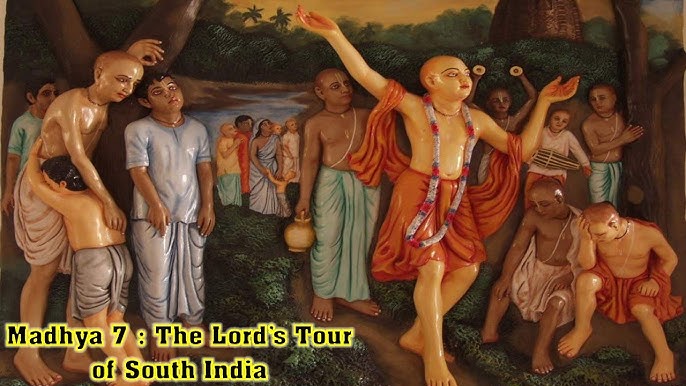
In whatever village Śrī Caitanya Mahāprabhu stayed to accept alms, many people came to see Him. (106) By the mercy of the Supreme Lord, Śrī Caitanya Mahāprabhu, everyone became a first- class devotee. Later they became teachers or spiritual masters and liberated the entire world. (107) In this way the Lord went to the extreme southern part of India, and He converted all the provinces to Vaiṣṇavism. (108) Lord Śrī Caitanya Mahāprabhu did not manifest His spiritual potencies at Navadvīpa, but He did manifest them in South India and liberated all the people there. (109) Lord Śrī Caitanya Mahāprabhu’s empowering of others can be understood by one who is actually a devotee of the Lord and who has received His mercy. (110)

If one does not believe in the uncommon transcendental pastimes of the Lord, he is vanquished both in this world and in the next. (111) Whatever I have stated about the beginning of the Lord’s tour should also be understood to hold for as long as the Lord toured South India. (112) When Lord Śrī Caitanya Mahāprabhu came to the holy place known as Kūrma- kṣetra, He saw the Deity and offered prayers and obeisances. (113) While at this place, Lord Śrī Caitanya Mahāprabhu was in His usual ecstasy of love of Godhead and was laughing, crying, dancing and chanting. Everyone who saw Him was astonished. (114) After hearing of these wonderful occurrences, everyone came to see Him there. When they saw the beauty of the Lord and His ecstatic condition, they were all struck with wonder. (115) Just by seeing Lord Caitanya Mahāprabhu, everyone became a devotee. They began to chant “Kṛṣṇa” and “Hari” and all the holy names. They all were merged in a great ecstasy of love, and they began to dance, raising their arms. (116)

Always hearing them chant the holy names of Lord Kṛṣṇa, the residents of all the other villages also became Vaiṣṇavas. (117) By hearing the holy name of Kṛṣṇa, the entire country became Vaiṣṇava. It was as if the nectar of the holy name of Kṛṣṇa overflooded the entire country. (118) After some time, when Lord Śrī Caitanya Mahāprabhu manifested His external consciousness, a priest of the Lord Kūrma Deity gave Him various offerings. (119) Śrī Caitanya Mahāprabhu’s mode of preaching has already been explained, and I shall not repeat the explanation. In whichever village the Lord entered, His behavior was the same. (120) In one village there was a Vedic brāhmaṇa named Kūrma. He invited Lord Caitanya Mahāprabhu to his home with great respect and devotion. (121) This brāhmaṇa brought Lord Caitanya Mahāprabhu to his home, washed His lotus feet and, with his family members, drank that water. (122)

With great affection and respect, that Kūrma brāhmaṇa made Śrī Caitanya Mahāprabhu eat all kinds of food. After that, the remnants were shared by all the members of the family. (123) The brāhmaṇa then began to pray, “O my Lord, Your lotus feet are meditated upon by Lord Brahmā, and these very lotus feet have come into my home. (124) “My dear Lord, there is no limit to my great fortune. It cannot be described. Today my family, birth and riches have all been glorified.” (125) The brāhmaṇa begged Lord Caitanya Mahāprabhu, “My dear Lord, kindly show me favor and let me go with You. I can no longer tolerate the waves of misery caused by materialistic life.” (126) Śrī Caitanya Mahāprabhu replied, “Don’t speak like that again. Better to remain at home and chant the holy name of Kṛṣṇa always. (127) “Instruct everyone to follow the orders of Lord Śrī Kṛṣṇa as they are given in the Bhagavad- gītā and Śrīmad- Bhāgavatam. In this way become a spiritual master and try to liberate everyone in this land.” (128)

Śrī Caitanya Mahāprabhu further advised the brāhmaṇa Kūrma, “If you follow this instruction, your materialistic life at home will not obstruct your spiritual advancement. Indeed, if you follow these regulative principles, we will again meet here, or, rather, you will never lose My company.” (129) At whosever house Śrī Caitanya accepted His alms by taking prasādam, He would convert the dwellers to His saṅkīrtana movement and advise them just as He advised the brāhmaṇa named Kūrma. (130) While on His tour, Śrī Caitanya Mahāprabhu would spend the night at a temple or on the roadside. Whenever He accepted food from a person, He would give him the same advice He gave the brāhmaṇa named Kūrma. He adopted this process until He returned to Jagannātha Purī from His South Indian tour. (131-132)

Thus I have described the Lord’s behavior elaborately in the case of Kūrma. In this way, you will know Śrī Caitanya Mahāprabhu’s dealings throughout South India. (133) Thus Lord Śrī Caitanya Mahāprabhu would remain at night in one place, and the next morning, after bathing, He would start again. (134) When Śrī Caitanya Mahāprabhu left, the brāhmaṇa Kūrma followed Him a great distance, but eventually Lord Caitanya took care to send him back home. (135) There was also a brāhmaṇa named Vāsudeva, who was a great person but was suffering from leprosy. Indeed, his body was filled with living worms. (136) Although suffering from leprosy, the brāhmaṇa Vāsudeva was enlightened. As soon as one worm fell from his body, he would pick it up and place it back again in the same location. (137) Then one night Vāsudeva heard of Lord Caitanya Mahāprabhu’s arrival, and in the morning he came to see the Lord at the house of Kūrma. (138)

When the leper Vāsudeva came to Kūrma’s house to see Caitanya Mahāprabhu, he was informed that the Lord had already left. The leper then fell to the ground unconscious. (139) When Vāsudeva, the leper brāhmaṇa, was lamenting due to not being able to see Caitanya Mahāprabhu, the Lord immediately returned to that spot and embraced him. (140) When Śrī Caitanya Mahāprabhu touched him, both the leprosy and his distress went to a distant place. Indeed, Vāsudeva’s body became very beautiful, to his great happiness. (141) The brāhmaṇa Vāsudeva was astonished to behold the wonderful mercy of Śrī Caitanya Mahāprabhu, and he began to recite a verse from Śrīmad- Bhāgavatam, touching the Lord’s lotus feet. (142) He said, “‘Who am I? A sinful, poor friend of a brāhmaṇa. And who is Kṛṣṇa? The Supreme Personality of Godhead, full in six opulences. Nonetheless, He has embraced me with His two arms.’” (143)

The brāhmaṇa Vāsudeva continued, “O my merciful Lord, such mercy is not possible for ordinary living entities. Such mercy can be found only in You. Upon seeing me, even a sinful person goes away due to my bad bodily odor. Yet You have touched me. Such is the independent behavior of the Supreme Personality of Godhead.” (144-145) Being meek and humble, the brāhmaṇa Vāsudeva worried that he would become proud after being cured by the grace of Śrī Caitanya Mahāprabhu. (146) To protect the brāhmaṇa, Śrī Caitanya Mahāprabhu advised him to chant the Hare Kṛṣṇa mantra incessantly. By doing so, he would never become unnecessarily proud. (147)

Śrī Caitanya Mahāprabhu also advised Vāsudeva to preach about Kṛṣṇa and thus liberate living entities. As a result, Kṛṣṇa would very soon accept him as His devotee. (148) After instructing the brāhmaṇa Vāsudeva in that way, Śrī Caitanya Mahāprabhu disappeared from that place. Then the two brāhmaṇas, Kūrma and Vāsudeva, embraced each other and began to cry, remembering the transcendental qualities of Śrī Caitanya Mahāprabhu. (149) Thus I have described how Śrī Caitanya Mahāprabhu reclaimed the leper Vāsudeva and so received the name Vāsudevāmṛta- prada. (150) Thus I end my description of the beginning of the tour of Śrī Caitanya Mahāprabhu, His visiting the temple of Kūrma and His liberating the leper brāhmaṇa Vāsudeva. (151) One who hears these pastimes of Śrī Caitanya Mahāprabhu with great faith will surely very soon attain the lotus feet of Lord Śrī Caitanya Mahāprabhu. (152) I admit that I do not know the beginning or the end of Śrī Caitanya Mahāprabhu’s pastimes. However, whatever I have written I have heard from the mouths of great personalities. (153) O devotees, please do not consider my offenses in this regard. Your lotus feet are my only shelter. (154) Praying at the lotus feet of Śrī Rūpa and Śrī Raghunātha, always desiring their mercy, I, Kṛṣṇadāsa, narrate Śrī Caitanya- caritāmṛta, following in their footsteps. (155)

Chaitanya Charitamrta | Madhya Lila | Chapter 7 | Section 75

0

After staying five days at the home of Sārvabhauma Bhaṭṭācārya, Śrī Caitanya Mahāprabhu personally asked his permission to depart for South India. (54) After receiving the Bhaṭṭācārya’s permission, Lord Caitanya Mahāprabhu went to see Lord Jagannātha in the temple. He took the Bhaṭṭācārya with Him. (55) Seeing Lord Jagannātha, Śrī Caitanya Mahāprabhu also begged His permission. The priest then immediately delivered prasādam and a garland to Lord Caitanya. (56) Thus receiving Lord Jagannātha’s permission in the form of a garland, Śrī Caitanya Mahāprabhu offered obeisances, and then in great jubilation He prepared to depart for South India. (57)

Accompanied by His personal associates and Sārvabhauma Bhaṭṭācārya, Śrī Caitanya Mahāprabhu circumambulated the altar of Jagannātha. The Lord then departed on His South Indian tour. (58) While the Lord was going along the path to Ālālanātha, which was located on the seashore, Sārvabhauma Bhaṭṭācārya gave the following orders to Gopīnātha Ācārya. (59) “Bring the four sets of loincloths and outer garments I keep at home, and also some prasādam of Lord Jagannātha. You may carry these things with the help of some brāhmaṇa.” (60) While Lord Śrī Caitanya Mahāprabhu was departing, Sārvabhauma Bhaṭṭācārya submitted the following at His lotus feet: “My Lord, I have one final request that I hope You will kindly fulfill. (61) “In the town of Vidyānagara, on the bank of the Godāvarī, there is a responsible government officer named Rāmānanda Rāya. (62) “Please do not neglect him, thinking he belongs to a śūdra family engaged in material activities. It is my request that You meet him without fail.” (63)

Sārvabhauma Bhaṭṭācārya continued, “Rāmānanda Rāya is a fit person to associate with You; no other devotee can compare with him in knowledge of the transcendental mellows. (64) “He is a most learned scholar as well as an expert in devotional mellows. Actually he is most exalted, and if You talk with him, You will see how glorious he is. (65) “I could not realize when I first spoke with Rāmānanda Rāya that his topics and endeavors were all transcendentally uncommon. I made fun of him simply because he was a Vaiṣṇava.” (66) The Bhaṭṭācārya said, “By Your mercy I can now understand the truth about Rāmānanda Rāya. In talking with him, You also will acknowledge his greatness.” (67) Lord Śrī Caitanya Mahāprabhu accepted Sārvabhauma Bhaṭṭācārya’s request that He meet Rāmānanda Rāya. Bidding Sārvabhauma farewell, the Lord embraced him. (68) Śrī Caitanya Mahāprabhu asked the Bhaṭṭācārya to bless Him while he engaged in the devotional service of Lord Kṛṣṇa at home, so that by Sārvabhauma’s mercy the Lord could return to Jagannātha Purī. (69)

Saying this, Śrī Caitanya Mahāprabhu departed on His tour, and Sārvabhauma Bhaṭṭācārya immediately fainted and fell to the ground. (70) Although Sārvabhauma Bhaṭṭācārya fainted, Śrī Caitanya Mahāprabhu did not take notice of him. Rather, He left quickly. Who can understand the mind and intention of Śrī Caitanya Mahāprabhu? (71) This is the nature of the mind of an uncommon personality. Sometimes it is soft like a flower, but sometimes it is as hard as a thunderbolt. (72) “The hearts of those above common behavior are sometimes harder than a thunderbolt and sometimes softer than a flower. How can one accommodate such contradictions in great personalities?” (73) Lord Nityānanda Prabhu raised Sārvabhauma Bhaṭṭācārya and with the help of His men saw him to his home. (74) Immediately all the devotees came and partook of Śrī Caitanya Mahāprabhu’s company. Afterwards, Gopīnātha Ācārya came with the garments and prasādam. (75) All the devotees followed Śrī Caitanya Mahāprabhu to a place known as Ālālanātha. There they all offered respects and various prayers. (76) In great ecstasy, Śrī Caitanya Mahāprabhu danced and chanted for some time. Indeed, all the neighbors came to see Him. (77)

All around Śrī Caitanya Mahāprabhu, who is also known as Gaurahari, people began to shout the holy name of Hari. Lord Caitanya, immersed in His usual ecstasy of love, danced in the midst of them. (78) The body of Śrī Caitanya Mahāprabhu was naturally very beautiful. It was like molten gold dressed in saffron cloth. Indeed, He was most beautiful for being ornamented with the ecstatic symptoms, which caused His bodily hair to stand on end, tears to well up in His eyes, and His body to tremble and perspire all over. (79) Everyone present was astonished to see Śrī Caitanya Mahāprabhu’s dancing and His bodily transformations. Whoever came did not want to return home. (80) Everyone— including children, old men and women— began to dance and to chant the holy names of Śrī Kṛṣṇa and Gopāla. In this way they all floated in the ocean of love of Godhead. (81) Upon seeing the chanting and dancing of Lord Śrī Caitanya Mahāprabhu, Lord Nityānanda predicted that later there would be dancing and chanting in every village. (82)

Seeing that it was already getting late, Lord Nityānanda Prabhu, the spiritual master, invented a means to disperse the crowd. (83) When Lord Nityānanda Prabhu took Śrī Caitanya Mahāprabhu for lunch at noon, everyone came running around Them. (84) After finishing Their baths, They returned at noon to the temple. Admitting His own men, Śrī Nityānanda Prabhu closed the outside door. (85) Gopīnātha Ācārya then brought prasādam for the two Lords to eat, and after They had eaten, the remnants of the food were distributed to all the devotees. (86) Hearing about this, everyone there came to the outside door and began chanting the holy name, “Hari! Hari!” Thus there was a tumultuous sound. (87)

After lunch, Śrī Caitanya Mahāprabhu made them open the door. In this way everyone received His audience with great pleasure. (88) The people came and went until evening, and all of them became Vaiṣṇava devotees and began to chant and dance. (89) Śrī Caitanya Mahāprabhu then passed the night there and discussed the pastimes of Lord Kṛṣṇa with His devotees with great pleasure. (90) The next morning, after taking His bath, Śrī Caitanya Mahāprabhu started on His South Indian tour. He bade farewell to the devotees by embracing them. (91) Although they all fell to the ground unconscious, the Lord did not turn to see them but proceeded onward. (92) In separation, the Lord became very much perturbed and walked on unhappily. His servant, Kṛṣṇadāsa, who was carrying His waterpot, followed behind. (93) All the devotees remained there and fasted, and the next day they all unhappily returned to Jagannātha Purī. (94)

Almost like a mad lion, Lord Śrī Caitanya Mahāprabhu went on His tour filled with ecstatic love and performing saṅkīrtana, chanting Kṛṣṇa’s names as follows. (95) The Lord chanted: Kṛṣṇa! Kṛṣṇa! Kṛṣṇa! Kṛṣṇa! Kṛṣṇa! Kṛṣṇa! Kṛṣṇa! He – Kṛṣṇa! Kṛṣṇa! Kṛṣṇa! Kṛṣṇa! Kṛṣṇa! Kṛṣṇa! Kṛṣṇa! He – Kṛṣṇa! Kṛṣṇa! Kṛṣṇa! Kṛṣṇa! Kṛṣṇa! Kṛṣṇa! rakṣa mām – Kṛṣṇa! Kṛṣṇa! Kṛṣṇa! Kṛṣṇa! Kṛṣṇa! Kṛṣṇa! pāhi mām – That is, “O Lord Kṛṣṇa, please protect Me and maintain Me.” He also chanted: Rāma! Rāghava! Rāma! Rāghava! Rāma! Rāghava! rakṣa mām – Kṛṣṇa! Keśava! Kṛṣṇa! Keśava! Kṛṣṇa! Keśava! pāhi mām – That is, “O Lord Rāma, descendant of King Raghu, please protect Me. O Kṛṣṇa, O Keśava, killer of the Keśī demon, please maintain Me.” (96) Chanting this verse, Lord Śrī Caitanya Mahāprabhu, known as Gaurahari, went on His way. As soon as He saw someone, He would request him to chant “Hari! Hari!” (97) Whoever heard Lord Caitanya Mahāprabhu chant “Hari! Hari!” also chanted the holy name of Lord Hari and Kṛṣṇa. In this way they all followed the Lord, very eager to see Him. (98)

After some time the Lord would embrace these people and bid them return home, having invested each of them with spiritual potency. (99) Each of these empowered persons would return to his own village, always chanting the holy name of Kṛṣṇa and sometimes laughing, crying and dancing. (100) Such an empowered person would request everyone and anyone— whomever he saw—to chant the holy name of Kṛṣṇa. In this way all the villagers would also become devotees of the Supreme Personality of Godhead. (101) People from different villages who came to see such an empowered individual would become like him simply by seeing him and receiving the mercy of his glance. (102) When each of these newly empowered individuals returned to his own village, he also converted the villagers into devotees. And when others came from different villages to see him, they were also converted. (103) In this way, as empowered men went from one village to another, all the people of South India became devotees. (104) Thus many hundreds of people became Vaiṣṇavas when they passed the Lord on the way and were embraced by Him. (105)

Chaitanya Charitamrta | Madhya Lila | Chapter 7 | Section 74

0

Lord Caitanya Mahāprabhu, being very compassionate toward a brāhmaṇa named Vāsudeva, cured him of leprosy. He transformed him into a beautiful man satisfied with devotional service. I offer my respectful obeisances unto the glorious Lord Śrī Caitanya Mahāprabhu. (1) All glories to Lord Caitanya Mahāprabhu! All glories to Lord Nityānanda Prabhu! All glories to Advaita Ācārya! And all glories to all the devotees of Lord Caitanya! (2) After delivering Sārvabhauma Bhaṭṭācārya, the Lord desired to go to South India to preach. (3) Śrī Caitanya Mahāprabhu accepted the renounced order during the waxing fortnight of the month of Māgha. During the following month, Phālguna, He went to Jagannātha Purī and resided there. (4) At the end of the month of Phālguna, He witnessed the Dola- yātrā ceremony, and in His usual ecstatic love of God, He chanted and danced in various ways on the occasion. (5)

During the month of Caitra, while living at Jagannātha Purī, the Lord delivered Sārvabhauma Bhaṭṭācārya, and at the beginning of the next month (Vaiśākha), He decided to go to South India. (6) Śrī Caitanya Mahāprabhu called all His devotees together and, holding them by the hand, humbly informed them, “You are all more dear to Me than My life. I can give up My life, but to give you up is difficult for Me. (7-8) “You are all My friends, and you have properly executed the duties of friends by bringing Me here to Jagannātha Purī and giving Me the chance to see Lord Jagannātha in the temple. (9) “I now beg all of you for one bit of charity. Please give Me permission to leave for a tour of South India. (10) “I shall go to search out Viśvarūpa. Please forgive Me, but I want to go alone; I do not wish to take anyone with Me. (11) “Until I return from Setubandha, all of you dear friends should remain at Jagannātha Purī.” (12)

Knowing everything, Śrī Caitanya Mahāprabhu was aware that Viśvarūpa had already passed away. A pretense of ignorance was necessary, however, so that He could go to South India and liberate the people there. (13) Upon hearing this message from Śrī Caitanya Mahāprabhu, all the devotees became very unhappy and remained silent with sullen faces. (14) Nityānanda Prabhu then said, “How is it possible for You to go alone? Who can tolerate this? (15) “Let one or two of us go with You; otherwise You may fall into the clutches of thieves and rogues along the way. They may be whomever You like, but two persons should go with You. (16) “Indeed, I know all the paths to the different places of pilgrimage in South India. Just order Me, and I shall go with You.” (17) The Lord replied, “I am simply a dancer, and You are the wire- puller. However You pull the wires to make Me dance, I shall dance in that way. (18) “After accepting the sannyāsa order, I decided to go to Vṛndāvana, but You took Me instead to the house of Advaita Prabhu. (19) “While on the way to Jagannātha Purī, You broke My sannyāsa staff. I know that all of you have great affection for Me, but such things disturb My activities. (20)

“Jagadānanda wants Me to enjoy bodily sense gratification, and out of fear I do whatever he tells Me. (21) “If I sometimes do something against his desire, out of anger he will not talk to Me for three days. (22) “Being a sannyāsī, I have a duty to lie down on the ground and to take a bath three times a day, even during the winter. But Mukunda becomes very unhappy when he sees My severe austerities. (23) “Of course, Mukunda does not say anything, but I know that he is very unhappy within, and upon seeing him unhappy, I become twice as unhappy. (24) “Although I am in the renounced order of life and Dāmodara is a brahmacārī, he still keeps a stick in his hand just to educate Me. (25) “According to Dāmodara, I am still a neophyte as far as social etiquette is concerned; therefore he does not like My independent nature. (26) “Dāmodara Paṇḍita and others are more advanced in receiving the mercy of Lord Kṛṣṇa; therefore they are independent of public opinion. As such, they want Me to enjoy sense gratification, even though it be unethical. But since I am a poor sannyāsī, I cannot abandon the duties of the renounced order, and therefore I follow them strictly. (27)

“You should all therefore remain here in Nīlācala for some days while I tour the sacred places of pilgrimage alone.” (28) Actually the Lord was controlled by the good qualities of all His devotees. On the pretense of attributing faults, He tasted all these qualities. (29) No one can properly describe Lord Śrī Caitanya Mahāprabhu’s affection for His devotees. He always tolerated all kinds of personal unhappiness resulting from His acceptance of the renounced order of life. (30) The regulative principles observed by Caitanya Mahāprabhu were sometimes intolerable, and all the devotees became greatly affected by them. Although strictly observing the regulative principles, Caitanya Mahāprabhu could not tolerate the unhappiness felt by His devotees. (31) Therefore, to prevent them from accompanying Him and becoming unhappy, Śrī Caitanya Mahāprabhu declared their good qualities to be faults. (32)

Four devotees then humbly insisted that they go with the Lord, but Śrī Caitanya Mahāprabhu, being the independent Supreme Personality of Godhead, did not accept their request. (33) Thereupon Lord Nityānanda said, “Whatever You order is My duty, regardless of whether it results in happiness or unhappiness. (34) “Yet I still submit one petition to You. Please consider it, and if You think it proper, please accept it. (35) “You must take with You a loincloth, external clothes and a waterpot. You should take nothing more than this. (36) “Since Your two hands will always be engaged in chanting and counting the holy names, how will You be able to carry the waterpot and external garments? (37) “When, along the way, You fall unconscious in ecstatic love of Godhead, who will protect Your belongings—the waterpot, garments and so forth?” (38) Śrī Nityānanda Prabhu continued, “Here is a simple brāhmaṇa named Kṛṣṇadāsa. Please accept him and take him with You. That is My request. (39) “He will carry Your waterpot and garments. You may do whatever You like; he will not say a word.” (40)

Accepting the request of Lord Nityānanda Prabhu, Lord Caitanya took all His devotees and went to the house of Sārvabhauma Bhaṭṭācārya. (41) As soon as they entered his house, Sārvabhauma Bhaṭṭācārya offered the Lord obeisances and a place to sit. After seating all the others, the Bhaṭṭācārya took his seat. (42) After they had discussed various topics about Lord Kṛṣṇa, Śrī Caitanya Mahāprabhu informed Sārvabhauma Bhaṭṭācārya, “I have come to your place just to receive your order. (43) “My elder brother, Viśvarūpa, has taken sannyāsa and gone to South India. Now I must go search for Him. (44) “Please permit Me to go, for I must tour South India. With your permission, I shall soon return very happily.” (45) Upon hearing this, Sārvabhauma Bhaṭṭācārya became very much agitated. Catching hold of the lotus feet of Caitanya Mahāprabhu, he gave this sorrowful reply. (46)

“After many births, due to some pious activity I got Your association. Now providence is breaking this invaluable association. (47) “If a thunderbolt falls on my head or if my son dies, I can tolerate it. But I cannot endure the unhappiness of separation from You. (48) “My dear Lord, You are the independent Supreme Personality of Godhead. Certainly You will depart. I know that. Still, I ask You to stay here a few days more so that I can see Your lotus feet.” (49) Upon hearing Sārvabhauma Bhaṭṭācārya’s request, Caitanya Mahāprabhu relented. He stayed a few days longer and did not depart. (50) The Bhaṭṭācārya eagerly invited Lord Caitanya Mahāprabhu to his home and fed Him very nicely. (51) The Bhaṭṭācārya’s wife, whose name was Ṣāṭhīmātā (the mother of Ṣāṭhī), did the cooking. The narrations of these pastimes are very wonderful. (52) Later I shall tell about this in elaborate detail, but at present I wish to describe Śrī Caitanya Mahāprabhu’s South Indian tour. (53)

Significance For India–Russia Spiritual Diplomacy

0

Prime Minister Narendra Modi’s decision to gift a Russian edition of the Bhagavad-gītā to President Vladimir Putin during the latter’s state visit to India carries deep spiritual and historical significance for India–Russia relations. The book presented is the Russian translation of Bhagavad-gītā As It Is by His Divine Grace A. C. Bhaktivedanta Swami Prabhupāda, founder-ācārya of ISKCON, whose commentary has become one of the most widely read editions of the Gītā worldwide.​

Modi–Putin meeting and the Gītā

Welcoming President Putin at Delhi’s Palam Airport on 4 December 2025, Prime Minister Modi stepped beyond usual protocol by personally receiving him with a warm embrace and accompanying him in the same car to a private dinner at his residence. During this interaction, he presented a Russian copy of Bhagavad-gītā As It Is and later wrote on his official X account that the teachings of the Gītā offer inspiration to millions across the world.​

Putin is in India for a two-day visit to attend the 23rd India–Russia Annual Summit, during which the two sides are expected to sign more than ten inter-governmental agreements and over fifteen commercial MoUs. His programme includes paying homage at Mahatma Gandhi’s memorial at Rajghat, holding bilateral talks with the Prime Minister, and participating in a business forum focused on expanding economic cooperation.​

About “Bhagavad-gītā As It Is”

Bhagavad-gītā As It Is is the translation and commentary on the Bhagavad-gītā by A. C. Bhaktivedanta Swami Prabhupāda, who is revered in the Gauḍīya Vaiṣṇava tradition as the founder-ācārya of the International Society for Krishna Consciousness (ISKCON). First published by the Bhaktivedanta Book Trust in 1968, this edition has since been translated into around eighty languages, including Russian, with more than one hundred million copies distributed globally.

The Russian edition gifted to President Putin represents the same disciplic understanding of the Gītā that has guided the worldwide Hare Krishna movement, making it not only a state gift but also a spiritual bridge between Indian Vaiṣṇava paramparā and Russian readers. Scholars and diplomats have often noted that Prabhupāda’s edition is distinctive because it presents the original Sanskrit, transliteration, word-for-word meanings, translation, and extensive purports that explain the text through the lens of bhakti-yoga.

Earlier controversy and its resolution in Russia

The gifting of Bhagavad-gītā As It Is in Russian also recalls an important episode in recent India–Russia cultural history. In 2011, a public prosecutor in Tomsk, Russia, sought to have the Russian edition of Bhagavad-gītā As It Is declared “extremist” literature, alleging that certain commentaries incited religious hatred, which led to widespread concern in India and among international Hindu communities.

The case triggered strong reactions from Indian Parliament, religious leaders of multiple faiths, and the academic community in both countries, who emphasized that the Gītā is a revered scripture promoting self-discipline, duty, and spiritual harmony. In December 2011, the district court rejected the plea to ban the book, and in March 2012 the appeal court upheld this decision, after which Russian prosecutors dropped further challenges—an outcome welcomed as a victory for religious freedom and for the dignity of the Gītā in Russia.

Significance for India–Russia spiritual diplomacy

Presenting Bhagavad-gītā As It Is in Russian translation at the highest political level symbolizes how India’s spiritual heritage is being placed at the center of its contemporary diplomacy with Russia. The gesture underscores that the Gītā is not merely a Hindu scripture confined to India but a universal text that has deeply influenced seekers, scholars, and leaders across cultures, including in Russia where translations have circulated since the eighteenth century.​

For the Vaiṣṇava community and devotees associated with ISKCON and similar institutions, the fact that the edition chosen is by ISKCON’s founder-ācārya highlights the continuing role of Prabhupāda’s translations in carrying the message of Kṛṣṇa-bhakti to foreign lands. For platforms like Vedavarsity, this event offers a contemporary example of how classical śāstra, presented “as it is” in the paramparā, can serve as a living link between nations, peoples, and civilisations in the modern world.​

Stay Connected

16,985FansLike
12,500FollowersFollow
61,453SubscribersSubscribe