Mail ID: contact@vedavarsity.com

Contact: +91 9634998911

Google search engineGoogle search engine
Home Blog Page 119

Chaitanya Charitamrta | Madhya Lila | Chapter 15 | Section 109

0

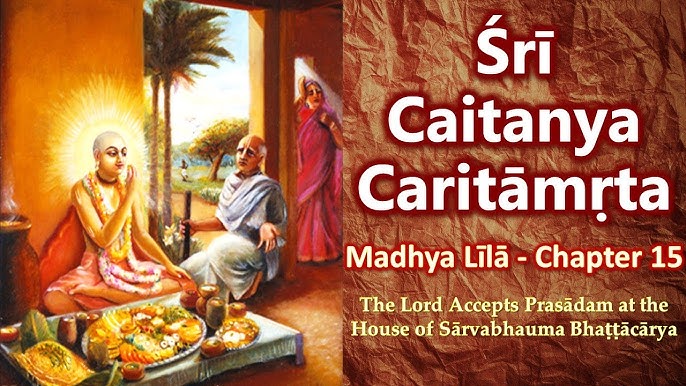
While Śrī Caitanya Mahāprabhu was taking prasādam at the house of Sārvabhauma Bhaṭṭācārya, Amogha criticized Him. Still, the Lord accepted Amogha, thereby showing how much He was obliged to His devotees. (1) All glories to Śrī Caitanya Mahāprabhu! All glories to Lord Nityānanda Prabhu! All glories to Advaitacandra! And all glories to all the devotees of Lord Caitanya! (2) All glories to the listeners of Śrī Caitanya- caritāmṛta who have accepted it as their life and soul! (3) While Śrī Caitanya Mahāprabhu stayed at Jagannātha Purī, He constantly enjoyed chanting and dancing with His devotees. (4) In the beginning of the day, Śrī Caitanya Mahāprabhu saw the Deity of Lord Jagannātha in the temple. He offered Him obeisances and prayers and danced and sang before Him. (5)

After visiting the temple, Śrī Caitanya Mahāprabhu would remain outside during the upala- bhoga offering. He would then go meet Haridāsa Ṭhākura and return to His residence. (6) Sitting in His room, Śrī Caitanya Mahāprabhu would chant on His beads, and Advaita Prabhu would come there to worship the Lord. (7) While worshiping Śrī Caitanya Mahāprabhu, Advaita Ācārya would offer Him scented water to wash His mouth and feet. Then Advaita Ācārya would smear very fragrant sandalwood pulp all over His body. (8) Śrī Advaita Prabhu would also place a flower garland around the Lord’s neck and tulasī flowers [mañjarīs] on His head. Then, with folded hands, Advaita Ācārya would offer obeisances and prayers unto the Lord. (9) After being worshiped by Advaita Ācārya, Śrī Caitanya Mahāprabhu would take the dish containing flowers and tulasī and, with whatever paraphernalia remained, worship Advaita Ācārya. (10)

Śrī Caitanya Mahāprabhu would worship Advaita Ācārya by chanting the mantra “Whatever You are, You are—but I offer My respects unto You.” In addition, the Lord would make some sounds within His mouth that would make Advaita Ācārya laugh. (11) In this way Advaita Ācārya and Śrī Caitanya Mahāprabhu would offer Their respectful obeisances unto each other. Then Advaita Ācārya would extend an invitation to Śrī Caitanya Mahāprabhu again and again. (12) Indeed, Śrī Advaita Ācārya’s invitation is another wonderful story. It has been very vividly described by Vṛndāvana dāsa Ṭhākura. (13) Since Advaita Ācārya’s invitation has been described by Vṛndāvana dāsa Ṭhākura, I shall not repeat the story. But I shall say that other devotees also extended invitations to Śrī Caitanya Mahāprabhu. (14) Day after day, one devotee after another would invite Śrī Caitanya Mahāprabhu and the other devotees to lunch and would also hold a festival. (15)

All the devotees remained at Jagannātha Purī for four continuous months, and they observed all Lord Jagannātha’s festivals with great pleasure. (16) The devotees celebrated the festival of Janmāṣṭamī, Kṛṣṇa’s birthday, which is also called Nanda- mahotsava, the festival of Nanda Mahārāja. At that time Śrī Caitanya Mahāprabhu and His devotees dressed themselves as cowherd boys. (17) Having dressed up like cowherd boys, all the devotees carried pots of milk and yogurt balanced on rods over their shoulders. Thus they all arrived at the festival grounds chanting the holy name of Hari. (18) Kānāñi Khuṭiyā dressed himself like Nanda Mahārāja, and Jagannātha Māhiti dressed himself as mother Yaśodā. (19) At that time, King Pratāparudra was also personally present with Kāśī Miśra, Sārvabhauma Bhaṭṭācārya and Tulasī Paḍichāpātra. (20)

As usual, Śrī Caitanya Mahāprabhu danced jubilantly. Everyone was covered with milk, yogurt and yellow turmeric water. (21) At this time Śrīla Advaita Ācārya said, “Please do not be angry. I speak the truth. I shall know that You are a cowherd boy only if You can wheel this rod about.” (22) Accepting Advaita Ācārya’s challenge, Śrī Caitanya Mahāprabhu took a big rod and began to wheel it around and around. Again and again He threw the rod into the sky and caught it when it fell. (23) Śrī Caitanya Mahāprabhu wheeled and threw the rod, sometimes over His head, sometimes behind His back, sometimes in front of Him, sometimes to His side and sometimes between His legs. All the people laughed to see this. (24) When Śrī Caitanya Mahāprabhu whirled the rod in a circle like a firebrand, the heart of everyone who saw it was astonished. (25) Nityānanda Prabhu also played at whirling the rod. Who can understand how They were ecstatically immersed in the deep emotions of the cowherd boys? (26)

Following the orders of Mahārāja Pratāparudra, the temple superintendent, named Tulasī, brought one of Lord Jagannātha’s used cloths. (27) This valuable cloth was wrapped around the head of Śrī Caitanya Mahāprabhu. The other devotees, headed by Advaita Ācārya, also had cloths wrapped about their heads. (28) In ecstasy, Kānāñi Khuṭiyā, who was dressed as Nanda Mahārāja, and Jagannātha Māhiti, who was dressed as mother Yaśodā, distributed all the riches they had stocked at home. (29) Śrī Caitanya Mahāprabhu was greatly satisfied to see this. Accepting them as His father and mother, He offered them obeisances. (30) In great ecstasy, Śrī Caitanya Mahāprabhu returned to His residence. In this way, Śrī Caitanya Mahāprabhu, known as Gaurāṅga- sundara, performed various pastimes. (31) On the day celebrating the conquest of Laṅkā—a day known as Vijayā- daśamī— Śrī Caitanya Mahāprabhu dressed up all His devotees as monkey soldiers. (32)

Displaying the emotions of Hanumān, Śrī Caitanya Mahāprabhu took up a large tree branch and, mounting the walls of the Laṅkā fort, began to dismantle it. (33) In the ecstasy of Hanumān, Śrī Caitanya Mahāprabhu angrily said, “Where is that rascal Rāvaṇa? He has kidnapped the universal mother, Sītā. Now I shall kill him and all his family.” (34) Everyone became very much astonished to see the emotional ecstasy of Śrī Caitanya Mahāprabhu, and everyone began to chant, “All glories! All glories!” again and again. (35) Śrī Caitanya Mahāprabhu and His devotees participated in all the festivals, including Rāsa- yātrā, Dīpāvalī and Utthāna- dvādaśī. (36) One day the two brothers, Śrī Caitanya Mahāprabhu and Nityānanda Prabhu, consulted with each other while sitting together in a solitary place. (37) No one could understand what the brothers discussed between Themselves, but later all the devotees could guess what the subject matter was. (38)

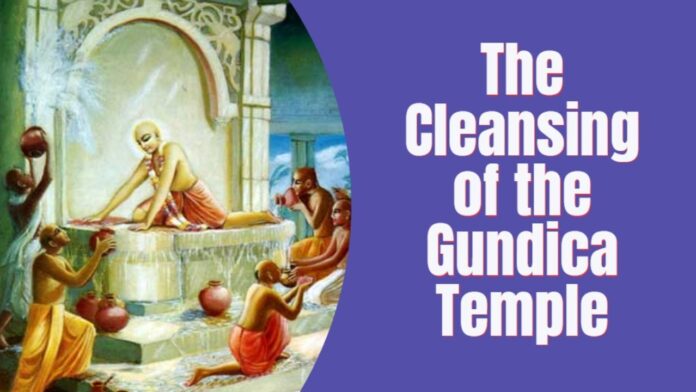
Thereafter, Śrī Caitanya Mahāprabhu called for all the devotees and asked them to return to Bengal. In this way, He bade farewell to them. (39) Bidding farewell to all the devotees, Śrī Caitanya Mahāprabhu requested them to return to Jagannātha Purī every year to see Him and then see the cleansing of the Guṇḍicā temple. (40) With great respect, Śrī Caitanya Mahāprabhu requested Advaita Ācārya, “Give Kṛṣṇa consciousness, devotion to Kṛṣṇa, even to the lowest of men [caṇḍālas].” (41) Śrī Caitanya Mahāprabhu ordered Nityānanda Prabhu, “Go to Bengal and, without restriction, manifest devotional service to the Lord, Kṛṣṇa consciousness.” (42) Nityānanda Prabhu was given assistants like Rāmadāsa, Gadādhara dāsa and several others. Śrī Caitanya Mahāprabhu said, “I give them to You to assist You. (43) “I shall also go to see You at intervals. Keeping Myself invisible, I shall watch You dance.” (44) Śrī Caitanya Mahāprabhu then embraced Śrīvāsa Paṇḍita and, with His arm about his neck, began to speak to him in sweet words. (45)

Śrī Caitanya Mahāprabhu requested Śrīvāsa Ṭhākura, “Perform congregational chanting daily, and be assured that I shall also dance in your presence. You will be able to see this dancing, but not others. (46) “Take this prasādam of Lord Jagannātha’s and this cloth and deliver them to My mother, Śacīdevī. After offering her obeisances, please request her to excuse My offenses. (47) “I have given up the service of My mother and have accepted the sannyāsa order. Actually I should not have done this, for by so doing I have destroyed My religious principles. (48) “I am subordinate to the love of My mother, and it is My duty to serve her in return. Instead of doing so, I have accepted the renounced order. Certainly this is the act of a madman. (49) “A mother is not offended by her mad son, and knowing this, My mother is not offended by Me. (50) “I had no business in accepting the renounced order and sacrificing My love for My mother, which is My real property. Actually I was in a crazy state of mind when I accepted sannyāsa. (51)

“I am staying here at Jagannātha Purī, Nīlācala, to comply with her orders. But at intervals I go see her lotus feet. (52) “Indeed, I go there daily to see her lotus feet. She is able to feel My presence, although she does not believe it to be true. (53) “One day My mother, Śacī, offered food to Śālagrāma Viṣṇu. She offered rice cooked from śāli paddies, various kinds of vegetables, spinach, curry made of banana flowers, fried paṭola with nimba leaves, pieces of ginger with lemon, and also yogurt, milk, sugar candy and many other foods. (54-55) “Taking the food upon her lap, Mother was crying to think that all that food was very dear to her Nimāi. (56) “My mother was thinking, ‘Nimāi is not here. Who will accept all this food?’ As she meditated upon Me in this way, her eyes filled with tears. (57) “While she was thus thinking and crying, I immediately went there with great haste and ate everything. Seeing the dish empty, she wiped her tears away. (58)

“She then began to wonder who had eaten all that food. ‘Why is the plate  empty?’ she wondered, doubting that Bāla- gopāla had eaten it all. (59) “She began to wonder whether there had actually been anything on the plate in the first place. Then again she thought that some animal might have come and eaten everything. (60) “She thought, ‘Perhaps by mistake I did not put any food on the plate.’ So thinking, she went into the kitchen and saw the pots. (61) “When she saw that all the pots were still filled with rice and vegetables, there was some doubt in her mind, and she was astonished. (62) “Thus wondering, she called Īśāna, the servant, and had the place cleaned again. She then offered another plate to Gopāla. (63) “Now whenever she prepares some good cooked food and wants to feed it to Me, she cries in great anxiety. (64) “Being obliged by her love, I am brought there to eat. Mother knows all these things internally and feels happiness, but externally she does not accept them. (65) “Such an incident took place on the last Vijayā- daśamī day. You can ask her about this incident and thus make her believe that I actually go there.” (66) While describing all this, Śrī Caitanya Mahāprabhu became a little overwhelmed, but just to finish bidding farewell to the devotees, He remained patient. (67)
Chaitanya Charitamrta | Madhya Lila | Chapter 14 | Section 108

0

Finally the goddess of fortune returned to her apartment. In due course of time, as Śrī Caitanya Mahāprabhu was dancing, afternoon arrived. (233) After much singing, all four saṅkīrtana parties grew fatigued, but Śrī Caitanya Mahāprabhu’s ecstatic love increased twofold. (234) While dancing absorbed in Śrīmatī Rādhārāṇī’s ecstatic love, Śrī Caitanya Mahāprabhu appeared in Her very form. Seeing this from a distant place, Nityānanda Prabhu offered prayers. (235) Seeing the ecstatic love of Śrī Caitanya Mahāprabhu, Nityānanda Prabhu did not approach but remained a little distance away. (236) Only Nityānanda Prabhu could catch Śrī Caitanya Mahāprabhu, but the ecstatic mood of the Lord would not stop. At the same time, kīrtana could not be continued. (237) Svarūpa Dāmodara then informed the Lord that all the devotees were fatigued. Seeing this situation, Śrī Caitanya Mahāprabhu came to His external senses. (238)

Śrī Caitanya Mahāprabhu then entered the flower garden with all His devotees. After resting there for some time, He took His afternoon bath. (239) Then there arrived in large quantities a variety of food that had been offered to Śrī Jagannātha and a variety that had been offered to the goddess of fortune. (240) Śrī Caitanya Mahāprabhu finished His afternoon lunch, and after His evening bath He went to see Lord Jagannātha. (241) As soon as He saw Lord Jagannātha, Śrī Caitanya Mahāprabhu began to chant and dance. Afterward, accompanied by His devotees, the Lord enjoyed sporting in the lake called Narendra- sarovara. (242) Then, entering the flower garden, Śrī Caitanya Mahāprabhu took His meal. In this way He continuously performed all kinds of pastimes for eight days. (243) The next day Lord Jagannātha came out from the temple and, riding on the car, returned to His own abode. (244)

As previously, Śrī Caitanya Mahāprabhu and His devotees chanted and danced with great pleasure. (245) During the Pāṇḍu- vijaya, Lord Jagannātha was carried, and while He was being carried, a bunch of silken ropes broke. (246) When the Jagannātha Deity is carried, at intervals He is placed on cotton pads. When the ropes broke, the cotton pads also broke due to the weight of Lord Jagannātha, and the cotton floated into the air. (247) Rāmānanda Vasu and Satyarāja Khān were present from Kulīna- grāma, and Śrī Caitanya Mahāprabhu, with great respect, gave them the following orders. (248) Śrī Caitanya Mahāprabhu ordered Rāmānanda Vasu and Satyarāja Khān to become the worshipers of these ropes and every year bring silken ropes from their village. (249)

After telling them this, Śrī Caitanya Mahāprabhu showed them the broken silken ropes, saying, “Just look at this sample. You must make ropes that are much stronger.” (250) Śrī Caitanya Mahāprabhu then informed Rāmānanda Vasu and Satyarāja Khān that this rope was the abode of Lord Śeṣa, who expands Himself into ten forms and serves the Supreme Personality of Godhead. (251) After receiving orders from the Lord for the rendering of service, the fortunate Satyarāja and Rāmānanda Vasu were highly pleased. (252) Every year thereafter, when the Guṇḍicā temple was being cleansed, Satyarāja and Rāmānanda Vasu would come with the other devotees and with great pleasure bring silken rope. (253)

Thus Lord Jagannātha returned to His temple and sat on His throne while Śrī Caitanya Mahāprabhu returned to His residence with His devotees. (254) Thus Śrī Caitanya Mahāprabhu showed the Ratha- yātrā ceremony to His devotees and performed the Vṛndāvana pastimes with them. (255) The pastimes of Lord Caitanya are unlimited and endless. Even Sahasra- vadana, Lord Śeṣa, cannot reach the limits of His pastimes. (256) Praying at the lotus feet of Śrī Rūpa and Śrī Raghunātha, always desiring their mercy, I, Kṛṣṇadāsa, narrate Śrī Caitanya- caritāmṛta, following in their footsteps. (257)

Chaitanya Charitamrta | Madhya Lila | Chapter 14 | Section 107

0

Śrī Caitanya Mahāprabhu felt unlimited happiness upon hearing these descriptions, and He again and again requested Svarūpa Dāmodara to continue speaking. (154) Dāmodara Gosvāmī said, “Kṛṣṇa is the master of all transcendental mellows and the taster of all transcendental mellows, and His body is composed of transcendental bliss. (155) “Kṛṣṇa is full of ecstatic love and always subordinate to the love of His devotees. The gopīs are very much experienced in pure love and in the dealings of transcendental mellows. (156) “There is no flaw or adulteration in the love of the gopīs; therefore they give Kṛṣṇa the highest pleasure. (157) “‘Lord Śrī Kṛṣṇa, who is the Absolute Truth, enjoyed His rāsa dance every night during the autumn season. He performed this dance in the moonlight and with full transcendental mellows. He used poetic words and surrounded Himself with women who were very much attracted to Him.’ (158)

“The gopīs can be divided into a left wing and a right wing. Both wings induce Kṛṣṇa to taste transcendental mellows by various manifestations of ecstatic love. (159) “Of all the gopīs, Śrīmatī Rādhārāṇī is the chief. She is a jewel mine of ecstatic love and the source of all purified transcendental conjugal mellows. (160) “Rādhārāṇī is grown up, and Her character is equipoised. She is always deeply absorbed in ecstatic love and always feeling in the mood of a left- wing gopī. (161) “Because She is a left- wing gopī, Her womanly anger is always awakening, but Kṛṣṇa derives transcendental bliss from Her activities. (162) “‘The progress of loving affairs between a young boy and a young girl is by nature crooked, like the movement of a snake. Because of this, two types of anger arise between a young boy and girl—anger with a cause and anger without a cause.’” (163)

As Śrī Caitanya Mahāprabhu heard these talks, His ocean of transcendental bliss increased. He therefore told Svarūpa Dāmodara, “Go on speaking, go on speaking.” And thus Svarūpa Dāmodara continued. (164) “Śrīmatī Rādhārāṇī’s love is a highly advanced ecstasy. All Her dealings are completely pure and devoid of material tinge. Indeed, Her dealings are ten times purer than gold. (165) “As soon as Rādhārāṇī gets a chance to see Kṛṣṇa, Her body is suddenly decorated with various ecstatic ornaments. (166) “The transcendental ornaments of Śrīmatī Rādhārāṇī’s body include the eight sāttvikas, or transcendental symptoms, the thirty- three vyabhicārī- bhāvas, beginning with harṣa, or jubilation in natural love, and the twenty bhāvas, or ecstatic emotional ornaments. (167) “Some of the symptoms critically explained in the following verses are kila- kiñcita, kuṭṭamita, vilāsa, lalita, vivvoka, moṭṭāyita, maugdhya and cakita. (168)

“When Śrīmatī Rādhārāṇī’s body manifests the ornaments of many ecstatic symptoms, the ocean of Kṛṣṇa’s happiness immediately displays transcendental waves. (169) “Now hear a description of different ecstasies, beginning with kila- kiñcita. With these ecstatic ornaments, Śrīmatī Rādhārāṇī enchants the mind of Kṛṣṇa. (170) “When Śrī Kṛṣṇa sees Śrīmatī Rādhārāṇī and wants to touch Her body, He prohibits Her from going to the spot where one can cross the river Yamunā. (171) “Approaching Her, Kṛṣṇa prohibits Śrīmatī Rādhārāṇī from picking flowers. He may also touch Her in front of Her friends. (172) “At such times, the ecstatic symptoms of kila- kiñcita are awakened. First there is jubilation in ecstatic love, which is the root cause of these symptoms. (173) “‘Pride, ambition, weeping, smiling, envy, fear and anger are the seven ecstatic loving symptoms manifested by a jubilant shrinking away, and these symptoms are called kila- kiñcita- bhāva.’ (174)

“There are seven other transcendental ecstatic symptoms, and when they combine on the platform of jubilation, the combination is called mahā- bhāva. (175) “The seven combined ingredients of mahā- bhāva are pride, ambition, fear, dry artificial crying, anger, envy and mild smiling. (176) “There are eight symptoms of ecstatic love on the platform of transcendental jubilation, and when they are combined and tasted by Kṛṣṇa, the Lord’s mind is completely satisfied. (177) “Indeed, they are compared to a combination of yogurt, candy, ghee, honey, black pepper, camphor and cardamom, which, when mixed together, are very tasty and sweet. (178) “Lord Śrī Kṛṣṇa is thousands upon thousands of times more satisfied when He sees Śrīmatī Rādhārāṇī’s face light up from this combination of ecstatic love than He is by direct union with Her. (179)

“‘May the sight of Śrīmatī Rādhārāṇī’s kila- kiñcita ecstasy, which is like a bouquet, bring good fortune to all. When Śrī Kṛṣṇa blocked Rādhārāṇī’s way to the dāna- ghāṭi, there was laughter within Her heart. Her eyes grew bright, and fresh tears flowed from Her eyes, reddening them. Due to Her sweet relationship with Kṛṣṇa, Her eyes were enthusiastic, and when Her crying subsided, She appeared even more beautiful.’ (180) “‘Agitated by tears, Śrīmatī Rādhārāṇī’s eyes were tinged with red, just like the eastern horizon at sunrise. Her lips began to move with jubilation and lusty desire. Her eyebrows curved, and Her lotuslike face smiled mildly. Seeing Rādhārāṇī’s face exhibit such emotion, Lord Śrī Kṛṣṇa felt a million times happier than when He embraced Her. Indeed, Lord Śrī Kṛṣṇa’s happiness is not at all mundane.’” (181) Upon hearing this, Śrī Caitanya Mahāprabhu became very happy, and being absorbed in this happiness, He embraced Svarūpa Dāmodara Gosvāmī. (182)

Śrī Caitanya Mahāprabhu then asked Svarūpa Dāmodara, “Please speak of the ecstatic ornaments decorating the body of Śrīmatī Rādhārāṇī, by which She enchants the mind of Śrī Govinda.” (183) Being thus requested, Svarūpa Dāmodara began to speak. All the devotees of Śrī Caitanya Mahāprabhu were very happy to hear him. (184) “Sometimes when Śrīmatī Rādhārāṇī is sitting or when She is going to Vṛndāvana, She sees Kṛṣṇa. (185) “The symptoms of various ecstasies that become manifest at that time are called vilāsa. (186) “‘The various symptoms manifested in a woman’s face, eyes and the other parts of her body and the way she moves, stands or sits when she meets her beloved are called vilāsa.’” (187) Svarūpa Dāmodara said, “Timidity, jubilation, ambition, respect, fear and the characteristics of the left- wing gopīs are all ecstatic symptoms that combine to agitate Śrīmatī Rādhārāṇī. (188)

“‘When Śrīmatī Rādhārāṇī saw Lord Kṛṣṇa just before Her, Her progress stopped and She assumed an attitude of opposition. Although Her face was slightly covered by a blue garment, Her two starry eyes were agitated, being wide and curved. Thus She was decorated with the ornaments of vilāsa, and Her beauty increased to give pleasure to Śrī Kṛṣṇa, the Supreme Personality of Godhead.’ (189) “When Śrīmatī Rādhārāṇī stands before Kṛṣṇa, She stands bent in three places—Her neck, waist and legs— and Her eyebrows dance. (190) “When there is an awakening of the various ecstatic features on Śrīmatī Rādhārāṇī’s face and in Her eyes that are appropriate to a charming feminine attitude, the lalita ornament is manifest. (191) “‘When the bodily features are delicate and expertly curved, and when the eyebrows are very beautifully agitated, the ornament of feminine charm, called lalita alaṅkāra, is manifest.’ (192)

“When Lord Śrī Kṛṣṇa happens to see Śrīmatī Rādhārāṇī decorated with these lalita ornaments, They both eagerly want to meet each other. (193) “‘When Śrīmatī Rādhārāṇī was decorated with the ornament of lalita alaṅkāra, just to increase Śrī Kṛṣṇa’s love, an attractive curve was manifested by Her neck, knees and waist. This was brought about by Her timidity and apparent desire to avoid Kṛṣṇa. The flickering movements of Her eyebrows could conquer the powerful bow of Cupid. To increase the joy of Her beloved, Her body was decorated with the ornaments of lalita alaṅkāra.’ (194) “When Kṛṣṇa comes forward and greedily snatches at the border of Her sari, Śrīmatī Rādhārāṇī is actually very pleased within, but still She tries to stop Him. (195) “This ecstatic attitude of Śrīmatī Rādhārāṇī’s is called kuṭṭamita. When this ecstatic ornament is manifested, Rādhārāṇī externally tries to avoid Kṛṣṇa, and She apparently becomes angry, although She is very happy within. (196) “‘When the border of Her sari and the cloth veiling Her face are caught, She externally appears offended and angry, but within Her heart She is very happy. Learned scholars call this attitude kuṭṭamita.’ (197)

“Although Śrīmatī Rādhārāṇī was checking Kṛṣṇa with Her hand, internally She was thinking, ‘Let Kṛṣṇa satisfy His desires.’ In this way She was very pleased within, although She externally displayed opposition and anger. (198) “Śrīmatī Rādhārāṇī externally displays a kind of dry crying, as if She is offended. Then She mildly smiles and admonishes Lord Kṛṣṇa. (199) “‘Actually She has no desire to stop Kṛṣṇa’s endeavor to touch Her body with His hands, yet Śrīmatī Rādhārāṇī, whose thighs are like the trunk of a baby elephant, protests His advances and, sweetly smiling, admonishes Him. At such times She cries without tears on Her charming face.’ (200) “In this way, Śrīmatī Rādhārāṇī is ornamented and decorated with various ecstatic symptoms, which attract the mind of Śrī Kṛṣṇa. (201)

“It is not at all possible to describe the unlimited pastimes of Śrī Kṛṣṇa, even though He Himself describes them in His incarnation of Sahasra- vadana, the thousand- mouthed Śeṣa Nāga.” (202) At this time, Śrīvāsa Ṭhākura smiled and told Svarūpa Dāmodara, “My dear sir, please hear! Just see how opulent my goddess of fortune is! (203) “As far as Vṛndāvana’s opulence is concerned, it consists of a few flowers and twigs, some minerals from the hills, a few peacock feathers and the plant known as guñjā. (204) “When Jagannātha decided to see Vṛndāvana, He went there, and upon hearing this, the goddess of fortune experienced restlessness and jealousy. (205) “She wondered, ‘Why did Lord Jagannātha give up so much opulence and go to Vṛndāvana?’ To make Him a laughingstock, the goddess of fortune made arrangements for much decoration. (206)

“Then the maidservants of the goddess of fortune said to the servants of Lord Jagannātha, ‘Why did your Lord Jagannātha abandon the great opulence of the goddess of fortune and, for the sake of a few leaves, fruits and flowers, go see the flower garden of Śrīmatī Rādhārāṇī? (207) ‘Your master is so expert at everything, but why does He do such things? Now bring your master before the goddess of fortune.’ (208) “In this way all the maidservants of the goddess of fortune arrested the servants of Jagannātha, bound them around the waist and brought them before the goddess of fortune. (209) “When all the maidservants brought Lord Jagannātha’s servants before the lotus feet of the goddess of fortune, the Lord’s servants were fined and forced to submit. (210) “All the maidservants began to beat the Ratha car with sticks, and they treated the servants of Lord Jagannātha almost like thieves. (211)

“Finally all of Lord Jagannātha’s servants submitted to the goddess of fortune with folded hands, assuring her that they would bring Lord Jagannātha before her the very next day. (212) “Being thus pacified, the goddess of fortune returned to her apartment. Just see! My goddess of fortune is opulent beyond all description.” (213) Śrīvāsa Ṭhākura continued to address Svarūpa Dāmodara: “Your gopīs are engaged in boiling milk and churning it into yogurt, but my mistress, the goddess of fortune, sits on a throne made of jewels and gems.” (214) Śrīvāsa Ṭhākura, who was enjoying the mood of Nārada Muni, thus made jokes. Hearing him, all the personal servants of Śrī Caitanya Mahāprabhu began to smile. (215) Śrī Caitanya Mahāprabhu then told Śrīvāsa Ṭhākura, “My dear Śrīvāsa, your nature is exactly like that of Nārada Muni. The Supreme Personality of Godhead’s opulence is having a direct influence upon you. (216) “Svarūpa Dāmodara is a pure devotee of Vṛndāvana. He does not even know what opulence is, for he is simply absorbed in pure devotional service.” (217)

Svarūpa Dāmodara then retorted, “My dear Śrīvāsa, please hear me with attention. You have forgotten the transcendental opulence of Vṛndāvana. (218) “The natural opulence of Vṛndāvana is just like an ocean. The opulence of Dvārakā and Vaikuṇṭha is not even to be compared to a drop. (219) “Śrī Kṛṣṇa is the Supreme Personality of Godhead, full of all opulences, and His complete opulences are exhibited only in Vṛndāvana- dhāma. (220) “Vṛndāvana- dhāma is made of transcendental touchstone. Its entire surface is the source of all valuable jewels, and the cintāmaṇi stone is used to decorate the lotus feet of the maidservants of Vṛndāvana. (221) “Vṛndāvana is a natural forest of desire trees and creepers, and the inhabitants do not want anything but the fruits and flowers of those desire trees. (222)

“In Vṛndāvana there are cows that fulfill all desires [kāma- dhenus], and their number is unlimited. They graze from forest to forest and deliver only milk. The people want nothing else. (223) “In Vṛndāvana, the natural speech of the people sounds like music, and their natural motion resembles a dance. (224) “The water in Vṛndāvana is nectar, and the brahmajyoti effulgence, which is full of transcendental bliss, is directly perceived there in its form. (225) “The gopīs there are also goddesses of fortune, and they surpass the goddess of fortune who abides in Vaikuṇṭha. In Vṛndāvana, Lord Kṛṣṇa is always playing His transcendental flute, which is His dear companion. (226) “‘The damsels of Vṛndāvana, the gopīs, are super goddesses of fortune. The enjoyer in Vṛndāvana is the Supreme Personality of Godhead, Kṛṣṇa. The trees there are all wish- fulfilling trees, and the land is made of transcendental touchstone. The water is all nectar, the talking is singing, the walking is dancing, and the constant companion of Kṛṣṇa is His flute. The effulgence of transcendental bliss is experienced everywhere. Therefore Vṛndāvana- dhāma is the only relishable abode.’ (227)

“‘The anklets on the damsels of Vraja- bhūmi are made of cintāmaṇi stone. The trees are wish- fulfilling trees, and they produce flowers with which the gopīs decorate themselves. There are also wish- fulfilling cows [kāma- dhenus], which deliver unlimited quantities of milk. These cows constitute the wealth of Vṛndāvana. Thus Vṛndāvana’s opulence is blissfully exhibited.’” (228) Śrīvāsa Ṭhākura then began to dance in ecstatic love. He vibrated sounds by slapping his armpits with the palms of his hands, and he laughed very loudly. (229) Thus Śrī Caitanya Mahāprabhu heard these discussions about the pure transcendental mellow of Śrīmatī Rādhārāṇī. Absorbed in transcendental ecstasy, the Lord began to dance. (230) While Śrī Caitanya Mahāprabhu was dancing in ecstatic love and Svarūpa Dāmodara was singing, the Lord said, “Go on singing! Go on singing!” The Lord then extended His own ears. (231) Thus Śrī Caitanya Mahāprabhu’s ecstatic love was awakened by hearing the songs of Vṛndāvana. In this way He inundated Puruṣottama, Jagannātha Purī, with love of Godhead. (232)

Chaitanya Charitamrta | Madhya Lila | Chapter 14 | Section 106

0

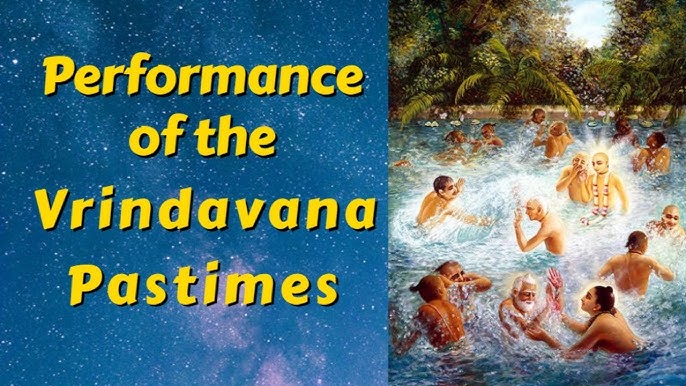
There were many gardens near the Guṇḍicā temple, and Śrī Caitanya Mahāprabhu and His devotees used to perform the pastimes of Vṛndāvana in each of them. In the lake named Indradyumna, He sported in the water. (75) The Lord personally splashed all the devotees with water, and the devotees, surrounding Him on all sides, also splashed the Lord. (76) While in the water they sometimes formed one circle and sometimes many circles, and while in the water they used to play cymbals and imitate the croaking of frogs. (77) Sometimes two would pair off to fight in the water. One would emerge victorious and the other defeated, and the Lord would watch all this fun. (78)

The first sporting took place between Advaita Ācārya and Nityānanda Prabhu, who threw water upon each other. Advaita Ācārya was defeated, and He later began to rebuke Nityānanda Prabhu, calling Him ill names. (79) Svarūpa Dāmodara and Vidyānidhi also threw water upon each other, and Murāri Gupta and Vāsudeva Datta also sported in that way. (80) Another duel took place between Śrīvāsa Ṭhākura and Gadādhara Paṇḍita, and yet another between Rāghava Paṇḍita and Vakreśvara Paṇḍita. Thus they all engaged in throwing water. (81) Indeed, Sārvabhauma Bhaṭṭācārya engaged in water sports with Śrī Rāmānanda Rāya, and they both lost their gravity and became like children. (82)

When Śrī Caitanya Mahāprabhu saw the exuberance of Sārvabhauma Bhaṭṭācārya and Rāmānanda Rāya, He smiled and spoke to Gopīnātha Ācārya. (83) “Tell the Bhaṭṭācārya and Rāmānanda Rāya to stop their childish play because they are both learned scholars and very grave and great personalities.” (84) Gopīnātha Ācārya replied, “I believe that one drop of the ocean of Your great mercy has swelled up upon them. (85) “A drop from the ocean of Your mercy can drown great mountains like Sumeru and Mandara. Since these two gentlemen are little hills by comparison, it is no wonder that they are being drowned in the ocean of Your mercy. (86) “Logic is like a dry oil cake from which all the oil has been extracted. The Bhaṭṭācārya passed his life in eating such dry cakes, but now You have made him drink the nectar of transcendental pastimes. It is certainly Your great mercy upon him.” (87)

After Gopīnātha Ācārya finished talking, Śrī Caitanya Mahāprabhu smiled and, calling for Advaita Ācārya, made Him act like the Śeṣa Nāga bed. (88) Lying down on Advaita Prabhu, who was floating on the water, Śrī Caitanya Mahāprabhu demonstrated the pastime of Śeṣaśāyī Viṣṇu. (89) Manifesting His personal potency, Advaita Ācārya floated about on the water, carrying Śrī Caitanya Mahāprabhu. (90) After sporting in the water for some time, Śrī Caitanya Mahāprabhu returned to His place at Aiṭoṭā, accompanied by His devotees. (91) Paramānanda Purī, Brahmānanda Bhāratī and all the other chief devotees of Śrī Caitanya Mahāprabhu took lunch at the invitation of Advaita Ācārya. (92) Whatever extra prasādam was brought by Vāṇīnātha Rāya was taken by the other associates of Śrī Caitanya Mahāprabhu. (93)

In the afternoon, Śri Caitanya Mahāprabhu went to the Guṇḍicā temple to visit the Lord and dance. At night He went to the garden to take rest. (94) The next day, Śrī Caitanya Mahāprabhu also went to the temple of Guṇḍicā and saw the Lord. He then chanted and danced in the yard for some time. (95) Accompanied by His devotees, Śrī Caitanya Mahāprabhu then went into the garden and enjoyed the pastimes of Vṛndāvana. (96) There were multifarious trees and creepers in the garden, and they were all jubilant to see Śrī Caitanya Mahāprabhu. Indeed, the birds were chirping, the bees were buzzing, and a cool breeze was blowing. (97) As Śrī Caitanya Mahāprabhu danced beneath each and every tree, Vāsudeva Datta sang alone. (98)

As Vāsudeva Datta sang a different song beneath each and every tree, Śrī Caitanya Mahāprabhu danced there alone in great ecstasy. (99) Śrī Caitanya Mahāprabhu then ordered Vakreśvara Paṇḍita to dance, and as he began to dance, the Lord began to sing. (100) Then devotees like Svarūpa Dāmodara and other kīrtana performers began to sing along with Śrī Caitanya Mahāprabhu. Being inundated with ecstatic love, they lost all consideration of time and circumstance. (101) After thus performing pastimes in the garden for some time, they all went to a lake called Narendra- sarovara and there enjoyed sporting in the water. (102) After sporting in the water, Śrī Caitanya Mahāprabhu returned to the garden and accepted prasādam with the devotees. (103) For nine continuous days His Lordship Śrī Jagannātha- deva stayed at the Guṇḍicā temple. During this time Śrī Caitanya Mahāprabhu also stayed there and performed the pastimes with His devotees that have already been described. (104)

The garden of His pastimes was very large and was named Jagannātha- vallabha. Śrī Caitanya Mahāprabhu took His rest there for nine days. (105) Knowing that the Herā- pañcamī festival was drawing near, King Pratāparudra attentively talked with Kāśī Miśra. (106) “Tomorrow will be the function of Herā- pañcamī or Lakṣmī- vijaya. Hold this festival in a way that it has never been held before.” (107) King Pratāparudra said, “Hold this festival in such a gorgeous way that upon seeing it Caitanya Mahāprabhu will be completely pleased and astonished. (108) “Take as many printed cloths, small bells, umbrellas and cāmaras as there are in my storehouse and in the Deity’s storehouse. (109) “Collect all kinds of small and large flags and ringing bells. Then decorate the carrier and have various musical and dancing parties accompany it. In this way decorate the carrier attractively. (110)

“You should also double the quantity of prasādam. Make so much that it will even surpass the Ratha- yātrā festival. (111) “Arrange the festival in such a way that Śrī Caitanya Mahāprabhu may freely go with His devotees to visit the Deity without difficulty.” (112) In the morning, Śrī Caitanya Mahāprabhu took His personal associates with Him to see Lord Jagannātha at Sundarācala. (113) Then Śrī Caitanya Mahāprabhu and His personal devotees returned to Nīlācala with great eagerness to see the Herā- pañcamī festival. (114) Kāśī Miśra received Caitanya Mahāprabhu with great respect, and taking the Lord and His associates to a very nice place, he had them seated. (115) After taking His seat, Śrī Caitanya Mahāprabhu wanted to hear about a particular mellow of devotional service; therefore, mildly smiling, He began to question Svarūpa Dāmodara. (116) “Although Lord Jagannātha enjoys His pastimes at Dvārakā- dhāma and naturally manifests sublime liberality there, still, once a year He becomes unlimitedly eager to see Vṛndāvana.” (117-118)

Pointing out the neighboring gardens, Śrī Caitanya Mahāprabhu said, “All these gardens exactly resemble Vṛndāvana; therefore Lord Jagannātha is very eager to see them again. (119) “Externally He gives the excuse that He wants to participate in the Ratha- yātrā festival, but actually He wants to leave Jagannātha Purī to go to Sundarācala, the Guṇḍicā temple, a replica of Vṛndāvana. (120) “The Lord enjoys His pastimes day and night in various flower gardens there. But why does He not take Lakṣmīdevī, the goddess of fortune, with Him?” (121) Svarūpa Dāmodara replied, “My dear Lord, please hear the reason for this. Lakṣmīdevī, the goddess of fortune, cannot be admitted to the pastimes of Vṛndāvana. (122) “In the pastimes of Vṛndāvana, the only assistants are the gopīs. But for the gopīs, no one can attract the mind of Kṛṣṇa.” (123) The Lord said, “Using the car festival as an excuse, Kṛṣṇa goes there with Subhadrā and Baladeva. (124)

“All the pastimes with the gopīs that take place in those gardens are very confidential ecstasies of Lord Kṛṣṇa. No one knows them. (125) “Since there is no fault at all in Kṛṣṇa’s pastimes, why does the goddess of fortune become angry?” (126) Svarūpa Dāmodara replied, “It is the nature of a girl afflicted by love to become immediately angry upon finding any neglect on the part of her lover.” (127) While Svarūpa Dāmodara and Śrī Caitanya Mahāprabhu were talking, the procession of the goddess of fortune came by. She was riding upon a golden palanquin carried by four men and bedecked with a variety of jewels. (128) The palanquin was also surrounded by people carrying umbrellas, cāmara whisks and flags, and it was preceded by musicians and dancing girls. (129)

The maidservants were carrying water pitchers, cāmara whisks and boxes for betel nuts. There were hundreds of maidservants, all attractively dressed and wearing valuable necklaces. (130) In an angry mood, the goddess of fortune arrived at the main gate of the temple accompanied by many members of her family, all of whom exhibited uncommon opulence. (131) When the procession arrived, the maidservants of the goddess of fortune began to arrest all the principal servants of Lord Jagannātha. (132) The maidservants bound the servants of Jagannātha, handcuffed them and made them fall down at the lotus feet of the goddess of fortune. Indeed, they were arrested just like thieves who have all their riches taken away. (133) When the servants fell down before the lotus feet of the goddess of fortune, they almost fell unconscious. They were chastised and made the butt of jokes and loose language. (134)

When Śrī Caitanya Mahāprabhu’s associates saw such impudence exhibited by the maidservants of the goddess of fortune, they covered their faces with their hands and began to smile. (135) Svarūpa Dāmodara said, “There is no egoistic pride like this within the three worlds. At least I have never seen it or heard of it. (136) “When a woman is neglected and disappointed, out of egoistic pride she gives up her ornaments and morosely sits down on the ground, marking lines on it with her nails. (137) “I have heard of this kind of pride in Satyabhāmā, Kṛṣṇa’s proudest queen, and I have also heard of it in the gopīs of Vṛndāvana, who are the reservoirs of all transcendental mellows. (138) “But in the case of the goddess of fortune, I see a different kind of pride. She manifests her own opulences and even goes with her soldiers to attack her husband.” (139) Śrī Caitanya Mahāprabhu said, “Please tell me of the varieties of egoistic pride manifested in Vṛndāvana.” Svarupa Dāmodara replied, “The pride of the gopīs is like a river flowing with hundreds of tributaries. (140)

“The characteristics and modes of love are different in different women. Their jealous anger also takes on different varieties and qualities. (141) “It is not possible to give a complete statement about the different types of jealous anger manifest by the gopīs, but a few principles may serve as an indication. (142) “There are three types of women experiencing jealous anger: sober women, restless women and women both restless and sober. (143) “When a sober heroine sees her hero approaching from a distance, she immediately stands up to receive him. When he comes near, she immediately offers him a place to sit. (144) “The sober heroine conceals her anger within her heart and externally speaks sweet words. When her lover embraces her, she returns his embrace. (145) “The sober heroine is very simple in her behavior. She keeps her jealous anger within her heart, but with mild words and smiles she rejects the advances of her lover. (146)

“The restless heroine, however, sometimes chastises her lover with cruel words, sometimes pulls his ear and sometimes binds him with a flower garland. (147) “The heroine who is a combination of sobriety and restlessness always jokes with equivocal words. She sometimes praises her lover, sometimes blasphemes him and sometimes remains indifferent. (148) “Heroines may also be classified as captivated, intermediate and impudent. The captivated heroine does not know very much about the cunning intricacies of jealous anger. (149) “The captivated heroine simply covers her face and goes on crying. When she hears sweet words from her lover, she is very satisfied. (150) “Both the intermediate and impudent heroines can be classified as sober, restless and both sober and restless. All their characteristics can be further classified in three divisions. (151) “Some of these heroines are very talkative, some are mild, and some are equipoised. Each heroine, according to her own character, increases Śrī Kṛṣṇa’s loving ecstasy. (152) “Although some of the gopīs are talkative, some mild and some equipoised, all of them are transcendental and faultless. They please Kṛṣṇa by their unique characteristics.” (153)

Chaitanya Charitamrta | Madhya Lila | Chapter 14 | Section 105

0

Accompanied by His personal devotees, Śrī Caitanya Mahāprabhu went to the festival known as Lakṣmī- vijayotsava. There He discussed the superexcellent love of the gopīs. Just by hearing about them, He became very pleased and danced in great ecstatic love for the Lord. (1) All glories to Śrī Caitanya Mahāprabhu, known as Gauracandra! All glories to Lord Nityānanda Prabhu! All glories to Advaita Ācārya, who is so exalted! (2) All glories to all the devotees, headed by Śrīvāsa Ṭhākura! All glories to the readers who have taken Śrī Caitanya Mahāprabhu as their life and soul! (3) While Śrī Caitanya Mahāprabhu was resting in ecstatic love, Mahārāja Pratāparudra entered the garden. (4)

Following Sārvabhauma Bhaṭṭācārya’s instructions, the King had given up his royal dress. He now entered the garden in the dress of a Vaiṣṇava. (5) Mahārāja Pratāparudra was so humble that with folded hands he first took permission from all the devotees. Then, with great courage, he fell down and touched the lotus feet of the Lord. (6) As Śrī Caitanya Mahāprabhu lay on the raised platform with His eyes closed in ecstatic love and emotion, the King very expertly began to massage His legs. (7) The King began to recite verses about the rāsa- līlā from Śrīmad- Bhāgavatam. He recited the chapter beginning with the words “jayati te ’dhikam.” (8) When Śrī Caitanya Mahāprabhu heard these verses, He was pleased beyond limits, and He said again and again, “Go on reciting, go on reciting.” (9) As soon as the King recited the verse beginning with the words “tava kathāmṛtam,” the Lord arose in ecstatic love and embraced him. (10)

Upon hearing the verse recited by the King, Śrī Caitanya Mahāprabhu said, “You have given Me invaluable gems, but I have nothing to give you in return. Therefore I am simply embracing you.” (11) After saying this, Śrī Caitanya Mahāprabhu began to recite the same verse again and again. Both the King and Śrī Caitanya Mahāprabhu were trembling, and tears were flowing from their eyes. (12) “‘My Lord, the nectar of Your words and the descriptions of Your activities are the life and soul of those who are always aggrieved in this material world. These narrations are transmitted by exalted personalities, and they eradicate all sinful reactions. Whoever hears these narrations attains all good fortune. These narrations are broadcast all over the world and are filled with spiritual power. Those who spread the message of Godhead are certainly the most munificent welfare workers.’” (13)

After reciting this verse, Śrī Caitanya Mahāprabhu immediately embraced the King and cried, “You are the most munificent! You are the most munificent!” At this point Śrī Caitanya Mahāprabhu did not know who the King was. (14) Śrī Caitanya Mahāprabhu’s mercy was aroused because of the King’s previous service. Therefore, without even asking who he was, the Lord immediately bestowed His mercy upon him. (15) How powerful is the mercy of Śrī Caitanya Mahāprabhu! Without even inquiring about the King, the Lord made everything successful. (16) Finally Śrī Caitanya Mahāprabhu said, “Who are you? You have done so much for Me. All of a sudden you have come here and made Me drink the nectar of the pastimes of Lord Kṛṣṇa.” (17) The King replied, “My Lord, I am the most obedient servant of Your servants. It is my ambition that You will accept me as the servant of Your servants.” (18) At that time, Śrī Caitanya Mahāprabhu displayed some of His divine opulences to the King, and He forbade him to disclose this to anyone. (19)

Although within His heart Caitanya Mahāprabhu knew everything that was happening, externally He did not disclose it. Nor did He disclose that He knew He was talking with King Pratāparudra. (20) Seeing the Lord’s special mercy upon King Pratāparudra, the devotees praised the King’s good fortune, and their minds became open and blissful. (21) Submissively offering prayers to the devotees with folded hands and offering obeisances to Śrī Caitanya Mahāprabhu, the King went outside. (22) After this, Vāṇīnātha Rāya brought all kinds of prasādam, and Śrī Caitanya Mahāprabhu accepted lunch with the devotees. (23) The King also sent a large quantity of prasādam through Sārvabhauma Bhaṭṭācārya, Rāmānanda Rāya and Vāṇīnātha Rāya. (24) The prasādam sent by the King had been offered at the Balagaṇḍi festival and included uncooked milk products and fruits. It was all of the finest quality, and there was no end to the variety. (25) There were curd, fruit juice, coconut, mango, dried coconut, jackfruit, various kinds of bananas and palm- fruit seeds. (26)

There were also oranges, grapefruit, tangerines, almonds, dried fruit, raisins and dates. (27) There were hundreds of different types of sweetmeats like manoharā- lāḍu, sweets like amṛta- guṭikā and various types of condensed milk. (28) There were also papayas and saravatī, a type of orange, and also crushed squash. There were also regular cream, fried cream and a type of purī made with cream. (29) There were also the sweets known as hari- vallabha and sweets made of seṅoti flowers, karpūra flowers and mālatī flowers. There were pomegranates, sweets made with black pepper, sweets made with fused sugar, and amṛti- jilipi. (30)

There were lotus- flower sugar, a kind of bread made from urad dhal, crispy sweetmeats, sugar candy, fried- rice sweets, sesame- seed sweets and cookies made from sesame seeds. (31) There were sugar- candy sweetmeats formed into the shape of orange, lemon and mango trees and arranged with fruits, flowers and leaves. (32) There were yogurt, milk, butter, buttermilk, fruit juice, a preparation made of fried yogurt and sugar candy, and salty mung- dhal sprouts with shredded ginger. (33) There were also various types of pickles—lemon pickle, berry pickle and so on. Indeed, I am not able to describe the variety of food offered to Lord Jagannātha. (34) When Śrī Caitanya Mahāprabhu saw half the garden filled with a variety of prasādam, He was very satisfied. (35) Indeed, Śrī Caitanya Mahāprabhu was fully satisfied just to see how Lord Jagannātha accepted all the food. (36)

There then arrived five or seven loads of plates made of the leaves of the ketakī tree. Each man was supplied ten of these plates, and in this way the leaf dishes were distributed. (37) Śrī Caitanya Mahāprabhu understood the labor of all the kīrtana chanters; therefore He was very eager to feed them sumptuously. (38) All the devotees sat down in lines, and Śrī Caitanya Mahāprabhu personally began to distribute the prasādam. (39) But the devotees would not accept the prasādam until Caitanya Mahāprabhu took it. Svarūpa Gosvāmī informed the Lord of this. (40) Svarūpa Dāmodara said, “My Lord, please sit down. No one will eat until You do.” (41) At that time, Śrī Caitanya Mahāprabhu sat down with His personal associates and had every one of them fed very sumptuously until they were filled to the necks. (42) After finishing, the Lord washed His mouth and sat down. There was so much extra prasādam that it was distributed to thousands. (43)

Following the orders of Śrī Caitanya Mahāprabhu, Govinda, His personal servant, called for all the poor beggars, who were unhappy due to their poverty, and fed them sumptuously. (44) Observing the beggars eating prasādam, Śrī Caitanya Mahāprabhu chanted, “Haribol!” and instructed them to chant the holy name. (45) As soon as the beggars chanted the holy name, “Haribol,” they were immediately absorbed in ecstatic love of Godhead. In this way Śrī Caitanya Mahāprabhu performed wonderful pastimes. (46) Outside the garden, when it was time to pull Jagannātha’s car, all the workers called gauḍas tried to pull it, but it would not move forward. (47)

When the gauḍas saw that they could not budge the car, they abandoned the attempt. Then the King arrived in great anxiety, and he was accompanied by his officers and friends. (48) The King then arranged for big wrestlers to try to pull the car, and even the King himself joined in, but the car could not be moved. (49) Becoming even more anxious to move the car, the King had very strong elephants brought forth and harnessed to it. (50) The strong elephants pulled with all their strength, but still the car remained at a standstill, not budging an inch. (51) As soon as Śrī Caitanya Mahāprabhu heard this news, He went there with all His personal associates. They then stood there and watched the elephants try to pull the car. (52)

The elephants, being beaten by the elephant- goad, were crying, but still the car would not move. The assembled people cried out, “Alas!” (53) At that time, Śrī Caitanya Mahāprabhu let all the elephants go free and placed the car’s ropes in the hands of His own men. (54) Śrī Caitanya Mahāprabhu then went to the back of the car and began to push with His head. It was then that the car began to move and roll along, making a rattling sound. (55) Indeed, the car began to move automatically, and the devotees simply carried the ropes in their hands. Since it was moving effortlessly, they did not need to pull it. (56) When the car moved forward, everyone began to chant with great pleasure, “All glories! All glories!” and “All glories to Lord Jagannātha!” No one could hear anything else. (57)

In a moment the car reached the door of the Guṇḍicā temple. Upon seeing the uncommon strength of Śrī Caitanya Mahāprabhu, all the people were struck with wonder. (58) The crowd made a tumultuous vibration, chanting “Jaya Gauracandra! Jaya Śrī Kṛṣṇa Caitanya!” Then the people began to chant, “Wonderful! Wonderful!” (59) Seeing the greatness of Śrī Caitanya Mahāprabhu, Pratāparudra Mahārāja and his ministers and friends were so moved by ecstatic love that the hair on their bodies stood on end. (60) All the servants of Lord Jagannātha then took Him down from the car, and the Lord went to sit on His throne. (61) Subhadrā and Balarāma also sat on their respective thrones. There followed the bathing of Lord Jagannātha and finally the offering of food. (62)

While Lord Jagannātha, Lord Balarāma and Subhadrā sat on their respective thrones, Śrī Caitanya Mahāprabhu and His devotees began to perform saṅkīrtana with great pleasure, chanting and dancing in the yard of the temple. (63) While Śrī Caitanya Mahāprabhu was chanting and dancing, He was overwhelmed with ecstatic love, and all the people who saw Him were also flooded in the ocean of love of Godhead. (64) In the evening, after finishing His dancing in the yard of the Guṇḍicā temple, the Lord observed the ārati ceremony. Thereafter He went to a place called Aiṭoṭā and took rest for the night. (65) For nine days, nine chief devotees, headed by Advaita Ācārya, got an opportunity to invite the Lord to their homes. (66) During the four months of the rainy season, the remaining devotees extended invitations to the Lord for one day each. In this way they shared invitations. (67)

For the four- month period, all the daily invitations were shared among the important devotees. The rest of the devotees did not get an opportunity to extend an invitation to the Lord. (68) Since they could not get one day each, two or three devotees combined to extend an invitation. These are the pastimes of Lord Śrī Caitanya Mahāprabhu’s acceptance of invitations. (69) After taking His bath early in the morning, Śrī Caitanya Mahāprabhu would go see Lord Jagannātha in the temple. Then He would perform saṅkīrtana with His devotees. (70)

By chanting and dancing, Śrī Caitanya Mahāprabhu induced Advaita Ācārya to dance. Sometimes He induced Nityānanda Prabhu, Haridāsa Ṭhākura and Acyutānanda to dance. (71) Sometimes Śrī Caitanya Mahāprabhu engaged Vakreśvara and other devotees in chanting and dancing. Three times daily—morning, noon and evening—He would perform saṅkīrtana in the yard of the Guṇḍicā temple. (72) At this time Śrī Caitanya Mahāprabhu felt that Lord Kṛṣṇa had returned to Vṛndāvana. Thinking this, His feelings of separation from Kṛṣṇa subsided. (73) Śrī Caitanya Mahāprabhu was always thinking of the pastimes of Rādhā and Kṛṣṇa, and He remained personally merged in this consciousness. (74)

Chaitanya Charitamrta | Madhya Lila | Chapter 13 | Section 104

0

Śrī Kṛṣṇa continued: “All the inhabitants of Vṛndāvana- dhāma—My mother, father, cowherd boyfriends and everything else— are like My life and soul. And among all the inhabitants of Vṛndāvana, the gopīs are My very life and soul. And among the gopīs, You, Śrīmatī Rādhārāṇī, are the chief. Therefore You are the very life of My life. (150) “My dear Śrīmatī Rādhārāṇī, I am always subservient to the loving affairs of all of you. I am under your control only. My separation from you and residence in distant places have occurred due to My strong misfortune. (151) “When a woman is separated from the man she loves or a man is separated from his beloved woman, neither of them can live. It is a fact that they live only for each other, for if one dies and the other hears of it, he or she will die also. (152)

“Such a loving, chaste wife and loving husband desire all welfare for each other in separation and do not care for personal happiness. Desiring only each other’s well- being, such a pair certainly meet again without delay. (153) “You are My most dear, and I know that in My absence You cannot live for a moment. Just to keep You living, I worship Lord Nārāyaṇa. By His merciful potency, I come to Vṛndāvana every day to enjoy pastimes with You. I then return to Dvārakā- dhāma. Thus You can always feel My presence there in Vṛndāvana. (154) “Our love affair is more powerful because of My good fortune in receiving Nārāyaṇa’s grace. This allows Me to come there unseen by others. I hope that very soon I will be visible to everyone. (155)

“I have already killed all the mischievous demons who are enemies of the Yadu dynasty, and I have also killed Kaṁsa and his allies. But there are two or four demons still living. I want to kill them, and after doing so I shall very soon return to Vṛndāvana. Please know this for certain. (156) “I wish to protect the inhabitants of Vṛndāvana from the attacks of My enemies. That is why I remain in My kingdom; otherwise I am indifferent to My royal position. Whatever wives, sons and wealth I maintain in the kingdom are only for the satisfaction of the Yadus. (157) “Your loving qualities always attract Me to Vṛndāvana. Indeed, they will bring Me back within ten or twenty days, and when I return I shall enjoy both day and night with You and all the damsels of Vrajabhūmi.” (158)

While speaking to Śrīmatī Rādhārāṇī, Kṛṣṇa became very anxious to return to Vṛndāvana. He made Her listen to a verse which banished all Her difficulties and which assured Her that She would again attain Kṛṣṇa. (159) Lord Śrī Kṛṣṇa said: “Devotional service unto Me is the only way to attain Me. My dear gopīs, whatever love and affection you have attained for Me by good fortune is the only reason for My returning to you.” (160) Śrī Caitanya Mahāprabhu would sit in His room with Svarūpa Dāmodara and taste the topics of these verses day and night. (161) Śrī Caitanya Mahāprabhu danced completely absorbed in ecstatic emotion. While looking at the face of Lord Jagannātha, He danced and recited these verses. (162) No one can describe the good fortune of Svarūpa Dāmodara Gosvāmī, for he is always absorbed in the service of the Lord with his body, mind and words. (163)

The senses of Lord Śrī Caitanya Mahāprabhu were identical with the senses of Svarūpa. Therefore Caitanya Mahāprabhu used to become fully absorbed in tasting the singing of Svarūpa Dāmodara. (164) In emotional ecstasy, Caitanya Mahāprabhu would sometimes sit on the ground and, looking down, would write on the ground with His finger. (165) Fearing that the Lord would injure His finger by writing in this way, Svarūpa Dāmodara checked Him with his own hand. (166) Svarūpa Dāmodara used to sing exactly according to the ecstatic emotion of the Lord. Whenever a particular mellow was being tasted by Śrī Caitanya Mahāprabhu, Svarūpa Dāmodara would personify it by singing. (167) Śrī Caitanya Mahāprabhu looked upon the beautiful lotuslike face and eyes of Lord Jagannātha. (168)

Lord Jagannātha was garlanded, dressed with nice garments and adorned with beautiful ornaments. His face was glittering from the rays of sunshine, and the entire atmosphere was fragrant. (169) An ocean of transcendental bliss expanded in the heart of Lord Śrī Caitanya Mahāprabhu, and symptoms of madness immediately intensified like a hurricane. (170) The madness of transcendental bliss created waves of various emotions. The emotions appeared like opposing soldiers staging a fight. (171) There was an increase in all the natural emotional symptoms. Thus there were awakening emotions, peacefulness, joined, mixed, transcendental and prevalent emotions, and impetuses for emotion. (172) Śrī Caitanya Mahāprabhu’s body appeared like a transcendental Himalayan mountain bearing ecstatic emotional flower trees, all of them blooming. (173) The sight of all these symptoms attracted everyone’s mind and consciousness. Indeed, the Lord sprinkled everyone’s mind with the nectar of transcendental love of Godhead. (174)

He sprinkled the minds of the servants of Lord Jagannātha, the government officers, the pilgrim visitors, the general populace and all the residents of Jagannātha Purī. (175) Upon seeing the dancing and ecstatic love of Śrī Caitanya Mahāprabhu, everyone became astonished. In their hearts they became infatuated with love of Kṛṣṇa. (176) Everyone danced and chanted in ecstatic love, and a great noise resounded. Everyone was overwhelmed with transcendental bliss just to see the dancing of Śrī Caitanya Mahāprabhu. (177) Apart from the others, even Lord Jagannātha and Lord Balarāma, with great happiness, began to move very slowly upon seeing the dancing of Śrī Caitanya Mahāprabhu. (178) Lord Jagannātha and Lord Balarāma sometimes stopped the car and happily observed Lord Caitanya’s dancing. Anyone who was able to see Them stop and watch the dancing bore witness to Their pastimes. (179)

When Lord Śrī Caitanya Mahāprabhu was dancing and wandering in this way, He fell down in front of Mahārāja Pratāparudra. (180) Mahārāja Pratāparudra picked the Lord up with great respect, but upon seeing the King, Lord Caitanya Mahāprabhu came to His external senses. (181) After seeing the King, Śrī Caitanya Mahāprabhu condemned Himself, saying, “Oh, how pitiful it is that I have touched a person who is interested in mundane affairs!” (182) Not even Lord Nityānanda Prabhu, Kāśīśvara or Govinda took care of Lord Caitanya Mahāprabhu when He fell down. Nityānanda was in great ecstasy, and Kāśīśvara and Govinda were elsewhere. (183) Śrī Caitanya Mahāprabhu had already been satisfied by the King’s behavior, for the King had accepted the service of a sweeper for Lord Jagannātha. Therefore Lord Caitanya Mahāprabhu actually desired to see the King. (184) However, just to warn His personal associates, the Supreme Personality of Godhead, Śrī Caitanya Mahāprabhu, externally expressed feelings of anger. (185)

King Pratāparudra became frightened when Lord Caitanya showed external anger, but Sārvabhauma Bhaṭṭācārya told the King, “Don’t worry.” (186) Sārvabhauma Bhaṭṭācārya informed the King, “The Lord is very satisfied with you. By pointing you out, He was teaching His personal associates how to behave with mundane people.” (187) Sārvabhauma Bhaṭṭācārya continued, “I shall submit your petition when there is an opportune moment. It will then be easy for you to come and meet the Lord.” (188) After circumambulating Jagannātha, Śrī Caitanya Mahāprabhu went behind the car and began pushing it with His head. (189) As soon as He pushed, the car immediately started to move, making a rattling noise. The people all around began to chant the holy name of the Lord, “Hari! Hari!” (190) As the car began to move, Śrī Caitanya Mahāprabhu took His personal associates in front of the cars occupied by Lord Balarāma and Subhadrā, the goddess of fortune. Greatly inspired, He then began to dance in front of them. (191)

After finishing the dance before Lord Baladeva and Subhadrā, Śrī Caitanya Mahāprabhu came before Lord Jagannātha’s car. Upon seeing Lord Jagannātha, He began to dance again. (192) When they reached the place called Balagaṇḍi, Lord Jagannātha stopped His car and began to look left and right. (193) On the left side, Lord Jagannātha saw a neighborhood of brāhmaṇas and a coconut- tree grove. On the right side, He saw nice flower gardens resembling those in the holy place Vṛndāvana. (194) Śrī Caitanya Mahāprabhu and His devotees were dancing in front of the car, and Lord Jagannātha, having stopped the car, watched the dancing. (195) It was customary that food be offered to the Lord at vipra- śāsana. Indeed, innumerable dishes of food were offered, and Lord Jagannātha tasted each one of them. (196) All kinds of devotees of Lord Jagannātha— from neophytes to the most advanced— offered their best cooked food to the Lord. (197)

These devotees included the King, his queens, his ministers and friends and all other big and small residents of Jagannātha Purī. (198) All the visitors who had come from different countries to Jagannātha Purī, as well as the local devotees, offered their personally cooked food to the Lord. (199) The devotees offered their food everywhere—in front of the car and behind it, on the two sides and within the flower garden. Wherever possible, they made their offering to the Lord, for there were no hard and fast rules. (200) While the food was being offered, a large crowd of people gathered. At that time Śrī Caitanya Mahāprabhu stopped His dancing and went to a nearby garden. (201) Śrī Caitanya Mahāprabhu entered the garden and, immersed in great ecstatic emotion, fell flat on a raised platform there. (202) The Lord was very much fatigued from the hard labor of dancing, and there was perspiration all over His body. He therefore enjoyed the fragrant, cool breeze of the garden. (203) All the devotees who had been performing saṅkīrtana came there and took rest under each and every tree. (204)

Thus I have described the great performance of congregational chanting by Lord Śrī Caitanya Mahāprabhu as He danced in front of Lord Jagannātha. (205) In his prayer known as the Caitanyāṣṭaka, Śrīla Rūpa Gosvāmī has given a vivid description of the Lord’s dancing before the car of Jagannātha. (206) “Śrī Caitanya Mahāprabhu danced down the main road in great ecstasy before Lord Jagannātha, the master of Nīlācala, who was sitting on His car. Overwhelmed by the transcendental bliss of dancing and surrounded by Vaiṣṇavas who sang the holy names, He manifested waves of ecstatic love of Godhead. When will Śrī Caitanya Mahāprabhu again be visible to my vision?” (207) Anyone who hears this description of the car festival will attain Śrī Caitanya Mahāprabhu. He will also attain the elevated state by which he will have firm conviction in devotional service and love of Godhead. (208) Praying at the lotus feet of Śrī Rūpa and Śrī Raghunātha, always desiring their mercy, I, Kṛṣṇadāsa, narrate Śrī Caitanya- caritāmṛta, following in their footsteps. (209)

Chaitanya Charitamrta | Madhya Lila | Chapter 13 | Section 103

0

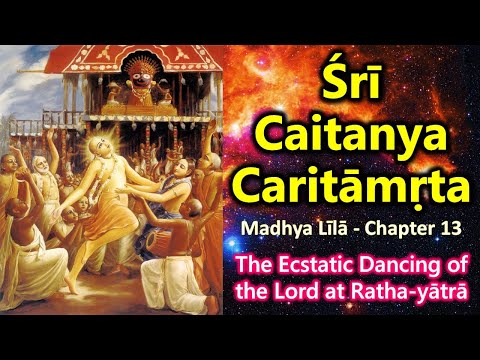
Now please hear about Lord Jagannātha’s going to the Guṇḍicā temple while Śrī Caitanya Mahāprabhu danced before the Ratha car. (70) The Lord performed kīrtana for some time and, through His own endeavor, inspired all the devotees to dance. (71) When the Lord Himself wanted to dance, all seven groups combined together. (72) The Lord’s devotees— including Śrīvāsa, Rāmāi, Raghu, Govinda, Mukunda, Haridāsa, Govindānanda, Mādhava and Govinda—all combined together. (73) When Śrī Caitanya Mahāprabhu desired to jump high while dancing, He placed these nine people in the charge of Svarūpa Dāmodara. (74) These devotees [Svarūpa Dāmodara and the devotees in his charge] sang along with the Lord, and they also ran beside Him. All the other groups of men also sang. (75)

Offering obeisances to the Lord with folded hands, Śrī Caitanya Mahāprabhu raised His face toward Jagannātha and prayed as follows. (76) “‘Let me offer my respectful obeisances unto Lord Kṛṣṇa, who is the worshipable Deity for all brahminical men, who is the well- wisher of cows and brāhmaṇas, and who is always benefiting the whole world. I offer my repeated obeisances to the Personality of Godhead, known as Kṛṣṇa and Govinda.’ (77) “‘All glories unto the Supreme Personality of Godhead, who is known as the son of Devakī! All glories to the Supreme Personality of Godhead, who is known as the light of the dynasty of Vṛṣṇi! All glories to the Supreme Personality of Godhead, whose bodily luster is like that of a new cloud, and whose body is as soft as a lotus flower! All glories to the Supreme Personality of Godhead, who appeared on this planet to deliver the world from the burden of demons, and who can offer liberation to everyone!’ (78)

“‘Lord Śrī Kṛṣṇa is He who is known as jana- nivāsa, the ultimate resort of all living entities, and who is also known as Devakī- nandana or Yaśodā- nandana, the son of Devakī and Yaśodā. He is the guide of the Yadu dynasty, and with His mighty arms He kills everything inauspicious, as well as every man who is impious. By His presence He destroys all things inauspicious for all living entities, moving and inert. His blissful smiling face always increases the lusty desires of the gopīs of Vṛndāvana. May He be all- glorious and happy!’ (79) “‘I am not a brāhmaṇa, I am not a kṣatriya, I am not a vaiśya or a śūdra. Nor am I a brahmacārī, a householder, a vānaprastha or a sannyāsī. I identify Myself only as the servant of the servant of the servant of the lotus feet of Lord Śrī Kṛṣṇa, the maintainer of the gopīs. He is like an ocean of nectar, and He is the cause of universal transcendental bliss. He is always existing with brilliance.’” (80)

Having recited all these verses from scripture, the Lord again offered His obeisances, and all the devotees, with folded hands, also offered prayers to the Supreme Personality of Godhead. (81) When Śrī Caitanya Mahāprabhu danced and jumped high, roaring like thunder and moving in a circle like a wheel, He appeared like a circling firebrand. (82) Wherever Śrī Caitanya Mahāprabhu stepped while dancing, the whole earth, with its hills and seas, appeared to tilt. (83) When Caitanya Mahāprabhu danced, He displayed various blissful transcendental changes in His body. Sometimes He appeared as though stunned. Sometimes the hairs of His body stood on end. Sometimes He perspired, cried, trembled and changed color, and sometimes He exhibited symptoms of helplessness, pride, exuberance and humility. (84) When Śrī Caitanya Mahāprabhu fell down with a crash while dancing, He would roll on the ground. At such times it appeared that a golden mountain was rolling on the ground. (85)

Nityānanda Prabhu would stretch out His two hands and try to catch the Lord when He was running here and there. (86) Advaita Ācārya would walk behind the Lord and loudly chant “Haribol! Haribol!” again and again. (87) Just to check the crowds from coming too near the Lord, the devotees formed three circles. The first circle was guided by Nityānanda Prabhu, who is Balarāma Himself, the possessor of great strength. (88) All the devotees headed by Kāśīśvara and Govinda linked hands and formed a second circle around the Lord. (89) Mahārāja Pratāparudra and his personal assistants formed a third circle around the two inner circles just to check the crowds from coming too near. (90) With his hands on the shoulders of Haricandana, King Pratāparudra could see Lord Caitanya Mahāprabhu dancing, and the King felt great ecstasy. (91) While the King beheld the dancing, Śrīvāsa Ṭhākura, standing in front of him, became ecstatic as he saw the dancing of Śrī Caitanya Mahāprabhu. (92)

Seeing Śrīvāsa Ṭhākura standing before the King, Haricandana touched Śrīvāsa with his hand and requested him to step aside. (93) Absorbed in watching Śrī Caitanya Mahāprabhu dance, Śrīvāsa Ṭhākura could not understand why he was being touched and pushed. After he was pushed again and again, he became angry. (94) Śrīvāsa Ṭhākura slapped Haricandana to stop him from pushing him. In turn, this made Haricandana angry. (95) As the angered Haricandana was about to speak to Śrīvāsa Ṭhākura, Pratāparudra Mahārāja personally stopped him. (96) King Pratāparudra said, “You are very fortunate, for you have been graced by the touch of Śrīvāsa Ṭhākura. I am not so fortunate. You should feel obliged to him.” (97) Everyone was astonished by the dancing of Caitanya Mahāprabhu, and even Lord Jagannātha became extremely happy to see Him. (98) The car came to a complete standstill and remained immobile while Lord Jagannātha, with unblinking eyes, watched the dancing of Śrī Caitanya Mahāprabhu. (99) The goddess of fortune, Subhadrā, and Lord Balarāma both felt great happiness and ecstasy within their hearts. Indeed, they were seen smiling at the dancing. (100)

When Caitanya Mahāprabhu danced and jumped high, eight wonderful transformations indicative of divine ecstasy were seen in His body. All these symptoms were visible simultaneously. (101) His skin erupted with goose pimples, and the hairs of His body stood on end. His body resembled the śimulī [silk cotton tree], all covered with thorns. (102) Indeed, the people became afraid just to see His teeth chatter, and they even thought that His teeth would fall out. (103) Śrī Caitanya Mahāprabhu’s whole body flowed with perspiration and at the same time oozed blood. He made the sounds “jaja gaga, jaja gaga” in a voice choked with ecstasy. (104) Tears came forcefully from the eyes of the Lord, as if from a syringe, and all the people surrounding Him became wet. (105) Everyone saw the complexion of His body change from white to pink, so that His luster resembled that of the mallikā flower. (106) Sometimes He appeared stunned, and sometimes He rolled on the ground. Indeed, sometimes His legs and hands became as hard as dry wood, and He did not move. (107)

When the Lord fell to the ground, sometimes His breathing almost stopped. When the devotees saw this, their lives also became very feeble. (108) Water flowed from His eyes and sometimes through His nostrils, and foam fell from His mouth. These flowings appeared to be torrents of nectar descending from the moon. (109) The foam that fell from the mouth of Śrī Caitanya Mahāprabhu was taken and drunk by Śubhānanda because he was very fortunate and expert in relishing the mellow of ecstatic love of Kṛṣṇa. (110) After Śrī Caitanya Mahāprabhu had performed His devastating dance for some time, His mind entered into a mood of ecstatic love. (111) After abandoning the dancing, the Lord ordered Svarūpa Dāmodara to sing. Understanding His mind, Svarūpa Dāmodara began to sing as follows. (112) “‘Now I have gained the Lord of My life, in the absence of whom I was being burned by Cupid and was withering away.’” (113) When this refrain was loudly sung by Svarūpa Dāmodara, Śrī Caitanya Mahāprabhu again began rhythmically dancing in transcendental bliss. (114)

The car of Lord Jagannātha began to move slowly while the son of mother Śacī went ahead and danced in front. (115) While dancing and singing, all the devotees in front of Lord Jagannātha kept their eyes on Him. Caitanya Mahāprabhu then went to the end of the procession with the saṅkīrtana performers. (116) His eyes and mind fully absorbed in Lord Jagannātha, Caitanya Mahāprabhu began to play the drama of the song with His two arms. (117) When Caitanya Mahāprabhu was dramatically enacting the song, He would sometimes fall behind in the procession. At such times, Lord Jagannātha would come to a standstill. When Caitanya Mahāprabhu again went forward, Lord Jagannātha’s car would slowly start again. (118) Thus there was a sort of competition between Caitanya Mahāprabhu and Lord Jagannātha in seeing who would lead, but Caitanya Mahāprabhu was so strong that He made Lord Jagannātha wait in His car. (119)

While Śrī Caitanya Mahāprabhu was dancing, His ecstasy changed. Raising His two arms, He began to recite the following verse in a loud voice. (120) “‘That very personality who stole away my heart during my youth is now again my master. These are the same moonlit nights of the month of Caitra. The same fragrance of mālatī flowers is there, and the same sweet breezes are blowing from the kadamba forest. In our intimate relationship, I am also the same lover, yet still my mind is not happy here. I am eager to go back to that place on the bank of the Revā under the Vetasī tree. That is my desire.’” (121) This verse was recited by Śrī Caitanya Mahāprabhu again and again. But for Svarūpa Dāmodara, no one could understand its meaning. (122) I have already explained this verse. Now I shall simply describe it in brief. (123) Formerly, all the gopīs of Vṛndāvana were very pleased when they met with Kṛṣṇa in the holy place Kurukṣetra. (124)

Similarly, after seeing Lord Jagannātha, Śrī Caitanya Mahāprabhu awoke with the ecstasy of the gopīs. Being absorbed in this ecstasy, He asked Svarūpa Dāmodara to sing the refrain. (125) Śrī Caitanya Mahāprabhu spoke thus to Lord Jagannātha: “You are the same Kṛṣṇa, and I am the same Rādhārāṇī. We are meeting again in the same way that We met in the beginning of Our lives. (126) “Although We are both the same, My mind is still attracted to Vṛndāvana- dhāma. I wish that You will please again appear with Your lotus feet in Vṛndāvana. (127) “In Kurukṣetra there are crowds of people, elephants and horses, and also the rattling of chariots. But in Vṛndāvana there are flower gardens, and the humming of the bees and chirping of the birds can be heard. (128) “Here at Kurukṣetra You are dressed like a royal prince, accompanied by great warriors, but in Vṛndāvana You appeared just like an ordinary cowherd boy, accompanied only by Your beautiful flute. (129) “Here there is not even a drop of the ocean of transcendental happiness that I enjoyed with You in Vṛndāvana. (130)

“I therefore request You to come to Vṛndāvana and enjoy pastimes with Me. If You do so, My ambition will be fulfilled.” (131) I have already described in brief Śrīmatī Rādhārāṇī’s statement from Śrīmad- Bhāgavatam. (132) In that ecstatic mood, Śrī Caitanya Mahāprabhu recited many other verses, but people in general could not understand their meaning. (133) The meaning of those verses was known to Svarūpa Dāmodara Gosvāmī, but he did not reveal it. However, Śrī Rūpa Gosvāmī has broadcast the meaning. (134) While dancing, Śrī Caitanya Mahāprabhu began to recite the following verse, which He tasted in the association of Svarūpa Dāmodara Gosvāmī. (135) “[The gopīs spoke thus:] ‘Dear Lord, whose navel is just like a lotus flower, Your lotus feet are the only shelter for those who have fallen into the deep well of material existence. Your feet are worshiped and meditated upon by great mystic yogīs and highly learned philosophers. We wish that these lotus feet may also be awakened within our hearts, although we are only ordinary persons engaged in household affairs.’” (136)

Speaking in the mood of Śrīmatī Rādhārāṇī, Caitanya Mahāprabhu said, “For most people, the mind and heart are one, but because My mind is never separated from Vṛndāvana, I consider My mind and Vṛndāvana to be one. My mind is already Vṛndāvana, and since You like Vṛndāvana, will You please place Your lotus feet there? I would deem that Your full mercy. (137) “My dear Lord, kindly hear My true submission. My home is Vṛndāvana, and I wish Your association there. But if I do not get it, then it will be very difficult for Me to keep My life.(138) “My dear Kṛṣṇa, formerly, when You were staying in Mathurā, You sent Uddhava to teach Me speculative knowledge and mystic yoga. Now You Yourself are speaking the same thing, but My mind doesn’t accept it. There is no place in My mind for jñāna- yoga or dhyāna- yoga. Although You know Me very well, You are still instructing Me in jñāna- yoga and dhyāna- yoga. It is not right for You to do so.” (139)

Caitanya Mahāprabhu continued, “I would like to withdraw My consciousness from You and engage it in material activities, but even though I try, I cannot do so. I am naturally inclined to You only. Your instructions for Me to meditate on You are therefore simply ludicrous. In this way, You are killing Me. It is not very good for You to think of Me as a candidate for Your instructions. (140) “The gopīs are not like the mystic yogīs. They will never be satisfied simply by meditating on Your lotus feet and imitating the so- called yogīs. Teaching the gopīs about meditation is another kind of duplicity. When they are instructed to undergo mystic yoga practice, they are not at all satisfied. On the contrary, they become more and more angry with You.” (141)

Śrī Caitanya Mahāprabhu continued, “The gopīs have fallen into the great ocean of separation and are being devoured by the timiṅgila fish of their ambition to serve You. The gopīs are to be delivered from the mouths of these timiṅgila fish, for they are pure devotees. Since they have no material conception of life, why should they aspire for liberation? The gopīs do not want that liberation desired by yogīs and jñānīs, for they are already liberated from the ocean of material existence. (142) “It is amazing that You have forgotten the land of Vṛndāvana. And how is it that You have forgotten Your father, mother and friends? How have You forgotten Govardhana Hill, the bank of the Yamunā and the forest where You enjoyed the rāsa- līlā dance? (143) “Kṛṣṇa, You are certainly a refined gentleman with all good qualities. You are well- behaved, softhearted and merciful. I know that there is not even a tinge of fault to be found in You. Yet Your mind does not even remember the inhabitants of Vṛndāvana. This is only My misfortune, and nothing else. (144)

“I do not care for My personal unhappiness, but when I see the morose face of mother Yaśodā and the hearts of all the inhabitants of Vṛndāvana breaking because of You, I wonder whether You want to kill them all. Or do You want to enliven them by coming there? Why are You simply keeping them alive in a state of suffering? (145) “The inhabitants of Vṛndāvana do not want You dressed like a prince, nor do they want You to associate with great warriors in a different country. They cannot leave the land of Vṛndāvana, and without Your presence, they are all dying. What is their condition to be? (146)

“My dear Kṛṣṇa, You are the life and soul of Vṛndāvana- dhāma. You are especially the life of Nanda Mahārāja. You are the only opulence in the land of Vṛndāvana, and You are very merciful. Please come and let all the residents of Vṛndāvana live. Kindly keep Your lotus feet again in Vṛndāvana.” (147) After hearing Śrīmatī Rādhārāṇī’s statements, Lord Kṛṣṇa’s love for the inhabitants of Vṛndāvana was evoked, and His body and mind became very much perturbed. After hearing of their love for Him, He immediately thought Himself to be always indebted to the residents of Vṛndāvana. Then Kṛṣṇa began to pacify Śrīmatī Rādhārāṇī as follows. (148) “My dearest Śrīmatī Rādhārāṇī, please hear Me. I am speaking the truth. I cry day and night simply upon remembering all you inhabitants of Vṛndāvana. No one knows how unhappy this makes Me.” (149)

Chaitanya Charitamrta | Madhya Lila | Chapter 13 | Section 102

0

I wish the grace of Lord Caitanya Mahāprabhu, by whose mercy even one who is fallen can describe the pastimes of the Lord. (1) All glories to Śrī Kṛṣṇa Caitanya and Prabhu Nityānanda! All glories to Advaitacandra! And all glories to the devotees of Lord Śrī Caitanya Mahāprabhu! (2) All glories to the listeners of Śrī Caitanya- caritāmṛta! Please hear the description of the dancing of Lord Caitanya Mahāprabhu at the Ratha- yātrā festival. His dancing is very enchanting. Please hear of it with great attention. (3) The next day, Śrī Caitanya Mahāprabhu and His personal associates got up in the dark and attentively took their early- morning baths. (4)

Śrī Caitanya Mahāprabhu and His personal associates then went to see the ceremony of Pāṇḍu- vijaya. During this ceremony, Lord Jagannātha leaves His throne and gets up onto the car. (5) King Pratāparudra in person, as well as his entourage, allowed the Pāṇḍu- vijaya ceremony to be seen by all the associates of Śrī Caitanya Mahāprabhu. (6) Śrī Caitanya Mahāprabhu and His prominent devotees—Advaita Ācārya, Nityānanda Prabhu and others— were very happy to observe how Lord Jagannātha began the Ratha- yātrā. (7) The very strongly built dayitās [carriers of the Jagannātha Deity] were as powerful as drunken elephants. They manually carried Lord Jagannātha from the throne to the car. (8) While carrying the Deity of Lord Jagannātha, some of the dayitās took hold of the shoulders of the Lord, and some caught His lotus feet. (9) The Lord Jagannātha Deity was bound at the waist by a strong, thick rope made of silk. From two sides the dayitās caught hold of this rope and raised the Deity. (10)

Strong, puffed- up cotton pads called tulīs were spread out from the throne to the car, and the heavy Deity of Lord Jagannātha was carried from one pillowlike pad to the next by the dayitās. (11) While the dayitās carried the heavy Jagannātha Deity from one pad to the next, some of the pads broke, and the cotton contents floated into the air. When they broke, they made a heavy cracking sound. (12) Lord Jagannātha is the maintainer of the whole universe. Who can carry Him from one place to another? The Lord moves by His personal will just to perform His pastimes. (13) While the Lord was transported from the throne to the car, tumultuous sounds were made on various musical instruments. Śrī Caitanya Mahāprabhu was chanting “Maṇimā! Maṇimā!” but He could not be heard. (14)

While the Lord was being carried from the throne to the car, King Pratāparudra personally engaged in the Lord’s service by cleansing the road with a broom that had a golden handle. (15) The King sprinkled the road with sandalwood- scented water. Although he was the owner of the royal throne, he engaged in menial service for the sake of Lord Jagannātha. (16) Although the King was the most exalted respectable person, still he accepted menial service for the Lord; he therefore became a suitable candidate for receiving the Lord’s mercy. (17) Upon seeing the King engaged in such menial service, Caitanya Mahāprabhu became very happy. Simply by rendering this service, the King received the mercy of the Lord. (18) Everyone was astonished to see the decorations on the Ratha car. The car appeared to be newly made of gold, and it was as high as Mount Sumeru. (19) The decorations included bright mirrors and hundreds and hundreds of cāmaras [white whisks made of yak tails]. On top of the car were a neat and clean canopy and a very beautiful flag. (20)

The car was also decorated with silken cloth and various pictures. Many brass bells, gongs and ankle bells rang. (21) For the pastimes of the Ratha- yātrā ceremony, Lord Jagannātha got aboard one car, and His sister, Subhadrā, and elder brother, Balarāma, got aboard two other cars. (22) For fifteen days the Lord had remained in a secluded place with the supreme goddess of fortune and had performed His pastimes with her. (23) Having taken permission from the goddess of fortune, the Lord came out to ride on the Ratha car and perform His pastimes for the pleasure of the devotees. (24) The fine, white sand spread all over the path resembled the bank of the Yamunā, and the small gardens on both sides looked just like those in Vṛndāvana. (25) As Lord Jagannātha rode in His car and saw the beauty on both sides, His mind was filled with pleasure. (26) The pullers of the car were known as gauḍas, and they pulled with great pleasure. However, the car sometimes went very fast and sometimes very slow. (27)

Sometimes the car would stand still and not move, even though it was pulled very vigorously. The chariot therefore moved by the will of the Lord, not by the strength of any ordinary person. (28) As the car stood still, Śrī Caitanya Mahāprabhu gathered all His devotees and, with His own hand, decorated them with flower garlands and sandalwood pulp. (29) Paramānanda Purī and Brahmānanda Bhāratī were both personally given garlands and sandalwood pulp from the very hands of Śrī Caitanya Mahāprabhu. This increased their transcendental pleasure. (30) Similarly, when Advaita Ācārya and Nityānanda Prabhu felt the touch of the transcendental hand of Śrī Caitanya Mahāprabhu, They were very pleased. (31) The Lord also gave garlands and sandalwood pulp to the performers of saṅkīrtana. The two chief performers were Svarūpa Dāmodara and Śrīvāsa Ṭhākura. (32) There were altogether four parties of kīrtana performers, comprising twenty- four chanters. In each party there were also two mṛdaṅga players, making an additional eight persons. (33)

When the four parties were formed, Śrī Caitanya Mahāprabhu, after some consideration, divided the chanters. (34) Śrī Caitanya Mahāprabhu ordered Nityānanda Prabhu, Advaita Ācārya, Haridāsa Ṭhākura and Vakreśvara Paṇḍita to dance in each of the four respective parties. (35) Svarūpa Dāmodara was chosen as the leader of the first party and was given five assistants to respond to his chanting. (36) The five who responded to the singing of Svarūpa Dāmodara were Dāmodara Paṇḍita, Nārāyaṇa, Govinda Datta, Rāghava Paṇḍita and Śrī Govindānanda. (37) Advaita Ācārya Prabhu was ordered to dance in the first group. The Lord then formed another group with Śrīvāsa Ṭhākura as the chief man. (38) The five singers who responded to the singing of Śrīvāsa Ṭhākura were Gaṅgādāsa, Haridāsa, Śrīmān, Śubhānanda and Śrī Rāma Paṇḍita. Śrī Nityānanda Prabhu was appointed as a dancer. (39) Another group was formed consisting of Vāsudeva, Gopīnātha and Murāri. All these were responsive singers, and Mukunda was the chief singer. (40)

Another two persons, Śrīkānta and Vallabha Sena, joined as responsive singers. In this group, the senior Haridāsa [Haridāsa Ṭhākura] was the dancer. (41) The Lord formed another group, appointing Govinda Ghoṣa as leader. In this group the younger Haridāsa, Viṣṇudāsa and Rāghava were the responding singers. (42) Two brothers named Mādhava Ghoṣa and Vāsudeva Ghoṣa also joined this group as responsive singers. Vakreśvara Paṇḍita was the dancer. (43) There was a saṅkīrtana party from the village known as Kulīna- grāma, and Rāmānanda and Satyarāja were appointed the dancers in this group. (44) There was another party that came from Śāntipura and was formed by Advaita Ācārya. Acyutānanda was the dancer, and the rest of the men were singers. (45) Another party was formed by the people of Khaṇḍa. These people were singing in a different place. In that group, Narahari Prabhu and Raghunandana were dancing. (46)

Four parties chanted and danced in front of Lord Jagannātha, and on either side was another party. Yet another was at the rear. (47) There were altogether seven parties of saṅkīrtana, and in each party two men were beating drums. Thus fourteen drums were being played at once. The sound was tumultuous, and all the devotees became mad. (48) All the Vaiṣṇavas came together like an assembly of clouds. As the devotees chanted the holy names in great ecstasy, tears fell from their eyes like rain. (49) When the saṅkīrtana resounded, it filled the three worlds. Indeed, no one could hear any sounds or musical instruments other than the saṅkīrtana. (50) Lord Caitanya Mahāprabhu wandered through all seven groups chanting the holy name, “Hari, Hari!” Raising His arms, He shouted, “All glories to Lord Jagannātha!” (51) Lord Caitanya Mahāprabhu then exhibited another mystic power by performing pastimes simultaneously in all seven groups. (52)

Everyone said, “Lord Caitanya Mahāprabhu is present in my group. Indeed, He does not go anywhere else. He is bestowing His mercy upon us.” (53) Actually, no one could see the inconceivable potency of the Lord. Only the most confidential devotees, those in pure, unalloyed devotional service, could understand. (54) Lord Jagannātha was very much pleased by the saṅkīrtana, and He brought His car to a standstill just to see the performance. (55) King Pratāparudra was also astonished to see the saṅkīrtana. He became inactive and was converted to ecstatic love of Kṛṣṇa. (56) When the King informed Kāśī Miśra of the glories of the Lord, Kāśī Miśra replied, “O King, your fortune has no limit!” (57) The King and Sārvabhauma Bhaṭṭācārya were both aware of the Lord’s activities, but no one else could see the tricks of Lord Caitanya Mahāprabhu. (58) Only a person who has received the mercy of the Lord can understand. Without the Lord’s mercy, even the demigods, headed by Lord Brahmā, cannot understand. (59)

Śrī Caitanya Mahāprabhu had been very satisfied to see the King accept the menial task of sweeping the street, and for this humility the King received the mercy of Śrī Caitanya Mahāprabhu. He could therefore observe the mystery of Śrī Caitanya Mahāprabhu’s activities. (60) Although the King had been refused an interview, he was indirectly bestowed causeless mercy. Who can understand the internal potency of Śrī Caitanya Mahāprabhu? (61) When the two great personalities Sārvabhauma Bhaṭṭācārya and Kāśī Miśra saw Caitanya Mahāprabhu’s causeless mercy upon the King, they were astonished. (62) Lord Śrī Caitanya Mahāprabhu performed His pastimes for some time in this way. He personally sang and induced His personal associates to dance. (63) According to His need, the Lord sometimes exhibited one form and sometimes many. This was being executed by His internal potency. (64)

Indeed, the Personality of Godhead forgot Himself in the course of His transcendental pastimes, but His internal potency [līlā- śakti], knowing the intentions of the Lord, made all arrangements. (65) Just as Lord Śrī Kṛṣṇa formerly performed the rāsa- līlā dance and other pastimes at Vṛndāvana, Lord Śrī Caitanya Mahāprabhu performed uncommon pastimes moment after moment. (66) Śrī Caitanya Mahāprabhu’s dancing before the Ratha- yātrā car could be perceived only by pure devotees. Others could not understand. Descriptions of Lord Kṛṣṇa’s uncommon dancing can be found in the revealed scripture Śrīmad- Bhāgavatam. (67) In this way Śrī Caitanya Mahāprabhu danced in great jubilation and inundated all the people with waves of ecstatic love. (68) Thus Lord Jagannātha mounted His car, and Lord Śrī Caitanya Mahāprabhu inspired all His devotees to dance in front of it. (69) 

Chaitanya Charitamrta | Madhya Lila | Chapter 12 | Section 101

0

The next day marked the performance of the festival of Netrotsava. This great festival was the life and soul of the devotees. (204) Everyone was unhappy for a fortnight because they could not see the Deity of Lord Jagannātha. Upon seeing the Lord at the festival, the devotees were very happy. (205) On this occasion, greatly happy, Śrī Caitanya Mahāprabhu took all the devotees with Him and visited the Lord in the temple. (206) When Śrī Caitanya Mahāprabhu went to visit the temple, Kāśīśvara walked in front, checking the crowds of people, and Govinda walked in the rear, bringing the sannyāsī’s pitcher filled with water. (207) When Śrī Caitanya Mahāprabhu went toward the temple, Paramānanda Purī and Brahmānanda Bhāratī walked in front of Him, and at His two sides walked Svarūpa Dāmodara and Advaita Ācārya. (208) With great eagerness all the other devotees followed them into the temple of Lord Jagannātha. (209)

Out of great eagerness to see the Lord, they all neglected the regulative principles and, just to see the Lord’s face, went to the place where the food was offered. (210) Śrī Caitanya Mahāprabhu was very thirsty to see the Lord, and His eyes became like two bumblebees drinking the honey from the lotuslike eyes of Lord Jagannātha, who is Kṛṣṇa Himself. (211) The eyes of Lord Jagannātha conquered the beauty of blossoming lotus flowers, and His neck was as lustrous as a mirror made of sapphires. (212) The chin of the Lord, tinged with buff color, conquered the beauty of the bāndhulī flower. This increased the beauty of His mild smiling, which was like lustrous waves of nectar. (213)

The luster of His beautiful face increased at every moment, and the eyes of hundreds and thousands of devotees drank its honey like bumblebees. (214) As their eyes began to drink the nectarean honey of His lotus face, their thirst increased. Thus their eyes did not leave Him. (215) Thus Śrī Caitanya Mahāprabhu and His devotees enjoyed transcendental bliss upon seeing the face of Jagannātha. This continued to midday. (216) As usual, there were transcendental blissful symptoms in Caitanya Mahāprabhu’s body. He perspired and trembled, and a constant flow of tears fell from His eyes. But the Lord checked these tears so they would not disturb His seeing the face of the Lord. (217) Their looking at the face of Lord Jagannātha was interrupted only when He was offered food. Afterwards they would again look upon His face. When the food was being offered to the Lord, Śrī Caitanya Mahāprabhu performed His kīrtana. (218)

Feeling such great pleasure upon seeing the face of Lord Jagannātha, Śrī Caitanya Mahāprabhu forgot everything. The devotees, however, took Him to His lunch at noontime. (219) Knowing that the car festival would take place in the morning, all the servants of Lord Jagannātha were doubling their offerings of food. (220) I have briefly described the pastimes of the Lord in washing and cleansing the Guṇḍicā temple. By seeing or hearing these pastimes, even sinful men can awaken their Kṛṣṇa consciousness. (221) Praying at the lotus feet of Śrī Rūpa and Śrī Raghunātha, always desiring their mercy, I, Kṛṣṇadāsa, narrate Śrī Caitanya- caritāmṛta, following in their footsteps. (222)

Chaitanya Charitamrta | Madhya Lila | Chapter 12 | Section 100

0

Among the devotees present with Śrī Caitanya Mahāprabhu were Paramānanda Purī, Brahmānanda Bhāratī, Advaita Ācārya and Nityānanda Prabhu. (156) Ācāryaratna, Ācāryanidhi, Śrīvāsa Ṭhākura, Gadādhara Paṇḍita, Śaṅkara, Nandanācārya, Rāghava Paṇḍita and Vakreśvara were also present. (157) Receiving the permission of the Lord, Sārvabhauma Bhaṭṭācārya sat down. Śrī Caitanya Mahāprabhu and all His devotees sat on raised wooden seats. (158) In this way all the devotees sat down to take their lunch in consecutive lines, one beside the other. (159) Śrī Caitanya Mahāprabhu was repeatedly calling, “Haridāsa, Haridāsa,” and at that time Haridāsa, standing at a distance, spoke as follows. (160) Haridāsa Ṭhākura said, “Let Lord Śrī Caitanya Mahāprabhu take His lunch with the devotees. Since I am abominable, I cannot sit down among you. (161) “Govinda will give me prasādam later, outside the door.” Understanding his mind, Śrī Caitanya Mahāprabhu did not call him again. (162) Svarūpa Dāmodara Gosvāmī, Jagadānanda, Dāmodara Paṇḍita, Kāśīśvara, Gopīnātha, Vāṇīnātha and Śaṅkara distributed prasādam, and the devotees chanted the holy names at intervals. (163-164)

Lord Śrī Kṛṣṇa had previously taken His lunch in the forest, and that very pastime was remembered by Śrī Caitanya Mahāprabhu. (165) Just by remembering the pastimes of Lord Śrī Kṛṣṇa, Śrī Caitanya Mahāprabhu was agitated by ecstatic love. But considering the time and circumstance, He remained somewhat patient. (166) Śrī Caitanya Mahāprabhu said, “You can give Me the ordinary vegetable known as lāphrā- vyañjana, and you may deliver to all the devotees better preparations like cakes, sweet rice and amṛta- guṭikā.” (167) Since Lord Śrī Caitanya Mahāprabhu is omniscient, He knew what types of preparations each person liked. He therefore had Svarūpa Dāmodara deliver these preparations to each devotee to his full satisfaction. (168) Jagadānanda went to distribute prasādam, and suddenly he placed all the first- class preparations on the plate of Śrī Caitanya Mahāprabhu. (169)

When such nice prasādam was put on the plate of Śrī Caitanya Mahāprabhu, the Lord was outwardly very angry. Nonetheless, when the preparations were placed on His plate sometimes by tricks and sometimes by force, the Lord was satisfied. (170) When the food was thus delivered, Śrī Caitanya Mahāprabhu looked at it for some time. Being afraid of Jagadānanda, He finally ate something. (171) The Lord knew that if He did not eat the food offered by Jagadānanda, Jagadānanda would certainly fast. Being afraid of this, Lord Śrī Caitanya Mahāprabhu ate some of the prasādam he offered. (172) Svarūpa Dāmodara Gosvāmī then brought some excellent sweetmeats and, standing before the Lord, offered them to Him. (173) Svarūpa Dāmodara Gosvāmī then said, “Just take a little of this mahā- prasādam, and see how it is that Lord Jagannātha has accepted it.” (174) Upon saying this, Svarūpa Dāmodara Gosvāmī placed some food before the Lord, and the Lord, out of affection, ate it. (175) Svarūpa Dāmodara and Jagadānanda again and again offered the Lord some food. Thus they behaved affectionately with the Lord. This was very, very uncommon. (176)

The Lord made Sārvabhauma Bhaṭṭācārya sit on His left side, and when Sārvabhauma saw the behavior of Svarūpa Dāmodara and Jagadānanda, he smiled. (177) Lord Śrī Caitanya Mahāprabhu also wanted to offer Sārvabhauma Bhaṭṭācārya first- class food; therefore, out of affection, He had the servers put first- class food on his plate again and again. (178) Gopīnātha Ācārya also brought first- class food and offered it to Sārvabhauma Bhaṭṭācārya while speaking sweet words. (179) After serving the Bhaṭṭācārya with first- class prasādam, Gopīnātha Ācārya said, “Just consider what the Bhaṭṭācārya’s previous mundane behavior was! Just consider how at present he is enjoying transcendental bliss!” (180) Sārvabhauma Bhaṭṭācārya replied to Gopīnātha Ācārya, “I was simply a less intelligent logician. But by your grace I have received this opulence of perfection. (181) “But for Śrī Caitanya Mahāprabhu,” Sārvabhauma Bhaṭṭācārya continued, “who is so merciful? He has converted a crow into a Garuḍa. Who could be so merciful? (182)

“In the association of the jackals known as logicians, I simply continued to bark a resounding ‘bheu bheu.’ Now, from the same mouth I am chanting the holy names ‘Kṛṣṇa’ and ‘Hari.’ (183) “Whereas I once associated with the disciples of logic, all nondevotees, I am now merged in the waves of the nectarean ocean of the association of devotees.” (184) Śrī Caitanya Mahāprabhu said to Sārvabhauma Bhaṭṭācārya, “From your previous birth you have been in Kṛṣṇa consciousness. Thus you love Kṛṣṇa so much that simply by your association we are all developing Kṛṣṇa consciousness.” (185) Thus there is no one within these three worlds—save for Śrī Caitanya Mahāprabhu—who is always so willing to increase the glories of the devotees and give them satisfaction. (186) Śrī Caitanya Mahāprabhu then took all the remnants of food offered to Jagannātha, such as cakes and sweet rice, and distributed them to all the other devotees, calling them individually. (187)

Śrī Advaita Ācārya and Nityānanda Prabhu sat side by side, and when prasādam was being distributed They engaged in a type of mock fighting. (188) First Advaita Ācārya said, “I am sitting in line with an unknown mendicant, and because I am eating with Him, I do not know what kind of destination is awaiting Me. (189) “Śrī Caitanya Mahāprabhu is in the renounced order of life. Consequently He does not recognize discrepancies. As a matter of fact, a sannyāsī is not affected by eating food from anywhere and everywhere. (190) “According to the śāstras, there is no discrepancy in a sannyāsī’s eating at another’s house. But for a householder brāhmaṇa, this kind of eating is faulty. (191) “It is not proper for householders to dine with those whose previous birth, family, character and behavior are unknown.” (192) Nityānanda Prabhu immediately refuted Śrīla Advaita Ācārya, saying, “You are a teacher of impersonal monism, and the monistic conclusion is a great hindrance to progressive, pure devotional service. (193)

“One who participates in Your impersonal monistic philosophy does not accept anything but the one Brahman.” (194) Nityānanda Prabhu continued, “You are such a monist! And now I am eating beside You. I do not know how My mind will be affected in this way.” (195) Thus They both went on talking and praising one another, although Their praise appeared negative, for it appeared as if They exchanged ill names. (196) Thereafter, calling all the Vaiṣṇavas, Śrī Caitanya Mahāprabhu distributed mahā- prasādam as if sprinkling nectar. At that time the mock fight between Advaita Ācārya and Nityānanda Prabhu became more and more delicious. (197) After taking their lunch, all the Vaiṣṇavas stood up and chanted the holy name of Hari, and the resounding noise filled all the upper and lower planetary systems. (198) After this, Śrī Caitanya Mahāprabhu offered flower garlands and sandalwood pulp to all His devoted personal associates. (199)

The seven persons headed by Svarūpa Dāmodara who were engaged in distributing prasādam to others then took their meals within the room. (200) Govinda saved some remnants of food left by Śrī Caitanya Mahāprabhu and kept them carefully. Later, one portion of these remnants was delivered to Haridāsa Ṭhākura. (201) The remnants of food left by Śrī Caitanya Mahāprabhu were later distributed among devotees who begged for them, and finally Govinda personally took the last remnants. (202) The fully independent Supreme Personality of Godhead performs various types of pastimes. The pastime of washing and cleansing the Guṇḍicā temple is but one of them. (203)

Stay Connected

16,985FansLike
12,500FollowersFollow
61,453SubscribersSubscribe