



Mail ID: contact@vedavarsity.com

Contact: +91 9634998911

Google search engineGoogle search engine
Home Blog Page 120

Chaitanya Charitamrta | Madhya Lila | Chapter 12 | Section 99

0

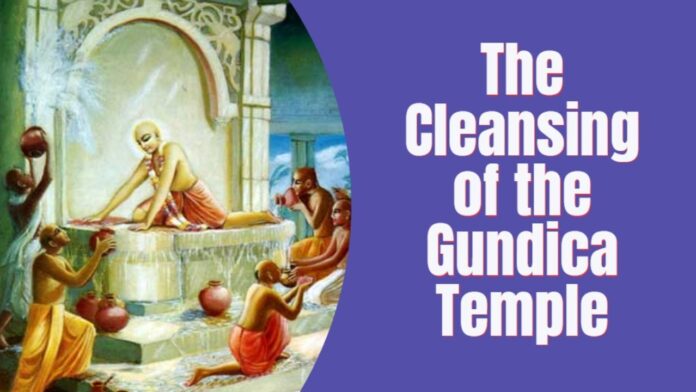
In this way all the rooms were cleansed with a hundred waterpots. After the rooms had been cleansed, the minds of the devotees were as clean as the rooms. (105) When the temple was cleansed, it was purified, cool and pleasing, just as if the Lord’s own pure mind had appeared. (106) Since hundreds of men were engaged in bringing water from the lake, there was no place to stand on the banks. Consequently someone began to draw water from a well. (107) Hundreds of devotees brought water in the pots, and hundreds took the empty pots away to fill them up again. (108) With the exception of Nityānanda Prabhu, Advaita Ācārya, Svarūpa Dāmodara, Brahmānanda Bhāratī and Paramānanda Purī, everyone was engaged in filling the waterpots and bringing them there. (109) Many of the waterpots were broken when people collided with one another, and hundreds of men had to bring new waterpots to fill. (110)

Some people were filling the pots, and others were washing the rooms, but everyone was engaged in chanting the holy name of Kṛṣṇa and Hari. (111) One person begged for a waterpot by chanting the holy names “Kṛṣṇa, Kṛṣṇa,” and another delivered a pot while chanting “Kṛṣṇa, Kṛṣṇa.” (112) Whenever anyone had to speak, he did so by uttering the holy name of Kṛṣṇa. Consequently, the holy name of Kṛṣṇa became an indication for everyone who wanted something. (113) As Śrī Caitanya Mahāprabhu was vibrating the holy name of Kṛṣṇa in ecstatic love, He Himself was performing the work of hundreds of men. (114) It appeared as though Śrī Caitanya Mahāprabhu were cleansing and washing with a hundred hands. He approached every devotee just to teach him how to work. (115)

When He saw someone doing nicely, the Lord praised him, but if He saw that someone was not working to His satisfaction, He immediately chastised that person, not bearing him any grudge. (116) The Lord would say, “You have done well. Please teach this to others so that they may act in the same way.” (117) As soon as they heard Śrī Caitanya Mahāprabhu say this, everyone became ashamed. Thus the devotees began to work with great attention. (118) They washed the Jagamohana area and then the place where food was kept. All other places were also washed. (119) In this way the meeting place was washed, the entire yard, the raised sitting places, the kitchen and every other room. (120) Thus all places around the temple were thoroughly washed within and without. (121) After everything was thoroughly washed, a Vaiṣṇava from Bengal, who was very intelligent and simple, came and poured water on the lotus feet of the Lord. (122)

The Gauḍīya Vaiṣṇava then took that water and drank it himself. Seeing that, Śrī Caitanya Mahāprabhu felt a little unhappy and was also outwardly angry. (123) Although the Lord was certainly satisfied with him, He became angry externally in order to establish the etiquette of religious principles. (124) The Lord then called for Svarūpa Dāmodara and told him, “Just see the behavior of your Bengali Vaiṣṇava. (125) “This person from Bengal has washed My feet within the temple of the Personality of Godhead. Not only that, but he has drunk the water himself. (126) “I now do not know what My destination is because of this offense. Indeed, your Bengali Vaiṣṇava has greatly implicated Me.” (127) At this point Svarūpa Dāmodara Gosvāmī caught the Gauḍīya Vaiṣṇava by the neck and, giving him a little push, ejected him from the Guṇḍicā Purī temple and made him stay outside. (128)

After Svarūpa Dāmodara Gosvāmī returned within the temple, he requested Śrī Caitanya Mahāprabhu to excuse that innocent person. (129) After this incident, Śrī Caitanya Mahāprabhu was very satisfied. He then asked all of the devotees to sit down in two lines on both sides. (130) The Lord then personally sat down in the middle and picked up all kinds of straw, grains of sand and dirty things. (131) While Śrī Caitanya Mahāprabhu was picking up the straws and grains of sand, He said, “I shall gather everyone’s collection, and I shall ask whoever has collected less than all the others to pay a fine of sweet cakes and sweet rice.” (132) In this way all the quarters of the Guṇḍicā temple were completely cleansed and cleared. All quarters were cool and spotless, like one’s cleansed and pacified mind. (133) When the water from the different rooms was finally let out through the halls, it appeared as if new rivers were rushing out to meet the waters of the ocean. (134) Outside the gateway of the temple, all the roads were also cleansed, and no one could tell exactly how this was done. (135)

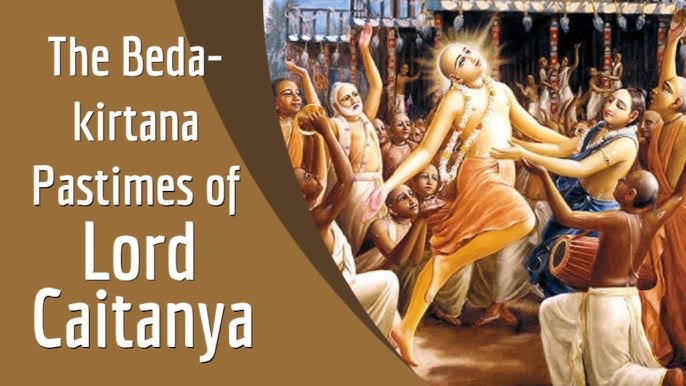
Śrī Caitanya Mahāprabhu also cleansed the Nṛsiṁha temple inside and outside. Finally, He rested a few minutes and then began dancing. (136) All around Śrī Caitanya Mahāprabhu all the devotees performed congregational chanting. The Lord, just like a maddened lion, danced in the middle. (137) As usual, when Caitanya Mahāprabhu danced, there were perspiration, trembling, fading, tears, jubilation and roaring. Indeed, the tears from His eyes washed His body and those before Him. (138) In this way Śrī Caitanya Mahāprabhu washed the bodies of all the devotees with the tears from His eyes. The tears poured like the rains in the month of Śrāvaṇa. (139) The sky was filled with the great and loud chanting of saṅkīrtana, and the earth shook from the jumping and dancing of Lord Caitanya Mahāprabhu. (140)

Śrī Caitanya Mahāprabhu always liked the loud chanting of Svarūpa Dāmodara. Therefore when Svarūpa Dāmodara sang, Śrī Caitanya Mahāprabhu danced and jumped high in jubilation. (141) The Lord thus chanted and danced for some time. Finally, understanding the circumstances, He stopped. (142) Śrī Caitanya Mahāprabhu then ordered Śrī Gopāla, the son of Advaita Ācārya, to dance. (143) While dancing in ecstatic love, Śrī Gopāla fainted and fell to the ground unconscious. (144) When Śrī Gopāla fainted, Advaita Ācārya hastily took him upon His lap. Seeing that he was not breathing, He became very much agitated. (145) Advaita Ācārya and others began to chant the holy name of Lord Nṛsiṁha and sprinkle water. The roaring of the chant was so great that it seemed to shake the entire universe. (146) When the boy did not regain consciousness after some time, Advaita Ācārya and the other devotees began to cry. (147)

Then Śrī Caitanya Mahāprabhu placed His hand on the chest of Śrī Gopāla and said loudly, “Gopāla, stand up.” (148) As soon as Gopāla heard the voice of Śrī Caitanya Mahāprabhu, he immediately came to his senses. All the devotees then began to dance, chanting the holy name of Hari. (149) This incident has been described in detail by Vṛndāvana dāsa Ṭhākura. Therefore I have described it only in brief. (150) After taking rest, Śrī Caitanya Mahāprabhu and all the devotees departed to take their baths. (151) After bathing, the Lord stood on the bank of the lake and put on dry garments. After offering obeisances to Lord Nṛsiṁhadeva, whose temple was nearby, the Lord entered a garden. (152) In the garden, Śrī Caitanya Mahāprabhu sat down with the other devotees. Vāṇīnātha Rāya then came and brought all kinds of mahā- prasādam. (153) Kāśī Miśra and Tulasī, the superintendent of the temple, brought as much prasādam as five hundred men could eat. Seeing the large quantity of prasādam, which consisted of rice, cakes, sweet rice and a variety of vegetables, Śrī Caitanya Mahāprabhu was very satisfied. (154-155)
Chaitanya Charitamrta | Madhya Lila | Chapter 12 | Section 98

0

The prince, just entering upon his youth, was very beautiful. He was blackish in complexion and had large lotus eyes. (58) The prince was dressed in yellow cloth, and there were jeweled ornaments decorating his body. Therefore anyone who saw him would remember Lord Kṛṣṇa. (59) Seeing the boy, Śrī Caitanya Mahāprabhu immediately remembered Kṛṣṇa. Meeting the boy in ecstatic love, the Lord began to speak. (60)“Here is a great devotee,” Śrī Caitanya Mahāprabhu said. “Upon seeing him, everyone can remember the Supreme Personality of Godhead, Kṛṣṇa, son of Mahārāja Nanda.” (61) Śrī Caitanya Mahāprabhu continued, “I have become very much obligated just by seeing this boy.” After saying this, the Lord again embraced the prince. (62)

As soon as the prince was touched by Lord Śrī Caitanya Mahāprabhu, symptoms of ecstatic love immediately manifested themselves in his body. These symptoms included perspiration, trembling, tears, being stunned and jubilation. (63) The boy began to cry and dance, and he chanted, “Kṛṣṇa! Kṛṣṇa!” Upon seeing his bodily symptoms and his chanting and dancing, all the devotees praised him for his great spiritual fortune. (64) At that time, Śrī Caitanya Mahāprabhu calmed the youth and ordered him to come there daily to meet Him. (65) Rāmānanda Rāya and the boy then departed from Śrī Caitanya Mahāprabhu, and Rāmānanda took him back to the King’s palace. The King was very happy when he heard of his son’s activities. (66) Just by embracing his son, the King was filled with ecstatic love, just as if he had touched Śrī Caitanya Mahāprabhu directly. (67) From then on, the fortunate prince was one of the most intimate devotees of the Lord. (68) Thus Śrī Caitanya Mahāprabhu acted in the society of His pure devotees, performing His pastimes and spreading the saṅkīrtana movement. (69)

Some of the prominent devotees like Advaita Ācārya used to invite Śrī Caitanya Mahāprabhu to take His meals at their homes. The Lord accepted such invitations accompanied by His devotees. (70) In this way, the Lord passed some days in great jubilation. Then the car festival of Lord Jagannātha approached. (71) Śrī Caitanya Mahāprabhu first of all called for Kāśī Miśra, then for the superintendent of the temple, then for Sārvabhauma Bhaṭṭācārya. (72) When these three people came before the Lord, He begged them for permission to wash the temple known as Guṇḍicā. (73) Upon hearing the Lord’s request for permission to wash the Guṇḍicā temple, the paḍichā, the superintendent of the temple, said, “My dear Sir, we are all Your servants. Whatever You desire is our duty to perform. (74) “The King gave a special order for me to do without delay whatever Your Lordship orders. (75)

“My dear Lord, washing the temple is not service befitting You. Nonetheless, if You wish to do so, it is to be accepted as one of Your pastimes. (76) “To wash the temple, You need many waterpots and brooms. Therefore order me. I can immediately bring all these things to You.” (77) As soon as the superintendent understood the desire of the Lord, he immediately delivered a hundred new waterpots and a hundred brooms for sweeping the temple. (78) The next day, early in the morning, the Lord took His personal associates with Him and, with His own hand, smeared sandalwood pulp on their bodies. (79) He then gave each devotee a broom with His own hand, and taking all of them personally with Him, the Lord went to Guṇḍicā. (80) In this way the Lord and His associates went to cleanse the Guṇḍicā temple. At first they cleansed the temple with the brooms. (81) The Lord cleansed everything inside the temple very nicely, including the ceiling. He then took up the sitting place [siṁhāsana], cleansed it and again put it in its original place. (82)

Thus the Lord and His companions cleansed and swept all the temple’s buildings, big and small, and finally cleansed the area between the temple and the kīrtana hall. (83) Indeed, hundreds of devotees were engaged in cleansing all around the temple, and Śrī Caitanya Mahāprabhu was personally carrying out the operation just to instruct others. (84) Śrī Caitanya Mahāprabhu washed and cleansed the temple in great jubilation, chanting the holy name of Lord Kṛṣṇa all the time. Similarly, all the devotees were also chanting and at the same time performing their respective duties. (85) The entire beautiful body of the Lord was covered with dust and dirt. In this way it became transcendentally beautiful. At times, when cleansing the temple, the Lord shed tears, and in some places He even cleansed with those tears. (86) After this, the place where the Deity’s food was kept [bhoga- mandira] was cleansed. Then the yard was cleansed, and then all the residential quarters, one after the other. (87) After Śrī Caitanya Mahāprabhu collected all the straw, dust and grains of sand in one place, He gathered it all in His cloth and threw it outside. (88) Following the example of Śrī Caitanya Mahāprabhu, all the devotees, in great jubilation, began to gather straws and dust with their own cloths and throw them outside the temple. (89)

The Lord then told the devotees, “I can tell how much you have labored and how well you have cleansed the temple simply by seeing all the straw and dust you have collected outside.” (90) Even though all the devotees collected dirt in one pile, the dirt collected by Śrī Caitanya Mahāprabhu was much greater. (91) After the inside of the temple was cleansed, the Lord again allotted areas for the devotees to cleanse. (92) The Lord then ordered everyone to cleanse the inside of the temple very perfectly by taking finer dust, straws and grains of sand and throwing them outside. (93) After Śrī Caitanya Mahāprabhu and all the Vaiṣṇavas cleansed the temple for the second time, Śrī Caitanya Mahāprabhu was very happy to see the cleansing work. (94) While the temple was being swept, about a hundred men stood ready with filled waterpots, and they simply awaited the Lord’s order to throw the water from them. (95)

As soon as Śrī Caitanya Mahāprabhu called for water, all the men immediately brought the hundred waterpots, which were completely filled, and delivered them before the Lord. (96) In this way, Śrī Caitanya Mahāprabhu first washed the main temple and then thoroughly washed the ceiling, the walls, the floor, the sitting place [siṁhāsana] and everything else within the room. (97) Śrī Caitanya Mahāprabhu Himself and His devotees began to throw water onto the ceiling. When this water fell, it washed the walls and floor. (98) Then Śrī Caitanya Mahāprabhu began to wash the sitting place of Lord Jagannātha with His own hands, and all the devotees began to bring water to the Lord. (99) All the devotees within the temple began to wash. Each one had a broom in his hand, and in this way they cleansed the temple of the Lord. (100) Someone brought water to pour into the hands of Śrī Caitanya Mahāprabhu, and someone poured water on His lotus feet. (101)

The water that fell from the lotus feet of Śrī Caitanya Mahāprabhu was drunk by someone who hid himself. Someone else begged for that water, and another person was giving that water in charity. (102) After the room was washed, the water was let out through an outlet, and it then flowed and filled the yard outside. (103) The Lord mopped the rooms with His own clothes, and He polished the throne with them also. (104) (101) The water that fell from the lotus feet of Śrī Caitanya Mahāprabhu was drunk by someone who hid himself. Someone else begged for that water, and another person was giving that water in charity. (102) After the room was washed, the water was let out through an outlet, and it then flowed and filled the yard outside. (103) The Lord mopped the rooms with His own clothes, and He polished the throne with them also. (104)

Chaitanya Charitamrta | Madhya Lila | Chapter 12 | Section 97

0

Even a person with no knowledge can immediately acquire all knowledge simply by the benediction of Śrī Caitanya Mahāprabhu. Therefore I am praying to the Lord for His causeless mercy upon me. (1) All glories to Gauracandra! All glories to Nityānanda! All glories to Advaitacandra! And all glories to all the devotees of Lord Śrī Caitanya Mahāprabhu! (2) All glories to the devotees of Lord Śrī Caitanya Mahāprabhu, headed by Śrīvāsa Ṭhākura! I beg their power so that I can properly describe Śrī Caitanya Mahāprabhu. (3) When Śrī Caitanya Mahāprabhu returned from His South Indian tour, Mahārāja Pratāparudra, the King of Orissa, became very anxious to meet Him. (4)

The King sent a letter from his capital, Kaṭaka, to Sārvabhauma Bhaṭṭācārya, entreating him to obtain the Lord’s permission so that he could go and see Him. (5) Replying to the King’s letter, the Bhaṭṭācārya wrote that Śrī Caitanya Mahāprabhu had not given His permission. After this, the King wrote him another letter. (6) In this letter the King requested Sārvabhauma Bhaṭṭācārya, “Please appeal to all the devotees associated with Śrī Caitanya Mahāprabhu and submit this petition to them on my behalf. (7) “If all the devotees associated with the Lord are favorably disposed toward me, they can submit my petition at the lotus feet of the Lord. (8) “By the mercy of all the devotees, one can attain the shelter of the lotus feet of the Lord. Without His mercy, my kingdom does not appeal to me. (9) “If Gaurahari, Lord Śrī Caitanya Mahāprabhu, will not show mercy to me, I shall give up my kingdom, become a mendicant and beg from door to door.” (10)

When the Bhaṭṭācārya received this letter, he became very anxious. He then took the letter and went to the devotees of the Lord. (11) Sārvabhauma Bhaṭṭācārya met with all the devotees and described the King’s wishes. Then he presented the letter to all of them for inspection. (12) Upon reading the letter, everyone was astonished to see that King Pratāparudra had so much devotion for the lotus feet of Śrī Caitanya Mahāprabhu. (13) The devotees gave their opinion and said, “The Lord will never meet the King, and if we requested Him to do so, the Lord would surely feel very unhappy.” (14) Sārvabhauma Bhaṭṭācārya then said, “We shall go once again to the Lord, but we shall not request Him to meet the King. Rather, we shall simply describe the good behavior of the King.” (15) Having thus reached a decision, they all went to the place of Śrī Caitanya Mahāprabhu. There, although ready to speak, they could not even utter a word. (16)

After they arrived at Śrī Caitanya Mahāprabhu’s place, the Lord, seeing them, said, “What have you all come here to say? I see that you want to say something, but you do not speak. What is the reason?” (17) Nityānanda Prabhu then said, “We want to tell You something. Although we cannot stay without speaking, we are still very much afraid to speak. (18) “We want to submit before You something that may or may not be befitting. The matter is this: unless he sees You, the King of Orissa will become a mendicant.” (19) Nityānanda Prabhu continued, “The King has decided to become a mendicant and accept the sign of a mendicant by wearing an ivory earring. He does not want to enjoy his kingdom without seeing the lotus feet of Śrī Caitanya Mahāprabhu.” (20)

Nityānanda Prabhu continued, “The King also expressed his desire to see the moonlike face of Śrī Caitanya Mahāprabhu to his eyes’ full satisfaction. He would like to raise the lotus feet of the Lord to his heart.” (21) Hearing all these statements, Śrī Caitanya Mahāprabhu’s mind was certainly softened, but externally He wished to speak some harsh words. (22) Śrī Caitanya Mahāprabhu said, “I can understand that you all desire to take Me to Kaṭaka to see the King.” (23) Śrī Caitanya Mahāprabhu continued, “What to speak of spiritual advancement— all the people will blaspheme Me. And what to speak of all the people—Dāmodara would chastise Me. (24) “I shall not meet the King at the request of all the devotees, but I shall do so if Dāmodara will give his permission.” (25) Dāmodara immediately replied, “My Lord, You are the fully independent Supreme Personality of Godhead. Since everything is known to You, You know what is permissible and what is not permissible. (26) “I am merely an insignificant jīva, so what power do I have to give directions to You? By Your own personal choice You will meet with the King. I shall see it. (27) “The King is very much attached to You, and You are feeling affection and love toward him. Thus I can understand that by virtue of the King’s affection for You, You will touch him. (28)

“Although You are the Supreme Personality of Godhead and are completely independent, still You are dependent on the love and affection of Your devotees. That is Your nature.” (29) Nityānanda Prabhu then said, “Who is there in the three worlds who can ask You to see the King? (30) “Still, isn’t it the nature of an attached man to give up his life if he does not attain his desired object? (31) “For instance, some of the wives of the brāhmaṇas who were performing sacrifices gave up their lives in the presence of their husbands for the sake of Kṛṣṇa.” (32) Nityānanda Prabhu then submitted one suggestion for the Lord’s consideration. “There is a way,” He suggested, “by which You need not meet the King but which would enable the King to continue living. (33) “If You, out of Your mercy, send one of Your outer garments to the King, the King would live hoping to see You some time in the future.” (34)

The Lord said, “Since you are all very learned personalities, whatever you decide I shall accept.” (35) Lord Nityānanda Prabhu then obtained an external garment used by the Lord by requesting it from Govinda. (36) Thus Nityānanda Prabhu delivered the old cloth into the care of Sārvabhauma Bhaṭṭācārya, and Sārvabhauma Bhaṭṭācārya sent it to the King. (37) When the King received the old cloth, he began to worship it exactly as he would worship the Lord personally. (38) After returning from his service in South India, Rāmānanda Rāya requested the King to allow him to remain with Śrī Caitanya Mahāprabhu. (39) When Rāmānanda Rāya requested the King to allow him to stay with the Lord, the King immediately gave him permission with great satisfaction. As for the King himself, he began to solicit Rāmānanda Rāya to make a meeting arrangement. Rāmānanda (40)

The Rāya, “Śrī King told Caitanya Mahāprabhu is very, very merciful to you. Therefore please solicit my meeting with Him without fail.” (41) The King and Rāmānanda Rāya returned together to Jagannātha- kṣetra [Purī], and Śrī Rāmānanda Rāya met Śrī Caitanya Mahāprabhu. (42) At that time, Rāmānanda Rāya informed Śrī Caitanya Mahāprabhu about the ecstatic love of the King. Indeed, as soon as there was some opportunity, he repeatedly informed the Lord about the King. (43) Śrī Rāmānanda Rāya was indeed a diplomatic minister for the King. His general behavior was very expert, and simply by describing the King’s love for Śrī Caitanya Mahāprabhu, he gradually softened the Lord’s mind. (44) Mahārāja Pratāparudra, in great anxiety, could not endure not seeing the Lord; therefore Śrī Rāmānanda Rāya, by his diplomacy, arranged a meeting with the Lord for the King. (45) Śrī Rāmānanda Rāya frankly requested Śrī Caitanya Mahāprabhu, “Please show Your lotus feet to the King at least once.” (46) Śrī Caitanya Mahāprabhu replied, “My dear Rāmānanda, you should make this request after duly considering whether it is befitting for a sannyāsī to meet a king. (47)

“If a mendicant meets a king, this world and the next world are both destroyed for the mendicant. Indeed, what is there to say of the next world? In this world, people will joke if a sannyāsī meets a king.” (48) Rāmānanda Rāya replied, “My Lord, You are the supreme independent personality. You have nothing to fear from anyone because You are not dependent on anyone.” (49) When Rāmānanda Rāya addressed Śrī Caitanya Mahāprabhu as the Supreme Personality of Godhead, Caitanya Mahāprabhu objected, saying, “I am not the Supreme Personality of Godhead but an ordinary human being. Therefore I must fear public opinion in three ways—with My body, mind and words. (50) “As soon as the general public finds a little fault in the behavior of a sannyāsī, they advertise it like wildfire. A black spot of ink cannot be hidden on a white cloth. It is always very prominent.” (51)

Rāmānanda Rāya replied, “My dear Lord, You have delivered so many sinful people. This King Pratāparudra, the King of Orissa, is actually a servitor of the Lord and Your devotee.” (52) Śrī Caitanya Mahāprabhu then said, “There may be much milk in a big pot, but if it is contaminated by a drop of liquor, it is untouchable. (53) “The King certainly possesses all good qualities, but simply by taking up the name ‘king,’ he has infected everything. (54) “But if you are still very eager for the King to meet with Me, please first bring his son to meet Me. (55) “It is indicated in the revealed scriptures that the son represents the father; therefore the son’s meeting with Me would be just as good as the King’s meeting with Me.” (56) Rāmānanda Rāya then went to inform the King about his talks with Śrī Caitanya Mahāprabhu, and, following the Lord’s orders, brought the King’s son to see Him. (57)

Chaitanya Charitamrta | Madhya Lila | Chapter 11 | Section 96

0

When Nityānanda Prabhu, Jagadānanda Prabhu, Dāmodara Prabhu and Mukunda Prabhu met Haridāsa Ṭhākura, they all became very pleased. (196) When Śrī Caitanya Mahāprabhu returned to His residence after taking a bath in the sea, all the devotees, headed by Advaita Prabhu, went to bathe in the sea. (197) After bathing in the sea, Advaita Prabhu and all the other devotees returned, and on their return they saw the top of the Jagannātha temple. They then went to the residence of Śrī Caitanya Mahāprabhu to take their luncheon. (198) One after the other, Śrī Caitanya Mahāprabhu made all the devotees sit in their proper places. He then began to distribute prasādam with His own transcendental hand. (199) All the devotees were served prasādam on plantain leaves, and Śrī Caitanya Mahāprabhu distributed on each leaf a quantity suitable for two or three men to eat, for His hand could not distribute less than that. (200)

All the devotees kept their hands raised over the prasādam distributed to them, for they did not want to eat without seeing the Lord eat first. (201) Svarūpa Dāmodara Gosvāmī then informed Śrī Caitanya Mahāprabhu, “Unless You sit and take prasādam, no one will accept it. (202) “Gopīnātha Ācārya has invited all the sannyāsīs who remain with You to come and take prasādam. (203) “Gopīnātha Ācārya has already come, bringing sufficient remnants of food to distribute to all the sannyāsīs, and sannyāsīs like Paramānanda Purī and Brahmānanda Bhāratī are waiting for You. (204) “You may sit down and accept the luncheon with Nityānanda Prabhu, and I shall distribute the prasādam to all the Vaiṣṇavas.” (205) After this, Śrī Caitanya Mahāprabhu carefully delivered some prasādam into the hands of Govinda to be given to Haridāsa Ṭhākura. (206) Then Śrī Caitanya Mahāprabhu personally sat down to accept lunch with the other sannyāsīs, and Gopīnātha Ācārya began to distribute the prasādam with great pleasure. (207)

Then Svarūpa Dāmodara Gosvāmī, Dāmodara Paṇḍita and Jagadānanda all began to distribute prasādam to the devotees with great pleasure. (208) They ate all kinds of cakes and sweet rice, filling themselves up to their throats, and at intervals they vibrated the holy name of the Lord in great jubilation. (209) After everyone had finished his lunch and washed his mouth and hands, Śrī Caitanya Mahāprabhu personally decorated everyone with flower garlands and sandalwood pulp. (210) After thus accepting prasādam, they all went to take rest at their respective residences, and in the evening they again came to meet Śrī Caitanya Mahāprabhu. (211) At this time Rāmānanda Rāya also came to meet Śrī Caitanya Mahāprabhu, and the Lord took the opportunity to introduce him to all the Vaiṣṇavas. (212) The great Personality of Godhead, Śrī Caitanya Mahāprabhu, then took all of them to the temple of Jagannātha and began the congregational chanting of the holy name there. (213) After seeing the dhūpa- ārati of the Lord, they all began congregational chanting. Then the paḍichā, the superintendent of the temple, came and offered flower garlands and sandalwood pulp to everyone. (214)

Four parties were then distributed in four directions to perform saṅkīrtana, and in the middle of them the Lord Himself, known as the son of mother Śacī, began to dance. (215) In the four groups there were eight mṛdaṅgas and thirty- two cymbals. All together they began to vibrate the transcendental sound, and everyone said, “Very good! Very good!” (216) When the tumultuous vibration of saṅkīrtana resounded, all good fortune immediately awakened, and the sound penetrated the whole universe through the fourteen planetary systems. (217) When the congregational chanting began, ecstatic love immediately overflooded everything, and all the residents of Jagannātha Purī came running. (218) Everyone was astonished to see such a performance of saṅkīrtana, and they all agreed that never before had kīrtana been so performed and ecstatic love of God so exhibited. (219) At this time Śrī Caitanya Mahāprabhu circumambulated the temple of Jagannātha and continuously danced about the whole area. (220) As the circumambulation was performed, the four kīrtana parties sang in front and in the rear. When Śrī Caitanya Mahāprabhu fell down to the ground, Śrī Nityānanda Rāya Prabhu lifted Him up. (221)

While kīrtana was going on, there was a transformation of ecstatic love and much tears, jubilation, trembling, perspiration and deep resounding in the body of Śrī Caitanya Mahāprabhu. Upon seeing this transformation, all the people present became very much astonished. (222) The tears from the eyes of the Lord came out with great force, like water from a syringe. Indeed, all the people who surrounded Him were moistened by His tears. (223) After circumambulating the temple, Śrī Caitanya Mahāprabhu for some time remained at the rear of the temple and continued His saṅkīrtana. (224) On all four sides the four saṅkīrtana groups chanted very loudly, and in the middle Śrī Caitanya Mahāprabhu danced, jumping high. (225) After dancing for a long time, Śrī Caitanya Mahāprabhu became still and ordered four great personalities to begin to dance. (226) In one group Nityānanda Prabhu began to dance, and in another group Advaita Ācārya began to dance. (227) Vakreśvara Paṇḍita began to dance in another group, and in yet another group Śrīvāsa Ṭhākura began to dance. (228) While this dancing was going on, Śrī Caitanya Mahāprabhu watched them and performed a miracle. (229)

Śrī Caitanya Mahāprabhu stood in the middle of the dancers, and all the dancers in all directions perceived that Śrī Caitanya Mahāprabhu was looking at them. (230) Wanting to see the dancing of the four great personalities, Śrī Caitanya Mahāprabhu exhibited this miracle of seeing everyone simultaneously. (231) Everyone who saw Śrī Caitanya Mahāprabhu could understand that He was performing a miracle, but they did not know how it was that He could see on all four sides. (232) In His own pastimes in Vṛndāvana, when Kṛṣṇa used to eat on the bank of the Yamunā and sit in the center of His friends, every one of the cowherd boys would perceive that Kṛṣṇa was looking at him. In the same way, when Caitanya Mahāprabhu observed the dancing, everyone saw that Caitanya Mahāprabhu was facing him. (233) When someone came nearby while dancing, Śrī Caitanya Mahāprabhu would tightly embrace him. (234) Upon seeing the great dancing, great love and great saṅkīrtana, all the people of Jagannātha Purī floated in an ecstatic ocean of love. (235) Hearing the greatness of the saṅkīrtana, King Pratāparudra went up to the top of his palace and watched the performance with his personal associates. (236)

The King was very much astonished to see Śrī Caitanya Mahāprabhu’s kīrtana, and the King’s anxiety to meet Him increased unlimitedly. (237) After the saṅkīrtana ended, Śrī Caitanya Mahāprabhu watched the offering of flowers to the Lord Jagannātha Deity. Then He and all the Vaiṣṇavas returned to His residence. (238) The superintendent of the temple then brought large quantities of prasādam, which Śrī Caitanya Mahāprabhu personally distributed to all the devotees. (239) Finally they all departed to rest in bed. In this way Śrī Caitanya Mahāprabhu, the son of Śacīmātā, performed His pastimes. (240) As long as the devotees remained at Jagannātha Purī with Śrī Caitanya Mahāprabhu, the pastime of saṅkīrtana was performed with great jubilation every day. (241) In this way I have explained the Lord’s pastime of saṅkīrtana, and I bless everyone with this benediction: By listening to this description, one will surely become a servant of Śrī Caitanya Mahāprabhu. (242) Praying at the lotus feet of Śrī Rūpa and Śrī Raghunātha, always desiring their mercy, I, Kṛṣṇadāsa, narrate Śrī Caitanya- caritāmṛta, following in their footsteps. (243)

Chaitanya Charitamrta | Madhya Lila | Chapter 11 | Section 95

0

The Lord addressed Śrīvāsa and his brothers with great love and affection, saying, “I am so obliged that I am purchased by you four brothers.” (144) Śrīvāsa then replied to the Lord, “Why are You speaking in a contradictory way? Rather, we four brothers have been purchased by Your mercy.” (145) After seeing Śaṅkara, Lord Śrī Caitanya Mahāprabhu told Dāmodara, “My affection for you is on the platform of awe and reverence. (146) “Therefore keep your younger brother Śaṅkara with you because he is connected to Me by pure unalloyed love.” (147) Dāmodara Paṇḍita replied, “Śaṅkara is my younger brother, but from today he becomes my elder brother because of Your special mercy upon him.” (148) Then turning toward Śivānanda Sena, the Lord said, “I know that from the very beginning your affection for Me has been very great.” (149) Immediately upon hearing this, Śivānanda Sena became absorbed in ecstatic love and fell down on the ground, offering obeisances to the Lord. He then began to recite the following verse. (150)

“‘O my Lord! O unlimited one! Although I was merged in the ocean of nescience, I have now, after a long time, attained You, just as one may attain the seashore. My dear Lord, by getting me, You have obtained the right person upon whom to bestow Your causeless mercy.’” (151) Murāri Gupta at first did not meet the Lord but rather remained outside the door, falling down like a stick to offer obeisances. (152) When Lord Śrī Caitanya Mahāprabhu could not see Murāri amongst the devotees, He inquired about him. Thereupon many people immediately went to Murāri, running to take him to the Lord. (153) Thus Murāri Gupta, catching two bunches of straw in his teeth, went before Śrī Caitanya Mahāprabhu with humility and meekness. (154) Upon seeing Murāri come to meet Him, Lord Śrī Caitanya Mahāprabhu went up to him, but Murāri began to run away and speak as follows. (155)

“My Lord, please do not touch me. I am most abominable and am not fit for You to touch because my body is sinful.” (156) The Lord said, “My dear Murāri, please restrain your unnecessary humility. My mind is disturbed to see your meekness.” (157) Saying this, the Lord embraced Murāri and had him sit down by His side. The Lord then began to cleanse his body with His own hands. (158) Lord Śrī Caitanya Mahāprabhu then again and again embraced all the devotees, including Ācāryaratna, Vidyānidhi, Paṇḍita Gadādhara, Gaṅgādāsa, Hari Bhaṭṭa and Ācārya Purandara. The Lord described their good qualities and glorified them again and again. (159-160) After thus offering respect to each and every devotee, Lord Śrī Caitanya Mahāprabhu became very jubilant. However, not seeing Haridāsa Ṭhākura, He inquired, “Where is Haridāsa?” (161) Śrī Caitanya Mahāprabhu then saw in the distance that Haridāsa Ṭhākura was lying down flat on the road offering obeisances. (162)

Haridāsa Ṭhākura did not come to the Lord’s meeting place but remained fallen flat on the common road at a distance. (163) All the devotees then went to Haridāsa Ṭhākura, saying, “The Lord wants to meet you. Please come immediately.” (164) Haridāsa Ṭhākura replied, “I cannot go near the temple because I am a low- caste, abominable person. I have no authority to go there.” (165) Haridāsa Ṭhākura then expressed his desire: “If I could just get a solitary place near the temple, I could stay there alone and pass my time. (166) “I do not wish the servants of Lord Jagannātha to touch me. I would remain there in the garden alone. That is my desire.” (167) When this message was relayed to Śrī Caitanya Mahāprabhu by the people, the Lord became very happy to hear it. (168) At this time, Kāśī Miśra, along with the superintendent of the temple, came and offered his respects unto the lotus feet of Lord Śrī Caitanya Mahāprabhu. (169)

Upon seeing all the Vaiṣṇavas together, Kāśī Miśra and the superintendent became very happy. With great happiness they met with the devotees in a befitting manner. (170) Both submitted to Lord Śrī Caitanya Mahāprabhu, “Please give us orders so that we may make proper arrangements to accommodate all the Vaiṣṇavas. (171) “Accommodations have been arranged for all the Vaiṣṇavas. Now let us distribute mahā- prasādam to all of them.” (172) Śrī Caitanya Mahāprabhu immediately told Gopīnātha Ācārya, “Please go with the Vaiṣṇavas and accommodate them in whatever residences Kāśī Miśra and the temple superintendent offer.” (173) Then the Lord told Kāśī Miśra and the temple superintendent, “As for the remnants of food left by Jagannātha, let them be delivered to Vāṇīnātha Rāya’s charge, for he can take care of all the Vaiṣṇavas and distribute mahā- prasādam to them.” (174) Śrī Caitanya Mahāprabhu then said, “Nearby My place, in this garden of flowers, is a single room that is very solitary. (175)

“Please give that room to Me, for I have a need for it. Indeed, I shall remember the lotus feet of the Lord sitting in that solitary place.” (176) Kāśī Miśra then told Śrī Caitanya Mahāprabhu: “Everything belongs to You. What is the use of Your begging? By Your own will You can take whatever You like. (177) “My Lord, we are Your two servants and are here just to carry out Your orders. By Your mercy, please tell us to do whatever You want.” (178) Saying this, Kāśī Miśra and the temple inspector took their leave, and Gopīnātha and Vāṇīnātha went with them. (179) Gopīnātha was then shown all the residential places, and Vāṇīnātha was given large quantities of food [mahā- prasādam] left by Lord Jagannātha. (180) Thus Vāṇīnātha Rāya returned with large quantities of Lord Jagannātha’s food remnants, including cakes and other good eatables. Gopīnātha Ācārya also returned after cleansing all the residential quarters. (181)

Śrī Caitanya Mahāprabhu then addressed all the Vaiṣṇavas and requested that they listen to Him. He said, “Now you can go to your respective residential quarters. (182) “Go to the sea and bathe and look at the top of the temple. After so doing, please come back here and take your lunch.” (183) After offering obeisances to Śrī Caitanya Mahāprabhu, all the devotees departed for their residences, and Gopīnātha Ācārya showed them their respective quarters. (184) After this, Śrī Caitanya Mahāprabhu went to meet Haridāsa Ṭhākura, and He saw him engaged in chanting the mahā- mantra with ecstatic love. Haridāsa chanted, “Hare Kṛṣṇa, Hare Kṛṣṇa, Kṛṣṇa Kṛṣṇa, Hare Hare/ Hare Rāma, Hare Rāma, Rāma Rāma, Hare Hare.” (185) As soon as Haridāsa Ṭhākura saw Śrī Caitanya Mahāprabhu, he immediately fell down like a stick to offer Him obeisances, and Lord Śrī Caitanya Mahāprabhu raised him up and embraced him. (186)

Then both the Lord and His servant began to cry in ecstatic love. Indeed, the Lord was transformed by the qualities of His servant, and the servant was transformed by the qualities of his master. (187) Haridāsa Ṭhākura said, “My dear Lord, please do not touch me, for I am most fallen and untouchable and am the lowest among men.” (188) The Lord said, “I wish to touch you just to be purified, for your purified activities do not exist in Me.” (189) Śrī Caitanya Mahāprabhu exalted Haridāsa Ṭhākura, stating, “At every moment you take your bath in all the holy places of pilgrimage, and at every moment you perform great sacrifices, austerity and charity. (190) “You are constantly studying the four Vedas, and you are far better than any brāhmaṇa or sannyāsī.” (191)

Śrī Caitanya Mahāprabhu then recited the following verse: “‘My dear Lord, one who always keeps Your holy name on his tongue becomes greater than an initiated brāhmaṇa. Although he may be born in a family of dog- eaters and therefore by material calculation may be the lowest among men, he is still glorious. This is the wonderful effect of chanting the holy name of the Lord. It is therefore concluded that one who chants the holy name of the Lord should be understood to have performed all kinds of austerities and great sacrifices mentioned in the Vedas. He has already taken his bath in all the holy places of pilgrimage. He has studied all the Vedas, and he is actually an Āryan.’” (192) Saying this, Śrī Caitanya Mahāprabhu took Haridāsa Ṭhākura within the flower garden, and there, in a very secluded place, He showed him his residence. (193) Śrī Caitanya Mahāprabhu requested Haridāsa Ṭhākura, “Remain here and chant the Hare Kṛṣṇa mahā- mantra. I shall personally come here to meet you daily. (194) “Remain here peacefully and look at the cakra on the top of the temple and offer obeisances. As far as your prasādam is concerned, I shall arrange to have that sent here.” (195)

Chaitanya Charitamrta | Madhya Lila | Chapter 11 | Section 94

0

After this, King Pratāparudra came down from the top of his palace to the ground and called for Kāśī Miśra and the inspector of the temple. (119) Mahārāja Pratāparudra then told both Kāśī Miśra and the temple inspector, “Provide all the devotees and associates of Śrī Caitanya Mahāprabhu with comfortable residences, convenient eating facilities for prasādam and convenient visiting arrangements at the temple so that there will not be any difficulty. (120-121) “The orders of Śrī Caitanya Mahāprabhu must be carefully carried out. Although the Lord may not give direct orders, you are still to carry out His desires simply by understanding His indications.” (122) Saying this, the King gave them permission to leave. Sārvabhauma Bhaṭṭācārya also went to see the assembly of all the Vaiṣṇavas. (123) From a distant place, Gopīnātha Ācārya and Sārvabhauma Bhaṭṭācārya watched the meeting of all the Vaiṣṇavas with Śrī Caitanya Mahāprabhu. (124)

Beginning from the right side of the lion gate, or the main gate of the temple, all the Vaiṣṇavas began to proceed toward the house of Kāśī Miśra. (125) In the meantime, Śrī Caitanya Mahāprabhu, accompanied by His personal associates, met all the Vaiṣṇavas on the road with great jubilation. (126) First Advaita Ācārya offered prayers to the lotus feet of the Lord, and the Lord immediately embraced Him in ecstatic love. (127) Indeed, Śrī Caitanya Mahāprabhu and Advaita Ācārya displayed agitation due to ecstatic love. Seeing the time and circumstance, however, Lord Caitanya Mahāprabhu remained patient. (128) After this, all the devotees, headed by Śrīvāsa Ṭhākura, offered prayers to the lotus feet of the Lord, and the Lord embraced each and every one of them in great love and ecstasy. (129) The Lord addressed all the devotees one after another and took all of them with Him into the house. (130)

Since the residence of Kāśī Miśra was insufficient, all the assembled devotees were very much overcrowded. (131) Śrī Caitanya Mahāprabhu made all the devotees sit at His side, and with His own hand He offered them garlands and sandalwood pulp. (132) After this, Gopīnātha Ācārya and Sārvabhauma Bhaṭṭācārya met all the Vaiṣṇavas at the place of Śrī Caitanya Mahāprabhu in a befitting manner. (133) Śrī Caitanya Mahāprabhu addressed Advaita Ācārya Prabhu, saying sweetly, “My dear Sir, today I have become perfect because of Your arrival.” (134) Advaita Ācārya Prabhu replied, “This is a natural characteristic of the Supreme Personality of Godhead. Although He is personally complete and full in all opulences, He takes transcendental pleasure in the association of His devotees, with whom He has a variety of eternal pastimes.” (135-136) As soon as Śrī Caitanya Mahāprabhu saw Vāsudeva Datta, the older brother of Mukunda Datta, He immediately became very happy and, placing His hand on his body, began to speak. (137)

Śrī Caitanya Mahāprabhu said, “Although Mukunda is My friend from childhood, I nonetheless take greater pleasure in seeing you than in seeing him.” (138) Vāsudeva replied, “Mukunda got Your association in the beginning. As such, he has taken shelter at Your lotus feet. That is his transcendental rebirth.” (139) Thus Vāsudeva Datta admitted his inferiority to Mukunda, his younger brother. “Although Mukunda is my junior,” he said, “he first received Your favor. Consequently he became transcendentally senior to me. Besides that, You very much favored Mukunda. Thus he is superior in all good qualities.” (140) The Lord said, “For your sake only, I have brought two books from South India. (141) “The books are being kept with Svarūpa Dāmodara, and you can get them copied.” Hearing this, Vāsudeva became very glad. (142) Indeed, each and every Vaiṣṇava copied the two books. By and by, the two books [the Brahma- saṁhitā and Śrī Kṛṣṇa- karṇāmṛta] were broadcast all over India. (143)

Chaitanya Charitamrta | Madhya Lila | Chapter 11 | Section 93

0

Mahārāja Pratāparudra took the Bhaṭṭācārya’s advice and firmly decided to follow his instructions. Thus he felt transcendental happiness. (59) When the King asked the Bhaṭṭācārya when the bathing ceremony [Snāna- yātrā] of Lord Jagannātha would take place, the Bhaṭṭācārya replied that there were only three days left before the ceremony. (60) After thus encouraging the King, Sārvabhauma Bhaṭṭācārya returned home. On the day of Lord Jagannātha’s bathing ceremony, Śrī Caitanya Mahāprabhu was very happy at heart. (61) Upon seeing the bathing ceremony of Lord Jagannātha, Śrī Caitanya Mahāprabhu became very happy. But when Lord Jagannātha retired after the ceremony, Lord Caitanya became very unhappy because He could not see Him. (62) Due to separation from Lord Jagannātha, Śrī Caitanya Mahāprabhu felt the same great anxiety the gopīs feel in separation from Kṛṣṇa. In this condition He gave up all association and went to Ālālanātha. (63) The devotees who had followed the Lord came into His presence and requested Him to return to Purī. They submitted that the devotees from Bengal were coming to Puruṣottama- kṣetra. (64)

In this way Sārvabhauma Bhaṭṭācārya brought Lord Caitanya back to Jagannātha Purī. He then went to King Pratāparudra and informed him of the Lord’s arrival. (65) At this time, Gopīnātha Ācārya came there while Sārvabhauma Bhaṭṭācārya was with King Pratāparudra. Being a brāhmaṇa, he offered his benediction to the King and addressed Sārvabhauma Bhaṭṭācārya as follows. (66) “About two hundred devotees are coming from Bengal. All of them are greatly advanced and specifically devoted to Śrī Caitanya Mahāprabhu. (67) “All of them have already arrived on the bank of Lake Narendra and are waiting there. I desire residential quarters and prasādam arrangements for them.” (68) The King replied, “I shall give orders to the attendant in the temple. He will arrange for everyone’s residential quarters and prasādam, as you desire. (69)

“Sārvabhauma Bhaṭṭācārya, please show me, one after another, all of Śrī Caitanya Mahāprabhu’s devotees who are coming from Bengal.” (70) Sārvabhauma Bhaṭṭācārya requested the King, “Go up on the roof of the palace. Gopīnātha Ācārya knows every one of the devotees. He will identify them for you. (71) “Actually I do not know any of them, although I have a desire to know them. Since Gopīnātha Ācārya knows them all, he will give you their names.” (72) After Sārvabhauma said this, he went up to the top of the palace with the King and Gopīnātha Ācārya. At this time all the Vaiṣṇava devotees from Bengal drew closer to the palace. (73) Svarūpa Dāmodara and Govinda, taking the flower garlands and prasādam of Lord Jagannātha, proceeded to where all the Vaiṣṇavas were standing. (74) Lord Śrī Caitanya Mahāprabhu first sent those two persons in advance. The King inquired, “Who are these two? Please let me know their identities.” (75)

Śrī Sārvabhauma Bhaṭṭācārya replied, “Here is Svarūpa Dāmodara, who is practically the second expansion of the body of Śrī Caitanya Mahāprabhu. (76) “The second person is Govinda, Lord Caitanya’s personal servant. The Lord has sent garlands and remnants of Lord Jagannātha’s food with these two persons simply to honor the devotees from Bengal.” (77) At the beginning, Svarūpa Dāmodara came forward and garlanded Advaita Ācārya. Govinda next came and offered a second garland to Advaita Ācārya. (78) When Govinda offered his obeisances by falling down flat before Advaita Ācārya, Advaita Ācārya asked Svarūpa Dāmodara about his identity, for He did not know Govinda at that time. (79) Svarūpa Dāmodara informed Him, “Govinda was the servant of Īśvara Purī. He is very highly qualified. (80) “Īśvara Purī ordered Govinda to serve Śrī Caitanya Mahāprabhu. Thus the Lord keeps him by His side.” (81) The King inquired, “To whom did Svarūpa Dāmodara and Govinda offer the two garlands? His bodily effulgence is so great that He must be a very great devotee. Please let me know who He is.” (82)

Gopīnātha Ācārya replied, “His name is Advaita Ācārya. He is honored even by Śrī Caitanya Mahāprabhu, and He is therefore the topmost devotee. (83) “Here are Śrīvāsa Paṇḍita, Vakreśvara Paṇḍita, Vidyānidhi Ācārya and Gadādhara Paṇḍita. (84) “Here are Ācāryaratna, Purandara Paṇḍita, Gaṅgādāsa Paṇḍita and Śaṅkara Paṇḍita. (85) “Here are Murāri Gupta, Paṇḍita Nārāyaṇa and Haridāsa Ṭhākura, the deliverer of the whole universe. (86) “Here is Hari Bhaṭṭa, and there is Nṛsiṁhānanda. Here are Vāsudeva Datta and Śivānanda Sena. (87) “Here also are Govinda Ghoṣa, Mādhava Ghoṣa and Vāsudeva Ghoṣa. They are three brothers, and their saṅkīrtana, congregational chanting, pleases the Lord very much. (88) “Here is Rāghava Paṇḍita, here is Ācārya Nandana, there is Śrīmān Paṇḍita, and here are Śrīkānta and Nārāyaṇa.” (89) Gopīnātha Ācārya continued to point out the devotees: “Here is Śuklāmbara. See, there is Śrīdhara. Here is Vijaya, and there is Vallabha Sena. Here is Puruṣottama, and there is Sañjaya. (90)

“And here are all the residents of Kulīna- grāma, such as Satyarāja Khān and Rāmānanda. Indeed, all of them are present here. Please see. (91) “Here are Mukunda dāsa, Narahari, Śrī Raghunandana, Cirañjīva and Sulocana, all residents of Khaṇḍa. (92) “How many names shall I speak to you? All the devotees you see here are associates of Śrī Caitanya Mahāprabhu, who is their life and soul.” (93) The King said, “Upon seeing all these devotees, I am very much astonished, for I have never seen such an effulgence. (94) “Indeed, their effulgence is like the brilliance of a million suns. Nor have I ever heard the Lord’s names chanted so melodiously. (95) “I have never before seen such ecstatic love, nor heard the vibration of the holy name of the Lord chanted in such a way, nor seen such dancing during saṅkīrtana.” (96) Sārvabhauma Bhaṭṭācārya replied, “This sweet transcendental sound is a special creation of the Lord known as prema- saṅkīrtana, congregational chanting in love of Godhead. (97)

“In this Age of Kali, Śrī Caitanya Mahāprabhu has descended to preach the religion of Kṛṣṇa consciousness. Therefore the chanting of the holy names of Lord Kṛṣṇa is the religious principle for this age. (98) “Anyone who worships Lord Caitanya Mahāprabhu by congregational chanting should be understood to be very intelligent. One who does not do so must be considered a victim of this age and bereft of all intelligence. (99) “‘In the Age of Kali, intelligent persons perform congregational chanting to worship the incarnation of Godhead who constantly sings the name of Kṛṣṇa. Although His complexion is not blackish, He is Kṛṣṇa Himself. He is accompanied by His associates, servants, weapons and confidential companions.’” (100) The King said, “According to evidence given in the revealed scriptures, it is concluded that Lord Śrī Caitanya Mahāprabhu is Lord Kṛṣṇa Himself. Why, then, are learned scholars sometimes indifferent to Him?” (101) The Bhaṭṭācārya replied, “A person who has received but a small fraction of mercy from Śrī Caitanya Mahāprabhu can understand that He is Lord Kṛṣṇa. No one else can. (102)

“If the mercy of Śrī Caitanya Mahāprabhu is not bestowed upon a person—regardless of how learned a scholar that person may be and regardless of his seeing or listening— he cannot accept Lord Caitanya as the Supreme Personality of Godhead. (103) “[Lord Brahmā said:] ‘My Lord, if one is favored by even a slight trace of the mercy of Your lotus feet, he can understand the greatness of Your personality. But those who speculate to understand the Supreme Personality of Godhead are unable to know You, even though they continue to study the Vedas for many years.’” (104) The King said, “Instead of visiting the temple of Lord Jagannātha, all the devotees are running toward the residence of Śrī Caitanya Mahāprabhu.” (105) Sārvabhauma Bhaṭṭācārya replied, “This is spontaneous love. All the devotees are very anxious to meet Śrī Caitanya Mahāprabhu. (106) “First the devotees will meet Śrī Caitanya Mahāprabhu and then take Him with them to the temple to see Lord Jagannātha.” (107) The King said, “The son of Bhavānanda Rāya named Vāṇīnātha, along with five or seven other men, went there to obtain the remnants of Lord Jagannātha’s food. (108)

“Indeed, Vāṇīnātha has already gone to the residence of Lord Śrī Caitanya Mahāprabhu and has taken a huge quantity of mahā- prasādam. Please let me know the reason for this.” (109) Sārvabhauma Bhaṭṭācārya said, “Understanding that all the devotees have come, Lord Caitanya gave the sign, and therefore Vāṇīnātha and the others have brought such great quantities of mahā- prasādam.” (110) The King then asked the Bhaṭṭācārya, “Why have the devotees not observed the regulations for visiting the pilgrimage place, such as fasting, shaving and so on? Why have they first eaten prasādam?” (111) The Bhaṭṭācārya told the King, “What you have said is right according to the regulative principles governing the visiting of holy places, but there is another path, which is the path of spontaneous love. According to those principles, there are subtle intricacies involved in the execution of religious principles. (112)

“The scriptural injunctions for shaving and fasting are indirect orders of the Supreme Personality of Godhead. However, when there is a direct order from the Lord to take prasādam, naturally the devotees take prasādam as their first duty. (113) “When mahā- prasādam is not available, there must be fasting, but when the Supreme Personality of Godhead directly orders one to take prasādam, neglecting such an opportunity is offensive. (114) “When Śrī Caitanya Mahāprabhu is distributing prasādam with His transcendental hand, who will neglect such an opportunity and accept the regulative principle of fasting? (115) “Previously the Lord gave me mahā- prasādam rice one morning, and I ate it just sitting on my bed, without having even washed my mouth. (116) “The man to whom the Lord shows His mercy by inspiring him within the heart takes shelter only of Lord Kṛṣṇa and abandons all Vedic and social customs. (117) “‘When one is inspired by the Lord, who is sitting in everyone’s heart, he does not care for social custom or Vedic regulative principles.’” (118)

Chaitanya Charitamrta | Madhya Lila | Chapter 11 | Section 92

0

Śrī Caitanya Mahāprabhu merged the entire world into the ocean of ecstatic love by performing His beautiful dances within the temple of Jagannātha. He danced exquisitely and jumped high. (1) All glories to Lord Śrī Caitanya Mahāprabhu! All glories to Lord Nityānanda Prabhu! All glories to Śrī Advaita Prabhu! And all glories to all the devotees of Śrī Caitanya Mahāprabhu! (2) The next day Sārvabhauma Bhaṭṭācārya requested Lord Śrī Caitanya Mahāprabhu to give him permission to submit a statement without fear. (3) The Lord gave the Bhaṭṭācārya assurance that he could speak without fear, but added that if his statement were suitable He would accept it, and if it were not, He would reject it. (4) Sārvabhauma Bhaṭṭācārya said, “There is a king named Pratāparudra Rāya. He is very anxious to meet You, and he wants Your permission.” (5) As soon as Śrī Caitanya Mahāprabhu heard this proposal, He immediately covered His ears with His hands and said, “My dear Sārvabhauma, why are you requesting such an undesirable thing from Me? (6)

“Since I am in the renounced order, it is as dangerous for Me to meet a king as to meet a woman. To meet either would be just like drinking poison.” (7) Greatly lamenting, the Lord then informed Sārvabhauma Bhaṭṭācārya, “‘Alas, for a person who is seriously desiring to cross the material ocean and engage in the transcendental loving service of the Lord without material motives, seeing a materialist engaged in sense gratification or seeing a woman who is similarly interested is more abominable than drinking poison willingly.’” (8) Sārvabhauma Bhaṭṭācārya replied, “My dear Lord, what You have said is correct, but this King is not an ordinary king. He is a great devotee and servant of Lord Jagannātha.” (9) Śrī Caitanya Mahāprabhu said, “Although it is correct that the King is a great devotee, he is still to be considered a venomous snake. Similarly, even though a woman be made of wood, one becomes agitated simply by touching her form. (10) “‘Just as one is immediately frightened upon seeing a live serpent or even the form of a serpent, one endeavoring for self- realization should similarly fear a materialistic person and a woman. Indeed, he should not even glance at their bodily features.’ (11)

“Bhaṭṭācārya, if you continue to speak like this, you will never see Me here again. Therefore you should never let such a request come from your mouth.” (12) Being afraid, Sārvabhauma returned home and began to meditate on the matter. (13) At this time, Mahārāja Pratāparudra arrived at Jagannātha Purī, Puruṣottama, and, accompanied by his secretaries, ministers and military officers, went to visit the temple of Lord Jagannātha. (14) When King Pratāparudra returned to Jagannātha Purī, Rāmānanda Rāya came with him. Rāmānanda Rāya immediately went to meet Śrī Caitanya Mahāprabhu with great pleasure. (15) Upon meeting Śrī Caitanya Mahāprabhu, Rāmānanda Rāya offered his obeisances. The Lord embraced him, and both of them began to cry in the great ecstasy of love. (16) Seeing Lord Śrī Caitanya Mahāprabhu’s intimate dealings with Śrī Rāmānanda Rāya, all the devotees there were astonished. (17)

Rāmānanda Rāya said, “I duly informed King Pratāparudra of Your order for me to retire from service. By Your grace, the King was pleased to relieve me of these material activities. (18) “I said, ‘Your Majesty, I am now not willing to engage in political activities. I desire only to stay at the lotus feet of Śrī Caitanya Mahāprabhu. Kindly give me permission.’ (19) “When I submitted this proposal, the King immediately became very pleased upon hearing Your name. Indeed, he instantly rose from his throne and embraced me. (20) “My dear Lord, as soon as the King heard Your holy name, he was immediately overwhelmed by great ecstatic love. Catching my hand, he displayed all the symptoms of love. (21) “As soon as he heard my petition, he immediately granted me a pension without reductions. Thus the King granted me a full salary as a pension and requested me to engage without anxiety in the service of Your lotus feet. (22)

“Then Mahārāja Pratāparudra very humbly said, ‘I am most fallen and abominable, and I am unfit to receive an interview with the Lord. One’s life is successful if one engages in His service.’ (23) “The King then said, ‘Śrī Caitanya Mahāprabhu is Kṛṣṇa, the son of Mahārāja Nanda. He is very merciful, and I hope that in a future birth He will allow me an interview.’ (24) “My Lord, I don’t think that there is even a fraction of Mahārāja Pratāparudra’s loving ecstasy in me.” (25) Śrī Caitanya Mahāprabhu then said, “My dear Rāmānanda Rāya, you are the foremost of all the devotees of Kṛṣṇa; therefore whoever loves you is certainly a very fortunate person. (26) “Because the King has shown so much love for you, Lord Kṛṣṇa will certainly accept him. (27) “[Lord Kṛṣṇa told Arjuna:] ‘Those who are My direct devotees are actually not My devotees, but those who are the devotees of My servant are factually My devotees.’ (28)

“‘My devotees take great care and respect in rendering Me service. They offer obeisances to Me with all their bodily limbs. They worship other devotees and find all living entities related to Me. For Me they engage the entire energy of their bodies. They engage the power of speech in the glorification of My qualities and form. They also dedicate their minds unto Me and try to give up all kinds of material desires. Thus My devotees are characterized.’ (29 30) “[Lord Śiva told the goddess Durgā:] ‘My dear Devī, although the Vedas recommend worship of demigods, the worship of Lord Viṣṇu is topmost. However, above the worship of Lord Viṣṇu is the rendering of service to Vaiṣṇavas, who are related to Lord Viṣṇu.’ (31) “‘Those whose austerity is meager can hardly obtain the service of the pure devotees progressing on the path back to the kingdom of Godhead, the Vaikuṇṭhas. Pure devotees engage one hundred percent in glorifying the Supreme Lord, who is the Lord of the demigods and the controller of all living entities.’” (32)

Paramānanda Purī, Brahmānanda Bhāratī Gosāñi, Svarūpa Dāmodara Gosāñi, Lord Nityānanda, Jagadānanda, Mukunda and others were present before the Lord at that time. (33) Śrī Rāmānanda Rāya therefore offered his obeisances to all the Lord’s devotees, in particular to the four spiritual masters. Thus Rāmānanda Rāya suitably met all the devotees. (34) Śrī Caitanya Mahāprabhu next asked Rāmānanda Rāya, “Have you already visited the temple of the lotus- eyed Lord Jagannātha?” Rāmānanda Rāya replied, “I shall now go visit the temple.” (35) Śrī Caitanya Mahāprabhu replied, “What have you done, My dear Rāya? Why did you not first see Lord Jagannātha and then come here? Why have you come here first?” (36) Rāmānanda Rāya said, “The legs are like the chariot, and the heart is like the charioteer. Wherever the heart takes the living entity, the living entity is obliged to go.” (37) Śrī Rāmānanda Rāya continued, “What shall I do? My mind has brought me here. I could not consider going first to Lord Jagannātha’s temple.” (38)

Śrī Caitanya Mahāprabhu advised, “Immediately go to Lord Jagannātha’s temple to see the Lord. Then go home and meet your family members.” (39) Having received Śrī Caitanya Mahāprabhu’s permission, Rāmānanda Rāya hastily went to the temple of Lord Jagannātha. Who can understand the devotional service of Rāya Rāmānanda? (40) When King Pratāparudra returned to Jagannātha Purī, he called for Sārvabhauma Bhaṭṭācārya. When the Bhaṭṭācārya went to see the King, the King offered him respects and made the following inquiries. (41) The King asked, “Have you submitted my petition to the Lord?” Sārvabhauma replied, “Yes, with much endeavor I have tried my best. (42) “Yet despite my great endeavor, the Lord would not agree to see a king. Indeed, He said that if He were asked again, He would quit Jagannātha Purī and go elsewhere.” (43)

Hearing this, the King became very unhappy and, greatly lamenting, began to speak as follows. (44) The King said, “Śrī Caitanya Mahāprabhu has descended just to deliver all kinds of sinful, lowborn persons. Consequently He has delivered sinners like Jagāi and Mādhāi. (45) “Alas, has Śrī Caitanya Mahāprabhu incarnated to deliver all kinds of sinners with the exception of a king named Mahārāja Pratāparudra? (46) “‘Alas, has Śrī Caitanya Mahāprabhu made His advent deciding that He will deliver all others with the exception of me? He bestows His merciful glance upon many lower- class men who are usually not even to be seen.’” (47) Mahārāja Pratāparudra continued, “If Śrī Caitanya Mahāprabhu is determined not to see me, then I am determined to give up my life if I do not see Him. (48) “If I do not receive Śrī Caitanya Mahāprabhu’s mercy, my body and my kingdom are certainly useless.” (49) Hearing King Pratāparudra’s determination, Sārvabhauma Bhaṭṭācārya became thoughtful. Indeed, he was very much astonished to see the King’s determination. (50)

Finally Sārvabhauma Bhaṭṭācārya said, “My dear King, do not worry. Because of your firm determination, I am sure that Śrī Caitanya Mahāprabhu’s mercy will definitely be bestowed upon you.” (51) As soon as the Bhaṭṭācārya saw the King’s firm determination, he declared, “The Supreme Lord is approached only by pure love. Your love for Śrī Caitanya Mahāprabhu is very, very deep; therefore without a doubt He will be merciful upon you.” (52) Sārvabhauma Bhaṭṭācārya then suggested, “There is one means by which you can directly see Him. (53) “On the day of the car festival, Śrī Caitanya Mahāprabhu will dance before the Deity in great ecstatic love. (54) “On that Ratha- yātrā festival day, after dancing before the Lord, Śrī Caitanya Mahāprabhu will enter the Guṇḍicā garden. At that time you should go there alone, without your royal dress. (55)

“When Śrī Caitanya Mahāprabhu enters the Guṇḍicā garden, you should also go there and read the five chapters of Śrīmad- Bhāgavatam about Lord Kṛṣṇa’s dancing with the gopīs. In this way you can catch hold of the Lord’s lotus feet. (56) “Lord Śrī Caitanya Mahāprabhu will be in a mood of ecstatic love, without external consciousness. At that time, as you recite those chapters from Śrīmad- Bhāgavatam, He will embrace you, knowing you to be a pure Vaiṣṇava. (57) “The Lord has already changed His mind due to Rāmānanda Rāya’s description of your pure love for Him.” (58)

Chaitanya Charitamrta | Madhya Lila | Chapter 10 | Section 91

0

The next day Mukunda Datta informed Śrī Caitanya Mahāprabhu, “Brahmānanda Bhāratī has come to see You.” (151) Mukunda Datta then asked the Lord, “Shall I bring him here?” Śrī Caitanya Mahāprabhu said, “Brahmānanda Bhāratī is like My spiritual master. It is better that I go to him.” (152) After saying this, Śrī Caitanya Mahāprabhu and His devotees came into the presence of Brahmānanda Bhāratī. (153) When Śrī Caitanya Mahāprabhu and His devotees approached him, they saw that he was covered with a deerskin. Seeing this, Śrī Caitanya Mahāprabhu became very unhappy. (154) Seeing Brahmānanda Bhāratī wearing the deerskin, Caitanya Mahāprabhu pretended not to see him. Instead, He asked Mukunda Datta, “Where is Brahmānanda Bhāratī, My spiritual master?” (155) Mukunda Datta replied, “Here is Brahmānanda Bhāratī, in Your presence.” The Lord replied, “You are incorrect. This is not Brahmānanda Bhāratī. (156)

“You must be talking of someone else, for this is surely not Brahmānanda Bhāratī. You simply have no knowledge. Why should Brahmānanda Bhāratī wear a deerskin?” (157) When Brahmānanda Bhāratī heard this, he thought, “My deerskin is not approved by Śrī Caitanya Mahāprabhu.” (158) Thus admitting his mistake, Brahmānanda Bhāratī thought, “He spoke well. I put on this deerskin only for prestige. I cannot cross over the ocean of nescience simply by wearing a deerskin. (159) “From today on I shall not wear this deerskin.” As soon as Brahmānanda Bhāratī decided this, Śrī Caitanya Mahāprabhu, understanding his mind, immediately sent for the robes of a sannyāsī. (160) As soon as Brahmānanda Bhāratī gave up his deerskin and covered himself with sannyāsī robes, Śrī Caitanya Mahāprabhu came and offered His respects at his lotus feet. (161) Brahmānanda Bhāratī said, “You instruct the general populace by Your behavior. I will not do anything against Your wishes; otherwise You will not offer me respects but will neglect me. I am afraid of this. (162)

“At the present moment I see two Brahmans. One Brahman is Lord Jagannātha, who does not move, and the other Brahman, who is moving, is You. Lord Jagannātha is the arcā- vigraha, the worshipable Deity, and it is He who is the nonmoving Brahman. But You are Lord Śrī Caitanya Mahāprabhu, and You are moving here and there. The two of You are the same Brahman, master of the material nature, but You are playing two parts—one moving and one not moving. In this way two Brahmans are now residing at Jagannātha Purī, Puruṣottama. (163) “Of the two Brahmans, You are fair- complexioned, and the other, Lord Jagannātha, is blackish. Both of You are delivering the whole world.” (164) Lord Śrī Caitanya Mahāprabhu replied, “Actually, to tell you the truth, due to your presence there are now two Brahmans at Jagannātha Purī. (165)

“Both Brahmānanda and Gaurahari are moving, whereas the blackish Lord Jagannātha is sitting tight and immobile.” (166) Brahmānanda Bhāratī said, “My dear Sārvabhauma Bhaṭṭācārya, please become the mediator in this logical argument between Śrī Caitanya Mahāprabhu and me.” (167) Brahmānanda Bhāratī continued, “The living entity is localized, whereas the Supreme Brahman is all- pervading. That is the verdict of the revealed scriptures. (168) “Śrī Caitanya Mahāprabhu purified me by taking away my deerskin. This is proof that He is all- pervasive and all- powerful and that I am subordinate to Him. (169) “‘His bodily hue is golden, and His whole body is like molten gold. Every part of His body is very beautifully constructed and smeared with sandalwood pulp. Accepting the renounced order, the Lord is always equipoised. He is firmly fixed in His mission of chanting the Hare Kṛṣṇa mantra, and He is firmly situated in His dualistic conclusion and in His peace.’ (170) “All the symptoms mentioned in the verse from the Viṣṇu- sahasra- nāma- stotra are visible in the body of Śrī Caitanya Mahāprabhu. His arms are decorated with sandalwood pulp and the thread received from the Śrī Jagannātha Deity, and these are His ornamental bangles.” (171)

After hearing this, Sārvabhauma Bhaṭṭācārya rendered his judgment, saying, “Brahmānanda Bhāratī, I see that you are victorious.” Śrī Caitanya Mahāprabhu immediately said, “I accept whatever Brahmānanda Bhāratī has said. It is quite all right with Me.” (172) Śrī Caitanya Mahāprabhu thus posed Himself as a disciple and accepted Brahmānanda Bhāratī as His spiritual master. He then said, “The disciple is certainly defeated in an argument with the spiritual master.” Brahmānanda Bhāratī immediately countered these words, saying, “This is not the cause of Your defeat. There is another cause. (173) “It is Your natural characteristic to accept defeat at the hands of Your devotee. There is also another glory of Yours, which I ask You to hear attentively. (174) “I have been meditating on the impersonal Brahman since my birth, but since I have seen You, I have fully experienced Kṛṣṇa.” (175) Brahmānanda Bhāratī continued, “Since I have seen You, I have been feeling Lord Kṛṣṇa’s presence in my mind and have been seeing Him before my eyes. I now want to chant the holy name of Lord Kṛṣṇa. Over and above this, within my heart I consider You to be Kṛṣṇa, and I am therefore very eager to serve You. (176)

“Bilvamaṅgala Ṭhākura abandoned his impersonal realization for the realization of the Personality of Godhead. I now see that my condition is similar to his, for it has already changed.” (177) Brahmānanda Bhāratī concluded, “‘Although I was worshiped by those on the path of monism and initiated into self- realization through the yoga system, I have nonetheless been forcibly turned into a maidservant by some cunning boy who is always joking with the gopīs.’” (178) Lord Śrī Caitanya Mahāprabhu replied, “You have a deep ecstatic love for Kṛṣṇa; therefore wherever you turn your eyes, you simply heighten your Kṛṣṇa consciousness.” (179) Sārvabhauma Bhaṭṭācārya said, “The statements of both of you are correct. Kṛṣṇa gives direct audience through His mercy. (180) “Without having ecstatic love for Kṛṣṇa, one cannot see Him directly. Therefore through the mercy of Śrī Caitanya Mahāprabhu, Brahmānanda Bhāratī has acquired direct vision of the Lord.” (181) Śrī Caitanya Mahāprabhu said, “Sārvabhauma Bhaṭṭācārya, what are you saying? Lord Viṣṇu, save Me! Such glorification is simply another form of blasphemy.” (182)

After saying this, Śrī Caitanya Mahāprabhu took Brahmānanda Bhāratī with Him to His residence. From that time on, Brahmānanda Bhāratī remained with Śrī Caitanya Mahāprabhu. (183) Later, Rāmabhadra Ācārya and Bhagavān Ācārya joined them and, giving up all other responsibilities, remained under Śrī Caitanya Mahāprabhu’s shelter. (184) The next day, Kāśīśvara Gosāñi also came and remained with Śrī Caitanya Mahāprabhu, who received him with great respect. (185) Kāśīśvara used to usher Śrī Caitanya Mahāprabhu into the Jagannātha temple. He would precede the Lord into the crowd and keep the people from touching Him. (186) As all the rivers flow into the sea, all the devotees throughout the country finally came to Śrī Caitanya Mahāprabhu’s shelter. (187) Since all the devotees came to Him for shelter, Lord Śrī Caitanya Mahāprabhu showed them all mercy and kept them under His protection. (188) Thus I have described the meeting of all the Vaiṣṇavas with Śrī Caitanya Mahāprabhu. Whoever hears this description ultimately attains shelter at His lotus feet. (189) Praying at the lotus feet of Śrī Rūpa and Śrī Raghunātha, always desiring their mercy, I, Kṛṣṇadāsa, narrate Śrī Caitanya- caritāmṛta, following in their footsteps. (190)

Chaitanya Charitamrta | Madhya Lila | Chapter 10 | Section 90

0

Śrī Caitanya Mahāprabhu said, “My dear Bhaṭṭācārya, just consider the character of this man who went with Me to South India. (63) “He left My company to associate with the Bhaṭṭathāris, but I rescued him from their company and brought him here. (64) “Now that I have brought him here, I am asking him to leave. Now he can go wherever he likes, for I am no longer responsible for him.” (65) Hearing the Lord reject him, Kālā Kṛṣṇadāsa began to cry. However, Śrī Caitanya Mahāprabhu, not caring for him, immediately left to take His noon lunch. (66) After this, the other devotees—headed by Nityānanda Prabhu, Jagadānanda, Mukunda and Dāmodara— began to consider a certain plan. (67) The Lord’s four devotees considered, “We want a person to go to Bengal just to inform Śacīmātā about Śrī Caitanya Mahāprabhu’s arrival at Jagannātha Purī. (68) “After hearing news of Śrī Caitanya Mahāprabhu’s arrival, devotees like Advaita and Śrīvāsa will certainly come to see Him. (69) “Let us therefore send Kṛṣṇadāsa to Bengal.” Saying this, they kept Kṛṣṇadāsa engaged in the service of the Lord and gave him assurance. (70) The next day, all the devotees asked Śrī Caitanya Mahāprabhu, “Please give permission for a person to go to Bengal. (71)

“Mother Śacī and all the devotees headed by Advaita Prabhu are all very unhappy due to not receiving news about Your return from Your South Indian tour. (72) “One person should go to Bengal and inform them about the auspicious news of Your return to Jagannātha Purī.” Upon hearing this, Śrī Caitanya Mahāprabhu replied, “Do whatever you decide.” (73) In this way Kālā Kṛṣṇadāsa was sent to Bengal, and he was given sufficient quantities of Lord Jagannātha’s food remnants to distribute there. (74) Thus Kālā Kṛṣṇadāsa went to Bengal, and he first went to Navadvīpa to see mother Śacī. (75) Upon reaching mother Śacī, Kālā Kṛṣṇadāsa first offered his obeisances and delivered the food remnants [mahā- prasādam]. He then informed her of the good news that Śrī Caitanya Mahāprabhu had returned from His South Indian tour. (76) This good news gave much pleasure to mother Śacī, as well as to all the devotees of Navadvīpa, headed by Śrīvāsa Ṭhākura. (77) Hearing of Lord Caitanya’s return to Purī, everyone became very glad. Kṛṣṇadāsa next went to the house of Advaita Ācārya. (78)

After paying Him respectful obeisances, Kṛṣṇadāsa offered mahā- prasādam to Advaita Ācārya. He then informed Him of the news of Lord Caitanya in complete detail. (79) When Advaita Ācārya Gosvāmī heard of Śrī Caitanya Mahāprabhu’s return, He became very pleased. In His great ecstasy of love, He made a rumbling sound and danced and chanted for a long time. (80) Also hearing this auspicious news, Haridāsa Ṭhākura became very pleased. So also did Vāsudev Datta, Murāri Gupta and Śivānanda Sena. (81) Ācāryaratna, Vakreśvara Paṇḍita, Ācāryanidhi and Gadādhara Paṇḍita were all very pleased to hear this news. (82) Śrīrāma Paṇḍita, Dāmodara Paṇḍita, Śrīmān Paṇḍita, Vijaya and Śrīdhara were also very pleased to hear it. (83) Rāghava Paṇḍita, the son of Advaita Ācārya and all the devotees became very satisfied. How many can I describe? (84) Everyone was very pleased, and they all gathered together at the house of Advaita Ācārya. (85) All the devotees offered respectful obeisances at the lotus feet of Advaita Ācārya, and in return Advaita Ācārya embraced them all. (86) Advaita Ācārya then held a festival that lasted two or three days. Thereafter, they all made a firm decision to go to Jagannātha Purī. (87)

All the devotees met together at Navadvīpa and, with mother Śacī’s permission, departed for Nīlādri, Jagannātha Purī. (88) The inhabitants of Kulīna- grāma—Satyarāja, Rāmānanda and all the other devotees there—came and joined Advaita Ācārya. (89) Mukunda, Narahari, Raghunandana and all the others came from Khaṇḍa to Advaita Ācārya’s home to accompany Him to Jagannātha Purī. (90) At that time Paramānanda Purī came from South India. Traveling along the banks of the Ganges, he ultimately reached the town of Nadia. (91) At Navadvīpa, Paramānanda Purī took his board and lodging at the house of Śacīmātā. She provided him with everything very respectfully. (92) While residing at the house of Śacīmātā, Paramānanda Purī heard the news of Śrī Caitanya Mahāprabhu’s return to Jagannātha Purī. He therefore decided to go there as soon as possible. (93) There was a devotee of Śrī Caitanya Mahāprabhu’s named Dvija Kamalākānta, whom Paramānanda Purī took with him to Jagannātha Purī. (94)

Paramānanda Purī very soon arrived at Śrī Caitanya Mahāprabhu’s place. The Lord was very happy to see him. (95) In the great ecstasy of love, the Lord worshiped the lotus feet of Paramānanda Purī, and in turn Paramānanda Purī embraced the Lord in great ecstasy. (96) Śrī Caitanya Mahāprabhu said, “Please stay with Me and thus show Me favor, accepting the shelter of Jagannātha Purī.” (97) Paramānanda Purī replied, “I also wish to stay with You. Therefore I have come from Bengal, Gauḍa, to Jagannātha Purī. (98) “At Navadvīpa, mother Śacī and all the other devotees were very glad to hear about Your return from South India. (99) “They are all coming here to see You, but seeing that they were delayed, I came alone very quickly.” (100) There was a solitary room at Kāśī Miśra’s house, and Śrī Caitanya Mahāprabhu gave it to Paramānanda Purī. He also gave him a servant. (101) Svarūpa Dāmodara also arrived the next day. He was a very intimate friend of Śrī Caitanya Mahāprabhu’s, and he was an ocean of transcendental mellows. (102)

When Svarūpa Dāmodara was residing at Navadvīpa under the shelter of Śrī Caitanya Mahāprabhu, his name was Puruṣottama Ācārya. (103) After seeing that Śrī Caitanya Mahāprabhu accepted the renounced order, Puruṣottama Ācārya became like a madman and immediately went to Vārāṇasī to take sannyāsa. (104) At the conclusion of his sannyāsa, his spiritual master, Caitanyānanda Bhāratī, ordered him, “Read the Vedānta- sūtra and teach it to all others.” (105) Svarūpa Dāmodara was a great renunciant as well as a great learned scholar. With heart and soul he took shelter of the Supreme Personality of Godhead, Śrī Kṛṣṇa. (106) He was very enthusiastic to worship Śrī Kṛṣṇa without disturbance, and therefore, almost in madness, he accepted the sannyāsa order. (107) Upon accepting sannyāsa, Puruṣottama Ācārya followed the regulative principles by giving up his tuft of hair and sacred thread, but he did not accept the saffron- colored dress. Also, he did not accept a sannyāsī title but remained as a naiṣṭhika- brahmacārī. (108)

After taking permission from his sannyāsa- guru, Svarūpa Dāmodara went to Nīlācala and accepted the shelter of Śrī Caitanya Mahāprabhu. Then all day and night, in ecstatic love of Kṛṣṇa, he enjoyed transcendental mellows in the loving service of the Lord. (109) Svarūpa Dāmodara was the limit of all learned scholarship, but he did not exchange words with anyone. He simply remained in a solitary place, and no one could understand where he was. (110) Śrī Svarūpa Dāmodara was the personification of ecstatic love, fully cognizant of the transcendental mellows in relationship with Kṛṣṇa. He directly represented Śrī Caitanya Mahāprabhu as His second expansion. (111) If someone wrote a book or composed verses and songs and wanted to recite them before Śrī Caitanya Mahāprabhu, Svarūpa Dāmodara would first examine them and then correctly present them. Only then would Śrī Caitanya Mahāprabhu agree to listen. (112)

Śrī Caitanya Mahāprabhu was never pleased to hear books or verses opposed to the conclusive statements of devotional service. The Lord did not like hearing rasābhāsa, the overlapping of transcendental mellows. (113) It was the practice of Svarūpa Dāmodara Gosvāmī to examine all literatures to find out whether their conclusions were correct. Only then would he allow them to be heard by Śrī Caitanya Mahāprabhu. (114) Śrī Svarūpa Dāmodara used to read the poems of Vidyāpati and Caṇḍīdāsa and Jayadeva Gosvāmī’s Śrī Gīta- govinda. He used to make Śrī Caitanya Mahāprabhu very happy by singing these songs. (115) Svarūpa Dāmodara was as expert a musician as the Gandharvas, and in scriptural discussion he was just like Bṛhaspati, the priest of the heavenly gods. Therefore it is to be concluded that there was no great personality quite like Svarūpa Dāmodara. (116) Śrī Svarūpa Dāmodara was very dear to Advaita Ācārya and Nityānanda Prabhu, and he was the life and soul of all the devotees, headed by Śrīvāsa Ṭhākura. (117)

When Svarūpa Dāmodara came to Jagannātha Purī, he fell flat before the lotus feet of Śrī Caitanya Mahāprabhu, offering Him obeisances and reciting a verse. (118) “O ocean of mercy, Śrī Caitanya Mahāprabhu! Let there be an awakening of Your auspicious mercy, which easily drives away all kinds of material lamentation by making everything pure and blissful. Indeed, Your mercy awakens transcendental bliss and covers all material pleasures. By Your auspicious mercy, quarrels and disagreements arising among different scriptures are vanquished. Your auspicious mercy pours forth transcendental mellows and thus causes the heart to jubilate. Your mercy, which is full of joy, always stimulates devotional service and glorifies conjugal love of God. May transcendental bliss be awakened within my heart by Your causeless mercy.” (119) Śrī Caitanya Mahāprabhu raised Svarūpa Dāmodara to his feet and embraced him. They both became ecstatic in love and fell unconscious. (120) After they had regained their patience, Śrī Caitanya Mahāprabhu began to speak. (121)

Śrī Caitanya Mahāprabhu said, “I saw in a dream that you were coming, and so this is very auspicious. I have been like a blind man, but your coming here restores My vision.” (122) Svarūpa said, “My dear Lord, please excuse my offense. I gave up Your company to go elsewhere, and that was my great mistake. (123) “My dear Lord, I do not possess even a trace of love for Your lotus feet. If I did, how could I have gone to another country? I am therefore a most sinful man. (124) “I gave up Your company, but You did not give me up. By Your rope of mercy You have bound me by the neck and brought me back again to Your lotus feet.” (125) Svarūpa Dāmodara then worshiped the lotus feet of Nityānanda Prabhu, and Nityānanda Prabhu in turn embraced him in the ecstasy of love. (126) After worshiping Nityānanda Prabhu, Svarūpa Dāmodara met Jagadānanda, Mukunda, Śaṅkara and Sārvabhauma, as was befitting. (127) Svarūpa Dāmodara also offered his worshipful prayers at the lotus feet of Paramānanda Purī, who, in return, embraced him in ecstatic love. (128)

Śrī Caitanya Mahāprabhu then gave Svarūpa Dāmodara residence in a solitary place and ordered a servant to serve him with a supply of water and other necessities. (129) The next day Śrī Caitanya Mahāprabhu sat with all the devotees, headed by Sārvabhauma Bhaṭṭācārya, and they discussed the pastimes of Kṛṣṇa. (130) At that time Govinda appeared on the scene, offered his respectful obeisances and spoke submissively. (131) “I am the servant of Īśvara Purī. My name is Govinda, and following the orders of my spiritual master, I have come here. (132) “Just before his departure from this mortal world to attain the highest perfection, Īśvara Purī told me that I should go to Śrī Caitanya Mahāprabhu and render service unto Him. (133) “Kāśīśvara will also come here after visiting all the holy places. However, following the orders of my spiritual master, I have hastily come to be present at Your lotus feet.” (134) Śrī Caitanya Mahāprabhu replied, “My spiritual master, Īśvara Purī, always favors Me with paternal affection. Therefore, out of his causeless mercy, he has sent you here.” (135)

After hearing this, Sārvabhauma Bhaṭṭācārya asked Śrī Caitanya Mahāprabhu, “Why did Īśvara Purī keep a servant who comes from a śūdra family?” (136) Śrī Caitanya Mahāprabhu said, “Both the Supreme Personality of Godhead and My spiritual master, Īśvara Purī, are completely independent. Therefore neither the mercy of the Supreme Personality of Godhead nor that of Īśvara Purī is subject to any Vedic rules and regulations. (137) “The mercy of the Supreme Personality of Godhead is not restricted to the jurisdiction of caste and creed. Vidura was a śūdra, yet Kṛṣṇa accepted lunch at his home. (138) “Lord Kṛṣṇa’s mercy is dependent only on affection. Being obliged only by affection, Lord Kṛṣṇa acts very independently. (139) “In conclusion, dealings in affection with the Supreme Personality of Godhead bring happiness many millions of times greater than dealings with Him in awe and veneration. Simply by hearing the holy name of the Lord, the devotee is merged in transcendental bliss.” (140) After saying this, Śrī Caitanya Mahāprabhu embraced Govinda, and Govinda in turn offered his respectful obeisances unto Śrī Caitanya Mahāprabhu’s lotus feet. (141)

Śrī Caitanya Mahāprabhu then continued speaking to Sārvabhauma Bhaṭṭācārya: “Consider this point. The servant of the spiritual master is always respectable for Me. (142) “As such, it is not befitting that the guru’s servant should engage in My personal service. Yet My spiritual master has given this order. What shall I do?” (143) Sārvabhauma Bhaṭṭācārya said, “The order of the spiritual master is very strong and cannot be disobeyed. That is the injunction of the śāstras, the revealed scriptures. (144) “‘Being ordered by his father, Paraśurāma killed his mother, Reṇukā, just as if she were an enemy. When Lakṣmaṇa, the younger brother of Lord Rāmacandra, heard of this, He immediately engaged Himself in the service of His elder brother and accepted His orders. The order of the spiritual master must be obeyed without consideration.’ (145)

‘The order of a great personality like a father must be executed without consideration because there is good fortune in such an order for both of us. In particular, there is good fortune for Me.’” (146) After Sārvabhauma Bhaṭṭācārya said this, Śrī Caitanya Mahāprabhu embraced Govinda and engaged him in the service of His personal body. (147) Everyone respected Govinda as the dearest servant of Śrī Caitanya Mahāprabhu, and Govinda served all the Vaiṣṇavas and saw to their needs. (148) Both Haridāsa senior and Haridāsa junior, who were musicians, as well as Rāmāi and Nandāi, used to stay with Govinda. (149) They all remained with Govinda to serve Śrī Caitanya Mahāprabhu; therefore no one could estimate the good fortune of Govinda. (150)

Stay Connected

16,985FansLike
12,500FollowersFollow
61,453SubscribersSubscribe