


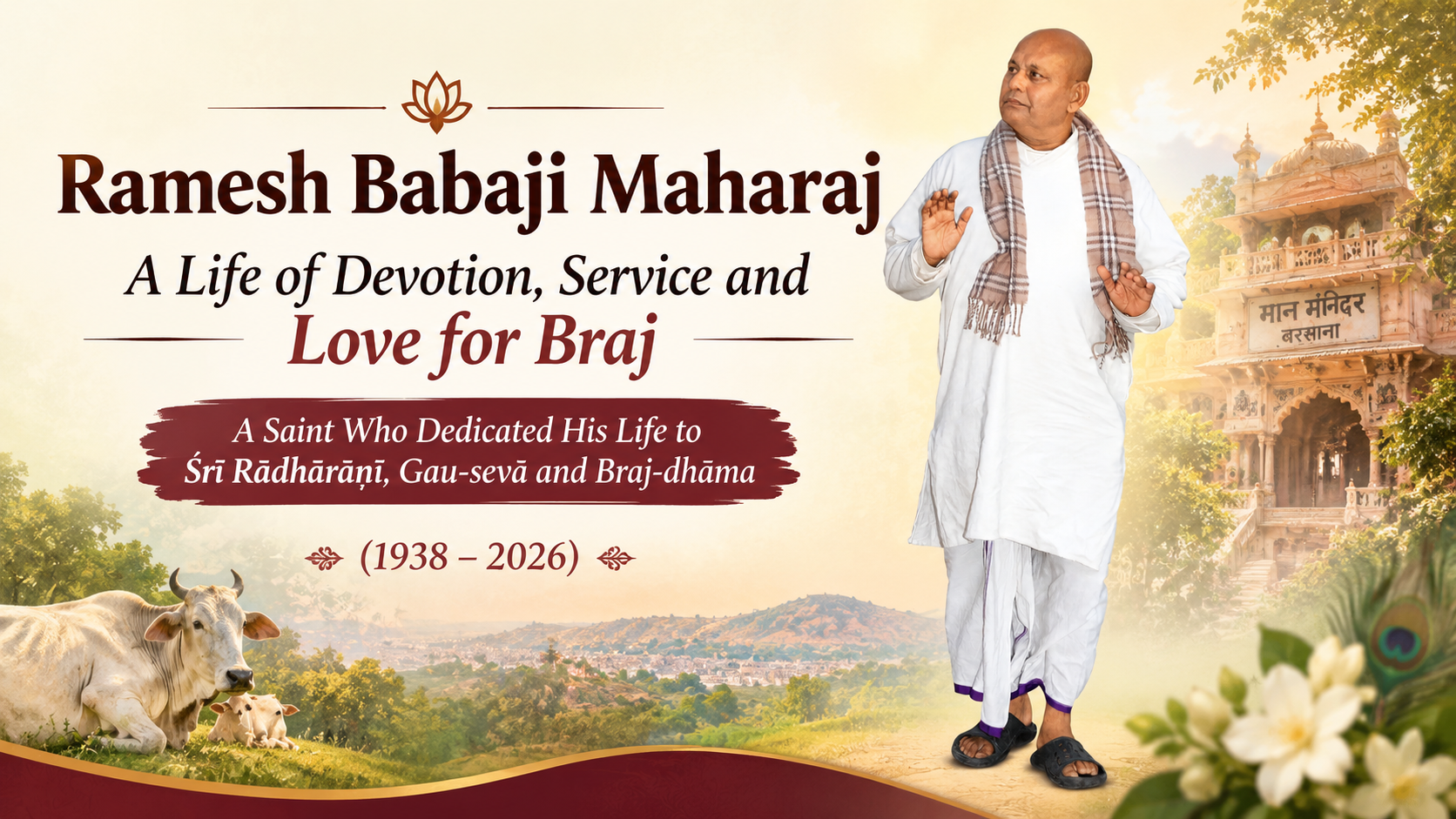
Ramesh Babaji Maharaj, the revered saint of Barsana and founder of Maan Mandir, entered nitya-līlā on 6 October 2026 at Maan Mandir in Barsana, Braj. He was 88 years old. His passing marks the departure of a saint whose entire life was dedicated to Śrī Rādhārāṇī, Śrī Vraja-dhāma, Gau-sevā, hari-nāma-saṅkīrtana and the preservation of the sacred land of Braj.
For devotees, the disappearance of a saint is not understood merely as the end of the material body. The Vaiṣṇava tradition teaches that the soul is eternal and that the sincere servant of the Lord continues his spiritual journey by the mercy of Śrī Guru and Śrī Bhagavān. Thus, while devotees naturally feel separation, they also remember the divine service and teachings left behind.
The life of Ramesh Babaji Maharaj stands as an example of vairāgya—detachment from material life—and sevā, or selfless devotional service.
Early Life and the Call of Braj
Ramesh Babaji Maharaj was born in 1938 in Prayagraj, the sacred city of Prayāga. His father, Baldev Prasad Shukla, was a respected astrologer, and his mother was Hemeshwari Devi. According to accounts preserved by Maan Mandir, his birth took place during the sacred month of Pauṣa.
From childhood, he displayed a strong inclination toward spiritual life. His heart was naturally attracted toward Braj, the sacred land associated with the eternal pastimes of Śrī Śrī Rādhā and Kṛṣṇa.
He attempted more than once to leave his birthplace and come to Braj. The affection of his mother brought him back on his first attempts, but eventually his longing for spiritual life became so strong that he left home and came to the land of Vraja.
At a young age, therefore, he chose a life of renunciation and dedicated himself to spiritual practice.
Ramesh Babaji Maharaj and Maan Mandir
After arriving in Braj, Ramesh Babaji Maharaj accepted the shelter of the saint Priyāśaraṇa Ji Maharaj. His life thereafter became deeply connected with the worship of Śrī Rādhārāṇī and service to Braj-dhāma.
He eventually made Maan-gaṛh, situated upon Brahmāñcala Hill in Barsana, the centre of his spiritual life. This place became known as Maan Mandir.
In its earlier days, the area was surrounded by dense forest and was difficult to access. Yet rather than seeking comfort or an easier place of residence, the saint remained there and continued his sādhana and sevā.
Over the years, Maan Mandir developed into an important centre of devotion in Barsana.
For Ramesh Babaji Maharaj, Braj was not simply a geographical region. It was Vraja-dhāma—the sacred abode of Śrī Rādhā and Kṛṣṇa—and therefore worthy of the highest reverence and protection.
Ramesh Babaji Maharaj and Gau-sevā
One of the most prominent services associated with Ramesh Babaji Maharaj is Gau-sevā, service to the sacred cow.
In 2007, Mataji Gaushala was begun with only two cows. The institution subsequently grew into a large centre dedicated to the protection and care of cows, particularly abandoned, injured and helpless animals.
Contemporary reports describe the gaushala as caring for tens of thousands of cows. Because the reported numbers have varied over the years, the exact current figure should be taken from the institution’s latest official records rather than assuming a single historical number.
His service reflects the traditional understanding of go-sevā within Vedic culture. The cow has long been honoured as a motherly being and as an important foundation of a dharmic agricultural society.
For him, serving cows was not merely social welfare. It was an expression of compassion and devotional service.
Protecting the Sacred Land of Braj
Another major dimension of his life was the protection of Braj’s natural and sacred heritage.
Braj is celebrated throughout Vaiṣṇava literature for its forests, hills, kundas, groves and places connected with the pastimes of Śrī Kṛṣṇa and Śrīmatī Rādhārāṇī. For a devotee, these places are not ordinary pieces of land. They are sacred reminders of the Lord’s transcendental pastimes.
Ramesh Babaji Maharaj therefore raised his voice against activities that threatened the ecological and religious character of Braj.
He worked against the cutting of trees in Gahvaravana and campaigned against illegal mining in the hills connected with Braj. Reports also credit his movement with contributing to the protection of the Braj hills from mining activity.
His efforts demonstrate an important principle of devotional life: seva means caring for the Lord’s property and the sacred places connected with His devotees and pastimes.
Restoration of Sacred Kundas
Ramesh Babaji Maharaj also contributed to the restoration and preservation of numerous sacred water bodies throughout the Braj region.
Among the kundas associated with restoration efforts are Ratna Kunda, Vihvala Kunda, Kṛṣṇa Kunda, Bichhua Kunda, Gaya Kunda, Lal Kunda, Gopāla Kunda, Rudra Kunda, Gomati-Ganga, Lalita Kunda and several others.
The preservation of these places is particularly significant because sacred kundas form an integral part of the spiritual geography of Vraja.
A devotee approaching such places is reminded of the eternal pastimes of the Divine Couple and of the great Vaiṣṇavas who performed bhajana in the holy land.
Rādhārāṇī Braj Yatra and Hari-nāma-saṅkīrtana
Another important contribution of Ramesh Babaji Maharaj was the promotion of the Rādhārāṇī Braj Yatra, commonly known as the 84-kosa Braj Yatra.
The tradition of circumambulating the sacred places of Braj allows pilgrims to visit the various forests, villages, kundas and līlā-sthalīs associated with Śrī Rādhā and Kṛṣṇa.
Reports state that the yatra has been offered freely to pilgrims, with arrangements for their accommodation and food.
Through such activities, the chanting of the holy name and remembrance of the pastimes of the Lord reached many villages of Braj.
This is especially meaningful in the age of Kali-yuga, when the scriptures glorify hari-nāma-saṅkīrtana, the congregational chanting of the holy names of the Lord, as a powerful means of spiritual purification.
Service to Yamunā and the Environment
His service was also connected with the protection of the Yamunā and the wider environment of Braj.
The Yamunā is revered by Vaiṣṇavas as a sacred river intimately connected with the pastimes of Śrī Kṛṣṇa. Efforts associated with Maan Mandir included campaigns and public awareness activities for the restoration and protection of the Yamunā.
Thus, his understanding of environmental protection was inseparable from his understanding of dhāma-sevā—service to the holy abode.
Honoured with the Padma Shri
In recognition of his work in animal welfare, particularly cow protection, Ramesh Babaji Maharaj was honoured with the Padma Shri in 2019, one of India’s highest civilian honours. The Government of India’s Padma Awards records list him under Social Work–Animal Welfare, Uttar Pradesh.
Yet for a renounced Vaiṣṇava, external honours are ultimately secondary.
The true wealth of a saint is his service to the Lord, his compassion toward living beings and his unwavering dedication to the spiritual path.
A Life Dedicated to Śrī Rādhārāṇī and Vraja-dhāma
The defining feature of Ramesh Babaji Maharaj’s life was his deep attachment to Braj.
He chose the dust of Vraja over worldly comfort. He remained connected with Barsana, Maan Mandir and the service of Śrī Rādhārāṇī throughout his life.
His example reminds us that genuine spiritual life is not simply a matter of philosophical knowledge. It is expressed through sevā, humility, renunciation, compassion and remembrance of the Supreme Lord.
A saint may leave behind institutions, temples, cowsheds, restored kundas and organised pilgrimages. But his greatest legacy is often the inspiration he gives others to serve.
Remembering His Service
As devotees and residents of Braj remember Ramesh Babaji Maharaj, they can also remember the principles that shaped his life.
To honour a Vaiṣṇava is not merely to speak about his accomplishments. It is to learn from his dedication.
His life encourages us to respect the holy dhāma, protect sacred places, serve living beings, honour Gau-mātā, chant the holy name and cultivate attachment to Śrī Rādhā and Kṛṣṇa.
The departure of a saint naturally creates feelings of separation. Yet devotional culture teaches us to transform separation into deeper remembrance and service.
Conclusion
Ramesh Babaji Maharaj dedicated his life to the service of Śrī Rādhārāṇī, Braj-dhāma, Gau-mātā and the sacred heritage of Vraja. From Maan Mandir in Barsana, his service extended into Gau-sevā, Braj preservation, restoration of sacred kundas, protection of the hills and forests, pilgrimage and hari-nāma-saṅkīrtana.
On 6 October 2026, he left his body at Maan Mandir, Barsana. For those who loved and respected him, this is a moment of profound separation. At the same time, his life remains a powerful reminder of what it means to dedicate one’s existence to sevā and devotion.
May we remember his example with humility and gratitude, and may his service inspire us to serve Śrī Vraja-dhāma with greater sincerity.
All glories to the saints of Vraja. All glories to Śrī Rādhārāṇī. All glories to Śrī Vraja-dhāma.
Deepen your Bhakti-yoga practice, harmonize relationships, and receive guided coaching — all at Vedavarsity.com