


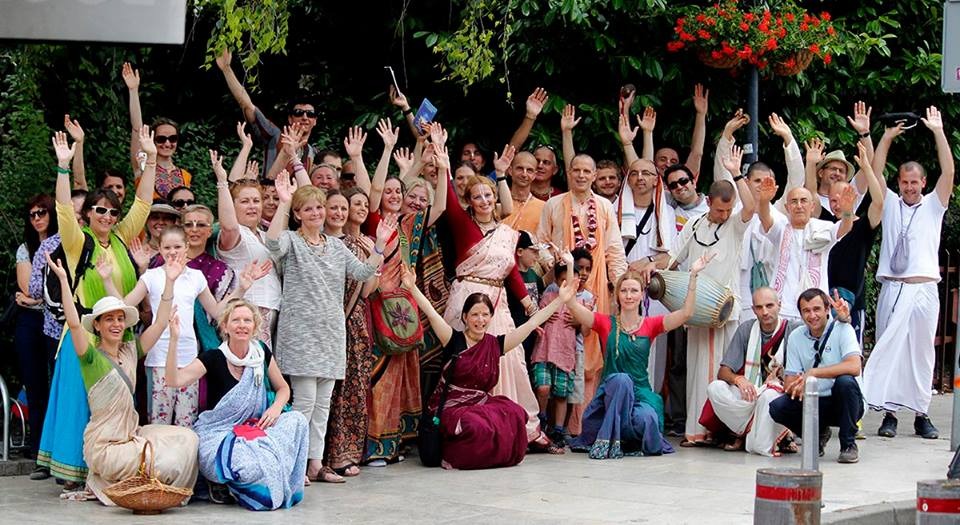
ISKCON Croatia is strengthening its congregational life and expanding public outreach as the International Society for Krishna Consciousness enters its 60th anniversary year. Through harināma-saṅkīrtana, prasādam distribution, book distribution, festivals, educational programs, and personal relationships, devotees in Croatia are working to create a living spiritual community rooted in the teachings of Śrīla Prabhupāda.
The history of Krishna consciousness in Croatia is closely connected with the wider development of ISKCON in the former Yugoslavia. Over several decades, devotees have distributed Śrīla Prabhupāda’s books, organized programs, established temples, and introduced people to the chanting of the holy name.
Today, the community is placing renewed emphasis on congregational development—helping devotees who live outside the temple remain connected through meaningful association and practical service.
ISKCON Croatia and the Revival of Congregational Outreach
The foundation of spiritual life is sādhu-saṅga, or association with devotees. While temples remain important centers of devotional activity, many devotees have family responsibilities, employment, and other commitments that prevent them from living within a temple community.
For this reason, ISKCON Croatia is giving particular attention to small groups, personal relationships, and accessible programs.
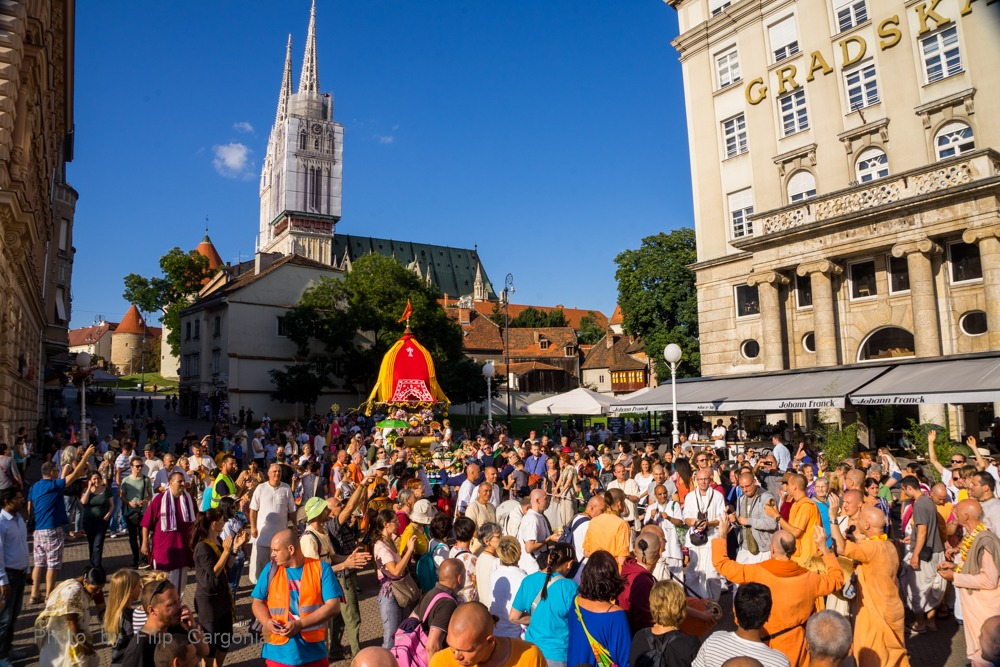
Recent activities at the Gaura-Nitai Mandir in Zagreb included a four-day program with Indradyumna Swami from August 27 to 30, 2026. The program began with Balarāma Pūrṇimā observances and continued with public chanting through Zagreb, followed by a large public festival.
Approximately 150 people participated in the public chanting, while around 350 attended Soul Fest. The festival included kīrtana, music, Rāmāyaṇa theatre, a spiritual talk, and prasādam.
Such programs demonstrate an important principle of devotional outreach: people may first come through music, culture, philosophy, or food, but through continued association they can gradually come to understand the science of Kṛṣṇa consciousness.
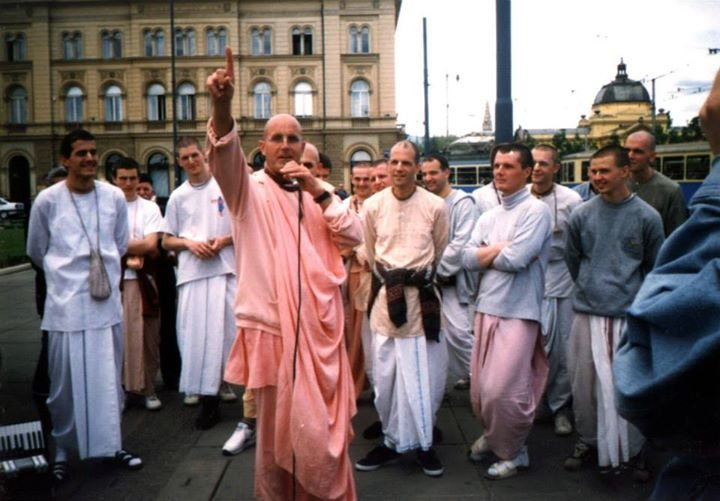
Harināma-Saṅkīrtana in the Streets
The chanting of the Hare Kṛṣṇa mahā-mantra is one of the principal means of spreading spiritual consciousness in the present age.
Public kīrtana allows people to encounter the holy name without requiring them to enter a temple or already understand Vedic philosophy. In this way, the saṅkīrtana movement reaches people in their ordinary surroundings.
Croatia has a long history of such public outreach. The Ratha Yātrā festival in Rijeka has continued for approximately twenty years, while Zagreb’s Ratha Yātrā has been conducted for around ten years. Smaller towns have also begun organizing devotional festivals.
From Book Distribution to a Living Spiritual Community
The history of ISKCON Croatia is deeply connected with the distribution of Śrīla Prabhupāda’s books.
During the Yugoslav period, traveling devotees introduced many people to Bhagavad-gītā, The Science of Self-Realization, and other books of transcendental knowledge. These books became a doorway through which people could inquire into the purpose of life.
Ishvara Puri Das recalled encountering devotees at his school in 1986 when he was only sixteen years old. Saffron-clad devotees distributed The Science of Self-Realization, giving young students an opportunity to encounter Vedic wisdom even under the social restrictions of the communist period.
At one stage, the temples in Zagreb and Rijeka were reportedly distributing approximately 100,000 books each year. This represents not merely the distribution of literature but the sowing of spiritual seeds.
As Śrīla Prabhupāda repeatedly emphasized, transcendental knowledge must be made available to sincere souls. A book may remain on a shelf for years, but at the proper time it can awaken a person’s dormant spiritual consciousness.
Bhakti-Saṅga and Devotee Association
Alongside book distribution, smaller bhakti-sāṅga groups helped sustain devotional life.
At one point, Zagreb had at least fifteen such groups, with approximately ten to fifteen participants in each. Groups took turns arranging Sunday programs, creating opportunities for devotees to hear, chant, honor prasādam, and associate with one another.
This model of congregational development remains relevant today. Spiritual advancement is not simply a matter of attending occasional festivals. It is strengthened through regular śravaṇam, hearing about Kṛṣṇa; kīrtanam, chanting His glories; and sādhu-saṅga, association with devotees.
ISKCON Croatia Builds Bridges with Society
Devotional outreach becomes meaningful when it creates genuine relationships with society.
In Croatia, devotees have interacted with educators, government officials, cultural institutions, municipal authorities, and representatives of the Indian community. Such relationships have helped people understand Krishna consciousness beyond stereotypes or superficial impressions.
Following Croatian independence in 1991, devotees were involved in discussions concerning the recognition of religious communities. Krishna consciousness subsequently received official recognition alongside other religious traditions.
Academic engagement has also provided opportunities for dialogue. An Indology professor brought students to the Zagreb temple, where they could explore the Bhagavad-gītā from both academic and devotional perspectives. Some students later researched ISKCON for university projects, while others continued their personal spiritual practices.
Such encounters demonstrate that genuine spiritual culture does not need to isolate itself from society. Rather, it can share transcendental knowledge respectfully and allow people to inquire according to their own capacity.
Serving People Through Prasādam
Another powerful form of outreach is prasādam, food that has first been offered to Kṛṣṇa with devotion.
During the pandemic and earthquakes affecting Zagreb and Petrinja, devotees organized food distribution and traveled extensively to serve affected people. One account describes a woman who was initially frightened to open her door but later expressed her gratitude by giving a small white angel to the devotee who brought her food.
Such service reflects the Vaiṣṇava principle of jīve dayā—compassion toward living beings.
When spiritual principles are expressed through practical service, people can experience the culture of devotion not merely as philosophy but as genuine care.
Creating a Place for Everyone
One of the central challenges facing modern spiritual communities is helping people find a meaningful place for service.
Many devotees today work full-time, raise families, travel for employment, or live far from temples. Their circumstances may differ from those of devotees who reside in āśramas.
The leaders of ISKCON Croatia have therefore emphasized distributing responsibilities more widely and creating opportunities for people to participate according to their abilities.
The principle is simple: every sincere devotee should have an opportunity to serve.
A community becomes strong when service is not concentrated in the hands of only a few people. When devotees cooperate, guide one another, and willingly accept responsibility, the spiritual atmosphere becomes more nourishing.
Challenges and Opportunities for the Future
The growth of a spiritual community naturally brings challenges.
The Croatian community has experienced periods in which leadership difficulties and disagreements consumed valuable energy. Working devotees also face the challenge of balancing professional responsibilities, family life, and devotional service.
For younger people especially, spiritual commitment may develop gradually. Rather than expecting everyone to immediately adopt the same level of involvement, experienced devotees can create welcoming pathways through which newcomers gradually develop faith.
This corresponds with the Vaiṣṇava understanding of śraddhā, or initial spiritual faith. Faith can develop through association, hearing, service, and personal experience.
ISKCON Croatia is therefore exploring regular small groups and additional facilities for devotees and guests. A newly purchased building beside the Zagreb temple is planned for use as a guesthouse, creating further opportunities for visitors to experience devotional life.
Preserving Śrīla Prabhupāda’s Books and Teachings
Literature remains a central pillar of the movement.
Croatian publications include Bhagavad-gītā, the complete Śrī Caitanya-caritāmṛta, the first three cantos of Śrīmad-Bhāgavatam, and numerous smaller books. A pocket edition of Bhagavad-gītā is also being prepared.
These books preserve the teachings received through the disciplic succession and make them accessible to future generations.
The real strength of a spiritual movement lies not simply in buildings or institutions but in the transmission of transcendental knowledge. When devotees study Śāstra, practice bhakti, and share the teachings sincerely, the spiritual culture continues to flourish.
The Future of ISKCON Croatia
The story of ISKCON Croatia illustrates how a spiritual community can evolve while remaining faithful to its foundational teachings.
From early book distribution during the Yugoslav period to modern public festivals, Ratha Yātrās, kīrtanas, prasādam distribution, educational programs, and congregational groups, the Croatian devotees continue to build upon decades of service.
The next stage is not merely about increasing the size of the community. It is about deepening relationships, encouraging cooperation, engaging younger generations, and giving every sincere person an opportunity to participate in devotional service.
As Śrīla Prabhupāda’s teachings continue to travel across the world, the chanting of the holy name remains at the heart of this mission:
Hare Kṛṣṇa Hare Kṛṣṇa Kṛṣṇa Kṛṣṇa Hare Hare
Hare Rāma Hare Rāma Rāma Rāma Hare Hare
The continuing efforts of ISKCON Croatia show how the timeless principles of bhakti can be practiced within contemporary society while preserving the essential spirit of Guru, Sādhu, and Śāstra.
Deepen your Bhakti-yoga practice, harmonize relationships, and receive guided coaching — all at Vedavarsity.com