


The Meenakshi Sundareswarar Temple stands at the heart of Madurai, representing one of the most remarkable expressions of India’s cultural and spiritual heritage. It is not merely a temple but a living institution that has preserved traditions, literature, and devotional practices for over two millennia.
To understand the identity of Madurai is to understand the central role of the Meenakshi Sundareswarar Temple. Its presence reflects the continuity of dharma—sustained through time by collective faith, disciplined worship, and cultural refinement.
A Temple Rooted in Ancient Tradition
The Meenakshi Sundareswarar Temple finds mention in the literature of the Sangam period, indicating its antiquity and importance even in early Tamil civilization. Devotional hymns of the Nayanmars glorify Lord Sundareswarar (Shiva), also known as Aalavaayan of Madurai.
Sacred texts such as the Tiruvilayadal Puranam and Haalaasya Mahatmyam narrate the divine acts (līlā) of Lord Shiva associated with this temple. These narratives are not confined to scripture; they are actively reenacted during festivals, ensuring that tradition remains a lived experience rather than a distant memory.
This continuity reflects the Vedic understanding that spiritual knowledge is preserved not only through texts but through practice (ācāra).
The Living Legacy of Meenakshi Sundareswarar Temple
One of the most striking aspects of the Meenakshi Sundareswarar Temple is its ability to absorb and sustain traditions over centuries. Despite periods of disruption, including the destruction during the invasion led by Malik Kafur, the temple was later rebuilt under the patronage of the Nayak rulers.
This restoration reflects the resilience of cultural and spiritual institutions rooted in dharma. When aligned with higher principles, such systems endure beyond temporary challenges.
Royal Tradition and Divine Kingship
In the tradition of Madurai, Goddess Meenakshi and Lord Sundareswarar are regarded as the reigning sovereigns of the city. According to legend, Meenakshi is the daughter of King Malayadwaja Pandyan, and her divine marriage (Meenakshi Kalyanam) symbolizes the union of Shakti (divine energy) and Shiva (consciousness).
This concept reflects a deeper philosophical idea: governance, when aligned with divine principles, becomes an expression of righteousness rather than mere authority.
Architectural Splendour of Meenakshi Sundareswarar Temple
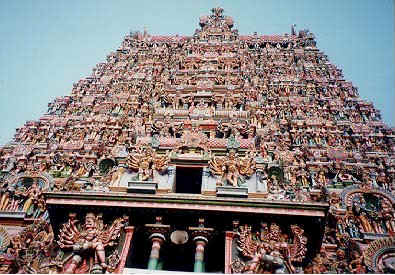
The Meenakshi Sundareswarar Temple is renowned for its architectural magnificence, particularly its towering gopurams (gateway towers).
Towering Rajagopurams
These gopurams dominate the skyline of Madurai and are adorned with thousands of stucco images depicting scenes from the Puranas. Each figure carries symbolic meaning, illustrating moral lessons and spiritual truths.
Sculptures and Mandapams
The temple complex functions as a vast gallery of art:
- The thousand-pillared hall showcases intricate sculptures
- Murals depict episodes from the Tiruvilayadal Puranam
- Numerous mandapams serve both ritual and cultural purposes
Such artistic expression is not merely decorative. In traditional understanding, art serves as a medium for transmitting knowledge and elevating consciousness.
Festival Traditions and Cultural Integration
The Meenakshi Sundareswarar Temple is especially known for its elaborate festival traditions, which integrate multiple streams of Hindu worship.
Chittirai Festival
One of the most significant festivals is the Chittirai festival, which includes the celebration of Meenakshi Kalyanam. This event draws large numbers of devotees and transforms the city into a unified space of celebration.
Integration of Diverse Traditions
The temple’s festivals reflect a harmonious blending of Saiva, Shakta, Skanda, and Vaishnava traditions. This integration demonstrates the inclusive nature of Vedic culture, where different paths converge toward a common spiritual goal.
The alignment of the Maasi Tiruvizha with the festival of Kallazhagar Temple further emphasizes this unity.
Literary and Cultural Contributions
The Meenakshi Sundareswarar Temple has inspired a vast body of literature over centuries. From Sangam poetry to devotional hymns and Puranic narratives, the temple has been a focal point of intellectual and artistic activity.
Such contributions highlight the role of temples as centers of learning, where philosophy, literature, and devotion intersect.
In Vedic tradition, knowledge (jnāna) and devotion (bhakti) are not separate pursuits; they complement each other in guiding the individual toward higher understanding.
Spiritual Perspective: Beyond Structure and Ritual
While the grandeur of the Meenakshi Sundareswarar Temple is evident in its architecture and festivals, its deeper significance lies in its ability to guide individuals toward self-realization.
The temple environment encourages reflection on fundamental questions:
- What is the nature of the self (ātma)?
- What is the purpose of human life?
- How does one align with divine order?
Through rituals, stories, and sacred spaces, the temple provides a framework for contemplating these questions.
Resilience and Continuity Through Time
The history of the Meenakshi Sundareswarar Temple demonstrates resilience. Despite periods of destruction and reconstruction, the temple has retained its identity and purpose.
The contributions of the Nayak rulers, who rebuilt and expanded the temple, ensured that its traditions would continue. Their patronage reflects the understanding that preserving spiritual heritage is a responsibility that extends beyond individual lifetimes.
Such continuity is a manifestation of karma in a collective sense—actions performed with dedication yield lasting results.
Conclusion: A Living Expression of Cultural and Spiritual Harmony
The Meenakshi Sundareswarar Temple stands as a living example of India’s cultural and spiritual depth. It is not merely a monument of the past but an active center of worship, learning, and community life.
Its enduring presence reminds us that when human effort aligns with higher principles, traditions can transcend time and remain relevant across generations.
In a subtle way, the temple points toward a deeper truth: that beneath the diversity of forms and practices lies a unified divine order, accessible to those who approach with sincerity and understanding.
library.vedavarsity.com | www.vedavarsity.com
Deepen your Bhakti-yoga practice, harmonize relationships, and receive guided coaching — all at Vedavarsity.com