



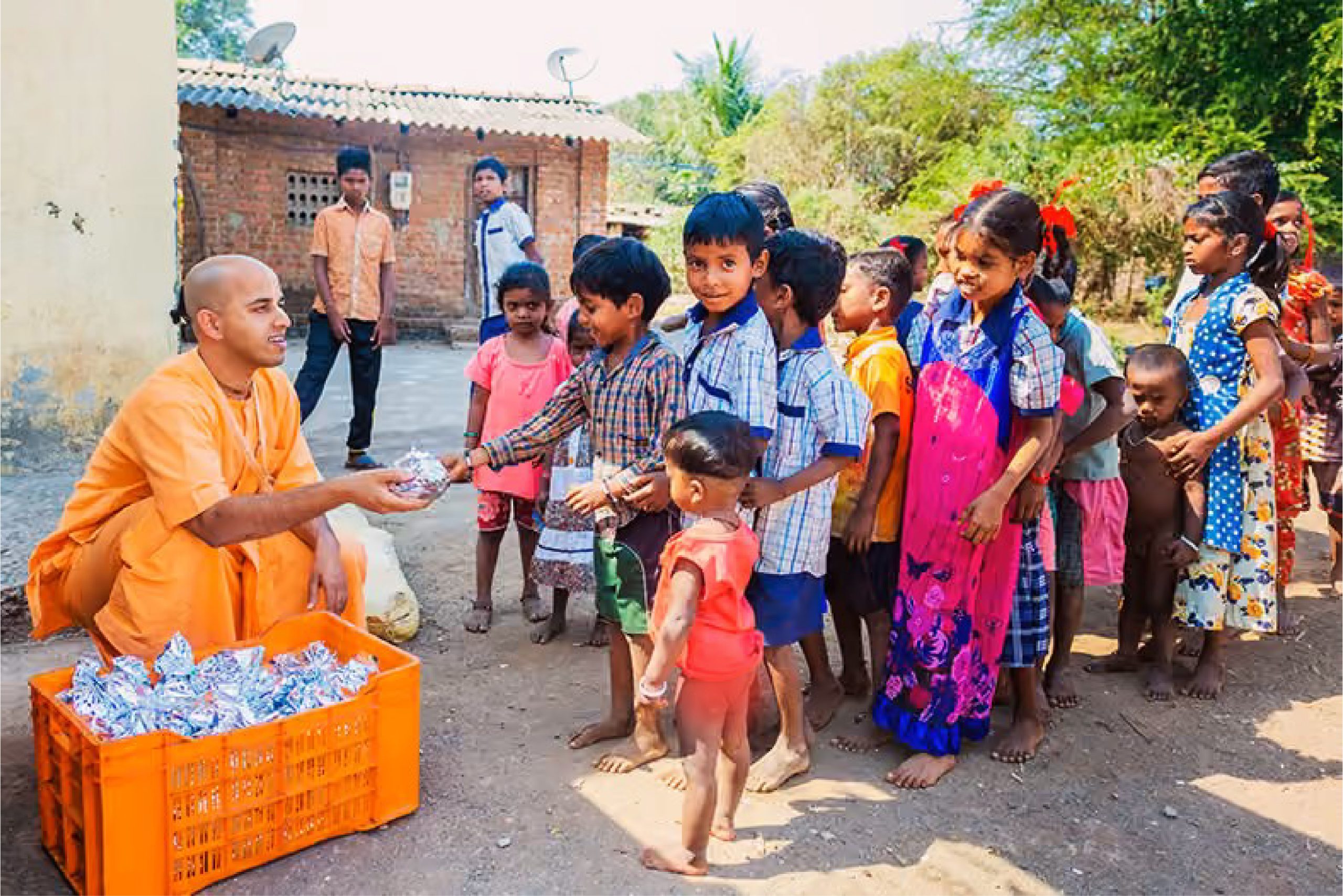
The ISKCON Bhiwandi prasadam distribution initiative demonstrates how the timeless Vedic principle of seva (selfless service) can address the practical needs of society while awakening spiritual consciousness. During October 2026, devotees and volunteers associated with ISKCON Bhiwandi’s Food for Life–Annadaan initiative distributed Krishna prasādam across Kalyan, Temghar and Kharbav in Maharashtra, India.
As the world observed World Food Day on October 16, this service offered a meaningful reminder that feeding the hungry is not merely an act of charity. In the Vedic understanding, food becomes spiritually beneficial when it is first offered to the Supreme Personality of Godhead, Lord Śrī Krishna, and then distributed as prasādam.
This principle transforms ordinary food distribution into an expression of devotion, compassion and gratitude towards the Supreme Lord.

The Spiritual Significance of Annadaan in Vedic Culture
In Vedic culture, offering food to others has traditionally been regarded as an important expression of compassion and generosity. The Sanskrit word annadāna means the charitable distribution of food.
However, the Vaiṣṇava understanding of food distribution goes beyond material charity. It recognizes that the living entity is not simply the temporary material body but an eternal spiritual soul.
Śrī Krishna explains in Bhagavad-gītā (15.7):
mamaivāṁśo jīva-loke jīva-bhūtaḥ sanātanaḥ
“The living entities in this conditioned world are My eternal fragmental parts.”
Thus, every living being is connected with Krishna. Serving others with compassion and humility is therefore an opportunity to express one’s relationship with the Supreme Lord.
When food is prepared with devotion, offered to Krishna and distributed to others, it becomes prasādam, the mercy of the Lord.
This is the spiritual foundation behind ISKCON’s Food for Life activities.
ISKCON Bhiwandi Prasadam Distribution: A Practical Expression of Krishna Consciousness
ISKCON Bhiwandi has been conducting its Annadaan initiative through the Food for Life service team. The initiative began in 2020, during the COVID-19 pandemic, when migrant workers and economically vulnerable families faced severe difficulties in obtaining regular meals.
Based at Sri Sri Radha Madhava Mandir, the initiative has continued to provide freshly prepared vegetarian meals to people in need.
According to information published by the temple, its kitchen prepares approximately 1,500 meals every day.
During October 2026, volunteers extended this service to several neighbouring communities:
- October 5: Food distribution in Kalyan.
- October 6: Food distribution in Temghar.
- October 7: Food distribution in Kharbav.
These activities reflect the continuing commitment of devotees and volunteers to serve society through the distribution of Krishna prasādam.
The exact number of meals distributed during October has not been independently confirmed. Nevertheless, the documented activities demonstrate the importance of consistent community participation and organized devotional service.
Why Is Krishna Prasādam Different from Ordinary Food?
According to Vedic philosophy, food is not merely a source of bodily nourishment. It is also connected with consciousness, gratitude and one’s relationship with the Supreme Lord.
In Bhagavad-gītā (3.13), Lord Krishna explains:
yajña-śiṣṭāśinaḥ santo mucyante sarva-kilbiṣaiḥ
” The devotees of the Lord are released from all kinds of sins because they eat food which is offered first for sacrifice.”
This verse establishes an important principle: food should first be offered to the Supreme Lord in a spirit of devotion.
In Bhagavad-gītā (9.26), Krishna further declares:
patraṁ puṣpaṁ phalaṁ toyaṁ yo me bhaktyā prayacchati
“If one offers Me with love and devotion a leaf, a flower, a fruit or water, I will accept it.”
The essential qualification is bhakti, or loving devotion.
Therefore, in ISKCON temples, food is prepared according to devotional standards and offered to Krishna before being distributed.
After the offering, the food is accepted as prasādam.
The distribution of prasādam is thus not simply an act of feeding the body. It also provides an opportunity for people to receive the mercy of Krishna.
World Food Day and the Message of Compassionate Service
World Food Day, observed annually on October 16, draws attention to hunger, food insecurity and the need for sustainable food systems.
The October activities of ISKCON Bhiwandi offered a practical example of how local spiritual communities can contribute towards addressing these challenges.
Bhiwandi is an important industrial and warehousing centre. Many people in the region depend upon daily wages and irregular employment. For economically vulnerable families and workers, access to regular and nutritious meals remains an important concern.
Through its Annadaan initiative, ISKCON Bhiwandi seeks to provide assistance through freshly prepared vegetarian food.
The service also reflects an important teaching of Vaiṣṇava philosophy: compassion should be expressed through practical action.
A devotee should not remain indifferent to the suffering of others. Rather, one should use one’s resources, abilities and time in the service of Krishna and His living entities.
In this way, food distribution becomes an opportunity to practise spiritual values in everyday life.
Selfless Service: The Foundation of Devotional Charity
The Bhagavad-gītā teaches that actions performed without selfish attachment gradually purify one’s consciousness.
Lord Krishna explains in Bhagavad-gītā (3.9):
yajñārthāt karmaṇo ‘nyatra loko ‘yaṁ karma-bandhanaḥ
“Work done as a sacrifice for Viṣṇu has to be performed, otherwise work binds one to this material world.”
This principle is central to the philosophy of devotional service.
When people perform charity merely for recognition, prestige or personal satisfaction, their activities remain influenced by material desires.
However, when service is performed to please Krishna, the same activity becomes an expression of bhakti-yoga.
The volunteers preparing meals, arranging supplies, coordinating transportation and distributing prasādam are participating in a collective devotional activity.
Such service encourages humility, cooperation and compassion.
It also teaches that genuine spirituality is not confined to rituals or philosophical discussions. It must be reflected in one’s dealings with other living beings.
The Importance of Food Distribution in the Krishna Consciousness Movement
Śrīla A. C. Bhaktivedanta Swami Prabhupāda, the Founder-Ācārya of the International Society for Krishna Consciousness, strongly emphasized the distribution of Krishna prasādam.
He established a worldwide movement in which spiritual education, chanting of the Hare Krishna mahā-mantra and prasādam distribution became important aspects of devotional life.
His vision was that people everywhere should have access to Krishna consciousness.
Prasādam distribution provides a simple and practical opportunity to introduce people to the mercy of Krishna.
It also helps establish a culture in which food is respected as the Lord’s gift rather than consumed merely for personal enjoyment.
The Food for Life programme reflects this understanding by combining food relief with the devotional principle of offering food to Krishna.
Through such initiatives, the Krishna consciousness movement demonstrates that spiritual knowledge and compassionate action can work together for the welfare of society.
From Material Charity to Spiritual Welfare
Material assistance is undoubtedly important. A hungry person requires food, and providing a meal can offer immediate relief.
However, Vedic philosophy also emphasizes the eternal spiritual nature of every living being.
Real welfare should therefore consider both the needs of the body and the spiritual identity of the soul.
Prasādam distribution provides an opportunity to serve these two aspects together.
The body receives nourishment, while the person also receives food that has been offered to the Supreme Lord.
This does not mean that material suffering should be neglected. Rather, it means that humanitarian activities can be performed with a deeper spiritual purpose.
When service is offered to Krishna, it becomes an instrument of spiritual purification for both the person serving and the person receiving.
Conclusion: ISKCON Bhiwandi Prasadam Distribution as Devotional Service
The ISKCON Bhiwandi prasadam distribution initiative demonstrates how the timeless teachings of Vedic culture can be expressed through practical service to society.
The October 2026 distributions across Kalyan, Temghar and Kharbav highlight the contribution of devotees and volunteers who are working to make Krishna prasādam accessible to people in need.
More importantly, this initiative reminds us that genuine charity is not simply about giving food. It is about cultivating compassion, humility and devotion through service to the Supreme Lord.
As taught in Bhagavad-gītā, when our actions are performed as an offering to Krishna, they become a means of spiritual purification.
Thus, the distribution of prasādam is both an act of compassion and an expression of bhakti.
By following this principle, individuals and communities can transform ordinary activities into devotional service and contribute towards a society guided by spiritual values.
Food offered to Krishna becomes prasādam, and prasādam distributed with compassion becomes an opportunity to share the mercy of the Supreme Lord.
Deepen your Bhakti-yoga practice, harmonize relationships, and receive guided coaching — all at Vedavarsity.com