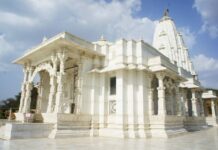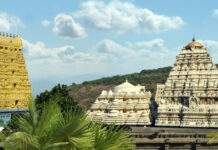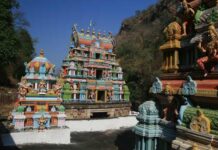
The Ekambareswarar Temple Kanchipuram stands as one of the most revered temples dedicated to Lord Shiva, representing the earth element (Prithvi) among the five sacred Panchabhoota Stalams. Located in Kanchipuram, an ancient city once ruled by the Pallavas, this temple reflects both spiritual depth and architectural grandeur.
As one of the foremost pilgrimage centers in India, Kanchipuram houses numerous temples. Among them, the Ekambareswarar Temple Kanchipuram occupies a central place, not only for its antiquity but also for its association with profound spiritual symbolism and living traditions.
Ekambareswarar Temple Kanchipuram: A Panchabhoota Stalam
The Ekambareswarar Temple Kanchipuram is one of the five temples representing the fundamental elements of nature:
- Earth (Kanchipuram)
- Water (Tiruvanaikka)
- Fire (Tiruvannamalai)
- Air (Kalahasti)
- Space (Chidambaram)
In this temple, Shiva is worshipped as the Prithvi Lingam, symbolizing the element of earth—stability, nourishment, and endurance.
From a philosophical standpoint, the five elements form the basis of the material body. Recognizing their sacred origin helps one understand the distinction between the body and the eternal self (ātma).
Sacred Geography of Kanchipuram
Kanchipuram is often described as a temple city, filled with shrines that have been revered for centuries. Notable among them are Kamakshi Amman Temple and Kumara Kottam Temple.
These temples, along with the Ekambareswarar Temple Kanchipuram, are arranged symbolically to represent the Somaskanda form—Shiva, Parvati, and Skanda. Interestingly, there is no separate shrine for the Goddess in most Shiva temples in Kanchipuram, as she is worshipped centrally at the Kamakshi shrine.
This arrangement reflects a unified understanding of divine energies within a single sacred geography.
Historical Evolution and Patronage
The Ekambareswarar Temple Kanchipuram has evolved over centuries, supported by various dynasties.
Pallava and Chola Contributions
Kanchipuram, the capital of the Pallavas, witnessed early temple construction under their rule. Later, the Cholas contributed significantly to the temple’s expansion and maintenance.
Ancient Tamil works such as Manimekalai and Tiruvacakam mention the glory of Kanchi, indicating its long-standing importance.
Vijayanagara Influence
The Vijayanagara rulers, particularly Krishnadevaraya, made major additions to the temple. The towering gopuram and spacious mandapams reflect their architectural vision.
This continuity of patronage demonstrates how rulers considered the preservation of dharma a central responsibility.
Temple Architecture and Layout
The Ekambareswarar Temple Kanchipuram spans an area of over 40 acres, making it one of the largest temple complexes in South India.
Raja Gopuram and Mandapams
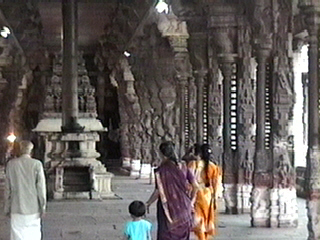
The grand Raja Gopuram rises to a height of approximately 172 feet, dominating the skyline of Kanchipuram. The pillared hall near the sanctum showcases intricate craftsmanship and serves as a space for rituals and gatherings.
Temple Corridors and Structures
Long corridors, expansive courtyards, and multiple shrines form the architectural layout. These elements guide the devotee gradually toward the sanctum, reflecting the inward journey of spiritual practice.
Temple architecture, in this sense, is not merely structural but instructional.
Deities and Sacred Legend
The presiding deity of the Ekambareswarar Temple Kanchipuram is Lord Shiva, worshipped as Ekambareswarar.
Legend of the Sand Lingam
According to tradition, Goddess Parvati (Kamakshi) performed penance by worshipping a Shiva Lingam made of sand under a mango tree. When the nearby Vegavati River overflowed and threatened the Lingam, she embraced it to protect it.
Moved by her devotion, Lord Shiva appeared and accepted her as his consort. In this context, he is referred to as “Tazhuvakkuzhainthaar,” meaning “the one who was embraced.”
This legend illustrates the principle that sincere devotion (bhakti) can overcome obstacles and lead to divine union.
Somaskanda Representation
A Somaskanda panel depicting Shiva, Parvati, and Skanda adorns the rear of the sanctum. This reinforces the idea of divine family unity and balance.
The Sacred Mango Tree (Stala Vriksham)
One of the most unique features of the Ekambareswarar Temple Kanchipuram is its ancient mango tree, believed to be over 3500 years old.
Tradition holds that the tree represents the four Vedas and produces fruits of four distinct tastes. This symbolism suggests that all branches of knowledge ultimately originate from a single source.
Such elements remind devotees that nature itself participates in divine expression.
Spiritual Significance and Devotional Experiences
The temple is also associated with the saint Sundarar, who is believed to have regained vision in one eye after worshipping here.
This narrative highlights the transformative potential of sincere devotion. In Vedic understanding, actions performed with faith yield results not always visible through ordinary reasoning.
Worship Practices and Festivals
The Ekambareswarar Temple Kanchipuram maintains a structured schedule of six daily worship services:
- Ushad Kalam
- Kala Santhi
- Uchi Kalam
- Pradosham
- Sayarakshai
- Ardhajamam
Major Festivals
The temple calendar is marked by numerous festivals:
- Ani Tirumanjanam (June–July)
- Adi Kritikai (July–August)
- Avani Moolam (August–September)
- Navaratri (September–October)
- Karthikai Deepam (November–December)
- Thai Poosam (January–February)
- Panguni Uthiram (March–April)
- Chitra Pournami (April–May)
- Vaikasi Vishakam (May–June)
The Panguni festival, lasting thirteen days, celebrates the divine marriage of Shiva and Parvati with great devotion.
Festivals serve as reminders that spiritual life is enriched through collective participation and disciplined observance.
Conclusion: Stability and Spiritual Insight Through the Earth Element
The Ekambareswarar Temple Kanchipuram stands as a profound representation of the earth element—steady, nurturing, and enduring. Its legends, architecture, and rituals collectively guide the devotee toward deeper understanding.
In recognizing the sacredness of the elements, one begins to see the body as part of a larger system governed by divine order. This awareness encourages responsible action (karma) and alignment with dharma.
Ultimately, the temple reminds us that true stability is not merely physical but arises from a grounded understanding of the self and its relationship with the Supreme.
library.vedavarsity.com | www.vedavarsity.com
Deepen your Bhakti-yoga practice, harmonize relationships, and receive guided coaching — all at Vedavarsity.com