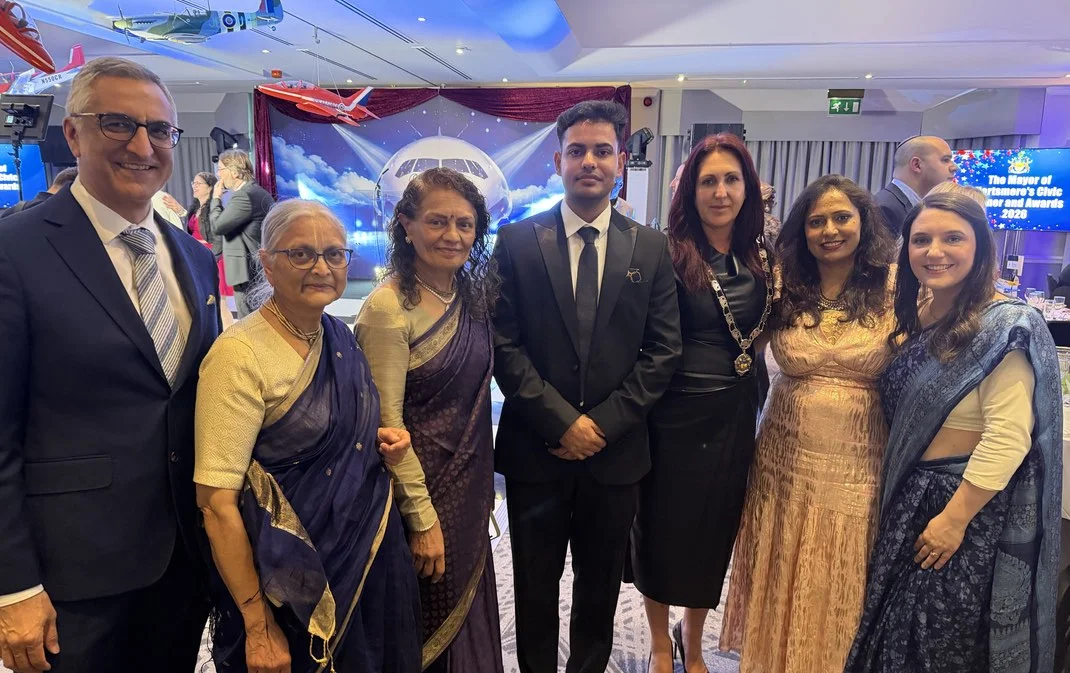
The Devotee Care Office Civic Award marks a significant recognition of sustained community service carried out by the Devotee Care Office (DCO) at Bhaktivedanta Manor. At Hertsmere’s annual civic ceremony, held at the Hilton DoubleTree in Borehamwood, the DCO received the award in the Community Care category, acknowledging a year of dedicated service to vulnerable individuals across the region.
Representatives Krishna Purna Dasi, Dr Diviash Thakrar, Hemangi Radha Dasi, and Saraswati accepted the award on behalf of the DCO. The ceremony, attended by local leaders, charity workers, and community representatives, featured the presentation by the Mayor of Hertsmere, Councillor Alpha Bird Collins.
This recognition highlights not only measurable achievements but also a consistent commitment to compassionate service—an expression of dharma, or duty performed for the welfare of others.
Devotee Care Office Civic Award and Community Meal Initiatives
A central aspect of the DCO’s work, which contributed to the Devotee Care Office Civic Award, is its weekly meal distribution program.
Every Thursday, volunteers prepare approximately 70 meals for elderly and unwell individuals. These meals are distributed through collaboration with a local charity as part of the Meals on Wheels – Prasadam Seva initiative.
Over the past year, this program has delivered more than 5,000 meals across Bushey, Watford, Radlett, Borehamwood, and Stanmore. In addition, partnerships with local organisations have enabled the DCO to distribute a further 3,000 meals annually to individuals unable to cook for themselves.
The offering of prasadam—food prepared with devotion—holds both practical and spiritual significance. It nourishes the body while also reminding one of the principle that all sustenance ultimately comes from a higher source.

Healthcare Support and Hindu Chaplaincy Services
The activities recognised by the Devotee Care Office Civic Award extend into healthcare support, particularly for Hindu patients in local hospitals.
Over the past year, the DCO has assisted 23 patients, including those receiving end-of-life care. This support ensures that individuals are able to maintain their cultural and spiritual practices during critical stages of life.
In September 2025, 20 volunteers successfully completed chaplaincy training, qualifying them to serve as Hindu chaplains. This development strengthens the DCO’s ability to provide structured spiritual care within institutional settings.
From a Vedic perspective, care at the time of illness and departure from the body is of deep importance, as consciousness at such moments influences one’s future direction (karma and its continuation).
Women’s Wellbeing and Community Engagement
Another key area acknowledged through the Devotee Care Office Civic Award is the DCO’s focus on women’s wellbeing.
Since the previous year, 110 women have participated in health and wellbeing sessions organized by the DCO. These sessions aim to support both physical health and emotional resilience.
The first International Women’s Day event hosted by the DCO brought together 70 participants, fostering dialogue and shared experience. In addition, weekly fitness sessions held at the Haveli have been fully subscribed, reflecting strong community engagement.
Such initiatives contribute to balanced living, where care for the body supports clarity of mind, enabling individuals to better understand their responsibilities and purpose.
Legal, Social, and Emotional Support Services
The Devotee Care Office Civic Award also recognises the DCO’s efforts in providing essential legal and social support.
Workshops on Lasting Power of Attorney have assisted 17 individuals in completing important legal arrangements. These provisions ensure that personal and medical decisions can be managed responsibly when individuals are no longer able to act independently.
The DCO has also supported individuals with care planning, housing needs, and relocation to care homes. In addition, a weekly Friendship Group has been established to assist those experiencing isolation, offering regular social interaction and emotional support.
Such services address practical needs while also affirming the dignity of each individual, recognising that every person is more than their immediate circumstances.
Expansion of Community Programs and Institutional Development
Ongoing efforts connected to the Devotee Care Office Civic Award include expansion and institutional strengthening.
The DCO conducts monthly kirtan visits to care homes, bringing spiritual sound vibration into environments where many residents may experience loneliness or limited mobility.
New care programs have been initiated in Soho and Scotland, extending the reach of the DCO’s services. Additionally, the development of an Adult Safeguarding Policy ensures that all activities are conducted with accountability and care.
Financial support has also played a role in this growth. The DCO secured £5,000 in funding from Hertfordshire County Council, enabling stronger collaboration with local organisations and improved service delivery.
Such structured development reflects the principle that service, when guided by responsibility and proper systems, becomes sustainable and impactful.
A Deeper Understanding of Service
The Devotee Care Office Civic Award ultimately recognises more than a series of initiatives. It acknowledges a consistent approach to service grounded in compassion and responsibility.
In Vedic understanding, seva (selfless service) is not merely social work; it is an expression of one’s duty toward others, performed without expectation of personal gain. When service is carried out in this spirit, it benefits both the recipient and the provider.
The DCO’s activities demonstrate how organized efforts can address physical, emotional, and spiritual needs simultaneously.
Conclusion
The Devotee Care Office Civic Award stands as a meaningful acknowledgment of sustained community care at Bhaktivedanta Manor. Through meal distribution, healthcare support, wellbeing programs, and social services, the Devotee Care Office has addressed a wide range of human needs with consistency and dignity.
Such efforts illustrate that genuine progress lies not only in external development but also in cultivating compassion and responsibility toward others. In this way, acts of service become aligned with a higher order, contributing to both individual well-being and collective harmony.
library.vedavarsity.com | www.vedavarsity.com
Deepen your Bhakti-yoga practice, harmonize relationships, and receive guided coaching — all at Vedavarsity.com