


Mail ID: contact@vedavarsity.com

Contact: +91 9634998911

Google search engineGoogle search engine
Home Blog Page 97

The Position of Kṛṣṇa

0

Thus far, we have discussed Vedic references to phenomena and theoretical entities that do not fit into the rigorously defined theories of modern physics but that can be readily inserted into our ordinary picture of the world around us. In this book, however, we will be dealing with many things that do not seem to be at all compatible with that picture. We suggest that to accommodate these things, it is necessary for us to re-examine our basic ideas concerning the nature of space.


Modern physics and astronomy began with the idea that matter is made of tiny bits of substance, each of which has a location in three-dimensional space. According to this idea, which was strongly developed by Descartes and Newton, three-dimensional space can be seen as an absolute, pre-existing container in which all material events take place. This idea is quite consistent with the picture of the world provided by our own senses, and it tends to provide an unquestioned background for all of our thinking. However, many cultures have maintained quite different ideas about the nature of space, and this is also true of the Vedic culture.


To understand the Vedic conception of space, it is necessary to consider the position of Kṛṣṇa as the absolute cause of all causes. Clearly we cannot regard the transcendental form of Kṛṣṇa as being composed of tiny bits of substance situated at different locations in three-dimensional space. Whether we regard the tiny bits as spiritual or material, such a form would certainly be limited and relative. The actual nature of Kṛṣṇa’s form is indicated by the following verses from the Brahma-saṁhitā:


I worship Govinda, the primeval Lord, whose transcendental form is full of bliss, truth, and substantiality and is thus full of the most dazzling splendor. Each of the limbs of that transcendental figure possesses in itself the full-fledged functions of all the organs, and He eternally sees, maintains, and manifests the infinite universes, both spiritual and mundane [SBS 5.32].


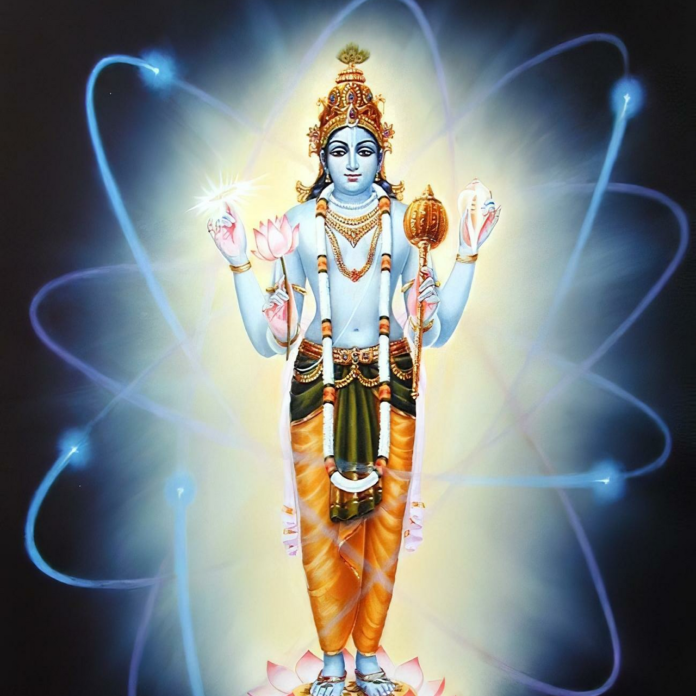
He is an undifferentiated entity, as there is no distinction between the potency and the possessor thereof. In His work of creation of millions of worlds, His potency remains inseparable. All the universes exist in Him, and He is present in His fullness in every one of the atoms that are scattered throughout the universe, at one and the same time. Such is the primeval Lord whom I adore [SBS 5.35].


These verses indicate that the form of Kṛṣṇa is made of many parts, but that each part is identical to the whole. Also, all space is within the form of Kṛṣṇa, but at the same time Kṛṣṇa is fully present within every atom. One implication of this is that the entire universe, which is within Kṛṣṇa, is fully present within every atom of the universe. Such a state of affairs cannot be visualized in three-dimensional terms, and indeed, it is not possible within three-dimensional space. The statement that reality is like this must simply be taken as an axiom describing the position of Kṛṣṇa as the Supreme Absolute Truth. Thus, the Vedic concept of space begins with a statement of Kṛṣṇa’s unified nature, rather than with the geometric axioms defining three-dimensional space.


Here we will introduce an idea of higher-dimensional space that may help us understand the ideas about space implicit in the Vedic literature. The term higher-dimensional is borrowed from modern mathematics; it does not appear directly in Vedic literature. It is part of an attempt to bridge the conceptual gap between modern thinking and the Vedic world view. Naturally, since the traditional followers of Vedic culture have not been confronted with such a gap, they have not been motivated to introduce ideas to bridge it.


The most fundamental feature of the Vedic idea of space is that many more things can be brought close together in this space than the geometric rules of three-dimensional space allow. In the course of this chapter we will give several examples from the Vedic literature illustrating this theme. Since the higher-dimensional spaces of mathematics also permit more things to be brought together than the rules of three-dimensional space allow, we have chosen the term higher-dimensional to refer to this feature of the Vedic view of reality.


Although Kṛṣṇa’s situation is very difficult for us to visualize, we can nonetheless understand from Vedic statements describing Kṛṣṇa that space must be higher-dimensional. Kṛṣṇa’s situation is that He has full access to every location simultaneously. In ordinary, three-dimensional space we have access, through the operation of our senses of action and perception, to locations within a limited neighborhood, and we can change that neighborhood by moving from one place to another. Thus our situation can be viewed as a restricted form of Kṛṣṇa’s situation. A higher-dimensional space corresponds to a situation in which access between locations is more restricted than it is for Kṛṣṇa but less restricted than it is for beings experiencing three-dimensional space.


This concept of higher-dimensional space is closely tied together with the idea of varying levels of sensory development in sentient beings. Access between locations depends on the operation of senses of action and senses of perception, and thus it should be possible in principle to enlarge the space of one’s experience by increasing the scope of one’s sensory powers.


These ideas about space and its relation to sense perception are implicit in the Vedic literature, and they can best be understood by giving some specific examples. The nature of Kṛṣṇa’s absolute position is nicely illustrated by the following story of a visit by Lord Brahmā to Kṛṣṇa in Dvārakā. In the story, Kṛṣṇa first responds to Brahmā’s request to see Him by having His secretary ask, “Which Brahmā wishes to see Me?” Brahmā later begins his conversation with Kṛṣṇa by asking why Kṛṣṇa made this inquiry:
“Why did you inquire which Brahmā had come see You? What is the purpose of such an inquiry? Is there any other Brahmā besides me within this universe?”


Upon hearing this, Śrī Kṛṣṇa smiled and immediately meditated. Unlimited Brahmās arrived instantly. These Brahmās had different numbers of heads. Some had ten heads, some twenty, some a hundred, some a thousand, some ten thousand, some a hundred thousand, some ten million, and others a hundred million. No one can count the number of faces they had.


There also arrived many Lord Śivas with various heads numbering one hundred thousand and ten million. Many Indras also arrived, and they had hundreds of thousands of eyes all over their bodies.
When the four-headed Brahmā of this universe saw all these opulences of Kṛṣṇa, he became very bewildered and considered himself a rabbit among many elephants.


All the Brahmās who came to see Kṛṣṇa offered their respects at His lotus feet, and when they did this, their helmets touched His lotus feet. No one can estimate the inconceivable potency of Kṛṣṇa. All the Brahmās who were there were resting in the one body of Kṛṣṇa. When all the helmets struck together at Kṛṣṇa’s lotus feet, there was a tumultuous sound. It appeared that the helmets themselves were offering prayers unto Kṛṣṇa’s lotus feet.
With folded hands, all the Brahmās and Śivas began to offer prayers unto Lord Kṛṣṇa, saying, “O Lord, You have shown me a great favor. I have been able to see Your lotus feet.”


Each of them then said, “It is my great fortune, Lord, that You have called me, thinking of me as Your servant. Now let me know what Your order is so that I may carry it on my heads.”
Lord Kṛṣṇa replied, “Since I wanted to see all of you together, I have called all of you here. All of you should be happy. Is there any fear of the demons?”
They replied, “By Your mercy, we are victorious everywhere. Whatever burden there was upon the earth You have taken away by descending on that planet.”


This is the proof of Dvārakā’s opulence: all the Brahmās thought, “Kṛṣṇa is now staying in my jurisdiction.” Thus the opulence of Dvārakā was perceived by each and every one of them. Although they were all assembled together, no one could see anyone but himself.
Lord Kṛṣṇa then bade farewell to all the Brahmās there, and after offering their obeisances, they all returned to their respective homes [CC ML 21.65-80].


In this story it is significant that each of the Brahmās remained within his own universe. This means that Kṛṣṇa was simultaneously manifesting His Dvārakā pastimes in all of those universes. Each Brahmā except ours thought that he was alone with Kṛṣṇa in Dvārakā within his own universe, but by Kṛṣṇa’s grace our Brahmā could simultaneously see all the others. This illustrates that Kṛṣṇa has access to all locations at once, and it also shows that, by Kṛṣṇa’s grace, different living beings can be given different degrees of spatial access, either permanently or temporarily.
Arjuna’s vision of Kṛṣṇa’s universal form on the battlefield of Kurukṣetra is another example of Kṛṣṇa’s expanding the sensory powers of a living being and giving him access to regions of the universe previously unknown to him.

Before revealing this form to Arjuna, Kṛṣṇa said,
O best of the Bhāratas, see here the different manifestations of Ādityas, Vasus, Rudras, Aśvinī-kumāras, and all the other demigods. Behold the many wonderful things that no one has ever seen or heard of before.
O Arjuna, whatever you want to see, behold at once in this body of Mine! This universal form can show you whatever you now desire to see and whatever you may want to see in the future. Everything-moving and nonmoving-is here completely, in one place [Bg 11.6-7].


Thus from one place Arjuna was able to see many different realms occupied by demigods and other kinds of living beings. To perceive such a vast variety of scenes simultaneously, Arjuna clearly had to transcend the limitations of three-dimensional space, and it is significant that Kṛṣṇa made this possible through the medium of His all-pervading universal form. The story of Mother Yaśodā’s seeing the entire universe (including herself and Kṛṣṇa) within Kṛṣṇa’s mouth is another example showing that Kṛṣṇa can reveal all locations through His all-encompassing form (see KB, pp. 83-84).


It is interesting to note that the Brahmās visiting Kṛṣṇa had varying numbers of heads, ranging from four to hundreds of millions. It is rather difficult to understand how millions of heads could be arranged on one body in three-dimensional space, and it is also difficult to see how millions of Brahmās could all be seen simultaneously within one room. We suggest that these things are made possible by the fact that the underlying space is not three-dimensional.


Similar observations could be made about the incident in which Bāṇāsura used 1,000 arms to work 500 bows and shoot 2,000 arrows at a time at Kṛṣṇa. In this case we are dealing with a materially embodied being living on the earth. One might wonder how 500 material arms could be mounted on one shoulder without interfering with one another. And if this is possible, how could they aim 500 bows in the same direction at once? (Did the bows pass through each other?) We suggest that stories of this kind implicitly require higher-dimensional conceptions of space.


We can sum up the idea of dimensionality of space by saying that the greater the degree of access between locations, the higher the dimensionality of the space. Since Kṛṣṇa has simultaneous access to all locations, He perceives space at the highest level of dimensionality. Different living beings will perceive space at different levels of dimensionality, and thus they will have access to different sets of locations (or lokas).


It is interesting to note that the idea of higher-dimensional access between locations is a key feature of quantum mechanics. The quantum mechanical atom cannot be represented in three-dimensional space. In fact, to represent something as commonplace as an atom of carbon, quantum mechanics makes use of a kind of infinite-dimensional space called Hilbert space. The three-dimensional bonding of carbon and other atoms is made possible by the higher-dimensional interactions within the atoms. Thus, although the idea of higher-dimensional realms may seem to be an extreme departure from accepted scientific thinking, it is possible to interpret modern physics as laying the groundwork for such an idea.

Extending Our Physical World View

0

Before making a truly radical departure from our familiar conceptions, we will begin by discussing some relatively moderate instances in which the Vedic literature refers to phenomena and theoretical ideas that do not fit into the current framework of scientific thought. These examples illustrate two main points: (1) Although many Vedic ideas contradict current scientific thinking, they also allow for the possibility that the contradictions can be alleviated by extending the conceptual scope of modern science.

(2) Many ideas relevant to our physical world-picture are alluded to only briefly in works such as the Śrīmad-Bhāgavatam, since these works were not intended to serve as textbooks of astronomy or physical science. Thus the conceptual advances needed to reconcile the Vedic world view with modern science may be difficult to make, since they require ideas that radically extend current theories but are not explicitly spelled out in available Vedic texts.


Our first example is found in SB 3.26.34p. There we read that the ethereal element provides a substrate for the production of subtle forms by the mind, and that it is also involved in the circulation of vital air within the body. Śrīla Prabhupāda indicates that “this verse is the potential basis of great scientific research work,” and indeed, it provides a clear idea of how the subtle mind may interact with the gross elements of the body and brain.
In the theoretical structure of modern physics, however, there is at present no place for such a conception of the mind and the ethereal element (although some physicists have tentatively begun to entertain such ideas).

As a consequence, scientists still generally adhere to the idea that it is impossible for the brain to interact with a distinct nonphysical mind. This in turn makes it impossible for them to give credence to many phenomena that imply the existence of such a mind, even though empirical evidence for these phenomena has existed for many years. These phenomena include the psychic events studied by the parapsychologists, out-of-body experiences, and the spontaneous remembrance of previous incarnations by small children.


It is not our purpose here to make a case for the reality of such phenomena. Our main point is that it is very difficult for people (including scientists) to seriously contemplate particular ideas about reality unless those ideas fit neatly into a familiar and accepted conceptual system. The current theories of physics have been worked out in great technical detail, and one who lives in the conceptual universe these theories provide may find that the Vedic idea of ether seems crude and unimpressive.

Openness to the Vedic ideas may also be blocked by certain misconceptions, such as the idea that ether must be like the “luminiferous ether” rejected by Einstein. Yet the possibility nonetheless exists that physical theory can be extended by introducing a new conception of the ether that agrees with the Vedic conception and is consistent with experimental observations. And such an extended theory may provide explanations for many phenomena presently considered scientifically impossible.


Texts such as the Śrīmad-Bhāgavatam were written for the purpose of clearly explaining certain spiritual ideas to people in general. However, they inevitably make reference to many other ideas that were familiar to people of the ancient Vedic culture but that may be very unfamiliar to people of modern Western background. One interesting example is the analogy given by Śrīla Sanātana Gosvāmī in which the transformation of a lowborn man into a brāhmaṇa is compared to the transformation of bell metal into gold by an alchemical process (SB 5.24.17p).


The alchemical process itself is not described, and on the basis of modern science we might tend to regard such a transformation as impossible. Yet the dictionary defines bell metal as an alloy of copper and tin, and if we consult the periodic table of the elements, we find that the atomic numbers of copper and tin added together give the atomic number of gold. This suggests that there just might be something to this example, but if so, it clearly involves an extensive body of practical and theoretical knowledge that is completely unknown to us. For Sanātana Gosvāmī, however, this transformation simply provided a familiar example to illustrate a point about the spiritual transformation of human beings.

The Size of the Universe

0

In the Śrīmad-Bhāgavatam a figure of 500 million yojanas is given for the diameter of the universe. On the basis of 8 miles per yojana, this comes to 4 billion miles, a distance that can accommodate the orbit of Saturn (according to modern distance figures), but that is smaller than the orbital diameters of Uranus, Neptune, and Pluto. Since this figure for the diameter of the universe seems to be quite small, it is interesting to note the purport given by Śrīla Prabhupāda to CC ML 21.84:


[Text:] Kṛṣṇa said, “Your particular universe extends four billion miles; therefore it is the smallest of all the universes. Consequently you have only four heads.”
[Purport:] Śrīla Bhaktisiddhānta Sarasvatī Ṭhākura, one of the greatest astrologers of his time, gives information from Siddhānta-śiromaṇi that this universe measures 18,712,069,200,000,000 X 8 miles. This is the circumference of this universe. According to some, this is only half the circumference.


In his Anubhāṣya commentary on this verse of Caitanya-caritāmṛta, Śrīla Bhaktisiddhānta Sarasvatī quotes from Sūrya-siddhānta 12.90, “The circumference of the sphere of the Brahmāndee in which the sun’s rays spread is 18,712,080,864,000,000 yojanas” (SS, p. 87). Then he quotes Siddhānta-śiromaṇi, Golādhyāya Bhuvana-kośa: “Some astronomers have asserted the circumference of the circle of heaven to be 18,712,069,200,000,000 yojanas in length. Some say that this is the length of the zone binding the two hemispheres of the Brahmāṇḍa. Some Paurāṇikas say that this is the length of the circumference of the Lokāloka Parvata [adṛśya-dṛśyaka-girim] (SSB1, p. 126).


Here the circumference of 18,712,069,200,000,000 yojanas corresponds to a diameter of 5,956,200,000,000,000 yojanas. This number is much larger than the 500,000,000-yojana diameter given in the Bhāgavatam, and we might ask how it relates to it. According to the Bhāgavatam (5.20.37),
By the supreme will of Kṛṣṇa, the mountain known as Lokāloka has been installed as the outer border of the three worlds-Bhūrloka, Bhuvarloka and Svarloka-to control the rays of the sun throughout the universe. All the luminaries, from the sun up to Dhruvaloka, distribute their rays throughout the three worlds, but only within the boundary formed by this mountain.


This verse reconciles the statement that the 18-quadrillion-yojana circumference is the limit of distribution of the sun’s rays with the statement that it is the circumference of Lokāloka Mountain. We also note that in SB 5.20.38 the diameter of Lokāloka Mountain is stated to be half the diameter of the universe. This is consistent with the statement in Śrīla Prabhupāda’s purport that “according to some, this is only half the circumference.” We are thus left with a picture of the universe in which the rays of the sun and other luminaries spread to a radial distance of 2,978,100,000,000,000 yojanas, and are there blocked in all directions by an enormous mountain. This mountain lies halfway between the sun and the beginning of the outer coverings of the universe. This means that the distance from the sun to the coverings of the universe is some 5,077 light-years, where a light-year is the distance traveled in one year by a beam of light moving at 186,000 miles per second and we use the Sūrya-siddhānta’s 5-mile yojanas.


In Chapters 3 and 4 we will say more about the possible relation between this very large universal radius and the much smaller figure given in the Bhāgavatam. At present we will consider what the jyotiṣa śāstras have to say about the radius of the universe. It turns out that the Siddhānta-śiromaṇi, the Sūrya-siddhānta, and many other jyotiṣa śāstras give a simple rule for computing this number.


The Sūrya-siddhānta gives the following rule: “Multiply the number of … revolutions of the moon in a kalpa by the moon’s orbit…: the product is equal to the orbit of heaven (or the circumference of the middle of the brahmāṇḍa): to this orbit the sun’s rays reach” (SS, p. 86). If we perform this calculation, we find that the circumference of the brahmāṇḍa, or universe, is:
57,753,336 X 1,000 X 324,000 = 18,712,080,864,000,000 yojanas
In The Aryabhatiya of Aryabhata we find the statement that the circumference of the sky (ākāśa-kakṣa) in yojanas is equal to 10 times the number of minutes of arc covered by the moon during one divya-yuga (AA, p. 13). This comes to:
57,753,336 x 360 x 60 x 10 = 12,474,720,576,000 yojanas


When interpreting this figure, we should keep in mind that Āryabhaṭa used a yojana of about 7.55 miles rather than 5 miles. If we convert Āryabhaṭa’s figure to 5-mile yojanas, we obtain a universal circumference that is almost exactly one thousandth of the figure cited in Sūrya-siddhānta and Siddhānta-śiromaṇi. The reason for this is that Āryabhaṭa used the number of revolutions of the moon in a divya-yuga rather than the number of revolutions in a kalpa. (There are 1,000 divya-yugas per kalpa.)


We mention Āryabhaṭa’s calculation for the sake of completeness. There are a number of ways in which Āryabhaṭa differs from other Indian astronomers (AA). For example, he is unique in making the four yugas equal in length, and he also suggests that the earth rotates daily on its axis. (All other Indian astronomers speak of the kāla-cakra rotating around a fixed earth.) Our main point here is that very large figures for the size of the universe were commonly presented in the jyotiṣa śāstras, and such figures have been accepted by Śrīla Bhaktisiddhānta Sarasvatī Ṭhākura and Śrīla Prabhupāda.

The Distances and Sizes of the Planets

0

In Section 1.a we derived relative distances between the planets from the orbital data contained in the Sūrya-siddhānta. These distances are expressed in units of the earth-sun distance, or AU. In this section we will consider absolute distances measured in miles or yojanas and point out an interesting feature of the Sūrya-siddhānta: it seems that figures for the diameters of the planets are encoded in a verse in the seventh chapter of this text. These diameters agree quite well with the planetary diameters determined by modern astronomy. This is remarkable, since it is hard to see how one could arrive at these diameters by observation without the aid of powerful modern telescopes.


Absolute distances are given in the Sūrya-siddhānta in yojanas-the same distance unit used throughout the Śrīmad-Bhāgavatam. To convert such a unit into Western units such as miles or kilometers, it is necessary to find some distances that we can measure today and that have also been measured in yojanas. Śrīla Prabhupāda has used a figure of eight miles per yojana throughout his books, and this information is presumably based on the joint usage of miles and yojanas in India.


Since some doubt has occasionally been expressed concerning the size of the yojana, here is some additional information concerning the definition of this unit of length. One standard definition of a yojana is as follows: one yojana equals four krośas, where a krośa is the maximum distance over which a healthy man can shout and be heard by someone with good hearing (AA). It is difficult to pin down this latter figure precisely, but it surely could not be much over two miles. Another definition is that a yojana equals 8,000 nṛ, or heights of a man. Using 8 miles per yojana and 5,280 feet per mile, we obtain 5.28 feet for the height of a man, which is not unreasonable. In Appendix 1 we give some other definitions of the yojana based on the human body.


A more precise definition of a yojana can be obtained by making use of the figures for the diameter of the earth given by Indian astronomers. Āryabhaṭa gives a figure of 1,050 yojanas for the diameter of the earth (AA). Using the current figure of 7,928 miles for the diameter of the earth, we obtain 7,928/1,050 = 7.55 miles per yojana, which is close to 8. We also note that Alberuni (AL, p. 167) gives a figure of 8 miles per yojana, although it is not completely clear whether his mile is the same as ours.


In the Siddhānta-śiromaṇi of Bhāskarācārya, the diameter of the earth is given as 1,581 yojanas (SSB2, p. 83), and in the Sūrya-siddhānta a diameter of 1,600 yojanas is used (SS, p. 11). These numbers yield about 5 miles per yojana, which is too small to be consistent with either the 8 miles per yojana or the 8,000 nṛ per yojana standards. (At 5 miles per yojana we obtain 3.3 feet for the height of a man, which is clearly too short.) The Indian astronomer Parameśvara suggests that these works use another standard for the length of a yojana, and this is borne out by the fact that their distance figures are consistently 60% larger than those given by Āryabhaṭa. Thus, it seems clear that a yojana has traditionally represented a distance of a few miles, with 5 and approximately 8 being two standard values used by astronomers.


At this point it is worthwhile considering how early Indian astronomers obtained values for the diameter of the earth. The method described in their writings (GP, p. 84) is similar to the one reportedly used by the ancient Greek astronomer Eratosthenes. If the earth is a sphere, then the vertical directions at two different points should differ in angle by an amount equal to 360 times the distance between the points divided by the circumference of the earth. This angle can be determined by measuring the tilt of the noon sunlight from vertical at one place, and simultaneously measuring the same tilt at the other place (assuming that the sun’s rays at the two places run parallel to one another). At a separation of, say, 500 miles, the difference in tilt angles should be about 7 degrees, a value that can be easily measured and used to compute the earth’s circumference and diameter.


The Sūrya-siddhānta lists the diameter of the moon as 480 yojanas and the circumference of the moon’s orbit as 324,000 yojanas. If we convert these figures into miles by multiplying by the Sūrya-siddhānta value of 5 miles per yojana, we obtain 2,400 and 1,620,000. According to modern Western figures, the diameter of the moon is 2,160 miles, and the circumference of the moon’s orbit is 2ṇ times the earth-to-moon distance of 238,000 miles, or 1,495,000 miles. Thus the Sūrya-siddhānta agrees closely with modern astronomy as to the size of the moon and its distance from the earth.


TABLE 6
The Diameters of the Planets, According to the Sūrya-siddhānta

Planet Orbit Reduced Diameter SS
Yojanas Diameter
Miles W Diameter
Miles W/SS
Moon 324,000 480.00 480.00 2400.00 2,160. .90
Sun 4,331,500 486.21 6,500.00 32,500.0 865,110. 26.62
Mercury 4,331,500 45.00 601.60 3,008.0 3,100. 1.03
Venus 4,331,500 60.00 802.13 4,010.6 7,560. 1.89
Earth 0 – 1,600.00 8,000.0 7,928. .99
Mars 8,146,909 30.00 754.34 3,771.7 4,191. 1.11
Jupiter 51,375,764 52.50 8,324.80 41,624.0 86,850. 2.09
Saturn 127,668,255 37.50 14,776.00 73,882.0 72,000. .97


The first column lists the planetary orbital circumferences in yojanas (SS, p. 87). The second column lists the diameters of the planets in yojanas reduced to the orbit of the moon (SS, p, 59). The third column lists the corresponding actual diameters (in yojanas and miles). Except for the sun, moon, and earth (where figures are taken from SS, p. 41), these values are computed using the data in columns 1 and 2. The fourth column lists the current Western values for the planetary diameters, and the last column lists the ratios between the Western diameters and the diameters based on the Sūrya-siddhānta.


Table 6 lists some figures taken from the Sūrya-siddhānta giving the circumferences of the orbits of the planets (with the earth as center), and the diameters of the discs of the planets themselves. The orbital circumferences of the planets other than the moon are much smaller than they should be according to modern astronomy.
The diameter of the moon is also the only planetary diameter that seems, at first glance, to agree with modern data. Thus, the diameter given for the sun is 6,500 yojanas, or 32,500 miles, whereas the modern figure for the diameter of the sun is 865,110 miles. The diameter figures for Mercury, Venus, Mars, Jupiter, and Saturn are given in yojanas for the size of the planetary disc when projected to the orbit of the moon (see Figure 2).

These figures enable us to visualize how large the planets should appear in comparison with the full moon. On the average the figures are too large by a factor of ten, and they imply that we should easily be able to see the discs of the planets with the naked eye. Of course, without the aid of a telescope, we normally see these planets as starlike points.


The discs of the planets Mercury through Saturn actually range from a few seconds of arc to about 1′, and for comparison the disc of the full moon covers about 31.2′ of arc. This means that a planetary diameter projected to the orbit of the moon should be no greater than 15.4 yojanas. From the standpoint of modern thought, it is not surprising that an ancient astronomical work like the Sūrya-siddhānta should give inaccurate figures for the sizes of the planetary discs. In fact, it seems remarkable that ancient astronomers lacking telescopes could have seen that the planets other than the sun and moon actually have discs.


If we look more closely at the data in Table 6, however, we can make a very striking discovery. Since the diameters of Mercury through Saturn are projected on the orbit of the moon, their real diameters should be given by the formula:
projected diameter x orbital circumference
real diameter = —————————-
moon’s orbital circumference
If we compute the real diameters using this formula and the data in Table 6, we find that the answers agree very well with the modern figures for the diameters of the planets (see the last three columns of the table). Thus, the distance figures and the values for the projected (or apparent) diameters disagree with modern astronomy, but the actual diameters implied by these figures agree. This is very surprising indeed, considering that modern astronomers have traditionally computed the planetary diameters by using measured values of distances and apparent diameters.


We note that the diameters computed for Mercury, Mars, and Saturn using our formula are very close to the modern values, while the figures for Venus and Jupiter are off by almost exactly 1/2. This is an error, but we suggest that it is not simply due to ignorance of the actual diameters of these two planets. Rather, the erroneous factor of 1/2 may have been introduced when a careless copyist mistook “radius” for “diameter” when copying an old text that was later used in compiling the present Sūrya-siddhānta.


This explanation is based on the otherwise excellent agreement that exists between the Sūrya-siddhānta diameters and modern values, and on our hypothesis that existing jyotiṣa śāstras such as the Sūrya-siddhānta may be imperfectly preserved remnants of an older Vedic astronomical science. We suggest that accurate knowledge of planetary diameters existed in Vedic times, but that this knowledge was garbled at some point after the advent of Kali-yuga. However, this knowledge is still present in an encoded form in the present text of the Sūrya-siddhānta.
The circumferences of the planetary orbits listed in Table 6 are based on the theory of the Sūrya-siddhānta that all planets move through space with the same average speed. Using this theory, one can compute the average distances of the planets from their average apparent speeds, and this is how the circumferences listed in Table 6 were computed in the Sūrya-siddhānta.

The same theory concerning the motions of the planets can be found in other works of the siddhāntic school, but it is not mentioned in the Śrīmad-Bhāgavatam. This theory disagrees with that of modern astronomers, who maintain that the planets move more slowly the further they are from the sun.


We should emphasize that this theory applies only to the planets’ average speeds in circular motion around the earth. The actual speeds of the planets vary in the Sūrya-siddhānta, and a rule is given for computing the change in apparent diameter of the planets as their distance from the earth changes. The motions of the planets are said to be caused by the pravaha wind and by the action of reins of wind pulled by demigods.


Since the relative distances of the planets derived from the Sūrya-siddhānta in Section 1.a are not consistent with the orbital circumferences listed in Table 6, it would seem that the Sūrya-siddhānta contains material representing more than one theoretical viewpoint. This also makes sense if we suppose that the surviving jyotiṣa śāstras may represent the incompletely understood remnants of a body of knowledge that was more complete in the ancient past.


TABLE 7
Modern Values for Planetary Distances and Diameters
vs. Those of the Sūrya-siddhānta

Planet Mean Distance
from Earth Apparent
Diameter Real
Diameter
Moon agrees agrees agrees
Sun disagrees agrees disagrees
Mercury disagrees disagrees agrees
Venus disagrees disagrees off by 1/2
Earth – – agrees
Mars disagrees disagrees agrees
Jupiter disagrees disagrees off by 1/2
Saturn disagrees disagrees agrees


The entry “agrees” means that the Sūrya-siddhānta value falls within about 10% of the modern value. The cases that are “off by 1/2” fall within less than 7% of the modern values after being doubled.
Table 7 sums up our observations on the diameters and distances of the planets given in the Sūrya-siddhānta. At present we have no explanation of how diameters agreeing so closely with modern values were found, even though estimates of distances and apparent diameters disagree. According to current astronomical thinking, the real diameters can be obtained only by making measurements using powerful telescopes and then combining these results with accurate knowledge of the planetary distances. However, other methods may have been available in Vedic times.


We should note, by the way, that the numbers for planetary diameters can be found not only in our English translation of the Sūrya-siddhānta (SS), but also in Śrīla Bhaktisiddhānta Sarasvatī Ṭhākura’s Bengali translation. This strongly indicates that these numbers belong to the original Sūrya-siddhānta, and were not inserted as a hoax in recent times.


We should also consider the possibility that the planetary diameters given in the Sūrya-siddhānta were derived from Greek sources. It turns out that there is a medieval tradition regarding the distances and diameters of the planets that can be traced back to a book by Ptolemy entitled Planetary Hypotheses. In this book the apparent diameters of the planets are given as fractions of the sun’s apparent diameter. For the moon, Mercury, Venus, Mars, Jupiter, and Saturn, these apparent diameters are stated by Ptolemy to be, respectively, 1m, nn, nn, nn, nn, and nn (SW, p. 167). Corresponding apparent diameters can be computed from the Sūrya-siddhānta data by taking the diameters of the planets reduced to the moon’s orbit and dividing by 486.21, the diameter of the sun reduced to the moon’s orbit. The values obtained, however, are quite different from Ptolemy’s apparent diameters.


Ptolemy also computes actual diameters, expressed as multiples of the earth’s diameter, using his apparent diameters and his values for the average distances of the planets from the earth. We have converted his actual diameters into miles by multiplying them by 7,928 miles, our modern value for the diameter of the earth. The results for the moon, Mercury, Venus, Mars, Jupiter, and Saturn are 2,312, 294, 2,246, 9,061, 34,553, and 34,090, respectively. (See SW, p. 170.) Apart from the figure for the moon, these diameters show no relationship with either the modern planetary diameters or the diameters obtained from the Sūrya-s_ddhānta and listed in Table 6.


The only feature that the Sūrya-siddhānta and Ptolemy seem to share with regard to the diameters of the planets is that both give unrealistically large values for apparent diameters. If the planets actually had such large apparent diameters, they would appear to the naked eye as clearly visible discs rather than as stars. The ancient planetary diameters would therefore seem to be completely fictitious, were it not for the fact that in the case of the Sūrya-siddhānta, they correspond to realistic, actual diameters as seen from unrealistically short distances.

The Starting Date of Kali-yuga

0

Imagine the following scene: It is midnight on the meridian of Ujjain in India on February 18, 3102 B.C. The seven planets, including the sun and moon, cannot be seen since they are all lined up in one direction on the other side of the earth. Directly overhead the dark planet Rāhu hovers invisibly in the blackness of night.


According to the jyotiṣa śāstras, this alignment of the planets actually occurred on this date, which marks the beginning of the Kali-yuga. In fact, in the Sūrya-siddhānta, time is measured in days since the start of Kali-yuga, and it is assumed that the positions of the seven planets in their two cycles are all aligned with the star Zeta Piscium at day zero. This star, which is known as Revatī in Sanskrit, is used as the zero point for measuring celestial longitudes in the jyotiṣa śāstras. The position of Rāhu at day zero is also assumed to be 180 degrees from this star. Nearly identical assumptions are made in other astronomical siddhāntas. (In some systems, such as that of Āryabhaṭa, it is assumed that Kali-yuga began at sunrise rather than at midnight. In others, a close alignment of the planets is assumed at this time, rather than an exact alignment.)


In the Caitanya-caritāmṛta AL 3.9-10, the present date in this day of Brahmā is defined as follows: (1) The present Manu, Vaivasvata, is the seventh, (2) 27 divya-yugas of his age have passed, and (3) we are in the Kali-yuga of the 28th divya-yuga. The Sūrya-siddhānta also contains this information, and its calculations of planetary positions require knowledge of the ahargana, or the exact number of elapsed days in Kali-yuga. The Indian astronomer Āryabhaṭa wrote that he was 23 years old when 3,600 years of Kali-yuga had passed (BJS, part 2, p. 55). Since Āryabhaṭa is said to have been born in Śaka 398, or A.D. 476, this is in agreement with the standard ahargana used today for the calculations of the Sūrya-siddhānta.


For example, October 1, 1965, corresponds to day 1,850,569 in Kali-yuga. On the basis of this information one can calculate that the Kali-yuga began on February 18, 3102 B.C., according to the Gregorian calendar. It is for this reason that Vaiṣṇavas maintain that the pastimes of Kṛṣṇa with the Pāṇḍavas in the battle of Kurukṣetra took place about 5,000 years ago.


Of course, it comes as no surprise that the standard view of Western scholars is that this date for the start of Kali-yuga is fictitious. Indeed, these scholars maintain that the battle of Kurukṣetra itself is fictitious, and that the civilization described in the Vedic literature is simply a product of poetic imagination. It is therefore interesting to ask what modern astronomers have to say about the positions of the planets on February 18, 3102 B.C.


TABLE 5
The Celestial Longitudes of the Planets
at the Start of Kali-yuga

Planet Modern Mean Longitude Modern True Longitude
Moon -6;04 -1;14
Sun -5;40 -3;39
Mercury -38;09 -19;07
Venus 27;34 8;54
Mars -17;25 -6;59
Jupiter 11;06 10;13
Saturn -25;11 -27;52
Rāhu -162;44 -162;44


This table shows the celestial longitudes of the planets relative to the star Zeta Piscium (Revatī in Sanskrit) at sunrise of February 18, 3102 B.C., the beginning of Kali-yuga. Each longitude is expressed as degrees; minutes.
Table 5 lists the longitudes of the planets relative to the reference star Zeta Piscium at the beginning of Kali-yuga. The figures under “Modern True Longitude” represent the true positions of the planets at this time according to modern calculations. (These calculations were done with computer programs published by Duffett-Smith (DF).) We can see that, according to modern astronomy, an approximate alignment of the planets did occur at the beginning of Kali-yuga. Five of the planets were within 10Ṭ of the Vedic reference star, exceptions being Mercury, at -19Ṭ, and Saturn, at -27Ṭ. Rāhu was also within 18Ṭ of the position opposite Zeta Piscium.


The figures under “Modern Mean Longitude” represent the mean positions of the planets at the beginning of Kali-yuga. The mean position of a planet, according to modern astronomy, is the position the planet would have if it moved uniformly at its average rate of motion. Since the planets speed up and slow down, the true position is sometimes ahead of the mean position and sometimes behind it. Similar concepts of true and mean positions are found in the Sūrya-siddhānta, and we note that while the Sūrya-siddhānta assumes an exact mean alignment at the start of Kali-yuga, it assumes only an approximate true alignment.


Planetary alignments such as the one in Table 5 are quite rare. To find out how rare they are, we carried out a computer search for alignments by computing the planetary positions at three-day intervals from the start of Kali-yuga to the present. We measured the closeness of an alignment by averaging the absolute values of the planetary longitudes relative to Zeta Piscium. (For Rāhu, of course, we used the absolute value of the longitude relative to a point 180Ṭ from Zeta Piscium.) Our program divided the time from the start of Kali-yuga to the present into approximately 510 ten-year intervals. In this entire period we found only three ten-year intervals in which an alignment occurred that was as close as the one occurring at the beginning of Kali-yuga.


We would suggest that the dating of the start of Kali-yuga at 3102 B.C. is based on actual historical accounts, and that the tradition of an unusual alignment of the planets at this time is also a matter of historical fact. The opinion of the modern scholars is that the epoch of Kali-yuga was concocted during the early medieval period. According to this hypothesis, Indian astronomers used borrowed Greek astronomy to determine that a near planetary alignment occurred in 3102 B.C. After performing the laborious calculations needed to discover this, they then invented the fictitious era of Kali-yuga and convinced the entire subcontinent of India that this era had been going on for some three thousand years. Subsequently, many different Purāṇas were written in accordance with this chronology, and people all over India became convinced that these works, although unknown to their forefathers, were really thousands of years old.


One might ask why anyone would even think of searching for astronomical alignments over a period of thousands of years into the past and then redefining the history of an entire civilization on the basis of a particular discovered alignment. It seems more plausible to suppose that the story of Kali-yuga is genuine, that the alignment occurring at its start is a matter of historical recollection, and that the Purāṇas really were written prior to the beginning of this era.


We should note that many historical records exist in India that make use of dates expressed as years since the beginning of Kali-yuga. In many cases, these dates are substantially less than 3102-that is, they represent times before the beginning of the Christian era. Interesting examples of such dates are given in the book Ādi Śaṅkara (AS), edited by S. D. Kulkarni, in connection with the dating of Śaṅkarācārya. One will also find references to such dates in Age of Bhārata War (ABW), a series of papers on the date of the Mahābhārata, edited by G. C. Agarwala. The existence of many such dates from different parts of India suggests that the Kali era, with its 3102 B.C. starting date, is real and not a concoction of post-Ptolemaic medieval astronomers. (Some references will give 3101 B.C. as the starting date of the Kali-yuga. One reason for this discrepancy is that in some cases a year 0 is counted between A.D. 1 and 1 B.C., and in other cases this is not done.)


At this point the objection might be raised that the alignment determined by modern calculation for the beginning of Kali-yuga is approximate, whereas the astronomical siddhāntas generally assume an exact alignment. This seems to indicate a serious defect in the jyotiṣa śāstras.


In reply, we should note that although modern calculations are quite accurate for our own historical period, we know of no astronomical observations that can be used to check them prior to a few hundred years B.C. It is therefore possible that modern calculations are not entirely accurate at 3102 B.C. and that the planetary alignment at that date was nearly exact. Of course, if the alignment was as inexact as Table 5 indicates, then it would be necessary to suppose that a significant error was introduced into the jyotiṣa śāstras, perhaps in fairly recent times. However, even this hypothesis is not consistent with the theory that 3102 B.C. was selected by Ptolemaic calculations, since these calculations also indicate that a very rough planetary alignment occurred at this date.
Apart from this, we should note that the astronomical siddhāntas do not show perfect accuracy over long periods of time. This is indicated by the Sūrya-siddhānta itself in the following statement, which a representative of the sun-god speaks to the asura Maya:


O Maya, hear attentively the excellent knowledge of the science of astronomy which the sun himself formerly taught to the great saints in each of the yugas.
I teach you the same ancient science…. But the difference between the present and the ancient works is caused only by time, on account of the revolution of the yugas (SS, p. 2).


According to the jyotiṣa śāstras themselves, the astronomical information they contain was based on two sources: (1) revelation from demigods, and (2) human observation. The calculations in the astronomical siddhāntas are simple enough to be suitable for hand calculation, but as a result they tend to lose accuracy over time. The above statement by the sun’s representative indicates that these works were updated from time to time in order to keep them in agreement with celestial phenomena.


We have made a computer study comparing the Sūrya-siddhānta with modern astronomical calculations. This study suggests that the Sūrya-siddhānta was probably updated some time around A.D. 1000, since its calculations agree most closely with modern calculations at that time. However, this does not mean that this is the date when the Sūrya-siddhānta was first written. Rather, the parameters of planetary motion in the existing text may have been brought up to date at that time. Since the original text was as useful as ever once its parameters were updated, there was no need to change it, and thus it may date back to a very remote period.


A detailed discussion concerning the date and origin of Āryabhaṭa’s astronomical system is found in Appendix 2. There we observe that the parameters for this astronomical system were probably determined by observation during Āryabhaṭa’s lifetime, in the late 5th and early 6th centuries A.D. Regarding his theoretical methods, Āryabhaṭa wrote, “By the grace of Brahmā the precious sunken jewel of true knowledge has been brought up by me from the ocean of true and false knowledge by means of the boat of my own intellect” (VW, p. 213). This suggests that Āryabhaṭa did not claim to have created anything new. Rather, he simply reclaimed old knowledge that had become confused in the course of time.


In general, we would suggest that revelation of astronomical information by demigods was common in ancient times prior to the beginning of Kali-yuga. In the period of Kali-yuga, human observation has been largely used to keep astronomical systems up to date, and as a result, many parameters in existing works will tend to have a fairly recent origin. Since the Indian astronomical tradition was clearly very conservative and was mainly oriented towards fulfilling customary day-to-day needs, it is quite possible that the methods used in these works are extremely ancient.


As a final point, we should consider the objection that Indian astronomers have not given detailed accounts of how they made observations or how they computed their astronomical parameters on the basis of these observations. This suggests to some that a tradition of sophisticated astronomical observation never existed in India.
One answer to this objection is that there is abundant evidence for the existence of elaborate programs of astronomical observation in India in recent centuries. The cover of this book depicts an astronomical instrument seen in Benares in 1772 by an Englishman named Robert Barker; it was said to be about 200 years old at that time. About 20 feet high, this structure includes two quadrants, divided into degrees, which were used to measure the position of the sun. It was part of an observatory including several other large stone and brass instruments designed for sighting the stars and planets (PR, pp. 31-33).


Similar instruments were built in Agra and Delhi. The observatory at Delhi was built by Rajah Jayasingh in 1710 under the auspices of Mohammed Shah, and it can still be seen today. Although these observatories are quite recent, there is no reason to suppose that they first began to be built a few centuries ago. It is certainly possible that over a period of thousands of years such observatories were erected in India when needed.


The reason we do not find elaborate accounts of observational methods in the jyotiṣa śāstras is that these works were intended simply as brief guides for calculators, not as comprehensive textbooks. Textbooks were never written, since it was believed that knowledge should be disclosed only to qualified disciples. This is shown by the following statement in the Sūrya-siddhānta: “O Maya, this science, secret even to the Gods, is not to be given to anybody but the well-examined pupil who has attended one whole year” (SS, p. 56). Similarly, after mention of a motor based on mercury that powers a revolving model of the universe, we find this statement: “The method of constructing the revolving instrument is to be kept a secret, as by diffusion here it will be known to all” (SS, p. 90). The story of the false disciple of Droṇācārya in the Mahābhārata shows that this restrictive approach to the dissemination of knowledge was standard in Vedic culture.

The Vedic Calendar and Astrology

0

In this subsection we will present some evidence from Śrīla Prabhupāda’s books suggesting that astronomical computations of the kind presented in the astronomical siddhāntas were used in Vedic times. As we have pointed out, many of the existing astronomical siddhāntas were written by recent Indian astronomers. But if the Vedic culture indeed dates back thousands of years, as the Śrīmad-Bhāgavatam describes, then this evidence suggests that methods of astronomical calculation as sophisticated as those of the astronomical siddhāntas were also in use in India thousands of years ago. Consider the following passage from the Śrīmad-Bhāgavatam:


One should perform the śrāddha ceremony on the Makara-saṅkrānti or on the Karkaṭa-saṅkrānti. One should also perform this ceremony on the Meṣa-saṅkrānti day and the Tulā-saṅkrānti day, in the yoga named Vyatīpāta, on that day in which three lunar tithis are conjoined, during an eclipse of either the moon or the sun, on the twelfth lunar day, and in the Śravaṇa-nakṣatra. One should perform this ceremony on the Akṣaya-tṛtīyā day, on the ninth lunar day of the bright fortnight of the month of Kārttika, on the four aṣṭakās in the winter season and cool season, on the seventh lunar day of the bright fortnight of the month of Māgha, during the conjunction of Māgha-nakṣatra and the full-moon day, and on the days when the moon is completely full, or not quite completely full, when these days are conjoined with the nakṣatras from which the names of certain months are derived.

One should also perform the śrāddha ceremony on the twelfth lunar day when it is in conjunction with any of the nakṣatras named Anurādhā, Śravaṇa, Uttara-phalgunī, Uttarāṣādhā, or Uttara-bhādrapadā. Again, one should perform this ceremony when the eleventh lunar day is in conjunction with either Uttara-phalgunī, Uttarāṣādhā, or Uttara-bhādrapadā. Finally, one should perform this ceremony on days conjoined with one’s own birth star [janma-nakṣatra] or with Śravaṇa-nakṣatra [SB 7.14.20-23].


This passage indicates that to observe the śrāddha ceremony properly one would need the services of an expert astronomer. The Sūrya-siddhānta contains rules for performing astronomical calculations of the kind required here, and it is hard to see how these calculations could be performed without some computational system of equal complexity. For example, in the Sūrya-siddhānta the Vyatīpāta yoga is defined as the time when “the moon and sun are in different ayanas, the sum of their longitudes is equal to 6 signs (nearly) and their declinations are equal” (SS, p. 72). One could not even define such a combination of planetary positions without considerable astronomical sophistication.


Similar references to detailed astronomical knowledge are scattered throughout the Bhāgavatam. For example, the Vyatīpāta yoga is also mentioned in SB 4.12.49-50. And KB p. 693 describes that in Kṛṣṇa’s time, people from all over India once gathered at Kurukṣetra on the occasion of a total solar eclipse that had been predicted by astronomical calculation. Also, SB 10.28.7p recounts how Nanda Mahārāja once bathed too early in the Yamunā River-and was thus arrested by an agent of Varuṇa-because the lunar day of Ekādaśī ended at an unusually early hour on that occasion. We hardly ever think of astronomy in our modern day-to-day lives, but it would seem that in Vedic times daily life was constantly regulated in accordance with astronomical considerations.


The role of astrology in Vedic culture provides another line of evidence for the existence of highly developed systems of astronomical calculation in Vedic times. The astronomical siddhāntas have been traditionally used in India for astrological calculations, and astrology in its traditional form would be impossible without the aid of highly accurate systems of astronomical computation. Śrīla Prabhupāda has indicated that astrology played an integral role in the karma-kāṇḍa functions of Vedic society. A few references indicating the importance of astrology in Vedic society are SB 1.12.12p, 1.12.29p, 1.19.10p, 6.2.26p, 9.18.23p, 9.20.37p, and 10.8.5, and also CC AL 13.89-90 and 17.104.


These passages indicate that the traditions of the Vaiṣṇavas are closely tied in with the astronomical siddhāntas. Western scholars will claim that this close association is a product of processes of “Hindu syncretism” that occurred well within the Christian era and were carried out by unscrupulous brāhmaṇas who misappropriated Greek astronomical science and also concocted scriptures such as the Śrīmad-Bhāgavatam. However, if the Vaiṣṇava tradition is indeed genuine, then this association must be real, and must date back for many thousands of years.

The Opinion of Western Scholars

0

This agreement between Vedic and Western astronomy will seem surprising to anyone who is familiar with the cosmology described in the Fifth Canto of the Śrīmad-Bhāgavatam and in the other Purāṇas, the Mahābhārata, and the Rāmāyaṇa. The astronomical siddhāntas seem to have much more in common with Western astronomy than they do with Purāṇic cosmology, and they seem to be even more closely related with the astronomy of the Alexandrian Greeks.

Indeed, in the opinion of modern Western scholars, the astronomical school of the siddhāntas was imported into India from Greek sources in the early centuries of the Christian era. Since the siddhāntas themselves do not acknowledge this, these scholars claim that Indian astronomers, acting out of chauvinism and religious sentiment, Hinduized their borrowed Greek knowledge and claimed it as their own. According to this idea, the cosmology of the Purāṇas represents an earlier, indigenous phase in the development of Hindu thought, which is entirely mythological and unscientific.


This, of course, is not the traditional Vaiṣṇava viewpoint. The traditional viewpoint is indicated by our observations regarding the astronomical studies of Śrīla Bhaktisiddhānta Sarasvatī Ṭhākura, who founded a school for “teaching Hindu Astronomy nicely calculated independently of Greek and other European astronomical findings and calculations.”


The Bhāgavatam commentary of the Vaiṣṇava scholar Vaṁśīdhara also sheds light on the traditional understanding of the jyotiṣa śāstras. His commentary appears in the book of Bhāgavatam commentaries Śrīla Prabhupāda used when writing his purports. In Appendix 1 we discuss in detail Vaṁśīdhara’s commentary on SB 5.20.38. Here we note that Vaṁśīdhara declares the jyotiṣa śāstra to be the “eye of the Vedas,” in accord with verse 1.4 of the Nārada-saṁhitā, which says, “The excellent science of astronomy comprising siddhānta, saṁhitā, and horā as its three branches is the clear eye of the Vedas” (BJS, xxvi).


Vaiṣṇava tradition indicates that the jyotiṣa śāstra is indigenous to Vedic culture, and this is supported by the fact that the astronomical siddhāntas do not acknowledge foreign source material. The modern scholarly view that all important aspects of Indian astronomy were transmitted to India from Greek sources is therefore tantamount to an accusation of fraud. Although scholars of the present day do not generally declare this openly in their published writings, they do declare it by implication, and the accusation was explicitly made by the first British Indologists in the early nineteenth century.


John Bentley was one of these early Indologists, and it has been said of his work that “he thoroughly misapprehended the character of the Hindu astronomical literature, thinking it to be in the main a mass of forgeries framed for the purpose of deceiving the world respecting the antiquity of the Hindu people” (HA, p. 3). Yet the modern scholarly opinion that the Bhāgavatam was written after the ninth century A.D. is tantamount to accusing it of being a similar forgery. In fact, we would suggest that the scholarly assessment of Vedic astronomy is part of a general effort on the part of Western scholars to dismiss the Vedic literature as a fraud.


A large book would be needed to properly evaluate all of the claims made by scholars concerning the origins of Indian astronomy. In Appendix 2 we indicate the nature of many of these claims by analyzing three cases in detail. Our observation is that scholarly studies of Indian astronomy tend to be based on imaginary historical reconstructions that fill the void left by an almost total lack of solid historical evidence.


Here we will simply make a few brief observations indicating an alternative to the current scholarly view. We suggest that the similarity between the Sūrya-siddhānta and the astronomical system of Ptolemy is not due to a one-sided transfer of knowledge from Greece and Alexandrian Egypt to India. Due partly to the great social upheavals following the fall of the Roman Empire, our knowledge of ancient Greek history is extremely fragmentary. However, although history books do not generally acknowledge it, evidence does exist of extensive contact between India and ancient Greece. (For example, see PA, where it is suggested that Pythagoras was a student of Indian philosophy and that brāhmaṇas and yogīs were active in the ancient Mediterranean world.)


We therefore propose the following tentative scenario for the relations between ancient India and ancient Greece: SB 1.12.24p says that the Vedic king Yayāti was the ancestor of the Greeks, and SB 2.4.18p says that the Greeks were once classified among the kṣatriya kings of Bhārata but later gave up brahminical culture and became known as mlecchas. We therefore propose that the Greeks and the people of India once shared a common culture, which included knowledge of astronomy. Over the course of time, great cultural divergences developed, but many common cultural features remained as a result of shared ancestry and later communication. Due to the vicissitudes of the Kali-yuga, astronomical knowledge may have been lost several times in Greece over the last few thousand years and later regained through communication with India, discovery of old texts, and individual creativity. This brings us down to the late Roman period, in which Greece and India shared similar astronomical systems. The scenario ends with the fall of Rome, the burning of the famous library at Alexandria, and the general destruction of records of the ancient past.


According to this scenario, much creative astronomical work was done by Greek astronomers such as Hipparchus and Ptolemy. However, the origin of many of their ideas is simply unknown, due to a lack of historical records. Many of these ideas may have come from indigenous Vedic astronomy, and many may also have been developed independently in India and the West. Thus we propose that genuine traditions of astronomy existed both in India and the eastern Mediterranean, and that charges of wholesale unacknowledged cultural borrowing are unwarranted.

Mayapur Acting Workshop Bridges Devotion and Creative Expression

0

Participants of the workshop with Shyamsundar Das (wearing black in folded hands).

A four-day acting workshop recently concluded in Mayapur, marking a significant step in engaging devotees through creative preaching. Organized by Shyamsundar Das of Omnilight Films, it brought together devotees eager to explore dramatic arts as a medium for expressing and sharing Krishna consciousness.

Sharing his inspiration, Shyamsundar Das said his vision was to create a platform in Mayapur where devotees with creative talents could collaborate and serve through art. “Mayapur has a lot of potential, but there is no platform,” he noted, emphasizing the need for a space where creative devotees can express their abilities in Krishna’s service. He highlighted the urgency of offering spiritual alternatives in today’s digital age. “Because of this whole digital revolution, people are engaging themselves in all these different social media platforms,” he observed. Without providing devotional avenues for engagement, young people will naturally drift toward material entertainment.

Each day of the workshop built progressively on acting fundamentals while maintaining spiritual context. Sessions ran three hours daily, from 3 PM to 6 PM, beginning with warm-up exercises and games designed to help participants become fully present both physically and mentally.

Day One introduced participants to the actor’s instrument through icebreakers, mirror exercises where partners mimicked each other’s body language and expressions, and discussions on observation and imagination. The day included improvisation basics and concluded with an assignment to observe real people’s behavior and body language.

Day Two focused on character development and emotional expression. Participants performed their observations from the previous day, then engaged in “Who am I?” exercises to build complete character backgrounds with specific names, ages, habits, and goals. Through card-based activities, they practiced expressing emotional range by delivering simple lines in different moods. Each participant wrote a short five-line dialogue for their created character.

Day Three emphasized scene work and collaboration. Through trust exercises and improvisation games, participants developed listening and reacting skills. Pairs and trios rehearsed scenes using their previously written dialogues, focusing on emotional truth, pacing, and blocking before performing for their peers.

Day Four brought everything together in final performances in front of a camera. After focused rehearsal with directorial feedback on expression, movement, and timing, participants performed short scenes before their peers and invited guests, including senior devotees. The workshop concluded with constructive feedback, individual instructor notes, and reflection on growth and key takeaways.Workshop attendeees practicing the breathing exercise for calmness and focus.Participants doing warm up exercises before each day began.

The workshop featured expert trainers who combined professional skill with spiritual depth. Kamalakshi Rupini, a Bharatanatyam-trained actress from Brazil, led sessions on character work, explaining that an actor must enter into an emotion to portray it sincerely and then withdraw from it without attachment. “This way, we learn not to get attached to any character we are playing, including the one we are playing in this body. It is like many reincarnations in one lifetime,” she reflected, beautifully connecting the art of acting to the philosophy of self-realization.

Egidijus, a teacher at the Lithuanian Music and Theatre Academy, led modules that included exercises, skill development, and guidance on on-screen performance. He shared that the purpose of acting was not to become an actor but to understand oneself more deeply, which in turn supports one’s journey on the path of bhakti. Chintamani Devi Dasi led calming breathing exercises to help participants center themselves, while Gaura Nitai Das inspired everyone with his expressive acting and heartfelt participation. Professional actor and sound engineer Baldev Nitai Das provided constructive feedback to all participants, offering valuable insights on how they could continue to refine their craft.

His inspiration was strengthened by encouragement from senior devotees, including disciples of Srila Prabhupada, who sent him direct quotes from Srila Prabhupada highlighting his consistent support for the use of dramas and films to spread Krishna consciousness. “Sankarshan Prabhu specifically wrote that Srila Prabhupada would have encouraged Hindi film productions as well, had such opportunities been available in his time,” Shyamsundar said. He added that several senior devotees reminded him how Sri Chaitanya Mahaprabhu Himself participated in dramatic performances during His pastimes—affirming that devotional theatre and creative expression have always been cherished mediums for sharing spiritual wisdom.

While the workshop primarily prepared participants for film work, Shyamsundar Das emphasized that its value extended far beyond acting. “Even if someone is not interested in being in front of the camera, they still benefit from this workshop,” he explained. The process helps devotees step out of their comfort zones, overcome personal limitations, and discover unexplored dimensions of their own personalities.

One participant, Malini Sugopi Devi Dasi, shared her transformative experience: “This four-day acting workshop was really great. For anyone who is interested in acting but is a complete beginner or wants to gain confidence, this workshop is a must. It helped me in so many ways—I discovered aspects of my personality I never knew existed and came out of my little shell under the right guidance.”A trust game establishes cooperation amongst participants.Shyamsundar Das explaininng one of the activities to workshop goers.

Organizing the workshop came with challenges. Finding a suitable venue was the first hurdle, and the limited time made it difficult to cover all modules. Yet, as Shyamsundar Das humbly noted, “Somehow Krishna managed—Krishna helped us complete the workshop without any issues.”

Looking ahead, Shyamsundar Das shared plans for a second workshop in early December and a broader vision to establish a six-month diploma course in acting at Mayapur in collaboration with a recognized university. Future plans also include courses in makeup, hairdressing, singing, 3D animation, and computer graphics, supported by a dedicated facility. The production roadmap will begin with short films and gradually expand to full-length projects aimed at spreading Krishna consciousness through impactful visual storytelling.

Shyamsundar Das emphasized that the vision extends beyond the devotee community, aiming to create meaningful content that introduces Krishna consciousness and Vedic culture to a wider audience. He concluded with a humble appeal for devotees’ blessings and support to collaborate in serving Srila Prabhupada’s mission, noting that even spreading the word would be a valuable contribution.

Mild earthquake in Mayapur

0

It was a 5.5 magnitude, located in Narsingdi, Bangladesh, about 300kms away from Mayapur.
Three dead, several injured, tremors felt across West Bengal. Preliminary reports suggest that the earthquake was felt between 10.08 to 10.10 am for a few seconds and it was felt in Kolkata, Malda, Nadia, Cooch Behar and several other districts.

Mild earthquake in Mayapur. It was a 5.5 magnitude, located in Narsingdi, Bangladesh, about 300kms away from Mayapur. https://earthquaketrack.com/quakes/2025-11-21-04-38-26-utc-5-5-10

The Solar System According to the Sūrya-siddhānta

0

By Dr. T. D. Singh (Bhaktisvarüpa Dämodara Swami)

The Sūrya-siddhānta treats the earth as a globe fixed in space, and it describes the seven traditional planets (the sun, the moon, Mars, Mercury, Jupiter, Venus, and Saturn) as moving in orbits around the earth. It also describes the orbit of the planet Rāhu, but it makes no mention of Uranus, Neptune, and Pluto. The main function of the Sūrya-siddhānta is to provide rules allowing us to calculate the positions of these planets at any given time. Given a particular date, expressed in days, hours, and minutes since the beginning of Kali-yuga, one can use these rules to compute the direction in the sky in which each of the seven planets will be found at that time. All of the other calculations described above are based on these fundamental rules.


The basis for these rules of calculation is a quantitative model of how the planets move in space. This model is very similar to the modern Western model of the solar system. In fact, the only major difference between these two models is that the Sūrya-siddhānta’s is geocentric, whereas the model of the solar system that forms the basis of modern astronomy is heliocentric.


To determine the motion of a planet such as Venus using the modern heliocentric system, one must consider two motions: the motion of Venus around the sun and the motion of the earth around the sun. As a crude first approximation, we can take both of these motions to be circular. We can also imagine that the earth is stationary and that Venus is revolving around the sun, which in turn is revolving around the earth. The relative motions of the earth and Venus are the same, whether we adopt the heliocentric or geocentric point of view.


In the Sūrya-siddhānta the motion of Venus is also described, to a first approximation, by a combination of two motions, which we can call cycles 1 and 2. The first motion is in a circle around the earth, and the second is in a circle around a point on the circumference of the first circle. This second circular motion is called an epicycle.


It so happens that the period of revolution for cycle 1 is one earth year, and the period for cycle 2 is one Venusian year, or the time required for Venus to orbit the sun according to the heliocentric model. Also, the sun is located at the point on the circumference of cycle 1 which serves as the center of rotation for cycle 2. Thus we can interpret the Sūrya-siddhānta as saying that Venus is revolving around the sun, which in turn is revolving around the earth (see Figure 1). According to this interpretation, the only difference between the Sūrya-siddhānta model and the modern heliocentric model is one of relative point of view.


Table 1
Planetary Years, Distances, and Diameters,
According to Modern Western Astronomy

Planet Length of year Mean Distance from Sun Mean Distance from Earth Diameter
Sun – 0. 1.00 865,110
Mercury 87.969 .39 1.00 3,100
Venus 224.701 .72 1.00 7,560
Earth 365.257 1.00 0. 7,928
Mars 686.980 1.52 1.52 4,191
Jupiter 4,332.587 5.20 5.20 86,850
Saturn 10,759.202 9.55 9.55 72,000
Uranus 30,685.206 19.2 19.2 30,000
Neptune 60,189.522 30.1 30.1 28,000
Pluto 90,465.38 39.5 39.5 ?


Years are equal to the number of earth days required for the planet to revolve once around the sun. Distances are given in astronomical units (AU), and 1 AU is equal to 92.9 million miles, the mean distance from the earth to the sun. Diameters are given in miles. (The years are taken from the standard astronomy text TSA, and the other figures are taken from EA.)


In Tables 1 and 2 we list some modern Western data concerning the sun, the moon, and the planets, and in Table 3 we list some data on periods of planetary revolution taken from the Sūrya-siddhānta. The periods for cycles 1 and 2 are given in revolutions per divya-yuga. One divya-yuga is 4,320,000 solar years, and a solar year is the time it takes the sun to make one complete circuit through the sky against the background of stars. This is the same as the time it takes the earth to complete one orbit of the sun according to the heliocentric model.


TABLE 2
Data pertaining to the Moon,
According to Modern Western Astronomy

Siderial Period 27.32166 days
Synodic Period 29.53059 days
Nodal Period 27.2122 days
Siderial Period of Nodes -6,792.28 days
Mean Distance from Earth 238,000 miles = .002567 AU
Diameter 2,160 miles

The sidereal period is the time required for the moon to complete one orbit against the background of stars. The synodic period, or month, is the time from new moon to new moon. The nodal period is the time required for the moon to pass from ascending node back to ascending node. The sidereal period of the nodes is the time for the ascending node to make one revolution with respect to the background of stars. (This is negative since the motion of the nodes is retrograde.) (EA)


For Venus and Mercury, cycle 1 corresponds to the revolution of the earth around the sun, and cycle 2 corresponds to the revolution of the planet around the sun. The times for cycle 1 should therefore be one revolution per solar year, and, indeed, they are listed as 4,320,000 revolutions per divya-yuga.


The times for cycle 2 of Venus and Mercury should equal the modern heliocentric years of these planets. According to the Sūrya-siddhānta, there are 1,577,917,828 solar days per divya-yuga. (A solar day is the time from sunrise to sunrise.) The cycle-2 times can be computed in solar days by dividing this number by the revolutions per divya-yuga in cycle 2. The cycle-2 times are listed as “SS [Sūrya-siddhānta] Period,” and they are indeed very close to the heliocentric years, which are listed as “W [Western] Period” in Table 3.


For Mars, Jupiter, and Saturn, cycle 1 corresponds to the revolution of the planet around the sun, and cycle 2 corresponds to the revolution of the earth around the sun. Thus we see that cycle 2 for these planets is one solar year (or 4,320,000 revolutions per divya-yuga). The times for cycle 1 in solar days can also be computed by dividing the revolutions per divya-yuga of cycle 1 into 1,577,917,828, and they are listed under “SS Period.” We can again see that they are very close to the corresponding heliocentric years.


For the sun and moon, cycle 2 is not specified. But if we divide 1,577,917,828 by the numbers of revolutions per divya-yuga for cycle 1 of the sun and moon, we can calculate the number of solar days in the orbital periods of these planets. Table 3 shows that these figures agree well with the modern values, especially in the case of the moon. (Of course, the orbital period of the sun is simply one solar year.)


TABLE 3
Planetary Periods According to the Sūrya-siddhānta

Planet Cycle 1 Cycle 2 SS Period W Period
Moon 57,753,336 * 27.322 27.32166
Mercury 4,320,000 17,937,000 87.97 87.969
Venus 4,320,000 7,022,376 224.7 224.701
Sun 4,320,000 * 365.26 365.257
Mars 2,296,832 4,320,000 687.0 686.980
Jupiter 364,220 4,320,000 4,332.3 4,332.587
Saturn 146,568 4,320,000 10,765.77 10,759.202
Rāhu -232,238 * -6,794.40 -6,792.280


The figures for cycles 1 and 2 are in revolutions per divya-yuga. The “SS Period” is equal to 1,577,917,828, the number of solar days in a yuga cycle, divided by one of the two cycle figures (see the text). This should give the heliocentric period for Mercury, Venus, the earth (under sun) Mars, Jupiter, and Saturn, and it shold give the geocentric period for the moon and Rāhu. These periods can be compared with the years in Table 1 and the sidereal periods of the moon and its nodes in Table 2. These quantities have been reproduced from Tables 1 and 2 in the column labeled “W Period.”


In Table 3 a cycle-1 value is also listed for the planet Rāhu. Rāhu is not recognized by modern Western astronomers, but its position in space, as described in the Sūrya-siddhānta, does correspond with a quantity that is measured by modern astronomers. This is the ascending node of the moon.


From a geocentric perspective, the orbit of the sun defines one plane passing through the center of the earth, and the orbit of the moon defines another such plane. These two planes are slightly tilted with respect to each other, and thus they intersect on a line. The point where the moon crosses this line going from celestial south to celestial north is called the ascending node of the moon. According to the Sūrya-siddhānta, the planet Rāhu is located in the direction of the moon’s ascending node.


From Table 3 we can see that the modern figure for the time of one revolution of the moon’s ascending node agrees quite well with the time for one revolution of Rāhu. (These times have minus signs because Rāhu orbits in a direction opposite to that of all the other planets.)


TABLE 4
Heliocentric Distances of Planets, According to the Sūrya-siddhānta

Planet Cycle 1 Cycle 2 SS Distance W Distance
Mercury 360 133 132 .368 .39
Venus 360 262 260 .725 .72
Mars 360 235 232 1.54 1.52
Jupiter 360 70 72 5.07 5.20
Saturn 360 39 40 9.11 9.55


These are the distances of the planets from the sun. The mean heliocentric distance of Mercury and Venus in AU should be given by its mean cycle-2 circumference divided by its cycle-1 circumference. (The cycle-2 circumferences vary between the indicated limits, and we use their average values.) For the other planets the mean heliocentric distance should be the reciprocal of this (see the text). These figures are listed as “SS Distance,” and the corresponding modern Western heliocentric distances are listed under “W Distance.”


If cycle 1 for Venus corresponds to the motion of the sun around the earth (or of the earth around the sun), and cycle 2 corresponds to the motion of Venus around the sun, then we should have the following equation:
circumference of cycle 2 = Venus-to-Sun distance
circumference of cycle 1 Earth-to-Sun distance


Here the ratio of distances equals the ratio of circumferences, since the circumference of a circle is 2 pi times its radius. The ratio of distances is equal to the distance from Venus to the sun in astronomical units (AU), or units of the earth-sun distance. The modern values for the distances of the planets from the sun are listed in Table 1. In Table 4, the ratios on the left of our equation are computed for Mercury and Venus, and we can see that they do agree well with the modern distance figures. For Mars, Jupiter, and Saturn, cycles 1 and 2 are switched, and thus we are interested in comparing the heliocentric distances with the reciprocal of the ratio on the left of the equation. These quantities are listed in the table, and they also agree well with the modern values. Thus, we can conclude that the Sūrya-siddhānta presents a picture of the relative motions and positions of the planets Mercury, Venus, Earth, Mars, Jupiter, and Saturn that agrees quite well with modern astronomy.

Stay Connected

16,985FansLike
12,500FollowersFollow
61,453SubscribersSubscribe