


Mail ID: contact@vedavarsity.com

Contact: +91 9634998911

Google search engineGoogle search engine
Home Blog Page 96

Ana Katha Na Bolibo

0

Song Name: Ana Katha Na Bolibo

Official Name: Song 9

Author: Narottam Das Thakur

Book Name: Prem Bhakti Chandrika

Language: Bengali

LYRICS:

(1)

āna kathā nā bolibo, āna kathā nā śunibo,

sakali koribo paramārtha

prārthanā koribo sadā, lālasā abhīṣṭa kathā,

ihā vinā sakali anartha

(2)

īśvarera tattva yoto, tāhā vā kohibo koto,

ananta apāra kebā jāne

vraja pure prema satya, ei se parama tattva,

bhajo bhajo anurāga

(3)

govinda gokula candra, parama ānanda kanda,

parivāra gopa gopī sańge

nandīśvara yāra dhāma, giridhārī yāra nāma,

sakhī sańge tāre bhajo rańge

(4)

prema bhakti tattva ei, tomāre kohinu bhāi,

āra durvāsanā parihari

śrī guru prasāde bhāi, e saba bhajana pāi,

prema bhakti sakhī anucarī

(5)

sārthaka bhajana patha, sādhu sańge avirata,

smaraṇa bhajana kṛṣṇa kathā

prema bhakti hoy yadi, tabe hoy manaḥ śuddhi

tabe yāy hṛdayera vyathā

(6)

viṣaya vipatti jāno, saḿsāra svapana māno,

nara tanu bhajanera mūla

anurāge bhajo sadā, prema bhāve līlā kathā,

āra yoto hṛdayera śūla

(7)

rādhikā caraṇa reṇu, bhūṣaṇa koriyā tanu,

anāyāse pābe giridhārī

rādhikā caraṇāśraya, ye kore se mahāśaya,

tāre mui yāi bolihārī

(8)

jaya jaya rādhā nāma, vṛndāvana yāra dhāma,

kṛṣṇa sukha vilāsera nidhi,

heno rādhā guṇa gāna, na śunilo mora kāna,

vañchita korilo more vidhi

(9)

tāra bhakta sańge sadā, rasa līlā prema kathā,

ye kore se pāy ghanaśyāma

ihāte vimukha yei, tāra kabhu siddhi nāi,

nāhi yeno śuni tāra nāma

(10)

kṛṣṇa nāma gāne bhāi, rādhikā caraṇa pāi,

rādhā nāma gāne kṛṣṇa candra.

sańkṣepe kohinu kothā, ghucāo monera byathā,

duḥkamaya anya kathā dhanda

(11)

ahańkāra abhimāna, asat sańga asat jñāna,

chāḍi bhajo guru pāda padma

kori ātma nivedana, deha geha parijana,

guru vākya parama mahattva

(12)

śrī kṛṣṇa caitanya deva, rati mati tāre seva,

prema kalpataru dātā

vraja rāja nandana, rādhikāra prāṇa dhana,

aparūpa ei saba kathā

(13)

navadvīpe avatāra, rādhā bhāva ańgīkāra,

bhāva kānti ańgera bhūṣaṇa

tina vāñchā abhilāṣī, śacī garbhe parakāśi,

sańge saba pariṣada gaṇa

(14)

gaurahari avatari, premera bādara kori,

sādhilā manera nija kāja

rādhikāra prāṇapati, ki bhāve kāndaye niti,

ihā bujhe bhakata samāja

(15)

gupate sādhibe siddhi, sādhana navadhā bhakti,

prārthanā koribo dainye sadā

kori hari sańkīrtana, sadāi ānanda mana,

kṛṣṇa vinā āra saba bādhā

(16)

e saḿsāra bāṭuyāre, kāma pāśe bāndhi māre,

phukāra koroho hari dāsa

koroho bhakata sańga, prema kathā rasa-rańga,

tabe hoy vipada vināśa

(17)

strī putra bāndhava yoto, mari yāy koto śata,

āpanāre hao sāvadhāna

mui se viṣaya hata, nā bhajinu hari pada,

mora āra nāhi paritrāṇa

(18)

rāmacandra kavirāja, sei sańge mora kāja,

tāra sańga vinā sab śūnya

yadi janma hoy punaḥ, tāra sańga hoy yeno,

tabe hoy narottama dhanya

(19)

āpana bhajana kathā, nā kohibo yathā tathā,

ihāte hoibo sāvadhāna

nā koriho keho roṣa, nā loiho keho doṣa,

praṇamahu bhaktera caraṇa

(20)

śrī gaurāńga prabhu more ye bolāna vāṇī

tāhā vinā bhālo manda kichui nā jāni

(21)

lokanātha prabhupada hṛdaye vilāsa

prema bhakti candrikā kohe narottama dāsa

TRANSALATION

1) I will not hear other talk.  I will not speak other talk.  I will speak about the most precious thing.  I always pray for this.  Aside from the talk I yearn to hear, all other words are useless.

2) How can I describe the Supreme Personality of Godhead?  He is limitless.  Who can know Him?  The love the people of Vraja feel for Lord Krsna is eternal.  It is the true reality.  Always strive to attain that love.

3) Lord Krsna is the pleasure of the cows, land and senses, the moon of Gokula, and the root of transcendental bliss.  He stays with many gopa and gopi friends.  His home is Nandisvara, and His name is Giridhari.  Please, in the company of the gopis, worship Him with love.

4) O brother, the truth of loving devotional service has already been explained to you.  O brother, I will leave all material desires behind and, by my guru’s mercy I will perfectly worship Lord Krsna with pure love, and I will become His gopi-maidservant.

5) Follow the path of sincere devotional service.  Stay among the devotees.  Remember Krsna and talk about Him.  When loving devotion comes, your mind will become pure and all sufferings will flee from your heart.

6) Know that sense happiness is a calamity.  Know that the material world is a dream.  Know that this human life is the root from which devotional service may sprout.  With love always worship Lord Krsna.  With love always hear His pastimes.  To do anything else is to plunge a spear in your own heart.

7) If one decorates his body with the dust from Srimati Radharani’s lotus feet, then it will be very easy for him to attain Lord Giridhari.  I congratulate such a great soul who takes shelter of Srimati Radharani’s lotus feet and I say to him” Well done! Bravo! Excellent!

8) Glory, glory to She who is named Radha, whose home is Vrndavana, and who is Lord Krsna’s treasury of blissful pastimes!  Alas, destiny has cheated me, for my ears have not heard Radha’s glories.

9) A person who, in the company of the devotees, again and again hears the stories of the pure love in the rasa-dance pastimes will attain Lord Krsna, who is dark as a monsoon cloud.  A person averse to hearing these pastimes will never attain perfection.  I refuse to hear the name of such an offender.

10) O brother, by chanting Krsna’s name I will attain Radha, and by chanting Radha’s name I will attain Krsna.  Now I have briefly told you how to chase all sufferings from your heart.  What contradicts my words will bring only pain.

11) Abandon false ego, pride, company with materialists, and useless material knowledge, and worship the lotus feet of your spiritual master.  Offer your home, friends, relatives, body and self to him.  His words are supreme.

12) Always serve Sri Krsna Caitanyadeva, who is a kalpa-vrksa tree giving away the treasure of pure love.  He is Lord Krsna Himself, the prince of Vraja and the life of Srimati Radharani.  Talk about Him is full of wonder.

13) Accepting the loving emotions of Sri Radha and accepting Her bodily lustre as the ornament of His limbs, Lord Krsna descended to Navadvipa.  Desiring to attain three things, He appear in Saci’s womb.  He attained His desires in the company of His devotees.

14) Appearing in a fair-complexioned form, He made a great monsoon of spiritual love.  In this way He attained His three desires.  Why did Lord Krsna, the master of Radha, cry again and again?  Only the devotees can know.

15) In private I will practice the nine kinds of devotional service and in this way I will attain perfection.  I will always humbly pray for that.  In public I will perform Hari-sankirtana, my heart overcome with love.  Any activity that does not lead to My worshipable Lord is an obstacle.

16) When arrested by the highwaymen of material illusion, bound about the neck with ropes of lust, and about to take his last breath, the devotee of Lord Hari calls out for the Lord’s help and is saved.  O devotees, call out in this way, glorifying the nectar topics of pure love for Krsna.  Then the calamity of repeated birth and death will come to an end.

17) Hundreds and hundreds of women, children and other relatives will someday die.  Take care of yourself.  I, who am very fallen, am already killed by sense gratification.  I would not worship Lord Hari’s feet.  Now I have no protection.

18) I desire the association of Ramcandra Kaviraja.  Without his company the entire world is a desert.  If I must take birth again, I would feel myself fortunate to have his association.

19) I will not describe the specific devotional activities of each devotee.  Perform your devotional service carefully.  Don’t become angry.  Don’t find fault with others.  Offer obeisances to the devotees’ feet.

20) Sri Gauranga Mahaprabhu has enabled me to write these words.  Without His mercy I am simply a fool who cannot distinguish right from wrong.

21) In his heart aspiring to attain the mercy of Srila Lokanatha Gosvami Prabhupada, Narottama dasa speaks this book, Sri Prema-bhakti-candrika (The Moonlight of Loving Devotion).

Aji Rase Badara Nice

0

Song Name: Aji Rase Badara Nice

Official Name: Sri Krsne Vijnaptih: Song 2

Author: Narottam Das Thakur

Book Name: Prarthna

Language: Bengali

LYRICS:

 (1)

āji rase bādara nice

preme bhāsalo sab vṛndāvana vāsī

(2)

śyāma ghana varikhaye prema sudhā dhāra;

kore rańgiṇī rādhā vijurī sañcāra

(3)

preme pichalo patha gamana bhelo bańka;

mṛgamada candana, kuńkume bhelo pańka

(4)

dig vidiga nāhi premera pāthāra

ḍubilo narottama nā jāne sāńtāra

TRANSLATION:

1) Soon all the residents of Vrndavana will float in the nectar of pure love for Radha and Krsna.

2) Sri Krsna is like a dark cloud that showers the nectar of pure love, and Srimati Radharani is like a restless lightning flash sitting in the lap of that cloud.

3) The path of love for Krsna is winding and crooked.  It is slippery, and filled with mud and mixed with kunkuma, sandalwood paste, and musk.

4) The great ocean of love of Krsna stretches without limit in all directions.  Although Narottama dasa does not know how to swim across that ocean, he plunges head first into it.

Winter Nasya

0

By Diane Westwater

Ayurveda’s aim is to create and maintain balance of mind, body and consciousness. When imbalance arises and manifests as a psychosomatic disorder, it is necessary to determine whether “pacification” or “cleansing” is the appropriate first step. When an individual is weak and in need of nourishment, then pacification (Shamanam) is indicated for removing the cause of distress and building strength. When Shamanam is complete, or when it is not indicated, then purification (Shodanam) may begin.

Ayurveda employs five methods of purification which together are called panchakarma. Pancha means five and Karma means action. These actions are:

  1. VAMANA, therapeutic vomiting, indicated for some Kapha conditions;
  2. BASTI, medicated enema indicated in some Vata conditions
  3. VIRECHANA, purgation therapy used for cleansing high Pitta
  4. RAKTA MOKSHA, literally freeing the blood, principally for Pitta disorders
  5. NASYA, nasal administration of herbal powders, oils, ghees, for Vata, Pitta and Kapha

NASYA is useful for many disorders of Vata, Pitta and Kapha doshas. As we are now in Kapha season, our focus shall be Nasya recipes and remedies for winter cleansing. The attributes of Kapha and therefore the winter season are cold, heavy, dense, slow and cloudy. To balance these, we should seek heating, drying, expansive herbs.

There are five types of NASYA:

  1. VIRECHANA NASYA: This cleansing action is performed with dry powders of herbs which activate the mucous membranes and are often recommended for a feeling of heaviness in the head, sinus congestion, dull headache, blockage of the nasal lacrimal ducts, cataracts, runny nose and hoarseness of voice due to Kapha.
  2. BRUMHANA NASYA is a nutritional nasya used more commonly with Vata type of derangement. Some concoctions used are Shatavari Ghee, Ashwaghanda Ghee, medicated milk or ghee, oils and salts. This type of Nasya is especially good for nervousness, anxiety, stiffness of neck, migraine and cerviacal spondylosis.
  3. SHAMANA NASYA is a sedative administration and is used chiefly for chronic conditions of dandruff, hair loss, conjunctivitis, and ringing in the ears. Various medicated teas, oils and herbal extracts are used in this Nasya.
  4. NAVANA NASYAS are decoctions and oils used together in the treatment of Vata-Pitta or Kapha-Pitta disorders.
  5. MARSHYA NASYA: Using the little finger, the inside of each nostril is deeply massaged. This aids in the opening of deep tissues and can be performed daily at any time to relieve stress. Medicated ghees such as Brahmi or medicated oils like Sidha Soma Oil are commonly used for this Nasya. It is said that a deviated septum can be remedied through this method. This type of Nasya also enhances Ojas, nourishes Sadhak Pitta and is good for meditation.

The nose is the door to the brain and consciousness. Any substance inhaled through the nose alters the consciousness. Nasya directly acts upon the brain (Majja Dhatu). Medicine administered through the nose gives clarity of perception depending upon the action of the herbals. Nasal administration aids in the purification of the Nadis, or rivers of life and also changes the breathing pattern. This action takes place something like this: upon inhalation, some air travels to the brain through the cribriform plate in the nose. Some of the air presses the minenges (three membranes investing the spinal cord and the brain) and the diaphragm moves up and down. This pumping action stimulates the circulation of cerebral spinal fluid and results in increased venous and arterial flow.

Winter Nasya Recipes

Generally speaking, vacha root powder is heating, pungent and bitter; the precise energetics we need to balance Kapha disorders. Vacha is used to advantage with problems indicating Virechana Kasya. These energetics clear the srotas (channels) of obstructions and aid in the purging of toxins, the revitalization of prana in the body. Vacha is saatvic in nature and provides nourishment for the mind. Prana, after all, is our life force so we should enhance it when possible. To administer, take a pinch of calamus root powder (Vacha) and inhale into each nostril, Sneezing may result and this is fine as it helps to balance prana and udana and opens the brain centers for greater clarity of perception.

Another good nasya is GINGER/JAGGERY. You may experience an Immediate burning sensation and flushing of eyes and nose but the result is an after glow that is exhilarating. As always, it is suggested that you consult your own health professional before attempting these cleansing actions.

Ingredients:

Grate 1 tsp ginger and 1 tsp jaggery.

Mix this with 1/3 cup water

Strain mixture through a cheese cloth & squeeze gently.

Recipe:

This diluted mixture is used to relieve sinus congestion as well as pain from headaches. Place 2-3 drops in each nostril. It will also bring wonderful clarity of perception. Be sure to use a freshly made nasya each time.

Discovering your Ayurvedic Body Type

0

By Beatrice Voss, CAP, RYT-200

Ayurveda: Ancient India’s Individualized medicine

Ayurvedic medicine categorizes individuals into three main ‘types’ according to the predominant qualitative tendencies of their anatomy and physiologies. Unlike modern systems of medicine which rely on averages and treat most people by the same standards, Ayurveda, India’s ancient system of healing, treats on an individual basis. 

This understanding of constitutional differences between individuals was also understood in ancient western medicine with the concept of the humors, and in traditional chinese medicine with their concepts of the five elements. It can explain why the same remedy is beneficial for one individual experiencing disease, while it may not help or even worsen the condition in others.

The Ayurvedic constitution, also called ‘prakriti’ or fundamental nature, is determined by the unique composition of the five great elements and three ‘doshas’ (biological energies) in their being from birth and throughout life. This constitution stays constant throughout the span of life, but the doshas may increase due to external influences, manifesting as ‘vikruti’; imbalance or disease.

Five elements: three doshas
“Sarvani dravyani panchabautikani”

This famous vedic sutra states that all material substances are made up of the five great elements. Those elements are Space, Air, Fire, Water and Earth. The first element, Space or Akasha, is clear, light, soft and expansive. In the body it is associated with cavities, pores and channels. The air element, Vayu, corresponds to all that moves and breathes within the body as well as communications at the cellular and systemic level; such as the shooting of electrical impulses through nerves. The fire element, Agni, is represented in all transformational processes in the body such as intelligence, digestion, the generation of body heat and sensation. The water element, Apas,  is predominant in all the fluid tissues of the body; blood and lymph as well as in the inter and extracellular spaces throughout the body. Water is the universal solvent for all chemical reactions and processes. Finally, the earth element, Prthvi, composes the physical structure and solid mass of the body tissues; nails, teeth, muscles and the skeleton.

The concept of the tridosha in Ayurveda are groupings of these original, great elements into pairs; Vata is the space and air elements, Pitta is fire and water elements and Kapha is water and earth elements. These three biological ‘humors’ are responsible for the proper functioning of the body when in balance, and disease when they become imbalanced.

Everybody has all five elements in their body, and as such all three doshas, working together to sustain life. What the Prakruti really refers to is the proportion and predominance of one or two of these elements or doshas, that leads to them being classified as either Vata, Pitta or Kapha predominant. As discussed, this predominance is set at the moment of birth and does not change throughout life, other than in rare circumstances. While the doshas may fluctuate in response to foods we eat, travel, or activities, our constitutional baseline does not change. In order to maintain good health, each individual needs to work to restore this original ratio of the doshas in their constitution.


What are the three primary ayurvedic body types?

The physical appearance of the body is used, amongst other methods of visual and tactile diagnosis, to determine an individual’s doshic predominance; whether they are more Vata, Pitta or Kapha. Dual doshic and even a balanced Triple doshic prakruti is possible alongside a single dosha being predominant.

The Ayurvedic science of akruti refers to the look of a person, which to the trained eye of an Ayurvedic practitioner or doctor, will reveal particular tendencies and the deeper nature of a person beyond their present state of health or imbalance. The Akruti includes the general shape of the body, type of musculature, distribution of fat as well as height and weight. More specifics come in with skin and hair color and texture, as well as the color and quality of various organs such as the eyes.

Read on to determine your ayurvedic body type! As you do, it is important to consider general truths over the lifespan, as temporary manifestations of some of these items may be more indicative of vikruti; temporary states of imbalance as opposed to the underlying constitution. For example, if over the course of your life you have generally been slim, but during pregnancy put on a lot of weight and even developed conditions such as gestational diabetes; that would reflect more of a temporary Kapha accumulation or condition, not your deeper constitution.

Sometimes, especially with long lingering doshic imbalance, it can be difficult to identify the true prakruti of a person based only on physical appearance. In these cases, consider having your pulse read by an Ayurvedic practitioner or doctor.

Vata body type

Given the dry, cold, light, rough, subtle, mobile, clear qualities of Air and Space elements, the Vata individual will have bodies with a propensity to these qualities in its physical manifestation.

The Vata body type is typically either tall or short, not average height. This reflects the irregular quality of Vata. The irregular quality of Vata may result in some asymmetry of the face or other structures and the teeth may be large and have spaces in between them. The Vata face can be elongated, thin and long. A thin body with little weight on it reflects the laghu, light quality of Vata’s Air and Space elements. Vata body types often have difficulty gaining weight for the same reason. Often, Vata body types will be highly mobile, finding it hard to sit still and be calm. There may be twitching or jostling of the feet and a general restlessness about them. They may walk quickly and sporadically trip or fall because of the lack of sthira or grounded quality. Vata body types generally enjoy movement; exercise, running, dance, yoga but they need to be careful not to overdo it!

Because of the dry quality of Vata, Vata predominant individuals can tend to have dry skin and hair. The irregular quality can create frizzy, unruly or curly hair. Vata types tend to have darker skin than individuals with Kapha and Pitta predominance.


Pitta body type

Being composed of fire and water elements, the attributes of Pitta are hot, light, sharp, oily, spreading and pungent thus these qualities will be more present in the Pitta individual overall. Pitta is associated with red and yellow colors, so Pitta types can have more of a reddish complexion. They can be prone to sensitive skin (especially to sunlight) with more of a tendency to have moles and freckles. The hair can be a fiery red color or have reddish hues. The strong fire and sharpness of mind in Pitta individuals can cause premature graying or balding of the hair. The yellow color can emerge in the form of yellowish teeth, which can also be sharp in shape. The nose and chin can be sharp while the face has a heart shape with a tapering chin.

Pitta types are often sensitive and have generally delicate bodies and constitutions. They have moderate strength and, like Vata types, should not work or push themselves too hard physically.


The Pitta body type is more of a moderate build with a good musculature and average height. Pitta types generally have a consistent and stable, moderate weight with a good digestive capacity. Pitta also governs the luster of the body so when in balance, the skin can have a slightly oily, shining complexion.

Kapha body type

The qualities of Kapha are heavy, smooth, stable, sticky, cool, and dense. As such, Kapha body types tend to be overweight or have difficulty losing weight. They tend to have bigger builds with larger bones and joints. The feet and hands will be wider and the shape of the face tends to be round. Kapha types have thick hair and strong nails. They have beautiful, big, glossy eyes and a wide button nose. Kapha types can have big lips compared to Vata and Pitta types and the skin can be oily but cool, with a pale color.

Of all the three types, Kapha types have the most resilient and stable physiology. They can easily tend to an excess of the qualities of heaviness, manifesting as lethargy, stagnation and excess growth.

As mentioned before, individuals can have a tendency to multiple doshas. If, as you read this you identify multiple doshas in play you may have a dual or even triple doshic body type.

General guidelines for physical exercise per dosha

 
We can go one step further after identifying our primary ayurvedic body type; whether that be Vata, Pitta or Kapha and use the principle of ‘like increases like’ or opposites balance to guide the movement practices that can be most supportive to our body type.

For Vata people, who tend towards dryness, excess mobility and coldness, warm, grounding, fluid and gentle exercise can be very supportive. Examples include gentle yoga in a gently heated space, walking and swimming. Vata types should never push themselves to full capacity as they can tend towards depletion and exhaustion. The ancient vedic texts state that exercising to half capacity, just until the heart rate is noticeably elevated or sweat forms on the brow is sufficient.

For Pitta body types, exercise is seen to be like ‘food’ for their more developed musculature. Moderate exercise is indicated, again just like Vata not pushing themselves to extremes as they can be delicate and get ‘burned out’ easily. Because of Pitta’s hot, oily and sharp qualities, exercises like dance, swimming or moderate yoga in a well ventilated space can work well.

Kapha is the heaviest, most stable and static of the three doshas and can tend towards lethargy, heaviness, stagnation and accumulation. It’s qualities are cool, sticky and can become stuck so the best exercise for Kapha is opposite in nature; heating, stimulating of the circulatory systems and vigorous in intensity. Good types of exercise can be warm yoga at a faster pace, cardio and more stimulating pranayamas such as Bhastrika and Kapalabhati.

Surya Namaskar (yogic sun salutations) is seen as a complete exercise and can be modified to accommodate each dosha.

The Tridoshic Theory

0

By Robin Voss, AP

What are the five elements of the doshas? 

The word dosha comes from the Sanskrit root dush, which is equivalent to the English word ‘dys’, as in dysfunction. Besides looking at dosha as an error, which it can create, Ayurveda looks at dosha first and foremost as a barrier between the microcosm and the macrocosm, governing any permutation and combination of the five great elements; ether, air, fire, water and earth. The three doshas, which are the following, vāta, pitta and kapha, are the body’s protective mechanism and are present everywhere in the body. The doshas protect our wellbeing and warn us with premonitory signs before causing actual disease. The combination of ether and air form vāta, fire and water form pitta and water and earth form kapha. In Ayurveda, the doshas are explained into five subtypes depending on their function and location. 

How to explain the doshas?

The three doshas, vāta, pitta and kapha, are biological organizers that manage our psychophysiological functioning and are thus permitting embodied life. They are invisible forces that can be shown in the body only by inference, but without them, no one can exist on this planet. Hippocrates, the father of modern medicine, elaborated on a similar concept called ‘humors’, as the waste products stemming from the five great elements and called them wind, bile and phlegm, highlighting their physical characteristics that indeed serve as containers of their non-physical essence. 

We are all born with a certain genetic blueprint of the ratio of the three doshas, mainly influenced by our parental and ancestral genetic information at the moment of conception. Well-being is a state of perfect balance between vata, pitta and kapha corresponding to that genetic code, which in Ayurveda is called prakruti. Usually one or two doshas are predominant at the time of fertilization and a unique individual is constituted. The doshas control and balance one another by their opposite qualities. Throughout the gestational period and throughout life our doshas are constantly bombarded by influences such as the cycles of time in the day and of the seasons, by age, the stages of digestion, the place we live in, by lifestyle and diet, relationships, emotions, and even changes of the luminaries; the planets and astral bodies have an effect on them. So when life happens, there is the inevitable permutation of prakruti, which is called vikruti – the currently altered state of the dosas that causes fluctuations in our health. 

Balancing the doshas

When the doshas are balanced, we have proper functioning bodily processes, powerful digestion and clear comprehension, well formed tissues and elimination, pleased and pure senses and a joyful mind that is well contained in awareness. There is clarity, happiness, joy, peace and love. When there is improper digestion, the body’s intelligence becomes affected and the three doshas are more likely to go out of balance by their excessive or decreased quality or quantity. When a dosa is decreased below the level represented in a person’s prakruti, it creates a serious, even life threatening situation requiring immediate attention. When the doshas increase, they start moving from their homesites within the gastrointestinal tract into circulation moving throughout the body affecting the functioning of bodily systems to eventually alter the structure of certain tissue, disturbing their equilibrium and giving rise to disease by lodging in a ‘weak space’. It is best to treat the dosas as soon as premonitory signs are showing up. Therefore we have to learn about our individual praktuti/vikruti paradigm in order to read ‘our own book’, so we can properly understand what is good for us.

The instinct of plants and animals keeps them in sync with the seasons and other cycles of time, but we humans, having evolved into more conscious sentience, must create these rhythms if we want to enhance our wellbeing. Seasonal cleansing is one of the tools we have to come into alignment with the rhythm of the cosmos and support the elimination of the dosas when they naturally and generally accumulate at times throughout the year within all breathing beings. 

Panchakarma in the Ayurvedic Practice

0

By Nandan Shah

A Path of Wellness in Ayurveda

Ayurveda is considered one of the most ancient healing sciences in humanity’s existence. Intuited from a group of seers and sages, Ayurveda is not only the science of life, but an art of graceful living in harmony with our environment. “You are the world and the world is you!” This phrase is not an uncommon one from our dear teacher Vasant Lad, BAM&S, MASc. You are just a mirror and representation of the greater macrocosm that surrounds you. Hence, truly everything in our life has an impact on our health–the food we eat, the beverages we drink, our exercise habits, our relationships, work, stress, our environment, and so much more. This is why in Ayurveda, detoxification processes are fundamentally part of our wellness practice.  Living in accordance with our environment, the season, and our own constitution are considered some of the pillars of good health. And this isn’t just physically! In Ayurveda, we see the whole human as the body, the mind, and the spirit. The harmony and balance of all 3 of these facets are seen as the sign of true health.  In Ayurveda, we have two main methods to support healing: Shamana or palliative support: This form of healing includes basic dosha pacification. Eating well for our constitution, having a good routine, exercising, doing yoga and pranayama, and sleeping well are fundamental to this form of wellness.  Shodhana or cleansing: This form of healing includes detoxification processes to cleanse the deeper tissues to ensure our channels are clear and there is a healthy flow of prana, or life force to remain in a state of balance. 

What is Panchakarma?

Google alternative health, and I’m sure that you’ll come across no less than 25 different types of detox as part of the healing process. Detoxing has long been part of many healing traditions–from water cleanses, juice cleanses, parasite cleanses, to observing fasting as a spiritual cleansing and so much more. And it makes sense! In today’s society, we are constantly being bombarded with sensory stimulation through all of our sense organs that have the potential to throw us out of balance. In Ayurveda, we call this our vikruti, and it can be seen as the opposite of our prakruti or our balanced state of health.  You may be wondering what makes a panchakarma retreat so unique. This is the glory of Ayurveda. It is a personalized and individualistic science. No two humans are made the same, thus no two cleanses can have the same impact on an individual. On top of that, we are working on the root causes of our imbalances by pulling toxins or ama from deep within the tissues and then eliminating them from our body. Many of the modern wellness retreat processes can be powerful for general recalibration of our agni or our digestive fire. These practices can feel really wonderful because we feel an instant difference in the way we are digesting food. With juice, water, or fruit fasts, you may feel a sense of lightness in your body. This makes sense because we have given our digestive system a break from our otherwise harder-to-digest foods.  In panchakarma however, we move beyond just the G.I. tract (although definitely crucial to our health, which we will get into in future blogs!). Panchakarma retreats use various herbs and oils to extract the toxins from our deep tissues, to bring them back into the digestive system, to then eventually pull them out of the body. So, oftentimes, with panchakarma, you may notice that same lightness, but towards the end of the detox process.  The other key difference between general detox programs and panchakarma is that we are doing more than just changing and modifying our diet. There are several other treatments that we utilize in order to support pulling the ama from the deep tissues. These treatments can be abhyangas or oil massages, bastis or enemas, as well as other topical treatments to support various organs and tissue systems that are unique to your state of imbalance. 

How Often Should I Cleanse?

Cleansing isn’t just for specific imbalances. In Ayurveda, we say that we should cleanse at the turn of each season to prepare for the next one. So, anywhere from 2-3 cleanses are recommended for most individuals. Panchakarma is also a great way to stay ahead of any doshic imbalances by keeping the body strong and preparing it to transition from one season to the next.  But the important factor here is also making sure that our bodies are ready to receive the cleansing. Remember, we see everything as highly personalized. So, cleansing may not be for everyone at any given moment. There are also preparatory practices we must undergo to make sure our bodies are also strong for the process. This is where being under the guidance of an Ayurvedic practitioner comes into play. 

Supportive Care

Because of the nuances of how the panchakarma retreat program is designed for each client, it is best to undergo a panchakarma through the care and support of an Ayurvedic practitioner. These individuals have been trained to understand not only the panchakarma process but also the pre and post aspects of the detoxification process.  The Ayurvedic practitioner should check-in daily with the client to ensure that all treatments are going well and that ama is continuing to pull out in a manner that is conducive for that client.  At The Ayurvedic Institute, our Level 2 and Level 3 students have the privilege and opportunity to observe Vasant Lad in his own panchakarma clinic, both in Asheville, NC at SoHum Mountain Healing Resort, and in India at the Vasanta Institute of Ayurveda in Pune. Learning the science and the art of the panchakarma process requires deep levels of study, observation, and implementation of the theory.  The beauty of Vasant Lad’s training program is that it is beyond just learning and memorizing the classical texts and theory. As practitioners, we must ask ourselves, “how are we holding a client in our awareness?” “how are we acting from compassion and grace?” “how are we supporting what is best for the client?”. These are the subtleties that true Ayurvedic practitioners operate from, and this is the inner wisdom that Vasant Lad imparts to his dear students. To take on being a panchakarma practitioner is a great responsibility, but if taken on with care and love, our clients can become our greatest teachers. 

Panchakarma Protocols: A Practitioner’s Perspective

0

By Nishita Shah

No two bodies are the same. No two beings are the same. This is the beauty of Ayurveda; a fully individualized approach to the path of healing and wellness. This is the reason that the Ayurvedic approach tends to be so successful. Even something as “simple” as pain has multiple paths of treatment protocols. You can have a vata-type of pain, pitta-type of pain, and a kapha-type of pain. 

Another example is diabetes–did you know in Ayurveda there are 20 classifications of diabetes? In allopathic medicine? Two main types. So, while many imbalances may seem the same on the surface, the path of treatment and therapies vary so greatly from person to person. 

This is where the role of an Ayurvedic practitioner comes into play. 

The Importance of a Personalized Treatment 

When working with Ayurveda, a practitioner is always trying to get to the root cause of where an imbalance is stemming from. The understanding of the disease process or samprapti is a critical component of understanding how and where the imbalance is moving and taking place. On top of this, a critical eye is needed to understand which qualities are out of balance to then create a treatment protocol that is supportive to that specific individual. As you can see, there is more to understanding how an individual stays in balance and moves into imbalance than just putting a band-aid over symptoms. 

Many treatment plans may involve the use of cleansing techniques and therapies such as Panchakarma. Panchakarma is a detoxification process in which we are cleansing the body through a simple monodiet, the use of internal oleation to pull toxins from the deep tissues and into the digestive track, and then to flush those toxins out of the system through the various treatments and actions. But again, there is more to this than meets the eye. 

When a practitioner is designing a panchakarma protocol for an individual, it’s important to take into consideration the clients’ prakruti (state of balance), vikruti (state of imbalance), agni (strength of digestion), ama (toxin accumulation), and so much more. Thus again, we come back to the notion that even panchakarma, which has standardized steps, requires a practitioner’s viewpoint to customize the process. 

The Three Stages of Panchakarma 

In Panchakarma, there are three main stages of treatment and design:

Stage 1: Purvakarma 

Purvakarma begins the preparatory stages prior to the main kriyas or actions taking place. This stage involves the process of kindling our digestive fire or agni and starting the detoxification process by pulling the toxins from tissues and digesting them. As each person is unique, how we kindle the agni is unique. Some individuals may need ginger pickle, some individuals may need hot water. These are just some of the ways this process starts. Along with the kindling agni process, we also start the internal oleation process. This is the lubricative aspect of this stage which helps to loosen up the toxins to dislodge them and bring them into the digestive track for elimination. There are many types of lubrication products from medicated ghees to special oils. 

Stage 2: Pradhānakarma 

This stage of panchakarma is the process that most people are familiar with. This is where “panchakarma” actually translates into 5 Actions. This is exactly what this stage entails, 5 actions to start the elimination of toxins. 

  • Action 1: Virechana purgation
  • Action 2: Basti enema 
  • Action 3: Vamana emesis 
  • Action 4: Nasya nasal administration of oil 
  • Action 5: Raktamoksha blood cleansing 

Once the body is saturated with the internal oleation, it is time to push the toxins out of the system. The first action is virechana which targets the small intestine, liver, and gallbladder. All of these organs happen to be the seats of pitta dosha. The purgation takes place through taking milk laxatives to help purge the excess pitta out of the body. 

Basti focuses on the large intestine/colon, the home site of vata dosha. The unique experience of this enema is that an herbalized tea or oil is used for the liquid. The specific herbs chosen are all based on the imbalance the client is experiencing and what herbs will support the balancing action. The enema is used for more than nourishing, but the herbs support nourishing the colon walls, and even helping to absorb back into the lining. 

The process of vamana is a very unique experience in panchakarma, and not indicated for everyone. There is a special process of preparing for this kriya, which ultimately supports pulling kapha out of its homesite of the stomach. The goal is to pull excess phlegm from the system through vomiting action. A combination of licorice tea and salt water is used to pull the phlegm out of the system. It’s important to note that not everyone receives the process of emesis, as it is indicated for very specific imbalances. 

Nasya is application of oil into the nasal passages to support doshic imbalances in the head space. Nasya is great to clear the sinuses, support memory, alleviate brain fog and so much more. There are different types of oils and herbs used in nasya therapy specific to which dosha is out of balance and what quality needs to be balanced. 

Finally we have raktamoksha. Raktamoksha is a means to clear the blood of any lingering ama. The blood is part of our circulatory system, nourishing the body with oxygen and nutrients. In ayurveda, we say that blood gives us jivanam or is life-giving. In this way, we are getting healthy prana flow to all parts of the body through blood. If blood is healthy, then our bodies are receiving what it needs to be healthy. Traditionally, raktamoksha is conducted with the use of leeches, however in the United States, this is an uncommon practice. There are methods outside of leech therapy that can be used, but only in very specific cases. 

Stage 3: Paschyātkarma 

The final stage of panchakarma takes place once all of the therapies have been delivered and the individual has come back to a state of balance, it is time to rejuvenate and rebuild the tissues. Panchakarma is a deep detoxification process, which can have moments of feeling fatigued. Because of this, the post-PK process is equally important. In this stage the practitioner creates an appropriate diet and lifestyle plan to focus on digestion, tissue nutrition, and healthy habits to keep the body in a state of vitality. 

The Role of the Practitioner: 

As you can see, panchakarma, although rooted in the same principles and treatments, requires an experienced practitioner who has been trained in the design and implementation of panchakarma to support the client throughout the whole process–purvakarma, pradhānakarma, and paschyatkarma. Without the practitioner, doshic imbalances can worsen or take a turn in a direction that is less than desirable. Because of this, it’s important to ensure that both your practitioners and the panchakarma center supports your goals. 

As ayurveda continues to become more and more popular, take the time to align your wellness values with that of the practitioner and panchakarma center you choose. The individualized approach is key to a successful panchakarma. 

Regions of this Earth Not Perceivable by Our senses

0

We have been developing the idea that the three-dimensional continuum of our experience does not constitute the totality of spiritual or material reality. One feature of this idea is that there exist worlds, or realms of experience, that are located here on the earth but that cannot be perceived or visited by human beings possessing ordinary sensory powers. Of course, the most striking example of this is Kṛṣṇa’s transcendental dhāma of Vṛndāvana. In CC Adi 5.18 purport it is stated that although Kṛṣṇa’s abode is unlimited and all-pervading, it is identical to the Vṛndāvana of this earth. This implies that within the tract of land called Vṛndāvana in India, there exists a completely real domain of spiritual existence that is not accessible to the senses of ordinary conditioned beings. This is another example of higher-dimensional connections, and it implies that two (or more) worlds of experience can co-exist in parallel, in the same location.


The holy dhāma of Navadvīpa is another example of this (and, of course, Navadvīpa dhāma is also identical to Vṛndāvana). Śrīla Bhaktivinoda Ṭhākura says in the Navadvīpa Mahātmyā, “The dhāma of Navadvīpa, within Gaura Maṇḍala and served by the Gaṅgā, is situated in eternal splendor…. The form of Gaura Maṇḍala, eternally transcendental to the material world, is like the sun. The materialist’s eye is covered by the cloud of illusion, and because of this he sees only the secondary transformations of that spiritual energy, the dull, inert material world” (NM, p. 4).


The transcendental realms of Navadvīpa and Vṛndāvana are purely spiritual, but there are also material examples illustrating the idea of parallel worlds co-existing in one place. For example, the Bhāgavatam states that Maru and Devāpi, two ancient royal princes belonging to the Sūrya and Soma dynasties, are still living in the Himalayas in a place called Kalāpa-grāma. By the power of mystic yoga they will prolong their lives until the beginning of the next Satya-yuga and then revive the lost Sūrya and Soma dynasties by begetting children (SB 9.12.6, 9.22.17-18, and 12.2.37-38).


If we go to the Himalayas, we will certainly not be able to perceive Maru and Devāpi using our ordinary senses, even though they are human beings possessing gross material bodies. It can also be argued that we will not be able to perceive the surroundings in which they live. A human being cannot live without interacting with his material surroundings. Even a yogī who is simply living on air requires an undisturbed sitting place. Could it be that the material accoutrements and sitting places of these two persons are directly visible and accessible to us, even though they themselves are invisible? We suggest that they are actually living in a setting that is entirely inaccessible to our senses, but that can be seen and entered by a person, such as an advanced yogī, whose senses can operate on an appropriate level.


Here the objection may be raised that a co-existing invisible world cannot be on the same level of reality as our world because it must be “subtle,” transparent, or ghostlike in nature, whereas our own world is opaque and substantial. Our reply is that such a co-existing world is invisible to us not because it is made of transparent substance distributed within our own three-dimensional continuum, but rather because it lies in a higher dimension and is entirely outside our continuum. It can be in the “same place” as we are by virtue of higher-dimensional interconnection. A person with higher sensory powers is able to perceive this world not because he can discern some nearly transparent substance lying within his own three-dimensional space, but because his senses are not restricted to three dimensions and have access to broader realms of material or spiritual reality.


We should note that the basic elements-of earth, water, fire, air, and ether-are present in some form on all levels of reality, both spiritual and mundane. In SB 11.21.5 it is stated that these five elements constitute the bodies of all conditioned souls, from Lord Brahmā down to the nonmoving creatures. Also, CC Adi 5.53 states that “the earth, water, fire, air, and ether of Vaikuṇṭha are all spiritual. Material elements are not found there.”


The five material elements (pañca-bhūta) are described in the Bhagavad-gītā as separated energies of Kṛṣṇa. Their counterparts in Vaikuṇṭha are evidently similar enough to them to warrant being called by the same names. However, the spiritual elements must belong to Kṛṣṇa’s internal potency. It would therefore seem that the spiritual world and the material world are similar in the sense that both contain variegated forms composed of solid, liquid, and gaseous constituents. At the same time, they have distinct qualitative features, of which one of the most notable is the presence of the modes of passion and ignorance in the material world and their absence in the spiritual world. Material realms on various dimensional levels will also possess similar variegated forms, but the higher realms will be characterized by greater predominance of the mode of goodness over the modes of passion and ignorance.


As a final point, we note that the history of the Mādhva-Gauḍīya-sampradāya sheds some light on the higher-dimensional nature of reality. In SB 1.4.15p Śrīla Prabhupāda points out that Vyāsadeva is residing in Śamyāprāsa in Badarikāśrama. Many people in India make a pilgrimage to Badarikāśrama every year, but it is not possible for an ordinary person to meet Vyāsadeva. However, it is said that Madhvācārya met Vyāsadeva there and took initiation from him. It was through this higher-dimensional link that the Mādhva-Gauḍīya-sampradāya was passed down from Śrīla Vyāsadeva to the recent line of ācāryas.

The Activities of Demigods, Yogīs, and Ṛṣis

0

In the Śrīmad-Bhāgavatam there are many references to the mystic powers of demigods, yogīs, and ṛṣis. These living beings are clearly endowed with more highly developed sensory powers than ordinary human beings, and they also are able to operate within a more extensive realm of activity than the space-time continuum of our ordinary experience. (Note that in accordance with Vedic usage, we are using the term “sensory” to refer both to senses of perception and to senses of action.)


A typical inhabitant of the higher planets has a life span of 10,000 celestial years, where each day and each night equals six earthly months (SB 4.9.63p). However, many demigods live for a much longer period. Thus demigods such as Indra hold official positions in the universal administration for the span of one manvantara, or 71 X 12,000 celestial years, and their total life span is much longer.


The demigods have the power to assume any desired form (SB 8.15.32p) and to appear and disappear at will before ordinary human beings. Thus SB 9.21.15 says that demigods such as Lord Brahmā and Lord Śiva appeared in human form before Mahārāja Rantideva, and SB 1.12.20p says that that Indra and Agni appeared before Mahārāja Śibi in the form of an eagle and a pigeon. There are also many passages in the Bhāgavatam that describe how demigods possessing higher levels of karmic merit can appear and disappear at will before lesser demigods. For example, Indra’s guru, Bṛhaspati, made himself inaccessible to Indra after Indra offended him (SB 6.7.16).
Our thesis is that this ability to appear and disappear is not “just a matter of mystical power.”

Rather, it demonstrates an important feature of the physical world in which we live. This world contains many manifestations that are not accessible to us with our ordinary senses, but that are accessible to more highly developed beings, such as the demigods. There is a hierarchy of dimensional levels within the universe, and beings on one particular level can operate within a larger continuum than beings on lower levels. The spiritual realm of Vaikuṇṭha and Goloka Vṛndāvana is on a still higher level. Thus Brahmā, the topmost demigod within the material universe, became completely bewildered when Kṛṣṇa revealed the spiritual world to him.


In SB 1.16.3 it is said that during Mahārāja Parīkṣit’s horse sacrifices, even a common man could see demigods. It appears that in Vedic times demigods often visited the earth and engaged in various dealings with human beings. Generally, however, only qualified persons were able to see them. Even recently, after the birth of Lord Caitanya, to glorify the Lord demigods used to visit the home of Jagannātha Miśra while remaining invisible (CC AL 14.76-81).
The Bhāgavatam often alludes to the idea that by acquiring higher spiritual qualifications one can enhance one’s sensory powers and automatically experience phenomena within a broader realm of existence. (It is also emphasized, of course, that such powers should not be exploited for sense gratification, since this would divert one from the actual goal of spiritual life.) One example of such powers is indicated by Nārada Muni’s instructing Dhruva Mahārāja that by chanting a certain mantra-oṁ namo bhagavate vāsudevāya-Dhruva would soon be able to see “the perfect human beings [khe-carān] flying in the sky” (SB 4.8.53).


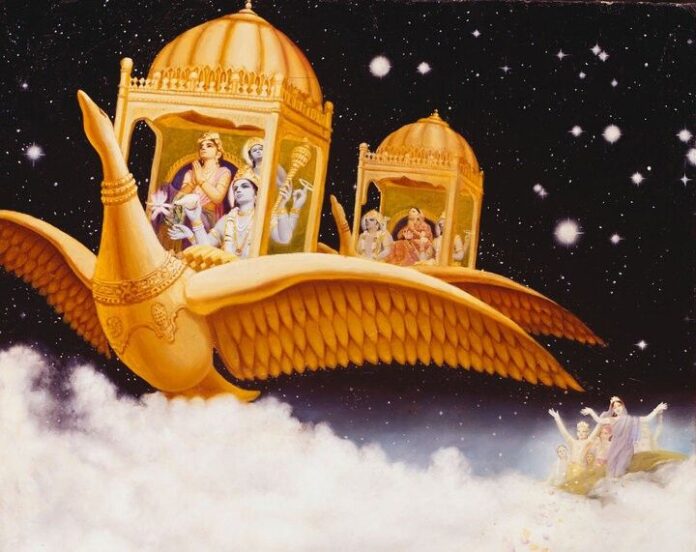
One method that was sometimes used to travel between the higher planets and the earth is mentioned in SB 3.8.5p, where we read that great sages can travel from Satyaloka to the earth via the Ganges River, which flows all over the universe. Śrīla Prabhupāda points out that this form of travel is possible in any river by mystic power. It hardly seems plausible that this method of travel involves swimming up- or downstream over vast distances, and, of course, the connection between the earthly Ganges and its celestial counterpart is not visible to us. We suggest that this process of travel involves higher-dimensional connections between locations, and that the river serves as a kind of guiding beacon to direct such higher-dimensional transport. In the case of the Ganges, the course of the river from higher planets down to the earth must also be higher-dimensional.


In KB p. 534 there is a description of the mystic yoginī Citralekhā traveling in outer space from Śoṇitapura to Dvārakā and taking the sleeping Aniruddha back to Śoṇitapura. This is another example of a form of travel that seems to require higher-dimensional connections for its operation.


The Vedic śāstras mention many remarkable events that are said to have taken place on the earth in the remote past. Many of these events involve phenomena that we do not experience today, and one might ask why this should be so, if these events actually did occur at one time. One reason for this given in the Bhāgavatam is that prior to the beginning of Kali-yuga, natural processes on the earth operated in a different mode than they do today (see SB 1.4.17p). The sensory powers of all living beings were on a higher average level than they are at present, and advanced beings such as demigods and great sages regularly visited the earth. Thus the earthly realm of ordinary human life was more intimately linked up with higher realms of material and spiritual reality than it has been since the start of the Kali-yuga.


This idea leads naturally to the following tentative scenario for the history of the last few thousand years: Once the Kali-yuga began, demigods and other higher beings greatly curtailed communications with people on the earth, and the general sensory level of human beings also declined. For some time, people continued to believe in stories about the earlier state of affairs on the earth due to the authority of tradition. However, due to the lack of feedback from higher sources and the natural cheating propensity of human beings, the traditions in various parts of the world gradually became more and more garbled, and people began to lose faith in them. Finally the present stage of civilization was reached, in which old traditions are widely viewed as useless mythology, and people seek knowledge entirely through the use of their current, limited senses.

Mystic Siddhis

0

The eight mystic siddhis directly illustrate that sentient beings can operate at different levels of sensory power by being endowed to varying degrees with Kṛṣṇa’s primordial potencies. Śrīla Prabhupāda gives the following description of some of the mystic siddhis:


A mystic yogī can enter into the sun planet simply by using the rays of the sunshine. This perfection is called laghimā. Similarly, a yogī can touch the moon with his finger. Though the modern astronauts go to the moon with the help of spaceships, they undergo many difficulties, whereas a person with mystic perfection can extend his hand and touch the moon with his finger. This siddhi is called prāpti, or acquisition. With this prāpti-siddhi, not only can the perfect mystic yogī touch the moon planet, but he can extend his hand anywhere and take whatever he likes. He may be sitting thousands of miles away from a certain place, and if he likes he can take fruit from a garden there” [NOD, pp. 11-12].


The prāpti-siddhi provides a perfect example of what we mean by the extension of access between locations. Consider the yogī on the earth who reaches out his hand to touch the moon. Does the yogī experience that his hand moves up through the atmosphere and crosses over thousands of miles of outer space, followed by a greatly elongated arm? This hardly seems plausible. We suggest that this siddhi actually allows the yogī to reach any desired location directly, and thus it requires higher-dimensional connections between remotely separated regions. The idea here is that Kṛṣṇa always has direct access to all locations, and by His grace this power of direct access can be conferred to varying degrees on various living beings.


The following verses in the Eleventh Canto of Śrīmad-Bhāgavatam (11.15.10-13) show that the siddhis are indeed obtained by partial realization of Kṛṣṇa’s inherent potencies:

  1. aṇimā-becoming smaller than the smallest. “One who worships Me [Kṛṣṇa] in My atomic form pervading all subtle elements [bhūta-sūkṣma and tan-mātra], fixing his mind on that alone, obtains the mystic perfection called aṇimā.”
  2. mahimā-becoming greater than the greatest. “One who absorbs his mind in the particular form of the mahat-tattva and thus meditates upon Me as the Supreme Soul of the total material existence achieves the mystic perfection called mahimā.”
  3. laghimā-becoming lighter than the lightest. “I exist within everything, and I am therefore the essence of the atomic constituents of material elements. By attaching his mind to Me in this form, the yogī may achieve the perfection called laghimā, by which he realizes the subtle atomic substance of time.”
  4. prāpti-acquisition. “Fixing his mind completely on Me within the element of false ego generated from the mode of goodness, the yogī obtains the power of mystic acquisition, by which he becomes the proprietor of the senses of all living entities. He obtains such perfection because his mind is absorbed in Me.”

  5. Similar statements are made about the four other siddhis. According to the purport to SB 11.15.13, “Śrīla Bhaktisiddhānta Sarasvatī Ṭhākura states that those who pursue such perfections without fixing the mind on the Supreme Lord acquire a gross and inferior reflection of each mystic potency.”

Stay Connected

16,985FansLike
12,500FollowersFollow
61,453SubscribersSubscribe