The word vegetarian, coined by the founders of the British Vegetarian Society in 1842, comes from the Latin word vegetus, meaning “whole, sound, fresh, or lively,” as in homo vegetus-a mentally and physically vigorous person. The original meaning of the word implies a balanced philosophical and moral sense of life, a lot more than just a diet of vegetables and fruits.
Most vegetarians are people who have understood that to contribute towards a more peaceful society we must first solve the problem of violence in our own hearts. So it’s not surprising that thousands of people from all walks of life have, in their search for truth, become vegetarian. Vegetarianism is an essential step towards a better society, and people who take the time to consider its advantages will be in the company of such thinkers as Pythagoras, Socrates, Plato, Clement of Alexandria, Plutarch, King Asoka, Leonardo da Vinci, Montaigne, Akbar, John Milton, Sir Isaac Newton, Emanuel Swedenbourg, Voltaire, Benjamin Franklin, Jean Jacques Rousseau, Lamartine, Percy Bysshe Shelley, Ralph Waldo Emerson, Henry David Thoreau, Leo Tolstoy, George Bernard Shaw, Rabindranath Tagore, Mahatma Gandhi, Albert Schweitzer, and Albert Einstein.
Let’s examine some of the advantages of becoming vegetarian.
Health and Nutrition
Can a vegetarian diet improve or restore health? Can it prevent certain diseases?
Advocates of vegetarianism have said yes for many years, although they didn’t have much support from modern science until recently. Now, medical researchers have discovered evidence of a link between meat-eating and such killers as heart disease and cancer, so they’re giving vegetarianism another look.
Since the 1960s, scientists have suspected that a meat-based diet is somehow related to the development of arteriosclerosis and heart disease. As early as 1961, the Journal of the American Medical Association said: “Ninety to ninety-seven percent of heart disease can be prevented by a vegetarian diet.” (Journal of the American Medical Association, Editor: Diet and Stress in vascular disease. JAMA 176: 134-5, 1961) Since that time, several well-organized studies have scientifically shown that after tobacco and alcohol, the consumption of meat is the greatest single cause of mortality in Western Europe, the United States, Australia, and other affluent areas of the world. (Inter-Society Commission for Heart Disease Resources. Report of Inter-Society Commission for Heart Disease Resources: Primary prevention of the arteriosclerotic diseases. Circulation 42: A53-95, December 1970; also Senate Select Committee on Nutrition and Human Needs: Dietary Goals for the United States. U.S. Government Printing Office, Washington, D.C., 20402, 1977.)
The human body is unable to deal with excessive amounts of animal fat and cholesterol.(Saturated fats are found primarily, but not exclusively, in foods of animal origin; hydrogenated fats are found in commercially prepared foods; cholesterol is found only in animal products.) A poll of 214 scientists doing research on arteriosclerosis in 23 countries showed almost total agreement that there is a link between diet, serum cholesterol levels, and heart disease.(Kaare R. Norum, “What is the Experts’ Opinion on Diet and Coronary Heart Diseases?” Journal of the Norwegian Medical Association, 12 February 1977.) When a person eats more cholesterol than the body needs (as he usually does with a meat-centered diet), the excess cholesterol gradually becomes a problem. It accumulates on the inner walls of the arteries, constricts the flow of blood to the heart, and can lead to high blood pressure, heart disease, and strokes.
On the other hand, scientists at the University of Milan and Maggiore Hospital have shown that vegetable protein may act to keep cholesterol levels low. In a report to the British medical journal The Lancet, D.C.R. Sirtori concluded that people with the type of high cholesterol associated with heart disease “may benefit from a diet in which protein comes only from vegetables.”(C.R. Sirtori, et. al., “Soybean Protein Diet in the Treatment of Type II Hyperlipoproteinaemia,” The Lancet 1 (8006): 275-7, (5 February 1977).)
What about cancer? Research over the past twenty years strongly suggests a link between meat-eating and cancer of the colon, rectum, breast, and uterus. These types of cancer are rare among those who eat little or no meat, such as Seventh-Day Adventists, Japanese, and Indians, but they are prevalent among meat-eating populations.(R.L. Phillips, “Role of Lifestyle and Dietary Habits in Risk of Cancer among Seventh-Day Adventists,” Cancer Research 35:3513, (November 1975); Morton Mintz, “Fat Intake Seen Increasing Cancer Risk,” Washington Post, 10 September 1976.)
Another article in The Lancet reported, “People living in the areas with a high recorded incidence of carcinoma of the colon tend to live on diets containing large amounts of fat and animal protein; whereas those who live in areas with a low incidence live on largely vegetarian diets with little fat or animal matter.”(M.J. Hill, “Bacteria and the Aetiology of Cancer of the Large Bowel,” Lancet, 1:95-100, 1971.)
Rollo Russell, in his Notes on the Causation of Cancer, says, “I have found of twenty-five nations eating flesh largely, nineteen had a high cancer rate and only one had a low rate, and that of thirty five nations eating little or no flesh, none had a high rate.”(Quoted from Cancer and Other Diseases from Meat Consumption, Blanche Leonardo, Ph.D. 1979, p. 12.)
Why do meat-eaters seem more prone to these diseases? One reason given by biologists and nutritionists is that man’s intestinal tract is simply not suited for digesting meat. Flesh-eating animals have short intestinal tracts (three times the length of the animal’s body), to pass rapidly decaying toxin-producing meat out of the body quickly. Since plant foods decay more slowly than meat, plant-eaters have intestines at least six times the length of the body. Man has the long intestinal tract of a herbivore, so if he eats meat, toxins can overload the kidneys and lead to gout, arthritis, rheumatism, and even cancer.
And then there are the chemicals added to meat. As soon as an animal is slaughtered, its flesh begins to putrefy, and after several days it turns a sickly gray-green. The meat industry masks this discoloration by adding nitrites, nitrates, and other preservatives to give the meat a bright red color. But research has now shown many of these preservatives to be carcinogenic.(M. Jacobson, “How Sodium Nitrite Can Affect Your Health,” (Washington, D.C.: Center for Science in the public interest, 1973); W. Linjinsky, and S.S. Epstein, “Nitrosamines as Environmental Carcinogens,” Nature, no. 225 (1970), p. 21-3; Committee on Nitrate Accumulation, National Academy of Sciences. 2101 Constitution Ave., Washington, D.C., 20418, 1972, and the Lancet, “Nitrate and Human Cancer,” 2 (8032): 281, 6 August 1977.) And what makes the problem worse is the massive amounts of chemicals fed to livestock. Gary and Steven Null, in their book, Poisons in your Body, show us something that ought to make anyone think twice before buying another steak or ham. “The animals are kept alive and fattened by continuous administration of tranquilizers, hormones, antibiotics, and 2,700 other drugs. The process starts even before birth and continues long after death. Although these drugs will still be present in the meat when you eat it, the law does not require that they be listed on the package.”(Gary and Steven Null, Poisons in Your Body, Arco Press, 1977, p. 52.)
Because of findings like this, the American National Academy of Sciences reported in 1983 that “people may be able to prevent many common types of cancer by eating less fatty meats and more vegetables and grains.”(American Academy of Sciences, Diet, Nutrition, and Cancer, National Research Consul, National Academy Press, Washington, June 1982.)
But wait a minute! Weren’t human beings designed to be meateaters? Don’t we need animal protein?
The answer to both these questions is no. Although some historians and anthropologists say that man is historically omnivorous, our anatomical equipment-teeth, jaws, and digestive system-favors a fleshless diet. The American Dietetic Association notes that “most of mankind for most of human history has lived on vegetarian or near-vegetarian diets.”
And much of the world still lives that way. Even in most industrialized countries, the love affair with meat is less than a hundred years old. It started with the refrigerator car and the twentieth-century consumer society.
But even in the twentieth century, man’s body hasn’t adapted to eating meat. The prominent Swedish scientist Karl von Linne states, “Man’s structure, external and internal, compared with that of the other animals, shows that fruit and succulent vegetables constitute his natural food.” The chart on the next page compares the anatomy of man with that of carnivorous and herbivorous animals.
As for the protein question, Dr. Paavo Airola, a leading authority on nutrition and natural biology, has this to say: “The official daily recommendation for protein has gone down from the 150 grams recommended twenty years ago to only 45 grams today. Why? Because reliable worldwide research has shown that we do not need so much protein, that the actual daily need is only 30 to 45 grams. Protein consumed in excess of the actual daily need is not only wasted, but actually causes serious harm to the body and is even causatively related to such killer diseases as cancer and heart disease. In order to obtain 45 grams of protein a day from your diet you do not have to eat meat; you can get it from a 100 percent vegetarian diet of a variety of grains, lentils, nuts, vegetables, and fruits.”(Dr. Paavo Airola, “Health Forum”, Vegetarian Times, August 1982, p. 67.)
Dairy products, grains, beans, and nuts are all concentrated sources of protein. Cheese, peanuts, and lentils, for instance, contain more protein per ounce than hamburger, pork, or porterhouse steak.
Meat-eater Plant-eater Human being has claws no claws no claws no skin pores; perspires through tongue to cool body perspires through millions of skin pores perspires through millions of skin pores sharp, pointed front teeth to tear flesh no sharp pointed front teeth no sharp pointed front teeth salivary glands in the mouth (not needed to predigest grains and fruits) well-developed salivary glands, needed to predigest grains and fruits well-developed salivary glands, needed to predigest grains and fruits acid saliva; no enzyme ptyalin to pre-digest grains alkaline saliva; much ptyalin to pre-digest grains alkaline saliva; much ptyalin to pre-digest grains no flat back molar teeth to grind food flat back molar teeth to grind food flat back molar teeth to grind food much strong hydrochlorid acid in stomach to digest tough animal muscle, bone, etc.
Stomach acid ten times less strong than meat eaters stomach acid ten times less strong than meat eaters intestinal tract only 3 times body length so radlt decaying meat can pass out of body quickly intestinal tract 6 times body length fruits do not decay as rapidly so can pass more slowely through body intestinal tract 6 times body length Based on a chart by A.D. Andrews, Fit Food for Men, (Chicago American Hygiene Society, 1970) Still, nutritionists thought until recently that only meat, fish, eggs, and milk products had complete proteins (containing the eight amino acids not produced in the body), and that all vegetable proteins were incomplete (lacking one or more of these amino acids). But research at the Karolinska Institute in Sweden and the Max Planck Institute in Germany has shown that most vegetables, fruits, seeds, nuts, and grains are excellent sources of complete proteins. In fact, their proteins are easier to assimilate than those of meat-and they don’t bring with them any toxins. It’s nearly impossible to lack protein if you eat enough natural unrefined food. Remember, the vegetable kingdom is the real source of all protein. Vegetarians simply eat it “direct” instead of getting it second-hand from the vegetarian animals.
Too much protein intake even reduces the body’s energy. In a series of comparative endurance tests conducted by Dr. Irving Fisher of Yale University, vegetarians performed twice as well as meateaters. When Dr. Fisher knocked down the nonvegetarians’ protein consumption by twenty percent, their efficiency went up thirty-three percent.(Irving Fisher, “The Influence of Flesh Eating on Endurance,” Yale Medical Journal, 13(5); 205-21 (March 1907).) Numerous other studies have shown that a proper vegetarian diet provides more nutritional energy than meat. A study by Dr. J. Iotekyo and V. Kipani at Brussels University showed that vegetarians were able to perform physical tests two to three times longer than meat-eaters before tiring out-and the vegetarians fully recovered from fatigue three times more quickly than the meateaters.(J.L. Buttner, A Fleshless Diet: Vegetarianism as a rational dietary, Fredrick A. Stokes Company, New York, 1910, p. 131-2.)
Economics
Meat feeds few at the expense of many. For the sake of producing meat, grain that could feed people feeds livestock instead. According to information compiled by the United States Department of Agriculture, over ninety percent of all the grain produced in America goes to feed livestock-cows, pigs, sheep, and chickens- that wind up on dinner tables.(Frances Moore Lappe, Diet for a Small Planet, (New York Ballantine Books, 1975), p. 12.) Yet the process of using grain to produce meat is incredibly wasteful. Figures from the U.S. Department of Agriculture show that for every sixteen pounds of grain fed to cattle, we get back only one pound of meat.(Ibid., p. 10.)
In Diet for a Small Planet, Frances Moore Lappe asks us to imagine ourselves sitting down to an eight-ounce steak. “Then imagine, the room filled with 45 to 50 people with empty bowls in front of them. For the ‘feed cost’ of your steak, each of their bowls could be filled with a full cup of cooked cereal grains.”(Ibid., p. 235.)
Affluent nations do not only waste their own grains to feed livestock. They also use protein-rich plant foods from poor nations. Dr. Georg Borgstrom, an authority on the geography of food, estimates that one-third of Africa’s peanut crop (and peanuts give the same amount of protein as meat) ends up in the stomachs of cattle and poultry in Western Europe.(Georg Borgstrom cited in Frances Moore Lappe, Diet for a Small Planet, p. 25.)
In underdeveloped countries, a person consumes an average of four hundred pounds of grain a year, most of it by eating it directly. In contrast, says world food authority Lester Brown, the average European or American goes through two thousand pounds a year, by first feeding almost ninety percent of it to animals for meat. The average European or American meat-eater, Brown says, uses five times the food resources of the average Colombian, Indian, or Nigerian.(Lester Brown cited in Vic Sussman, The Vegetarian Alternative (Rodale Press, 1978), p. 234.)
Facts such as these have led food experts to point out that the world hunger problem is artificial. Even now, we are already producing more than enough food for everyone on the planet-but we are allocating it wastefully.
Harvard nutritionist Jean Mayer estimates that bringing down meat production by only ten percent would release enough grain to feed sixty million people.(Dr. Jean Mayer cited by the U.S. Senate Select Committee on Nutrition and Human Needs, Dietary Goals for the U.S. (Washington, D.C.: February 1977), p. 44.)
Another price we pay for meat-eating is degradation of the environment. The heavily contaminated runoff and sewage from slaughterhouses and feedlots are major sources of pollution of rivers and streams. It is fast becoming apparent that the fresh water resources of this planet are not only becoming contaminated but also depleted, and the meat industry is particularly wasteful. Georg Borgstrom says the production of livestock creates ten times more pollution than residential areas, and three times more than industry.(Georg Borgstrom cited in Frances Moore Lappe, Diet for a Small Planet, p. 32.)
In their book Population, Resources, and Environment, Paul and Anne Ehrlich show that to grow one pound of wheat requires only sixty pounds of water, whereas production of one pound of meat requires anywhere from 2,500 to 6,000 pounds of water.(Paul and Anne Ehrlich, Population, Resources, Environment, W.H. Freeman and Company, 1970, p. 64.)
And in 1973 the New York Post uncovered a shocking misuse of this most valuable resource-one large chicken-slaughtering plant in the United States was using one hundred million gallons of water daily, an amount that could supply a city of twenty-five thousand people.(“Food Price Rises,” Sylvia Porter, New York Post, July 27, 1973.)
But now let’s turn from the world geopolitical situation, and get right down to our own pocketbooks. A spot check of supermarkets in New York in January 1986 showed that sirloin steak cost around four dollars a pound, while ingredients for a delicious, substantial vegetarian meal average less than two dollars a pound. An eight ounce container of cottage cheese costing sixty cents provides sixty percent of the minimum daily requirement of protein. Becoming a vegetarian could potentially save you at least several thousand dollars a year, tens of thousands of dollars over the course of a lifetime. The savings to America’s consumers would amount to billions of dollars annually. And the same principle applies to consumers all over the world. Considering all this, it’s hard to see how anyone could afford not to become a vegetarian.
Ethics
Many people consider the ethical reasons the most important of all for becoming vegetarian. The beginning of ethical vegetarianism is the knowledge that other creatures have feelings, and that their feelings are similar to ours. This knowledge encourages one to extend personal awareness to encompass the suffering of others.
In an essay titled The Ethics of Vegetarianism, from the journal of the North American Vegetarian Society, the conception of “humane animal slaughter” is refuted. “Many people nowadays have been lulled into a sense of complacency by the thought that animals are now slaughtered ‘humanely’, thus presumably removing any possible humanitarian objection to the eating of meat. Unfortunately, nothing could be further from the actual facts of life… and death.
The entire life of a captive ‘food animal’ is an unnatural one of artificial breeding, vicious castration and/or hormone stimulation, feeding of an abnormal diet for fattening purposes, and eventually long rides in intense discomfort to the ultimate end. The holding pens, the electric prods and tail twisting, the abject terror and fright, all these are still very much a part of the most ‘modern’ animal raising, shipping, and slaughtering. To accept all this and only oppose the callous brutality of the last few seconds of the animals’ life, is to distort the word ‘humane’.”
The truth of animal slaughter is not at all pleasant-commercial slaughterhouses are like visions of hell. Screaming animals are stunned by hammer blows, electric shock, or concussion guns. They are hoisted into the air by their feet and moved through the factories of death on mechanized conveyor systems. Still alive, their throats are sliced and their flesh is cut off while they bleed to death. Why isn’t the mutilation and slaughter of farm animals governed by the same stipulations intended for the welfare of pets and even the laboratory rat?
Many people would no doubt take up vegetarianism if they visited a slaughterhouse, or if they themselves had to kill the animals they ate. Such visits should be compulsory for all meat eaters.
Pythagoras, famous for his contributions to geometry and mathematics, said, “Oh, my fellow men, do not defile your bodies with sinful foods. We have corn, we have apples bending down the branches with their weight, and grapes swelling on the vines. There are sweet-flavored herbs, and vegetables which can be cooked and softened over the fire, nor are you denied milk or thyme-scented honey. The earth affords a lavish supply of riches of innocent foods, and offers you banquets that involve no bloodshed or slaughter; only beasts satisfy their hunger with flesh, and not even all of those, because horses, cattle, and sheep live on grass.”
In an essay titled On Eating Flesh, the Roman author Plutarch wrote: “Can you really ask what reason Pythagoras had for abstinence from flesh. For my part I rather wonder both by what accident and in what state of mind the first man touched his mouth to gore and brought his lips to the flesh of a dead creature, set forth tables of dead, stale bodies, and ventured to call food and nourishment the parts that had a little before bellowed and cried, moved and lived… It is certainly not lions or wolves that we eat out of self-defense; on the contrary, we ignore these and slaughter harmless, tame creatures without stings or teeth to harm us. For the sake of a little flesh we deprive them of sun, of light, of the duration of life they are entitled to by birth and being.”
Plutarch then delivered this challenge to flesh-eaters: “If you declare that you are naturally designed for such a diet, then first kill for yourself what you want to eat. Do it, however, only through your own resources, unaided by cleaver or cudgel or any kind of ax “
The poet Shelly was a committed vegetarian. In his essay A Vindication of Natural Diet,” he wrote, “Let the advocate of animal food force himself to a decisive experiment on its fitness, and as Plutarch recommends, tear a living lamb with his teeth and, plunging his head into its vitals, slake his thirst with the steaming blood… then, and then only, would he be consistent.”
Leo Tolstoy wrote that by killing animals for food, “Man suppresses in himself, unnecessarily, the highest spiritual capacity- that of sympathy and pity towards living creatures like himself- and by violating his own feelings becomes cruel.” He also warned, “While our bodies are the living graves of murdered animals, how can we expect any ideal conditions on earth?”
When we lose respect for animal life, we lose respect for human life as well. Twenty-six hundred years ago, Pythagoras said, “Those that kill animals to eat their flesh tend to massacre their own.” We’re fearful of enemy guns, bombs, and missiles, but can we close our eyes to the pain and fear we ourselves bring about by slaughtering, for human consumption, over 1.6 billion domestic mammals and 22.5 billion poultry a year.(These totals of domestic mammals and poultry slaughtered each year have been compiled by the author from statistics found in the FAO Production Yearbook 1984, vol. 38, Statistics Series No. 61, Food and Agriculture Organization of the United Nations/Rome, p. 226-47. The data on livestock slaughtered shown in this yearbook is collected from about 200 countries and territories. Estimates have been made by the FAO for nonreporting countries as well as for countries reporting partial coverage.
For the interest of our readers, the FAO statistics given for the number of livestock slaughtered in 1984, of some major species, are as follows: cattle and calfs, 229,249,000; buffalo, 7,269,000; sheep and lamb, 409,500,000; goat, 177,296,000; pig, 765,424,000; horse, 4,032,000; chicken, 21,902,400,000; duck, 234,000,000; and turkey, 372,300,000. Instead of giving the number of horses and poultry (chickens, ducks, and turkeys) slaughtered in the world each year, the FAO Production Yearbook gives the metric tonnage (MT) of horsemeat and poultry meat produced. The world total for 1984 is 504,000 MT and 29,958,000 MT (chickens, 27,378,000 MT; ducks, 390,000 MT; turkeys, 2,190,000 MT) respectively. The author corresponded with the chief of the FAO Basic Date Unit Statistics Division to find that an average of seven horses, 800 chickens, 600 ducks, or 170 turkeys comprise a metric ton of meat. These figures were also confirmed by butchers in Paris.)
The number of fish killed each year is in the trillions. And what to speak of the tens of millions of animals killed each year in the “torture-camps” of medical research laboratories, or slaughtered for their fur, hide, or skin, or hunted for “sport”. Can we deny that this brutality makes us more brutal too?
Leonardo da Vinci wrote, “Truly man is the king of beasts, for his brutality exceeds theirs. We live by the death of others. We are burial places!” He added, “The time will come when men will look upon the murder of animals as they now look upon the murder of men.”
Mahatma Gandhi felt that ethical principles are a stronger support for lifelong commitment to a vegetarian diet than reasons of health. “I do feel,” he stated, “that spiritual progress does demand at some stage that we should cease to kill our fellow creatures for the satisfaction of our bodily wants.” He also said, “The greatness of a nation and its moral progress can be judged by the way its animals are treated.”
Religion
All major religious scriptures enjoin man to live without killing unnecessarily. The Old Testament instructs, “Thou shalt not kill.” (Exodus 20:13) This is traditionally misinterpreted as referring only to murder. But the original Hebrew is lo tirtzach, which clearly translates “Thou shalt not kill.” Dr. Reuben Alcalay’s Complete Hebrew/English Dictionary says that the word tirtzach, especially in classical Hebrew usage, refers to “any kind of killing,” and not necessarily the murder of a human being.
Although the Old Testament contains some prescriptions for meat-eating, it is clear that the ideal situation is vegetarianism. In Genesis (1:29) we find God Himself proclaiming, “Behold, I have given you every herb-bearing tree, in which the fruit of the tree yielding seed, it unto you shall be for meat.” And in later books of the Bible, major prophets condemn meat-eating.
For many Christians, major stumbling blocks are the belief that Christ ate meat and the many references to meat in the New Testament. But close study of the original Greek manuscripts shows that the vast majority of the words translated as “meat” are trophe, brome, and other words that simply mean “food” or “eating” in the broadest sense. For example, in the Gospel of St. Luke (8:55) we read that Jesus raised a woman from the dead and “commanded to give her meat.” The original Greek word translated as “meat” is phago,” which means only “to eat.” The Greek word for meat is kreas (“flesh”), and it is never used in connection with Christ. Nowhere in the New Testament is there any direct reference to Jesus eating meat. This is in line with Isaiah’s famous prophecy about Jesus’s appearance, “Behold, a virgin shall conceive, and bear a son, and shall call his name Immanuel. Butter and honey shall he eat, that he may know to refuse the evil and choose the good.”
In Thus Spake Mohammed (the translation of the Hadith by Dr. M. Hafiz Syed), the disciples of the prophet Mohammed ask him, “Verily are there rewards for our doing good to quadrupeds, and giving them water to drink?” Mohammed answers, “There are rewards for benefiting every animal.”
Lord Buddha is known particularly for His preaching against animal killing. He established ahimsa (nonviolence) and vegetarianism as fundamental steps on the path to self-awareness and spoke the following two maxims, “Do not butcher the ox that plows thy fields,” and “Do not indulge a voracity that involves the slaughter of animals.”(It is interesting to note that the Vedic scriptures consider Buddha an incarnation of Lord Kṛṣṇa. The Śrīmad-Bhāgavatam predicted Buddha’s appearance in the world, and the great spiritual master Śrīla Jayadeva Gosvāmī later wrote in his prayers to Lord Kṛṣṇa, “O my Lord, O Personality of Godhead, all glories unto You. You compassionately appeared in the form of Lord Buddha to condemn animal sacrifices.”)
The Vedic scriptures of India, which predate Buddhism, also stress nonviolence as the ethical foundation of vegetarianism. “Meat can never be obtained without injury to living creatures,” states the Manu-samhita, the ancient Indian code of law, “Let one therefore shun the use of meat.” In another section, the Manu-samhita warns, “Having well considered the disgusting origin of flesh and the cruelty of fettering and slaying of corporeal beings, let one entirely abstain from eating flesh.” In the Mahābharata (the epic poem which contains 100,000 verses and is said to be the longest poem in the world), there are many injunctions against killing animals. Some examples: “He who desires to increase the flesh of his own body by eating the flesh of other creatures lives in misery in whatever species he may take his birth.”;”Who can be more cruel and selfish than he who augments his flesh by eating the flesh of innocent animals?”; and “Those who desire to possess good memory, beauty, long life with perfect health, and physical, moral and spiritual strength, should abstain from animal food.”
All living entities possess a soul. In the Bhagavad-gītā, Kṛṣṇa describes the soul as the source of consciousness and the active principle that activates the body of every living being. According to the Vedas, a soul in a form lower than human automatically evolves to the next higher species, ultimately arriving at the human form. Only in the human form of life can the soul turn its consciousness towards God and at the time of death be transferred back to the spiritual world. In both the social order and the universal order, a human being must obey laws.
In his Śrīmad-Bhāgavatam purports, Śrīla Prabhupāda says, “All living entities have to fulfill a certain duration for being encaged in a particular type of material body. They have to finish the duration allotted in a particular body before being promoted or evolved to another body. Killing an animal or any other living being simply places an impediment in the way of his completing his term of imprisonment in a certain body. One should therefore not kill bodies for one’s sense gratification, for this will implicate one in sinful activity.” In short, killing an animal interrupts its progressive evolution through the species, and the killer will invariably suffer the reaction for this sinful behavior.
In the Bhagavad-gītā (5.18), Kṛṣṇa explains that spiritual perfection begins when one can see the equality of all living beings, “The humble sage, by virtue of true knowledge, sees with equal vision a learned and gentle brahmana (a priest), a cow, an elephant, a dog, and a dog-eater (outcaste).” Kṛṣṇa also instructs us to adopt the principles of spiritual vegetarianism when He states, “Offer Me with love and devotion a fruit, a flower, a leaf, or water, and I will accept it.”
Karma
The Sanskrit word karma means “action”, or more specifically, any material action that brings a reaction that binds us to the material world. Although the idea of karma is generally associated with Eastern philosophy, many people in the West are also coming to understand that karma is a natural principle, like time or gravity, and no less inescapable. For every action there is a reaction. According to the law of karma, if we cause pain and suffering to other living beings, we must endure pain and suffering in return, both individually and collectively. We reap what we sow, in this life and the next, for nature has her own justice. No one can escape the law of karma, except those who understand how it works.
To understand how karma can cause war, for example, let’s take an illustration from the Vedas. Sometimes a fire starts in a bamboo forest when the trees rub together. The real cause of the fire, however, is not the trees but the wind that moves them. The trees are only the instruments. In the same way, the principle of karma tells us that the United States and the Soviet Union are not the real causes of the friction that exists between them, the friction that may well set off the forest fire of nuclear war. The real cause is the imperceptible wind of karma generated by the world’s supposedly innocent citizens.
According to the law of karma, the neighborhood supermarket or hamburger stand (the local abortion clinic too, but that could be the subject for another book) has more to do with the threat of nuclear war than the White House or the Kremlin. We recoil with horror at the prospects of nuclear war while we permit equally horrifying massacres every day inside the world’s automated slaughterhouses.
The person who eats an animal may say that he hasn’t killed anything, but when he buys his neatly packaged meat at the supermarket he is paying someone else to kill for him, and both of them bring upon themselves the reactions of karma. Can it be anything but hypocritical to march for peace and then go to McDonald’s for a hamburger or go home to grill a steak? This is the very duplicity that George Bernard Shaw condemned:
We pray on Sundays that we may have light
To guide our footsteps on the path we tread;
We are sick of war, we don’t want to fight,
And yet we gorge ourselves upon the dead.
As Śrīla Prabhupāda says in his explanations of Bhagavad-gītā, “Those who kill animals and give them unnecessary pain-as people do in slaughterhouses-will be killed in a similar way in the next life and in many lives to come… In the Judeo-Christian scriptures, it is stated clearly ‘Thou shalt not kill.’ Nonetheless, giving all kinds of excuses, even the heads of religion indulge in killing animals and, at the same time, try to pass as saintly persons. This mockery and hypocrisy in human society brings about unlimited calamities such as great wars, where masses of people go out onto the battlefields and kill each other. Presently they have discovered the nuclear bomb, which is simply waiting to be used for wholesale destruction.” Such are the effects of karma.
Those who understand the laws of karma, know that peace will not come from marches and petitions, but rather from a campaign to educate people about the consequences of murdering innocent animals (and unborn children). That will go a long way toward preventing any increase in the world’s enormous burden of karma. To solve the world’s problems we need people with purified consciousness to perceive that the real problem is a spiritual one. Sinful people will always exist, but they shouldn’t occupy positions of leadership.
One of the most common objections non-vegetarians raise against vegetarianism is that vegetarians still have to kill plants, and that this is also violence. In response it may be pointed out that vegetarian foods such as ripe fruits and many vegetables, nuts, grains, and milk do not require any killing. But even in those cases where a plant’s life is taken, because plants have a less evolved consciousness than animals, we can presume that the pain involved is much less than when an animal is slaughtered, what to speak ot the suffering a food-animal experiences throughout its life.
It’s true vegetarians have to kill some plants, and that is also violence, but we do have to eat something, and the Vedas say, jīvo jīvasya jīvanam: one living entity is food for another in the struggle for existence. So the problem is not how to avoid killing altogether-an impossible proposal-but how to cause the least suffering to other creatures while meeting the nutritional needs of the body.
The taking of any life, even that of a plant, is certainly sinful, but Kṛṣṇa, the supreme controller, frees us from sin by accepting what we offer. Eating food first offered to the Lord is something like a soldier’s killing during wartime. In a war, when the commander orders a man to attack, the obedient soldier who kills the enemy will get a medal. But if the same soldier kills someone on his own, he will be punished. Similarly, when we eat only prasāda, we do not commit any sin. This is confirmed in the Bhagavad-gītā (3.13) “The devotees of the Lord are released from all kinds of sins because they eat food which is offered first for sacrifice. Others, who prepare food for personal sense enjoyment, eat only sin.” This brings us to the central theme of this book: vegetarianism, although essential, is not an end in itself.
Beyond Vegetarianism
Beyond concerns of health, economics, ethics, religion, and even karma, vegetarianism has a higher, spiritual dimension that can help us develop our natural appreciation and love of God. Śrīla Prabhupāda tells us in his explanations of Śrīmad-Bhāgavatam, “The human being is meant for self-realization, and for that purpose he is not to eat anything that is not first offered to the Lord. The Lord accepts from His devotee all kinds of food preparations made from vegetables, fruits, milk products, and grains. Different varieties of fruits, vegetables, and milk products can be offered to the Lord, and after the Lord accepts the foodstuffs, the devotee can partake of the prasāda, by which all suffering in the struggle for existence will be gradually mitigated.”
Kṛṣṇa Himself confirmed the divinity of prasāda when He appeared in this world as Śrī Caitanya Mahāprabhu 500 years ago: “Everyone has tasted these material substances before, but now, these same ingredients have taken on extraordinary flavors and uncommon fragrances. Just taste them and see the difference. Not to mention the taste, the fragrance alone pleases the mind and makes one forget all other sweetnesses. It is to be understood therefore, that these ordinary ingredients have been touched by the transcendental nectar of Kṛṣṇa’s lips and imbued with all of Kṛṣṇa’s qualities.”
Offered food, traditionally called prasāda, “the mercy of God,” offers not only the healthy life of a vegetarian, but also God realization; not just food for the starving masses, but spiritual nourishment for everyone. When Kṛṣṇa accepts an offering, He infuses His own divine nature into it. Prasāda, therefore, is not different from Kṛṣṇa Himself. Out of His unbounded compassion for the souls entrapped in the material world, Kṛṣṇa comes in the form of prasāda, so that simply by eating, we can come to know Him.
Eating prasāda nourishes the body spiritually. By eating prasāda not only are past sinful reactions in the body vanquished, but the body becomes immunized to the contamination of materialism. Just as an antiseptic vaccine can protect us against an epidemic, eating prasāda protects us from the illusion and influence of the materialistic conception of life. Therefore, a person who eats only food offered to Kṛṣṇa, can counteract all the reactions of one’s past material activities, and readily progresses in self-realization. Because Kṛṣṇa frees us from the reactions of karma, or material activities, we can easily transcend illusion and serve Him in devotion. One who acts without karma can dovetail his consciousness with God’s and become constantly aware of His personal presence. This is the true benefit of prasāda.
One who eats prasāda is actually rendering devotional service to the Lord and is sure to receive His blessings. Śrīla Prabhupāda often said that by eating prasāda even once we can escape from the cycle of birth and death, and by eating only prasāda even the most sinful person can become a saint. The Vedic scriptures speak of many people whose lives were transformed by eating prasāda, and any Hare Kṛṣṇa devotee will vouch for the spiritual potency of prasāda and the effect it has had on his life. Eating only food offered to Kṛṣṇa is the ultimate perfection of a vegetarian diet. After all, pigeons and monkeys are also vegetarian, so becoming a vegetarian is not in itself the greatest of accomplishments. The Vedas inform us that the purpose of human life is to reawaken the soul to its relationship with God, and only when we go beyond vegetarianism to prasāda can our eating be helpful in achieving this goal.
A Temple of Kṛṣṇa in Your Home
Guests visiting a temple of Kṛṣṇa for the first time are often puzzled by the ceremonial offering of vegetarian dishes to the form of Kṛṣṇa on the altar-and understandably so. After all, what does the omnipotent, omniscient, omnipresent Lord want with our little plate of rice and vegetables? Has He suddenly become hungry? Hasn’t He created countless tons of food? Isn’t God self-sufficient? Does Kṛṣṇa really need these offerings of food?
In fact, Kṛṣṇa does ask for these offerings, not because He needs our rice and vegetables, but because He wants our devotion. In Bhagavad-gītā (9.26) He says, “If one offers Me with love and devotion a leaf, a flower, fruit, or water, I will accept it.”
When Kṛṣṇa asks us to offer Him food, we should understand that He is actually inviting us to reawaken our eternal loving relationship with Him. At first we comply in a mood of faith mixed with duty; later, as our realization matures, we do it with affection and love. Just as anybody naturally offers the best he has to his beloved, the devotee offers Kṛṣṇa his wealth, his intelligence, his life, and his vegetarian food.
Kṛṣṇa is the ultimate beloved of everyone, but how can we offer gifts to a beloved we don’t yet know? The Vedic tradition can guide us. If you would like to try, but can’t follow all the procedures, you can remember that when the great devotee Hanuman and his companions were building a bridge of large, heavy stones for King Rāma, an incarnation of Kṛṣṇa, a little spider also pleased the Lord by carrying the largest pebbles he could.
First, reserve a special place for the offering. It can be a tabletop or an entire room converted into a temple. Make an altar with a picture of Lord Kṛṣṇa on it. On Kṛṣṇa’s left you will see Śrīmatī Rādhārāṇī, His eternal consort. She is Kṛṣṇa’s pleasure potency, and it is She who awards love of Godhead to the sincere devotee.
If possible, put a photograph of a Kṛṣṇa-conscious spiritual master on the altar. The spiritual master accepts the offering of his disciple and offers it to his own spiritual master, who in turn offers it to his spiritual master. In this way the offering ascends through a succession of spiritual masters, until it reaches Lord Kṛṣṇa. The devotees of the Hare Kṛṣṇa movement always have a photograph of Śrīla Prabhupāda, the founder-spiritual master of the International Society for Kṛṣṇa Consciousness (ISKCON), and if a devotee is a disciple of one of Śrīla Prabhupāda’s disciples, he also has a photograph of his own spiritual master.
A Kṛṣṇa-conscious spiritual master who is visibly present in the world can personally guide you to perfection in spiritual life. Just before Śrīla Prabhupāda left this material world, he asked some of his senior disciples to become spiritual masters and perpetuate the Vedic tradition. If you would like to find out more about these spiritual masters and how you can meet one of them, you can inquire at any ISKCON center.
From the shopping to the cooking, meditate on pleasing Kṛṣṇa. Look for the freshest and best fruits and vegetables. Shopping in supermarkets requires care. There’s more to it than simply avoiding obvious meat, fish, and eggs. Take the time to read every label. And don’t assume that products stay the same; they change. Watch out for rennet (made from the lining of a calf’s stomach and used to make cheese), gelatin (boiled bones, hooves and horns, used to set foods), and lecithin (if it is not marked “soy lecithin,” it may come from eggs). Anything with onions or garlic is unofferable to Kṛṣṇa, because these foods, the Vedas say, increase the mode of ignorance. Watch out for animal fat. Many products have it. And if a product has a blank label, don’t buy it: the manufacturer doesn’t want you to know what’s inside.
You can also look into alternatives to supermarket shopping. Many cooperatives have inexpensive produce that is free from chemical fertilizers and pesticides. And, if you have a little space in your yard, why not grow something for Kṛṣṇa yourself?
Now you are ready to cook for Kṛṣṇa. Here’s how we do it in our temples:
- The cook thinks about Kṛṣṇa’s pleasure, not his own. He thinks, “My Lord has kindly provided me with these ingredients, so let me combine them and cook them in such a way that He will be pleased.” Chanting the Hare Kṛṣṇa mantra or listening to devotional recordings helps him remember Kṛṣṇa and he avoids mundane talk in the kitchen.
- Cleanliness is next to Godliness. The cook should have a clean body and a clean mind, and wear clean clothes in the kitchen. Hair should be tied back so it stays out of the food and out of the fire. The kitchen and cooking utensils should be spotless, so he takes a minute to sponge off the work areas before beginning to cook. “Kṛṣṇa will accept a very simple offering from a clean kitchen,” Śrīla Prabhupāda said, “but He will not accept an elaborate offering from a dirty kitchen.”
- Prasāda (food already offered) and bhoga (food not yet offered) are never mixed. We don’t want to offer Kṛṣṇa the same thing twice, so we keep prasāda in specific containers so that it won’t be accidentally mixed with bhoga.
- This may surprise you: the cook never tastes the food before offering it-not even to test it. Kṛṣṇa must be the first to relish it. Experience teaches the cook to judge the correct amounts of seasonings. If something is taken before being offered to the Deity, the entire preparation is polluted and can no longer be offered.
When the meal is ready, it is time to offer it to Kṛṣṇa. In our temples we arrange portions of the food on diningware kept especially for this purpose. (No one else eats from these dishes). The rest of the food stays in the pots until the offering is finished.
Put a small glass of cool water by Kṛṣṇa’s plate, along with a spoon and a tiny plate with a little salt and pepper. You might also light one or two sticks of incense to provide a pleasant atmosphere. After putting the plate on the altar, recite the Hare Kṛṣṇa mantra:
Hare Kṛṣṇa, Hare Kṛṣṇa, Kṛṣṇa Kṛṣṇa, Hare Hare
Hare Rāma, Hare Rāma, Rāma Rāma, Hare Hare
Recite the mantra three times. Then leave the offering on the altar for a few minutes. The Hare Kṛṣṇa mantra is a prayer: “My dear Rādhārāṇī and Kṛṣṇa, please engage me in Your devotional service.”
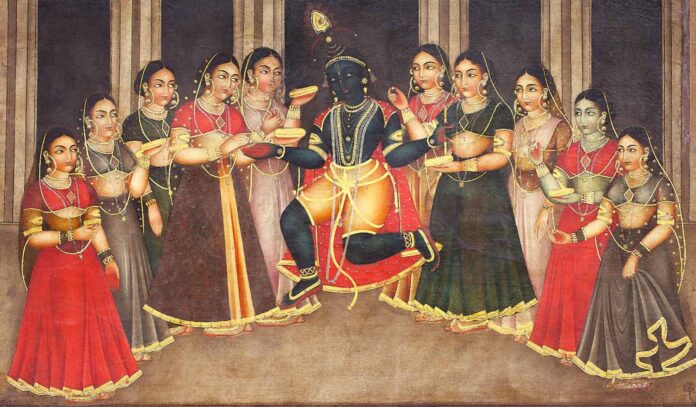
The more our consciousness is fixed on pleasing Kṛṣṇa, the more He enjoys the offering. We can offer Kṛṣṇa the best dishes we can but what really attracts Kṛṣṇa is our sincerity. Our love and devotion are the essential ingredients. Lord Kṛṣṇa is also called Bhavagrahi-janardana, which means “One whose pleasure is the devotional attitude of His devotee.” Once, when Kṛṣṇa was present on earth five thousand years ago, His friend and pure devotee Vidura was offering Him bananas. But Vidura was overcome with devotional ecstasy because of Kṛṣṇa’s presence, and was inadvertently discarding the fruits and offering the skins, which Kṛṣṇa ate with relish because they were offered out of love. Another great devotee, Sanatana Gosvāmī, was so poor that he could offer only dry chapatis to Kṛṣṇa; but to Kṛṣṇa they tasted like nectar because they were offered with love.
After the offering, remove Kṛṣṇa’s plate from the altar and transfer the prasāda to a serving plate. Wash Kṛṣṇa’s plate and bowls and put them away. Now the prasāda can be served. The prasāda that comes directly from the Lord’s plate is called mahāprasāda (mahā means “great,” prasāda means “mercy”) and is extra special. The person serving should see that everyone gets some mahā-prasāda.
The proper mentality for eating prasāda is described by Śrīla Prabhupāda in the Śrī Caitanya-caritāmṛta: “Prasāda is nondifferent from Kṛṣṇa. Therefore, instead of eating prasāda, one should honor it. When taking prasāda, one should not consider the food to be ordinary preparations. Prasāda means favor. One should consider prasāda a favor of Kṛṣṇa. Kṛṣṇa is very kind. In this material world we are all attached to tasting various types of food. Therefore, Kṛṣṇa eats many nice varieties of food and offers the food back to the devotees, so that not only are one’s demands for various tastes satisfied, but by eating prasāda one makes advancement in spiritual life. Therefore, we should never consider ordinary food on an equal level with prasāda.”
In other words, if while eating prasāda one thinks of it as a manifestation of Kṛṣṇa’s mercy, he is considered to have actually stopped eating; now his eating has become honoring. By thus honoring Kṛṣṇa, who has come in the form of prasāda, one pleases Kṛṣṇa, and when Kṛṣṇa is pleased His devotee is pleased.
This is real yoga, linking with the Supreme Lord. The simple process of offering food makes us aware of an essential teaching of the Vedas: everything comes from Kṛṣṇa, and everything should be offered back to Him for His pleasure.
So every day when you cook, cook for Kṛṣṇa and offer the food to Him. Before long, your home will start to feel like a temple, and you’ll be well on your way back to Godhead.
If you are new to offering your food to Kṛṣṇa, we suggest the recitation of the Hare Kṛṣṇa mantra as the easiest method. However, if you like, you can recite the same prayers that the devotees use. Acknowledging that it is through the mercy of the spiritual master and Lord Caitanya that Kṛṣṇa accepts our offering, every devotee recites three times the pranam mantra to his own spiritual master (you can use the pranam mantra of any of the present ISKCON spiritual masters) and the following two prayers in glorification of Śrī Caitanya Mahāprabhu and Lord Kṛṣṇa.
namo-mahā-vadanyaya krishna-prema-pradaya te
krishnaya krishna chaitanya-namne gaura-tvise namah
“O most munificent incarnation! You are Kṛṣṇa Himself appearing as Śrī Kṛṣṇa Caitanya Mahāprabhu. You have assumed the golden color of Śrīmatī Rādhārāṇī, and You are widely distributing pure love of Kṛṣṇa. We offer our respectful obeisances unto You.”
namo brahmanya-devaya go-brahmana-hitaya ca
jagat-hitaya krishnaya govindaya namo namah
“I offer my respectful obeisances to the Supreme Absolute Truth, Kṛṣṇa, Who is the well-wisher of the cows and the brāhmaṇas as well as the living entities in general. I offer my repeated obeisances to Govinda, who is the pleasure reservoir for all the senses.”
Vegetarianism and the Hare Kṛṣṇa Movement
Bhakti-yoga, the science of devotion to Kṛṣṇa, has been faithfully handed down through the ages for the spiritual health of humanity. The Vedic culture considers a person who caters to the whims of the body and mind, neglecting the needs of the soul, to be infected with the disease of materialism. As doctors prescribe a medicine and a special diet for a disease, the Vedic sages recommend the chanting of Kṛṣṇa’s holy names as the medicine for the materialistic disease, and prasāda as the diet. The Vedic scriptures have predicted that this remedy for human suffering will reach every town and village in the world.
Eager to hasten the fulfillment of this prediction, His Divine Grace A.C. Bhaktivedanta Swami Prabhupāda, following in the footsteps of his great spiritual predecessors, dedicated his life to spreading Kṛṣṇa consciousness. In 1965, he left India for the United States to introduce Kṛṣṇa consciousness to the people of the West, as his own spiritual master, His Divine Grace Bhaktisiddhanta Sarasvatī, had requested of him many years earlier. Śrīla Prabhupāda was undaunted by his advanced age and the many other obstacles that faced him. Relying fully on the mercy of Lord Kṛṣṇa, he started what was to become a worldwide movement, in the form of the International Society for Kṛṣṇa Consciousness (ISKCON). Between 1965, when Śrīla Prabhupāda came to America from India, and 1977, when he passed away from this world, he conveyed the fullness of spiritual life through his lectures, letters, books, and tape recordings, as well as his personal example. He established more than one hundred temples, translated nearly eighty volumes of transcendental literature, and initiated almost five thousand disciples.
Śrīla Prabhupāda was motivated by a sense of urgency, because he could see that the world needed India’s great spiritual culture, which was rapidly disappearing. In India he saw that leaders who had neither faith in the Vedic teachings nor knowledge of how to apply them were trying to solve essentially spiritual problems with material solutions. He saw the young generation of Indian people turning away from their sublime spiritual heritage in favor of Western materialism, at the same time that many people in the West, disillusioned with materialism, were looking for a new life with a higher set of values.
Śrīla Prabhupāda was keenly aware of the problems of both India and the West, and he offered a sensible solution. He compared India, which still has some spiritual vision, but lacks widespread technology, to a lame man; and the Western countries, which excel in technology but lack spiritual vision, to a blind man. If the seeing lame man sits on the shoulders of the walking blind man, they become like one man who sees and walks. The International Society for Kṛṣṇa Consciousness is this seeing and walking man, using the best of both India and the West to revive Vedic culture in India and spread it to the rest of the world.
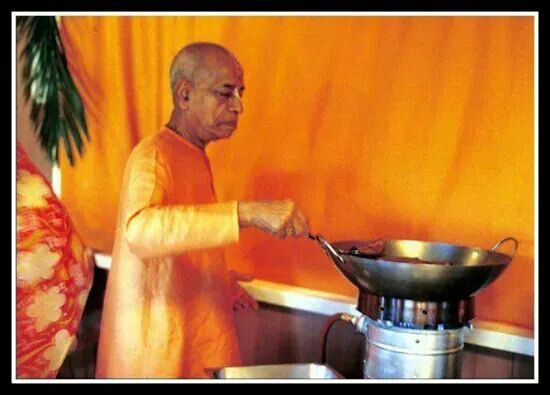
Kṛṣṇa consciousness, Śrīla Prabhupāda would often say, is not something dry. And prasāda was one way he proved his assertion. He showed his disciples how to cook many kinds of vegetarian dishes, how to offer them to Kṛṣṇa, the Supreme Lord, and how to relish the sanctified food as Kṛṣṇa’s mercy. Śrīla Prabhupāda was always pleased to see his disciples eating only Kṛṣṇa’s prasāda. Many times he personally cooked the prasāda and served his disciples with his own hand.
In Volume Two of Prabhupāda Nectar, His Holiness Satsvarūpa dāsa Gosvāmī describes the mood in which Śrīla Prabhupāda gave out prasāda. “He liked to give prasāda from his hand, and everyone liked to receive it. It was not just food, but the blessings of bhakti, the essence of devotional service. Śrīla Prabhupāda gave out prasāda happily, calmly, and without discrimination. When he gave to children, they liked the sweet taste of it, in the form of a cookie or sweet-meat, yet also they liked it as a special treat from Prabhupāda, who sat on the vyasasana [seat of the spiritual master] leaning forward to them. Women liked it because they got a rare chance to come forward and extend their hand before Prabhupāda. They felt satisfied and chaste. And stalwart men came forward like expectant children, sometimes pushing one another just to get the mercy from Prabhupāda.
To Prabhupāda it was serious and important, and he would personally supervise to make sure that a big plate was always ready for him to distribute… Although now prasāda distribution in the Kṛṣṇa consciousness movement is done on a huge scale, as Prabhupāda desired, it all started from his own hand, as he gave it out one-to-one.”
Śrīla Prabhupāda taught that giving prasāda to others is an important part of the Kṛṣṇa conscious way of life. A spiritual movement is useless without free distribution of sanctified foods, Śrīla Prabhupāda said. He wanted free prasāda to be part of every Hare Kṛṣṇa function. Indeed, with full faith in the spiritual potency of prasāda to elevate humanity to God consciousness, Śrīla Prabhupāda wanted the whole world to taste Kṛṣṇa-prasāda.
The doors are open to the public every day at each of the two hundred Hare Kṛṣṇa temples and thirty-five farm communities around the world, where anyone can take free Kṛṣṇa-prasāda. On Sunday, each center invites the public for a sumptuous multicourse “love feast”, a program Śrīla Prabhupāda started in 1966 at the first temple on the Lower East Side of New York City. Every center also has several public festivals a year, such as Ratha-yatra, the Festival of the Chariots, perhaps the world’s oldest spiritual festival. And at each festival, tens of thousands of people see the beautiful form of Kṛṣṇa and eat Kṛṣṇa-prasāda.
In 1979 some devotees in North America created the “Festival of India”, a touring cultural program that cries-crosses the United States and Canada every year, holding 40 festivals in 20 major cities. Under six large tents and at numerous booths and display panels, thousands of people experience Vedic culture as it was presented to the West by Śrīla Prabhupāda, through drama, dance, music, diorama exhibits, Vedic literature, and free vegetarian feasts.
The Hare Kṛṣṇa movement also has restaurants in major cities like London, Paris, Milan, Los Angeles, Dallas, and Sydney. As far as possible, the restaurants use ingredients grown on farms run by Kṛṣṇa devotees. The devotees also give courses in cooking Kṛṣṇa-prasāda. In England, the United States, and Australia, the Hare Kṛṣṇa Vegetarian Club on many of the major campuses, provides a humane alternative to the slaughterhouse-oriented college nutrition courses. And having become acquainted with the Kṛṣṇa conscious philosophy, which encompasses all of the ordinary arguments for vegetarianism, and then goes beyond by giving lucid spiritual arguments, most of the people who participate in these clubs become very resolute vegetarians.
Many people have come to know the devotees of Kṛṣṇa through the public congregational chanting of Kṛṣṇa’s holy names. This public chanting, inaugurated in India five hundred years ago, is always accompanied by the distribution of free prasāda.
In some countries, the temples sponsor free prasāda restaurants. For example, at Mukunda’s Drop-In Centre in Sydney, Australia, over one million meals have been given away by the end of 1985.
Another prasāda-distribution program started in 1973, when Śrīla Prabhupāda looked out the window of his room one day in Śrī Mayapur, India, and saw a young girl searching through some garbage for food. At that moment he resolved that no one within ten kilometers of the Hare Kṛṣṇa temple in Śrī Māyāpura should ever go hungry, and he told this to his disciples. A few days later, looking out the same window, Śrīla Prabhupāda was happy to see his disciples passing out prasāda to hundreds of villagers, who sat in long rows eating heartily from round leaf plates. “Continue this forever,” Śrīla Prabhupāda told his disciples. “Always distribute prasāda.” This was the birth of the ISKCON Food Relief program, which now distributes more than fifteen thousand meals each week, especially in India, Bangladesh and Africa.
A similar project, Hare Kṛṣṇa Food for Life, lives up to its motto “Feeding the Hungry Worldwide” by distributing over twenty thousand plates of prasāda every day to needy people in both the Third World and the industrialized countries of the West. The Hare Kṛṣṇa movement is one of the world’s leading promoters of a vegetarian diet as a long-range solution to the problem of world hunger. And to relieve the immediate effects of hunger, the devotees of Kṛṣṇa are feeding disaster victims, the homeless, the unemployed, and the hungry through this “Food for Life” program. Working in cooperation with the local officials in different countries, “Food for Life” is often helped with government grants and donations of surplus foodstuffs.
These programs give away more than food, however. Śrīla Prabhupāda emphasized that simply feeding the hungry was not enough, that it was false charity to feed someone unless you gave him prasāda and thereby liberate him from birth and death.
It is not surprising, then, that the Hare Kṛṣṇa movement is often called the “kitchen religion,” the movement that combines philosophy with good food. And though some people may not accept the philosophy, hardly anyone says no to the food. In fact, every year more than twenty million people relish Kṛṣṇa-prasāda, food offered to the Supreme Personality of Godhead, Lord Kṛṣṇa.
We look forward to the time when unlimited amounts of prasāda will be distributed all over the world and people everywhere will offer their food to God. Such a revolution in this most universal of human rituals-eating-will certainly cure the materialistic disease of mankind.