Mail ID: contact@vedavarsity.com

Contact: +91 9634998911

Google search engineGoogle search engine
Home Blog Page 54

Chaitanya Charitamrta | Madhya Lila | Chapter 24 | Section 150

0

“Another meaning of the word ‘ātmā’ is ‘one’s characteristic nature.’ Whoever enjoys his particular type of nature is called ātmārāma. Therefore, all living entities— be they moving or nonmoving—are also called ātmārāma. (200) “The original nature of every living entity is to consider himself the eternal servant of Kṛṣṇa. But under the influence of māyā he thinks himself to be the body, and thus his original consciousness is covered. (201) “In that case, by the word ‘ca,’ the word ‘eva’ is meant. The word ‘api’ can be taken in the sense of aggregation. Thus the verse would read ātmārāmā eva—that is, ‘even all kinds of living beings worship Kṛṣṇa.’ (202) “Living entities include great personalities like the four Kumāras, and also low- class foolish people, trees, plants, birds and beasts. (203)

“The devotional service of Vyāsa, Śuka and the four Kumāras has already been well celebrated. Now let Me explain how immovable living entities like trees and plants engage in the Lord’s devotional service. (204) “Everyone is eligible to receive Kṛṣṇa’s mercy— including Vyāsadeva, the four Kumāras, Śukadeva Gosvāmī, lowborn creatures, trees, plants and beasts. By Kṛṣṇa’s mercy they are elevated and engaged in His service. (205) “‘This land of Vṛndāvana [Vrajabhūmi] is glorified today because Your lotus feet have touched her earth and grass, Your fingernails have touched her trees and creepers, and Your merciful eyes have glanced upon her rivers, hills, birds and beasts. The gopīs have been embraced by Your arms, and even the goddess of fortune desires this. Now all of these are glorified.’ (206)

“‘My dear friend, Kṛṣṇa and Balarāma are passing through the forest leading Their cows with Their cowherd boyfriends. They both carry ropes with which, at the time of milking, They bind the rear legs of the cows. When They play on Their flutes, all moving living entities are stunned, and nonmoving living entities experience ecstatic jubilation by Their sweet music. All these things are certainly very wonderful.’ (207) “‘The plants, creepers and trees were full of fruits and flowers due to ecstatic love of Kṛṣṇa. Indeed, being so full, they were bowing down. They were inspired by such deep love for Kṛṣṇa that they were constantly pouring showers of honey. In this way the gopīs saw all the forests of Vṛndāvana.’ (208) “‘Kirātas, Hūnas, Āndhras, Pulindas, Pukkaśas, Ābhīras, Śumbhas, Yavanas and members of the Khaśa races, and even others who are addicted to sinful acts, can be purified by taking shelter of the devotees of the Lord, due to His being the supreme power. I beg to offer my respectful obeisances unto Him.’ (209)

“I have already spoken about thirteen meanings [of the ātmārāma verse]. Now there are six more. Combined, these make nineteen. (210) “I have already explained nineteen different meanings. Now please hear further meanings. The word ‘ātma’ also refers to the body, and this can be taken in four ways. (211) “One in the bodily conception worships his own body as Brahman, but when he comes in contact with a devotee, he gives up this mistaken idea and engages himself in the devotional service of Lord Kṛṣṇa. (212) “‘Those who follow the path of great, saintly mystic yogīs take to the yogic gymnastic process and begin worshiping from the abdomen, where it is said that Brahman is located. Such people are called śārkarākṣa, which means that they are situated in the gross bodily conception. There are also followers of the ṛṣi known as Āruṇa. Following his path, they observe the activities of the arteries. Thus they gradually rise to the heart, where subtle Brahman, Paramātmā, is situated. They then worship Him. O unlimited Ananta! Better than these persons are the mystic yogīs who worship You from the top of their heads. Beginning with the abdomen and proceeding through the heart, they reach the top of the head and pass through the brahma- randhra, the hole at the top of the skull. Thus these yogīs attain the perfectional platform and do not enter the cycle of birth and death again.’ (213)

“Those who are in the bodily conception mainly engage in fruitive activity. Those who perform yajñas and ritualistic ceremonies are also considered in the same category. However, when such persons come in contact with the pure devotee, they give up their fruitive activity and fully engage in the service of the Lord. (214) “‘We have just begun performing this fruitive activity, a sacrificial fire, but due to the many imperfections in our action, we are not certain of its result. Our bodies have become black from the smoke, but we are factually pleased by the nectar of the lotus feet of the Personality of Godhead, Govinda, which you are distributing.’ (215) “The tapasvīs, those who undergo severe austerities and penances to elevate themselves to the higher planetary systems, are also in the same category. When such persons come in contact with a devotee, they give up all those practices and engage in Lord Kṛṣṇa’s service. (216) “‘The taste for loving service is like the water of the river Ganges, which flows from the feet of Lord Kṛṣṇa. Every day that taste diminishes the results of sinful activities acquired over a period of many births by those who perform austerities.’ (217)

“As long as one labors under the bodily conception, he must fulfill volumes and volumes of material desires. Thus a person is called ātmārāma. When such an ātmārāma is favored by the mercy of Kṛṣṇa, he gives up his so- called self- satisfaction and engages in the transcendental loving service of the Lord. (218) “[When he was being blessed by the Supreme Personality of Godhead, Dhruva Mahārāja said:] ‘O my Lord, because I was seeking an opulent material position, I was performing severe types of penance and austerity. Now I have gotten You, who are very difficult for the great demigods, saintly persons and kings to attain. I was searching after a piece of glass, but instead I have found a most valuable jewel. Therefore I am so satisfied that I do not wish to ask any benediction from You.’ (219) “In addition to the nineteen meanings of the verse mentioned previously, there are these four further meanings when the word ‘ātmārāma’ is taken to mean ‘those laboring under the bodily conception.’ This brings the total to twenty- three. Now hear of another three meanings, which are very suitable. (220) “As mentioned above, the word ‘ca’ can be used to mean ‘aggregate.’ According to this meaning, all the ātmārāmas and munis engage in Kṛṣṇa’s service. Besides ‘aggregate,’ there is another meaning of the word ‘ca.’ (221)

“The word ‘nirgranthāḥ’ can be used as an adjective, and ‘api’ can be used in the sense of certainty. For instance, rāmaś ca kṛṣṇaś ca means that both Rāma and Kṛṣṇa enjoy walking in the forest. (222) “The word ‘ca’ can also present a secondary thing to be done at the same time. This way of understanding the word ‘ca’ is called anvācaye. An example is ‘O brahmacārī, go out to collect alms and at the same time bring in the cows.’ (223) “Saintly persons who are always meditating upon Kṛṣṇa are engaged in the devotional service of the Lord. The ātmārāmas are also engaged in the Lord’s service. That is the indirect import. (224) “The word ‘ca’ can also be used to indicate the certainty that only saintly persons are engaged in rendering devotional service to Kṛṣṇa. In the combination ‘ātmārāmā api,’ ‘api’ is used in the sense of censure. (225) “The word ‘nirgrantha’ can be taken as an adjective modifying ‘muni’ and ‘ātmārāma.’ There is another meaning, which you may hear from Me, indicating association with a devotee. Now I shall explain how it is that through the association of devotees, even a nirgrantha can become a devotee. (226)

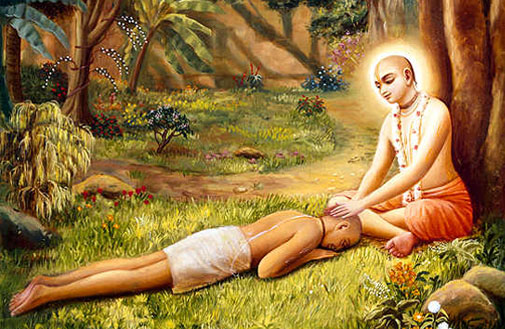
“The word ‘nirgrantha,’ when combined with ‘api’ used in the sense of certainty, indicates a person who is a hunter by profession or who is very poor. Nonetheless, when such a person associates with a great saint like Nārada, he engages in Lord Kṛṣṇa’s devotional service. (227) “The words ‘kṛṣṇārāmaś ca’ refer to one who takes pleasure in thinking of Kṛṣṇa. Even though such a person may be a hunter, he is still worshipable and is the best of devotees. (228) “I shall now narrate the story of how a hunter became a great devotee by the association of such an exalted personality as Nārada Muni. From this story, one can understand the greatness of association with pure devotees. (229) “Once upon a time the great saint Nārada, after visiting Lord Nārāyaṇa in the Vaikuṇṭhas, went to Prayāga to bathe at the confluence of three rivers—the Ganges, Yamunā and Sarasvatī.(230)

“Nārada Muni saw that a deer was lying on the path through the forest and that it was pierced by an arrow. It had broken legs and was twisting due to much pain. (231) “Farther ahead, Nārada Muni saw a boar pierced by an arrow. Its legs were also broken, and it was twisting in pain. (232) “When he went farther, he saw a rabbit that was also suffering. Nārada Muni was greatly pained at heart to see living entities suffer so. (233) “When Nārada Muni advanced farther, he saw a hunter behind a tree. This hunter was holding arrows, and he was ready to kill more animals. (234) “The hunter’s body was blackish. He had reddish eyes, and he appeared fierce. It was as if the superintendent of death, Yamarāja, were standing there with a bow and arrows in his hands. (235) “When Nārada Muni left the forest path and went to the hunter, all the animals immediately saw him and fled. (236) “When all the animals fled, the hunter wanted to chastise Nārada with abusive language, but due to Nārada’s presence, he could not utter anything abusive. (237)

“The hunter addressed Nārada Muni: ‘O gosvāmī! O great saintly person! Why have you left the general path through the forest to come to me? Simply by seeing you, all the animals I was hunting have now fled.’ (238) “Nārada Muni replied, ‘Leaving the path, I have come to you to settle a doubt that is in my mind. (239) “‘I was wondering whether all the boars and other animals that are half- killed belong to you.’ “The hunter replied, ‘Yes, what you are saying is so.’ (240) “Nārada Muni then inquired, ‘Why did you not kill the animals completely? Why did you half- kill them by piercing their bodies with arrows?’ (241) “The hunter replied, ‘My dear saintly person, my name is Mṛgāri, enemy of animals. My father taught me to kill them in that way. (242) “‘When I see half- killed animals suffer, I feel great pleasure.’(243) “Nārada Muni then told the hunter, ‘I have one thing to beg of you.’ “The hunter replied, ‘You may take whatever animals or anything else you would like. (244) “‘I have many skins, if you would like them. I shall give you either a deerskin or a tiger skin.’ (245)

“Nārada Muni said, ‘I do not want any of the skins. I am asking only one thing from you in charity. (246) “‘I beg you that from this day on you will kill animals completely and not leave them half- dead.’(247) “The hunter replied, ‘My dear sir, what are you asking of me? What is wrong with the animals’ lying there half- killed? Will you please explain this to me?’ (248) “Nārada Muni replied, ‘If you leave the animals half- dead, you are purposefully giving them pain. Therefore you will have to suffer in retaliation.’(249) “Nārada Muni continued, ‘My dear hunter, your business is killing animals. That is a slight offense on your part. But when you consciously give them unnecessary pain by leaving them half- dead, you incur very great sins.’ (250) “Nārada Muni continued, ‘All the animals that you have killed and given unnecessary pain will kill you one after the other in your next life and in life after life.’ (251)

“In this way, through the association of the great sage Nārada Muni, the hunter was a little convinced of his sinful activity. He therefore became somewhat afraid due to his offenses. (252) “The hunter then admitted that he was convinced of his sinful activity, and he said, ‘I have been taught this business from my very childhood. Now I am wondering how I can become freed from these unlimited volumes of sinful activity.’ (253) “The hunter continued, ‘My dear sir, please tell me how I can be relieved from the reactions of my sinful life. Now I fully surrender unto you and fall down at your lotus feet. Please deliver me from sinful reactions.’ (254) “Nārada Muni assured the hunter, ‘If you listen to my instructions, I shall find the way you can be liberated.’ (255) “The hunter then said, ‘My dear sir, whatever you say I shall do.’ “Nārada immediately ordered him, ‘First of all, break your bow. Then I shall tell you what is to be done.’ (256)

“The hunter replied, ‘If I break my bow, how shall I maintain myself?’ “Nārada Muni replied, ‘Do not worry. I shall supply all your food every day.’ (257) “Being thus assured by the great sage Nārada Muni, the hunter broke his bow, immediately fell down at the saint’s lotus feet and fully surrendered. After this, Nārada Muni raised him with his hand and gave him instructions for spiritual advancement.(258) “Nārada Muni then advised the hunter, ‘Return home and distribute whatever riches you have to the pure brāhmaṇas who know the Absolute Truth. After you have distributed all your riches to the brāhmaṇas, you and your wife should leave home, each of you taking only one cloth to wear.’(259) “Nārada Muni continued, ‘Leave your home and go to the river. There you should construct a small cottage, and in front of the cottage you should grow a tulasī plant on a raised platform. (260)

“‘After planting the tulasī tree before your house, you should daily circumambulate that tulasī plant, serve her by giving her water and other things, and continuously chant the Hare Kṛṣṇa mahā- mantra.’ (261) “Nārada Muni continued, ‘Every day I shall send sufficient food to you both. You can take as much food as you want.’ (262) “The three animals that were half- killed were then brought to their consciousness by the sage Nārada. Indeed, the animals got up and swiftly fled. (263) “When the hunter saw the half- killed animals flee, he was certainly struck with wonder. He then offered his respectful obeisances to the sage Nārada and returned home. (264) “After all this, Nārada Muni went to his destination. After the hunter returned home, he exactly followed the instructions of his spiritual master, Nārada. (265) “The news that the hunter had become a Vaiṣṇava spread all over the village. Indeed, all the villagers brought alms and presented them to the Vaiṣṇava who had formerly been a hunter. (266)

“In one day enough food was brought for ten or twenty people, but the hunter and his wife would accept only as much as they could eat. (267) “One day, while speaking to his friend Parvata Muni, Nārada Muni requested him to go with him to see his disciple the hunter. (268) “As the saintly sages approached the hunter’s place, the hunter could see them from a distance. (269) “With great alacrity the hunter began to run toward his spiritual master, but he could not fall down and offer obeisances because ants were running hither and thither around his feet. (270) “Seeing the ants, the hunter whisked them away with a piece of cloth. After thus clearing the ants from the ground, he fell down flat to offer his obeisances. (271) Nārada Muni said, ‘My dear hunter, such behavior is not at all astonishing. A man in devotional service is automatically nonviolent. He is the best of gentlemen. (272) “‘O hunter, good qualities like nonviolence, which you have developed, are not very astonishing, for those engaged in the Lord’s devotional service are never inclined to give pain to others because of envy.’(273)

“The hunter then received the two great sages in the courtyard of his house. He spread out a straw mat for them to sit upon, and with great devotion he begged them to sit down. (274) “He then fetched water and washed the sages’ feet with great devotion. Then both husband and wife drank that water and sprinkled it on their heads.(275) “When the hunter chanted the Hare Kṛṣṇa mahā- mantra before his spiritual master, his body trembled and tears welled up in his eyes. Filled with ecstatic love, he raised his hands and began to dance, waving his garments up and down. (276) “When Parvata Muni saw the ecstatic loving symptoms of the hunter, he told Nārada, ‘Certainly you are a touchstone.’ (277) “Parvata Muni continued, ‘My dear friend Nārada Muni, you are glorified as the sage among the demigods. By your mercy, even a lowborn person like this hunter can immediately become attached to Lord Kṛṣṇa.’ (278)

“Nārada Muni then asked the hunter, ‘My dear Vaiṣṇava, do you have some income for your maintenance?’ “The hunter replied, ‘My dear spiritual master, whoever you send gives me something when he comes to see me.’ (279) The former hunter said, ‘Please do not send so much grain. Only send what is sufficient for two people, no more.’ (280) “Nārada Muni approved his not wanting more than a daily supply of food, and he blessed him, saying, ‘You are fortunate.’ Nārada Muni and Parvata Muni then disappeared from that place. (281) “Thus I have narrated the incident of the hunter. By hearing this narration, one can understand the influence of association with devotees. (282)

Chaitanya Charitamrta | Madhya Lila | Chapter 24 | Section 149

0

“‘O great learned devotee, although there are many faults in this material world, there is one good opportunity—the association with devotees. Such association brings about great happiness. Due to this good quality, our strong desire to achieve liberation by merging into the Brahman effulgence has become weakened.’ (125) “By associating with the great saint Nārada, Śaunaka and other great sages gave up the desire for liberation and engaged in Kṛṣṇa’s devotional service. (126) “Simply by meeting Kṛṣṇa or receiving Kṛṣṇa’s special favor, one can give up the desire for liberation. Being attracted by the transcendental qualities of Kṛṣṇa, one can engage in His service. (127)

“‘In this Dvārakā- dhāma, I am being attracted by the Supreme Personality of Godhead, Kṛṣṇa, who is personified spiritual bliss. Simply by seeing Him, I am feeling great happiness. Oh, I have wasted so much time trying to become self- realized through impersonal cultivation. This is a cause for lamentation!’ (128) “There are many people who are liberated even in this lifetime. Some are liberated by discharging devotional service, and others are liberated through the philosophical speculative process. (129) “Those who are liberated by devotional service become more and more attracted by the transcendental qualities of Kṛṣṇa. Thus they engage in His service. Those who are liberated by the speculative process eventually fall down again due to offensive activity. (130)

“‘O lotus- eyed one, those who think they are liberated in this life but are without devotional service to You are of impure intelligence. Although they accept severe austerities and penances and rise to the spiritual position, to impersonal Brahman realization, they fall down again because they neglect to worship Your lotus feet.’(131) “‘One who is thus transcendentally situated at once realizes the Supreme Brahman and becomes fully joyful. He never laments or desires to have anything; he is equally disposed to every living entity. In that state he attains pure devotional service unto Me.’(132) “‘Although I was worshiped by those on the path of monism and initiated into self- realization through the yoga system, I have nonetheless been forcibly turned into a maidservant by some cunning boy who is always joking with the gopīs.’ (133) “One who has attained his constitutional position by the strength of devotional service attains a transcendental body even in this lifetime. Being attracted by Lord Kṛṣṇa’s transcendental qualities, he fully engages in service at His lotus feet. (134)

“‘The living entities and other potencies merge into Mahā- Viṣṇu as the Lord lies down and winds up [destroys] the cosmic manifestation. Liberation means being situated in one’s eternal, original form after giving up the changeable gross and subtle bodies.’ (135) “By opposing Kṛṣṇa consciousness, one becomes conditioned and fearful due to the influence of māyā. By executing devotional service faithfully, one is liberated from māyā.(136) “‘When the living entity is attracted by the material energy, which is separate from Kṛṣṇa, he is overpowered by fear. Because he is separated from the Supreme Personality of Godhead by the material energy, his conception of life is reversed. In other words, instead of being the eternal servant of Kṛṣṇa, he becomes Kṛṣṇa’s competitor. This is called viparyayo ’smṛtiḥ. To nullify this mistake, one who is actually learned and advanced worships the Supreme Personality of Godhead as his spiritual master, worshipful Deity and source of life. He thus worships the Lord by the process of unalloyed devotional service.’ (137)

“‘This divine energy of Mine, consisting of the three modes of material nature, is difficult to overcome. But those who have surrendered unto Me can easily cross beyond it.’ (138) “One does not attain liberation without rendering devotional service. Liberation is attained only by devotional service. (139) “‘My dear Lord, devotional service unto You is the only auspicious path. If one gives it up simply for speculative knowledge or the understanding that these living beings are spirit souls and the material world is false, he undergoes a great deal of trouble. He only gains troublesome and inauspicious activities. His actions are like beating a husk that is already devoid of rice. His labor becomes fruitless.’ (140) “‘O lotus- eyed one, those who think they are liberated in this life but are without devotional service to You are of impure intelligence. Although they accept severe austerities and penances and rise to the spiritual position, to impersonal Brahman realization, they fall down again because they neglect to worship Your lotus feet.’ (141)

“‘If one simply maintains an official position in the four varṇas and āśramas but does not worship the Supreme Lord Viṣṇu, he falls down from his puffed- up position into a hellish condition.’ (142) “When one is actually liberated by executing devotional service, he always engages in the transcendental loving service of the Lord. (143) “‘Even a liberated soul merged in the impersonal Brahman effulgence is attracted to the pastimes of Kṛṣṇa. He thus installs a Deity and renders the Lord service.’ (144) “These six kinds of ātmārāmas engage in the loving service of Kṛṣṇa. The varieties of service are indicated by adding ‘ca,’ and they also bear the meaning of ‘api’ [‘indeed’]. (145) “The six kinds of ātmārāmas render devotional service to Kṛṣṇa without ulterior motives. The words ‘munayaḥ’ and ‘santaḥ’ indicate those who are very much attached to meditating upon Kṛṣṇa. (146)

“The word ‘nirgranthāḥ’ means ‘without ignorance’ and ‘devoid of rules and regulations.’ Whichever meaning fits may be applied. (147) “The use of the word ‘ca’ in different places produces different meanings. Over and above them, there is another meaning that is very important. (148) “Although the words ‘ātmārāmāś ca’ would be repeated six times, simply by adding the word ‘ca,’ five ‘ātmārāmas’ are deleted. (149) “Therefore there is no need to repeat the word ‘ātmārāma.’ One is sufficient, and that one word indicates six persons. (150) “‘Of words having the same form and case termination, the last one is the only one retained. For example, the word “rāmāḥ” is used to stand for “rāmaś ca, rāmaś ca, rāmaś ca, etc.”’ (151) “By the aggregate use of the word ‘ca,’ it is indicated that all the ātmārāmas and saints serve and worship Kṛṣṇa.(152)

“‘Api’ added to the word ‘nirgranthāḥ’ is used for exposition. Thus I have tried to clarify seven meanings [of the ātmārāma verse].(153) “The yogī who worships the Supersoul within himself is also called ātmārāma. There are two types of ātmārāma- yogīs.(154) “The two types of ātmārāma- yogīs are called sagarbha and nigarbha. Each of these is divided into three; therefore there are six types of worshipers of the Supersoul.(155) “‘Some yogīs think of the Lord within their hearts as measuring about six inches. The Lord has four hands, in which He holds a conchshell, club, disc and lotus flower. Those who worship this form of Viṣṇu within the heart are called sagarbha- yogīs.’(156) “‘When one is in ecstatic love with the Supreme Personality of Godhead, one’s heart is melted by bhakti- yoga and one feels transcendental bliss. There are bodily symptoms manifest, and due to eagerness, there are tears in the eyes. Thus one is subjected to spiritual bliss. When the heart is overly afflicted, the meditative mind, like a fishing hook, is gradually separated from the object of meditation.’(157)

“By these three divisions of advancement in yoga—yogārurukṣu, yogārūḍha and prāpta- siddhi—there are six kinds of mystic yogīs.(158) “‘For those saintly persons who wish to rise to the platform of yogic perfection, the means consists of practicing the yoga system by strictly following its regulative principles and practicing the yoga postures, āsanas and breathing exercises. And for those who are already elevated to this platform, the means consists of maintaining mental equilibrium [śama] by rejecting all material activity and practicing meditation to keep the mind on the Supreme Lord. (159) “‘When a person is no longer interested in acting for sense gratification and when he renounces all material desires, he is said to be situated in perfect yoga [yogārūḍha].’ (160) “When a purified yogī associates with devotees, he engages in Lord Kṛṣṇa’s devotional service, being attracted by the Lord’s transcendental qualities.(161)

“The meanings of the words ‘ca’ and ‘api’ can be applied here. The meanings of the words ‘muni’ and ‘nirgrantha’ are the same as before. (162) “The word ‘ahaitukī’ is always applicable to the Supreme Personality of Godhead, Urukrama. In this way I have described thirteen complete meanings [of the ātmārāma verse]. (163) “These thirteen types of yogīs and munis are called śānta- bhaktas, for they render transcendental loving service to the Supreme Personality of Godhead in the neutral stage. (164) “The word ‘ātmā’ sometimes means ‘the mind.’ In this case the word ‘ātmārāma’ means ‘a person who is satisfied by mental speculation.’ When such a person associates with a pure devotee, he takes to devotional service at the lotus feet of Kṛṣṇa. (165)

“‘Those who follow the path of great, saintly mystic yogīs take to the yogic gymnastic process and begin worshiping from the abdomen, where it is said that Brahman is located. Such people are called śārkarākṣa, which means that they are situated in the gross bodily conception. There are also followers of the ṛṣi known as Āruṇa. Following his path, they observe the activities of the arteries. Thus they gradually rise to the heart, where subtle Brahman, Paramātmā, is situated. They then worship Him. O unlimited Ananta! Better than these persons are the mystic yogīs who worship You from the top of their heads. Beginning with the abdomen and proceeding through the heart, they reach the top of the head and pass through the brahma- randhra, the hole at the top of the skull. Thus these yogīs attain the perfectional platform and do not enter the cycle of birth and death again.’(166)

“Being attracted by the transcendental qualities of Kṛṣṇa, such yogīs become great saints. At that time, not being hampered by the yogic process, they engage in unalloyed devotional service. (167) “‘Ātmā’ also means ‘endeavor.’ Being attracted by Kṛṣṇa’s transcendental qualities, some saints make a great endeavor to come to the point of rendering service to Him. (168) “‘The transcendental position cannot be attained by wandering up and down from Brahmaloka and Satyaloka to Pātālaloka. If one is actually intelligent and learned, he should endeavor for that rare transcendental position. By the force of time one attains whatever material happiness is available within the fourteen worlds, just as one attains distress in due course of time. But since spiritual consciousness is not attained in this way, one should try for it.’ (169) “‘Those who are eager to awaken their spiritual consciousness and who thus have unflinching, undeviated intelligence certainly attain the desired goal of life very soon.’ (170)

“The word ‘ca’ may be used in place of ‘api,’ which gives emphasis to something. Thus it means that without sincere endeavor in devotional service, one cannot attain love of Godhead.(171) “‘Devotional perfection is very difficult to attain for two reasons. First, unless one is attached to Kṛṣṇa, he cannot attain devotional perfection even if he renders devotional service for a long time. Second, Kṛṣṇa does not easily deliver perfection in devotional service.’(172) “‘To those who are constantly devoted to serving Me with love, I give the understanding by which they can come to Me.’ (173) “Another meaning of ‘ātmā’ is dhṛti, or endurance. A person who endeavors with endurance is ātmārāma. With endurance, such a person engages in devotional service. (174)

“The word ‘muni’ also means ‘bird’ and ‘bumblebee.’ The word ‘nirgrantha’ refers to foolish people. By the mercy of Kṛṣṇa, such creatures contact a sādhu [spiritual master] and thus engage in devotional service. (175) “‘My dear mother, in this forest, all the birds, after rising on the beautiful branches of the trees, are closing their eyes and, not being attracted by any other sound, are simply listening to the vibration of Kṛṣṇa’s flute. Such birds must be on the same level as great saints.’ (176) “‘O good fortune personified! O original Personality of Godhead, all these bees are chanting about Your transcendental fame, which will purify the entire universe. Indeed, they are following Your path in the forest and are worshiping You. Actually they are all saintly persons, but now they have taken the form of bees. Although You are playing like a human being, they could not forget that You are their worshipable Deity.’ (177)

“‘All the cranes and swans in the water are being enchanted by the melodious song of Kṛṣṇa’s flute. They have approached and are worshiping the Supreme Personality of Godhead with full attention. Alas, they are closing their eyes and are becoming completely silent.’ (178) “‘Kirātas, Hūnas, Āndhras, Pulindas, Pukkaśas, Ābhīras, Śumbhas, Yavanas and members of the Khaśa races, and even others who are addicted to sinful acts, can be purified by taking shelter of the devotees of the Lord, due to His being the supreme power. I beg to offer my respectful obeisances unto Him.’ (179) “The word ‘dhṛti’ is also used when one is fully perfect in knowledge. When, due to having obtained the lotus feet of the Supreme Personality of Godhead, one has no material miseries, he attains mahā- pūrṇa, the highest level of perfection. (180) “‘Dhṛti is the fullness felt due to the absence of misery and the attainment of knowledge of the Supreme Lord and pure love for Him. The lamentation that accrues from not obtaining a goal or from losing something already attained does not affect this completeness.’ (181)

“A devotee of Kṛṣṇa is never in a miserable condition, nor does he have any desire other than to serve Kṛṣṇa. He is experienced and advanced. He feels the transcendental bliss of love of Kṛṣṇa and always engages in His service in full perfection. (182) “‘My devotees, having fulfilled their desires by serving Me, do not accept the four kinds of salvation that are easily earned by such service. Why then should they accept any pleasures that are lost in the course of time?’ (183) “‘In this material world, all living entities are disturbed due to their flickering position. A devotee, however, is fixed in the service of the lotus feet of the Lord, the master of the senses. Such a person is to be considered situated in endurance and patience.’ (184)

“The word ‘ca’ is for emphasis, and the word ‘api’ is used to indicate an aggregate. Thus it is to be understood that even dull creatures [birds and illiterates] can also be situated in endurance and engage in Kṛṣṇa’s devotional service. (185) “The word ‘ātmā’ is also used for a particular type of intelligence. Since all living entities generally have some intelligence, more or less, they are included. (186) “Everyone has some kind of intelligence, and one who utilizes his intelligence is called an ātmārāma. There are two types of ātmārāmas. One is a learned scholar and philosopher, and the other is an uneducated, illiterate, foolish person. (187) “By the mercy of Kṛṣṇa and by the association of devotees, one increases his attraction to and intelligence for pure devotional service; therefore one gives up everything and engages himself at the lotus feet of Kṛṣṇa and His pure devotees. (188)

“‘I [Kṛṣṇa] am the original source of everything. Everything emanates from Me. The wise who perfectly know this engage in My service with love and devotion.’ (189) “‘Women, fourth- class men, uncivilized hill tribes, hunters and many others born of low families, as well as birds and beasts, can engage in the service of the Supreme Personality of Godhead—who acts very wonderfully—and follow the path of the devotees and take lessons from them. Although the ocean of nescience is vast, they can still cross over it. What, then, is the difficulty for those who are advanced in Vedic knowledge?’ (190) “Considering all these points, when one engages in the service of Kṛṣṇa’s lotus feet, Kṛṣṇa gives one the intelligence by which he can gradually progress toward perfection in service to the Lord. (191) “‘To those who are constantly devoted to serving Me with love, I give the understanding by which they can come to Me.’ (192)

“To be elevated to the platform of devotional service, the following five items should be observed: association with devotees, engagement in the service of Lord Kṛṣṇa, the reading of Śrīmad- Bhāgavatam, the chanting of the holy names and residence at Vṛndāvana or Mathurā. (193) “One’s dormant love for Kṛṣṇa gradually awakens if one is a little advanced in one of these five items and is intelligent. (194) “‘The power of these five principles is very wonderful and difficult to understand. Even without faith in them, a person who is offenseless can awaken his dormant love of Kṛṣṇa simply by being a little connected with them.’ (195) “If a person is actually liberal and intelligent, he can advance and become perfect in devotional service even if he has material desires and serves the Lord with some motive. (196)

“‘Whether one desires everything or nothing, or whether he desires to merge into the existence of the Lord, he is intelligent only if he worships Lord Kṛṣṇa, the Supreme Personality of Godhead, by rendering transcendental loving service.’ (197) “Devotional service is so strong that when one engages in it, he gradually gives up all material desires and becomes fully attracted to the lotus feet of Kṛṣṇa. All this is brought about by attraction for the transcendental qualities of the Lord. (198) “‘Whenever Kṛṣṇa is requested to fulfill one’s desire, He undoubtedly does so, but He does not award anything which, after being enjoyed, will cause one to petition Him again and again to fulfill further desires. When one has other desires but engages in the Lord’s service, Kṛṣṇa forcibly gives one shelter at His lotus feet, where one will forget all other desires.’ (199)

Chaitanya Charitamrta | Madhya Lila | Chapter 24 | Section 148

0

“‘As all fuel is burned to ashes by a full- fledged fire, all sinful activities are totally erased when one engages in devotional service to Me.’ (61) “In this way, when all sinful activities are vanquished by the grace of the Supreme Personality of Godhead, one gradually vanquishes all kinds of impediments on the path of devotional service, as well as the ignorance resulting from these impediments. After this, one totally manifests his original love of Godhead through devotional service in nine different ways—hearing, chanting and so forth. (62) “When the devotee is freed from all sinful material activities, Kṛṣṇa attracts his body, mind and senses to His service. Thus Kṛṣṇa is very merciful, and His transcendental qualities are very attractive. (63) “When one’s mind, senses and body are attracted to the transcendental qualities of Hari, one gives up the four principles of material success. Thus I have explained the chief meanings of the word ‘hari.’ (64)

“When the conjunction ‘ca’ [‘and’] and the adverb ‘api’ [‘although’] are added to this verse, the verse can assume whatever meaning one wants to give it. (65) “The word ‘ca’ can be explained in seven ways. (66) “‘The word “ca” [“and”] is used to connect a word or sentence with a previous word or sentence, to give the sense of aggregation, to assist the meaning, to give a collective understanding, to suggest another effort or exertion, or to fulfill the meter of a verse. It is also used in the sense of certainty.’ (67) “There are seven chief meanings of the word ‘api.’ They are as follows. (68) “‘The word “api” is used in the sense of possibility, question, doubt, censure, aggregation, appropriate application of things, and extravagance.’ (69) “I have now described the different meanings of the eleven separate words. Now let Me give the complete meaning of the śloka, as it is applied in different places. (70)

“The word ‘brahma’ indicates the summum bonum, the Absolute Truth, which is greater than all other truths. It is the original identity, and there can be nothing equal to that Absolute Truth. (71) “‘I offer my respectful obeisances to the Absolute Truth, the summum bonum. He is the all- pervasive, all- increasing subject matter for the great yogīs. He is changeless, and He is the soul of all.’ (72) “The proper meaning of the word ‘brahma’ is the Supreme Personality of Godhead, who is one without a second and without whom nothing else exists. (73) “‘Learned transcendentalists who know the Absolute Truth say that it is nondual knowledge and is called impersonal Brahman, localized Paramātmā and the Personality of Godhead.’ (74) “That Absolute Truth without a second is Lord Kṛṣṇa, the Supreme Personality of Godhead. He is the supreme truth in the past, present and future. That is the evidence of all revealed scriptures. (75)

“‘Prior to the cosmic creation, only I exist, and no phenomena exist, either gross, subtle or primordial. After creation, only I exist in everything, and after annihilation only I remain eternally.’ (76) “The word ‘ātmā’ [‘self’] indicates the highest truth, Kṛṣṇa. He is the all- pervasive witness of all, and He is the supreme form. (77) “‘Hari, the Personality of Godhead, is the all- pervasive original source of everything; He is therefore the Supersoul of everything.’(78) “There are three ways to attain the lotus feet of the Absolute Truth, Kṛṣṇa. There is the process of philosophical speculation, the practice of mystic yoga and the execution of devotional service. Each of these has its different characteristics. (79) “The Absolute Truth is the same, but according to the process by which one understands Him, He appears in three forms—as Brahman, Paramātmā and Bhagavān, the Supreme Personality of Godhead. (80)

“‘Learned transcendentalists who know the Absolute Truth say that it is nondual knowledge and is called impersonal Brahman, localized Paramātmā and the Personality of Godhead.’ (81) “Although the words ‘brahma’ and ‘ātmā’ indicate Kṛṣṇa, their direct meaning refers only to the impersonal Brahman and the Supersoul respectively. (82) “If one follows the path of philosophical speculation, the Absolute Truth manifests Himself as impersonal Brahman, and if one follows the path of mystic yoga, He manifests Himself as the Supersoul. (83) “There are two kinds of devotional activity—spontaneous and regulative. By spontaneous devotional service, one attains the original Personality of Godhead, Kṛṣṇa, and by the regulative process one attains the expansion of the Supreme Personality of Godhead. (84) “By executing spontaneous devotional service in Vṛndāvana, one attains the original Supreme Personality of Godhead, Kṛṣṇa. (85)

“‘The Supreme Personality of Godhead, Kṛṣṇa, the son of mother Yaśodā, is accessible to those devotees engaged in spontaneous loving service, but He is not as easily accessible to mental speculators, to those striving for self- realization by severe austerities and penances, or to those who consider the body the same as the self.’ (86) “By executing regulative devotional service, one becomes an associate of Nārāyaṇa and attains the Vaikuṇṭhalokas, the spiritual planets in the spiritual sky. (87) “‘Those who discuss the activities of Lord Kṛṣṇa are on the highest platform of devotional life, and they evince the symptoms of tears in the eyes and bodily jubilation. Such persons discharge devotional service to Kṛṣṇa without practicing the rules and regulations of the mystic yoga system. They possess all spiritual qualities, and they are elevated to the Vaikuṇṭha planets, which exist above us.’ (88)

“The devotees are divided into three categories—akāma [desireless], mokṣa- kāma [desiring liberation] and sarva- kāma [desiring material perfection]. (89) “‘One who is actually intelligent, although he may be a devotee free from material desires, a karmī desiring all kinds of material facilities, or a jñānī desiring liberation, should seriously engage in bhakti- yoga for the satisfaction of the Supreme Personality of Godhead.’ (90) “The meaning of the word ‘udāra- dhī’ is buddhimān—intelligent or considerate. Because of this, even for one’s own sense gratification one engages in the devotional service of Lord Kṛṣṇa. (91) “The other processes cannot yield results unless they are associated with devotional service. Devotional service, however, is so strong and independent that it can give one all the desired results. (92) “With the exception of devotional service, all the methods of self- realization are like the nipples on the neck of a goat. Therefore an intelligent person adopts only devotional service, giving up all other processes of self- realization. (93)

“‘O best among the Bharatas [Arjuna], four kinds of pious men render devotional service unto Me—the distressed, the desirer of wealth, the inquisitive and he who is searching for knowledge of the Absolute.’ (94) “Materialistic devotees take to devotional service and worship Kṛṣṇa when they are distressed or in need of money. Those who are actually inquisitive to understand the supreme source of everything and those who are in search of knowledge are called transcendentalists, for they desire liberation from all material contamination.(95) “Because they have a pious background, all four types of people are to be considered greatly fortunate. Such people gradually give up material desires and become pure devotees. (96) “One is elevated to the platform of devotional life by the mercy of a Vaiṣṇava, the bona fide spiritual master, and by the special mercy of Kṛṣṇa. On that platform, one gives up all material desires and the association of unwanted people. Thus one is elevated to the platform of pure devotional service. (97)

“‘The intelligent, who have understood the Supreme Lord in the association of pure devotees and have become free from bad, materialistic association, can never avoid hearing the glories of the Lord, even though they have heard them only once.’ (98) “Cheating oneself and cheating others is called kaitava. Associating with those who cheat in this way is called duḥsaṅga, bad association. Those who desire things other than Kṛṣṇa’s service are also called duḥsaṅga, bad association. (99) “‘The great scripture Śrīmad- Bhāgavatam, compiled by Mahāmuni Vyāsadeva from four original verses, describes the most elevated and kindhearted devotees and completely rejects the cheating ways of materially motivated religiosity. It propounds the highest principle of eternal religion, which can factually mitigate the threefold miseries of a living being and award the highest benediction of full prosperity and knowledge. Those willing to hear the message of this scripture in a submissive attitude of service can at once capture the Supreme Lord in their hearts. Therefore there is no need for any scripture other than Śrīmad- Bhāgavatam.’ (100)

“The prefix ‘pra’ in the word ‘projjhita’ specifically refers to those desiring liberation or oneness with the Supreme. Such a desire should be understood to be the foremost cheating propensity. The great commentator Śrīdhara Svāmī has explained this verse in that way. (101) “When merciful Lord Kṛṣṇa understands that a foolish devotee desires material prosperity, He gratefully gives him the shelter of His lotus feet. In this way, the Lord covers the devotee’s undesirable ambitions. (102) “‘Whenever Kṛṣṇa is requested to fulfill one’s desire, He undoubtedly does so, but He does not award anything which, after being enjoyed, will cause one to petition Him again and again to fulfill further desires. When one has other desires but engages in the Lord’s service, Kṛṣṇa forcibly gives one shelter at His lotus feet, where one will forget all other desires.’ (103) “Association with a devotee, the mercy of Kṛṣṇa, and the nature of devotional service help one to give up all undesirable association and gradually attain elevation to the platform of love of Godhead. (104)

“In this way I shall progressively explain all the words in the ātmārāma verse. It should be understood that all these words are meant to enable one to taste the transcendental qualities of Kṛṣṇa. (105) “I have given all these explanations just to give some indication of the verse’s meaning. Now let Me explain the real meaning of the verse. (106) “There are two kinds of worshipers on the path of philosophical speculation—one is called brahma- upāsaka, a worshiper of the impersonal Brahman, and the other is called mokṣākāṅkṣī, one who desires liberation. (107) “There are three types of people who worship the impersonal Brahman. The first is the beginner, the second is one whose thoughts are absorbed in Brahman, and the third is one who is actually merged in the impersonal Brahman. (108)

“One cannot attain liberation simply through philosophical speculation devoid of devotional service. However, if one renders devotional service, he is automatically on the Brahman platform. (109) “Characteristically, one in devotional service is attracted away from the impersonal Brahman platform. He is offered a transcendental body to engage in Lord Kṛṣṇa’s service.(110) “When one gets a devotee’s spiritual body, he can remember the transcendental qualities of Kṛṣṇa. Simply by being attracted to Kṛṣṇa’s transcendental qualities, one becomes a pure devotee engaged in His service.(111) “‘Even a liberated soul merged in the impersonal Brahman effulgence is attracted to the pastimes of Kṛṣṇa. He thus installs a Deity and renders the Lord service.’(112)

“Although Śukadeva Gosvāmī and the four Kumāras were always absorbed in the thought of impersonal Brahman and were thus Brahmavādīs, they were nonetheless attracted by the transcendental pastimes and qualities of Kṛṣṇa. Therefore they later became devotees of Kṛṣṇa. (113) “The minds of the four Kumāras were attracted by the aroma of the flowers offered to Kṛṣṇa’s lotus feet. Being thus attracted by the transcendental qualities of Kṛṣṇa, they engaged in pure devotional service. (114) “‘When the breeze carrying the aroma of tulasī leaves and saffron from the lotus feet of the lotus- eyed Personality of Godhead entered through the nostrils into the hearts of those sages [the Kumāras], they experienced a change in both body and mind, even though they were attached to the impersonal Brahman understanding.’ (115) “By the mercy of Śrīla Vyāsadeva, Śukadeva Gosvāmī was attracted by the pastimes of Lord Kṛṣṇa. Being thus attracted by Kṛṣṇa’s transcendental qualities, he also became a devotee and engaged in His service.(116)

“‘Being very much attracted by the transcendental pastimes of the Lord, the mind of Śrīla Śukadeva Gosvāmī was agitated by Kṛṣṇa consciousness. He therefore began to study Śrīmad- Bhāgavatam by the grace of his father.’(117) “From their very births, the nine great mystic yogīs [Yogendras] were impersonal philosophers of the Absolute Truth. But because they heard about Lord Kṛṣṇa’s qualities from Lord Brahmā, Lord Śiva and the great sage Nārada, they also became Kṛṣṇa’s devotees.(118) “In the Eleventh Canto of Śrīmad- Bhāgavatam there is a full description of the devotional service of the nine Yogendras, who rendered devotional service because they were attracted by the Lord’s transcendental qualities.(119)

“‘The nine Yogendras entered Lord Brahmā’s association and heard from him the real meaning of the topmost Vedic literatures, the Upaniṣads. Although the Yogendras were already conversant in Vedic knowledge, they became very jubilant in Kṛṣṇa consciousness just by listening to Brahmā. Thus they wanted to enter Dvārakā, the abode of Lord Kṛṣṇa. In this way they finally achieved the place known as Raṅga- kṣetra.’ (120) “Those who wish to merge into the impersonal Brahman are also divided into three categories—those desiring to be liberated, those already liberated and those who have realized Brahman. (121)

“There are many people within this material world who desire liberation, and for this purpose they render devotional service to Lord Kṛṣṇa.(122) “‘Those who want to be relieved from the material clutches give up the worship of the various demigods who have fearful bodily features. Such peaceful devotees, who are not envious of the demigods, worship the different forms of the Supreme Personality of Godhead, Nārāyaṇa.’(123) “If those who are attached to demigod worship fortunately associate with the devotees, their dormant devotional service and appreciation of the Lord’s qualities gradually awaken. In this way they also engage in Kṛṣṇa’s devotional service and give up the desire for liberation and the desire to merge into the existence of impersonal Brahman. (124)

Chaitanya Charitamrta | Madhya Lila | Chapter 24 | Section 147

0

All glories to Śrī Caitanya Mahāprabhu, who acted as the eastern horizon where the sun of the ātmārāma verse rose. He manifested its rays in the form of different meanings and thus eradicated the darkness of the material world. May He protect the universe. (1) All glories to Lord Caitanya! All glories to Lord Nityānanda! All glories to Advaitacandra! And all glories to all the devotees of Lord Caitanya! (2) Thereafter, Sanātana Gosvāmī clasped the lotus feet of Śrī Caitanya Mahāprabhu and humbly submitted the following petition. (3) Sanātana Gosvāmī said, “My Lord, I have heard that previously, at the home of Sārvabhauma Bhaṭṭācārya, You explained the ātmārāma verse in eighteen different ways. (4)

“‘Those who are self- satisfied and unattracted by external material desires are also attracted to the loving service of Śrī Kṛṣṇa, whose qualities are transcendental and whose activities are wonderful. Hari, the Personality of Godhead, is called Kṛṣṇa because He has such transcendentally attractive features.’ (5) “I have heard this wonderful story and am therefore very inquisitive to hear Your explanation again. If You would kindly repeat it, I would be very pleased to hear.” (6) Śrī Caitanya Mahāprabhu replied, “I am one madman, and Sārvabhauma Bhaṭṭācārya is another. Therefore he took My words to be the truth. (7) “I do not recall what I spoke in that connection, but if something comes to My mind due to association with you, I shall explain it. (8)

“Generally by Myself I cannot give an explanation, but by the strength of your association something may manifest itself. (9) “There are eleven clear words in this verse, but when they are studied separately, various meanings glitter from each word. (10) “The seven different meanings of the word ‘ātmā’ are the Absolute Truth, the body, the mind, endeavor, firmness, intelligence and nature. (11) “‘The following are synonyms of the word “ātmā”: the body, mind, Absolute Truth, natural characteristics, firmness, intelligence and endeavor.’ (12) “The word ‘ātmārāma’ refers to one who enjoys these seven items [the Absolute Truth, body, mind and so on]. Later, I shall enumerate the ātmārāmas. (13) “My dear Sanātana, first hear the meanings of the other words, beginning with the word ‘muni.’ I shall first explain their separate meanings, then combine them. (14)

“The word ‘muni’ refers to one who is thoughtful, one who is grave or silent, an ascetic, one who keeps great vows, one in the renounced order and a saint. These are the different meanings of the word ‘muni.’ (15) “The word ‘nirgrantha’ refers to one who is liberated from the material knots of ignorance. It also refers to one who is devoid of all regulative principles enjoined in the Vedic literature. It also refers to one who does not have knowledge. (16) “‘Nirgrantha’ also refers to one who is illiterate, lowborn, misbehaved, unregulated and devoid of respect for the Vedic literature. The word also refers to one who is a capitalist and to one who has no riches. (17) “‘The prefix “niḥ” may be used for a sense of ascertainment, gradation, construction or forbidding. The word “grantha” means “riches,” “thesis” and “composition.”’ (18) “The word ‘urukrama’ refers to one whose krama [step] is great. The word ‘krama’ means ‘throwing the foot forward,’ that is, ‘stepping.’ (19) “‘Krama’ also means ‘power,’ ‘trembling,’ ‘a systematic method,’ ‘argument’ and ‘a forcible attack by stepping forward.’ Thus Vāmana caused the three worlds to tremble. (20)

“‘Even if a learned man is able to count all the minute atoms in this material world, he still cannot count the potencies of Lord Viṣṇu. In the form of the Vāmana incarnation, Lord Viṣṇu, without hindrance, captured all the planets, extending from the root of the material world up to Satyaloka. Indeed, He caused every planetary system to tremble by the force of His steps.’ (21) “Through His all- pervasive feature, the Supreme Personality of Godhead has expanded the entire creation. He is holding and maintaining this creation by His extraordinary potency. By His conjugal potency, He maintains the planetary system known as Goloka Vṛndāvana. Through His six opulences, He maintains many Vaikuṇṭha planets. (22) “The word ‘urukrama’ indicates the Supreme Personality of Godhead, who, by His external potency, has perfectly created innumerable universes. (23) “‘These are the different meanings of the word “krama.” It is used in the sense of potency, systematic arrangement, step, moving or trembling.’ (24)

“The word ‘kurvanti’ means ‘they do something for others,’ since it is a form of the verb ‘to do’ indicating things done for others. It is used in connection with devotional service, which must be executed for the satisfaction of Kṛṣṇa. That is the purport of the word ‘kurvanti.’ (25) “‘The terminations of the ātmane- pada are employed when the fruit of the action accrues to the agent of verbs having an indicatory ñ or a svarita accent.’ (26) “The word ‘hetu’ [‘cause’] means that a thing is done for some motive. There can be three motives. One may act to enjoy the result personally, to achieve some material perfection, or to attain liberation. (27) “First we take the word ‘bhukti’ [‘material enjoyment’], which is of unlimited variety. We may also take the word ‘siddhi’ [‘perfection’], which has eighteen varieties. Similarly, the word ‘mukti’ has five varieties. (28) “Causeless devotional service is unmotivated by sense enjoyment, perfection or liberation. When one is freed from all these contaminations, he can bring Lord Kṛṣṇa, who is very funny, under control. (29)

“There are ten meanings for the word ‘bhakti’ [‘devotional service’]. One is sādhana- bhakti, execution of devotional service according to the regulative principles, and the other nine are varieties of prema- bhakti, ecstatic love of Godhead. (30) “Next are explained the symptoms of love of Godhead, which can be divided into nine varieties, beginning with attraction and extending up to ecstatic love and finally up to the topmost ecstatic love [mahābhāva]. (31) “The attraction to Kṛṣṇa of devotees on the platform of neutrality increases up to love of Godhead [prema], and the attraction of devotees on the platform of servitorship increases to spontaneous attachment [rāga]. (32) “Devotees in Vṛndāvana who are friends of the Lord can increase their ecstatic love to the point of anurāga. Parental affectionate lovers, Kṛṣṇa’s father and mother, can increase their love of Godhead up to the end of anurāga. (33)

“The gopīs of Vṛndāvana who are attached to Kṛṣṇa in conjugal love can increase their ecstatic love up to the point of mahābhāva, the greatest ecstatic love. These are some of the glorious meanings of the word ‘bhakti.’ (34) “Please hear the meaning of the word ‘ittham- bhūta- guṇa,’ which is found in the ātmārāma verse. ‘Ittham- bhūta’ has different meanings, and ‘guṇa’ has other meanings. (35) “The word ‘ittham- bhūta’ is transcendentally exalted because it means ‘full of transcendental bliss.’ Before this transcendental bliss, the bliss derived from merging into the existence of the Absolute [brahmānanda] becomes like a piece of straw in comparison. (36) “‘My dear Lord, O master of the universe, since I have directly seen You, my transcendental bliss has taken the shape of a great ocean. Being situated in that ocean, I now realize all other so- called happiness to be like the water contained in the hoofprint of a calf.’ (37)

“Lord Kṛṣṇa is so exalted that He is more attractive than anything else and more pleasing than anything else. He is the most sublime abode of bliss. By His own strength, He causes one to forget all other ecstasies. (38) “Pure devotional service is so sublime that one can very easily forget the happiness derived from material enjoyment, material liberation and mystic or yogic perfection. Thus the devotee is bound by Kṛṣṇa’s mercy and His uncommon power and qualities. (39) “When one is attracted to Kṛṣṇa on the transcendental platform, there is no longer any logical argument on the basis of revealed scripture, nor are there considerations of such conclusions. This is His transcendental quality that is the essence of all transcendental sweetness. (40) “The word ‘guṇa’ means ‘quality.’ The qualities of Kṛṣṇa are transcendentally situated and are unlimited in quantity. All of the spiritual qualities are full of transcendental bliss. (41)

“Kṛṣṇa’s transcendental qualities of opulence, sweetness and mercy are perfect and full. As far as Kṛṣṇa’s affectionate leaning toward His devotees is concerned, He is so magnanimous that He can give Himself to His devotees. (42) “Kṛṣṇa has unlimited qualities. The devotees are attracted by His uncommon beauty, mellows and fragrance. Thus they are differently situated in the different transcendental mellows. Therefore Kṛṣṇa is called all- attractive. (43) “The minds of the four boy sages [Sanaka, Sanātana, Sanandana and Sanat- kumāra] were attracted to the lotus feet of Kṛṣṇa by the aroma of the tulasī that had been offered to the Lord. (44) “‘When the breeze carrying the aroma of tulasī leaves and saffron from the lotus feet of the lotus- eyed Personality of Godhead entered through the nostrils into the hearts of those sages [the Kumāras], they experienced a change in both body and mind, even though they were attached to the impersonal Brahman understanding.’ (45) “Śukadeva’s mind was carried away by hearing the pastimes of the Lord. (46)

“[Śukadeva Gosvāmī addressed Parīkṣit Mahārāja:] ‘My dear King, although I was fully situated in the transcendental position, I was nonetheless attracted to the pastimes of Lord Kṛṣṇa. Therefore I studied Śrīmad- Bhāgavatam from my father.’ (47) “‘I offer my respectful obeisances unto Śrīla Śukadeva Gosvāmī, the son of Vyāsadeva and the destroyer of all sinful reactions. Being full in self- realization and bliss, he had no material desire. Still, he was attracted by the transcendental pastimes of the Supreme Personality of Godhead, and out of compassion for the people he described the transcendental historical literature called Śrīmad- Bhāgavatam. This is compared to the light of the Absolute Truth.’ (48) “Lord Śrī Kṛṣṇa attracts the minds of all the gopīs with His beautiful, transcendental bodily features. (49)

“‘Dear Kṛṣṇa, we have simply surrendered ourselves as Your maidservants, for we have seen Your beautiful face decorated with tresses of hair, Your earrings falling upon Your cheeks, the nectar of Your lips, and the beauty of Your smile. Indeed, because we have also been embraced by Your arms, which give us courage, and seen Your chest, which is beautiful and broad, we have surrendered ourselves.’ (50) “The queens in Dvārakā, headed by Rukmiṇī, are also attracted to Kṛṣṇa simply by hearing about His transcendental beauty and qualities. (51) “‘O most beautiful Kṛṣṇa, I have heard about Your transcendental qualities from others, and therefore all my bodily miseries are relieved. If someone sees Your transcendental beauty, his eyes have attained everything profitable in life. O infallible one, I have become shameless after hearing of Your qualities, and I have become attracted to You.’ (52)

“Lord Kṛṣṇa even attracts the mind of the goddess of fortune simply by vibrating His transcendental flute. (53) “‘O Lord, we do not know how the serpent Kāliya attained such an opportunity to be touched by the dust of Your lotus feet. For this end, the goddess of fortune performed austerities for centuries, giving up all other desires and taking austere vows. Indeed, we do not know how this serpent Kāliya got such an opportunity.’ (54) “Kṛṣṇa attracts not only the minds of the gopīs and the goddesses of fortune but the minds of all the young girls in the three worlds as well. (55) “‘My dear Lord Kṛṣṇa, where is that woman within the three worlds who would not be captivated by the rhythms of the sweet songs coming from Your wonderful flute? Who would not fall down from the path of chastity in this way? Your beauty is the most sublime within the three worlds. Upon seeing Your beauty, even cows, birds, animals and trees in the forest become stunned in jubilation.’ (56)

“The women of Vṛndāvana who are on the level of superior guardians are attracted to Lord Kṛṣṇa maternally. The men of Vṛndāvana are attracted as servants, friends and fathers. (57) “The qualities of Kṛṣṇa captivate and attract everything, living and nonliving. Even birds, animals and trees are attracted to Kṛṣṇa’s qualities. (58) “Although the word ‘hari’ has many different meanings, two of them are foremost. One meaning is that the Lord takes away all inauspicious things from His devotee, and the second meaning is that He attracts the mind by ecstatic love for God. (59) “When the devotee somehow or other always remembers the Supreme Personality of Godhead anywhere and everywhere, Lord Hari takes away life’s four miserable conditions. (60)

Chaitanya Charitamrta | Madhya Lila | Chapter 23 | Section 146

0

“Udghūrṇā [unsteadiness] and vivaśa- ceṣṭā [boastful activities] are aspects of transcendental madness. In separation from Kṛṣṇa, one experiences the manifestation of Kṛṣṇa, and one thinks oneself to be Kṛṣṇa. (61) “In conjugal love [śṛṅgāra] there are two departments— meeting and separation. On the platform of meeting, there are unlimited varieties that are beyond description. (62) “Vipralambha has four divisions—pūrva- rāga, māna, pravāsa and prema- vaicittya. (63) “Of the four kinds of separation, three [pūrva- rāga, pravāsa and māna] are celebrated in Śrīmatī Rādhārāṇī and the gopīs. In Dvārakā, among the queens, feelings of prema- vaicittya are very prominent. (64) “‘My dear friend kurarī, it is now night, and Lord Śrī Kṛṣṇa is sleeping. You yourself are not asleep or resting but are lamenting. Should I presume that you, like us, are affected by the smiling, liberal, playful glances of lotus- eyed Kṛṣṇa? If so, your heart is deeply pierced. Is that why you are showing these signs of sleepless lamentation?’ (65)

“Lord Kṛṣṇa, the Supreme Personality of Godhead, who appeared as the son of Nanda Mahārāja, is the supreme hero in all dealings. Similarly, Śrīmatī Rādhārāṇī is the topmost heroine in all dealings. (66) “‘Kṛṣṇa is the Supreme Personality of Godhead Himself, and He is the crown jewel of all heroes. In Kṛṣṇa, all transcendental permanently good situated.’ qualities (67) are “‘The transcendental goddess Śrīmatī Rādhārāṇī is the direct counterpart of Lord Śrī Kṛṣṇa. She is the central figure for all the goddesses of fortune. She possesses all the attraction to attract the all- attractive Personality of Godhead. She is the primeval internal potency of the Lord.’ (68) “The transcendental qualities of Lord Kṛṣṇa are unlimited. Out of these, sixty- four are considered prominent. The ears of the devotees are satisfied simply by hearing all these qualities one after the other. (69) “‘Kṛṣṇa, the supreme hero, has the most beautiful transcendental body. This body possesses all good features. It is radiant and very pleasing to the eyes. His body is powerful, strong and youthful. (70)

“‘Kṛṣṇa is the linguist of all wonderful languages. He is a truthful and very pleasing speaker. He is expert in speaking, and He is a very wise, learned scholar and a genius. (71) “‘Kṛṣṇa is very expert in artistic enjoyment. He is highly cunning, expert, grateful and firmly determined in His vows. He knows how to deal according to time, person and country, and He sees through the scriptures and authoritative books. He is very clean and self- controlled. (72) “‘Lord Kṛṣṇa is steady, His senses are controlled, and He is forgiving, grave and calm. He is also equal to all. Moreover, He is magnanimous, religious, chivalrous and kind. He is always respectful to respectable people. (73) “‘Kṛṣṇa is very simple and liberal, He is humble and bashful, and He is the protector of the surrendered souls. He is very happy, and He is always the well- wisher of His devotees. He is all- auspicious, and He is submissive to love. (74)

“‘Kṛṣṇa is very influential and famous, and He is the object of attachment for everyone. He is the shelter of the good and the virtuous. He is attractive to the minds of women, and He is worshiped by everyone. He is very, very rich. (75) “‘Kṛṣṇa is the Supreme, and He is always glorified as the Supreme Lord and controller. Thus all the previously mentioned transcendental qualities are in Him. The fifty qualities of the Supreme Personality of Godhead mentioned above are as deep as an ocean. In other words, they are difficult to fully comprehend. (76) “‘These qualities are sometimes very minutely exhibited in living beings, but they are fully manifested in the Supreme Personality of Godhead.’ (77) “‘Apart from these fifty qualities, there are five other qualities found in the Supreme Personality of Godhead that are partially present in demigods like Śiva. (78)

“‘These qualities are (1) the Lord is always situated in His original position, (2) He is omniscient, (3) He is always fresh and youthful, (4) He is the concentrated form of eternity, knowledge and bliss, and (5) He is the possessor of all mystic perfection. There are another five qualities, which exist in the Vaikuṇṭha planets in Nārāyaṇa, the Lord of Lakṣmī. These qualities are also present in Kṛṣṇa, but they are not present in demigods like Lord Śiva or in other living entities. These are (1) the Lord possesses inconceivable supreme power, (2) He generates innumerable universes from His body, (3) He is the original source of all incarnations, (4) He bestows salvation upon enemies He kills, and (5) He has the ability to attract exalted persons who are satisfied in themselves. Although these qualities are present in Nārāyaṇa, the dominating Deity of the Vaikuṇṭha planets, they are even more wonderfully present in Kṛṣṇa. (79-81)

“‘Apart from these sixty transcendental qualities, Kṛṣṇa has an additional four transcendental qualities, which are not manifested even in the personality of Nārāyaṇa. These are: (1) Kṛṣṇa is like an ocean filled with waves of pastimes that evoke wonder within everyone in the three worlds. (2) In His activities of conjugal love, He is always surrounded by His dear devotees who possess unequaled love for Him. (3) He attracts the minds of all three worlds with the melodious vibration of His flute. (4) His personal beauty and opulence are beyond compare. No one is equal to Him, and no one is greater than Him. Thus the Personality of Godhead astonishes all living entities, both moving and nonmoving, within the three worlds. He is so beautiful that He is called Kṛṣṇa. (82-83)

“‘Above Nārāyaṇa, Kṛṣṇa has four specific transcendental qualities—His wonderful pastimes, an abundance of wonderful associates who are very dear to Him [like the gopīs], His wonderful beauty and the wonderful vibration of His flute. Lord Kṛṣṇa is more exalted than ordinary living beings and demigods like Lord Śiva. He is even more exalted than His personal expansion Nārāyaṇa. In all, the Supreme Personality of Godhead has sixty- four transcendental qualities in full.’ (84-85) “Similarly, Śrīmatī Rādhārāṇī has unlimited transcendental qualities, of which twenty- five are principal. Śrī Kṛṣṇa is controlled by these transcendental qualities of Śrīmatī Rādhārāṇī. (86)

“‘Śrīmatī Rādhārāṇī’s twenty- five chief transcendental qualities are: (1) She is very sweet. (2) She is always freshly youthful. (3) Her eyes are restless. (4) She smiles brightly. (5) She has beautiful, auspicious lines. (6) She makes Kṛṣṇa happy with Her bodily aroma. (7) She is very expert in singing. (8) Her speech is charming. (9) She is very expert in joking and speaking pleasantly. (10) She is very humble and meek. (11) She is always full of mercy. (12) She is cunning. (13) She is expert in executing Her duties. (14) She is shy. (15) She is always respectful. (16) She is always calm. (17) She is always grave. (18) She is expert in enjoying life. (19) She is situated at the topmost level of ecstatic love. (20) She is the reservoir of loving affairs in Gokula. (21) She is the most famous of submissive devotees. (22) She is very affectionate to elderly people. (23) She is very submissive to the love of Her friends. (24) She is the chief gopī. (25) She always keeps Kṛṣṇa under Her control. In short, She possesses unlimited transcendental qualities, just as Lord Kṛṣṇa does.’ (87-91)

“The basis of all transcendental mellows is the hero and the heroine, and Śrīmatī Rādhārāṇī and Lord Kṛṣṇa, the son of Mahārāja Nanda, are the best. (92) “Just as Lord Kṛṣṇa and Śrīmatī Rādhārāṇī are the object and shelter of the mellow of conjugal love, so, in the mellow of servitorship, Kṛṣṇa, the son of Mahārāja Nanda, is the object, and servants like Citraka, Raktaka and Patraka are the shelter. Similarly, in the transcendental mellow of friendship, Lord Kṛṣṇa is the object, and friends like Śrīdāmā, Sudāmā and Subala are the shelter. In the transcendental mellow of parental affection, Kṛṣṇa is the object, and mother Yaśodā and Mahārāja Nanda are the shelter. (93) “Now hear how the mellows appear and how they are realized by the devotees on different transcendental platforms. (94)

“‘For those who are completely washed of all material contamination by pure devotional service, who are always satisfied and brightly enlightened in the heart, who are always attached to understanding the transcendental meaning of Śrīmad- Bhāgavatam, who are always eager to associate with advanced devotees, whose happiness in the service of the lotus feet of Govinda is their very life, who always discharge the confidential activities of love—for such advanced devotees, who are by nature situated in bliss, the seed of love [rati] is expanded in the heart by previous and current reformatory processes. Thus the mixture of ecstatic ingredients becomes tasty and, being within the perception of the devotee, reaches the highest platform of wonder and deep bliss.’ (95-98) “The exchange between Kṛṣṇa and different devotees situated in different transcendental mellows is not to be experienced by nondevotees. Advanced devotees can understand and appreciate the different varieties of devotional service reciprocated with the Supreme Personality of Godhead. (99)

“‘Nondevotees cannot understand the exchange of transcendental mellows between the devotees and the Lord. In all respects, this is very difficult to understand, but one who has dedicated everything to the lotus feet of Kṛṣṇa can taste the transcendental mellows.’ (100) “This brief description is an elaboration of the ultimate goal of life. Indeed, this is the fifth and ultimate goal, which is beyond the platform of liberation. It is called kṛṣṇa- prema- dhana, the treasure of love for Kṛṣṇa. (101) “Previously I empowered your brother Rūpa Gosvāmī to understand these mellows. I did this while instructing him at the Daśāśvamedha- ghāṭa in Prayāga. (102) “O Sanātana, you should broadcast the revealed scriptures on devotional service and excavate the lost places of pilgrimage in the district of Mathurā. (103) “Establish devotional service to Lord Kṛṣṇa and Rādhārāṇī in Vṛndāvana. You should also compile bhakti scriptures and preach the bhakti cult from Vṛndāvana.” (104) Śrī Caitanya Mahāprabhu then told Sanātana Gosvāmī about proper renunciation according to a particular situation, and the Lord forbade dry renunciation and speculative knowledge in all respects. (105)

“‘One who is not envious but is a kind friend to all living entities, who does not think himself a proprietor and is free from false ego, who is equal in both happiness and distress, who is always satisfied, forgiving and self- controlled, and who is engaged in devotional service with determination, his mind and intelligence dedicated to Me—such a devotee of Mine is very dear to Me. (106-107) “‘He by whom no one is put into difficulty or anxiety and who is not disturbed by anyone, who is liberated from jubilation, anger, fear and anxiety, is very dear to Me. (108) “‘A devotee who is not dependent on others but is dependent solely on Me, who is clean inwardly and outwardly, who is expert, indifferent to material things, without cares and free from all pains, and who rejects all pious and impious activities is very dear to Me. (109) “One who is free of all material jubilation, hatred, lamentation and desire, who renounces both materially auspicious and materially inauspicious things, and who is devoted to Me is very dear to Me. (110)

“‘One who is equal to friends and enemies, who is equipoised in honor and dishonor, heat and cold, happiness and distress, fame and infamy, who is always free from attachment to material things and always grave and satisfied in all circumstances, who doesn’t care for any residence, and who is always fixed in devotional service—such a person is very dear to Me. (111-112) “‘Devotees who follow these imperishable religious principles of Kṛṣṇa consciousness with great faith and devotion, fully accepting Me as the supreme goal, are very, very dear to Me.’ (113) “‘Are there no torn clothes lying on the common road? Do the trees, which exist for maintaining others, no longer give alms in charity? Do the rivers, being dried up, no longer supply water to the thirsty? Are the caves of the mountains now closed, or, above all, does the unconquerable Supreme Personality of Godhead not protect the fully surrendered souls? Why then should learned persons like devotees go to flatter those who are intoxicated by hard- earned wealth?’” (114)

Thereafter Sanātana Gosvāmī inquired from Śrī Caitanya Mahāprabhu about all the conclusive statements concerning devotional service, and the Lord very vividly explained all the confidential meanings of Śrīmad- Bhāgavatam. (115) In the revealed scripture Hari- vaṁśa, there is a description of Goloka Vṛndāvana, the planet where Lord Śrī Kṛṣṇa eternally resides. This information was given by King Indra when he surrendered to Kṛṣṇa and offered prayers after Kṛṣṇa had raised Govardhana Hill. (116) Illusory stories opposed to the conclusions of Kṛṣṇa consciousness concern the destruction of the Yadu dynasty, Kṛṣṇa’s disappearance, the story that Kṛṣṇa and Balarāma arise from a black hair and a white hair of Kṣīrodakaśāyī Viṣṇu, and the story about the kidnapping of the queens. Śrī Caitanya Mahāprabhu explained to Sanātana Gosvāmī the proper conclusions of these stories. (117-118)

Sanātana Gosvāmī then humbly accepted his position as lower than a piece of straw, and symbolically holding some straw in his mouth, he fell down, clasped the lotus feet of Śrī Caitanya Mahāprabhu and submitted the following petition. (119) Sanātana Gosvāmī said, “My dear Lord, I am a very lowborn person. Indeed, I am a servant to lowborn people; therefore I am very, very downtrodden. Nonetheless, You have taught me conclusions unknown even to Lord Brahmā. (120) “The conclusions that You have told me are the ocean of the ambrosia of truth. My mind is unable to approach even a drop of that ocean. (121) “If You want to make a lame man like me dance, kindly bestow Your transcendental blessings by placing Your lotus feet on my head. (122)

“Now, will You please tell me, ‘Let whatever I have instructed all be fully manifested unto you.’ By blessing me in this way, You will give me strength to describe all this.” (123) Śrī Caitanya Mahāprabhu then placed His hand on Sanātana Gosvāmī’s head and blessed him, saying, “Let all these instructions be manifested to you.” (124) Thus I have briefly described a discussion of the ultimate goal of life, love of Godhead. The mercy of Śrī Caitanya Mahāprabhu cannot be described expansively. (125) Whoever hears these instructions given to Sanātana Gosvāmī by the Lord comes very soon to realize love of God, Kṛṣṇa. (126) Praying at the lotus feet of Śrī Rūpa and Śrī Raghunātha, always desiring their mercy, I, Kṛṣṇadāsa, narrate Śrī Caitanya- caritāmṛta, following in their footsteps. (127)

Chaitanya Charitamrta | Madhya Lila | Chapter 23 | Section 145

0

The most munificent Supreme Personality of Godhead, known as Gaurakṛṣṇa, distributed to everyone—even the lowest of men—His own confidential treasury in the form of the nectar of love of Himself and the holy name. This was never given to the people at any time before. I therefore offer my respectful obeisances unto Him. (1) All glories to Śrī Caitanya Mahāprabhu! All glories to Lord Nityānanda! All glories to Advaita Ācārya! And all glories to all the devotees of Lord Caitanya Mahāprabhu! (2) Śrī Caitanya Mahāprabhu continued, “Now hear, O Sanātana, about the result of devotional service, which is love of Godhead, life’s ultimate goal. One who hears this description will be enlightened in the transcendental mellows of devotional service. (3) “When affection for Kṛṣṇa becomes deeper, one attains love of Godhead in devotional service. Such a position is called sthāyi- bhāva, permanent enjoyment of the mellows of devotional service to Kṛṣṇa. (4)

“‘When devotional service is executed on the transcendental platform of pure goodness, it is like a sun- ray of love for Kṛṣṇa. At such a time, devotional service causes the heart to be softened by various tastes, and one is then situated in bhāva [emotion].’ (5) “Bhāva [emotion] has two different symptoms— constitutional and marginal. Now, My dear Sanātana, listen to the symptoms of love. (6) “‘When that bhāva softens the heart completely, becomes endowed with a great feeling of possessiveness in relation to the Lord and becomes very much condensed and intensified, it is called prema [love of Godhead] by learned scholars. (7) “‘When one develops an unflinching sense of ownership or possessiveness in relation to Lord Viṣṇu, or, in other words, when one thinks Viṣṇu and no one else to be the only object of love, such an awakening is called bhakti [devotion] by exalted persons like Bhīṣma, Prahlāda, Uddhava and Nārada.’ (8) “If, by good fortune, a living entity develops faith in Kṛṣṇa, he begins to associate with devotees. (9)

“When one is encouraged in devotional service by the association of devotees, one becomes free from all unwanted contamination by following the regulative principles and chanting and hearing. (10) “When one is freed from all unwanted contamination, he advances with firm faith. When firm faith in devotional service awakens, a taste for hearing and chanting also awakens. (11) “After taste is awakened, a deep attachment arises, and from that attachment the seed of love for Kṛṣṇa grows in the heart. (12) “When that ecstatic emotional stage intensifies, it is called love of Godhead. Such love is life’s ultimate goal and the reservoir of all pleasure. (13) “‘In the beginning there must be faith. Then one becomes interested in associating with pure devotees. Thereafter one is initiated by the spiritual master and executes the regulative principles under his orders. Thus one is freed from all unwanted habits and becomes firmly fixed in devotional service. Thereafter, one develops taste and attachment. This is the way of sādhana- bhakti, the execution of devotional service according to the regulative principles. Gradually emotions intensify, and finally there is an awakening of love. This is the gradual development of love of Godhead for the devotee interested in Kṛṣṇa consciousness.’ (14-15)

“‘The spiritually powerful message of Godhead can be properly discussed only in a society of devotees, and it is greatly pleasing to hear in that association. If one hears from devotees, the way of transcendental experience quickly opens, and gradually one attains firm faith that in due course develops into attraction and devotion.’ (16) “If one actually has the seed of transcendental emotion in his heart, the symptoms will be visible in his activities. That is the verdict of all revealed scriptures. (17) “‘When the seed of ecstatic emotion for Kṛṣṇa fructifies, the following nine symptoms manifest in one’s behavior: forgiveness, concern that time should not be wasted, detachment, absence of false prestige, hope, eagerness, a taste for chanting the holy name of the Lord, attachment to descriptions of the transcendental qualities of the Lord, and affection for those places where the Lord resides—that is, a temple or a holy place like Vṛndāvana. These are all called anubhāva, subordinate signs of ecstatic emotion. They are visible in a person in whose heart the seed of love of God has begun to fructify.’ (18-19) “If love for Kṛṣṇa in a seedling state has fructified in one’s heart, one is not agitated by material things. (20)

“‘O brāhmaṇas, just accept me as a completely surrendered soul, and let mother Ganges, the representative of the Lord, also accept me in that way, for I have already taken the lotus feet of the Lord into my heart. Let the snakebird—or whatever magical thing the brāhmaṇa created—bite me at once. I only desire that you all continue singing the deeds of Lord Viṣṇu.’ (21) “Not a moment should be lost. Every moment should be utilized for Kṛṣṇa or connected with Him. (22) “‘With their words, they offer prayers to the Lord. With their minds, they always remember the Lord. With their bodies, they offer obeisances to the Lord. Despite all these activities, they are still not satisfied. This is the nature of pure devotees. Shedding tears from their eyes, they dedicate their whole lives to the Lord’s service.’ (23) “In the material field, people are interested in material enjoyment, mystic power and sense gratification. But these things do not appeal to the devotee at all. (24) “‘King Bharata was very eager to attain the association of the Supreme Personality of Godhead, Kṛṣṇa, who is called Uttamaḥśloka because poems and prayers are offered to Him for His favor. In his youth, King Bharata gave up his attractive wife and children, as well as his beloved friends and opulent kingdom, just as one gives up stool after passing it.’ (25)

“Although a pure devotee’s standard is above all, he still considers himself to be in the lowest stage of life. (26) “‘Bharata Mahārāja always carried affection for Kṛṣṇa within his heart. Although Bharata Mahārāja was the crown jewel of kings, he was still wandering about and begging alms in the city of his enemies. He was even offering respects to caṇḍālas, low- class men who eat dogs.’ (27) “A fully surrendered devotee always hopes that Lord Kṛṣṇa will be kind to him. This hope is very firm in him. (28) “‘O my Lord, I do not have any love for You, nor am I qualified for discharging devotional service by chanting and hearing. Nor do I possess the mystic power of a Vaiṣṇava, knowledge or pious activities. Nor do I belong to a very high- caste family. On the whole, I do not possess anything. Still, O beloved of the gopīs, because You bestow Your mercy on the most fallen, I have an unbreakable hope that is constantly in my heart. That hope is always giving me pain.’ (29) “This eagerness is chiefly characterized by an ardent desire to associate with the Lord. (30)

“‘O Kṛṣṇa, O flute- player, the sweetness of Your early age is wonderful within these three worlds. You know My unsteadiness, and I know Yours. No one else knows about this. I want to see Your beautiful, attractive face somewhere in a solitary place, but how can this be accomplished?’ (31) “Due to having great relish for the holy name, one is inclined to chant the Hare Kṛṣṇa mahā- mantra constantly. (32) “‘O Govinda, this youthful girl named Rādhikā is today constantly pouring forth tears like nectar falling from flowers as She sings Your holy names in a sweet voice.’ (33) “At this stage of bhāva, a devotee has awakened the tendency to chant and describe the transcendental qualities of the Lord. He has attachment for this process. (34) “‘O my Lord, the transcendental body of Kṛṣṇa is very sweet, and His face is even sweeter than His body. But His soft smile, which has the fragrance of honey, is sweeter still.’ (35) “A devotee absorbed in ecstatic emotion for Kṛṣṇa always resides in a place where Kṛṣṇa’s pastimes were performed. (36)

“‘O Lord Puṇḍarīkākṣa, while chanting Your holy name with tears in my eyes, when shall I dance in ecstasy on the bank of the Yamunā?’ (37) “These are the symptoms of a person who has developed attraction [bhāva] for Kṛṣṇa. Now let Me describe the symptoms of a person who is actually elevated to love of Kṛṣṇa. O Sanātana, please hear this from Me. (38) “Even the most learned man cannot understand the words, activities and symptoms of a person situated in love of Godhead. (39) “‘Even a most learned scholar cannot understand the activities and symptoms of an exalted personality in whose heart love of Godhead has awakened.’ (40) “‘When a person is actually advanced and takes pleasure in chanting the holy name of the Lord, who is very dear to him, he is agitated and loudly chants the holy name. He also laughs, cries, becomes agitated and chants just like a madman, not caring for outsiders.’ (41) “Love of Godhead increases and is manifested as affection, counterlove, love, attachment, subattachment, ecstasy and sublime ecstasy. (42)

“This development is compared to sugarcane seeds, sugarcane plants, sugarcane juice, molasses, crude sugar, refined sugar, sugar candy and rock candy. (43) “One should understand that just as the taste of sugar increases as it is gradually purified, so when love of Godhead increases from rati, which is compared to the beginning seed, its taste increases. (44) “According to the candidate possessing these transcendental qualities [sneha, māna and so on], there are five transcendental mellows—neutrality, servitorship, friendship, parental love and conjugal love. (45) “These five transcendental mellows exist permanently. The devotee may be attracted to one of these mellows, and thus he becomes happy. Kṛṣṇa also becomes inclined toward such a devotee and comes under his control. (46) “When the permanent ecstasies [neutrality, servitorship and so on] are mixed with other ingredients, devotional service in love of Godhead is transformed and becomes composed of transcendental mellows. (47) “Permanent ecstasy becomes a more and more tasteful transcendental mellow through the mixture of special ecstasy, subordinate ecstasy, natural ecstasy and transitory ecstasy. (48)

“Yogurt mixed with sugar candy, black pepper and camphor is very palatable and tasty. Similarly, when permanent ecstasy mixes with other ecstatic symptoms, it becomes unprecedentedly tasty. (49) “There are two kinds of particular ecstasies [vibhāva]. One is called the support, and the other is called the awakening. The vibration of Kṛṣṇa’s flute is an example of the awakening, and Lord Kṛṣṇa Himself is an example of the support. (50) “The subordinate ecstasies are smiling, dancing and singing, as well as different manifestations in the body. The natural ecstasies, such as being stunned, are considered among the subordinate ecstasies [anubhāva]. (51) “There are other ingredients, beginning with complete despondency and jubilation. Altogether there are thirty- three varieties, and when these combine, the mellow becomes very wonderful. (52) “There are five transcendental mellows—neutrality, servitorship, friendship, parental affection and conjugal love, which is also known as the mellow of sweetness. Conjugal love excels all the others. (53)

“The position of neutrality increases up to the point where one can appreciate love of Godhead. The mellow of servitorship gradually increases to the point of spontaneous love of Godhead. (54) “After the mellow of servitorship, there are the mellows of friendship and parental love, which increase to subordinate spontaneous love. The greatness of the love found in friends like Subala extends to the standard of ecstatic love of Godhead. (55) “There are two divisions of each of the five mellows— yoga [connection] and viyoga [separation]. Among the mellows of friendship and parental affection, there are many divisions of connection and separation. (56)

“Only in the conjugal mellow are there two ecstatic symptoms called rūḍha [advanced] and adhirūḍha [highly advanced]. The advanced ecstasies are found among the queens of Dvārakā, and the highly advanced ecstasies are found among the gopīs.(57) “Highly advanced ecstasy is divided into two categories—mādana and mohana. Meeting together is called mādana, and separation is called mohana. (58) “On the mādana platform there are kissing and many other symptoms, which are unlimited. In the mohana stage, there are two divisions—udghūrṇā [unsteadiness] and citra- jalpa [varieties of mad emotional talks]. (59) “Mad emotional talks include ten divisions, called prajalpa and other names. An example of this is the ten verses spoken by Śrīmatī Rādhārāṇī called ‘The Song to the Bumblebee.’ (60)

Chaitanya Charitamrta | Madhya Lila | Chapter 22 | Section 144

0

“When one is firmly fixed in devotional service, whether he executes one or many processes of devotional service, the waves of love of Godhead will awaken. (134) “There are many devotees who execute only one of the nine processes of devotional service. Nonetheless, they get ultimate success. Devotees like Mahārāja Ambarīṣa execute all nine items, and they also get ultimate success. (135) “‘Mahārāja Parīkṣit attained the highest perfection, shelter at Lord Kṛṣṇa’s lotus feet, simply by hearing about Lord Viṣṇu. Śukadeva Gosvāmī attained perfection simply by reciting Śrīmad- Bhāgavatam. Prahlāda Mahārāja attained perfection by remembering the Lord. The goddess of fortune attained perfection by massaging the transcendental legs of Mahā- Viṣṇu. Mahārāja Pṛthu attained perfection by worshiping the Deity, and Akrūra attained perfection by offering prayers unto the Lord. Vajrāṅgajī [Hanumān] attained perfection by rendering service to Lord Rāmacandra, and Arjuna attained perfection simply by being Kṛṣṇa’s friend. Bali Mahārāja attained perfection by dedicating everything to the lotus feet of Kṛṣṇa.’ (136)

“‘Mahārāja Ambarīṣa always engaged his mind at the lotus feet of Kṛṣṇa, his words in describing the spiritual world and the Supreme Personality of Godhead, his hands in cleansing and washing the Lord’s temple, his ears in hearing topics about the Supreme Lord, his eyes in seeing the Deity of Lord Kṛṣṇa in the temple, his body in embracing Vaiṣṇavas or touching their lotus feet, his nostrils in smelling the aroma of the tulasī leaves offered to Kṛṣṇa’s lotus feet, his tongue in tasting food offered to Kṛṣṇa, his legs in going to places of pilgrimage like Vṛndāvana and Mathurā or to the Lord’s temple, his head in touching the lotus feet of the Lord and offering Him obeisances, and his desires in serving the Lord faithfully. In this way Mahārāja Ambarīṣa engaged his senses in the transcendental loving service of the Lord. As a result, he awakened his dormant loving propensity for the Lord’s service.’ (137-139)

“If a person gives up all material desires and completely engages in the transcendental loving service of Kṛṣṇa, as enjoined in the revealed scriptures, he is never indebted to the demigods, sages or forefathers. (140) “‘One who has given up all material duties and taken full shelter at the lotus feet of Mukunda, who gives shelter to all, is not indebted to the demigods, great sages, ordinary living beings, relatives, friends, mankind or even his forefathers who have passed away.’ (141) “Although the pure devotee does not follow all the regulative principles of varṇāśrama, he worships the lotus feet of Kṛṣṇa. Therefore he naturally has no tendency to commit sin. (142) “If, however, a devotee accidentally becomes involved in a sinful activity, Kṛṣṇa purifies him. He does not have to undergo the regulative form of atonement. (143) “‘One who has given up everything and taken full shelter at the lotus feet of Hari, the Supreme Personality of Godhead, is very dear to Kṛṣṇa. If he is involved in some sinful activity by accident, the Supreme Personality of Godhead, who is seated within everyone’s heart, removes his sins without difficulty.’ (144)

“The path of speculative knowledge and renunciation is not essential for devotional service. Indeed, good qualities such as nonviolence and control of the mind and senses automatically accompany a devotee of Lord Kṛṣṇa. (145) “‘For one who is fully engaged in My devotional service, whose mind is fixed on Me in bhakti- yoga, the path of speculative knowledge and dry renunciation is not very beneficial.’ (146) “‘O hunter, good qualities like nonviolence, which you have developed, are not very astonishing, for those who are engaged in the Lord’s devotional service are never inclined to give pain to others because of envy.’ (147) “My dear Sanātana, I have now in detail described devotional service according to the regulative principles. Now hear from Me about spontaneous devotional service and its characteristics. (148) “The original inhabitants of Vṛndāvana are attached to Kṛṣṇa spontaneously in devotional service. Nothing can compare to such spontaneous devotional service, which is called rāgātmikā bhakti. When a devotee follows in the footsteps of the devotees of Vṛndāvana, his devotional service is called rāgānugā bhakti. (149)

“‘When one becomes attached to the Supreme Personality of Godhead, his natural inclination to love is fully absorbed in thoughts of the Lord. That is called transcendental attachment, and devotional service according to that attachment is called rāgātmikā, or spontaneous devotional service.’ (150) “The primary characteristic of spontaneous love is deep attachment for the Supreme Personality of Godhead. Absorption in thought of Him is a marginal characteristic. (151) “Thus devotional service which consists of rāga [deep attachment] is called rāgātmikā, spontaneous loving service. If a devotee covets such a position, he is considered to be most fortunate. (152) “If one follows in the footsteps of the inhabitants of Vṛndāvana out of such transcendental covetousness, he does not care for the injunctions or reasonings of śāstra. That is the way of spontaneous love. (153) “‘Devotional service in spontaneous love is vividly expressed and manifested by the inhabitants of Vṛndāvana. Devotional service that accords with their devotional service is called rāgānugā bhakti, or devotional service following in the wake of spontaneous loving service.’ (154)

“‘When an advanced, realized devotee hears about the affairs of the devotees of Vṛndāvana— in the mellows of śānta, dāsya, sakhya, vātsalya and mādhurya—he becomes inclined in one of these ways, and his intelligence becomes attracted. Indeed, he begins to covet that particular type of devotion. When such covetousness is awakened, one’s intelligence no longer depends on the instructions of śāstra [revealed scripture] or on logic and argument.’ (155) “There are two processes by which one may execute this rāgānugā bhakti—external and internal. When self- realized, the advanced devotee externally remains like a neophyte and executes all the śāstric injunctions, especially those concerning hearing and chanting. But within his mind, in his original, purified, self- realized position, he serves Kṛṣṇa in Vṛndāvana in his particular way. He serves Kṛṣṇa twenty- four hours a day, all day and night. (156-157)

“‘The advanced devotee who is inclined to spontaneous loving service should follow the activities of a particular associate of Kṛṣṇa’s in Vṛndāvana. He should execute service externally as a regulative devotee as well as internally from his self- realized position. Thus he should perform devotional service both externally and internally.’ (158) “Actually the inhabitants of Vṛndāvana are very dear to Kṛṣṇa. If one wants to engage in spontaneous loving service, he must follow the inhabitants of Vṛndāvana and constantly engage in devotional service within his mind. (159) “‘The devotee should always think of Kṛṣṇa within himself and should choose a very dear devotee who is a servitor of Kṛṣṇa in Vṛndāvana. One should constantly engage in topics about that servitor and his loving relationship with Kṛṣṇa, and one should live in Vṛndāvana. If one is physically unable to go to Vṛndāvana, he should mentally live there.’ (160)

“Kṛṣṇa has many types of devotees—some are servants, some are friends, some are parents, and some are conjugal lovers. Devotees who are situated in one of these attitudes of spontaneous love according to their choice are considered to be on the path of spontaneous loving service. (161) “‘My dear mother, Devahūti! O emblem of peace! My weapon, the disc of time, never vanquishes those for whom I am very dear—for whom I am the Supersoul, son, friend, spiritual master, well- wisher, worshipable Deity and desired goal. Since the devotees are always attached to Me, they are never vanquished by the agents of time.’ (162) “‘Let me offer my respectful obeisances again and again to those who always eagerly meditate upon the Supreme Personality of Godhead as a husband, son, friend, brother, father or intimate friend.’ (163) “If one engages in spontaneous loving service to the Lord, his affection for the lotus feet of Kṛṣṇa gradually increases. (164)

“In the seed of affection, there is attachment which goes by two names, rati and bhāva. The Supreme Personality of Godhead comes under the control of such attachment. (165) That by which one can attain loving service to the Lord I have described in detail as the execution of devotional service, called abhidheya. (166) “My dear Sanātana, I have briefly described the process of devotional service in practice, which is the means for obtaining love of Kṛṣṇa. It cannot be described broadly.” (167) Whoever hears this description of the process of practical devotional service very soon attains shelter at the lotus feet of Kṛṣṇa in love and affection. (168) Praying at the lotus feet of Śrī Rūpa and Śrī Raghunātha, always desiring their mercy, I, Kṛṣṇadāsa, narrate Śrī Caitanya- caritāmṛta, following in their footsteps. (169)

Chaitanya Charitamrta | Madhya Lila | Chapter 22 | Section 143

0

“A faithful devotee is a truly eligible candidate for the loving service of the Lord. According to one’s faith, one is classified as a topmost devotee, an intermediate devotee or an inferior devotee. (64) “One who is expert in logic, argument and the revealed scriptures and who has firm faith in Kṛṣṇa is classified as a topmost devotee. He can deliver the whole world. (65) “‘One who is expert in logic and in understanding the revealed scriptures, and who always has firm conviction and deep faith that is not blind, is to be considered a topmost devotee in devotional service.’ (66) “One who is not very expert in argument and logic based on the revealed scriptures but who has firm faith is considered a second- class devotee. He also must be considered most fortunate. (67)

“‘He who does not know scriptural argument very well but who has firm faith is called an intermediate or second- class devotee. (68) “One whose faith is soft and pliable is called a neophyte, but by gradually following the process he will rise to the platform of a first- class devotee. (69) “‘One whose faith is not very strong, who is just beginning, should be considered a neophyte devotee.’ (70) “A devotee is considered superlative or superior according to his attachment and love. In the Eleventh Canto of Śrīmad- Bhāgavatam, the following symptoms have been given. (71) “‘A person advanced in devotional service sees within everything the soul of souls, the Supreme Personality of Godhead, Śrī Kṛṣṇa. Consequently he always sees the form of the Supreme Personality of Godhead as the cause of all causes and understands that all things are situated in Him. (72)

“‘An intermediate, second- class devotee shows love for the Supreme Personality of Godhead, is friendly to all devotees and is very merciful to neophytes and ignorant people. The intermediate devotee neglects those who are envious of devotional service. (73) “‘A prākṛta- bhakta, or materialistic devotee, does not purposefully study the śāstra and try to understand the actual standard of pure devotional service. Consequently he does not show proper respect to advanced devotees. He may, however, follow the regulative principles learned from his spiritual master or from his family who worships the Deity. He is to be considered on the material platform, although he is trying to advance in devotional service. Such a person is a bhakta- prāya [neophyte devotee], or bhaktābhāsa, for he is a little enlightened by Vaiṣṇava philosophy.’ (74) “A Vaiṣṇava is one who has developed all good transcendental qualities. All the good qualities of Kṛṣṇa gradually develop in Kṛṣṇa’s devotee. (75)

“‘In one who has unflinching devotional faith in Kṛṣṇa, all the good qualities of Kṛṣṇa and the demigods are consistently manifest. However, he who has no devotion to the Supreme Personality of Godhead has no good qualifications because he is engaged by mental concoction in material existence, which is the external feature of the Lord.’ (76) “All these transcendental qualities are the characteristics of pure Vaiṣṇavas, and they cannot be fully explained, but I shall try to point out some of the important qualities. (77) “Devotees are always merciful, humble, truthful, equal to all, faultless, magnanimous, mild and clean. They are without material possessions, and they perform welfare work for everyone. They are peaceful, surrendered to Kṛṣṇa and desireless. They are indifferent to material acquisitions and are fixed in devotional service. They completely control the six bad qualities—lust, anger, greed and so forth. They eat only as much as required, and they are not inebriated. They are respectful, grave, compassionate and without false prestige. They are friendly, poetic, expert and silent. (78-80) “‘Devotees are always tolerant, forbearing and very merciful. They are the well- wishers of every living entity. They follow the scriptural injunctions, and because they have no enemies, they are very peaceful. These are the decorations of devotees.’ (81)

“‘It is the verdict of all śāstras and great personalities that service to a pure devotee is the path of liberation. By contrast, association with materialistic people who are attached to material enjoyment and women is the path of darkness. Those who are actually devotees are broadminded, equal to everyone and very peaceful. They never become angry, and they are friendly to all living entities.’ (82) “The root cause of devotional service to Lord Kṛṣṇa is association with advanced devotees. Even when one’s dormant love for Kṛṣṇa awakens, association with devotees is still most essential. (83) “‘O my Lord! O infallible Supreme Person! When a person wandering throughout the universes becomes eligible for liberation from material existence, he gets an opportunity to associate with devotees. When he associates with devotees, his attraction for You is awakened. You are the Supreme Personality of Godhead, the highest goal of the topmost devotees, and the Lord of the universe.’ (84)

“‘O devotees! O you who are free from all sins! Let me inquire from you about that which is supremely auspicious for all living entities. Association with a pure devotee for even half a moment in this material world is the greatest treasure for human society.’ (85) “‘The spiritually powerful message of Godhead can be properly discussed only in a society of devotees, and it is greatly pleasing to hear in that association. If one hears from devotees, the way of transcendental experience quickly opens, and gradually one attains firm faith that in due course develops into attraction and devotion.’ (86) “A Vaiṣṇava should always avoid the association of ordinary people. Common people are very much materially attached, especially to women. Vaiṣṇavas should also avoid the company of those who are not devotees of Lord Kṛṣṇa. (87) “‘By association with worldly people, one becomes devoid of truthfulness, cleanliness, mercy, gravity, spiritual intelligence, shyness, austerity, fame, forgiveness, control of the mind, control of the senses, fortune and all opportunities. One should not at any time associate with a coarse fool who is bereft of the knowledge of self- realization and who is no more than a toy animal in the hands of a woman. The illusion and bondage that accrue to a man from attachment to any other object are not as complete as that resulting from association with a woman or with men too much attached to women.’ (88-90)

“‘It is better to accept the miseries of being encaged within bars and surrounded by burning flames than to associate with those bereft of Kṛṣṇa consciousness. Such association is a very great hardship.’ (91) “‘One should not even see those who are bereft of devotional service in Kṛṣṇa consciousness and who are therefore devoid of pious activities.’ (92) “Without hesitation, one should take exclusive shelter of Lord Kṛṣṇa with full confidence, giving up bad association and even neglecting the regulative principles of the four varṇas and four āśramas. That is to say, one should abandon all material attachment. (93) “‘After giving up all kinds of religious and occupational duties, if you come to Me, the Supreme Personality of Godhead, and take shelter, I shall give you protection from all of life’s sinful reactions. Do not worry.’ (94) “Lord Kṛṣṇa is very kind to His devotees. He is always very grateful and magnanimous, and He possesses all abilities. A learned man does not give up Kṛṣṇa to worship anyone else. (95)

“‘My dear Lord, You are very affectionate to Your devotees. You are also a truthful and grateful friend. Where is that learned man who would give You up and surrender to someone else? You fulfill all the desires of Your devotees, so much so that sometimes You even give Yourself to them. Still, You neither increase nor decrease by such activity.’ (96) “Whenever an experienced person develops real knowledge of Kṛṣṇa and His transcendental qualities, he naturally gives up all other engagements and renders service to the Lord. Uddhava gives evidence concerning this. (97) “‘Oh, how wonderful it is! Pūtanā, the sister of Bakāsura, wanted to kill Kṛṣṇa by smearing deadly poison on her breasts and having Kṛṣṇa take it. Nonetheless, Lord Kṛṣṇa accepted her as His mother, and thus she attained the destination befitting Kṛṣṇa’s mother. Of whom should I take shelter but Kṛṣṇa, who is most merciful?’ (98)

“There are two kinds of devotees—those who are fully satiated and free from all material desires and those who are fully surrendered to the lotus feet of the Lord. Their qualities are one and the same, but those who are fully surrendered to Kṛṣṇa’s lotus feet are qualified with another transcendental quality—ātma- samarpaṇa, full surrender without reservation. (99) “‘The six divisions of surrender are the acceptance of those things favorable to devotional service, the rejection of unfavorable things, the conviction that Kṛṣṇa will give protection, the acceptance of the Lord as one’s guardian or master, full self- surrender, and humility. (100) “‘One whose body is fully surrendered takes shelter at the holy place where Kṛṣṇa had His pastimes, and he prays to the Lord, “My Lord, I am Yours.” Understanding this with his mind, he enjoys spiritual bliss.’ (101)

“When a devotee thus fully surrenders unto Kṛṣṇa’s lotus feet, Kṛṣṇa accepts him as one of His confidential associates. (102) “‘The living entity who is subjected to birth and death attains immortality when he gives up all material activities, dedicates his life to the execution of My order, and acts according to My directions. In this way he becomes fit to enjoy the spiritual bliss derived from exchanging loving mellows with Me.’ (103) “My dear Sanātana, please now hear about the regulative principles for the execution of devotional service. By this process, one can attain the highest perfection of love of Godhead, which is the most desirable treasure. (104) “‘When transcendental devotional service, by which love for Kṛṣṇa is attained, is executed by the senses, it is called sādhana- bhakti, or the regulative discharge of devotional service. Such devotion eternally exists within the heart of every living entity. The awakening of this eternal devotion is the potentiality of devotional service in practice.’ (105)

“The spiritual activities of hearing, chanting, remembering and so forth are the natural characteristics of devotional service. The marginal characteristic is that it awakens pure love for Kṛṣṇa. (106) “Pure love for Kṛṣṇa is eternally established in the hearts of the living entities. It is not something to be gained from another source. When the heart is purified by hearing and chanting, this love naturally awakens. (107) “There are two processes of practical devotional service. One is regulative devotional service, and the other is spontaneous devotional service. (108) “Those who have not attained the platform of spontaneous attachment in devotional service render devotional service under the guidance of a bona fide spiritual master according to the regulative principles mentioned in the revealed scriptures. According to the revealed scriptures, this kind of devotional service is called vaidhī bhakti. (109)

“‘O descendant of Bharata! O Mahārāja Parīkṣit! The Supreme Personality of Godhead, who is situated in everyone’s heart as Paramātmā, who is the supreme controller, and who always removes the miseries of the living entities, must always be heard about from reliable sources, and He must be glorified and remembered by one who wishes to become fearless.’ (110) “‘From the mouth of Brahmā, the brahminical order has come into existence. Similarly, from his arms the kṣatriyas have come, from his waist the vaiśyas have come, and from his legs the śūdras have come. These four orders and their spiritual counterparts [brahmacarya, gṛhastha, vānaprastha and sannyāsa] combine to make human society complete. (111) “‘If one simply maintains an official position in the four varṇas and āśramas but does not worship the Supreme Lord Viṣṇu, he falls down from his puffed- up position into a hellish condition.’ (112) “‘Kṛṣṇa is the origin of Lord Viṣṇu. He should always be remembered and never forgotten at any time. All the rules and prohibitions mentioned in the śāstras should be the servants of these two principles.’ (113) “I shall say something about the various practices of devotional service, which is expanded in so many ways. I wish to speak briefly of the essential practices. (114)

“On the path of regulative devotional service, one must observe the following items: (1) One must accept a bona fide spiritual master. (2) One must accept initiation from him. (3) One must serve him. (4) One must receive instructions from the spiritual master and make inquiries in order to learn devotional service. (5) One must follow in the footsteps of the previous ācāryas and follow the directions given by the spiritual master. (115) “The next steps are as follows: (6) One should be prepared to give up everything for Kṛṣṇa’s satisfaction, and one should also accept everything for Kṛṣṇa’s satisfaction. (7) One must live in a place where Kṛṣṇa is present—a city like Vṛndāvana or Mathurā or a Kṛṣṇa temple. (8) One should acquire a livelihood that is just sufficient to keep body and soul together. (9) One must fast on the Ekādaśī day. (116) “(10) One should worship dhātrī trees, banyan trees, cows, brāhmaṇas and devotees of Lord Viṣṇu. (11) One should avoid offenses against devotional service and the holy name. (117)

“The twelfth item is to give up the company of nondevotees. (13) One should not accept an unlimited number of disciples. (14) One should not partially study many scriptures just to be able to give references and expand explanations. (118) “(15) The devotee should treat loss and gain equally. (16) The devotee should not be overwhelmed by lamentation. (17) The devotee should not worship demigods, nor should he disrespect them. Similarly, the devotee should not study or criticize other scriptures. (119) “(18) The devotee should not hear Lord Viṣṇu or His devotees blasphemed. (19) The devotee should avoid reading or hearing newspapers or mundane books that contain stories of love affairs between men and women or subjects palatable to the senses. (20) Neither by mind nor words should the devotee cause anxiety to any living entity, regardless how insignificant he may be. (120) “After one is established in devotional service, the positive actions are (1) hearing, (2) chanting, (3) remembering, (4) worshiping, (5) praying, (6) serving, (7) accepting servitorship, (8) becoming a friend and (9) surrendering fully. (121) “One should also (10) dance before the Deity, (11) sing before the Deity, (12) open one’s mind to the Deity, (13) offer obeisances to the Deity, (14) stand up before the Deity and the spiritual master just to show them respect, (15) follow the Deity or the spiritual master and (16) visit different places of pilgrimage or go see the Deity in the temple. (122)

“One should (17) circumambulate the temple, (18) recite various prayers, (19) chant softly, (20) chant congregationally, (21) smell the incense and flower garlands offered to the Deity, and (22) eat the remnants of food offered to the Deity. (123) “One should (23) attend ārati and festivals, (24) see the Deity, (25) present what is very dear to oneself to the Deity, (26) meditate on the Deity, and (27–30) serve those related to the Lord. (124) “Tadīya means the tulasī leaves, the devotees of Kṛṣṇa, the birthplace of Kṛṣṇa (Mathurā), and the Vedic literature Śrīmad- Bhāgavatam. Kṛṣṇa is very eager to see His devotee serve tulasī, Vaiṣṇavas, Mathurā and Bhāgavatam. (125) “(31) One should perform all endeavors for Kṛṣṇa. (32) One should look forward to His mercy. (33) One should partake of various ceremonies with devotees— ceremonies like Lord Kṛṣṇa’s birthday or Rāmacandra’s birthday. (126) “(34) One should surrender to Kṛṣṇa in all respects. (35) One should observe particular vows like kārtika- vrata. These are some of the sixty- four important items of devotional service. (127)

“One should associate with devotees, chant the holy name of the Lord, hear Śrīmad- Bhāgavatam, reside at Mathurā and worship the Deity with faith and veneration. (128) “These five limbs of devotional service are the best of all. Even a slight performance of these five awakens love for Kṛṣṇa. (129) ‘With love and full faith one should worship the lotus feet of the Deity. (130) “‘One should taste the meaning of Śrīmad- Bhāgavatam in the association of pure devotees, and one should associate with the devotees who are more advanced than oneself and who are endowed with a similar type of affection for the Lord. (131) “‘One should congregationally chant the holy name of the Lord and reside in Vṛndāvana.’ (132) “‘The power of these five principles is very wonderful and difficult to understand. Even without faith in them, a person who is offenseless can awaken his dormant love of Kṛṣṇa simply by being a little connected with them.’ (133)

Chaitanya Charitamrta | Madhya Lila | Chapter 22 | Section 142

0

I offer my respectful obeisances unto Lord Śrī Caitanya Mahāprabhu. He is an ocean of transcendental mercy, and although the subject matter of bhakti- yoga is very confidential, He has nonetheless manifested it so nicely, even in this Age of Kali, the age of quarrel. (1) All glories to Śrī Caitanya Mahāprabhu! All glories to Nityānanda Prabhu! All glories to Advaitacandra! And all glories to all the devotees of Śrī Caitanya Mahāprabhu! (2) Śrī Caitanya Mahāprabhu said, “I have described one’s relationship with Kṛṣṇa in various ways. This is the subject matter of all the Vedas. Kṛṣṇa is the center of all activities. (3) “Now I shall speak about the characteristics of devotional service, by which one can attain the shelter of Kṛṣṇa and His loving transcendental service. (4)

“A human being’s activities should be centered only on devotional service to Lord Kṛṣṇa. That is the verdict of all Vedic literatures, and all saintly people have firmly concludeded this. (5) “‘When the mother Vedas [śruti] is questioned as to whom to worship, she says that You are the only Lord and worshipable object. Similarly, the corollaries of the śruti- śāstras, the smṛti- śāstras, give the same instructions, just like sisters. The Purāṇas, which are like brothers, follow in the footsteps of their mother. O enemy of the demon Mura, the conclusion is that You are the only shelter. Now I have understood this in truth.’ (6) “Kṛṣṇa is the nondual Absolute Truth, the Supreme Personality of Godhead. Although He is one, He maintains different personal expansions and energies for His pastimes. (7)

“Kṛṣṇa expands Himself in many forms. Some of them are personal expansions, and some are separate expansions. Thus He performs pastimes in both the spiritual and the material worlds. The spiritual worlds are the Vaikuṇṭha planets, and the material universes are the brahmāṇḍas, gigantic globes governed by Lord Brahmā. (8) “Expansions of His personal self—like the quadruple manifestations of Saṅkarṣaṇa, Pradyumna, Aniruddha and Vāsudeva—descend as incarnations from Vaikuṇṭha to this material world. The separated expansions are the living entities. Although they are expansions of Kṛṣṇa, they are counted among His different potencies. (9) “The living entities [jīvas] are divided into two categories. Some are eternally liberated, and others are eternally conditioned. (10) “Those who are eternally liberated are always awake to Kṛṣṇa consciousness, and they render transcendental loving service at the feet of Lord Kṛṣṇa. They are to be considered eternal associates of Kṛṣṇa, and they are eternally enjoying the transcendental bliss of serving Kṛṣṇa. (11)

“Apart from the ever- liberated devotees, there are the conditioned souls, who always turn away from the service of the Lord. They are perpetually conditioned in this material world and are subjected to the material tribulations brought about by different bodily forms in hellish conditions. (12) “Due to his being opposed to Kṛṣṇa consciousness, the conditioned soul is punished by the witch of the external energy, māyā. He is thus ready to suffer the threefold miseries—miseries brought about by the body and mind, the inimical behavior of other living entities and natural disturbances caused by the demigods. (13) “In this way the conditioned soul becomes the servant of lusty desires, and when these are not fulfilled, he becomes the servant of anger and continues to be kicked by the external energy, māyā. Wandering and wandering throughout the universe, he may by chance get the association of a devotee physician, whose instructions and hymns make the witch of the external energy flee. The conditioned soul thus gets into touch with devotional service to Lord Kṛṣṇa, and in this way he can approach nearer and nearer to the Lord. (14-15)

“‘O my Lord, there is no limit to the unwanted orders of lusty desires. Although I have rendered these desires so much service, they have not shown any mercy to me. I have not been ashamed to serve them, nor have I even desired to give them up. O my Lord, O head of the Yadu dynasty, recently, however, my intelligence has been awakened, and now I am giving them up. Due to transcendental intelligence, I now refuse to obey the unwanted orders of these desires, and I now come to You to surrender myself at Your fearless lotus feet. Kindly engage me in Your personal service and save me.’ (16) “Devotional service to Kṛṣṇa is the chief function of the living entity. There are different methods for the liberation of the conditioned soul—karma, jñāna, yoga and bhakti—but all are dependent on bhakti. (17) “Without devotional service, all other methods for spiritual self- realization are weak and insignificant. Unless one comes to the devotional service of Lord Kṛṣṇa, jñāna and yoga cannot give the desired results. (18)

“‘When pure knowledge is beyond all material affinity but is not dedicated to the Supreme Personality of Godhead [Kṛṣṇa], it does not appear very beautiful, although it is knowledge without a material tinge. What, then, is the use of fruitive activities— which are naturally painful from the beginning and transient by nature—if they are not utilized for the devotional service of the Lord? How can they be very attractive?’ (19) “‘Those who perform severe austerities and penances, those who give away all their possessions out of charity, those who are very famous for their auspicious activity, those who are engaged in meditation and mental speculation, and even those who are very expert in reciting the Vedic mantras are not able to obtain any auspicious results, although they are engaged in auspicious activities, if they do not dedicate their activities to the service of the Supreme Personality of Godhead. I therefore repeatedly offer my respectful obeisances unto the Supreme Personality of Godhead, whose glories are always auspicious.’ (20)

“Speculative knowledge alone, without devotional service, is not able to give liberation. On the other hand, even without knowledge one can obtain liberation if one engages in the Lord’s devotional service. (21) “‘My dear Lord, devotional service unto You is the only auspicious path. If one gives it up simply for speculative knowledge or the understanding that these living beings are spirit souls and the material world is false, he undergoes a great deal of trouble. He only gains troublesome and inauspicious activities. His endeavors are like beating a husk that is already devoid of rice. His labor becomes fruitless.’ (22) “‘This divine energy of Mine, consisting of the three modes of material nature, is difficult to overcome. But those who have surrendered unto Me can easily cross beyond it.’ (23) “The living entity is bound around the neck by the chain of māyā because he has forgotten that he is eternally a servant of Kṛṣṇa. (24)

“If the conditioned soul engages in the service of the Lord and simultaneously carries out the orders of his spiritual master and serves him, he can get out of the clutches of māyā and become eligible for shelter at Kṛṣṇa’s lotus feet. (25) “The followers of the varṇāśrama institution accept the regulative principles of the four social orders [brāhmaṇa, kṣatriya, vaiśya and śūdra] and four spiritual orders [brahmacarya, gṛhastha, vānaprastha and sannyāsa]. However, if one carries out the regulative principles of these orders but does not render transcendental service to Kṛṣṇa, he falls into a hellish condition of material life. (26) “‘From the mouth of Brahmā, the brahminical order has come into existence. Similarly, from his arms the kṣatriyas have come, from his waist the vaiśyas have come, and from his legs the śūdras have come. These four orders and their spiritual counterparts [brahmacarya, gṛhastha, vānaprastha and sannyāsa] combine to make human society complete. (27) “‘If one simply maintains an official position in the four varṇas and āśramas but does not worship the Supreme Lord Viṣṇu, he falls down from his puffed- up position into a hellish condition.’ (28)

“There are many philosophical speculators [jñānīs] belonging to the Māyāvāda school who consider themselves liberated and call themselves Nārāyaṇa. But their intelligence is not purified unless they engage in Kṛṣṇa’s devotional service. (29) “‘O lotus- eyed one, those who think they are liberated in this life but do not render devotional service to You must be of impure intelligence. Although they accept severe austerities and penances and rise to the spiritual position, to impersonal Brahman realization, they fall down again because they neglect to worship Your lotus feet.’ (30) “Kṛṣṇa is compared to sunshine, and māyā is compared to darkness. Wherever there is sunshine, there cannot be darkness. As soon as one takes to Kṛṣṇa consciousness, the darkness of illusion (the influence of the external energy) will immediately vanish. (31) “‘The external illusory energy of Kṛṣṇa, known as māyā, is always ashamed to stand in front of Kṛṣṇa, just as darkness is ashamed to remain before the sunshine. However, that māyā bewilders unfortunate people who have no intelligence. Thus they simply boast that this material world is theirs and that they are its enjoyers.’ (32)

“One is immediately freed from the clutches of māyā if he seriously and sincerely says, ‘My dear Lord Kṛṣṇa, although I have forgotten You for so many long years in the material world, today I am surrendering unto You. I am Your sincere and serious servant. Please engage me in Your service.’ (33) “‘It is My vow that if one only once seriously surrenders unto Me, saying “My dear Lord, from this day I am Yours,” and prays to Me for courage, I shall immediately award courage to that person, and he will always remain safe from that time on.’ (34) “Due to bad association, the living entity desires material happiness, liberation or merging into the impersonal aspect of the Lord, or he engages in mystic yoga for material power. If such a person actually becomes intelligent, he takes to Kṛṣṇa consciousness by engaging himself in intense devotional service to Lord Śrī Kṛṣṇa. (35)

“‘Whether one desires everything or nothing, or whether he desires to merge into the existence of the Lord, he is intelligent only if he worships Lord Kṛṣṇa, the Supreme Personality of Godhead, by rendering transcendental loving service.’ (36) “If those who desire material enjoyment or merging into the existence of the Absolute Truth engage in the Lord’s transcendental loving service, they will immediately attain shelter at Kṛṣṇa’s lotus feet, although they did not ask for it. Kṛṣṇa is therefore very merciful. (37) “Kṛṣṇa says, ‘If one engages in My transcendental loving service but at the same time wants the opulence of material enjoyment, he is very, very foolish. Indeed, he is just like a person who gives up ambrosia to drink poison. (38) “‘Since I am very intelligent, why should I give this fool material prosperity? Instead I shall induce him to take the nectar of the shelter of My lotus feet and make him forget illusory material enjoyment.’ (39)

“‘Whenever Kṛṣṇa is requested to fulfill one’s desire, He undoubtedly does so, but He does not award anything which, after being enjoyed, will cause one to petition Him again and again to fulfill further desires. When one has other desires but engages in the Lord’s service, Kṛṣṇa forcibly gives one shelter at His lotus feet, where one will forget all other desires.’ (40) “When someone engages in Lord Kṛṣṇa’s devotional service for the satisfaction of the senses and instead acquires a taste for serving Kṛṣṇa, he gives up his material desires and willingly offers himself as an eternal servant of Kṛṣṇa. (41) “[When he was being blessed by the Supreme Personality of Godhead, Dhruva Mahārāja said:] ‘O my Lord, because I was seeking an opulent material position, I was performing severe types of penance and austerity. Now I have gotten You, who are very difficult for the great demigods, saintly persons and kings to attain. I was searching after a piece of glass, but instead I have found a most valuable jewel. Therefore I am so satisfied that I do not wish to ask any benediction from You.’ (42)

“The conditioned souls are wandering throughout the different planets of the universe, entering various species of life. By good fortune one of these souls may somehow or other be delivered from the ocean of nescience, just as one of the many big logs in a flowing river may by chance reach the bank. (43) “‘“Because I am so fallen, I shall never get a chance to see the Supreme Personality of Godhead.” This was my false apprehension. Rather, by chance a person as fallen as I am may get to see the Supreme Personality of Godhead. Although one is being carried away by the waves of the river of time, one may eventually reach the shore.’ (44) “By good fortune one becomes eligible to cross the ocean of nescience, and when one’s term of material existence decreases, one may get an opportunity to associate with pure devotees. By such association, one’s attraction to Kṛṣṇa is awakened. (45)

“‘O my Lord! O infallible Supreme Person! When a person wandering throughout the universes becomes eligible for liberation from material existence, he gets an opportunity to associate with devotees. When he associates with devotees, his attraction for You is awakened. You are the Supreme Personality of Godhead, the highest goal of the topmost devotees and the Lord of the universe.’ (46) “Kṛṣṇa is situated in everyone’s heart as the caittya- guru, the spiritual master within. When He is kind to some fortunate conditioned soul, He personally gives him lessons so he can progress in devotional service, instructing the person as the Supersoul within and the spiritual master without. (47) “‘O my Lord! Transcendental poets and experts in spiritual science could not fully express their indebtedness to You, even if they were endowed with the prolonged lifetime of Brahmā, for You appear in two features— externally as the ācārya and internally as the Supersoul—to deliver the embodied living being by directing him how to come to You.’ (48)

“By associating with a devotee, one awakens his faith in devotional service to Kṛṣṇa. Because of devotional service, one’s dormant love for Kṛṣṇa awakens, and thus one’s material, conditioned existence comes to an end. (49) “‘Somehow or other, if one is attracted to talks about Me and has faith in the instructions I have set forth in the Bhagavad- gītā, and if one is neither falsely detached from material things nor very much attracted to material existence, his dormant love for Me will be awakened by devotional service.’ (50) “Unless one is favored by a pure devotee, one cannot attain the platform of devotional service. To say nothing of kṛṣṇa- bhakti, one cannot even be relieved from the bondage of material existence. (51) “‘O King Rahūgaṇa, without taking upon one’s head the dust from the lotus feet of a pure devotee [a mahājana or mahātmā], one cannot attain devotional service. Devotional service is not possible to attain simply by undergoing severe austerities and penances, by gorgeously worshiping the Deity, or by strictly following the rules and regulations of the sannyāsa or gṛhastha order; nor is it attained by studying the Vedas, submerging oneself in water, or exposing oneself to fire or scorching sunlight.’ (52)

“‘Unless human society accepts the dust of the lotus feet of great mahātmās—devotees who have nothing to do with material possessions— mankind cannot turn its attention to the lotus feet of Kṛṣṇa. Those lotus feet vanquish all the unwanted, miserable conditions of material life.’ (53) “The verdict of all revealed scriptures is that by even a moment’s association with a pure devotee, one can attain all success. (54) “‘The value of a moment’s association with a devotee of the Lord cannot be compared even to the attainment of the heavenly planets or liberation from matter, and what to speak of worldly benedictions in the form of material prosperity, which is for those who are meant for death.’ (55) “Kṛṣṇa is so merciful that simply by aiming His instructions at Arjuna, He has given protection to the whole world. (56)

“‘Because you are My very dear friend, I am speaking to you My supreme instruction, the most confidential knowledge of all. Hear this from Me, for it is for your benefit. Always think of Me and become My devotee, worship Me and offer your homage unto Me. Thus you will come to Me without fail. I promise you this because you are My very dear friend.’ (57-58) “Although Kṛṣṇa previously explained the proficiency of executing Vedic rituals, performing fruitive activity as enjoined in the Vedas, practicing yoga and cultivating jñāna, these last instructions are most powerful and stand above all the others. (59)

“If the devotee has faith in the strength of this order, he worships Lord Kṛṣṇa and gives up all other activities. (60) “‘As long as one is not satiated by fruitive activity and has not awakened his taste for devotional service by śravaṇaṁ kīrtanaṁ viṣṇoḥ, one has to act according to the regulative principles of the Vedic injunctions.’ (61) “Śraddhā is confident, firm faith that by rendering transcendental loving service to Kṛṣṇa one automatically performs all subsidiary activities. Such faith is favorable to the discharge of devotional service. (62) ‘By pouring water on the root of a tree, one automatically satisfies the trunk, branches and twigs. Similarly, by supplying food to the stomach, where it nourishes the life air, one satisfies all the senses. In the same way, by worshiping Kṛṣṇa and rendering Him service, one automatically satisfies all the demigods.’ (63)

Chaitanya Charitamrta | Madhya Lila | Chapter 21 | Section 141

0

“‘O my Lord, the transcendental body of Kṛṣṇa is very sweet, and His face is even sweeter than His body. But His soft smile, which has the fragrance of honey, is sweeter still.’ (136) “My dear Sanātana, the sweetness of Kṛṣṇa’s personality is just like an ocean of ambrosia. Although My mind is now afflicted by convulsive diseases and I wish to drink that entire ocean, the repressive physician does not allow Me to drink even one drop. (137) “Kṛṣṇa’s body is a city of attractive features, and it is sweeter than sweet. His face, which is like the moon, is sweeter still. And the supremely sweet gentle smile on that moonlike face is like rays of moonshine. (138)

“The beauty of Kṛṣṇa’s smile is the sweetest feature of all. His smile is like a full moon that spreads its rays throughout the three worlds—Goloka Vṛndāvana, the spiritual sky of the Vaikuṇṭhas, and Devī- dhāma, the material world. Thus Kṛṣṇa’s shining beauty spreads in all ten directions. (139) “His slight smiling and fragrant illumination are compared to camphor, which enters the sweetness of His lips. That sweetness is transformed and enters into space as vibrations from the holes of His flute. (140) “The sound of Kṛṣṇa’s flute spreads in the four directions. Even though Kṛṣṇa vibrates His flute within this universe, its sound pierces the universal covering and goes to the spiritual sky. Thus the vibration enters the ears of all inhabitants. It especially enters Goloka Vṛndāvana- dhāma and attracts the minds of the young damsels of Vrajabhūmi, bringing them forcibly to where Kṛṣṇa is present. (141)

“The vibration of Kṛṣṇa’s flute is very aggressive, and it breaks the vows of all chaste women. Indeed, its vibration takes them forcibly from the laps of their husbands. The vibration of His flute attracts even the goddesses of fortune in the Vaikuṇṭha planets, to say nothing of the poor damsels of Vṛndāvana. (142) “The vibration of His flute slackens the knots of their underwear even in front of their husbands. Thus the gopīs are forced to abandon their household duties and come before Lord Kṛṣṇa. In this way all social etiquette, shame and fear are vanquished. The vibration of His flute causes all women to dance. (143)

“The vibration of His flute is just like a bird that creates a nest within the ears of the gopīs and always remains prominent there, not allowing any other sound to enter their ears. Indeed, the gopīs cannot hear anything else, nor are they able to concentrate on anything else, not even to give a suitable reply. Such are the effects of the vibration of Lord Kṛṣṇa’s flute.” (144) Resuming His external consciousness, Śrī Caitanya Mahāprabhu told Sanātana Gosvāmī, “I have not spoken of what I intended. Lord Kṛṣṇa is very merciful to you because by bewildering My mind He has revealed His personal opulence and sweetness. He has caused you to hear all these things from Me for your understanding. (145)

“Since I have become a madman, I am saying one thing instead of another. This is because I am being carried away by the waves of the nectarean ocean of Lord Kṛṣṇa’s transcendental sweetness.” (146) Śrī Caitanya Mahāprabhu then remained silent for a moment. Finally, adjusting things within His mind, He again spoke to Sanātana Gosvāmī. (147) If anyone gets an opportunity to hear about the sweetness of Kṛṣṇa in this chapter of Śrī Caitanya- caritāmṛta, he will certainly be eligible to float in the transcendentally blissful ocean of love of God. (148) Praying at the lotus feet of Śrī Rūpa and Śrī Raghunātha, always desiring their mercy, I, Kṛṣṇadāsa, narrate Śrī Caitanya- caritāmṛta, following in their footsteps. (149)

Stay Connected

16,985FansLike
12,500FollowersFollow
61,453SubscribersSubscribe