Mail ID: contact@vedavarsity.com

Contact: +91 9634998911

Google search engineGoogle search engine
Home Blog Page 164

Srimad Bhagavatam | Canto 3 Chapter 8 | Brahmā Manifested from Garbhodakaśāyī Viṣṇu

The great sage Maitreya Muni said to Vidura: The royal dynasty of King Pūru is wor thy to serve the pure devotees because all the descendants of that family are devoted to the Personality of Godhead. You are also born in that family, and it is wonderful that because of your attempt the transcendental pastimes of the Lord are becoming newer and newer at every moment (1).

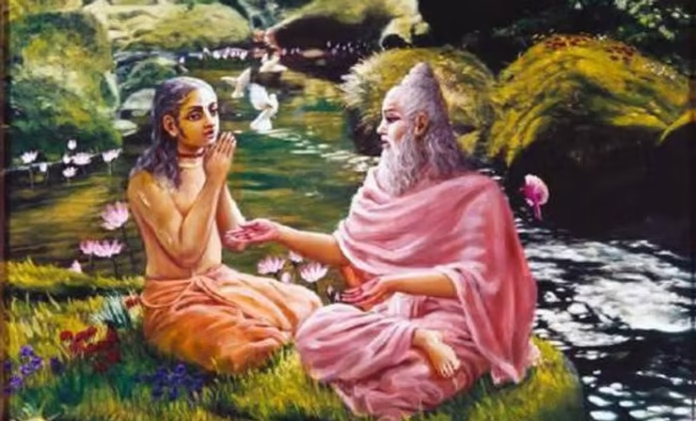
Let me now begin speaking on the Bhāgavata Purāṇa, which was directly spoken to the great sages by the Personality of God head for the benefit of those who are entangled in extreme miseries for the sake of very little pleasure (2). Some time ago, being inquisitive to know, Sanat-kumāra, the chief of the boy-saints, ac companied by other great sages, inquired ex actly like you about the truths regarding Vāsudeva, the Supreme, from Lord Saṅkarṣaṇa, who is seated at the bottom of the universe (3). At that time Lord Saṅkarṣaṇa was meditating upon His Supreme Lord, whom the learned esteem as Lord Vāsudeva, but for the sake of the advancement of the great learned sages He slightly opened His lotus like eyes and began to speak (4).

The sages came from the highest planets down to the lower region through the water of the Ganges, and therefore the hair on their heads was wet. They touched the lotus feet of the Lord, which are worshiped with various paraphernalia by the daughters of the serpent king when they desire good husbands (5). The four Kumāras, headed by Sanat kumāra, who all knew the transcendental pas times of the Lord, glorified the Lord in rhyth mic accents with selected words full of affec tion and love. At that time Lord Saṅkarṣaṇa, with His thousands of raised hoods, began to radiate an effulgence from the glowing stones on His head (6). Lord Saṅkarṣaṇa thus spoke the purport of Śrīmad-Bhāgavatam to the great sage Sanat-kumāra, who had already taken the vow of renunciation. Sanat-kumāra also, in his turn, when inquired of by Sāṅkhyāyana Muni, explained Śrīmad-Bhāgavatam as he had heard it from Saṅkarṣaṇa (7).

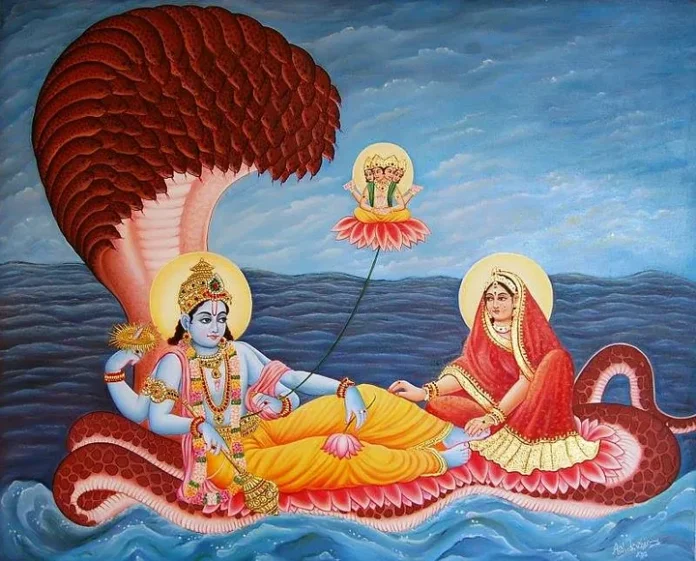
The great sage Sāṅkhyāyana was the chief amongst the tran scendentalists, and when he was describing the glories of the Lord in terms of Śrīmad Bhāgavatam, it so happened that my spiritual master, Parāśara, and Bṛhaspati both heard him (8).The great sage Parāśara, as aforementioned, being so advised by the great sage Pulastya, spoke unto me the foremost of the Purāṇas [Bhāgavatam]. I shall also describe this before you, my dear son, in terms of my hearing, be cause you are always my faithful follower (9). At that time when the three worlds were sub merged in water, Garbhodakaśāyī Viṣṇu was alone, lying on His bedstead, the great snake Ananta, and although He appeared to be in slumber in His own internal potency, free from the action of the external energy, His eyes were not completely closed (10).

 Just like the strength of fire within fuel wood, the Lord re mained within the water of dissolution, sub merging all the living entities in their subtle bodies. He lay in the self-invigorated energy called kāla (11). The Lord lay down for a thou sand cycles of four yugas in His internal po tency, and by His external energy He appeared to be sleeping within the water. When the living entities were coming out for further develop ment of their fruitive activities, actuated by the energy called kāla-śakti, He saw His transcen dental body as bluish (12).The subtle subject matter of creation, on which the Lord’s atten tion was fixed, was agitated by the material mode of passion, and thus the subtle form of creation pierced through His abdomen (13).

 Piercing through, this sum total form of the fru itive activity of the living entities took the shape of the bud of a lotus flower generated from the Personality of Viṣṇu, and by His su preme will it illuminated everything, like the sun, and dried up the vast waters of devastation (14). Into that universal lotus flower Lord Viṣṇu personally entered as the Supersoul, and when it was thus impregnated with all the modes of material nature, the personality of Ve dic wisdom, whom we call the self-born, was generated (15). Brahmā, born out of the lotus flower, could not see the world, although he was situated in the whorl. He therefore circum ambulated all of space, and while moving his eyes in all directions he achieved four heads in terms of the four directions (16).

Lord Brahmā, situated in that lotus, could not perfectly under stand the creation, the lotus or himself. At the end of the millennium the air of devastation be gan to move the water and the lotus in great cir cular waves (17). Lord Brahmā, in his ignorance, contem plated: Who am I that am situated on the top of this lotus? Wherefrom has it sprouted? There must be something downwards, and that from which this lotus has grown must be within the water (18). Lord Brahmā, thus contemplating, entered the water through the channel of the stem of the lotus. But in spite of entering the stem and go ing nearer to the navel of Viṣṇu, he could not trace out the root (19).O Vidura, while search ing in that way about his existence, Brahmā reached his ultimate time, which is the eternal wheel in the hand of Viṣṇu and which generates fear in the mind of the living entity like the fear of death (20).

 Thereafter, being unable to achieve the desired destination, he retired from such searching and came back again to the top of the lotus. Thus, controlling all objectives, he concentrated his mind on the Supreme Lord (21). At the end of Brahmā’s one hundred years, when his meditation was complete, he developed the required knowledge, and as a re sult he could see in his heart the Supreme within himself, whom he could not see before with the greatest endeavor (22).Brahmā could see that on the water there was a gigantic lo tuslike white bedstead, the body of Śeṣa-nāga, on which the Personality of Godhead was lying alone. The whole atmosphere was illuminated by the rays of the jewels bedecking the hood of Śeṣa-nāga, and that illumination dissipated all the darkness of those regions(23).The luster of the transcendental body of the Lord mocked the beauty of the coral mountain. The coral moun tain is very beautifully dressed by the evening sky, but the yellow dress of the Lord mocked its beauty. There is gold on the summit of the mountain, but the Lord’s helmet, bedecked with jewels, mocked it. The mountain’s water falls, herbs, etc., with a panorama of flowers, seem like garlands, but the Lord’s gigantic body, and His hands and legs, decorated with jewels, pearls, tulasī leaves and flower gar lands, mocked the scene on the mountain (24).

His transcendental body, unlimited in length and breadth, occupied the three plane tary systems, upper, middle and lower. His body was self-illuminated by unparalleled dress and variegatedness and was properly or namented (25). The Lord showed His lotus feet by raising them. His lotus feet are the source of all awards achieved by devotional service free from material contamination. Such awards are for those who worship Him in pure devotion. The splendor of the transcendental rays from His moonlike toenails and fingernails appeared like the petals of a flower (26).He also acknowledged the service of the devotees and vanquished their distress by His beautiful smile. The reflection of His face, decorated with earrings, was so pleasing because it daz zled with the rays from His lips and the beauty of His nose and eyebrows (27).

O my dear Vidura, the Lord’s waist was covered with yel low cloth resembling the saffron dust of the ka damba flower, and it was encircled by a well  decorated belt. His chest was decorated with the śrīvatsa marking and a necklace of unlim ited value (28).As a sandalwood tree is deco rated with fragrant flowers and branches, the Lord’s body was decorated with valuable jew els and pearls. He was the self-situated tree, the Lord of all others in the universe. And as a san dalwood tree is covered with many snakes, so the Lord’s body was also covered by the hoods of Ananta (29).

 Like a great mountain, the Lord stands as the abode for all moving and nonmov ing living entities. He is the friend of the snakes because Lord Ananta is His friend. As a moun tain has thousands of golden peaks, so the Lord was seen with the thousands of golden-hel meted hoods of Ananta-nāga; and as a moun tain is sometimes filled with jewels, so also His transcendental body was fully decorated with valuable jewels. As a mountains is sometimes submerged in the ocean water, so the Lord is sometimes submerged in the water of devasta tion (30).

Lord Brahmā, thus looking upon the Lord in the shape of a mountain, concluded that He was Hari, the Personality of Godhead. He saw that the garland of flowers on His chest glorified Him with Vedic wisdom in sweet songs and looked very beautiful. He was pro tected by the Sudarśana wheel for fighting, and even the sun, moon, air, fire, etc., could not have access to Him (31). When Lord Brahmā, the maker of the uni versal destination, thus saw the Lord, he simul taneously glanced over creation. Lord Brahmā saw the lake in Lord Viṣṇu’s navel, and the lo tus flower, as well as the devastating water, the drying air and the sky. All became visible to him (32). Lord Brahmā, thus being surcharged with the mode of passion, became inclined to create, and after seeing the five causes of crea tion indicated by the Personality of Godhead, he began to offer his respectful prayers on the path of the creative mentality (33).
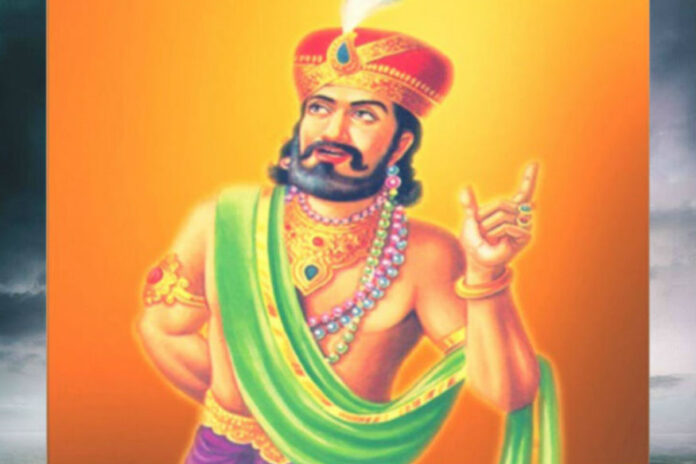
Srimad Bhagavatam | Canto 3 Chapter 7 | Vidura’s Further Inquiries

ŚrīŚukadeva Gosvāmī said: O King, while Maitreya, the great sage, was thus speaking, Vidura, the learned son of Dvaipāyana Vyāsa, expressed a request in a pleasing manner by asking this question (1). Śrī Vidura said: O great brāhmaṇa, since the Supreme Personality of Godhead is the complete spiritual whole and is unchangeable, how is He connected with the material modes of nature and their activities? If this is His pas time, how do the activities of the unchangeable take place and exhibit qualities without the modes of nature? (2)

 Boys are enthusiastic to play with other boys or with various diversions because they are encouraged by desire. But there is no possibility of such desire for the Lord because He is self-satisfied and detached from everything at all times (3).By His self sheltered potency of the three modes of mate rial nature, the Lord has caused the creation of this universe. By her He maintains the creation and conversely dissolves it, again and again (4).The pure soul is pure consciousness and is never out of consciousness, either due to cir cumstances, time, situations, dreams or other causes. How then does he become engaged in nescience? (5) The Lord, as the Supersoul, is situated in every living being’s heart. Why then do the living entities’ activities result in misfor tune and misery? (6)

O great and learned one, my mind is greatly illusioned by the distress of this nescience, and I therefore request you to clear it up (7). ŚrīŚukadeva Gosvāmī said: O King, Mait reya, being thus agitated by the inquisitive Vidura, at first seemed astonished, but then he replied to him without hesitation, since he was fully God conscious (8). Śrī Maitreya said: Certain conditioned souls put forward the theory that the Supreme Brahman, or the Personality of Godhead, is overcome by illusion, or māyā, and at the same time they maintain that He is unconditioned. This is against all logic (9). The living entity is in distress regarding his self-identity. He has no factual background, like a man who dreams that he sees his head cut off (10).

 As the moon re flected on water appears to the seer to tremble due to being associated with the quality of the water, so the self associated with matter ap pears to be qualified as matter (11).But that misconception of self-identity can be dimin ished gradually by the mercy of the Personality of Godhead, Vāsudeva, through the process of devotional service to the Lord in the mode of detachment (12).When the senses are satisfied in the seer-Supersoul, the Personality of God head, and merge in Him, all miseries are com pletely vanquished, as after a sound sleep (13). Simply by chanting and hearing of the tran scendental name, form, etc., of the Personality of Godhead, Śrī Kṛṣṇa, one can achieve the ces sation of unlimited miserable conditions. Therefore what to speak of those who have at tained attraction for serving the flavor of the dust of the Lord’s lotus feet? (14)

 Vidura said: O powerful sage, my lord, all my doubts about the Supreme Personality of Godhead and the living entities have now been removed by your convincing words. My mind is now perfectly entering into them (15). O learned sage, your explanations are very good, as they should be. Disturbances to the condi tioned soul have no other basis than the move ment of the external energy of the Lord (16). Both the lowest of fools and he who is transcen dental to all intelligence enjoy happiness, whereas persons between them suffer the mate rial pangs (17).But, my dear sir, I am obliged to you because now I can understand that this ma terial manifestation is without substance, alt hough it appears real. I am confident that by serving your feet it will be possible for me to give up the false idea (18).

 By serving the feet of the spiritual master, one is enabled to de velop transcendental ecstasy in the service of the Personality of Godhead, who is the un changeable enemy of the Madhu demon and whose service vanquishes one’s material dis tresses (19).Persons whose austerity is meager can hardly obtain the service of the pure devo tees who are progressing on the path back to the kingdom of Godhead, the Vaikuṇṭhas. Pure devotees engage one hundred percent in glori fying the Supreme Lord, who is the Lord of the demigods and the controller of all living enti ties (20).

 After creating the total material energy, the mahat-tattva, and thereby manifesting the gi gantic universal form with senses and sense or gans, the Supreme Lord entered within it (21).The puruṣa incarnation lying on the Causal Ocean is called the original puruṣa in the mate rial creations, and in His virāṭ form, in whom all the planets and their inhabitants live, He has many thousands of legs and hands (22). O great brāhmaṇa, you have told me that the gigantic virāṭ form and His senses, sense objects and ten kinds of life air exist with three kinds of life vigor. Now, if you will, kindly explain to me the different powers of the specific divisions (23).O my lord, I think that the process mani fest in the forms of sons, grandsons and family members has spread all over the universe in dif ferent varieties and species (24). O learned brāhmaṇa, please describe how the leader of all the demigods, namely the Prajāpati, Brahmā, decided to establish the various Manus, the heads of the ages. Please describe the Manus also, and please describe the descendants of those Manus (25).

O son of Mitrā, kindly de scribe how the planets are situated above the earth as well as underneath it, and also please mention their measurement as well as that of the earthly planets (26). Also please describe the living beings under different classifications: subhumans, humans, those born of the embryo, those born of perspiration, those who are twice born [birds], and the plants and vegetables. Kindly describe their generations and subdivi sions also (27).Please also describe the incarna tions of the material modes of nature Brahmā, Viṣṇu and Maheśvara and please describe the incarnation of the Supreme Personality of God head and His magnanimous activities (28).O great sage, kindly describe the divisions and or ders of human society in terms of symptoms, behavior and the characteristics of mental equi librium and sense control. Also please describe the births of the great sages and the categorical divisions of the Vedas (29).

Please also describe the expansions of different sacrifices and the paths of mystic powers, analytical study of knowledge, and devotional service, all with their respective regulations (30). Please also describe the imperfections and contradictions of the faithless atheists, the situation of crosS Breeding, and the movements of the living en tities in various species of life according to their particular modes of nature and work (31). You may also describe the noncontradictory causes of religiosity, economic development, sense gratification and salvation and also the different means of livelihood and different pro cesses of law and order as mentioned in the re vealed scriptures (32). Please also explain the regulations for offering respects to the forefa thers, the creation of the Pitṛloka, the time schedule in the planets, stars and luminaries, and their respective situations (33).

Please also describe the fruitive results of charity and pen ance and of digging reservoirs of water. Please describe the situation of persons who are away from home and also the duty of a man in an awkward position (34).O sinless one, because the Personality of Godhead, the controller of all living entities, is the father of all religion and all those who are candidates for religious activ ities, kindly describe how He can be completely satisfied (35).O best among the brāhmaṇas, those who are spiritual masters are very kind to the needy. They are always kind to their follow ers, disciples and sons, and without being asked by them, the spiritual master describes all that is knowledge (36).

Please describe how many dissolutions there are for the elements of mate rial nature and who survives after the dissolu tions to serve the Lord while He is asleep (37).What are the truths regarding the living en tities and the Supreme Personality of Godhead? What are their identities? What are the specific values in the knowledge in the Vedas, and what are the necessities for the spiritual master and his disciples? (38) Spotless devotees of the Lord have mentioned the source of such knowledge. How could one have knowledge of devotional service and detachment without the help of such devotees?(39)

 My dear sage, I have put all these questions before you with a view to knowing the pastimes of Hari, the Su preme Personality of Godhead. You are the friend of all, so kindly describe them for all those who have lost their vision (40).O spotless one, your answers to all these questions will grant immunity from all material miseries. Such charity is greater than all Vedic charities, sacrifices, penances, etc (41). ŚrīŚukadeva Gosvāmī said: Thus the chief of the sages, who was always enthusiastic about describing topics regarding the Personality of Godhead, began to narrate the descriptive ex planation of the Purāṇas, being so infused by Vidura. He was very much enlivened by speak ing on the transcendental activities of the Lord (42).

Srimad Bhagavatam | Canto 3 Chapter 6 | Creation of the Universal Form

The Ṛṣi Maitreya said: The Lord thus heard about the suspension of the progressive creative functions of the universe due to the noncombination of His potencies, such as the mahat-tattva (1). The Supreme Powerful Lord then simultaneously entered into the twenty three elements with the goddess Kālī, His ex ternal energy, who alone amalgamates all the different elements (2).

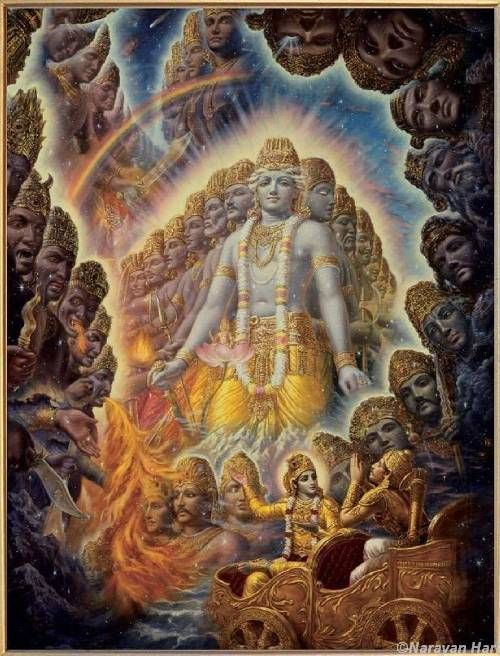
Thus when the Personal ity of Godhead entered into the elements by His energy, all the living entities were enlivened into different activities, just as one is engaged in his work after awakening from sleep (3).When the twenty-three principal elements were set in action by the will of the Supreme, the gigantic universal form, or the viśvarūpa body of the Lord, came into existence (4).As the Lord, in His plenary portion, entered into the elements of the universal creation, they transformed into the gigantic form in which all the planetary systems and all movable and im movable creations rest (5).

The gigantic virāṭ puruṣa, known as Hiraṇmaya, lived for one thousand celestial years on the water of the uni verse, and all the living entities lay with Him (6).The total energy of the mahat-tattva, in the form of the gigantic virāṭ-rūpa, divided Himself by Himself into the consciousness of the living entities, the life of activity, and self-identifica tion, which are subdivided into one, ten and three respectively (7).The gigantic universal form of the Supreme Lord is the first incarna tion and plenary portion of the Supersoul. He is the Self of an unlimited number of living enti ties, and in Him rests the aggregate creation, which thus flourishes (8).

The gigantic univer sal form is represented by three, ten and one in the sense that He is the body and the mind and the senses, He is the dynamic force for all movements by ten kinds of life energy, and He is the one heart where life energy is generated (9). The Supreme Lord is the Supersoul of all the demigods entrusted with the task of construct ing the cosmic manifestation. Being thus prayed to [by the demigods], He thought to Himself and thus manifested the gigantic form for their understanding (10).Maitreya said: You may now hear from me how the Supreme Lord separated Himself into the diverse forms of the demigods after the manifestation of the gigan tic universal form (11).Agni, or heat, separated from His mouth, and all the directors of mate rial affairs entered into it in their respective po sitions. By that energy the living entity ex presses himself in words (12).

When the palate of the gigantic form was separately manifested, Varuṇa, the director of water in the planetary systems, entered therein, and thus the living en tity has the facility to taste everything with his tongue (13). When the Lord’s two nostrils sep arately manifested themselves, the dual Aśvinī kumāras entered them in their proper positions, and because of this the living entities can smell the aromas of everything (14).Thereafter, the two eyes of the gigantic form of the Lord were separately manifested. The sun, the director of light, entered them with the partial representa tion of eyesight, and thus the living entities can have vision of forms (15).

When there was a manifestation of skin separated from the gigan tic form, Anila, the deity directing the wind, en tered with partial touch, and thus the living en tities can realize tactile knowledge (16).When the ears of the gigantic form became mani fested, all the controlling deities of the direc tions entered into them with the hearing princi ples, by which all the living entities hear and take advantage of sound (17).

 When there was a separate manifestation of skin, the controlling deities of sensations and their different parts entered into it, and thus the living entities feel itching and happiness due to touch (18).When the genitals of the gigantic form separately be came manifest, then Prajāpati, the original liv ing creature, entered into them with his partial semen, and thus the living entities can enjoy sex pleasure (19).The evacuating channel sep arately became manifest, and the director named Mitra entered into it with partial organs of evacuation. Thus the living entities are able to pass stool and urine (20).

 Thereafter, when the hands of the gigantic form separately be came manifested, Indra, the ruler of the heav enly planets, entered into them, and thus the liv ing entity is able to transact business for his livelihood (21).Thereafter the legs of the gigan tic form separately became manifest, and the demigod named Viṣṇu [not the Personality of Godhead] entered with partial movement. This helps the living entity move to his destination (22). When the intelligence of the gigantic form separately became manifest, Brahmā, the lord of the Vedas, entered into it with the partial power of understanding, and thus an object of understanding is experienced by the living en tities (23).

After that, the heart of the gigantic form separately manifested itself, and into it en tered the moon demigod with partial mental ac tivity. Thus the living entity can conduct his mental speculations (24).Thereafter the materi alistic ego of the gigantic form separately man ifested itself, and into it entered Rudra, the con troller of false ego, with his own partial activi ties, by which the living entity transacts his ob jective actions (25). Thereafter, when His con sciousness separately manifested itself, the to tal energy, mahat-tattva, entered with His con scious part. Thus the living entity is able to con ceive specific knowledge (26).

Thereafter, from the head of the gigantic form, the heavenly planets were manifested, and from His legs the earthly planets and from His abdomen the sky separately manifested themselves. Within them the demigods and others also were manifested in terms of the modes of material nature (27).The demigods, qualified by the superex cellent quality of the mode of goodness, are sit uated in the heavenly planets, whereas the hu man beings, because of their nature in the mode of passion, live on the earth in company with their subordinates (28).Living entities who are associates of Rudra develop in the third mode of material nature, or ignorance. They are situ ated in the sky between the earthly planets and the heavenly planets (29).

O chief of the Kuru dynasty, the Vedic wis dom became manifested from the mouth of the virāṭ, the gigantic form. Those who are inclined to this Vedic knowledge are called brāhmaṇas, and they are the natural teachers and spiritual masters of all the orders of society (30). There after the power of protection was generated from the arms of the gigantic virāṭ form, and in relation to such power the kṣatriyas also came into existence by following the kṣatriya princi ple of protecting society from the disturbance of thieves and miscreants (31).The means of livelihood of all persons, namely production of grains and their distribution to the prajās, was generated from the thighs of the Lord’s gigantic form. The mercantile men who take charge of such execution are called vaiśyas (32).

Thereaf ter, service was manifested from the legs of the Personality of Godhead for the sake of perfect ing the religious function. Situated on the legs are the śūdras, who satisfy the Lord by service (33).All these different social divisions are born, with their occupational duties and living conditions, from the Supreme Personality of Godhead. Thus for unconditional life and self realization one has to worship the Supreme Lord under the direction of the spiritual master (34).O Vidura, who can estimate or measure the transcendental time, work and potency of the gigantic form manifested by the internal po tency of the Supreme Personality of Godhead? (35)

 In spite of my inability, whatever I have been able to hear [from the spiritual master] and whatever I could assimilate I am now describ ing in glorification of the Lord by pure speech, for otherwise my power of speaking would re main unchaste (36).The highest perfectional gain of humanity is to engage in discussions of the activities and glories of the Pious Actor. Such activities are so nicely arranged in writing by the greatly learned sages that the actual pur pose of the ear is served just by being near them (37). O my son, the original poet, Brahmā, after mature meditation for one thousand celestial years, could know only that the glories of the Supreme Soul are inconceivable (38).

The won derful potency of the Supreme Personality of Godhead is bewildering even to the jugglers. That potency is unknown even to the self-suffi cient Lord, so it is certainly unknown to others (39).Words, mind and ego, with their respec tive controlling demigods, have failed to achieve success in knowing the Supreme Per sonality of Godhead. Therefore, we simply have to offer our respectful obeisances unto Him as a matter of sanity (40).

Srimad Bhagavatam | Canto 3 Chapter 5 | Vidura’s Dialogue with Maitreya

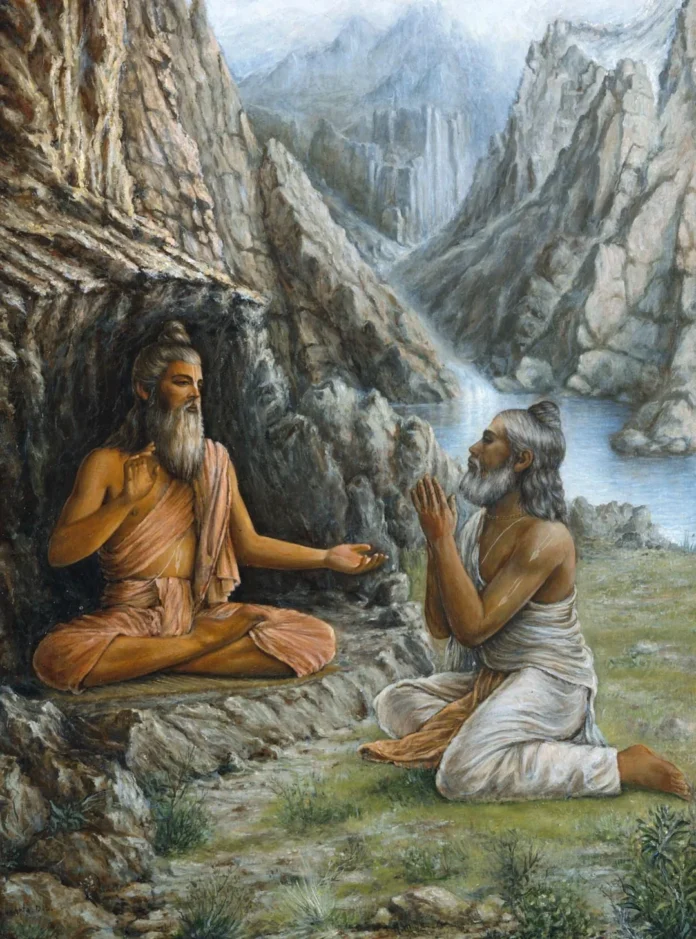
Śukadeva Gosvāmī said: Vidura, the best amongst the Kuru dynasty, who was perfect in devotional service to the Lord, thus reached the source of the celestial Ganges river [Hardwar], where Maitreya, the great, fathomless learned sage of the world, was seated. Vidura, who was perfect in gentleness and satisfied in transcend ence, inquired from him (1).

Vidura said: O great sage, everyone in this world engages in fruitive activities to attain happiness, but one finds neither satiation nor the mitigation of distress. On the contrary, one is only aggravated by such activities. Please, therefore, give us directions on how one should live for real happiness (2). O my lord, great philanthropic souls travel on the earth on behalf of the Supreme Personality of Godhead to show compassion to the fallen souls who are averse to the sense of subordination to the Lord (3).Therefore, O great sage, please give me in struction on the transcendental devotional ser vice of the Lord, so that He who is situated in the heart of everyone can be pleased to impart, from within, knowledge of the Absolute Truth in terms of the ancient Vedic principles deliv ered only to those who are purified by the pro cess of devotional service (4).

O great sage, kindly narrate how the Supreme Personality of Godhead, who is the independent, desireless Lord of the three worlds and the controller of all energies, accepts incarnations and creates the cosmic manifestation with perfectly ar ranged regulative principles for its maintenance (5).He lies down on His own heart spread in the form of the sky, and thus placing the whole cre ation in that space, He expands Himself into many living entities, which are manifested as different species of life. He does not have to en deavor for His maintenance, because He is the master of all mystic powers and the proprietor of everything. Thus He is distinct from the liv ing entities (6).

You may narrate also about the auspicious characteristics of the Lord in His different incarnations for the welfare of the twice-born, the cows and the demigods. Our minds are never satisfied completely, although we continuously hear of His transcendental ac tivities (7). The Supreme King of all kings has created different planets and places of habitation where living entitiesare situated in terms of the modes of nature and work, and He has created their different kings and rulers (8).O chief amongst the brāhmaṇas, please also describe how Nārāyaṇa, the creator of the universe and the self-sufficient Lord, has differently created the natures, activities, forms, features and names of the different living creatures (9).

O my lord, I have repeatedly heard about these higher and lower statuses of human society from the mouth of Vyāsadeva, and I am quite satiated with all these lesser subject matters and their happiness. They have not satisfied me with the nectar of topics about Kṛṣṇa (10). Who in hu man society can be satisfied without hearing sufficient talk of the Lord, whose lotus feet are the sum total of all places of pilgrimage and who is worshiped by great sages and devotees? Such topics can cut off one’s bondage to family affection simply by entering the holes of one’s ears (11). Your friend the great sage Kṛṣṇa dvaipāyana Vyāsa has already described the transcendental qualities of the Lord in his great work the Mahābhārata. But the whole idea is to draw the attention of the mass of people to kṛṣṇa-kathā [Bhagavad-gītā] through their strong affinity for hearing mundane topics (12).

For one who is anxious to engage con stantly in hearing such topics, kṛṣṇa-kathā gradually increases his indifference towards all other things. Such constant remembrance of the lotus feet of Lord Kṛṣṇa by the devotee who has achieved transcendental bliss vanquishes all his miseries without delay (13).O sage, persons who because of their sinful activities are averse to the topics of Transcendence and thus igno rant of the purpose of the Mahābhārata [Bhaga vad-gītā] are pitied by the pitiable. I also pity them because I see how their duration of life is spoiled by eternal time while they involve themselves in presentations of philosophical speculation, theoretical ultimate goals of life, and different modes of ritual (14).

 O Maitreya, O friend of the distressed, the glories of the Su preme Lord can alone do good for people all over the world. Therefore, just as bees collect honey from flowers, kindly describe the es sence of all topics the topics of the Lord (15). Kindly chant all those superhuman transcen dental activities of the supreme controller, the Personality of Godhead, who accepted incarna tions fully equipped with all potency for the full manifestation and maintenance of the cosmic creation (16). Śukadeva Gosvāmī said: The great sage Maitreya Muni, after honoring Vidura very greatly, began to speak, at Vidura’s request, for the greatest welfare of all people (17).

 Śrī Maitreya said: O Vidura, all glory unto you. You have inquired from me of the greatest of all goodness, and thus you have shown your mercy both to the world and to me because your mind is always absorbed in thoughts of the Transcendence (18). O Vidura, it is not at all wonderful that you have so accepted the Lord without deviation of thought, for you were born from the semen of Vyāsadeva (19).I know that you are now Vidura due to the cursing of Māṇḍavya Muni and that formerly you were King Yamarāja, the great controller of living entities after their death. You were begotten by the son of Satyavatī, Vyāsadeva, in the kept wife of his brother (20).

Your good self is one of the eternal associates of the Supreme Person ality of Godhead for whose sake the Lord, while going back to His abode, left instructions with me (21).I shall therefore describe to you the pastimes by which the Personality of God head extends His transcendental potency for the creation, maintenance and dissolution of the cosmic world as they occur one after another (22). The Personality of Godhead, the master of all living entities, existed prior to the creation as one without a second. It is by His will only that creation is made possible and again every thing merges in Him. This Supreme Self is symptomized by different names (23).

The Lord, the undisputed proprietor of everything, was the only seer. The cosmic manifestation was not present at that time, and thus He felt imperfect without His plenary and separated parts and parcels. The material energy was dormant, whereas the internal potency was manifested (24). The Lord is the seer, and the external energy, which is seen, works as both cause and effect in the cosmic manifestation. O greatly fortunate Vidura, this external energy is known as māyā or illusion, and through her agency only is the entire material manifestation made possible (25).

The Supreme Living Being in His feature as the transcendental puruṣa in carnation, who is the Lord’s plenary expansion, impregnates the material nature of three modes, and thus by the influence of eternal time the liv ing entities appear (26). Thereafter, influenced by the interactions of eternal time, the supreme sum total of matter, called the mahat-tattva, be came manifested, and in this mahat-tattva the unalloyed goodness, the Supreme Lord, sowed the seeds of universal manifestation out of His own body (27).Thereafter the mahat-tattva dif ferentiated itself into many different forms as the reservoir of the would-be entities. The ma hat-tattva is chiefly in the mode of ignorance, and it generates the false ego. It is a plenary ex pansion of the Personality of Godhead, with full consciousness of creative principles and time for fructification (28).

Mahat-tattva, or the great causal truth, transforms into false ego, which is manifested in three phases cause, ef fect and the doer. All such activities are on the mental plane and are based on the material ele ments, gross senses and mental speculatio. The false ego is represented in three different modes goodness, passion and ignorance (29).The false ego is transformed into mind by interaction with the mode of goodness. All the demigods who control the phenomenal world are also products of the same principle, namely the in teraction of false ego and the mode of goodness (30).

The senses are certainly products of the mode of passion in false ego, and therefore philosophical speculative knowledge and frui tive activities are predominantly products of the mode of passion (31). The sky is a product of sound, and sound is the transformation of ego istic ignorance. In other words, the sky is the symbolic representation of the Supreme Soul. Thereafter the Personality of Godhead glanced over the sky, partly mixed with eternal time and external energy, and thus developed the touch sensation, from which the air in the sky was produced (32).

Thereafter the extremely power ful air, interacting with the sky, generated the form of sense perception, and the perception of form transformed into electricity, the light to see the world (33).When electricity was sur charged in the air and was glanced over by the Supreme, at that time, by a mixture of eternal time and external energy, there occurred the creation of water and taste (34).Thereafter the water produced from electricity was glanced over by the Supreme Personality of Godhead and mixed with eternal time and external en ergy. Thus it was transformed into the earth, which is qualified primarily by smell (35).

O gentle one, of all the physical elements, begin ning from the sky down to the earth, all the in ferior and superior qualities are due only to the final touch of the glance of the Supreme Per sonality of Godhead (36). The controlling dei ties of all the above-mentioned physical ele ments are empowered expansions of Lord Viṣṇu. They are embodied by eternal time un der the external energy, and they are His parts and parcels. Because they were entrusted with different functions of universal duties and were unable to perform them, they offered fascinat ing prayers to the Lord as follows (37). The demigods said: O Lord, Your lotus feet are like an umbrella for the surrendered souls, protecting them from all the miseries of mate rial existence. All the sages under that shelter throw off all material miseries. We therefore offer our respectful obeisances unto Your lotus feet (38).

O Father, O Lord, O Personality of Godhead, the living entities in the material world can never have any happiness because they are overwhelmed by the three kinds of miseries. Therefore they take shelter of the shade of Your lotus feet, which are full of knowledge, and we also thus take shelter of them (39).The lotus feet of the Lord are by themselves the shelter of all places of pilgrim age. The great clear-minded sages, carried by the wings of the Vedas, always search after the nest of Your lotuslike face. Some of them sur render to Your lotus feet at every step by taking shelter of the best of rivers [the Ganges], which can deliver one from all sinful reactions (40)

Simply by hearing about Your lotus feet with eagerness and devotion and by meditating upon them within the heart, one at once becomes en lightened with knowledge, and on the strength of detachment one becomes pacified. We must therefore take shelter of the sanctuary of Your lotus feet (41).O Lord, You assume incarna tions for the creation, maintenance and dissolu tion of the cosmic manifestation, and therefore we all take shelter of Your lotus feet because they always award remembrance and courage to Your devotees (42).O Lord, persons who are entangled by undesirable eagerness for the tem porary body and kinsmen, and who are bound by thoughts of “mine” and “I,” are unable to see Your lotus feet, although Your lotus feet are sit uated within their own bodies. But let us take shelter of Your lotus feet (43).

 O great Supreme Lord, offensive persons whose internal vision has been too affected by external materialistic activities cannot see Your lotus feet, but they are seen by Your pure devotees, whose one and only aim is to transcendentally enjoy Your ac tivities (44).O Lord, persons who, because of their serious attitude, attain the stage of enlight ened devotional service achieve the complete meaning of renunciation and knowledge and at tain the Vaikuṇṭhaloka in the spiritual sky simply by drinking the nectar of Your topics (45). Others, who are pacified by means of tran scendental self-realization and have conquered over the modes of nature by dint of strong power and knowledge, also enter into You, but for them there is much pain, whereas the devo tee simply discharges devotional service and thus feels no such pain (46).

 O Original Person, we are therefore but Yours only. Although we are Your creatures, we are born one after another under the influ ence of the three modes of nature, and for this reason we are separated in action. Therefore, after the creation we could not act concertedly for Your transcendental pleasure (47).O unborn one, please enlighten us regarding the ways and means by which we can offer You all enjoyable grains and commodities so that both we and all other living entities in this world can maintain ourselves without disturbance and can easily accumulate the necessities of life both for You and for ourselves (48).

You are the original personal founder of all the demigods and the orders of different gradations, yet You are the oldest and are unchanged. O Lord, You have no source or superior. You have impregnated the external energy with the semen of the total liv ing entities, yet You are unborn (49).O Su preme Self, please give us, who are created in the beginning from the mahat-tattva, the total cosmic energy, Your kind directions on how we shall act. Kindly award us Your perfect knowledge and potency so that we can render You service in the different departments of sub sequent creation (50).

Srimad Bhagavatam | Canto 3 Chapter 4 | Vidura Meets Maitreya

Thereafter, all of them [the descendants of Vṛṣṇi and Bhoja], being permitted by the brāhmaṇas, partook of the remnants of prasāda and also drank liquor made of rice. By drinking they all became delirious, and, bereft of knowledge, they touched the cores of each other’s hearts with harsh words (1). As by the friction of bamboos destruction takes place, so also, at sunset, by the interaction of the faults of intoxication, all their minds became unbal anced, and destruction took place (2).

 The Per sonality of Godhead, Lord Śrī Kṛṣṇa, after fore seeing the end [of His family] by His internal potency, went to the bank of the river Sarasvatī, sipped water, and sat down underneath a tree (3).The Lord is the vanquisher of the distresses of one who is surrendered unto Him. Thus He who desired to destroy His family told me pre viously to go to Badarikāśrama (4). Yet in spite of my knowing His desire [to destroy the dyn asty], O Arindama [Vidura], I followed Him because it was impossible for me to bear sepa ration from the lotus feet of the master (5).

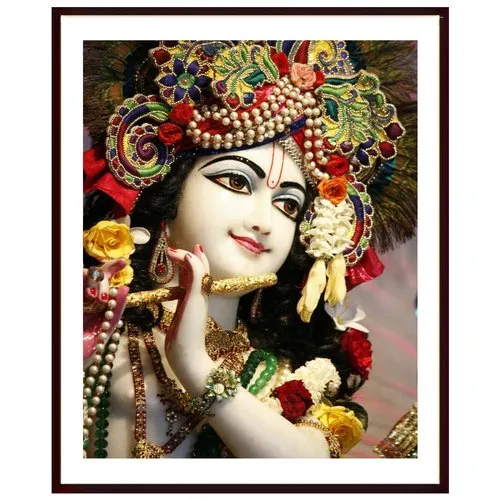
Thus following, I saw my patron and master [Lord Śrī Kṛṣṇa] sitting alone and deeply thinking, taking shelter on the bank of the river Sarasvatī although He is the shelter of the goddess of for tune (6).The Lord’s body is blackish, but is eternal, full of bliss and knowledge, and very, very beautiful. His eyes are always peaceful, and they are reddish like the rising morning sun. I could immediately recognize Him as the Supreme Personality of Godhead by His four hands, different symbolic representations, and yellow silk garments (7).The Lord was sitting, taking rest against a young banyan tree, with His right lotus foot on His left thigh, and alt hough He had left all household comforts, He looked quite cheerful in that posture (8).

At that time, after traveling in many parts of the world, Maitreya, a great devotee of the Lord and a friend and well-wisher of the great sage Kṛṣṇa dvaipāyana Vyāsa, reached that spot out of his own perfect accord (9). Maitreya Muni was greatly attached to Him [the Lord], and he was listening in a pleasing attitude, with his shoul der lowered. With a smile and a particular glance upon me, having allowed me to rest, the Lord spoke as follows (10). O Vasu, I know from within your mind what you desired in the days of yore when the Vasus and other demigods responsible for expanding the universal affairs performed sacrifices. You particularly desired to achieve My association. This is very difficult for others to obtain, but I award it unto you (11).

O honest one, your pre sent life is the last and the supermost because in this term of life you have been awarded My ultimate favor. Now you can go to My tran scendental abode, Vaikuṇṭha, by leaving this universe of conditioned living entities. Your visit to Me in this lonely place because of your pure and unflinching devotional service is a great boon for you (12).

 O Uddhava, in the lo tus millennium in the days of yore, at the be ginning of the creation, I spoke unto Brahmā, who is situated on the lotus that grows out of My navel, about My transcendental glories, which the great sages describe as Śrīmad Bhāgavatam (13). Uddhava said: O Vidura, when I was thus favored at every moment by the Supreme Per sonality of Godhead and addressed by Him with great affection, my words failed in tears, and the hairs on my body erupted. After smear ing my tears, I, with folded hands, spoke like this (14).

O my Lord, devotees who engage in the transcendental loving service of Your lotus feet have no difficulty in achieving anything within the realm of the four principles of relig iosity, economic development, sense gratifica tion and liberation. But, O great one, as far as I am concerned, I have preferred only to engage in the loving service of Your lotus feet (15). My Lord, even the learned sages become disturbed in their intelligence when they see that Your Greatness engages in fruitive work although You are free from all desires, that You take birth although You are unborn, that You flee out of fear of the enemy and take shelter in a fort although You are the controller of invinci ble time, and that You enjoy householder life surrounded by many women although You en joy in Your Self (16).

 O my Lord, Your eternal Self is never divided by the influence of time, and there is no limitation to Your perfect knowledge. Thus You were sufficiently able to consult with Yourself, yet You called upon me for consultation, as if bewildered, although You are never bewildered. And this act of Yours bewilders me (17). My Lord, kindly ex plain to us, if You think us competent to receive it, that transcendental knowledge which gives enlightenment about Yourself and which You explained before to Brahmājī (18). When I thus expressed my heartfelt desires unto the Supreme Personality of Godhead, the lotus-eyed Lord instructed me about His tran scendental situation (19). I have studied the path of understanding self-knowledge from my spiritual master, the Personality of Godhead, and thus after circumambulating Him I have come to this place, very much aggrieved due to separation (20).

My dear Vidura, now I am mad for want of the pleasure of seeing Him, and just to mitigate this I am now proceeding to Bada rikāśrama in the Himālayas for association, as I have been instructed by Him (21). There in Ba darikāśrama the Personality of Godhead, in His incarnation as the sages Nara and Nārāyaṇa, has been undergoing great penance since time immemorial for the welfare of all amiable liv ing entities (22). ŚrīŚukadeva Gosvāmī said: After hearing from Uddhava all about the annihilation of his friends and relatives, the learned Vidura paci fied his overwhelming bereavement by dint of his transcendental knowledge (23).

 While Ud dhava, the chief and most confidential amongst the devotees of the Lord, was going away, Vidura, in affection and confidence, questioned him (24). Vidura said: O Uddhava, because the serv ants of Viṣṇu, the Lord, wander in the interest of serving others, it is quite fit that you kindly describe the self-knowledge with which you have been enlightened by the Lord Himself (25). Śrī Uddhava said: You may take lessons from the great learned sage Maitreya, who is nearby and who is worshipable for reception of transcendental knowledge. He was directly in structed by the Personality of Godhead while He was about to quit this mortal world (26).

 Śukadeva Gosvāmī said: O King, after thus discussing with Vidura the transcendental name, fame, qualities, etc., on the bank of the Yamunā, Uddhava was overwhelmed with great affliction. He passed the night as if it were a moment, and thereafter he went away (27). The King inquired: At the end of the pas times of the Lord of the three worlds, Śrī Kṛṣṇa, and after the disappearance of the members of the Vṛṣṇi and Bhoja dynasties, who were the best of the great commanders, why did Ud dhava alone remain? (28)

 Śukadeva Gosvāmī replied: My dear King, the cursing of the brāhmaṇas was only a plea, but the actual fact was the supreme desire of the Lord. He wanted to disappear from the face of the earth after dispatching His excessively nu merous family members. He thought to Him self as follows (29). Now I shall leave the vi sion of this mundane world, and I see that Ud dhava, the foremost of My devotees, is the only one who can be directly entrusted with knowledge about Me (30).

Uddhava is not infe rior to Me in any way because he is never af fected by the modes of material nature. There fore he may remain in this world in order to dis seminate specific knowledge of the Personality of Godhead (31).Śukadeva Gosvāmī informed the King that Uddhava, being thus instructed by the Supreme Personality of Godhead, who is the source of all Vedic knowledge and the spir itual master of the three worlds, reached the pil grimage site of Badarikāśrama and engaged himself there in trance to satisfy the Lord (32).

 Vidura also heard from Uddhava about the ap pearance and disappearance of Lord Kṛṣṇa, the Supersoul, in the mortal world, which is a sub ject matter sought after with great perseverance by the great sages (33). The Lord’s glorious acts and His acceptance of various transcenden tal forms for the performance of extraordinary pastimes in the mortal world are very difficult for anyone other than His devotees to under stand, and for the beasts they are simply a men tal disturbance (34).Understanding that he was remembered by Lord Kṛṣṇa [while quitting this world], Vidura began to cry loudly, over whelmed by the ecstasy of love (35). After passing a few days on the bank of the river Ya munā, Vidura, the self-realized soul, reached the bank of the Ganges, where the great sage Maitreya was situated (36).

Srimad Bhagavatam | Canto 3 Chapter 3 |The Lord’s Pastimes Beyond Vṛndāvana

Śrī Uddhava said: Thereafter Lord Kṛṣṇa went to Mathurā City with Śrī Baladeva, and to please Their parents They dragged Kaṁsa, the leader of public enemies, down from his throne and killed him, pulling him along the ground with great strength (1). The Lord learned all the Vedas with their different branches simply by hearing them once from His teacher, Sāndīpani Muni, whom He rewarded by bringing back his dead son from the region of Yamaloka (2).

At tracted by the beauty and fortune of Rukmiṇī, the daughter of King Bhīṣmaka, many great princes and kings assembled to marry her. But Lord Kṛṣṇa, stepping over the other hopeful candidates, carried her away as His own share, as Garuḍa carried away nectar (3).By subduing seven bulls whose noses were not pierced, the Lord achieved the hand of Princess Nāgnijitī in the open competition to select her bridegroom. Although the Lord was victorious, His compet itors asked the hand of the princess, and thus there was a fight. Well equipped with weapons, the Lord killed or wounded all of them, but He Himself was not hurt (4). Just to please His dear wife, the Lord brought back the pārijāta tree from heaven, just as an ordinary husband would do. But Indra, the King of heaven, induced by his wives (henpecked as he was), ran after the Lord with full force to fight Him (5).

 Na rakāsura, the son of Dharitrī, the earth, tried to grasp the whole sky, and for this he was killed by the Lord in a fight. His mother then prayed to the Lord. This led to the return of the king dom to the son of Narakāsura, and thus the Lord entered the house of the demon (6).There in the house of the demon, all the princesses kid napped by Narakāsura at once became alert upon seeing the Lord, the friend of the dis tressed. They looked upon Him with eagerness, joy and shyness and offered to be His wives (7). All those princesses were lodged in different apartments, and the Lord simultaneously as sumed different bodily expansions exactly matching each and every princess. He accepted their hands in perfect rituals by His internal po tency (8).

Just to expand Himself according to His transcendental features, the Lord begot in each and every one of them ten offspring with exactly His own qualities (9). Kālayavana, the King of Magadha and Sālva attacked the city of Mathurā, but when the city was encircled by their soldiers, the Lord refrained from killing them personally, just to show the power of His own men (10).Of kings like Śambara, Dvivida, Bāṇa, Mura, Balvala and many other demons, such as Dantavakra, some He killed Himself, and some He caused to be killed by others [Śrī Baladeva, etc.] (11). Then, O Vidura, the Lord caused all the kings, both the enemies and those on the side of your fighting nephews, to be killed in the Battle of Kurukṣetra. All those kings were so great and strong that the earth seemed to shake as they traversed the warfield (12).

Duryodhana was bereft of his fortune and duration of life because of the intricacy of ill advice given by Karṇa, Duḥśāsana and Sau bala. When he lay on the ground with his fol lowers, his thighs broken although he was pow erful, the Lord was not happy to see the scene (13). [After the end of the Battle of Kurukṣetra, the Lord said:] The abatement of the earth’s great burden, eighteen akṣauhiṇīs, has now been effected with the help of Droṇa, Bhīṣma, Arjuna and Bhīma. But what is this? There is still the great strength of the Yadu dynasty, born of Myself, which may be a more unbeara ble burden (14). When they quarrel among themselves, influenced by intoxication, with their eyes red like copper because of drinking [madhu], then only will they disappear; other wise, it will not be possible. On My disappear ance, this incident will take place (15).

Lord Śrī Kṛṣṇa, thus thinking to Himself, es tablished Mahārāja Yudhiṣṭhira in the position of supreme control of the world in order to show the ideal of administration on the path of piety (16).The embryo of Pūru’s descendant begotten by the great hero Abhimanyu in the womb of Uttarā, his wife, was burnt by the weapon of the son of Droṇa, but later he was again protected by the Lord (17). The Supreme Lord induced the son of Dharma to perform three horse sacrifices, and Mahārāja Yudhiṣṭhira, constantly following Kṛṣṇa, the Personality of Godhead, protected and enjoyed the earth, assisted by his younger brothers (18). Simultaneously, the Personality of Godhead enjoyed life in the city of Dvārakā, strictly in conformity with the Vedic customs of society. He was situated in detachment and knowledge, as enunciated by the Sāṅkhya system of philos ophy (19).

 He was there in His transcendental body, the residence of the goddess of fortune, with His usual gentle and sweetly smiling face, His nectarean words and His flawless character (20). The Lord enjoyed His pastimes, both in this world and in other worlds [higher planets], specifically in the association of the Yadu dyn asty. At leisure hours offered by night, He en joyed the friendship of conjugal love with women (21).The Lord was thus engaged in household life for many, many years, but at last His detachment from ephemeral sex life was fully manifested (22). Every living entity is controlled by a supernatural force, and thus his sense enjoyment is also under the control of that supernatural force. No one, therefore, can put his faith in Lord Kṛṣṇa’s transcendental sense activities but one who has become a dev otee of the Lord by rendering devotional ser vice (23).

 Once upon a time, great sages were made angry by the sporting activities of the princely descendants of the Yadu and Bhoja dynasties, and thus, as desired by the Lord, the sages cursed them (24).A few months passed, and then, bewildered by Kṛṣṇa, all the descendants of Vṛṣṇi, Bhoja and Andhaka who were incar nations of demigods went to Prabhāsa, while those who were eternal devotees of the Lord did not leave but remained in Dvārakā (25). After arriving there, all of them took bath, and with the water of this place of pilgrimage they of fered their respects to the forefathers, demigods and great sages and thus satisfied them. They gave cows to the brāhmaṇas in royal charity (26).

The brāhmaṇas were not only given well fed cows in charity, but also gold, gold coins, bedding, clothing, animal-skin seats, blankets, horses, elephants, girls and sufficient land for maintenance (27).Thereafter they offered the brāhmaṇas highly delicious foodstuffs first of fered to the Personality of Godhead and offered their respectful obeisances by touching their heads to the ground. They lived perfectly by protecting the cows and the brāhmaṇas (28).

Srimad Bhagavatam | Canto 3 Chapter 2 | c

ŚrīŚukadeva Gosvāmī said: When the great devotee Uddhava was asked by Vidura to speak on the messages of the dearest [Lord Kṛṣṇa], Uddhava was unable to answer imme diately due to excessive anxiety at the remem brance of the Lord (1).He was one who even in his childhood, at the age of five years, was so absorbed in the service of Lord Kṛṣṇa that when he was called by his mother for morning break fast, he did not wish to have it (2).

 Uddhava thus served the Lord continually from child hood, and in his old age that attitude of service never slackened. As soon as he was asked about the message of the Lord, he at once remem bered all about Him (3). For a moment he re mained dead silent, and his body did not move. He became absorbed in the nectar of remem bering the Lord’s lotus feet in devotional ec stasy, and he appeared to be going increasingly deeper into that ecstasy (4).It was so observed by Vidura that Uddhava had all the transcen dental bodily changes due to total ecstasy, and he was trying to wipe away tears of separation from his eyes. Thus Vidura could understand that Uddhava had completely assimilated ex tensive love for the Lord (5).

The great devotee Uddhava soon came back from the abode of the Lord to the human plane, and wiping his eyes, he awakened his reminiscence of the past and spoke to Vidura in a pleasing mood (6). Śrī Uddhava said: My dear Vidura, the sun of the world, Lord Kṛṣṇa, has set, and our house has now been swallowed by the great snake of time. What can I say to you about our welfare? (7) This universe with all its planets is most un fortunate. And even more unfortunate are the members of the Yadu dynasty because they could not identify Lord Hari as the Personality of Godhead, any more than the fish could iden tify the moon (8). The Yadus were all experi enced devotees, learned and expert in psychic study. Over and above this, they were always with the Lord in all kinds of relaxations, and still they were only able to know Him as the one Supreme who dwells everywhere (9).

 Under no circumstances can the words of persons bewil dered by the illusory energy of the Lord deviate the intelligence of those who are completely surrendered souls (10).Lord Śrī Kṛṣṇa, who manifested His eternal form before the vision of all on the earth, performed His disappear ance by removing His form from the sight of those who were unable to see Him [as He is] due to not executing required penance (11).The Lord appeared in the mortal world by His inter nal potency, yoga-māyā. He came in His eter nal form, which is just suitable for His pas times. These pastimes were wonderful for eve ryone, even for those proud of their own opu lence, including the Lord Himself in His form as the Lord of Vaikuṇṭha. Thus His [Śrī Kṛṣṇa’s] transcendental body is the ornament of all ornaments (12).

All the demigods from the upper, lower and middle universal planetary systems assembled at the altar of the rājasūya sacrifice performed by Mahārāja Yudhiṣṭhira. After seeing the beautiful bodily features of Lord Kṛṣṇa, they all contemplated that He was the ultimate dexter ous creation of Brahmā, the creator of human beings(13).The damsels of Vraja, after pas times of laughter, humor and exchanges of glances, were anguished when Kṛṣṇa left them. They used to follow Him with their eyes, and thus they sat down with stunned intelligence and could not finish their household duties (14).The Personality of Godhead, the all-com passionate controller of both the spiritual and material creations, is unborn, but when there is friction between His peaceful devotees and per sons who are in the material modes of nature, He takes birth just like fire, accompanied by the mahat-tattva (15).

When I think of Lord Kṛṣṇa how He was born in the prison house of Vasudeva although He is unborn, how He went away from His father’s protection to Vraja and lived there incognito out of fear of the enemy, and how, although unlimitedly powerful, He fled from Mathurā in fear all these bewildering incidents give me distress (16). Lord Kṛṣṇa begged pardon from His parents for Their [Kṛṣṇa and Balarāma’s] inability to serve their feet, due to being away from home because of great fear of Kaṁsa. He said, “O mother, O fa ther, please excuse Us for this inability.” All this behavior of the Lord gives me pain at heart (17). Who, after smelling the dust of His lotus feet even once, could ever forget it? Simply by expanding the leaves of His eyebrows, Kṛṣṇa has given the deathblow to those who were bur dening the earth (18).

 You have personally seen how the King of Cedi [Śiśupāla] achieved suc cess in yoga practice, although he hated Lord Kṛṣṇa. Even the actual yogīs aspire after such success with great interest by performance of their various practices. Who can tolerate sepa ration from Him? (19) Certainly others who were fighters on the Battlefield of Kurukṣetra were purified by the onslaught of Arjuna’s ar rows, and while seeing the lotuslike face of Kṛṣṇa, so pleasing to the eyes, they achieved the abode of the Lord (20). Lord Śrī Kṛṣṇa is the Lord of all kinds of threes and is inde pendently supreme by achievement of all kinds of fortune. He is worshiped by the eternal main tainers of the creation, who offer Him the para phernalia of worship by touching their millions of helmets to His feet (21).

Therefore, O Vidura, does it not pain us, His servitors, when we re member that He [Lord Kṛṣṇa] used to stand be fore King Ugrasena, who was sitting on the royal throne, and used to submit explanations before him, saying, “O My lord, please let it be known to you”? (22) Alas, how shall I take shelter of one more merciful than He who granted the position of mother to a she-demon [Pūtanā] although she was unfaithful and she prepared deadly poison to be sucked from her breast? (23) I consider the demons, who are in imical toward the Lord, to be more than the devotees because while fighting with the Lord, absorbed in thoughts of enmity, they are able to see the Lord carried on the shoulder of Garuḍa, the son of Tārkṣya [Kaśyapa], and carrying the wheel weapon in His hand (24).

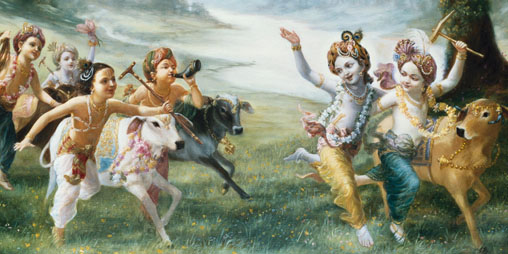
 The Personality of Godhead, Lord Śrī Kṛṣṇa, being prayed to by Brahmā to bring wel fare to the earth, was begotten by Vasudeva in the womb of his wife Devakī in the prison of the King of Bhoja (25). Thereafter, His father, being afraid of Kaṁsa, brought Him to the cow pastures of Mahārāja Nanda, and there He lived for eleven years like a covered flame with His elder brother, Baladeva (26). In His childhood, the Almighty Lord was surrounded by cowherd boys and calves, and thus He traveled on the shore of the Yamunā river, through gardens densely covered with trees and filled with vi brations of chirping birds (27).When the Lord displayed His activities just suitable for child hood, He was visible only to the residents of Vṛndāvana. Sometimes He would cry and sometimes laugh, just like a child, and while so doing He would appear like a lion cub (28).

While herding the very beautiful bulls, the Lord, who was the reservoir of all opulence and fortune, used to blow His flute, and thus He en livened His faithful followers, the cowherd boys (29).The great wizards who were able to assume any form were engaged by the King of Bhoja, Kaṁsa, to kill Kṛṣṇa, but in the course of His pastimes the Lord killed them as easily as a child breaks dolls (30).The inhabitants of Vṛndāvana were perplexed by great difficulties because a certain portion of the Yamunā was poisoned by the chief of the reptiles [Kāliya]. The Lord chastised the snake-king within the water and drove him away, and after coming out of the river, He caused the cows to drink the water and proved that the water was again in its natural state (31).

 The Supreme Lord, Kṛṣṇa, desired to utilize the opulent financial strength of Mahārāja Nanda for worship of the cows, and also He wanted to give a lesson to Indra, the King of heaven. Thus He advised His father to perform worship of go, or the pasturing land and the cows, with the help of learned brāhmaṇas (32).O sober Vidura, King Indra, his honor having been insulted, poured water incessantly on Vṛndāvana, and thus the inhab itants of Vraja, the land of cows, were greatly distressed. But the compassionate Lord Kṛṣṇa saved them from danger with His pastime um brella, the Govardhana Hill (33). In the third season of the year, the Lord enjoyed as the cen tral beauty of the assembly of women by at tracting them with His pleasing songs in an au tumn night brightened by moonshine (34).

Srimad Bhagavatam | Canto 3 Chapter 1 | Vidura’s Questions

Śukadeva Gosvāmī said: After renouncing his prosperous home and entering the forest, King Vidura, the great devotee, asked this question of His Grace Maitreya Ṛṣi (1). What else is there to say about the residential house of the Pāṇḍavas? Śrī Kṛṣṇa, the Lord of every thing, acted as your minister. He used to enter that house as if it were His own, and He did not take any care of Duryodhana’s house (2).

The King askedŚukadeva Gosvāmī: Where and when did the meeting and discussion take place between Saint Vidura and His Grace Maitreya Muni? Kindly oblige, my lord, and describe this to us (3). Saint Vidura was a great and pure devotee of the Lord, and therefore his questions to His Grace Ṛṣi Maitreya must have been very purposeful, on the highest level, and approved by learned circles (4). Śrī Suta Gosvāmī said: The great sage Śukadeva Gosvāmī was highly experienced and was pleased with the King. Thus being questioned by the King, he said to him, “Please hear the topics attentively.” (5)

 ŚrīŚukadeva Gosvāmī said: King Dhṛtarāṣṭra became blind under the influence of impious desires to nourish his dishonest sons, and thus he set fire to the lacquer house to burn his fatherless nephews, the Pāṇḍavas (6). The King did not forbid his son Duḥśāsana’s abom inable action of grabbing the hair of Draupadī, the wife of the godly King Yudhiṣṭhira, even though her tears washed the red dust on her breast (7).Yudhiṣṭhira, who was born without any enemy, was unfairly defeated in gambling. But because he had taken the vow of truthful ness, he went off to the forest. When he came back in due course and begged the return of his rightful share of the kingdom, he was refused by Dhṛtarāṣṭra, who was overwhelmed by illu sion (8).

Lord Kṛṣṇa was sent by Arjuna into the assembly as the spiritual master of the whole world, and although His words were heard by some [like Bhīṣma] as pure nectar, it was not so for the others, who were completely bereft of the last farthing of past pious works. The King [Dhṛtarāṣṭra or Duryodhana] did not take the words of Lord Kṛṣṇa very seriously (9).When Vidura was invited by his elder brother [Dhṛtarāṣṭra] for consultation, he entered the house and gave instructions which were exactly to the point. His advice is well known, and in structions by Vidura are approved by expert ministers of state (10).

 [Vidura said:] You must now return the le gitimate share to Yudhiṣṭhira, who has no ene mies and who has been forbearing through un told sufferings due to your offenses. He is wait ing with his younger brothers, among whom is the revengeful Bhīma, breathing heavily like a snake. Surely you are afraid of him (11).Lord Kṛṣṇa, the Personality of Godhead, has ac cepted the sons of Pṛthā as His kinsmen, and all the kings of the world are with Lord Śrī Kṛṣṇa. He is present in His home with all His family members, the kings and princes of the Yadu dynasty, who have conquered an unlimited number of rulers, and He is their Lord (12).You are maintaining offense personified, Duryodhana, as your infallible son, but he is en vious of Lord Kṛṣṇa. And because you are thus maintaining a nondevotee of Kṛṣṇa, you are de void of all auspicious qualities. Relieve your self of this ill fortune as soon as possible and do good to the whole family! (13) While speaking thus, Vidura, whose per sonal character was esteemed by respectable persons, was insulted by Duryodhana, who was swollen with anger and whose lips were trem bling. Duryodhana was in company with Karṇa, his younger brothers and his maternal uncle Śakuni (14).

 Who asked him to come here, this son of a kept mistress? He is so crooked that he spies in the interest of the en emy against those on whose support he has grown up. Toss him out of the palace immedi ately and leave him with only his breath (15).Thus being pierced by arrows through his ears and afflicted to the core of his heart, Vidura placed his bow on the door and quit his brother’s palace. He was not sorry, for he con sidered the acts of the external energy to be su preme (16).By his piety, Vidura achieved the advantages of the pious Kauravas. After leav ing Hastināpura, he took shelter of many places of pilgrimages, which are the Lord’s lotus feet. With a desire to gain a high order of pious life, he traveled to holy places where thousands of transcendental forms of the Lord are situated (17).

He began to travel alone, thinking only of Kṛṣṇa, through various holy places like Ayodhyā, Dvārakā and Mathurā. He traveled where the grove, hill, orchard, river and lake are all pure and sinless and where the forms of the Unlimited decorate the temples. Thus he performed the pilgrim’s progress (18).While so traversing the earth, he simply performed du ties to please the Supreme Lord Hari. His occu pation was pure and independent. He was con stantly sanctified by taking his bath in holy places, although he was in the dress of a men dicant and had no hair dressing nor a bed on which to lie. Thus he was always unseen by his various relatives (19). Thus, when he was in the land of Bhāratavarṣa traveling to all the places of pil grimage, he visited Prabhāsakṣetra. At that time Mahārāja Yudhiṣṭhira was the emperor and held the world under one military strength and one flag (20).

 At the place of pilgrimage at Prabhāsa, it came to his knowledge that all his relatives had died due to violent passion, just as an entire forest burns due to fire produced by the friction of bamboos. After this he proceeded west, where the river Sarasvatī flows (21). On the bank of the river Sarasvatī there were eleven places of pilgrimage, namely (1) Trita, (2) Uśanā, (3) Manu, (4) Pṛthu, (5) Agni, (6) Asita, (7) Vāyu, (8) Sudāsa, (9) Go, (10) Guha and (11) Śrāddhadeva. Vidura visited all of  them and duly performed rituals (22). There were also many other temples of various forms of the Supreme Personality of Godhead Viṣṇu, established by great sages and demigods. These temples were marked with the chief emblems of the Lord, and they reminded one always of the original Personality of Godhead, Lord Kṛṣṇa (23). Thereafter he passed through very wealthy provinces like Surat, Sauvīra and Mat sya and through western India, known as Ku rujāṅgala. At last he reached the bank of the Yamunā, where he happened to meet Uddhava, the great devotee of Lord Kṛṣṇa (24).

 Then, due to his great love and feeling, Vidura embraced him [Uddhava], who was a constant companion of Lord Kṛṣṇa and formerly a great student of Bṛhaspati’s. Vidura then asked him for news of the family of Lord Kṛṣṇa, the Personality of Godhead (25). [Please tell me] whether the original Person alities of Godhead, who incarnated Themselves at the request of Brahmā [who is born out of the lotus flower from the Lord] and who have in creased the prosperity of the world by elevating everyone, are doing well in the house of Śūrasena (26). [Please tell me] whether the best friend of the Kurus, our brother-in-law Vasudeva, is doing well. He is very munificent. He is like a father to his sisters, and he is always pleasing to his wives (27). O Uddhava, please tell me, How is Pradyumna, the commander in chief of the Yadus, who was Cupid in a former life? Rukmiṇī bore him as her son from Lord Kṛṣṇa, by the grace of brāhmaṇas whom she pleased (28).

O my friend, [tell me] whether Ugrasena, the King of the Sātvatas, Vṛṣṇis, Bhojas and Dāśārhas, is now doing well. He went far away from his kingdom, leaving aside all hopes of his royal throne, but Lord Kṛṣṇa again installed him (29). O gentle one, does Sāmba fare well? He exactly resembles the son of the Personality of Godhead. In a previous birth he was born as Kārttikeya in the womb of the wife of Lord Śiva, and now he has been born in the womb of Jāmbavatī, the most en riched wife of Kṛṣṇa (30). O Uddhava, does Yuyudhāna fare well? He learned the intrica cies of the military art from Arjuna and attained the transcendental destination which is very difficult to reach even for great renouncers (31).

Please tell me whether Akrūra, the son of Śvaphalka, is doing well. He is a faultless soul surrendered unto the Personality of Godhead. He once lost his mental equilibrium due to his ecstasy of transcendental love and fell down on the dust of a road which was marked with the footprints of Lord Kṛṣṇa (32). As the Vedas are the reservoir of sacrificial purposes, so the daughter of King Devaka-bhoja conceived the Supreme Personality of Godhead in her womb, as did the mother of the demigods. Is she [Devakī] doing well? (33)May I inquire whether Aniruddha is doing well? He is the ful filler of all the desires of the pure devotees and has been considered from yore to be the cause of the Ṛg Veda, the creator of the mind and the fourth plenary expansion of Viṣṇu (34).

O so ber one, others, such as Hṛdīka, Cārudeṣṇa, Gada and the son of Satyabhāmā, who accept Lord Śrī Kṛṣṇa as the soul of the self and thus follow His path without deviation are they well? (35) Also let me inquire whether Mahārāja Yudhiṣṭhira is now maintaining the kingdom according to religious principles and with re spect for the path of religion. Formerly Duryodhana was burning with envy because Yudhiṣṭhira was being protected by the arms of Kṛṣṇa and Arjuna as if they were his own arms (36). [Please tell me] whether the unconquera ble Bhīma, who is like a cobra, has released his long-cherished anger upon the sinners? The field of battle could not tolerate even the won derful playing of his club when he stepped on the path (37). [Please tell me] whether Arjuna, whose bow bears the name Gāṇḍīva and who is always famous amongst the chariot warriors for vanquishing his enemies, is doing well. He once satisfied Lord Śiva by covering him with arrows when Śiva came as an unidentified false hunter (38)

Are the twin brothers who are pro tected by their brothers doing well? Just as the eye is always protected by the eyelid, they are protected by the sons of Pṛthā, who snatched back their rightful kingdom from the hands of their enemy Duryodhana, just as Garuḍa snatched nectar from the mouth of Indra, the thunderbolt carrier (39). O my lord, is Pṛthā still living? She lived only for the sake of her fatherless children; otherwise it was impossible for her to live without King Pāṇḍu, who was the greatest commander and who alone conquered the four directions simply with the help of a second bow (40). O gentle one, I simply lament for him [Dhṛtarāṣṭra] who rebelled against his brother after death. By him I was driven out of my own house, although I am his sincere well wisher, because he accepted the line of action adopted by his own sons (41). I am not aston ished at this, having traveled over the world without being seen by others. The activities of the Personality of Godhead, which are like those of a man in this mortal world, are bewil dering to others, but I know of His greatness by His grace, and thus I am happy in all respects (42).

 Despite His being the Lord and being al ways willing to relieve the distress of sufferers, He [Kṛṣṇa] refrained from killing the Kurus, although they committed all sorts of sins and although He saw other kings constantly agitat ing the earth by their strong military move ments carried out under the dictation of three kinds of false pride (43).The appearance of the Lord is manifested for the annihilation of the upstarts. His activities are transcendental and are enacted for the understanding of all persons. Otherwise, since the Lord is transcendental to all material modes, what purpose could He serve by coming to earth? (44)

 O my friend, please, therefore, chant the glories of the Lord, who is meant to be glorified in the places of pil grimage. He is unborn, and yet He appears by His causeless mercy upon the surrendered rul ers of all parts of the universe. Only for their interest did He appear in the family of His un alloyed devotees the Yadus (45).

Srimad Bhagavatam | Canto 2 Chapter 10 | All Questions Resolved By The Bhagavatam

ŚrīŚukadeva Gosvāmī said: In the Śrīmad Bhāgavatam there are ten divisions of state ments regarding the following: the creation of the universe, subcreation, planetary systems, protection by the Lord, the creative impetus, the change of Manus, the science of God, re turning home, back to Godhead, liberation, and the summum bonum (1).To isolate the tran scendence of the summum bonum, the symp toms of the rest are described sometimes by Ve dic inference, sometimes by direct explanation, and sometimes by summary explanations given by the great sages (2).

The elementary creation  of sixteen items of matter namely the five ele ments [fire, water, land, air and sky], sound, form, taste, smell, touch, and the eyes, ears, nose, tongue, skin and mind is known as sarga, whereas subsequent resultant interaction of the modes of material nature is called visarga (3).The right situation for the living entities is to obey the laws of the Lord and thus be in per fect peace of mind under the protection of the Supreme Personality of Godhead. The Manus and their laws are meant to give right direction in life. The impetus for activity is the desire for fruitive work (4).

The science of God describes the incarnations of the Personality of Godhead and His different activities together with the ac tivities of His great devotees (5).The merging of the living entity, along with his conditional living tendency, with the mystic lying down of the Mahā-Viṣṇu is called the winding up of the cosmic manifestation. Liberation is the perma nent situation of the form of the living entity after he gives up the changeable gross and sub tle material bodies (6).The supreme one who is celebrated as the Supreme Being or the Su preme Soul is the supreme source of the cosmic manifestation as well as its reservoir and wind ing up. Thus He is the Supreme Fountainhead, the Absolute Truth (7).The individual person possessing different instruments of senses is called the adhyātmic person, and the individual controlling deity of the senses is called ad hidaivic. The embodiment seen on the eyeballs is called the adhibhautic person (8).

All three of the above-mentioned stages of different living entities are interdependent. In the absence of one, another is not understood. But the Su preme Being who sees every one of them as the shelter of the shelter is independent of all, and therefore He is the supreme shelter (9). After separating the different universes, the gigantic universal form of the Lord [Mahā Viṣṇu], which came out of the Causal Ocean, the place of appearance for the first puruṣa avatāra, entered into each of the separate uni verses, desiring to lie on the created transcen dental water [Garbhodaka] (10).That Supreme Person is not impersonal and therefore is dis tinctively a nara, or person. Therefore the tran scendental water created from the Supreme Nara is known as nāra. And because He lies down on that water, He is known as Nārāyaṇa (11).

One should definitely know that all mate rial ingredients, activities, time and modes, and the living entities who are meant to enjoy them all, exist by His mercy only, and as soon as He does not care for them, everything becomes nonexistent (12).The Lord, while lying on His bed of mystic slumber, generated the seminal symbol, golden in hue, through external energy out of His desire to manifest varieties of living entities from Himself alone (13).Just hear from me how the potency of His Lordship divides one into three, called the controlling entities, the controlled entities and the material bodies, in the manner mentioned above (14).

 From the sky situated within the transcen dental body of the manifesting Mahā-Viṣṇu, sense energy, mental force and bodily strength are all generated, as well as the sum total of the fountainhead of the total living force (15).As the followers of a king follow their lord, simi larly when the total energy is in motion, all other living entities move, and when the total energy stops endeavoring, all other living enti ties stop sensual activities (16).The living force, being agitated by the virāṭ-puruṣa, gen erated hunger and thirst, and when He desired to drink and eat, the mouth opened (17).From the mouth the palate became manifested, and thereupon the tongue was also generated. After this all the different tastes came into existence so that the tongue can relish them (18).

 When the Supreme desired to speak, speeches were vibrated from the mouth. Then the controlling deity Fire was generated from the mouth. But when He was lying in the water, all these func tions remained suspended (19). Thereafter, when the supreme puruṣa desired to smell odors, the nostrils and respiration were gener ated, the nasal instrument and odors came into existence, and the controlling deity of air, car rying smell, also became manifested (20).Thus when everything existed in darkness, the Lord desired to see Himself and all that was created. Then the eyes, the illuminating god Sun, the power of vision and the object of sight all be came manifested (21).

By development of the desire of the great sages to know, the ears, the  power of hearing, the controlling deity of hear ing, and the objects of hearing became mani fested. The great sages desired to hear about the Self (22).When there was a desire to perceive the physical characteristics of matter, such as softness, hardness, warmth, cold, lightness and heaviness, the background of sensation, the skin, the skin pores, the hairs on the body and their controlling deities (the trees) were gener ated. Within and outside the skin is a covering of air through which sense perception became prominent (23).Thereafter when the Supreme Person desired to perform varieties of work, the two hands and their controlling strength, and Indra, the demigod in heaven, became mani fested, as also the acts dependent on both the hands and the demigod (24).

Thereupon, be cause of His desiring to control movement, His legs became manifested, and from the legs the controlling deity named Viṣṇu was generated. By His personal supervision of this act, all va rieties of human being are busily engaged in dutiful occupational sacrifice (25).Thereupon, for sexual pleasure, begetting offspring and tasting heavenly nectar, the Lord developed the genitals, and thus there is the genital organ and its controlling deity, the Prajāpati. The object of sexual pleasure and the controlling deity are under the control of the genitals of the Lord (26).Thereafter, when He desired to evacuate the refuse of eatables, the evacuating hole, anus, and the sensory organ thereof developed along with the controlling deity Mitra. The sen sory organ and the evacuating substance are both under the shelter of the controlling deity (27).

Thereafter, when He desired to move from one body to another, the navel and the air of de parture and death were combinedly created. The navel is the shelter for both, namely death and the separating force (28).When there was a desire to have food and drink, the abdomen and the intestines and also the arteries became man ifested. The rivers and seas are the source of their sustenance and metabolism (29).When there was a desire to think about the activities of His own energy, then the heart (the seat of the mind), the mind, the moon, determination and all desire became manifested (30).

The seven elements of the body, namely the thin layer on the skin, the skin itself, the flesh, blood, fat, marrow and bone, are all made of earth, water and fire, whereas the life breath is produced by the sky, water and air (31).The sense organs are attached to the modes of ma terial nature, and the modes of material nature are products of the false ego. The mind is sub jected to all kinds of material experiences (hap piness and distress), and the intelligence is the feature of the mind’s deliberation (32). Thus by all this, the external feature of the Personal ity of Godhead is covered by gross forms such as those of planets, which were explained to you by me (33).

Therefore beyond this [gross manifestation] is a transcendental manifesta tion finer than the finest form. It has no begin ning, no intermediate stage and no end; there fore it is beyond the limits of expression or mental speculation and is distinct from the ma terial conception (34). Neither of the above forms of the Lord, as just described unto you from the material angle of vision, is accepted by the pure devotees of the Lord who know Him well (35).He, the Per sonality of Godhead, manifests Himself in a transcendental form, being the subject of His transcendental name, quality, pastimes, entou rage and transcendental variegatedness. Alt hough He is unaffected by all such activities, He appears to be so engaged (36).

O King, know from me that all living entities are created by the Supreme Lord according to their past deeds. This includes Brahmā and his sons like Dakṣa, the periodical heads like Vaivasvata Manu, the demigods like Indra, Candra and Varuṇa, the great sages like Bhṛgu, Vyāsa and Vasiṣṭha, the inhabitants of Pitṛloka and Siddhaloka, the Cāraṇas, Gandharvas, Vidyādharas, Asuras, Yakṣas, Kinnaras and angels, the serpentines, the monkey-shaped Kimpuruṣas, the human beings, the inhabitants of Mātṛloka, the de mons, Piśācas, ghosts, spirits, lunatics and evil spirits, the good and evil stars, the goblins, the animals in the forest, the birds, the household animals, the reptiles, the mountains, the mov ing and standing living entities, the living enti ties born from embryos, from eggs, from per spiration and from seeds, and all others, whether they be in the water, land or sky, in happiness, in distress or in mixed happiness and distress. All of them, according to their past deeds, are created by the Supreme Lord (37 40).

According to the different modes of mate rial nature the mode of goodness, the mode of passion and the mode of darkness there are dif ferent living creatures, who are known as dem igods, human beings and hellish living entities. O King, even a particular mode of nature, being mixed with the other two, is divided into three, and thus each kind of living creature is influ enced by the other modes and acquires its hab its also (41).He, the Personality of Godhead, as the maintainer of all in the universe, appears in different incarnations after establishing the cre ation, and thus He reclaims all kinds of condi tioned souls amongst the humans, the nonhu mans and the demigods (42).Thereafter, at the end of the millennium, the Lord Himself in the form of Rudra, the destroyer, will annihilate the complete creation as the wind displaces the clouds (43).

 The great transcendentalists thus describe the activities of the Supreme Personality of Godhead, but the pure devotees deserve to see more glorious things in transcendence, beyond these features (44).There is no direct engineer ing by the Lord for the creation and destruction of the material world. What is described in the Vedas about His direct interference is simply to counteract the idea that material nature is the creator (45).

 This process of creation and anni hilation described in summary herein is the reg ulative principle during the duration of Brahmā’s one day. It is also the regulative prin ciple in the creation of mahat, in which the ma terial nature is dispersed (46).O King, I shall in due course explain the measurement of time in its gross and subtle features with the specific symptoms of each, but for the present let me explain unto you the Pādma-kalpa (47).Śau naka Ṛṣi, after hearing all about the creation, inquired from Sūta Gosvāmī about Vidura, for Sūta Gosvāmī had previously informed him how Vidura left home, leaving aside all his rel atives, who were very difficult to leave (48).

 Śaunaka Ṛṣi said: Let us know, please, what topics were discussed between Vidura and Maitreya, who talked on transcendental sub jects, and what was inquired by Vidura and re plied by Maitreya. Also please let us know the reason for Vidura’s giving up the connection of his family members, and why he again came home. Please also let us know the activities of Vidura while he was in the places of pilgrimage (49-50). Śrī Sūta Gosvāmī explained: I shall now explain to you the very subjects explained by the great sage in answer to King Parīkṣit’s in quiries. Please hear them attentively (51).

Srimad Bhagavatam | Canto 2 Chapter 9 | Answers Found In The Words Of The Lord

ŚrīŚukadeva Gosvāmī said: O King, un less one is influenced by the energy of the Su preme Personality of Godhead, there is no meaning to the relationship of the pure soul in pure consciousness with the material body. That relationship is just like a dreamer’s seeing his own body working (1).The illusioned living entity appears in so many forms offered by the external energy of the Lord. While enjoying in the modes of material nature, the encaged liv ing entity misconceives, thinking in terms of “I” and “mine.” (2). As soon as the living entity becomes situated in his constitutional glory and begins to enjoy the transcendence beyond time and material energy, he at once gives up the two misconceptions of life [I and mine] and thus be comes fully manifested as the pure self (3).

O King, the Personality of Godhead, being very much pleased with Lord Brahmā because of his nondeceptive penance in bhakti-yoga, pre sented His eternal and transcendental form be fore Brahmā. And that is the objective goal for purifying the conditioned soul(4). Lord Brahmā, the first spiritual master, su preme in the universe, could not trace out the source of his lotus seat, and while thinking of creating the material world, he could not under stand the proper direction for such creative work, nor could he find out the process for such creation (5). While thus engaged in thinking, in the water, Brahmājī heard twice from nearby two syllables joined together. One of the sylla bles was taken from the sixteenth and the other from the twenty-first of the sparśa alphabets, and both joined to become the wealth of the re nounced order of life (6).

When he heard the sound, he tried to find the speaker, searching on all sides. But when he was unable to find any one besides himself, he thought it wise to sit down on his lotus seat firmly and give his at tention to the execution of penance, as he was instructed (7).Lord Brahmā underwent pen ances for one thousand years by the calcula tions of the demigods. He heard this transcen dental vibration from the sky, and he accepted it as divine. Thus he controlled his mind and senses, and the penances he executed were a great lesson for the living entities. Thus he is known as the greatest of all ascetics (8). The Personality of Godhead, being thus very much satisfied with the penance of Lord Brahmā, was pleased to manifest His personal abode, Vaikuṇṭha, the supreme planet above all others. This transcendental abode of the Lord is adored by all self-realized persons freed from all kinds of miseries and fear of illusory exist ence (9).

In that personal abode of the Lord, the material modes of ignorance and passion do not prevail, nor is there any of their influence in goodness. There is no predominance of the in fluence of time, so what to speak of the illusory, external energy; it cannot enter that region. Without discrimination, both the demigods and the demons worship the Lord as devotees (10).The inhabitants of the Vaikuṇṭha planets are described as having a glowing sky-bluish complexion. Their eyes resemble lotus flowers, their dress is of yellowish color, and their bod ily features very attractive. They are just the age of growing youths, they all have four hands, they are all nicely decorated with pearl necklaces with ornamental medallions, and they all appear to be effulgent (11).Some of them are effulgent like coral and diamonds in complexion and have garlands on their heads, blooming like lotus flowers, and some wear earrings (12).

The Vaikuṇṭha planets are also surrounded by various airplanes, all glowing and brilliantly situated. These airplanes belong to the great mahātmās or devotees of the Lord.  The ladies are as beautiful as lightning because of their celestial complexions, and all these combined together appear just like the sky dec orated with both clouds and lightning (13). The goddess of fortune in her transcendental form is engaged in the loving service of the Lord’s lotus feet, and being moved by the black bees, followers of spring, she is not only en gaged in variegated pleasure service to the Lord, along with her constant companions but is also engaged in singing the glories of the Lord’s activities (14).

 Lord Brahmā saw in the Vaikuṇṭha planets the Personality of Godhead, who is the Lord of the entire devotee commu nity, the Lord of the goddess of fortune, the Lord of all sacrifices, and the Lord of the uni verse, and who is served by the foremost servi tors like Nanda, Sunanda, Prabala and Arhaṇa, His immediate associates (15).The Personality of Godhead, seen leaning favorably towards His loving servitors, His very sight intoxicating and attractive, appeared to be very much satis fied. He had a smiling face decorated with an enchanting reddish hue. He was dressed in yel low robes and wore earrings and a helmet on his head. He had four hands, and His chest was marked with the lines of the goddess of fortune (16).

The Lord was seated on His throne and was surrounded by different energies like the four, the sixteen, the five, and the six natural opulences, along with other insignificant ener gies of the temporary character. But He was the factual Supreme Lord, enjoying His own abode (17).Lord Brahmā, thus seeing the Personality of Godhead in His fullness, was overwhelmed with joy within his heart, and thus in full tran scendental love and ecstasy, his eyes filled with tears of love. He thus bowed down before the Lord. That is the way of the highest perfection for the living being [paramahaṁsa] (18). And seeing Brahmā present before Him, the Lord accepted him as worthy to create living beings, to be controlled as He desired, and thus being much satisfied with him, the Lord shook hands with Brahmā and, slightly smiling, ad dressed him thus (19).The beautiful Personality of Godhead addressed Lord Brahmā: O Brahmā, impregnated with the Vedas, I am very much pleased with your long-accumulated penance with the desire for creation. Hardly am I pleased with the pseudo mystics (20).

I wish you good luck. O Brahmā, you may ask from Me, the giver of all benediction, all that you may desire. You may know that the ultimate benediction, as the result of all penances, is to see Me by realization (21).The highest perfec tional ingenuity is the personal perception of My abodes, and this has been possible because of your submissive attitude in the performance of severe penance according to My order (22). O sinless Brahmā, you may know from Me that it was I who first ordered you to undergo pen ance when you were perplexed in your duty. Such penance is My heart and soul, and there fore penance and I are nondifferent.I create this cosmos by such penance, I maintain it by the same energy, and I withdraw it all by the same energy. Therefore the potency is penance only (23). Lord Brahmā said: O Personality of God head, You are situated in every living entity’s heart as the supreme director, and therefore You are aware of all endeavors by Your supe rior intelligence, without any hindrance what soever (24).

In spite of that, my Lord, I am pray ing to You to kindly fulfill my desire. May I please be informed how, in spite of Your tran scendental form, You assume the mundane form, although You have no such form at all (25). And [please inform me] how You, by Your own Self, manifest different energies for annihilation, generation, acceptance and maintenance by combination and permutation (26).O master of all energies, please tell me philosophically all about them. You play like a spider that covers itself by its own energy, and Your determination is infallible (27).Please tell me so that I may be taught in the matter by the instruction of the Personality of Godhead and may thus act instrumentally to generate living entities, without being conditioned by such ac tivities (28).

O my Lord, the unborn, You have shaken hands with me just as a friend does with a friend [as if equal in position]. I shall be en gaged in the creation of different types of living entities, and I shall be occupied in Your service. I shall have no perturbation, but I pray that all  this may not give rise to pride, as if I were the Supreme (29). The Personality of Godhead said: Knowledge about Me as described in the scrip tures is very confidential, and it has to be real ized in conjunction with devotional service. The necessary paraphernalia for that process is being explained by Me. You may take it up carefully (30).

 All of Me, namely My actual eternal form and My transcendental existence, color, qualities and activities let all be awak ened within you by factual realization, out of My causeless mercy (31).Brahmā, it is I, the Personality of Godhead, who was existing be fore the creation, when there was nothing but Myself. Nor was there the material nature, the cause of this creation. That which you see now is also I, the Personality of Godhead, and after annihilation what remains will also be I, the Personality of Godhead (32).O Brahmā, what ever appears to be of any value, if it is without relation to Me, has no reality. Know it as My illusory energy, that reflection which appears to be in darkness (33). O Brahmā, please know that the universal elements enter into the cos mos and at the same time do not enter into the cosmos; similarly, I Myself also exist within everything created, and at the same time I am outside of everything (34). A person who is searching after the Supreme Absolute Truth, the Personality of Godhead, must certainly search for it up to this, in all circumstances, in all space and time, and both directly and indi rectly (35).

 O Brahmā, just follow this conclu sion by fixed concentration of mind, and no pride will disturb you, neither in the partial nor in the final devastation (36). Śukadeva Gosvāmī said to Mahārāja Parīkṣit: The Supreme Personality of Godhead, Hari, after being seen in His transcendental form, instructing Brahmājī, the leader of the living entities, disappeared (37).On the disap pearance of the Supreme Personality of God head, Hari, who is the object of transcendental enjoyment for the senses of devotees, Brahmā, with folded hands, began to re-create the uni verse, full with living entities, as it was previ ously (38). Thus once upon a time the forefa ther of living entities and the father of religious ness, Lord Brahmā, situated himself in acts of regulative principles, desiring self-interest for the welfare of all living entities (39).

Nārada, the most dear of the inheritor sons of Brahmā, always ready to serve his father, strictly follows the instructions of his father by his mannerly behavior, meekness and sense control.Nārada very much pleased his father and desired to know all about the energies of Viṣṇu, the mas ter of all energies, for Nārada was the greatest of all sages and greatest of all devotees, O King (40-41).The great sage Nārada also inquired in detail from his father, Brahmā, the great-grand father of all the universe, after seeing him well satisfied (42).Thereupon the supplementary Vedic literature, Śrīmad-Bhāgavatam, which was described by the Personality of Godhead and which contains ten characteristics, was told with satisfaction by the father [Brahmā] to his son Nārada (43).

In succession, O King, the great sage Nārada instructed Śrīmad Bhāgavatam unto the unlimitedly powerful Vyāsadeva, who meditated in devotional ser vice upon the Supreme Personality of Godhead, the Absolute Truth, on the bank of the river Sar asvatī (44). O King, your questions as to how the universe became manifested from the gi gantic form of the Personality of Godhead, as well as other questions, I shall answer in detail by explanation of the four verses already men tioned (45).  

Stay Connected

16,985FansLike
12,500FollowersFollow
61,453SubscribersSubscribe