Mail ID: contact@vedavarsity.com

Contact: +91 9634998911

Google search engineGoogle search engine
Home Blog Page 163

Extending Our Physical World View

0

Before making a truly radical departure from our familiar conceptions, we will begin by discussing some relatively moderate instances in which the Vedic literature refers to phenomena and theoretical ideas that do not fit into the current framework of scientific thought. These examples illustrate two main points: (1) Although many Vedic ideas contradict current scientific thinking, they also allow for the possibility that the contradictions can be alleviated by extending the conceptual scope of modern science.

(2) Many ideas relevant to our physical world-picture are alluded to only briefly in works such as the Śrīmad-Bhāgavatam, since these works were not intended to serve as textbooks of astronomy or physical science. Thus the conceptual advances needed to reconcile the Vedic world view with modern science may be difficult to make, since they require ideas that radically extend current theories but are not explicitly spelled out in available Vedic texts.


Our first example is found in SB 3.26.34p. There we read that the ethereal element provides a substrate for the production of subtle forms by the mind, and that it is also involved in the circulation of vital air within the body. Śrīla Prabhupāda indicates that “this verse is the potential basis of great scientific research work,” and indeed, it provides a clear idea of how the subtle mind may interact with the gross elements of the body and brain.
In the theoretical structure of modern physics, however, there is at present no place for such a conception of the mind and the ethereal element (although some physicists have tentatively begun to entertain such ideas).

As a consequence, scientists still generally adhere to the idea that it is impossible for the brain to interact with a distinct nonphysical mind. This in turn makes it impossible for them to give credence to many phenomena that imply the existence of such a mind, even though empirical evidence for these phenomena has existed for many years. These phenomena include the psychic events studied by the parapsychologists, out-of-body experiences, and the spontaneous remembrance of previous incarnations by small children.


It is not our purpose here to make a case for the reality of such phenomena. Our main point is that it is very difficult for people (including scientists) to seriously contemplate particular ideas about reality unless those ideas fit neatly into a familiar and accepted conceptual system. The current theories of physics have been worked out in great technical detail, and one who lives in the conceptual universe these theories provide may find that the Vedic idea of ether seems crude and unimpressive.

Openness to the Vedic ideas may also be blocked by certain misconceptions, such as the idea that ether must be like the “luminiferous ether” rejected by Einstein. Yet the possibility nonetheless exists that physical theory can be extended by introducing a new conception of the ether that agrees with the Vedic conception and is consistent with experimental observations. And such an extended theory may provide explanations for many phenomena presently considered scientifically impossible.


Texts such as the Śrīmad-Bhāgavatam were written for the purpose of clearly explaining certain spiritual ideas to people in general. However, they inevitably make reference to many other ideas that were familiar to people of the ancient Vedic culture but that may be very unfamiliar to people of modern Western background. One interesting example is the analogy given by Śrīla Sanātana Gosvāmī in which the transformation of a lowborn man into a brāhmaṇa is compared to the transformation of bell metal into gold by an alchemical process (SB 5.24.17p).


The alchemical process itself is not described, and on the basis of modern science we might tend to regard such a transformation as impossible. Yet the dictionary defines bell metal as an alloy of copper and tin, and if we consult the periodic table of the elements, we find that the atomic numbers of copper and tin added together give the atomic number of gold. This suggests that there just might be something to this example, but if so, it clearly involves an extensive body of practical and theoretical knowledge that is completely unknown to us. For Sanātana Gosvāmī, however, this transformation simply provided a familiar example to illustrate a point about the spiritual transformation of human beings.

The Size of the Universe

0

In the Śrīmad-Bhāgavatam a figure of 500 million yojanas is given for the diameter of the universe. On the basis of 8 miles per yojana, this comes to 4 billion miles, a distance that can accommodate the orbit of Saturn (according to modern distance figures), but that is smaller than the orbital diameters of Uranus, Neptune, and Pluto. Since this figure for the diameter of the universe seems to be quite small, it is interesting to note the purport given by Śrīla Prabhupāda to CC ML 21.84:


[Text:] Kṛṣṇa said, “Your particular universe extends four billion miles; therefore it is the smallest of all the universes. Consequently you have only four heads.”
[Purport:] Śrīla Bhaktisiddhānta Sarasvatī Ṭhākura, one of the greatest astrologers of his time, gives information from Siddhānta-śiromaṇi that this universe measures 18,712,069,200,000,000 X 8 miles. This is the circumference of this universe. According to some, this is only half the circumference.


In his Anubhāṣya commentary on this verse of Caitanya-caritāmṛta, Śrīla Bhaktisiddhānta Sarasvatī quotes from Sūrya-siddhānta 12.90, “The circumference of the sphere of the Brahmāndee in which the sun’s rays spread is 18,712,080,864,000,000 yojanas” (SS, p. 87). Then he quotes Siddhānta-śiromaṇi, Golādhyāya Bhuvana-kośa: “Some astronomers have asserted the circumference of the circle of heaven to be 18,712,069,200,000,000 yojanas in length. Some say that this is the length of the zone binding the two hemispheres of the Brahmāṇḍa. Some Paurāṇikas say that this is the length of the circumference of the Lokāloka Parvata [adṛśya-dṛśyaka-girim] (SSB1, p. 126).


Here the circumference of 18,712,069,200,000,000 yojanas corresponds to a diameter of 5,956,200,000,000,000 yojanas. This number is much larger than the 500,000,000-yojana diameter given in the Bhāgavatam, and we might ask how it relates to it. According to the Bhāgavatam (5.20.37),
By the supreme will of Kṛṣṇa, the mountain known as Lokāloka has been installed as the outer border of the three worlds-Bhūrloka, Bhuvarloka and Svarloka-to control the rays of the sun throughout the universe. All the luminaries, from the sun up to Dhruvaloka, distribute their rays throughout the three worlds, but only within the boundary formed by this mountain.


This verse reconciles the statement that the 18-quadrillion-yojana circumference is the limit of distribution of the sun’s rays with the statement that it is the circumference of Lokāloka Mountain. We also note that in SB 5.20.38 the diameter of Lokāloka Mountain is stated to be half the diameter of the universe. This is consistent with the statement in Śrīla Prabhupāda’s purport that “according to some, this is only half the circumference.” We are thus left with a picture of the universe in which the rays of the sun and other luminaries spread to a radial distance of 2,978,100,000,000,000 yojanas, and are there blocked in all directions by an enormous mountain. This mountain lies halfway between the sun and the beginning of the outer coverings of the universe. This means that the distance from the sun to the coverings of the universe is some 5,077 light-years, where a light-year is the distance traveled in one year by a beam of light moving at 186,000 miles per second and we use the Sūrya-siddhānta’s 5-mile yojanas.


In Chapters 3 and 4 we will say more about the possible relation between this very large universal radius and the much smaller figure given in the Bhāgavatam. At present we will consider what the jyotiṣa śāstras have to say about the radius of the universe. It turns out that the Siddhānta-śiromaṇi, the Sūrya-siddhānta, and many other jyotiṣa śāstras give a simple rule for computing this number.


The Sūrya-siddhānta gives the following rule: “Multiply the number of … revolutions of the moon in a kalpa by the moon’s orbit…: the product is equal to the orbit of heaven (or the circumference of the middle of the brahmāṇḍa): to this orbit the sun’s rays reach” (SS, p. 86). If we perform this calculation, we find that the circumference of the brahmāṇḍa, or universe, is:
57,753,336 X 1,000 X 324,000 = 18,712,080,864,000,000 yojanas
In The Aryabhatiya of Aryabhata we find the statement that the circumference of the sky (ākāśa-kakṣa) in yojanas is equal to 10 times the number of minutes of arc covered by the moon during one divya-yuga (AA, p. 13). This comes to:
57,753,336 x 360 x 60 x 10 = 12,474,720,576,000 yojanas


When interpreting this figure, we should keep in mind that Āryabhaṭa used a yojana of about 7.55 miles rather than 5 miles. If we convert Āryabhaṭa’s figure to 5-mile yojanas, we obtain a universal circumference that is almost exactly one thousandth of the figure cited in Sūrya-siddhānta and Siddhānta-śiromaṇi. The reason for this is that Āryabhaṭa used the number of revolutions of the moon in a divya-yuga rather than the number of revolutions in a kalpa. (There are 1,000 divya-yugas per kalpa.)


We mention Āryabhaṭa’s calculation for the sake of completeness. There are a number of ways in which Āryabhaṭa differs from other Indian astronomers (AA). For example, he is unique in making the four yugas equal in length, and he also suggests that the earth rotates daily on its axis. (All other Indian astronomers speak of the kāla-cakra rotating around a fixed earth.) Our main point here is that very large figures for the size of the universe were commonly presented in the jyotiṣa śāstras, and such figures have been accepted by Śrīla Bhaktisiddhānta Sarasvatī Ṭhākura and Śrīla Prabhupāda.

The Distances and Sizes of the Planets

0

In Section 1.a we derived relative distances between the planets from the orbital data contained in the Sūrya-siddhānta. These distances are expressed in units of the earth-sun distance, or AU. In this section we will consider absolute distances measured in miles or yojanas and point out an interesting feature of the Sūrya-siddhānta: it seems that figures for the diameters of the planets are encoded in a verse in the seventh chapter of this text. These diameters agree quite well with the planetary diameters determined by modern astronomy. This is remarkable, since it is hard to see how one could arrive at these diameters by observation without the aid of powerful modern telescopes.


Absolute distances are given in the Sūrya-siddhānta in yojanas-the same distance unit used throughout the Śrīmad-Bhāgavatam. To convert such a unit into Western units such as miles or kilometers, it is necessary to find some distances that we can measure today and that have also been measured in yojanas. Śrīla Prabhupāda has used a figure of eight miles per yojana throughout his books, and this information is presumably based on the joint usage of miles and yojanas in India.


Since some doubt has occasionally been expressed concerning the size of the yojana, here is some additional information concerning the definition of this unit of length. One standard definition of a yojana is as follows: one yojana equals four krośas, where a krośa is the maximum distance over which a healthy man can shout and be heard by someone with good hearing (AA). It is difficult to pin down this latter figure precisely, but it surely could not be much over two miles. Another definition is that a yojana equals 8,000 nṛ, or heights of a man. Using 8 miles per yojana and 5,280 feet per mile, we obtain 5.28 feet for the height of a man, which is not unreasonable. In Appendix 1 we give some other definitions of the yojana based on the human body.


A more precise definition of a yojana can be obtained by making use of the figures for the diameter of the earth given by Indian astronomers. Āryabhaṭa gives a figure of 1,050 yojanas for the diameter of the earth (AA). Using the current figure of 7,928 miles for the diameter of the earth, we obtain 7,928/1,050 = 7.55 miles per yojana, which is close to 8. We also note that Alberuni (AL, p. 167) gives a figure of 8 miles per yojana, although it is not completely clear whether his mile is the same as ours.


In the Siddhānta-śiromaṇi of Bhāskarācārya, the diameter of the earth is given as 1,581 yojanas (SSB2, p. 83), and in the Sūrya-siddhānta a diameter of 1,600 yojanas is used (SS, p. 11). These numbers yield about 5 miles per yojana, which is too small to be consistent with either the 8 miles per yojana or the 8,000 nṛ per yojana standards. (At 5 miles per yojana we obtain 3.3 feet for the height of a man, which is clearly too short.) The Indian astronomer Parameśvara suggests that these works use another standard for the length of a yojana, and this is borne out by the fact that their distance figures are consistently 60% larger than those given by Āryabhaṭa. Thus, it seems clear that a yojana has traditionally represented a distance of a few miles, with 5 and approximately 8 being two standard values used by astronomers.


At this point it is worthwhile considering how early Indian astronomers obtained values for the diameter of the earth. The method described in their writings (GP, p. 84) is similar to the one reportedly used by the ancient Greek astronomer Eratosthenes. If the earth is a sphere, then the vertical directions at two different points should differ in angle by an amount equal to 360 times the distance between the points divided by the circumference of the earth. This angle can be determined by measuring the tilt of the noon sunlight from vertical at one place, and simultaneously measuring the same tilt at the other place (assuming that the sun’s rays at the two places run parallel to one another). At a separation of, say, 500 miles, the difference in tilt angles should be about 7 degrees, a value that can be easily measured and used to compute the earth’s circumference and diameter.


The Sūrya-siddhānta lists the diameter of the moon as 480 yojanas and the circumference of the moon’s orbit as 324,000 yojanas. If we convert these figures into miles by multiplying by the Sūrya-siddhānta value of 5 miles per yojana, we obtain 2,400 and 1,620,000. According to modern Western figures, the diameter of the moon is 2,160 miles, and the circumference of the moon’s orbit is 2ṇ times the earth-to-moon distance of 238,000 miles, or 1,495,000 miles. Thus the Sūrya-siddhānta agrees closely with modern astronomy as to the size of the moon and its distance from the earth.


TABLE 6
The Diameters of the Planets, According to the Sūrya-siddhānta

Planet Orbit Reduced Diameter SS
Yojanas Diameter
Miles W Diameter
Miles W/SS
Moon 324,000 480.00 480.00 2400.00 2,160. .90
Sun 4,331,500 486.21 6,500.00 32,500.0 865,110. 26.62
Mercury 4,331,500 45.00 601.60 3,008.0 3,100. 1.03
Venus 4,331,500 60.00 802.13 4,010.6 7,560. 1.89
Earth 0 – 1,600.00 8,000.0 7,928. .99
Mars 8,146,909 30.00 754.34 3,771.7 4,191. 1.11
Jupiter 51,375,764 52.50 8,324.80 41,624.0 86,850. 2.09
Saturn 127,668,255 37.50 14,776.00 73,882.0 72,000. .97


The first column lists the planetary orbital circumferences in yojanas (SS, p. 87). The second column lists the diameters of the planets in yojanas reduced to the orbit of the moon (SS, p, 59). The third column lists the corresponding actual diameters (in yojanas and miles). Except for the sun, moon, and earth (where figures are taken from SS, p. 41), these values are computed using the data in columns 1 and 2. The fourth column lists the current Western values for the planetary diameters, and the last column lists the ratios between the Western diameters and the diameters based on the Sūrya-siddhānta.


Table 6 lists some figures taken from the Sūrya-siddhānta giving the circumferences of the orbits of the planets (with the earth as center), and the diameters of the discs of the planets themselves. The orbital circumferences of the planets other than the moon are much smaller than they should be according to modern astronomy.
The diameter of the moon is also the only planetary diameter that seems, at first glance, to agree with modern data. Thus, the diameter given for the sun is 6,500 yojanas, or 32,500 miles, whereas the modern figure for the diameter of the sun is 865,110 miles. The diameter figures for Mercury, Venus, Mars, Jupiter, and Saturn are given in yojanas for the size of the planetary disc when projected to the orbit of the moon (see Figure 2).

These figures enable us to visualize how large the planets should appear in comparison with the full moon. On the average the figures are too large by a factor of ten, and they imply that we should easily be able to see the discs of the planets with the naked eye. Of course, without the aid of a telescope, we normally see these planets as starlike points.


The discs of the planets Mercury through Saturn actually range from a few seconds of arc to about 1′, and for comparison the disc of the full moon covers about 31.2′ of arc. This means that a planetary diameter projected to the orbit of the moon should be no greater than 15.4 yojanas. From the standpoint of modern thought, it is not surprising that an ancient astronomical work like the Sūrya-siddhānta should give inaccurate figures for the sizes of the planetary discs. In fact, it seems remarkable that ancient astronomers lacking telescopes could have seen that the planets other than the sun and moon actually have discs.


If we look more closely at the data in Table 6, however, we can make a very striking discovery. Since the diameters of Mercury through Saturn are projected on the orbit of the moon, their real diameters should be given by the formula:
projected diameter x orbital circumference
real diameter = —————————-
moon’s orbital circumference
If we compute the real diameters using this formula and the data in Table 6, we find that the answers agree very well with the modern figures for the diameters of the planets (see the last three columns of the table). Thus, the distance figures and the values for the projected (or apparent) diameters disagree with modern astronomy, but the actual diameters implied by these figures agree. This is very surprising indeed, considering that modern astronomers have traditionally computed the planetary diameters by using measured values of distances and apparent diameters.


We note that the diameters computed for Mercury, Mars, and Saturn using our formula are very close to the modern values, while the figures for Venus and Jupiter are off by almost exactly 1/2. This is an error, but we suggest that it is not simply due to ignorance of the actual diameters of these two planets. Rather, the erroneous factor of 1/2 may have been introduced when a careless copyist mistook “radius” for “diameter” when copying an old text that was later used in compiling the present Sūrya-siddhānta.


This explanation is based on the otherwise excellent agreement that exists between the Sūrya-siddhānta diameters and modern values, and on our hypothesis that existing jyotiṣa śāstras such as the Sūrya-siddhānta may be imperfectly preserved remnants of an older Vedic astronomical science. We suggest that accurate knowledge of planetary diameters existed in Vedic times, but that this knowledge was garbled at some point after the advent of Kali-yuga. However, this knowledge is still present in an encoded form in the present text of the Sūrya-siddhānta.
The circumferences of the planetary orbits listed in Table 6 are based on the theory of the Sūrya-siddhānta that all planets move through space with the same average speed. Using this theory, one can compute the average distances of the planets from their average apparent speeds, and this is how the circumferences listed in Table 6 were computed in the Sūrya-siddhānta.

The same theory concerning the motions of the planets can be found in other works of the siddhāntic school, but it is not mentioned in the Śrīmad-Bhāgavatam. This theory disagrees with that of modern astronomers, who maintain that the planets move more slowly the further they are from the sun.


We should emphasize that this theory applies only to the planets’ average speeds in circular motion around the earth. The actual speeds of the planets vary in the Sūrya-siddhānta, and a rule is given for computing the change in apparent diameter of the planets as their distance from the earth changes. The motions of the planets are said to be caused by the pravaha wind and by the action of reins of wind pulled by demigods.


Since the relative distances of the planets derived from the Sūrya-siddhānta in Section 1.a are not consistent with the orbital circumferences listed in Table 6, it would seem that the Sūrya-siddhānta contains material representing more than one theoretical viewpoint. This also makes sense if we suppose that the surviving jyotiṣa śāstras may represent the incompletely understood remnants of a body of knowledge that was more complete in the ancient past.


TABLE 7
Modern Values for Planetary Distances and Diameters
vs. Those of the Sūrya-siddhānta

Planet Mean Distance
from Earth Apparent
Diameter Real
Diameter
Moon agrees agrees agrees
Sun disagrees agrees disagrees
Mercury disagrees disagrees agrees
Venus disagrees disagrees off by 1/2
Earth – – agrees
Mars disagrees disagrees agrees
Jupiter disagrees disagrees off by 1/2
Saturn disagrees disagrees agrees


The entry “agrees” means that the Sūrya-siddhānta value falls within about 10% of the modern value. The cases that are “off by 1/2” fall within less than 7% of the modern values after being doubled.
Table 7 sums up our observations on the diameters and distances of the planets given in the Sūrya-siddhānta. At present we have no explanation of how diameters agreeing so closely with modern values were found, even though estimates of distances and apparent diameters disagree. According to current astronomical thinking, the real diameters can be obtained only by making measurements using powerful telescopes and then combining these results with accurate knowledge of the planetary distances. However, other methods may have been available in Vedic times.


We should note, by the way, that the numbers for planetary diameters can be found not only in our English translation of the Sūrya-siddhānta (SS), but also in Śrīla Bhaktisiddhānta Sarasvatī Ṭhākura’s Bengali translation. This strongly indicates that these numbers belong to the original Sūrya-siddhānta, and were not inserted as a hoax in recent times.


We should also consider the possibility that the planetary diameters given in the Sūrya-siddhānta were derived from Greek sources. It turns out that there is a medieval tradition regarding the distances and diameters of the planets that can be traced back to a book by Ptolemy entitled Planetary Hypotheses. In this book the apparent diameters of the planets are given as fractions of the sun’s apparent diameter. For the moon, Mercury, Venus, Mars, Jupiter, and Saturn, these apparent diameters are stated by Ptolemy to be, respectively, 1m, nn, nn, nn, nn, and nn (SW, p. 167). Corresponding apparent diameters can be computed from the Sūrya-siddhānta data by taking the diameters of the planets reduced to the moon’s orbit and dividing by 486.21, the diameter of the sun reduced to the moon’s orbit. The values obtained, however, are quite different from Ptolemy’s apparent diameters.


Ptolemy also computes actual diameters, expressed as multiples of the earth’s diameter, using his apparent diameters and his values for the average distances of the planets from the earth. We have converted his actual diameters into miles by multiplying them by 7,928 miles, our modern value for the diameter of the earth. The results for the moon, Mercury, Venus, Mars, Jupiter, and Saturn are 2,312, 294, 2,246, 9,061, 34,553, and 34,090, respectively. (See SW, p. 170.) Apart from the figure for the moon, these diameters show no relationship with either the modern planetary diameters or the diameters obtained from the Sūrya-s_ddhānta and listed in Table 6.


The only feature that the Sūrya-siddhānta and Ptolemy seem to share with regard to the diameters of the planets is that both give unrealistically large values for apparent diameters. If the planets actually had such large apparent diameters, they would appear to the naked eye as clearly visible discs rather than as stars. The ancient planetary diameters would therefore seem to be completely fictitious, were it not for the fact that in the case of the Sūrya-siddhānta, they correspond to realistic, actual diameters as seen from unrealistically short distances.


Mayapur Acting Workshop Bridges Devotion and Creative Expression

0

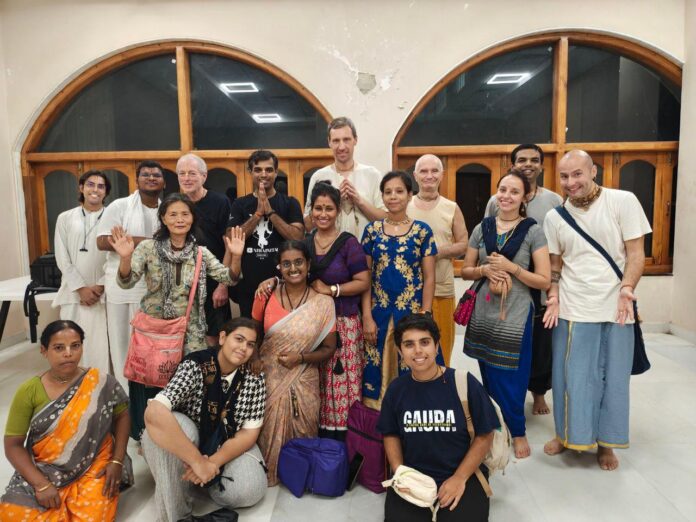
Participants of the workshop with Shyamsundar Das (wearing black in folded hands).

A four-day acting workshop recently concluded in Mayapur, marking a significant step in engaging devotees through creative preaching. Organized by Shyamsundar Das of Omnilight Films, it brought together devotees eager to explore dramatic arts as a medium for expressing and sharing Krishna consciousness.

Sharing his inspiration, Shyamsundar Das said his vision was to create a platform in Mayapur where devotees with creative talents could collaborate and serve through art. “Mayapur has a lot of potential, but there is no platform,” he noted, emphasizing the need for a space where creative devotees can express their abilities in Krishna’s service. He highlighted the urgency of offering spiritual alternatives in today’s digital age. “Because of this whole digital revolution, people are engaging themselves in all these different social media platforms,” he observed. Without providing devotional avenues for engagement, young people will naturally drift toward material entertainment.

Each day of the workshop built progressively on acting fundamentals while maintaining spiritual context. Sessions ran three hours daily, from 3 PM to 6 PM, beginning with warm-up exercises and games designed to help participants become fully present both physically and mentally.

Day One introduced participants to the actor’s instrument through icebreakers, mirror exercises where partners mimicked each other’s body language and expressions, and discussions on observation and imagination. The day included improvisation basics and concluded with an assignment to observe real people’s behavior and body language.

Day Two focused on character development and emotional expression. Participants performed their observations from the previous day, then engaged in “Who am I?” exercises to build complete character backgrounds with specific names, ages, habits, and goals. Through card-based activities, they practiced expressing emotional range by delivering simple lines in different moods. Each participant wrote a short five-line dialogue for their created character.

Day Three emphasized scene work and collaboration. Through trust exercises and improvisation games, participants developed listening and reacting skills. Pairs and trios rehearsed scenes using their previously written dialogues, focusing on emotional truth, pacing, and blocking before performing for their peers.

Day Four brought everything together in final performances in front of a camera. After focused rehearsal with directorial feedback on expression, movement, and timing, participants performed short scenes before their peers and invited guests, including senior devotees. The workshop concluded with constructive feedback, individual instructor notes, and reflection on growth and key takeaways.Workshop attendeees practicing the breathing exercise for calmness and focus.Participants doing warm up exercises before each day began.

The workshop featured expert trainers who combined professional skill with spiritual depth. Kamalakshi Rupini, a Bharatanatyam-trained actress from Brazil, led sessions on character work, explaining that an actor must enter into an emotion to portray it sincerely and then withdraw from it without attachment. “This way, we learn not to get attached to any character we are playing, including the one we are playing in this body. It is like many reincarnations in one lifetime,” she reflected, beautifully connecting the art of acting to the philosophy of self-realization.

Egidijus, a teacher at the Lithuanian Music and Theatre Academy, led modules that included exercises, skill development, and guidance on on-screen performance. He shared that the purpose of acting was not to become an actor but to understand oneself more deeply, which in turn supports one’s journey on the path of bhakti. Chintamani Devi Dasi led calming breathing exercises to help participants center themselves, while Gaura Nitai Das inspired everyone with his expressive acting and heartfelt participation. Professional actor and sound engineer Baldev Nitai Das provided constructive feedback to all participants, offering valuable insights on how they could continue to refine their craft.

His inspiration was strengthened by encouragement from senior devotees, including disciples of Srila Prabhupada, who sent him direct quotes from Srila Prabhupada highlighting his consistent support for the use of dramas and films to spread Krishna consciousness. “Sankarshan Prabhu specifically wrote that Srila Prabhupada would have encouraged Hindi film productions as well, had such opportunities been available in his time,” Shyamsundar said. He added that several senior devotees reminded him how Sri Chaitanya Mahaprabhu Himself participated in dramatic performances during His pastimes—affirming that devotional theatre and creative expression have always been cherished mediums for sharing spiritual wisdom.

While the workshop primarily prepared participants for film work, Shyamsundar Das emphasized that its value extended far beyond acting. “Even if someone is not interested in being in front of the camera, they still benefit from this workshop,” he explained. The process helps devotees step out of their comfort zones, overcome personal limitations, and discover unexplored dimensions of their own personalities.

One participant, Malini Sugopi Devi Dasi, shared her transformative experience: “This four-day acting workshop was really great. For anyone who is interested in acting but is a complete beginner or wants to gain confidence, this workshop is a must. It helped me in so many ways—I discovered aspects of my personality I never knew existed and came out of my little shell under the right guidance.”A trust game establishes cooperation amongst participants.Shyamsundar Das explaininng one of the activities to workshop goers.

Organizing the workshop came with challenges. Finding a suitable venue was the first hurdle, and the limited time made it difficult to cover all modules. Yet, as Shyamsundar Das humbly noted, “Somehow Krishna managed—Krishna helped us complete the workshop without any issues.”

Looking ahead, Shyamsundar Das shared plans for a second workshop in early December and a broader vision to establish a six-month diploma course in acting at Mayapur in collaboration with a recognized university. Future plans also include courses in makeup, hairdressing, singing, 3D animation, and computer graphics, supported by a dedicated facility. The production roadmap will begin with short films and gradually expand to full-length projects aimed at spreading Krishna consciousness through impactful visual storytelling.

Shyamsundar Das emphasized that the vision extends beyond the devotee community, aiming to create meaningful content that introduces Krishna consciousness and Vedic culture to a wider audience. He concluded with a humble appeal for devotees’ blessings and support to collaborate in serving Srila Prabhupada’s mission, noting that even spreading the word would be a valuable contribution.

Mild earthquake in Mayapur

0

It was a 5.5 magnitude, located in Narsingdi, Bangladesh, about 300kms away from Mayapur.
Three dead, several injured, tremors felt across West Bengal. Preliminary reports suggest that the earthquake was felt between 10.08 to 10.10 am for a few seconds and it was felt in Kolkata, Malda, Nadia, Cooch Behar and several other districts.

Mild earthquake in Mayapur. It was a 5.5 magnitude, located in Narsingdi, Bangladesh, about 300kms away from Mayapur. https://earthquaketrack.com/quakes/2025-11-21-04-38-26-utc-5-5-10

Accepting a Bona Fide Spiritual Master

0

By Dr. T. D. Singh (Bhaktisvarüpa Dämodara Swami)

Any sincere soul who is searching for spiritual science must try to seek out a bona fide spiritual master in disciplic succession (paramparā). Lord Śrī Kṛṣṇa is the original spiritual master. The Vedic knowledge, as it is, has been handed down from master to disciple, one after another. Even on the mundane platform, if someone wants to learn chemistry, he has to approach a professor of chemistry; how much greater, then, is the need to approach a bona fide spiritual master to attain the supreme spiritual perfection, Kṛṣṇa consciousness.

It is absolutely necessary for a sincere soul to approach a bona fide spiritual master and surrender unto the lotus feet of the spiritual master without reservation. Lord Śrī Caitanya Mahāprabhu instructed Sanātana Gosvāmī thus: “The first and foremost thing is that one should accept a bona fide spiritual master. That is the beginning of spiritual life.”1


The symptoms of a bona fide guru (spiritual master) and devotee are described in the Padma Purāṇa. “A person who is a qualified brāhmaṇa, and at the same time qualified with all the symptoms of a devotee, can become the spiritual master of all classes of men, and such a devotee and spiritual master must be respected as God Himself. But a person, even though he may be born of a very respected brāhmaṇa family, cannot become a bona fide spiritual master if he is not a devotee of the Lord.”2 It is further stated: “Whatever he may be, whatever position he may have, if a person is fully conversant with the science of Kṛṣṇa, Kṛṣṇa consciousness, he can become a bona fide spiritual master, initiator, or teacher of the science.

In other words, his capability to become a bona fide spiritual master depends on his sufficient knowledge of the science of Kṛṣṇa, Kṛṣṇa consciousness; it does not depend on birth or a particular position in society.”3 The qualifications of a bona fide spiritual master are also described in the Śrīmad-Bhāgavatam, Eleventh Canto, where the sage Prabuddha tells Mahārāja Nimi: “My dear King, please know for certain that in the material world there is no happiness. It is simply a mistake to think that there is happiness here because this place is full of nothing but miserable conditions. Any person who is seriously desirous of achieving real happiness must seek out a bona fide spiritual master and take shelter of him by initiation.

The qualification of a spiritual master is that he must have realized the conclusion of the scriptures by deliberation and arguments and thus be able to convince others of these conclusions. Such great personalities who have taken shelter of the Supreme Godhead, leaving aside all material considerations, are to be understood as bona fide spiritual masters. Everyone should try to find such a bona fide spiritual master in order to furfill his mission of life, which is to transfer himself to the place of spiritual bliss.”4 The sage further continued: “My dear King, a disciple has to accept the spiritual master not only as spiritual master, but also as the representative of the Supreme Personality of Godhead and the Supersoul. In other words, the disciple should accept the spiritual master as God because he is the external manifestation of Kṛṣṇa.”5


Indeed, this material world is a vast ocean of sufferings and miseries, and the waves of māyā (illusion) are constantly kicking the living entities. Therefore, undoubtedly, all human beings urgently need the kind and able guidance of an expert captain to cross this vast ocean of Kali-yuga. If we are in the hands of an expert captain, our position is quite safe. The bona fide spiritual master in disciplic succession is, unquestionably, an expert captain. Our material bodies are the ships, and the words of Kṛṣṇa are the favorable winds. If one takes shelter of such a spiritual master, there is no difficulty in crossing this vast ocean of Kali-yuga. In Bhagavad-gītā Lord Kṛṣṇa instructs Arjuna: “Just try to learn the truth by approaching a spiritual master. Inquire from him submissively and render service unto him. The self-realized soul can impart knowledge unto you because he has seen the truth.” [Bg 4.34] Also in the Vedic literatures we find:


yasya deve parā bhaktir yathā deve tathā gurau
tasyaite kathitā hy arthāḥ prakaśānte mahātrnanaḥ


“Only unto those great souls who have implicit faith in both the Lord and the spiritual master are all the imports of Vedic knowledge automatically revealed.”7


Therefore, we simply have to depend on the kind and causeless mercy of the spiritual master and the Supreme Personality of Godhead, Lord Śrī Kṛṣṇa. Lord Caitanya Mahāprabhu says: “By the mercy of Kṛṣṇa one gets a spiritual master, and by the mercy of the spiritual master one gets Kṛṣṇa.” In Bhagavad-gītā it is stated: “The Supreme Lord is situated in everyone’s heart, O Arjuna, and is directing the wanderings of all living entities, who are seated as on a machine, made of the material energy.” [Bg 18.61] When the Supreme Lord within the heart sees the sincerity of the conditioned soul, He mercifully gives all opportunities for the deliverance of the fallen soul. “Out of compassion for them, I, dwelling in their hearts, destroy with the shining lamp of knowledge the darkness born of ignorance [Bg 10.11] … When one is enlightened with the knowledge by which nescience is destroyed, then his knowledge reveals everything, as the sun lights up everything in the daytime.” [Bg 5.16]


It is an unquestionable fact that neither doctors, nor social and political leaders, nor philanthropists can solve the basic problems of life, namely, birth, death, old age and disease. At any moment the material body will be finished. Everyone, therefore, should prepare for inevitable death. But without the background of the transcendental science, Kṛṣṇa consciousness, and without the merciful guidance of the expert spiritual master, how can one prepare for impending death? Parīkṣit Mahārāja, a great king and devotee of the Lord, had seven days’ time to prepare for death, but we do not even know for sure whether we have seven minutes to prepare for death.

King Parīkṣit spent those days exclusively hearing the great sage Śukadeva Gosvāmī speak the Śrīmad-Bhāgavatam, which describes the transcendental qualities of the Supreme Personality of Godhead, Lord Śrī Kṛṣṇa. In this way, he perfected his life. Material scientists and philosophers cannot give transcendental knowledge to their students. They have no qualifications to do so. However, a bona fide spiritual master who is one hundred percent Kṛṣṇa conscious can impart complete transcendental knowledge, the science of Kṛṣṇa, to his disciples, and thus he can solve all their problems in life.


Lord Śrī Kṛṣṇa is the Supreme Absolute Truth. “The Absolute Truth must descend from the absolute platform. It is not to be understood by the ascending process.”11 One cannot, therefore, approach the Supreme Personality of Godhead, Lord Śrī Kṛṣṇa, directly. In the Ādi Purāṇa, Lord Kṛṣṇa addresses Arjuna: “My dear Pārtha, one who claims to be My devotee is not so. Only a person who claims to be the devotee of My devotee is actually My devotee.”12 Lord Śrī Caitanya Mahāprabhu also says: “I am not a brāhmaṇa [teacher], I am not a kṣatriya [administrator], I am not a gṛhastha [householder] and I am not a vānaprastha [retired man]. I do not belong to any of the eight varṇāśramas [occupational and spiritual divisions of society]. I am the servant of the servant of the servant of the servant-one hundred times the servant-of the maintainer of the gopīs, Kṛṣṇa.” This is the perfect example given by the perfect master, Lord Śrī Kṛṣṇa Caitanya Himself.


The spiritual master is, therefore, the transparent via medium through which to approach the Supreme Lord, Śrī Kṛṣṇa. Śrīla Viśvanātha Cakravartī Ṭhākura, a great ācārya (holy teacher), kindly gives us the following sublime instructions in his famous prayers for the glorification of the spiritual master:


yasya prasādād bhagavat-prasādo yasyāprasādān na gatiḥ kuto ‘pi
dhyāyan stuvaṁs tasya yaśas tri-sandhyaṁ vande guroḥ śrī-caraṇāravindam


“If one satisfies the spiritual master, the Supreme Personality of Godhead becomes satisfied. If one does not satisfy the spiritual master, there is no chance of one’s being promoted to the plane of Kṛṣṇa consciousness. I should therefore meditate upon him, pray for his mercy three times a day, and offer my respectful obeisances unto him, my spiritual master.”13


This is the great Vaiṣṇava (Kṛṣṇa conscious) tradition. The duty of the disciple is to always think and act to satisfy the spiritual master in all circumstances. Therefore, one should execute the orders of the spiritual master one hundred per cent, without any tinge of personal motivation.

Śāstric (Authoritative Scriptural) Injunctions Are the Supreme Judgement

0

By Dr. T. D. Singh (Bhaktisvarüpa Dämodara Swami)

We understand that our knowledge and intelligence are extremely limited. Our brains are tiny, our senses and scientific equipment are imperfect, and our vision is limited. With all these imperfect means, how will it be possible to comprehend the knowledge (science) beyond? Attempting to understand unlimited knowledge by one’s own limited means in the name of doing research is simply a waste of valuable time and energy. Śrīla Prabhupāda very kindly explains that by the mature research work of Śrīla Vyāsadeva, an avatāra (incarnation) of the Supreme Personality of Godhead Himself, Lord Śrī Kṛṣṇa, complete and perfect knowledge (science) is available in the Vedic literatures.


The Vedas were originally spoken by the Supreme Lord Himself to Brahmā, the first living being in the material universe, from within his heart. Vedic knowledge is called śruti, indicating that it is learned by aural reception. Therefore the Vedic knowledge has to be received from higher authorities by hearing (śravaṇam). In previous ages people were very intelligent. Their memories were extremely sharp. Just by hearing once from a spiritual master, disciples could remember everything. Therefore, there was no necessity for keeping the Vedas in written form during those ages. However, Śrīla Vyāsadeva could see beforehand that people in this present Age of Kali, the age of quarrel and misunderstanding, situated amidst the disturbing noise of science and technology, would be much less intelligent, possessing extremely short memories. Therefore about 5,000 years ago he compiled the Vedas in written form for the benefit of all inquisitive souls of this present age.


Veda actually means knowledge, and Vedānta means the end of knowledge, which is to know the Supreme Personality of Godhead, Lord Śrī Kṛṣṇa. Bhagavad-gītā is the essence of all Vedic knowledge. It was spoken by the Supreme Lord, Śrī Kṛṣṇa Himself, to His intimate friend and disciple Arjuna. Śrīmad-Bhāgavatam is the ripened fruit of all the Vedic literatures. It is the summum bonum of life, Lord Śrī Kṛṣṇa personified. It describes the unlimited transcendental qualities of the Lord. Lord Śrī Caitanya Mahāprabhu explained to Sanātana Gosvāmī, “Śrīmad-Bhāgavatam is the sound representation of the Supreme Lord, Kṛṣṇa. So, as Kṛṣṇa is unlimited, similarly, in each word and each letter of Śrīmad-Bhāgavatam there are unlimited meanings, and one can understand them by the association of devotees.

”1 Lord Śrī Kṛṣṇa says: “I am situated in everyone’s heart, and from Me come remembrance, knowledge and forgetfulness. By all the Vedas am I to be known; indeed I am the compiler of Vedānta, and I am the knower of the Vedas.” [Bg 15.15] Thus the words of the Vedas are the supreme authority.


One may ask, “How may one accept authority?” The answer is given by Śrīla Prabhupāda: “The answer of the genuine mother to the question of who is one’s father is authoritative.” One cannot argue about or object to this point. Similarly, when a child learns that two times two is equal to four from his father and he tells the same thing to a professor of mathematics, the professor has to agree that the child is speaking perfectly. The child may not be perfect, but the knowledge that he is speaking is perfect because he has taken it from an authority. Similarly, all the Vedic knowledge is infallible. For example, it has been mentioned in the Vedas that cow dung is pure whereas other stool is impure, and modern science has found this to be true. It has been scientifically confirmed by chemical analysis that cow dung indeed contains various antiseptic properties.


There are four principal defects inherent in the conditioned soul, namely, imperfect senses, the propensity to cheat, surety of committing mistakes and surety of being illusioned. Therefore, the conditioned soul is completely unfit to make any rules and regulations. The injunctions laid down in the śāstras (authoritative scriptures) are above these four defects. Therefore, all the great saints and ācāryas (holy teachers) accept the scriptural injunctions completely, without adulteration. Our position is simply to accept the supreme authority without question. In this way, one can understand the Supreme Lord and supreme scientist, Lord Śrī Kṛṣṇa, through authority. One can perceive or detect Him through authority, one can see Him through authority, and one can associate with Him through authority. Similarly, one can also speak through authority, argue and defend through authority, and prove and demonstrate through authority. The supreme authority is the ultimate judgement, and Śrī Kṛṣṇa is that supreme authority.
Men who have a poor fund of understanding further ask, “How does one know that Kṛṣṇa is the supreme authority?” Lord Brahmā, the first living being and the engineer who creates all the living entities in the material universe, sings as follows:


īśvaraḥ paramaḥ kṛṣṇaḥ sac-cid-ānanda-vigrahaḥ
anādir ādir govindaḥ sarva-kāraṇa-kāraṇam


“Kṛṣṇa is the Supreme Personality of Godhead. He is the very form of eternal being, full of knowledge and bliss. He is the primeval Lord Govinda and the cause of all causes.” [Bs 5.1] Śrīmad-Bhāgavatam says, kṛṣṇas tu bhagavān svayam: “Kṛṣṇa is the Supreme Personality of Godhead Himself.”[S.B. 1.3.28] Arjuna, the great devotee of the Lord, also says to Lord Kṛṣṇa: “You are the Supreme Brahman, the ultimate, the supreme abode and purifier, the Absolute Truth and the eternal divine person. You are the primal God, transcendental and original, and You are the unborn and all-pervading beauty.

All the great sages such as Nārada, Asita, Devala, and Vyāsa proclaim this of You, and now You Yourself are declaring it to me.” [Bg 10.12-13] In the same way, all the mahājanas (great self-realized personalities) like Prahlāda Mahārāja, Śukadeva Gosvāmī and Bali Mahārāja, the great ācāryas (holy teachers) like Madhvācārya, Rāmānujācārya and Lord Śrī Caitanya Mahāprabhu, all my predecessor gurus (spiritual masters) in disciplic succession and now my spiritual master and eternal father, His Divine Grace A.C. Bhaktivedanta Swami Prabhupāda, declare the same thing-that Kṛṣṇa is the Supreme Personality of Godhead. Therefore there should be no tinge of doubt. Our duty is just to follow the kind footsteps of these greatest of saintly personalities. In this way we can understand the science of Kṛṣṇa.


In spite of this, the project to control nature continues. Rather than researching to find out the plan of the Supreme Being, rather than accepting the laws of nature as laws of God, the scientific mentality seeks to put mankind in the place of God in order to improve on nature. But when we inspect these activities closely, we can see that the two admitted goals, knowledge and pleasure, have not been achieved after so many years of trying. The materialists enjoin us to be patient, saying that very shortly the answer will be known and the pleasure will be available for all. To keep us amused in the meantime, there are technological trinkets galore. If it happens that we die waiting, still the scientist does not admit the tragedy, since for him life is only a molecular peculiarity anyway.


Thus the insensitive fritter away the valuable time of human life, time meant for discovering the answer to the most pressing of all questions-“Why am I suffering?” In fact, they won’t even admit that they are suffering. Life thus wasted becomes a painful paradox, in which each minute that passes increases the misery, until finally the body collapses in agonized bewilderment.


In a jeep, in the 1940’s, several scientists rode through the New Mexico desert. They were tense, trying to resolve the nerve-wracking conflict of fear and dizzy elation in their minds. The Manhattan Project had come to an end, and they were to witness the first explosion of a nuclear device, which was being considered for use as the “ultimate weapon” to win the war.

In their bunker, as they confronted the terrifying, spectacular power of the bomb, Dr. Oppenheimer quoted a verse from the Bhagavad-gītā, “Time I am, the destroyer of the worlds…,” no doubt fearing that it would take a person as intelligent as God to be able to use atomic energy properly, and that humanity might not be equal to the task. To know that answer for certain, which evidence will be sufficient for us? The sublime words of the Gītā, or the brute force of history?

Complete and Perfect Knowledge of Evolution

0

By Dr. T. D. Singh (Bhaktisvarüpa Dämodara Swami)

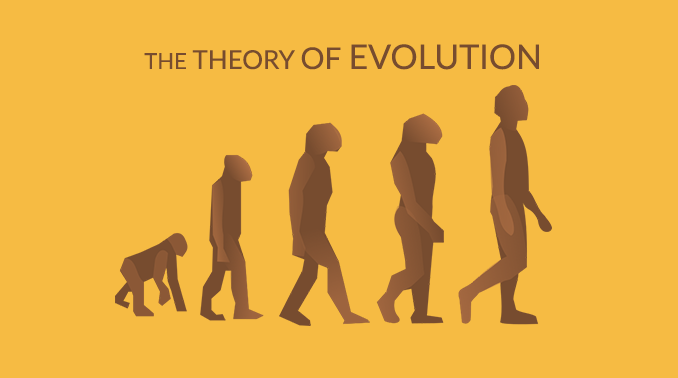
Complete and perfect knowledge of evolution in minute detail is available in the Vedic literatures. His Divine Grace Śrīla Prabhupāda has kindly supplied the following Vedic quotations:


aśītiṁ caturaś caiva lakṣāṁs tāñ jīva-jātiṣu
bhramadbhiḥ puruṣaiḥ prāpyaṁ mānuṣyaṁ janma-paryayāt
tad apy aphalatāṁ jātaḥ teṣām ātmābhimānināṁ
varākāṇām anāśritya govinda-caraṇa-dvayam


“One attains the human form of life after transmigrating through 8,400,000 species of life by the process of gradual evolution. That human form of life is spoiled for those conceited fools who do not take shelter of the lotus feet of Govinda [Kṛṣṇa].”1


jalajā nava-lakṣāṇi sthāvarā lakṣa-viṁśati
kṛmayo rudra-saṅkhyakāḥ pakṣiṇāṁ daśa-lakṣaṇam
triṁśal-lakṣāṇi paśavaḥ catur-lakṣāṇi mānuṣāḥ


“There are 900,000 species of aquatic life; 2,000,000 species of plants and trees; 1,100,000 species of insects; 1,000,000 species of bird life; 3,000,000 species of beasts, and 400,000 species of human life.”2

The meaning of “species” understood by biologists is different from the meaning implied here. The meaning used by biologists applies to the gross physical appearance or the gross morphological feature of the living material bodies. The Vedic meaning, however, which is derived after thorough and careful analysis, is based on the level of consciousness of the living being. For example, biologists say that all human beings belong to one species, whereas the Vedic literatures list 400,000 species. In other words, there are 400,000 grades of human beings on different levels of consciousness.


The process of evolution through these 8,400,000 species of life has been going on since time immemorial. As we noted earlier, the spirit soul never dies and is never born; it is eternal. It transmigrates from one body to another. Lord Śrī Kṛṣṇa, the supreme knower of everything, says: “As a person puts on new garments, giving up old ones, similarly, the soul accepts new material bodies, giving up the old and useless ones.” [Bg 2.22] In this way the transmigration of the soul is going on.


As we noted from Brahma-vaivarta Purāṇa, the most important species of life is the human being. The Vedānta-sūtra instructs, athāto brahma-jijñāsā: “Now, therefore, in this human form of life, it is time to inquire about spiritual realization.”4 Who am I? What is the real mission of human life? What is the ultimate purpose of our existence? Every intelligent person must ask these questions and should search for the right answers from the right source. So-called modern educators claim that the purpose of education is to solve the problems of life.

But in actuality they are teaching their students how to increase sense gratification more and more, thereby creating more and more paths to degradation. “Thus perplexed by various anxieties and bound by a network of illusions [in terms of increased sense gratification], one becomes too strongly attached to sense enjoyment and falls down into hell.” [Bg 16.16] In modern universities and colleges no one teaches the science by which to answer the question “Who am I?” Śrīla Prabhupāda kindly points out, “There are so many departments in a university: technological, medical, engineering, etc.

But where is the department to know and understand what this life is, what God is, and what our relationship is?”6 The most important department of education, that which teaches the real mission of human life, is completely left out. Scientists claim that modern science is a product of man’s curiosity to know. Why aren’t they curious to know who we are and what our relationship is with the Supreme Lord, the supreme scientist, Śrī Kṛṣṇa? The Vedas give all the answers perfectly.


Lower forms of life such as animals, birds and plants do not suffer from sinful activities because they never violate the laws of nature. A tiger, for instance, does not commit sinful activity by killing its prey because his body is meant to act in that way; it is properly equipped for that purpose. However, when the spirit soul comes to the level of a human being, the living entity is then subject to the results of his actions (karma-phala). From this human platform the living entity has, therefore, a choice. If the spirit soul wants to leave his material body and attain a spiritual body, he can do so from this human platform; otherwise, at the time of death he can transmigrate to one of the 8,400,000 species according to the desires and consciousness he has developed.

Lord Kṛṣṇa says: “Whatever state of being one remembers when he quits his body, that state he will attain without fail.” [Bg 8.6] From the human platform the spirit soul can escape the miserable wheel of birth and death by developing Kṛṣṇa consciousness. “And whoever, at the time of death, quits his body, remembering Me alone, at once attains My nature. Of this there is no doubt.” [Bg 8.5] This is evolution from the material platform to the spiritual platform.


Lower forms of life (animals, birds, plants, etc.) are not favorably situated for taking to Kṛṣṇa consciousness because they are not intelligent enough to understand this great science. On the other hand, it is understood from Vedic literature that there are demigods who are more elevated than human beings, but their position is also not favorable for taking to Kṛṣṇa consciousness because they are too materially opulent. Too much material opulence is also a disqualification for taking up Kṛṣṇa consciousness.

“In the minds of those who are too attached to sense enjoyment and material opulence, and who are bewildered by such things, the resolute determination of devotional service to the Supreme Lord does not take place.” [Bg 2.44] That is why it is an absolute necessity for all sane human beings to take up Kṛṣṇa consciousness from this human platform, which is the intermediate birth between the demigods and the lower forms of life. Otherwise, the precious human form of life will simply be wasted.

The Incomplete and Speculative Knowledge of Darwin’s Theory of Evolution

0

By Dr. T. D. Singh (Bhaktisvarüpa Dämodara Swami)

Before Charles Darwin published his theory of evolution in 1859, he frequently corresponded with A.R. Wallace, one of his contemporary naturalists. In one of his letters to A.R. Wallace (December 22, 1857), Darwin wrote, “… I am a firm believer that without speculation there is no good and original observation….’1 Thus, one does not need to make an extensive study in order to understand his theory. His theory was completely based on his own speculation and mental manipulation, based on some data collected during his “Voyage of the Beagle” (1831-1836). Every sensible person knows that speculative knowledge is quite fallible.


How his theory was developed is given in his own words: “When onboard H.M.S. Beagle as naturalist, I was much struck with certain facts in the distribution of the organic beings inhabiting South America, and in the geological relations of the present to the past inhabitants of that continent. These facts … seemed to throw some light on the origin of species, that mystery of mysteries. On my return home, it occurred to me, in 1837, that something might perhaps be made out on this question by patiently accumulating and reflecting on all sorts of facts which could possibly have any bearing on it. After five years work I allowed myself to speculate on the subject, and drew up some short notes; these I enlarged in 1844 into a sketch of the conclusions, which seemed to me probable: from that period to the present day I have steadily pursued the same object. In considering the Origin of Species, it is quite conceivable that a naturalist might come to the conclusion that species had not been independently created, but had descended, like varieties from other species.”2


Darwin has no knowledge about the nature of the spirit soul. He has no clear information as to how the living entity (spirit soul) is transmigrating from one species to another. He does not know whether there is further evolution from the human platform, and he hasn’t the slightest idea as to the total number of species through which the cycle of evolution goes on. He also has no infonnation whether the spirit soul can transmigrate from the human platform to lower species of life.


There has been great confusion regarding Darwin’s Theory. His critics are very legitimately asking, “If the theory of natural selection of Darwin is correct, why can’t we see the intermediate forms of species, the connecting links?” Darwin himself was completely confused in this respect. He could not provide any logical answer except his speculative argumentation. His own answer was that “extinction and natural selection will … go hand in hand.”3 He did not know that all the species of life have been existing since the dawn of creation. “The different species of life are created immediately along with the universe.

Men, animals, beasts, birds-everything is simultaneously created, because whatever desires the living entities had at the last annihilation are again manifested.”4 As a crude example, the species portrayed in the ancient Egyptian pyramids were the same as those we meet at the present day. Similarly, since time immemorial the peacock, whose colorful feathers so nicely decorate the transcendental head of the Supreme Personality of Godhead Śri Kṛṣṇa, has been the same as the species we find today. With his poor fund of knowledge, Darwin concluded that some species became extinct in the process of evolution. This is completely wrong.

What is the Difficulty?

0

By Dr. T. D. Singh (Bhaktisvarüpa Dämodara Swami)

The greatest disease in the minds of the scientists is that they do not believe that something is a fact unless it is proved by scientific experiments. When a scientist makes a statement and he supports that statement with scientific experiments, everyone is completely convinced, and no questions are asked. When we talk about the spirit soul to these scientists, their usual response is, “How can one detect the presence of the soul?” Because they have been conditioned to working with machines, they wonder whether the soul can be detected by scientific experiments. However, scientists have to agree that even in their own scientific realm there are many facts that cannot be proved by experiments. The fact is that the soul is there, but in order to understand its existence we have to accept knowledge from the right person, Śrī Kṛṣṇa, or God, and His representative in disciplic succession, the spiritual master.


Everyone in the scientific community knows that mathematicians work with an imaginary number called “i,” which is the square root of minus one. This number does not figure among the natural numbers (1,2,3, etc.). However, important branches of mathematics-for example, the theory of analytical functions-are based on this imaginary unit. Without the help of this branch of mathematics, various complex theories and problems cannot be solved. Thus the existence of this number cannot be denied; yet there is no experiment to prove it. In a similar manner, scientists in the field of statistical mechanics also utilize various conceptual models-ensembles, for example-to explain their theories and arguments. These are all beyond the realm of experimental science. If scientists are willing to accept these imaginary and conceptual models, what is the difficulty in accepting the perfect knowledge given by Lord Kṛṣṇa, the supreme scientist?


Another scientific theory that is beyond the limit of experimental science is Heisenberg’s uncertainty principle. The statement of this principle is that it is impossible to simultaneously determine the position and momentum of any object. In mathematical language, it is stated that the product of the uncertainties in the measured values of the position and momentum (product of mass and velocity) cannot be smaller than Planck’s constant. No existing experimental technique can prove this principle. However, scientists all over the world accept this statement as a fact, knowing that the experimental proof is beyond their ability. Similarly, there is no scientific experiment to prove the Third Law of Thermodynamics. This law, as formulated by Planck, states that the entropy of a perfect crystal at absolute zero degrees is equal to zero. Factually, there is no means available for measuring directly the absolute entropies. Therefore the proof of this law is beyond the realm of experimental science.


It is also to be noted that so-called scientific theories are changing constantly. For example, at the beginning of the Nineteenth Century (1808), John Dalton, in developing his atomic theory, stated that atoms could not be further divided. However, toward the end of the Nineteenth Century and the beginning of the Twentieth Century, it was found that Dalton’s atomic theory could no longer be considered correct. It was observed that atoms could be further divided into fundamental particles like electrons, protons and neutrons. It was also found that some atoms could emit alpha and beta particles, thereby producing new atoms, and so on. As a matter of fact, the so-called nuclear bombs are a result of these findings.

In a similar manner, during the Eighteenth and Nineteenth Centuries Newton’s mechanics had a tremendous influence on the minds of scientists, since they could be applied to gross material objects. However, at the beginning of the Twentieth Century, with the discoveries of the fundamental particles, it was realized that Newton’s mechanics failed in describing the motions of these particles. Thus quantum mechanics has been developed to explain the phenomena they exhibit. These theories are filled with speculation, and they are also changing. Just as past and present scientific theories are changing, so we can understand that future scientific theories will also change.


This simply shows that the brains of the highly honored material scientists are imperfect, and, as a result, the theories proposed by these brains will always be imperfect. Actually, perfect knowledge cannot be changed. In order to get perfect knowledge, one has to take knowledge from the perfect scientist, Lord Kṛṣṇa, and His bona fide representative, the spiritual master. Kṛṣṇa says: “I am the source of all spiritual and material worlds. Everything emanates from Me. The wise who know this perfectly engage in My devotional service and worship Me with all their hearts.” [Bg 10.8] Furthermore: “Of all creations I am the beginning and the end and also the middle, O Arjuna. Of all sciences I am the spiritual science of the Self, and among logicians I am the conclusive truth.” [Bg 10.32]


Scientists have to understand that the knowledge and ability they have is extremely limited and in fact quite insignificant. With this insignificant and limited knowledge, how will it be possible to understand knowledge beyond the material context? Actually there is no question about the existence of the soul. The living entities are fragmental spirit souls, whereas Lord Kṛṣṇa is the supreme soul, supreme person and supreme scientist. Kṛṣṇa says: “The living entities in this conditioned world are My eternal, fragmental parts. Due to conditioned life, they are struggling very hard with the six senses, which include the mind.” [Bg 15.7] Also: “It should be understood that all species of life, O son of Kuntī, are made possible by birth in this material nature, and that I am the seed-giving father.” [Bg 14.4]


Just as the existence of air can be felt by touch and the existence of certain molecules by fragrance and aroma, similarly consciousness is the clear symptom of the existence of the soul. “O son of Bharata, as the sun alone illuminates all this universe, so does the living entity, one within the body, illuminate the entire body by consciousness.” [Bg 13.34] Biologists also confirm that even the smallest microorganisms, such as bacteria, have consciousness. When consciousness enters into a material body. we call it a living body.

However, when there is no consciousness in the body-in other words, when the spirit soul leaves the body-simply a lump of matter is left over. This phenomenon we call death. Therefore the spirit soul never dies and is never born. It is eternal. What we call birth and death are nothing but the changing of different material bodies, the replacement of old bodies with new ones. “The living entity in the material world carries his different conceptions of life from one body to another, as the air carries aromas.” [Bg 15.8] Thus birth, death, old age and disease are the signals of the changing of the material body.


When our scientific friends readily accept Heisenberg’s uncertainty principle, the imaginary unit and the various conceptual models of statistical mechanics, which are all beyond experimental science, what is the difficulty in accepting the existence of the spirit soul? The supreme scientist Śrī Kṛṣṇa says: “For the soul there is never birth nor death. Nor, having once been, does he ever cease to be. He is unborn, eternal, ever-existing, undying and primeval. He is not slain when the body is slain.” [Bg 2.20] Its size has been described thus: “When the upper point of a hair is divided into one hundred parts and again each of such parts is divided into one hundred parts, each such part is the measurement of the dimension of the spirit soul.”8


Scientists are familiar with the law of conservation of energy which states that energy can be neither created nor destroyed. The living entities are the superior energy of the Supreme Lord, Śrī Kṛṣṇa. Therefore the soul is eternal. “Know that which pervades the entire body is indestructible. No one is able to destroy the imperishable soul.” [Bg 2.17] The nature of the spirit soul is elaborately described in the Second and Thirteenth Chapters of Bhagavad-gītā. One simply has to take the knowledge from the supreme scientist, Śrī Kṛṣṇa, the speaker of Bhagavad-gītā.
KCSB 4: The Incomplete and Speculative Knowledge of Darwin’s Theory of Evolution

Stay Connected

16,985FansLike
12,500FollowersFollow
61,453SubscribersSubscribe
Have a question?Send us an enquiry. We usually reply within a day.