


Mail ID: contact@vedavarsity.com

Contact: +91 9634998911

Google search engineGoogle search engine
Home Blog Page 160

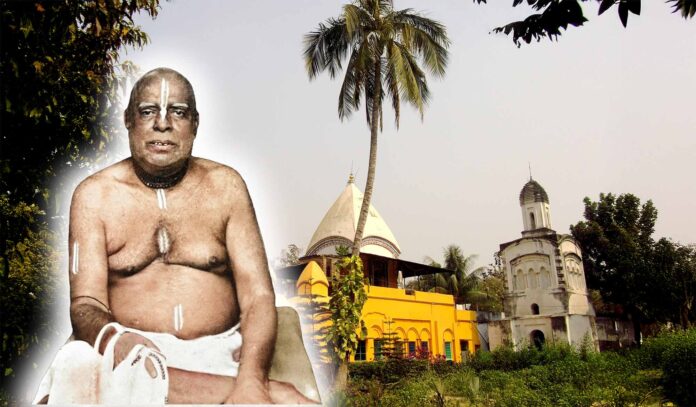
Śrīla Bhaktivinoda in Gauḍacala

0

In the sub-division of Ukhḍa , within 20 miles of Śrīdhāma Māyāpura, the appearance place of Śrī Nadīyā-canda, near to where the founder of the Kartābhajā movement, Aula-canda, was found as a child by Mahadeva Barui, one very dynamic personality on the path of bhakti appeared at that place to dispel all sorts of delusional misconceptions, in order to drive the human intellect engrossed in worldly knowledge towards the path of the highest spiritual truth, and again propagate the flow of pure bhakti initiated by Śrī Māyāpura-candra all over the world.

A few years after his appearance, Ulanagar became depopulated due to an epidemic. Based on the severe effect of that epidemic, that nitya-siddha litterateur, who appeared in Ulagram, composed an epic poem named Vijana-grāma (‘The Empty Village’) in the amitrākṣara metre* for the very first time in the Bengali language. The period in which he composed it was 1863 of the Christian era.

*This is known as blank verse in English.

This Ulagram is in the sub-division of Ukhḍa, within the district of Nadīyā. From Calcutta, it’s distance is 51 miles. Immediately after the Ranaghat station on the Murshidabad line of East Bengal Railway is Birnagar Station, which is merely the new name of the well-known and ancient Ulagram. The specific site within this city where Bhaktivinoda Thakura appeared, the house in which he was born, still stands and sings songs of its past glories.

A little more than three hundred and fifty years has passed from the time when the revealers of Śrī Nadīyā – Śrī Māyāpura-candra and His associates – manifested Their own audārya-līlā (pastimes of magnanimity) in order to demonstrate progressive service which is contrary to the enjoying mentality of the jīvas contaminated by the filth of Kali. In 352 Gaurābda, 1760 Śakābda, 1895 Samvat, 1245 Baṅgābda, * on 2nd September, 1838 of the Christian era, and on the thirteenth lunar day on the 18th of the month of Bhādra of the Bengali calendar, one great personality who was three and a half hands length in height (approx. 5 foot, 3 inches), who was a supremely dear personal associate of Śrī Śrī Māyāpura-candra, appeared.

* There are various calendars used in India. Gaurābda is counted from the time of Mahāprabhu’s appearance. Śakābda is a luni-solar calendar introduced by Mahārāja Śalivāhana who defeated the Śaka tribe. Samvat is the ancient calendar introduced by Mahārāja Vikramāditya. Baṅgābda is the traditional Bengali calendar, aligned with Emperor Akbar’s revenue reforms in the 16th century.

In order to expand His own mahā-vadānya-līlā (pastimes of supreme magnanimity), Puruṣottama – the bestower of auspiciousness to the world and possessor of infinite potencies – revealed the example of attaining bliss through eternal, transcendental knowledge while traversing the path of pure bhakti. Yet, as His mutually contending potencies gradually unfolded, the jīvas of this world became fearful that the cooling rays of the spotless religion of prema might grow faint and become eclipsed by the ocean of impurity. To once again uncover those pure, soothing, and beautiful sun-rays of prema, His intimate associate – that exalted soul devoted to the service of Puruṣottama – appeared in this world as the āśraya-vigraha of the viṣaya, Śrī Caitanya-candra.*

*Here, viṣaya refers to the Supreme Lord, and the āśraya refers to His devotee.

When he came, people perceived by their external vision that he had appeared in a family  of pañcopāsakas.  In actuality, a worshipper had appeared in the house of pañcopāsakas who was far beyond the material world. A weak-hearted man, overwhelmed by material enjoyment, depending on his own strength, roams the land of karma and assumes the responsibility of various kinds of virtuous and non-virtuous deeds. Yet if some potency of Bhagavān or bhagavat-prakāśa-tattva (that principle which reveals Bhagavān) appears in the world as the ideal of the pure jīvātmā’s nature and function, then alone can the welfare of the world be accomplished.

Pañcopāsakas refers to the Smārtas who worship the impersonal Brahman in the form of five deities – Viṣṇu, Śiva, Durgā, Sūrya and Gaṇeśa.

The unsteady mind repeatedly engages the bound jīva in topics other than Kṛṣṇa, giving indulgence to reckless behaviour. It could never be that in the land of pious activities, beyond the sphere of Brahma-vārta, upon the eastern hills of Āryāvarta, within the sky of Gauḍa, some ideal star, free from selfish karma and jñāna, should arise – such was the delusion to be dispelled. For the purpose of making an unblessed land blessed, of sanctifying an unsanctified soil, of transforming the age of Kali into a pure Satya-yuga, for removing all inauspiciousness from the world and inviting auspiciousness – for this cause, the appearance of the Moon of Gauḍa and His constellation of attendant-stars was, in fact, the rightful claim of those very inhabitants of that unfortunate land, who were unworthy, impious people.

In Gauḍa-deśa, flooded by Tantras in the mode of ignorance, where the darkness resounded with the shrill ballads of Yogī Pāla and Bhogī-Pālas, and with the folk-songs of Maṅgala-Caṇḍī and Viṣahari’s cricket-like commotion– there, the effulgent light of the divine proclamation from Śrī Hari’s own holy lips, ‘kīrtanīyaḥ sadā Hariḥ’ (‘the Name of Hari is to be constantly chanted’), completely dispelled that mass of gloom.

* Yogī Pāla (also known as Chowranginath) was a prince of the Pāla Dynasty of Bengal, who gave up his royal lifestyle and became a tantrika yogī. Less is known about Bhogī Pāla. Maṅgala-Caṇḍī is a goddess worshipped in rural Bengal; Viṣahari is another name for Manasā Devī, the snake goddess, who removes the effects of snake bites.

In that land at that time, among those very assemblies of the heroes of karma where practices such as bhūta-siddhi (control over spirits), vaśīkaraṇa (enchantments), pañca-pakṣi-sādhana (omens based upon five specific birds), and pañca-deva-vāhana (invoking the five deities) etc, were powerful – to those very people there, the appearance of one supremely transcendental embodiment of all-auspiciousness was nothing other than a sign of Bhagavān’s amandodaya-dayā (strong and progressive mercy).

After the concealment of Śrī Gaurasundara’s prema-līlā, Ācārya Śrīnivasa, Ṭhākura Narottama, and Prabhu Śyāmānanda became the divine triad for showering that prema upon the world. They infused the waters of śravaṇa and kīrtana drawn from the ambrosial ocean of bhakti-rasa into the heart-fields of those driven by selfish desires, karma, and dry jñāna. Due to many years of draught and scanty rainfall, the desert-like heart of the jīva had become incapable for the sprout of prema to emerge.

Hence, no one can deny the necessity of proper arrangements for delivering the cultivators of ulterior desires from the overwhelming power of time. The expectation of the rise of prema can be considered as timely, as the accompanying medicine for all sorts of diseases such as indulgence in intoxicants, the restless efforts of morally bewildered hearts, intense thirst for argument, and the craving for unlawful material advancement. At that time, the Supreme Person, who is the Reality of truth, knowledge, and unlimited bliss, sanctioned the service regulations in this world established by Saccidānanda, the servant of Puruṣottama. Instead of flowing in hundreds of streams, the threefold flow of Srinivāsa etc., being felicitated by the favourable service-flow to the Six Gosvāmīs while travelling to the confluence of the sea which is the abode of all nectarean rasas, instead faced obstacles such as dryness scarcity etc along the way.

At this time, from the devotional ocean of nectarean rasa, the kṛpā-śakti (mercy-potency) of Śrī Navadvīpa-candra, who is a rising ocean of strong and progressive mercy, once again caused the current of the Bhāgīrathī of pure bhakti to flow, thereby rejuvenating the wish-fulfilling tree of auspiciousness. In the midst of dense darkness, even two bright stars are incapable of fully expanding their powerful influence. After the light of the sun disappears in the western sky, the constellation of stars help the viewers by dispelling the darkness of night. Even at twilight, for some time, light and shadow continue to give the traveller a little assistance to a certain extent. Once again, with the arrival of the lord of night (the moon), the mind of the jīva becomes joyful with hope.

Far be it from seeking eternal life, the jīvas, intoxicated by the commotion arising out of karma, in their thirst for peace, desire to enter into the dense darkness of Kevalādvaitavāda (absolute monism) – that is itself a deviation. When there is a scarcity of persons to give caution against such deviation, then the majority of society becomes afflicted by various conflicting opinions.

When all the jīvas, who are scorched by distress, hear the loud declaration of those philosophers who claim that there is no distinction in the self, one’s race, or that of others, they then pursue the search for kaivalya (oneness) in order to find the akāśa-puṣpa of imaginary peace.* At that time, the humble, quiet voice of the guileless devotee engaged in bhajana announces the futility of the shrill tones of the followers of Kevalādvaitavāda – that voice becomes favourable to the attainment of the most auspicious fruits of the wish-fulfilling tree of auspiciousness.

* The phrase akāśa-puṣpa (sky-flower) is a common analogy used in Indian philosophy to denote something which is illusory. The sky does not produce flowers, therefore, anything that is referred to as an akāśa-puṣpa suggests that it is a misconception not based in reality.

The jīva has the aptitude to receive suffering in the thorny field of bhoga (enjoyment) and tyāga (renunciation) at every moment. Reasoning possessed of carelessness and short-sighted vision is incapable of bestowing ultimate auspiciousness. For this reason, we must take constant support by considering bhakti which is under the guidance of the aśraya (Śrī Guru). As the medicine suited to the disease, the bhakti-latā (creeper of devotion) that originated in Vṛndāvana was revealed in the Eastern region. However, the worshippable forms of the Lord that signify the principles of sambandha, abhidheya and prayojana, attract the sincere souls. They alone can progress in accepting that truth which is nirasta-kuhaka (without deceit). This itself is called sukṛti. Those travellers who regard karma, yoga, jñāna, tapasya, etc. as the true path, become anxious upon losing their way and go astray – for them alone there is the necessity of an honest guide. Śrī Caitanya-candra, encouraging those who had taken shelter of Him, and constructed the road of bhakti, leading from the entanglement of worldly existence toward the transcendental path. Yet, since that path was also inaccessible and filled with thorns, fear arose, and the travellers on the path of life encountered dangers and obstacles in many places. Through the simple and direct path of bhakti, the supreme joy attainable establishes the prayojana-tattva. Yet, there was an absence of an exemplary life to make this known. To what extent Ṭhākura Bhaktivinoda has fulfilled all those deficiencies is to be observed with the awakening of pure knowledge.

Ṭhākura Bhaktivinoda has shown the purpose of the conscious and unconscious worlds in relation to Kṛṣṇa. Service to Bhagavān is the only abhidheya, and that the desire for material enjoyment is an obstacle to it – he preserved these teachings through the propagation of proper conduct. Peace, enjoyment, and bliss – all culminate in supreme peace and true kṛṣṇa-bhakti. By revealing this, he has pointed out prayojana-tattva. When one considers the greatness of those who glorify or discuss other subject matters, it becomes clear that relying upon the greatness of those who cannot direct us to that strong and progressive mercy of the Lord, is not at all necessary for those who seek auspiciousness.

Ṭhākura Bhaktivinoda’s compassion, through his conduct and propagation, serves to demonstrate the unparalleled nature of the manner in which Śrī Gaurasundara and His own pure devotees distributed mercy;  it is the subject of hearing, chanting, and remembering during the time of His annual appearance.

The śāstra says that by rejecting bad association and establishing oneself in good association, one can become free from the influence of inauspiciousness through hearing, chanting, and remembering. If we advance by taking shelter of Bhagavān and His own associates by cultivating the threefold process of hearing, chanting, and remembering, then only we will surely become an object worthy of the eternal mercy of Jagannātha, the Supreme Protector. May He, who bestows boundless mercy to protect us from sinking in this ocean of material existence, and who is the knower of the principles of sambandha, abhidheya, and prayojana – in other words, that wise one possessing knowledge of subjugation and liberation – may he guide us like the Pole Star on the path of life.
A Devotee is Peaceful (Sajjana Śānta)

0

Only a pure Vaiṣṇava, or a sajjana, is truly peaceful. It is true that no one desires to become asajjana (impious); yet, due to a lack of eligibility, when one commits offences at the lotus feet of a Vaiṣṇava, one begins to identify such a mundane nature to be one’s own inherent self. Thus, such a jīva who is bound by māyā and filled with false ego becomes known as aśānta (one who is devoid of peace).

From prakṛti (material nature) intelligence arises, and from ahaṅkāra–tattva (the principle of false egotism), the false ego itself manifests. Due to offences to the Vaiṣṇavas, the asajjana falls from the plane of the mahat-tattva (principle of material existence). Having turned away from transcendental vision, he becomes agitated in the enjoyment of material form, taste, smell, sound, and touch. Thus, the workings of his false ego become manifest. Being so afflicted by that poison, he becomes restless and, overcome by egotism, even projects the same egoistic faults upon the pure devotee, the sajjana – considering him to be of a nature similar to his own.

If, by giving up his material ego, he can one day achieve the vision to behold the ideal of the peaceful sajjanas, then he will understand that only the sajjanas are truly peaceful – whereas those of narrow, mundane intellect, who crave the designation of ‘Vaiṣṇava’ while being prākṛta-sahajiyās, are the only ones who are not peaceful. Śrīman Mahāprabhu has said (Caitanya-caritāmṛta, Madhya-līlā 139-149):

keśāgra-śateka-bhāga punaḥ śatāṁśa kari
tāra sama sūkṣma jīvera ‘svarūpa’ vicāri

If one were to divide the tip of a hair into one hundred parts, and again divide one of those parts into another hundred, the jīva’s real nature is still more subtle than that.

keśāgra-śata-bhāgasya śatāṁśa-sadṛśātmakaḥ
jivaḥ sūkṣma-svarūpo ’yaṁ saṅkhyātīto hi cit-kaṇaḥ

The jīva, whose form is subtler than one ten-thousandth part of the tip of a hair, is an atom of pure consciousness, innumerable and beyond all material calculation.

bālāgra-śata-bhāgasya śatadhā kalpitasya ca
bhāgo jīvaḥ sa vijñeya iti cāha parā śrutiḥ

The śruti declares that the jīva is to be known as one ten-thousandth part of the tip of a hair, divided again a hundred times – exceedingly minute.

sūkṣmāṇām apy ahaṁ jīvaḥ

Of all things that are minute, I am the jīva.

aparimitā dhruvās tanu-bhṛto yadi sarva-gatās
tarhi na śāsyateti niyamo dhruva netarathā
ajani ca yan-mayaṁ tad avimucya niyantṛ bhavet
samam anujānatāṁ yad amataṁ mata-duṣṭatayā

If the embodied beings were infinite and omnipresent like You, then naturally there could be no Supreme Ruler over them – that would logically follow. But, because they are born of You, and exist only within Your energy, they can never be independent of You; You alone remain their eternal Master. Those who think that the individual jīva is equal to You are misguided by defective intelligence.

tāra madhye sthāvara jaṅgama dui bheda
jaṅgame tiryak-jala-sthalacara-vibheda

Among them (the jīvas), there are two divisions – the sthāvara (inanimate) and the jaṅgama (animate). The animate beings are further divided into those that fly, those that dwell in water, and those that live on land.

tāra madhye manuṣya-jāti ati alpatara
tāra madhye mleccha, pulinda, bauddha, śabara

Among all of them, the human species are very few. And among humans, there are the mlecchaspulindasBuddhists, and śabaras.

veda-niṣṭha-madhye ardheka veda mukhe māne
veda-niṣiddha pāpa kare, dharma nāhi gaṇe

Among those who claim to follow the Vedas, half of them accept the Vedas by lip-service only. They still engage in sinful acts forbidden by the Vedas and do not truly care for dharma.

dharmācāri-madhye bahuta karma-niṣṭha
koṭi-karma-niṣṭha-madhye eka jñānī śreṣṭha

Among those who follow dharma, many are devoted to karma. Among millions of those who are engaged in karma, a jñānī is supreme.

koṭi-jñāni-madhye haya eka-jana mukta
koṭi-mukta-madhye durlabha eka kṛṣṇa-bhakta

Among millions of jñānīs, only one attains liberation. Among millions of liberated souls, a devotee of Kṛṣṇa is most rare.

kṛṣṇa-bhakta niṣkāma, ataeva śānta
bhukti-mukti-siddhi-kāmī sakali aśānta

The devotee of Kṛṣṇa, being desireless, is peaceful (śānta). Those who are attached to enjoyment, liberation, or mystic perfections are all restless (aśānta).

Relying upon mundane analysis, those who consider themselves knowledgeable of the principles of sambandha, abhidheya, and prayojana, yet by their natural disposition remain distant from engaging in the service of Hari, never escape committing offences even after countless millions of lifetimes. Such persons remain eternally offensive and restless, and driven by their desire to oppose Viṣṇu and the Vaiṣṇavas, they repeatedly take birth again and again.

Some of them accept the Vedas only through lip-service, while others, even though they know that the Vedic injunctions forbid sensual enjoyment, live a life of illicit sexual indulgence and, and with prideful arrogance, establish themselves as preachers or mendicants in an inferior śūdra-like manner. By the desire of Kṛṣṇa, all people generally disregard them. Therefore, being neglected, they become disturbed due to committing offences against the Vaiṣṇavas and gradually sink deeper and deeper into degradation.

They cannot comprehend the sambandha, abhidheya, and prayojana of the Vedas, and they propagate their tendencies based on asat-śāstras (non-bona fide scriptures) under various pretentious names, thereby accumulating offences at the feet of the Vaiṣṇavas. Accepting the Vedas in word only, such arrogant and inimical jīvas remain averse to hari-bhajana and continue to commit sins forbidden by the Vedas, and in vehement opposition, they criticise the society of devotees. After experiencing no peace for countless lifetimes, such jīvas eventually, upon the exhaustion of their sins, attain pious births in successive lives and become elevated to the position of karmīs (followers of karma-kāṇḍa). Later, transcending such poisonous paths of karma-kāṇḍa, jñāna-kāṇḍa, as well as false bhakti-kāṇḍa, they achieve peace at the pure lotus feet of the sajjanas.

As long as he does not realise the turbulent disposition found within the venomous consequences of those who are opposed to Kṛṣṇa, and while he does not obtain the glories of the pure lotus feet of the sajjanas by gathering sukṛti, the egotistical jīva continues to loudly declare the Vaiṣṇavas to be like himself – restless, proud, and deceitful. The sole dharma of a pure Vaiṣṇava is to ignore all such ignorant, immature, and disturbed jīvas.

 In the same way, in the Śrīmad-Bhāgavatam, the virtuous tridaṇḍī devotee, while being oppressed by the restless and egotistical jīvas, disregarded them. That particular section is a subject to be constantly discussed by every Vaiṣṇava tridaṇḍī. The Vaiṣṇava tridaṇḍīs, or the paramahaṁsas who have given up the daṇḍa, will not deliver these agitated jīvas from their unrest, but will merely disregard them – this indeed is the dharma of the tridaṇḍī, or of those who have given up the daṇḍa.* Śrīman Mahāprabhu has established such tridaṇḍi-dharma alone as the highest discernment of the conditioned jīvas who are attached householders who claim to be servants of gṛhī-gaurāṅga (‘householder Gaurāṅga’).**

Śrī Kṛṣṇa Himself is the expounder of this tridaṇḍī dharma, and Śrī Gaurasundara Himself accepted sannyāsa, personally establishing it as the very standard for the tridaṇḍī Vaiṣṇavas. If one can grasp the essential meaning of this, the jīva’s restless nature will be eradicated. A bound jīva, abandoning artificial sāttvika–vikāra (so-called ecstatic symptoms) or false identifications such as being ‘the son of Bābā Ṭhākura,’can become a sajjana.*

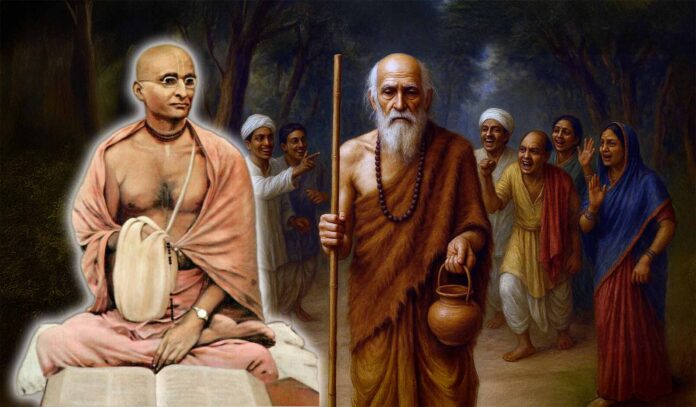
Wicked persons showed various forms of hostility toward the Vaiṣṇava tridaṇḍī, including contempt, insult, ridicule, physical assault, harassment, and restraint. Sometimes, they showed hatred towards the tridaṇḍī, by spitting on his body, urinating upon him, and causing various disturbances during his worship of Bhagavān. Despite the words of the wicked, the tridaṇḍī personally endured everything without abandoning his firm bhajana. Śrī Bhagavān told Uddhava that such a sādhu who is not angry at the words of a wicked person is rare in this world. The harsh words of the asajjana are unbearable; one can only tolerate them if he has hari-bhakti.

In the province of Avantī, a wealthy brāhmaṇa accumulated money in various ways and gained fame in society. Due to his miserly nature and greed, the villagers, the Devas, and many others became opposed to him. As a result of this unfavourable treatment, he withdrew from all material pursuits and achieved true renunciation. As soon as renunciation arose in him, he realised that the unalloyed mercy of Bhagavān had manifested towards him. He recognised himself as an eternal servant of Kṛṣṇa and directly took up the tridaṇḍa, kamaṇḍalu, and other practices of the renunciate āśrama himself, because artificially, such practices cannot be imparted by one person to another, and no one can accept counterfeit renunciation from another. At the time of taking sannyāsa, Śrīman Mahāprabhu and a few others showed respect towards the formal priesthood. However, such sajjanas do not say that it is appropriate to adopt artificial renunciation from a guru in imitation of such an ideal. In vivitsā or vaidha sannyāsa,* formal ritualistic priestly officiation is accepted.

When the noble renunciate of Avantī, having abandoned all worldly possessions, household duties, and all hopes and reliance on domestic yajñas, went out for the purpose of hari-bhajana in order to exhibit proper conduct by accepting the tridaṇḍa, the agitated yajñika priests who were attached to their households, mocked and obstructed him, and grabbed his tridaṇḍa. The old men, the youth, and the children tried to snatch away his water-pot, blanket, sacred thread, and beads; the asajjanas spat and urinated on the alms he had received. They slapped him on the head to insult him, and they began to say: “This tridaṇḍī is a thief, unable to protect his possessions, incapable of enjoying – that is why he has become a tridaṇḍī!”

In order to gain recognition among the people, by using various tricks, they tied up the tridaṇḍī, plotted together to kill him, seized the insignia of his sannyāsa, and, being deceitful religious pretenders, maintained silence or spoke many malicious words like cunning cranes.* Such ill-treatment constantly befell the Vaiṣṇava tridaṇḍī.

The tridaṇḍī did not feel aggrieved by these unbearable words, or by the cruel behaviour of the wicked, but maintained steadfast, sattvika tolerance. He thought, “All these ignorant, foolish materialists, who have become intoxicated with sense-pleasure and who regard Bhagavān as a mere illusory avatāra are not Vaiṣṇava tridaṇḍīs. I do not seek any worldly peace by changing their nature, temperament, and conduct. The day they obtain the good fortune to become Vaiṣṇava tridaṇḍīs, those kinds of bad habits will cease by themselves. Why should I become an obstacle to their intense attachment to sense pleasure? Since a jīva is naturally kṛṣṇa-dāsa by constitution, their intense hostile mischief will cease sooner or later.

 At present, why should I abandon my bhajana and go about instructing the wicked – either in response to their provocations, or to satisfy their inquisitive curiosity? They are devoid of faith; in their present intoxicated state, they cannot accept any words of mine. I am a tridaṇḍī servant of Bhagavān, therefore, I do not wish to cause them any anxiety by word, mind, or body. Following the path of the pure mahājanas, I will not wander on the path of the fourfold desires, or the threefold path of karma, and jñāna of these wicked people.* Just as the peaceful sajjanas, taking shelter solely at the feet of Kṛṣṇa, have abandoned all worldly misdeeds and engage in hari-bhajana, I will do likewise. I will not cause an increase in the unrest of wicked people by becoming fuel for the fire of their hostility.”

By singing these verses and personally demonstrating to the Vaiṣṇava tridaṇḍīs the path of śrī-hari-bhajana, Śrī Gaurasundara established that the ancient veśa-paddhatis (manuals for accepting sannyāsa) have recorded the procedure for accepting the tridaṇḍa. All the words of an attached yajñika brāhmaṇa householder who claims to be a servant of gṛhī-gaurāṅga will never penetrate hearts absorbed in sense-enjoyment. Taking shelter of contaminated māyāvāda, they become both lawful and unlawful prākṛta-sahajiyās,* and declare material enjoyment itself to be prema. But the peaceful devotees, rejecting with heart and soul, the doctrine of both the lawful and unlawful prākṛta-sahajiyās, will advance along the specific path of śrī-rūpānuga-bhajana- established by the Gosvāmīs residing in Vraja. In every way, they completely disregard the loud and intense protests of the sahajiyās, which are full of violent sense-indulgence.

* Lawful (vaidha) means those sahajiyās who give lip-service to the śāstras, and unlawful (avaidha) refers to sahajiyās who do not follow any śāstrika injunctions whatsoever.

The Forgetfulness of the Humanists

0

The Forgetfulness of the Humanists – Srila Bhaktisiddhanta Sarasvati Thakura.
This article was originally published in The Harmonist on Sept 19th, 1934 Volume XXI No.2.

The Fountainhead of all eternal and temporal manifestations is confined in Sree Krishna alone. The non-absolute phases are emanations from a particular potency whose analytical distributions are known as gunas or qualities. In the factor of time, they are branched as past, present and future and their material representations have three characteristics viz. evolution, sustenance and dissolution. The Fountainhead is Absolute and His borderland emanations are absolute infinitesimals, though they are recognized in the same qualities. Their quantitative reference is then considered as apart from the Absolute, but swayed by a quality and their special characteristic is that the infinitesimal bearing should not be confused with the Infinitude.


The resources of manifestive nature have their common origin in the absolute existence of the Fountainhead. The delegation of the power of the Absolute Infinity is traced in the spirit and the matter. The family of qualitative temporal representations possesses numerous isolated entities and so the absolute infinitesimals are grouped together in magnitudinal difference form the Fountainhead.


The present human figure or the figure of a member of the Zoo or of one of the family of the phytographic species has got a restrictive and depending position and it is liable to change in the shape of growth and deterioration. The internal nature of the absolute-infinitesimals is spirit and takes the initiative; whereas, the difference of quality cannot show the power of taking initiative, similar to that of living entities.
The two potencies possessed by the Fountainhead are known as spiritual and material. The frame of the living should never be confused with the life itself. so there is a broad distinction of aspects between the two families of spirit and matter. The predominating phase is exercised in the material atmosphere which is liable to be controlled by animation. The animal world differs from materialistic structure, though it is endowed with a material association in its outward appearance.


We may often distinguish between a living body and a dead one. The generative advent has a smaller beginning to undergo development and growth and the elimination of the life principle from the structure itself has got different denominations.
In the Semitic thought we do not find any metensomatosistic speculation; so they are prone to consider the spirit as a composition of chanced incident, and this material combination as the starting point of the souls. So these thoughts are opposed to the theory inculcated by the conception of Seelenwanderung or metempsychosis. The spiritistic view is quite different from the idea of material congregation which is wrongly considered as the composition of the eternal soul. On the other hand, the non-Semitic thoughts make a departure from the Semitic ideas of non-transmigrating accidental composition.


The explanation of the different methods of the two bearings – the tabernacle and the inner temporal animating entity – can lead us to a differing element in the transcendental entity beyond our sensuous conception when we bring into consideration the true eternal position of the absolute infinitesimals, by following the analogy of wrapping the entity by two kinds of garments covering the same as incorporations. The covers, though foreign, are amalgamated to create a confusion of their natural isolated position.


Portions of matter, in the factor of time, are liable to change. But the substratum – the spirit – is not obliged to undergo transformation like the foreign parts attached to the same by conventional practices. The very theory is explained in other words by the encountering attitude of a different potentia of the Fountainhead to effect the conversions by means of temporary decorations. The exercising function of the spirit is more or less impeded by the counteracting agency of a different potency of the Absolute. So the susceptibility of being attacked is an inevitable element in the spirit infinitesimal which is different from the spiritual Infinite.


Conversion in or mixing with the temporary material dust should not and cannot disable or disfigure the Spirit Infinity, as the value of spirits infinitesimals should not and could not be identical with the Fountainhead and His emanation, just like a particular pencil of ray should not be misconceived as the glowing disc from which the rays come. The Absolute Fountainhead of spirit should not be considered to slumber like absolute infinitesimals who are subject to the other potentia of the Absolute.


The nature of the spirits of borderland potency of the Fountainhead need not be affirmed with the objective knowledge of the mixed up conception. The nature of the Absolute Infinite should not be standardized in the same line as His infinitesimals. The spirits are observed in two different stages; whereas the eternal Fountainhead of all spirits has no bifurcation. The Absolute Infinite cannot be expected to be accommodated in the finite reference of phenomena which have limiting merits.


The Fountainhead alone has the reservation of Ubiquity; whereas all ubiquitous aspects are wanting in infinitesimals. So isolation and association of infinitesimals with the Infinite should not be recognized as two different entities. Pleasure and pain are of the same temporary stay and they are counted differently in their gradatory condition.
The eternal and temporal potencies have got their two realms, and on the border of the two, the border-land potentia can easily be traced. The members of the border-land potency can claim one of the two potencies at a time which are double-winged places of their habitation. The mundane phenomena have got a temporal situation; whereas, the eternal manifestations of the Transcendence are not subject to the atmosphere of inadequacy, limit and imperfection of phenomena.


The border-land potency can be traced to exhibit her neutral position which is normal and does not espouse at that time the cause of temporal or eternal manifestation of the Fountainhead. The members of this potency are apt to be forgetful of their eternal situation, when they have stronger affinity to live in this temporal region as lords and by their inherent free-will want not to submit to their eternal functions of the transcendence.
The forgetful demeanor posed by a member of the border-land potency cannot welcome the guidance of the eternal blissful wisdom of a devotee. The misguiding and tempting objects of phenomena often dictate the necessity, in the heart of a weak, cringing forgetful spirit, of his wonted participation in the enjoyment of this material sphere.


The eternal acquisition of the members of the border-land potency cannot be dissociated from their persons. The impersonalist has got a non-differentiative impression of all spirits into one. If an erroneous argument is offered by a silly person of his having been endowed with the susceptibilities of forgetfulness of his eternal function, and therefore, because the Fountainhead is to be blamed for delegating to him inadequate power, he should not have been held responsible for the incomplete investiture on him alone with complete freedom, then this polemic character of the Semitic school can easily be met by an acquaintance of prepossession of spiritual independent element inherent in the border-land potency to entangle themselves in undesirable situation. Free will of an absolute infinitesimal cannot be denied as a limited quality like the material characteristic of phenomenal nature.


The absolute infinitesimal has got his free will, and by his free will he can either pose himself as a forgetful agent or he can awaken himself for his original eternal function of remembering his own eternal exploits. The Fountainhead does never wish to delude nor oblige His parts – the infinitesimal spirits by devoiding them of such free will but allows them the freedom inherent in them.
The conditioned souls, out of their own discretion, rush into moods quite apathetic for not serving the Fountainhead when He Himself sends His message of delivering them through His messengers who act as spiritual guides to the wrong-doers. Both the Semitic and the non-Semitic people live in the impersonality of the Absolute; whereas, the clear eyes of the devotees can see the personality of Godhead as the Fountainhead of many conflicting and contending energies that foster the whims of different parties. Proneness to forgetfulness is afforded by the free will of non-devotees who are found to adopt wrong processes as their guiding principles.

The True Nature of Bhakti and the Supreme Service to Śrī Kṛṣṇa in Kali-yuga

0

By Śrīla Bhaktisiddhānta Sarasvatī Goswāmī
22nd Kartik, 1928, Friday Afternoon


I have no capacity to tend to the feet of the denizens of this holy place. Yet by the grace of Śrī Gaurasundara and urged by your good wishes, I stand here to speak only if I may thereby serve the servants of Śrī Gaurāṅga. Indeed if we can truly serve the feet of the devotees of Śrī Gaurāṅga, by whose graceful glance alone all desires, hopes, and aims in life are easily fulfilled, then that will be a crowning achievement.


We are proud of our ego. We are either given to judge sinful and pious acts or think how we can lord it over others by acquiring power. These are all base self-glorifications. But one devoted to Gaurāṅga says that all desires actuating every object from the pillar to the highest being (Brahmā), all labour for worldly possessions, all longing for enjoyment and every kind of renunciation after satiety, are all pseudo-existent and evanescent, i.e., subject to change and time. When we lose anything so acquired, life seems vacant and useless. But it is quite futile to try to straighten the tail of a dog-such being the end of all enjoyments in the fourteen spheres. All pleasures acquired as the fruits of worldly work are transitory.


Carried away by sense-perceptions of eye, ear, touch, taste and sound we turn into ego-worshippers. In this state the pure activity of the soul lies dormant. Then we also desire the pleasure in heaven. And when such ideas are strong in us we err by identifying ourselves with this mind, which thus seems to be the enjoyer of the things of this world. This propensity for selfish enjoyment deadens the pure function of the Soul.


But the Soul knows that Śrī Kṛṣṇa is the One Absolute Truth.
Śrī Nārāyaṇa is the embodiment of His Majesty. Nārāyaṇa though is the ultimate source of the Absolute Truth, Kṛṣṇa’s transcendent designation, form, qualities, and sportive activities (lila) excel Nārāyaṇa’s Majesty by His display of sweetening Beauty. In Kṛṣṇa the fullest majesty is mellowed by the most delicious sweetness (madhurya) which predominates. When we do not know all these and forget our true selves, we cannot understand the activities of a Vaiṣṇava and the transcendental truth underlying such activities, and so give ourselves up to worldly enmity and friendship, taking things transitory and illusory as eternal and real.


Secondly, Kṛṣṇa is completely all-cognisant. Material objects are not self-conscious. God is ever existent. It is, indeed, through mistake that we consider ourselves as Brahman. It is only then that such useless arguments for the effacement of all super-sensual diversity or variety in Absolute Truth take hold of us. The function of the spirit is clogged and our minds run after worldly enjoyment. The materialised mind thinks that sensual enjoyment is obtained at Kṛṣṇa’s feet. But at the feet of Kṛṣṇa everything is spiritual and so not an object for the gratification of our senses. When truth is obscured in us carried away by egotistic tendencies, we take things material as of the spirit.
Kṛṣṇa is bliss. In Him dwells perfect joy-He is the embodiment of it. Sensual knowledge or joy is not perfect;-therein all our longings are not realised. Under the spell of sense perceptions we imagine that there might be unalloyed happiness in ego-worship or in the kaivalya state of Pataṅjali.


All seeking after joy is the function of the soul. When the desire for joy wakes up in our minds we commit a blunder in running after worldly objects and enjoyment. It is only when we receive a spiritual sight of Kṛṣṇa that we understand that His service must, of necessity, be the sole aim in life. As long as we thus hanker after our own pleasures we try to enjoy the world through the senses and are given to hollow argumentation. But this world is not made for our enjoyment. When spiritual bliss will appear in us like the incessant flow of oil then shall we be truly tied to the feet of Kṛṣṇa.


Such numerical variety as that of one, two and three exists only in worldly diversity. This diversity acquires a certain inexpressible sameness in the world of spirit. Then we can appreciate that Kṛṣṇa alone is the eternal Truth Absolute. When the very existence of Truth and sensiency in our own selves becomes solely relative to Him only then we are established in our real normal state.
At present many false meanings have been imported into the word “devotion.” Regard for one’s parents, loyalty to man, obedience to the teacher, etc., pass as bhakti. But the root “bhaj” means “to serve.” If we do not clearly judge as to what must be the medium of that service then it is sure to be misapplied. As Caitanya-candrāmṛta sings:


kalah kalir balina indriya-vairi-vargah
sri-bhakti-marga iha kantaka koti-ruddhah
ha ha kva yami vikalah kim aham karomi
caitanya-candra! yadi nadya krpam karosi
“This is the quarrelling age. The senses, which are our enemies, are now very powerful; and crores of thorns choke the path of pure bhakti. I am quite at a loss to know what I shall do or where I shall go unless Caitanya Candra shows mercy unto me.”


We live in the Kali-yuga-this is an age of strife. So it happens that the self-luminous path of pure devotion is completely covered up with millions of thorns in the shape of foolish argumentations and wordy wranglings. In these circumstances it is absolutely impossible to have the knowledge of pure devotion without the mercy of Caitanya Candra. Śrī Caitanya Candra is Kṛṣṇa Himself. He is the Godhead. We cannot know God by the exertions of our senses. As the Kaṭha Upaniṣad says:


nayamatma pravacanena labhyo
na medhaya na bahuna srutena
yam evaisa vrnute tena labhyas
tasyaisa atma vrnute tanum svam
“The knowledge about the all-embracing Oversoul cannot be attained either through reasoning, argumentations or hearing the Vedas; only to him does He manifest His person whom He accepts.”


Godhead is eternal. We cannot attain to Him unless we realise He is bliss Himself. One confined within his psychic range in a hundred ways cannot know what God is and so accepts things other than God as objects of his worship. Unable to understand the true subject and object of enjoyment, as well as the nature of enjoyment itself, he imagines the world as created to afford him every kind of pleasure. This materialised mind strives only after selfish enjoyment. By this fleshly form we cannot serve Kṛṣṇa. It is possible only in spirit. The atomic theory of the world knows nothing of that service.


In the variety of His manifestations, Absolute Truth Himself is to be determined from Nārāyaṇa. In Kṛṣṇa exists Nārāyaṇa, Who is His Majestic form. Baladeva is the manifestation of His Self. He is the all-pervading Oversoul. With the revelation of the function of supreme knowledge in our soul, we come to know that Kṛṣṇa is the Absolute Truth. He is also perfect bliss, reverence does not stand in His way. Intimate service cannot be rendered if one is actuated by reverence. Yet Kṛṣṇa is the eternal object of the devotees’ whole-hearted service. But He is to be served with the ever-existent senses of the soul. We cannot serve Him through imagination or sentiment. Super-sensuous knowledge of our relation with Him is essential. There is nobody whom I can call my own except one who is solely devoted to Kṛṣṇa. Kṛṣṇa alone is the one object of my service. This faith is the one glory of the Vaiṣṇava. This is the supreme necessity of life. Material fame full of the idea of selfish enjoyment is never desirable.


Time is running short. The time for the evening wave-offering ceremony is drawing nigh. I must no longer encroach upon your time of service. If it be Kṛṣṇa’s wish I shall again try to serve you. A thousand obeisances at the feet of the devotees of Kṛṣṇa.
A Lecture in Calcutta

Assuming Responsibility of Being Guru

0

We have taken upon ourselves the responsibility of welcoming this grave charge. All the audience have accepted ordinary seats, I alone have been provided with a lofty seat. All are being told in effect-“Do have a look at a big animal from the Zoo-gardens. What arrogance! So foolish! So wicked! Have you ever seen such a big brute? Garlands of flowers have been put round his neck! What laudations! What bombastic long-drawn, and hyperbolic adjectives! And how complacently too he is listening to the praise of his own achievements, how intently, and with his own ears! He also evidently feels delighted in mind! Is he not acting in plain violation of the teaching of Mahāprabhu? Can such a big brute, so selfish and insolent, be ever reclaimed from brutishness?”


I happen to be one of the greatest of fools. No one offers me good advice on account of my arrogance. Inasmuch as nobody condescends to instruct me I placed my case before Mahāprabhu Himself. The thought occurred to me that I would make over the charge of myself to Him and see what He would advise me to do. Then Śrī Caitanyadeva said to me:


“Whom-so-ever thou meet’st,
instruct him regarding Kṛṣṇa,
By My command being Guru deliver this land;
In this thou wilt not be obstructed
by the current of the world;
Thou wilt have My company once again
at this place.”


In these verses is to be found the proper explanation of the apparent inconsistency noticed above.
He whose only teaching is humility greater than that of a blade of grass, said—”By My command being guru save this land!” In this instance Mahāprabhu Himself has given the command. His command being “Perform the duty of the guru, even as I do it Myself. Also convey this command to whom-so-ever you chance to meet.” Caitanyadeva says, “Tell them these very words, viz. By My command being Guru save this land. Deliver the people from their foolishness.” Now who-so-ever happens to hear these words would naturally protest with palms joined—”But I am really a great sinner; how can I be Guru? You are Godhead Himself, the Teacher of the world. You can be Guru.” To this

Mahāprabhu replies:
“In this thou will not be obstructed
by the current of the world;
Thou wilt have My company once again
at this place.”
“Do not practice the craft of a guru for the purpose of injuring others through malice. Do not adopt the trade of a guru in order to get immersed in the slough of this world. But if you can, indeed, be My guileless servant you will be endowed with My power-then you need not fear.”


I have no fear. My gurudeva has heard this from his gurudeva. And it is for this reason that my gurudeva has accepted even such a great sinner as myself and has told me: “By My command being guru save this land.” It is only those who have never heard these words of Gaursundara who say “How odd! To listen to one’s own praise!” While the guru is instructing his disciple in the eleventh Skandha of the Bhāgavatam what a great sin, in their opinion, is he not perpetuating! What is the ācārya to do when he has to explain the śloka, ācārya māṁ vijaniyat: Never disregard the ācārya; never entertain the idea that the ācārya is your equal in any sense.” These are the words of Śrī Kṛṣṇa Himself by which the jiva is to be benefitted. Is the guru to take himself off, to desert his seat-the seat of the ācārya-from which these words are to be explained? That office his gurudeva has conferred on him. If he does not act up to its requirements he is doomed to perdition by reason of his offense against the holy Name in the shape of disrespect towards the guru. He has to do it in spite of the fact that such procedure is apparently open to the charge of egoism.


When the guru imparts the mantram to the disciple should he not tell him by this mantram to worship the guru? Should he say instead, “Give the guru a few strokes of the shoe or the horse-whip?” The guru is never to be decried. The guru is the abode of all the gods. Should the gurudeva abstain from communicating these words to his disciple while reading the Bhāgavatam to him? “To him alone who possesses guileless spiritual devotion, similar to the transcendental devotion that is due to Kṛṣṇa Himself, to the gurudeva, the holy mysteries are manifested.” Is the gurudeva not to tell these things to his disciples? Athau gurupuja: the worship of the guru has precedence over all others.” The guru is to be served just as Kṛṣṇa is served. The guru is to be worshiped in a particular way. Is the guru to desert his seat without telling all these things to the disciple? In the angle there is always the defect in the shape of absence of the fullness, the evenness of level, of 180 degrees or of 360 degrees. But in the plain surface, in 360 degrees, there is no such defect. That in the emancipated state no defect is possible, this simple truth ordinary foolish people entirely fail to grasp.


As the saying goes, “Having started on the dance it is no use to draw close the veil.” I am doing the duty of the guru, but if I preach that no one should shout “Jai” to me, that is to say, if I say in a round about way, “Sing Jai to me,” it would be nothing short of duplicity. Our Gurudeva has not taught us such insincerity. Mahāprabhu has not taught such insincerity. I have to serve God in the straightforward way. The word of God has come down to the gurudeva; I have to obey it in all sincerity. I will not disrespect the guru at the instance of any foolish or malicious sectarians. Especially as Śrī Gurudeva has directed me saying, “By My command being guru save this land.” This command has my gurudeva preached. My gurudeva in his turn has conveyed the command to me. I will not be guilty of any insincerity in carrying out that command. In this matter I will not accept the ideal of ignorant, insincere, pseudo-ascetic sectarianism. I will not learn insincerity. The worldly-minded, the malicious, the pseudo-renunciationists, the selfish cannot understand how the devotees of God, spurning at everything of this world by command of God, never, not even for a second, deviate from the service of God through all the twenty-four hours.


Hypocritical sectarians, pseudo-Vaiṣṇava sects, those sects that cherish internally the longing for earthly fame, naturally enough think “What a shame it is for one to listen to the eulogies of disciples occupying the seat of the guru.” But every Vaiṣṇava regards everyone of the Vaiṣṇavas as the object of his veneration. When Ṭhākura Haridāsa exhibits the attitude of humility Mahāprabhu says-“You are the greatest of the world, the crest-jewel of the world. Be agreeable, let us have our meal together.” He carried in His arms the body of Ṭhākura Haridāsa which is eternally existent, self-conscious and full of spiritual bliss. In the community that follows Śrī Rūpa, the qualities of desiring no honor for oneself and of readiness to duly honor others are fully present. Those who detect any disparity are, like the owl, blind while the sun shines. They commit an offense by such conduct.


If I disobey the law which has come down to me through the chain of preceptorial succession, the offense due to omission to carry out the command of the guru will sever me from the lotus-feet of Śrī Gurudeva. If in order to carry out the command of the Vaiṣṇava guru I have to be arrogant, to be brutish, to suffer eternal perdition, I am prepared to welcome such eternal damnation and even sign a pact to that effect. I will not listen to the words of other malicious persons in lieu of the command of the gurudeva. I will dissipate with indomitable courage and conviction the currents of thought of all the rest of the world, relying on the strength derived from the lotus feet of Śrī Gurudeva. I confess to this arrogance. By sprinkling a particle of the pollen of the lotus-feet of my Preceptor crores of people like you will be saved. There is no such learning in this world, no such sound reasoning in all the fourteen worlds, in no man-gods, that can weigh more than a solitary particle of the dust of the lotus-feet of my gurudeva. Gurudeva in whom I have implicit trust can never spite me. I am by no means prepared to listen to the words of any one who wants to hurt me or to accept such a malicious person as my perceptor.

Associating with Kṛṣṇa

If one gets something superior, he naturally gives up all inferior things. We want enjoyment, but impersonalism and voidism have created such an atmosphere that we have become addicted to material enjoyment. There must be enjoyment in connection with the Supreme Person (puruṣaḥ sa paraḥ), whom we can see face to face. In the spiritual sky we are able to speak personally with God, play with Him, eat with Him, etc. All of this can be attained by bhaktyā—transcendental loving service. However, this service must be without adulteration, that is to say, we must love God without expecting material remuneration. Loving God to become one with Him is also a form of adulteration.


One of the major differences between the spiritual sky and the material sky is that in the spiritual sky the head or leader of the spiritual planets has no rival. In all cases, the predominating personality in the spiritual planets is a plenary expansion of Śrī Kṛṣṇa. The Supreme Lord and His multifarious manifestations preside over all the Vaikuṇṭha planets. On earth, for instance, there is rivalry for the position of president or prime minister, but in the spiritual sky everyone acknowledges the Supreme Personality of Godhead to be supreme. Those who do not acknowledge Him and attempt to rival Him are placed into the material universe, which is just like a prison house. As in any city there is a prison, and the prison forms a very insignificant part of the whole city, so the material universe is a prison for the conditioned souls. It forms an insignificant part of the spiritual sky, but it is not outside the spiritual sky, just as a prison is not outside of the city.


The inhabitants of the Vaikuṇṭha planets in the spiritual sky are all liberated souls. In Śrīmad-Bhāgavatam we are informed that their bodily features are exactly like God’s. On some of these planets God is manifested with two arms, and on others He has four. The inhabitants of these planets, like the Supreme Lord, also manifest two and four arms, and it is said that one cannot distinguish between them and the Supreme Person. In the spiritual world there are five kinds of liberation. Sāyujya-mukti is a form of liberation in which one merges into the impersonal existence of the Supreme Lord, called Brahman. Another form of liberation is sārūpya-mukti, by which one receives features exactly like God’s. Another is sālokya-mukti, by which one can live in the same planet with God. By sārṣṭi-mukti one can have opulences similar to the Supreme Lord’s. Another type enables one to remain always with God as one of His associates, just like Arjuna, who is always with Kṛṣṇa as His friend.

One can have any of these five forms of liberation, but of the five the sāyujya-mukti, merging with the impersonal aspect, is not accepted by Vaiṣṇava devotees. A Vaiṣṇava wishes to worship God as He is and retain his separate individuality to serve Him, whereas the Māyāvādī impersonal philosopher wishes to lose his individuality and merge into the existence of the Supreme. This merging is recommended neither by Śrī Kṛṣṇa in Bhagavad-gītā nor by the disciplic succession of Vaiṣṇava philosophers. Lord Caitanya Mahāprabhu wrote on this subject in His Śikṣāṣṭaka (4):


na dhanaṁ na janaṁ na sundarīṁ
kavitāṁ vā jagad-īśa kāmaye
mama janmani janmanīśvare
bhavatād bhaktir ahaitukī tvayi
[Cc. Antya 20.29, Śikṣāṣṭaka 4]
“O almighty Lord! I have no desire to accumulate wealth, nor have I any desire to enjoy beautiful women, nor do I want any number of followers. What I want only is that I may have Your causeless devotional service in my life, birth after birth.”

Here Lord Caitanya Mahāprabhu refers to “birth after birth.” When there is birth after birth, there is no liberation. In liberation one either attains the spiritual planets or merges into the existence of the Supreme—in either case, there is no question of rebirth into the material world. But Caitanya Mahāprabhu doesn’t care whether He is liberated or not: His only concern is to be engaged in Kṛṣṇa consciousness, to serve the Supreme Lord. The devotee doesn’t care where he is, nor does he care whether he is born in the animal society, human society, demigod society, or whatever—he only prays to God that he not forget Him and that he always be able to engage in His transcendental service. These are symptoms of pure devotion. Of course a devotee, wherever he is, remains in the spiritual kingdom, even while in this material body. But he does not demand anything from God for his own personal elevation or comfort.


Although Śrī Kṛṣṇa indicates that He can be easily reached by one who is devoted to Him, there is an element of risk involved for the yogīs who practice other methods of yoga. For them, He has given directions in Bhagavad-gītā (8.23) regarding the proper time to leave the gross body.
yatra kāle tv anāvṛttim
āvṛttiṁ caiva yoginaḥ
prayātā yānti taṁ kālaṁ
vakṣyāmi bharatarṣabha
“O best of the Bhāratas, I shall now explain to you the different times at which, passing away from this world, one does or does not come back.”

Here Kṛṣṇa indicates that if one is able to leave his body at a particular time, he can become liberated, never to return to the material world. On the other hand, he indicates that if one dies at another time, he has to return. There is this element of chance, but there is no question of chance for a devotee always in Kṛṣṇa consciousness, for he is guaranteed entrance into the abode of Kṛṣṇa by dint of his devotion to the Lord.
agnir jyotir ahaḥ śuklaḥ
ṣaṇ-māsā uttarāyaṇam
tatra prayātā gacchanti
brahma brahma-vido janāḥ
“Those who know the Supreme Brahman pass away from the world during the influence of the fiery god, in the light, at an auspicious moment, during the fortnight of the moon and the six months when the sun travels in the north.” (Bg. 8.24)

The sun spends six months on the northern side of the equator and six months on the southern side. In Śrīmad-Bhāgavatam we have information that as the planets are moving, so also the sun is moving. If one dies when the sun is situated in the northern hemisphere, he attains liberation.
dhūmo rātris tathā kṛṣṇaḥ
ṣaṇ-māsā dakṣiṇāyanam
tatra cāndramasaṁ jyotir
yogī prāpya nivartate
śukla-kṛṣṇe gatī hy ete
jagataḥ śāśvate mate
ekayā yāty anāvṛttim
anyayāvartate punaḥ
“The mystic who passes away from this world during the smoke, the night, the moonless fortnight, or in the six months when the sun passes to the south, or who reaches the moon planet, again comes back. According to the Vedas, there are two ways of passing from this world—one in light and one in darkness. When one passes in light, he does not come back; but when one passes in darkness, he returns.” (Bg. 8.25-26)

This is all by chance. We do not know when we are going to die, and we may die accidentally at any time. But for one who is a bhakti-yogī, who is established in Kṛṣṇa consciousness, there is no question of chance. He is always sure.
naite sṛtī pārtha jānan
yogī muhyati kaścana
tasmāt sarveṣu kāleṣu
yoga-yukto bhavārjuna
“The devotees who know these two paths, O Arjuna, are never bewildered. Therefore, be always fixed in devotion.” (Bg. 8.27)

It has already been ascertained that at the time of death, if one can think of Kṛṣṇa, he is immediately transferred to the abode of Kṛṣṇa.
anta-kāle ca mām eva
smaran muktvā kalevaram
yaḥ prayāti sa mad-bhāvaṁ
yāti nāsty atra saṁśayaḥ
abhyāsa-yoga-yuktena
cetasā nānya-gāminā
paramaṁ puruṣaṁ divyaṁ
yāti pārthānucintayan
“And whoever, at the time of death, quits his body remembering Me alone, at once attains My nature. Of this there is no doubt. He who meditates on the Supreme Personality of Godhead, his mind constantly engaged in remembering Me, undeviated from the path, he, O Pārtha [Arjuna], is sure to reach Me.” (Bg. 8.5, 8.8)

Such meditation on Kṛṣṇa may seem very difficult, but it is not. If one practices Kṛṣṇa consciousness by chanting the mahā-mantra, Hare Kṛṣṇa, Hare Kṛṣṇa, Kṛṣṇa Kṛṣṇa, Hare Hare / Hare Rāma, Hare Rāma, Rāma Rāma, Hare Hare, he will be quickly helped. Kṛṣṇa and His name are nondifferent, and Kṛṣṇa and His transcendental abode are also nondifferent. By sound vibration we can have Kṛṣṇa associate with us. If, for instance, we chant Hare Kṛṣṇa on the street, we will see that Kṛṣṇa is going with us, just as when we look up and see the moon overhead, we perceive that it is also going with us. If Kṛṣṇa’s inferior energy may appear to go with us, is it not possible for Kṛṣṇa Himself to be with us when we are chanting His names? He will keep us company, but we have to qualify to be in His company. If, however, we are always merged in the thought of Kṛṣṇa, we should rest assured that Kṛṣṇa is always with us. Lord Caitanya Mahāprabhu prays,
nāmnām akāri bahudhā nija-sarva-śaktis
tatrārpitā niyamitaḥ smaraṇe na kālaḥ
etādṛśī tava kṛpā bhagavan mamāpi
durdaivam īdṛśam ihājani nānurāgaḥ
“O my Lord! Your holy name alone can render all benediction upon the living beings, and therefore You have hundreds and millions of names, like Kṛṣṇa and Govinda. In these transcendental names You have invested all Your transcendental energies, and there is no hard and fast rule for chanting these holy names. O my Lord! You have so kindly made approach to You easy by Your holy names, but unfortunate as I am, I have no attraction for them.” (Śikṣāṣṭaka 2)

Merely by chanting we can have all the advantages of personal association with Kṛṣṇa. Lord Caitanya Mahāprabhu, who is not only considered to be a realized soul but an incarnation of Kṛṣṇa Himself, has pointed out that in this Age of Kali, although men have no real facilities for self-realization, Kṛṣṇa is so kind that He has given this śabda (sound incarnation) to be utilized as the yuga-dharma, or way of realization of this age. No special qualification is necessary for this method; we need not even know Sanskrit. The vibrations of Hare Kṛṣṇa are so potent that anyone can immediately begin chanting them, without any knowledge of Sanskrit whatsoever.
vedeṣu yajñeṣu tapaḥsu caiva
dāneṣu yat puṇya-phalaṁ pradiṣṭam
atyeti tat sarvam idaṁ viditvā
yogī paraṁ sthānam upaiti cādyam
“A person who accepts the path of devotional service is not bereft of the results derived from studying the Vedas, performing austere sacrifices, giving charity, or pursuing philosophical and fruitive activities. At the end he reaches the supreme abode.” (Bg. 8.28)

Here Kṛṣṇa says that the purpose of all Vedic instructions is to achieve the ultimate goal of life—to go back to Godhead. All scriptures from all countries aim at this goal. This has also been the message of all religious reformers or ācāryas. In the West, for example, Lord Jesus Christ spread this same message. Similarly, Lord Buddha and Muhammad. No one advises us to make our permanent settlement here in this material world. There may be small differences according to country, time, and circumstance, and according to scriptural injunction, but the main principle that we are not meant for this material world but for the spiritual world is accepted by all genuine transcendentalists. All indications for the satisfaction of our soul’s innermost desires point to those worlds of Kṛṣṇa beyond birth and death.

The Sky Beyond the Universe

If even the higher planets in this universe are subject to birth and death, why do great yogīs strive for elevation to them? Although they may have many mystic powers, these yogīs still have the tendency to want to enjoy the facilities of material life. On the higher planets, it is possible to live for incredibly long lifetimes. The time calculation on these planets is indicated by Śrī Kṛṣṇa:


sahasra-yuga-paryantam
ahar yad brahmaṇo viduḥ
rātriṁ yuga-sahasrāntāṁ
te ‘ho-rātra-vido janāḥ
“By human calculation, a thousand ages taken together is the duration of Brahmā’s one day. And such also is the duration of his night.” (Bg. 8.17)

One yuga covers 4,300,000 years. This number multiplied by one thousand is calculated to be twelve hours of Brahmā on the planet Brahmaloka. Similarly, another twelve-hour period covers the night. Thirty such days equal a month, twelve months a year, and Brahmā lives for one hundred such years. Life on such a planet is indeed long, yet even after trillions of years, the inhabitants of Brahmaloka have to face death. Unless we go to the spiritual planets, there is no escape from death.


avyaktād vyaktayaḥ sarvāḥ
prabhavanty ahar-āgame
rātry-āgame pralīyante
tatraivāvyakta-saṁjñake
“When Brahmā’s day is manifest, this multitude of living entities comes into being, and at the arrival of Brahmā’s night, they are all annihilated.” (Bg. 8.18)

At the end of the day of Brahmā, all the lower planetary systems are covered with water, and the beings on them are annihilated. After this devastation and after the night of Brahmā passes, in the morning when Brahmā arises there is again creation, and all these beings come forth. Thus subjection to creation and destruction is the nature of the material world.


bhūta-grāmaḥ sa evāyaṁ
bhūtvā bhūtvā pralīyate
rātry-āgame ‘vaśaḥ pārtha
prabhavaty ahar-āgame
“Again and again the day comes, and this host of beings is active; and again the night falls, O Pārtha, and they are helplessly dissolved.” (Bg. 8.19)

Although the living entities do not like devastation, that devastation will come and overflood the planets until all living beings on the planets stay merged in water throughout the night of Brahmā. But as day comes, the water gradually disappears.


paras tasmāt tu bhāvo ‘nyo
‘vyakto ‘vyaktāt sanātanaḥ
yaḥ sa sarveṣu bhūteṣu
naśyatsu na vinaśyati
“Yet there is another nature, which is eternal and is transcendental to this manifested and unmanifested matter. It is supreme and is never annihilated. When all in this world is annihilated, that part remains as it is.” (Bg. 8.20)

We cannot calculate the extent of the material universe, but we have Vedic information that there are millions of universes within the entire creation, and beyond these material universes there is another sky, which is spiritual. There all the planets are eternal, and the lives of all the beings on them are eternal. In this verse the word bhāvaḥ means “nature,” and here another nature is indicated. In this world we have experience also of two natures. The living entity is spirit, and as long as he is within matter, matter is moving, and as soon as the living entity, the spiritual spark, is out of the body, the body is immovable. The spiritual nature is called Kṛṣṇa’s superior nature, and the material is called the inferior. Beyond this material nature there is a superior nature, which is totally spiritual. It is not possible to understand this by experimental knowledge. We can see millions and millions of stars through a telescope, but we cannot approach them. We have to understand our incapabilities. If we cannot understand the material universe by experimental knowledge, what is the possibility of understanding God and His kingdom? It is not possible experimentally. We have to understand by hearing Bhagavad-gītā. We cannot understand who our father is by experimental knowledge; we have to hear the word of our mother and believe her. If we do not believe her, there is no way of knowing. Similarly, if we just stick to the Kṛṣṇa conscious method, all information about Kṛṣṇa and His kingdom will be revealed.


Paras tu bhāvaḥ means “superior nature,” and vyaktaḥ refers to what we see manifested. We can see that the material universe is manifested through the earth, sun, stars, and planets. And beyond this universe is another nature, an eternal nature. Avyaktāt sanātanaḥ. This material nature has a beginning and an end, but that spiritual nature is sanātanaḥ—eternal. It has neither beginning nor end. How is this possible? A cloud may pass over the sky, and it may appear to cover a great distance, but actually it is only a small speck covering an insignificant part of the whole sky. Because we are so small, if only a few hundred miles is covered by cloud, it appears that the whole sky is covered. Similarly, this whole material universe is like a small, insignificant cloud in the vast spiritual sky. It is encased by the mahat-tattva, matter. As a cloud has a beginning and an end, this material nature also has a beginning and an end. When the clouds disappear and the sky clears, we see everything as it is. Similarly, the body is like a cloud passing over the spirit soul. It stays for some time, gives some by-products, dwindles, and then vanishes. Any kind of material phenomenon that we observe is subject to these six transformations of material nature—it comes into being, grows, stays for a while, produces some by-products, dwindles, and then vanishes. Kṛṣṇa indicates that beyond this changing, cloudlike nature there is a spiritual nature, which is eternal. In addition, when this material nature is annihilated, that avyaktāt sanātanaḥ will remain.


In Vedic literatures there is a good deal of information about the material and spiritual skies. In the Second Canto of Śrīmad-Bhāgavatam there are descriptions of the spiritual sky and of its inhabitants. There is even information given that there are spiritual airplanes in the spiritual sky and that the liberated entities there travel about on these planes like lightning. Everything that we find here can also be found there in reality. Here in the material sky everything is an imitation, or shadow, of that which exists in the spiritual sky. As in a cinema we simply see a show or facsimile of the real thing, in Śrīmad-Bhāgavatam it is said that this material world is but a combination of matter modeled after the reality, just as a mannequin of a girl in a store window is modeled after a girl. Every sane man knows that the mannequin is an imitation. Śrīdhara Svāmī says that because the spiritual world is real, this material world, which is an imitation, appears to be real. We must understand the meaning of reality—reality means existence which cannot be vanquished; reality means eternity.


nāsato vidyate bhāvo
nābhāvo vidyate sataḥ
ubhayor api dṛṣṭo ‘ntas
tv anayos tattva-darśibhiḥ
“Those who are seers of the truth have concluded that of the nonexistent there is no endurance, and of the existent there is no cessation. This seers have concluded by studying the nature of both.” (Bg. 2.16)

Real pleasure is Kṛṣṇa, whereas material pleasure, which is temporary, is not actual. Those who can see things as they are do not take part in shadow pleasure. The real aim of human life is to attain to the spiritual sky, but as Śrīmad-Bhāgavatam points out, most people do not know about it. Human life is meant to understand reality and to be transferred into it. All Vedic literature instructs us not to remain in this darkness. The nature of this material world is darkness, but the spiritual world is full of light and yet is not illumined by fire or electricity. Kṛṣṇa hints of this in the Fifteenth Chapter of Bhagavad-gītā (15.6):


na tad bhāsayate sūryo
na śaśāṅko na pāvakaḥ
yad gatvā na nivartante
tad dhāma paramaṁ mama
“That abode of Mine is not illumined by the sun or moon, nor by electricity. One who reaches it never returns to this material world.”

The spiritual world is called unmanifested because it cannot be perceived by material senses.


avyakto ‘kṣara ity uktas
tam āhuḥ paramāṁ gatim
yaṁ prāpya na nivartante
tad dhāma paramaṁ mama
“That supreme abode is called unmanifested and infallible, and it is the supreme destination. When one goes there, he never comes back. That is My supreme abode.” (Bg. 8.21)

A great journey is indicated in this verse. We have to be able to penetrate outer space, traverse the material universe, penetrate its covering, and enter the spiritual sky. Paramāṁ gatim—that journey is supreme. There is no question of going a few thousand miles away from this planet and then returning. This sort of journey is not very heroic. We have to penetrate the whole material universe. This we cannot do by spaceships but by Kṛṣṇa consciousness. One who is absorbed in Kṛṣṇa consciousness and who at the time of death thinks of Kṛṣṇa is at once transferred there. If we at all want to go to that spiritual sky and cultivate eternal, blissful life, full of knowledge, we will have to begin now to cultivate a sac-cid-ānanda body. It is said that Kṛṣṇa has a sac-cid-ānanda body—īśvaraḥ paramaḥ kṛṣṇaḥ sac-cid-ānanda-vigrahaḥ [Bs. 5.1]—and we also have a similar body of eternity, knowledge, and bliss, but it is very small and is covered by the dress of matter. If somehow or other we are able to give up this false dress, we can reach that spiritual kingdom. If once we can attain that spiritual world, return is not necessary (yaṁ prāpya na nivartante).


Everyone, then, should try to go to that dhāma paramam—Kṛṣṇa’s supreme abode. Kṛṣṇa Himself comes to call us, and He gives us literatures as guidebooks and sends His bona fide representatives. We should take advantage of this facility given to human life. For one who reaches that supreme abode, penances, austerities, yogic meditations, and so on are no longer required, and for one who does not reach it, all penances and austerities are a useless waste of time. The human form of life is an opportunity to get this boon, and it is the duty of the state, parents, teachers, and guardians to elevate those who have acquired this human form of life to attain this perfection of life. Simply eating, sleeping, mating, and quarreling like cats and dogs is not civilization. We should properly utilize this human form of life and take advantage of this knowledge to prepare ourselves in Kṛṣṇa consciousness, so that twenty-four hours of the day we will be absorbed in Kṛṣṇa and at death at once transfer to that spiritual sky.


puruṣaḥ sa paraḥ pārtha
bhaktyā labhyas tv ananyayā
yasyāntaḥ-sthāni bhūtāni
yena sarvam idaṁ tatam
“The Supreme Personality of Godhead, who is greater than all, is attainable by unalloyed devotion. Although He is present in His abode, He is all-pervading, and everything is situated within Him.” (Bg. 8.22)

If we are at all interested in reaching that supreme abode, the process, as indicated here, is bhakti. Bhaktyā means devotional service, submission to the Supreme Lord. The root word for bhaktyā is bhaj, which means “service.” The definition of bhakti given in the Nārada Pañcarātra is “freedom from designation.” If one is determined to get out of all the designations that are attached to the pure spirit soul, and which arise due to the body and are always changed when the body is changed, one can attain to bhakti. Bhakti is realizing that one is pure spirit and not matter at all. Our real identity is not this body, which is simply a covering of the spirit, but our real identity is dāsa, servant of Kṛṣṇa. When one is situated in his real identity and is rendering service to Kṛṣṇa, he is a bhakta. Hṛṣīkeṇa hṛṣīkeśa-sevanam: [Cc. Madhya 19.170] when our senses are free from material designations, we will utilize them in the service of the master of the senses, Hṛṣīkeśa, or Kṛṣṇa.


As Rūpa Gosvāmī points out, we have to serve Kṛṣṇa favorably. Generally we want to serve God for some material purpose or gain. Of course, one who goes to God for material gain is better than one who never goes, but we should be free from desire for material benefit. Our aim should be to understand Kṛṣṇa. Of course Kṛṣṇa is unlimited, and it is not possible to understand Him, but we have to accept what we can understand. Bhagavad-gītā is specifically presented for our understanding. Through receiving knowledge in this way, we should know that Kṛṣṇa is pleased, and we should serve Him favorably, according to His pleasure. Kṛṣṇa consciousness is a great science with immense literatures, and we should utilize them for the attainment of bhakti.


Puruṣaḥ sa paraḥ: in the spiritual sky, the Supreme Lord is present as the Supreme Person. There are innumerable self-luminous planets there, and in each one an expansion of Kṛṣṇa resides. They are four-armed and have innumerable names. They are all persons—they are not impersonal. These puruṣas, or persons, can be approached by bhakti, not by challenge, philosophical speculation, or mental concoctions, nor by physical exercises, but by devotion without the deviations of fruitive activity.


What is the puruṣaḥ, the Supreme Person, like? Yasyāntaḥ-sthāni bhūtāni yena sarvam idaṁ tatam: every living entity and everything is within Him, and yet He is without, all-pervading. How is that? He is just like the sun, which is situated in one place and yet is present all over by its rays. Although God is situated in His dhāma paramam, His energies are distributed everywhere. Nor is He different from His energies, inasmuch as the sunshine and the sun are nondifferent. Since Kṛṣṇa and His energies are nondifferent, we can see Kṛṣṇa everywhere if we are advanced in devotional service.


premāñjana-cchurita-bhakti-vilocanena
santaḥ sadaiva hṛdayeṣu vilokayanti
“I worship the original Personality of Godhead, Govinda, whom the pure devotees whose eyes are smeared with the ointment of love of Godhead always observe within their hearts.” (Bs. 5.38)

Those who are filled with love of God see God constantly before them. It is not that we saw God last night and He is no longer present. No. For one who is Kṛṣṇa conscious, Kṛṣṇa is always present and can be perceived constantly. We simply have to develop the eyes to see Him.
Due to our material bondage, the covering of the material senses, we cannot understand what is spiritual. But this ignorance can be removed by this process of chanting Hare Kṛṣṇa. How is this? A sleeping man may be awakened by sound vibration. Although a man may be for all intents and purposes unconscious—he cannot see, feel, smell, etc.—the sense of hearing is so prominent that a sleeping man may be awakened just by sound vibration. Similarly, the spirit soul, although now overpowered by the sleep of material contact, can be revived by this transcendental sound vibration of Hare Kṛṣṇa, Hare Kṛṣṇa, Kṛṣṇa Kṛṣṇa, Hare Hare / Hare Rāma, Hare Rāma, Rāma Rāma, Hare Hare. Hare Kṛṣṇa is simply an address to the Supreme Lord and His energies. Hare means energy, and Kṛṣṇa is the name of the Supreme Lord, so when we chant Hare Kṛṣṇa we are saying, “O energy of the Lord, O Lord, please accept me.” We have no other prayer for acceptance by the Lord. There is no question of praying for daily bread, for the bread is always there. Hare Kṛṣṇa is but an address to the Supreme Lord, requesting Him to accept us. Lord Caitanya Mahāprabhu Himself prayed,


ayi nanda-tanuja kiṅkaraṁ
patitaṁ māṁ viṣame bhavāmbudhau
kṛpayā tava pāda-paṅkaja-
sthita-dhūlī-sadṛśaṁ vicintaya
[Cc. Antya 20.32, Śikṣāṣṭaka 5]
“O son of Mahārāja Nanda, I am Your eternal servitor, and although I am so, somehow or other I have fallen into the ocean of birth and death. Please, therefore, pick me up from this ocean of death and fix me as one of the atoms at Your lotus feet.” (Śikṣāṣṭaka 5)

The only hope for a man fallen in the middle of the ocean is that someone will come and pick him up. If someone just comes and hauls him but a few feet out of the water, he is immediately relieved. Similarly, if we are somehow lifted from the ocean of birth and death by the process of Kṛṣṇa consciousness, we are immediately relieved.


Although we cannot perceive the transcendental nature of the Supreme Lord, His name, fame, and activities, if we establish ourselves in Kṛṣṇa consciousness, gradually God will reveal Himself before us. We cannot see God by our own endeavor, but if we qualify ourselves, God will reveal Himself, and then we will see. No one can order God to come before him and dance, but we do have to work in such a way that Kṛṣṇa will be pleased to reveal Himself to us.


Kṛṣṇa gives us information about Himself in Bhagavad-gītā, and there is no question of doubting it; we just have to feel it, understand it. There is no preliminary qualification necessary for the understanding of Bhagavad-gītā, because it is spoken from the absolute platform. The simple process of chanting the names of Kṛṣṇa will reveal what one is, what God is, what the material and spiritual universes are, why we are conditioned, how we can get out of that conditioning—and everything else, step by step. Actually, the process of belief and revelation is not foreign to us. Every day we place faith in something that we have confidence will be revealed later. We may purchase a ticket to go to India, and on the basis of the ticket we have faith that we will be transported there. Why should we pay money for a ticket? We do not just give the money to anyone. The company is authorized and the airline is authorized, so faith is created. Without faith we cannot take one step forward in the ordinary course of our life. Faith we must have, but it must be faith in that which is authorized. It is not that we have blind faith, but that we accept something that is recognized. Bhagavad-gītā is recognized and accepted as scripture by all classes of men in India, and as far as outside India is concerned, many scholars, theologians, and philosophers accept Bhagavad-gītā as a great, authoritative work. There is no question that Bhagavad-gītā is authority. Even Professor Albert Einstein, such a scientist, read Bhagavad-gītā regularly.
From Bhagavad-gītā we have to accept that there is a spiritual universe which is the kingdom of God. If somehow we are transported to a country where we are informed that we will no longer have to undergo birth, old age, disease, and death, will we not be happy? If we heard of such a place, surely we would try as hard as possible to go there. No one wants to grow old; no one wants to die. Indeed, a place free of such sufferings would be our heart’s desire. Why do we want this? Because we have the right, the prerogative, to want it. We are eternal, blissful, and full of knowledge, but having been covered by this material entanglement, we have forgotten ourselves. Therefore Bhagavad-gītā gives us the advantage of being able to revive our original status.


The Śaṅkarites and Buddhists claim that the world beyond is void, but Bhagavad-gītā does not disappoint us like this. The philosophy of voidness has simply created atheists. We are spiritual beings, and we want enjoyment, but as soon as our future is void, we will become inclined to enjoy this material life. In this way, the impersonalists discuss the philosophy of voidism while trying as much as possible to enjoy this material life. One may enjoy speculation in this way, but there is no spiritual benefit.


brahma-bhūtaḥ prasannātmā
na śocati na kāṅkṣati
samaḥ sarveṣu bhūteṣu
mad-bhaktiṁ labhate parām
“One who is thus transcendentally situated at once realizes the Supreme Brahman. He never laments or desires to have anything; he is equally disposed to every living entity. In that state he attains pure devotional service unto Me.” (Bg. 18.54)

He who has progressed in devotional life and who is relishing service to Kṛṣṇa will automatically become detached from material enjoyment. The symptom of one absorbed in bhakti is that he is fully satisfied with Kṛṣṇa.

Liberation from Material Planets

The jñānīs and yogīs are generally impersonalists, and although they attain the temporary form of liberation by merging into the impersonal effulgence, the spiritual sky, according to Śrīmad-Bhāgavatam their knowledge is not considered pure. By penances, austerities, and meditations they can rise up to the platform of the Supreme Absolute, but as has been explained, they again fall down to the material world, because they have not taken Kṛṣṇa’s personal features seriously. Unless one worships the lotus feet of Kṛṣṇa, he again has to descend to the material platform. The ideal attitude should be, “I am Your eternal servitor. Please let me somehow engage in Your service.”

Kṛṣṇa is called ajitaḥ—unconquerable—for no one can conquer God, but according to Śrīmad-Bhāgavatam, one with this attitude easily conquers the Supreme. Śrīmad-Bhāgavatam also recommends that we give up this futile process to measure the Supreme. We cannot even measure the limitations of space, what to speak of the Supreme. It is not possible to measure the length and breadth of Kṛṣṇa by one’s minuscule knowledge, and one who arrives at this conclusion is considered intelligent by Vedic literature. One should come to understand, submissively, that he is a very insignificant segment of the universe. Abandoning the endeavor to understand the Supreme by limited knowledge or mental speculation, we should become submissive and hear of the Supreme through the authoritative sources such as Bhagavad-gītā or through the lips of a realized soul.


In Bhagavad-gītā Arjuna is hearing about God from the lips of Śrī Kṛṣṇa Himself. In this way Arjuna set the criterion for understanding the Supreme by submissive hearing. It is our position to hear Bhagavad-gītā from the lips of Arjuna or his bona fide representative, the spiritual master. After hearing, it is necessary to practice this acquired knowledge in daily life. “My dear Lord, You are unconquerable,” the devotee prays, “but by this process, by hearing, You are conquered.” God is unconquerable, but He is conquered by the devotee who abandons mental speculation and listens to authoritative sources.


According to Brahma-saṁhitā there are two ways of acquiring knowledge—the ascending process and the descending process. By the ascending process one is elevated by knowledge acquired by himself. In this way one thinks, “I don’t care for any authorities or books. I will attain knowledge myself by meditation, philosophy, etc. In this way I will understand God.” The other process, the descending process, involves receiving knowledge from higher authorities. Brahma-saṁhitā states that if one takes to the ascending process and travels at the speed of mind and wind for millions of years, he will still end up not knowing. For him, the subject matter will remain elusive and inconceivable. But that subject matter is given in Bhagavad-gītā: ananya-cetāḥ. Kṛṣṇa says to meditate on Him without deviation from the path of devotional service in submission. For one who worships Him in this way—tasyāhaṁ sulabhaḥ: “I become easily available.” This is the process: if one works for Kṛṣṇa twenty-four hours a day, Kṛṣṇa cannot forget him. By becoming submissive, he can attract the attention of God. As Guru Mahārāja Bhaktisiddhānta Sarasvatī used to say, “Don’t try to see God. Is God to come and stand before us like a servant just because we want to see Him? That is not the submissive way. We have to oblige Him by our love and service.”


The proper process for approaching Kṛṣṇa was given to humanity by Lord Caitanya Mahāprabhu, and Rūpa Gosvāmī, His first disciple, appreciated it. Rūpa Gosvāmī was a minister in the Muhammadan government, but he left the government to become a disciple of Caitanya Mahāprabhu. When he first went to see the Lord, Rūpa Gosvāmī approached Him with the following verse:


namo mahā-vadānyāya
kṛṣṇa-prema-pradāya te
kṛṣṇāya kṛṣṇa-caitanya-
nāmne gaura-tviṣe namaḥ
[Cc. Madhya 19.53]
“I offer my respectful obeisances unto the Supreme Lord, Śrī Kṛṣṇa Caitanya, who is more magnanimous than any other avatāra, even Kṛṣṇa Himself, because He is bestowing freely what no one else has ever given—pure love of Kṛṣṇa.”

Rūpa Gosvāmī called Caitanya Mahāprabhu “the most munificent, the most charitable personality,” because He was offering the most precious thing of all very cheaply—love of God. We all want Kṛṣṇa and are all hankering after Him. Kṛṣṇa is the most attractive, the most beautiful, the most opulent, the most powerful, and the most learned. That is the object of our hankering. We’re hankering after the beautiful, the powerful, the learned, the wealthy. Kṛṣṇa is the reservoir of all of this, so we need only turn our attention toward Him, and we will get everything. Everything—whatever we want. Whatever is our heart’s desire will be fulfilled by this process of Kṛṣṇa consciousness.
For one who dies in Kṛṣṇa consciousness, as stated before, entrance into Kṛṣṇaloka, the supreme abode where Kṛṣṇa resides, is guaranteed. At this point one may ask what the advantage is in going to that planet, and Kṛṣṇa Himself answers,


mām upetya punar janma
duḥkhālayam aśāśvatam
nāpnuvanti mahātmānaḥ
saṁsiddhiṁ paramāṁ gatāḥ
“After attaining Me, the great souls, who are yogīs in devotion, never return to this temporary world, which is full of miseries, because they have attained the highest perfection.” (Bg. 8.15)

This material world is certified by Śrī Kṛṣṇa, the creator, as duḥkhālayam—full of miseries. How then can we make it comfortable? Is it possible to make this world comfortable by the so-called advancement of science? No, this is not possible. As a result, we do not even wish to know what these miseries are. The miseries, as stated before, are birth, old age, disease, and death, and because we cannot make a solution to them, we try to set them aside. Science has no power to solve these miseries that are always giving us trouble. Instead, they divert our attention to the making of spaceships or atomic bombs. The solution to these problems is given here in Bhagavad-gītā: if one attains to Kṛṣṇa’s platform he does not have to return again to this earth of birth and death. We should try to understand that this place is full of miseries. It takes a certain amount of developed consciousness to understand this. Cats and dogs and hogs cannot understand that they are suffering. Man is called a rational animal, but his rationality is being used to further his animalistic propensities instead of to find out how to get liberation from this miserable condition. Here Kṛṣṇa explicitly states that one who comes to Him will never be reborn to suffer miseries again. Those great souls who come to Him have attained the highest perfection of life, which alleviates the living entity from the suffering of conditional existence.


One of the differences between Kṛṣṇa and an ordinary being is that an ordinary entity can be in only one place at a time, but Kṛṣṇa can be everywhere in the universe and yet also in His own abode, simultaneously. Kṛṣṇa’s abode in the transcendental kingdom is called Goloka Vṛndāvana. The Vṛndāvana in India is that same Vṛndāvana descended on this earth. When Kṛṣṇa descends Himself by His own internal potency, His dhāma, or abode, also descends. In other words, when Kṛṣṇa descends on this earth, He manifests Himself in that particular land. Despite this, Kṛṣṇa’s abode remains eternally in the transcendental sphere, in the Vaikuṇṭhas. In this verse Kṛṣṇa proclaims that one who comes to His abode in the Vaikuṇṭhas never has to take birth again in the material world. Such a person is called a mahātmā. The word mahātmā is generally heard in the West in connection with Mahatma Gandhi, but we should understand that mahātmā is not the title of a politician. Rather, mahātmā refers to the first-class Kṛṣṇa conscious man who is eligible to enter into the abode of Kṛṣṇa. The mahātmā’s perfection is this: to utilize the human form of life and the resources of nature to extricate himself from the cycle of birth and death.
An intelligent person knows that he does not want miseries, but they are inflicted upon him by force. As stated before, we are always in a miserable condition due to this mind, body, natural disturbances, or other living entities. There is always some kind of misery inflicted upon us. This material world is meant for misery; unless the misery is there, we cannot come to Kṛṣṇa consciousness. Miseries are actually an impetus and help to elevate us to Kṛṣṇa consciousness. An intelligent man questions why these miseries are inflicted on him by force. However, modern civilization’s attitude is, “Let me suffer. Let me cover it by some intoxication, that’s all.” But as soon as the intoxication is over, the miseries return. It is not possible to make a solution to the miseries of life by artificial intoxication. The solution is made by Kṛṣṇa consciousness.


One may point out that although the devotees of Kṛṣṇa are trying to enter Kṛṣṇa’s planet, everyone else is interested in going to the moon. Isn’t going to the moon also perfection? The tendency to travel to other planets is always present in the living entity. One name for the living entity is sarva-gata, which means “one who wants to travel everywhere.” Travel is part of the nature of the living entity. The desire to go to the moon is not a new thing. The yogīs also are interested in entering the higher planets, but in Bhagavad-gītā (8.16) Kṛṣṇa points out that this will not be of any help.


ābrahma-bhuvanāl lokāḥ
punar āvartino ‘rjuna
mām upetya tu kaunteya
punar janma na vidyate
“From the highest planet in the material world down to the lowest, all are places of misery wherein repeated birth and death take place. But one who attains to My abode, O son of Kuntī, never takes birth again.”

The universe is divided into higher, middle, and lower planetary systems. The earth is considered to be a member of the middle planetary system. Kṛṣṇa points out that even if one enters into the highest planet of all, called Brahmaloka, there is still repetition of birth and death. Other planets in the universe are full of living entities. We should not think that we are here and that all the other planets are vacant. From experience we can see that no place on earth is vacant of living entities. If we dig deep down into the earth, we find worms; if we go deep into the water, we find aquatics; if we go into the sky, we find so many birds. How is it possible to conclude that other planets have no living entities? But Kṛṣṇa points out that even if we enter into those planets where great demigods reside, we will still be subjected to death. Again, Kṛṣṇa repeats that upon reaching His planet, one need not take birth again.


We should be very serious about attaining our eternal life full of bliss and knowledge. We have forgotten that this is actually our aim of life, our real self-interest. Why have we forgotten? We have simply been entrapped by the material glitter, by skyscrapers, big factories, and political play, although we know that however big we build skyscrapers, we will not be able to live here indefinitely. We should not spoil our energy in building mighty industries and cities to further entrap ourselves in material nature; rather, our energy should be used to develop Kṛṣṇa consciousness, in order to attain a spiritual body whereby we may enter into Kṛṣṇa’s planet. Kṛṣṇa consciousness is not a religious formula or some spiritual recreation; it is the most important part of the living entity.

Elevation at Death

There are different kinds of transcendentalists who are called yogīs—haṭha-yogīs, jñāna-yogīs, dhyāna-yogīs, and bhakti-yogīs—and all of them are eligible to be transferred to the spiritual world. The word yoga means “to link up,” and the yoga systems are meant to enable us to link with the transcendental world. As mentioned in the previous chapter, originally we are all connected to the Supreme Lord, but now we have been affected by material contamination. The process is that we have to return to the spiritual world, and that process of linking up is called yoga. Another meaning of the word yoga is “plus.” At the present moment we are minus God, or minus the Supreme. When we add Kṛṣṇa—or God—to our lives, this human form of life becomes perfect.


At the time of death we have to finish that process of perfection. During our lifetime we have to practice the method of approaching that perfection so that at the time of death, when we have to give up this material body, that perfection can be realized.


prayāṇa-kāle manasācalena
bhaktyā yukto yoga-balena caiva
bhruvor madhye prāṇam āveśya samyak
sa taṁ paraṁ puruṣam upaiti divyam
“One who, at the time of death, fixes his life air between the eyebrows and in full devotion engages himself in remembering the Supreme Lord, will certainly attain to the Supreme Personality of Godhead.” (Bg. 8.10)

Just as a student studies a subject for four or five years and then takes his examination and receives a degree, similarly, with the subject of life, if we practice during our lives for the examination at the time of death, and if we pass the examination, we are transferred to the spiritual world. Our whole life is examined at the time of death.


yaṁ yaṁ vāpi smaran bhāvaṁ
tyajaty ante kalevaram
taṁ tam evaiti kaunteya
sadā tad-bhāva-bhāvitaḥ
“Whatever state of being one remembers when he quits his body, that state he will attain without fail.” (Bg. 8.6)

There is a Bengali proverb that says that whatever one does for perfection will be tested at the time of his death. In Bhagavad-gītā Kṛṣṇa describes what one should do when giving up the body. For the dhyāna-yogī (meditator) Śrī Kṛṣṇa speaks the following verses:


yad akṣaraṁ veda-vido vadanti
viśanti yad yatayo vīta-rāgāḥ
yad icchanto brahmacaryaṁ caranti
tat te padaṁ saṅgraheṇa pravakṣye
sarva-dvārāṇi saṁyamya
mano hṛdi nirudhya ca
mūrdhny ādhāyātmanaḥ prāṇam
āsthito yoga-dhāraṇām
“Persons learned in the Vedas, who utter oṁkāra and who are great sages in the renounced order, enter into Brahman. Desiring such perfection, one practices celibacy. I shall now explain to you this process by which one may attain salvation. The yogic situation is that of detachment from all sensual engagements. Closing all the doors of the senses and fixing the mind on the heart and the life air at the top of the head, one establishes himself in yoga.” (Bg. 8.11-12)

In the yoga system this process is called pratyāhāra, which means “just the opposite.” Although during life the eyes are engaged in seeing worldly beauty, at death one has to retract the senses from their objects and see the beauty within. Similarly, the ears are accustomed to hearing so many sounds in the world, but at the moment of death one has to hear the transcendental oṁkāra from within.


oṁ ity ekākṣaraṁ brahma
vyāharan mām anusmaran
yaḥ prayāti tyajan dehaṁ
sa yāti paramāṁ gatim
“After being situated in this yoga practice and vibrating the sacred syllable oṁ, the supreme combination of letters, if one thinks of the Supreme Personality of Godhead and quits his body, he will certainly reach the spiritual planets.” (Bg. 8.13)

In this way, all the senses have to be stopped in their external activities and concentrated on the form of viṣṇu-mūrti, the form of God. The mind is very turbulent, but it has to be fixed on the Lord in the heart. When the mind is fixed within the heart and the life air is transferred to the top of the head, one can attain perfection of yoga.


At this point the yogī determines where he is to go. In the material universe there are innumerable planets, and beyond this universe there is the spiritual universe. The yogīs have information of these places from Vedic literatures. Just as one going to America can get some idea what the country is like by reading books, one can also have knowledge of the spiritual planets by reading Vedic literatures. The yogī knows all these descriptions, and he can transfer himself to any planet he likes, without the help of spaceships. Space travel by mechanical means is not the accepted process for elevation to other planets. Perhaps with a great deal of time, effort, and money a few men may be able to reach other planets by material means—spaceships, space suits, etc.—but this is a very cumbersome and impractical method. In any case, it is not possible to go beyond the material universe by mechanical means.


The generally accepted method for transferral to higher planets is the practice of the meditational yoga system or jñāna system. The bhakti-yoga system, however, is not to be practiced for transferral to any material planet, for those who are servants of Kṛṣṇa, the Supreme Lord, are not interested in any planets in this material world because they know that on whatever planet one enters in the material sky, the four principles of birth, old age, disease, and death are present. On higher planets, the duration of life may be longer than on this earth, but death is there nonetheless. By “material universe” we refer to those planets where birth, old age, disease, and death reside, and by “spiritual universe” we refer to those planets where there is no birth, old age, disease, and death. Those who are intelligent do not try to elevate themselves to any planet within the material universe.


If one tries to enter higher planets by mechanical means, instant death is assured, for the body cannot stand the radical changes in atmosphere. But if one attempts to go to higher planets by means of the yoga system, he will acquire a suitable body for entrance. We can see this demonstrated on this earth, for we know it is not possible for us to live in the sea, in a watery atmosphere, nor is it possible for aquatics to live on the earth. As we understand that even on this planet one has to have a particular type of body to live in a particular place, so a particular type of body is required for other planets. On the higher planets, bodies live much longer than on earth, for six months on earth is equal to one day on the higher planets. Thus the Vedas describe that those who live on higher planets live upward to ten thousand earth years. Yet despite such a long life span, death awaits everyone. Even if one lives twenty thousand or fifty thousand or even millions of years, in the material world the years are all counted, and death is there. How can we escape this subjugation by death? That is the lesson of Bhagavad-gītā.


na jāyate mriyate vā kadācin
nāyaṁ bhūtvā bhavitā vā na bhūyaḥ
ajo nityaḥ śāśvato ‘yaṁ purāṇo
na hanyate hanyamāne śarīre
“For the soul there is never birth nor death. Nor, once having been, does he ever cease to be. He is unborn, eternal, ever-existing, undying, and primeval. He is not slain when the body is slain.” (Bg. 2.20)

We are spirit soul, and as such we are eternal. Why, then, should we subject ourselves to birth and death? One who asks this question is to be considered intelligent. Those who are Kṛṣṇa conscious are very intelligent, because they are not interested in gaining entrance to any planet where there is death. They will reject a long duration of life in order to attain a body like God’s. Īśvaraḥ paramaḥ kṛṣṇaḥ sac-cid-ānanda-vigrahaḥ [Bs. 5.1]. Sat means “eternal,” cit means “full of knowledge,” and ānanda means “full of pleasure.” Kṛṣṇa is the reservoir of all pleasure. If we transfer ourselves from this body into the spiritual world—either to Kṛṣṇaloka (Kṛṣṇa’s planet) or any other spiritual planet—we will receive a similar sac-cid-ānanda body. Thus the aim of those who are in Kṛṣṇa consciousness is different from those who are trying to promote themselves to higher planets within this material world.


The self, or soul, of the individual is a minute spiritual spark. The perfection of yoga lies in the transferral of this spiritual spark to the top of the head. Having attained this, the yogī can transfer himself to any planet in the material world, according to his desire. If the yogī is curious to know what the moon is like, he can transfer himself there, or if he is interested in higher planets, he can transfer himself there, just as travelers go to New York, Canada, or other cities on the earth. Wherever one goes on earth, he finds the same visa and customs systems operating, and on all the material planets one can similarly see the principles of birth, old age, disease, and death operating.


Oṁ ity ekākṣaraṁ brahma: at the point of death the yogī can pronounce oṁ, oṁkāra, the concise form of transcendental sound vibration. If the yogī can vibrate this sound and at the same time remember Kṛṣṇa, or Viṣṇu (mām anusmaran), he attains the highest goal. It is the process of yoga to concentrate the mind on Viṣṇu. The impersonalists imagine some form of the Supreme Lord, but the personalists do not imagine this; they actually see. Whether one imagines Him or actually sees Him, one has to concentrate his mind on the personal form of Kṛṣṇa.


ananya-cetāḥ satataṁ
yo māṁ smarati nityaśaḥ
tasyāhaṁ sulabhaḥ pārtha
nitya-yuktasya yoginaḥ
“For one who remembers Me without deviation, I am easy to obtain, O son of Pṛthā, because of his constant engagement in devotional service.” (Bg. 8.14)

Those who are satisfied with temporary life, temporary pleasure, and temporary facilities are not to be considered intelligent, at least not according to Bhagavad-gītā. According to the Gītā, one whose brain substance is very small is interested in temporary things. We are eternal, so why should we be interested in temporary things? No one wants a nonpermanent situation. If we are living in an apartment and the landlord asks us to vacate, we are sorry, but we are not sorry if we move into a better apartment. It is our nature, because we are permanent, to want permanent residence. We don’t wish to die, because in actuality we are permanent. Nor do we want to grow old or be diseased, because these are all external or nonpermanent states. Although we are not meant to suffer from fever, sometimes fever comes, and we have to take precautions and remedies to get well again. The fourfold miseries are like a fever, and they are all due to the material body. If somehow we can get out of the material body, we can escape the miseries that are integral with it.


For the impersonalists to get out of this temporary body, Kṛṣṇa here advises that they vibrate the syllable oṁ. In this way they can be assured of transmigration into the spiritual world. However, although they may enter the spiritual world, they cannot enter into any of the planets there. They remain outside, in the brahma-jyoti. The brahma-jyoti may be compared to the sunshine, and the spiritual planets may be compared to the sun itself. In the spiritual sky the impersonalists remain in the effulgence of the Supreme Lord, the brahma-jyoti. The impersonalists are placed in the brahma-jyoti as spiritual sparks, and in this way the brahma-jyoti is filled with spiritual sparks. This is what is meant by merging into the spiritual existence. It should not be considered that one merges into the brahma-jyoti in the sense of becoming one with it; the individuality of the spiritual spark is retained, but because the impersonalist does not want to take a personal form, he is found as a spiritual spark in that effulgence. Just as the sunshine is composed of so many atomic particles, so the brahma-jyoti is composed of so many spiritual sparks.


However, as living entities we want enjoyment. Being, in itself, is not enough. We want bliss (ānanda) as well as being (sat). In his entirety, the living entity is composed of three qualities—eternality, knowledge, and bliss. Those who enter impersonally into the brahma-jyoti can remain there for some time in full knowledge that they are now merged homogeneously with Brahman, but they cannot have that eternal ānanda, bliss, because that part is wanting. One may remain alone in a room for some time and may enjoy himself by reading a book or engaging in some thought, but it is not possible to remain in that room for years and years at a time, and certainly not for all eternity.

Therefore, for one who merges impersonally into the existence of the Supreme, there is every chance of falling down again into the material world in order to acquire some association. This is the verdict of Śrīmad-Bhāgavatam. Astronauts may travel thousands and thousands of miles, but if they do not find rest on some planet, they have to return again to earth. In any case, rest is required. In the impersonal form, rest is uncertain. Therefore Śrīmad-Bhāgavatam says that even after so much endeavor, if the impersonalist enters into the spiritual world and acquires an impersonal form, he returns again into the material world because of neglecting to serve the Supreme Lord in love and devotion. As long as we are here on earth, we must learn to practice to love and serve Kṛṣṇa, the Supreme Lord. If we learn this, we can enter into those spiritual planets. The impersonalist’s position in the spiritual world is nonpermanent, for out of loneliness he will attempt to acquire some association. Because he does not associate personally with the Supreme Lord, he has to return again to the world and associate with conditioned living entities there.


It is of utmost importance, therefore, that we know the nature of our constitutional position: we want eternity, complete knowledge, and also pleasure. When we are left alone for a long time in the impersonal brahma-jyoti, we cannot have pleasure, and therefore we accept the pleasure given by the material world. But in Kṛṣṇa consciousness, real pleasure is enjoyed. In the material world it is generally accepted that the highest pleasure is sex. This is a perverted reflection of the sex pleasure in the spiritual world, the pleasure of association with Kṛṣṇa. But we should not think that the pleasure there is like the sex pleasure in the material world. No, it is different. But unless sex life is there in the spiritual world, it cannot be reflected here. Here it is simply a perverted reflection, but the actual life is there in Kṛṣṇa, who is full of all pleasure. Therefore, the best process is to train ourselves now, so that at the time of death we may transfer ourselves to the spiritual universe, to Kṛṣṇaloka, and there associate with Kṛṣṇa. In Brahma-saṁhitā (5.29) Śrī Kṛṣṇa and His abode are described thus:


cintāmaṇi-prakara-sadmasu kalpa-vṛkṣa-
lakṣāvṛteṣu surabhīr abhipālayantam
lakṣmī-sahasra-śata-sambhrama-sevyamānaṁ
govindam ādi-puruṣaṁ tam ahaṁ bhajāmi
“I worship Govinda, the primeval Lord, the first progenitor, who is tending the cows, fulfilling all desire, in abodes built with spiritual gems, surrounded by millions of wish-fulfilling trees, always served with great reverence and affection by hundreds and thousands of lakṣmīs, or gopīs.”

This is a description of Kṛṣṇaloka. The houses are made of what is called “touchstone.” Whatever touchstone touches immediately turns into gold. The trees are wish-fulfilling trees, or “desire trees,” for one can receive from them whatever he wishes. In this world we get mangoes from mango trees and apples from apple trees, but there from any tree one can get whatever he desires. Similarly, the cows are called surabhi, and they yield an endless supply of milk. These are descriptions of the spiritual planets found in Vedic scriptures.


In this material world we have become acclimatized to birth, death, and all sorts of suffering. Material scientists have discovered many facilities for sense enjoyment and destruction, but they have discovered no solution to the problems of old age, disease, and death. They cannot make any machine that will check death, old age, or disease. We can manufacture something that will accelerate death, but nothing that will stop death. Those who are intelligent, however, are not concerned with the fourfold miseries of material life, but with elevation to the spiritual planets. One who is continuously in trance (nitya-yuktasya yoginaḥ) does not divert his attention to anything else. He is always situated in trance. His mind is always filled with the thought of Kṛṣṇa, without deviation (ananya-cetāḥ satatam). Satatam refers to anywhere and any time.


In India I lived in Vṛndāvana, and now I am in America, but this does not mean that I am out of Vṛndāvana, because if I think of Kṛṣṇa always, then I’m always in Vṛndāvana, regardless of the material designation. Kṛṣṇa consciousness means that one always lives with Kṛṣṇa on that spiritual planet, Goloka Vṛndāvana, and that one is simply waiting to give up this material body. Smarati nityaśaḥ means “continuously remembering,” and for one who is continuously remembering Kṛṣṇa, the Lord becomes tasyāhaṁ sulabhaḥ—easily purchased. Kṛṣṇa Himself says that He is easily purchased by this bhakti-yoga process. Then why should we take to any other process? We can chant Hare Kṛṣṇa, Hare Kṛṣṇa, Kṛṣṇa Kṛṣṇa, Hare Hare / Hare Rāma, Hare Rāma, Rāma Rāma, Hare Hare twenty-four hours daily. There are no rules and regulations. One can chant in the street, in the subway, or at his home or office. There is no tax and no expense. So why not take to it?

We Are Not These Bodies

dehī nityam avadhyo ‘yaṁ
dehe sarvasya bhārata
tasmāt sarvāṇi bhūtāni
na tvaṁ śocitum arhasi
“O descendant of Bharata, he who dwells in the body is eternal and can never be slain. Therefore you need not grieve for any creature.” (Bhagavad-gītā 2.30)

The very first step in self-realization is realizing one’s identity as separate from the body. “I am not this body but am spirit soul” is an essential realization for anyone who wants to transcend death and enter into the spiritual world beyond. It is not simply a matter of saying “I am not this body,” but of actually realizing it. This is not as simple as it may seem at first. Although we are not these bodies but are pure consciousness, somehow or other we have become encased within the bodily dress. If we actually want the happiness and independence that transcend death, we have to establish ourselves and remain in our constitutional position as pure consciousness.


Living in the bodily conception, our idea of happiness is like that of a man in delirium. Some philosophers claim that this delirious condition of bodily identification should be cured by abstaining from all action. Because these material activities have been a source of distress for us, they claim that we should actually stop these activities. Their culmination of perfection is in a kind of Buddhistic nirvāṇa, in which no activities are performed. Buddha maintained that due to a combination of material elements, this body has come into existence, and that somehow or other if these material elements are separated or dismantled, the cause of suffering is removed. If the tax collectors give us too much difficulty because we happen to possess a large house, one simple solution is to destroy the house. However, Bhagavad-gītā indicates that this material body is not all in all. Beyond this combination of material elements, there is spirit, and the symptom of that spirit is consciousness.


Consciousness cannot be denied. A body without consciousness is a dead body. As soon as consciousness is removed from the body, the mouth will not speak, the eye will not see, nor the ears hear. A child can understand that. It is a fact that consciousness is absolutely necessary for the animation of the body. What is this consciousness? Just as heat or smoke are symptoms of fire, so consciousness is the symptom of the soul. The energy of the soul, or self, is produced in the shape of consciousness. Indeed, consciousness proves that the soul is present. This is not only the philosophy of Bhagavad-gītā but the conclusion of all Vedic literature.


The impersonalist followers of Śaṅkarācārya, as well as the Vaiṣṇavas following in the disciplic succession from Lord Śrī Kṛṣṇa, acknowledge the factual existence of the soul, but the Buddhist philosophers do not. The Buddhists contend that at a certain stage the combination of matter produces consciousness, but this argument is refuted by the fact that although we may have all the constituents of matter at our disposal, we cannot produce consciousness from them. All the material elements may be present in a dead man, but we cannot revive that man to consciousness. This body is not like a machine. When a part of a machine breaks down, it can be replaced, and the machine will work again, but when the body breaks down and consciousness leaves the body, there is no possibility of our replacing the broken part and rejuvenating the consciousness. The soul is different from the body, and as long as the soul is there, the body is animate. But there is no possibility of making the body animate in the absence of the soul.


Because we cannot perceive the soul by our gross senses, we deny it. Actually there are so many things that are there which we cannot see. We cannot see air, radio waves, or sound, nor can we perceive minute bacteria with our blunt senses, but this does not mean they are not there. By the aid of the microscope and other instruments, many things can be perceived which had previously been denied by the imperfect senses. Just because the soul, which is atomic in size, has not been perceived yet by senses or instruments, we should not conclude that it is not there. It can, however, be perceived by its symptoms and effects.


In Bhagavad-gītā Śrī Kṛṣṇa points out that all of our miseries are due to false identification with the body.
mātrā-sparśās tu kaunteya
śītoṣṇa-sukha-duḥkha-dāḥ
āgamāpāyino ‘nityās
tāṁs titikṣasva bhārata
“O son of Kuntī, the nonpermanent appearance of heat and cold, happiness and distress, and their disappearance in due course, are like the appearance and disappearance of winter and summer seasons. They arise from sense perception, O scion of Bharata, and one must learn to tolerate them without being disturbed.” (Bg. 2.14)

In the summertime we may feel pleasure from contact with water, but in the winter we may shun that very water because it is too cold. In either case, the water is the same, but we perceive it as pleasant or painful due to its contact with the body.
All feelings of distress and happiness are due to the body. Under certain conditions the body and mind feel happiness and distress. Factually we are hankering after happiness, for the soul’s constitutional position is that of happiness. The soul is part and parcel of the Supreme Being, who is sac-cid-ānanda-vigrahaḥ [Bs. 5.1]—the embodiment of knowledge, bliss, and eternity. Indeed, the very name Kṛṣṇa, which is nonsectarian, means “the greatest pleasure.” Kṛṣ means “greatest,” and ṇa means “pleasure.” Kṛṣṇa is the epitome of pleasure, and being part and parcel of Him, we hanker for pleasure. A drop of ocean water has all the properties of the ocean itself, and we, although minute particles of the Supreme Whole, have the same energetic properties as the Supreme.


The atomic soul, although so small, is moving the entire body to act in so many wonderful ways. In the world we see so many cities, highways, bridges, great buildings, monuments, and great civilizations, but who has done all this? It is all done by the minute spirit spark within the body. If such wonderful things can be performed by the minute spirit spark, we cannot begin to imagine what can be accomplished by the Supreme Spirit Whole. The natural hankering of the minute spirit spark is for the qualities of the whole—knowledge, bliss, and eternality—but these hankerings are being frustrated due to the material body. The information on how to attain the soul’s desire is given in Bhagavad-gītā.


At present we are trying to attain eternity, bliss, and knowledge by means of an imperfect instrument. Actually, our progress toward these goals is being blocked by the material body; therefore we have to come to the realization of our existence beyond the body. Theoretical knowledge that we are not these bodies will not do. We have to keep ourselves always separate as masters of the body, not as servants. If we know how to drive a car well, it will give us good service; but if we do not know how, we will be in danger.
The body is composed of senses, and the senses are always hungry after their objects. The eyes see a beautiful person and tell us, “Oh, there is a beautiful girl, a beautiful boy. Let’s go see.” The ears are telling us, “Oh, there is very nice music. Let us go hear it.” The tongue is saying, “Oh, there is a very nice restaurant with palatable dishes. Let us go.” In this way the senses are dragging us from one place to another, and because of this we are perplexed.


indriyāṇāṁ hi caratāṁ
yan mano ‘nuvidhīyate
tad asya harati prajñāṁ
vāyur nāvam ivāmbhasi
“As a boat on the water is swept away by a strong wind, even one of the senses on which the mind focuses can carry away a man’s intelligence.” (Bg. 2.67)

It is imperative that we learn how to control the senses. The name gosvāmī is given to someone who has learned how to master the senses. Go means “senses,” and svāmī means “controller”; so one who can control the senses is to be considered a gosvāmī. Kṛṣṇa indicates that one who identifies with the illusory material body cannot establish himself in his proper identity as spirit soul. Bodily pleasure is flickering and intoxicating, and we cannot actually enjoy it, because of its momentary nature. Actual pleasure is of the soul, not the body. We have to mold our lives in such a way that we will not be diverted by bodily pleasure. If somehow we are diverted, it is not possible for us to establish our consciousness in its true identity beyond the body.


bhogaiśvarya-prasaktānāṁ
tayāpahṛta-cetasām
vyavasāyātmikā buddhiḥ
samādhau na vidhīyate
traiguṇya-viṣayā vedā
nistrai-guṇyo bhavārjuna
nirdvandvo nitya-sattva-stho
niryoga-kṣema ātmavān
“In the minds of those who are too attached to sense enjoyment and material opulence, and who are bewildered by such things, the resolute determination for devotional service to the Supreme Lord does not take place. The Vedas deal with the subject of the three modes of material nature. Rise above these modes, O Arjuna. Be transcendental to all of them. Be free from all dualities and from all anxieties for gain and safety, and be established in the Self.” (Bg. 2.44-45)

The word veda means “book of knowledge.” There are many books of knowledge, which vary according to the country, population, environment, etc. In India the books of knowledge are referred to as the Vedas. In the West they are called the Old Testament and New Testament. The Muhammadans accept the Koran. What is the purpose for all these books of knowledge? They are to train us to understand our position as pure soul. Their purpose is to restrict bodily activities by certain rules and regulations, and these rules and regulations are known as codes of morality. The Bible, for instance, has ten commandments intended to regulate our lives. The body must be controlled in order for us to reach the highest perfection, and without regulative principles, it is not possible to perfect our lives. The regulative principles may differ from country to country or from scripture to scripture, but that doesn’t matter, for they are made according to the time and circumstances and the mentality of the people. But the principle of regulated control is the same. Similarly, the government sets down certain regulations to be obeyed by its citizens. There is no possibility of making advancement in government or civilization without some regulations. In the previous verse, Śrī Kṛṣṇa tells Arjuna that the regulative principles of the Vedas are meant to control the three modes of material nature—goodness, passion, and ignorance (traiguṇya-viṣayā vedāḥ). However, Kṛṣṇa is advising Arjuna to establish himself in his pure constitutional position as spirit soul, beyond the dualities of material nature.


As we have already pointed out, these dualities—such as heat and cold, pleasure and pain—arise due to the contact of the senses with their objects. In other words, they are born of identification with the body. Kṛṣṇa indicates that those who are devoted to enjoyment and power are carried away by the words of the Vedas, which promise heavenly enjoyment by sacrifice and regulated activity. Enjoyment is our birthright, for it is the characteristic of the spirit soul, but the spirit soul tries to enjoy materially, and this is the mistake.


Everyone is turning to material subjects for enjoyment and is compiling as much knowledge as possible. Someone is becoming a chemist, physicist, politician, artist, or whatever. Everyone knows something of everything or everything of something, and this is generally known as knowledge. But as soon as we leave the body, all of this knowledge is vanquished. In a previous life one may have been a great man of knowledge, but in this life he has to start again by going to school and learning how to read and write from the beginning. Whatever knowledge was acquired in the previous life is forgotten. The situation is that we are actually seeking eternal knowledge, but this cannot be acquired by this material body. We are all seeking enjoyment through these bodies, but bodily enjoyment is not our actual enjoyment. It is artificial. We have to understand that if we want to continue in this artificial enjoyment, we will not be able to attain our position of eternal enjoyment.


The body must be considered a diseased condition. A diseased man cannot enjoy himself properly; a man with jaundice, for instance, will taste sugar candy as bitter, but a healthy man can taste its sweetness. In either case, the sugar candy is the same, but according to our condition it tastes different. Unless we are cured of this diseased conception of bodily life, we cannot taste the sweetness of spiritual life. Indeed, it will taste bitter to us. At the same time, by increasing our enjoyment of material life, we are further complicating our diseased condition. A typhoid patient cannot eat solid food, and if someone gives it to him to enjoy, and he eats it, he is further complicating his malady and is endangering his life. If we really want freedom from the miseries of material existence, we must minimize our bodily demands and pleasures.


Actually, material enjoyment is not enjoyment at all. Real enjoyment does not cease. In the Mahābhārata there is a verse—ramante yogino ‘nante—to the effect that the yogīs (yogino), those who are endeavoring to elevate themselves to the spiritual platform, are actually enjoying (ramante), but their enjoyment is anante, endless. This is because their enjoyment is in relation to the supreme enjoyer (Rāma), Śrī Kṛṣṇa. Bhagavān Śrī Kṛṣṇa is the real enjoyer, and Bhagavad-gītā (5.29) confirms this:


bhoktāraṁ yajña-tapasāṁ
sarva-loka-maheśvaram
suhṛdaṁ sarva-bhūtānāṁ
jñātvā māṁ śāntim ṛcchati
“The sages, knowing Me as the ultimate enjoyer of all sacrifices and austerities, the Supreme Lord of all planets and demigods, and the benefactor and well-wisher of all living entities, attain peace from the pangs of material miseries.”

Bhoga means “enjoyment,” and our enjoyment comes from understanding our position as the enjoyed. The real enjoyer is the Supreme Lord, and we are enjoyed by Him.
An example of this relationship can be found in the material world between the husband and the wife: the husband is the enjoyer (puruṣa), and the wife is the enjoyed (prakṛti). The word prakṛti means “woman.” Puruṣa, or spirit, is the subject, and prakṛti, or nature, is the object. The enjoyment, however, is participated in both by the husband and the wife. When actual enjoyment is there, there is no distinction that the husband is enjoying more or the wife is enjoying less. Although the male is the predominator and the female is the predominated, there is no division when it comes to enjoyment. On a larger scale, no living entity is the enjoyer.


God expanded into many, and we constitute those expansions. God is one without a second, but He willed to become many in order to enjoy. We have experience that there is little or no enjoyment in sitting alone in a room talking to oneself. However, if there are five people present, our enjoyment is enhanced, and if we can discuss Kṛṣṇa before many, many people, the enjoyment is all the greater. Enjoyment means variety. God became many for His enjoyment, and thus our position is that of the enjoyed. That is our constitutional position and the purpose for our creation. Both enjoyer and enjoyed have consciousness, but the consciousness of the enjoyed is subordinate to the consciousness of the enjoyer. Although Kṛṣṇa is the enjoyer and we the enjoyed, the enjoyment can be participated in equally by everyone. Our enjoyment can be perfected when we participate in the enjoyment of God. There is no possibility of our enjoying separately on the bodily platform. Material enjoyment on the gross bodily platform is discouraged throughout Bhagavad-gītā.


mātrā-sparśās tu kaunteya
śītoṣṇa-sukha-duḥkha-dāḥ
āgamāpāyino ‘nityās
tāṁs titikṣasva bhārata
“O son of Kuntī, the nonpermanent appearance of heat and cold, happiness and distress, and their disappearance in due course, are like the appearance and disappearance of winter and summer seasons. They arise from sense perception, O scion of Bharata, and one must learn to tolerate them without being disturbed.” (Bg. 2.14)

The gross material body is a result of the interaction of the modes of material nature, and it is doomed to destruction.


antavanta ime dehā
nityasyoktāḥ śarīriṇaḥ
anāśino ‘prameyasya
tasmād yudhyasva bhārata
“Only the material body of the indestructible, immeasurable, and eternal living entity is subject to destruction; therefore, fight, O descendant of Bharata.” (Bg. 2.18)

Śrī Kṛṣṇa therefore encourages us to transcend the bodily conception of existence and attain to our actual spiritual life.
guṇān etān atītya trīn
dehī deha-samudbhavān
janma-mṛtyu jarā-duḥkhair
vimukto ‘mṛtam aśnute
“When the embodied being is able to transcend these three modes [goodness, passion, and ignorance], he can become free from birth, death, old age, and their distresses and can enjoy nectar even in this life.” (Bg. 14.20)

To establish ourselves on the pure brahma-bhūta [SB 4.30.20] spiritual platform, above the three modes, we must take up the method of Kṛṣṇa consciousness. The gift of Caitanya Mahāprabhu, the chanting of the names of Kṛṣṇa—Hare Kṛṣṇa, Hare Kṛṣṇa, Kṛṣṇa Kṛṣṇa, Hare Hare / Hare Rāma, Hare Rāma, Rāma Rāma, Hare Hare—facilitates this process. This method is called bhakti-yoga or mantra-yoga, and it is employed by the highest transcendentalists. How the transcendentalists realize their identity beyond birth and death, beyond the material body, and transfer themselves from the material universe to the spiritual universes are the subjects of the following chapters.

Stay Connected

16,985FansLike
12,500FollowersFollow
61,453SubscribersSubscribe