


Mail ID: contact@vedavarsity.com

Contact: +91 9634998911

Google search engineGoogle search engine
Home Blog Page 16

What Is the Deeper Inspiration Behind Distributing Lord Caitanya’s Books?

1

The Bhaktivedanta Book Trust (BBT) will convene an online gathering dedicated to the book distribution of Śrī Caitanya-caritāmṛta, bringing together seasoned practitioners from ISV, London, Pune, and other regions. This sacred assembly will focus on practical methods of distribution, refined approaches to presenting these transcendental literatures, and the deeper spiritual inspiration that sustains one’s participation in Lord Caitanya Mahāprabhu’s merciful mission through book distribution.

The gathering will be held on Saturday, 7 February 2026, via the Zoom platform. Devotees who aspire to strengthen their service in the “Be a Gardener” spirit of worldwide cooperation are warmly invited to participate. The Zoom Meeting ID is 882 6207 4108, and the password is LIVETOGIVE.

Sixty Holy Tirthas Of Mathura Parikrama

0

The sixty tirthas along the Mathura Pancha-kosi Parikrama path are as follows: Vishrama Ghata, Ghatashrama Ghata, Kamsa Khara, Sati Burj, Chrachika Devi, Yoga Ghata, Pipaleshwara Mahadeva, Batuka Bhairava Mandira, Shyama Ghata, Shyama Mandira, Dauji Mandira, Madana-mohana Mandira, Gokulanatha Mandira, Kankhala-tirtha, Tinduka-tirtha, Surya Ghata, Dhruva Ghata, Dhruva-tila, Sapta-rishi-tila, Koti-tirtha, Buddha-tirtha, Ravana-tila, Bali-tila, Kubja Kupa, Kamsa-tila, Rangeshwara Mahadeva, Sapta-samudra Kupa, Shiva Tala, Khankali-tila, Balabhadra-kunda, Bhuteshwara Mahadeva, Potra-kunda, Jnana Vapi, Keshavadev Mandira, Shri Krishna Janmasthana, Krishna Kupa, Mahavidya Devi Mandira, Saraswati-kunda, Saraswati Mandira, Chamunda Devi Mandira, Uttara Koti-tirtha, Vighnaraja-tirtha, Gokarneshwara Mahadeva, Gautama Rishi Samadhi, Senapati Ghata, Saraswati-sangama, Dashashmavedha Ghata, Ambarisha-tila, Chakra-tirtha, Krishna-ganga Ghata, Kalinjar Mahadeva, Go Ghata, Soma Ghata, Ghanta-bharana Ghata, Bhukti-tirtha, Kamsa Khila, Brahma Ghata, Vaikuntha Ghata, and Vishrama Ghata.

In the Padma Purana it says, “As heaps of grass is burnt by fire, so all the greatest sins of men can be destroyed by seeing all the holy places of Mathura.” In the Adi-Varaha Purana it says, “Every step taken within the twenty yojanas of Mathura gives the same virtuous result as an ashvamedha-yajna. If anyone commits a sin, he can be freed from that sin by visiting any place within Mathura.”

What Inspires Devotees To Embrace Responsibility In The Service Of Śrī Caitanya Mahāprabhu?

1

The Bhakti Vṛkṣa Leadership Training Course, together with the Counseling, Care, and Nurturing Course, was conducted from January 24 to 26, 2026, at ISKCON Ranchi, Jharkhand. This three-day program drew the participation of more than 150 devotees from the local community and was guided by Madhusudan Mukund Dāsa, Centre Manager of ISKCON Ranchi.

Within a span of merely three to four years, ISKCON Ranchi has manifested itself as a vibrant and expanding center of preaching activity, engaging thousands of devotees through a wide range of outreach initiatives. These efforts include village preaching, youth and college preaching programs, the ISKCON Girls Forum, Bhakta Prahlāda School, and a Gurukula. At present, the community supports four preaching centers, more than thirty full-time devotees, over fifty Bhakti Vṛkṣa groups, fifteen youth preaching programs, and a congregation exceeding one thousand devotees. During the most recent marathon, the devotees distributed more than 25,000 transcendental books.

The participants attended the training with great eagerness and sincerity, expressing renewed resolve to further expand the mission of Śrī Caitanya Mahāprabhu through organized preaching and conscientious community care. Reflecting upon the program, Nityānanda Āśraya Dāsa, who conveyed this report, stated, “I am grateful to all the Vaiṣṇavas who contributed to the success of this program and humbly request their blessings and prayers for these enthusiastic devotees.”

Overall, the program underscored the growing strength of ISKCON Ranchi in the areas of leadership formation, congregational care, and the sustainable expansion of devotional community life.

Where The Holy Name Is Chanted, Is That Not Vṛndāvana?

1

For many people, the month of December is marked by exhaustion, pressing deadlines, and the closing of annual obligations. Yet across cultures—through observances such as Christmas, New Year, Hanukkah, and various regional traditions—this period is also regarded as a time meant for spiritual renewal, relief from material strain, and hope for a brighter and happier year to come. It is naturally associated with family gatherings, gift-giving, music, and a general expectation of auspiciousness and miracle.

In contemporary America, however, December often finds people seeking escape in leisure and sunshine. Many travel southward, particularly to Florida—and especially Miami—in pursuit of relaxation and enjoyment.

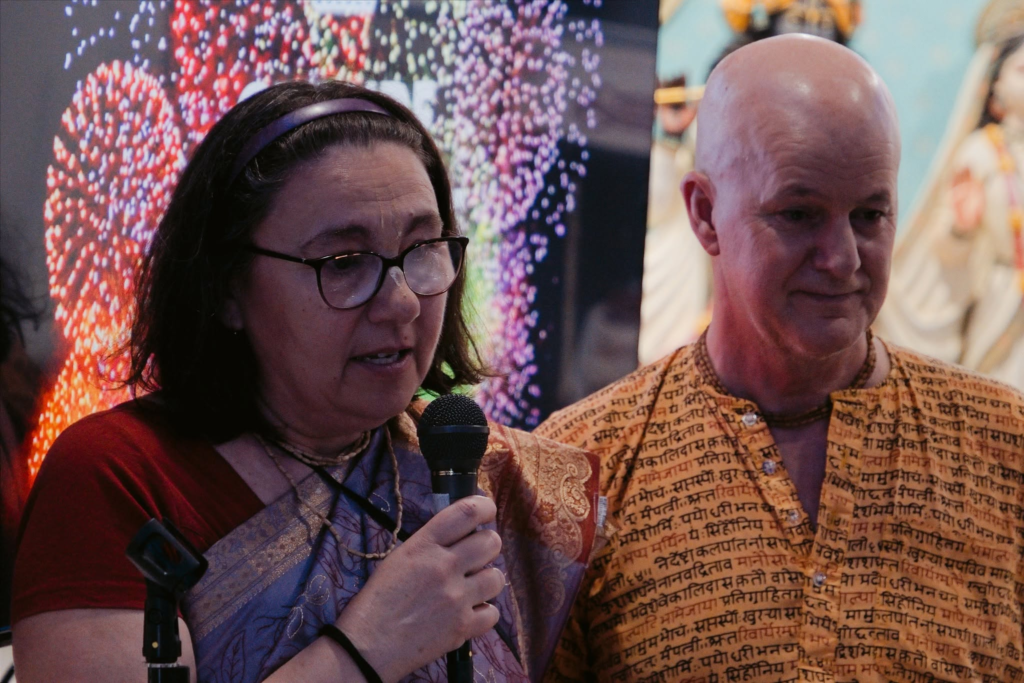
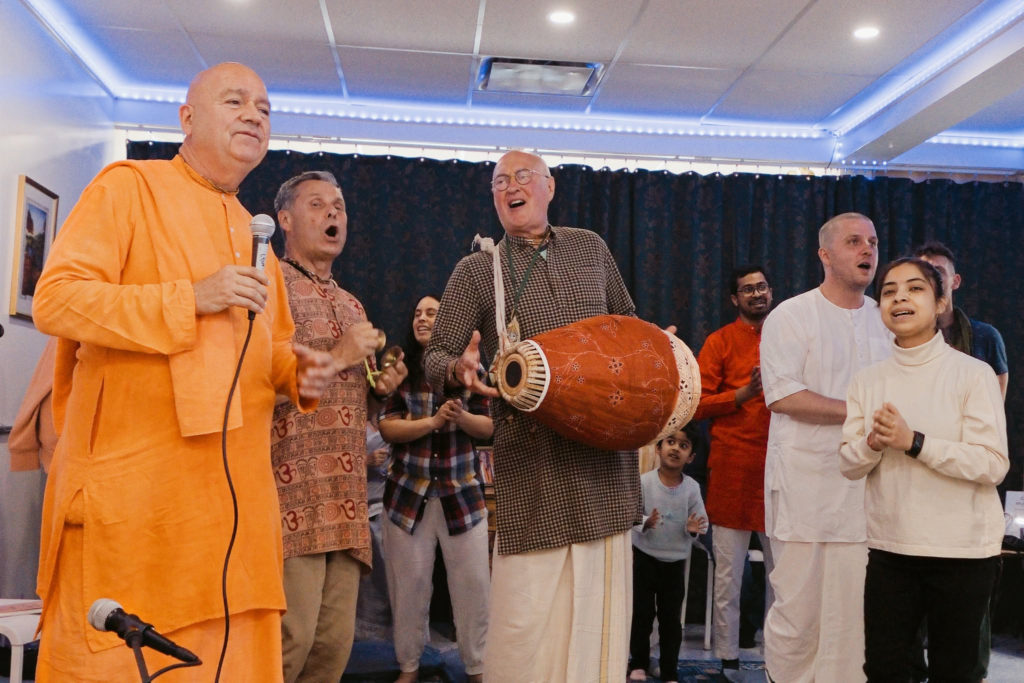
My dear friends, Īśvara Śyāma Dās and Ekananda Vallabhī Devī Dāsī, a gentle and devoted Russian Vaiṣṇava family residing in New Rāmanā Reti (ISKCON Alachua, Florida), also returned recently from a two-week December stay in Miami. Yet the manner in which they spent this time stands apart. Rather than indulging in ordinary recreation, they engaged daily in harināma-saṅkīrtana on the streets and beaches of Miami. Their example is so inspiring that it deserves to be shared with the broader Vaiṣṇava community.

How It All Began

“It began in 2021,” Ekananda Vallabhī Devī Dāsī recalled. “We were planning a December vacation when we happened to see a video of a joyful Christmas harināma in Moscow. At that moment, we understood—this is how we wished to spend our holiday.”

Several kīrtanīyas from Russia were then invited, and they joyfully agreed to participate. “I danced,” she said with a smile. “Īśvara Śyāma carried the speaker, our guests from Moscow led the kīrtanas, our son Balarām played the mṛdaṅga, and our daughter Mañjarī distributed coconut sweets accompanied by messages from the Bhagavad-gītā.” From this simple beginning emerged what later came to be known as the Karuṇā Bhakti Harināma Saṅkīrtana.

Iśvara Śyāma Dās and Ekananda Vallabhī Devī Dāsi.

A Devotional Vacation Routine

How, then, does one organize a vacation centered on harināma? “First,” Īśvara Śyāma Dās explained, “we rent a modest yet sufficiently large house in a Miami suburb for two weeks. The expenses are shared among the devotees staying together, and local devotees from ISKCON Miami also participate.” Ekananda Vallabhī Devī Dāsī added, “We live together very much in the spirit of the glorious Rādhā-Dāmodara Saṅkīrtana Party.”

Each day begins with japa meditation, followed by maṅgala-ārati, Tulasī-pūjā, and Guru-pūjā. “We chant together in one voice,” she said. Daily Śrīmad-Bhāgavatam classes are delivered by different devotees, while others prepare between 200 and 250 coconut sweet balls, each bearing a verse from the Bhagavad-gītā, reminiscent of fortune messages. Some devotees cook breakfast and lunch. By 1:00 p.m., lunch is completed, allowing sufficient time for rest and preparation for the afternoon outreach.

“Around 2:00 p.m., we depart for harināma,” Īśvara Śyāma continued. “We generally go to Lincoln Road, South Miami Beach, or Hollywood Beach—areas frequented by vacationers. We perform walking harināma for approximately three hours.” During the kīrtana, other devotees distribute Śrīla Prabhupāda’s books as well as the prasādam sweets.

Mercy on the Streets of Miami

This year, more than twenty devotees took part in the program. Participants joined from Alachua, Miami, New York, Chicago, California, and even Moscow. “People are very pleased to see our procession,” Īśvara Śyāma remarked. “The ladies dance dressed in bright, colorful saris, the Holy Name resounds accompanied by harmonium and mṛdaṅga, and the joyful atmosphere naturally touches everyone.”

Passersby readily accept flyers, books, and prasādam. Many are delighted to take photographs and dance alongside the devotees. Later, some of them even come to visit the local temple. Reflecting on these experiences, Ekananda Vallabhī Devī Dāsī observed, “Harināma is truly extraordinary. It dissolves misunderstandings—within communities and even within families. The Holy Name performs miracles.”

The best Christmas for a child.

Devotees offering sankirtan in the streets.

Locals joining the joyful celebration.

Gratitude to Our Spiritual Teachers and Śrīla Prabhupāda

Above all, this harināma vacation is offered in a spirit of deep gratitude to the devotees’ spiritual masters and to His Divine Grace A.C. Bhaktivedanta Swami Śrīla Prabhupāda, whose boundless compassion and visionary guidance made such activities possible. Chanting in public, distributing books and prasādam, and living together in a mood of service are all humble attempts to follow his instructions and to please his heart.

“For devotees,” Ekananda Vallabhī Devī Dāsī explained, “December holds special significance as Śrīla Prabhupāda’s Marathon month—a time dedicated to increased effort in preaching, book distribution, and the sincere sharing of Kṛṣṇa consciousness. Remembering this, we try to make our December vacation not merely a pause from routine, but an offering of service. By engaging in harināma and distributing Śrīla Prabhupāda’s books, we hope to bring joy to his heart and extend his mercy to others. If even a small portion of this service pleases Śrīla Prabhupāda and our spiritual masters, we consider our vacation fully successful.” She concluded with a gentle smile.

An Invitation to All Devotees

We humbly encourage devotees everywhere to consider following this simple yet powerful example: transform your family vacation into harināma-saṅkīrtana. Invite local kīrtanīyas, or lead the chanting yourselves. Go to places where people naturally gather. Chant the Holy Name together as a family. Such engagement is deeply joyful, purifying, and spiritually nourishing. Those seeking guidance may contact the Karuṇā Bhakti team, who will be happy to assist.

Hare Kṛṣṇa.

Can Marital Struggle Become An Opportunity For Deeper Spiritual Care?

0

Seva Care has released a new episode in its ongoing podcast series, Care During Tough Times, entitled “Marriages and Vaiṣṇava Community Support.” This episode features Dhanya Rico, M.Ed., Ed.S., NCC, a National Certified Counselor specializing in personal and relationship wellness. The discussion offers a sober and compassionate examination of how individuals and devotional communities may respond to marital challenges, separation, and divorce within the shelter of Vaiṣṇava principles.

The episode is hosted by Dhanya Devi Dāsī together with Tamohara Dāsa, PhD—an educational psychologist, former faculty member in counseling and clinical psychology, and a member of the Gṛhastha Vision Team. Their dialogue centers on approaching these delicate and often painful life circumstances through the lens of devotional service. Together, they consider how members of the Vaiṣṇava community can acknowledge and process the emotions that arise during marital difficulty, extend practical and spiritually grounded support to others, and thoughtfully integrate such experiences into their own spiritual practice.

Dhanya Devi Dāsī brings to the conversation a rare synthesis of professional training and lived devotional experience. A musician and traveling kīrtanīyā, she is also a widely respected educator in the field of personal and relationship wellness. She holds a Master’s degree in Counselor Education and a Specialist’s degree in Couples and Family Therapy, and for more than a decade she has dedicated her work to helping individuals and relationships flourish by situating profound spiritual principles at the heart of genuine personal transformation.

Listeners may access Seva Care Education, Episode 14, featuring Dhanya Devi Dāsī here. . Those who wish to remain informed of future episodes are encouraged to subscribe to Seva Care of Alachua on  YouTube and to follow them on Facebook. Additional content may also be viewed the ISKCON Alachua here and here.

Śrīmatī Vṛṣabhānu-Nandinī – The Daughter Of King Vṛṣabhānu

0

Overview

For Śrī Rādhāṣṭamī, we present this lecture by Prabhupāda Bhaktisiddhānta Sarasvatī Ṭhākura given on Thursday, 26th August, 1925, at Kolkata Gauḍīya Maṭha, on the occasion of Rādhāṣṭamī. Amongst other topics, Sarasvatī Ṭhākura talks about the pre-eminent position of Rādhārāṇī, how Rūpa Gosvāmī’s descriptions of the afternoon pastimes of Rādhā-Govinda surpasses the narrations of Nimbārkācārya, the prerequisite to understand higher topics, and Śrī Rūpa and Jīva Gosvāmī’s opinions on Svākiya and Parakīya-rasa.

yasyāḥ kadāpi vasasāñcala-khelanottha
dhanyāti-dhanya pavanena kṛtārthamānī
yogendra-durgama-gatir madhusūdano’pi
tasyā namo’stu vṛṣabhānubhuvo diśe’pi

May our respects be offered unto Śrīmatī Vṛṣabhānu-nandinī, by whose flowing garment the wind, becoming supremely blessed, touched the body of Kṛṣṇa, and thereby made Śrī Nanda-nandana feel most fulfilled – who Himself is most difficult to attain, even for the monarchs amongst yogīs.

This statement has been sung by Tridaṇḍipāda Śrī Prabodhānanda Sarasvatī in his Śrī Rādhā-rasa-sudhā-nidhi. Śrī Prabodhānanda himself is a great yogī; in kṛṣṇa-līlā he is Tuṅgavidyā. Following in the footsteps of Śrī Prabodhānanda-pāda, we too offer our obeisance unto the daughter of Vṛṣabhānu.

Śrī Rādhā – The Enchantress of Govinda

In this world, there exists many kinds of objects that serve as the very abodes of beauty, charm, and qualities. Śrī Kṛṣṇacandra is the shelter of all rasas, as well as the foundation of qualities such as beauty, charm etc. He is the fundamental āśraya-tattva of all opulence, strength, and knowledge. Moreover, how great is His essential nature of that supremely perfect Bhagavān, who is both the āśraya (the abode of divine love) and the viṣaya (the object of divine love)? It is beyond human comprehension, and even beyond the conception of many mukta-puruṣas, or liberated souls. Śrī Kṛṣṇa, by whose majesty and sweetness the whole universe is charmed, who becomes captivated by His own beauty, is Himself enchanted by Her. The greatness of She who enchants even Madana-mohana, the bewilderer of the universe, is beyond the power of language to convey to others.

The Glories of Śrī Rādhā, the Āśraya-Vigraha, are Solely Known and Proclaimed by Kṛṣṇa Himself.

Although Kṛṣṇa is the viṣaya–tattva (the object of love), still, He is the viṣaya of the āśraya (Śrī Rādhā). In the material world, there are classifications of distinctions and material relationships that exist between men and women – there are higher and lower bhāvas, and mutual differences. However, between Śrīmatī Rādhikā and Śrī Kṛṣṇa, such types of distinctions or material relationships do not exist. Vṛṣabhānu-nandinī is not inferior to Kṛṣṇa. Śrī Kṛṣṇa Himself, as both the relisher (āsvādaka) and the relished (āsvādita), eternally assumes two forms. If Śrīmatī Rādhikā’s beauty were not greater than Kṛṣṇa’s, whose unparalleled beauty enchants even Himself, then it cannot be possible for Her to enchant Him. Śrīmatī Rādhā is Bhuvana-mohana-mana-mohinī (the enchantress of the mind of Kṛṣṇa, who charms the world), Hari-hṛṅga-mañjarī (the tender bud embracing Hari’s body), Mukunda-madhu-mādhavī (the sweet mādhavī blossom of Mukunda), Pūrṇa-candra-kṛṣṇa-pūrṇima-svarūpiṇī (the embodiment of the full moon to the full moon-like Kṛṣṇa), and Kṛṣna-kāntā-gaṇa-śiromaṇi-svarūpā (the personified crest-jewel amongst those who are Kṛṣṇa’s beloved). The ontological truth of Vṛṣabhānu-nandinī cannot be explained in the language of an individual jīva, or even of the collective jīvas. The sevaka (servant) has no such language by which he can properly describe his sevya-vastu (the object of his service). Yet service alone is capable of describing the ontological truth of the servant. Hence, it is Bhagavān Kṛṣṇacandra Himself who can reveal to us the tattva of Śrīmatī Rādhārāṇī.

There is also another who is capable of making the tattva of Govindānandinī the object of realisation for our purified ātmā; that is, one who directly serves both Vṛṣabhānu’s daughter and Kṛṣṇa – that is, Śrī Gurudeva, the intimate associate of Śrī Gaurasundara, or those who are the very potency of Gaura. That Kṛṣṇacandra, who is rādhā-bhāva-dyuti-suvalita-tanu (who has assumed a form endowed with Rādhā’s heart and halo), in other words, who has accepted Her mood and splendour – that Kṛṣṇacandra alone can reveal Śrīmatī’s glories within the mundane world. His most beloved servants can also speak of that supreme tattva, but apart from them, no one else is capable.

Prior to Śrī Gaurasundara’s Teachings, Narrations About the Midday Service of Śrīmatī Were Unknown

Previously, the way in which narrations concerning the Daughter of Vṛṣabhānu were propagated in the world – in other words, the way that Ācārya Nimbārkapāda described the method of worshipping Śrī Rādhā-Govinda to Śrīnivāsācārya and others – in that, the glories of Śrīmatī were not revealed in the material world in such an elaborate manner. To those who had absolutely no right of entry into the midday pastimes (madhyahnika–līlā), the accounts of the nocturnal pastimes (niśa-līlā) of Śrī Rādhā-Govinda had become greatly honoured by them. The narrations of the nocturnal pastimes on the banks of the Yamunā which Śrī Nimbārka-pāda has sung, are far surpassed in comparison by the excellent descriptions of the sweet midday pastimes of Śrī Rādhā-Govinda, as spoken by Śrī Rūpa-pāda, the most beloved of Śrī Gaurasundara, and his followers, as they are much more elevated and complete. Before the advent of Śrī Gaurasundara, based upon the doctrine of Acintya-bhedābheda and in contrast to the deliberations of Dvaita-advaita philosophy, no worshipper or ācārya was able to properly describe the excellence of rasa, the confidential plane of Goloka, and the ever-fresh, unparalleled playful pastimes that unfold beneath the transcendental desire-trees in the kuñjas along the banks of Rādhā-kuṇḍa. Some of them were merely acquainted with the accounts of the pastimes at the rāsa-sthalī. But in what manner Vṛṣabhānu-nandinī achieves the right of serving Kṛṣṇa at midday – previously, no one ever had the eligibility to enter into that service of sweetness and beauty. Attracted by the sound of the flute, so many of Kṛṣṇa’s maidservants – unmarried girls, married women etc. – had attained the qualification to participate in the rāsa-sthalī. But the fortune of entering into the zenith of līlā specified by the phrase, dolāraṇyāmbu-vaṁśī-hṛti-rati-madhupānārka-pūjādi-līlau* which has been described by Śrī Rūpa, is not attainable by anyone other than the Gauḍīyas, the associates of Gaura, who serve in madhura-rasa. This topic is not known to anyone of the Nimbārka sampradāya.

* Dolāraṇyāmbu-vaṁśī-hṛti-rati-madhupānārka-pūjādi-līlau – They engage in various pastimes – playing on a swing, wandering in the forest, sporting in the water, hiding the flute, drinking honey-beverages, worshipping the sun and so on. (Govinda-līlāmṛta 8.1)

The Divine Mellows of Madhura-Rasa Are Beyond the Reach of Those Who Take Refuge in Mundane Rasa

The exalted status of Śrīmatī’s pālya-dāsīs (personal maidservants) is not within the grasp of human understanding. No one except Her own associates, who are eternally engaged in the intimate service of Vārṣabhānavī, can know all these topics. The day when you have no perception whatsoever of the external world, when trivial morality, austerity, karma, jñāna, and endeavours in yoga will seem to be things fit to be rejected, when even accounts of the awe-filled Śrī Nārāyaṇa will seem to be distasteful, and when even the dance at the rāsa-sthalī will not seem to be such a great topic – on that day alone will you be able to understand these matters.

Matters concerning Śrī Rādhā-Govinda’s service cannot be expressed in the language of any country. When the words svakīya and pārakīya are spoken,* we mix them with our own conception of sensual pleasure. For this reason, those who are qualified to speak, hear, and understand the pastimes of Śrī Rādhā-Govinda are extremely rare – it would not even be an exaggeration to say that such people do not exist in this world.

* Svakīya means legal conjugal mellows; pārakīya means paramourship.

The Misconceptions and Misunderstanding of the Prākṛta Sahajiyās

One group of prākṛta-sahajiyās says that Śrī Rūpa-pāda displayed madness for pārakīya–sevā, but Śrī Jīva was not like that. The decisions of those who judge through their mundane senses and arrive at a conclusion are not in accordance with the actual truth. Śrī Jīva-pāda, the foremost of Śrī Rūpa’s followers, was established in the position of ācārya after Śrī Rūpa Gosvāmī. The prākṛta-sahajiyās sect falsely imagines or alleges that Śrī Jīva-pāda, by describing the marriage of Śrī Rādhā-Govinda in the text of Gopāla Campū, and by following the path of deliberation in the Sandarbhas, has silenced the pure pārakīya doctrine, as propounded by Śrī Rūpa. In reality, this is not the case. We have observed such misconceptions in the prākṛta-sahajiyā tradition going back two or three hundred years. Even today, that notion is seen to be prevalent in the prākṛta-sahajiyā community. Śrī Jīva-pāda is the ācārya of the Rūpānuga Gauḍīyas. He has endeavoured to protect insignificant jīvas as ourselves, from straying on the wrong path. Thus, for those who are overcome by perverted tastes, who lack the capacity to understand spiritual diversity, Śrījīva-pāda has shown such a deliberation on the true siddhānta so that all dull, materialistic people may not fall into great difficulty.

Even such persons who have attained the apex of morality, who have attained expertise in renunciation, observance of great vows, and dharma are not capable of understanding even a particle of these astonishing pastimes. Such are the transcendental pārakīya pastimes that are full of astonishment. Because unqualified persons are incapable of understanding it, in certain places, Śrī Jīva-pāda has presented conceptions based on morality according to the eligibility of the adhikārī. Through this, no fault arises in kṛṣṇa-bhajana. The lawful marriage of Rādhā-Govinda, as described in Gopāla Campū, is not an attack on Their pārakīya–bhāva.

Śrīmatī Rādhikā, the foremost Heroine of pārakīya–rasa and Daughter of Vṛṣabhānu, having completely renounced all worldly desires – including the familial bonds with Her husband Abhimanyu – is prepared at all times to serve the Son of the king of Vraja, who is the Absolute Truth beyond duality. Yet the sahajiyās, who fully consider this through mundane intelligence, may think that She was attached to worldly enjoyment. In reality, such a view is a misunderstanding of Her supreme, selfless devotion. But even compared to Arundhatī,* the chastity of Vṛṣabhānu-nandinī is greater. Pati-vratya-dharma (the marital duty of a chaste wife) has entirely arisen from Vārṣabhānavī alone. The essence of all good morality is contained in the lotus feet of Vṛṣabhānu-nandinī.

yāṅra pati-vratā-dharma vāñche arundhatī

Arundhatī desires the pati-vratya-dharma of Rādhikā (Caitanya-caritāmṛta, Madhya-līlā 8.184)

*Arundhatī is the wife of Vasiṣṭha Muni, and is famous for her chastity to her husband.

An Analysis of Rasa, or Rati, and Samāgrī

Śrī Kṛṣṇa is the origin (aṁśī) of all viṣṇu-tattva. Śrīmatī is the origin (aṁśīnī) of all all Mahā-Lakṣmīs. Śrī Kṛṣṇa, as the aṁśī–avatārī (origin of all avatāras), expands as various avatāras such as prābhava, vaibhava, and the puruṣas. Similarly, aṁśīnī Śrīmatī Rādhikā expands as the Lakṣmīs, Mahishīs (queens of Dvārakā), and the beautiful women of Vraja. Śrī Kṛṣṇa alone is the Master of all, and Śrī Vṛṣabhānu-nandinī alone is eternally qualified to serve Him. Thus, She is nothing other than His nitya-kāntā-śiromaṇi (the crest-jewel amongst His eternal lovers).

Śrī Kṛṣṇa is the only viṣaya (enjoyer). All jīvātmās, possessing sthayī-rati (eternal attachment), are the āśraya (the source of enjoyment) of that bhagavat-tattva. Śānta (neutrality), dāsya (servitude), sakhya (friendship), vātsalya (parental affection), and mādhurya (conjugal love) – these are the five kinds of rati (attachment) or sthayī-bhāva (permanent ecstatic moods) in relation to Śrī Kṛṣṇa. This rati, in the form of sthayī-bhāva though itself a form of bliss, attains the state of rasa when it unites with the components of rasa, or samāgrī. The samāgrī is of four types:

  1. Vibhāva (voluntary symptoms of bhāva)
  2. Anubhāva (involuntary symptoms of bhāva)
  3. Sāttvika (ecstatic symptoms)
  4. Vyabhicārī, or Sañcārī (transitory bhāvas)

For relishing rati, there are two kinds of vibhāva – ālambana (supportive) and uddīpana (stimulative). There are two types of ālambana – viṣaya (enjoyer) and āśraya (the object of enjoyment). He who is the object of rati – in other words, toward whom the attachment is operative – is the ālambana in the form of the viṣaya. That is, the ālambana in the form of the viṣaya is the goal of rati, and He who is the support of rati, meaning, in whom rati is present – is the ālambana in the form of the āśraya.

The Divine Abode and Uninterrupted Time

In Vaikuṇṭha and other dhāmas, all three phases of time exist simultaneously. In this material world, which is an inferior reflection of Vaikuṇṭha and other realms, the good fortune of the past or future are not experienced in the present – it is not so in the original, transcendental Vaikuṇṭha and other spiritual worlds. There, all good fortune is experienced simultaneously at the same moment in time.

An Analysis of the Mutual Relationship Between the Viṣaya and the Āśraya

In Goloka, advaya-jñāna Śrī Kṛṣṇa, the Absolute Truth beyond duality, is the sole viṣaya, and the infinite jīvātmās are the āśraya. Those who are the āśraya are not separate from the viṣaya, nor are they secondary entities. They are the āśraya of the advaya-jñāna viṣaya. The relationship between the viṣaya and the āśraya is that they are one in essence (vastutva) and many in potency (śaktitva). The sahajiyas, who are fixed in material sense-perception, are incapable of understanding this topic of viṣaya and āśraya. For those who believe in the non-differentiated Absolute (nirviṣeśa-vāda), there is no place for the viṣaya and the āśraya.

In his treatise on poetics named Sāhitya Darpana, Śrīla Narahari Tīrtha, under the name ‘Viśvanātha Kavirāja’ from his previous āśrama, was unable to properly describe the viṣaya and āśraya to this extent. Indeed, even the author of the Kāvya Prakāśa, or Bharata Muni have been incapable of describing it. In the writings of Śrīla Rūpā-pāda, the topic of the transcendental viṣaya and āśraya have been clearly revealed.

Although for the viṣaya-tattva, countless jīvātmās exist as the āśraya, for Vrajendra-nanda, the primary form of the āśraya-tattva is fivefold. In the madhura-rasa, it is Śrī Vṛṣabhānu-nandinī; in vātsalya-rasa, it is Nanda-Yaśodā; in sakhya-rasa, it is Subala and others; in dāsya-rasa, it is Raktaka and others; and in śānta-rasa, it is the cows, deer, the flute, etc. In śānta-rasa, the subtly conscious transcendental entities – the cows, deer, flute, kadamba trees, the banks of the Yāmuna etc. – continuously serve Śrī Kṛṣṇa unknowlingly.

Considerations of Qualified Participants in Madhura-Rasa etc.

Only those who no longer have the leisure to waste on matters of the external world are capable of understanding the essence of these topics. In order to show this, Śrīla Rūpa-pāda enacted the renunciation of worldly things – eating dry roṭis and chickpeas, spending each night under a different tree – and by showing the ideal of renunciation for the pleasure of Kṛṣṇa, he granted the eligibility and qualification to understand all these matters.

In the position and condition in which we are situated, the ontological truths about Śrī Rādhā, the very embodiment of Kṛṣṇa’s love, cannot become perceivable to our gross material senses. The Daughter of Vṛṣabhānu is the āśraya-jātiya (the abode of love) of Kṛṣṇa, the Supreme Reality. In that realm where neither the gross world, the subtle world, nor even the non-differentiated perception of pure consciousness exists – in that transcendental abode where the wondrous divine playful pastimes are fully present – Śrī Rādhikā is present, occupying the supreme position within it. She climbs upon Kṛṣṇa’s chest to serve Him; and for His service; She even goes so far as to goad Him or scold Him. All these matters are not something to be grasped merely by ascending through the higher stages of ordinary human reasoning, nor are they a matter of simply reaching the stage of consciousness acknowledged by the impersonalists. Yet, only one in whom the greed for attaining Kṛṣṇa has arisen, can, by their own inner disposition, realise the essence of all these topics.

The Ontology and Glories of Śrīmatī Vārṣabhānavī

Śrīmatī Rādhikā is the original form of Kāminī who belongs to svayaṁ-rupa Śrī Kāmadeva (Kṛṣṇa as the transcendental God of love). Śrī Rūpa Gosvāmī himself is surrendered to that Vṛṣabhānu-nandinī, who is the original source of all transcendental women. Just as Śrī Kṛṣṇa is the aṁśī (source of all male avatāras), similarly, Śrīmatī is the aṁśiṇī (source of all female avatāras). In the description of Śrīmatī Vṛṣabhānu-nandinī’s nature (Caitanya-caritāmṛta, Madhya-līlā, 8.177) it is found:

kṛṣṇa-līlā-manovṛtti-sakhī āśa-pāśa

The sakhīs are Her mental functions, which are concentrated on the pastimes of Kṛṣṇa.

Thousands upon yutheśvarīs (group leaders) amongst the gopīs, along with the thousands upon thousands of maidservants of the original aṣṭa-sakhīs, are serving Vṛṣabhānu-nandinī at every moment. The sakhīs in the form of Her mental functions are of eight types:

  1. Abhisārikā (preparing a romantic rendezvous)
  2. Vāsaka-sajjā (decorating herself)
  3. Utkanthitā (anxiety due to a delay)
  4. Khaṇḍitā (jealous)
  5. Vipralabdhā (dejected)
  6. Kalahantaritā (separated due to an argument)
  7. Proṣita-bhartṛkā (feeling separation from the beloved)
  8. Svādhina-bhartṛkā (controlling the beloved)

Vṛṣabhānu-nandinī, through various servitors, enriches the Lord’s service with the mood of vipralambha (separation), thus producing wonderful transcendental pastimes. Vṛṣabhānu-nandinī has eight sakhīs in the eight directions. Vārṣabhānavī fully possesses the eight moods of the eight sakhīs simultaneously. Kṛṣṇa is the taster of all bhāvas, the relisher of all rasas, the object of all love – taking all those moods as complete instruments, She becomes fulfilled in whatever Kṛṣṇa desires and remains eternally absorbed in the bliss of intimate service to Śrī Kṛṣṇa.

The Ontology and Abundance of Qualities of Śrī Kṛṣṇa

Although all sixty-four qualities of Śrī Kṛṣṇa are fully resplendent at all times in Śrī Nārāyaṇa in their pure, spiritual form, they are present in Śrī Kṛṣṇa in an even more extraordinary way. Moreover, the four unique and heroic qualities of Śrī Kṛṣṇa are not manifested even in Śrī Nārāyaṇa. The surge of the waves of Śrī Kṛṣṇa’s pastimes astound all the worlds. There is nothing equal or superior to the beautiful form that He possesses. He is the player of the flute that captivates the minds of the three worlds. He is resplendent with the unparalleled prema of śṛṅgara-rasa, surrounded by His most beloved circle of companions. In other words, He eternally resides in His spiritual abode, endowed with four extraordinary qualities – līlā-mādhurī (sweet pastimes), rūpa-mādhurī (a sweet form), veṇu-mādhurī (with a sweet flute), and bhakta-mādhurī (with sweet devotees). These four qualities are found in Śrī Kṛṣṇa alone; even Nārāyaṇa does not possess them.

An Analysis of the Distinction and Characteristics of the Conscious and Unconscious worlds.

This material world is a perverted reflection of the spiritual realm. In the transcendental abode there is One who is to be served, and all others are His servants. Also, in the material world, the number of both the served and the servants is many. In the spiritual world, the only happiness of the One Worshipable Object is itself the eternal, spiritual interest of the servants. This material world is but a mutated reflection of that spiritual realm, where there have been, are, and will be many objects of service and many servants. In this material world, the interests of the servant and the served are mutually different. Here, if the service becomes a hindrance to the servant’s own happiness, he abandons his service to the served. In brief, this means that in this place, selflessness, either in the served or the servant, does not exist, and everything here is either lacking in single-minded purpose, or tainted with the defect of disloyalty.*

*Translator’s Note: The original word that Sarasvatī Ṭhākura uses here is vyabhicāra which has been translated as ‘disloyalty.’ However, a more common translation is ‘infidelity’ or ‘adultery.’ Considering that the jīva is female by constitution and is to be enjoyed by Kṛṣṇa, any enjoyment that the jīva engages in which is not centred on Kṛṣṇa is considered to be adultery, just as when a wife has an illicit affair with another person.

The wife serves the husband for her own temporary, selfish interests, and the husband loves the wife for his own enjoyment or sense gratification – in other words, the interests of the husband and wife are not one. In this case, however chaste the wife may be, or however moral the husband may be, since they are bound by the nature of the body and the mind, their endeavours are haitukī (dependent upon a motive), anaikāntikī (uncertain), and avyavasāyātmikā (without consistency). Apart from the sole service to Kṛṣṇa, which is the dharma of the ātmā, there is no service anywhere that is free from disloyalty. The affection of parents toward their son in this material world, the reverence of a son toward the parents — even within that, there is gross or subtle desires for sense-enjoyment, or disloyalty. In the realm of the body and mind, there is only the relation of enjoyer and enjoyed; hence, the pure relation of served and servitor does not exist, nor can it exist.

The knowledge of non-duality is found in Vrajandra-nandana. Where there is only Personality who possesses all potencies, or the viṣaya-tattva – where there is no second Person – there, disloyalty cannot occur. There, the viṣaya is one – ekam evādvitīyam (‘He is one without a second’ – Chāndogya Upaniṣad 6.2.1). Potency is infinite – that means, in considering śaktima-tattva (the principle of the Possessor of potency) and śakti-tattva (the principle of the potency itself), non-dual knowledge perceives the oneness of the viṣaya, or the Supreme, and the āśraya, or the potency, to be infinite. The Śvetāśvatara Upaniṣad (6.8) says:

na tasya kāryaṁ karaṇaṁ ca vidyate na tat samaś cābhyadhikaś ca dṛśyate
parāsya śaktir vividhaiva śrūyate svābhāvikī jñāna-bala-kriyā ca

He has no work to perform, nor any instrument to fulfil it; nor is anyone seen to be His equal or superior. His supreme potency is indeed spoken of as manifold, and knowledge, strength, and action are naturally inherent within Him.

An Analysis of the Relationship between the Potency and the Possessor of Potency

Although the principle of non-dual knowledge and the Possessor of potency are one Reality, since the potencies are numerous, during analysis, various distinct attributes in the potency are observed. The followers of Viśiṣṭādvaita have analysed the distinctiveness of the potency – in other words, in Viśiṣṭādvaita, the non-duality of the Supreme Reality and the distinctiveness of potency are established. Therefore, in that philosophy, there is no consideration of pure kevalādvaita (non-duality), devoid of any relation to the āśraya.

The Means of Attaining the Shelter of the Āśraya-Vigraha

In this Devī-dhāma, all objects of enjoyment may be measured with the aid of sensory perception. Yet no one, by means of that sensory-knowledge, should confuse the sovereign of the transcendental realm, Vṛṣabhānu-nandinī, along with Her associates (in other words, the āśraya-tattva rasikas of the fourfold rasas) with the viṣaya-tattva (Kṛṣṇa). In the terminology of the rhetoricians, they are spoken of as the viṣaya and āśraya; in philosophical language, as śaktimān and śakti; and in the devotees’ language, as sevyā (the served) and sevaka (the servant). If we can take shelter of the eternal āśraya-vigraha, then we will, in truth, attain realisation of the viṣaya. Refuge at the lotus feet of Vṛṣabhānu-nandinī, which is described as sudurlabhād api sudurlabhā (‘more rare than rare’) had not been revealed in such a clear and complete way to the finite vibhinnāṁśa-jīvas before the pastimes of Śrī Gaura. Śrī-Gaurasundara, who is rādhā-bhāva-dyuti-suvalita (who is adormed with the heart and halo of Śrī Rādhā), anarpita-carīṁ-prema-pradātā (who had not previously bestowed prema), and mahā-vadānya (most magnanimous) has properly revealed this confidential topic to the jīvas of this world.

Apart From the Gauḍīyas, Other Vaiṣṇava Ācāryas Lack Realisation of Service to Śrī Rādhā

Even when speaking of Ācārya Nimbārka-pāda’s worship of Śrī Vṛṣabhānu-nandinī, it does not display such profundity. This is because, since there is mention of svakīya-vāda in it, it actually has only culminated in aiming at the worship of Rukmiṇī-vallabha.

parakīyā-bhāve ati rasera ullāsa
vraja vinā ihāra anyatra nāhi vāsa
vraja-vadhū-gaṇera ei bhāva niravadhi
tāra madhye śrī-rādhāya bhāvera avadhi

There is an extreme abundance of pārakīya-bhāva – this is not present anywhere except for Vraja. This bhāva is infinite amongst the gopīs of Vraja, and amongst them, the limits of that bhāva is found in Śrī Rādhā. (Caitanya-caritāmṛta, Ādi-līlā 4.47-48)

gopī-ānugatya vinā aiśvarya-jñāne
bhajileha nāhi pāya vrajendra-nandane

Without following the gopīs, one worships with the conception of reverence, and one will never attain the Son of the king of Vraja. (Caitanya-caritāmṛta, Madhya-līlā 8,230)

Considering his allegiance to Śrī Viṣṇu-Svāmipāda, even though Līlāśuka Śrī Bilvamaṅgala has sung about pastimes based on madhura-rasa in the book Kṛṣṇa Karṇāmṛta, nevertheless therein the supreme wonder of the midday pastimes of the Daughter of Vṛṣabhānu, as propagated by Śrīman Mahāprabhu, have not been revealed. Indeed, they have not even been sung in the book Gīta Govinda of Śrī Jayadeva. We can know from Śrī Jayadeva’s Gīta Govinda that at the time of the rāsa dance, Śrīmatī Vārṣabhānavī, being considered ordinary and equal to the other gopīs, abandoned the rāsa-sthālī due to wounded pride. After the Daughter of Vṛṣabhānu left the rāsa-sthalī, due to Kṛṣṇa’s act of searching for Her alone, it was proven in the highest way that Śrīmatī is indeed Kṛṣṇākarṣiṇī (the one who attracts Kṛṣṇa).

Śrīmatī Vārṣabhānavī is the Original Form of the Supreme Potency

The confidential topic of Vṛṣabhānu-nandinī has been spoken in the Śrīmad Bhāgavata only in the form of subtle indications. Topics concerning Śrīmatī Rādhikā are most mysterious and esoteric, so Śrī Śukadeva has only described them in the Śrīmad Bhāgavata in an indirect manner, in order to conceal them from ordinary readers who are averse to the Lord. Śrīmatī Vārṣabhānavī is the mother of the universe. She is the mother of all entities who originated from the potency. She is the source of the various manifestations of potencies, their qualities, and natures also. As Parameśvarī, She is the para-śakti, the supreme potency, of Parameśvara Śrī Kṛṣṇa in His own original form (svayaṁ rūpa). That which is indicated by saying śaktimad-vastu (the Supreme Possessor of potencies) is the very same thing that is signified by saying śakti (potency). Śrīmatī is worshipable to Baladeva and others. Eeveryone up to Śrī Anaṅga Mañjarī is always busy in serving Śrīmatī Rādhikā. This goddess, Śrī Anaṅga Mañjarī, is celebrated as another form of Śrī Nityānanda-Baladēva Prabhu.

Supreme Auspiciousness is Found in Taking Shelter in Those Who Are Sheltered by Śrī Vārṣabhānavī

Shame upon those who do not recognise the shelter of the divine feet of Śrī Vārṣabhānavī as most desirable. Those who have taken shelter of Śrī Vārṣabhānavī are supremely fortunate! If we can take shelter of those who have obtained the great refuge of that Vārṣabhānavī, then our supreme auspiciousness will be achieved. Therefore:

dīvyad-vṛndāraṇya-kalpa-drumādhaḥ-
śrīmad-ratnāgāra-siṁhāsana-sthau
śrīmad-rādhā-śrīla-govinda-devau
preṣṭhālībhiḥ sevyamānau smarāmi
(Caitanya-caritāmṛta, Ādi-līlā 1.16)

I remember Śrī Rādhā-Govinda, who are seated upon a jewelled throne within the divinely effulgent Vṛndāvana, beneath a wish-fulfilling spiritual tree, surrounded by Śrī Rūpa Mañjarī and the other dedicated maid-servants, together with Śrī Lalitā and the other beloved sakhīs.

(Translated by Swami Bhaktivijñāna Giri)

Abhirama Gopal Thakur

0

He belonged to the lineage of Lord Caitanya.  In Ramalila he was Bharata, in Krsnalila he was Sridama sakha, and in Gauralila one of the twelve Gopalas. A close associate of Nityananda Prabhu, Abhirama Goswami was also known as “Ramadasa”, “Rama”, “Abhirama Thakura”, etc.  His Sripata is located at Khanakula Krsnanagar in the Hugli district.  Malini Devi was his wife. 

In a state of loving ecstacy Abhirama lifted a huge log, which would ordinarily have taken sixteen people to lift, and held it as a flute. (According to Bhaktiratnakara 4.123, It would have taken 100 people to lift it)  

It has been said that Abhirama was so spiritually powerful that whenever he offered his humble obeisances to the Deity or Salagrama, the latter would crack.  By offering his obeisances to the seven sons of Nityananda Prabhu, Abhirama killed them all. Later when Virabhadra Goswami was born, he was able to survive Abhirama’s pranama.  In great joy Abhirama acknowledged Virabhadra as the second embodiment of Lord Gauranga, which he also mentioned in his own writing entitled Sri Virabhadrastaka:  “Soyan prasidatu Harih kila Virabhadra.”

Mother Ganga was also glorified in the same way by Abhirama in his Gangastotra (6):  “I, Sridama sakha, am moving all over the earth to find that object which can withstand my obeisances.  But my dear Mother Ganga! After I offered you obeisances twelve times and you still remained unharmed and smiling, only then did I become aware of your extraordinary spiritual wealth.”

Abhirama always carried a cane named “Jayamangala”. Anyone who was fortunate enough to be touched by it was blessed with the wealth of divine love.  Srinivasa Acarya received such a benediction.  Abhirama liberated great numbers of pasandis.  In the Pata Paryatana it is stated that even the most notorious pasandi trembled in fear at the sight of Abhirama.

It has been said that since the time of Krsna’s appearance Sridama sakha never took birth again, but wandered about in that same form. Later he met Nityananda Prabhu in Vrndavana.  In the unpublished work of Vrndavana dasa Thakura entitled Aisaryamrta‑Kavya (109‑111) it is explained that during the Dvapara Yuga, at the time of Vrajalila, Nityananda Prabhu brought Sridama, in his subtle body, out of a mountain cave and took him to Navadvipa, where Nityananda revealed to Sridama the truths regarding Gauralila.  But the following extract from Bhaktiratnakara (4.105‑108) says:  Abhirama incarnated in the house of a brahmana in order to liberate the fallen jivas.  He was erudite in all scriptures, extremely charming, and expert in the art of dancing, vocal and instrumental music.  Submitting to the desire of Nityananda Prabhu, he married an extremely qualified girl named Malini, the daughter of a scholarly brahmana. 

In most Vaisnava books Abhirama and Ramadasa are mentioned as one and the same person. But the late Jagadvandu Bhadra states, “The late Jagadisvara Gupta mentions Ramadasa as another name of Abhirama; the fact is not so.  *****It is explained in the book Abhiramalilamrta that Lord Gauranga requested Abhirama Gupta should be brought from Vrndavana to Navadvipa when Abhirama instead of accompanying Lord Gauranga, revealed the image of Ramadasa generating his force.***** Then Abhirama accompanied Lord Gauranga to Navadvipa where he captivated the world with his dancing, kirtana, and taming of the pasandis.  *****Ramadasa, the svarupa of Abhirama, belonged to Sri Nityananda sakha, and Abhirama himself belonged to Sri Caitanya sakha (Gaurapadatarangini P. 21). Abhirama wrote Sri Virabhadrastaka and Sri Gangastotra.

Bhaktiratnakara informs that Abhirama, *****while in a dreaming state, lifted the Deity Sri Sri Gopinatha from beneath the earth at Khanakula Krsnanagar and installed it there.  The site from which the deity was lifted is known as “Ramakunda” (Bhaktiratnakara 4.118).  He is said to have established the Balimatha at Puri.  Abhirama died on the seventh day of the dark fortnight of Vaisaka.  BMO p.121 mentions two other unpublished works which give biographical information on Abhirama entitled Abhiramapatala and Abhiramabandana.

Bhagavandasa Babaji Maharaja

0

He became a disciple of Siddha Krsnadasa babaji of Govardhana.  It is said that Bhagavandasa was originally from Orissa, but he always conversed in Bengali.  He introduced the worship of the Deity of Nama-Brahmah at Kalana, which is still going on.

Bhagavandasa was a reserved person who rarely discussed Raganuga bhajana with anyone.  Even with his disciple, Jagadisadasa, he only spoke on the subject matter in brief. He did not approve of the emotional behavior of Caitanyadasa babaji of Navadvipa (during his bhava state), referring to him as a `facke’ (frivolous).

On one occasion when the pujari of Nama-Brahmah ran away with the ornaments of the deity, close associates of Bhagavandasa suggested that the theft be reported to the police.  Bhagavandasa did not agree and explained to his devotees that Nama-Brahmah had allowed the pujari to take the ornaments away because Nama-Brahmah did not wish to wear them any longer.

After a few months the pujari suddenly appeared one day with all the ornaments.  He admitted to stealing out of greed, but said that his conscience would not allow him to sell the ornaments, and begged Bhagavandasa to forgive him.  The pujari was allowed to return and Bhagavandasa remarked that the Deity of Nama-Brahmah had changed his mind like a `facke’ and wished to be re-decorated with the ornaments.

On one occasion the servants of Bhagavandasa purchased a bundle of wood for three annas from a poor woman vendor.  Bhagavandasa, who was observing the transaction, called the woman over and found out that she had two older sons, besides the little one with her, and no one else in her family. Thinking that three annas would be of very little use to her, Bhagavandas told his servant to pay her three more annas.  After that vendors were not allowed within the sight of Bhagavandasa.

One day a snake was found inside the asrama and one of the devotees picked it up and threw it away at a safe distance.  When Bhagavandasa came to know about it he was very annoyed and ordered the devotee to leave the asrama and stay away.  It is said that the snake happened to be an elder brother of Nama-Brahmah in one of its earlier births.  Bhagavandasa would not take prasada until the snake had taken a portion of it.

Bhagavandasa regularly took his evening meals after his daily bhajana recitals.  On some days he was so absorbed in bhajana that he forgot about his meal, which was usually kept close to his seat.  One pet cat of the asrama regularly shared prasada with babaji, thus when Bhagavandasa remained absorbed in prayer till late, the cat would mew repeatedly, going around and around babaji to attract his attention.  Bhagavandasa would lift the lid of the bowl of prasada, allow the pet to help itself and then replacing the lid, continue with his bhajana.

On occasions when Bhagavandasa failed to derive the inspiration desired from his bhajana, he would advise his devotees to take their meals and on pretext of his own illness, he refrained from eating.  If the devotees tried to convince him to eat, babaji would simply reply: “In that case let us all retire to bed without any meal.”  Thus the devotees would reluctantly take their meals.

On the other hand, sometimes when a bhajana session would run late into the night, babaji would suddenly declare himself to be very hungry.  If no food was available at the asrama, he sent the devotees to buy sweets from an outside shop.  He made sure that the sweets were sanctified with sprinkles of charanamrita, then offered them to Nama-Brahmah.

He was a virtuous man both in his practices and behavior.  He did not allow any prasada received as offerings, to be placed on the floor unless the devotees mopped the place clean.  If a devotee failed to do so, babaji would pull him up and call him a Mussulman.  When flowers or garlands were offered to Bhagavandasa, he touched them to his forehead with care, making sure the flowers did not come in contact with his garments.

One of his disciples, Visnudasa, came down with a fever for three continuous days.  When Bhagavandasa advised his disciple to take medicine the latter said that there was no need to do so as he would be cured by the grace of Nama-Brahmah.  Bhagavandasa angrily remarked that, “A man suffers illness as a part of his penance and should act upon a doctor’s advice, rather than pass the responsibility for the disease, and also its cure, to Nama-Brahmah.  After all, it is a doctor’s job to provide aid to a sick person.”  Visnudasa promptly took some medicine and was cured.

One day Bhagavandasa had a sudden desire to eat talsansa (the edible kernel of the stone of a palmyra fruit).  For days he continued to eat talsansa, without touching his normal food.  After some days, due to the excessive intake of fruits, he became very sick with dysentery, nevertheless he insisted on eating the talsansa.  His devotee, having failed to restrain babaji, devised a plan;  They had a mali (gardener) come before the Deity of Nama-Brahmah and proclaim, while beating a drum (dheran), that the sale of talsansa would no longer be permitted in the market.  Any vendor defying this order must pay a fine of twenty five rupees.  After some initial resistance Bhagavandasa reverted to his normal diet.

On another occasion Bhagavandasa announced that he had a strong desire to perform his bhajan seated on a high platform overlooking a pond near the Deity of Nama-Brahmah.  He ordered his disciple Pranakrsnadasa to begin excavating a tank very early the following morning.  Another disciple named Jagadisadasa was put in charge of the construction of the platform.  Pranakrsna hired fifty laborers, paying each man two annas per day, and completed the tank within 24 hours, on the day of ekadasi.  Jagadisa also executed his part of the platform work, with some assistance from Pranakrsna, carrying the necessary bamboo poles from the market on his shoulder and completed the work the following day (dvadasi).  Bhagavandasa was very happy to see the job completed on time and sat down to perform bhajan sitting on the high platform overlooking the pond.  However, after a few days, Bhagavandasa saw a calf accidentally fall into the pond.  Immediately he shouted for his men to rescue the calf from the water, but they were unsuccessful.  From that day babaji shifted his seat of prayer back to its original place and had the pond filled up with earth so as to prevent any other cow from falling in.

One day while Bhagavandasa was absorbed in bhajan, he was heard to shout “go away”.  It came to be known later that he was shouting to scare away a goat which was chewing the leaves of a Tulasi plant in the courtyard of the Govinda temple, far away in Vrndavana.  On that same day the Maharaja of Burdwan, having heard about the powers of Bhagavandas, came to Nama-Brahmah Asrama for darsana.  It so happened that Maharaja entered the asrama at the same time that Bhagavandasa shouted, “go away”.  Naturally, the Maharaja thought that Babaji, for some reason, wanted Maharaja to leave the premises.  Thus, in disappointment, he left Nama-Brahmah Asrama.

Afterwards the devotees told babaji of Maharaja’s arrival and why he had left without getting babaji’s darsana.  Bhagavandasa immediately sent a messenger requesting the Maharaja to visit Nama-Brahmah again.  When the Maharaja again visited the asrama babaji begged forgiveness and explained the circumstances which had led to the misunderstanding on Maharaja’s previous visit.  The Maharaja was understanding, but skeptical as to whether Bhagavandasa Maharaja actually possessed the power to see something which was taking place in Vrndavana.  To satisfy his own curiosity the Maharaja sent a telegram to Vrndavana to verify the truth of the incident.  The reply corroborated the statement made by Bhagavandasa.  From that time Bhagavandasa was known as Siddhababa Bhagavandasa Babaji Maharaja.

Siddhababa rarely discussed `lila’, but occasionally mentioned the topic amongst a few confidential devotees.  Once he told Jagdisadasa to note down some divine-nama which would be of great value to Jagadisa in the future.  Sometimes in the course of speaking with his disciples, Siddhababa would suddenly laugh out loud, without any relevance to the subject of discussion.  Though Bhagavandasa did not talk of his internal meditation, his communion with the Lord continued ceaselessly like the flow of a stream; and his sudden laughter, without any apparent reason, could perhaps, be attributed to the manifestation of his actual state of mind.  Siddhababa Bhagavandasa expired on the eighth day of the new moon in the month of Kartika (Oct.-Nov.).

What Role Does Leadership Training Play In Expanding Bhakti Vṛkṣa Communities?

0

The Bhakti Vṛkṣa Leadership Training (Level One) will take place in Śrīdhāma Māyāpur, India, from February 14 to 16, 2026. This program is designed to provide participants with a systematic and practical foundation for developing into effective leaders in the preaching of Kṛṣṇa consciousness.

The training will be conducted in the English language and will be accessible both through in-person participation in Māyāpur and online via the Zoom platform. It will be guided by His Grace Nityānanda Āśraya Dāsa, Temple President of ISKCON Bahadurgarh, a seasoned Bhakti Vṛkṣa coach and trainer, recipient of international recognition, and an experienced developer of devotional communities.

The course will address essential principles of preaching, structured and effective outreach methodologies, and practical instruction for successfully conducting Bhakti Vṛkṣa classes. It will also examine common obstacles encountered in leadership roles and present thoughtful approaches to overcoming challenges in preaching, including live demonstrations of class facilitation.

Those who wish to deepen their service in devotional leadership are encouraged to enroll in the program and to extend this opportunity to members of their respective communities by registering here. For additional details or inquiries, interested devotees may seek further information accordingly.

How Can Devotional Sound Carry Kṛṣṇa Consciousness Beyond Its Origins?

0

Public voting has now commenced for the Bhakti Song Contest, a grassroots initiative dedicated to exploring how music—together with emerging technologies—may be thoughtfully engaged in Krishna-conscious outreach. Three devotional songs have been formally submitted and are presently available for listening and voting on the Bhakti Song website.

ISKCON News first reported the Bhakti Song Contest in September 2025, when the initiative was presented by Īśvara Kṛṣṇa Dāsa of Bhaktivedanta College in Budapest, in collaboration with Bhakta Szabolcs Tárkányi, a media and marketing professional and long-standing member of the Budapest congregation.

The project was conceived as an exploratory effort to encourage sincere devotional creativity, with artificial intelligence employed solely as an initial creative stimulus. During its early phase, the organizers generated a limited number of AI-assisted songs in order to examine how such tools might be engaged cautiously and responsibly in devotional service.

These preliminary compositions were never intended for independent promotion. Rather, they were meant to serve as inspiration, inviting musically inclined devotees to respond with original works firmly rooted in Krishna-conscious themes and devotional intent.

This process has now borne fruit in the form of three submitted songs, each composed by practicing devotees. All entries are original compositions, aligned with the teachings of ISKCON, and intended for devotional expression and outreach.

The organizers have emphasized sincerity of purpose, philosophical soundness, and devotional mood as the principal considerations guiding the initiative. Instead of selecting a winner through internal deliberation, they have entrusted the decision to the broader devotee community.

Accordingly, the winning song will be determined through public voting, enabling listeners from around the world to participate directly. Voting is hosted on the contest  website, where devotees may hear all three submissions and cast their votes.

The website also makes available the AI-generated songs that initially inspired the project, thereby providing context and illustrating the progression of the initiative from conceptual exploration to collective devotional participation. The voting deadline will be finalized in coordination with ISKCON News.

Upon the conclusion of voting, the winning composition will be announced publicly and shared with the wider ISKCON community. The organizers express the hope that this endeavor will inspire further devotional music-making and offer a humble contribution to ISKCON’s ongoing outreach efforts.

They regard the submitted songs not merely as contest entries, but as offerings—meant to be shared, sung, and employed in devotional settings well beyond the scope of the competition itself.

Devotees are invited to hear the submitted compositions and take part in the public voting by visiting the Bhakti Song website here.

Stay Connected

16,985FansLike
12,500FollowersFollow
61,453SubscribersSubscribe