


Mail ID: contact@vedavarsity.com

Contact: +91 9634998911

Google search engineGoogle search engine
Home Blog Page 138

Srimad Bhagavatam | Canto 4 Chapter 2 | Dakṣa Curses Lord Śiva

0

Vidura inquired: Why was Dakṣa, who was so affectionate towards his daughter, envi ous of Lord Śiva, who is the best among the gentle? Why did he neglect his daughter Satī? (1) Lord Śiva, the spiritual master of the entire world, is free from enmity, is a peaceful per sonality, and is always satisfied in himself. He is the greatest among the demigods. How is it possible that Dakṣa could be inimical towards such an auspicious personality? (2) My dear Maitreya, to part with one’s life is very difficult. Would you kindly explain to me how such a son-in-law and father-in-law could quarrel so bitterly that the great goddess Satī could give up her life? (3)

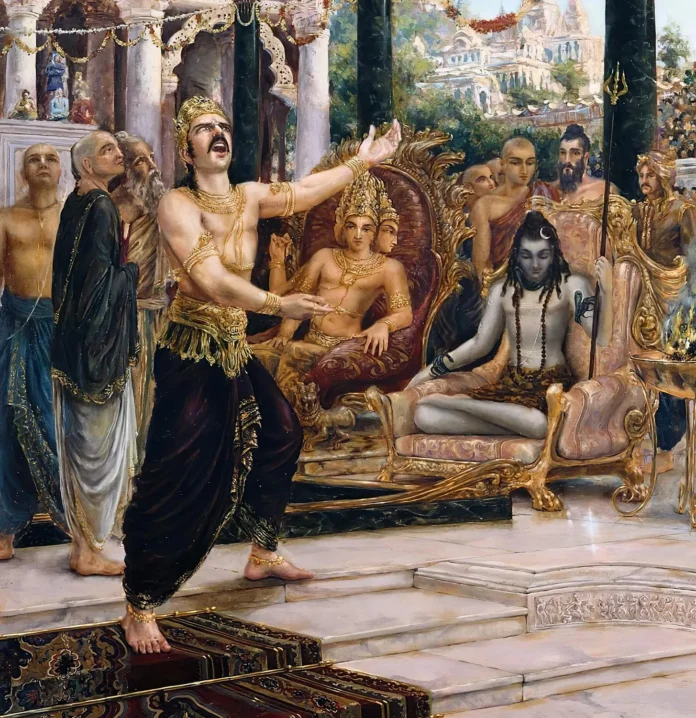
The sage Maitreya said: In a former time, the leaders of the universal creation performed a great sacrifice in which all the great sages, philosophers, demigods and fire-gods assem bled with their followers (4). When Dakṣa, the leader of the Prajāpatis, entered that assembly, his personal bodily luster as bright as the efful gence of the sun, the entire assembly was illu minated, and all the assembled personalities be came insignificant in his presence (5). Influ enced by his personal bodily luster, all the fire gods and other participants in that great assem bly, with the exceptions of Lord Brahmā and Lord Śiva, gave up their own sitting places and stood in respect for Dakṣa (6).Dakṣa was ade quately welcomed by the president of the great assembly, Lord Brahmā. After offering Lord Brahmā respect, Dakṣa, by the order of Brahmā, properly took his seat (7).

Before taking his seat, however, Dakṣa was very much offended to see Lord Śiva sitting and not showing him any respect. At that time, Dakṣa became greatly angry, and, his eyes glowing, he began to speak very strongly against Lord Śiva (8).All sages, brāhmaṇas and fire-gods present, please hear me with atten tion, for I speak about the manners of gentle persons. I do not speak out of ignorance or envy (9).Śiva has spoiled the name and fame of the governors of the universe and has polluted the path of gentle manners. Because he is shame less, he does not know how to act (10).He has already accepted himself as my subordinate by marrying my daughter in the presence of fire and brāhmaṇas. He has married my daughter, who is equal to Gāyatrī, and has pretended to be just like an honest person (11).

He has eyes like a monkey’s, yet he has married my daugh ter, whose eyes are just like those of a deer cub. Nevertheless he did not stand up to receive me, nor did he think it fit to welcome me with sweet words (12).I had no desire to give my daughter to this person, who has broken all rules of civil ity. Because of not observing the required rules and regulations, he is impure, but I was obliged to hand over my daughter to him just as one teaches the messages of the Vedas to a śūdra (13).He lives in filthy places like crematori ums, and his companions are the ghosts and de mons. Naked like a madman, sometimes laugh ing and sometimes crying, he smears cremato rium ashes all over his body. He does not bathe regularly, and he ornaments his body with a garland of skulls and bones. Therefore only in name is he śiva, or auspicious; actually, he is the most mad and inauspicious creature. Thus he is very dear to crazy beings in the gross mode of ignorance, and he is their leader (14 15).

On the request of Lord Brahmā I handed over my chaste daughter to him, although he is devoid of all cleanliness and his heart is filled with nasty things (16). The sage Maitreya continued: Thus Dakṣa, seeing Lord Śiva sitting as if against him, washed his hands and mouth and cursed him in the following words (17).The demigods are eligible to share in the oblations of sacrifice, but Lord Śiva, who is the lowest of all the dem igods, should not have a share (18).Maitreya continued: My dear Vidura, in spite of the re quests of all the members of the sacrificial as sembly, Dakṣa, in great anger, cursed Lord Śiva and then left the assembly and went back to his home (19).

Upon understanding that Lord Śiva had been cursed, Nandīśvara, one of Lord Śiva’s princi pal associates, became greatly angry. His eyes became red, and he prepared to curse Dakṣa and all the brāhmaṇas present there who had tolerated Dakṣa’s cursing Śiva in harsh words (20).Anyone who has accepted Dakṣa as the most important personality and neglected Lord Śiva because of envy is less intelligent and, be cause of visualizing in duality, will be bereft of transcendental knowledge (21).Pretentiously religious householder life, in which one is at tracted to material happiness and thus also at tracted to the superficial explanation of the Ve das, robs one of all intelligence and attaches one to fruitive activities as all in all (22).

Dakṣa has accepted the body as all in all. Therefore, since he has forgotten the viṣṇu-pāda, or viṣṇu gati, and is attached to sex life only, within a short time he will have the face of a goat (23).Those who have become as dull as matter by cultivating materialistic education and intel ligence are nesciently involved in fruitive ac tivities. Such men have purposely insulted Lord Śiva. May they continue in the cycle of re peated birth and death (24).May those who are envious of Lord Śiva, being attracted by the flowery language of the enchanting Vedic promises, and who have thus become dull, al ways remain attached to fruitive activities (25).

These brāhmaṇas take to education, aus terity and vows only for the purpose of main taining the body. They shall be devoid of dis crimination between what to eat and what not to eat. They will acquire money, begging from door to door, simply for the satisfaction of the body (26). When all the hereditary brāhmaṇas were thus cursed by Nandīśvara, the sage Bhṛgu, as a reaction, condemned the followers of Lord Śiva with this very strong brahminical curse (27).One who takes a vow to satisfy Lord Śiva or who follows such principles will certainly become an atheist and be diverted from tran scendental scriptural injunctions (28). Those who vow to worship Lord Śiva are so foolish that they imitate him by keeping long hair on their heads. When initiated into worship of Lord Śiva, they prefer to live on wine, flesh and other such things (29).Bhṛgu Muni continued: Since you blaspheme the Vedas and the brāhmaṇas, who are followers of the Vedic principles, it is understood that you have al ready taken shelter of the doctrine of atheism (30).

The Vedas give the eternal regulative prin ciples for auspicious advancement in human civilization which have been rigidly followed in the past. The strong evidence of this princi ple is the Supreme Personality of Godhead, who is called Janārdana, the well-wisher of all living entities (31). By blaspheming the princi ples of the Vedas, which are the pure and su preme path of the saintly persons, certainly you followers of Bhūtapati, Lord Śiva, will descend to the standard of atheism without a doubt (32). The sage Maitreya said: When such curs ing and countercursing was going on between Lord Śiva’s followers and the parties of Dakṣa and Bhṛgu, Lord Śiva became very morose. Not saying anything, he left the arena of the sacri fice, followed by his disciples (33).

The sage Maitreya continued: O Vidura, all the progeni tors of the universal population thus executed a sacrifice for thousands of years, for sacrifice is the best way to worship the Supreme Lord, Hari, the Personality of Godhead (34).My dear Vidura, carrier of bows and arrows, all the dem igods who were performing the sacrifice took their bath at the confluence of the Ganges and the Yamunā after completing the yajña perfor mance. Such a bath is called avabhṛtha-snāna. After thus becoming purified in heart, they de parted for their respective abodes (35).
Srimad Bhagavatam | Canto 4 Chapter 1 | Genealogical Table Of The Daughters Of Manu

2

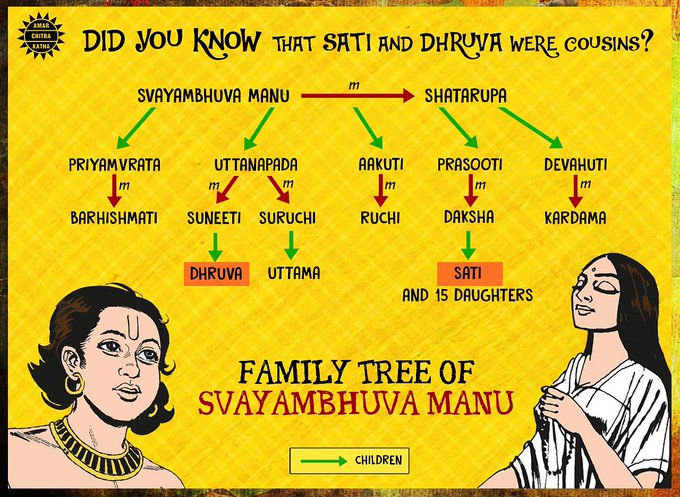
Śrī Maitreya said: Svāyambhuva Manu be got three daughters in his wife, Śatarūpā, and their names were Ākūti, Devahūti and Prasūti (1).Ākūti had two brothers, but in spite of her brothers, King Svāyambhuva Manu handed her over to Prajāpati Ruci on the condition that the son born of her be returned to Manu as his son. This he did in consultation with his wife, Śatarūpā (2). Ruci, who was very powerful in his brah minical qualifications and was appointed one of the progenitors of the living entities, begot one son and one daughter by his wife, Ākūti (3).

Of the two children born of Ākūti, the male child was directly an incarnation of the Su preme Personality of Godhead, and His name was Yajña, which is another name of Lord Viṣṇu. The female child was a partial incarna tion of Lakṣmī, the goddess of fortune, the eter nal consort of Lord Viṣṇu (4).Svāyambhuva Manu very gladly brought home the beautiful boy named Yajña, and Ruci, his son-in-law, kept with him the daughter, Dakṣiṇā (5).The Lord of the ritualistic performance of yajña later married Dakṣiṇā, who was anxious to have the Personality of Godhead as her husband, and in this wife the Lord was also very much pleased to beget twelve children (6).

The twelve boys born of Yajña and Dakṣiṇā were named Toṣa, Pratoṣa, Santoṣa, Bhadra, Śānti, Iḍaspati, Idhma, Kavi, Vibhu, Svahna, Sudeva and Rocana (7).During the time of Svāyambhuva Manu, these sons all became the demigods col lectively named the Tuṣitas. Marīci became the head of the seven ṛṣis, and Yajña became the king of the demigods, Indra (8). Svāyambhuva Manu’s two sons, Priyavrata and Uttānapāda, became very powerful kings, and their sons and grandsons spread all over the three worlds dur ing that period (9). My dear son, Svāyambhuva Manu handed over his very dear daughter Devahūti to Kar dama Muni. I have already spoken to you about them, and you have heard about them almost in full (10).

Svāyambhuva Manu handed over his daughter Prasūti to the son of Brahmā named Dakṣa, who was also one of the progenitors of the living entities. The descendants of Dakṣa are spread throughout the three worlds (11). You have already been informed about the nine daughters of Kardama Muni, who were handed over to nine different sages. I shall now describe the descendants of those nine daugh ters. Please hear from me (12).Kardama Muni’s daughter Kalā, who was married to Marīci, gave birth to two children, whose names were Kaśyapa and Pūrṇimā. Their descendants are spread all over the world (13).My dear Vidura, of the two sons, Kaśyapa and Pūrṇimā, Pūrṇimā begot three children, namely Viraja, Viśvaga and Devakulyā. Of these three, Devakulyā was the water which washed the lo tus feet of the Personality of Godhead and which later on transformed into the Ganges of the heavenly planets (14).

Anasūyā, the wife of Atri Muni, gave birth to three very famous sons Soma, Dattātreya and Durvāsā who were par tial representations of Lord Viṣṇu, Lord Śiva and Lord Brahmā. Soma was a partial represen tation of Lord Brahmā, Dattātreya was a partial representation of Lord Viṣṇu, and Durvāsā was a partial representation of Lord Śiva (15). After hearing this, Vidura inquired from Maitreya: My dear master, how is it that the three deities Brahmā, Viṣṇu and Śiva, who are the creator, maintainer and destroyer of the whole creation, became the offspring of the wife of Atri Muni? (16) Maitreya said: When Lord Brahmā ordered Atri Muni to create generations after marrying Anasūyā, Atri Muni and his wife went to per form severe austerities in the valley of the mountain known as Ṛkṣa (17).

In that mountain valley flows a river named Nirvindhyā. On the bank of the river are many aśoka trees and other plants full of palāśa flowers, and there is always the sweet sound of water flowing from a water fall. The husband and wife reached that beauti ful place (18).There the great sage concentrated his mind by the yogic breathing exercises, and thereby controlling all attachment, he remained standing on one leg only, eating nothing but air, and stood there on one leg for one hundred years (19).He was thinking: May the Lord of the universe, of whom I have taken shelter, kindly be pleased to offer me a son exactly like Him (20).

While Atri Muni was engaged in these se vere austerities, a blazing fire came out of his head by virtue of his breathing exercise, and that fire was seen by the three principal deities of the three worlds (21).At that time, the three deities approached the hermitage of Atri Muni, accompanied by the denizens of the heavenly planets, such as the celestial beauties, the Gandharvas, the Siddhas, the Vidyādharas and the Nāgas. Thus they entered the āśrama of the great sage, who had become famous by his aus terities (22).The sage was standing on one leg, but as soon as he saw that the three deities had appeared before him, he was so pleased to see them all together that despite great difficulty he approached them on one leg (23).

Thereafter he began to offer prayers to the three deities, who were seated on different carriers a bull, a swan and Garuḍa and who held in their hands a drum, kuśa grass and a discus. The sage offered them his respects by falling down like a stick (24).Atri Muni was greatly pleased to see that the three devas were gracious towards him. His eyes were dazzled by the effulgence of their bodies, and therefore he closed his eyes for the time being (25).But since his heart was already attracted by the deities, somehow or other he gathered his senses, and with folded hands and sweet words he began to offer prayers to the predominating deities of the universe (26).

 The great sage Atri said: O Lord Brahmā, Lord Viṣṇu and Lord Śiva, you have divided yourself into three bodies by accepting the three modes of material nature, as you do in every millennium for the creation, maintenance and dissolution of the cosmic manifestation. I offer my respectful obeisances unto all of you and beg to inquire whom of you three I have called by my prayer (27).I called for the Su preme Personality of Godhead, desiring a son like Him, and I thought of Him only. But alt hough He is far beyond the mental speculation of man, all three of you have come here. Kindly let me know how you have come, for I am greatly bewildered about this (28).

The great sage Maitreya continued: Upon hearing Atri Muni speak in that way, the three great deities smiled, and they replied in the fol lowing sweet words (29). The three deities told Atri Muni: Dear brāhmaṇa, you are perfect in your determina tion, and therefore as you have decided, so it will happen; it will not happen otherwise. We are all the same person upon whom you were meditating, and therefore we have all come to you (30).You will have sons who will represent a partial manifestation of our potency, and be cause we desire all good fortune for you, those sons will glorify your reputation throughout the world (31).Thus, while the couple looked on, the three deities Brahmā, Viṣṇu and Maheśvara disappeared from that place after bestowing upon Atri Muni the benediction (32).

 Thereaf ter, from the partial representation of Brahmā, the moon-god was born of them; from the par tial representation of Viṣṇu, the great mystic Dattātreya was born; and from the partial rep resentation of Śaṅkara [Lord Śiva], Durvāsā was born. Now you may hear from me of the many sons of Aṅgirā (33). Aṅgirā’s wife, Śraddhā, gave birth to four daughters, named Sinīvālī, Kuhū, Rākā and Anumati (34).Besides these four daughters, she also had another two sons. One of them was known as Utathya, and the other was the learned scholar Bṛhaspati (35).Pulastya begot in his wife, Havirbhū, one son of the name Agastya, who in his next birth became Dahrāgni. Besides him, Pulastya begot another very great and saintly son, whose name was Viśravā (36).

Viśravā had two wives. The first wife was Iḍaviḍā, from whom Kuvera, the mas ter of all Yakṣas, was born, and the next wife was named Keśinī, from whom three sons were born Rāvaṇa, Kumbhakarṇa and Vibhīṣaṇa (37). Gati, the wife of the sage Pulaha, gave birth to three sons, named Karmaśreṣṭha, Varīyān and Sahiṣṇu, and all of them were great sages (38).Kratu’s wife, Kriyā, gave birth to sixty thousand great sages, named the Vālakhilyas. All these sages were greatly advanced in spir itual knowledge, and their bodies were illumi nated by such knowledge (39).The great sage Vasiṣṭha begot in his wife, Ūrjā [sometimes called Arundhatī], seven spotlessly great sages, headed by the sage named Citraketu (40).

The names of these seven sages are as follows: Citraketu, Suroci, Virajā, Mitra, Ulbaṇa, Vasubhṛdyāna and Dyumān. Some other very competent sons were born from Vasiṣṭha’s other wife (41).Citti, wife of the sage Atharvā, gave birth to a son named Aśvaśirā by accept ing a great vow called Dadhyañca. Now you may hear from me about the descendants of the sage Bhṛgu (42). The sage Bhṛgu was highly fortunate. In his wife, known as Khyāti, he begot two sons, named Dhātā and Vidhātā, and one daughter, named Śrī, who was very much devoted to the Supreme Personality of Godhead (43).The sage Meru had two daughters, named Āyati and Ni yati, whom he gave in charity to Dhātā and Vidhātā. Āyati and Niyati gave birth to two sons, Mṛkaṇḍa and Prāṇa (44).

From Mṛkaṇḍa, Mārkaṇḍeya Muni was born, and from Prāṇa, the sage Vedaśirā, whose son was Uśanā [Śukrācārya], also known as Kavi. Thus Kavi also belonged to the descendants of the Bhṛgu dynasty (45).My dear Vidura, the population of the universe was thus increased by the descend ants of these sages and the daughters of Kar dama. Anyone who hears the descriptions of this dynasty with faith will be relieved from all sinful reactions (46). Another of Manu’s daughters, known as Prasūti, married the son of Brahmā named Dakṣa (47). Dakṣa begot sixteen very beautiful daugh ters with lotuslike eyes in his wife Prasūti. Of these sixteen daughters, thirteen were given in marriage to Dharma, and one daughter was given to Agni (48).

One of the remaining two daughters was given in charity to the Pitṛloka, where she resides very amicably, and the other was given to Lord Śiva, who is the deliverer of sinful persons from material entanglement. The names of the thirteen daughters of Dakṣa who were given to Dharma are Śraddhā, Maitrī, Dayā, Śānti, Tuṣṭi, Puṣṭi, Kriyā, Unnati, Bud dhi, Medhā, Titikṣā, Hrī and Mūrti. These thir teen daughters produced the following sons: Śraddhā gave birth to Śubha, Maitrī produced Prasāda, Dayā gave birth to Abhaya, Śānti gave birth to Sukha, Tuṣṭi gave birth to Muda, Puṣṭi gave birth to Smaya, Kriyā gave birth to Yoga, Unnati gave birth to Darpa, Buddhi gave birth to Artha, Medhā gave birth to Smṛti, Titikṣā gave birth to Kṣema, and Hrī gave birth to Praśraya. Mūrti, a reservoir of all respectable qualities, gave birth to Śrī Nara-Nārāyaṇa, the Supreme Personality of Godhead (49-52).

On the occasion of the appearance of Nara Nārāyaṇa, the entire world was full of joy. Eve ryone’s mind became tranquil, and thus in all directions the air, the rivers and the mountains became pleasant (53).In the heavenly planets, bands began to play, and they showered flow ers from the sky. The pacified sages chanted Vedic prayers, the denizens of heaven known as the Gandharvas and Kinnaras sang, the beau tiful damsels of the heavenly planets danced, and in this way, at the time of the appearance of Nara-Nārāyaṇa, all signs of good fortune were visible. Just at that time, great demigods like Brahmā also offered their respectful pray ers (54-55).

The demigods said: Let us offer our re spectful obeisances unto the transcendental Personality of Godhead, who created as His ex ternal energy this cosmic manifestation, which is situated in Him as the air and clouds are sit uated in space, and who has now appeared in the form of Nara-Nārāyaṇa Ṛṣi in the house of Dharma (56).Let that Supreme Personality of Godhead, who is understood by truly author ized Vedic literature and who has created peace and prosperity to destroy all calamities of the created world, be kind enough to bestow His glance upon the demigods. His merciful glance can supersede the beauty of the spotless lotus flower which is the home of the goddess of for tune (57).

[Maitreya said:] O Vidura, thus the demi gods worshiped with prayers the Supreme Per sonality of Godhead appearing as the sage Nara-Nārāyaṇa. The Lord glanced upon them with mercy and then departed for Gand hamādana Hill (58).That Nara-Nārāyaṇa Ṛṣi, who is a partial expansion of Kṛṣṇa, has now appeared in the dynasties of Yadu and Kuru, in the forms of Kṛṣṇa and Arjuna respectively, to mitigate the burden of the world (59). The predominating deity of fire begot in his wife, Svāhā, three children, named Pāvaka, Pa vamāna and Śuci, who exist by eating the obla tions offered to the fire of sacrifice (60).From those three sons another forty-five descendants  were generated, who are also fire-gods. The to tal number of fire-gods is therefore forty-nine, including the fathers and the grandfather (61).These forty-nine fire-gods are the benefi ciaries of the oblations offered in the Vedic sac rificial fire by impersonalist brāhmaṇas (62).

The Agniṣvāttas, the Barhiṣadas, the Saumyas and the Ājyapas are the Pitās. They are either sāgnika or niragnika. The wife of all these Pitās is Svadhā, who is the daughter of King Dakṣa (63). Svadhā, who was offered to the Pitās, begot two daughters named Vayunā and Dhāriṇī, both of whom were impersonalists and were expert in transcendental and Vedic knowledge (64).The sixteenth daughter, whose name was Satī, was the wife of Lord Śiva. She could not produce a child, although she always faithfully engaged in the service of her husband (65).The reason is that Satī’s father, Dakṣa, used to rebuke Lord Śiva in spite of Śiva’s faultlessness. Consequently, before attaining a mature age, Satī gave up her body by dint of yogic mystic power (66).

Glorifying Lord Chaitanya

0

– From “Following Srila Prabhupada – Rememberances” ISKCON Cinema

February 1971: BENARES, INDIA Festival glorifying Lord Chaitanya

Radha Govinda Swami: I was in Benares at that time when Srila Prabhupada was touring, traveling India with his 40 disciples. I read in a newspaper in America Krishna-bhakti is preached. Naturally, I was a devotee of Krishna so I liked this topic. So I went there. Then there was a procession from Dashashvamedha Ghat to Tapan Misra’s house that is now in Benares.

When the procession finished, I approached Srila Prabhupada and I spoke in Hindi, “When you went to America, and how you preach?”
Prabhupada said, “You see, I just chant Hare Krishna and give some lecture.” He said, “They need this Vedic knowledge. So just see how they are happy and they are chanting.”
Then I asked, “Where is your program after Benares?”
Prabhupada said, “I will go to Gorakhpur.”
So I wrote down the date.

Then I went to Gorakhpur, and Prabhupada was there. He was staying in Krishna Niketan.

I went there, I was waiting. Prabhupada was at that time alone, so I did not recognize that he is Prabhupada.

“Where is A.C. Bhaktivedanta Swami?” I asked Prabhupada.
So Prabhupada asked me, “Why you want to meet with him?”
I replied, “Because he is my guru. I like him very much.”
So Prabhupada asked me, “Why you accept him as your guru?”
I said, “Because he is the servant of Chaitanya Mahaprabhu.”
Then Prabhupada asked me, “Who is Chaitanya Mahaprabhu?”
So I said, “He is Krishna Himself.”
So I was talking and Prabhupada asked, “Why you accept Lord Chaitanya as Krishna?” “Because I read Chaitanya-caritamrta Krishna Himself came as a devotee to preach.”
Then Prabhupada said, “No, no, no, He’s not Krishna, He is devotee of Krishna.”
I said, “No, He is Krishna Himself.”
But Prabhupada insisted, “No, He is devotee of Krishna, He is not Krishna.”
Then I spoke very hard words to Srila Prabhupada. I said, “Just keep quiet, don’t speak anymore.”
Then Prabhupada laughed very loudly, very loudly he was laughing.

Then some bhaktas came and they were offering obeisances. So I realized that he is Guru Maharaj, he is Srila Prabhupada. So when they offered obeisances, I also offered obeisances.
So I said, “Please forgive me, I offended at your lotus feet. I did not recognize you. Please forgive me.”
Then Prabhupada caught my hand like this and said, “Come to my room.”
Then three disciples were sitting there and Prabhupada was laughing, laughing. His smile was not stopped, and then he told that “He knows that Chaitanya Mahaprabhu is Krishna Himself.”
He said, “You chastised me, I like that. I am very happy with your words.”

The Glories of Chapter Eighteen

0

Parvati said “My dear husband, you have told me the glories of the Seventeenth Chapter of the Srimad Bhagavad-gita, now kindly relate the glories of the Eighteenth Chapter of Srimad Bhagavad-gita.


Lord Siva said; “Oh daughter of the Himalayas (Parvati), please listen to the glories of the Eighteenth Chapter of Srimad Bhagavad-gita, which is higher than the Vedas and the giver of unlimited bliss. When it enters into one’s ears it destroys all material desires. For the pure devotee, it is divine nectar, it is Lord Vishnu’s very life and it is a solace to the hearts of Lord Indra and the demigods as well as the great yogis headed by Sanak and Sananda
One who recites it sends the messengers of Yamaraja far away. There is no other recitation, which can so quickly destroy all sin and free one from the threefold miseries of this world. Now listen with great devotion.
On the topmost peak of Mount Meru is Amaravati, which was built by Visvakarma.

In that heavenly kingdom, Lord Indra along with his wife Saci is served by the demigods. One day while Lord Indra was sitting peacefully, he saw that one very beautiful person had arrived there, whom the servants of Lord Vishnu were serving. When. Lord Indra saw that beautiful young person; he immediately fell from his throne unto the ground. At that time those demigod who had been worshipping Indra picked up the crown that he was wearing and placed it on the head of that new beautiful person. After that, all the demigods and other denizens of the heavenly planets started to perform artik and sing wonderful songs to that new King Indra. The great rishis came there and offered their blessings and chanted Vedic mantras and the Gandharvas and Apsaras started to sing and dance joyfully. In this way, the new Indra, who had not performed the usual one hundred horse sacrifices, started to enjoy hundreds of different types of services rendered by the demigods and other denizens of the heavenly planets. When the old Indra saw this he became very surprised.


He started to think to himself, “This person here has never built wells or dug kunds or planted trees for the welfare of others, and when there were droughts, he did not provide grains in charity. He never performed any fire-sacrifices or great charities in the holy places. So how has he managed to attain my seat?” The old Indra, feeling greatly disturbed in his mind, left to the ocean of milk to pray to Lord Vishnu. When he managed to obtain darshan of Lord Vishnu, he asked Him “My dear Lord Vishnu, in the past I performed many sacrifices and other pious activities, for which I was installed as the Lord of heaven. But at this time another person has come there and taken my place as the king of heaven. This person in his life never performed any great, wonderful pious activities, nor had he performed any great Vedic sacrifices.

So, how is it possible that he has managed to obtain my throne?”
At that time Lord Vishnu said, “My dear Indra, That great soul has performed the recitation daily of the Eighteenth Chapter of the Srimad Bhagavad-gita. Everyday during his life, he recited five slokas from this Chapter, and because of that activity he has attained the results of all sorts of pious activities and yajnas and after enjoying for many years as the king of heaven, he will attain My personal abode. If you perform the same activity of reciting the Eighteenth Chapter of Srimad Bhagavad-gita, you can also attain My divine abode.”


After hearing Lord Visnu’s words, Lord Indra took the form of a brahmana and went to the bank of the Godavari River, where he saw the town of Kalegrani, which is very sacred. At that place, the Supreme Lord in His form known as Kalesva, resides. Close to this town, on the bank of the Godavari river, one very pure brahmana was sitting, who was very merciful and had understood the topmost goal and secret of the Vedic literatures. Daily he would sit at that spot and recite slokas of the Eighteenth Chapter of Srimad Bhagavad-gita.

When Lord Indra saw him he became very happy. He immediately fell at his lotus-feet and requested him to teach him the Eighteenth Chapter of Srimad Bhagavad-gita. After Lord Indra had practiced the recitation, of the Eighteenth Chapter of Srimad Bhagavad-gita for sometime he managed to attain the topmost place of Vishnuloka. When he attained that place, he realized that the pleasure he had enjoyed as King Indra, along with the demigods, was nothing in comparison.


My dear Parvati, for this reason, the great sages, especially chant this Eighteenth Chapter of Srimad Bhagavad-gita and by so doing very quickly attain the lotus-feet of Lord Visnu.


Anyone who hears or studies this Gita Mahatmya very quickly destroys all sins, which he has accumulated. And that person, who remembers this discourse with great faith attains the results of all kinds of pious activities and great sacrifices, and after enjoying all worldly opulences, attains the abode of Lord Visnu.
Thus ends the glories of the Srimad Bhagavad-gita as spoken by Lord Siva to his wife Parvati Devi.
GM: Gita Mahatmyam by Sri Sankaracarya

The Glories of Chapter Seventeen

0

c Now, kindly hear the nectarian glories of the Seventeenth Chapter of Srimad Bhagavad-gita.
King Khadgabahu’s son had a servant by the name of Dushasan who was very crafty and exceptionally foolish. Dushasan made a bet with the prince that he could ride the elephant, at which time he jumped upon the elephant and after going a few steps, the people there started requesting him, not to ride that dangerous elephant. But foolish Dushasan started to prod that elephant and used strong words to urge him on. Suddenly, that elephant became very angry and started to run wildly here and there. Unable to hold on, Dushasan fell to the ground. The elephant stomped on him and Dushasan died. After that he attained the body of an elephant in Simbaldwip, where he stayed in the king’s palace.


The king of Simbaldwip was a close friend of King Khadgabahu. One day the king of Simhaldwip decided to send that elephant as a present to his friend, King Khadgabahu, who in turn presented that elephant to one poet, who pleased him with his beautiful poetry.


Thereafter, that poet sold that elephant for one hundred gold coins to the king of Malva. After some time, that elephant contracted a terminal disease. When the elephant-keepers saw that the elephant had stopped eating and drinking, they reported the matter to the king. When the king found out, he went to the place of the elephant, along with the best of doctors. At that time, to the surprise of that king, the elephant started to speak, “My dear king you are very pious, and a strict follower of the Vedas. You always worship the lotus feet of Lord Visnu. So you should know, that at this time, these medicines and doctors will be of no use. Neither any kind of charity of sacrifice will help at the time of death. If you care for me and want to help me, then bring someone, who daily recites the Seventeenth Chapter of Srimad Bhagavad-gita.”


As requested by that elephant, the king brought one great devotee, who regularly recited the Seventeenth Chapter of the Srimad Bhagavad-gita. That devotee, while chanting the Seventeenth Chapter, sprinkled water on the elephant at which time he gave up his elephant body and attained a four-armed form, similar to that of Lord Vishnu. He immediately sat down in a flower airplane, which had been sent to take him to Vaikuntha. While sitting in that airplane, the king inquired from him about his previous birth, and Dushasan, after telling him everything, left for Vaikuntha. After which, that best of men, the king of Malva, started regularly reciting the Seventeenth Chapter of Srimad Bhagavad-gita. After a short time he attained the lotus feet of Lord Krishna.

The Glories of Chapter Sixteen

0

Lord Siva said, “My dear Parvati, I will now tell you the glories of the Sixteenth Chapter of Srimad Bhagavad-gita.
In Gujarat, there is a town of the name Sourastra (Surat). King Khadgabahu had his kingdom there, where he lived just like another lndra, king of heaven. He kept a very passionate male elephant of the name Arimardana from whose temples liquid oozed due to his pride. One day that elephant, in a fit of anger, broke loose from his chains and started to destroy the elephant shed, after which he began running here and there, wildly chasing the citizens. Everyone fled as fast as possible.

The elephant keepers immediately reported the news to the king and when the king heard, he went along with his son to the place, where the mad elephant was. King Khadgabahu knew the art of controlling wild elephants. When the king reached the spot, where the elephant was running amok, he saw that many persons had been trampled and others were running here and there to avoid that elephant. Just then, as the king was watching that chaotic scene, he saw one brahmana peacefully returning from taking his bath in the lake. That brahmana was silently reciting the first three slokas from the Sixteenth Chapter of Srimad Bhagavad-gita, which start with the word; abhayam (fearlessness). When the people saw that brahmana walking towards the elephant, they tried to tell him not to go near him, but that brahmana did not take any notice of them and walked straight up to that mad elephant and started to stroke him. When the elephant saw the Brahmana approaching, he immediately lost all anger and lay down peacefully.


After that brahmana had patted the elephant for a few moments, he went peacefully on his way. When the king and all the citizens saw these amazing incidents, they were astonished. The king immediately went and fell at the feet of that brahmana and inquired from him, “what austerities and worship have you performed to attain such peacefulness and amazing powers?” The brahmana replied; “Daily I am reciting some slokas from the sixteenth Chapter of the Srimad Bhagavad-gita.”


Lord Siva said; “That king requested the brahmana to come to the palace, where he offered to him in charity, one hundred gold coins and requested that pious brahmana to instruct him in the chanting of those verses from the Sixteenth Chapter of the Srimad Bhagavad-gita


After King Khadgabahu had been chanting those verses for some time, he one day along with his guards went to the place where that mad elephant was kept and ordered the elephant keepers to release him. At that, the citizens became upset with the king thinking that the elephant would begin to run amok again. The king went before that mad elephant, which immediately lay down and he started to stroke him. After that the king returned to his palace and installed his son on the throne and left for the forest, where he worshipped Lord Krishna by chanting those slokas from the Sixteenth Chapter of Srimad Bhagavad-gita and very quickly he attained the lotus-feet of Lord Krishna.


Anyone who chants the Sixteenth Chapter of the Srimad Bhagavad-gita, however sinful he is, very quickly attains the same goal as King Khadgabahu, the lotus-feet of Lord Krishna.

The Glories of Chapter Fourteen

0

Lord Siva said “Oh, Parvati kindly hear from Me the glories of the Fourteenth Chapter of the Srimad Bhagavad-gita, with the greatest attention.


In Simhaldvip was a king of the name Vikram-Betual. One day, when he was going to the forest for hunting, he took his son and two hunting dogs along with him. When he reached the forest he released one dog to chase a rabbit. When that dog was chasing it, the rabbit looked as if it was flying. Running and running, that rabbit reached a beautiful hermitage, which was very peaceful. The deer were sitting happily under the shade of the trees. And the monkeys were joyfully eating the fruits of those trees. The cubs of the tigers were playing with the baby elephants, and the snakes were crawling over the peacocks.

In this forest, the great sage Vatsa lived, who worshipped Lord Krishna by reciting the Fourteenth Chapter of the Srimad Bhagavad-gita ? Near the ashram of Maharaja Vatsa, one of his disciples was washing his feet while chanting the Fourteenth Chapter of Srimad Bhagavad-gita. The earth at that spot became wet. Just then that rabbit came running and slipped in the mud. Immediately that rabbit attained a heavenly body. An airplane came down, picked him up and took him off to the heavenly planets. After a moment, that dog arrived there in search of the rabbit, and he also slipped in the mud; gave up that dog body and attained a heavenly body and was also taken off to the heavenly planets.


Seeing all of this, the disciple of Maharaja Vatsa started to laugh. King Vikram-Betal, having witnessed those amusing events inquired from that Brahmana, “How is it possible that the rabbit and dog went off to heaven in front of our eyes?” That Brahmana said, “in this forest, a great sage of the name Vatsa, who has completely conquered his senses, is always engaged in chanting the Fourteenth Chapter of the Srimad Bhagavad-gita. I am his disciple, and I am also by his grace always engaged in chanting the Fourteenth Chapter of the Srimad Bhagavad-gita. Due to that rabbit and dog slipping in the mud, which had been made wet from the water, which had washed my feet, they both attained the higher planets.

Now I will tell you the reason why I was laughing; In Maharastra, there is the town of the name Pratudhak. One Brahmana of the name Keshava had lived there. He was the most cruel of men. His wife’s name was Vilobbana. She was a very loose lady, who always enjoyed the company of other men. For this reason, her husband became very angry and killed her. In her next life she became that dog. And that Brahmana Keshava, due to his sinful activities became that rabbit.”


Lord Siva said, “After hearing the glories of the Fourteenth Chapter of Srimad Bhagavad-gita, King Vikram-Betal also began daily reciting the Fourteenth Chapter of Srimad Bhagavad-gita, when he gave up that body, he went to Vaikuntha where he was able to engage eternally in the service of the lotus-feet of Lord Visnu.

The Glories of Chapter Thirteen

0

Lord Siva said, “Oh Parvati, please hear the unlimited glories of the Thirteenth Chapter of the Srimad Bhagavad-gita, by hearing which, you will become very happy.
In the South, there was a very large river of the name Tungabhadra, on the banks of which; there is a very beautiful town of the name Hariharpur. There, the deity of Lord Siva, known by name Harihar, is worshipped. One, who has His darshan, attains auspicious things.


In Hariharpur lived one brahmana by the name of Hari-diksit, who was very learned, and lived a simple, austere life. His wife was called Duracara, by the people. The reason for this was due to her low-class activities. She would always speak to her husband in abusive language, and she had never slept with him. She was always rude to her husband’s friends, and she would keep company with other men, to satisfy her lusty desires. She was also addicted to taking various kinds of intoxicants. Seeing that the town was becoming more and more populated, she constructed a small structure in the forest where she could meet her lovers.


One night, feeling very lusty, and not having been able to find any lover to satisfy her lust, she went out into the forest to her meeting place, to see if any of her lovers were there. Not finding anyone at that place, and burning up with lust, she started to wander in the forest in the hope of finding someone to satisfy her lusty desires. After having wandered for some time, and finding that her body, senses and mind were paining so much, due to not being able to satisfy their lust, she became bewildered and sat down and started to cry.


Hearing the sound of her crying, one hungry tiger, who was sleeping, woke up and reached that place very quickly. Hearing the tiger coming, the lusty woman got up and thinking to herself that surely someone is coming who would satisfy her needs, she all of a sudden saw a tiger arrive in infront of her. He was about to rip her apart with his sharp claws.
At that time, the lusty woman addressed the tiger, “Oh tiger, why have you come here to kill me? First you must tell me this and then you can kill me.” That king of animals refrained from killing Durachara, and laughed. Then he related the following story.


“In the South there is a river of the name Malapaha. On the bank of which is the town of Muniparna. At that place, there is a famous deity of Lord Siva, known as Panchalinga. In that town I had taken birth in a brahmana family. Although I had taken such a high birth, I was still very greedy, and had no control over my senses. I used to sit on the banks of the river and perform sacrifices for those persons, who were not qualified to partake in such performances. I would also eat from the homes of materialistic persons. I would also collect more funds than necessary in the name of performing sacrifices and worship for the deity, and use the same for my own sense gratification.

I would also criticize those brahmanas, who were strictly following the regulative principles, and I would never give charity to anyone. Slowly I became old, my hair turned white, my teeth fell out, my eyes became weak, but even still, I did not lose my lust to collect and hoard more funds. One day, by mistake, I went to the house of some brahmanas, who were very cruel and expert at cheating, to beg some food, when they set the dogs on me. One of those dogs bit my leg and I fell over and very quickly died. After that, I attained this tiger’s body, and I am living in this dangerous forest.


Fortunately, I am able to remember my last birth and in this birth I do not attack any devotee, sannyasi or chaste lady. Only those sinful persons and unchaste woman I take as my food. As you are the most unchaste, and sinful woman, you will definitely become my lunch.”


After the tiger had finished his narration, he devoured that sinful woman. Thereafter, the Yamadutas threw her into the hell known as Duyada, which is a lake full of stool, urine and blood. And she had to stay in that filthy place for ten million kalpas. After that, she was thrown into the hell known as Raurava, where she stayed for one hundred manvataras, after which she again took birth on earth as a female candala. Again she lived in the same sinful way as she had previously. Due to her sinful activities, she got leprosy and also tuberculosis.

By chance and good fortune, she once went to the holy place of Hariharpur and close to the temple of Jambakadevi (Parvati). She saw the great saint Vasudeva who was always reciting the Thirteenth Chapter of Srimad Bhagavad-gita. From his mouth she heard that recitation, and becoming attracted, she heard it again and again and by that hearing, she was able to give up that body of a chandala and becoming completely free from the reactions of her past sinful activities. She attained a four-armed form similar to Lord Visnu, and she was taken to Vaikuntha.

The Glories of Chapter Twelve

0

Lord Siva said, “I will recite the wonderful glories of the twelfth Chapter of Srimad Bhagavad-gita before you, dear Parvati.”


In the South there is an important holy place by the name of Kolbapur, where the temple of the Lord’s divine consort Maha Lakshmi, is situated. Maha Lakshmi is continuously worshipped by all of the demigods. That place is the fulfiller of all desires. Rudragaya is also situated there. One day, one young prince arrived there. His body was the color of gold. His eyes were very beautiful. His shoulders were very strong and his chest was broad. His arms were long and strong. When he arrived in Kohlapur, he first went to the lake known as Manikanth-tirth, where he took bath and offered worship to his ancestors.

And then he went to the temple of Maha Lakshmi, where he offered his obeisances, and then started to pray, “Oh Devi, Whose heart is full of mercy, Who is worshipped throughout the three worlds and is the giver of all fortune and the Mother of Creation. All glories to You, Oh shelter of all living entities. Oh fulfiller of all desires. You are the wonderful energy of Lord Achyuta, Who is maintaining the three worlds. You are the Supreme Goddess. Oh protector of the devotees. All glories to You. Oh Devi, it is You who fulfills the desires of the devotees, and it is You, who engages them in the service of Lord Achyuta. You are eternal and deliverer of all fallen souls. All glories unto You. Oh Devi, for the welfare and protection of the three worlds, You take on many forms such as Ambika, Brahmi, Vaishnavi, Maheshwari, Varahi Maha-Lakshmi, Narasimhi, Indri, Kumari, Chandika, Lakshmi, Savitri, Chandrakala, Rohini, Parameshwari. All glories unto You, whose glories are unlimited. Kindly be merciful upon me.”


When Maha Lakshmi heard those prayers, She became very pleased and said to the prince, “Oh prince, I am very happy with you, please request any benediction according to your heart’s desire from me.”
That prince said, “Oh Mother of the three worlds, my father; King Brahadrathy was performing the famous sacrifice known as Ashwamedha. But before having completed that yajna, he dies due to disease. And before I was able to complete that Ashwamedha yajna, someone stole the horse that had traveled all over the world and had been purified for sacrifice in that Ashwamedha, I sent persons in all directions in search of that horse, but they were unable to find it. Then I took permission from the priest to come and pray for Your help. And, if You are pleased with me, then kindly let me know, how I can get back that horse and complete the fire sacrifice and thus fulfill my father’s desire.”


Maha-Lakshmi said, “Oh noble prince, by the gate of my temple one highly elevated Brahmana lives, who is known by the name of Siddha-Samadhi. He will be able to fulfill your desire.”
When the prince heard these words of Maha-Lakshmi, he went to the place, where Siddha-Samadhi lived and offered obeisances to him. After having offered obeisances, he stood before Siddha-Samadhi silently with fold hands. Siddha Samadhi then said, “You have been sent here by mother Maha Lakshmi, so I will fulfill your desire.”
Then chanting some mantras, Siddha-Samadhi brought all of the demigods before him. The prince at that time saw all of the demigods standing before Siddha Samadhi, awaiting his instructions. Then Siddha-Samadhi said to those demigods, “Oh devas, this prince’s horse, which he had kept ready for his sacrifice, was stolen at night by Lord Indra. Kindly bring that horse back now.”


Immediately those demigods brought that horse before him, after which Siddha-Samadhi dismissed them. When the prince saw all these wonderful happenings, he fell at the feet of Siddha-Samadhi, and inquired from him. “How have you attained such power, which I have not seen or heard of any one else possessing? Oh great sage, kindly hear my request.


My father, king Brahadratha while beginning the Ashwamedha-sacrifice, died unexpectedly. And thus I kept his body in pure boiled oil. Kindly, if you desire, please bring him back to life.”
Hearing this, Siddha-Samadhi gave a little chuckle, and said, “Let us go to that place, where you have kept your father’s body.” When they reached that place, Siddha-Samadhi took some water in his hand and while chanting some mantras, he sprinkled the water onto the head of the dead body of King Brahadratha. As soon as that water touched his head, the King sat up and inquired from Siddha- Samadhi, “Oh, great devotee, who are you?” The prince immediately informed his father of all the events, which had taken place. When the King heard that narration, he again and again offered his obeisances to Siddha-Samadhi, and inquired from him, What austerities he had performed to attain such divine powers. Hearing the King’s inquiry, Siddha-Samadhi replied “My dear king Brahadratha, daily I recite the Twelfth Chapter of Srimad Bhagavad-gita.”


Hearing those words of that great devotee, the king learnt from Siddha-Samadhi the Twelfth Chapter of Srimad Bhagavad-gita. In the course of time, boyh the king and his son attained the lotus-feet of Lord Krishna. Many other persons have achieved the topmost goal, devotion to Lord Krishna’s lotus-feet, by reciting the Twelfth Chapter of Srimad Bhagavad-gita daily.

The Glories of Chapter Eleven

0

Lord Siva said; “My dear Parvati, now I will relate to you the glories of the Eleventh Chapter of Srimad Bhagavad-gita. It is not possible to tell it’s full glories, as there are thousands of stories, I will relate one of them only.
On the banks of the Pranita river is a large town of the name Megankara in which is the famous temple of Jagat Isvara. Jagat lsvara is holding in His hand a bow. In that town of Megankara, there was a pure brahmana of the name Sunand, who remained a brahmachari his whole life.


Sunand would sit in front of Lord Jagat Isvara and recite the Eleventh Chapter of the Srimad Bhagavad-gita and remember the Universal Form of the Lord. By reciting that Eleventh Chapter of Srimad Bhagavad-gita, he gained complete control over his senses and was able to remember Lord Jagat Isvara continuously.


Once that pure brahmana Sunand went on a tour of the holy places on the banks of the Godavari River. He visited all the sacred places, starting with Viraj-Tirtha. In all the holy places he visited, he bathed, and took darshan of the presiding deity. One day he reached the town of Vivaha Mandap. Along with his associates he searched for a place to stay and eventually in the middle of that town they found a dharmashala, where they all took rest for the night. When Sunand woke up in the morning he found that all his associates had left. While searching for them, he met the headman of the town, who immediately fell at his feet and said, “Oh great sage, I cannot say where your associates have gone, but I can tell you that there is no devotee equal to you. I have never seen anyone as pure as you. Oh, my dear brahmana, I am begging you to stay in this town.”


When Sunand heard the humble request of the headman of the town, he decided to stay for some days.
That headman made every arrangement for the comfortable stay of Sunand and engaged in his service day and night. After eight days had passed, one villager came before Sunand, crying very loudly and said, “Oh pure Brahmana, last night one rakshasa ate my son.” Sunand inquired, “Where does that rakshasa stay? And how did he eat your son?”


The villager replied, “In this town one very frightful rakshasa lives, who every day was eating villagers as and when he pleased. One day, we all went to that rakshasa and requested him to protect us, in return for which we would provide him with his daily food. One dharmashala was built, and any travelers who came here were sent there to stay and while they were sleeping the rakshasa would eat them, In this way we have been able to protect ourselves from this rakshasa. You, along with your associates, stayed at that dharmashala, but that rakshasa did not eat you along with everyone else. The reason I will tell you. Last night a friend of my son came but I did not realize that he was a very close and dear friend of my son, so I sent him to stay in dharmashala.

Later when my son found out, he went after him to try and bring him back from the dharmashala but when he went there, he was also eaten by that rakshasa. Today, in the morning, I went to that rakshasa and asked him, why he had eaten my son along with the other travelers. I also requested him, if there was any way, I could get back my son. That rakshasa told me, “I did not know that your son had also entered the dharmashala, thus he was eaten with everyone else. As far as getting him back that will be possible when I am freed from this rakshasa body which will be possible by the mercy of a person who recites the Eleventh Chapter of Srimad Bhagavad-gita daily.
Right now, there is one brahmana staying in this town, who had stayed at this dharmashala, but I had not eaten him, because he daily recites the Eleventh Chapter of Srimad Bhagavad-gita. If He daily recites the Eleventh Chapter of Srimad Bhagavad-gita seven times then sprinkles water on me, then I will be able to get free from the curse of this rakshasa body”.


Sunand inquired, from that villager, “What sin did this person perform to attain a rakshasa body?” The villager replied, ‘Long ago there had been a farmer living in this town. One day he was guarding the fields when, just a little distance away from him, one large vulture attacked a person, who was travelling on the road. At that time, one yogi was passing by and when he saw that person being attacked by that vulture he came running to his aid but when he reached him, it was too late. Then that yogi became very angry with the farmer and spoke to him as follows, “One who sees others in danger from thieves, snakes, fire, attack by weapons etc., and even though he is capable of helping them, but does not come to help, is punished by Yamaraja.

After suffering in hell for a very long time, he takes birth as a wolf. And one, who helps someone in need of help, certainly pleases Lord Visnu. One, who attempts to save a cow from the hands of a ferocious animal, a low-class man or a wicked ruler, attains Lord Visnu. Wicked farmer, you saw that vulture attacking that person but still you made no attempt to save him. Now I curse you to take birth as a rakshasa.” The Farmer said, “I was watching the fields for the whole night and I am very tired, so kindly be merciful to me, oh, gentle sage.” The yogi replied, “When someone, who is daily reciting the Eleventh Chapter of Srimad Bhagavad-gita, sprinkles water on your head, then you will become free from this curse”.


The villager said. “My dear Sunand, with your hand kindly sprinkle water on the head of this rakshasa.” After hearing that history from the villager, Sunand went along with him to the place where that rakshasa was staying and while he was reciting the Eleventh Chapter of Srimad Bhagavad-gita, sprinkled water on his head. That rakshasa immediately attained a four-armed form like that of Lord Visnu. Not only he, but all the thousands of persons he had eaten also attained a four-armed form like that of Lord Visnu. Then they all sat down in the flower aeroplane, which had been sent to take them all to Vaikuntha.


Seeing those amazing events, the villager inquired from the rakshasa which one was his son. The rakshasa started to laugh and pointed at one of those thousands of beautiful persons sitting in the transcendental airplane and replied, “That is your son”. The villager requested his son to come home with him. Hearing his father’s request the son smilingly replied, “My dear sir, many times you have been my son and I yours but now by the grace of this great pure devotee Sunand, I have been released from this wheel of birth and death and now I am going to my real home, Vaikuntha.

Dear sir, kindly surrender unto the lotus-feet of Sunand and hear from him the Eleventh Chapter of Srimad Bhagavad-gita, and you also will be able to attain the abode of Lord Visnu (Vaikuntha), of this there is no doubt. From Lord Krishna’s mouth, these nectarian instructions came on the battlefield of Kuruksetra in reply to the questions of His friend Arjuna. And only by hearing and reciting this discourse can one break the tight knot which is binding us to this wheel of birth and death.”


Lord Siva said; “After speaking those words, full of wisdom, to his father, along with all those other fortunate souls, he went to Vaikuntha and his father learned the Eleventh Chapter of Srimad Bhagavad-gita from Sunand and very soon they also went to Vaikuntha.
My dear Parvati, you have heard the glories of the Eleventh Chapter of Srimad Bhagavad-gita, which is capable of destroying all sinful reactions.”

Stay Connected

16,985FansLike
12,500FollowersFollow
61,453SubscribersSubscribe
Have a question?Send us an enquiry. We usually reply within a day.