



Mail ID: contact@vedavarsity.com

Contact: +91 9634998911

Google search engineGoogle search engine
Home Blog Page 136

Chaitanya Charitamrta | Adi Lila | Chapter 2 | Section 5

0

The truth indicated in this verse [text 30] is the essence of Śrīmad- Bhāgavatam. This conclusion, through synonyms, applies everywhere.(59) Not knowing that Brahman, Paramātmā and Bhagavān are all features of Kṛṣṇa, foolish scholars speculate in various ways. (60) Because Nārāyaṇa has four hands whereas Kṛṣṇa looks just like a man, they say that Nārāyaṇa is the original God whereas Kṛṣṇa is but an incarnation. (61) In this way their arguments appear in various forms, but the poetry of the Bhāgavatam expertly refutes them all. (62)

“Learned transcendentalists who know the Absolute Truth say that it is nondual knowledge and is called impersonal Brahman, the localized Paramātmā and the Personality of Godhead.” (63) My dear brothers, kindly listen to the explanation of this verse and consider its meaning: the one original entity is known in His three different features. (64) Lord Kṛṣṇa Himself is the one undivided Absolute Truth, the ultimate reality. He manifests Himself in three features-as Brahman, Paramātmā and Bhagavān. (65) The import of this verse has stopped you from arguing. Now listen to another verse of Śrīmad- Bhāgavatam. (66)

“All these incarnations of Godhead are either plenary portions or parts of the plenary portions of the puruṣa- avatāras. But Kṛṣṇa is the Supreme Personality of Godhead Himself. In every age He protects the world through His different features when the world is disturbed by the enemies of Indra.” (67) The Bhāgavatam describes the symptoms and deeds of the incarnations in general and counts Śrī Kṛṣṇa among them. (68) This made Sūta Gosvāmī greatly apprehensive. Therefore he distinguished each incarnation by its specific symptoms. (69) All the incarnations of Godhead are plenary portions or parts of the plenary portions of the puruṣa- avatāras, but the primeval Lord is Śrī Kṛṣṇa. He is the Supreme Personality of Godhead, the fountainhead of all incarnations. (70) An opponent may say, “This is your interpretation, but actually the Supreme Lord is Nārāyaṇa, who is in the transcendental realm. (71) “He [Nārāyaṇa] incarnates as Lord Kṛṣṇa. This is the meaning of the verse as I see it. There is no need for further consideration.” (72)

To such a misguided interpreter we may reply, “Why should you suggest such fallacious logic? An interpretation is never accepted as evidence if it opposes the principles of scripture. (73) “‘One should not state a predicate before its subject, for it cannot thus stand without proper support.’ (74) “If I do not state a subject, I do not state a predicate. First I speak the former and then I speak the latter. (75) “The predicate of a sentence is what is unknown to the reader, whereas the subject is what is known to him. (76) For example, we may say, ‘This vipra is a greatly learned man.’ In this sentence, the vipra is the subject, and the predicate is his erudition. (77) “The man’s being a vipra is known, but his erudition is unknown. Therefore the person is identified first and his erudition later. (78)

“In the same way, all these incarnations were known, but whose incarnations they are was unknown. (79) “First the word ‘ete’ [‘these’] establishes the subject [the incarnations]. Then ‘plenary portions of the puruṣa- avatāras’ follows as the predicate. (80) “In the same way, when Kṛṣṇa was first counted among the incarnations, specific knowledge about Him was still unknown. (81) “Therefore first the word ‘kṛṣṇa’ appears as the subject, followed by the predicate, describing Him as the original Personality of Godhead. (82) “This establishes that Śrī Kṛṣṇa is the original Personality of Godhead. The original Personality of Godhead is therefore necessarily Kṛṣṇa. (83) “Had Kṛṣṇa been the plenary portion and Nārāyaṇa the primeval Lord, the statement of Sūta Gosvāmī would have been reversed. (84) “Thus he would have said, ‘Nārāyaṇa, the source of all incarnations, is the original Personality of Godhead. He has appeared as Śrī Kṛṣṇa.’ (85)

“Mistakes, illusions, cheating and defective perception do not occur in the sayings of the authoritative sages. (86) “You say something contradictory and become angry when this is pointed out. Your explanation has the defect of a misplaced object. This is an unconsidered adjustment. (87) “Only the Personality of Godhead, the source of all other Divinities, is eligible to be designated svayaṁ bhagavān, or the primeval Lord. (88) “When from one candle many others are lit, I consider that one the original. (89) “Kṛṣṇa, in the same way, is the cause of all causes and all incarnations. Please hear another verse to defeat all misinterpretations. (90)

“‘Here [in Śrīmad- Bhāgavatam] ten subjects are described: (1) the creation of the ingredients of the cosmos, (2) the creations of Brahmā, (3) the maintenance of the creation, (4) special favor given to the faithful, (5) impetuses for activity, (6) prescribed duties for law- abiding men, (7) a description of the incarnations of the Lord, (8) the winding up of the creation, (9) liberation from gross and subtle material existence, and (10) the ultimate shelter, the Supreme Personality of Godhead. The tenth item is the shelter of all the others. To distinguish this ultimate shelter from the other nine subjects, the mahājanas have described these nine, directly or indirectly, through prayers or direct explanations.’ (91-92)

“To know distinctly the ultimate shelter of everything that be, I have described the other nine categories. The cause for the appearance of these nine is rightly called their shelter. (93) “The Personality of Godhead Śrī Kṛṣṇa is the shelter and abode of everything. All the universes rest in His body. (94) “‘The Tenth Canto of Śrīmad- Bhāgavatam reveals the tenth object, the Supreme Personality of Godhead, who is the shelter of all surrendered souls. He is known as Śrī Kṛṣṇa, and He is the ultimate source of all the universes. Let me offer my obeisances unto Him.’ (95) “One who knows the real feature of Śrī Kṛṣṇa and His three different energies cannot remain ignorant about Him. (96)
Chaitanya Charitamrta | Adi Lila | Chapter 2 | Section 4

0

I offer my obeisances to Sri Caitanya Mahāprabhu, by whose mercy even an ignorant child can swim across the ocean of conclusive truth, which is full of the crocodiles of various theories. (1) O my merciful Lord Caitanya, may the nectarean Ganges waters of Your transcendental activities flow on the surface of my desertlike tongue. Beautifying these waters are the lotus flowers of singing, dancing and loud chanting of Kṛṣṇa’s holy name, which are the pleasure abodes of unalloyed devotees. These devotees are compared to swans, ducks and bees. The river’s flowing produces a melodious sound that gladdens their ears. (2)

All glories to Lord Śrī Caitanya Mahāprabhu and Lord Śrī Nityānanda! All glories to Advaitacandra, and all glories to the devotees of Lord Gaurāṅga! (3) Let me describe the meaning of the third verse [of the first fourteen]. It is an auspicious vibration that describes the Absolute Truth. (4) What the Upaniṣads describe as the impersonal Brahman is but the effulgence of His body, and the Lord known as the Supersoul is but His localized plenary portion. Lord Caitanya is the Supreme Personality of Godhead, Kṛṣṇa Himself, full with six opulences. He is the Absolute Truth, and no other truth is greater than or equal to Him. (5) Impersonal Brahman, the localized Paramātmā and the Personality of Godhead are three subjects, and the glowing effulgence, the partial manifestation and the original form are their three respective predicates. (6) A predicate always follows its subject. Now I shall explain the meaning of this verse according to the revealed scriptures. (7)

Kṛṣṇa, the original form of the Personality of Godhead, is the summum bonum of the all- pervading Viṣṇu. He is all- perfect knowledge and all- perfect bliss. He is the Supreme Transcendence. (8) He whom Śrīmad- Bhāgavatam describes as the son of Nanda Mahārāja has descended to earth as Lord Caitanya. (9) In terms of His various manifestations, He is known in three features, called the impersonal Brahman, the localized Paramātmā and the original Personality of Godhead. (10) “Learned transcendentalists who know the Absolute Truth say that it is nondual knowledge and is called impersonal Brahman, the localized Paramātmā and the Personality of Godhead.” (11) What the Upaniṣads call the transcendental, impersonal Brahman is the realm of the glowing effulgence of the same Supreme Person. (12)

As with the naked eye one cannot know the sun except as a glowing substance, merely by philosophical speculation one cannot understand Lord Kṛṣṇa’s transcendental varieties. (13) “I worship Govinda, the primeval Lord, who is endowed with great power. The glowing effulgence of His transcendental form is the impersonal Brahman, which is absolute, complete and unlimited and which displays the varieties of countless planets, with their different opulences, in millions and millions of universes.” (14) [Lord Brahmā said:] “The opulences of the impersonal Brahman spread throughout the millions and millions of universes. That Brahman is but the bodily effulgence of Govinda. (15) “I worship Govinda. He is my Lord. Only by His grace am I empowered to create the universe.” (16) “Naked saints and sannyāsīs who undergo severe physical penances, who can raise the semen to the brain, and who are completely equipoised in Brahman can live in the realm known as Brahmaloka.” (17)

He who is described in the yoga- śāstras as the indwelling Supersoul [ātmā antar- yāmī] is also a plenary portion of Govinda’s personal expansion. (18) As the one sun appears reflected in countless jewels, so Govinda manifests Himself [as Paramātmā] in the hearts of all living beings. (19) [The Personality of Godhead, Śrī Kṛṣṇa, said:] “What more shall I say to you? I live throughout this cosmic manifestation merely by My single plenary portion.” (20) [Grandfather Bhīṣma said:] “As the one sun appears differently situated to different seers, so also do You, the unborn, appear differently represented as the Paramātmā in every living being. But when a seer knows himself to be one of Your own servitors, no longer does he maintain such duality. Thus I am now able to comprehend Your eternal forms, knowing well the Paramātmā to be only Your plenary portion.” (21)

That Govinda personally appears as Caitanya Gosāñi. No other Lord is as merciful in delivering the fallen souls. (22) Lord Nārāyaṇa, who dominates the transcendental world, is full in six opulences. He is the Personality of Godhead, the Lord of the goddess of fortune. (23) The Personality of Godhead is He who is described as the Absolute Whole in the Vedas, Bhāgavatam, Upaniṣads and other transcendental literatures. No one is equal to Him. (24) Through their service, devotees see that Personality of Godhead, just as the denizens of heaven see the personality of the sun. (25) Those who walk the paths of knowledge and yoga worship only Him, for it is Him they perceive as the impersonal Brahman and localized Paramātmā. (26) Thus one may understand the glories of the Lord through different modes of worship, as the analogy of the sun illustrates. (27) Nārāyaṇa and Śrī Kṛṣṇa are the same Personality of Godhead, but although They are identical, Their bodily features are different. (28)

This Personality of Godhead [Śrī Kṛṣṇa] has two hands and holds a flute, whereas the other [Nārāyaṇa] has four hands, with conch, wheel, mace and lotus. (29) “O Lord of lords, You are the seer of all creation. You are indeed everyone’s dearest life. Are You not, therefore, my father, Nārāyaṇa? Nārāyaṇa refers to one whose abode is in the water born from Nara [Garbhodakaśāyī Viṣṇu], and that Nārāyaṇa is Your plenary portion. All Your plenary portions are transcendental. They are absolute and are not creations of māyā.” (30) After Brahmā had offended Kṛṣṇa by stealing His playmates and calves, he begged the Lord’s pardon for his offensive act and prayed for the Lord’s mercy. (31) “I took birth from the lotus that grew from Your navel. Thus You are both my father and my mother, and I am Your son. (32) “Parents never take seriously the offenses of their children. I therefore beg Your pardon and ask for Your benediction.” (33) Śrī Kṛṣṇa said, “O Brahmā, your father is Nārāyaṇa. I am but a cowherd boy. How can you be My son?” (34) Brahmā replied, “Are You not Nārāyaṇa? You are certainly Nārāyaṇa. Please listen as I state the proofs. (35) “All the living beings within the material and spiritual worlds are ultimately born of You, for You are the Supersoul of them all. (36)

“As the earth is the original cause and shelter of all pots made of earth, so You are the ultimate cause and shelter of all living beings. (37) “The word ‘nāra’ refers to the aggregate of all the living beings, and the word ‘ayana’ refers to the refuge of them all. (38) “You are therefore the original Nārāyaṇa. This is one reason; please listen as I state the second. (39 “The direct Lords of the living beings are the puruṣa incarnations. But Your opulence and power are more exalted than Theirs. (40) “Therefore You are the primeval Lord, the original father of everyone. They [the puruṣas] are protectors of the universes by Your power. (41) “Since You protect those who are the shelters of all living beings, You are the original Nārāyaṇa. (42) “O my Lord, O Supreme Personality of Godhead! Kindly hear my third reason. There are countless universes and fathomless transcendental Vaikuṇṭhas. (43)

“Both in this material world and in the transcendental world, You see all the deeds of all living beings, in the past, present and future. Since You are the witness of all such deeds, You know the essence of everything. (44) “All the worlds exist because You oversee them. None can live, move or have their being without Your supervision. (45) “You oversee the wanderings of all living beings. For this reason also, You are the primeval Lord Nārāyaṇa.” (46) Kṛṣṇa said, “Brahmā, I cannot understand what you are saying. Lord Nārāyaṇa is He who sits in the hearts of all living beings and lies down in the waters of the Kāraṇa Ocean.” (47) Brahmā replied, “What I have said is true. The same Lord Nārāyaṇa who lives on the waters and in the hearts of all living beings is but a plenary portion of You. (48) “The Kāraṇodakaśāyī, Garbhodakaśāyī and Kṣīrodakaśāyī forms of Nārāyaṇa all create in cooperation with the material energy. In this way They are attached to māyā. (49)

“These three Viṣṇus lying in the water are the Supersoul of everything. The Supersoul of all the universes is known as the first puruṣa. (50) “Garbhodakaśāyī Viṣṇu is the Supersoul of the aggregate of living entities, and Kṣīrodakaśāyī Viṣṇu is the Supersoul of each individual living being. (51) “Superficially we see that these puruṣas have a relationship with māyā, but above them, in the fourth dimension, is Lord Kṛṣṇa, who has no contact with the material energy. (52) “‘In the material world the Lord is designated as virāṭ, hiraṇyagarbha and kāraṇa. But beyond these three designations, the Lord is ultimately in the fourth dimension.’ (53) “Although these three features of the Lord deal directly with the material energy, none of Them are touched by it. They are all beyond illusion. (54)

“‘This is the opulence of the Lord: Although situated in the material nature, He is never affected by the modes of nature. Similarly, those who have surrendered to Him and fixed their intelligence upon Him are not influenced by the modes of nature.’ (55) “You are the ultimate shelter of these three plenary portions. Thus there is not the slightest doubt that You are the primeval Nārāyaṇa. (56) “The source of these three features is the Nārāyaṇa in the spiritual sky. He is Your vilāsa expansion. Therefore You are the ultimate Nārāyaṇa.” (57) Therefore according to the authority of Brahmā, the Nārāyaṇa who is the predominating Deity in the transcendental world is but the vilāsa feature of Kṛṣṇa. This has now been conclusively proved. (58)

Chaitanya Charitamrta | Adi Lila | Chapter 1 | Section 3

0

Now I have worshiped all th1e various levels of devotees. Worshiping them is the source of all good fortune. (82) In the first verse I have invoked a general benediction, but in the second I have prayed to the Lord in a particular form. (83) “I offer my respectful obeisances unto Śrī Kṛṣṇa Caitanya and Lord Nityānanda, who are like the sun and moon. They have arisen simultaneously on the horizon of Gauḍa to dissipate the darkness of ignorance and thus wonderfully bestow benediction upon all.” (84)

Śrī Kṛṣṇa and Balarāma, the Personalities of Godhead, who formerly appeared in Vṛndāvana and were millions of times more effulgent than the sun and moon, have arisen over the eastern horizon of Gauḍadeśa [West Bengal], being compassionate for the fallen state of the world. (85-86) The appearance of Śrī Kṛṣṇa Caitanya and Prabhu Nityānanda has surcharged the world with happiness. (87) As the sun and moon drive away darkness by their appearance and reveal the nature of everything, these two brothers dissipate the darkness of ignorance covering the living beings and enlighten them with knowledge of the Absolute Truth. (88-89) The darkness of ignorance is called kaitava, the way of cheating, which begins with religiosity, economic development, sense gratification and liberation. (90)

“The great scripture Śrīmad- Bhāgavatam, compiled by Mahā-muni Vyāsadeva from four original verses, describes the most elevated and kindhearted devotees and completely rejects the cheating ways of materially motivated religiosity. It propounds the highest principle of eternal religion, which can factually mitigate the threefold miseries of a living being and award the highest benediction of full prosperity and knowledge. Those willing to hear the message of this scripture in a submissive attitude of service can at once capture the Supreme Lord in their hearts. Therefore there is no need for any scripture other than Śrīmad- Bhāgavatam.” (91) The foremost process of cheating is to desire to achieve liberation by merging into the Supreme, for this causes the permanent disappearance of loving service to Kṛṣṇa. (92)

“The prefix ‘pra’ [in the verse from Śrīmad- Bhāgavatam] indicates that the desire for liberation is completely rejected.” (93) All kinds of activities, both auspicious and inauspicious, that are detrimental to the discharge of transcendental loving service to Lord Śrī Kṛṣṇa are actions of the darkness of ignorance. (94) By the grace of Lord Caitanya and Lord Nityānanda, this darkness of ignorance is removed and the truth is brought to light. (95) The Absolute Truth is Śrī Kṛṣṇa, and loving devotion to Śrī Kṛṣṇa exhibited in pure love is achieved through congregational chanting of the holy name, which is the essence of all bliss. (96)

The sun and moon dissipate the darkness of the external world and thus reveal external material objects like pots and plates. (97) But these two brothers [Lord Caitanya and Lord Nityānanda] dissipate the darkness of the inner core of the heart, and thus They help one meet the two kinds of bhāgavatas [persons or things in relationship with of the bhāgavatas is the great scripture Śrīmad- Bhāgavatam, and the other is the pure devotee absorbed in the mellows of loving devotion. (99) Through the actions of these two bhāgavatas the Lord instills the mellows of transcendental loving service into the heart of a living being, and thus the Lord, in the heart of His devotee, comes under the control of the devotee’s love. (100) The first wonder is that both brothers appear simultaneously, and the other is that They illuminate the innermost depths of the heart. (101)

These two, the sun and moon, are very kind to the people of the world. Thus for the good fortune of all, They have appeared on the horizon of Bengal. (102) Let us therefore worship the holy feet of these two Lords. Thus one can be rid of all difficulties on the path of self- realization. (103) I have invoked the benediction of the Lords with these two verses [texts 1 and 2 of this chapter]. Now please hear attentively the purport of the third verse. (104) I purposely avoid extensive description for fear of increasing the bulk of this book. I shall describe the essence as concisely as possible. (105) “Essential truth spoken concisely is true eloquence.” (106) Simply hearing submissively will free one’s heart from all the faults of ignorance, and thus one will achieve deep love for Kṛṣṇa. This is the path of peace. (107)

If one patiently hears about the glories of Śrī Caitanya Mahāprabhu, Śrī Nityānanda Prabhu and Śrī Advaita Prabhu-and Their devotees, devotional activities, names and fame, along with the mellows of Their transcendental loving exchanges-one will learn the essence of the Absolute Truth. Therefore I have described these [in the Caitanya- caritāmṛta] with logic and discrimination. (108-109) Praying at the lotus feet of Śrī Rūpa and Śrī Raghunātha, always desiring their mercy, I, Kṛṣṇadāsa, narrate Śrī Caitanya- caritāmṛta, following in their footsteps. (110)

Chaitanya Charitamrta | Adi Lila | Chapter 1 | Section 2

0

Having offered obeisances unto the Lord and all His associates, I shall now try to explain these six diversities in one. (43) Although I know that my spiritual master is a servitor of Śrī Caitanya, I know Him also as a plenary manifestation of the Lord. (44) According to the deliberate opinion of all revealed scriptures, the spiritual master is nondifferent from Kṛṣṇa. Lord Kṛṣṇa in the form of the spiritual master delivers His devotees. (45)

“One should know the ācārya as Myself and never disrespect him in any way. One should not envy him, thinking him an ordinary man, for he is the representative of all the demigods.” (46) One should know the instructing spiritual master to be the Personality of Kṛṣṇa. Lord Kṛṣṇa manifests Himself as the Supersoul and as the greatest devotee of the Lord. (47) “O my Lord! Transcendental poets and experts in spiritual science could not fully express their indebtedness to You, even if they were endowed with the prolonged lifetime of Brahmā, for You appear in two features-externally as the ācārya and internally as the Supersoul-to deliver the embodied living being by directing him how to come to You.” (48) “To those who are constantly devoted to serving Me with love, I give the understanding by which they can come to Me.” (49)

The Supreme Personality of Godhead [svayaṁ bhagavān] taught Brahmā and made him self- realized. (50) “Please hear attentively what I shall speak to you, for transcendental knowledgee about Me is not only scientific but also full of mysteries. (51) “By My causeless mercy, be enlightened in truth about My personality, manifestations, qualities and pastimes. (52) “Prior to the cosmic creation, only I exist, and no phenomena exist, either gross, subtle or primordial. After creation, only I exist in everything, and after annihilation, only I remain eternally. (53) “What appears to be truth without Me is certainly My illusory energy, for nothing can exist without Me. It is like a reflection of a real light in the shadows, for in the light there are neither shadows nor reflections. (54) “As the material elements enter the bodies of all living beings and yet remain outside them all, I exist within all material creations and yet am not within them. (55) “A person interested in transcendental knowledge must therefore always directly and indirectly inquire about it to know the all- pervading truth.” (56)

“All glories to Cintāmaṇi and my initiating spiritual master, Somagiri. All glories to my instructing spiritual master, the Supreme Personality of Godhead, who wears peacock feathers in His crown. Under the shade of His lotus feet, which are like desire trees, Jayaśrī [Rādhārāṇī] enjoys the transcendental mellow of an eternal consort.” (57) Since one cannot visually experience the presence of the Supersoul, He appears before us as a liberated devotee. Such a spiritual master is none other than Kṛṣṇa Himself. (58) One should therefore avoid bad company and associate only with devotees. With their realized instructions, such saints can cut the knot connecting one with activities unfavorable to devotional service.” (59) “The spiritually powerful message of Godhead can be properly discussed only in a society of devotees, and it is greatly pleasing to hear in that association. If one hears from devotees, the way of transcendental experience quickly opens, and gradually one attains firm faith that in due course develops into attraction and devotion.” (60) A pure devotee constantly engaged in the loving service of the Lord is identical with the Lord, who is always seated in his heart. (61)

“Saints are My heart, and only I am their hearts. They do not know anyone but Me, and therefore I do not recognize anyone besides them as Mine.” (62) “Saints of your caliber are themselves places of pilgrimage. Because of their purity, they are constant companions of the Lord, and therefore they can purify even the places of pilgrimage.” (63) Such pure devotees are of two types: personal associates [pāriṣats] and neophyte devotees [sādhakas]. (64) There are three categories of incarnations of Godhead: partial incarnations, qualitative incarnations and empowered incarnations. The puruṣas and Matsya are examples of partial incarnations. (65-66) Brahmā, Viṣṇu and Śiva are qualitative incarnations. Empowered incarnations are those like the Kumāras, King Pṛthu and Mahā- muni Vyāsa [the compiler of the Vedas].(67) The Personality of Godhead exhibits Himself in two kinds of forms: prakāśa and vilāsa. (68) When the Personality of Godhead expands Himself in many forms, all nondifferent in Their features, as Lord Kṛṣṇa did when He married sixteen thousand queens and when He performed His rāsa dance, such forms of the Lord are called manifested forms [prakāśa- vigrahas]. (69-70)

“It is astounding that Lord Śrī Kṛṣṇa, who is one without a second, expanded Himself in sixteen thousand similar forms to marry sixteen thousand queens in their respective homes.” (71) “When Lord Kṛṣṇa, surrounded by groups of cowherd girls, began the festivities of the rāsa dance, the Lord of all mystic powers placed Himself between each two girls.” (72) “When the cowherd girls and Kṛṣṇa thus joined together, each girl thought that Kṛṣṇa was dearly embracing her alone. To behold this wonderful pastime of the Lord’s, the denizens of heaven and their wives, all very eager to see the dance, flew in the sky in their hundreds of airplanes. They showered flowers and beat sweetly on drums.” (73-74) “If numerous forms, all equal in their features, are displayed simultaneously, such forms are called prakāśa- vigrahas of the Lord.” (75)

But when the numerous forms are slightly different from one another, they are called vilāsa- vigrahas. (76) “When the Lord displays numerous forms with different features by His inconceivable potency, such forms are called vilāsa- vigrahas.” (77) Examples of such vilāsa- vigrahas are Baladeva, Nārāyaṇa in Vaikuṇṭha- dhāma, and the catur- vyūha-Vāsudeva, Saṅkarṣaṇa, Pradyumna and Aniruddha. (78) The energies [consorts] of the Supreme Lord are of three kinds: the Lakṣmīs in Vaikuṇṭha, the queens in Dvārakā and the gopīs in Vṛndāvana. The gopīs are the best of all, for they have the privilege of serving Śrī Kṛṣṇa, the primeval Lord, the son of the King of Vraja. (79-80) The personal associates of the primeval Lord, Śrī Kṛṣṇa, are His devotees, who are identical with Him. He is complete with His entourage of devotees. (81)

Chaitanya Charitamrta | Adi Lila | Chapter 1 | Section 1

0

I offer my respectful obeisances unto the spiritual masters, the devotees of the Lord, the Lord’s incarnations, His plenary portions, His energies and the primeval Lord Himself, Śrī Kṛṣṇa Caitanya.(1) I offer my respectful obeisances unto Śrī Kṛṣṇa Caitanya and Lord Nityānanda, who are like the sun and moon. They have arisen simultaneously on the horizon of Gauḍa to dissipate the darkness of ignorance and thus wonderfully bestow benediction upon all. (2)

What the Upaniṣads describe as the impersonal Brahman is but the effulgence of His body, and the Lord known as the Supersoul is but His localized plenary portion. Lord Caitanya is the Supreme Personality of Godhead, Kṛṣṇa Himself, full with six opulences. He is the Absolute Truth, and no other truth is greater than or equal to Him. (3) May the Supreme Lord who is known as the son of Śrīmatī Śacī- devī be transcendentally situated in the innermost chambers of your heart. Resplendent with the radiance of molten gold, He has appeared in the Age of Kali by His causeless mercy to bestow what no incarnation has ever offered before: the most sublime and radiant mellow of devotional service, the mellow of conjugal love.(4)

The loving affairs of Śrī Rādhā and Kṛṣṇa are transcendental manifestations of the Lord’s internal pleasure- giving potency. Although Rādhā and Kṛṣṇa are one in Their identity, They separated Themselves eternally. Now these two transcendental identities have again united, in the form of Śrī Kṛṣṇa Caitanya. I bow down to Him, who has manifested Himself with the sentiment and complexion of Śrīmatī Rādhārāṇī although He is Kṛṣṇa Himself. (5) Desiring to understand the glory of Rādhārāṇī’s love, the wonderful qualities in Him that She alone relishes through Her love, and the happiness She feels when She realizes the sweetness of His love, the Supreme Lord Hari, richly endowed with Her emotions, appeared from the womb of Śrīmatī Śacī- devī, as the moon appeared from the ocean. (6) May Śrī Nityānanda Rāma be the object of my constant remembrance. Saṅkarṣaṇa, Śeṣa Nāga and the Viṣṇus who lie on the Kāraṇa Ocean, Garbha Ocean and ocean of milk are His plenary portions and the portions of His plenary portions. (7)

I surrender unto the lotus feet of Śrī Nityānanda Rāma, who is known as Saṅkarṣaṇa in the midst of the catur- vyūha [consisting of Vāsudeva, Saṅkarṣaṇa, Pradyumna and Aniruddha]. He possesses full opulences and resides in Vaikuṇṭhaloka, far beyond the material creation. (8) I offer my full obeisances unto the feet of Śrī Nityānanda Rāma, whose partial representation called Kāraṇodakaśāyī Viṣṇu, lying on the Kāraṇa Ocean, is the original puruṣa, the master of the illusory energy, and the shelter of all the universes. (9) I offer my full obeisances unto the feet of Śrī Nityānanda Rāma, a partial part of whom is Garbhodakaśāyī Viṣṇu. From the navel of Garbhodakaśāyī Viṣṇu sprouts the lotus that is the birthplace of Brahmā, the engineer of the universe. The stem of that lotus is the resting place of the multitude of planets. (10)

I offer my respectful obeisances unto the feet of Śrī Nityānanda Rāma, whose secondary part is the Viṣṇu lying in the ocean of milk. That Kṣīrodakaśāyī Viṣṇu is the Supersoul of all living entities and the maintainer of all the universes. Śeṣa Nāga is His further subpart. (11) Lord Advaita Ācārya is the incarnation of Mahā- Viṣṇu, whose main function is to create the cosmic world through the actions of māyā. (12) Because He is nondifferent from Hari, the Supreme Lord, He is called Advaita, and because He propagates the cult of devotion, He is called Ācārya. He is the Lord and the incarnation of the Lord’s devotee. Therefore I take shelter of Him. (13) I offer my obeisances unto the Supreme Lord, Kṛṣṇa, who is nondifferent from His features as a devotee, devotional incarnation, devotional manifestation, pure devotee and devotional energy. (14)

Glory to the all- merciful Rādhā and Madana-mohana! I am lame and ill advised, yet They are my directors, and Their lotus feet are everything to me. (15) In a temple of jewels in Vṛndāvana, underneath a desire tree, Śrī Śrī Rādhā- Govinda, served by Their most confidential associates, sit upon an effulgent throne. I offer my humble obeisances unto Them. (16) Śrī Śrīla Gopīnātha, who originated the transcendental mellow of the rāsa dance, stands on the shore in Vaṁśīvaṭa and attracts the attention of the cowherd damsels with the sound of His celebrated flute. May they all confer upon us their benediction. (17) Glory to Śrī Caitanya and Nityānanda! Glory to Advaitacandra! And glory to all the devotees of Śrī Gaura [Lord Caitanya]! (18)

These three Deities of Vṛndāvana [Madana- mohana, Govinda and Gopīnātha] have absorbed the heart and soul of the Gauḍīya Vaiṣṇavas [followers of Lord Caitanya]. I worship Their lotus feet, for They are the Lords of my heart. (19) In the beginning of this narration, simply by remembering the spiritual master, the devotees of the Lord, and the Personality of Godhead, I have invoked their benedictions. (20) Such remembrance destroys all difficulties and very easily enables one to fulfill his own desires. (21) The invocation involves three processes: defining the objective, offering benedictions and offering obeisances. (22) The first two verses offer respectful obeisances, generally and specifically, to the Lord, who is the object of worship. (23) In the third verse I indicate the Absolute Truth, who is the ultimate substance. With such a description, one can visualize the Supreme Truth. (24) In the fourth verse I have invoked the benediction of the Lord upon all the world, praying to Lord Caitanya for His mercy upon all. (25)

In that verse I have also explained the external reason for Lord Caitanya’s incarnation. But in the fifth and sixth verses I have explained the prime reason for His advent. (26) In these six verses I have described the truth about Lord Caitanya, whereas in the next five I have described the glory of Lord Nityānanda. (27) The next two verses describe the truth of Advaita Prabhu, and the following verse describes the Pañca- tattva [the Lord, His plenary portion, His incarnation, His energies and His devotees]. (28) These fourteen verses, therefore, offer auspicious invocations and describe the Supreme Truth. (29) I offer my obeisances unto all my Vaiṣṇava readers as I begin to explain the intricacies of all these verses. (30) I request all my Vaiṣṇava readers to read and hear with rapt attention this narration of Śrī Kṛṣṇa Caitanya as inculcated in the revealed scriptures. (31) Lord Kṛṣṇa enjoys by manifesting Himself as the spiritual masters, the devotees, the diverse energies, the incarnations and the plenary portions. They are all six in one. (32)

I therefore worship the lotus feet of these six diversities of the one truth by invoking their benedictions. (33) I offer my respectful obeisances unto the spiritual masters, the devotees of the Lord, the Lord’s incarnations, His plenary portions, His energies and the primeval Lord Himself, Śrī Kṛṣṇa Caitanya. (34) I first offer my respectful obeisances at the lotus feet of my initiating spiritual master and all my instructing spiritual masters. (35) My instructing spiritual masters are Śrī Rūpa Gosvāmī, Śrī Sanātana Gosvāmī, Śrī Bhaṭṭa Raghunātha, Śrī Jīva Gosvāmī, Śrī Gopāla Bhaṭṭa Gosvāmī and Śrīla Raghunātha dāsa Gosvāmī. (36)

These six are my instructing spiritual masters, and therefore I offer millions of respectful obeisances unto their lotus feet. (37) There are innumerable devotees of the Lord, of whom Śrīvāsa Ṭhākura is the foremost. I offer my respectful obeisances thousands of times unto their lotus feet. (38) Advaita Ācārya is the Lord’s partial incarnation, and therefore I offer my obeisances millions of times at His lotus feet. (39) Śrīla Nityānanda Rāma is the plenary manifestation of the Lord, and I have been initiated by Him. I therefore offer my respectful obeisances unto His lotus feet. (40) I offer my respectful obeisances unto the internal potencies of the Lord, of whom Śrī Gadādhara Prabhu is the foremost. (41) Lord Śrī Kṛṣṇa Caitanya Mahāprabhu is the Personality of Godhead Himself, and therefore I offer innumerable prostrations at His lotus feet. (42)

ISKCON UK Acquires Historic 7 Bury Place, Its First Radha Krishna Temple

0

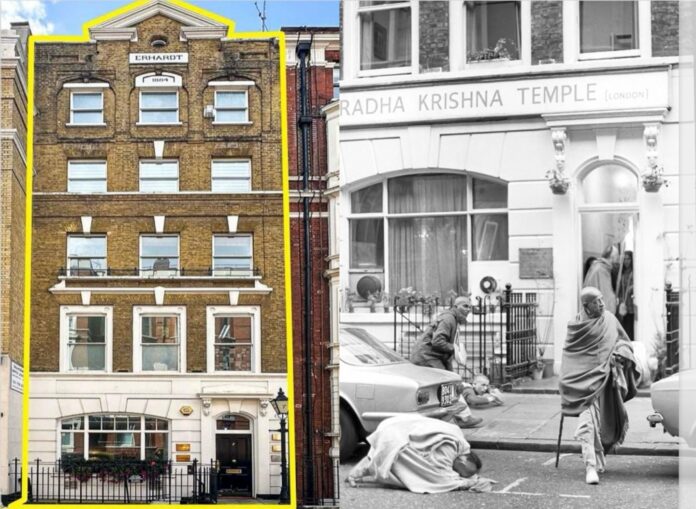
The International Society for Krishna Consciousness (ISKCON) is thrilled to announce that it has successfully acquired 7 Bury Place, the site of its original London temple, in an auction held today.

A Historic Homecoming

ISKCON London, also known as the Radha-Krishna Temple, traces its roots to 1968, when Srila Prabhupada sent three American couples to establish a mission in the UK. 7 Bury Place was eventually secured with the help of supporters—including Beatle George Harrison, who co-signed the original lease—to serve as the base for Srila Prabhupada’s early work in the UK’s capital. Ideally located near the British Museum in the Bloomsbury district, the building quickly became a focal point for ISKCON’s emerging presence in the UK. It was here, in December 1969, that A.C. Bhaktivedanta Swami Prabhupada, ISKCON’s Founder–Acarya, formally inaugurated London’s first Radha-Krishna temple and installed Sri Sri Radha-Londonisvara. The ISKCON London congregation later moved to its current location on Soho Street, always remembering its origins at 7 Bury Place.

“This is a full-circle moment,” said Praghosa Das, GBC, ISKCON UK. “To reacquire 7 Bury Place is to reclaim our spiritual birthplace in the UK. Our hope is to transform it once again into a living, breathing centre of Krishna consciousness, an ISKCON tirtha, place of pilgrimage for devotees who have only read about ISKCON’s heritage and the pioneering work of the original devotees who established Krishna consciousness in the UK.”

Looking Ahead

With the reacquisition of 7 Bury Place, ISKCON London now has a fresh opportunity to honor its past while expanding its presence in the heart of the city. As plans take shape, the building is poised to become a vibrant hub for outreach, education, and devotional culture, further strengthening ISKCON’s mission in London for generations to come.

Srimad Bhagavad-Gita | Chapter 18 | Verses

0

Conclusion – The Perfection of Renunciation

TEXT 1

arjuna uvāca
sannyāsasya mahā-bāho
tattvam icchāmi veditum
tyāgasya ca hṛṣīkeśa
pṛthak keśi-niṣūdana

TEXT 2

śrī-bhagavān uvāca
kāmyānāṁ karmaṇāṁ nyāsaṁ
sannyāsaṁ kavayo viduḥ
sarva-karma-phala-tyāgaṁ
prāhus tyāgaṁ vicakṣaṇāḥ

TEXT 3

tyājyaṁ doṣa-vad ity eke
karma prāhur manīṣiṇaḥ
yajña-dāna-tapaḥ-karma
na tyājyam iti cāpare

TEXT 4

niścayaṁ śṛṇu me tatra
tyāge bharata-sattama
tyāgo hi puruṣa-vyāghra
tri-vidhaḥ samprakīrtitaḥ

TEXT 5

yajña-dāna-tapaḥ-karma
na tyājyaṁ kāryam eva tat
yajño dānaṁ tapaś caiva
pāvanāni manīṣiṇām

TEXT 6

etāny api tu karmāṇi
saṅgaṁ tyaktvā phalāni ca
kartavyānīti me pārtha
niścitaṁ matam uttamam

TEXT 7

niyatasya tu sannyāsaḥ
karmaṇo nopapadyate
mohāt tasya parityāgas
tāmasaḥ parikīrtitaḥ

TEXT 8

duḥkham ity eva yat karma
kāya-kleśa-bhayāt tyajet
sa kṛtvā rājasaṁ tyāgaṁ
naiva tyāga-phalaṁ labhet

TEXT 9

kāryam ity eva yat karma
niyataṁ kriyate ’rjuna
saṅgaṁ tyaktvā phalaṁ caiva
sa tyāgaḥ sāttviko mataḥ

TEXT 10

na dveṣṭy akuśalaṁ karma
kuśale nānuṣajjate
tyāgī sattva-samāviṣṭo
medhāvī chinna-saṁśayaḥ

TEXT 11

na hi deha-bhṛtā śakyaṁ
tyaktuṁ karmāṇy aśeṣataḥ
yas tu karma-phala-tyāgī
sa tyāgīty abhidhīyate

TEXT 12

aniṣṭam iṣṭaṁ miśraṁ ca
tri-vidhaṁ karmaṇaḥ phalam
bhavaty atyāgināṁ pretya
na tu sannyāsināṁ kvacit

TEXT 13

pañcaitāni mahā-bāho
kāraṇāni nibodha me
sāṅkhye kṛtānte proktāni
siddhaye sarva-karmaṇām

TEXT 14

adhiṣṭhānaṁ tathā kartā
karaṇaṁ ca pṛthag-vidham
vividhāś ca pṛthak ceṣṭā
daivaṁ caivātra pañcamam

TEXT 15

śarīra-vāṅ-manobhir yat
karma prārabhate naraḥ
nyāyyaṁ vā viparītaṁ vā
pañcaite tasya hetavaḥ

TEXT 16

tatraivaṁ sati kartāram
ātmānaṁ kevalaṁ tu yaḥ
paśyaty akṛta-buddhitvān
na sa paśyati durmatiḥ

TEXT 17

yasya nāhaṅkṛto bhāvo
buddhir yasya na lipyate
hatvāpi sa imāḻ lokān
na hanti na nibadhyate

TEXT 18

jñānaṁ jñeyaṁ parijñātā
tri-vidhā karma-codanā
karaṇaṁ karma karteti
tri-vidhaḥ karma-saṅgrahaḥ

TEXT 19

jñānaṁ karma ca kartā ca
tridhaiva guṇa-bhedataḥ
procyate guṇa-saṅkhyāne
yathāvac chṛṇu tāny api

TEXT 20

sarva-bhūteṣu yenaikaṁ
bhāvam avyayam īkṣate
avibhaktaṁ vibhakteṣu
taj jñānaṁ viddhi sāttvikam

TEXT 21

pṛthaktvena tu yaj jñānaṁ
nānā-bhāvān pṛthag-vidhān
vetti sarveṣu bhūteṣu
taj jñānaṁ viddhi rājasam

TEXT 22

yat tu kṛtsna-vad ekasmin
kārye saktam ahaitukam
atattvārtha-vad alpaṁ ca
tat tāmasam udāhṛtam

TEXT 23

niyataṁ saṅga-rahitam
arāga-dveṣataḥ kṛtam
aphala-prepsunā karma
yat tat sāttvikam ucyate

TEXT 24

yat tu kāmepsunā karma
sāhaṅkāreṇa vā punaḥ
kriyate bahulāyāsaṁ
tad rājasam udāhṛtam

TEXT 25

anubandhaṁ kṣayaṁ hiṁsām
anapekṣya ca pauruṣam
mohād ārabhyate karma
yat tat tāmasam ucyate

TEXT 26

mukta-saṅgo ’nahaṁ-vādī
dhṛty-utsāha-samanvitaḥ
siddhy-asiddhyor nirvikāraḥ
kartā sāttvika ucyate

TEXT 27

rāgī karma-phala-prepsur
lubdho hiṁsātmako ’śuciḥ
harṣa-śokānvitaḥ kartā
rājasaḥ parikīrtitaḥ

TEXT 28

ayuktaḥ prākṛtaḥ stabdhaḥ
śaṭho naiṣkṛtiko ’lasaḥ
viṣādī dīrgha-sūtrī ca
kartā tāmasa ucyate

TEXT 29

buddher bhedaṁ dhṛteś caiva
guṇatas tri-vidhaṁ śṛṇu
procyamānam aśeṣeṇa
pṛthaktvena dhanañ-jaya

TEXT 30

pravṛttiṁ ca nivṛttiṁ ca
kāryākārye bhayābhaye
bandhaṁ mokṣaṁ ca yā vetti
buddhiḥ sā pārtha sāttvikī

TEXT 31

yayā dharmam adharmaṁ ca
kāryaṁ cākāryam eva ca
ayathāvat prajānāti
buddhiḥ sā pārtha rājasī

TEXT 32

adharmaṁ dharmam iti yā
manyate tamasāvṛtā
sarvārthān viparītāṁś ca
buddhiḥ sā pārtha tāmasī

TEXT 33

dhṛtyā yayā dhārayate
manaḥ-prāṇendriya-kriyāḥ
yogenāvyabhicāriṇyā
dhṛtiḥ sā pārtha sāttvikī

TEXT 34

yayā tu dharma-kāmārthān
dhṛtyā dhārayate ’rjuna
prasaṅgena phalākāṅkṣī
dhṛtiḥ sā pārtha rājasī

TEXT 35

yayā svapnaṁ bhayaṁ śokaṁ
viṣādaṁ madam eva ca
na vimuñcati durmedhā
dhṛtiḥ sā pārtha tāmasī

TEXT 36

sukhaṁ tv idānīṁ tri-vidhaṁ
śṛṇu me bharatarṣabha
abhyāsād ramate yatra
duḥkhāntaṁ ca nigacchati

TEXT 37

yat tad agre viṣam iva
pariṇāme ’mṛtopamam
tat sukhaṁ sāttvikaṁ proktam
ātma-buddhi-prasāda-jam

TEXT 38

viṣayendriya-saṁyogād
yat tad agre ’mṛtopamam
pariṇāme viṣam iva
tat sukhaṁ rājasaṁ smṛtam

TEXT 39

yad agre cānubandhe ca
sukhaṁ mohanam ātmanaḥ
nidrālasya-pramādotthaṁ
tat tāmasam udāhṛtam

TEXT 40

na tad asti pṛthivyāṁ vā
divi deveṣu vā punaḥ
sattvaṁ prakṛti-jair muktaṁ
yad ebhiḥ syāt tribhir guṇaiḥ

TEXT 41

brāhmaṇa-kṣatriya-viśāṁ
śūdrāṇāṁ ca paran-tapa
karmāṇi pravibhaktāni
svabhāva-prabhavair guṇaiḥ

TEXT 42

śamo damas tapaḥ śaucaṁ
kṣāntir ārjavam eva ca
jñānaṁ vijñānam āstikyaṁ
brahma-karma svabhāva-jam

TEXT 43

śauryaṁ tejo dhṛtir dākṣyaṁ
yuddhe cāpy apalāyanam
dānam īśvara-bhāvaś ca
kṣātraṁ karma svabhāva-jam

TEXT 44

kṛṣi-go-rakṣya-vāṇijyaṁ
vaiśya-karma svabhāva-jam
paricaryātmakaṁ karma
śūdrasyāpi svabhāva-jam

TEXT 45

sve sve karmaṇy abhirataḥ
saṁsiddhiṁ labhate naraḥ
sva-karma-nirataḥ siddhiṁ
yathā vindati tac chṛṇu

TEXT 46

yataḥ pravṛttir bhūtānāṁ
yena sarvam idaṁ tatam
sva-karmaṇā tam abhyarcya
siddhiṁ vindati mānavaḥ

TEXT 47

śreyān sva-dharmo viguṇaḥ
para-dharmāt sv-anuṣṭhitāt
svabhāva-niyataṁ karma
kurvan nāpnoti kilbiṣam

TEXT 48

saha-jaṁ karma kaunteya
sa-doṣam api na tyajet
sarvārambhā hi doṣeṇa
dhūmenāgnir ivāvṛtāḥ

TEXT 49

asakta-buddhiḥ sarvatra
jitātmā vigata-spṛhaḥ
naiṣkarmya-siddhiṁ paramāṁ
sannyāsenādhigacchati

TEXT 50

siddhiṁ prāpto yathā brahma
tathāpnoti nibodha me
samāsenaiva kaunteya
niṣṭhā jñānasya yā parā

TEXTS 51-53

buddhyā viśuddhayā yukto
dhṛtyātmānaṁ niyamya ca
śabdādīn viṣayāṁs tyaktvā
rāga-dveṣau vyudasya ca

vivikta-sevī laghv-āśī
yata-vāk-kāya-mānasaḥ
dhyāna-yoga-paro nityaṁ
vairāgyaṁ samupāśritaḥ

ahaṅkāraṁ balaṁ darpaṁ
kāmaṁ krodhaṁ parigraham
vimucya nirmamaḥ śānto
brahma-bhūyāya kalpate

TEXT 54

brahma-bhūtaḥ prasannātmā
na śocati na kāṅkṣati
samaḥ sarveṣu bhūteṣu
mad-bhaktiṁ labhate parām

TEXT 55

bhaktyā mām abhijānāti
yāvān yaś cāsmi tattvataḥ
tato māṁ tattvato jñātvā
viśate tad-anantaram

TEXT 56

sarva-karmāṇy api sadā
kurvāṇo mad-vyapāśrayaḥ
mat-prasādād avāpnoti
śāśvataṁ padam avyayam

TEXT 57

cetasā sarva-karmāṇi
mayi sannyasya mat-paraḥ
buddhi-yogam upāśritya
mac-cittaḥ satataṁ bhava

TEXT 58

mac-cittaḥ sarva-durgāṇi
mat-prasādāt tariṣyasi
atha cet tvam ahaṅkārān
na śroṣyasi vinaṅkṣyasi

TEXT 59

yad ahaṅkāram āśritya
na yotsya iti manyase
mithyaiṣa vyavasāyas te
prakṛtis tvāṁ niyokṣyati

TEXT 60

svabhāva-jena kaunteya
nibaddhaḥ svena karmaṇā
kartuṁ necchasi yan mohāt
kariṣyasy avaśo ’pi tat

TEXT 61

īśvaraḥ sarva-bhūtānāṁ
hṛd-deśe ’rjuna tiṣṭhati
bhrāmayan sarva-bhūtāni
yantrārūḍhāni māyayā

TEXT 62

tam eva śaraṇaṁ gaccha
sarva-bhāvena bhārata
tat-prasādāt parāṁ śāntiṁ
sthānaṁ prāpsyasi śāśvatam

TEXT 63

iti te jñānam ākhyātaṁ
guhyād guhya-taraṁ mayā
vimṛśyaitad aśeṣeṇa
yathecchasi tathā kuru

TEXT 64

sarva-guhyatamaṁ bhūyaḥ
śṛṇu me paramaṁ vacaḥ
iṣṭo ’si me dṛḍham iti
tato vakṣyāmi te hitam

TEXT 65

man-manā bhava mad-bhakto
mad-yājī māṁ namaskuru
mām evaiṣyasi satyaṁ te
pratijāne priyo ’si me

TEXT 66

sarva-dharmān parityajya
mām ekaṁ śaraṇaṁ vraja
ahaṁ tvāṁ sarva-pāpebhyo
mokṣayiṣyāmi mā śucaḥ

TEXT 67

idaṁ te nātapaskāya
nābhaktāya kadācana
na cāśuśrūṣave vācyaṁ
na ca māṁ yo ’bhyasūyati

TEXT 68

ya idaṁ paramaṁ guhyaṁ
mad-bhakteṣv abhidhāsyati
bhaktiṁ mayi parāṁ kṛtvā
mām evaiṣyaty asaṁśayaḥ

TEXT 69

na ca tasmān manuṣyeṣu
kaścin me priya-kṛttamaḥ
bhavitā na ca me tasmād
anyaḥ priya-taro bhuvi

TEXT 70

adhyeṣyate ca ya imaṁ
dharmyaṁ saṁvādam āvayoḥ
jñāna-yajñena tenāham
iṣṭaḥ syām iti me matiḥ

TEXT 71

śraddhāvān anasūyaś ca
śṛṇuyād api yo naraḥ
so ’pi muktaḥ śubhāḻ lokān
prāpnuyāt puṇya-karmaṇām

TEXT 72

kaccid etac chrutaṁ pārtha
tvayaikāgreṇa cetasā
kaccid ajñāna-sammohaḥ
praṇaṣṭas te dhanañ-jaya

TEXT 73

arjuna uvāca
naṣṭo mohaḥ smṛtir labdhā
tvat-prasādān mayācyuta
sthito ’smi gata-sandehaḥ
kariṣye vacanaṁ tava

TEXT 74

sañjaya uvāca
ity ahaṁ vāsudevasya
pārthasya ca mahātmanaḥ
saṁvādam imam aśrauṣam
adbhutaṁ roma-harṣaṇam

TEXT 75

vyāsa-prasādāc chrutavān
etad guhyam ahaṁ param
yogaṁ yogeśvarāt kṛṣṇāt
sākṣāt kathayataḥ svayam

TEXT 76

rājan saṁsmṛtya saṁsmṛtya
saṁvādam imam adbhutam
keśavārjunayoḥ puṇyaṁ
hṛṣyāmi ca muhur muhuḥ

TEXT 77

tac ca saṁsmṛtya saṁsmṛtya
rūpam aty-adbhutaṁ hareḥ
vismayo me mahān rājan
hṛṣyāmi ca punaḥ punaḥ

TEXT 78

yatra yogeśvaraḥ kṛṣṇo
yatra pārtho dhanur-dharaḥ
tatra śrīr vijayo bhūtir
dhruvā nītir matir mama

Srimad Bhagavad-Gita | Chapter 17 | Verses

0

The Divisions of Faith

TEXT 1

arjuna uvāca
ye śāstra-vidhim utsṛjya
yajante śraddhayānvitāḥ
teṣāṁ niṣṭhā tu kā kṛṣṇa
sattvam āho rajas tamaḥ

TEXT 2

śrī-bhagavān uvāca
tri-vidhā bhavati śraddhā
dehināṁ sā svabhāva-jā
sāttvikī rājasī caiva
tāmasī ceti tāṁ śṛṇu

TEXT 3

sattvānurūpā sarvasya
śraddhā bhavati bhārata
śraddhā-mayo ’yaṁ puruṣo
yo yac-chraddhaḥ sa eva saḥ

TEXT 4

yajante sāttvikā devān
yakṣa-rakṣāṁsi rājasāḥ
pretān bhūta-gaṇāṁś cānye
yajante tāmasā janāḥ

TEXTS 5-6

aśāstra-vihitaṁ ghoraṁ
tapyante ye tapo janāḥ
dambhāhaṅkāra-saṁyuktāḥ
kāma-rāga-balānvitāḥ

karṣayantaḥ śarīra-sthaṁ
bhūta-grāmam acetasaḥ
māṁ caivāntaḥ śarīra-sthaṁ
tān viddhy āsura-niścayān

TEXT 7

āhāras tv api sarvasya
tri-vidho bhavati priyaḥ
yajñas tapas tathā dānaṁ
teṣāṁ bhedam imaṁ śṛṇu

TEXT 8

āyuḥ-sattva-balārogya-
sukha-prīti-vivardhanāḥ
rasyāḥ snigdhāḥ sthirā hṛdyā
āhārāḥ sāttvika-priyāḥ

TEXT 9

kaṭv-amla-lavaṇāty-uṣṇa-
tīkṣṇa-rūkṣa-vidāhinaḥ
āhārā rājasasyeṣṭā
duḥkha-śokāmaya-pradāḥ

TEXT 10

yāta-yāmaṁ gata-rasaṁ
pūti paryuṣitaṁ ca yat
ucchiṣṭam api cāmedhyaṁ
bhojanaṁ tāmasa-priyam

TEXT 11

aphalākāṅkṣibhir yajño
vidhi-diṣṭo ya ijyate
yaṣṭavyam eveti manaḥ
samādhāya sa sāttvikaḥ

TEXT 12

abhisandhāya tu phalaṁ
dambhārtham api caiva yat
ijyate bharata-śreṣṭha
taṁ yajñaṁ viddhi rājasam

TEXT 13

vidhi-hīnam asṛṣṭānnaṁ
mantra-hīnam adakṣiṇam
śraddhā-virahitaṁ yajñaṁ
tāmasaṁ paricakṣate

TEXT 14

deva-dvija-guru-prājña-
pūjanaṁ śaucam ārjavam
brahmacaryam ahiṁsā ca
śārīraṁ tapa ucyate

TEXT 15

anudvega-karaṁ vākyaṁ
satyaṁ priya-hitaṁ ca yat
svādhyāyābhyasanaṁ caiva
vāṅ-mayaṁ tapa ucyate

TEXT 16

manaḥ-prasādaḥ saumyatvaṁ
maunam ātma-vinigrahaḥ
bhāva-saṁśuddhir ity etat
tapo mānasam ucyate

TEXT 17

śraddhayā parayā taptaṁ
tapas tat tri-vidhaṁ naraiḥ
aphalākāṅkṣibhir yuktaiḥ
sāttvikaṁ paricakṣate

TEXT 18

satkāra-māna-pūjārthaṁ
tapo dambhena caiva yat
kriyate tad iha proktaṁ
rājasaṁ calam adhruvam

TEXT 19

mūḍha-grāheṇātmano yat
pīḍayā kriyate tapaḥ
parasyotsādanārthaṁ vā
tat tāmasam udāhṛtam

TEXT 20

dātavyam iti yad dānaṁ
dīyate ’nupakāriṇe
deśe kāle ca pātre ca
tad dānaṁ sāttvikaṁ smṛtam

TEXT 21

yat tu pratyupakārārthaṁ
phalam uddiśya vā punaḥ
dīyate ca parikliṣṭaṁ
tad dānaṁ rājasaṁ smṛtam

TEXT 22

adeśa-kāle yad dānam
apātrebhyaś ca dīyate
asat-kṛtam avajñātaṁ
tat tāmasam udāhṛtam

TEXT 23

oṁ tat sad iti nirdeśo
brahmaṇas tri-vidhaḥ smṛtaḥ
brāhmaṇās tena vedāś ca
yajñāś ca vihitāḥ purā

TEXT 24

tasmād oṁ ity udāhṛtya
yajña-dāna-tapaḥ-kriyāḥ
pravartante vidhānoktāḥ
satataṁ brahma-vādinām

TEXT 25

tad ity anabhisandhāya
phalaṁ yajña-tapaḥ-kriyāḥ
dāna-kriyāś ca vividhāḥ
kriyante mokṣa-kāṅkṣibhiḥ

TEXTS 26-27

sad-bhāve sādhu-bhāve ca
sad ity etat prayujyate
praśaste karmaṇi tathā
sac-chabdaḥ pārtha yujyate

yajñe tapasi dāne ca
sthitiḥ sad iti cocyate
karma caiva tad-arthīyaṁ
sad ity evābhidhīyate

TEXT 28

aśraddhayā hutaṁ dattaṁ
tapas taptaṁ kṛtaṁ ca yat
asad ity ucyate pārtha
na ca tat pretya no iha

Srimad Bhagavad-Gita | Chapter 16 | Verses

0

The Divine and Demoniac Natures

TEXTS 1-3

śrī-bhagavān uvāca
abhayaṁ sattva-saṁśuddhir
jñāna-yoga-vyavasthitiḥ
dānaṁ damaś ca yajñaś ca
svādhyāyas tapa ārjavam

ahiṁsā satyam akrodhas
tyāgaḥ śāntir apaiśunam
dayā bhūteṣv aloluptvaṁ
mārdavaṁ hrīr acāpalam

tejaḥ kṣamā dhṛtiḥ śaucam
adroho nāti-mānitā
bhavanti sampadaṁ daivīm
abhijātasya bhārata

TEXT 4

dambho darpo ’bhimānaś ca
krodhaḥ pāruṣyam eva ca
ajñānaṁ cābhijātasya
pārtha sampadam āsurīm

TEXT 5

daivī sampad vimokṣāya
nibandhāyāsurī matā
mā śucaḥ sampadaṁ daivīm
abhijāto ’si pāṇḍava

TEXT 6

dvau bhūta-sargau loke ’smin
daiva āsura eva ca
daivo vistaraśaḥ prokta
āsuraṁ pārtha me śṛṇu

TEXT 7

pravṛttiṁ ca nivṛttiṁ ca
janā na vidur āsurāḥ
na śaucaṁ nāpi cācāro
na satyaṁ teṣu vidyate

TEXT 8

asatyam apratiṣṭhaṁ te
jagad āhur anīśvaram
aparaspara-sambhūtaṁ
kim anyat kāma-haitukam

TEXT 9

etāṁ dṛṣṭim avaṣṭabhya
naṣṭātmāno ’lpa-buddhayaḥ
prabhavanty ugra-karmāṇaḥ
kṣayāya jagato ’hitāḥ

TEXT 10

kāmam āśritya duṣpūraṁ
dambha-māna-madānvitāḥ
mohād gṛhītvāsad-grāhān
pravartante ’śuci-vratāḥ

TEXTS 11-12

cintām aparimeyāṁ ca
pralayāntām upāśritāḥ
kāmopabhoga-paramā
etāvad iti niścitāḥ

āśā-pāśa-śatair baddhāḥ
kāma-krodha-parāyaṇāḥ
īhante kāma-bhogārtham
anyāyenārtha-sañcayān

TEXTS 13-15

idam adya mayā labdham
imaṁ prāpsye manoratham
idam astīdam api me
bhaviṣyati punar dhanam

asau mayā hataḥ śatrur
haniṣye cāparān api
īśvaro ’ham ahaṁ bhogī
siddho ’haṁ balavān sukhī

āḍhyo ’bhijanavān asmi
ko ’nyo ’sti sadṛśo mayā
yakṣye dāsyāmi modiṣya
ity ajñāna-vimohitāḥ

TEXT 16

aneka-citta-vibhrāntā
moha-jāla-samāvṛtāḥ
prasaktāḥ kāma-bhogeṣu
patanti narake ’śucau

TEXT 17

ātma-sambhāvitāḥ stabdhā
dhana-māna-madānvitāḥ
yajante nāma-yajñais te
dambhenāvidhi-pūrvakam

TEXT 18

ahaṅkāraṁ balaṁ darpaṁ
kāmaṁ krodhaṁ ca saṁśritāḥ
mām ātma-para-deheṣu
pradviṣanto ’bhyasūyakāḥ

TEXT 19

tān ahaṁ dviṣataḥ krūrān
saṁsāreṣu narādhamān
kṣipāmy ajasram aśubhān
āsurīṣv eva yoniṣu

TEXT 20

āsurīṁ yonim āpannā
mūḍhā janmani janmani
mām aprāpyaiva kaunteya
tato yānty adhamāṁ gatim

TEXT 21

tri-vidhaṁ narakasyedaṁ
dvāraṁ nāśanam ātmanaḥ
kāmaḥ krodhas tathā lobhas
tasmād etat trayaṁ tyajet

TEXT 22

etair vimuktaḥ kaunteya
tamo-dvārais tribhir naraḥ
ācaraty ātmanaḥ śreyas
tato yāti parāṁ gatim

TEXT 23

yaḥ śāstra-vidhim utsṛjya
vartate kāma-kārataḥ
na sa siddhim avāpnoti
na sukhaṁ na parāṁ gatim

TEXT 24

tasmāc chāstraṁ pramāṇaṁ te
kāryākārya-vyavasthitau
jñātvā śāstra-vidhānoktaṁ
karma kartum ihārhasi

Srimad Bhagavad-Gita | Chapter 15 | Verses

0

The Yoga of the Supreme Person

TEXT 1

śrī-bhagavān uvāca
ūrdhva-mūlam adhaḥ-śākham
aśvatthaṁ prāhur avyayam
chandāṁsi yasya parṇāni
yas taṁ veda sa veda-vit

TEXT 2

adhaś cordhvaṁ prasṛtās tasya śākhā
guṇa-pravṛddhā viṣaya-pravālāḥ
adhaś ca mūlāny anusantatāni
karmānubandhīni manuṣya-loke

TEXTS 3-4

na rūpam asyeha tathopalabhyate
nānto na cādir na ca sampratiṣṭhā
aśvattham enaṁ su-virūḍha-mūlam
asaṅga-śastreṇa dṛḍhena chittvā

tataḥ padaṁ tat parimārgitavyaṁ
yasmin gatā na nivartanti bhūyaḥ
tam eva cādyaṁ puruṣaṁ prapadye
yataḥ pravṛttiḥ prasṛtā purāṇī

TEXT 5

nirmāna-mohā jita-saṅga-doṣā
adhyātma-nityā vinivṛtta-kāmāḥ
dvandvair vimuktāḥ sukha-duḥkha-saṁjñair
gacchanty amūḍhāḥ padam avyayaṁ tat

TEXT 6

na tad bhāsayate sūryo
na śaśāṅko na pāvakaḥ
yad gatvā na nivartante
tad dhāma paramaṁ mama

TEXT 7

mamaivāṁśo jīva-loke
jīva-bhūtaḥ sanātanaḥ
manaḥ-ṣaṣṭhānīndriyāṇi
prakṛti-sthāni karṣati

TEXT 8

śarīraṁ yad avāpnoti
yac cāpy utkrāmatīśvaraḥ
gṛhītvaitāni saṁyāti
vāyur gandhān ivāśayāt

TEXT 9

śrotraṁ cakṣuḥ sparśanaṁ ca
rasanaṁ ghrāṇam eva ca
adhiṣṭhāya manaś cāyaṁ
viṣayān upasevate

TEXT 10

utkrāmantaṁ sthitaṁ vāpi
bhuñjānaṁ vā guṇānvitam
vimūḍhā nānupaśyanti
paśyanti jñāna-cakṣuṣaḥ

TEXT 11

yatanto yoginaś cainaṁ
paśyanty ātmany avasthitam
yatanto ’py akṛtātmāno
nainaṁ paśyanty acetasaḥ

TEXT 12

yad āditya-gataṁ tejo
jagad bhāsayate ’khilam
yac candramasi yac cāgnau
tat tejo viddhi māmakam

TEXT 13

gām āviśya ca bhūtāni
dhārayāmy aham ojasā
puṣṇāmi cauṣadhīḥ sarvāḥ
somo bhūtvā rasātmakaḥ

TEXT 14

ahaṁ vaiśvānaro bhūtvā
prāṇināṁ deham āśritaḥ
prāṇāpāna-samāyuktaḥ
pacāmy annaṁ catur-vidham

TEXT 15

sarvasya cāhaṁ hṛdi sanniviṣṭo
mattaḥ smṛtir jñānam apohanaṁ ca
vedaiś ca sarvair aham eva vedyo
vedānta-kṛd veda-vid eva cāham

TEXT 16

dvāv imau puruṣau loke
kṣaraś cākṣara eva ca
kṣaraḥ sarvāṇi bhūtāni
kūṭa-stho ’kṣara ucyate

TEXT 17

uttamaḥ puruṣas tv anyaḥ
paramātmety udāhṛtaḥ
yo loka-trayam āviśya
bibharty avyaya īśvaraḥ

TEXT 18

yasmāt kṣaram atīto ’ham
akṣarād api cottamaḥ
ato ’smi loke vede ca
prathitaḥ puruṣottamaḥ

TEXT 19

yo mām evam asammūḍho
jānāti puruṣottamam
sa sarva-vid bhajati māṁ
sarva-bhāvena bhārata

TEXT 20

iti guhya-tamaṁ śāstram
idam uktaṁ mayānagha
etad buddhvā buddhimān syāt
kṛta-kṛtyaś ca bhārata

Stay Connected

16,985FansLike
12,500FollowersFollow
61,453SubscribersSubscribe