Mail ID: contact@vedavarsity.com

Contact: +91 9634998911

Google search engineGoogle search engine
Home Blog Page 13

Srimad Bhagavatam | Canto 10 Chapter 13 | The Stealing Of The Boys And Calves By Brahmā

0

Śrīla Śukadeva Gosvāmī said: O best of devotees, most fortunate Parīkṣit, you have in quired very nicely, for although constantly hearing the pastimes of the Lord, you are perceiving His activities to be newer and newer. (1) Paramahaṁsas, devotees who have ac cepted the essence of life, are attached to Kṛṣṇa in the core of their hearts, and He is the aim of their lives. It is their nature to talk only of Kṛṣṇa at every moment, as if such topics were newer and newer. They are attached to such topics, just as materialists are attached to topics of women and sex. (2) O King, kindly hear me with great attention. Although the activities of the Supreme Lord are very confidential, no or dinary man being able to understand them, I shall speak about them to you, for spiritual masters explain to a submissive disciple even subject matters that are very confidential and difficult to understand. (3)

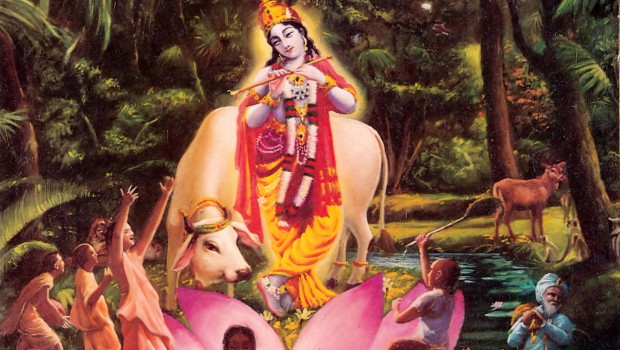
Then, after saving the boys and calves from the mouth of Aghāsura, who was death personified, Lord Kṛṣṇa, the Supreme Personality of Godhead, brought them all to the bank of the river and spoke the following words. (4) My dear friends, just see how this riverbank is extremely beauti ful because of its pleasing atmosphere. And just see how the blooming lotuses are attracting bees and birds by their aroma. The humming and chirping of the bees and birds is echoing throughout the beautiful trees in the forest. Also, here the sands are clean and soft. There fore, this must be considered the best place for our sporting and pastimes. (5) I think we should take our lunch here, since we are already hun gry because the time is very late. Here the calves may drink water and go slowly here and there and eat the grass. (6)

Accepting Lord Kṛṣṇa’s proposal, the cow herd boys allowed the calves to drink water from the river and then tied them to trees where there was green, tender grass. Then the boys opened their baskets of food and began eating with Kṛṣṇa in great transcendental pleasure. (7) Like the whorl of a lotus flower surrounded by its petals and leaves, Kṛṣṇa sat in the center, en circled by lines of His friends, who all looked very beautiful. Every one of them was trying to look forward toward Kṛṣṇa, thinking that Kṛṣṇa might look toward him. In this way they all en joyed their lunch in the forest. (8) Among the cowherd boys, some placed their lunch on flowers, some on leaves, fruits, or bunches of leaves, some actually in their baskets, some on the bark of trees and some on rocks. This is what the children imagined to be their plates as they ate their lunch. (9)

All the cowherd boys enjoyed their lunch with Kṛṣṇa, showing one another the different tastes of the different va rieties of preparations they had brought from home. Tasting one another’s preparations, they began to laugh and make one another laugh. (10) Kṛṣṇa is yajña-bhukthat is, He eats only offerings of yajñabut to exhibit His childhood pastimes, He now sat with His flute tucked be tween His waist and His tight cloth on His right side and with His horn bugle and cow-driving stick on His left. Holding in His hand a very nice preparation of yogurt and rice, with pieces of suitable fruit between His fingers, He sat like the whorl of a lotus flower, looking forward to ward all His friends, personally joking with them and creating jubilant laughter among them as He ate. At that time, the denizens of heaven were watching, struck with wonder at how the Personality of Godhead, who eats only in yajña, was now eating with His friends in the forest. (11)

O Mahārāja Parīkṣit, while the cowherd boys, who knew nothing within the core of their hearts but Kṛṣṇa, were thus engaged in eating their lunch in the forest, the calves went far away, deep into the forest, being allured by green grass. (12) When Kṛṣṇa saw that His friends the cowherd boys were frightened, He, the fierce controller even of fear itself, said, just to mitigate their fear, “My dear friends, do not stop eating. I shall bring your calves back to this spot by personally going after them My self.” (13) “Let Me go and search for the calves,” Kṛṣṇa said. “Don’t disturb your enjoy ment.” Then, carrying His yogurt and rice in His hand, the Supreme Personality of Godhead, Kṛṣṇa, immediately went out to search for the calves of His friends. To please His friends, He began searching in all the mountains, mountain caves, bushes and narrow passages. (14)

O Mahārāja Parīkṣit, Brahmā, who resides in the higher planetary system in the sky, had ob served the activities of the most powerful Kṛṣṇa in killing and delivering Aghāsura, and he was astonished. Now that same Brahmā wanted to show some of his own power and see the power of Kṛṣṇa, who was engaged in His childhood pastimes, playing as if with ordinary cowherd boys. Therefore, in Kṛṣṇa’s absence, Brahmā took all the boys and calves to another place. Thus he became entangled, for in the very near future he would see how powerful Kṛṣṇa was. (15) Thereafter, when Kṛṣṇa was unable to find the calves, He returned to the bank of the river, but there He was also unable to see the cowherd boys. Thus He began to search for both the calves and the boys, as if He could not under stand what had happened. (16) When Kṛṣṇa was unable to find the calves and their caretak ers, the cowherd boys, anywhere in the forest, He could suddenly understand that this was the work of Lord Brahmā. (17)

Thereafter, just to create pleasure both for Brahmā and for the mothers of the calves and cowherd boys, Kṛṣṇa, the creator of the entire cosmic manifestation, expanded Himself as calves and boys. (18) By His Vāsudeva feature, Kṛṣṇa simultaneously expanded Himself into the exact number of missing cowherd boys and calves, with their exact bodily features, their particular types of hands, legs and other limbs, their sticks, bugles and flutes, their lunch bags, their particular types of dress and ornaments placed in various ways, their names, ages and forms, and their special activities and characteristics. By ex panding Himself in this way, beautiful Kṛṣṇa proved the statement samagra-jagad viṣṇuma yam: “Lord Viṣṇu is all-pervading.” (19) Now expanding Himself so as to appear as all the calves and cowherd boys, all of them as they were, and at the same time appear as their leader, Kṛṣṇa entered Vrajabhūmi, the land of His father, Nanda Mahārāja, just as He usually did while enjoying their company. (20)

O Mahārāja Parīkṣit, Kṛṣṇa, who had divided Himself as different calves and also as different cowherd boys, entered different cow sheds as the calves and then different homes as different boys. (21) The mothers of the boys, upon hearing the sounds of the flutes and bugles being played by their sons, immediately rose from their house hold tasks, lifted their boys onto their laps, em braced them with both arms and began to feed them with their breast milk, which flowed forth because of extreme love specifically for Kṛṣṇa. Actually Kṛṣṇa is everything, but at that time, expressing extreme love and affection, they took special pleasure in feeding Kṛṣṇa, the Par abrahman, and Kṛṣṇa drank the milk from His respective mothers as if it were a nectarean bev erage. (22)

Thereafter, O Mahārāja Parīkṣit, as required according to the scheduled round of His pastimes, Kṛṣṇa returned in the evening, entered the house of each of the cowherd boys, and engaged exactly like the former boys, thus enlivening their mothers with transcendental pleasure. The mothers took care of the boys by massaging them with oil, bathing them, smear ing their bodies with sandalwood pulp, decorat ing them with ornaments, chanting protective mantras, decorating their bodies with tilaka and giving them food. In this way, the mothers served Kṛṣṇa personally. (23) Thereafter, all the cows entered their different sheds and be gan mooing loudly, calling for their respective calves. When the calves arrived, the mothers began licking the calves’ bodies again and again and profusely feeding them with the milk flowing from their milk bags. (24)

Previously, from the very beginning, the gopīs had motherly affection for Kṛṣṇa. Indeed, their affection for Kṛṣṇa exceeded even their affection for their own sons. In displaying their affection, they had thus distinguished between Kṛṣṇa and their sons, but now that distinction disappeared. (25) Although the inhabitants of Vrajabhūmi, the cowherd men and cowherd women, previ ously had more affection for Kṛṣṇa than for their own children, now, for one year, their af fection for their own sons continuously in creased, for Kṛṣṇa had now become their sons. There was no limit to the increment of their af fection for their sons, who were now Kṛṣṇa. Every day they found new inspiration for lov ing their children as much as they loved Kṛṣṇa. (26) In this way, Lord Śrī Kṛṣṇa, having Himself become the cowherd boys and groups of calves, maintained Himself by Himself. Thus He con tinued His pastimes, both in Vṛndāvana and in the forest, for one year. (27)

One day, five or six nights before the com pletion of the year, Kṛṣṇa, tending the calves, entered the forest along with Balarāma. (28) Thereafter, while pasturing atop Govardhana Hill, the cows looked down to find some green grass and saw their calves pasturing near Vṛndāvana, not very far away. (29) When the cows saw their own calves from the top of Govardhana Hill, they forgot themselves and their caretakers because of increased affection, and although the path was very rough, they ran toward their calves with great anxiety, each running as if with one pair of legs. Their milk bags full and flowing with milk, their heads and tails raised, and their humps moving with their necks, they ran forcefully until they reached their calves to feed them. (30)

The cows had given birth to new calves, but while coming down from Govardhana Hill, the cows, because of increased affection for the older calves, al lowed the older calves to drink milk from their milk bags and then began licking the calves’ bodies in anxiety, as if wanting to swallow them. (31) The cowherd men, having been un able to check the cows from going to their calves, felt simultaneously ashamed and angry. They crossed the rough road with great diffi culty, but when they came down and saw their own sons, they were overwhelmed by great af fection. (32)

At that time, all the thoughts of the cowherd men merged in the mellow of paternal love, which was aroused by the sight of their sons. Experiencing a great attraction, their an ger completely disappearing, they lifted their sons, embraced them in their arms and enjoyed the highest pleasure by smelling their sons’ heads. (33) Thereafter the elderly cowherd men, having obtained great feeling from em bracing their sons, gradually and with great dif ficulty and reluctance ceased embracing them and returned to the forest. But as the men re membered their sons, tears began to roll down from their eyes. (34)

Because of an increase of affection, the cows had constant attachment even to those calves that were grown up and had stopped sucking milk from their mothers. When Baladeva saw this attachment, He was unable to understand the reason for it, and thus He be gan to consider as follows. (35) What is this wonderful phenomenon? The affection of all the inhabitants of Vraja, including Me, toward these boys and calves is increasing as never be fore, just like our affection for Lord Kṛṣṇa, the Supersoul of all living entities. (36) Who is this mystic power, and where has she come from? Is she a demigod or a demoness? She must be the illusory energy of My master, Lord Kṛṣṇa, for who else can bewilder Me? (37)

Thinking in this way, Lord Balarāma was able to see, with the eye of transcendental knowledge, that all these calves and Kṛṣṇa’s friends were expansions of the form of Śrī Kṛṣṇa. (38) Lord Baladeva said, “O supreme controller! These boys are not great demigods, as I previously thought. Nor are these calves great sages like Nārada. Now I can see that You alone are manifesting Yourself in all varieties of difference. Although one, You are existing in the different forms of the calves and boys. Please briefly explain this to Me.” Having thus been requested by Lord Baladeva, Kṛṣṇa ex plained the whole situation, and Baladeva un derstood it. (39) When Lord Brahmā returned after a moment of time had passed(according to his own meas urement), he saw that although by human meas urement a complete year had passed, Lord Kṛṣṇa, after all that time, was engaged just as before in playing with the boys and calves, who were His expansions. (40)

Lord Brahmā thought: Whatever boys and calves there were in Gokula, I have kept them sleeping on the bed of my mystic potency, and to this very day they have not yet risen again. (41) A similar number of boys and calves have been playing with Kṛṣṇa for one whole year, yet they are different from the ones illusioned by my mystic potency. Who are they? Where did they come from? (42) Thus Lord Brahmā, thinking and thinking for a long time, tried to distinguish between those two sets of boys, who were each separately ex isting. He tried to understand who was real and who was not real, but he couldn’t understand at all. (43) Thus because Lord Brahmā wanted to mys tify the all-pervading Lord Kṛṣṇa, who can never be mystified, but who, on the contrary, mystifies the entire universe, he himself was put into bewilderment by his own mystic power. (44)

As the darkness of snow on a dark night and the light of a glowworm in the light of day have no value, the mystic power of an inferior person who tries to use it against a person of great power is unable to accomplish anything; in stead, the power of that inferior person is di minished. (45) Then, while Lord Brahmā looked on, all the calves and the boys tending them immediately appeared to have complexions the color of blu ish rainclouds and to be dressed in yellow silken garments. (46) All those personalities had four arms, holding conchshell, disc, mace and lotus flower in Their hands. They wore hel mets on Their heads, earrings on Their ears and garlands of forest flowers around Their necks. On the upper portion of the right side of Their chests was the emblem of the goddess of for tune. Furthermore, They wore armlets on Their arms, the Kaustubha gem around Their necks, which were marked with three lines like a conchshell, and bracelets on Their wrists. With bangles on Their ankles, ornaments on Their feet, and sacred belts around Their waists, They all appeared very beautiful. (47-48)

Every part of Their bodies, from Their feet to the top of Their heads, was fully decorated with fresh, tender garlands of tulasī leaves offered by dev otees engaged in worshiping the Lord by the greatest pious activities, namely hearing and chanting. (49) Those Viṣṇu forms, by Their pure smiling, which resembled the increasing light of the moon, and by the sidelong glances of Their reddish eyes, created and protected the desires of Their own devotees, as if by the modes of passion and goodness. (50) All be ings, both moving and nonmoving, from the four-headed Lord Brahmā down to the most in significant living entity, had taken forms and were differently worshiping those viṣṇu-mūr tis, according to their respective capacities, with various means of worship, such as dancing and singing. (51)

All the viṣṇu-mūrtis were sur rounded by the opulences, headed by aṇimā siddhi; by the mystic potencies, headed by Ajā; and by the twenty-four elements for the crea tion of the material world, headed by the ma hat-tattva. (52) Then Lord Brahmā saw that kāla(the time factor), svabhāva(one’s own na ture by association), saṁskāra(reformation), kāma(desire), karma(fruitive activity) and the guṇas(the three modes of material nature), their own independence being completely subordi nate to the potency of the Lord, had all taken forms and were also worshiping those viṣṇu mūrtis. (53) The viṣṇu-mūrtis all had eternal, unlimited forms, full of knowledge and bliss and existing beyond the influence of time. Their great glory was not even to be touched by the jñānīs engaged in studying the Upaniṣads. (54)

Thus Lord Brahmā saw the Supreme Brah man, by whose energy this entire universe, with its moving and nonmoving living beings, is manifested. He also saw at the same time all the calves and boys as the Lord’s expansions. (55) Then, by the power of the effulgence of those viṣṇu-mūrtis, Lord Brahmā, his eleven senses jolted by astonishment and stunned by transcendental bliss, became silent, just like a child’s clay doll in the presence of the village deity. (56) The Supreme Brahman is beyond mental speculation, He is self-manifest, exist ing in His own bliss, and He is beyond the ma terial energy. He is known by the crest jewels of the Vedas by refutation of irrelevant knowledge. Thus in relation to that Supreme Brahman, the Personality of Godhead, whose glory had been shown by the manifestation of all the four-armed forms of Viṣṇu, Lord Brahmā, the lord of Sarasvatī, was mystified. “What is this?” he thought, and then he was not even able to see. Lord Kṛṣṇa, understanding Brahmā’s position, then at once removed the curtain of His yoga-māyā. (57)

Lord Brahmā’s external consciousness then revived, and he stood up, just like a dead man coming back to life. Opening his eyes with great difficulty, he saw the universe, along with himself. (58) Then, looking in all directions, Lord Brahmā immediately saw Vṛndāvana before him, filled with trees, which were the means of livelihood for the inhabitants and which were equally pleasing in all seasons. (59) Vṛndāvana is the transcendental abode of the Lord, where there is no hunger, anger or thirst. Though naturally inimical, both human beings and fierce animals live there together in transcendental friendship. (60) Then Lord Brahmā saw the Absolute Truthwho is one without a second, who pos sesses full knowledge and who is unlimitedas suming the role of a child in a family of cow herd men and standing all alone, just as before, with a morsel of food in His hand, searching everywhere for the calves and His cowherd friends. (61)

After seeing this, Lord Brahmā hastily got down from his swan carrier, fell down like a golden rod and touched the lotus feet of Lord Kṛṣṇa with the tips of the four crowns on his heads. Offering his obeisances, he bathed the feet of Kṛṣṇa with the water of his tears of joy. (62) Rising and falling again and again at the lotus feet of Lord Kṛṣṇa for a long time, Lord Brahmā remembered over and over the Lord’s greatness he had just seen. (63) Then, rising very gradually and wiping his two eyes, Lord Brahmā looked up at Mukunda. Lord Brahmā, his head bent low, his mind con centrated and his body trembling, very humbly began, with faltering words, to offer praises to Lord Kṛṣṇa. (64)

Srimad Bhagavatam | Canto 10 Chapter 12 | The Killing Of The Demon Aghāsura

0

Śukadeva Gosvāmī continued: O King, one day Kṛṣṇa decided to take His breakfast as a picnic in the forest. Having risen early in the morning, He blew His bugle made of horn and woke all the cowherd boys and calves with its beautiful sound. Then Kṛṣṇa and the boys, keeping their respective groups of calves before them, proceeded from Vrajabhūmi to the forest. (1) At that time, hundreds and thousands of cowherd boys came out of their respective homes in Vrajabhūmi and joined Kṛṣṇa, keep ing before them their hundreds and thousands of groups of calves. The boys were very beau tiful, and they were equipped with lunch bags, bugles, flutes, and sticks for controlling the calves. (2) Along with the cowherd boys and their own groups of calves, Kṛṣṇa came out with an unlimited number of calves assembled. Then all the boys began to sport in the forest in a greatly playful spirit. (3)

Although all these boys were already decorated by their mothers with ornaments of kāca, guñjā, pearls and gold, when they went into the forest they further dec orated themselves with fruits, green leaves, bunches of flowers, peacock feathers and soft minerals. (4) All the cowherd boys used to steal one another’s lunch bags. When a boy came to understand that his bag had been taken away, the other boys would throw it farther away, to a more distant place, and those standing there would throw it still farther. When the proprietor of the bag became disappointed, the other boys would laugh, the proprietor would cry, and then the bag would be returned. (5) Sometimes Kṛṣṇa would go to a somewhat distant place to see the beauty of the forest. Then all the other boys would run to accompany Him, each one saying, “I shall be the first to run and touch Kṛṣṇa! I shall touch Kṛṣṇa first!” In this way they enjoyed life by repeatedly touching Kṛṣṇa. (6)

All the boys would be differently engaged. Some boys blew their flutes, and others blew bugles made of horn. Some imitated the buzz ing of the bumblebees, and others imitated the voice of the cuckoo. Some boys imitated flying birds by running after the birds’ shadows on the ground, some imitated the beautiful move ments and attractive postures of the swans, some sat down with the ducks, sitting silently, and others imitated the dancing of the pea cocks. Some boys attracted young monkeys in the trees, some jumped into the trees, imitating the monkeys, some made faces as the monkeys were accustomed to do, and others jumped from one branch to another. Some boys went to the waterfalls and crossed over the river, jump ing with the frogs, and when they saw their own reflections on the water they would laugh. They would also condemn the sounds of their own echoes. In this way, all the cowherd boys used to play with Kṛṣṇa, who is the source of the Brahman effulgence for jñānīs desiring to merge into that effulgence, who is the Supreme Personality of Godhead for devotees who have accepted eternal servitorship, and who for ordi nary persons is but another ordinary child. The cowherd boys, having accumulated the results of pious activities for many lives, were able to associate in this way with the Supreme Person ality of Godhead. How can one explain their great fortune? (7-11)

Yogīs may undergo se vere austerities and penances for many births by practicing yama, niyama, āsana and prāṇāyāma, none of which are easily per formed. Yet in due course of time, when these yogīs attain the perfection of controlling the mind, they will still be unable to taste even a particle of dust from the lotus feet of the Su preme Personality of Godhead. What then can we describe about the great fortune of the in habitants of Vrajabhūmi, Vṛndāvana, with whom the Supreme Personality of Godhead personally lived and who saw the Lord face to face? (12) My dear King Parīkṣit, thereafter there ap peared a great demon named Aghāsura, whose death was being awaited even by the demigods. The demigods drank nectar every day, but still they feared this great demon and awaited his death. This demon could not tolerate the tran scendental pleasure being enjoyed in the forest by the cowherd boys. (13)

Aghāsura, who had been sent by Kaṁsa, was the younger brother of Pūtanā and Bakāsura. Therefore, when he came and saw Kṛṣṇa at the head of all the cow herd boys, he thought, “This Kṛṣṇa has killed my sister and brother, Pūtanā and Bakāsura. Therefore, in order to please them both, I shall kill this Kṛṣṇa, along with His assistants, the other cowherd boys.” (14) Aghāsura thought: If somehow or other I can make Kṛṣṇa and His associates serve as the last offering of sesame and water for the departed souls of my brother and sister, then the inhabitants of Vrajabhūmi, for whom these boys are the life and soul, will automatically die. If there is no life, there is no need for the body; consequently, when their sons are dead, naturally all the inhabitants of Vraja will die. (15)

After thus deciding, that crooked Aghāsura assumed the form of a huge python, as thick as a big mountain and as long as eight miles. Having assumed this wonderful python’s body, he spread his mouth like a big cave in the mountains and lay down on the road, expecting to swallow Kṛṣṇa and His asso ciates the cowherd boys. (16) His lower lip rested on the surface of the earth, and his upper lip was touching the clouds in the sky. The bor ders of his mouth resembled the sides of a big cave in a mountain, and the middle of his mouth was as dark as possible. His tongue resembled a broad traffic-way, his breath was like a warm wind, and his eyes blazed like fire. (17) Upon seeing this demon’s wonderful form, which resembled a great python, the boys thought that it must be a beautiful scenic spot of Vṛndāvana. Thereafter, they imagined it to be similar to the mouth of a great python. In other words, the boys, unafraid, thought that it was a statue made in the shape of a great python for the enjoyment of their pastimes. (18) The boys said: Dear friends, is this creature dead, or is it actually a living python with its mouth spread wide just to swallow us all? Kindly clear up this doubt. (19)

Thereafter they decided: Dear friends, this is certainly an animal sitting here to swallow us all. Its upper lip resembles a cloud reddened by the sunshine, and its lower lip resembles the reddish shadows of a cloud. (20) On the left and right, the two depressions re sembling mountain caves are the corners of its mouth, and the high mountain peaks are its teeth. (21) In length and breadth the animal’s tongue resembles a broad traffic-way, and the inside of its mouth is very, very dark, like a cave in a mountain. (22) The hot fiery wind is the breath coming out of his mouth, which is giving off the bad smell of burning flesh be cause of all the dead bodies he has eaten. (23) Then the boys said, “Has this living creature come to swallow us? If he does so, he will im mediately be killed like Bakāsura, without de lay.” Thus they looked at the beautiful face of Kṛṣṇa, the enemy of Bakāsura, and, laughing loudly and clapping their hands, they entered the mouth of the python. (24)

The Supreme Personality of Godhead, Śrī Kṛṣṇa, who is situ ated as antaryāmī, the Supersoul, in the core of everyone’s heart, heard the boys talking among themselves about the artificial python. Un known to them, it was actually Aghāsura, a de mon who had appeared as a python. Kṛṣṇa, knowing this, wanted to forbid His associates to enter the demon’s mouth. (25) In the mean time, while Kṛṣṇa was considering how to stop them, all the cowherd boys entered the mouth of the demon. The demon, however, did not swallow them, for he was thinking of his own relatives who had been killed by Kṛṣṇa and was just waiting for Kṛṣṇa to enter his mouth. (26) Kṛṣṇa saw that all the cowherd boys, who did not know anyone but Him as their Lord, had now gone out of His hand and were helpless, having entered like straws into the fire of the abdomen of Aghāsura, who was death personi fied. It was intolerable for Kṛṣṇa to be sepa rated from His friends the cowherd boys. Therefore, as if seeing that this had been ar ranged by His internal potency, Kṛṣṇa was mo mentarily struck with wonder and unsure of what to do. (27)

Now, what was to be done? How could both the killing of this demon and the saving of the devotees be performed simul taneously? Kṛṣṇa, being unlimitedly potent, decided to wait for an intelligent means by which He could simultaneously save the boys and kill the demon. Then He entered the mouth of Aghāsura. (28) When Kṛṣṇa entered the mouth of Aghāsura, the demigods hidden behind the clouds exclaimed, “Alas! Alas!” But the friends of Aghāsura, like Kaṁsa and other demons, were jubilant. (29) When the invincible Supreme Personality of Godhead, Kṛṣṇa, heard the demigods crying “Alas! Alas!” from behind the clouds, He im mediately enlarged Himself within the demon’s throat, just to save Himself and the cowherd boys, His own associates, from the demon who wished to smash them. (30)

Then, because Kṛṣṇa had increased the size of His body, the demon extended his own body to a very large size. Nonetheless, his breathing stopped, he suffocated, and his eyes rolled here and there and popped out. The demon’s life air, however, could not pass through any outlet, and therefore it finally burst out through a hole in the top of the demon’s head. (31) When all the demon’s life air had passed away through that hole in the top of his head, Kṛṣṇa glanced over the dead calves and cowherd boys and brought them back to life. Then Mukunda, who can give one liberation, came out from the demon’s mouth with His friends and the calves. (32) From the body of the gigantic python, a glaring efful gence came out, illuminating all directions, and stayed individually in the sky until Kṛṣṇa came out from the corpse’s mouth. Then, as all the demigods looked on, this effulgence entered into Kṛṣṇa’s body. (33)

Thereafter, everyone being pleased, the demigods began to shower flowers from Nandana-kānana, the celestial dancing girls began to dance, and the Gandhar vas, who are famous for singing, offered songs of prayer. The drummers began to beat their kettledrums, and the brāhmaṇas offered Vedic hymns. In this way, both in the heavens and on earth, everyone began to perform his own du ties, glorifying the Lord. (34) When Lord Brahmā heard the wonderful ceremony going on near his planet, accompanied by music and songs and sounds of “Jaya! Jaya!” he immedi ately came down to see the function. Upon see ing so much glorification of Lord Kṛṣṇa, he was completely astonished. (35)

O King Parīkṣit, when the python-shaped body of Aghāsura dried up into merely a big skin, it became a wonderful place for the inhabitants of Vṛndāvana to visit, and it remained so for a long, long time. (36) This incident of Kṛṣṇa’s saving Himself and His associates from death and of giving deliverance to Aghāsura, who had assumed the form of a python, took place when Kṛṣṇa was five years old. It was disclosed in Vrajabhūmi after one year, as if it had taken place on that very day. (37) Kṛṣṇa is the cause of all causes. The causes and effects of the ma terial world, both higher and lower, are all cre ated by the Supreme Lord, the original control ler. When Kṛṣṇa appeared as the son of Nanda Mahārāja and Yaśodā, He did so by His cause less mercy. Consequently, for Him to exhibit His unlimited opulence was not at all wonder ful. Indeed, He showed such great mercy that even Aghāsura, the most sinful miscreant, was elevated to being one of His associates and achieving sārūpya-mukti, which is actually im possible for materially contaminated persons to attain. (38)

If even only once or even by force one brings the form of the Supreme Personality of Godhead into one’s mind, one can attain the supreme salvation by the mercy of Kṛṣṇa, as did Aghāsura. What then is to be said of those whose hearts the Supreme Personality of God head enters when He appears as an incarnation, or those who always think of the lotus feet of the Lord, who is the source of transcendental bliss for all living entities and by whom all il lusion is completely removed? (39) Śrī Sūta Gosvāmī said: O learned saints, the childhood pastimes of Śrī Kṛṣṇa are very wonderful. Mahārāja Parīkṣit, after hearing about those pastimes of Kṛṣṇa, who had saved him in the womb of his mother, became steady in his mind and again inquired from Śukadeva Gosvāmī to hear about those pious activities. (40)

Mahārāja Parīkṣit inquired: O great sage, how could things done in the past have been de scribed as being done at the present? Lord Śrī Kṛṣṇa performed this pastime of killing Aghāsura during His kaumāra age. How then, during His paugaṇḍa age, could the boys have described this incident as having happened re cently? (41) O greatest yogī, my spiritual mas ter, kindly describe why this happened. I am very much curious to know about it. I think that it was nothing but another illusion due to Kṛṣṇa. (42) O my lord, my spiritual master, although we are the lowest of kṣatriyas, we are glorified and benefited because we have the opportunity of always hearing from you the nectar of the pious activities of the Supreme Personality of God head. (43)

Sūta Gosvāmī said: O Śaunaka, greatest of saints and devotees, when Mahārāja Parīkṣit in quired from Śukadeva Gosvāmī in this way, Śukadeva Gosvāmī, immediately remembering subject matters about Kṛṣṇa within the core of his heart, externally lost contact with the ac tions of his senses. Thereafter, with great diffi culty, he revived his external sensory percep tion and began to speak to Mahārāja Parīkṣit about kṛṣṇa-kathā. (44)

DIPS, SAUCES AND DRESSINGS

0
bowls of various dip sauces, top view

By Kurma Das

Lebanese Eggplant Dip (Babagannouj)

This version of the famous Middle Eastern mezze (hors d’oeuvre) can be served as an appetizer with breads, salads, and a variety of other nourishing and substantial dishes. This delicious dip has a characteristic smoky flavour from roasting the eggplants until they blacken.

  •  PREPARATION TIME: 10 minutes

  •  OVEN ROASTING TIME: At least 1 hour

  •  YIELD: Enough for about 4 persons

  •   2 large eggplants

  •   1 tablespoon (20 ml) olive oil

  •   1/2 cup (125 ml) tahini

  •   juice of 2 large lemons

  •   1/2 teaspoon (2 ml) salt

  •   1/4 teaspoon (1 ml) coarsely ground black pepper

  •   1/2 teaspoon (2 ml) yellow asafoetida powder

  •   1 tablespoon (20 ml) finely chopped fresh parsley

  •   1 teaspoon (5 ml) paprika or cayenne pepper

1. Slit the eggplants with a sharp knife to allow the steam to escape whilst baking. Lightly oil the eggplants; then place them in a preheated oven 200°C/390°F. Bake them until the outside is charred and crisp.

2. Remove the eggplants from the oven, scoop out the pulp into a bowl (it should have a smoky aroma), and mash thoroughly. Mix with the tahini, lemon juice, salt, pepper, asafoetida, and parsley until it reaches a smooth consistency. If the mixture is too thick, add a little water. Spoon the dip into a suitable serving bowl, pour the olive oil into the centre, and garnish with paprika or cayenne. Serve immediately.

Indonesian Chili-and-Peanut Relish (Sambal Pecal)

Indonesian chili-based sauces or pickles are called sambals. This water sambal functions as a dip with raw or cooked vegetables and can also be used as a salad dressing.

  •  PREPARATION TIME: 5 minutes

  •  COOKING TIME: 5 minutes

  •  YIELD: Enough for a dip for 4 or 5 or a salad dressing for 10 to 12

  •   water

  •   1/4 teaspoon (1 ml) salt

  •   1/4 teaspoon (1 ml) yellow asafoetida powder

  •   oil for deep-frying

  •   3/4 cup (185 ml) raw peanuts

  •   3 tablespoons (60 ml) water

  •   1/2 teaspoon (2 ml) tamarind concentrate

  •   3 medium green chilies, seeded and chopped

  •   1 teaspoon (5 ml) brown sugar

  •   2 teaspoons (10 ml) light kejap manis (Indonesian sweet soy sauce)

1. Heat the oil in a wok or pan to 185°C/365°F and deep-fry the peanuts until golden brown. Remove and drain.

2. Mix the 3 tablespoons (60 ml) water with the tamarind concentrate to form tamarind juice.

3. In a blender or food processor, grind the peanuts to a fine sand-like consistency. Add the tamarind juice, chilies, sugar, soy sauce, salt, and 1 tablespoon (20 ml) water and blend or process until it reaches a stiff, grainy paste consistency. Add more water until it reaches a smooth paste consistency.

4. Heat 1 teaspoon (5 ml) oil in a small pan and momentarily fry the asafoetida until it becomes fragrant. Add this to the sambal. Blend or process the sambal a little more and then remove it from the blender or food processor. Serve warm or at room temperature.

Tartare Sauce

Here are two recipes for this famous sauce, using an eggless mayonnaise base. Both recipes call for capers which give Tartare Sauce its characteristic flavour. Non-vegetarians serve this sauce with seafood. However, I have discovered a wonderful karma-free use for Tartare Sauce as an accompaniment to juicy Curd Pakoras. Serve this combination with a slice of lemon and amaze your dinner guests!

Tartare Sauce I

  •  PREPARATION TIME: A few minutes

  •  YIELD: Almost 1 cup (250 ml)

  •   3/4 cup (185 ml) Eggless Mayonnaise II

  •   1 tablespoon (20 ml) chopped green olives

  •   1 tablespoon (20 ml) chopped gherkins

  •   1 tablespoon (20 ml) chopped capers

  •   1/2 teaspoon (2 ml) salt

1. Combine all the ingredients an refrigerate.

Tartare Sauce II

  •  PREPARATION TIME: A few minutes

  •  YIELD: Almost 1 cup (250 ml)

  •   2/3 cup (165 ml) Eggless Mayonnaise II

  •   1/4 cup (60 ml) chopped capers

  •   1 tablespoon (20 ml) chopped gherkin

  •   1/2 teaspoon (2 ml) salt

  •   1/4 teaspoon (1 ml) black pepper

1. Combine all the ingredients and refrigerate.

Date and Tamarind Sauce

Tamarind, the fruit pulp from the pods of the Asian tamarind tree, Tamarindus indica, is the most commonly used souring agent in Indian cuisine. When combined with dates, a delightful sweet-and-sour flavour results. This date and tamarind sauce is delicious served with Potato and Pea Croquettes or Cauliflower and Pea Samosas.

  •  PREPARATION AND COOKING TIME: 20 minutes

  •  SETTING TIME: 4 hours

  •  YIELD: About 1 cup (250 ml)

  •   3 tablespoons (60 ml) tamarind concentrate

  •   2 green chilies, seeded and minced

  •   1 1/4 cups (310 ml) boiling water

  •   1/2 cup (125 ml) chopped dried dates

  •   1 teaspoon (5 ml) minced ginger

  •   2 tablespoons (40 ml) brown sugar

  •   1 teaspoon (5 ml) garam masala

  •   1/2 teaspoon (2 ml) chat masala

  •   2 teaspoons (10 ml) salt

1. Blend the tamarind concentrate, chilies, water, dates, ginger, brown sugar, spices, and salt in a food processor or blender until smooth.

2. Place the sauce in a small saucepan and simmer it over moderate heat for 10 minutes, stirring occasionally.

3. Transfer the sauce to a bowl and set it aside for 4 hours to allow the sauce to thicken and the flavours to mingle. Serve at room temperature.

Greek Cucumber and Yogurt Dip (Tzatziki)

Here’s my version of the refreshing Greek cucumber-and-yogurt dip that is great served with crisp raw vegetables. The yogurt is hung for a few hours to drain off some of its whey; then it’s folded with shredded cucumber and garnished with fresh herbs. Serve as a dip with chunks of vegetables such as blanched cauliflower and broccoli, squares of red or green peppers, celery wedges, baby tomatoes, carrot spears, or slices of fresh flat-bread.

  •  PREPARATION TIME: 5 minutes

  •  YOGURT HANGING TIME: 2 hours

  •  YIELD: About 2 cups (500 ml)

  •   2 cups (500 ml) plain yogurt

  •   1 medium green cucumber

  •   1 tablespoon (20 ml) fresh lemon juice

  •   1 teaspoon (5 ml) salt

  •   1/4 teaspoon (1 ml) coarsely ground black pepper

  •   2 teaspoons (10 ml) olive oil

  •   1/4 teaspoon (1 ml) yellow asafoetida powder

  •   1 tablespoon (20 ml) chopped fresh parsley

1. Line a sieve with a double thickness of cheesecloth. Place it over a bowl, spoon the yogurt into it, and allow to drain for 2 hours, preferably in the refrigerator.

2. When the yogurt is drained, semi-peel the cucumber, allowing some of the green under-skin to remain. Slit the cucumber in half, seed it, and grate it coarsely. Squeeze out the excess moisture.

3. Empty the drained yogurt into a bowl and add the cucumber, lemon juice, salt, and pepper.

4. Heat the olive oil in a small pan until slightly hot and momentarily saute the asafoetida until it becomes fragrant. Add the oil and asafoetida to the bowl of yogurt and cucumber, add half the parsley, and combine well. Garnish with parsley and serve chilled.

Mexican Avocado Dip (Guacamole)

Here’s my version of Guacamole, the famous dip or spread of Mexican origin that now enjoys great popularity around the world. In Guacamole the creaminess of the avocado combines wonderfully with the lemon and chili flavours. It is great served with Nachos, Tacos, or as a dip for corn chips. I have found that the variety of avocado with the purple crinkly skin (known as the Haas variety in Australia) lends itself best to this dish.

  •  PREPARATION TIME: 10 minutes

  •  YIELD: Enough for 4 or 6 persons

  •   2 ripe medium avocados, peeled and stoned

  •   3 or 4 inner leaves fresh crisp lettuce shredded very finely into long thin strips (chiffonade)

  •   1 medium firm tomato, finely chopped

  •   2 small green chilies, seeded and finely chopped

  •   2 teaspoons (10 ml) fresh lemon or lime juice

  •   1/4 teaspoon (1 ml) coarsely ground black pepper

  •   1/2 teaspoon (2 ml) salt

  •   1/4 teaspoon (1 ml) yellow asafoetida powder

1. Cut the avocado flesh into chunks and mash coarsely in a bowl.

2. Combine the avocado, lettuce, tomato, chilies, lemon or lime juice, pepper, salt, and asafoetida and transfer to a serving dish.

Note: If you would like to prepare Guacamole a few hours in advance, leave the avocado stone in the mixture. This will prevent browning. Remove the stone before serving.

Chickpea Pate

Chickpeas are a great source of protein and iron as well as fibre, vitamins A and B6, riboflavin, thiamin, niacin, calcium, phosphorus, sodium, and potassium. One cup of chick peas has the usable protein equivalent of one 30 g (4 1/4-ounce) steak. When chickpeas are combined with dairy products, the usable protein increases.

This chickpea pate is very tasty and goes well as a dip or spread on bread or crackers.

  •  CHICKPEA COOKING TIME: 1 – 2 hours

  •  PREPARATION TIME: 10 minutes

  •  YIELD: About 3 cups (750 ml)

  •   1 cup (250 ml) raw chickpeas, soaked overnight

  •   1 1/2 teaspoons (7 ml) salt

  •   1 cup (250 ml) sour cream

  •   1/2 cup (125 ml) finely chopped fresh parsley

  •   1 teaspoon (5 ml) ground coriander

  •   1 tablespoon (20 ml) fresh lemon juice

  •   1/4 teaspoon (1 ml) ground black pepper

  •   1 tablespoon (20 ml) olive oil

  •   1/4 teaspoon (1 ml) yellow asafoetida powder

  •   1/2 cup (125 ml) celery, finely minced

1. Drain the soaked chickpeas and place them in a large saucepan with lots of water. Boil for 1 to 2 hours or until they’re soft.

2. Drain the cooked chickpeas and blend them in a food processor or blender until they become smooth and creamy.

3. Add salt, sour cream, parsley, ground coriander, lemon juice, and black pepper and continue processing for 2 minutes.

4. Heat the olive oil in a pan and saute the asafoetida. Add the minced celery and saute for 1 minute or until the celery becomes soft. Add the celery mixture to the food processor and process a little more. Place the pate in a suitable bowl and refrigerate until firm. The pate can be refrigerated for two days.

Tahini Sauce

Tahini is a paste made from the finely ground seeds of the sesame plant, Sesamum indicum. It is cream or cream-gray in colour and has the texture, though not the taste, of runny peanut butter. In the Levant, tahini is used as a basis for various salad dressings and to flavour the famous hummus, or chick pea puree, which I have also included in this book. Here is an ultra-simple but delicious tahini  sauce which can be served with fresh Middle Eastern breads and any of the following mezze or Middle Eastern hors d’oeuvres: slices of cucumber, lemon wedges, fresh raw cauliflower pieces, chunks of carrot, celery, lettuce leaves, tomato pieces, olives, nuts, or chickpeas.

  •  PREPARATION TIME: A few minutes

  •  YIELD: Enough for 6 – 8 persons

  •   1 cup (250 ml) tahini

  •   1/2 teaspoon (2 ml) ground cumin

  •   1/2 cup (125 ml) fresh lemon juice

  •   1/2 teaspoon (2 ml) yellow asafoetida powder

  •   1 teaspoon (5 ml) salt

  •   1 tablespoon (20 ml) finely chopped fresh parsley

1. Combine all the ingredients (reserving half the parsley) with the aid of a food processor or blender. The sauce should resemble mayonnaise in consistency. Add a little water if required.

2. Pour the sauce into a serving bowl and garnish it with the reserved parsley. Serve at room temperature.

Tomato Relish

Here’s the tomato sauce I use as the basis for many dishes at Gopal’s Restaurant. It’s ideal served with all types of pasta dishes, including lasagna and gnocchi. I also use it as the basis for various casseroles and as a dipping sauce. It’s great on pakoras, especially cauliflower, and it’s quick and easy to prepare.

  •  PREPARATION & COOKING TIME: 20 minutes

  •  YIELD: 2 cups (500 ml)

  •   3 tablespoons (60 ml) olive oil

  •   1/2 teaspoon (2 ml) yellow asafoetida powder

  •   1/4 teaspoon (1 ml) ground black pepper

  •   2 1/2 cups (625 ml) pureed tomatoes

  •   1 1/2 teaspoons (7 ml) minced fresh basil leaves, or 1/2 teaspoon (2 ml) dried basil leaves

  •   1/4 teaspoon (1 ml) clove powder

  •   1 teaspoon (5 ml) salt

  •   1 teaspoon (5 ml) brown sugar

  •   2 tablespoons (40 ml) tomato paste

  •   1 teaspoon (5 ml) fresh lemon juice

  •   2 tablespoons (40 ml) minced fresh parsley

1. Heat the olive oil in a medium sized saucepan over moderate heat. When the oil is hot but not smoking, add the asafoetida and saute momentarily. Add the black pepper, saute for a moment, and then add the tomatoes. Add the basil, cloves, salt, and sugar. Bring to a boil; then reduce the heat to low and simmer for 15 minutes, stirring occasionally.

2. Fold in the tomato paste, lemon juice, and parsley, combine and cook for another 1 minute, and remove from the heat. Serve hot, or if you prefer, allow it to cool, put it in a well-sealed glass jar, and use it when required for pasta dishes. This sauce can be refrigerated for about a week.

Chickpea and Sesame Dip (Hummus)

Hummus, a chickpea and sesame dip, is the most popular and best known of the Middle Eastern bread dips. The chickpeas should be soaked the night before you prepare the dip. Serve hummus with warmed Middle Eastern Breads.

  •  CHICKPEA COOKING TIME: 1 – 2 hours

  •  PREPARATION TIME: 10 minutes

  •  YIELD: Enough for 6 persons

  •   1 1/2 cups (375 ml) chickpeas, soaked overnight in cold water juice of 2 large lemons

  •   1 1/2 teaspoons (7 ml) salt

  •   1/2 teaspoon (2 ml) yellow asafoetida powder

  •   2/3 cup (165 ml) tahini

  •   2 tablespoons (40 ml) olive oil for garnish

  •   1/4 teaspoon (1 ml) paprika for garnish

  •   1 teaspoon (5 ml) chopped fresh parsley for garnish

1. Drain the soaked chickpeas and place them in a saucepan with lots of water. Boil for 1 to 2 hours or until the chickpeas are soft.

2. Drain the cooked chickpeas, reserving the water. Place the cooked and drained chickpeas, the lemon juice, salt, asafoetida, and tahini in a food processor or blender. Process until smooth, adding a little reserved cooking water if required to reach a puree consistency.

3. Transfer into a serving bowl and garnish with olive oil, paprika, and parsley. Serve at room temperature.

Bechamel Sauce

In French cuisine, bechamel  sauce is considered to be the mother of all sauces because it is the basic white sauce from which so many others are made. It can be used as a flowing sauce or as a base for cream soups. Fold with grated cheese to make sauce mornay; pour it onto vegetables and bake it with more grated cheese on top and you have Vegetables au gratin; add cream or sour cream and you have cream sauce or sour cream sauce; fold with parsley and lemon juice for parsley sauce; and mix with powdered mustard seeds for mustard sauce.

Bechamel  sauce is based on a roux, which is a combination of melted butter and flour to which warm milk is added. This recipe makes a thin bechamel  sauce. For a sauce thick enough to coat vegetables, such as in Vegetables Au Gratin, the quantities of butter and flour are doubled.

  •  PREPARATION & COOKING TIME: 10 minutes

  •  YIELD: About 2 1/2 cups (625 ml)

  •   2 tablespoons (40 ml) butter

  •   2 tablespoons (40 ml) plain flour

  •   2 1/2 cups (625 ml) very warm milk

  •   1/2 teaspoon (2 ml) salt

  •   1/4 teaspoon (1 ml) white pepper

  •   pinch of nutmeg (optional)

1. Melt the butter in a medium sized saucepan over moderate heat. Remove the pan from the heat. With a wooden spoon, add the flour to make a smooth paste. Gradually add the milk, stirring constantly.

2. Return the pan to the heat and bring the sauce to the boil, still stirring. Reduce the heat to low and simmer, stirring constantly for 2 or 3 minutes or until the sauce is smooth and thickened. Season with salt, pepper, and nutmeg. Serve immediately.

Italian Salad Dressing

Use this Italian-style herbed dressing on crisp green salads. This recipe makes a large quantity of dressing. It can be bottled and used as required.

  •  PREPARATION TIME: A few minutes

  •  YIELD: 2 1/2 cups (625 ml)

  •   1 cup (250 ml) olive oil

  •   1 cup (250 ml) safflower oil

  •   1 1/2 cups (375 ml) fresh lemon juice

  •   1 teaspoon (5 ml) each of the following: dried oregano, dried basil, freshly milled black pepper,

        dried sage, dried dill. (If fresh herbs are available use 1 tablespoon (20 ml) of each.)

  •   2 teaspoons (10 ml) salt

  •   2 teaspoons (10 ml) paprika

  •   3 tablespoons (60 ml) honey (optional)

1. Process all the ingredients in a food processor or blender until thick and smooth. Pour the dressing into a bottle or jar which can be sealed. Refrigerate.

Orange Fluff

Here’s a gourmet salad dressing with a difference! Orange Fluff can be served with savoury or sweet salads with equally stunning results. Add the optional salt and serve with savoury salads, or add the optional honey when serving with fresh fruit salad.

  •  PREPARATION TIME: 5 minutes

  •  YIELD: A little over one cup (250 ml)

  •   1 cup (250 ml) heavy sour cream

  •   2 tablespoons (40 ml) orange juice concentrate

  •   1/4 teaspoon (1 ml) finely grated orange rind

  •   1/2 teaspoon (2 ml) finely chopped fresh mint

  •   1 teaspoon (5 ml) mild honey (optional)

  •   1/4 teaspoon (1 ml) salt (optional)

1. Combine all ingredients in a medium-sized bowl. Whip until smooth. Chill and serve cold.

Horseradish and Beetroot Relish (Khrain)

This is a nose-tingling relish due to the presence of freshly grated horseradish. It is also a good example of central European Jewish cuisine. Serve Khrain with breads, soups, and savounes.

  •  PREPARATION TIME: A few minutes

  •  YIELD: Just over 1 1/2 cups (375 ml)

  •   1 cup (250 ml) horseradish, peeled and grated

  •   1/2 cup (125 ml) raw beetroot, peeled and grated

  •   2 teaspoons (10 ml) brown sugar

  •   1 tablespoon (20 ml) fresh lemon juice

1. Combine the ingredients in a bowl and mix well. Serve immediately.

Horseradish Cream

This delightfully simple accompaniment can be used as a relish, dip, or sauce and features the pungent horseradish (Armoracia rusticana). The root of the plant is grated and mixed with sour cream in this centuries-old European condiment. The pungent flavour of horseradish is due to the volatile essential oils it contains. If horseradish is cooked, however, most of its pungency disappears. If using fresh horseradish, do not allow the grated horseradish to sit around after grating it quickly loses its pungency. Fresh horseradish can be obtained from good green-grocer shops. If fresh horseradish is unavailable, substitute with good quality dried horseradish powder. Serve with Potato Pakoras or Buckwheat Puffs.

  •  PREPARATION TIME: A few minutes

  •  YIELD: 1 cup (250 ml)

  •   3/4 cup (185 ml) sour cream

  •   1 teaspoon (5 ml) fresh lemon juice

  •   2 tablespoons (40 ml) freshly grated horseradish or dried horseradish powder

  •   1/2 teaspoon (2 ml) salt

  •   1/4 teaspoon (1 ml) freshly ground black pepper

  •   1/4 teaspoon (1 ml) sugar

1. Place the sour cream in a bowl and beat until smooth. Add the lemon juice, horseradish, salt, pepper, and sugar and fold lightly. Chill, or serve at room temperature.

Eggless Mayonnaise

Here are three different recipes for eggless mayonnaise. The first recipe uses condensed milk as the base and is a sweet mayonnaise. The second recipe calls for evaporated milk, and the third is a dairy-free variety featuring pureed tofu.

Mayonnaise I

  •  PREPARATION TIME: A few minutes

  •  SETTING: 10 minutes

  •  YIELD: About 1 1/2 cups (375 ml)

  •   1 cup (250 ml) sweetened condensed milk

  •   4 tablespoons (80 ml) olive oil

  •   1/2 teaspoon (2 ml) salt

  •   1 teaspoon (5 ml) mustard powder

  •   4 tablespoons (80 ml) fresh lemon juice

  •   1/4 teaspoon (1 ml) black pepper

1. Combine all the ingredients except the lemon juice in a bowl. Gradually add the lemon juice whilst stirring with a whisk until the dressing thickens. Allow the mayonnaise to set for a further 10 minutes in the refrigerator.

Mayonnaise II

  •  PREPARATION TIME: A few minutes

  •  SETTING TIME: 10 minutes

  •  YIELD: About 2 1/4 cups (560 ml)

  •   1 cup (250 ml) evaporated milk (unsweetened)

  •   1 cup (250 ml) safflower oil

  •   1/2 teaspoon (2 ml) salt

  •   1 teaspoon (5 ml) honey (optional)

  •   4 tablespoons (80 ml) fresh lemon juice

  •   1 teaspoon (5 ml) mustard powder

1. Place the evaporated milk in a blender. While the blender is on, gradually add the oil until the mixture slightly thickens. Add the salt, optional honey, lemon juice, and mustard powder. Continue blending until the mixture thickens further. Allow the mayonnaise to set for a further 10 minutes in the refrigerator.

Mayonnaise III

  •  PREPARATION TIME: A few minutes

  •  SETTING TIME: 10 minutes

  •  YIELD: Almost 2 1/2 cups (625 ml)

  •   2 cups (500 ml) mashed firm tofu

  •   1/2 cup (125 ml) olive oil

  •   4 tablespoons (80 ml) fresh lemon juice

  •   1 teaspoon (5 ml) mustard powder

  •   2 teaspoons (10 ml) honey (optional)

  •   1 teaspoon (5 ml) salt water (if required)

1. Combine all ingredients (except the lemon juice and water) in a blender. Blend until smooth and creamy. Gradually add the lemon juice. If the mayonnaise is too thick, add a little water. Refrigerate.

Hot-Pepper Sauce (Harissa)

This famous pungent sauce from North Africa is made from fresh hot red chilies and is a must for hot sauce aficionados.  It is used as a condiment or as a dip to accompany couscous.

Serve with Moroccan couscous with Vegetable Sauce or with Middle Eastern Round Breads (Pita) and a selection of Middle Eastern mezze (entrees).

  •  PREPARATION TIME: 10 minutes

  •  YIELD: 1 1/2 cups (375 ml)

  •   225 g (8 ounces) fresh hot red chilies, seeded

  •   1/2 teaspoon (2 ml) yellow asafoetida powder

  •   1 teaspoon (5 ml) ground caraway seeds

  •   1 teaspoon (5 ml) salt

  •   1 1/2 teaspoons (7 ml) freshly ground black pepper

  •   1 1/2 teaspoons (7 ml) ground cumin

  •   1 teaspoon (5 ml) ground coriander

  •   olive oil

1. Place the chilies in a blender or food processor. Process until coarsely ground.

2. Add the remaining ingredients except the olive oil and process until almost smooth. Store the sauce in a small jar and top with a thin layer of olive oil. Refrigerate until required

Walnut Sauce

This Italian puree-like sauce is called “salsa di noci”. It’s great served with vegetarian rissoles or burgers, especially good with hot pasta, and can be prepared in minutes.

  •  PREPARATION TIME: 10 minutes

  •  YIELD: Enough for 4 persons

  •   1/2 cup (125 ml) walnut pieces

  •   2 tablespoons (40 ml) finely chopped fresh marjoram or parsley

  •   3 tablespoons (60 ml) cold water

  •   1/2 cup (125 ml) heavy cream

  •   1 tablespoon (20 ml) extra virgin olive oil

  •   1/2 teaspoon (2 ml) salt

  •   1/4 teaspoon (1 ml) black pepper

1. Grind the walnuts to a paste in a food processor. Add the fresh herbs and water. Grind further. Transfer the nut-and-herb paste to a bowl. Fold in the cream, blending thoroughly. The paste should be fairly soft and pale green.

2. Gradually add the olive oil, salt, and pepper and refrigerate the sauce until ready to serve.

Satay Sauce

Satay sauce is delicious served with a variety of fried savouries. This recipe yields a fairly hot sauce. Adjust chilies as desired.

  •  PREPARATION TIME: A few minutes

  •  COOKING TIME: 15 minutes

  •  YIELD: Just under 2 cups (500 ml)

  •   1 tablespoon (20 ml) olive oil

  •   1 teaspoon (5 ml) minced fresh ginger

  •   1 tablespoon (20 ml) hot green chilies, minced

  •   1/4 teaspoon (1 ml) yellow asafoetida powder

  •   1 1/2 cups (375 ml) tomato puree.

  •   1 1/2 teaspoons (7 ml) ground cumin

  •   3 tablespoons (60 ml) peanut butter

  •   4 tablespoons (80 ml) coconut milk

  •   1 1/2 teaspoons (7 ml) brown sugar

  •   1 teaspoon (5 ml) salt

  •   1 tablespoon (20 ml) minced parsley

  •   1 tablespoon (20 ml) lemon juice

1. Heat the olive oil in a heavy pan until almost smoking. Saute the ginger and chilies until they start to brown; then add the asafoetida. Saute for just a few seconds; then add the tomato puree. Stirring often, bring the puree to a boil. Reduce the heat to low and simmer for 5 minutes.

2. Add the ground cumin and peanut butter, stirring the sauce until the peanut butter melts. Blend the coconut milk, sugar, salt, parsley, and lemon juice with the peanut butter and remove the sauce from the heat. Whisk until smooth. This sauce is best served hot.

French Salad Dressing

This simple French salad dressing can be used with French Steamed Vegetable Salad or crisp salads of your choice.

  •  PREPARATION TIME: A few minutes

  •  YIELD: Cups (375 ml)

  •   2/3 cup (165 ml) fresh lemon juice

  •   1/2 teaspoon (2 ml) dry mustard

  •   1 cup (250 ml) extra virgin olive oil

  •   1 teaspoon (5 ml) salt

  •   1 teaspoon (5 ml) freshly ground black pepper

1. Place all the ingredients in a food processor or blender and process at high speed for a short time. Bottle and refrigerate.

Cantonese Black Bean Sauce

Black beans are soya beans that have been fermented with malt, salt, and flour. Black Bean Sauce can accompany fried savoury items or can be used as a base in vegetable dishes.

  •  PREPARATION TIME: 5 minutes

  •  COOKING TIME: 10 minutes

  •  YIELD: 1 cup (250 ml)

  •   2 tablespoons (40 ml) soy sauce

  •   1/2 cup (125 ml) water

  •   1/4 cup (60 ml) Chinese dried black beans

  •   1/2 teaspoon (2 ml) chili oil

  •   1 1/2 teaspoons (7 ml) peanut oil

  •   1/4 teaspoon (1 ml) yellow asafoetida powder

  •   1 teaspoon (5 ml) brown sugar

  •   1 tablespoon (20 ml) corn flour mixed with 1 tablespoon (20 ml) water, as a thickening paste

1. Heat the chili oil and peanut oil together in a pan or wok. Momentarily saute the asafoetida; then add the dried black beans and increase the heat to full. Saute the beans, breaking them up a little, for 1 or 2 minutes. Add the water and place a lid on the pan or wok. Allow the beans to simmer and soften for another 2 minutes.

2. After the beans become soft, add the soy sauce and sugar and, stirring slowly, add the thickening paste. When the sauce thickens, remove the pan from the heat.

Serve this sauce immediately or let it cool and store it in the refrigerator to use as a sauce base for stir-fried vegetable dishes.

Mustard Sauce

This combination of dry mustard and sour cream can be served as a dip with raw salad vegetables or as an accompaniment to Vegetables Fritters (Pakoras).

  •  PREPARATION TIME: 15 minutes

  •  YIELD: About 2 cups (500 ml)

  •   6 teaspoons (30 ml) prepared mustard powder

  •   2 tablespoons (40 ml) cold water

  •   2 cups (500 ml) sour cream

  •   1/2 teaspoon (2 ml) salt

  •   1/4 teaspoon (1 ml) freshly ground black pepper

  •   1/4 teaspoon (1 ml) yellow asafoetida powder

  •   1 tablespoon (20 ml) minced fresh parsley

1. Combine the mustard and the cold water in a small bowl and set aside for 15 minutes.

2. Combine the sour cream, mustard paste, and all the other ingredients. Mix well and serve chilled, or at room temperature.

Syrian Yogurt-Cheese (Labneh)

In Middle Eastern cuisine, the ever popular hors d’oeuvre is called mezze. Sometimes this abundant variety of mainly vegetarian entrees becomes the whole meal. Other famous mezze included in this book are Hummus, Lebanese Eggplant Dip (Babbagannouj), Falafel,  and Tabbouleh. Labneh, a delightfully simple yogurt dip made from yogurt cheese, serves as a wonderful dip for fresh Middle Eastern Round Bread (Pita).

  •  YOGURT DRAINING TIME: 12 to 16 hours

  •  PREPARATION TIME: A few minutes

  •  YIELD: 2 cups (500 ml) (for 6 to 8 persons)

  •   4 cups (1 litre) plain yogurt

  •   1/2 teaspoon (2 ml) salt

  •   1 tablespoon (20 ml) chopped fresh mint or

        1 teaspoon (5 ml) dried mint for garnish

  •   2 tablespoons (40 ml) extra virgin olive oil

1. Fold a large piece of damp cheesecloth in half and place it over a bowl. Pour the yogurt into the cloth, tie the corners of the cloth together with string, and suspend it over the top of the bowl overnight. Yogurt can also be hung in the refrigerator.

2. Next day, transfer the yogurt cheese from the cloth to a clean bowl, add the salt, and chill for some time (if necessary). Serve the dip garnished with chopped fresh mint and drizzle olive oil on top of the dip. Serve chilled.

Sweet-and-sour Sesame Sauce

This traditional sesame sauce, with a rich strong taste, enhances many Chinese savoury dishes Use it as a dip for Vegetarian Spring sesame passe Rolls. Vegetable Fritters (Pakoras). or savories of your choice.

  •  PREPARATION TIME: A few minutes

  •  COOKING TIME: 5 minutes

  •  YIELD: About 1 cup (250 ml)

  •   4 tablespoons (80 ml) water

  •   2 teaspoons (10 ml) Chinese sesame paste

  •   4 tablespoons (80 ml) salty soy sauce

  •   4 tablespoons (80 ml) brown sugar

  •   2 teaspoons (10 ml) Chinese sesame oil

  •   2 tablespoons (40 ml) fresh lemon juice

  •   1 teaspoon (5 ml) Chinese chili oil

  •   tiny pinch Chinese 5-spice

  •   1/2 teaspoon (2 ml) fresh green chilies, seeded and minced

  •   2 teaspoons (10 ml) minced fresh coriander leaves

1. Combine all the ingredients (except the fresh coriander leaves) in a small pan. Heat the sauce ingredients over low heat until a smooth sauce forms. Bring the sauce to a near boil, remove from the heat, add the fresh herb, and serve at room temperature.

Rasa Saṅketa (The Indications of Rasa)

0

By Srila Bhaktivinod Thakur

(1)
ebe āmi rasa-tantra saṅkṣepa varṇane
pravṛtta hainu, sabe śuna eka-mane
e tattva bujhite yāṅ’ra haibe śakati
sambhogādi rasa-gāne ha’be tāṅ’ra mati

Now I will begin to briefly explain the process of rasa. All of you please listen attentively. Those who have the ability to understand this principle will be attracted to songs concerning sambhoga-rasa etc.

(2)
akhaṇḍa rasera bhāva – ‘rāsa’ bali tāre
jīvera carama-lābha vedānta vicāre
sei rasa siddha-vastu vaikuṇṭhera prāṇa
yāhāra sādhane śiṣṭa jīva yatnavān

The sentiments of undivided mellows are called rāsa (that which leads to pastimes of rasa) which is considered by the Vedānta to be the ultimate attainment for a jīva.* That rasa is the most perfect thing, the very life of Vaikuṇṭha, and a diligent jīva is very attentive to its cultivation.

Bhoga-mātra-sāmya-liṅgāccha – “There is only a similarity (between the jīva and Īśvara) in regards to enjoyment.” (Vedānta-sūtra 4.4.21)

(3)
‘vibhāva’ o ‘anubhāva’ āra ye ‘sañcārī’
ei bhāva-traya-vyakta pradhāna vihārī
sthāyī-bhāva svādyatva labhile ‘rasa’ haya
alaṅkāra-śāstre ei siddhānta niścaya

Vibhāva, anubhāva, and sañcārī – these three kinds of bhāva are primarily manifested by the Supreme Enjoyer. When they become relishable as sthāyī-bhāva (permanent emotions), they become rasa. This conclusion is certainly established in the alaṅkāra-śāstra (literature on poetics and aesthetics). *

* sthāyī-bhāvo vibhāvānubhāvaiḥ sañcāribhis tathā
svādyatvaṁ nīyamāno’sau rasa ity abhidhīyate

Sthāyī-bhāva, when enhanced with vibhāva, anubhāva and sañcari becomes relishable and is known as rasa. (Śrīla Sanātana Gosvāmī – Vaiṣṇava Toṣaṇī 10.43.17)

(4)
citta-tattva ātmāra sattā, ‘rati’ – tāṅ’ra dharma
rati tāi ‘sthāyī-bhāva, bujha tā’ra marma
ānukūlyātmikā jñapti lipsollāsamaya
ratira jānibe ei mūla paricaya

Cit-tattva (the principle of spiritual consciousness) is the very existence of the ātmā, and rati (attraction) is its inherent quality, hence rati is sthāyī-bhāva, and you should understand its significance. You should know that the primary characteristic of rati is the awareness of those favourable circumstances which are full of increased hankering.

(5)
ye bhāva viśeṣa-rūpe rasera āśraya
raty-āsvāda-hetu tā’ra ‘vibhāvākhyā’ haya
vibhāva dvividha 
– ‘ālambana’, ‘uddīpana’
tad abhāve ratira nā haya prabodhana

That bhāva which is the specific shelter of rasa is termed vibhāva because it is the cause of relishing ratiVibhāva is of two kinds – ālambana (that which supports) and uddīpana (that which stimulates), without which, rati cannot be awakened.

(6)
viṣaya, āśraya – ālambana dvi-prakāra
āśraye ratira sthiti, viṣaye pracāra
bhakta āra kṛṣṇa 
– du’i ‘āśraya’, ‘viṣaya’
paraspara rati-kārye jānaha niścaya

Ālambana is of two types – viṣaya (the object of love) and āśraya (the subject in love). Rati is situated in the āśraya, and it is distributed to the viṣaya. Both the devotee and Kṛṣṇa are the āśraya and viṣaya respectively. Know for certain that they are mutually engaged in acts of love.

(7)
kṛṣṇa-kṛṣṇa-bhakta-guṇa-ceṣṭā – ‘uddīpana’
rati-kārye, baliyā jānaha bhakta-jana
ālambana-uddīpana-abhāva haile
nā haya ratira vyakti, 
– vijña-jane bale

Kṛṣṇa and the qualities and endeavours of His devotees are called uddīpana (stimuli). O devotees, you should know these to be the activities of rati. Those that are wise declare that in the absence of ālambana and uddīpanarati does not express itself.

(8)
‘āṅgika’, ‘sāttvika’, – ‘anubhāva’ dvi-prakāra
nṛtya-gīta-luṇṭhanādi – ‘āṅgika’ vikāra
stambha, sveda, svarabhaṅga romāñca, pralaya
kampa, aśru, vaivarṇa 
 aṣṭa sāttvika niścaya

Anubhāva is of two types – āṅgika (physical expressions) and sāttvika (emotional expressions). Dancing, singing, rolling on the ground etc, are transformations of āṅgika. Paralysis, perspiration, faltering of the voice, horripilation, fainting, trembling, tears, and discolouration – these are the eight sāttvika-bhāvas.

(9)
‘vibhāva’ kāraṇa haya rati-prabodhane
‘anubhāva’ kārya tā’ra bale budha-gaṇe
nirvedādi tetriśaṭī bhāva ye ‘sañcārī’
ratira vyāpāre kabhu haya sahakārī

The wise say that vibhāva is the cause of the awakening of rati, and the activities of that are anubhāva (that which reveals spiritual emotions). The thirty-three types of emotions, such as detachment, are called sañcārī. In relation to rati, they sometimes act as auxiliary emotions. *

kāraṇāny atha kāryāṇi sahakārīṇi yāni ca
tānyeva vyapadiśyante vibhāvādyākhyā rase

Causes, effects, and assisting factors, which bring about the experience of rasa, are referred to as vibhāvas and the like in the context of rasa. (Śrīla Sanātana Gosvāmī – Vaiṣṇava Toṣaṇī 10.43.17)

In this context, it is to be understood that the sthāyī-bhāva known as rati, itself transforms into rasaVibhāva is the cause, Anubhāva is its effect, and Sañcārī or vyabhicārī-bhāva are the assisting emotions. Once the essence of rasa-tattva is understood, one can then comprehend vraja-tattva.

(10)
āśraya-viṣaya-rūpa vibhāva-udaye
saṁbandha-nāmaka bhāva udibe hṛdaye
śānta, dāsya, sakhya, āra vātsalya, śṛṅgāra
e pañca sambandha-bhāve ratira vihāra

With the appearance of vibhāva in terms of the āśraya and the viṣaya, the emotion known as sambandha (relationship) arises in the heart. The bhāva found within the five relationships of śānta (neutrality), dāsya (servitude), sakhya (friendship), vātsalya (parental love), and śṛṅgāra (conjugal love) is the playground of rati.*

śāntiḥ prītis tathā sakhyaṁ vātsalyaṁ priyatā ca saḥ
jñānādarasva-tulyatva-kṛpā-vallabha-bhāvataḥ

Peace, affection, friendship, parental love, and conjugal love arise from knowledge, respect, equality, compassion, and the state of being beloved. (Śrīla Sanātana Gosvāmī – Vaiṣṇava Toṣaṇī 10.43.17)

(11)
anubhāva-vibhāvādi sāmagrī-āśraye
saṁbandha-rūpiṇī rati bāḍe hṛdaye
prema, sneha, praṇayādi, mana, rāga āra
anurāga, mahābhāva, rūpa prāpti tāṅ’ra

Under the shelter of the ingredients of anubhāvavibhāva etc, rati, which is the embodiment of all relationships, increases within the heart. Rati thus takes the form of prema (divine love), sneha (affection), praṇaya (deep affection), mana (pride), raga (attachment), as well as anurāga (deep attachment) and mahābhāva (supreme ecstasy).*

ratiḥ-prema-tathā-snehaḥ praṇayo māna-rāgakau
anurāga-mahā-bhāvāvete bhāvakramā matāḥ

Rati, prema, sneha, praṇaya, māna, rāga, anurāga, and mahābhāva – these are considered the successive stages of bhāva. (Śrīla Sanātana Gosvāmī – Vaiṣṇava Toṣaṇī 10.43.17)

(12)
puṣṭa-rati śṛṅgārākhyā rasatā lābhile
vṛndāvane rāsa-līlā sahajaite mile
parabrahmānanda-rūpa kṛṣṇānanda-rasa
udiyā jīvera citta kare bhakti-vaśa

When one attains fully nourished rati, which is the rasa known as śṛṅgāra, one naturally experiences the rāsa-līlā in Vṛndāvana. The blissful rasa of Kṛṣṇa, who is the embodiment of supreme joy, arises in the jīva’s heart, and he becomes absorbed in bhakti.

(13)
karmānanda, yogānanda, brahmānanda yata
kṛṣṇānanda-sūrya-prati khadyotera mata
kṣaya ha’ye lupta haya rasera taraṅge
eka-mātra rasānanda nṛtya kare raṅge

The joys of karma, yoga, and Brahman are like glow-worms in comparison to the sun of the bliss of Kṛṣṇa.* They all dissolve and fade away into the waves of divine rasa. Then, only the bliss of rasa playfully dances.

brahmānando bhaved eṣa cet parārdha-guṇī-kṛtaḥ
naiti bhakti-sukhāmbhodheḥ paramāṇu-tulām api

Even if the bliss of Brahman were multiplied by billions of times, it could not compare to even a single particle of the ocean of happiness found in bhakti. (Bhakti-rasāmṛta-sindhu 1.1.38)

(14)
ye ratira gati kṛṣṇe karinu vicāra
sei rati baddha-jīve jaḍīya vikāra
bhajiyā ātmāke karā kṛṣṇa-hate dūra
viṣaya-vilāse ceṣṭā dekhāya pracura

I have analysed the direction of that rati which is meant for Kṛṣṇa. In the bound jīvas it becomes materially perverted, and when that mutated rati is cultivated, the ātmā becomes far away from Kṛṣṇa, displaying great endeavour in trying to enjoy the objects of the senses.

(15)
jaḍa-gata ratira āśraya  duṣṭa mana
jaḍīya-rūpādi – tā’ra viṣaya sādhana
jaḍa-mohana bhāva – uddīpana tā’ra
jaḍa-gata-sambandhe bhāva-vikāra

The āśraya for material rati is the wicked mind. Physical forms etc. become the objects of one’s sādhana. Fascination with the mundane becomes one’s uddīpana, and through material sambandha, one’s emotions become perverted.

(16)
jaḍa-rati-viṣayaka-śāstra ei kṣaṇe
alaṅkāra-nāme pracalita sādhāraṇe
kāle lupta brahma-rati-vyākhyāna-kāraṇa
śrī-caitanya-avatāra māne sādhu-jana

At the moment, scriptures on mundane attachment under the name of alaṅkāra are in vogue amongst the common people.* As time goes on, the explanations concerning spiritual attachment are becoming lost – for this reason, sādhus recognise the avatāra of Śrī Caitanya.

* laghutvam atra yat prokta? tat tu prākṛta-nāyake
na kṛṣṇe rasa-niryāsa-svādārtham avatārini
(Ujjvala-Nīlamaṇi 1.21)

From this statement in Ujjvala-nīlamaṇi, it can be understood that the attachment related to a worldly hero is insignificant, and the descriptions in alaṅkāra-śāstra (mundane texts of poetic ornamentation) reflecting this type of attachment are nothing but despicable distortions. I have the intention to later publish a separate collection of alaṅkāra that reflect the independent and unique nature of spiritual rasa.

(17)
ūrdhva-gata rati hāye jīvera sva-dharma
adhogaṭa rati tā’ra patanera karma
svārūpya ubhaye sadā haibe lakṣita
ādarśera chāyā bimba jānaha niścita

Elevated attachment is the jīva’s true nature, and inferior attachment leads to actions that result in his decline. In both states, some similar appearance is always seen – know for certain that it is merely a shadow or a reflection of the ideal.

(18)
tathāpi ‘prākṛta’ eka, ‘aprākṛta’ āra
prākṛta-jīvera pakṣa tuccha, ghṛṇya, chāra
aprākṛta rati-tattva – jīvera maṅgala
śiva-śuka-nāradādi bhaktasya sambala

Nevertheless, one is prākṛta (mundane) and the other is aprākṛta (transcendental). For a mundane jīva, the former is insignificant, detestable, and as worthless as ash. The transcendental principle of divine attachment (rati-tattva), which is auspicious for the jīva, is the wealth of devotees such as Śiva, Śuka, Nārada etc.

(19)
yadi cāo nitya-rase karite praveśa
māyika viṣaye nāhi kara rāga-dveṣa
māyika phalita rati lakṣi’ brahma-rati
sandhāna karaha chāḍi’ śuṣka-jñāna-mati

If you wish to enter into eternal rasa, do not harbour attachment or aversion towards māyika objects. Observing the attachment that is produced from illusory things, seek out spiritual attachment and abandon dry intellectual knowledge.*

anugrahāya bhaktānāṁ mānuṣaṁ deham āsthitaḥ
bhajate tādṛśīḥ krīḍaḥ yāḥ śrutvā tat-paro bhavet

In order to show mercy to His devotees, the Lord assumes a human-like form and performs pastimes that attract those who hear about them to become dedicated unto Him. (Śrīmad Bhāgavatam 10.33.36)

From this statement made by Śukadeva in the Rāsa-pañcādhyāya of the Śrīmad Bhāgavatam, it is to be understood that, by observing the mundane dealings of love influenced by māyā and knowing the truth of the highest love (parama-rati) in relation to both the finite consciousness (aṇu-caitanya) and the supreme consciousness (vibhu-caitanya), all jīvas should accept themselves to be in a state of bhāva as the maidservants of the gopīs. In doing so, they will embrace their eternal femininity and acknowledge Kṛṣṇa, the Supreme Male, as their one and only eternal husband.

(20)
satya satya janiyāchi ei tattva, bhāi
kṛṣṇa-bhakti vinā tava āra kichu nāi
kṛṣṇa-bhakti vinā yata vastu tuccha chāra
amaṅgala-dātā saba 
– anitya, asāra

O brother! I know for certain that this reality is true! Without kṛṣṇa-bhaktithere is nothing else for you. Without kṛṣṇa-bhakti, everything else is insignificant and worthless. They all bestow inauspiciousness and are temporary and insubstantial.

(21)
tomāke kuśala-karmā baliba takhana
nir-dvandve saṁsāra-yātrā kariyā yāpana
śrī-caitanya-rūpa gurudeva-padāśraye
bhajibe yugala-dhana vaikuṇṭha-nilaye

I will call you a man of wholesome conduct when you live your life in this world free from duality, taking shelter at the feet of Gurudeva, who is non-different from Śrī Caitanya, and worshiping that treasure which is the Divine Couple in the abode of Vaikuṇṭha.

(22)
jīvene-marane yabe ha’ye udāsīna
ha’be kṛṣṇa-rati-rasa-sāgarera mīna
karma-prati vīta-bhāva, dayā sarva-jīve
citte tava kṛṣṇa-bhakti saha upajibe

When you become indifferent to both life and death, you will become like a fish swimming in the ocean of mellows and divine attachment for Kṛṣṇa. Possessing a mood free from all distressing activities, and showing compassion to all jīvaskṛṣṇa-bhakti will manifest within your heart along with these qualities.

(23)
nirākāra-sākārādi kutarka chāḍiyā
sarvatra heribe kṛṣṇe bhakti-rasa piyā
sarva-jīve sama-buddhi haibe yakhana
tomāke kuśala-karmā baliba takhana

Abandoning all useless arguments concerning form or formlessness, you will drink bhakti-rasa and see Kṛṣṇa everywhere. When you consider all jīvas to be equal, I will call you a man of wholesome conduct.

ya bhaktirvraja-bhāva-tattva-viṣayā-cid-viśeṣodvodhinī
śrī caitanya-prabho prasāda-viditā mādhurya-sphūrtātmikā
māyā-jāla-vitāna-bhedanakāriṇī sāyujya-samārjanī
sā vaikuṇṭha-vilāsasvādana-mayī jāgartu naś cetasi

That Bhakti, who specifically reveals the cit potency, the principle of vraja-bhāva, and embodies mādhurya-rasa, is known only by the grace of Śrī Caitanya Mahāprabhu. She pierces through the expansive net of māyā and purifies the desire for merging into Brahman. May she who fully relishes the pastimes of Vaikuṇṭha awaken within my heart.

The Jugal-Jodi Parikrama

0

Jugal-Jodi Parikrama: Sacred Combined Parikrama of Mathura and Vrindavana

Jugal-Jodi Parikrama refers to the sacred circumambulation of the two holy cities of Mathura and Vrindavana, performed together as a single combined parikrama. The word jugala means “combined,” while jodi means “partner,” signifying the traditional observance of this parikrama by life-partners, married couples, and members of the same family. This time-honored practice emphasizes unity, devotion, and shared spiritual progress in the holy land of Vraja.

The first Jugal-Jodi Parikrama of the year is observed on Akshaya Tritiya, the third day of the bright fortnight (śukla-pakṣa) in the lunar month of Vaiśākha (April–May), a day renowned for its inexhaustible spiritual merit. The second Jugal-Jodi Parikrama takes place on Devasayana Ekadashi during the bright fortnight of Āṣāḍha (June–July). This Ekadashi marks the beginning of Cāturmāsya, the four-month rainy season when Lord Vishnu and the demigods enter divine rest.

Another important Jugal-Jodi Parikrama of Mathura and Vrindavana is performed on Akshaya Navami in the bright fortnight of Kārtika (October–November), just two days before Devotthana Ekadashi. Devotthana Ekadashi signifies the awakening of Lord Vishnu at the conclusion of the rainy season.

Two days later, devotees observe the Teen-van Parikrama on Devotthana Ekadashi. The word teen means “three,” and vana means “forests.” This parikrama circumambulates the three sacred forests of Madhuvana (Mathura), Bahulavana (Garuda-Govinda), and Vrindavana, covering a distance of approximately 34 miles (55 kilometers).

Thus, Jugal-Jodi Parikrama remains a revered Vaishnava tradition, closely connected with the sacred calendar of Ekadashis and holy months, inviting devotees to deepen their devotion through regulated pilgrimage and remembrance of the Lord’s eternal pastimes in Vraja.

The True Wealth of Kṛṣṇa-prema and the Mission of Worldwide Harināma Propaganda

0

By Śrīla Bhaktisiddhānta Sarasvatī Goswāmī
from the anthology
Śrīla Prabhupāda’s Discourses
Place—The Gaudiya Math, Calcutta, Evening-July 12, 1936


(Within the beautiful marble Temple at Bagh Bazaar, Śrīla Bhaktisiddhānta Sarasvatī Prabhupāda sat upon a raised platform before the assembly (composed of many distinguished persons of learning and theistic culture, prominent amongst whom were Mr. Sultjay, Sj. Supati Ranjan Nag M.A., B.L. of Dacca, Raja Khitendra Deb Roy of Bansberia and Tridandi Swami Sripada Tirtha Maharaja). After pointing out the indispensable necessity of proper cultivation of Kṛṣṇa-bhakti with quotations from the Bhāgavata and other Holy Scriptures, His Divine Grace Śrīla Prabhupāda continued, with all humility, thus:)


We jīvas are really poor, no doubt. We are poor jīvas but we are not poor Nārāyaṇas. (To identify Nārāyaṇa Who is the permanent Possessor of all wealth, with a poor jiva, is an absurdity.) Our poverty should be diminished. And to that end, wealth should be accumulated. Wealth of what kind? It is wealth of Kṛṣṇa-prema, i.e. causeless love for the Absolute Truth-Kṛṣṇa. And for this, we should pray to Him in the same way as a Vaiṣṇava mahājana prays, in the following lines:


prema dhana vina vyartha daridra-jivana
dasa kari vetan more deha prema dhana
Life without Love is useless and poor they say,
Appoint me in Thy service, Oh Lord with Love as my pay.


Our prayer should be of the aforesaid nature. We naturally begin to feel dislike for everything but Kṛṣṇa as soon as we feel necessity for Kṛṣṇa-prema. In absence of this, other tendencies and considerations take firm hold of our mind, exhorting us to be great workers, forgetful of the main object of the Pancharatra.


Now, what course should we adopt, with regard to our propaganda work in England? Mahāprabhu enjoins us to proclaim His Name, throughout the length and breadth of this world-from small hamlets to big cities. Gross, worldly names are being in vogue, everywhere at present; let the Transcendental Name be henceforth proclaimed all over the world.


We do not belittle the importance of Pancharatrik process (system) of having representatives (in theistic institutions), or establishing temples with deities; but we are of the opinion that the duty of better or higher class, is propaganda work. And Mahāprabhu’s open desire was that the Transcendental Name should be proclaimed everywhere. And to that end, we think sufficient number of pamphlets should be published. The rich are the so-called big men of the world, who are running after fame, females and money. They will not listen to our words even if we cry hoarse in their ears, so what’s the use of wasting our time, in trying to make them hear? We say therefore, that the line of our propaganda work should be to publish sufficient number of pamphlets even at the cost of possible suspension of building temples. This will show to them the insignificance of discoveries of truths or discussions that have found expression in their philosophies or applied sciences, in contrast to the enormity and magnitude of the subject matter of our discussions.


So far about our propaganda work. Now, as to the manner in which that work is to be carried out. A self-conceited or vain-glorious man can never successfully carry on propaganda work. How will it be possible for him? For, the Absolute Truth never manifests Itself to a vain-glorious man, who looks upon himself as the only preacher of truths. Such a man can do no good to the world. Of such persons some will be fond of prohibited food as available at Kalighat. Some will be malicious patriots engrossed with considerations of their own advantages, as opposed to others’ interests; while others will be in the clutches of self-enjoying propensities or its opposite-renunciating tendencies with a view to have, respectively, self-emolument or salvation; and the rest will make pretended show of bhakti. But none of them will have the least idea of the Absolute Truth divested of the slightest trace of insincerity and maliciousness.


Oh, how deplorable it is that the propaganda of the Bhakti-Rasamrita-Sindhu, the glorious, unique, devotional teachings of India is stopped here, in the very land of its origin. And it is not the less regrettable to see people suffer under the mistaken idea that mere ringing of bells in places of worship (i.e., mere formal observance of prescribed rites), or touring in holy places, or ostentatiously reading of holy works like the Bhagavata with no other purpose than earning livelihood, or playing the role of preceptors by a right of heredity only, are sure signs of bhakti, they being quite ignorant of the true significance of right worship, the true object of pilgrimage, the right duty of the proper ways of preceptorship, the true culture of theistic works like the Bhagavata and the real difference between true and false bhakti. And it is painful to see people wasting their valuable time in no better work than mischievous, ill-conceived criticisms of others’ conduct. They excel only in giving advice to others. (Their damned mind is, no doubt, responsible for this.) So, every morning, on rising from bed they should make their wicked mind hear the following immortal song of Thakur Bhaktivinoda:


bhaja re bhaja re amara mana ati manda
(bhaja) vraja-vane radha-krsna caranaravinda
(bhaja) gaura-gadadharadvaita guru nityananda
(smara) srinivasa, haridasa, murari, mukunda
(smara) rupa-sanatana-jiva-raghunatha-dvandva
(smara) raghava-gopala-bhatta svarupa ramananda
(smara) gosthi saha karnapura, sena sivananda
(smara) rupanuga sadhu-jana bhajana-ananda


In this song, the mind is asked, first of all, to hold bhajan of Radha-Kṛṣṇa (in Their joyful activity) in the sacred woodland of Vraja. In comparative view, the degrees of excellence of the five rasas, from madhurya (consorthood) to shanta (the state in which active service is wanting), are gradually lowering. A servitor in the last mentioned position (i.e., shanta rasa) is neither actively engaged in bhajan, nor against it. He will neither oppose bhajan nor actively hold it. Now bhajan or bhakti may be of different kinds. There is such a thing as micha bhakti (false bhakti), as opposed to shuddha bhakti (unalloyed bhakti); the former kind of bhakti being taken recourse to by adherents of karma, who again are followers of Smriti. And Thakur Narottama Das warns us against such false bhakti by saying:
karmi jnani, micha bhakta, na habe tate anurakta,
suddha bhajanete kara mana
The cult of the so-called social reformers (or society makers) of the past or present age is quite different from the ideas and principles of bhaktas. And the followers of the former are engaged, at present, in various movements relating to personal advantages and self-enjoyment.


Those agitators, who, leaving aside all considerations of bhakti, are busily engaged in movements for temporal advantages only, are doing harm to themselves. And their failure to serve Kṛṣṇa, Who is the emporium or rather effigy of all endless, immeasurable nectar of love, joys and pleasures, bespeaks simply of their ignorance of the real state of affairs. And such desistance of service to Kṛṣṇa, gradually turns a man into an upholder of nirvishesha-vada (i.e. the doctrine of the unspecifiedness of the Absolute Truth.) And what can be more deplorable than such misfortune of the mankind. So, to counteract the aforesaid tendencies in us, we should sing, every morning, advising our wicked mind to hold bhajan, which is impossible if we be unmindful of the dictum:


trnad api sunicena taror api sahisnuna
amanina manadena kirtaniyah sada harih
-which means that Hari kirtana should be continued ceaselessly and with the humility of low grass.


Now, what is the object of our bhajan? It is only the Holy Feet of Radha-Kṛṣṇa, roaming about freely in the woodland of Vraja. And what should be our line of conduct in holding bhajan? Mahāprabhu’s advice to Śrīla Das Goswami, in this connection, is as follows:


gramya katha na sunibe, gramya katha na kahibe
bhala na khaibe ara bhala na paribe
amani manada hanya sada krsna nama labe
vraje radha-krsna seva manase karibe
Have no worldly talk, nor pay heed to it,
Wear no good clothes, nor rich food eat,
Have Kṛṣṇa-nama always, humbly, on your tongue,
Serve Radha-Kṛṣṇa in the closet of the mind, all day long.


In the aforesaid verse, the first two advices are in the negative and the remaining two are in the affirmative. By “Vraja-seva” Mahāprabhu meant service to Kṛṣṇa by one who has a transcendental body and whose self-realisation is complete. People ignorant of this generally turn into mental speculators, and cannot rightly understand the teachings of the Gaudiya Math.
This wicked mind, which is never to be trusted, should be broom-sticked every morning with such warning as, “Be not anxious to find fault with others, or to proclaim thyself as a true, sincere, bonafide bhakta, which certainly thou art not.” In this connection, the advice of a Vaiṣṇava Mahajana is this:


karmi-jnani micha-bhakta, na habe tate anurakta,
suddha-bhajanete kara mana
vraja-janera yei mata, tanhe habe anugata,
ei se param tattva dhana
Be not attached to karmis, jnanis and bhaktas false.
But pure, unalloyed bhajan you should always endorse.
Follow principles, which Vraja folk adopt,
These being valued truths to be kept aloft.
The mind is always working erroneously in looking upon this thing or that, either as good or bad. The Charitamrita sings:
dvaite bhadrabhadra jnana-saba mano-dharma
ei bhala ei manda-ei saba bhrama


People are usually too much busy with mental speculations. They should relieve themselves of this and try to find out the real good of their own selves or souls. There is an adage to the effect that para-carccakera gati nahi kona kale, “a man who is habituated to criticise others’ conduct will never prosper.” Let others do whatever they like, I have no concern with them. I should rather find fault with my own damned mind, and think like the Vaiṣṇava Mahajana who sings:


amara jivan, sada pape rata, nahi punyera lesa,
para-sukhe duhkhi, sada mithya-bhasi,
para-duhkha sukha-kara
Ever engaged in vicious activity,
And without the slightest trace of virtue in me,
A liar as I am, always sorry at others’ pleasures
And merry at others’ sorrows, troubles and cares.


We should always remember this song and engage our mind ceaselessly in Hari-bhajan. We should not run about attacking others with dissuading policy; such conduct behooves only deceitful persons and not preachers.
The way of Karmis and Jnanis will lead us to immense troubles and difficulties, by engaging our attention to consideration of the shadowy, transient things, instead of the only cause or true origin; viz., the Sac-chid-ananda vigraha (the ever-existing, joyful, conscious Entity-Kṛṣṇa), of Whom every thing visible is a mere shadow. The gross archaeologist is too much busy with ascertaining of material ingredient of idols which may be either of stone or wood or any other material. There are some who work as iconographers or iconoclasts, while there are others who are busy in ascertaining the amount of filth or impurities accumulated in a particular soil. But none of them ever cares to find out or measure the impurities of their own minds. There is no attempt on their part to weed out the undesirable elements in their mind, though such an attempt is of paramount importance in their own personal interest.


Now, whose bhajan are we to hold? Whom are we to worship? Usually we want to worship Mammon, with a view to satisfy our own personal greed; or sometimes we desire to secure the exalted position of presidentship of the American Republic. But we never think of the necessity of worshipping the lotus feet of Radha-Kṛṣṇa moving merrily in the woodland of Vraja, without which there is no other way of securing the permanent good.


There are some who want to worship Kṛṣṇa not of Vrindavan but of Dwaraka, where He is being served majestically by thousands of His Queens; while others are willing to serve respectfully the Lord Vaikuntha-natha (Who is possessed of all wealth and magnificence), with the help of their upper limbs only. But Śrī Caitanya Deva asks, “Should there be any service which may not be unrestrictedly done with the help of all the limbs from head to foot (not excluding the inferior lower limbs)?” One will find no difficulty in finding out proper answer to this, when he thinks within himself thus: If these lower limbs have no use or existence at all in the Transcendental World (of which this gross world is a mere shadow), whence are they and why are they? In fact, to use these limbs in serving the Absolute Lord is their proper adjustment. Want of this, will lead us to woeful ways of karma and jnana.


Tad vanam upasitavyam-the woodland of Vraja alone is to be served and worshipped. And to that end, we should always associate with the followers and devotees of Śrī Caitanya. Association with those who take historic side or speculative side of Kṛṣṇa will spoil everything. Now what does Śrī Caitanya say? He says that His Name will be proclaimed everywhere, all over the world-from small hamlets to big cities. Mahāprabhu desires that all the people of the world should know Kṛṣṇa-katha (details or discussions about Kṛṣṇa) as prevailing in Vrindavan. Notwithstanding their proficiencies in their particular field of activities, they should feel necessity of Radha-Govinda’s bhajan.
The twelve vanas or woodlands, included within Vrindavan are twelve places of Kṛṣṇa-bhajan, in twelve separate rasas (capacities or tastes), of which five are primary, and seven are secondary. Vana-bihari Kṛṣṇa, i.e. Kṛṣṇa who wanders in the woodland of Vraja, playfully, and Who is the effigy, emblem, or incarnation of all rasa, is alone to be served and worshipped and not any other thing like earth, water or mud. And in doing this, we should beware of the ways of the mental speculators, who want to pose as so many Kṛṣṇas, by going to enjoy the world, and thus imitate Him. For such persons are liable to quarrel amongst themselves for their own share of enjoyments and fall ultimately into this lowest depth of degradation. To avoid this calamity, Kṛṣṇa should be worshipped as Vana-bihari, i.e. Kṛṣṇa in bihari, the land of His Own free, joyful movement.


Now, to turn to the third line of the previous song, which is:
(bhaja) gaura-gadadharadvaita guru nityananda
Śrī Gadadhara has taught us the proper way to serve Kṛṣṇa, with His Own example in serving Mahāprabhu. Raya Ramananda and Damodara Svarupa too have set the same example. Mahāprabhu Himself has shown the true functions of a servitor. Though Himself the real Master to be served, Mahāprabhu has played the role of a servitor, with a view to let us know how a servitor is to do his duty. Again, Śrī Gadadhara Prabhu too is a servitor (to Mahāprabhu). The same absolute Lord is Kṛṣṇa (in His enjoying activity), and Śrī Gaurasundara (in His serving capacity). And Śrī Gadadhara Prabhu is His Transcendental Consort. A parallel case of this is the instance in which a man may scratch his body with one of his own limbs, while an entirely separate person (i.e. a third party) also may do the same work. And Śrī Gadadhara Prabhu furnished the example of the last mentioned person, i.e., He stands in the place of the third party, in the aforesaid case. (To be more explicit, Mahāprabhu here serves Kṛṣṇa-His Ownself, while the third party Gadadhara serves Mahāprabhu.)
Now to turn to Advaita Prabhu. He acted as an acharya or preceptor. And so Kaviraja Goswami says:


advaitam harinadvaitad
acharyam bhakti samsanat
bhaktavataram isam tam
advaitacharyam asraye

“Because He is non-different from Hari, the Supreme Lord, He is called Advaita, and because He propagates the cult of devotion, He is called Acharya. He is the Lord of the incarnation of the Lord’s devotee. Therefore I take shelter of Him.”
(Cc. Adi-lila Ch. 1, v.13)


The so-called acharyas of present day are not removers of the afflictions and miseries of their disciples, but removers (stealers) of their disciples’ properties. But what sort of acharya Advaita Prabhu was? From His Own version in Caitanya Charitamrita we find that He declares Himself as a servant’s servant of Śrī Caitanya (Vide Charitamrita 6.86)


Servitude is the predominating feature of bhakti. And the acharya (Advaita Prabhu) sings glory to it by declaring Himself as a servant’s servant of Mahāprabhu. This serving tendency is predominant in the other four rasas. The special characteristic of Advaita Prabhu’s conduct is found in His identification of His Own revered Self as a servitor to Mahāprabhu, in spite of His venerable position like that of a father. But such humble serving attitude is never found in the conduct of the so-called acharyas of present day, whose only object in life is to live happily by acting as gurus.


Next advice in the aforesaid song is to serve Guru Nityananda. We are to follow their ideal only. We should not offer ourselves to be guided by these ignorant, debauched fools, who are fond of eating goats’ flesh. Such persons can never act as gurus, they themselves having fallen to the lowest depth of degradation.


Next advice in the song is:
(smara) srinivasa, haridasa, murari, mukunda
To remember Srinivasa, Haridasa, Murari and Mukunda, who were Nityananda Prabhu’s assistants, and Mahāprabhu’s associates in His earthly activities in Navadvipa. They were asked by Mahāprabhu to go from door to door, and bless everyone with Hari-nama, thus:


prati ghare ghare giya koro ei bhiksa
bolo krsna, bhaja krsna, koro krsna-siksa
iha bai ara na boliba, bolaiba
dina-avasane asi amare kohiba
Go from door to door and beg their favour
To say “Kṛṣṇa,” serve Kṛṣṇa and learn His air,
Say not, and make not others say, anything more,
And at sun-set, come back, with news to my door.
Then we find the following advice in the song:
(smara) rupa-sanatana-jiva-raghunatha-dvandva


Here we are advised to remember Rupa Goswami, Sanatana Goswami, Jiva Goswami, Raghunatha Das Goswami and Raghunatha Bhatta Goswami. We are to follow them. Bhajan is impossible without following Rupa Goswami (in particular).
(At this stage of the discourse, Raja K.C. Deb Roy of Bansberia comes in, offering due obeisances to Śrīla Prabhupāda’s holy feet, and refers, in course of talk, to God’s mercy in letting him incidentally know Prabhupāda’s arrival at the Math on that very day. In reply to which, His Divine Grace remarked thus:)


Prabhupāda: Yes, Bhagavan is always lending us helping hands, and we should stretch our hands on our part to catch hold of them. We should wait for His favour; and when it comes, we should avail of it. It will be alright then.
The Raja: But your blessings-the holy dust of your lotus feet-are above all. Today is a glorious day. Bhagavan has kindly supplied food for my soul today.


Prabhupāda: Yes, the soul requires nourishment, no doubt. The function of the limited soul to the Universal Soul is what is called bhakti, and that is the only thing needful. But unfortunately, people do not understand it. In bhakti alone, all will meet. Nowhere else is union possible.
Everything should be used in Bhagavan’s service. And such use alone is the proper adjustment of things. It will be alright if all our acquired knowledge is used in His service, making coincidence of circumstances possible, in absence of which there will be only chaos.
The Raja: The news about you, in newspaper, at once presented your appearance before my mind.


Prabhupāda: Yes, such association of ideas takes place when one is engaged in serving Śrī-Vigraha (the Deity). And without this, one is likely to be overtaken with nirvishesha ideas (i.e. ideas about the Absolute Truth as without form, figure, attributes and activities). We should have full association with the Absolute Truth. But at present, we are unfortunately detached from the same, with the result that we are bringing miseries and troubles upon ourselves, by running after finite things with out-stretched hands, to grasp any and every limited thing, which is far from being the Undivided Whole or the Absolute Truth. Such state of affairs will not cease to continue unless and until we take shelter under the Holy Feet of Bhagavan, Who is Undivided and Infinite. And Śrī-Vigraha is nothing but direct manifestation of the Absolute Truth, i.e., Bhagavan.


The Raja: But the ideas about the Trueself of the Bhagavan are different in different sects and communities, some opining that He is invisible, while others are of the opinion that He is visible.
Prabhupāda: Yes, but they are mere different perspectives of mental speculation. Such attitude as to accept one idea now, and reject it the next moment, is useless and should be avoided. We should relieve ourselves of this, and try to directly approach Bhagavan, Who is the effigy of the nectar of endless rasa (akhila-rasamrita-murti).
But we should not lose sight of the fact that He is Transcendental, and so, not measurable or perceptible to our gross senses. And effort in that direction, viz., to measure Him, will bring in varied sceptic views. And it is for this reason, that the Bhakti-Rasamrita-Sindhu and the

Brahma-saṁhitā says:
atah sri-krsna-namadi
na bhaved grahyam indriyaih
sevonmukhe hi jihvadau
svayam eva sphuraty adah


“So the Name Who is identical with Kṛṣṇa, is not perceptible to gross senses but manifests Himself (i.e. is articulated) of His Own accord, on the tongue (i.e. in the mouth) of those who are eager to serve Him.”
(B.r.s. 2.109)


premanjana-cchurita-bhakti-vilocanena
santah-sadaiva hrdayesu vilokayanti
yam syama-sundaram acintya-guna-svarupam
govindam adi-purusam tam aham bhajami


“I worship that original Lord Shyama Sundara (Kṛṣṇa) Who is possessed of inconceivable Form and Attributes, perceptible to such (transcendental) eyes only as are painted and so invigorated, as it were, with the paint of loving service known as bhakti.” (Bs. 5.38)

What Is The Real Meaning Of Gṛha-Praveśa For A Devotee Of Kṛṣṇa?

0

Overview

In this transcript which first appeared in Bengali in the 9th Volume of The Gauḍīya, published on 18th April 1931, Śrīla Sarasvatī Ṭhākura explains the duty of a Vaiṣṇava householder in relation to hari-bhajana. This article was translated into English by Swami B.V. Giri and Sanātana Dāsa.
On the morning of Friday, April 10, 1931, parama-bhāgavata Śrīyukta Nitya-Gopāla Ghoṣa Mahāśaya, one of the most important helpers of the preachers of Śrī Gauḍīya Matha, who has great faith in the Vaiṣṇavas and who is dedicated to the Holy Name of the Lord, having finished constructing his new home, sanctified it with the foot dust of His Divine Grace Oṁ Viṣṇupāda Śrīmad Bhaktisiddhānta Sarasvatī Gosvāmī Prabhupāda, only entering it after the guru and his pure Vaiṣṇava servants. Those who perform gṛha-praveśa, following the rituals of the materialistic karma-kāṇḍa Smārta paddhatis, certainly fall down again and again into the dark well of materialistic household life; but that householder who reject such common conceptions and is always entertaining spiritual topics, maintaining a mood of humility and submission, always inviting the paramahaṁsa mahā-bhāgavata and the pure devotees to his home and filling his new home with hari-bhajana benefits his town and indeed the whole world.

For this purpose, filled with causeless mercy, the saviour of the fallen Śrī Śrīla Prabhupāda and his associates stepped into the home of Śrīyukta Nitya-Gopāla Ghoṣa Mahāśaya and spoke hari-kathā and performed kīrtana with the understanding that entering a spiritually surcharged house and entering the maṭha are non-different. In this place Śrīla Prabhupāda manifested some ambrosial instructions. That morning, Śrīmad Ananta Vāsudeva Parāvidyābhūṣaṇa B.A, Śrīyukta Haripāda Vidyāratna MA. BL. and Paṇḍita Śrīyukta Pramoda-bhūṣaṇa Cakravartī Pratna-vidyālaṅkara Mahāśaya performed saṅkīrtana for the satisfaction of Gaurāṅga. At the request of Śrī Śrīla Prabhupāda, the Gauḍīya editor Śrīpāda Sundarānanda Vidyāvinoda Prabhu read and explained the precepts of the duties of gṛhastha-āśrama from the Śrīmad Bhāgavatam, 4th Canto, 22nd Chapter, wherein Mahaṛṣi Sanat-kumāra’s gives instructions to Mahārāja Pṛthu.

That same day in the evening, Śrī Śrīla Prabhupāda and his associates came to the home of parama-bhāgavata Śrīyukta Nitya-Gopāla Ghoṣa Mahāśaya and delivered instructions concerning the gṛha-praveśa performed by the spiritually minded householder. At that time we had the chance to hear that and we consider ourselves to be most fortunate. We have published some of that here).

By the powerful association of the representatives of a paramahaṁsa, one removes the risk of falling into the dark well of family life and the same powerful association with liberated family members allows one to become a paramārthika-gṛhastha. When one does not constantly deliberate upon Śrīmad bhakta-bhāgavata and Śrīmad grantha-bhāgavata, then there can be no auspiciousness in that house. Those who do not live every moment by the mercy of the Bhāgavata, will not be able to understand the meaning of the two instructions of Śrī Gaurasundara – these two commandments serve as a guiding light towards the ultimate goal of life:

anāsaktasya viṣayān yathārham upayuṣjataḥ
nirbandhaḥ kṛṣṇa-sambandhe yuktaṁ vairāgyam ucyate

prāpaṣcikatayā buddhyā hari-sambandhi-vastunaḥ
mumukṣubhiḥ parityāgo vairāgyaṁ phalgu kathyate

“Things should be accepted for the Lord’s service and not for one’s personal sense gratification. If one accepts something without attachment and accepts it because it is related to Kṛṣṇa, one’s renunciation is called yukta-vairāgya. When persons eager to achieve liberation renounce things that are related to the Supreme, though they are material, this is called incomplete renunciation.” (Bhakti-rasāmṛta-sindhu 2.253-542)

Gṛha-praveśa is the duty of every Vaiṣṇava, because the house will become conducive for hari-bhajana. It is not possible for those that follow gṛha-vrata-dharma. It is better to enter the house and make the vow that, “I shall serve Kṛṣṇa.” It is incomparably better than those that follow futile monkey-like renunciation (markaṭa-vairāgya). Firstly, one who follows such useless renunciation is not a good sādhaka. If family life is favourable to hari-bhajana, then one should accept the gṛhastha-āśrama, and if family life is unfavourable then one should certainly reject the dark well of household life. If one shows aversion to family life simply to demonstrate the gymnastic feats of useless renunciates, then the rejection of household life will never be beneficial. It will only be a matter of a couple of days before such immature vairāgīs will fall down.

There is no difference between entering a spiritual household and entering a maṭha; but do not mix the gṛha-praveśa of the gṛha-vrata and the gṛha-praveśa of the kṛṣṇa-vrata together just as you would mix muri. Those that belong to the school of the gṛha-vrata cannot understand these words. For those whose life is governed by the Śrīmad Bhāgavatam, their attachment to gṛha-vrata-dharma is completely destroyed. Those who enter household life following the laws of the external world will be increasingly absorbed in gṛha-vrta-dharma. Just as the acceptance of the sannyāsa-āśrama is most essential for the Lord’s devotees, similarly entering the gṛhastha-āśrama and gṛha-praveśa are also essential for the Lord’s devotees.

Gṛha-praveśa should only be performed by the Lord’s devotees, the non-devotees should not perform it. When the Lord’s devotee performs the gṛha-praveśa, we should understand that he has actually entered his maṭha. Performing gṛha-praveśa is for creating a conducive environment to constantly serve Kṛṣṇa. Collecting more than necessary (atyāhāra), over endeavouring (praya), gossiping (prajalpa), neglecting the scriptural injunctions (niyamāgraha), bad association (jana–saṅga) and mental restlessness (laulyam) – a spiritually minded householder should always keep these things far away. With enthusiasm (utsāhā), determination (niścaya), patience (dhairya) he should constantly cultivate such various divisions of bhakti such as hearing and chanting etc; he should completely reject female association which is not according to scriptural law, association with those who are attached to women and those who are dominated by a feminine nature and he should abandon the bad association of non-devotees of Kṛṣṇa. He should perform his activities by following the virtuous examples of Pṛthu, Ambarīṣa and other mahājanas, all his ordinary and spiritual activities should be done while cultivating a favourable mood of hari-sevā. The spiritually minded householder should curb the impulses of speech, mind, anger, tongue, stomach and genitals. That man who is who is totally indifferent to all the instructions given in Śrī Upadeśāmṛta and is obsessed with household affairs almost has the nature of an animal. He deviates from gṛhastha-dharma and becomes firmly attached to gṛha-vrata-dharma. “I will not accept gṛha-vrata-dharma nor useless renunciation and for the sake of hari-bhajana I will perform the spiritual activities of gṛhastha-dharma and act as a caretaker for Kṛṣṇa by earning money honestly to perform kṛṣṇa-bhajana” – in this way one who is spiritually minded will make this vow when entering the house. Immorality makes hari-bhajana impossible, only when one is moral can hari-bhajana be performed.

It is not possible to serve Hari while collecting a multitude of sins, and it is also not possible to serve Hari by performing various works of piety. For those people who think about the limited boundaries of their piety, who wish to enjoy the fruits of their own heroic works and who desire to nourish their crooked mentality, there is no other way for them to be freed of their misconceptions except by the exclusive worship of Śrī Hari through the execution of gṛhastha-dharma. By the endeavours of trying to satisfy his senses, the sensual gṛha-vrati will fall down; but by completely endeavouring to serve Kṛṣṇa, he acquires auspiciousness. By niyamāgraha (infatuation with ritualistic ceremonies) and niyama-agraha (disregard for the scriptural injunctions), one becomes a gṛha-vrata. Many people think, “I will enter my new house, shut the doors and chant japa! That will be auspicious and I will also be recognized as a spiritually-minded householder.” But after many days chanting on beads they will fall into the dark well of the basest pleasures. If they did not perform kīrtana after hearing the words delivered from the divine mouth of the associates of the paramahaṁsas, if they do not construct their lives properly, they will descend into gṛha-vrata-dharma. gṛhastha devotees will try to do everything possible to help those who have given up everything and who constantly perform kṛṣṇa-bhajana.

The present business of Śrī Gauḍīya Maṭha is to engage all of mankind in the service of Śrī Hari – to this end Śrī Gauḍīya Maṭha is willing to spend many, many gallons of blood. Those who are reluctant to take up this opportunity of service and are immersed in gṛha-vrata-dharma, are aware of this. The spiritually-minded householder works hard for his wife and children, and works just as hard to serve Hari. Knowing that his wife and children belong to Bhagavān, he feeds them and takes care of them. Otherwise, just as one does not feed a snake bananas and milk, if the association of family members is unfavourable then one should remain aloof from them. Such spiritually-minded householders have absolutely no interest in material pleasures, he only tries to serve Hari twenty-four hours a day. He is kṛṣṇārthe akhila-ceṣṭā (‘Serving Kṛṣṇa at all times’) at all times and in various ways he is busy serving Hari. gṛhastha devotees fully respect the spiritual concepts of duty and morality, but as regards mundane ethics, they have neither love nor hatred towards them. For one whose consciousness is always immersed in divine service, all his mundane obligations are concluded by his performance of spiritual duties.

Tirumaṅgai Āḷvār took birth in the Kallara tribe. Even though he preached hari-bhakti, influenced by his past saṁskāras, he was involved in robbery. Yet his heart was moved by spiritual ethics, and he even managed to make robbery favourable to serve Lord Hari. Only the devotees of Bhagavān know the art of utilising any activity in the service of Hari. When Jagad-bandhu Bhakti-raṣjana Mahāśaya could have done many things with his wealth, he made his accumulated money favourable by engaging it in the service of Hari. He mastered the spirit of service in such a short time! Amongst unlimited multitudes of jīvas, one can scarcely comprehend how one came to the Lord so suddenly. He surrendered everything to the service of Hari.

He decided that, “This family and home is His, and if I perform service to Hari, whatever will be left will be His prasādam and I shall accept His remnants.” He had only to realise that his losses and gains were all connected to the service of Hari; he was not involved in either sin or piety. By trying to deceive the Supreme Lord by one’s sin or piety, exploitation or renunciation, morality or immorality, one will be forced to reap the fruits of good and evil. But if all results go to the Almighty, the jīva will not be involved in the consequences of good and evil. A man robs others to enjoy for himself, but Tirumaṅgai Āḷvār robbed others for the service of Viṣṇu, and thus he did not have to pay for the results of his plundering. All the ways by which Jagad-bandhu Bābu had to resort to in order to earn his fortune and all the difficulties he encountered found their true meaning when he offered the fruits of both morality and immorality in the service of the Supreme Controller.

But relying upon the Holy Name is no reason to sin. “Since Tirumaṅgai Āḷvār served Hari by robbing people, then let all looting be used to serve Hari” – such arguments come from the desire to commit sinful activities on the strength of chanting the Holy Name. Jagad-bandhu Bābu’s material activities were unexpectedly used to serve Hari. The idea that, “First we should become good materialists and then we will become servants of Hari” – this sort of argument is unfavourable in cultivating devotion. Even if the divine will utilizes activities that are due to one’s previous saṁskāra, in the service of Hari, such acts cannot be considered as the rule or as an example for ordinary people. Although Tirumaṅgai Āḷvār was committing crimes, although Jagad-bandhu was facilitating service by inappropriate ways sometimes, through the results of their extraordinary sukṛti, the considered everything as the property of the Supreme Lord, and being utilized in that way, it became beneficial.

Engaging in karma is futile. The path of karma-kāṇḍa never brings the jīva any auspiciousness – they are just like a football. One minute the jīva is up, the next minute they are down again and they are constantly moving around. By receiving a good thrashing for his sins, the jīva gradually takes to the path of piety, then once again when he has been deceived by the illusory flowers of piety, he again turns to the path of sinful activities. Due to this he takes to the path of renunciation – the desire to renounce everything up to the point of moksa. These are known as the specific activities of devotion to the Lord.

Whether a devotee resides in the house or he resides in the maṭha – the result is the same. A devotee is always vigilant; every act he performs is for worship of the Almighty, and not for the worship of Satan or an attempt to enjoy for himself.

GLOSSARY

gṛha-praveśa – The ceremony of entering a newly constructed house for the first time

gṛha-vrata-dharma – Following materialistic household life

Jagad-bandhu Bhakti-raṣjana – The spiritual name of Śrī J.B. Dutta, a wealthy businessman of Calcutta and disciple of Śrīla Sarasvatī Ṭhākura

Muri – Dried puffed rice mixed with spices

Paddhati – A text describing the performance of various rituals

Saṁskāra – The results of one’s previous actions

Tirumaṅgai Āḷvār – One of the twelve Āḷvār saints of the Śrī Vaiṣṇava sampradāya

“Śravaṇa, Kīrtana, Smaraṇa—Which Comes First?”

0

Overview

In ‘Hari-kathā in Puruṣottama-kṣetra’ Śrīla Bhaktisiddhānta Sarasvatī Ṭhākura speaks in Jagannātha Purī about the necessity for hari-kātha (topics of Kṛṣṇa) and the constant chanting of the Lord’s Name. He also explains what is actual kīrtana and what is not. This article was first published in The Gauḍīya, Volume 14, issue 37, and translated from Bengali by Swami B.V. Giri and Sanātana Dāsa.
(In the afternoon of the 11th April (1936), Deputy Collector Śrīyukta Amarendranātha Pāla Chaudhurī of Rāṇāghāṭa came to Caṭaka-parvata and heard hari-kathā in the presence of Śrīla Prabhupāda. Śrīla Prabhupāda’s wonderful instructions are presented below)

Above all else, remembrance of Hari is the most necessary thing. This depends upon Śravaṇa, and kīrtana. Only after Śravaṇa and kīrtana can one perform smaraṇa.

‘‘We are in the midst of calamities!” Many times, this type of consideration forces us to cultivate a taste for hari-kathā. Only through the continual hearing of hari-kathā does kīrtana and smaraṇa occur. Whenever we perform kīrtana of Hari, then immediately remembrance of Hari comes to us. When the innate taste to hear and chant awakens within us, then this leads to ātma-samarpaṇa (self-surrender).

āradhānānāṁ sarveṣāṁ viṣṇor-ārādhanaṁ param
tasmāt parataraṁ devi tadīyānāṁ samarcanam
(Padma Purāṇa 6.253.176)

This means that of all engagements, the service of Viṣṇu is the best engagement, and taking the association of those who serve Him and serving them is an even greater engagement – then our life will be a ‘life of dedication.’

In this world we accept the unholy association of various kinds of people. We have rejected the service of Kṛṣṇa, who is adhokṣaja (who transcends mundane perception), and we take up public service etc. which only gives fleeting results. Only if Bhagavān gives us His mercy will we attain the association of a sādhu who performs kīrtana and speaks pure hari-kathā.

We must consider the life that will result from our present transgressions. There is a huge chasm between ourselves and the Supreme Controller, and it is necessary to bridge that gulf. Then we must cross the bridge without plunging into that abyss, in order that we may come before Him.

Form, taste, smell, sound and touch – these things are constantly charming us. We should hear how we may become associated with Bhagavān. Some of us have clerical employment, some have a business and others are doing something else. Yet even after accepting retirement, we still continue to ruminate over the memories of such activities.

Birth after birth we have performed public service. Even animals behave in various ways for the benefit of their own kind. But as humans, should we not attain a higher promotion? Everything here is of a temporary and mortal nature; but have we discussed the connection to that which is always eternal? The significance of this human life is that it enables us to deliberate upon the next life and eternal life. In this life we are able to hear hari-kathā and speak hari-kathā, and this is the only method by which remembrance of Hari is awakened. We have no other activity to do here except hari-kathā. King Parīkṣit only had seven days, but there is no certainty that we even have seven days. Our necessity is to perform kīrtana of the Śrīmad Bhāgavata – such discussions on the Śrīmad Bhāgavata are not meant for earning money and food.

(That evening, sitting at the Bodhāyana-kuṭīra, Śrīla Prabhupāda spoke the following glorious instructions that are written below)

Kṛṣṇa is full of mercy, He is the Complete Reality. Similarly his mercy also bestows complete mercy. The Complete Reality gives Himself to the incomplete. In this way the incomplete can easily attain the Complete Reality. Without approaching the Complete, it is impossible to achieve complete auspiciousness. If we attain finite happiness or limited happiness, then our hopes can never be complete.

śrī-kṛṣṇa-caitanya-dayā karaha vicāra
vicāra karile citte pābe camatkāra

(If one deliberates upon the mercy of Śrī Kṛṣṇa Caitanya, one’s heart will be struck with wonder. – Cc. Ādi 8.15)

Due to His compassion for everyone, Śrī Caitanyadeva instructed us to perform constant hari-nāma-kīrtana. Anyone who has heard this statement, “Constantly chant hari-nāma,” has been given this instruction. There is no time when one should not chant hari-nāma –hariḥ sadā kīrtanīyaḥ (Hari should always be glorified). Śrīman Mahāprabhu said, “May śrī-kṛṣṇa-saṅkīrtana be forever victorious.” By hearing kīrtana one will begin to perform it, and by performing kīrtana, smaraṇa arises. When the person performing kīrtana glorifies Hari, then hari-kathā enters the memory.

Bhagavān is full of great compassion and He has given us the opportunity to perform śravaṇa and kīrtana of bhagavata-kathā. The Śrīmad Bhāgavata declares:

kaler doṣa-nidhe rājannasti hy eko mahān guṇaḥ
kīrtanād eva kṛṣṇasya mukta-bandhaḥ paraṁ vrajet

(O King, Kali-yuga is an ocean of faults, yet it has one great quality – one that performs kṛṣṇa-kīrtana can certainly attain liberation from material bondage and receive entrance to the highest destination. –Bhāg.12.3.51)

In life and in death, we have no other refuge or activity than performing kīrtana of kṛṣṇa-kathā. For one who properly performs kīrtana of Kṛṣṇa, his whole ātma is completely bathed in sevā-rasa. Just as when a mirror is covered with dust and we cannot see our own reflection within it, similarly, while we perform activities other than the kīrtana of kṛṣṇa-kathā, then different types of coverings surround the mirror of our consciousness and we cannot see our own svarūpa. If we perform kīrtana of He who is all-attractive, then, by His mercy, we can easily become attracted to Him.

kṛṣṇa-varṇaṁ tviṣākṛṣṇaṁ saṅgopāṅgāstra-pārṣadam|
yajṣaiḥ saṅkīrtana-prāyair yajanti hi su-medhasaḥ

(In the age of Kali, Kṛṣṇa appears in a golden form, chanting the two syllables kṛṣ-ṇa. He descends along with His weapons, potencies and eternal confidential associates. Those with intelligence worship Him by the performance of saṅkīrtana-yajṣa. – Bhāg.11.5.32)

Those persons who are most intelligent (su-medhasa) are the ones who perform kīrtana of kṛṣṇa-kathā, and those persons with poor intelligence (ku-medhasa) are those that perform other activities (anyābhilāṣa), jṣāna, karma and ritualistic sacrifices. Vārṣabhānavī (Śrīmatī Rādhārāṇī) constantly chants kṛṣṇa-nāma. She is not simply the effulgence of Kṛṣṇa, in actuality She is none other than Kṛṣṇa Himself. We can hear the words of Śrī Rādhā in the pāda of Caṇḍīdāsa:

kevā sunāila Śyāma nāma
kāṇera bhitara diyā, marame paśila go
ākula karila mana prāṇa

(Who made Me hear the name of Śyāma? When it entered My ears and into My heart, it agitated my mind and my life-airs.)

Vārṣabhānavī (Śrī Rādhā) is the greatest of all intelligent persons, and Gaurasundara is the original personality amongst those who are most intelligent:

nāmnām akāri bahudhā nija sarva-śaktis
tatrārpitā niyamitaḥ smaraṇe na kālaḥ
etādṛśī tava kṛpā bhagavān mamāpi
durdaivam idṛśam ihājani nānurāgaḥ

(O my Lord, Your Holy Name bestows auspiciousness upon all and You have unlimited Names such as Kṛṣṇa and Govinda by which You reveal Yourself. In such Holy Names You have kindly invested all Your transcendental potency. And in chanting these Names, there are no strict rules concerning time or place. Out of Your causeless mercy, You have descended in the form of divine sound, but my great misfortune is that I have no love for Your Holy Name. – Śikṣāṣṭakam 2)

We do not know that thing which is Kṛṣṇa, thus Kṛṣṇa has placed all His potencies within kṛṣṇa-nāma, and has descended in this world in the form of His Holy Name. Amongst His secondary Names (gauṇa-nāma) there are some differences between the Śabda and Śabdī (the Name and the Named) – He who is indicated by the name) but in regards to His primary Names there is no difference. There is no consideration of eligibility when one takes up the chanting of the Holy Name; however, in worship of the Deity, eligibility is a consideration. For example, one should have accepted dīkṣā, taken bath etc. There is no consideration of time, place or circumstance in connection to hari-kīrtana. It is necessary to perform kīrtana loudly. If one does not perform loud kīrtana of hari-kathā, but simply engages in gossip as if he had five mouths, then he will be seized and swallowed by the serpent of time. Such hari-kīrtana is a sign of the greatest type of compassion, yet some people cannot understand this and say –

mālā jape śālā, kara jape bhāi
yo āpnā man man jape usko balihāri jāi

(“Hey śālā! You chant on beads? O brother, you are chanting on your hand? But whoever chants within his mind, I say to him, ‘Well done!’”)

“Do not speak hari-kathā loudly! Just chant within your mind.” This is the instruction they give, but such people themselves simply talk drivel, because most people always look up from what they are doing when useless talks are going on. This has been forbidden by Mahāprabhu. His declaration is kīrtanīyaḥ sadā hariḥ (always perform kīrtana of Hari) and nāma-līlā-guṇādīnām-uccair-bhāṣā tu kīrtanam (kīrtana means to loudly call out the Lord’s name, pastimes, qualities etc.). One who performs loud kīrtana is most munificent; he never commits violence towards others. But for those who take up silence – who do not perform kṛṣṇa-kīrtana – their suppression of the urge to speak becomes an inauspicious practice, both for themselves and for others. In their minds they constantly think about the objects of the senses; they commit violence unto themselves and also to others. Thus, Mahāprabhu’s instruction is to always perform kīrtana. While listening to this kīrtana, if your friends are there, then they will rectify any mistakes within it.

Also, if you perform kīrtana without any type of duplicity, caitya-guru (the Lord within the heart) will correct any mistakes found there. Due to duplicity, some people harbour a desire within their hearts for name and fame and thus accept the path of silence (mauna-dharma). Bakaḥ parama-dhārmikaḥ (the silent meditation of the crane is the most virtuous of all). But driven by their deceit, those that follow the path of silence will suddenly perform sinful activities. In order to cultivate their own selfish interests, the maunī (those that take a vow of silence) and the dhyānī (those that sit and meditate) behave in a disruptive way with others. If there is no kīrtana of kṛṣṇa-kathā in the world, the path of distress will gain greater strength. That person who is merciless and does not distribute Kṛṣṇa’s mercy according to time, place and circumstance eventually kills himself.

There are two types of people that never perform kṛṣṇa-kīrtana – firstly there are those that are extremely foolish – this means Māyāvādīs (impersonalists), aparādhīs (offenders), dhyānīs (those performing so-called meditation), maunīs (those that take a so-called vow of silence) etc. Then there are others who do not actually perform kṛṣṇa-kīrtana, but nevertheless continue to think, “We are performing kṛṣṇa-kīrtana.”

Apart from hari-kīrtana everything else that remains is babble – it is simply the shrieking of a she-jackal. Apart from kṛṣṇa-kathā, nothing else should be allowed to enter our ears. Therefore, one must hear gaura-vihita-Śravaṇa (topics about Mahāprabhu and His teachings) and only then, gaura-vihita-kīrtana (one can glorify Mahāprabhu and His teachings). The gates of Śravaṇa and smaraṇa are closed for those who are maunīs. Due to their endeavours for seclusion and their vows of silence, those who remain contemptuous of hari-smaraṇa block the road to Śravaṇa and kīrtana. The Śrīmad Bhāgavata says:

śṛṇvataḥ śraddhayā nityaṁ gṛṇataś ca sva-ceṣṭitam
nātidīrgheṇa kālena bhagavān viśate hṛdi

(For those who always hear with faith about the Lord, and sincerely make endeavours to do so, within no time the Lord Himself manifests in the heart. – Bhāg.2.8.4)

Bahubhir-militvā yat kīrtanam tadeva saṅkīrtanam – kīrtana which is performed by many people is known as saṅkīrtana. What is Śrī Gauḍīya Maṭha doing at present? Many preachers perform kīrtana of hari-kathā in many different ways. Some perform hari-kīrtana with the help of tunes and rhythm, some by dancing, some by giving classes at diorama exhibitions and some by writing books.

Saṅkīrtana is not for satisfying peoples material senses through the medium of sura (tunes), tāla (rhythm), laya (tempo) and māna (metre) or making loud noise for some other similar purpose. Actually, such is not genuine kīrtana of Kṛṣṇa. When we say ‘kṛṣṇa-saṅkīrtana,’ it should be understood to be the transcendental kīrtana of the transcendental name, the transcendental form, the transcendental qualities, the transcendental pastimes and the special characteristics of the transcendental associates of the transcendental Kṛṣṇa. However, kṛṣṇa-kīrtana is also not performed by neglecting sura, tāla, māna and laya. Sura, tāla and māna should all be used for kṛṣṇa-kīrtana. The six rāgas and the thirty-six rāginīs are the servants of kṛṣṇa-kīrtana. The proper way of performing hari-kīrtana is by engaging kāya-mana-vākya (body, mind and words). Kīrtana with our mind, kīrtana with our words and kīrtana with our body must be performed simultaneously. If the mind is not engaged in kṛṣṇa-kīrtana, if it is always preoccupied with other thoughts, then it is not actual kīrtana of Kṛṣṇa.

What does Nārada do? At every moment, he performs kṛṣṇa-kīrtana with all his senses. What does five-headed Śiva do? He performs kṛṣṇa-kīrtana. What does four-headed Brahmā do? Kṛṣṇa-kīrtana. Vyāsa, Śuka, the four Kumāras and Śeṣa all perform kṛṣṇa-kīrtana. All the personalities in our guru-varga perform kṛṣṇa-kīrtana and none of them observes so-called vows of silence. Bhāgavata-dharma is not a dharma that observes so-called silence – it is kīrtana-dharma, it is saṅkīrtana-dharma.In Śrī Gauḍīya Maṭha, whoever is preaching by compiling books or writing articles for periodicals are performing kṛṣṇa-kīrtana. They are performing kṛṣṇa-kīrtana through the medium of the ‘Big Mṛdaṅga’ which also includes opening a post-office and establishing a printing press. Organising exhibitions is also kṛṣṇa-kīrtana. Some perform kṛṣṇa-kīrtana through their own good conduct. In order that this kṛṣṇa-kīrtana does not fade into thin air, it is being recorded in books, so that people in the future will also be able to hear this kṛṣṇa-kīrtana. However, those who only perform solitary meditation, who remain in silence, can hardly even benefit themselves and indeed they cannot give any benefit to others at present, what to say of people in the future!

Can One Serve Hari While Seeking Honor, Comfort, And Prestige?

0

Overview

In the following lecture which was first published in The Gauḍīya, Volume 11, No.22, January 1933, Śrīla Bhaktisiddhānta Sarasvati Ṭhākura describes the duties and position of a real tridaṇḍi-sannyāsī and delivers a scathing attack upon so-called sādhus and tridaṇḍis. This article was translated into English by Swami B.V. Giri.
The Highest Ideal is to Become a Tridaṇḍi
The Worship of Demigods
Using the Tridaṇḍa to Make a Living
Are We Tridaṇḍis?
At the end of December 1933, the Gauḍīya Maṭha in Dacca launched the transcendental diorama exhibition. Ācāryadeva Śrīla Sarasvatī Ṭhākura arrived in Dacca to participate in its opening. In the afternoon on December 24th, Śrīla Prabhupāda, surrounded by his close associates, began to speak about the position and duty of a tridaṇḍi-sannyāsī:

Atyāhāra (the urge to devour more or collect more than necessary) causes death to the living entity. Jihvopastha-jayo dhṛtiḥ (steadiness in conquering the urges of the tongue and genitals) — those who aspire for auspiciousness should abide by this śloka, but it should not be artificial as we see with the māyāvādīs and the false renunciants. The senses can only be conquered by cultivating a spirit of service. In a verse from his swan-like poetry, Śrīla Rūpa Gosvāmī Prabhu has told:

vāco vegaṁ manasaḥ krodha-vegaṁ
jihvā-vegam udaropastha-vegam
etān vegān yo viṣaheta dhīraḥ
sarvām apīmāṁ pṛthivīṁ sa śiṣyāt

“A self-controlled person who can overcome the impulses of speech, the mind, anger, the tongue, belly and genitals is qualified to instruct the whole world.” (Upadeśāmrta 1)

Śrīman Mahāprabhu has said:

grāmya-kathā nā śunibe, grāmya-vārtā nā kahibe
bhāla nā khāibe āra bhāla nā paribe

“Do not hear mundane talks and do not speak about mundane topics. Do not eat very palatable food, nor dress very luxuriously.” (Cc. Antya 6.236)

Songs about Śrī Rādhā-Govinda and mundane talks (grāmya–varta) are not the same thing. Songs about Nagna-Śyāmā (naked Kālī), folksongs about Śani, Satya-Nārāyaṇa, Ghetu Devī, Makala Devī, Cāṇḍī, Manasā Devī, songs about village gods etc, topics about worldly auspiciousness and inauspiciousness, sense-enjoyment or the dry renunciation of enjoyment are all considered to be mundane talks. And who engages in useless talks the most? The archeologists, epigraphists etc.

To conquer the urge of the tongue and genitals is called dhṛti. Those who have become tridaṇḍis have conquered their body, mind and words. News found in periodicals is full of mundane talks. It is impossible for tridaṇḍis to read such newspapers that report topics of the illusory world (māyā-kathā). By reading them the consciousness no longer cooperates and becomes an enemy to us. “So-and-so did this, so-and-so did that” – by reading such things, adversity and material desires are created. In the world of our dreams we long to become extremely rich with the desire to become respected for our wealth – thus the teachings of Cārvāka (the scholar of Bṛhaspati-Nyāya), Akbar and Jahangir’s teachings on royal pleasures, Napoleon’s teachings on bravery, Methuselah’s teachings of benevolence for all men etc. are greatly relished. We think that their advice will fulfil our dreams of becoming powerful. In this way Ṭhākura Mahāśaya has said:

rājāra ye rājya-pāṭa, yena natūyāra nāṭa

“A monarch’s kingdom is just like the dramatic performance of an actor. “(Prema-bhakti-candrikā 6.14)

The Highest Ideal is to Become a Tridaṇḍi
Those who are averse to devotion think, “I shall go on doing everything, but I shall not serve the Supreme Lord. Let idle gossip, narrow-minded ideas, and worldly affairs fill every second of my life.” By some means to achieve auspiciousness, they will build so many moats and fortresses for their protection. They argue that watering tulasī is a waste of time – it is better to spend both time and money in watering eggplants, because then they can eat more eggplants. But who will eat those eggplants? If monkeys take those eggplants, then they won’t be able to eat them, and if the monkeys steal them they will simply be forced to compete with them!

In human life, the highest ideal is to become a tridaṇḍi. The meaning of tridaṇḍi is one who does not demand respect for one’s self. He is respectful to others, he is tolerant and he glorifies Hari. The Vaiṣṇava is a demigod, yet he does not consider himself as a demigod. A tridaṇḍi means nirāśir-nirnamas-kriyāḥ – a tridaṇḍi does not bless anybody, nor does he accept any respects from anyone. But if one does not offer his respects to a tridaṇḍi and does not accept his blessing of kṛṣṇe matirastu (‘May you always remember Kṛṣṇa’), one must fast as atonement. As many times that one does not offer obeisance, that many times he should fast. It is the foremost duty of a brāhmaṇa to accept the tridaṇḍa.

The Worship of Demigods
By worshipping the demigods material obstacles will be destroyed, and one’s path for sense gratification thus becomes unhindered. Gaṇeśa removes the obstacles of the sensual worshipper, Sūrya removes the obstacles that hinder dharma (or puṇya). He removes darkness and gives light. Śakti gives mystical perfection to fulfil one’s desires. Rāvaṇa worshipped Śakti in order to kidnap Śītā. A worshipper of the material energy becomes close to Śakti and attains power and tries to steal the śakti from Śakti! Those that worship Rudra are able to perform all types of destructive activities. The worshippers of Gaṇeśa, Sūrya, Śakti and Rudra are all self-worshippers and iconoclasts.

Those that worship Viṣṇu do not ask for anything. In fact, Viṣṇu takes everything from the living entity. The devotees of Viṣṇu do not simply worship Him with sandalwood paste and flowers. Offering sandalwood paste and flowers means that they do not enjoy the fragrance for themselves. Some consider Viṣṇu as a temporary deity and imagine that by attaining perfection one may be able to destroy Kṛṣṇa. Such people think that Viṣṇu is simply one of the paṣca-devatās and is a nonpermanent entity. This is against the conclusions of Vyāsa, and also against the conclusions of the Vedas. Vyāsa states:

viṣṇau sarveśvareśe tad-itara-sama-dhīr yasya vā nārakī saḥ

“Viṣṇu is the Supreme Controller of all. One who thinks otherwise is a resident of hell.” (Padma Purāṇa)

The Vedas say –

oṁ tad viṣṇo paramam padam

“The lotus feet of Viṣṇu are above all.” (Ṛg Veda 1.22.20)

Those that consider Viṣṇu and other demigods to be equal are impersonalists (nirviśeṣavādīs). The sūtra that these ‘killers of all gods’ continually chant is śivo’ham śivo’ham! (“I am Śiva, the destroyer of all”).

brahmacaryaṁ tapaḥ śaucaṁ santoṣo bhūta-sauhṛdam
gṛhasthasyāpy ṛtau gantuḥ sarveṣāṁ mad-upāsanam

“A householder should approach his wife at the proper time for begetting progeny. Otherwise he should practice celibacy, austerity and cleanliness. He should remain satisfied and cultivate friendship with all living beings. All living entities should worship Me.” (Bhāg. 11.18.43)

Only Viṣṇu should be worshipped without exception and all other fabricated deities that are worshipped and traded with are simply servants. One Kṛṣṇa is better than millions of others. By worshipping Him, all other worship is complete. O men! Gṛhasthas, brahmacārīs, vanaprasthas and sannyāsīs — you are all brāhmaṇas (descendants of Brahmā). Sarve brahmajā brāhmaṇas ca – Śrī Kṛṣṇa says, “Worship Me alone with everything you have; My service is your duty. You have no other duty than this. Your eyes, ears, mouth, nose – give everything in service to Me “.

Using the Tridaṇḍa to Make a Living
“O brother, If there is no mung-dahl then I will fast!” – these types are sādhus in name only. They cannot become real sādhus. Some people say: “In India there are 44 lakhs of sādhus who couldn’t collect the money to get married. Because they have no money to wash their clothes, they put on saffron cloth.”

Renunciation of the world, abstention, austerities and so forth are not the symptoms of a sādhu. The ant says, “Look, how much the elephant eats! I do not eat so much, I only eat a small amount.” Therefore, according to this logic, the ant is a great sādhu! But the elephant carries Kṛṣṇa on his back to Samanta-paṣcaka, whereas the ant simply bites Kṛṣṇa. The elephant eats a large amount and carries and serves Kṛṣṇa, and the ant eats very little and only sinks his teeth into Kṛṣṇa. Many times we see ‘sannyāsīs’ who have renounced the use of eating from metal utensils living under a tree. But while living under a tree, all they have learned is how to smoke gāṣja. If they had not become sannyāsīs for the sake of smoking gāṣja and remained at home, they may well have been considered to be better renunciants.

Tridaṇḍam-upajīvati (accepting the tridaṇḍa in order to make a living) — “I have accepted shelter in the maṭha because here I can eat well.” If we accept the bhikṣu-āśrama in order to collect money, then the tridaṇḍa simply becomes an instrument for financial gain.

The rule of our Gauḍīya Maṭha is that sannyāsīs, brahmacārīs and vanaprasthas should not wear fancy clothes, should not possess footwear, should not collect even one penny for their personal needs. But they can collect money for vaiṣṇava–sevā. The activities of the 44 lakhs of so-called sādhus in India has nothing in common with the activities of Śrī Gauḍīya Maṭha.

In Śrī Gauḍīya Maṭha, the brahmacārīs, sannyāsīs etc. are all bhikṣus. I ask them to go out and beg. I alone have accepted the responsibility for this activity and in this work I will not bypass any house. Therefore I constantly send our men from door to door everywhere for bhikṣā. For our preaching of the Holy Name of Kṛṣṇa, for the sake of benefiting this world, we will approach everyone and accept something from them to use in Kṛṣṇa’s service. Simply to collect money and convert it into stool and urine is the occupation of monkeys, not of the Gauḍīya Maṭha. It is necessary to engage billions of Vaiṣṇavas — such a service is assigned to me.

There is the community of tridaṇḍi-sannyāsīs, and most of them belong to one and the same category. However, the paramahaṁsa is not amongst them – he is special. He does not belong to any community or class. He is of a very special category.

Are We Tridaṇḍis?
Our Professor Sanyal receives his salary and gives all of it for kṛṣṇa-sevā, so that we are not without money. So, is he a tridaṇḍi or are we tridaṇḍis? Go and collect food and money for Kṛṣṇa – then bring everything to me.

For the sake of pure hari-sevā and in order that pure hari-kathā will be preached in a straightforward manner throughout the world, I am ready to give our preachers thousands and thousands of motor cars. There is no objection to this. But why should somebody with a sensual mentality ride in a motorcar? He has no qualification to ride in a motorcar. He will simply become a viṣayī. One who does not want to serve Hari, Guru and Vaiṣṇava strongly desires to ride in a motorcar in order to be seen as a great person. Such a gross piece of flesh should not be allowed to drive in a motorcar because such a materialistic sense-enjoyer will simply ride that vehicle down the road leading to hell. He will simply turn it into a machine to make a living. What is the necessity for somebody to drive a car when they are not sincerely engaging their mind body and words in the worship of Hari, and when they are not giving everything to Hari, Guru and Vaiṣṇava? Moreover, the sahajiyā sampradāya will increase because we will have created another type, then we will certainly be destroyed.

Therefore I have made this proposal – tridaṇḍi-sannyāsīs! All of you please come to Ekāyana Gauḍīya Maṭha. Please do not do any more bhikṣā. I shall go out on mādhukarī–bhikṣā and feed you. Why do you wish to imitate me? I am not a tridaṇḍi. I am most fallen. You are not fallen – you are pāvana (saviours of the fallen). I have accepted you as my gurus, so why do you represent yourselves as something different? May the tridaṇḍi-bhikṣus use their body, mind and words at every moment in the service of Hari. With what hopes and with what expectations did we come to do hari-bhajana – and where have those hopes and expectations gone now?

(Translated by Swami B.V. Giri and Sanātana Dāsa)

Can Divine Love Arise In An Envious Heart?

0

Overview

In this article “Envy” from Sajjana Toṣaṇi Vol.4, Bhaktivinoda Ṭhākura deliberates upon envy according to the Vaiṣṇava perspective as a direct competitor to divine love (prema) and the harm it does to a practicing devotee. This article was translated by Swami B.V. Giri and Sanātana Dāsa.


The word ‘envy’ is applied in many places and is used in connection to various things – envy of another’s good fortune, being disturbed at seeing the wealth of others, displeasure and jealousy etc. are some of the various examples. Wherever the word envy (mātsarya) has been explained in the Vaiṣṇava scriptures, it is fully understood that its influence is the competitor of divine love (prema).

dharmaḥ projjhita-kaitavo ‘tra paramo nirmatsarāṇāṁ satām

“The path described in the Bhāgavatam is entirely devoid of any dishonest purpose. It is held in adoration by those who are free of the flaw of envy.” (Bhāg.1.1.2)

In these words of the Śrīmad Bhāgavatam, it has been revealed who is eligible to receive the highest conception of dharma. In the scriptures, it is indicated that prema-rasa is the topmost dharma. One who is non-envious is eligible to receive that. The quality of non-enviousness is called nirmatsarata. Although respected commentators have explained mātsarya as feeling miserable at seeing the happiness of others and taking pleasure in the sufferings of others, nevertheless, they have not revealed the broader meaning of this word and the general populace cannot understand it.

The ignorant baddha-jīvas are tightly bound in the material world by six things – lust, anger, greed, illusion, madness and envy. These are said to be the six categories. These are the transformations of the fivefold miseries – ignorance, forgetfulness, self-absorption, attachment and jealousy. Absorption in material objects in relation to the origin of lust has been explained in Śrīmad Bhagavad-gītā (2.62-63):

saṅgat saṣjayate kāmaḥ
kāmāt krodho’bhijāyate
krodhād bhavati sammohaḥ
sammohāt smṛti-vibhramaḥ
smṛti-bhraṁśād buddhi-nāśo
buddhi-nāśāt praṇaśyati

“In association with material attachment, lust develops; from lust anger arises. From anger, delusion appears. Delusion means unlawful material greed. From material greed, moha or bewilderment of memory appears. From moha, intelligence is destroyed, which means that one becomes mad and bereft of the understanding of what is right and wrong. By madness one is destroyed which means that the living entity becomes ruined by envy.”

This instruction has also been mentioned (Gītā 3.43):

evaṁ buddheḥ paraṁ buddhvā
saṁstabhyātmānam ātmanā
jahi śatruṁ mahā-bāho
kāma-rūpaṁ durāsadam

“O mighty armed Arjuna, knowing that individual unit of consciousness to be superior to the intelligence, steady the mind with firm intelligence and conquer this indomitable enemy in the form of lust.”

Considering the jīva as fully spiritual, beyond intelligence, with determination and through proper siddhānta, by subduing the mind, one must conquer the formidable enemy of lust.

From all of these instructions, it can be understood that this sprout of lust, arising due to the misconception of one’s own svarūpa, in due course of its development, becomes transformed into the tree of enviousness, and thereby the dharma of the jīva, which is prema, remains inapproachable. There is lust in anger, and in greed there is anger as well as lust. In illusion there is anger and lust. In madness there is greed, anger and lust. In enviousness there is madness, illusion, greed, anger and lust. We may understand that the word ‘mada’ (insanity) refers to the six types of bewilderment which includes being intoxicated by one’s beauty, one’s caste, one’s education etc.

All sufferings of the jīva arise due to enviousness. Ignorance, the desire to commit sin, the desire to perform pious activities and impious activities – all of these are included within envy. On one side is Vaiṣṇava dharma, which refers to service to the Vaiṣṇavas, mercy to the living entities and a taste for the Holy Name – on the other side, is enviousness. Whoever feels pleasure at the distress of others can never display mercy to the jīvas. The sweet mood of love for the Lord cannot arise within him. He has innate hatred or enmity towards the Vaiṣṇava. Only those who are without envy can fully accept the purport of the tṛṇād api verse. Śrīman Mahāprabhu has spoken (in the third verse of Śikṣāṣṭakam):

tṛṇād api sunīcena taror api sahiṣṇunā
amāninā mānadena kīrtanīyaḥ sadā hariḥ

“One who is humbler than a blade of grass, more forbearing than a tree who gives due honour to others without desiring it for himself is qualified to always chant the holy name of Kṛṣṇa.” (Śikṣāṣṭakam 3)

One who is devoid of envy cannot have false pride due to wealth, material beauty, caste, education and material strength; therefore, he knows himself to be lower than a blade of grass. A non-envious person cannot be dominated by anger and cannot be envious towards others; therefore, he is more tolerant than a tree. In other words, he is most munificent. Being devoid of all false conceptions due to caste, education etc. a non-envious person becomes endowed with all good qualities and thus has no desire for name and fame. Thus he never expects any respect for himself. A non-envious person finds happiness in the happiness of others and is sad at the miseries of other; therefore he gives proper honour to all living beings. Generally, with mercy he shows respect to all jīvas; with proper honour he respects the brāhmaṇas; he appropriately satisfies those within the cultured section of society who have become somewhat inclined towards Vaisnavism, and he serves the lotus feet of the Vaiṣṇavas. By his very nature, the person who is without envy –

1) Does not make offences to sādhus.

2) Does not consider the demigods to be independent, for his intelligence is absorbed only in Kṛṣṇa, yet he does not disrespect them.

3) Shows appropriate respect to the spiritual preceptors.

4) Appropriately honours the bhakti-śāstras which includes the śrutis etc.

5) Gives up unnecessary arguments and develops the faith that nāma and nāmi are non-different. He considers the Holy Name as the highest worshipable reality.

6) Does not engage in sinful activities on the strength of the Holy Name.

7) Does not consider pious activities such as dharma, vows, austerities etc. to be equal to the Holy Name.

8) Makes an effort to develop faith in the faithless, but does not instruct them about the Holy Name until that faith has awakened.

9) Has complete faith in the glories of the Holy Name that is described in the śāstras.

10) Does not identify himself with material conceptions.

O readers! Non-enviousness alone is liberation and enviousness is entanglement. Thus, in Śrī Caitanya-caritāmṛta (Madhya 9. 361) it is said:

caitanya-caritra śuna śraddhā bhakti kari
mātsarya chāḍiyā mukhe bala hari hari

“Endowed with full faith and devotion, listen to the lifework of Śrī Caitanya. Cast aside envy and let your mouth sing, Hari, Hari!”

“To continue reading, please visit our next article →” NEXT

Stay Connected

16,985FansLike
12,500FollowersFollow
61,453SubscribersSubscribe