



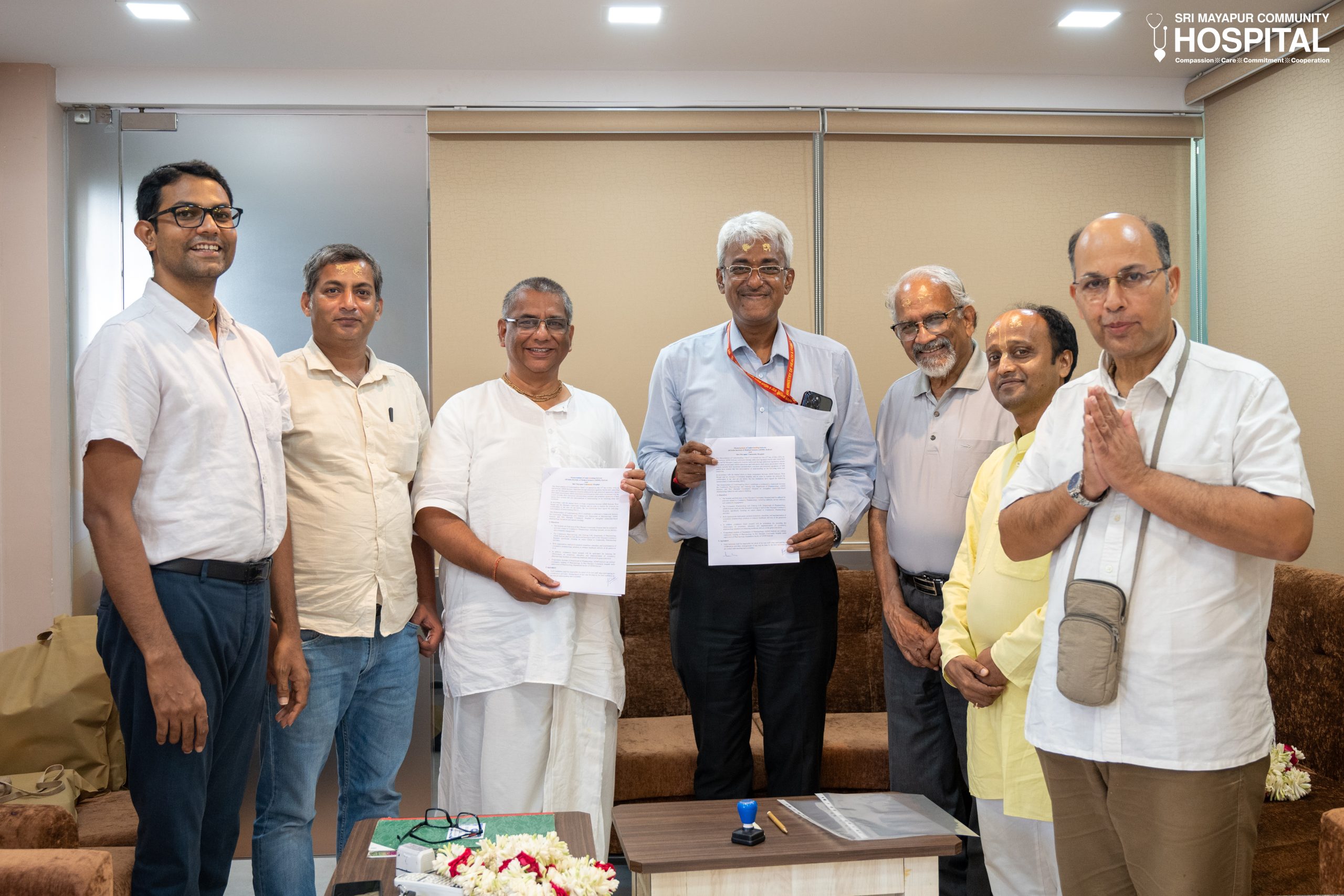
In a significant development for healthcare in West Bengal, an important AIIMS Kalyani partnership has been formally established between All India Institute of Medical Sciences Kalyani and Sri Mayapur Community Hospital. The five-year Memorandum of Understanding (MOU), signed on 23 May 2026, creates a framework for collaboration in community pharmacology, healthcare training, outreach initiatives, and community-based medical research.
The agreement reflects a shared commitment to ethical medical practice, responsible healthcare delivery, and compassionate service to rural and semi-urban communities. At a time when many healthcare systems face increasing commercial pressures, this AIIMS Kalyani partnership stands out as an example of cooperation rooted in public welfare, professional integrity, and service-oriented values.
The signing ceremony was attended by senior representatives from both institutions, including Harilila Das, who signed on behalf of Sri Mayapur Community Hospital, and Arvind Sinha, who signed on behalf of AIIMS Kalyani. The event also took place in the presence of Yogendra Kumar Gupta.
Additional representatives included Mukesh Kumar, Tirthankar Deb, Santosh Kumar Roy, and Santaraj Singh.
Why Sri Mayapur Community Hospital Was Chosen
A Shared Commitment to Ethical Healthcare
The decision by AIIMS Kalyani to select Sri Mayapur Community Hospital as its community partner was not incidental. The institution was chosen after careful evaluation of both its operational values and its practical contribution to public healthcare.
AIIMS Kalyani sought a partner whose work reflected a genuine commitment to community welfare and ethical medical practice. Sri Mayapur Community Hospital distinguished itself through years of charitable healthcare service provided without discrimination based on economic background, caste, or creed.
Located in Mayapur within the Nadia district, the hospital has steadily expanded its services in recent years. This growth includes the development of specialist departments, diagnostic facilities, community outreach programs, and broader access to healthcare for underserved populations.
The AIIMS Kalyani partnership therefore represents more than administrative cooperation. It is founded upon shared principles concerning the dignity of patient care and the moral responsibility of medical institutions toward society.
Healthcare Guided by Dharma
In Vedic understanding, true service is connected with dharma — righteous duty performed for the welfare of others. Healthcare naturally becomes one of society’s most important forms of practical compassion when guided by integrity and responsibility.
Sri Mayapur Community Hospital’s emphasis on patient-centered care reflects this spirit. Rather than treating medicine as merely transactional, the institution has maintained a focus on service, ethics, and long-term community welfare.
This philosophical alignment played an important role in establishing trust between the two institutions.
The Role of Dr. Tirthankar Deb
A central figure in developing the AIIMS Kalyani partnership was Tirthankar Deb, Head of the Department of Pharmacology at AIIMS Kalyani.
Dr. Deb was instrumental in conceptualizing and framing the MOU. He played a leading role in building communication between the institutions and guiding the discussions that ultimately resulted in the formal agreement.
His broader vision has been to extend the principles of community pharmacology beyond academic settings and into practical healthcare environments serving rural and semi-urban populations. This approach recognizes that medical knowledge achieves its highest value when it benefits communities directly.
Under the agreement, Dr. Deb will oversee the implementation of collaborative activities on behalf of AIIMS Kalyani, including training programs, workshops, research projects, and field interventions.
Key Areas of the AIIMS Kalyani Partnership
Community Pharmacology and Rational Drug Use
One of the central objectives of the collaboration is the promotion of rational prescribing practices and responsible medication use.
The Department of Pharmacology at AIIMS Kalyani, through its Community Pharmacology and Training Cell, will organize structured educational programs for hospital staff and healthcare practitioners. These initiatives will include workshops, continuing medical education (CME) sessions, and practical training focused on safe prescribing practices and community health interventions.
Particular emphasis will be placed on addressing the growing problem of inappropriate antibiotic and corticosteroid use.
Addressing Antimicrobial Resistance
According to Santosh Kumar Roy, one of the major concerns driving this initiative is the increasing threat of antimicrobial resistance.
The excessive and improper use of antibiotics has become a serious global healthcare challenge. Misuse weakens the long-term effectiveness of essential medicines and places future generations at risk.
Through the AIIMS Kalyani partnership, healthcare practitioners will receive guidance not only in clinical protocol but also in ethical responsibility regarding prescription practices.
This reflects an important principle acknowledged both in medicine and Vedic ethics: actions produce consequences. In Sanskrit, this principle is known as karma — the law of cause and effect. Responsible healthcare therefore requires foresight, discipline, and concern for long-term welfare rather than immediate convenience alone.
Community-Based Research and Medical Training
Integrating Academic Knowledge With Field Practice
Another major component of the collaboration involves community-based pharmacology research and postgraduate medical training.
Sri Mayapur Community Hospital will provide access to its community field areas, patient networks, facilities, and healthcare workers. This will enable AIIMS Kalyani researchers and postgraduate students to conduct practical field-based studies and outreach programs directly within local communities.
Postgraduate students from AIIMS Kalyani’s Department of Pharmacology will also participate in supervised community training rotations at the hospital.
This integration of academic learning with frontline healthcare delivery is expected to strengthen both professional competence and social awareness among future medical practitioners.
Outreach and Public Awareness
The agreement also includes plans for community outreach campaigns and public awareness programs focused on healthcare education and preventive medicine.
Such initiatives are especially important in rural and semi-urban regions where access to accurate medical information may be limited. By combining academic expertise with community engagement, the AIIMS Kalyani partnership seeks to make healthcare knowledge more accessible and practical for ordinary citizens.
Statements From Institutional Leadership
Speaking on the significance of the collaboration, Harilila Das expressed gratitude that AIIMS Kalyani had selected Sri Mayapur Community Hospital as its community partner.
He emphasized that the recognition affirms the value of seva — selfless service performed with compassion and integrity. He also reaffirmed the hospital’s longstanding conviction that quality healthcare should remain accessible to all, regardless of financial condition.
Similarly, Santosh Kumar Roy highlighted the importance of cultivating ethical and rational prescribing practices among regional healthcare providers.
Both leaders emphasized that the partnership is expected to improve healthcare standards while benefiting both practitioners and local communities.
A Model for Future Healthcare Collaboration
The AIIMS Kalyani partnership is expected to serve as a model for future collaboration between premier academic medical institutions and charitable community hospitals throughout the region.
Both institutions have stated their intention to publish the results of their collaborative research and advocate for the broader integration of community pharmacology principles into public healthcare policy.
This initiative demonstrates how academic expertise and grassroots healthcare service can complement one another effectively when guided by shared ethical principles.
Conclusion
The AIIMS Kalyani partnership with Sri Mayapur Community Hospital represents an important step toward strengthening ethical healthcare delivery, responsible medical education, and community-centered research in West Bengal.
By combining academic excellence with compassionate public service, both institutions are working to ensure that advanced medical knowledge reaches communities that need it most. Their collaboration reflects an understanding that healthcare is not merely a technical profession, but a sacred social responsibility grounded in integrity, wisdom, and concern for human well-being.
In a world increasingly shaped by commercial priorities, such partnerships remind society that genuine progress emerges when knowledge is guided by ethical duty, compassion, and a higher commitment to the welfare of all living beings.
library.vedavarsity.com || www.vedavarsity.com
Deepen your Bhakti-yoga practice, harmonize relationships, and receive guided coaching — all at Vedavarsity.com