


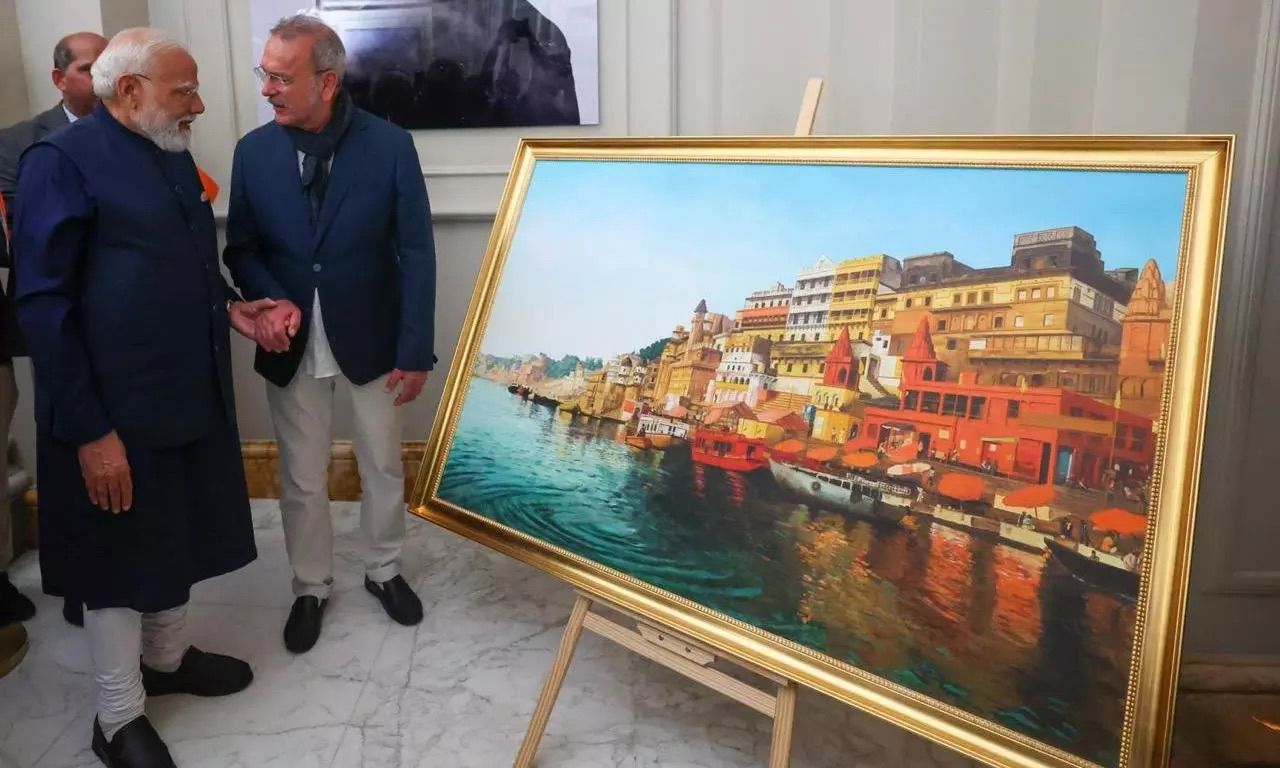
In anticipation of the recent visit of Narendra Modi to Italy, an important cultural initiative emerged that reflects the enduring spiritual and artistic relationship between India and Italy. Her Excellency Vani Rao proposed the creation of a significant artistic work that could communicate the spiritual essence of India through the vision of an Italian devotee artist.
The chosen subject was Varanasi, one of the world’s oldest living cities and among the most sacred destinations in India’s spiritual tradition. The resulting Varanasi art bridge became more than a diplomatic gesture. It evolved into a meaningful expression of cultural dialogue rooted in reverence, sacred memory, and shared appreciation for higher values.
At a time when global society increasingly seeks authentic connection beyond political and economic interests, such initiatives demonstrate how art can become a medium for harmony, dignity, and spiritual understanding.
The Spiritual Importance of Varanasi
A City of Eternal Sacred Memory
Varanasi has long been regarded as one of the spiritual hearts of India. Situated on the banks of the sacred Ganga, the city carries immense religious and philosophical significance within the Vedic tradition. Pilgrims from across the world visit Varanasi seeking purification, contemplation, and deeper understanding of life’s ultimate purpose.
In Vedic culture, places such as Varanasi are not valued merely for historical importance or architectural beauty. They are honored because they awaken remembrance of the eternal nature of the self, the ātmā, beyond temporary bodily identity.
The selection of Varanasi for this artistic commission therefore carried profound symbolic meaning. The city represents continuity, sacred learning, devotion, and humanity’s timeless search for transcendence.
Jnananjana Dasa and the Tradition of Devotional Art
There was little uncertainty regarding who should receive this distinguished commission. The responsibility was entrusted to Jnananjana Dasa, born Giampaolo Tomassetti, an internationally respected devotional artist whose life’s work has been dedicated to spiritually inspired art.
Jnananjana Dasa is widely recognized as one of the pioneering figures in devotional painting within the Hare Krishna movement in Europe. His artistic journey developed alongside important Vaishnava artists such as Ram Das and Dhrti Devi Dasi, both disciples connected to the artistic mission encouraged by A. C. Bhaktivedanta Swami Prabhupada.
Together, they contributed significantly to the development of the Vaishnava Art Academy, which played a major role in producing illustrations for publications of the Bhaktivedanta Book Trust. These publications have reached millions of readers worldwide and have introduced generations to the philosophical teachings of the Bhagavad-gita and Srimad-Bhagavatam.
Art as Service and Meditation
Within the Vedic tradition, art is not viewed merely as personal expression or commercial production. Authentic devotional art is understood as seva, or sacred service. The artist seeks not only technical excellence but inner purity and sincerity.
The work of Jnananjana Dasa reflects this principle deeply. His paintings consistently communicate serenity, sacred atmosphere, and contemplative depth. Rather than simply reproducing visual forms, his art invites the viewer toward introspection and remembrance of higher reality.
This approach aligns naturally with the broader spiritual culture of India, where beauty is traditionally understood as connected to truth and divine harmony.
Villa Vrindavana and the Preservation of Sacred Art
An important dimension of this Varanasi art bridge initiative is connected to the devotional art museum at Villa Vrindavana. Located within a historic 15th-century Medici villa, the museum preserves and exhibits many devotional works created through the collective vision of artists and supporters dedicated to sacred culture.
The project became possible through the collaboration of dedicated individuals, including Mahaprabhu Dasa, whose support helped establish the museum as a center for devotional artistic expression in Europe.
The presence of such a museum in Italy illustrates an important cultural truth: spiritual principles can transcend national boundaries while still respecting the integrity of distinct traditions. Sacred art has the capacity to communicate universal values through beauty, discipline, and devotion.
A Cultural and Spiritual Bridge Between India and Italy
The Meaning Behind the Commission
When the proposal was presented, Jnananjana Dasa reportedly accepted immediately, recognizing both the artistic responsibility and the deeper significance of the project.
The Varanasi art bridge represents far more than a diplomatic commission or ceremonial artwork. It symbolizes a meeting of two ancient civilizations with longstanding traditions of philosophy, spirituality, and artistic refinement.
India has preserved profound spiritual sciences concerning consciousness, duty, karma, and self-realization for millennia. Italy, likewise, carries a rich civilizational history shaped by art, architecture, scholarship, and cultural continuity. Through this project, these two traditions meet on common ground through sacred aesthetics.
Such exchanges remind us that genuine culture is not based solely on technology or economics. True culture elevates consciousness and encourages respect among peoples.
Art Beyond National Identity
One especially meaningful aspect of this initiative is that the spirituality of India is being interpreted through the sensibility of an Italian artist deeply connected to the devotional tradition.
This demonstrates an important Vedic principle: spiritual identity transcends temporary external designations such as nationality, ethnicity, or social background. The Bhagavad-gita teaches that wisdom begins when one understands the difference between the eternal self and the temporary body.
Through devotional sincerity and disciplined artistic practice, Jnananjana Dasa has become a cultural bridge capable of expressing India’s sacred heritage with authenticity and reverence.
Prime Minister Narendra Modi’s Personal Appreciation
A particularly memorable moment occurred during the meeting with Prime Minister Narendra Modi. Despite an exceptionally demanding schedule and the late hour, the Prime Minister personally wished to meet Jnananjana Dasa and discuss the details of the work.
This gesture reflected an important quality often appreciated by observers of Narendra Modi’s leadership: his visible respect for India’s spiritual and cultural traditions, as well as his recognition of art as an instrument of dialogue and civilizational continuity.
The interaction also highlighted the role that culture and spirituality can play within international relations. Political agreements may shape temporary policy, but shared cultural appreciation often creates longer-lasting bonds between nations.
The Continuing Relevance of Sacred Art
Beauty in Service of Higher Understanding
Modern society frequently approaches art through commercial trends, entertainment value, or ideological expression. Yet sacred art operates according to a different principle. Its purpose is elevation rather than agitation.
The Varanasi art bridge stands as a reminder that beauty can still serve truth, contemplation, and unity. In a fragmented world increasingly affected by conflict, distraction, and superficial identity, spiritually grounded artistic initiatives can help restore deeper human connection.
Such projects also affirm the enduring relevance of dharma, the principle of righteous responsibility and harmony with higher order. When art is guided by sincerity and service, it naturally becomes uplifting both for the creator and the audience.
Conclusion
The Varanasi art bridge created through the collaboration between India and Italy represents a meaningful example of cultural diplomacy rooted in spiritual respect rather than mere symbolism.
Through the vision of Jnananjana Dasa, the sacred atmosphere of Varanasi has been expressed in a manner capable of touching audiences across cultural boundaries. The initiative supported by Her Excellency Vani Rao and appreciated by Narendra Modi demonstrates how art, spirituality, and mutual respect can strengthen relations between nations in a dignified and enduring way.
At a deeper level, the Varanasi art bridge reminds us that genuine civilization flourishes when human creativity is connected with higher purpose, sacred remembrance, and sincere appreciation for the divine order that unites all living beings.
library.vedavarsity.com || www.vedavarsity.com
Deepen your Bhakti-yoga practice, harmonize relationships, and receive guided coaching — all at Vedavarsity.com