


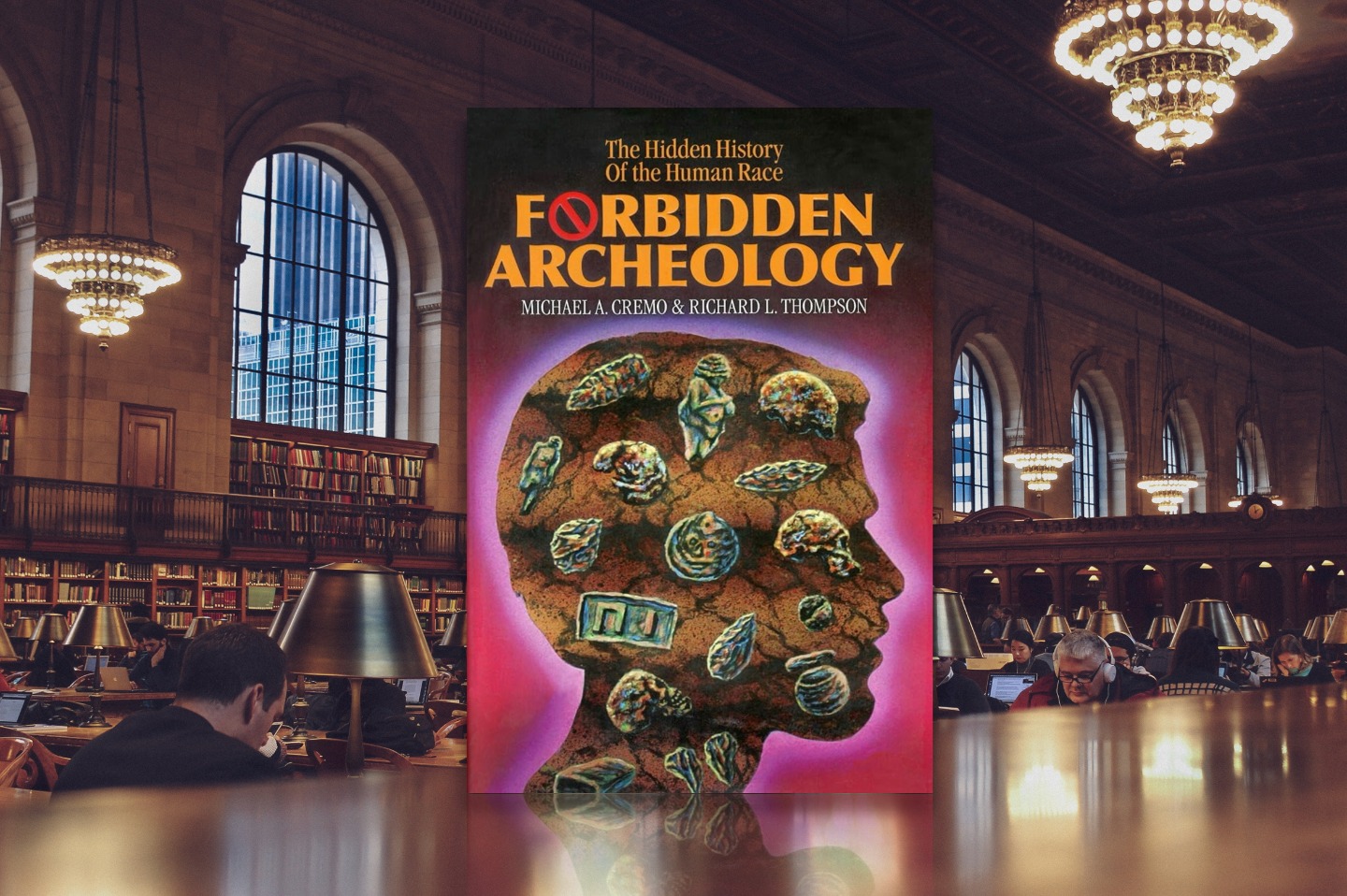
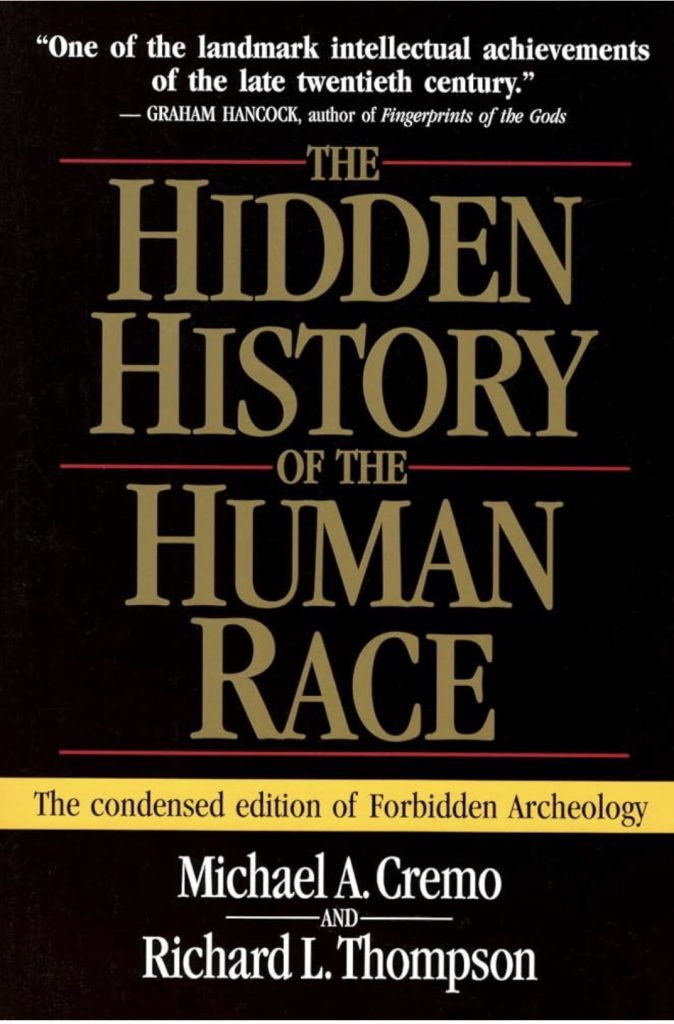
The question of human origins has occupied the minds of philosophers, scientists, and spiritual seekers for centuries. Forbidden Archeology, written by Michael A. Cremo (Drutakarmā Dāsa) and Richard L. Thompson (Sadāpūta Dāsa), challenges readers to reconsider how archaeological discoveries are interpreted and how scientific theories become established.
First published in 1993, this controversial work examines historical reports of human artifacts that its authors believe may challenge conventional accounts of human evolution. For students of Vedic philosophy, the discussion raises important questions about the relationship between empirical evidence, prevailing scientific assumptions, and the ancient wisdom preserved in India’s Vedic literature.
The significance of this work extends beyond archaeology. It invites a deeper inquiry into the nature of knowledge, the limitations of human investigation, and the search for truth.
What Is Forbidden Archeology?
Forbidden Archeology: The Hidden History of the Human Race is a substantial work that investigates unusual archaeological discoveries reported over several centuries. Cremo and Thompson examine claims concerning stone tools, human remains, and other objects allegedly found in geological deposits that would make them unexpectedly ancient if their original contexts and dates were correct.
The authors argue that some discoveries received inadequate attention or were dismissed because they did not fit prevailing models of human evolution.
Their central concern is methodological: should evidence be evaluated impartially, even when it challenges an established theory?
The book draws attention to historical reports from the nineteenth and early twentieth centuries, when researchers were actively debating the antiquity of humanity. It also considers how scientific interpretations changed as evolutionary explanations became increasingly influential.
However, the book’s conclusions remain controversial. Many of its cited discoveries have uncertain geological contexts, disputed dates, or alternative explanations. Mainstream archaeologists do not generally accept its thesis that anatomically modern humans have existed for millions of years.
Nevertheless, examining the book provides an opportunity to reflect on how evidence should be assessed and why reliable dating, reproducibility, and independent verification are essential to scientific inquiry.
Forbidden Archeology and the Question of Scientific Objectivity
One of the most significant themes in Forbidden Archeology is the possibility that accepted assumptions can influence the interpretation of evidence.
Science advances through observation, hypothesis, testing, and revision. A theory becomes stronger when it explains available evidence and survives rigorous examination. When credible new findings contradict an existing explanation, researchers should investigate the discrepancy rather than dismiss it merely because it is unfamiliar.
At the same time, not every unusual discovery overturns an established scientific model. An extraordinary claim requires particularly strong evidence, including reliable documentation of where an object was found, how its age was determined, and whether alternative explanations have been excluded.
This distinction is important for a balanced understanding of the book.
The Vedic tradition also encourages thoughtful inquiry. In Sanskrit, tattva-jijñāsā means the desire to inquire into the Absolute Truth. The opening aphorism of the Vedānta-sūtra declares, athāto brahma-jijñāsā—now, therefore, one should inquire into Brahman, the ultimate spiritual reality.
Such inquiry is not satisfied with superficial explanations. It seeks a deeper understanding of existence and the causes underlying the visible world.
A thoughtful reader can therefore appreciate the questions raised by Forbidden Archeology while carefully examining the evidence supporting its particular conclusions.
The Vedic Understanding of Human Origins
Vedic literature approaches the question of human existence from a perspective broader than biological ancestry alone. It considers the relationship between the body, consciousness, the living entity, and the Supreme Lord.
According to the Bhagavad-gītā (2.13), the embodied soul passes through childhood, youth, and old age, and similarly passes into another body at death. This teaching distinguishes the conscious self from the temporary material body.
Śrīla Prabhupāda repeatedly emphasized that a complete understanding of life must consider consciousness and the spiritual identity of the living being, rather than treating the body as the entirety of personal existence.
The Sanskrit term jīva refers to the individual living entity. In Vaiṣṇava philosophy, the jīva is an eternal spiritual being whose identity is distinct from the changing material body.
This perspective does not, by itself, establish a particular archaeological date for the appearance of anatomically modern humans. Rather, it addresses a different dimension of the question: what is the nature of the living being, and what is the ultimate purpose of human life?
The Vedic worldview thus encourages readers to distinguish between the historical development of physical bodies and the spiritual identity of the conscious self.
Time and Creation in Vedic Cosmology
Another reason the discussion surrounding Forbidden Archeology interests students of Vedic literature is its engagement with the antiquity of life and the history of the material world.
Vedic cosmology describes time on a vast scale. The Śrīmad-Bhāgavatam discusses cycles of creation and dissolution, the four yugas, and the lifespan of Brahmā, the secondary creator within the material universe.
According to traditional calculations, the four yugas together comprise 4.32 million human years. A thousand such cycles constitute one day of Brahmā, illustrating the immense timescales described in Purāṇic cosmology.
These accounts differ in their framework and purpose from modern geological chronology. They belong to a theological and cosmological tradition that understands the universe in relation to the Supreme Lord and recurring cycles of manifestation.
It is therefore important not to assume that a reference to vast time periods automatically verifies a specific archaeological claim. Nor should the spiritual significance of Vedic cosmology be reduced to whether every traditional description corresponds directly to a modern scientific model.
A serious comparative study should examine each tradition on its own terms while identifying where meaningful questions or points of comparison arise.
Michael Cremo, Sadāpūta Dāsa, and Their Intellectual Contribution
The history of Forbidden Archeology is closely connected with the work of devotees associated with the Bhaktivedanta Institute.
Richard L. Thompson, known as Sadāpūta Dāsa, brought an interest in mathematics, science, and Vedic cosmology to the project. Michael Cremo, known as Drutakarmā Dāsa, contributed much of the writing and historical research. Stephen Bernath, known as Mādhavendra Purī Dāsa, assisted with research and publication-related work.
Their collaboration developed from earlier efforts to explore questions about the origins of the universe and life through publications associated with the Bhaktivedanta Institute.
The book’s publication in 1993 represented a major undertaking, combining extensive historical documentation with an argument against what the authors viewed as selective treatment of archaeological evidence.
Its importance within the history of the Hare Krishna movement lies partly in this attempt to engage modern scientific discussions while drawing inspiration from Vedic literature.
Readers may disagree with the book’s interpretation of particular discoveries. Even so, its history illustrates the desire of these authors to investigate questions of human origins and to encourage dialogue between scientific inquiry and religious thought.
What Can We Learn from Forbidden Archeology?
The enduring value of Forbidden Archeology can be considered through several lessons.
1. Examine evidence carefully
A sincere seeker should neither accept nor reject a claim merely because it supports a preferred worldview. Evidence must be evaluated according to its quality, context, and reliability.
The same principle applies to archaeological discoveries, historical accounts, and interpretations of sacred literature.
2. Recognize the limits of empirical knowledge
Scientific investigation has produced remarkable insights into the natural world. Yet scientific methods have defined scopes, and empirical measurements alone do not settle every philosophical or spiritual question.
Questions about the meaning of existence, the nature of consciousness, and the purpose of human life require careful philosophical consideration as well.
3. Distinguish scientific hypotheses from spiritual teachings
Archaeology investigates material remains and their historical contexts. Vedic philosophy addresses material existence, consciousness, dharma, and the relationship between the living entity and the Supreme Lord.
These approaches may engage with some common questions, but they should not be confused with one another.
A balanced student studies the evidence for historical claims and approaches spiritual teachings through appropriate philosophical and scriptural methods.
4. Cultivate humility in the search for truth
The Vedic tradition places great importance on humility and the willingness to learn. Knowledge is not merely a means of winning arguments; it should help one understand reality more deeply.
In the Bhagavad-gītā (4.34), Kṛṣṇa recommends approaching a bona fide spiritual master with humility, inquiry, and a spirit of service.
This teaching highlights the importance of sincere inquiry guided by sound knowledge rather than pride or the desire to defend a predetermined conclusion.
The Deeper Purpose of Human Life
Although debates about human origins are intellectually stimulating, Vedic philosophy directs attention toward a still more fundamental question: what is the purpose of human life?
Human intelligence offers the opportunity to investigate the world, reflect upon existence, and inquire into spiritual truth. In the Vaiṣṇava tradition, this opportunity reaches its fulfillment in understanding one’s eternal relationship with Kṛṣṇa.
Śrīmad-Bhāgavatam 1.2.6 describes the highest dharma as that which awakens loving devotional service to the Supreme Lord, free from selfish motivation and uninterrupted.
From this perspective, the value of knowledge is not measured solely by the number of facts accumulated or controversies resolved. Knowledge becomes especially meaningful when it contributes to wisdom, humility, ethical conduct, and spiritual realization.
The study of archaeology can deepen appreciation for the material world’s history. The study of Vedic literature can offer a framework for reflecting upon consciousness, duty, and the ultimate goal of existence. Each should be approached with intellectual honesty and an awareness of its proper scope.
Conclusion: The Continuing Relevance of Forbidden Archeology
Forbidden Archeology remains a notable and controversial contribution to discussions about human origins. Michael Cremo and Richard L. Thompson challenged readers to examine historical archaeological reports and consider whether scientific assumptions can influence the interpretation of evidence.
Its central claims about extremely ancient modern humans are not accepted by mainstream archaeology, and the discoveries it discusses must be evaluated individually through reliable dating, geological context, and independent verification.
From a Vedic perspective, the broader questions raised by the book remain worthy of thoughtful consideration. How should knowledge be acquired? What are the limits of empirical investigation? How can material inquiry contribute to a deeper understanding of life?
Vedic philosophy encourages sincere inquiry while directing the human being toward the realization of the eternal self and its relationship with the Supreme Lord.
Ultimately, the significance of Forbidden Archeology lies not in treating every disputed artifact as proof of a particular worldview, but in encouraging careful investigation, philosophical reflection, and humility before the complexity of existence. For students of Vedavarsity Library, this provides an opportunity to explore the relationship between scientific claims and spiritual wisdom without sacrificing either intellectual honesty or devotional purpose.
Deepen your Bhakti-yoga practice, harmonize relationships, and receive guided coaching — all at Vedavarsity.com