


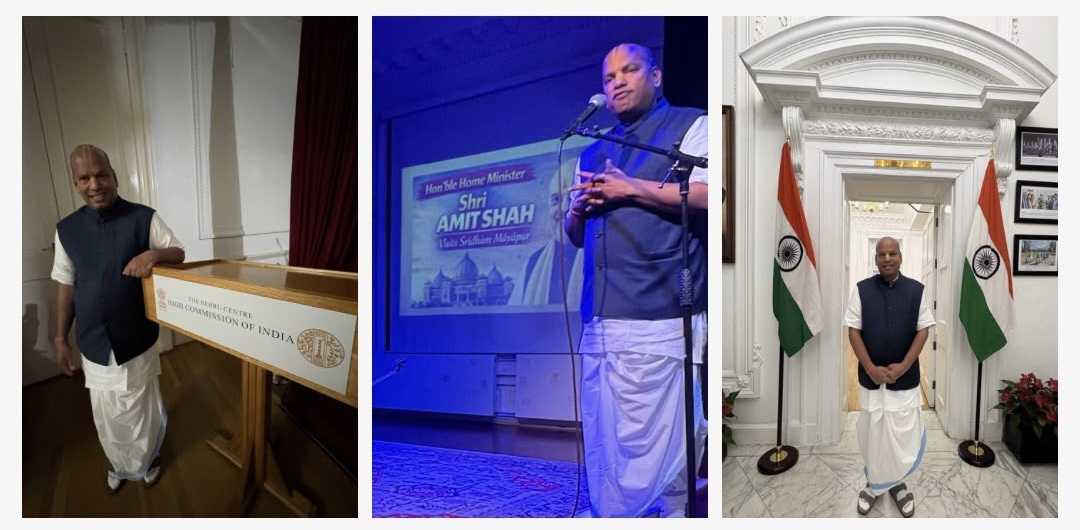
The TOVP celebration in London marked an important occasion in the international recognition of the Temple of the Vedic Planetarium (TOVP), a monumental spiritual project rising in Sri Mayapur Dham, West Bengal, India. Hosted by the Indian High Commission in London on October 13, 2026, the gathering brought together diplomats, ISKCON leaders, devotees, and well-wishers to appreciate the temple’s progress and spiritual significance.
The occasion was more than a celebration of architectural achievement. It offered an opportunity to reflect upon India’s timeless Vedic heritage and the universal message of devotion to the Supreme Personality of Godhead, Sri Krishna. Through presentations, devotional music, meditation, and fellowship, the gathering highlighted the TOVP’s aspiration to share Vedic wisdom with people throughout the world.
TOVP Celebration in London: Honouring a Spiritual Vision
The Temple of the Vedic Planetarium is one of the most ambitious temple projects associated with the International Society for Krishna Consciousness (ISKCON). Situated in Sri Mayapur Dham, the sacred birthplace of Sri Chaitanya Mahaprabhu, the temple is envisioned as a centre for spiritual education, devotional practice, and the presentation of Vedic cosmology.
The London gathering celebrated the progress of this remarkable undertaking and drew attention to its significance beyond the boundaries of India.
According to the event report published by ISKCON News, TOVP Vice Chairman Braja Vilasa Dasa provided updates on the temple’s construction. He also shared a video highlighting the recent visit of Indian Home Minister Amit Shah.
GBC representative Praghosa Dasa spoke about the project’s spiritual and cultural importance. Their presentations helped guests appreciate the vision behind the temple and its intended contribution to the preservation and dissemination of India’s spiritual traditions.
The event demonstrated how a sacred project rooted in India’s devotional heritage can inspire interest and appreciation among an international audience.
The Temple of the Vedic Planetarium and Its Spiritual Purpose
The TOVP is not conceived merely as a place of architectural grandeur. Its vision centres upon presenting the teachings of the Vedic scriptures and encouraging visitors to contemplate the nature of existence, the universe, and the Supreme Lord.
The Sanskrit word Veda refers to knowledge, particularly spiritual knowledge concerning the self, the Supreme Being, and the relationship between them. The word planetarium evokes the temple’s distinctive intention to present Vedic cosmological concepts through an educational and visual experience.
In the Vedic tradition, knowledge reaches its highest purpose when it awakens genuine understanding of the self and one’s eternal relationship with Bhagavan, the Supreme Personality of Godhead.
The Bhagavad-gita teaches that the living being is not merely the temporary material body but an eternal spiritual soul, or atma. Understanding this distinction provides the foundation for spiritual life.
The TOVP seeks to create an environment in which visitors can explore these philosophical principles alongside the cosmological vision preserved in Vedic literature.
Its significance, therefore, extends beyond physical construction. The temple represents an effort to make India’s spiritual knowledge accessible to future generations.
Sri Mayapur Dham: The Sacred Heart of the Project
To understand the significance of the TOVP, one must appreciate the spiritual importance of Sri Mayapur Dham.
Mayapur is revered by Gaudiya Vaishnavas as the birthplace of Sri Chaitanya Mahaprabhu, who appeared in the fifteenth century to propagate the chanting of the holy names of Krishna. His teachings emphasise bhakti-yoga, the path of loving devotional service to the Supreme Lord.
Sri Chaitanya Mahaprabhu taught that the chanting of the Hare Krishna maha-mantra is a powerful means of spiritual purification in the present age, known in Vedic literature as Kali-yuga.
The maha-mantra is:
Hare Krishna, Hare Krishna, Krishna Krishna, Hare Hare
Hare Rama, Hare Rama, Rama Rama, Hare Hare
Through sincere chanting, a practitioner seeks to purify the heart, overcome material attachments, and awaken the soul’s dormant love for Krishna.
The TOVP’s location in Mayapur connects its international educational mission with this living devotional tradition. Its purpose is not simply to present information about Vedic culture, but also to inspire deeper spiritual inquiry and appreciation for the process of bhakti.
For pilgrims and visitors, Mayapur offers an opportunity to experience a culture centred upon sadhana (regular spiritual practice), kirtana (congregational chanting), and seva (selfless service).
Devotional Music and Meditation at the London Gathering
The programme at the Indian High Commission included a flute recital, guided meditation, and opportunities for guests to receive special blessings.
These elements reflected the devotional character of the occasion. In the Vaishnava tradition, music and meditation are not merely forms of artistic expression or relaxation; they can also become means of directing the mind and heart towards the Supreme Lord.
The flute holds a particularly cherished place in Krishna’s pastimes. Sri Krishna is traditionally depicted playing His flute, attracting the hearts of His devotees through its transcendental sweetness.
Devotional music, when offered in a spirit of service, can help cultivate remembrance of the Lord and encourage a mood of humility and gratitude.
Similarly, meditation within the bhakti tradition involves more than withdrawing the mind from external distractions. It includes hearing about Krishna, remembering His names and activities, and developing loving awareness of Him.
The London gathering brought these devotional elements into a setting of international fellowship, allowing participants to encounter aspects of India’s spiritual heritage through both discussion and experience.
Vedic Wisdom as a Universal Cultural Heritage
India’s spiritual traditions have long explored questions concerning the nature of consciousness, the purpose of human life, and the relationship between the individual and the Supreme.
The Vedic scriptures encourage human beings to look beyond temporary material achievements and inquire into the eternal nature of the self.
In the Bhagavad-gita, Sri Krishna explains the importance of performing one’s duties with spiritual understanding and cultivating devotion to Him. Such teachings provide a foundation for a life guided by wisdom, compassion, self-discipline, and service.
The international appreciation reflected in the TOVP celebration in London offers an opportunity to consider how this philosophical heritage can contribute to meaningful dialogue across cultures.
The gathering at the Indian High Commission brought together people from different professional and cultural backgrounds around a shared interest in the temple’s spiritual and cultural significance.
Although architectural achievements may initially attract attention, the enduring value of a spiritual institution rests upon the wisdom it preserves and the positive transformation it encourages in human life.
The TOVP aspires to serve this broader purpose by presenting Vedic teachings in a setting that combines traditional devotion with educational interpretation.
Srila Prabhupada’s Vision of Sharing Krishna Consciousness
The international expansion of Krishna consciousness is closely associated with the teachings and mission of His Divine Grace A. C. Bhaktivedanta Swami Prabhupada, the founder-acharya of ISKCON.
Srila Prabhupada travelled from India to the West in 1965 with the intention of sharing the teachings of Sri Chaitanya Mahaprabhu and the devotional wisdom of the Bhagavad-gita and Srimad-Bhagavatam.
His mission demonstrated that the essential principles of bhakti are not restricted by nationality, language, or social background. The eternal relationship between the living being and Krishna is a spiritual reality that transcends temporary material distinctions.
Within this understanding, temples serve as centres of hearing, chanting, worship, education, and service. They offer opportunities for people to study sacred texts, participate in devotional practices, and cultivate a deeper understanding of spiritual life.
The TOVP reflects this broad educational and devotional aspiration. By drawing attention to Vedic cosmology and the teachings of the Vaishnava tradition, it seeks to encourage visitors to examine the philosophical foundations of India’s spiritual heritage.
The London celebration brought this vision into an international diplomatic setting, illustrating the potential for cultural gatherings to introduce a wider audience to the teachings and practices associated with Krishna consciousness.
The TOVP’s Growing International Significance
The Temple of the Vedic Planetarium has attracted attention because of its scale, its distinctive spiritual purpose, and its connection with Sri Mayapur Dham.
Events such as the London gathering help communicate the project’s progress to audiences beyond the community directly involved in its construction.
The participation of diplomats, religious representatives, and well-wishers also creates opportunities for cultural exchange and a deeper appreciation of India’s spiritual traditions.
However, the temple’s ultimate significance lies not in public recognition alone. Its lasting contribution will be measured by its ability to encourage sincere spiritual inquiry, preserve Vedic teachings, and inspire devotional service.
A sacred place becomes meaningful through the practices and principles it nurtures. In the Vaishnava understanding, the purpose of spiritual knowledge is to awaken one’s relationship with Krishna and encourage a life dedicated to His service.
The TOVP’s educational vision can therefore be understood as an invitation to look beyond the external world and inquire into the deeper purpose of human existence.
Conclusion: TOVP Celebration in London and the Message of Bhakti
The TOVP celebration in London on October 13, 2026, highlighted the growing international interest in the Temple of the Vedic Planetarium and its mission to share India’s spiritual heritage.
Through presentations by Braja Vilasa Dasa and Praghosa Dasa, devotional music, meditation, and fellowship, the gathering brought attention to the temple’s construction and its broader cultural and spiritual significance.
Rooted in Sri Mayapur Dham and inspired by the devotional tradition of Sri Chaitanya Mahaprabhu, the TOVP aspires to provide a setting for the study and appreciation of Vedic knowledge.
For the sincere seeker, the deeper invitation is to move beyond external achievements and cultivate spiritual understanding through hearing, chanting, reflection, and service.
The enduring message of bhakti is that genuine fulfilment arises when the soul revives its loving relationship with the Supreme Lord. In this spirit, the TOVP stands as an expression of the aspiration to preserve India’s sacred wisdom and share its devotional message with the world.
Deepen your Bhakti-yoga practice, harmonize relationships, and receive guided coaching — all at Vedavarsity.com