


The GBC Midterm Meeting began on October 19, 2026, at Govardhan Eco Village in Maharashtra, India, bringing together leaders of the International Society for Krishna Consciousness (ISKCON) to discuss organizational development, spiritual cooperation, and the future of Srila Prabhupada’s mission. A significant part of the meeting focused on developing a framework through which independently operating devotee organizations could establish closer relationships with ISKCON.
The discussions reflect an important question for the worldwide Vaishnava community: how can devotees serving in different organizational structures cooperate more effectively while remaining faithful to the teachings and instructions of His Divine Grace A. C. Bhaktivedanta Swami Srila Prabhupada?
The initiative seeks to explore practical ways of strengthening relationships, promoting unity, and facilitating cooperation in the service of Lord Sri Krishna.
What Is the GBC Midterm Meeting?
The Governing Body Commission (GBC) is the principal managerial authority of ISKCON, established to oversee the Society’s administration and ensure that its activities remain aligned with Srila Prabhupada’s instructions.
The 2026 Midterm General Meeting commenced on October 19 at Govardhan Eco Village, a spiritual community and retreat centre in Maharashtra, India. The gathering opened with prayers and respectful offerings to Srila Prabhupada, the Founder-Acharya of ISKCON.
Radhanath Swami, who hosted the gathering, welcomed the participating leaders.
Such meetings provide opportunities for ISKCON’s leadership to consider administrative challenges, evaluate existing policies, and discuss initiatives that may support the Society’s continued spiritual and organizational development.
The discussions also highlight the importance of responsible leadership in preserving the spiritual purpose of an institution established to spread Krishna consciousness throughout the world.
ISKCON Organizational Development and the Affiliation Framework
One of the principal subjects discussed during the opening day was a proposed framework for greater cooperation between ISKCON and independently operating devotee organizations.
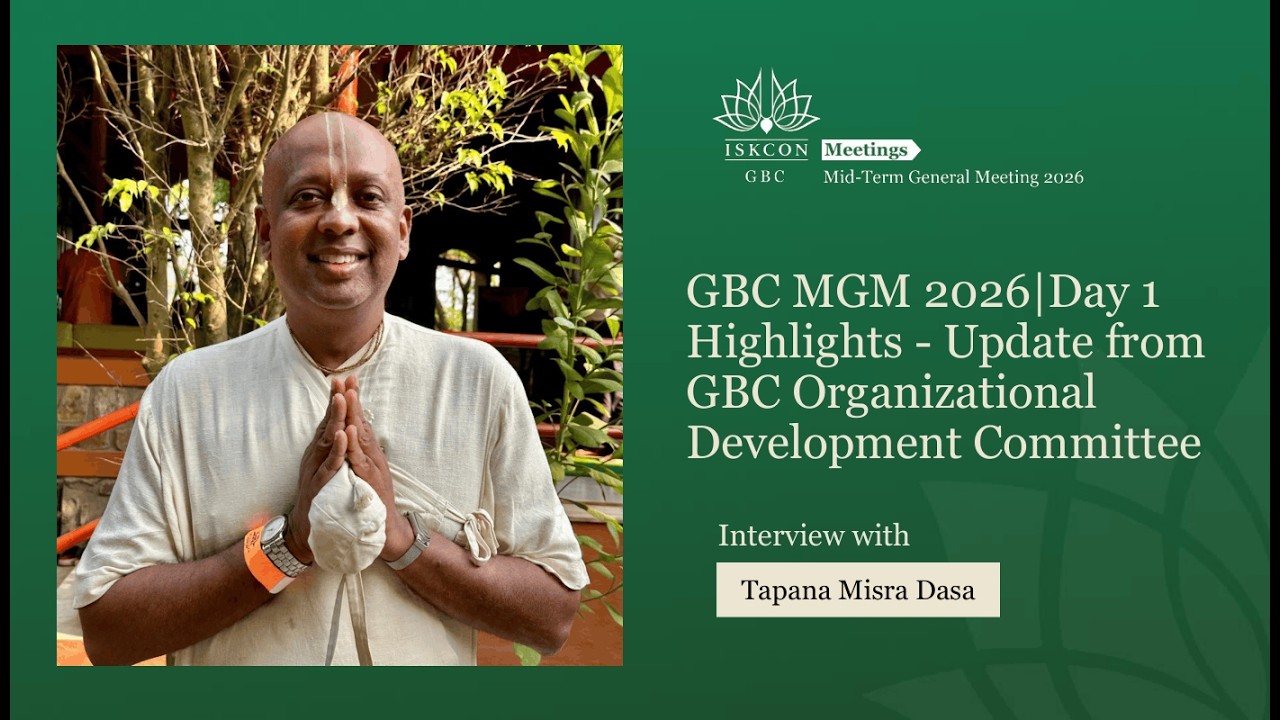
The GBC Organizational Development Committee, commonly known as OrgDev, presented its work under the facilitation of Tapana Misra Dasa, GBC Zonal Secretary for the Middle East and North Africa.
The presentation explored historical approaches to maintaining unity within religious movements, reviewed earlier GBC resolutions, and considered the possibilities for developing closer relationships with organizations operating outside ISKCON’s formal administrative structure.
The committee also examined previous GBC resolutions, including those adopted in 2002 concerning organizational affiliations.
Why Is an Affiliation Framework Important?
Over the decades, devotees inspired by Srila Prabhupada’s teachings have established different organizations and initiatives to serve the Vaishnava community and spread Krishna consciousness.
Although these organizations may operate independently, they can share a common spiritual aspiration: to assist in fulfilling the mission of Lord Caitanya Mahaprabhu and the instructions of the previous acharyas.
A carefully developed affiliation framework could provide a more structured means of exploring cooperation between such organizations and ISKCON.
Potential areas of cooperation may include educational initiatives, outreach, spiritual programmes, and other forms of devotional service, subject to the framework’s eventual provisions.
The proposed framework remains under development. Its purpose and implementation will depend on further evaluation and the recommendations presented to the GBC.
Srila Prabhupada’s Vision of Cooperation
A central theme of the discussions was Srila Prabhupada’s desire for devotees to cooperate under ISKCON’s umbrella.
In the Gaudiya Vaishnava tradition, cooperation is not merely an administrative arrangement. It is connected with the principle of seva, or devotional service, in which individual abilities and resources are engaged in the service of Krishna.
Srila Prabhupada established ISKCON to provide a worldwide platform for spreading the teachings of Lord Sri Krishna as presented in the Bhagavad-gita, Srimad-Bhagavatam, and the teachings of the disciplic succession.
The expansion of Krishna consciousness requires both spiritual conviction and organized effort. Educational institutions, temples, congregational programmes, book distribution, and community initiatives can all contribute to this purpose when conducted in accordance with the teachings of the acharyas.
At the same time, organizational cooperation requires clarity regarding responsibilities, authority, accountability, and shared objectives.
The proposed affiliation initiative seeks to examine how these considerations can be addressed while encouraging closer collaboration among devotees and organizations.
Unity in Diversity Within Devotional Service
The principle of unity does not necessarily mean that every devotee must perform identical activities or that every organization must follow the same operational arrangements.
Devotees possess different abilities, experiences, and opportunities for service. The important consideration is whether these abilities are engaged favourably in the service of the Supreme Lord and in accordance with the instructions of the spiritual authorities.
The Sanskrit principle yukta-vairagya refers to the proper engagement of material resources in the service of Krishna. In a broader practical sense, responsible organizational development can help devotees employ their knowledge, skills, and resources for spiritual purposes.
However, effective cooperation requires more than shared inspiration. It also requires mutual respect, transparent communication, clearly defined expectations, and fidelity to the spiritual principles upon which the movement is founded.
These considerations make the development of an affiliation framework a significant subject for ISKCON’s future organizational planning.
GBC Gives Directional Approval for Further Development
According to the ISKCON News report published on October 19, Tapana Misra Dasa stated that the GBC had given directional approval for further development of the proposed framework.
This approval authorizes the Organizational Development Committee to continue working with GBC zonal secretaries to evaluate the framework’s potential for implementation worldwide.
The decision represents a step towards further examination rather than the announcement of a completed policy.
Additional recommendations are expected to be presented at the GBC’s next Annual General Meeting in Mayapur.
The subsequent discussions will be important in determining how the proposed framework might operate, what forms of affiliation could be considered, and how relationships between ISKCON and independent devotee organizations could be structured.
A workable framework would need to consider the circumstances of different communities while preserving the principles and responsibilities associated with ISKCON’s institutional identity.
The initiative may also provide an opportunity to identify practical methods for cooperation that respect the distinct circumstances of participating organizations.
Management Handbooks to Strengthen ISKCON’s Administration
The opening day also included a presentation by Gauranga Dasa on management handbooks intended to compile international best practices in governance, administration, and operations.
Such resources can help institutions improve consistency in decision-making, clarify procedures, and strengthen organizational effectiveness.
For an international spiritual movement, effective administration is particularly important because activities take place across different countries, cultures, legal environments, and community settings.
Clear guidelines can help leaders and devotees understand their responsibilities while supporting continuity in institutional operations.
Nevertheless, administrative systems must remain connected with the spiritual purpose for which the institution exists. Management practices are valuable when they facilitate devotional service, support spiritual education, and help devotees serve responsibly.
The combination of spiritual principles and sound administration can therefore play an important role in the continued development of ISKCON.
Srimad-Bhagavatam Classes on the Seven Purposes of ISKCON
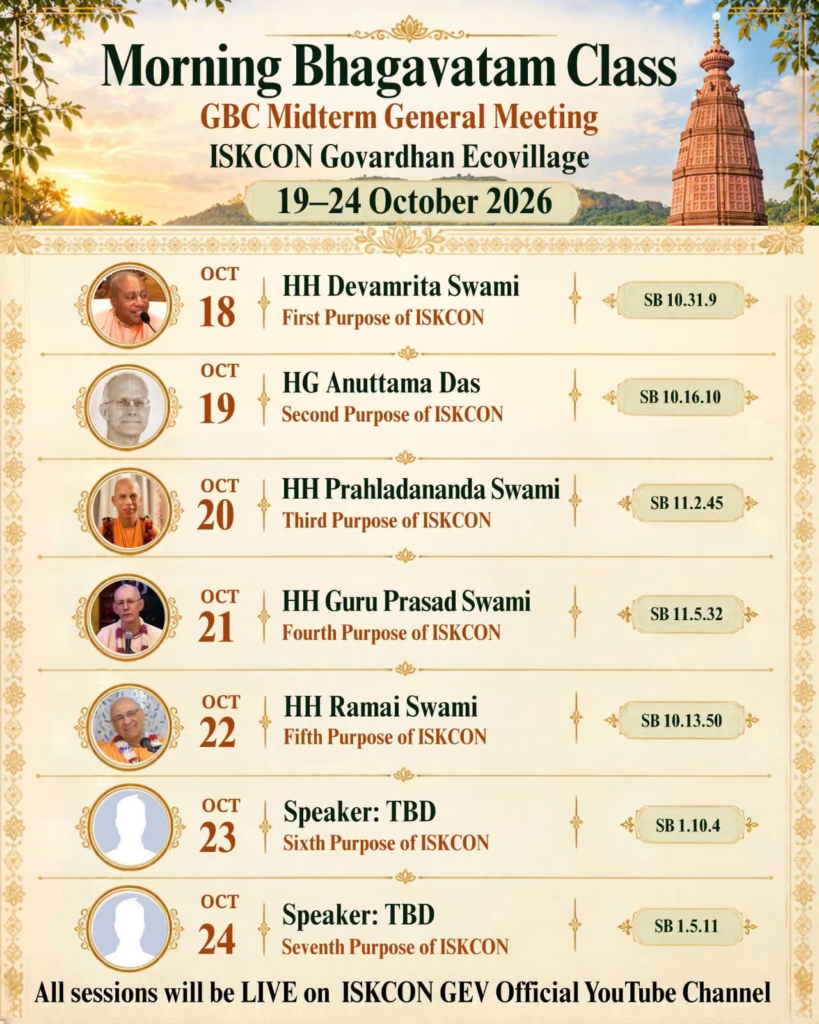
During the leadership meetings at Govardhan Eco Village, daily Srimad-Bhagavatam classes are scheduled to explore ISKCON’s Seven Purposes.
Srila Prabhupada established these purposes to guide the Society’s activities and communicate its spiritual and social objectives.
The Seven Purposes address the systematic dissemination of spiritual knowledge, the propagation of Krishna consciousness, the promotion of congregational chanting, the establishment of sacred places of pilgrimage, and the cultivation of a more spiritually conscious way of life.
Returning to these foundational purposes is relevant when considering organizational development. Institutional structures and administrative policies are ultimately meant to support the Society’s spiritual mission.
Regular study of Srimad-Bhagavatam also reinforces the importance of receiving knowledge through the authorized disciplic succession and applying spiritual teachings in practical life.
According to the report, the classes will be recorded and made available through the ISKCON Govardhan Eco Village YouTube channel, allowing devotees to access the sessions beyond the immediate gathering.
Health Update on Jayapataka Swami
The opening day concluded with Hridaya Chaitanya Dasa sharing an update on the health of Jayapataka Swami.
He also conveyed the gratitude and blessings of Jayapataka Swami to GBC members who had continued offering prayers for his recovery.
The update served as a reminder of the affection and concern within the Vaishnava community for its senior spiritual leaders.
Devotees wishing to receive further information about his condition may consult the health updates shared by his authorized health team.
Conclusion: The Significance of the GBC Midterm Meeting for ISKCON’s Future
The GBC Midterm Meeting of 2026 has brought attention to an important aspect of ISKCON’s development: strengthening cooperation among devotees and organizations while remaining faithful to Srila Prabhupada’s vision.
The proposed affiliation framework represents an ongoing effort to examine how independently operating devotee organizations might work more closely with ISKCON. The GBC’s directional approval allows further development and evaluation, with more detailed recommendations expected at the next Annual General Meeting in Mayapur.
As the initiative progresses, its effectiveness will depend on clear principles, practical arrangements, and a shared commitment to devotional service.
For the Vaishnava community, the deeper purpose of organizational cooperation is to facilitate the spread of Krishna consciousness and assist in fulfilling the mission of Lord Sri Caitanya Mahaprabhu.
When administration, leadership, and collective effort remain directed towards this spiritual objective, organizational development can become a valuable means of serving the mission established by Srila Prabhupada.
Source: ISKCON News, “GBC Midterm Meeting Explores ISKCON Affiliation Framework,” published October 19, 2026.
Further Viewing: Watch the Day One Highlights of the GBC Midterm Meeting.
Further Learning: Explore the daily Srimad-Bhagavatam classes on ISKCON’s Seven Purposes through the ISKCON Govardhan Eco Village YouTube channel.
Deepen your Bhakti-yoga practice, harmonize relationships, and receive guided coaching — all at Vedavarsity.com