Advancing in Krishna consciousness may sometimes appear difficult. Many practitioners sincerely chant, read, and attempt to follow the path of bhakti-yoga, yet they may not immediately perceive spiritual progress. When expectations for quick results remain unfulfilled, discouragement can arise. This challenge is especially common for those who cannot reside in or regularly visit a temple.
However, His Divine Grace A. C. Bhaktivedanta Swami Srila Prabhupada consistently taught that genuine spiritual advancement does not depend upon external circumstances. Rather, it depends upon sincerity, faithful practice, and adherence to the simple process given by the Supreme Lord through the disciplic succession. The essence of Krishna consciousness is accessible to every sincere soul, regardless of social position, occupation, or place of residence.
Krishna Consciousness Begins with a Simple Practice
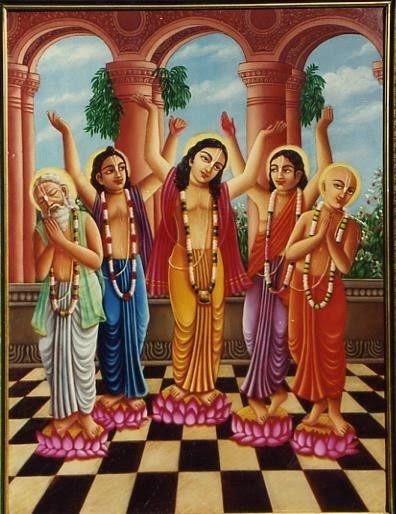
While speaking at Conway Hall in London in November 1969, Srila Prabhupada emphasized the remarkable simplicity of devotional service. He instructed that one should keep a picture of Lord Sri Caitanya Mahaprabhu with His associates—Sri Panca-Tattva—and chant the Hare Krishna maha-mantra.
According to Srila Prabhupada, this process requires no elaborate arrangement, expensive temple, or special qualification. Anyone may keep this sacred picture at home, chant the holy names, and worship the Lord.
He declared:
“The process is very simple… One simply has to keep this picture… chant this Hare Krishna mantra… and thus worship Lord Caitanya… Anyone, anywhere, can sit down on the road or beneath a tree and chant the Hare Krishna mantra and worship God.”
Srila Prabhupada further observed that those who recognize and embrace this uncomplicated process are “those who have good brains,” meaning those who appreciate genuine spiritual wisdom over unnecessary complexity.
The Essence of Bhakti Is Sincerity
One of Srila Prabhupada’s consistent teachings is that spiritual life is measured not by external achievements but by sincerity of heart.
The path of bhakti-yoga is not dependent upon becoming an accomplished scholar, a renunciant, or a public preacher. Such accomplishments may be valuable when accompanied by humility, but they can become obstacles if they produce pride.
Lord Sri Caitanya Mahaprabhu Himself instructed that the holy name should be chanted in a humble state of mind. Humility enables the heart to receive divine mercy, whereas false prestige creates unnecessary barriers.
Srila Prabhupada writes in The Nectar of Devotion (Chapter 14):
“Devotional service is dependent on nothing other than the sentiment or desire for such service. It requires nothing more than sincerity.”
This profound instruction reminds practitioners that devotion is ultimately an affair of the heart. Knowledge (jñāna) and renunciation (vairāgya) may assist one’s progress, but they are not the foundation of pure devotional service. Genuine desire to serve Sri Krishna is the essential qualification.
Hearing and Chanting: The Foundation of Spiritual Progress
The beginning of Krishna consciousness is hearing transcendental sound.
Srila Prabhupada encouraged everyone first to hear the Hare Krishna maha-mantra from the lips of a pure devotee and then chant attentively:
Hare Krishna, Hare Krishna, Krishna Krishna, Hare Hare
Hare Rama, Hare Rama, Rama Rama, Hare Hare
The Vedic scriptures explain that the living being is not the temporary material body but the eternal ātma, or soul. Because the soul is spiritual by nature, its original consciousness is awakened through spiritual sound. Chanting the holy names gradually purifies the heart, diminishes material misconceptions, and revives one’s forgotten relationship with the Supreme Personality of Godhead.
As one’s faith deepens, regular reading of Srila Prabhupada’s books or listening to his recorded lectures further strengthens understanding and determination.
Temple Association Is Beneficial but Not Always Essential
Association with devotees is highly recommended throughout the Vedic scriptures because it encourages steady advancement. Yet Srila Prabhupada also recognized that not everyone has the opportunity to live near a temple.
During a conversation in Honolulu on February 3, 1975, he explained:
“Whether you live in temple or outside temple, the rules and regulation and the process must be followed. Then you are successful… He must follow the rules and regulation. That is wanted.”
This instruction highlights an important principle of dharma: sincere obedience to the authorized process is more significant than one’s physical location.
Whether living in a temple, a city apartment, or a remote village, one can continue practicing devotional service with determination. Spiritual advancement depends upon faithful practice rather than geographical convenience.
Transforming the Home into a Sacred Place
Srila Prabhupada encouraged devotees to establish a simple place of worship within their homes.
A modest altar may include a picture of Sri Sri Panca-Tattva and a respectful photograph of Srila Prabhupada. Such an arrangement constantly reminds the practitioner of the Lord’s presence and encourages daily remembrance.
In a letter dated September 4, 1972, Srila Prabhupada wrote:
“There is no difference between me and my picture… The name and picture are as good as the person in spiritual world.”
For this reason, devotees respectfully worship Srila Prabhupada’s photograph, understanding it to be spiritually connected with his eternal service to Sri Krishna.
Even the simplest home can become a place of spiritual cultivation when centered on hearing, chanting, prayer, and remembrance.
Patience Is an Essential Quality in Krishna Consciousness
Spiritual growth often unfolds gradually.
Just as a seed develops into a mature tree through regular watering, the seed of devotion grows through consistent hearing and chanting. The law of karma teaches that material actions produce corresponding reactions, while devotional service gradually purifies previous conditioning and awakens one’s eternal relationship with Krishna.
Therefore, temporary feelings of discouragement should not become reasons to abandon spiritual practice. Every sincere effort made in devotional service is spiritually permanent and never lost.
The Supreme Lord, who resides within the heart of every living being as Paramātmā, observes every sincere endeavor and reciprocates according to one’s devotion.
The Practical Path Given by Srila Prabhupada
Srila Prabhupada repeatedly presented Krishna consciousness as a practical science of self-realization rather than a complicated religious system.
Its essential practices remain accessible to everyone:
- Chant the Hare Krishna maha-mantra daily.
- Hear from Srila Prabhupada’s books and recorded lectures.
- Follow the regulative principles as sincerely as possible.
- Establish a simple altar at home.
- Respect the Lord and His pure devotees.
- Continue devotional service with patience and humility.
These practices require sincerity more than external qualification.
Conclusion
The beauty of Krishna consciousness lies in its universal accessibility. Srila Prabhupada assured that anyone, regardless of circumstance, can make genuine spiritual progress by faithfully following the simple process of hearing, chanting, and remembering Krishna.
Living far from a temple need not become an obstacle to devotional life. When one’s home becomes a place of worship, one’s daily activities become connected with devotional service, and one’s heart remains fixed on the holy name, spiritual advancement naturally follows.
The eternal soul (ātma) is meant to revive its loving relationship with the Supreme Lord. By embracing Srila Prabhupada’s straightforward instructions with humility, sincerity, and steady determination, one gradually experiences the transformative power of bhakti. Sometimes the simplest process, faithfully practiced, leads to the highest realization.
All glories to His Divine Grace A. C. Bhaktivedanta Swami Srila Prabhupada.
Deepen your Bhakti-yoga practice, harmonize relationships, and receive guided coaching — all at Vedavarsity.com