Among all living beings, the human form of life possesses a unique gift—the capacity for self-inquiry. Unlike animals, whose awareness is primarily confined to bodily necessities, human beings can ask profound questions: Who am I? Why am I here? What is the purpose of life?
These questions mark the beginning of genuine spiritual advancement. When directed toward authentic Vedic knowledge, they lead the sincere seeker beyond temporary material concerns to the eternal truth of the soul and its relationship with the Supreme Personality of Godhead, Sri Krishna. This awakened understanding is the true Vision of Unity.
The Human Opportunity for Spiritual Inquiry
The Vedic scriptures explain that the human body is especially meant for athāto brahma jijñāsā—inquiring into the Absolute Truth. Without such inquiry, human life differs little from animal existence, which revolves around eating, sleeping, mating, and defending.
The Supreme Lord has mercifully revealed the answers to life’s deepest questions through the Vedas. These timeless scriptures explain our eternal spiritual identity and our forgotten relationship with Krishna. More importantly, this divine knowledge has been carefully preserved through the disciplic succession (paramparā), ensuring that its meaning remains pure and unchanged.
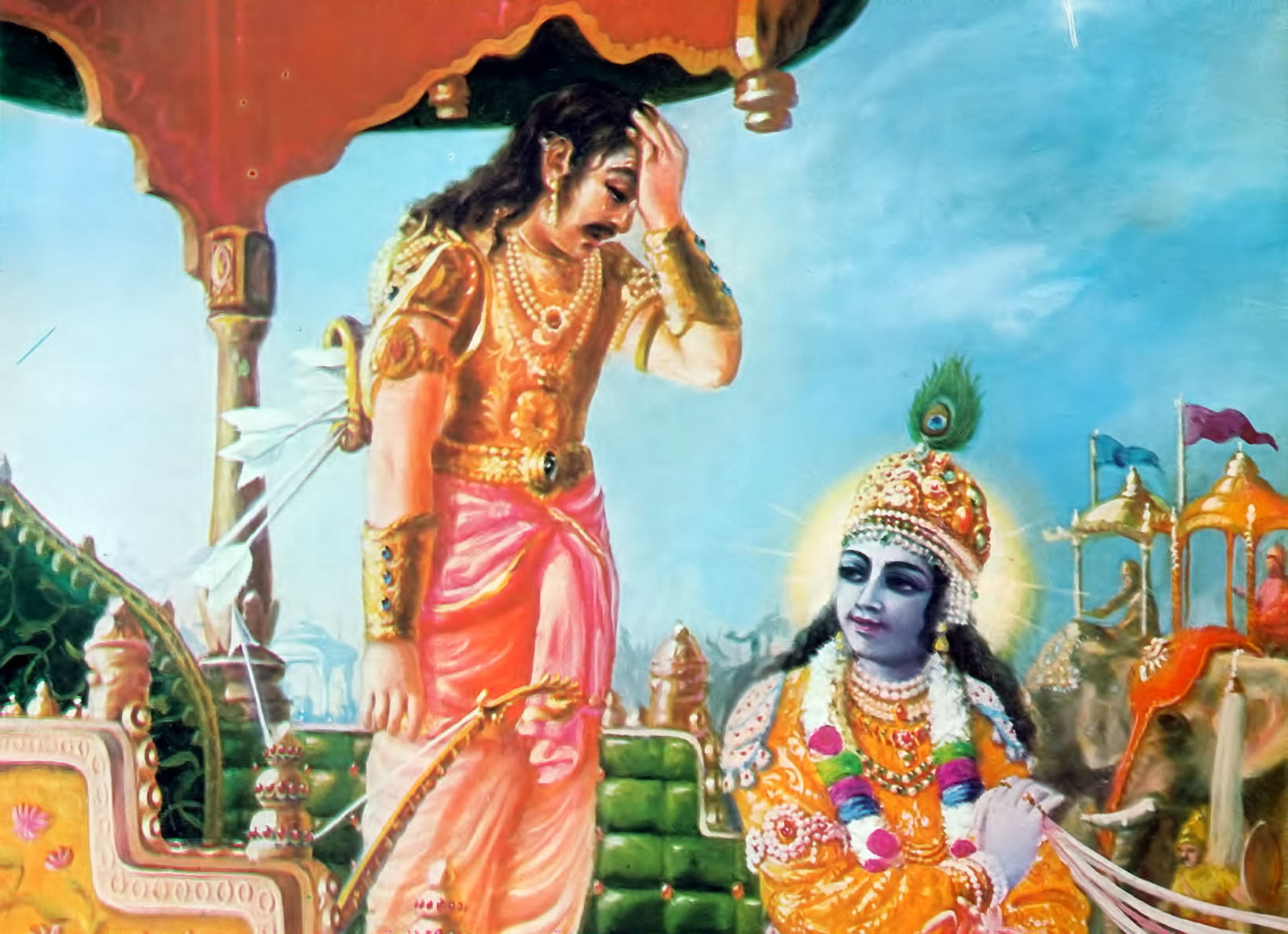
As Lord Krishna states, spiritual knowledge is transmitted through an authentic chain of realized teachers, enabling each generation to receive the same eternal wisdom without distortion.
The Vedas Illuminate Reality
The Bhagavad-gita compares spiritual knowledge to the rising sun that dispels darkness. In Bhagavad-gita (5.16), Krishna explains that when ignorance is destroyed by true knowledge, reality becomes clearly visible.
The Vedas encourage us to see through the eyes of scripture (śāstra-cakṣu). Instead of relying solely on imperfect senses or speculative reasoning, we learn to perceive the world from the divine perspective.
This vision reveals that the Supreme Lord is the ultimate controller of both the spiritual and material worlds. Everything exists under His direction, and nothing is independent of His will.
As the Bhagavad-gita declares:
“I am the source of all spiritual and material worlds. Everything emanates from Me.” (Bhagavad-gita 10.8)
Recognizing Krishna as the origin of everything forms the foundation of the Vision of Unity.
Seeing the Lord’s Presence Everywhere
One of the most inspiring teachings of Bhagavad-gita appears in the Tenth Chapter, where Lord Krishna describes His divine manifestations throughout creation.
He explains that every expression of beauty, strength, intelligence, wealth, and excellence reflects a spark of His unlimited splendor. Whatever appears glorious or extraordinary should remind us of its divine source.
Krishna further declares:
“With a single fragment of Myself I pervade and support this entire universe.” (Bhagavad-gita 10.42)
This understanding transforms our perception of the world. Rather than viewing creation as separate from God, we begin to recognize it as His energy, sustained by His supreme will.
The diversity of creation does not contradict unity. Instead, it beautifully expresses the unlimited energies of the one Supreme Person.
Bhakti-Yoga Awakens the Vision of Unity
The Vision of Unity is not achieved merely through intellectual study. It awakens through bhakti-yoga, the process of loving devotional service.
Krishna instructs:
“Whatever you do, whatever you eat, whatever you offer or give away, and whatever austerities you perform—do that as an offering unto Me.” (Bhagavad-gita 9.27)
When daily activities become acts of devotion, ordinary life acquires spiritual significance. Gradually, the heart becomes purified, and one’s original Krishna consciousness naturally awakens.
The Vedic tradition describes nine primary practices of bhakti, including hearing about Krishna, chanting His holy names, remembering Him, worshiping Him, offering prayers, serving Him, becoming His servant, cultivating friendship with Him, and fully surrendering to Him.
These devotional practices cleanse the consciousness and revive the soul’s forgotten love for the Supreme Lord.
Divine Mercy Reveals the Supreme Truth
The Bhagavad-gita emphasizes that spiritual realization ultimately depends upon the Lord’s mercy.
Krishna promises:
“To those who are constantly devoted to serving Me with love, I give the understanding by which they can come to Me.” (Bhagavad-gita 10.10)
This profound statement highlights an essential principle of Vedic philosophy. Although sincere study, discipline, and meditation are valuable, complete realization arises through loving devotion.
As devotion matures, Krishna personally guides the devotee from within the heart, illuminating spiritual understanding beyond ordinary intellectual comprehension.
Thus, knowledge becomes realization rather than mere information.
The Vision of Unity in Pure Devotion
When devotion becomes pure, the devotee develops spiritual vision.
Bhagavad-gita (6.29–30) describes this exalted consciousness:
“A true yogi sees Me in all beings and all beings in Me.”
This does not imply that every object is God Himself. Rather, the devotee recognizes that every living being is eternally connected with the Supreme Lord as His part and parcel.
Seeing every soul with spiritual vision naturally gives rise to compassion, humility, and respect. Such realization transforms relationships, dissolves envy, and inspires genuine service to others.
The devotee no longer identifies people merely by bodily designations such as nationality, race, occupation, or social status. Instead, he sees every living being as an eternal servant of Krishna.
This is the true Vision of Unity taught by the Vedic scriptures.
The Highest Perfection of Human Life
The ultimate purpose of human existence is to revive our eternal loving relationship with Krishna.
Material achievements, although sometimes beneficial, remain temporary. Wealth, fame, education, and social influence cannot satisfy the eternal soul. Lasting fulfillment arises only when the soul reconnects with its original source.
Pure devotion establishes an everlasting relationship between the Lord and His devotee—a relationship based upon love rather than fear or obligation.
As this loving bond deepens, the devotee experiences increasing spiritual happiness and steadily realizes the Lord’s presence both within the heart and throughout creation.
This realization is the essence of Vaishnavism and represents the highest perfection of human life.
Conclusion
The Vision of Unity is far more than a philosophical concept. It is a living spiritual realization attained through sincere study of the Vedic scriptures, faithful guidance received through disciplic succession, and dedicated practice of bhakti-yoga.
By understanding Krishna as the Supreme Source of everything and recognizing every living being as His eternal part, one rises above bodily distinctions and develops genuine spiritual vision. Such realization inspires compassion, strengthens one’s commitment to dharma, and brings lasting inner peace.
When knowledge is illuminated by devotion, the world is no longer seen as a collection of separate interests but as the harmonious energy of the Supreme Lord. This timeless vision invites every sincere seeker to awaken Krishna consciousness and experience the joy of eternal loving service to Sri Krishna.
Deepen your Bhakti-yoga practice, harmonize relationships, and receive guided coaching — all at Vedavarsity.com