The Ulagalanda Perumal Temple Kanchipuram is one of the most significant Divya Desams dedicated to Lord Vishnu, located in the ancient city of Kanchipuram. Known in sacred texts as Tiru Oorakam, this temple enshrines Vishnu in his majestic Trivikrama form—the cosmic manifestation that measures the universe in three strides.
Revered by the Alwars and deeply embedded in the Sri Vaishnava tradition, the Ulagalanda Perumal Temple Kanchipuram stands as a powerful symbol of divine authority and the ultimate supremacy of dharma.
Ulagalanda Perumal Temple Kanchipuram: A Prominent Divya Desam
The Ulagalanda Perumal Temple Kanchipuram is counted among the 108 Divya Desams, the sacred abodes of Vishnu praised in the Tamil hymns of the Alwars such as Tirumangai Alvar and Tirumazhisai Alvar.
This temple is unique in that it also houses three additional Divya Desam shrines within its complex:
- Tiruneerakam
- Tirukkaarakam
- Tirukkaarvaanam
This makes it a rare site where multiple sacred presences coexist within a single temple precinct.
The Trivikrama Form: Cosmic Expansion of the Divine
The defining feature of the Ulagalanda Perumal Temple Kanchipuram is the towering image of Lord Vishnu as Trivikrama. The stone image measures approximately 35 feet in height and 24 feet in width, depicting the Lord in the act of measuring the universe.
Symbolism of Trivikrama
In this form, Vishnu expands beyond all limitations, covering the earth, heavens, and the intermediate spaces in three strides. This manifestation conveys a profound spiritual truth: the Supreme pervades all existence, beyond human comprehension.
From a philosophical perspective, this teaches that while the individual soul (ātma) is limited, the Supreme reality is infinite and all-encompassing.
Legend of Mahabali and Divine Grace
The legend associated with the Ulagalanda Perumal Temple Kanchipuram centers around the asura king Mahabali.
According to tradition, Vishnu appeared as Vamana, a dwarf Brahmin, and requested three steps of land from Mahabali. Expanding into the Trivikrama form, he measured the universe in two steps and placed the third on Mahabali’s head.
Mahabali’s Devotion
It is said that Mahabali desired to witness this majestic form fully, as he could not see it while being subdued. In response, Vishnu manifested again as Trivikrama at Kanchipuram, granting him the vision he sought.
This episode illustrates that sincere surrender, even from one who initially opposed divine order, leads to grace and realization.
Associated Shrines and Manifestations
Within the Ulagalanda Perumal Temple Kanchipuram, several significant shrines enrich the spiritual experience.
Aadi Sesha Manifestation
As Mahabali could not comprehend the vast form of Trivikrama, Vishnu is believed to have appeared in a smaller, more approachable form as Aadi Sesha in a nearby shrine.
Vision to Hanuman
Tradition also states that Lord Vishnu granted Hanuman a vision of both Vamana and Trivikrama forms at this sacred site.
These narratives emphasize that divine manifestations are tailored to the capacity of the devotee.
Temple Structure and Architecture
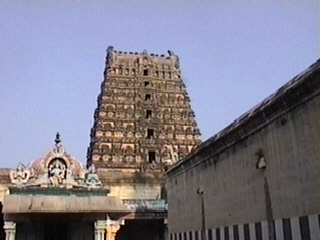
The Ulagalanda Perumal Temple Kanchipuram occupies an area of approximately 60,000 square feet and features a well-defined architectural layout.
Key Structural Elements
- Two prakarams (circumambulatory paths)
- A three-tiered Rajagopuram
- The sacred Naga Theertham tank located opposite the temple
The temple also contains inscriptions from the Chola period, reflecting its historical continuity.
An image of Parimelazhagar, the renowned commentator on the Tirukkural, is found here, indicating the temple’s connection to literary and intellectual traditions.
Deities and Worship
The presiding deity of the Ulagalanda Perumal Temple Kanchipuram is Ulagalanda Perumal (Trivikrama), facing west—a relatively rare orientation.
Consort and Utsavar
- Taayaar: Amritavalli
- Utsavar (festival deity): Perakattaan
Shrines to Andal and Manavala Mamunigal are also present, reflecting the temple’s strong association with Sri Vaishnava tradition.
Festivals and Ritual Observances
The Ulagalanda Perumal Temple Kanchipuram follows a regular schedule of worship, with two daily services offered.
Major Festivals
- Thai Brahmotsavam: The principal annual celebration
- Vamana Avatar Utsavam: Commemorating the Trivikrama episode
- Vaikuntha Ekadasi: A major Vaishnava festival
- Purattasi Sravana Dwadasi
- Avani Shukla Panchami
During these festivals, the temple becomes a center of devotional activity, attracting pilgrims from various regions.
Interestingly, the temple’s festival calendar aligns with nearby temples such as Kamakshi Amman Temple and Ekambareswarar Temple, creating a continuous sequence of celebrations in Kanchipuram.
Kanchipuram: A Sacred Confluence of Traditions
The Ulagalanda Perumal Temple Kanchipuram exists within a broader network of Divya Desams and Saivite temples in Kanchipuram.
The city hosts both Vaishnavite and Saivite shrines, many of which have been praised in the hymns of the Alwars and Nayanmars. This coexistence reflects a harmonious spiritual culture where different paths lead toward the same ultimate truth.
Philosophical Reflection: The Measure of the Infinite
The Trivikrama form depicted in the Ulagalanda Perumal Temple Kanchipuram conveys a profound message. Human perception is limited, yet the divine reality transcends all boundaries.
The act of measuring the universe symbolizes the establishment of order (dharma) over chaos. It also reminds the individual that humility and surrender open the path to higher understanding.
Conclusion: A Temple of Cosmic Vision and Inner Realization
The Ulagalanda Perumal Temple Kanchipuram is not merely a place of worship but a center of philosophical insight. Its grand image of Trivikrama invites the devotee to contemplate the vastness of existence and the role of the individual within it.
By reflecting on such teachings, one gradually moves from a limited perspective to a broader awareness aligned with divine order. In this understanding lies the true purpose of pilgrimage and spiritual inquiry.
library.vedavarsity.com | www.vedavarsity.com
Deepen your Bhakti-yoga practice, harmonize relationships, and receive guided coaching — all at Vedavarsity.com