The principle of Service to the Cow occupies a central place in Vedic civilization. Far beyond an agricultural practice or cultural tradition, it represents a philosophy of gratitude, responsibility, and harmonious living. The Vedas describe the cow as go-mātā—our mother—because she selflessly provides nourishing milk throughout human life, just as a mother lovingly nourishes her child.
This understanding is not based merely on sentiment. Rather, it recognizes the cow’s indispensable contribution to human society. Together with the ox, which assists in cultivating the land, the cow helps sustain a civilization centered on natural living, wholesome food, and spiritual progress. Consequently, Vedic literature teaches that human beings have sacred duties toward the cow: to serve her, worship her, and protect her.
These principles continue to offer valuable guidance for those seeking a life founded upon compassion, dharma (righteous duty), and respect for all living beings.
The Cow as Mother in Vedic Culture
According to the Vedas, every living being is an eternal soul (ātma), temporarily residing within a material body. Recognizing this spiritual equality naturally fosters compassion toward all creatures. Among animals, however, the cow receives exceptional honor because of her unique service to humanity.
When cared for with affection and proper attention, a healthy cow produces far more milk than her calf requires. This milk becomes one of nature’s most complete and nourishing foods.
His Divine Grace A. C. Bhaktivedanta Swami Prabhupada repeatedly emphasized the importance of milk within a balanced Vedic diet. He wrote:
“Foods such as milk, milk products, sugar, rice, wheat, fruits, and vegetables are the foods that best aid health and increase life’s duration.”
He further described milk as “the most wonderful of all foods,” highlighting its value for both physical health and intellectual development.
The ox complements the cow’s service by plowing fields that produce grains, fruits, and vegetables. Together, the cow and the ox form the foundation of a self-sufficient agricultural society that depends upon cooperation with nature rather than exploitation.
The Three Principles of Service to the Cow
The Vedic scriptures prescribe three fundamental responsibilities toward the cow:
- Go-sevā — serving the cow
- Go-pūjā — worshiping the cow
- Go-rakṣyā — protecting the cow
These three practices cultivate gratitude, compassion, and responsible stewardship.
Go-Sevā: Serving the Cow with Love and Respect
Lord Krishna’s Personal Example
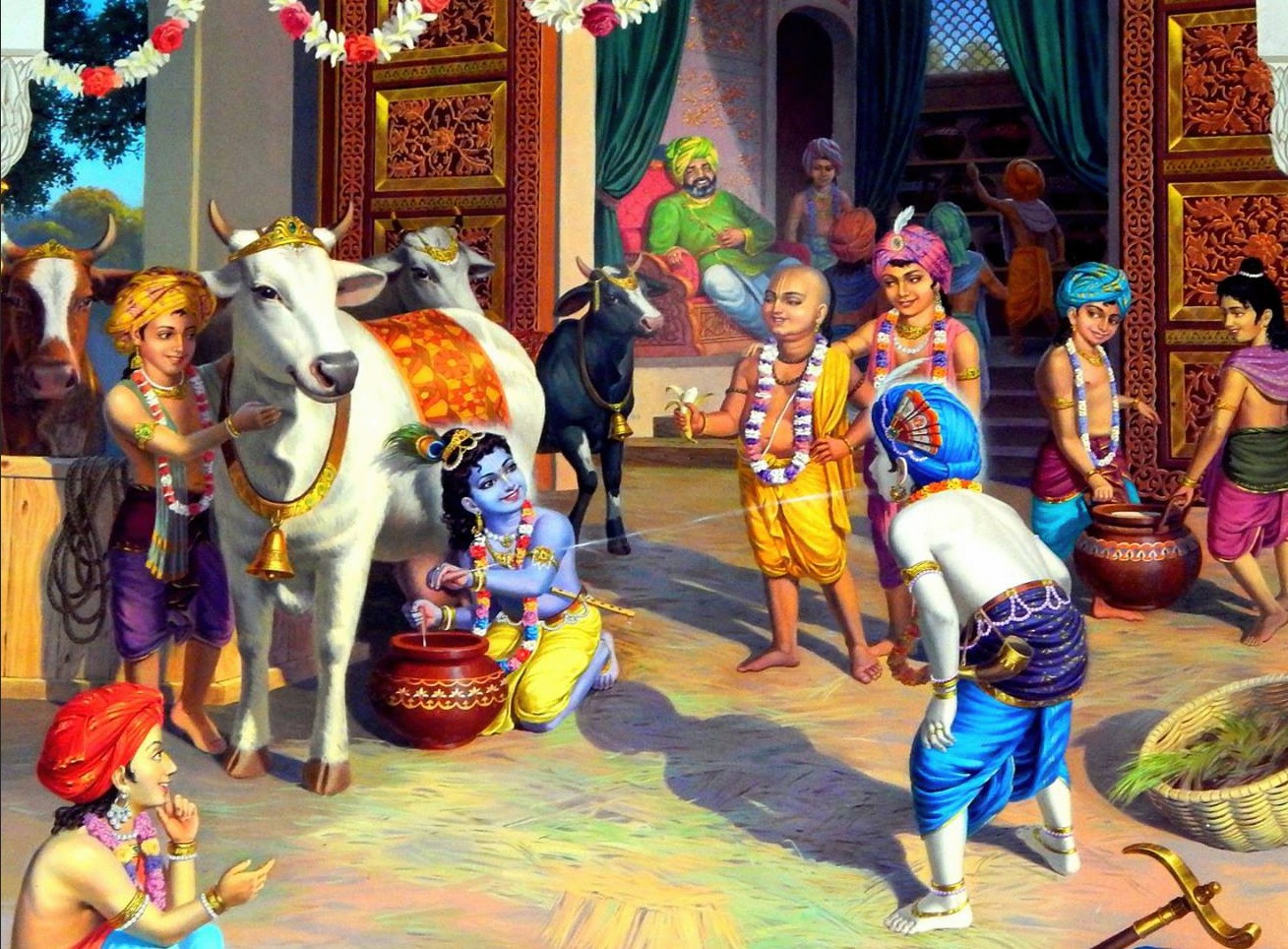
The highest example of Service to the Cow is demonstrated by Lord Sri Krishna Himself during His childhood pastimes in Vrindavana.
The Śrīmad-Bhāgavatam beautifully describes how Krishna daily led the cows and calves to the forests surrounding Govardhana Hill. Nanda Maharaja maintained hundreds of thousands of cows, each having a distinct name. Whenever Krishna played His flute and lovingly called them, the affectionate cows immediately responded and ran toward Him.
These pastimes reveal that caring for cows is not an ordinary occupation but a loving exchange founded upon mutual affection.
Daily Responsibility
Vedic culture teaches that civilized people should first ensure that the cows receive sufficient food, water, shelter, and care before attending to their own comforts.
Such service reflects the broader principle of dharma—performing one’s duties with gratitude rather than selfishness. By caring for those who sustain society, human beings cultivate humility and recognize their dependence upon the Supreme Lord’s arrangement.
Go-Pūjā: Worshiping the Cow
The Vedic scriptures describe the cow as sacred because all the demigods and goddesses are understood to reside symbolically within her body. For this reason, the cow is honored as a divine representative deserving respect and reverence.
The Garuḍa Purāṇa states that even a single act of sincerely worshiping Mother Cow brings profound spiritual benefit and helps protect one from severe suffering after death.
Lord Krishna Himself established the importance of honoring cows through His celebrated Govardhana pastime. Rather than encouraging worship motivated merely by material benefits, He redirected the residents of Vrindavana to worship Govardhana Hill, the cows, and the simple occupations that sustained their lives.
This pastime teaches an enduring lesson: true prosperity arises through gratitude toward the Lord and appreciation for His natural arrangements.
Even today, millions of devotees commemorate Govardhana Pūjā by worshiping cows and remembering Krishna’s loving relationship with them.
Go-Rakṣyā: Protecting the Cow
Cow Protection as a Sacred Duty
Among the three principles, cow protection occupies a particularly important place.
If the cow is accepted as mother, then she naturally deserves care, affection, and protection throughout her life—not merely while she is economically productive.
In Vedic civilization, protecting cows was regarded as one of the foremost duties of rulers and responsible citizens alike.
Emperor Dalip’s Example of Dharma
The Vedic literature preserves the inspiring account of Emperor Dalip, an ancestor of Lord Ramachandra.
While traveling through a forest, Emperor Dalip encountered a lion preparing to kill a helpless cow. Determined to fulfill his duty, the king challenged the lion and demanded that the cow be released.
The lion replied that killing animals was necessary for its own survival.
After thoughtful consideration, Emperor Dalip offered an extraordinary solution. Rather than allowing the innocent cow to die, he offered his own body as food for the lion.
At that very moment, the lion and the cow revealed their true identities. The lion was Dharma, the personification of righteousness, and the cow represented Mother Earth. Their appearance had been a divine test of the emperor’s unwavering commitment to protecting the innocent.
The story illustrates that genuine righteousness often requires selflessness, courage, and compassion rather than convenience.
Service to the Cow in the Modern World
Modern industrial society presents challenges that differ greatly from those of ancient Vedic culture. Millions of cows continue to be slaughtered annually to satisfy the demand for meat, despite their immense contributions to human welfare.
Nevertheless, the principles of Service to the Cow remain practical and meaningful today.
Individuals can participate in cow protection in several ways.
1. Refrain from Supporting Cow Slaughter
One practical step is to avoid eating meat, particularly beef, thereby reducing support for industries dependent upon cow slaughter.
Sharing the Vedic understanding of compassion and nonviolence (ahiṁsā) with others also contributes to greater awareness of the ethical and spiritual implications of harming innocent animals.
2. Support Genuine Cow Protection Programs
Another meaningful contribution is to assist projects dedicated to lifelong cow care.
Srila Prabhupada encouraged the establishment of farm communities where cows would be protected throughout their natural lives and where agriculture would be conducted in harmony with nature.
Programs such as Adopt-A-Cow at ISKCON farms provide opportunities for individuals to contribute financially toward the maintenance, feeding, and protection of cows receiving lifelong care.
Such efforts preserve an essential aspect of Vedic culture while promoting sustainable and compassionate living.
Compassion, Karma, and Divine Order
The Vedic understanding of Service to the Cow extends beyond economics or animal welfare. It reflects the universal law of karma, which teaches that our actions inevitably produce corresponding results.
When society honors, protects, and serves those who sustain life, harmony naturally develops. Conversely, widespread violence toward innocent creatures creates collective suffering and social imbalance.
This principle invites thoughtful reflection on humanity’s relationship with nature and the Supreme Controller, whose creation functions according to eternal laws of cooperation and responsibility.
By cultivating gratitude instead of exploitation, individuals gradually develop qualities favorable for spiritual realization.
Conclusion
The Vedic teachings on Service to the Cow present a timeless vision of compassionate civilization. By serving the cow through proper care, worshiping her with gratitude, and protecting her throughout her life, human beings acknowledge one of nature’s greatest benefactors.
These principles are not merely religious rituals but expressions of dharma that encourage respect for all living beings and harmony with the divine order established by the Supreme Lord.
Whether through adopting a compassionate diet, supporting authentic cow protection projects, or simply developing greater appreciation for the gifts of nature, everyone can participate in this noble tradition. In doing so, one not only honors Mother Cow but also cultivates qualities of gratitude, responsibility, and devotion that elevate both individual character and society as a whole.
Deepen your Bhakti-yoga practice, harmonize relationships, and receive guided coaching — all at Vedavarsity.com