



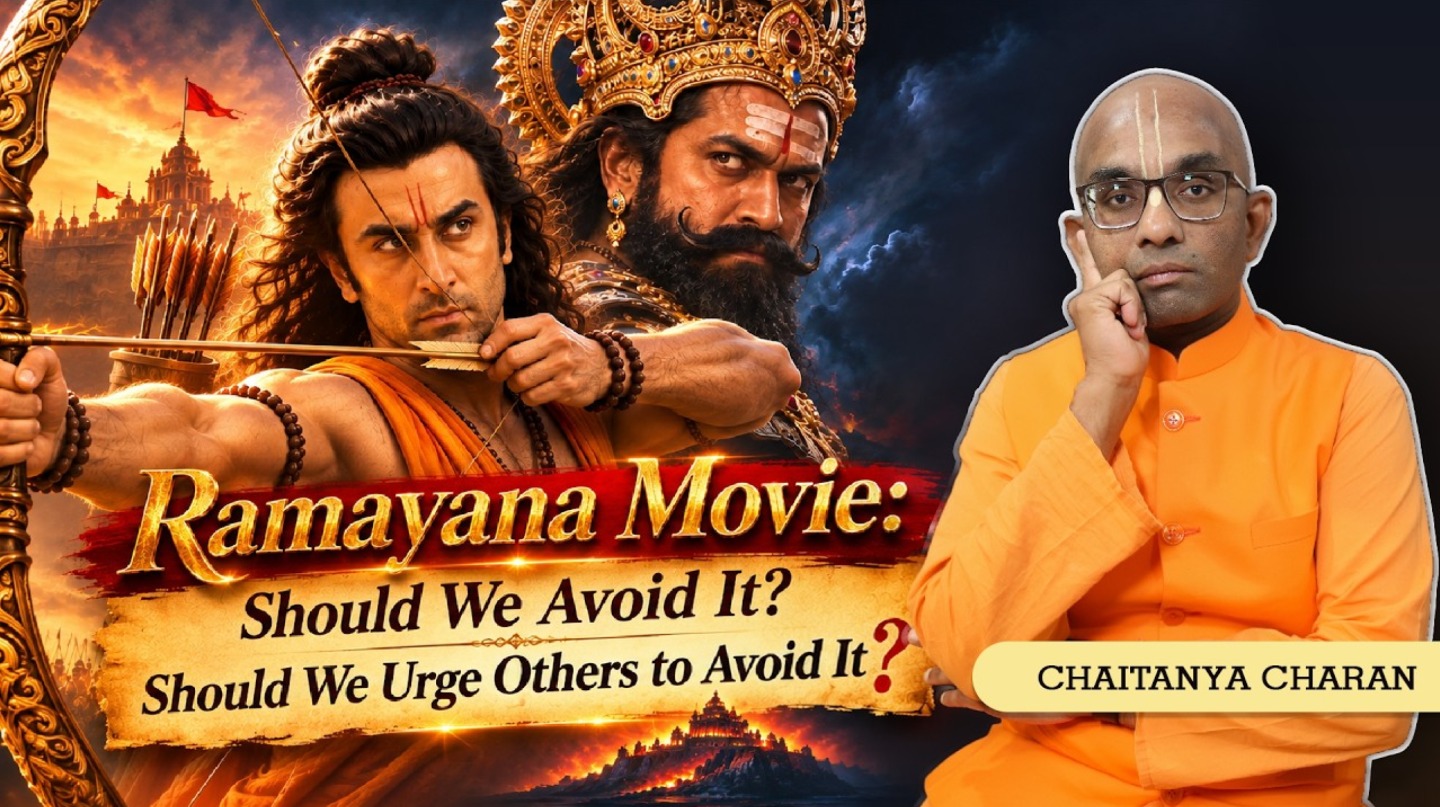
The Ramayana Movie adaptation by filmmaker Nitesh Tiwari has initiated an important discussion among devotees and followers of Vedic culture. Can a sacred narrative be adapted for contemporary audiences without compromising its spiritual essence? Should devotees watch such cinematic interpretations, discourage others from watching them, or critically examine their presentation?
These questions invite us to consider not merely the artistic freedom of filmmakers but also the responsibility of those who present and preserve sacred literature.
In a thoughtful discussion addressing nine important questions about the film, author and teacher Chaitanya Charan Dasa offers a balanced perspective. Drawing upon the teachings of His Divine Grace A. C. Bhaktivedanta Swami Prabhupada, he encourages devotees to exercise spiritual discernment rather than respond through impulsive condemnation.
His central message is significant: our ultimate purpose should be to increase people’s appreciation of Lord Ramachandra and the timeless wisdom of the Ramayana.
Understanding the Ramayana Movie Through the Lens of Dharma
The Ramayana is not merely an ancient Indian epic or a fascinating account of kings, kingdoms and warfare. It is a sacred narration that reveals the principles of dharma (religious duty), righteousness, devotion and ideal human conduct.
Lord Ramachandra, the Supreme Personality of Godhead, appeared in this world to establish the principles of dharma and demonstrate the highest standards of righteous conduct.
Therefore, any cinematic representation of the Ramayana carries a certain responsibility. While artistic interpretation may vary, the essential philosophical and moral teachings of the original narrative should not be distorted.
Chaitanya Charan Dasa emphasizes that devotees should evaluate the Ramayana Movie by examining its actual presentation rather than assuming the intentions of its creators.
This distinction is important. We can disagree with a particular interpretation without necessarily accusing its creators of deliberately opposing Vedic culture.
As Śrīla Prabhupāda consistently encouraged his followers to develop independent and thoughtful understanding based on Guru, Sādhu and Śāstra, devotees should approach such discussions with proper knowledge and discrimination.
Should Devotees Watch the Ramayana Movie?
One of the most important questions is whether devotees should watch the film.
According to Chaitanya Charan Dasa, there need not be one universal answer for everyone. Different devotees have different circumstances, responsibilities and levels of engagement with society.
1. Devotees Satisfied with Traditional Narrations
Those who regularly study the original Ramayana, hear the pastimes of Lord Rama from qualified spiritual teachers and derive spiritual satisfaction from traditional kathas need not feel any obligation to watch a cinematic adaptation.
The original scriptures and the association of devotees provide an authentic foundation for understanding the Lord’s transcendental pastimes.
A devotee should not feel that watching every contemporary representation of a sacred text is necessary to remain informed or relevant.
2. Devotees Engaged in Public Discussion
Some devotees are actively involved in education, public communication, cultural discussions and outreach.
For them, watching the film or studying detailed reviews may be useful. It enables them to understand the questions being raised in society and respond with scriptural knowledge.
Without understanding what an adaptation actually presents, criticism may become uninformed or ineffective.
3. People Unfamiliar with the Ramayana
The film may also become an introductory opportunity for people who have little knowledge of the original Ramayana.
Instead of immediately condemning their interest, devotees can use the opportunity to introduce them to the deeper teachings of the original scripture.
A cinematic experience may generate curiosity. That curiosity can subsequently lead someone towards reading the Ramayana, hearing Bhagavat Katha and associating with devotees.
The objective should be to encourage that spiritual progression.
Why Banning the Ramayana Movie May Not Be the Right Approach
Another important issue concerns calls to ban the film or publicly condemn its makers.
Chaitanya Charan Dasa questions whether such reactions will actually help preserve the dignity of the Ramayana.
Attempts to prohibit a controversial film can sometimes generate even greater public curiosity. Instead of discouraging interest, a ban may unintentionally increase its popularity.
More importantly, devotees should distinguish between criticizing an artistic presentation and making assumptions about the personal intentions of its creators.
We should not automatically label filmmakers as anti-Hindu or assume that they deliberately intend to undermine dharma.
A more constructive approach is to identify specific concerns:
- What aspects of the original narrative have been changed?
- Which important philosophical teachings have been omitted?
- Does the portrayal of particular characters alter their moral significance?
- What understanding might an audience develop after watching the film?
Such questions encourage meaningful discussion rather than emotional confrontation.
As Chaitanya Charan Dasa expresses in his discussion, we need not assume bad motives to point out bad effects.
This principle allows devotees to remain firm in their philosophical understanding while maintaining civility and openness in public dialogue.
Creative Freedom and the Sanctity of Sacred Literature
The Ramayana has been retold in different languages, cultures and literary traditions for centuries.
Different versions have presented the pastimes of Lord Rama through varied artistic expressions. Such diversity demonstrates the enduring appeal of the epic.
Therefore, creative freedom in presenting the Ramayana is not necessarily opposed to preserving its spiritual identity.
However, there is an important distinction between creative interpretation and changing the essential message of the original narration.
A filmmaker may introduce new visual elements, emotional expressions and narrative techniques to connect with contemporary audiences. Yet the central principles of dharma, devotion, truthfulness and righteousness should not be compromised.
The original Ramayana itself offers profound emotional dimensions that can be explored through cinema.
For example, Lord Rama’s grief upon hearing about the departure of His father, Maharaja Dasharatha, and His intense feelings of separation from Mother Sita reveal the extraordinary depth of His pastimes.
These episodes demonstrate that a spiritually meaningful cinematic presentation does not need to distort the original narrative to create emotional depth.
Indeed, the original scriptures contain sufficient philosophical richness and human emotion to inspire generations.
The Portrayal of Ravana: A Significant Concern
One of the strongest criticisms raised by Chaitanya Charan Dasa concerns the characterization of Ravana.
Ravana was undoubtedly a powerful personality. He possessed considerable knowledge, material opulence, administrative abilities and extraordinary military strength.
However, his greatness in certain material accomplishments did not make him a righteous person.
His defining weakness was his uncontrolled lust and desire to enjoy what did not belong to him.
The Danger of Glorifying Ravana’s Qualities While Ignoring His Character
According to Chaitanya Charan Dasa’s assessment, the film gives considerable attention to Ravana’s abilities and presents certain aspects of his actions through seemingly defensible motives.
At the same time, it appears to diminish the lust that fundamentally motivated his abduction of Mother Sita.
This creates an important philosophical concern.
In Vedic understanding, knowledge, power, wealth and influence do not independently establish a person’s spiritual greatness.
Unless these qualities are guided by self-control and dharma, they can become instruments of degradation.
Ravana’s downfall demonstrates precisely this principle.
A person may possess immense intellectual capacity and material achievements, yet remain defeated by uncontrolled senses.
The Ramayana teaches that adharma (unrighteousness) ultimately leads to destruction, irrespective of one’s material power.
Recognising Rama’s Exemplary Conduct
Chaitanya Charan Dasa also questions why certain adaptations highlight Ravana’s social inclusiveness while overlooking the well-known interactions of Lord Rama with Guha and Shabari.
Lord Rama’s acceptance and affection towards His devotees reveal that spiritual greatness is not determined by birth, social position or material status.
His relationship with Guha, the Nishada chief, and His blessings upon Shabari demonstrate the universal nature of divine compassion.
These episodes are essential to understanding the character of Lord Ramachandra.
They reveal His extraordinary qualities as the ideal king, compassionate Lord and well-wisher of all living beings.
Sita’s Abduction: Understanding Consent and Dharma
Another significant dimension of the discussion concerns the abduction of Mother Sita.
The incident offers an opportunity to address questions of desire, consent, coercion and respect for another person’s will.
Ravana attempts to attract Mother Sita through promises of wealth, power and material enjoyment. However, she firmly rejects his advances.
Despite her refusal, Ravana abducts her.
This episode is not simply a dramatic conflict between two powerful personalities. It demonstrates the consequences of uncontrolled desire and the violation of another person’s dignity and autonomy.
The distinction between love and lust is particularly important here.
Love is founded upon selflessness, respect and the desire for another person’s well-being, whereas lust seeks personal gratification.
Ravana’s conduct represents the latter.
By preserving this essential context, a cinematic adaptation could communicate a powerful message to contemporary audiences.
The Ramayana is therefore relevant not only as a historical or religious narrative but also as a timeless guide to understanding human behaviour and moral responsibility.
How Should Devotees Respond to Controversial Adaptations?
The discussion surrounding the Ramayana Movie provides an opportunity for devotees to reflect upon their responsibility in preserving and sharing Vedic knowledge.
Rather than reacting impulsively, devotees can adopt a more constructive approach.
First, remain rooted in scripture. Study the original Ramayana and hear the pastimes of Lord Rama from bona fide spiritual authorities.
Second, develop informed opinions. Criticism should be based on an understanding of the actual presentation rather than rumours or assumptions.
Third, avoid unnecessary hostility. Disagreement does not require personal attacks or accusations against filmmakers.
Fourth, use contemporary interest for spiritual outreach. When people show curiosity about Lord Rama, guide them towards authentic scriptures and qualified spiritual teachers.
Finally, remember the ultimate purpose. The objective is not merely to win an argument about a movie but to help people develop genuine appreciation for the Supreme Lord.
Śrīla Prabhupāda repeatedly emphasized the importance of presenting Kṛṣṇa consciousness through authentic knowledge and practical understanding.
The same principle can guide our engagement with contemporary cultural expressions.
Conclusion: The Ramayana Movie and the Greater Purpose of Devotional Outreach
The debate surrounding the Ramayana Movie reminds us that preserving sacred literature requires both philosophical conviction and thoughtful communication.
Devotees need not necessarily watch every adaptation, nor should they feel compelled to encourage or discourage others without understanding its content.
At the same time, artistic freedom should not become an excuse for distorting the essential moral and spiritual teachings of the Ramayana.
The portrayal of Lord Rama, Mother Sita and Ravana should be examined with reference to the original scriptural narrative, which reveals the eternal principles of dharma and the consequences of uncontrolled material desires.
Most importantly, our discussions should lead people closer to the teachings and transcendental pastimes of Lord Ramachandra.
Whether through a book, a discourse, a cultural presentation or a cinematic adaptation, the greatest success is achieved when someone’s interest develops into genuine spiritual inquiry.
Let us therefore approach such discussions with knowledge, discernment and compassion, always remembering the ultimate purpose: to increase people’s appreciation of and attraction towards the Supreme Personality of Godhead, Lord Sri Ramachandra.
Deepen your Bhakti-yoga practice, harmonize relationships, and receive guided coaching — all at Vedavarsity.com