



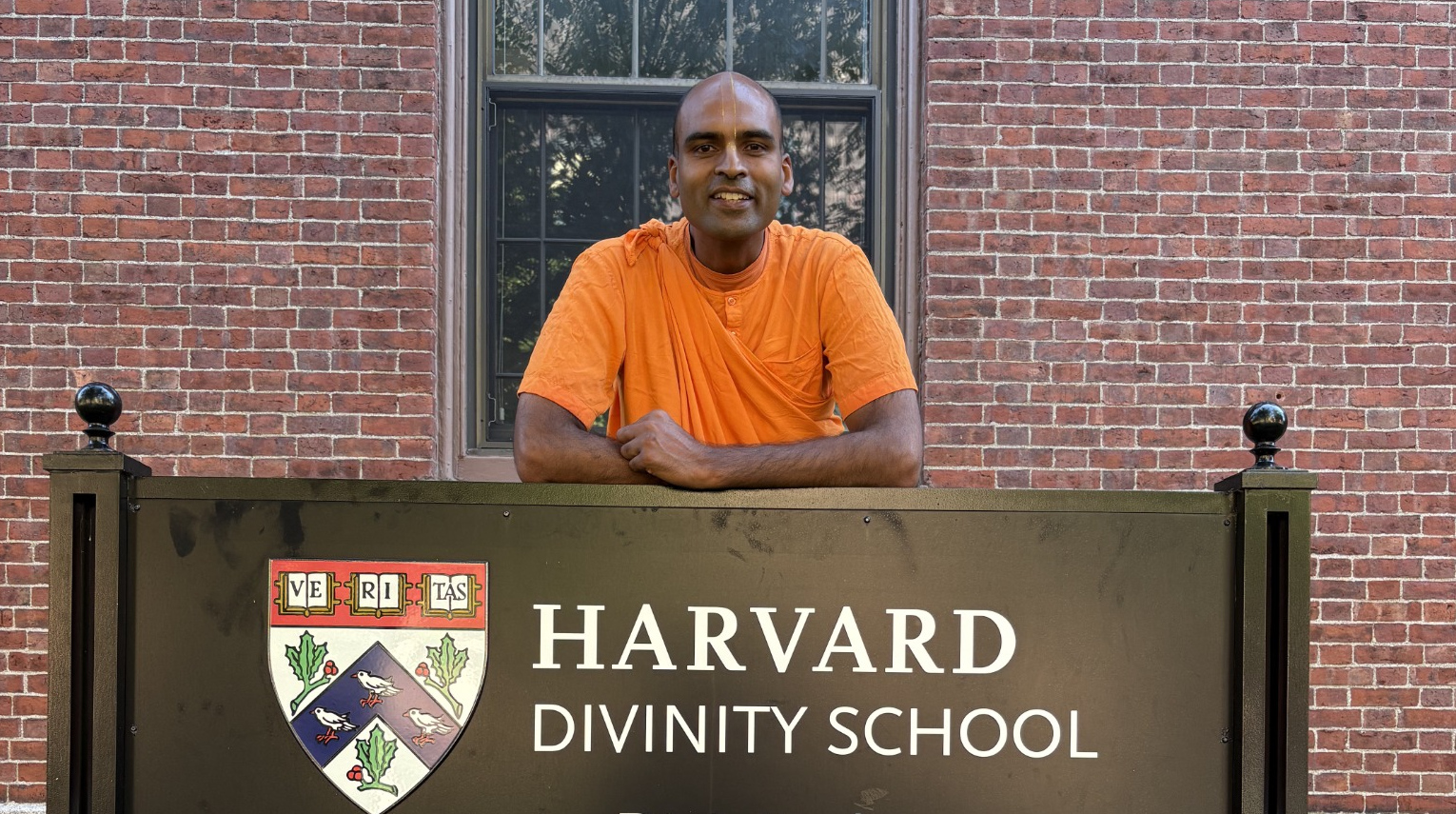
In an age of rapid technological advancement, growing uncertainty, and increasing demands upon leaders, the timeless wisdom of the Vedic scriptures offers a profound foundation for human development. The academic journey of Keshava Swami at Harvard Divinity School presents an opportunity to explore how spiritual knowledge can illuminate contemporary questions of leadership, education, character, and the purpose of life.
After spending more than twenty-five years in monastic life, Keshava Swami returned to the university classroom during the 2025–2026 academic year. His experience at Harvard was not merely an academic undertaking. It became an occasion to examine how the wisdom of the Vedic tradition may be communicated meaningfully in modern educational institutions and other spheres of society.
At the heart of this journey lies an essential question: Can genuine leadership and lasting progress be achieved without understanding and disciplining the self?
Keshava Swami at Harvard: Bringing Vedic Wisdom into Modern Education
Keshava Swami completed his degree in Information Management at University College London in 2002. At the age of twenty-one, he chose the path of spiritual life, entering an ashram dedicated to devotional practice, scriptural study, and service.
He subsequently accepted sannyasa, the renounced order of life within the Gaudiya Vaishnava tradition associated with the International Society for Krishna Consciousness (ISKCON).
After decades of teaching, travelling, studying, and sharing spiritual knowledge, he returned to formal academia with three principal aims: to deepen his understanding, gain insight into contemporary society, and strengthen his ability to communicate spiritual wisdom through research and writing.
His experience at Harvard Divinity School brought him into conversation with scholars and students representing diverse religious, philosophical, and intellectual traditions.
This encounter illustrates an important principle of Vedic education: learning should remain a lifelong pursuit. A person who teaches others must also cultivate humility and remain willing to learn.
The Vedic tradition places great emphasis upon jijnasa, the sincere desire to inquire into the Absolute Truth. Such inquiry is not limited to collecting information. It seeks understanding that can transform one’s consciousness, conduct, and relationship with the Supreme Lord.

The Vedic Understanding of Education and Knowledge
Modern education often emphasizes professional competence, technical expertise, and intellectual achievement. These are valuable, but the Vedic scriptures invite us to consider a deeper purpose of knowledge.
The Bhagavad-gita distinguishes between material knowledge and spiritual understanding without requiring that practical learning be neglected. Knowledge becomes truly beneficial when it helps a person understand the nature of the self, the workings of material nature, and the ultimate purpose of human existence.
In Bhagavad-gita 13.8–12, Śrī Krishna identifies qualities such as humility, simplicity, tolerance, self-control, and philosophical inquiry as elements of knowledge.
These qualities reveal that education involves more than the development of the intellect. It also involves the purification of character.
A highly educated person may possess considerable information yet struggle with anger, pride, greed, or uncontrolled desires. Conversely, genuine wisdom encourages discernment, responsibility, compassion, and self-restraint.
The experience of Keshava Swami at Harvard provides a contemporary setting in which these questions may be examined. When spiritual teachings encounter academic scrutiny, they can be explained through careful reasoning, historical understanding, and thoughtful dialogue.
Such engagement also requires humility. One must learn to distinguish between explaining a spiritual tradition from within its devotional framework and examining it through the perspectives of other disciplines.
Rather than avoiding difficult questions, sincere inquiry can deepen one’s understanding of both the tradition and the wider world.
Self-Leadership: The Foundation of Authentic Leadership
One of the significant themes of Keshava Swami’s engagement at Harvard was the inner life of leaders.
Drawing upon the Srimad-Bhagavatam and the example of the Six Goswamis of Vrindavana, he emphasized that leadership begins with mastery of one’s own mind and desires.
This principle is deeply rooted in Bhagavad-gita 6.5, where Śrī Krishna explains that the mind can become either a friend or an enemy of the living entity.
When the mind is trained through spiritual discipline, sound knowledge, and regulated conduct, it can assist a person in making wise decisions. When it is uncontrolled, it may lead even an intelligent individual toward impulsive actions and destructive habits.
Therefore, leadership is not simply a matter of position, influence, or authority. It begins with the capacity to govern oneself.
A leader who cannot regulate personal desires may misuse power, neglect responsibilities, or place individual ambition above the welfare of others. By contrast, a person who cultivates integrity and self-discipline is better prepared to serve a community responsibly.
The Example of the Six Goswamis
The Six Goswamis of Vrindavana—Śrī Rūpa Goswami, Śrī Sanatana Goswami, Śrī Jiva Goswami, Śrī Raghunatha Dasa Goswami, Śrī Raghunatha Bhatta Goswami, and Śrī Gopala Bhatta Goswami—occupy an important place in the Gaudiya Vaishnava tradition.
Their lives exemplified renunciation, scholarship, devotion, and dedicated service to Śrī Krishna.
They demonstrated that spiritual leadership does not depend upon worldly prestige. It arises from realization, disciplined living, and commitment to the welfare of others.
Their example remains relevant to contemporary leaders, educators, and public servants. Leadership becomes meaningful when personal ambition gives way to a higher purpose.
Spiritual Character in the Age of Artificial Intelligence
The relevance of Vedic wisdom extends beyond university classrooms. It also concerns the challenges facing young people in a world increasingly shaped by artificial intelligence and rapidly changing technology.
During a meeting with Guyana’s President, Dr. Mohamed Irfaan Ali, in August 2026, Keshava Swami discussed the importance of spiritual values in education. A subsequent discussion with Education Minister Sonia Parag explored potential collaboration concerning moral and character development.
These conversations highlight an important educational concern: technological advancement does not automatically produce wisdom, compassion, or ethical responsibility.
Artificial intelligence can expand access to information, assist scientific research, and transform professional life. Yet information alone cannot determine how knowledge should be used or what constitutes a meaningful life.
Young people need opportunities to cultivate discernment, emotional maturity, responsibility, and a stable sense of identity.
The Vedic concept of dharma offers a valuable framework for such reflection. Dharma refers broadly to one’s essential nature, duties, and the principles that sustain righteous living. In the Bhagavad-gita, duty is understood in relation to one’s nature, responsibilities, and spiritual purpose.
A character-oriented education can therefore encourage students to ask not only, “What can I achieve?” but also, “How should I use my abilities for the welfare of others?”
Spiritual education, when presented thoughtfully and respectfully, can contribute to discussions about ethics, responsibility, and human flourishing without dismissing the value of scientific or technological learning.
Wisdom That Breathes: Connecting Scripture with Everyday Life
An important challenge for spiritual teachers is communicating timeless teachings in language that resonates with contemporary audiences.
Scriptural wisdom must be studied carefully, understood in its proper context, and presented in a manner that addresses the concerns of those who hear it.
The Bhagavad-gita itself demonstrates the importance of this process. Śrī Krishna instructs Arjuna by responding to his confusion, moral dilemma, and emotional distress. Spiritual knowledge is presented not as abstract information alone, but as guidance relevant to a real human predicament.
Similarly, effective spiritual outreach requires scriptural fidelity, intellectual preparation, and genuine concern for the audience.
The Sanskrit principle of seva, or selfless service, is particularly relevant here. When knowledge is shared in a spirit of service rather than self-promotion, communication becomes an opportunity to benefit others.
For Keshava Swami, engaging with academic institutions and public leaders represents an effort to bring spiritual perspectives into conversations that extend beyond traditional religious settings.
Such dialogue does not require compromising the foundations of a spiritual tradition. Rather, it calls for the ability to explain its principles with clarity, sensitivity, and intellectual integrity.
The aim is not simply to speak about wisdom, but to help people discover how wisdom can influence their choices, relationships, and responsibilities.
Sustaining the Inner Life Amid External Responsibilities
Spiritual teachers, educators, and leaders often face demanding schedules. Teaching, writing, travelling, and serving others can leave little time for quiet reflection.
Yet a life of continuous activity without inner renewal may gradually weaken one’s clarity and effectiveness.
Keshava Swami has described the importance of regularly withdrawing from external responsibilities for spiritual practice, deep study, journaling, and reflection.
This approach resonates with the Vedic emphasis on sadhana, or disciplined spiritual practice.
Daily spiritual discipline provides an opportunity to redirect the mind toward higher values. In the Vaishnava tradition, practices such as hearing sacred teachings, chanting the holy names of Krishna, studying scripture, and associating with spiritually minded people support the cultivation of devotional consciousness.
Such practices are not intended merely to provide temporary relief from stress. Their deeper purpose is to help the individual develop a more meaningful relationship with the Supreme Lord and a clearer understanding of life’s ultimate goal.
For leaders, regular reflection can also create space to examine motives, acknowledge mistakes, and renew commitments to ethical conduct.
A balanced life is not measured solely by the number of tasks completed. It is also measured by the consciousness with which those tasks are performed.
Ashram to Academia: A New Chapter in Spiritual Dialogue
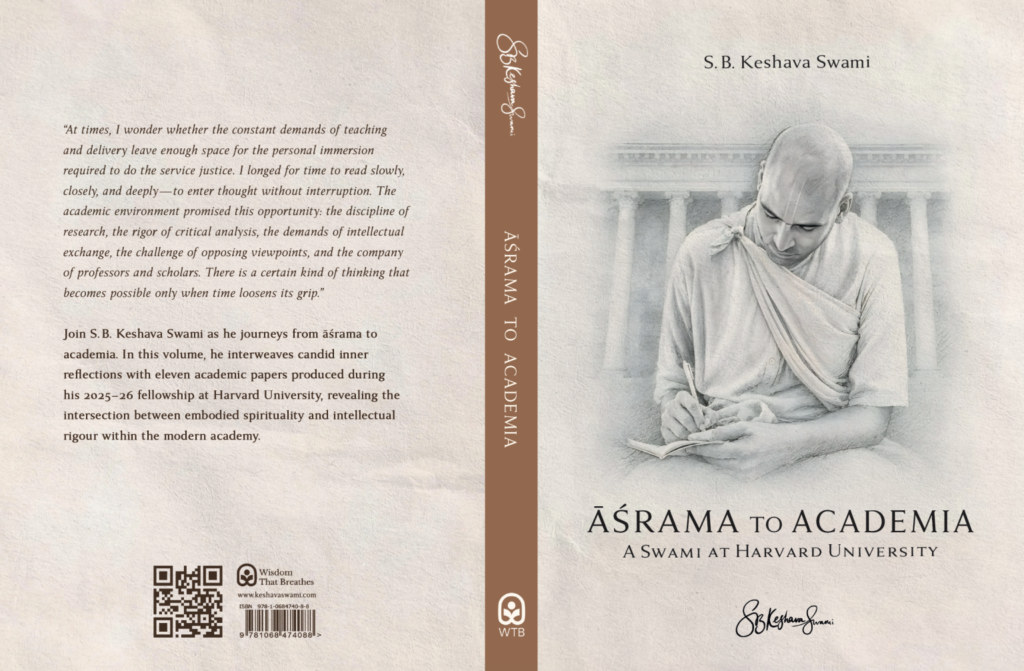
Keshava Swami’s forthcoming book, Ashram to Academia, brings together reflections on his return to university and eleven academic papers written during the academic year.
The work seeks to connect personal experiences of academic engagement with scholarly exploration of subjects relevant to spiritual and philosophical inquiry.
The title itself points toward a meeting of two environments: the ashram, associated with spiritual discipline and contemplative learning, and the academy, associated with research, critical inquiry, and intellectual exchange.
These environments need not be understood as inherently opposed. When approached with sincerity and discernment, they can offer different perspectives on questions concerning consciousness, ethics, human purpose, and society.
Academic research can help readers understand historical contexts, philosophical arguments, and the development of religious traditions. Spiritual practice, in turn, emphasizes the transformation of the individual through disciplined application of knowledge.
For the Vedavarsity Library audience, this dialogue invites further study of the Bhagavad-gita, the Srimad-Bhagavatam, and the teachings of the Gaudiya Vaishnava acharyas.
The purpose of such study is not merely to accumulate philosophical concepts. It is to cultivate understanding that finds expression in daily conduct and devotional service.
Conclusion: Keshava Swami at Harvard and the Future of Vedic Leadership
The experience of Keshava Swami at Harvard highlights the continuing relevance of Vedic wisdom in discussions about education, leadership, technology, and human character.
His academic journey demonstrates how scriptural study and contemporary inquiry can enter into meaningful dialogue while raising enduring questions about the purpose of knowledge and the responsibilities of those who lead.
The Vedic tradition reminds us that lasting progress requires more than external achievement. It calls for inner discipline, ethical conduct, humility, and an understanding of the self beyond temporary designations.
When knowledge is guided by dharma and offered in a spirit of service, education can become a means of personal refinement and social contribution.
Ultimately, the deepest measure of leadership is not the authority one possesses, but the quality of one’s character and the service one renders to others.
By integrating thoughtful inquiry with spiritual practice, individuals can work toward a form of progress in which competence is accompanied by character and knowledge is directed toward a higher purpose.
Deepen your Bhakti-yoga practice, harmonize relationships, and receive guided coaching — all at Vedavarsity.com