



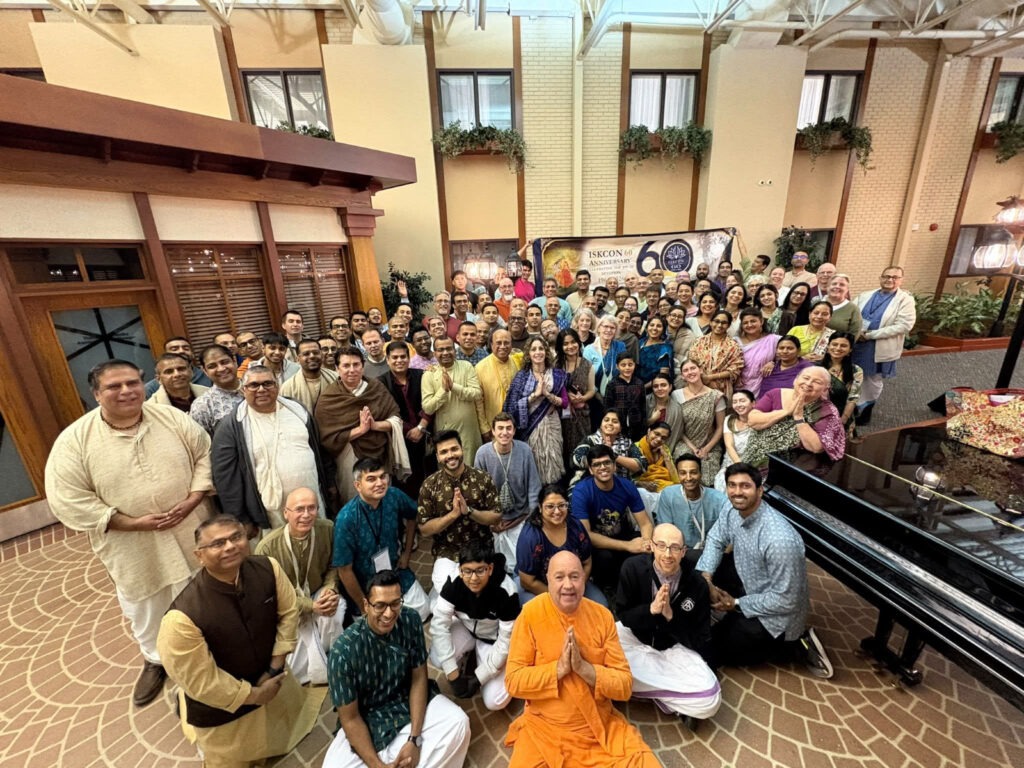
The ISKCON Zone 1 Leadership Conference brought together more than 108 leaders from Canada and six northern states of the United States in Winnipeg from October 8 to 11, 2026. The gathering represented an important step towards strengthening the worldwide mission of Śrīla Prabhupāda through spiritual education, devotee care, leadership development, and cooperation.
Affectionately called “Winning in Winnipeg,” the conference provided an opportunity for temple presidents, community leaders, educators, and senior devotees to exchange experiences and develop practical strategies for the future.
The central theme, “Boiling the Milk,” conveyed an important spiritual principle: the growth of a Krishna-conscious community should not be measured merely by the number of temples or centres established. True progress requires deeper spiritual understanding, stronger relationships, systematic education, and sincere care for devotees.
This vision reflects the teachings of Śrīla Prabhupāda, who established ISKCON not simply as an organisation but as a worldwide movement dedicated to awakening love of Godhead.
ISKCON Zone 1 Leadership Conference: Understanding the Theme of Boiling the Milk
The theme “Boiling the Milk” emphasised that external expansion must be accompanied by internal spiritual development.
In devotional life, numerical growth alone does not represent perfection. A temple may attract many visitors, organise large festivals, and establish new activities, but its real strength depends upon the spiritual consciousness of its members.
Indresh Gaura Das, GBC member for Zone 1 North, highlighted the need to deepen the quality of spiritual communities, systematically educate congregations, strengthen devotees, and invest in the next generation.
This understanding is closely connected with the principle of guṇa (quality). A spiritually healthy community must cultivate qualities such as humility, compassion, tolerance, discipline, and service.
Śrīla Prabhupāda repeatedly stressed that Krishna consciousness must be practically applied in everyday life. Devotees should not merely understand spiritual philosophy intellectually; they should develop genuine love and cooperation through devotional service.
Thus, “Boiling the Milk” serves as a reminder that spiritual depth must accompany organisational growth.

Spiritual Leadership Begins with Self-Transformation
One of the major highlights of the conference was a series of interactive leadership sessions conducted by Raghunath Das, a leadership trainer from Amritsar, India.
His presentations addressed three important subjects:
- Physician, Heal Thyself
- Building a Culture of Trust
- Creating a Cadence of Responsibility
These discussions examined personal well-being, healthy relationships, and accountability.
The Importance of Self-Discipline
The Bhagavad-gita teaches that a person must learn to elevate oneself through the proper engagement of the mind.
Lord Krishna states:
uddhared ātmanātmānaṁ nātmānam avasādayet
“One must deliver himself with the help of his mind, and not degrade himself.” (Bhagavad-gita 6.5)
A spiritual leader must first cultivate personal discipline and sincerity. Without controlling one’s own mind and senses, it becomes difficult to guide others effectively.
Leadership in Krishna consciousness is therefore not a position of prestige or authority. It is a responsibility to serve, protect, guide, and inspire others.
Building a Culture of Trust
Vaishnava relationships should be founded upon mutual respect, honesty, humility, and genuine concern.
A leader who listens carefully, appreciates the service of others, and accepts responsibility helps create an atmosphere in which devotees can grow spiritually.
Such leadership reflects the spirit of dāsya-bhāva, the mood of servitude, in which one considers oneself a servant of the Lord and His devotees.
Sambandha, Abhidheya and Prayojana: The Foundation of Devotional Life
The conference followed a spiritual progression based on three essential principles of Gaudiya Vaishnava philosophy.
1. Sambandha: Understanding Our Eternal Relationship
Sambandha means understanding the relationship between the living entity, the Supreme Lord, and the material and spiritual energies.
The living entity is an eternal servant of Lord Krishna. Forgetting this relationship, the soul becomes entangled in material existence.
Proper spiritual education begins by understanding one’s constitutional position as an eternal servant of Krishna.
2. Abhidheya: Practising Devotional Service
Abhidheya refers to the practical process of reviving our relationship with Krishna through devotional service.
This includes hearing (śravaṇam), chanting (kīrtanam), remembering (smaraṇam), worshipping the Deity, serving devotees, and following the instructions of the spiritual master.
A spiritual community becomes strong when its members regularly practise these principles.

3. Prayojana: Attaining the Ultimate Goal
Prayojana means the ultimate goal of spiritual life: pure love of Godhead, or prema-bhakti.
The purpose of all spiritual education, leadership, and community development is to help devotees progress towards this highest perfection.
The conference’s three-day spiritual progression therefore reflected the essential journey of every sincere practitioner.
Education and Youth Development: Investing in the Next Generation
Education emerged as one of the most important priorities of the ISKCON Zone 1 Leadership Conference.
Three panel discussions explored the educational needs of newcomers, children, youth, and adult devotees.
A coordinated educational framework was advanced to help different centres share resources, develop structured learning opportunities, and provide systematic spiritual education.

Developing the Next Generation of Devotees
A major initiative discussed was the establishment of a Zone 1 Youth Ministry.
The proposed programme includes youth representatives at individual centres, regional gatherings, opportunities for friendship, and leadership development.
This initiative recognises that young devotees are an important part of Srila Prabhupada’s mission.
Children and youth should receive proper spiritual guidance so that they can develop strong devotional foundations from an early age.
Śrīla Prabhupāda desired that the next generation become spiritually educated and dedicated to spreading Krishna consciousness.
Nitaipriya Devi Dasi also presented the importance of devotional musical education, particularly the preservation and development of kirtan traditions.
Through music, chanting, and spiritual association, young devotees can develop a natural attraction towards devotional service.
Devotee Care and Cooperation: The Strength of ISKCON Communities
Another significant aspect of the conference was the emphasis on devotee care and community relationships.
RamaLila Das presented developments in the Zone 1 devotee care network, while other discussions addressed family relationships, matchmaking support, fundraising, book distribution, and Ratha-yatra outreach.
These initiatives reflect an important principle of Vaishnava culture: devotees should care for one another and assist each other in advancing spiritually.
The Śrīmad-Bhāgavatam describes the importance of association among devotees.
satāṁ prasaṅgān mama vīrya-saṁvido
Through association with pure devotees, discussions about the Supreme Lord become spiritually powerful and awaken one’s attraction towards devotional service. (Śrīmad-Bhāgavatam 3.25.25)
Devotee association, or sādhu-saṅga, is essential for spiritual advancement.
When devotees cooperate with one another, share their experiences, and sincerely appreciate each other’s service, the entire community becomes spiritually stronger.
The conference discussions demonstrated how practical cooperation can help translate spiritual ideals into meaningful community activities.
Bhakti Academy: Strengthening Spiritual Education and Outreach
A particularly inspiring presentation came from the Bhakti Academy team.
Their presentation demonstrated how structured ashram life and systematic spiritual training can revitalise temple communities, strengthen outreach, and provide meaningful engagement for newcomers.
The presentation received a standing ovation from conference participants.
The success of such educational initiatives highlights the importance of providing practical opportunities for people to understand and experience Krishna consciousness.
Spiritual education should not remain limited to theoretical discussions. It should encourage disciplined living, regular chanting, scriptural study, association with devotees, and active participation in devotional service.
Through such programmes, newcomers can gradually develop a deeper understanding of the philosophy and practice of bhakti-yoga.
One Spiritual Family Serving One Mission
Beyond leadership discussions and educational planning, the conference provided an opportunity for devotees to strengthen their personal relationships.
Morning spiritual programmes led by Bhaktimarga Swami, shared prasadam, and enthusiastic kirtan at ISKCON Winnipeg’s newly acquired temple created an atmosphere of devotional association.
The host community, led by temple president Vishrambhar Das, provided hospitality and logistical support.
The gathering also celebrated ISKCON’s 60th anniversary and looked ahead to the 50th anniversary of Śrīla Prabhupāda’s disappearance in 2027.
One particularly touching incident occurred when flight delays brought approximately 30 participants together at the airport. Instead of simply waiting for their flights, devotees continued their discussions and association.
This demonstrated that the spirit of cooperation developed during the conference extended beyond the formal programme.
Vrinda Devi Dasi expressed this mood by describing the devotees as one family serving one mission.
This is the essence of Vaishnava community life: unity in diversity through service to Krishna.
Lessons from the Winnipeg Leadership Conference for Every Devotee
The conference offers several important lessons for spiritual communities throughout the world.
1. Quality is more important than quantity: Expanding temples and congregations should always be accompanied by deeper spiritual development.
2. Leadership means service: A genuine spiritual leader works for the welfare and advancement of others rather than personal prestige.
3. Education is essential: Systematic study of Bhagavad-gita and Śrīmad-Bhāgavatam provides a strong foundation for devotional life.
4. Youth engagement is a priority: The next generation requires proper guidance, spiritual friendship, and meaningful opportunities to serve Krishna.
5. Cooperation strengthens the mission: Devotees should work together in a spirit of humility and mutual appreciation.
6. Devotee care must be practical: Spiritual communities should provide an atmosphere in which devotees feel supported in their devotional practices.
These principles are relevant not only to temple presidents and senior leaders but also to every individual practising Krishna consciousness.
Conclusion: ISKCON Zone 1 Leadership Conference and the Vision of Srila Prabhupada
The ISKCON Zone 1 Leadership Conference in Winnipeg was more than an organisational gathering. It was an important expression of the collective determination to strengthen Krishna-conscious communities through spiritual education, devotee care, youth development, and cooperation.
The central message of “Boiling the Milk” reminds us that genuine spiritual progress requires depth, purity, and sincere relationships.
Śrīla Prabhupāda established ISKCON to create a worldwide society in which people could live together in Krishna consciousness, cultivate pure devotional service, and share the teachings of Lord Krishna with humanity.
Therefore, every temple, congregation, and devotee has a responsibility to contribute towards this mission.
When spiritual knowledge is combined with practical service, loving relationships, and sincere cooperation, Krishna-conscious communities can become powerful centres of spiritual inspiration.
The real victory of Winnipeg lies not simply in bringing together more than 108 leaders, but in inspiring them to return to their communities with renewed dedication to serving Śrīla Prabhupāda’s mission.
Hare Krishna! All glories to Śrīla Prabhupāda!
Deepen your Bhakti-yoga practice, harmonize relationships, and receive guided coaching — all at Vedavarsity.com