


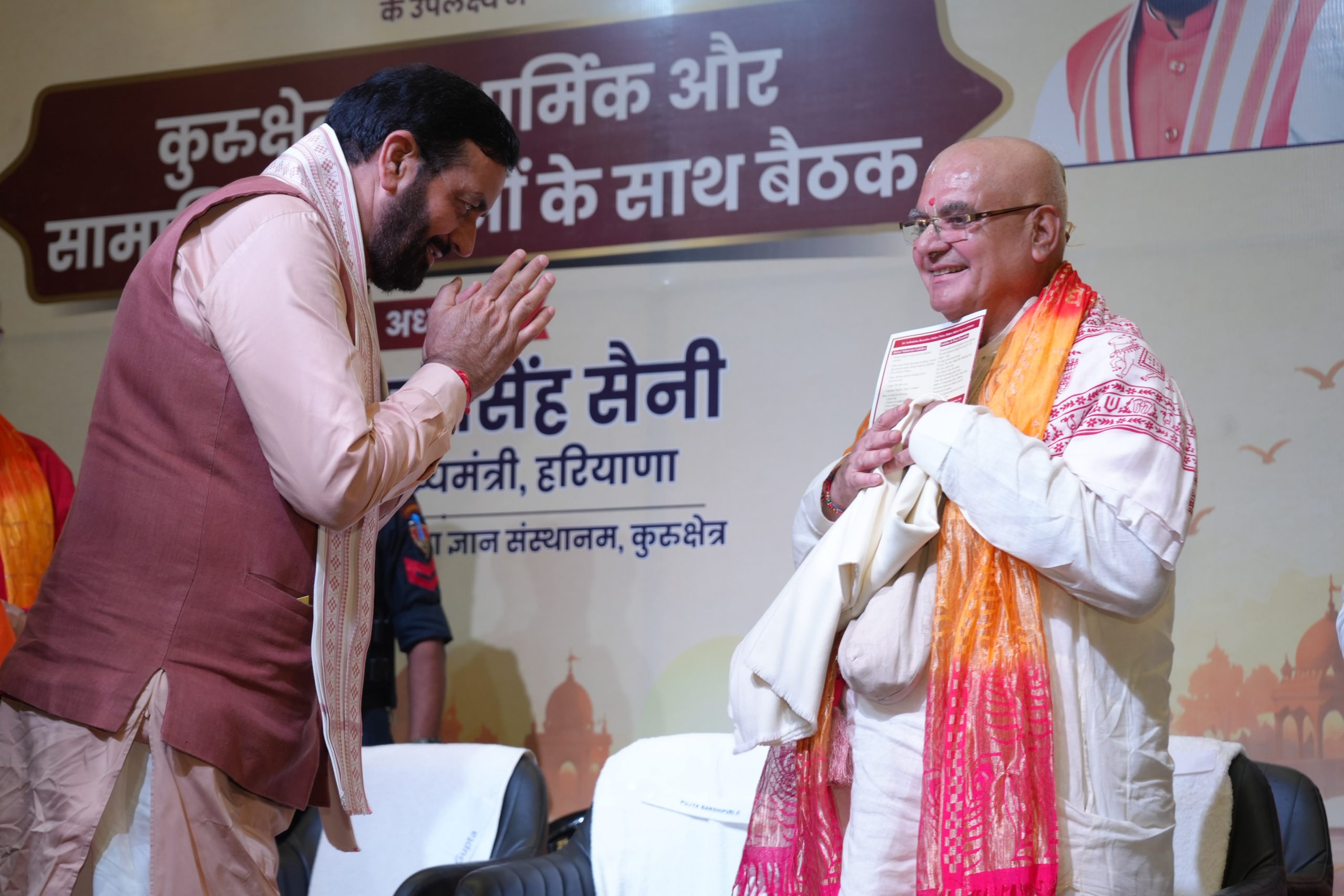
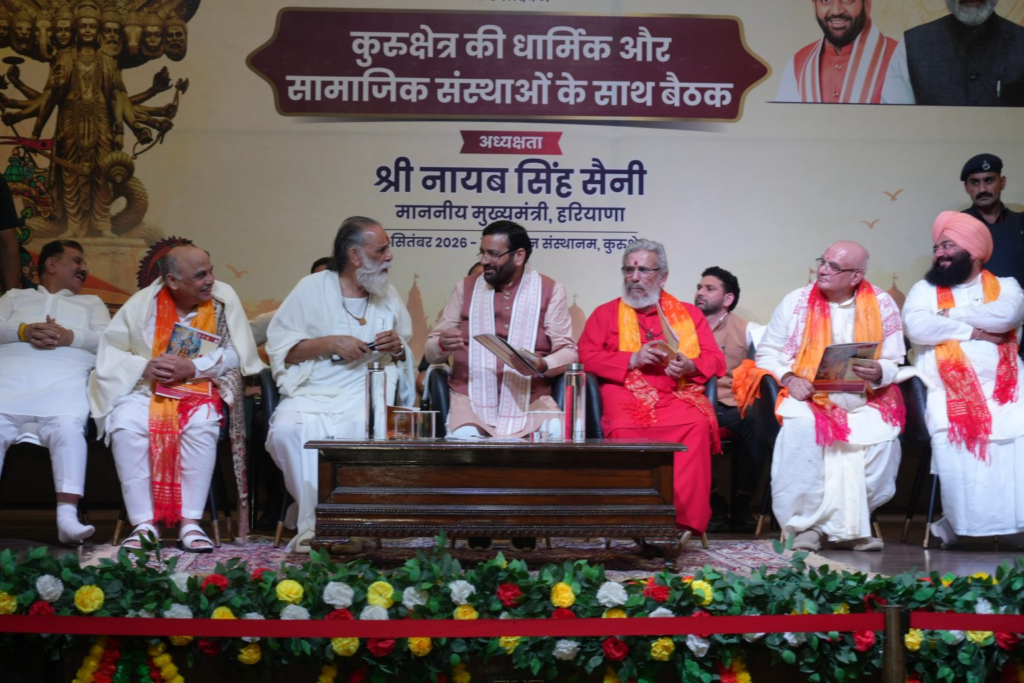
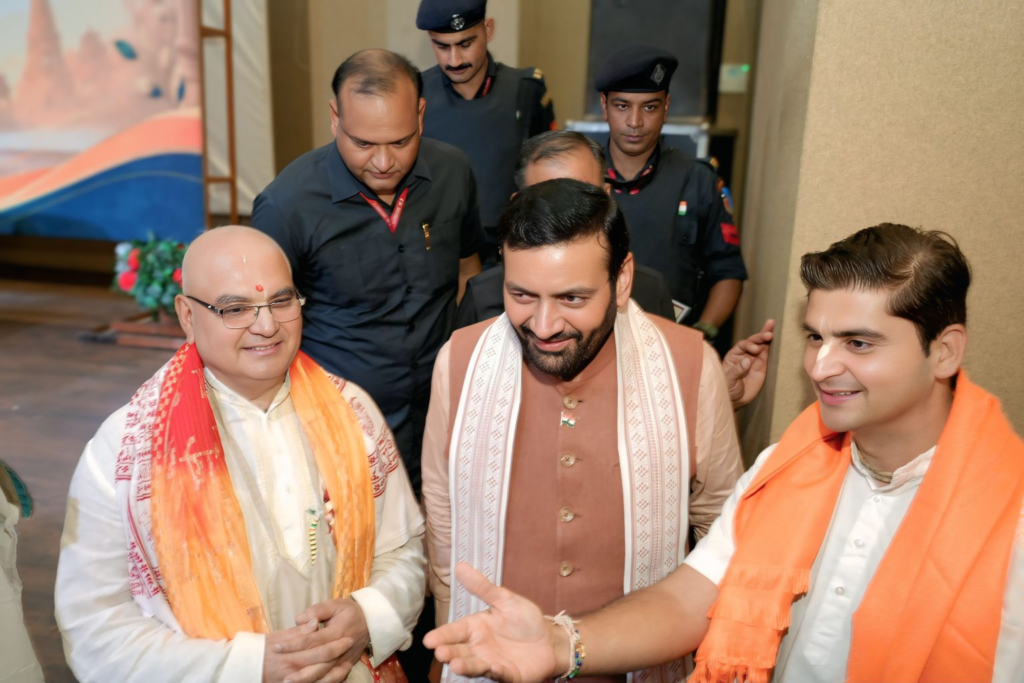
The Haryana CM invites ISKCON Kurukshetra for Gita Jayanti 2026 initiative highlights the growing emphasis on sharing the eternal wisdom of the Bhagavad-gita from the sacred land of Kurukshetra. On September 30, 2026, Sakshi Gopal Das, Temple President of ISKCON Kurukshetra, met Haryana Chief Minister Nayab Singh Saini to discuss the upcoming International Gita Jayanti Mahotsav 2026.
Additionally, the meeting brought together spiritual leaders, saints, government administrators, and other distinguished personalities.
Haryana CM Invites ISKCON Kurukshetra for Gita Jayanti 2026. The discussion centered on the international outreach of Gita Jayanti and Kurukshetra’s sacred role in teaching Lord Krishna.
According to the report published by ISKCON News, the Chief Minister invited suggestions concerning how the Mahotsav could communicate the universal message of the Bhagavad-gita to people around the world.
Gita Jayanti 2026 Event
Haryana CM Invites ISKCON Kurukshetra for Gita Jayanti 2026
The meeting assumes special significance because Kurukshetra is intimately connected with the revelation of Bhagavad-gita. It was here, on the battlefield of Kurukshetra, that Lord Krishna instructed Arjuna on the eternal principles of dharma, karma, bhakti, and ātma-jñāna.
The Bhagavad-gita is not merely a historical dialogue. In the Vaishnava understanding, it is the direct instruction of the Supreme Personality of Godhead, Sri Krishna, to the conditioned soul.
Lord Krishna declares:
“Whenever and wherever there is a decline in religious practice, O descendant of Bharat, and a predominant rise of irreligion—at that time I descend Myself.”
The message of the Gita therefore remains relevant in every age. Human beings may change their external circumstances, but the fundamental questions of life remain: Who am I? What is my duty? Why am I suffering? What is the purpose of existence? And how can I return to the Supreme?
Gita Jayanti provides an opportunity to contemplate these timeless questions.
Kurukshetra: The Sacred Land of Bhagavad-gita
Kurukshetra occupies a unique position within India’s sacred geography. It is traditionally remembered as dharma-kṣetra, the field of righteousness.
The opening verse of the Bhagavad-gita itself begins with the words, “dharma-kṣetre kuru-kṣetre”—indicating the spiritual importance of the place where the conversation between Krishna and Arjuna took place.
For devotees, visiting Kurukshetra is therefore not simply a matter of historical tourism. Tīrtha-yātrā, or pilgrimage to a sacred place, is meant to awaken remembrance of the Supreme Lord.
A sacred place becomes spiritually meaningful when its history, teachings, and devotional practices help the conditioned soul turn toward Krishna.
The International Gita Jayanti Mahotsav provides a platform through which this sacred heritage can be presented to visitors from India and abroad.
Additionally, Haryana’s official communications frame the festival as a chance to connect people with India’s spiritual heritage. Haryana CM Invites ISKCON Kurukshetra for Gita Jayanti 2026 reinforces this narrative.
ISKCON Kurukshetra and the Global Message of the Gita
During the meeting, Sakshi Gopal Das presented an update on the ongoing ISKCON Sri Krishna Arjuna Grand International Temple Project.
The project has been described as an international center for Bhagavad-gita education, Krishna consciousness, cultural outreach, and pilgrimage. Its vision reflects the broader principle that spiritual knowledge should be made accessible to sincere seekers regardless of nationality, language, or social background.
This is consistent with the preaching mission established by His Divine Grace A. C. Bhaktivedanta Swami Prabhupada.
Srila Prabhupada repeatedly emphasized that Krishna consciousness is not restricted to one particular country or community. The living entity is fundamentally an eternal servant of Krishna—jīvera svarūpa haya—kṛṣṇera nitya-dāsa.
Thus, the message of the Gita is universal because the soul is universal.
The Universal Wisdom of Bhagavad-gita
One of the central teachings of the Bhagavad-gita is that the living being is not the temporary body.
Krishna teaches:
“For the soul there is never birth nor death.”
This understanding of the self forms the foundation of Vedic spiritual life. When a person identifies himself exclusively with the body, he becomes absorbed in temporary designations—nationality, profession, social position, wealth, and bodily relationships.
The Gita gradually elevates one’s consciousness from such temporary identification toward knowledge of the eternal ātmā.
But knowledge alone is not the final destination.
The Gita culminates in surrender and devotion to the Supreme Lord. Krishna instructs Arjuna:
“Abandon all varieties of religion and simply surrender unto Me.”
This is the essence of bhakti-yoga—loving devotional service to Krishna.
A Meeting Centered on Spiritual Outreach
The interaction between the Haryana Chief Minister and ISKCON Kurukshetra also focused on ways to increase the international reach of Gita Jayanti.
ISKCON News reported that the gathering included Gita Manishi Swami Gyananand, senior saints of Kurukshetra Dham, government administrators, bureaucrats, and other distinguished officials.
The report further stated that the Chief Minister appreciated the educational, cultural, and devotional activities of ISKCON Kurukshetra and had viewed devotional lectures and kirtan presentations produced by Govind Krishna Das.
From a devotional perspective, such outreach becomes meaningful when it assists people in hearing śravaṇam, chanting kīrtanam, remembering Krishna, and gradually developing a spirit of service.
The Vedic tradition places great importance upon śravaṇam—hearing spiritual knowledge.
By hearing the teachings of Krishna from genuine sources, a person can gradually purify his consciousness.
The Role of Kirtan and Gita Education
The combination of Gita education and saṅkīrtana is particularly significant in the modern age.
The chanting of the holy names—Hare Krishna, Hare Krishna, Krishna Krishna, Hare Hare / Hare Rama, Hare Rama, Rama Rama, Hare Hare—is presented within the Gaudiya Vaishnava tradition as a powerful means of spiritual purification.
Kirtan is not merely musical performance. It is devotional glorification of the Supreme Lord.
Similarly, Gita education should not remain confined to academic study. The purpose of śāstra is transformation of consciousness.
A person may become highly educated yet remain dissatisfied if he has not understood the eternal nature of the self and his relationship with the Supreme.
Therefore, the combination of scriptural knowledge, chanting, service, and saintly association forms an important part of Krishna consciousness.
ISKCON Sri Krishna Arjuna Mandir in Kurukshetra
Another important point emerging from the meeting was the invitation extended to the Chief Minister to visit ISKCON Sri Krishna Arjuna Mandir in Kurukshetra.
According to ISKCON News, Nayab Singh Saini accepted the invitation and expressed his desire to visit the temple in the near future.
The temple project’s stated vision includes Gita education, Krishna consciousness, cultural activities, and pilgrimage.
Such a center can serve as a place where visitors encounter the teachings of Krishna not merely as philosophical concepts but through darśana, kīrtana, prasādam, devotional service, and association with devotees.
In Vedic culture, darśana means seeing the Deity with a mood of reverence and devotion. Prasādam refers to food offered to the Lord and received as His mercy.
These practices make spiritual life practical and accessible.
Gita Jayanti and the Call to Self-Realization
The celebration of Gita Jayanti should ultimately lead a person beyond external festivities toward inner transformation.
The battlefield of Kurukshetra was filled with confusion, fear, duty, and difficult choices. Arjuna stood before Krishna overwhelmed by uncertainty.
Yet after hearing the Gita, his consciousness changed.
At the conclusion of the dialogue, Arjuna declares:
“My illusion is now gone. I have regained my memory by Your mercy. I am now firm and free from doubt and am prepared to act according to Your instructions.”
This transformation is the heart of the Gita.
The purpose of spiritual knowledge is not simply to accumulate information. It is to remove ajñāna, ignorance, and awaken our eternal relationship with the Supreme Lord.
Taking the Message of Kurukshetra to the World
The significance of Haryana CM Invites ISKCON Kurukshetra for Gita Jayanti 2026 extends beyond one meeting or one annual festival.
It reflects an opportunity to present Kurukshetra as a living center of spiritual knowledge while encouraging people throughout the world to study the teachings of Lord Krishna.
The Gita’s message transcends temporary distinctions. It teaches the eternal identity of the soul, the law of karma, the importance of righteous action, the path of meditation and knowledge, and ultimately the supremacy of loving devotion to Krishna.
When this message is presented faithfully, Kurukshetra can become not merely a destination to visit but a place that inspires deeper spiritual inquiry.
Conclusion
The Haryana CM Invites ISKCON Kurukshetra for Gita Jayanti 2026 development highlights the sacred importance of Kurukshetra and the continuing relevance of the Bhagavad-gita. The meeting between Nayab Singh Saini and Sakshi Gopal Das focused on the forthcoming International Gita Jayanti Mahotsav and possibilities for expanding its international spiritual outreach.
For devotees and spiritual seekers, Gita Jayanti is an invitation to return to the original teachings of Sri Krishna.
The real celebration begins when the words of the Gita enter the heart and inspire bhakti, seva, and surrender.
May the sacred land of Kurukshetra continue to inspire humanity to hear the eternal message of Krishna and rediscover the forgotten relationship between the individual soul and the Supreme Personality of Godhead.
Hare Krishna.
Deepen your Bhakti-yoga practice, harmonize relationships, and receive guided coaching — all at Vedavarsity.com