Among the Muslims was a grave person who was wearing a black dress. People called him a saintly person. (185) The heart of that saintly person softened upon seeing Śrī Caitanya Mahāprabhu. He wanted to talk to Him and establish impersonal Brahman on the basis of his own scripture, the Koran. (186) When that person tried to establish the impersonal Brahman conception of the Absolute Truth on the basis of the Koran, Śrī Caitanya Mahāprabhu refuted his argument. (187) Whatever arguments he put forward, the Lord refuted them all. Finally the person became stunned and could not speak. (188) Śrī Caitanya Mahāprabhu said, “The Koran certainly establishes impersonalism, but at the end it refutes that impersonalism and establishes the personal God. (189)
“The Koran accepts the fact that ultimately there is only one God. He is full of opulence, and His bodily complexion is blackish. (190) “According to the Koran, the Lord has a supreme, blissful, transcendental body. He is the Absolute Truth, the all- pervading, omniscient and eternal being. He is the origin of everything. (191) “Creation, maintenance and dissolution come from Him. He is the original shelter of all gross and subtle cosmic manifestations. (192) “The Lord is the Supreme Truth, worshipable by everyone. He is the cause of all causes. By engaging in His devotional service, the living entity is relieved from material existence. (193) “No conditioned soul can get out of material bondage without serving the Supreme Personality of Godhead. Love at His lotus feet is the ultimate goal of life. (194)
“The happiness of liberation, whereby one merges into the Lord’s existence, cannot even be compared to a fragment of the transcendental bliss obtained by service unto the Lord’s lotus feet. (195) “In the Koran there are descriptions of fruitive activity, speculative knowledge, mystic power and union with the Supreme, but ultimately all this is refuted and the Lord’s personal feature established, along with His devotional service. (196) “The scholars of the Koran are not very advanced in knowledge. Although there are many methods prescribed, they do not know that the ultimate conclusion should be considered the most powerful. (197) “Seeing your own Koran and deliberating over what is written there, what is your conclusion?” (198) The saintly Muslim replied, “All that You have said is true. This has certainly been written in the Koran, but our scholars can neither understand nor accept it. (199)
“Usually they describe the Lord’s impersonal aspect, but they hardly know that the Lord’s personal feature is worshipable. They are undoubtedly lacking this knowledge. (200) “Since You are that very same Supreme Personality of Godhead Himself, please be merciful upon me. I am fallen and unfit. (201) “I have studied the Muslim scripture very extensively, but from it I cannot conclusively decide what the ultimate goal of life is or how I can approach it. (202) “Now that I have seen You, my tongue is chanting the Hare Kṛṣṇa mahā- mantra. The false prestige I felt from being a learned scholar is now gone.” (203) Saying this, the saintly Muslim fell at the lotus feet of Śrī Caitanya Mahāprabhu and requested Him to speak of life’s ultimate goal and the process by which it could be obtained. (204)
Śrī Caitanya Mahāprabhu said, “Please get up. You have chanted the holy name of Kṛṣṇa; therefore the sinful reactions you have accrued for many millions of lives are now gone. You are now pure.” (205) Śrī Caitanya Mahāprabhu then told all the Muslims there, “Chant the holy name of Kṛṣṇa! Chant the holy name of Kṛṣṇa!” As they all began to chant, they were overwhelmed by ecstatic love. (206) In this way Śrī Caitanya Mahāprabhu directly initiated the saintly Muslim by advising him to chant the holy name of Kṛṣṇa. The Muslim’s name was changed to Rāmadāsa. Another Pāṭhāna Muslim present there was named Vijulī Khān. (207) Vijulī Khān was very young, and he was the son of the king. All the other Muslims, or Pāṭhānas, headed by Rāmadāsa, were his servants. (208)
Vijulī Khān also fell down at the lotus feet of Śrī Caitanya Mahāprabhu, and the Lord placed His foot on his head. (209) After bestowing His mercy upon them in this way, Śrī Caitanya Mahāprabhu left. All those Pāṭhāna Muslims then became mendicants. (210) Later these very Pāṭhānas became celebrated as the Pāṭhāna Vaiṣṇavas. They toured all over the country and chanted the glorious activities of Śrī Caitanya Mahāprabhu. (211) Vijulī Khān became a greatly advanced devotee, and his importance was celebrated at every holy place of pilgrimage. (212) In this way Lord Śrī Caitanya Mahāprabhu performed His pastimes. Coming to the western part of India, He bestowed good fortune upon the yavanas and mlecchas. (213) Śrī Caitanya Mahāprabhu next went to a holy place of pilgrimage called Soro- kṣetra. He took His bath in the Ganges there and started for Prayāga on the path along the banks of the Ganges. (214)
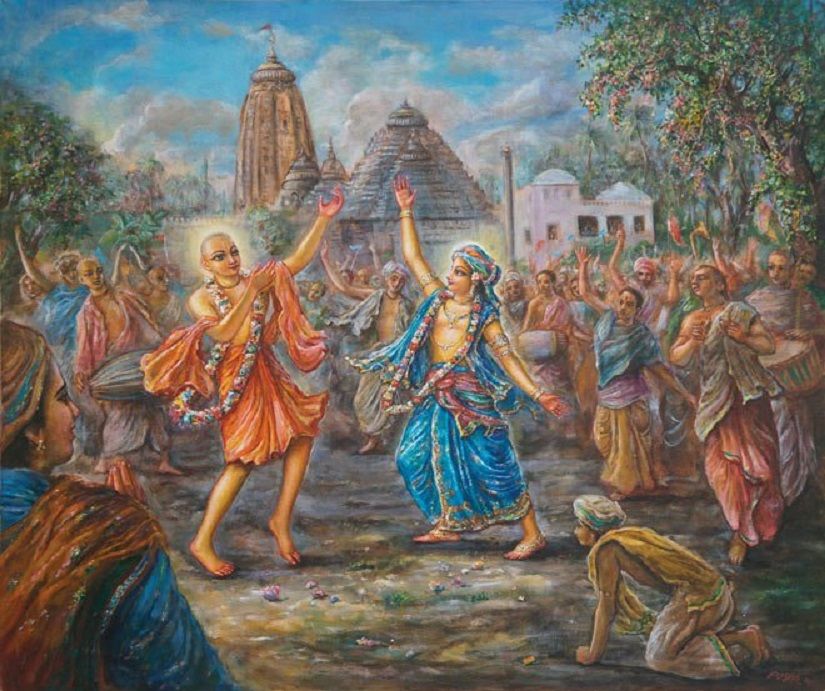
At Soro- kṣetra, the Lord requested the Sanoḍiyā brāhmaṇa and Rājaputa Kṛṣṇadāsa to return home, but with folded hands they began to speak as follows. (215) They prayed, “Let us go to Prayāga with You. If we do not go, when shall we again get the association of Your lotus feet? (216) “This country is mainly occupied by Muslims. At any place someone can create a disturbance, and although Your companion Balabhadra Bhaṭṭācārya is a learned scholar, he does not know how to speak the local language.” (217) Hearing this, Śrī Caitanya Mahāprabhu accepted their proposal by smiling mildly. Thus those two persons continued to accompany Him. (218) Whoever got to see Śrī Caitanya Mahāprabhu would feel himself overwhelmed with ecstatic love and would begin to chant the Hare Kṛṣṇa mantra. (219)
Whoever met Śrī Caitanya Mahāprabhu became a Vaiṣṇava, and whoever met that Vaiṣṇava also became a Vaiṣṇava. In this way, all the towns and villages became Vaiṣṇava, one after the other. (220) Just as the Lord inundated South India on His tour there, He also inundated the western part of the country with love of Godhead. (221) Śrī Caitanya Mahāprabhu finally arrived at Prayāga and for ten successive days bathed in the confluence of the rivers Yamunā and Ganges during the festival of Makara- saṅkrānti [Māgha- melā]. (222) Śrī Caitanya Mahāprabhu’s visit to Vṛndāvana and His activities there are unlimited. Even Lord Śeṣa, who has thousands of hoods, cannot reach the end of His activities. (223)
What ordinary living being can describe the pastimes of Śrī Caitanya Mahāprabhu? I have only indicated the general direction in the form of a summary. (224) The pastimes and methods of Śrī Caitanya Mahāprabhu are uncommon. Unfortunate is he who cannot believe even after hearing all these things. (225) From beginning to end the pastimes of Śrī Caitanya Mahāprabhu are uncommon. Just hear them with faith and accept them as true and correct. (226) Whoever argues about this is a great fool. He intentionally and personally brings a thunderbolt down upon his head. (227) The pastimes of Śrī Caitanya Mahāprabhu are an ocean of nectar. Even a drop of this ocean can inundate the whole world with transcendental bliss. (228) Praying at the lotus feet of Śrī Rūpa and Śrī Raghunātha, always desiring their mercy, I, Kṛṣṇadāsa, narrate Śrī Caitanya- caritāmṛta, following in their footsteps. (229)
Deepen your Bhakti-yoga practice, harmonize relationships, and receive guided coaching — all at Vedavarsity.com