


After Śrī Caitanya Mahāprabhu explained the difference between an ordinary living being and the Supreme Personality of Godhead, the people said, “No one considers You an ordinary human being. You are like Kṛṣṇa in every respect, in both bodily features and characteristics. (117) “By Your bodily features we can see that You are none other than the son of Nanda Mahārāja, although the golden luster of Your body has covered Your original complexion. (118) “As the aroma of deer musk cannot be concealed by wrapping it in a cloth, Your characteristics as the Supreme Personality of Godhead cannot be concealed by any means. (119)
“Indeed, Your characteristics are uncommon and beyond the imagination of an ordinary living being. Simply by seeing You, the entire universe becomes mad with ecstatic love for Kṛṣṇa. (120) “If they see You just once, even women, children, old men, meat- eaters and members of the lowest caste immediately chant the holy name of Kṛṣṇa, dance like madmen and become spiritual masters capable of delivering the whole world. (121-122) “Apart from seeing You, whoever listens to Your holy name is made mad with ecstatic love for Kṛṣṇa and is able to deliver the three worlds. (123) “Simply by hearing Your holy name, dog- eaters become holy saints. Your uncommon potencies cannot be described in words. (124)
“‘To say nothing of the spiritual advancement of persons who see the Supreme Person face to face, even a person born in a family of dog- eaters becomes immediately eligible to perform Vedic sacrifices if he once utters the holy name of the Supreme Personality of Godhead or chants about Him, hears about His pastimes, offers Him obeisances or even remembers Him.’ (125) “These glories of Yours are only marginal. Originally You are the son of Mahārāja Nanda.” (126) Śrī Caitanya Mahāprabhu then bestowed His causeless mercy upon all the people there, and everyone became ecstatic with love of God. Finally they all returned to their homes. (127) Śrī Caitanya Mahāprabhu remained for some days in Akrūra- tīrtha. He delivered everyone there simply by distributing the holy name of Kṛṣṇa and ecstatic love for the Lord. (128) The brāhmaṇa disciple of Mādhavendra Purī went from house to house in Mathurā and inspired other brāhmaṇas to invite Caitanya Mahāprabhu to their homes. (129)
Thus all the respectable people of Mathurā, headed by the brāhmaṇas, came to Balabhadra Bhaṭṭācārya and extended invitations to the Lord. (130) In one day, ten to twenty invitations were received, but Balabhadra Bhaṭṭācārya would accept only one of them. (131) Since not everyone got an opportunity to offer invitations to Śrī Caitanya Mahāprabhu personally, those who did not requested the Sanoḍiyā brāhmaṇa to ask the Lord to accept their invitations. (132) The brāhmaṇas from different places, such as Kānyakubja and South India, who were all strict followers of the Vedic religion, offered invitations to Śrī Caitanya Mahāprabhu with great humility. (133) In the morning they would come to Akrūra- tīrtha and cook food. After offering it to the śālagrāma- śilā, they offered it to Śrī Caitanya Mahāprabhu. (134) One day Śrī Caitanya Mahāprabhu sat at the bathing ghat of Akrūra- tīrtha and thought the following thoughts. (135)
Śrī Caitanya Mahāprabhu thought, “At this bathing place, Akrūra saw Vaikuṇṭha, the spiritual world, and all the inhabitants of Vraja saw Goloka Vṛndāvana.” (136) While considering how Akrūra remained within the water, Śrī Caitanya Mahāprabhu immediately jumped in and stayed under water for some time. (137) When Kṛṣṇadāsa saw that Caitanya Mahāprabhu was drowning, he cried and shouted very loudly. Balabhadra Bhaṭṭācārya immediately came and pulled the Lord out. (138) After this, Balabhadra Bhaṭṭācārya took the Sanoḍiyā brāhmaṇa to a secluded place and consulted with him. (139) Balabhadra Bhaṭṭācārya said, “Since I was present today, it was possible for me to pull the Lord up. But if He starts to drown at Vṛndāvana, who will help Him? (140)
“Now there is a crowd of people here, and these invitations are causing much disturbance. In addition, the Lord is always ecstatic and emotional. I do not find the situation here very good. (141) “It would be good if we could get Śrī Caitanya Mahāprabhu out of Vṛndāvana. That is my final conclusion.” (142) The Sanoḍiyā brāhmaṇa said, “Let us take Him to Prayāga and go along the banks of the Ganges. It will be very pleasurable to go that way. (143) “After going to the holy place named Soro- kṣetra and bathing in the Ganges, let us take Śrī Caitanya Mahāprabhu that way and go. (144) “It is now the beginning of the month of Māgha. If we go to Prayāga at this time, we shall have an opportunity to bathe for a few days during Makara- saṅkrānti.” (145)
The Sanoḍiyā brāhmaṇa continued, “Kindly submit to Śrī Caitanya Mahāprabhu the unhappiness you are feeling within yourself. Then propose that we all go to Prayāga on the full- moon day of the month of Māgha. (146) “Tell the Lord of the happiness you will feel in traveling via the banks of the Ganges.” Balabhadra Bhaṭṭācārya therefore submitted this prayer to Śrī Caitanya Mahāprabhu. (147) Balabhadra Bhaṭṭācārya told the Lord, “I can no longer tolerate the disturbance of the crowd. People are coming one after another to offer invitations. (148) “Early in the morning people come here, and not seeing You present, they simply tax my brain. (149)
“I will be very happy if we all leave and take the path by the banks of the Ganges. Then we can have the opportunity of bathing in the Ganges at Prayāga during Makara- saṅkrānti. (150) “My mind has become very much agitated, and I cannot bear this anxiety. Now everything rests on the permission of Your Lordship. I will accept whatever You want to do.” (151) Although Śrī Caitanya Mahāprabhu had no desire to leave Vṛndāvana, He began to speak sweet words just to fulfill the desire of His devotee. (152) Śrī Caitanya Mahāprabhu said, “You have brought Me here to show Me Vṛndāvana. I am very much indebted to you, and I shall not be able to repay this debt. (153) “Whatever you desire, I must do. Wherever you take Me, I shall go.” (154)
The next morning, Śrī Caitanya Mahāprabhu got up early. After taking His bath, He became ecstatic with love, knowing that He now had to leave Vṛndāvana. (155) Although the Lord did not exhibit any external symptoms, His mind was filled with ecstatic love. At that time, Balabhadra Bhaṭṭācārya said, “Let us go to Mahāvana [Gokula].” (156) Saying this, Balabhadra Bhaṭṭācārya made Śrī Caitanya Mahāprabhu sit aboard a boat. After they crossed the river, he took the Lord with him. (157) Both Rājaputa Kṛṣṇadāsa and the Sanoḍiyā brāhmaṇa knew the path along the Ganges bank very well. (158) While walking, Śrī Caitanya Mahāprabhu, understanding that the others were fatigued, took them all beneath a tree and sat down. (159)
There were many cows grazing near that tree, and the Lord was very pleased to see them. (160) Suddenly a cowherd boy blew on his flute, and immediately the Lord was struck with ecstatic love. (161) Filled with ecstatic love, the Lord fell to the ground unconscious. He foamed about the mouth, and His breathing stopped. (162) While the Lord was unconscious, ten cavalry soldiers belonging to the Muslim Pāṭhāna military order rode up and dismounted. (163) Seeing the Lord unconscious, the soldiers thought, “This sannyāsī must have possessed a large quantity of gold. (164) “These four rogues here must have taken away that sannyāsī’s riches after killing Him by making Him take the poison dhuturā.” (165) Thinking this, the Pāṭhāna soldiers arrested the four persons and decided to kill them. Because of this, the two Bengalis began to tremble. (166)
The devotee Kṛṣṇadāsa, who belonged to the Rājaputa race, was very fearless. The Sanoḍiyā brāhmaṇa was also fearless, and he spoke very bravely. (167) The brāhmaṇa said, “You Pāṭhāna soldiers are all under the protection of your king. Let us go to your commander and get his decision. (168) “This sannyāsī is my spiritual master, and I am from Mathurā. I am a brāhmaṇa, and I know many people who are in the service of the Muslim king. (169) “This sannyāsī sometimes falls unconscious due to the influence of a disease. Please sit down here, and you will see that He will very soon regain consciousness and His normal condition. (170) “Sit down here for a while and keep us all under arrest. When the sannyāsī regains his senses, you can question Him. Then, if you like, you can kill us all.” (171)
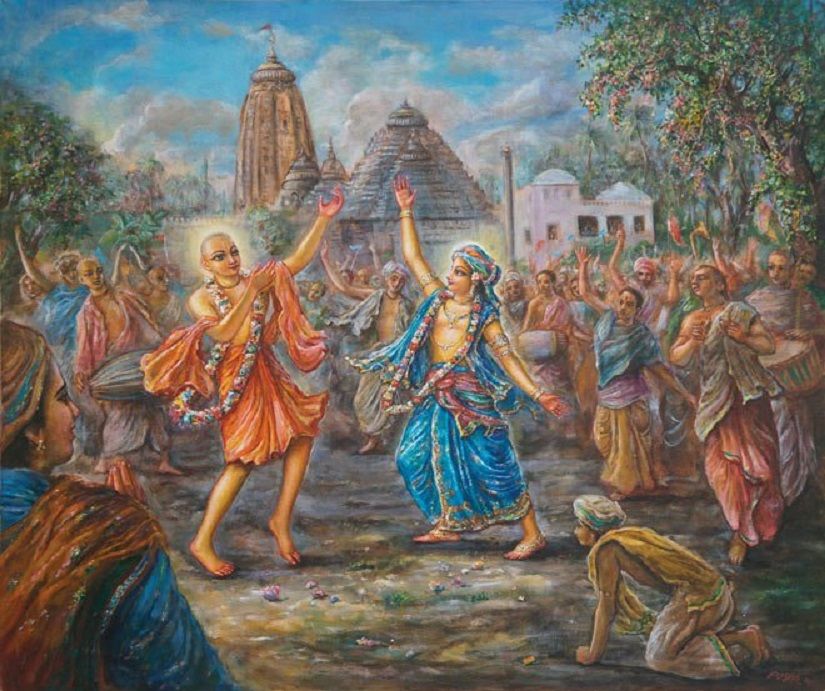
The Pāṭhāna soldiers said, “You are all rogues. One of you belongs to the western lands, one to the district of Mathurā, and the other two, who are trembling, belong to Bengal.” (172) Rājaputa Kṛṣṇadāsa said, “I have my home here, and I also have about two hundred Turkish soldiers and about one hundred cannons. (173) “If I call loudly, they will come immediately to kill you and plunder your horses and saddles. (174) “The Bengali pilgrims are not rogues. You are rogues, for you want to kill the pilgrims and plunder them.” (175) Upon hearing this challenge, the Pāṭhāna soldiers became hesitant. Then suddenly Śrī Caitanya Mahāprabhu regained consciousness. (176) Coming to His senses, the Lord very loudly began chanting the holy name, “Hari! Hari!” The Lord raised His arms upward and began to dance in ecstatic love. (177)
When the Lord shouted very loudly in ecstatic love, it appeared to the Muslim soldiers that their hearts were struck by thunderbolts. (178) Seized by fear, all the Pāṭhāna soldiers immediately released the four persons. Thus Śrī Caitanya Mahāprabhu did not see His personal associates arrested. (179) At that time, Balabhadra Bhaṭṭācārya went to Śrī Caitanya Mahāprabhu and made Him sit down. Seeing the Muslim soldiers, the Lord regained His normal senses. (180) All the Muslim soldiers then came before the Lord, worshiped His lotus feet and said, “Here are four rogues. (181) “These rogues have made You take dhuturā. Having made You mad, they have taken all Your possessions.” (182) Śrī Caitanya Mahāprabhu said, “These are not rogues. They are My associates. Being a sannyāsī beggar, I do not possess anything. (183) “Due to epilepsy, I sometimes fall unconscious. Out of their mercy, these four men maintain Me.” (184)
Deepen your Bhakti-yoga practice, harmonize relationships, and receive guided coaching — all at Vedavarsity.com